
I’m still trying to work out why I enjoyed the Rat Pack’s last hurrah so much. Sure, it’s the knockout debut of “My Kind of Town,” the last tune Frank Sinatra performed on the big screen and one that would have epitomised Ol’ Blue Eyes had it not been supplanted a few years later by “My Way.” And Bing Crosby, also in top crooning form, would have stolen the show except for Peter Falk’s gangster and Barbara Rush weaving a seductive web around all the males. But, actually, it’s mostly because this one time, far more than in the three preceding pictures, there’s a match between story and stars, as if at last the whole idea has come together. The gimmick of transplanting the Robin Hood legend to 1920s Prohibition Chicago works a treat, a gentle spoof rather than an awkward one.
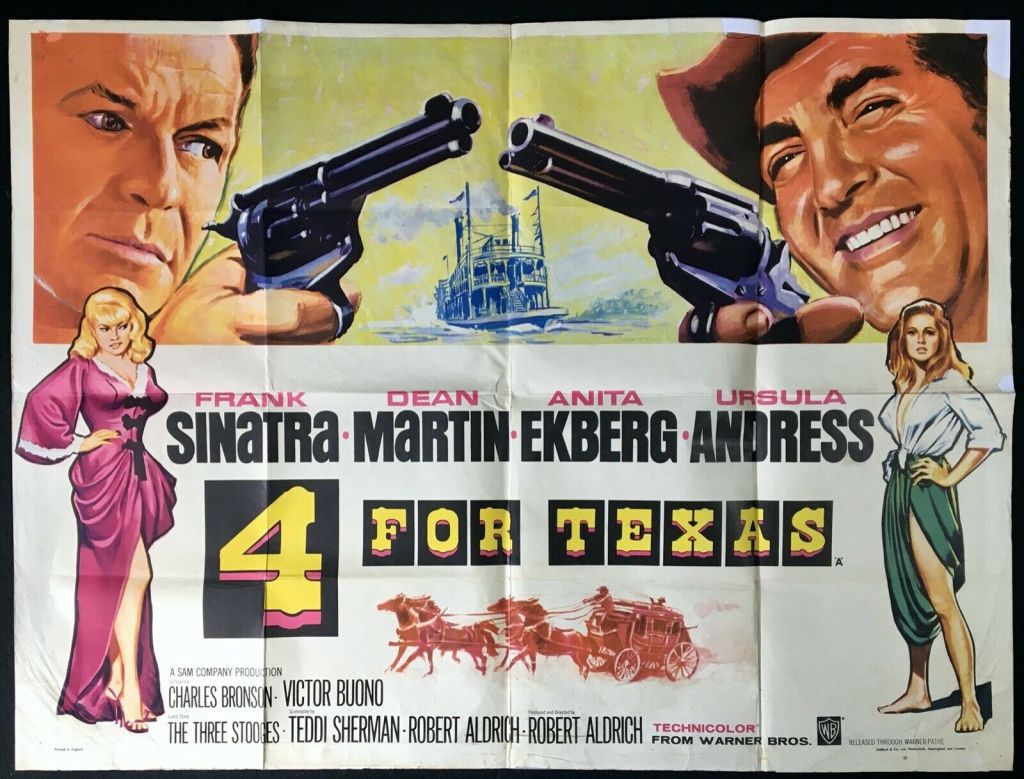
The notion that you would bring together three of the greatest singers – Sinatra, Dean Martin and Sammy Davis Jr. – of their generation and deny audiences the chance to hear their voices was anathema to audiences. As if nobody could make up their mind which way a Rat Pack vehicle was headed, Martin and Davis were accorded tunes in Oceans 11 (1960) but the next two pictures, westerns of one kind or another, appeared tuneless. Robin and the 7 Hoods is a proper musical, all the stars sing, some even get to dance, and the story carries a lot more heft than your usual musical, some decent running gags, and an affectionate nod to the old Warner Brothers gangster pictures.

Guy Gisborne (Peter Falk), having taken control of the city by rubbing out his rival, comes up against Robbo (Frank Sinatra) refusing to bow the knee. Naturally, both decide the only solution is to bust up each other’s joints. Even more naturally, this ends in stalemate. Cue the entrance of Marian (Barbara Rush), the dead mob boss’s daughter who wants her father avenged. As a by-product of her involvement, Robbo ends up donating $50,000 to the poor, a good deed turned into public relations bounty by orphanage chief Allen A. Dale (Bing Crosby), reviving the legend of the outlaw who stole from the rich and gave to the poor.
Complications arise when Robbo refuses to fall for Marian’s wiles and is framed for the murder of a corrupt Sheriff Glick (Robert Foulk). Marian proves far smarter than her male counterparts and when bribery, seduction and corruption fail she turns to politics.
While Sinatra’s rendition of “My Kind of Town” is the standout, tunesmiths Sammy Cahn and Jimmy van Heusen showcase some terrific numbers, in particular the gospel-style “Mr Booze” performed by Bing Crosby, “Style” involving Sinatra, Martin and Crosby, a Martin solo “Any Man Who Loves His Mother,” Sammy Davis with “Bang! Bang!” and even Peter Falk makes a decent stab at “All for One and One for All.” Once Sinatra, Martin or Crosby wrapped their larynxes round a particular song, they claimed ownership for life, you can’t imagine anyone else doing it better. And so it proved here.

In acting terms Sinatra, Martin and Davis are on cruise control, although Sinatra, the butt of the conspiracy, tends to have to work a little harder. The supporting cast relish the opportunities presented. Peter Falk (Penelope, 1966) makes the most of a made-to-order role as the back-stabbing mob chief, his fast-talking style little match for more superior brains, and you can see a screen persona develop in front of your eyes. Bing Crosby (Stagecoach, 1966) starts out as a joke with his outlandish language but soon comes to represent a different perspective on legitimate illegitimate moneymaking schemes. Barbara Rush (Come Blow Your Horn, 1963) is quite superb as the conniving sophisticate, all long dresses and innovative ideas.
Although Gordon Douglas (Stagecoach, 1966) would hardly be your go-to director for a musical, he acquits himself very well, incorporating a great deal of the style he evinced in Claudelle Inglish (1961). There are two marvellous running scenes. The first is that whenever the municipality sees fit to lay the foundation stone of some great new building you can be sure the block contains a corpse. But the second is just wonderful. Any time Marian has a man in her lounge, she goes round switching off the lamps until the room is in darkness. Each time, the scene is played in exactly the same way and of course the minute she starts switching off the lights, moving as sinuously as a spider from lamp to lamp, you know where this scene is going. I should also mention the “Mr Booze” sequence in which an illegal nightclub is transformed into a gospel meeting.
Edward G. Robinson (The Biggest Bundle of Them All, 1968) has a cameo and also look out for Oscar-nominated Victor Buono (What Ever Happened to Baby Jane, 1962). Songs aside, David R. Schwartz (The Bobo, 1967) penned this one.


 The Magnificent 60s