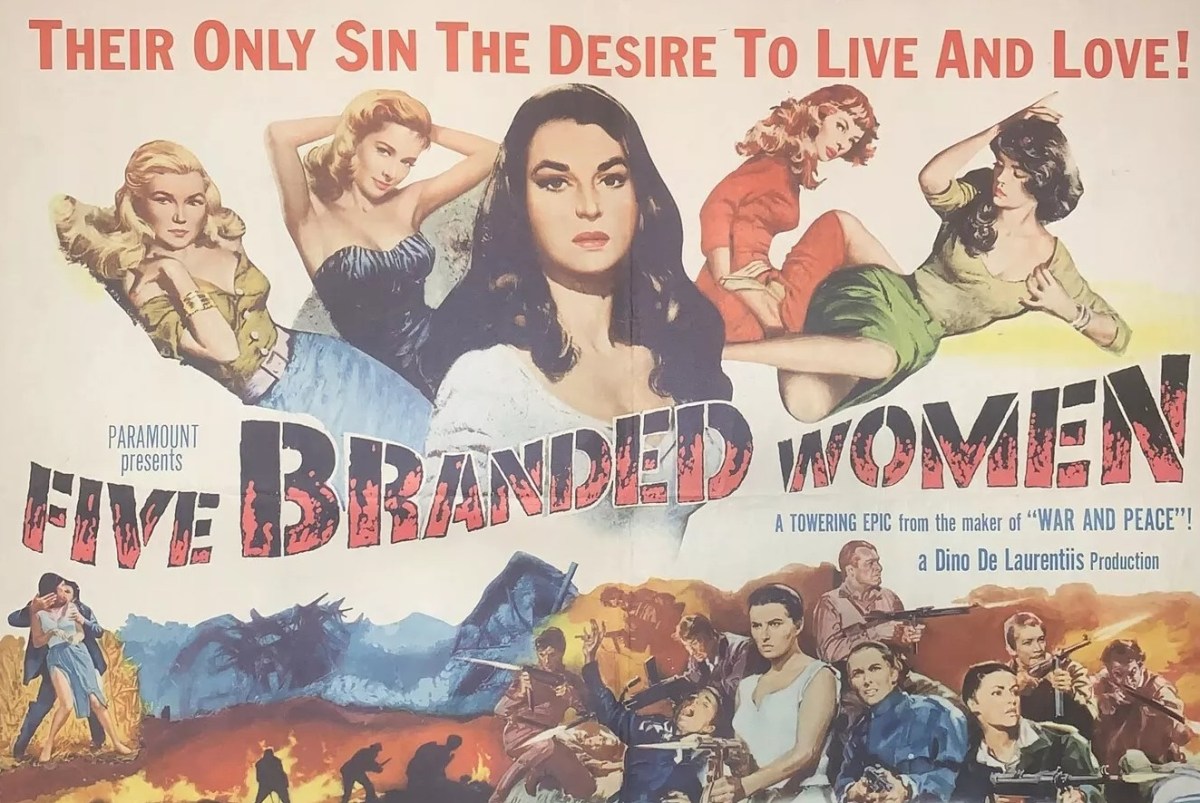
Five Branded Women (1960) ****

Should have qualified as that rare thing – an all-star female cast. Italian Silvana Mangano had led the arthouse revolution and kickstarted the importing of sexy Italians in international hit Bitter Rice (1949), Jeanne Moreau was a leading light in the French New Wave (and another sexy import to boot)  as star of Les Liaisons Dangereuses/Dangerous Liaisons (1959), Vera Miles was hot after Psycho (1960), rising star Barbara Bel Geddes (Vertigo, 1958) another Hitchcock protegee. Never mind that the story was a serious one, the redemption of female collaborators in Yugoslavia in World War Two, there was still time for what had become very much a western genre cliché, the inability of any woman not to strip off at the sight of a waterfall – here all five go skinny dipping.

The narrative should have been clearcut as redemption tales generally are: miscreant finds salvation. But this one is pretty muddled up and the moral confusion gets in the way. While some of the women such as Ljubo (Jeanne Moreau) have sex with the occupying Germans to prevent a brother being sent to a work camp, others such as Jovanka (Silvana Mangano) simply fall in love or like widow Marja (Barbara Bel Geddes) are desperate for a child. All five have been conquests of German lothario Sgt Keller (Steve Forrest) who is castrated by the partisans. The women are humiliated by the partisans who shave their heads and the Germans cast them out of the town, Daniza (Vera Miles) part of the quintet though she denies having sex with Keller.
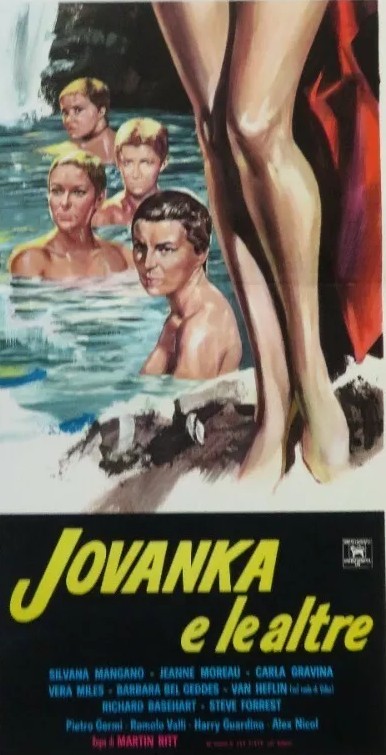
Like “Deadly Companions” the marketeers major on the promise of female nudity in a pool.

But it’s not just the Germans who are apt to have predatory notions about women. A pair of armed collaborators consider them fair game and attempt to rape Jovanka and Ljubo. Partisan Branko (Harry Guardino) – ostensibly in the category of good guy – attempts to rape Jovanka then seduces Daniza. The lovers are later executed by the partisans for breaking the rule not to have sex with each other. And this is where it gets mixed up. The pair were meant to be on guard when they started having sex. In consequence, three Germans sneaked into their camp and nearly caused disaster. Despite that, Jovanka, who believes she was unfairly treated in the first place in being denied love just because there was a war on, still insists that they shouldn’t be condemned for ordinary human desire.

The movie works best when it sticks to straightforward redemption or is character-driven. Given the chance Jovanka turns into an effective partisan, cutting down Germans with a machine gun, preventing rape of herself and Ljubo by shooting the attackers with a captured pistol. But she rejects an attempt at reconciliation by partisan leader Velko (Van Heflin), the one who had cut off her hair, blaming him for her unnecessary humiliation. He later tries to make amends, by trying to keep her out of brutal action.
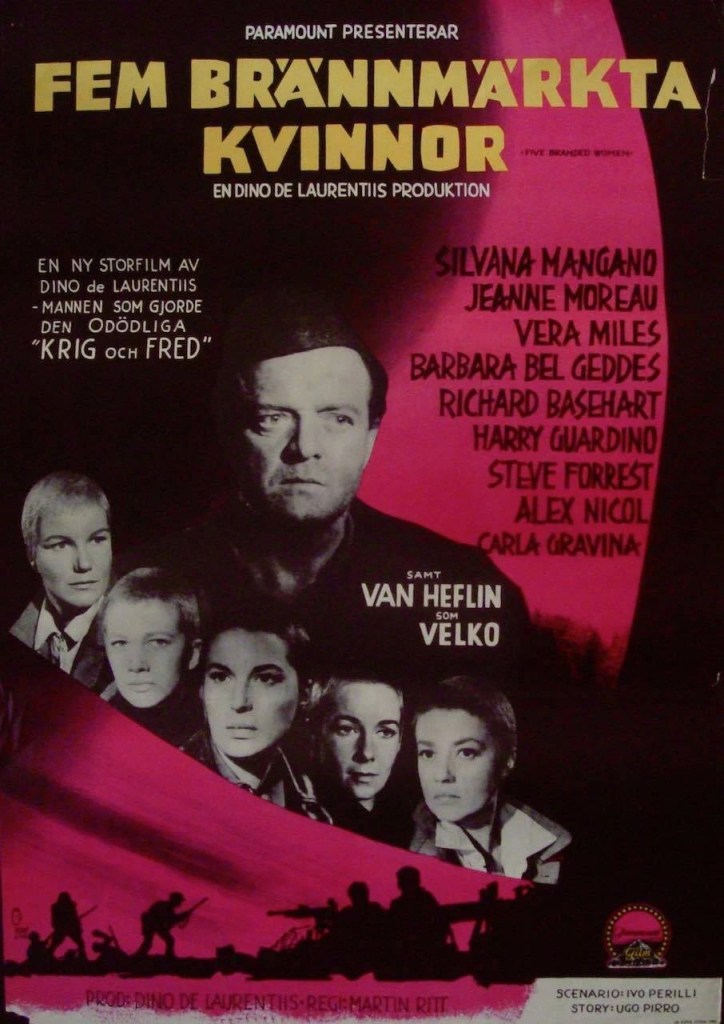
Despite taking up arms, the women remain vulnerable to smooth-talking men. Ljubo takes prisoner Capt Reinhardt (Richard Basehart), who might fall into the “good German” category since he isn’t like Keller, was a professor of philosophy and generates sympathy because his wife died in an air raid. Taking his word of honor, Ljubo unties him. She thinks he will be exchanged for a partisan prisoner. But he knows the truth – there are no partisan prisoners available for exchange because the Germans kill them. So he tries to escape, and she machine guns him in the back.

By this point Ljubo is far from a soft touch, not likely to prattle on about women being free to love the enemy or their compatriots, and is the one who shoots Daniza as part of a firing squad when it is left to her or Jovanka to do so.

What saves it is the brutal realism of war, this predates the vengeful citizens who at war’s end would take revenge on local women who slept with any occupying Germans (Malena, 2000, showed this repercussion in Italy and it was the same throughout France). There’s certainly an innocence about female desire and Jovanka defending her right to have sex, though, surely, there would have been shame involved in having sex with even a Yugoslavian before marriage in what would still have been a devout country. So a complex defiant woman, refusing to bow down to male-enforced rules. But there’s a male corelative. Branko equally refuses to obey any rules, and his actions cause harm.

In terms of acting, Silvana Mangano and Jeanne Moreau are streets ahead of their American counterparts, and complement each other, Mangano loud and outspoken, Moreau quiet and brooding. Harry Guardino (Madigan, 1968), Richard Basehart (The Satan Bug, 1965) and Van Heflin (Once a Thief, 1965) are the pick of the males.  

Martin Ritt (The Spy Who Came in from the Cold, 1965), who liked to back a cause, has chosen an odd one here, and after a slow start it picks up. Written by Ivo Perilli (Pontius Pilate, 1962) from the book by Ugo Pirro.

Easily leads the pack of the women-in-wartime subgenre and despite, or bcause of, the moral confusion still well worth a look.
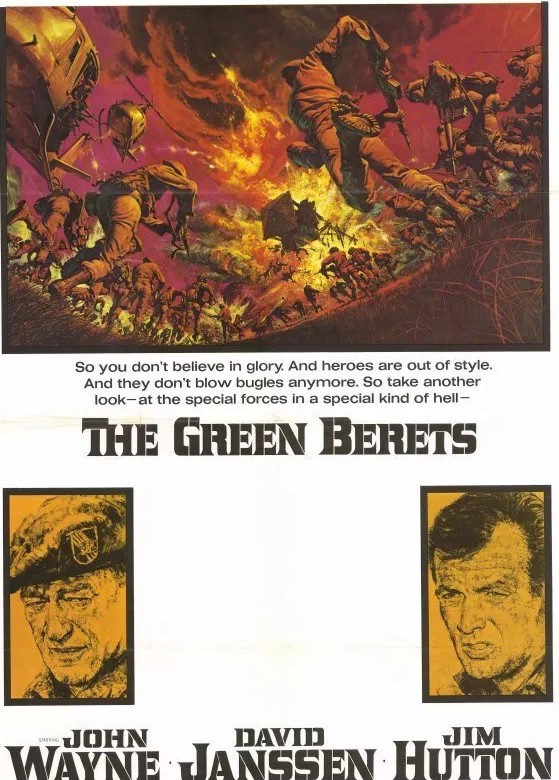
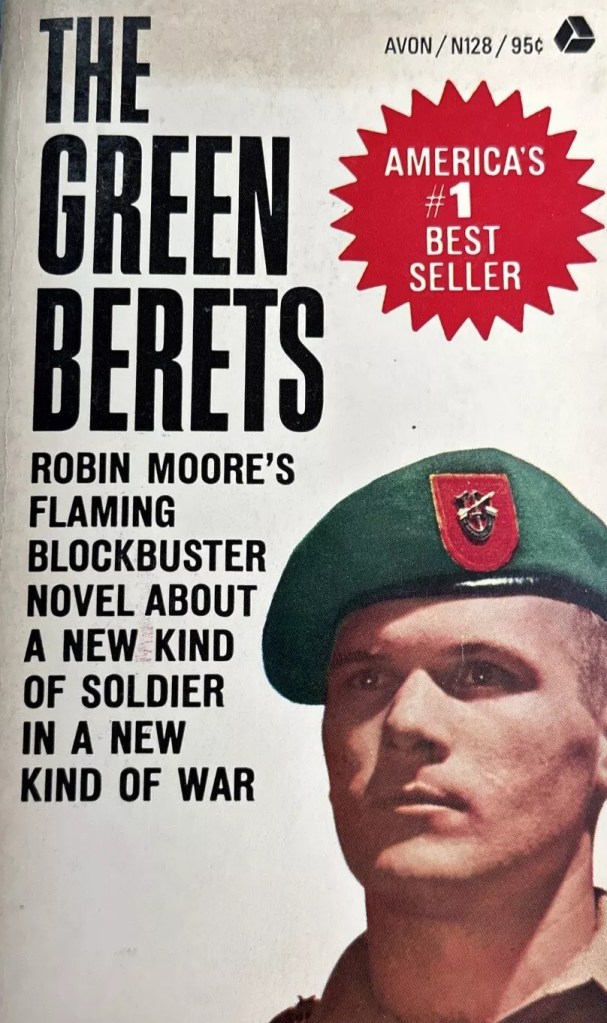
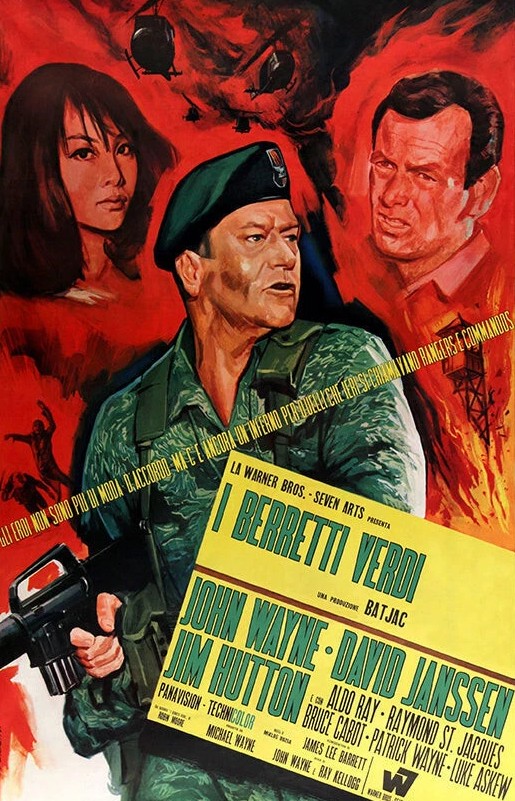
Behind the Scenes: “The Green Berets” (1968)

As if John Wayne hadn’t endured enough directing The Alamo (1960), he took on an even weightier task with this Vietnam War picture which, from the start, was likely to receive a critical roasting given the actor’s well-known stance on the conflict and his anti-Communist views that dated back to the McCarthy Era of the 1950s. Wayne had enjoyed a charmed life at the box office with three successive hit westerns, Henry Hathaway’s The Sons of Katie Elder (1965) with Dean Martin, Burt Kennedy’s The War Wagon (1967) co-starring Kirk Douglas, and best of all from a critical and commercial standpoint Howard Hawks El Dorado (1967) pairing Robert Mitchum. Outside of box office grosses, Wayne’s movies tended to be more profitable than his box office rivals because they were generally more inexpensive to make.

Columbia had been the first to recognize the potential of the book by Robin Moore and purchased the rights pre-publication in 1965 long before antipathy to the war reached its peak. A screenplay was commissioned from George Goodman who had served in the Special Forces the previous decade and was to to return to Vietnam on a research mission. But the studio couldn’t turn out a script that met the approval of the U.S. Army. Independent producer David Wolper (The Devil’s Brigade, 1968) was next to throw the dice but he couldn’t find the financing.

In 1966 Wayne took a trip to Vietnam and was impressed by what he saw. He bought the rights to the non-fiction book by Robin Moore (who also wrote The French Connection) for $35,000 plus a five per cent profit share. While the movie veered away in many places from the book, the honey trap and kidnapping of the general came from that source, although, ironically, that episode was entirely fictitious, originating in the mind of Robin Moore.

Universal originally agreed to back The Green Berets with filming scheduled for early 1967 but when it pulled out the project shifted to Warner Bros. And as if the director hadn’t learned his lesson from The Alamo, it was originally greenlit for a budget of $5.1 million, an amount that would prove signally inappropriate as the final count was $7 million. Wayne turned down the leading role in The Dirty Dozen (1967) to concentrate on this project. Wayne’s character was based on real-life Finnish Larry Thorne who had joined the Special Forces in Vietnam in 1963 and was reported missing in action in 1965 (his body was recovered four decades later).

As well as John Wayne, the movie was a platform for rising stars like Jim Hutton (Walk, Don’t Run, 1966), David Janssen (Warning Shot, 1967) and Luke Askew (Easy Rider, 1969) who replaced Bruce Dern. Howard Keel, who had appeared in The War Wagon, turned down a role.

Wayne holstered his normal $750,000 fee for acting plus $120,000 for directing. But it turned out The Alamo had taught him one important lesson – not to shoulder too much of the responsibility –  and Ray Kellogg for the modest sum of $40,000 was brought in as co-director. It was produced by Wayne’s production company, Batjac, now run by his son Michael. But neither Wayne nor Kellogg proved up to the task and concerned the movie was falling behind schedule and over budget the studio drafted in veteran director Mervyn Leroy – current remuneration $200,000 plus a percentage – whose over 40 years in the business ranged from gangster machine-gun fest Little Caesar (1931) to his most recent offering the Hitchcock-lite Moment to Moment (1966).

But exactly what LeRoy contributed over the next six months was open to question. Some reports had him directing all the scenes involving the star; others took the view that primarily he played the role of consultant, on set to offer advice. Even with his presence, the movie came in 18 days over schedule – 25 per cent longer than planned. Unlike the later Apocalypse Now (1979), it didn’t go anywhere near South-East Asia so the location didn’t add any of Coppola’s lush atmosphere, though the almost constant rain in Georgia, while a bugbear for the actors, helped authenticity.

It was filmed instead on five acres of Government land around Fort Benning, Georgia, hence pine forests rather than tropical trees.  President Lyndon B. Johnson and the Department of Defense offered full cooperation. But that was only after the producers complied with Army stipulations regarding the screenplay. James Lee Barratt’s script was altered to show the Vietnamese involved in defending the camp and the kidnapped was switched from being over the border. Also axed, though this time by the studio, was Wayne’s wish for a romantic element – the studio preferred more action. Sheree North (Madigan, 1968) was offered the role of Wayne’s wife but she also turned it down on political grounds. Vera Miles (The Hellfighters, 1968) was cast but she was edited out prior to release.

The Army provided UH-1 Huey helicopters, the Air Force chipped in with C-130 Hercules transports,  A-1 Skyraiders and the AC-47 Puff the Magic Dragon gunship and also the airplane that utilized the skyhook system. Actors and extras were kitted out in the correct jungle fatigues and uniforms. Making a cameo appearance was Col Welch, commander of the Army Airborne School at Ft Benning. The sequence of soldiers doing drill was actually airborne recruits.

The attack on the camp is based on the Battle of Nam Dong in 1964 when the defenders saw off a much bigger enemy unit.

This set was built on a hill inside Fort Benning. The authentic detail included barbed wire trenches and  punji sticks plus the use of mortar fire. While the camp was destroyed during filming the other villages were later used for training exercises. .

The pressure told on the Duke physically – he lost 15lb. But the oppressive heat and weather of that location – it was mostly shot in summer 1967 – was nothing compared to the reviews. It was slated by the critics with Wayne’s age for an active commander called into question, never mind the parachuting, the gung-ho heroics and the dalliance in an upmarket nightclub.

“In terms of Wayne’s directorial career,” wrote his biographer Scott Eyman, “The Alamo has many defenders, The Green Berets has none.” That assessment, of course, would be to ignore the moviegoers around the world who bought tickets and put the picture into reasonable profit.

Wayne was clear in his own mind about the kind of movie – “about good against bad”  – he was making and accommodated neither gray areas nor took note of current attitudes to the war as exemplified by nationwide demonstrations. Co-stars David Janssen, Jim Hutton and George Takei were opposed to the war. Takei, a regular on the Star Trek series, missed a third of the episodes on the second season; his lines were written to suit the character of Chekov, who went on to have a bigger role in the television series. Composer Elmer Bernstein turned down the gig as it went against his political beliefs. “The Ballad of the Green Berets,” heard over the opening credits was not composed for the film, having been released two years earlier.

Most critics hated it – “Truly monstrous ineptitude” (New York Times); “cliché-ridden throwback” (Hollywood Reporter); “immoral” (Glamour). Even those reviews that were mixed still came down hard: “rip-roaring Vietnam battle story…but certainly not an intellectual piece” (Motion Picture Exhibitor). Not that Wayne was too concerned. At the more vital place of judgement – the box office – it took in $9.5 million in rentals (what’s returned to the studios once cinemas have taken their cut) – $8.7 million on original release and a bit more in reissue – in the U.S. alone plus a good chunk overseas.

It was virtually impossible to examine a movie like this without taking a political stance. Other movies covering the same topic were allowed greater latitude regarding authenticity, audiences and critics like appearing to accept that creating watchable drama often took precedence over the facts. Both The Deer Hunter (1978) and Apocalypse Now, considered the best of this sub-genre, clearly ventured away from strict reality. With over half a century distancing the contemporary viewer from those inflammatory times, it’s worth noting that it still divides critics. Or, rather, critics and the general public take opposing views.

Although Rotten Tomatoes deems it “an exciting war film”, the critics voting on that  platform gave it a lowly 23 per cent favourable report compared to a generally positive 61 per cent from the ordinary viewer. That contrasts, for example, with a more even split for the likes of Exodus (1960) – 63 per cent from critics and 69 per cent from audiences. However, The Green Berets attracts twice as much interest, collaring 9,000 votes compared to just 4,300 for Exodus.

After this, Wayne’s fee went up to a flat million bucks a picture. “He wasn’t a guarantee of success,” explained his son Michael, “he was a guarantee against failure.” At this point in his career, he was gold-plated. Where other stars in his commercial league suffered the occasional box office lapse – Paul Newman’s career in the 1960s, for example, was riddled with flops like The Secret War of Harry Frigg (1968) – he did not. Especially with a global following, his pictures never lost money.

SOURCES: Michael Munn, John Wayne, The Man Behind the Myth, Robson, 2004; Scott Eyman, John Wayne, The Life and Legend, Simon and Schuster, 2014; Brian Hannan, The Magnificent 60s, The 100 Top Films at the Box Office, McFarland, 2023; Robin Moore, Introduction, The Green Berets, 1999 edition, Skyhorse Publishing; Laurence H. Suid, Guts and Glory, University of Lexington Press, 2002; The Making of The Green Berets, 2020; Review, Hollywood Reporter, June 17, 1968; Review, Motion Picture Exhibitor, June 19, 1968; Renata Adler, “The Absolute End of the ‘Romance of War’”, New York Times, June 30, 1968; Glamour, October 1968; “Big Rental Pictures of 1968,” Variety, January 8, 1969.

The Man Who Shot Liberty Valance (1962) *****

A mighty cast headed by John Wayne (True Grit, 1969), James Stewart (Shenandoah, 1965), Lee Marvin (The Dirty Dozen, 1967) and Vera Miles (Pyscho, 1960) with support from Edmond O’Brien (Seven Days in May, 1964) Woody Strode (The Professionals, 1966), Strother Martin (Cool Hand Luke, 1967) and Lee Van Cleef (The Good, the Bad and the Ugly, 1967) do justice to John Ford’s tightly-structured hymn to liberty and equality and reflection on the end of the Wild West. So tight is the picture that despite a love triangle there are no love scenes and no verbal protestations of love.

The thematic depth is astonishing: civilization’s erosion of lawlessness, big business vs. ordinary people and a democracy where “people are the boss.” Throw in a villain with a penchant for whipping and a lack of the standard brawls that often marred the director’s work and you have a western that snaps at the heels of Stagecoach (1939), Fort Apache (1948) and The Searchers (1956).

The story is told in flashback after Senator Ransom Stoddard (James Stewart) and wife Hallie (Vera Miles) turn up unexpectedly in the town of Shinbone for the funeral of a nobody, Tom Donovan (John Wayne), so poor the undertaker has filched his boots and gun belt to pay for  the barest of bare coffins. Intrigued by his arrival, newspapermen descend, and Stoddard explains why he has returned.

Now we are in flashback as, arriving on stagecoach, novice lawyer Ransom is attacked, beaten and whipped by outlaw Liberty Valance (Lee Marvin). He is found by horse-trader Donovan (John Wayne) and taken to a local boarding- house-cum-restaurant where Hallie (Vera Miles) tends his wounds. With a young man’s full quotient of principle, Stoddard is astonished to discover that local marshal Link Appleyard (Andy Devine) has ducked out of responsibility for apprehending Valance on the dubious grounds that it is outside his jurisdiction and that Valance has so mean a reputation he has the town scared witless. When Valance turns up, he humiliates Stoddard and only Donovan stands up to him, rescuing an ungrateful Ransom, who detests violence and any threat of it.

Stoddard soon turns principle into action, setting up his shingle in the local newspaper office run by Dutton Peabody (Edmond O’Brien) and on learning that Hallie is illiterate establishing a school for all ages. In the background is politics, but the push for statehood is inhibited by big ranchers who employ Valance to intimidate. Despite his aversion to violence and insistence that due legal process will eliminate the law of the gun, Stoddard practices shooting. When Donovan gives him a lesson and, to point out his unsuitability to confront such a mean character as Valance, covers him in paint, Stoddard floors him with a punch. 

That principle I mentioned has something in common with Rio Bravo (1959) – Howard Hawks’ riposte to High Noon (1952) – in that Stoddard, determined to fight his own battles, refuses to ask for help when targeted by Valance. The inevitable showdown is extraordinary, not least because it takes place at night and Ford, a la Rashomon (1951), tells it twice from different points of view.  

Precisely because it retains focus throughout with no extraneous scenes, as was occasionally John Ford’s wont, the direction is superb. As in The Searchers, to suggest emotional state-of-mind, the director uses imagery relating to doors. This time the humor is not so broad and limited primarily to one incident. Both main male characters suffer reversals, in the case of Stoddard it is physical but in the instance of Donovan it is emotional. Either way, action is character. In the romantic stakes, they are equals, dancing around their true feelings.

Upfront there is one storyline, the upholding of law and order whether against an individual such as Valance or against the attempts of big business to thwart democracy. But underneath is a subtly told romance. Donovan and Stoddard are allies but in terms of Hallie they are rivals. Neither has an ounce of sense when it comes to women. Neither actually protests their love for Hallie. Although Donovan brings her cactus roses and is, unknown to her, building an extension to his house to accommodate what he hopes is his future bride, his idea of romance is to mutter, in patronizing manner, the old saw of “you look pretty when you’re angry.”  He would have been wiser to have taken note of her spunk, because she can more than direct if need be.

Stoddard isn’t much better. Despite her growing feelings towards him being obvious to the audience, he assumes she prefers Donovan. Action drives the love element, the need to save or destroy.

All three principals are superb. This may seem like a typical Wayne performance, a dominant figure, comfortable with a gun and his abilities, but awkward in matters of the heart. But he shows as great depth as in The Searchers and the despair etched on his face at the possibility of losing Hallie eats into his soul. Stewart combines the man-of-the-people he essayed for Frank Capra with some of the toughness he showed in the Anthony Mann series of westerns. Vera Miles tempers genuine anger with tenderness and practicality. Unlike many Ford heroines she is not a trophy wife, but a worker, mostly seen running a kitchen. Lee Marvin cuts a sadistic figure, with an arrogance that sets him above the law, his tongue as sharp as his whip.

As well as Woody Strode, Strother Martin, Edmond O’Brien and Lee Van Cleef, you will spot various members of the John Ford stock company including Andy Devine (Two Rode Together, 1961) as the cowardly gluttonous marshal, John Carradine (Stagecoach), John Qualen (The Searchers) as the restaurant owner and Jeanette Nolan (Two Rode Together) as his wife.

Written by James Warner Bellah (X-15, 1961), Willis Goldbeck (Sergeant Rutledge, 1960) and Dorothy M. Johnson (A Man Called Horse, 1970).

SPOILER ALERT

Despite its five-star status, I am dubious about the famous “print the legend” conclusion and for two reasons. You could subtitle this picture The Good, the Bad and the Politician. In the first place, what Stoddart tells the newspapermen in the flashbacks is in fact a confession. He did not kill Liberty Valance. Donovan did. By this point in his life Stoddart has served two terms as a Senator, three terms as a governor and been the American Ambassador to Britain. And yet his career is based on bare-faced fraud. He took the glory for an action he did not commit. That is a huge scoop in anybody’s book. And I just can’t imagine a newspaperman turning a blind eye to it.

The second element is that Stoddart does not show the slightest sign of remorse. He built his entire career on this violent action, the antithesis of his supposed stance on the process of law.  He takes all the plaudits and fails to acknowledge Donovan, except when it’s too late, and Donovan has died a pauper, his rootless life perhaps engendered as a result of losing Hallie. Hallie’s character, too, is besmirched. She chose Stoddart precisely because he was a man of principle who risked his life to tackle – and kill – Donovan. Those two elements are indistinguishable. Had she known Stoddart had failed and was only saved by the action of Donovan it is questionable whether she would have chosen the lawyer.  

There are a couple of other quibbles, not so much about the picture itself, but about other quibblers, commonly known as critics.  Alfred Hitchcock famously came under fire for the use of back projection, not just in Marnie (1964) but other later films. That spotlight never appeared to be turned on the at-the-time more famous John Ford. The train sequence at the end of the film uses back projection and the ambush at the beginning is so obviously a set.

Don’t let these put you off, however, this is one very fine western indeed.

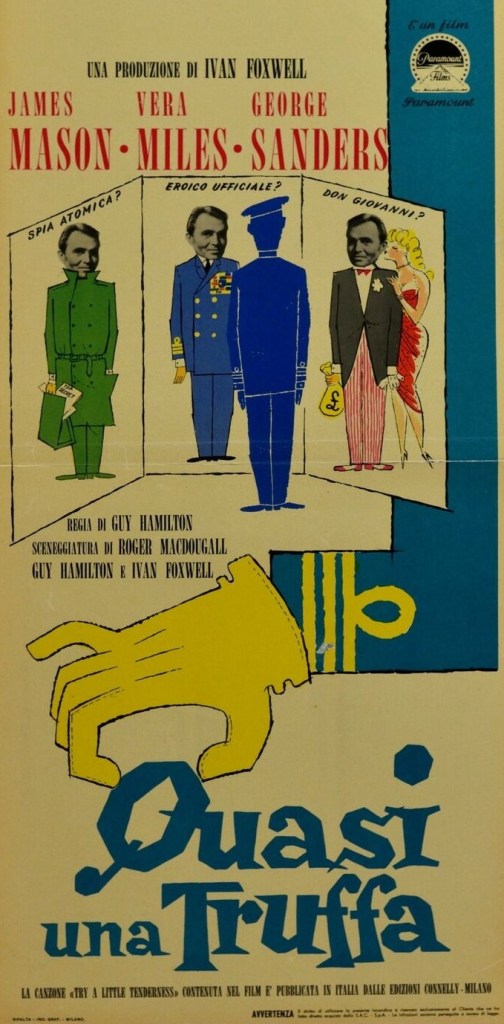
A Touch of Larceny (1960) ****

Magically fits into the “lost” film category that I’ve been banging on about recently, films, for a variety of reasons, denied cinematic release. Or at least that’s according to Rotten Tomatoes which declares “there are no featured reviews…because the movie has not (been) released yet” despite the fact that it was a big hit in cinemas over six decades ago.

Happening upon this nugget of information in a casual trawl of RT I thought I’d see if this “lost” movie was as good as The Appointment (1969) perhaps or Fade In (1969) or whether it should never be seen.

Imagine my surprise to find a highly entertaining picture best described as a one-man caper that takes aim at the Establishment and the Media, wrapped in a very witty rom-com, and helped along by the kind of Whitehall characters making a meal out of doing nothing as lampooned in BBC TV series Yes, Minister

The central conceit sounds so lame from the outset that you think this confection is going to collapse the minute it is put into practice, but, in fact, a good few twists inflate the idea until it floats along quite merrily towards a happy conclusion. And if you only remember James Mason from dour turns in The Deadly Affair (1967) or as the smarmy villain in North by Northwest (1959), you’re in for a treat.

For this is the actor at his most winning, so charming he almost edges into the adorable class, and this while playing a rake, the seducer’s seducer, but with the quickest of quick wits to get him out of any scrape. We begin and end with a demonstration of such speedy thinking.

Surprised by the return of his latest conquest’s husband, Commander Max “Rammer” (the nickname nothing to do with sexual prowess) Easton simply dons his naval uniform, whisks up the woman’s dog, his presence explained as delivering a poor creature lost in the street. As easy as pie.

His life is one of ease. When he says he works at the Admiralty, “working” might be a stretch, although “lolling about” would hardly be in the job description, the sole purpose of his desk somewhere to lay his feet, and has an airy dismissal at hand for any Whitehall buffoon inclined to pepper their language with Civil Service gobbledegook.

Bumping into an old war chum Sir Charles Holland (George Sanders), now an ambassador,  they were submarine commanders in World War Two, allows him brief acquaintance with American widow Virgina (Vera Miles). Naturally, he snaffles one of her gloves so as to have an excuse to return it. Realizing his game, she bats him back with effortless repartee, saving for the last the fact that she is engaged to be married to Sir Charles.

Given he is so practised at this game, he manages to inveigle his way into her life – Sir Charles away on urgent business – determines that her fiance’s main attraction is his dosh, and comes up with a barmy scheme to put himself in the wealthy category. His notion is to pretend to be a spy, drop a top secret document down behind a filing cabinet, vanish to a remote Scottish island, wait for his colleagues to raise the alarm, someone discover the document is missing, and the newspapers to brand him a traitor, at which point he will pop back up and sue the media for libel, and become rich enough to suit Virginia.

Yep, it seems a crazy notion, especially as Virginia, though clearly enjoying his company, has kept him at a decided arm’s length. Unfortunately, once the hue-and-cry is raised, Virginia makes the mistake of telling her husband it’s all a big con. But that puts Sir Charles in a bind, because to fess up might put his fiancé, and by extension himself, in a difficult position.

So they do nothing. Meanwhile, on his deserted tiny island off the coast of Scotland, Easton is living it up, dining off his ample supplies, occasionally catching a fish or a lobster, certainly enough booze to keep up his spirits, tuning into the radio to keep up with the news, waving half-heartedly at any passing ship, rehearsing his lines for when he is rescued. He’s even brought along a canister of petrol so he will have no trouble lighting damp driftwood and seaweed to make the bonfire he will require to attract attention.

So far, so barmy. But now the first twist. He chucks into the sea all evidence of his high living. He slips on a rock, falls into the water and the precious fuel sinks to the bottom. Now, he is a genuine castaway, soaked, starving, freezing. Second twist, the passengers on the boat that turns up to rescue him greet him by name.

So now we’re in for a devilish third act, the cops tipped the nod without getting the full story, Virginia the obvious culprit, Easton, back to the wall, requiring some fiendish ingenuity to get himself out of the mess. After a bundle of twists coming quick and fast, the romantic entanglement is disentangled, Easton still set to be rich by selling his tale (“the real true story” i.e. fictional hogwash) to the media who no doubt toss in a sweetener in gratitude for not being sued.

Not only is it delivered in effortless style by director Guy Hamilton (The Battle of Britain, 1969), and Mason at the top of his game, matched by Vera Miles (Psycho, 1960), but it is very short, clocking in at just over 90 minutes.  Roger MacDougall (The Man in the White Suit, 1951), Ivan Foxwell (Tiara Tahiti, 1962) and the director concocted the screenplay from the novel by Paul Somers.

Great fun, the repartee and the final third an absolute treat while poking gentle fun at the Establishment.

Rather than belonging to the “lost” category, it sits comfortably in the “they don’t make ‘em like that anymore” section.

Psycho (1960) *****

Even though critically reviled at the time – “up to his clavicle in whimsicality” (Variety) /   “fairground sideshow” (Films and Filming) –  Hitchcock blasted wide open the doors to what would be deemed acceptable in modern American cinema. Made on a low budget in black-and-white following the sumptuous color of North by Northwest, it seemed a perverse choice. No studio wanted it. Hitchcock had to fund it himself, Paramount merely the distributor.

On paper, and based on a real-life case, it was certainly an unappealing prospect, leading actress murdered halfway through by a maniac with a predilection for dressing up as his mother. Using the crew from his television series, Hitchcock made it quickly for just over $800,000, a quarter of the cost of North by Northwest. An initial stab at the script from James Cavanaugh was discarded and working with Joseph Stefano (Black Orchid, 1959) the director shifted the focus of the Robert Bloch novel.

Instead of a fat, middle-aged, alcoholic, Norman Bates would become young and attractive like the character from French thriller Les Diaboliques (1959). The story itself changed from “Norman and the role Marion plays in his life…(to) the redemptive but ultimately tragic role Norman plays in her life.”  Although Hitchcock openly claimed he detested filming, having already worked out the entire shoot in his head, this was never entirely true. Some ideas just did not work. In Psycho, for example, the director had planned a helicopter shot tracking into Marion and Sam’s hotel room but “high winds kept jiggling the camera” and it was changed to three separate shots.

Also, by using two cameras, he allowed the opportunity to choose a different shot than originally imagined and, in a change from the shooting script, the post-shower focus changed from Sam to Lila, making her the focus of the film’s final section where she confronts the killer.

Nor is Marion Crane (Janet Leigh) a typical Hitchcock villain. She is not cut out for the work. Alone in his repertoire, she regrets her action, tortured by, not so much her conscience, as the thought of getting caught. Having stolen $40,000 she is so jittery she turns a harmless highway cop suspicious.

Once more, Hitchcock has us rooting for the bad guy or, in this case, the bad girl. In Vertigo (1958), the drive is silent, but here the silence is punctuated by imagining what people are saying about her, knowing pursuit is inevitable. By the time she reaches the Bates Motel, she is repentant, planning to return and face the music, “I stepped in a private trap back there and I’d like to go back and pull myself out of it.” 

Unfortunately, Norman Bates (Anthony Perkins) has other plans. In Rear Window (1954) the peeping tom is a good guy, here he’s anything but. Although Bates is presented as fighting his demons, he always gives in, while Crane never hears a voice urging her on, telling her she will get away with it. Crane has a working conscience, Bates a defunct one.

Bernard Herrmann’s strings-only score behind the jarring opening credits is only the first in a series of taboos broken. In the opening scene beefcake Loomis (John Gavin) is shirtless, nothing unusual there for a male star, but to show an actress three times in her underwear and more flesh glimpsed in the shower is novel.

Killing her off is, obviously, not the done thing either, that scene a colossal shock at the time. Effectively, she is the bait, the sexiest MacGuffin ever, leading us to the mystery of Bates.

There are many brilliant scenes: Crane’s car sinking in the swamp, the murder of private detective Arbogast (Martin Balsam), the shrieking music as the strings hit their topmost register, the discovery by Crane’s sister Lila (Vera Miles) of the corpse of Bates’ mother, the motel’s neon sign flickering in the dark, the spectral house behind the motel filled with strange voices and, of course, the enigmatic Bates, alternating eager smile with defensive reaction. There are a host of great lines: “The first customer of the day is always trouble,” says the salesman; “We’re quickest to doubt people who have a reputation of being honest,” says Arbogast; and the immortal, “A boy’s best friend is his mother.”

On release, the director engineered a publicity coup by insisting nobody be allowed into the cinema after the start. This was an illogical demand for what did it matter if a patron missed the opening 10 or 20 minutes? But it certainly got the public’s attention – for a different reason entirely. It was an assault on their basic rights as theatergoers.

In those days people went into a film 30 minutes, 50 minutes after the start and left when the film came full circle. When it opened, long queues outside the box office, the best kind of word-of-mouth, attracted interest, thus alerting people who might otherwise have simply passed by. Even drive-ins were forced to comply. Trade advertisements showed Hitchcock pointing to his watch, exhorting, “Surely you do not have your meat course after your dessert at dinner?” Exhibitors were promised a special manual, “The Care and Handling of Psycho.” As well as smashing box office records, it demolished another convention by showing in local New York theaters while still playing at major first run theaters in Manhattan. 

The film has enormous visceral power. The shower scene has, rightly, achieved legendary status, every frame dissected by scholars, some images, the curtain wrenched loose, the hand reaching out, the dead eye, the blood draining away, imprinted on the universal brain, and the music unforgettable. The acting from Anthony Perkins (Pretty Poison, 1968) and Janet Leigh (The Manchurian Candidate, 1962) is excellent, Leigh nominated for a Best Supporting Actress Oscar, Perkins not so lucky, ending up typecast. For collectors of trivia, Hitchcock’s daughter, Patricia, plays Crane’s office colleague.  And for academics, especially those with auteur on their minds, this was a good place to start.

Sgt Ryker (1968) ***

Universal pulled a fast one with this tidy courtroom drama. The studio resurrected a two-part television piece originally made as the The Case Against Paul Ryker five years before under the Kraft Suspense Theatre brand to capitalize on the unexpected box office success of Lee Marvin, the decade’s most unlikely new star after a straight run of hits from the Oscar-winning Cat Ballou (1965) through western The Professionals (1966) to The Dirty Dozen (1967).

Re-titled and hoping audiences would not notice the sleight of hand, this was thrown out into first run. By normal standards it would be deemed a flop for a star of Marvin’s newfound magnitude but the $1 million notched up in rentals Stateside and more overseas prove a handy cache of found money for the studio. Audiences might have smelled a rat when the star’s name came at the bottom of the opening credits with an “And” billing, which generally denoted guest – rather than main – star.

Still, despite being promoted as an actioner, posters show Ryker with machine gun in hand in the midst of a battle scene – there is such a scene but Marvin plays no part in it – it’s actually a decent drama, especially given the unusual background. Set in 1951 during the Korean War there’s nothing gung-ho about it. The Americans are retreating, evacuating Seoul, when army attorney Capt Young (Bradford Dillman) feels Ryker was short-changed during a trial that condemned him to death as a traitor.

Young and Ryker’s estranged wife Ann (Vera Miles) embark on a deadline-dogged mission – he’s due to be hanged in a couple of days’ time – to clear his name. Strafed by enemy planes during a trip from Tokyo to Seoul, there’s a hint of nascent romance. And when they are later caught together in a clinch, this adds to the murky atmosphere, Young facing court martial accused of the deadly sin of having an affair with a colleague’s wife and deemed a pariah by colleagues. He has another strike against his name – he dug up a grave.

The situation is exacerbated by high command caught between troops needing the morale-booster of seeing a traitor hanged and fearing scandal if they are found after the event to have sent an innocent man to the gallows. And there is the irony that Young, in his capacity as prosecutor, was the man who found Ryker guilty in the first place. He only ends up on the opposite side as punishment for exposing technical irregularities in the defence’s handling of the case.

Ryker doesn’t help himself by initially proving to be an unreliable witness, remembering in erroneous detail minor matters but not the one thing that could clear his name, whether his commanding officer, now deceased, had left a note clearing Ryker. The sergeant, caught behind enemy lines, had claimed he was acting under orders during a counter-intelligence mission.

So the odds are heavily stacked against Ryker, at the re-trial the sheer malevolence of his boss Major Whittaker (Peter Graves), and sex-obsessed pal Capt Appleton (Murray Hamilton) and what seems like ranks of generals barely concealed. The investigation focuses on finding missing items – watch, pen, notebook – of the dead officer, none of which it transpires helps the case.

The courtroom has plenty of the usual twists including a surprise witness proving Ryker fraternised before the war with a Korean general. So, with army politics and a downbeat take on war thrown into the mix it’s a generally absorbing drama.

Bradford Dillman (A Rage to Live, 1965), usually relegated to leading man or supporting star in the credits, one or two places below the star in the billing, gets the chance to shine, essaying both a man standing up for his principles against heavy opposition and a lover guilty of attempting to steal another man’s wife. Appearing in virtually every scene, he gives a better account of his acting skills than in most of his movies, far more than the often one-note performances to which he was consigned. One-time Hitchcock protegee Vera Miles (Hellfighters, 1968) doesn’t bring quite enough of the internal conflict to her role but she’s a reasonable sidekick.

Had any big studio been paying attention, Lee Marvin gave pretty good notice of his potential for star status especially the menace he could impart with just a glance rather than the showy over-acting to which he was inclined in previous villainous outings such as The Man Who Shot Liberty Valance (1962). He’s careful to allow the shiftier and gloomier elements of his character to come into play rather than playing the role as heroic innocent. There’s good back-up from Peter Graves and allowed, a little leeway from their normal movie personas, Murray Hamilton md Norman Fell (both from The Graduate, 1967).

Buzz Kulik (Villa Rides, 1968) directed from a screenplay by Seeleg Lester (Change of Mind, 1969) and William D. Gordon (Cotter, 1973).

At a crisp 85 minutes it doesn’t outstay its welcome as long as you’re not taken in by the still-misleading poster. A good example of the species with excellent performances.

Plus, you can catch if for free on YouTube.

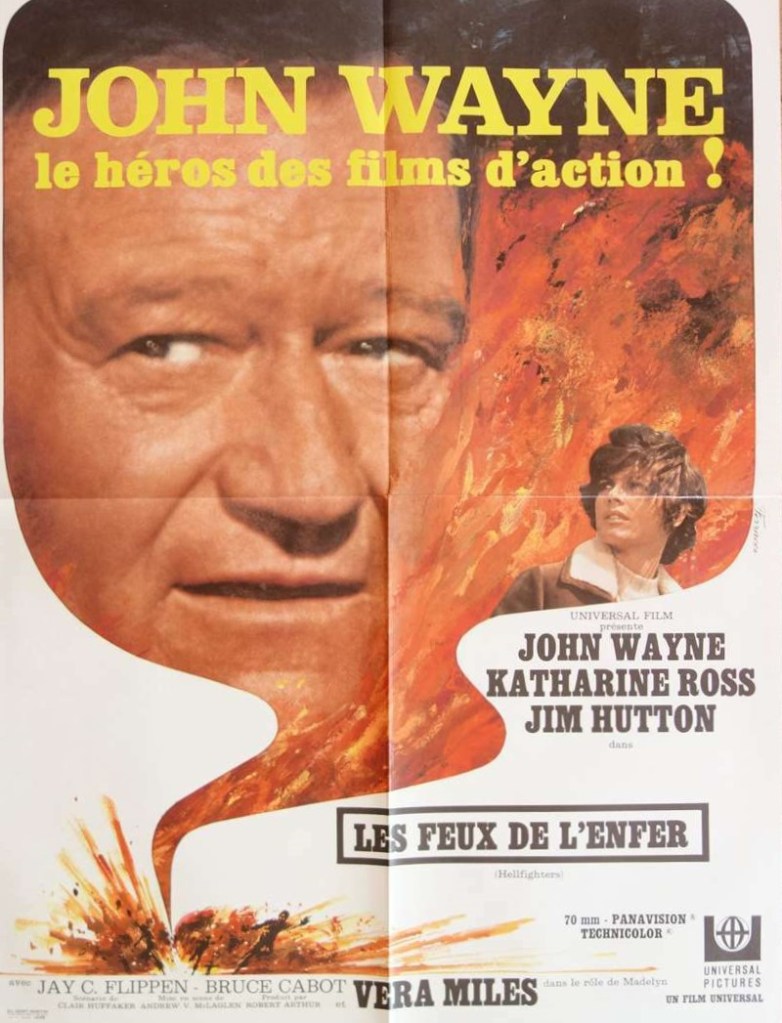
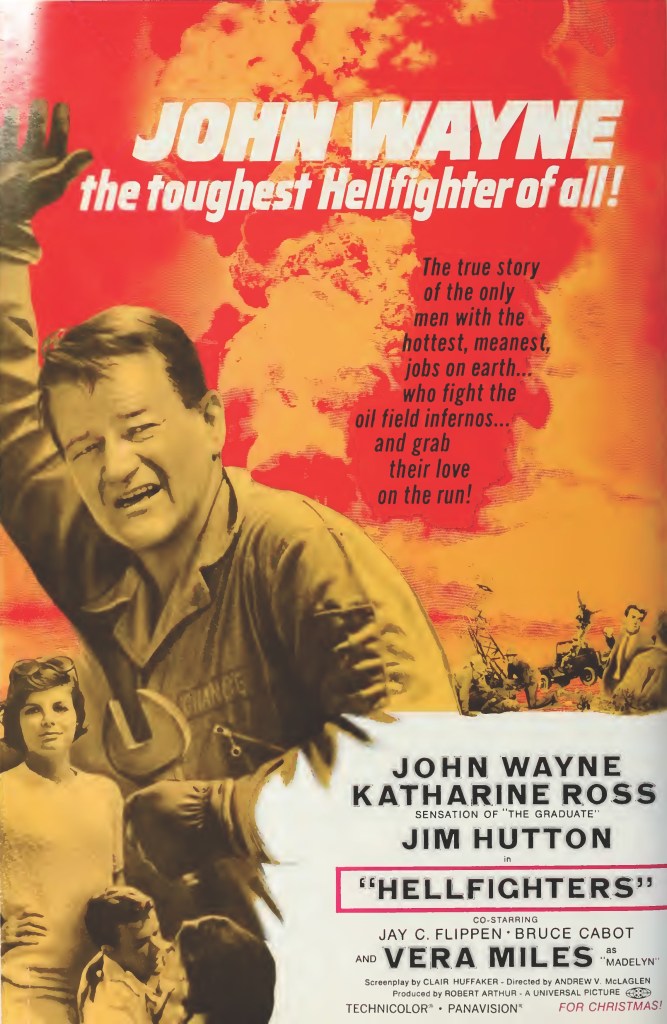
Hellfighters (1969) ****

I’m sticking my neck out on this one – under-rated would be an understatement – and primarily because it’s the Duke’s most intriguing film of the decade and possibly ever. For a start we have John Wayne The Quitter (the hell you say!). Then he ducks out of the picture for a full quarter of an hour (he does what?). Fast forward a couple of years and this would have led the disaster cycle pack – a little tinkering with the structure and you would have all four principals fighting fires in South America in the middle of a revolution (beat that, The Towering Inferno.) But most enthralling of all this is a family drama masquerading as an action picture.

And it led me to thinking if True Grit (1969) had not landed on Wayne’s doorstep whether he would have continued down the dramatic rather than the action road for the tail end of his career. He had just collected his first million-dollar fee so in box office terms he was untouchable. And just for the record, the action scenes, especially given the absence of CGI, are terrific. Sure, the oil’s a little bit too thin to pass for real oil, but it does gets sloshed over all concerned, including the Duke, by the bucketload.

And it might be a shade on the episodic side, Chance Buckman (John Wayne) and compadres racing from one hellish event to another, but it’s wrapped around a tight dramatic core, Chance vs independent daughter Tish (Katharine Ross), Chance vs one-time sidekick and now Tish’s husband Greg (Jim Hutton), Chance vs. Tish’s mother Madelyn (Vera Miles) and Chance vs. all the dimwits on the board of the company he quit his own operation to join.

Chance is based on the real-life Red Adair, an oilman who had invented the extremely scientific but extremely dangerous method of putting out oil-well fires. When a gazillion gallons of oil spurting unchecked out of the ground catch fire you’ve got a helluva problem on your hands. A gazillion gallons of water ain’t going to cut it. The only solution is to cut off the oxygen supply long enough to cap the well. Red Adair’s technique: blast the oxygen out of the way. He’d attach drums filled with massive amounts of nitro-glycerine, roll them into the blaze on the end of cranes, hide behind nothing more resilient than hazard suits and shields made of corrugated iron, and detonate them. The resulting explosion did the trick.

The picture opens with this stunt, although after being accidentally injured, Chance is hospitalized, bringing estranged daughter and ex-wife into the dramatic frame. After a pretty frosty meet-cute,  Tish and Greg hit it off and get married, forcing Tish to confront the fear that drove Chance and Madelyn apart, that, like the wife of a Formula One driver, she never knows if her husband will come back. This bothers the feisty Tish a lot less than the weary Madelyn. And she even ignores all protocol and rushes to her husband’s side, regardless of the danger.

Meanwhile, Chance decides not only has he had enough of dicing with danger but he can leave his company in the safe hands of Greg. His life now on a more mundane keel, Madelyn is attracted back. But of course it wouldn’t do for Chance to live out retirement with nothing more testy than board meetings so he comes back into the fray during a rebellion in Venezula and both women have to confront their true feelings.

The action, considering the lack of CGI, or the kind of budget available to The Towering Inferno, is first-class. This is the ideal movie reversal. Instead of running away from a fire, these characters race towards it. There are some hair-raising moments. At one blowout, gas is leaking from the ground, poisoning everyone in sight, Greg is trapped underwater. And should complacency sneak in, fire, being on the unpredictable side, is prone to sudden explosion.

John Wayne (The Undefeated, 1969) has always excelled at restrained emotion and here he gets both barrels. Having got rid of the over-protective wife he’s now saddled with a daughter he’s desperate to protect from the hell he put his wife through. He’s faultless here, given considerably more acting scope than normal and not, as in McLintock (1963), just able to tan a woman’s backside, presenting a more contemporary male, perhaps as puzzled by female behavior as any of his cowboys, but taking a more modern approach to resolving his feelings.

Katharine Ross (Tell Them Willie Boy Is Here, 1969) has her best role, not a mere appendage as in her other films of this period, but driving forward the action through her independence. Jim Hutton (Walk, Don’t Run, 1966) is growing on me. I’ve reversed my view of him as a lightweight. Vera Miles (The Man Who Shot Liberty Valance, 1962) does a pretty good job of playing older – she was not yet 40 – and essays a complicated character, more rounded than was often the case with the female lead in Wayne pictures. Veterans Jay C. Flippen (Firecreek, 1968) and Bruce Cabot (The Undefeated) head the support.

The perennially underrated Andrew V McLaglen (The Undefeated) does a pretty good job with the action, as you might expect, but is also savvy enough to let the dramatic scenes flow. Clair Huffaker (Rio Conchos, 1964) penned the screenplay.

Guilty pleasure personified, you might say, but I’d retort that this is a damn fine picture erroneously ignored – rating only two paragraphs in Scott Eyman’s  650-page biography of John Wayne for example – possibly because it appeared in between the critically-reviled The Green Berets (1968) and the critically-acclaimed True Grit.

The Man Who Shot Liberty Valance (1962) *****

A mighty cast headed by John Wayne (True Grit, 1969), James Stewart (Shenandoah, 1965), Lee Marvin (The Dirty Dozen, 1967) and Vera Miles (Pyscho, 1960) with support from Edmond O’Brien (Seven Days in May, 1964), Woody Strode (The Professionals, 1966), Strother Martin (Cool Hand Luke, 1967) and Lee Van Cleef (The Good, the Bad and the Ugly, 1967) do justice to John Ford’s tightly-structured hymn to liberty and equality and reflection on the end of the Wild West. So tight is the picture that despite a love triangle there are no love scenes and no verbal protestations of love.

The thematic depth is astonishing: civilization’s erosion of lawlessness, big business vs. ordinary people, political chicanery, and a democracy where “people are the boss.” Throw in a villain with a penchant for whipping and a lack of the standard brawls that often marred the director’s work and you have a western that snaps at the heels of Stagecoach (1939), Fort Apache (1948) and The Searchers (1956).

The story is told in flashback after Senator Ransom Stoddard (James Stewart) and wife Hallie (Vera Miles) turn up unexpectedly in the town of Shinbone for the funeral of a nobody Tom Donovan (John Wayne), so poor the undertaker has filched his boots and gunbelt to pay for the pay for the barest of bare coffins. Intrigued by his arrival, newspapermen descend and Stoddard explains why he has returned.

The backstory unfolds. Arriving on stagecoach, novice lawyer Ransom is attacked, beaten and whipped by outlaw Liberty Valance (Lee Marvin). He is found by horse-trader Donovan (John Wayne) and taken to a local boarding house-cum-restaurant where Hallie (Vera Miles) tends his wounds. With a young man’s full quotient of principle, Stoddard is astonished to discover that local marshal Link Appleyard (Andy Devine) has ducked out of responsibility for apprehending Valance on the dubious grounds that it is outside his jurisdiction and that Valance has so mean a reputation he has the town scared witless. When Valance turns up he humiliates Stoddard and only Donovan stands up to him, rescuing an ungrateful Ransom, who detests violence and any threat of it.

Stoddard soon turns principle into action, setting up his shingle in the local newspaper office run by Dutton Peabody (Edmond O’Brien) and on learning that Hallie is illiterate establishing  a school for all ages. In the background is politics, but the push for statehood is inhibited by big ranchers who employ Valance to intimidate. Despite his aversion to violence and insistence that due legal process will eliminate the law of the gun, Stoddard practices shooting. When Donovan gives him a lesson and, to point out his unsuitability to confront such a mean character as Valance, covers him in paint, Stoddard floors him with a punch.  

That principle I mentioned has something in common with Rio Bravo (1959) – Howard Hawks’ riposte to High Noon (1952) – in that Stoddard, determined to fight his own battles, refuses to ask for help when targeted by Valance. The inevitable showdown is extraordinary, not least because it takes place at night and Ford, a la Rashomon (1951) tells it twice from different points of view.   

Precisely because it retains focus throughout with no extraneous scenes as was occasionally John Ford’s wont, the direction is superb. As in The Searchers, to suggest emotional state-of-mind, the director uses imagery relating to doors. This time the humor is not so broad and limited primarily to one incident. Both main male characters suffer reversals, in the case of Stoddard it is physical but in the instance of Donovan it is emotional. Either way, action is character. In the romantic stakes, they are equals, dancing around their true feelings.

Upfront there is one storyline, the upholding of law and order whether against an individual such as Valance or against the attempts of big business to thwart democracy. But underneath is a subtly-told romance. Donovan and Stoddard are allies but in terms of Hallie they are rivals. Neither have an ounce of sense when it comes to women. Neither actually protests their love for Hallie. Although Donovan brings her cactus roses and is, unknown to her, building an extension to his house to accommodate what he hopes is his future bride, his idea of romance is to mutter, in patronizing manner, the old saw of “you look pretty when you’re angry.”  He would have been wiser to have taken note of her spunk, because she can be more than direct if need be.

Stoddard isn’t much better. Despite her growing feelings towards him being obvious to the audience, he assumes she prefers Donovan. Action drives the love element, the need to save or destroy.

All three principals are superb. This may seem a typical Wayne performance, a dominant figure, comfortable with a gun and his abilities, but awkward in matters of the heart. But he shows as great depth as in The Searchers and the despair etched on his face at the possibility of losing Hallie eats into his soul. Stewart combines the man-of-the-people he essayed for Frank Capra with some of the toughness he showed in the Anthony Mann series of westerns. Vera Miles tempers genuine anger with tenderness and practicality. Unlike many Ford heroines she is not a trophy wife, but a worker, mostly seen running a kitchen. Lee Marvin cuts a sadistic figure, with an arrogance that sets him above the law, his tongue as sharp as his whip.

As well as Woody Strode, Strother Martin, Edmond O’Brien and Lee Van Cleef, you will spot various members of the John Ford stock company including Andy Devine (Two Rode Together, 1961) as the cowardly gluttonous marshal, John Carradine (Stagecoach), John Qualen (The Searchers) as the restaurant owner and Jeanette Nolan (Two Rode Together) as his wife.

The boldest part of the picture, however, comes at the end, when the director dismantles the myth built up around Stoddard and which the politician has used to create a career that spanned two terms as a Senator, three terms as a Governor and been the American Ambassador to Britain. So be warned, if you ain’t seen the picture, this is spoiler alert. In some respects, Ford was way ahead of his time. The twist at the end where the good guy is revealed as the villain of the piece is more of a contemporary trope. There were plenty of pictures where the villain appeared to have gotten away with it only to be caught out at the very last minute. This is not that kind of movie. Stoddard gets away with it for the simple reason that he fits the heroic mold.

“Print the legend” is very much the standard American attitude to myth. Dig deeper and what you find is hypocrisy. Man-of-the-people Stoddard’s life is based on bare-faced fraud. He took the glory for an action he did not commit. Of course this was in the days before newspapers found that bringing down politicians sold more papers than building them up and these days I doubt if such a scoop would be ignored.

Nor for all his upstanding image does Stoddart show the slightest sign of remorse – until now when he must know his confession will never see the light of day. (Maybe, if he had gone to the New York Times but not the Shinbone paper). He built his entire career on this violent action, the antithesis of his supposed stance on process of law.  He takes all the plaudits and fails to acknowledge Donovan, except when it’s too late, and Donovan has died a pauper, his rootless life perhaps engendered as a result of losing Hallie. Hallie’s character, too, is besmirched. She chose Stoddart precisely because he was a man of principle who risked his life to tackle – and apparently kill – Donovan. Those two elements are indistinguishable. Had she know Stoddart had failed and was only saved by the action of Donovan it is questionable whether she would have chosen the lawyer.

There are a couple of other quibbles, not so much about the picture itself, but about other quibblers, commonly known as critics.  Alfred Hitchcock famously came under fire for the use of back projection, not just in Marnie (1964) but other later films. That spotlight never appeared to be turned on the at-the-time more famous John Ford. The train sequence at the end of the film uses back projection and the ambush at the beginning is so obviously a set.

Don’t let these put you off, however, this is one very fine western indeed and fully justifies its growing critical status.

CATCH IT ON THE BIG SCREEN: By the way, if you live in Italy you can catch this on the big screen in Bologna where it is showing at Il Cinema Ritrovato – Fondazione Cineteca di Bologna on July 20-27, 2021.

Discover WordPress

A daily selection of the best content published on WordPress, collected for you by humans who love to read.

The Atavist Magazine

by Brian Hannan

WordPress.com News

The latest news on WordPress.com and the WordPress community.