None but the Brave (1965) *****

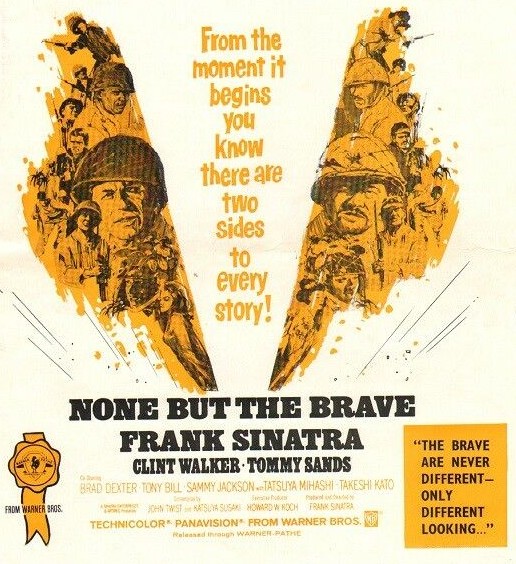
Frank Sinatra’s sole stab at direction is an astonishing piece of work and deserves to be revisited in a more positive frame of mind than it encountered on original release.  Maybe critical acclaim depends on your name, and most critics were already tearing into Ol’ Blue Eyes because his acting in the 1960s scarcely matched his work in the 1950s – From Here to Eternity (1953), The Man with the Golden Arm (1955), Guys and Dolls (1955), High Society (1956) and Pal Joey (1957).

On the other hand critics were all over themselves when John Boorman and Clint Eastwood went down a similar route in Hell in the Pacific (1968) and the double header Flags of Our Fathers (2006) and Letters from Iwo Jima (2006), respectively, and American audiences griped about the even-handedness of Tora! Tora! Tora! (1970).
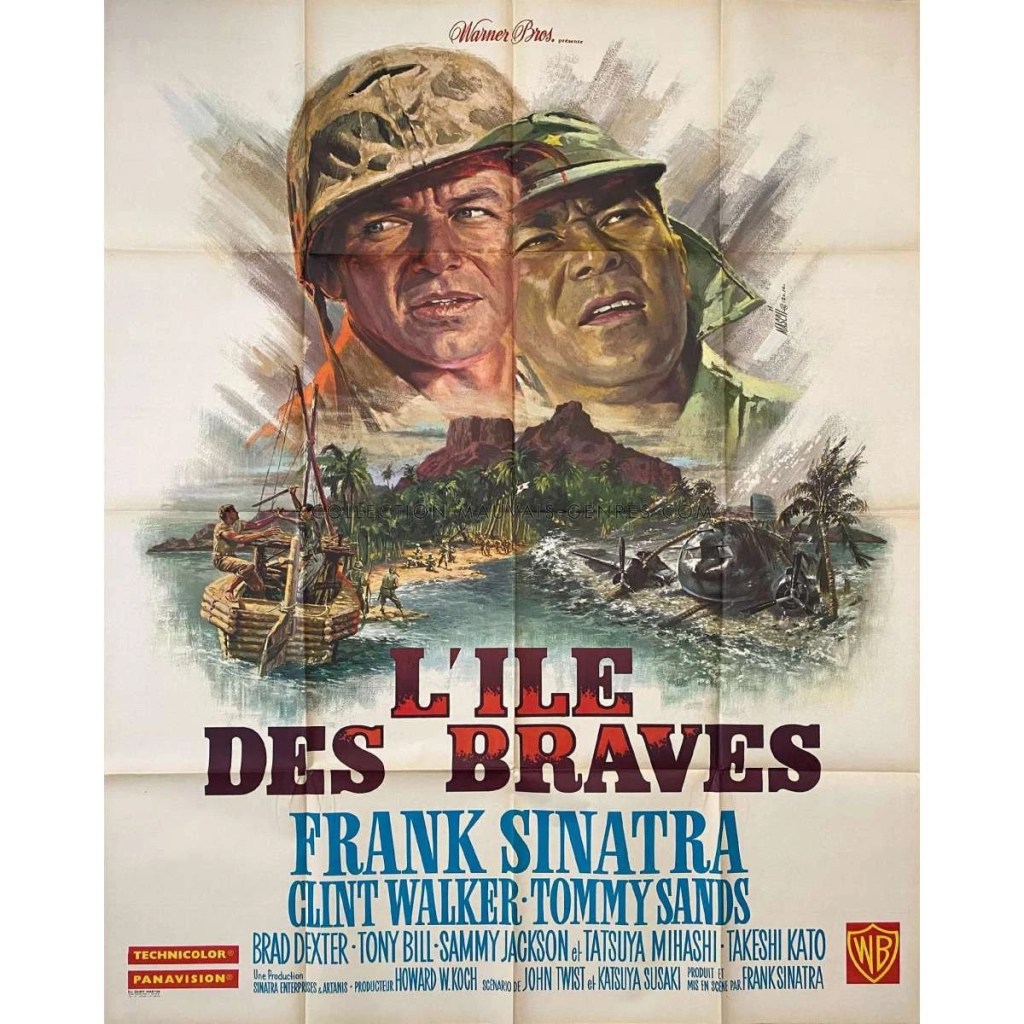
Not only is this primarily presented from the Japanese point-of-view, opening and closing with scenes involving the Japanese, but it is not so much even-handed as presenting the opposing sides in exactly the same manner, so that the “enemy” is never viewed as such but as a rag-tag collection of ordinary men thrust into warfare.

While there’s certainly courage on show, there’s also more than a war movie’s normal share of rashness and stupidity, disobedience, the flouting of orders, the challenging of the line of command and that taboo subject – death from friendly fire. There are clever maneuvers and outwitting the opposition.

The composition of both sides could be echoes of each other. Both have calm leaders in Capt Dennis Bourke (Clint Walker) and Lt Kuroki (Tatsuya Mihashi) who both struggle to keep in line intemperate subordinates, Second Lieut Blair (Tommy Sands) and Sgt Tamuro (Takeshi Kato) who tend to issue orders at a scream and in the latter instance with a slap in the face. Both lieutenant and sergeant, career soldiers, bristle at having to accept orders from less experienced officers.

None of the recruits are worth a button as soldiers. On the Japanese side we have a Buddhist priest, on the American side guys who wouldn’t recognize a trap even when they fell into it. Bourke also has to contend with loudmouth Sgt Bleeker (Brad Dexter), itching to start a fight.
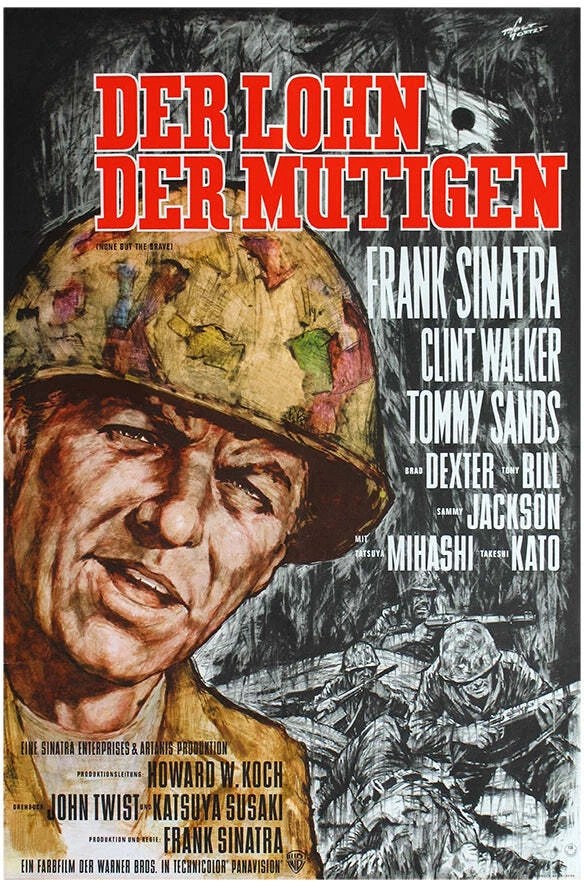
The Americans have one trump card – and it’s not weaponry. They have someone with the medical skill to save a badly wounded Japanese soldier. And although he’s only a pharmacist (Frank Sinatra) he’s got enough knowledge to carry out an amputation. The Japanese have their own trump cards – food and water. And the two leaders effect a truce. You know it won’t last, of course, which leads to a savage ending, though a touching climax.

There’s plenty action, more than you might expect, since generally in this kind of war movie we spend ages getting to know the soldiers long before there’s any reason to fire a shot or explode a bomb. All we know about the Americans is that they shouldn’t be here, they were flying elsewhere when their plane crash-landed on a remote island they believe is unoccupied. All we know about the Japs is that they’re trying to get off the island by building a boat.

Foolish soldiers on either side upset the leader’s strategies so the bullets soon fly. The Japanese on sighting an American warship cruising close by have the cleverest notion, running up a Japanese flag, which the sailors take to mean the island is under Japanese control and begin a bombardment which kills Americans. The Yanks, on the other hand, manage to steal the Japanese boat, but only for a short time before a grenade puts paid to any notions of escape.

In most war movies that pay any attention to the lives of the soldiers, that usually concentrates on sentiment, women left behind, families abandoned and so forth and while this strays into that territory once, the bulk of the time we see character revealed by current action, which is a more difficult thing to achieve, but far more rewarding.

Given his duties behind the camera, Frank Sinatra (Robin and the 7 Hoods, 1964) wisely plays a largely supporting role, restricted to the occasional wisecrack, but allocated one big central scene so that audiences don’t feel they’ve not had their money’s worth. But, actually, he relinquishes the most important scene to someone else. An armed American soldier coming across an unarmed half-naked Japanese who has been catching fish can’t bring himself to shoot him because you shouldn’t shoot a good fisherman.

There’s not much in the way of visuals or composition to write home about, but this film didn’t require such virtuosity, the director more than makes it work by sticking to the knitting, and concentrating on the humanity and refusing to allow the enemy to be portrayed as such.  

Clint Walker (Sam Whiskey, 1969) and Tatsuya Mihashi (Tora! Tora! Tora!) carry the picture effortlessly while their rebellious underlings, singer Tommy Sands (Ensign Pulver, 1964) and Takeshi Kato (Yojimbo, 1961) do their best to steal the picture. Look out for Brad Dexter (The Magnificent Seven, 1960) and future producer Tony Bill (The Sting, 1973).

Written by John Twist (A Distant Trumpet, 1964), Katsuya Susaki (Way Out, Way In, 1970) and the film’s producer Kikumaru Okuda.

Not to be missed. A war classic.
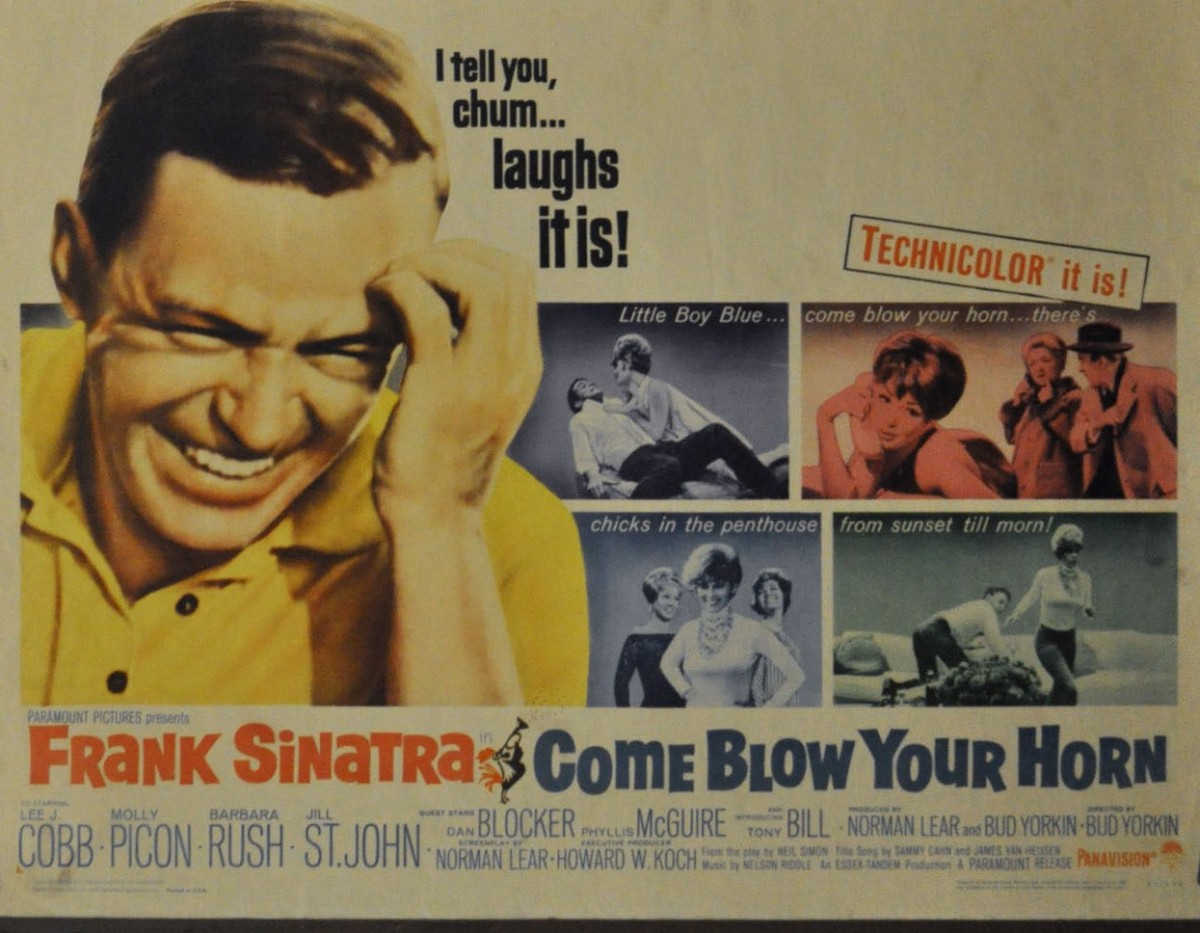
Come Blow Your Horn (1963) ***

Wonderful upbeat performance from Frank Sinatra lifts this out of a misogynistic pit where  women were either dumb, desperate to get married or passive-aggressive harridans. Bachelor playboy Alan (Frank Sinatra) has more women on a string than there is string. When younger brother Buddy (Tony Bill) moves in, Alan introduces him to the fun ways of the world, not expecting Buddy to be such an apt pupil.

Alan keeps main squeeze Connie (Barbara Rush) dangling while, pretending to have Hollywood connections, making hay with actress wannabe Peggy (Jill St John). He also keeps customer Mrs Eckman (Phyllis McGuire) sweet in transactional sex fashion and there’s no shortage of other women liable to appear out of the woodwork.

Meanwhile, his boss, apoplectic father Harry (Lee J. Cobb), goes around screaming at everyone, berating Alan for his lifestyle and moaning at harassed wife Sophie (Molly Picon). Most of the time it looks like it’s going to swerve into a more typical English farce with various women being hidden out of sight from various other woman or Harry or an equally apoplectic cuckolded husband (Dan Blocker).

But, with considerably more sophistication than that, the story takes the more interesting tack of character development. Alan, who might appear to be sitting pretty, woman at his beck and call, a glorious modern apartment, cocktails on tap, is brought up sharply by his brother’s delight at such a shallow life. Alan gets to play Hollywood honcho with Peggy while Connie delivers an ultimatum that threatens to bring Frank to his senses though, naturally, he believes it’s all hooey.

The fraternal business is well done, instead of the normal rivalry genuine affection and the older sibling offering guidance, though primarily in how to get drunk and get off with women rather than anything that might otherwise stand him in good stead. Though you might argue that being shown how to dress, and how converse with women, and organise a fun party might be as much education as a young gentleman in the Big Apple required.

The only thing better than one Frank Sinatra picture is two Frank Sinatras so to scoop up some extra cash these were paired for a speedy reissue.

Playwright Neil Simon, the toast of Broadway at this stage, exhibited such a keen sense of structure that the story never sagged. Any time that appeared a remote possibility, instead of a stranger coming in a la Raymond Chandler with a gun, it’s Harry stomping all over the place. There are some good catchphrases, genuinely funny moments, and some great lines, the best, I have to confess, from Peggy who bemoans the fact that she was stranded in a hotel room with Alan at a ski resort by all the snow outside. Redeeming factor: her homely kind of dumb serves narrative purpose, making the otherwise unbearably charming Alan come across as a heel.

This is quite a different Sinatra, like he’s channeling his record persona, none of the anguish, dramatic intensity or Rat Pack bonhomie he brought to other pictures. Often you hear of actors just playing the same character or a variation thereof, but this ain’t a Sinatra persona I’m familiar with and brings verve to the whole shebang.

Lee J. Cobb (Coogan’s Bluff, 1968) gives in to overacting. You can see how that loud style might work on the stage, but it’s less effective here. Jill St John (Tony Rome, 1967) is very good as the uncertain beauty, who could be incredibly seductive if only she could work out how, and not quite a victim either, and still managing vulnerability. Barbara Rush (Robin and the 7 Hoods, 1964) is wasted, though. Set up as a modern woman, she collapses at the first sniff of marriage, though framing her eyes in a mask of light in a taxi cab is about the only compositional mark of any note.

Quite what possessed director Bud Yorkin (Divorce American Style, 1967) to stick in the title song in the middle of the picture is anybody’s guess. Norman Lear (Divorce American Style) wrote the script but you can hardly go wrong with a Neil Simon template. 

End up: it’s mostly about family and people coming to terms with themselves and each other.

Ice Station Zebra (1969) ****

John Sturges’ Alistair Maclean Cold War thriller, released within months of the more action-oriented Where Eagles Dare, twists and turns as Americans in a nuclear submarine and the Soviet Union race to the Arctic to retrieve a fallen space capsule containing a deadly secret. Thoroughly enjoyable hokum filmed in Cinerama 70mm with an earworm of a booming theme from Michel Legrand and mostly outstanding special effects.

Nuke sub Commander Ferraday (Rock Hudson), despatched from Scotland, and believing he is only on a last-gasp mission to the save scientists at a stricken weather station, is somewhat surprised to be forced to carry as passengers arrogant British secret service agent David Jones (Patrick McGoohan) and Russian defector Boris Vaslov (Ernest Borgnine), the former refusing to divulge the reasons for being on board. From the outset the vessel is afflicted by sabotage and the cruel ice. Tensions mount further as they reach the Ice Station Zebra weather station. Since so much depends on mystery in a MacLean thriller, any other revelations would amount to significant plot spoilers.

So while there’s more than enough going on among the various characters and a plot that shifts like a teutonic plate, it’s the submarine section that proves the most riveting, the dives exhilarating. The underwater photography is superb in part thanks to an invention by second unit cameraman John M. Stephens which could film for the first time a continuous dive. Whether the sub is submerging, surfacing, puncturing the ice or in danger of being crushed to smithereens, it’s the nuke that takes centre stage, a significant achievement in the days before CGI.

Not all the effects are quite so top-notch, there’s some dodgy back projection, and the Arctic rocks look fake, but in general, especially with streamlined control panels, jargon spat out at pace, and sub interiors that appear realistic, the result of two years research, it’s a more than solid job, delivering the core of a Saturday night action picture.

The absence of a giant Cinerama screen does not detract from the movie – though if you get the chance to see it in 70mm, as I once did, jump at it – because the Super Panavision cameras capture in enormous detail the bow spray, the massive icebergs, the gleaming intricacy of the controls, and even the sea parting under the weight of the sub creates astonishing visuals. And there’s something inherently dramatic in the commander slapping down the periscope.

Rock Hudson (Tobruk, 1967) is back to straightforward leading man duty after his departure into paranoia in Seconds (1966) and he is burdened with both a chunk of exposition and having to develop a stiff upper lip in response to the secret agent’s reluctance to take him into his confidence. He comes more into his own in the action sequences. The tight-lipped brusque provocative McGoohan (Dr Syn, 1963) clearly has a ball as mischief-maker-in-chief, keeping everyone else on tenterhooks. Ernest Borgnine (The Wild Bunch, 1969) invests his character with wide-eyed charm at the same time as the audience doubts his credentials. Jim Brown (The Split, 1968) has little more than an extended cameo as the Marines’ chief and in smaller roles you can also spot future Oscar-winning producer Tony Bill (Castle Keep, 1969) and veteran Lloyd  Nolan (The Double Man, 1967).

This was the second MacLean adaptation for John Sturges (The Satan Bug, 1965) and he keeps a tighter grip on proceedings, a $10 million budget ensuring he could make the movie he envisaged, part-thriller, part-high adventure with well-orchestrated slugs of action.

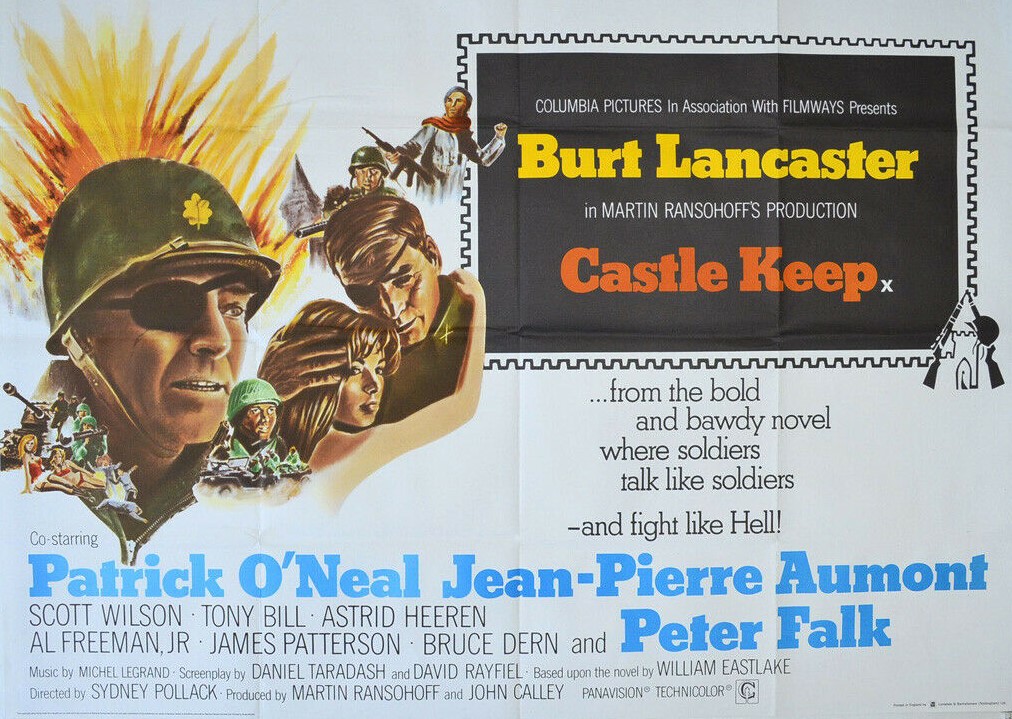
Castle Keep (1969) ****

A bit more directorial bombast and this could have matched Apocalypse Now (1979) in the surrealist war stakes. Never mind the odd incidents surrounding a small unit of G.I.s  taking over a magnificent Belgian castle towards the end of World War II prior to what turned out to be the Battle of the Bulge, this has on occasion such a dreamlike quality you wonder if it is all a figment of the imagination of one of the characters, wannabe writer Private Benjamin (Al Freeman Jr.). Throw in a stunning image, for the beleaguered soldiers at the start, of a horsewoman charging by in a yellow cloak, so out of place that it carries as much visual impact as the unicorn in Blade Runner (1982), and we are in definite cult territory.

One of the unusual elements is that, in this unexpected respite from battle, the soldiers are defined by character traits rather than dialogue or bravery as would be the norm. This ranges from baker Sergeant Rossi (Peter Falk) taking over the village boulangerie and bedding the baker’s wife (Olga Bisera), mechanic Corporal Clearboy (Scott Wilson) diving into a lake to rescue a Volkswagen he has adopted and the troops receiving a lecture on art history from Captain Beckman (Patrick O’Neal).

Commander Major Falconer (Burt Lancaster) is not only brilliant in the art of war, but calmly  mentors Beckman through a firefight with an enemy airplane, teaches local sex workers how to make Molotov cocktails and, evoking ancient aristocratic tradition, enjoys conjugal relations with the conquered countess (Astrid Heeren), whose impotent husband (Jean-Pierre Aumont) encourages the relationship since the castle needs an heir.   

There is wistful revelation, Beckman clearly hankering after his turn with the countess, a trainee minister who wishes he had the courage to join the boys in the brothel, the young soldiers there being treated as children rather than customers. And there are juvenile pranks – moustaches are painted on statues, wine bottles used for ten-pin bowling practice.

But the surreal moments keep mounting up. The Volkwagen, though riddled with bullets, refuses to sink in the lake, a hidden German reveals himself by playing the same tune on a flute as one of the enemy, the countess often appearing as an ethereal vision.

Through it all is rank realism. Falconer knows a German previously shared the countess’s bed. The count will do anything to safeguard his castle and maintain the family line, even to the extent of incest, since his wife is actually his niece. But above all, while his troops believe the war is at an end and enjoy the pleasures at hand, Major Falconer prepares for rearguard action by the Germans, filling the moat with gasoline, planning to pull up the drawbridge and control the high ground. The battle, when it comes, is vivid and brutal, the initial skirmish hand-to-hand in the village before the Germans advance to the castle.

Burt Lancaster (The Swimmer, 1968) is superb, far removed from his normal aggressive or athletic persona, slipping with pragmatic ease from the countess’s bed to battle stations. War films in the 1960s were full of great individual conflicts often won on a twist of ingenious strategy but seldom have we encountered a soldier like Falconer who knows every detail of war, from where and how the enemy will approach, to the details of the range of weaponry, and knows that shooting dead four soldiers from a German scouting mission still leaves one man unaccounted for.

Patrick O’Neal (Alvarez Kelly, 1966) also leaves behind his usual steely-eyed screen persona, here essaying a somewhat timid and thoughtful character. Peter Falk’s (Machine Gun McCain, 1969) baker is a beauty, a man who abandons war, if only temporarily, for a second “home,” baking bread, adopting a wife and child. In a rare major Hollywood outing French actor Jean-Pierre Aumont (Five Miles to Midnight, 1962) carries off a difficult role as a count willing to accept the humiliation of being cuckolded if it improves his chances of an heir. In one of only four screen appearances German actress Astrid Heeren (The Thomas Crown Affair, 1968) makes the transition from a woman going to bed with whoever offers the greatest chance of saving the beloved castle to one gently falling in love.

There is an excellent supporting cast. Bruce Dern (Support Your Local Sheriff, 1969) makes the most of a standout role as a conscientious objector.  You will also find Scott Wilson (In Cold Blood, 1967), Al Freeman Jr. (The Detective, 1968), future director Tony Bill (Ice Station Zebra, 1968) and Michael Conrad (Sol Madrid / The Heroin Gang, 1968).

Two top-name writers converted William Eastlake’s novel into a screenplay – Oscar-winning Daniel Taradash (Hawaii, 1966) and newcomer David Rayfiel who would work with Lancaster again on Valdez Is Coming (1971) and with Pollack on Three Days of the Condor (1973) and Havana (1990)

Sydney Pollack (This Property Is Condemned, 1966), who had teamed up with Lancaster on western The Scalphunters, 1968), does a terrific job of marshalling the material, casting an hypnotic spell in pulling this tantalising picture together, giving characters space and producing some wonderful images, but more especially for having the courage to leave it all hanging between fantasy and reality.

Expressions like  “we have been here before,” “once upon a time,” “the supernatural” and “a thousand years old” take solid root as the narrative develops and will likely keep spinning in your mind as you try to work out what it’s all about.

Discover WordPress

A daily selection of the best content published on WordPress, collected for you by humans who love to read.

The Atavist Magazine

by Brian Hannan

WordPress.com News

The latest news on WordPress.com and the WordPress community.