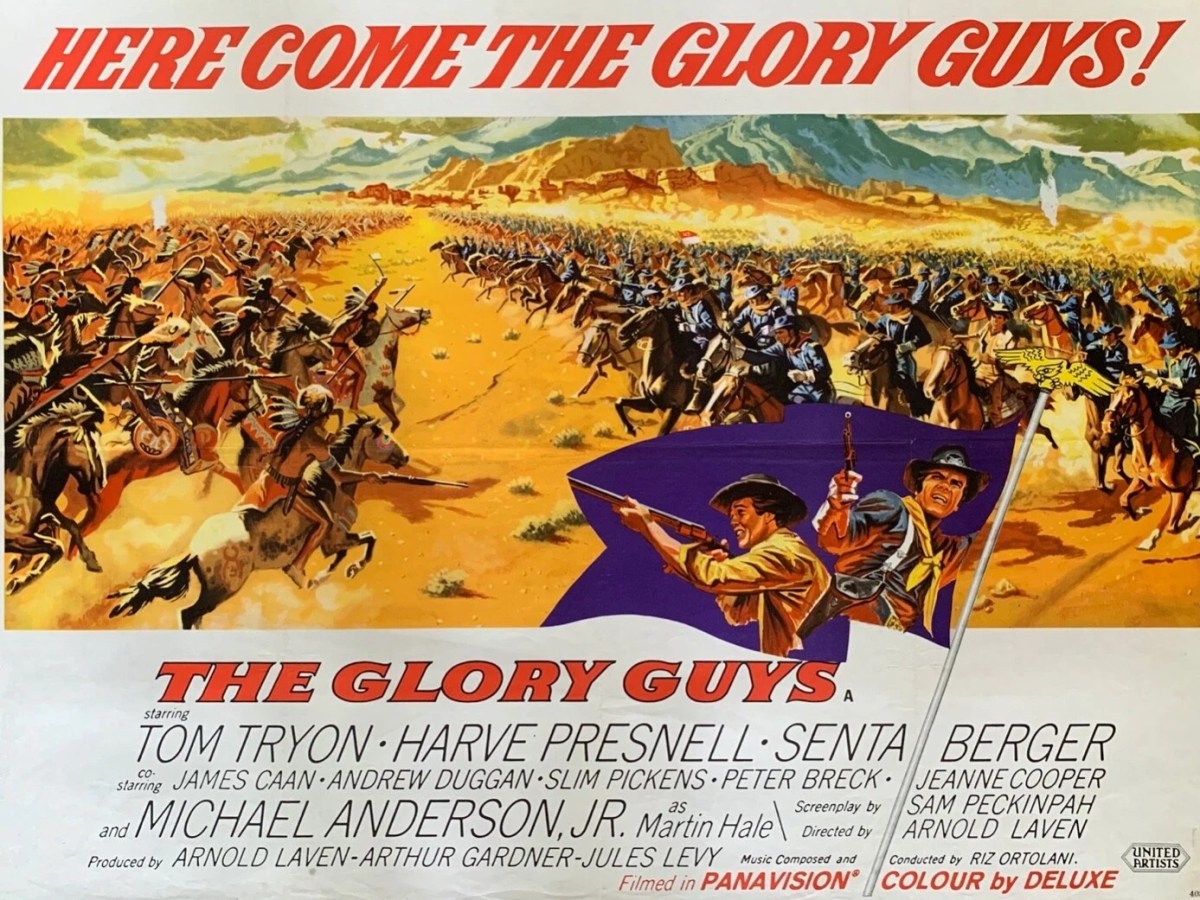
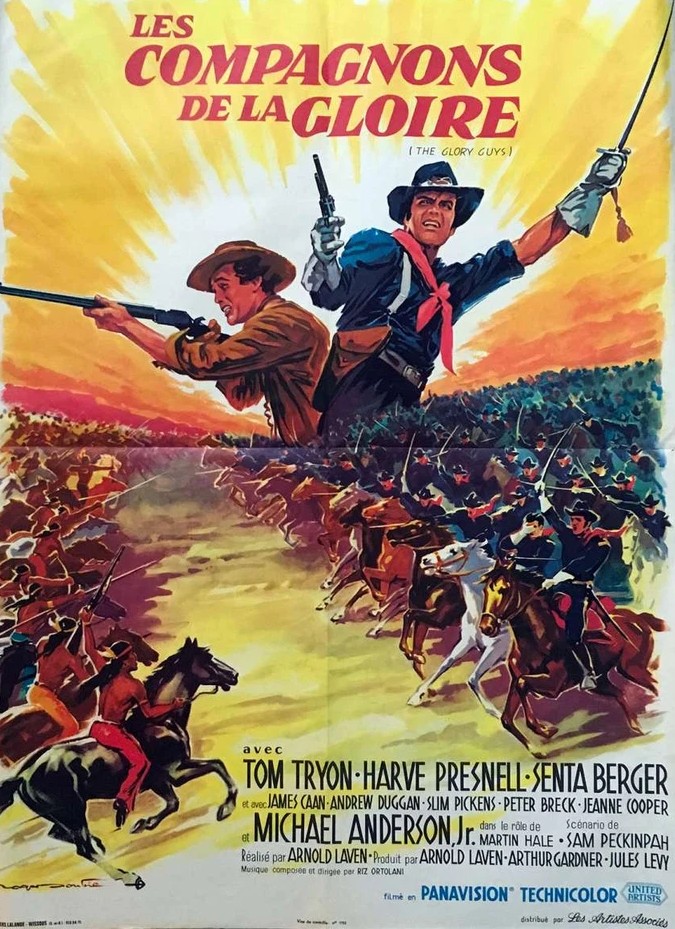
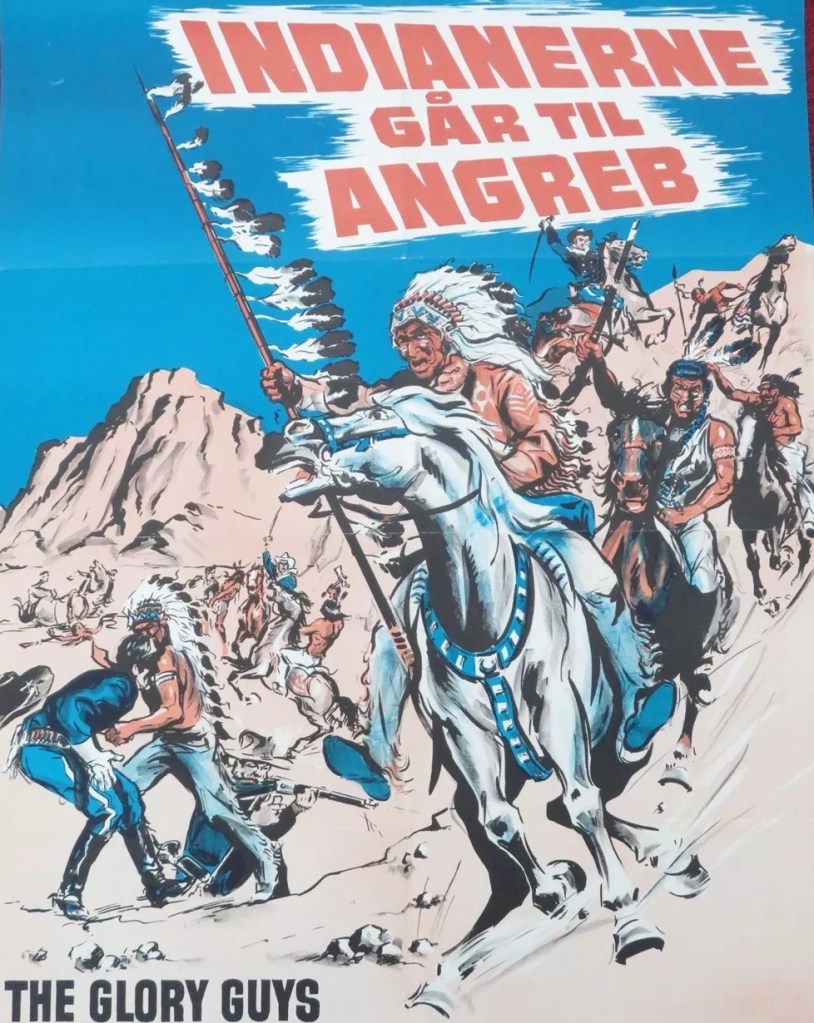
The dismissive verdict of Sam Peckinpah (he wrote the script) is the main reason this remains unfairly underrated. This came out the same year as that director’s over-rated Major Dundee and covers some of the same themes – the training of raw recruits and the woman requiring a protector.
But this is the first cavalry picture I’ve seen where training covers more than recruits falling off their horses, picking fights with each other and getting drunk and into scrapes. The main task of Capt Harrod (Tom Tryon), apart from teaching them to shoot, is to ensure they ride in formation and are ready to take part in action. There’s a brilliant scene where Harrod fakes an Indian attack where they are all in a flash knocked off their horses. And another superb scene where, having achieved an almost impossible goal in double-quick time, Harrod leads them in a ride-past in front of General McCabe (Andrew Duggan) and they ride in about ten rows six abreast, keeping time and distance. When the soldiers dismount during combat, how they arrange for the horses to get out of the way but not run off is also revealed. The scene of the whole detachment leaving the fort is also breathtaking. They are lined up in columns, five or six abreast, and you begin to see, for really the first time, how the U.S. Army operates as a trained unit.
But that’s just the cream of a very finely worked crop. Harrod and McCabe are at odds because the captain’s previous company of raw recruits was virtually wiped out in a previous engagement when the general used them as bait. McCabe is the “glory guy” of the title, everyone else is just trying to keep alive. The only certainty of going into battle, Harrod reminds his men, is that they have a fair chance of not returning home.
Widow Lou Woddard (Senta Berger) pops up to wreak romantic havoc. She owns a gunsmith business, and responsible for driving up sales, so not quite the vulnerable woman. What’s most at stake is her standing in town, her honor if you like, and she can’t be seen to be playing the field. While hardly promiscuous, she has two men on the go, Harrod, who seems disinclined to take the romance beyond a fling, and Army scout Sol Rogers (Harve Pressnell) who is off earning the chunk of money it will take for them to settle down elsewhere.
She doesn’t let on they are rivals and when they discover this it triggers an all-out slugging match – you almost wince with the power of the blows. This ain’t a brawl but a last man standing punch-up where literally they trade blows, one at a time. And she keeps dithering between the two. She reckons Sol isn’t the settling down kind while Harrod’s not keen on commitment. So any time she’s spurned by Harrod she flaunts Rogers.
If she gets her come-uppance, it’s not from either of the men. Attempting to trade barbs with McCabe’s snippy wife Rachael (Jeanne Cooper) she is publicly humiliated. And there’s a terrific scene as the calvary is set to leave the fort and the physical distance between Lou standing on the sidelines with the wives waving husbands goodbye and Harrod on horseback stretches into an emotional chasm simply from the way director Arnold Laven lines up his camera.
The action is clearly based on the Battle of the Little Big Horn. McCabe, instructed to form one half of a pincer movement, races his men ahead to beat his rival general into battle. True to form, he uses Harrod’s men as decoys, theoretically sent out to protect his flank, in reality to draw out the enemy, permitting the general to attack their unguarded rear.
The battle scene is just superb, hordes of cavalry charging towards the enemy, then turning tail when facing superior forces, dismounting to take up positions, then retreating again to the rocks, pursued but managing, mostly, to survive. The scene where Harrod comes across McCabe’s wiped-out army is like the beginning of Zulu (1964). (In fact, it’s worth bearing in mind that Little Big Horn and Isandlwana took place just three years apart and had there been instant global communication in those days the combined events would have sent shockwaves throughout the world.)
It is an excellent script regardless of how Peckinpah felt about the outcome. But it is also a very good western with sufficient changes rendered to the genre’s standard tropes. The compulsory saloon brawl is elevated by an ongoing comic element of Trooper Dugan (James Caan) being constantly defeated in his determination to smash a bottle over someone’s head.
Senta Berger completists should enjoy this far more than her performance in Major Dundee. She essays a more complete realistic character, not quite grasping, but not far short, and in chasing a dream coming close to heartbreak. Tom Tryon (The Cardinal, 1963) is better than I expected and hoofer Harve Pressnell (Paint Your Wagon, 1969) is a revelation. James Caan (El Dorado, 1967), playing a “miserable whining sugar”, is awful, a terrible Irish accent sinking all his attempts at scene stealing
Arnold Laven might have felt hard-done-by in regard to Peckinpah, given the director, in his capacity as producer, had dreamed up The Rifleman television series on which Peckinpah made his name. While this isn’t quite in the same league as Rough Night in Jericho (1967) but better than Sam Whiskey (1969) it deserves reappraisal. Had it featured bigger stars in the two male principal roles it would have attracted more attention at the outset instead of demanding it now.
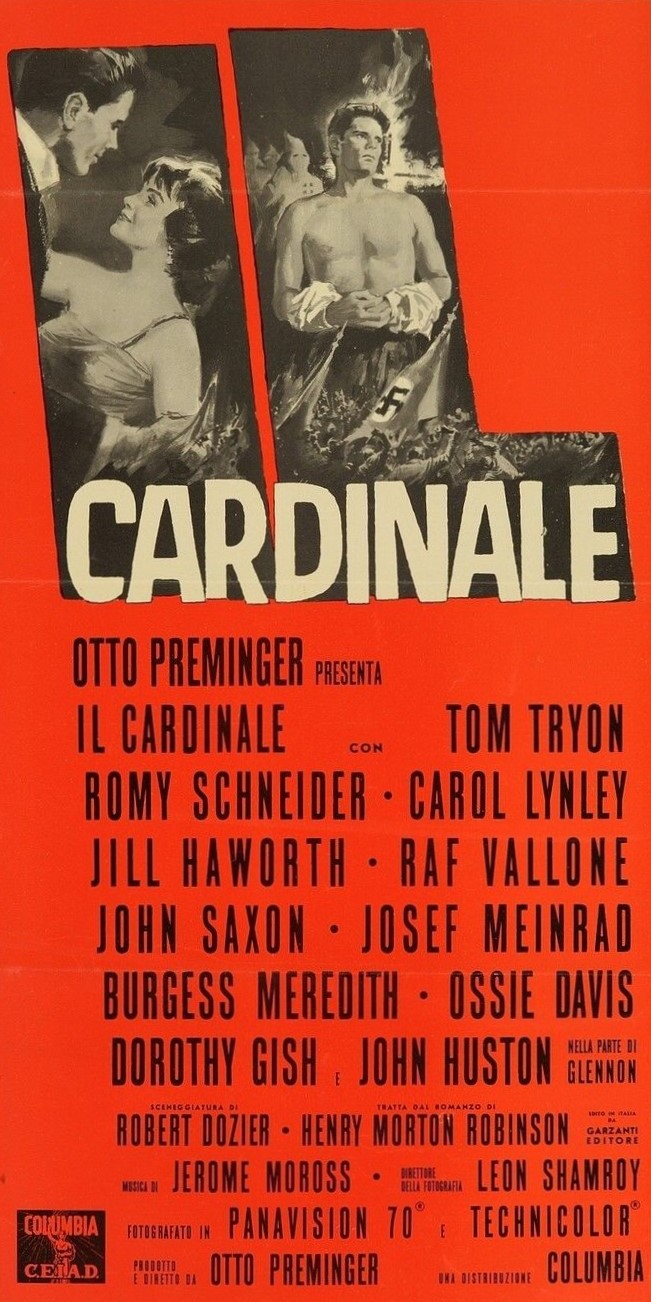
Otto Preminger was beaten to the punch on this one, the scandalous Henry Morton Robinson bestseller snapped up in 1955 by producer Louis de Rochemont (The Roman Spring of Mrs Stone, 1961) who had a tie-up with Columbia. Due to interference from the Catholic Church, de Rochemont dropped his option which Preminger picked up in 1961 while working on Advise and Consent (1962).
The last section of the novel, set in Austria during the Anschluss, reverberated with the director who was born in what was then the Austro-Hungarian Empire and although a Jew was well acquainted with Catholic society. One of his most significant changes to the book was introducing the Austrian cardinal who endorsed Hitler.
The first two screenwriters James Lee (Banning, 1967) and Daniel Taradash (Castle Keep, 1969) failed to whittle down the complex novel to cinematic proportions. So Preminger brought in Robert Dozier (The Big Bounce, 1969) and began working with him in summer 1962 making other alterations to heighten the drama. The incident involving the unborn child of the sister of Fr Fermoyle (Tom Tryon) acquires greater emotional power in the film, touching on the ambiguities inherent in any institution and provoking the priest’s guilt.
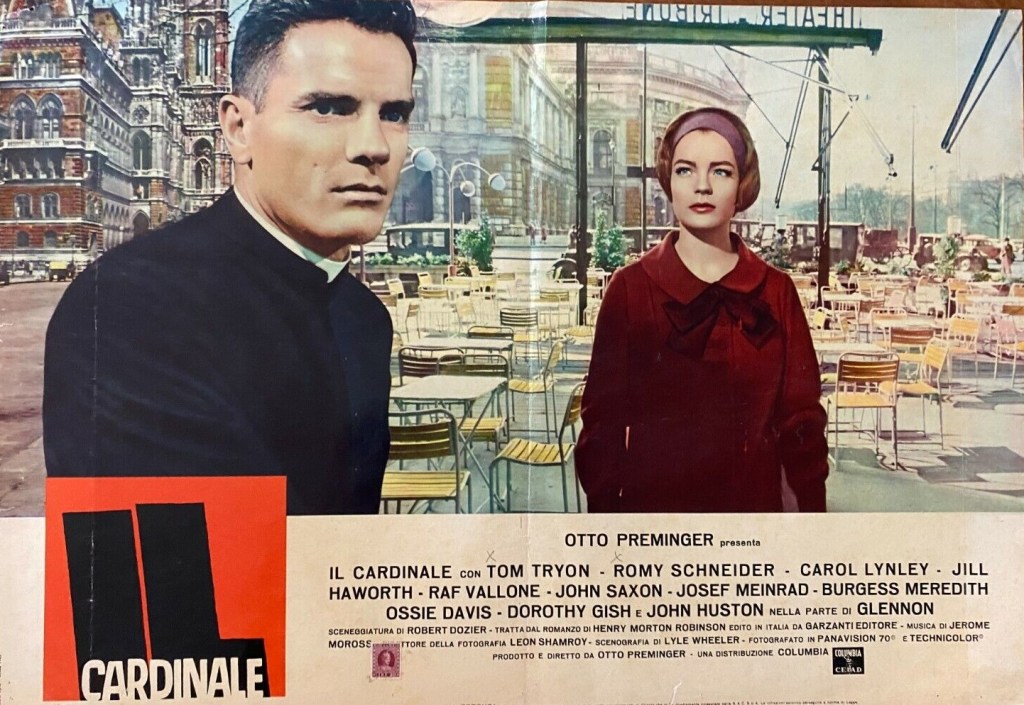
Gore Vidal (The Best Man, 1964) also worked on the script, swapping the novel’s Italian countess for the Viennese Annemarie (Romy Scheider) who, abandoned by the priest had married and was reunited with him prior to the Anschluss, and is sympathetic to Hitler until her husband’s faith endangers them both. Ring Lardner, who had satirized the Catholic church in a recent novel, was the final screenwriter added, his main task to rewrite scenes “to achieve what he (Preminger) wanted,” and, more importantly, to introduce the flashback structure. Ironically, both Vidal and Lardner were atheists.
Tom Tryon and Romy Scheider meet again in Vienna.
The director considered five actors for the leading role – Hugh O’Brian (Africa – Texas Style, 1967), Stuart Whitman (The Commancheros, 1961), Cliff Robertson (The Devil’s Brigade, 1968), Bradford Dillman (Circle of Deception, 1960) and Tom Tryon (In Harm’s Way, 1965), the latter three advancing to the screen-testing stage. The 34-year-old Tryon won the role and a five-picture contract he would later regret. Carol Lynley (Bunny Lake Is Missing, 1965) who plays the priest’s sister also pacted for five movies.
Romy Scheider’s (Triple Cross, 1966) part was enhanced by the work of cinematographer Leon Shamroy who “fell madly in love with her,” resulting in the actress virtually shimmering on screen, never before “looking as beautiful.” Held in warm regard by the director, she was exempt from his tirades.
It took considerable persuasion on the part of Preminger for John Huston to participate. Curd Jurgens, initially cast as the Austrian cardinal, pulled out and was replaced by character actor Josef Meinrad whose lack of English meant he had to learn his lines phonetically.
Tom Tryon described Preminger as “tyrant who ruled by terror.” He was fired on the first day and probably wished the director had not rescinded the decision, for thereafter the actor was tabbed “lazy…a fool…stupid and unprofessional.” Commented Tryon, “I was so frightened he was going to scream that…I (just) wanted the experience to end.”
One scene with John Huston took 78 takes because Tryon could not deliver what the director wanted. And at one point first assistant director Gerry O’Hara (later director of The Bitch, 1979) found the star in tears and refusing to return unless the director agreed not to shout at him. Eventually, during the Italian section of the shoot, Tryon collapsed from nervous exhaustion, and was prescribed two days rest, and after this incident Preminger let up on his demands of the actor.
Explained Preminger, “I probably chose him without deliberation because he is weak.” He felt than an ordinary person would not side with the Church against a family member in a predicament, and that only a person “with weakness in his character” would be believable in the role. The character “fails because when you become a priest you substitute your own judgement and your own feelings for the law of the Church…The big decisions are made for him.” (Quite why he never chose an actor who could portray such weakness is not known.)
Tryon admitted that he owed a brief let-up in the bullying to “Schneider’s benign presence.” He commented, “The only fun I ever had on The Cardinal was a (ballroom) scene I did with Romy.” Prior to turning the cameras, Prior called both over, appeared ready to issue instructions, but instead waved them away “you know what to do.”
Added Schneider, “Preminger taught me an important thing: work fast. It’s true that it greatly helps our acting. Each of his directions, whether of gesture or of intonation, is precise and correct. Even better, it’s the only one possible…Each phrase, each world, each syllable are minutely weighed.” That dexterity applied to his positioning of the camera. He made decisions immediately, never hesitating “over the placement of the camera and each time…it was the simplest, the most natural and, dramatically, the best.”
Ossie Davis (The Scalphunters, 1968), who professed to have enjoyed a marvellous relationship with the director, observed: “I met actors whom Otto liked, I met actors that had no relationship or feelings one way or the other and I met actors who were almost absolutely destroyed, almost literally in panic because of Otto Preminger (who) was always looking for a spark…whether you had the spark or not, he was going to find it and even put it in you.”
But Patrick O’Neal stood his ground. “I woiuld not take it from him.” And they became friends.
The unit shot for five weeks in New England before heading to Vienna, Preminger choosing to stay in the same suite in the Hotel Imperial as appropriated by Hitler when visiting the city. Permission to shoot in the National Library, “one of the most beautiful monuments in the city” was attacked by the current minister of education who wanted the Hitler era erased from memory. And he was barred from using other government buildings for spurious reasons.
After four and a half months in Austria, the unit shifted to Rome, locations including St Peter’s Square and inside St Peter’s Cathedral and the Santa Maria sopra Minerva church, with priests and monks hired as extras for the various ceremonies. The Georgia scenes were shot in Hollywood on the Universal back lot.
Although generally dismissed by the critics and given a hard time as you might expect from the Catholic Church, The Cardinal hit a chord with audiences, who turned it into Premigner’s second-biggest hit of the decade.
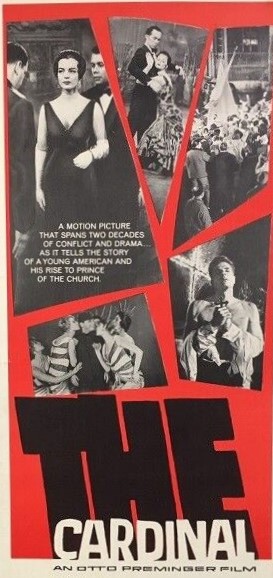
Would appear resolutely old-fashioned except for Forrest Gump (1994) adopting same premise of the main character present at major events. Here it’s issues affecting the Catholic Church between last century’s two world wars and the protagonist is an American priest, Father Stephen Fermoyle (Tom Tryon) of Irish stock, who rises to the position of Cardinal.
So we move at a relatively stately pace through abortion, inter-denominational marriage, racism, a miracle, challenging church philosophy, and Hitler’s annexation of Austria on the eve of the Second World War, in which the church played an inglorious part. Along the way Fr Fermoyle is afflicted so badly by doubt that he takes a sabbatical only for his flesh to be sorely tempted.
Astonishingly, I saw this on YouTube (it’s still there) in a beautiful 70mm print preserved by the National Film and Television Archive. The roadshow print, to be exact, which begins with a marvellous five-minute overture. Oddly enough there’s something very settling about sitting in the darkness with the curtains drawn watching a blank (black) screen and listening to the majestic score by Jerome Moross (The Big Country, 1958).
And then it’s another few minutes of a stunning credit sequence, all sunlight and shadow, before the movie begins. The movie itself is over three hours long, so if you are put off by this kind of epic now’s the time to check out. But if you do, you will miss something genuinely to be savored.
For Otto Preminger (Hurry Sundown, 1967) certainly knows how to tell a story, even one as sweeping as this. For all its pomp, he manages to retain intimacy.
Immediately after his ordination just as America enters the First World War, Fr Fermoyle faces a crisis. His sister Mona (Carol Lynley) wants to marry a Jewish dentist (John Saxon) who refuses to convert to Catholicism. Fermoyle’s advice, in keeping with the church’s stringent rules: give him up.
A noted intellectual, Fermoyle is astonished to be sent by the worldly piano-playing cigar-chomping Archbishop Glennon (John Huston) to an impoverished parish to learn humility. There, he encounters the blind faith of parishioners and a pastor, Fr Halley (Burgess Meredith), so inclined to put others first that he will not seek help for a debilitating disease.
Meanwhile Mona, now a dancer and drinker, has become pregnant, and not by the dentist. But complications arise and she is forced to choose between herself and the unborn child. According to Church doctrine, as Fermoyle, advises, abortion being illegal, the mother must die to save the baby. Mona, not the sacrificial kind, does the opposite. Fermoyle, racked with guilt, wants to quit the church. Instead, he is promoted to Monsignor, and given a two-year timeout which he spends lecturing in Vienna.
There he falls in love with Annemarie (Romy Scheider). In the nick of time, he is recalled to the States and sent to the Deep South to help the black Fr Gillis (Ossie Davis) who is being harassed by the Ku Klux Klan. In standing by his colleague, Fermoyle undergoes a brutal whipping. Promoted to bishop, he is despatched to Austria “to instruct the princes of the church in the realities of the modern world.” Unfortunately, the clergy, siding with the Nazis, presides over the marriage of Germany and Austria.
Meanwhile, he is reacquainted with Annemarie, who has married a Jewish banker, and witnesses at first-hand Nazi treatment of the Jews, her husband so fearful of his future he jumps out a window. When a mob ransacks a church, Fermoyle isn’t so intent on facing up to them and instead, with Annemarie, manages to escape.
At its best and its worst by the narrative being forced through the prism of an individual. His reactions to issues are regulated by his employers, the Church, which exerts as much control over personal thought as the Communist Party, so, in effect, it becomes a tale of a person initially bristling against authority until, it turns out, the Church shares the same antipathy to the worst of the century’s scandals, the Ku Klux Klan and the Nazis.
Father Fermoyle hardly seems suited to high office, given he is so often inclined to temptation, either in a sexual sense, or in taking the opposite view of the Church. And it’s almost as though the splendid backdrop as represented by the immense wealth of the Church has only been achieving by subjugation of the individual. That the worldly Glennon appears as the poster boy for the Church hierarchy is almost Preminger playing with the audience.
It might be sumptuously mounted, but once again Preminger takes no prisoners, showing up an institution that while purportedly set up for the benefit of mankind so often sabotages noble endeavor.
Tom Tryon (In Harm’s Way, 1965) is excellent in the leading role, personal conviction getting in the way of the easy path to the top. But the pick of the performers are the supporting stars, especially John Huston, more famous as a director (The Night of the Iguana, 1964) and here making his acting debut, and Romy Scheider (Triple Cross, 1966). Look out for Carol Lynley (Bunny Lake Is Missing, 1965), silent film star Dorothy Gish in her final movie appearance, Maggie McNamara (The Moon Is Blue, 1953) in her first picture in eight years, and John Saxon (The Appaloosa, 1966) before he was typecast as a heavy.
Otto Preminger (In Harm’s Way) directs in stately fashion from a screenplay by Robert Dozier (The Big Bounce, 1969) and Ring Lardner Jr. (The Cincinnati Kid, 1965).
In October 1962 Otto Preminger bought the rights to Harm’s Way, a thumping big bestseller by Ronald Basset with a host of characters and sub-plots which serve, like Advise and Consent by Allen Drury, to analyse an American institution, in this case the Navy, pre- and post-Pearl Harbor. In some respects, it was an odd choice, Preminger better known for pictures that filleted such august institutions, The Cardinal (1964) exposed the inner workings of the Catholic Church. On the other hand, it rubbed shoulders quite happily with Exodus (1960), a tale of battle against the odds.
Preminger’s aim was to blunt the current onslaught of movie pessimism with a picture that ended on an optimistic note. He observed: “We are attacked, we are unprepared in every way, and manage by sheer guts, character and resourcefulness to start to work out of it.” He concluded that such action “should remind us and perhaps other people that there is never any reason to give up or to give in to anything that is not right or dignified.”
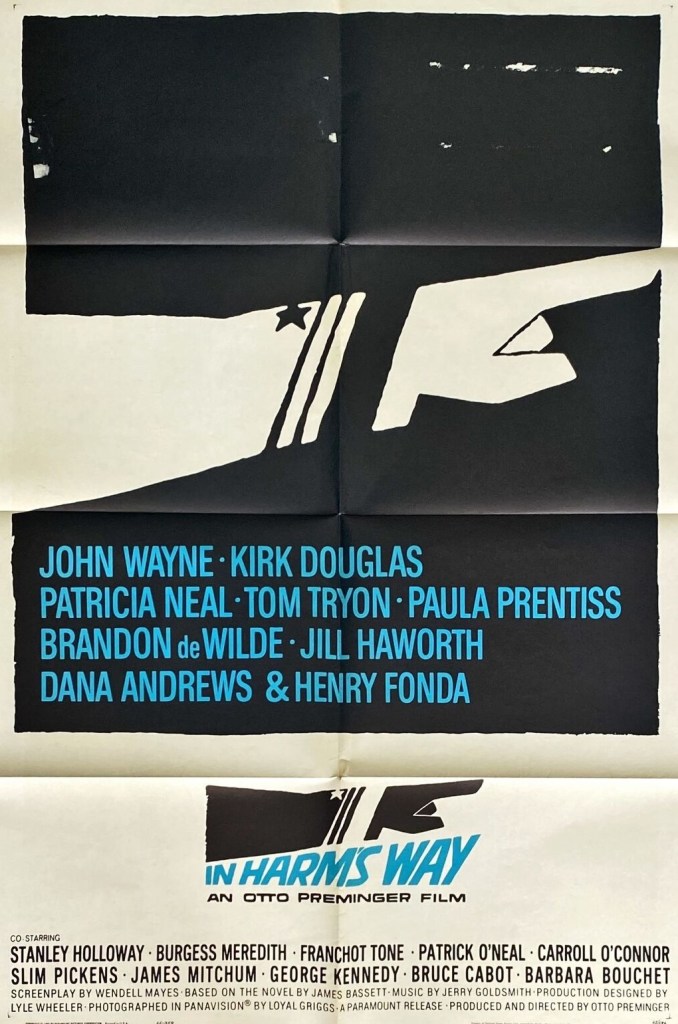
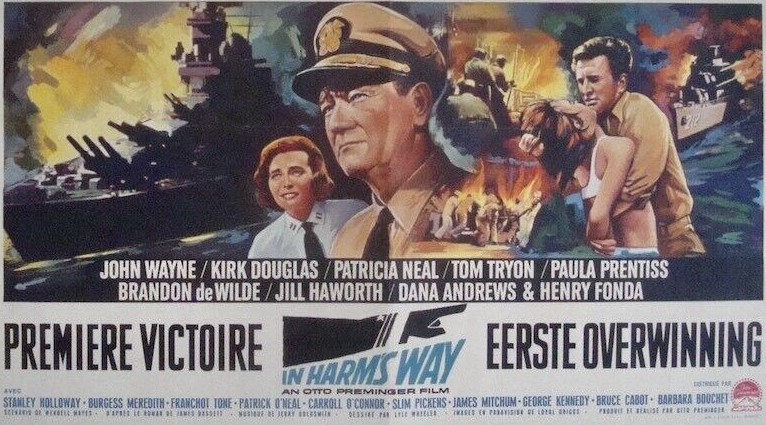
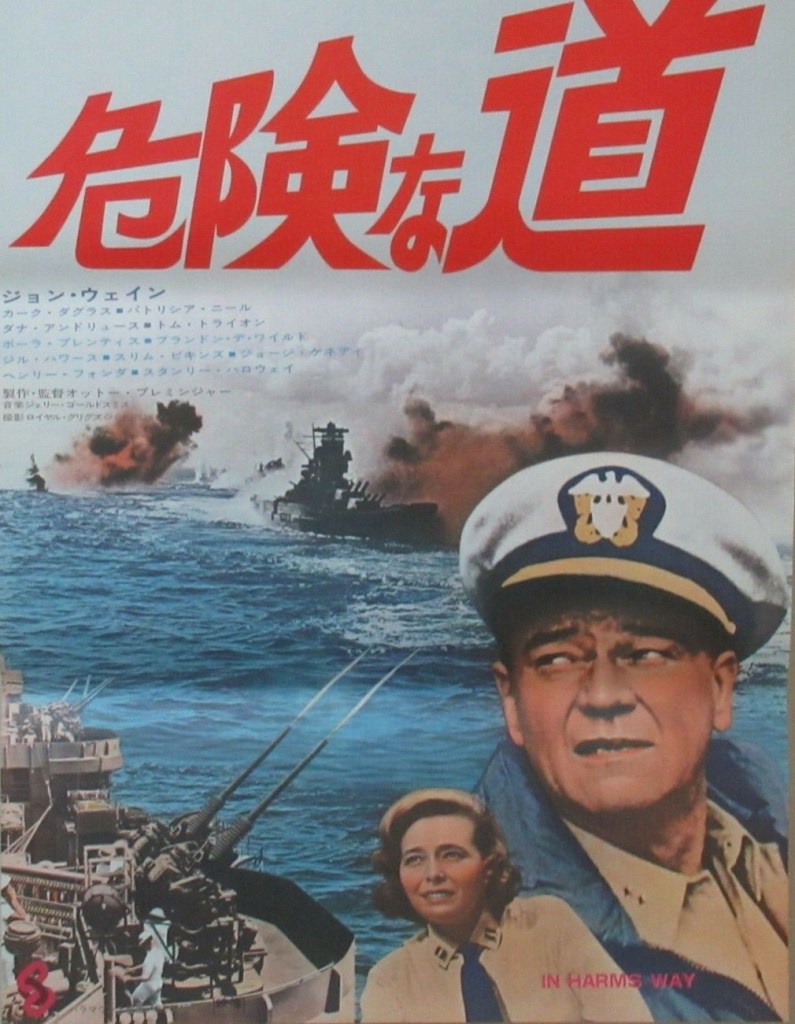
Celebrated Saul Bass poster.
“One of the reasons I made In Harm’s Way,” explained the director, “is that it is a big step away from most of the films I have made so far. I try not to repeat myself too much…not to make pictures in just one category…I was very fascinated by the characters and the story..,(which) shows that people will act even if they are unprepared and don’t want war.”
Wendell Mayes (Advise and Consent, 1962) started on the screenplay right away, taking it so far as embarking on a rewrite with the director in London. But the project was unexpectedly shelved for a couple of years. In the meantime Preminger assigned a different writer, Richard Jessup. But when the concept received the director’s full attention once again Mayes was at the wheel and with a different approach. “I had a fresher point of view and did many things that were not in the book at all. I think we improved it for that reason, since we had quite forgotten the novel.”
But collaboration with Preminger was exacting. “We sat together and and worked over almost every line,” explained the director. “I always work very closely with the writer on the screenplay…There is one man, the independent producer-director, who from very beginning takes the whole responsibility and has complete autonomy. I feel responsible for the script: I engaged the writer and I worked with him. Like I direct actors, I feel a director also directs the script.”
In particular, into sharper focus came the son, Jeremiah (played in the film by Brandon de Wilde) of Rockwell Torrey (John Wayne). In the book he had been a passing, insignificant character, who quickly befriended his father. “He had no feelings about the fact that his father had left his mother, and we changed that in the script,” said Mayes. This provided not just a source of dramatic tension but a more mature role for Wayne, who had to express regret for the estrangement, all his fault. (Although the idea of a son enlisting against the mother’s wishes reflect a similar situation in Rio Grande, 1950).
Wayne was Preminger’s first choice. “Because it has passive elements, a strong actor like Wayne is ideally cast,” said the director. Despite being sent an incomplete script, the star signed up – for $500,000. “I don’t look for stars and I don’t avoid them,” he said. The leading roles in Bunny Lake Missing (1965) and The Cardinal (1964) went to relative unknowns. “I would not ask John Wayne to play, say, a coward because his image is not the image of a coward, or have him play a Greek philosopher…He at least fulfilled all my expectations more than I could possibly hope for. Kirk Douglas, too, came to my mind almost immediately.”
The movie should have ended up at Columbia which had funded the director’s last two movies and would back Bunny Lake. But Preminger had just struck a deal for seven pictures with Paramount and in January 1964 that agreement was announced with the re-titled In Harm’s Way (a phrase associated with John Paul Jones).
Mayes completed the new draft two months later with the rest of the cast now assembled, including Preminger contract players Tom Tryon (The Cardinal) and Jill Haworth (Exodus) who replaced original choice Carol Lynley (Bunny Lake). Keir Dullea turned down the part of Jeremiah. Advise and Consent’s Henry Fonda came on board as the overall Navy commander at the expense of Chill Wills who was fired after shooting had begun.
One uncredited recruitment was Hugh O’Brian (Africa, Texas Style, 1967) who undertook the part of Liz Eddington’s lover. “He played a role as a favor without compensation,” recalled Preminger. “He did not want billing and only asked that I give some money to a charity. I needed somebody who was a secure actor and right for the part because I used a complete beginner (Barbara Bouchet) for the girl he plays opposite. And if I used some other young actor with her, people would have felt that this couple would disappear almost immediately at the beginning of the film. It was important to me to establish this young couple as an important episode at the beginning of the film and he helped that.”
The director spent three days scouting locations in Hawaii but decided to shoot in black-and-white because “ a picture like this has much more impact and you can create more of the feeling, the illusion of reality, than when you shoot it in color.” False guns mounts were attached to more recent ships since the older relevant vessels were no longer available.
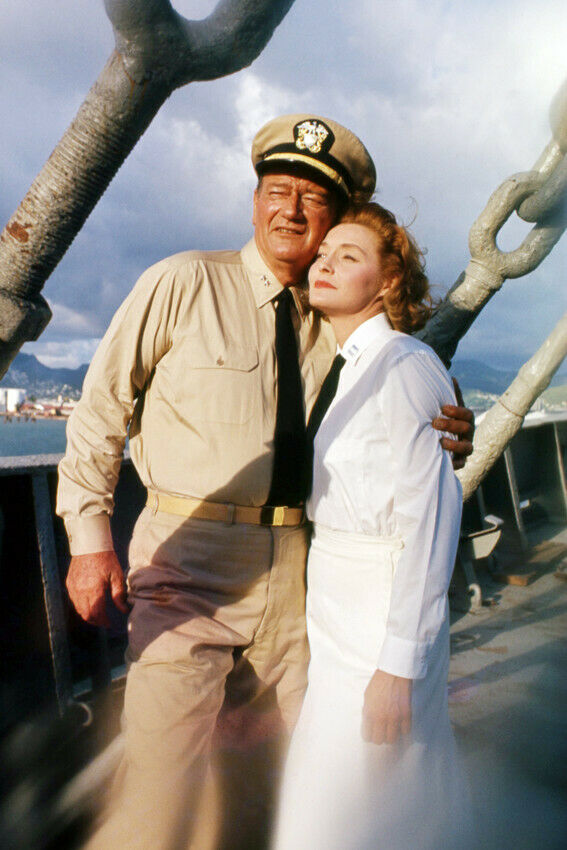
Wayne with co-star Patricia Neal.
Shooting started on June 23. The biggest issue was transportation, drivers getting lost reaching locations for the night-for-night sequences. Preminger struggled to meet his shooting schedule and the movie was soon over budget thanks to long hours, Sunday working and extra local staff. Even so, the Hawaii shoot came in 17 days ahead of schedule. Five days were assigned for shooting at sea. Larger than usual miniatures – some as much as 55ft long – were shot over a month on a lake in Mexico and in the Gulf of Mexico, the battle of Leyte Gulf costing an estimated $1 million. “I needed the real horizon,” said Preminger.
Some scenes were proving impossible to capture first time out. A second unit had two attempts filming a car going over a cliff, a marine landing was spoiled by water on the lens, and technical problems prevented Preminger achieving a “mystic-hour shot” of a plane taking off. Part of the director’s problem was his insistence on rehearsal. “I could make every picture in ten days if I slough it. Some actors just need more time and more rehearsal.”
Despite observers expecting – perhaps hoping – for volatile confrontation between the director and star, the pair enjoyed a cordial relationship based on mutual respect. Of Wayne, Preminger commented that he was “the most cooperative actor, willing to rehearse, willing to do anything as long as anybody. I was surprised really how disciplined a professional Wayne is and he liked this particular part very much.”
From Wayne’s perspective, “He had my respect and I had his respect. He is terribly hard on the crew and he’s terribly hard on people that he thinks are sloughing. But this is a thing that I can understand because I’ve been there (directing The Alamo) and I know that if a fellow comes on and he’s careless and he hasn’t thought at all about his…I come ready and that he appreciated that. I was usually there ahead of him on the set and he couldn’t believe that. So we had a really nice relationship.”
It was surprising Wayne remained on such an even keel since he was beginning to suffer from the cancer that would eventually kill him. “He looked ill,” Tryon remembered, “He was coughing badly, I mean, really awful. It was painful to see, so God knows what it was like for him. He’d begin coughing in the middle of a scene and Preminger would have to stop filming.” Although he refused to consult a doctor during filming, he agreed to a check-up once shooting of his role was complete, three weeks earlier than scheduled. He may indeed have owed his life to Preminger’s speedy shooting.
Kirk Douglas had a bone to pick with Preminger after the director stole the glory of being the first director to publicly announce, on Exodus, that he had employed a blacklisted writer, pre-empting Douglas who had done the same for Spartacus (1960). Although Douglas didn’t rank Preminger as a director he enjoyed a good relationship with him except for one minor confrontation.
Douglas got on well with Wayne: “There was a mutual respect…We got along quite well…He was a strange fellow. I’ll never forget the talk we had about my playing in Lust for Life (1956). Although emotionally we were not close and politically we were antipodal he asked me to work with him several times.” (Not entirely true – Douglas would have been the driving force for their collaboration on Cast a Giant Shadow in 1966 and he fell out spectacularly with Wayne on The War Wagon in 1967).
But others suffered from Preminger’s notorious temper, Tom Tryon in particular. The bullying became so bad Kirk Douglas once walked off the set. Douglas advised Tryon to fight back but Tryon could not pluck up the courage. Chill Wills who endured Preminger at his “absolute worst” did stand up to him and was fired. Patrick O’Neal turned on actors who refused to fight their corner. “Stand up to him once and find out he’s a human being,” was his advice.
Myth has it that Paula Prentiss’s role was truncated after she fell foul of the director but rumour was baseless. In fact, Prentiss was another of the director’s defenders, claiming he was “absolutely wonderful to work with. For a scene to work, tension needs to be put into a scene. There have to be genuine efforts to make the scene work. And Preminger understood this and was able to get much conflict and tension into the scenes.” And he was not all tough talk. She recalls him as particularly gentle guiding her through the scene where she asks her husband to make her pregnant.
Although surpassing the original $5 million budget, it was not by much, an extra $436,000. The Production Code had objected to the phrase “screw the captain,” a line Preminger refused to remove and despite further protest from the censor, who threatened to withhold the precious official approval,the director got his way. Preminger had shot the scene where Barbara Bouchet was dancing topless from the rear but the still photographs were sensational enough for publication in Playboy in its May 1965 issue.
The decision to shoot in black-and-white probably accounted for the picture’s relatively poor box office. Its length and the all-star cast should have qualified it for roadshow. (It was roadhsow for all of one day at two prestigious new York first houses; the next day it went continuous, but you could advance book a seat for an extra 50 cents). It was a sign of how quickly audience perceptions had changed that only three years previously the black-and-white The Longest Day had appeared as a roadshow and proved a resounding hit.
As a result of Wayne’s illness The Sons of Katie Elder was postponed. Preminger moved onto a smaller project, Bunny Lake Is Missing and Douglas reverted to top billing for The Heroes of Telemark (1965). Tom Tryon never worked for Preminger again and after top-billing in The Glory Guys (1965) faded from Hollywood view, re-emerging as the bestselling author of The Other. Paula Prentiss shifted sideways into television with He and She (1967-1968) and Jill Haworth made very few films after this, of which most were horror.
SOURCES: Chris Fujiwara, The World and Its Double, The Life and Work of Otto Preminger (Faber and Faber, 2008), p317-329; Scott Eyman, John Wayne, The Life and Legend, (Simon & Schuster, 2015) p385-387; Maurice Zolotow, Shooting Star, A Biography of John Wayne (Simon & Schuster, 1974) p361-362; Michael Munn, John Wayne: The Man Behind the Myth (Robson Books, 2003) p254-255; Kirk Douglas, The Ragman’s Son (Simon & Schuster, 2012), p387-381; Ian Cameron, Mark Shivas, Paul Mayersberg, “Interview with Otto Preminger,” Movie 13 (Summer 1965), p15-16; Patrick McGilligan, Backstory 3, p266; Otto Preminger, “Keeping Out of Harm’s Way,” Films and Filming, June 1965, p6; Newsweek, April 20, 1964; New York Herald Tribune, October 17, 1965, p55.
Preminger at a peak, the more I watch this picture, not just the more impressed I become but the more I want to watch it again – three times, as it happens, for this review. A tale of heroism populated by morally wounded heroes, the undertone of critique for the Naval establishment dealt with in brilliant narrative fashion, terrific pacing, one of John Wayne’s very best performances, Kirk Douglas not far behind, great action scenes, and one of the few movies to fulfil this director’s original intent.
You can, of course, argue that it’s the height of political PR. Just as the Americans managed with The Alamo and the British with Dunkirk, the aim was to turn defeat into victory, so this moves beyond the humiliation of Pearl Harbor to the victories beyond. But in some sense Pearl Harbor is just the prologue to a stiffer examination of men at war, rather than sailors taken to task over the complacency that left them so open to cataclysmic attack.
And while there’s a number of sub-plots, these are more expertly handled than I can recall in many another lengthy big-budget picture, no endless cutting between major and minor characters, but the minor characters only entering the frame when they have a dramatic part to play.
Captain “Rock” Rockwell (John Wayne) falls foul of his superiors for basically being in command of a ship sunk by a torpedo. On a technical point, he’s stripped of command, and reduced to a desk job, a casualty of the peace-time hierarchy determined to find someone to blame, only returning to active duty – and promoted to Admiral – when more war-oriented figures are put in charge.
The desk job gives him time to romance feisty nurse Lt. Maggie Haines (Patricia Haines) who has the cojones to take charge of the budding relationship. She happens to share an apartment with another nurse, the much younger Ensign Annalee Dorne (Jill Dorne) who is dating entitled Ensign Jeremiah Torrey (Brandon de Wilde), Rock’s estranged son.
Jeremiah works for slimy glory-hunter Commander Neal Owynn (Patrick O’Neal), a former U.S. Congressman using his political skills to worm his way into the office of by-the-book Vice Admiral Brodick (Dana Andrews). Rock shares his apartment with Commander Egan Powell (Burgess Meredith), a thrice-married playboy, high up in Navy intelligence.
Rock’s second-in-command is Commander – junior to a captain in case you don’t understand the U.S. Navy ranking system – Paul Eddington, a hothead whose mourning for dead wife Liz (Barbara Bouchet) results in him also being reduced to a desk job and exiled to the Pacific. On the fringes of the story are Lt. Commander “Mac” MacConnell (Tom Tryon) and pregnant wife Beverley (Paula Prentiss).
How all these characters enmesh is the consequence of a quite brilliant screenplay by Wendell Hayes (Advise and Consent, 1962). Rockwell and Eddington both seek redemption, the former to prove his Naval worth and regain the affection of his son, the latter to absolve himself for his terrible actions.
You can always tell the hero in war films because they are so rarely a physical casualty of war, all the others are killed and wounded but hardly ever the hero, so it takes something for the Hollywood Hero of the Century to play a character who is wounded not once but twice, and for the early part of the picture walks around with his arm in his sling (not quite an echo of the way he holds his arm in The Searchers, but evoking the same internal conflict).
The only supposed out-and-out hero is MacConnell, but his inaction at the beginning of the movie fails to prevent the death of Eddington’s wife. And his heroism largely takes place off-screen and it’s worth noting that Rock doesn’t raise a rifle or pistol in anger (or even get into a punch-up as was the actor’s wont in other films). Being in charge he’s removed from the core action even if suffering the consequences of battle. In a marvellous touch of irony, Rockwell is the most passive hero to hit the screen. It’s an incredibly bold and self-confident director who would even think of luring audiences into an action picture starring the Hero of the Century and then denying him a single moment of screen glory.
Much has been written about the cinematic arc John Ford took in the beginning and ending of The Searchers, the symbolic opening and closing of doors, but since Preminger is long out of critical favor nobody’s has bothered to notice how much of this film concerns cinematic echo.
To take the most obvious example, the first witnesses of the airborne Japanese attack on Pearl Harbor are illicit pair Liz Eddington and her paramour (Hugh O’Brian) and towards the end it’s her husband Paul, by this point guilty of horrendous behaviour, who leads the airborne fightback against the enemy.
A beach – where Liz and escort make love – is how the director initially pushes the audience towards sympathising with the drunken Eddington. A beach is where we later learn to despise him, as he brutally rapes Ensign Dorne. And it doesn’t take much to work out that his wife’s exuberant wildness explains Eddington’s initial attraction to her, not realising that psychologically it provides him with an excuse for his own darker wildness, initially restricted to self-destruction but when it truly emerges it’s to the detriment of an innocent.
And that’s before we get on to Rockwell as the messenger of death, delivering the bad news to wives, and then being on the receiving end after his son dies in battle. And finally, the political peace-time high-ups get their come-uppance in actual war.
It’s insulting – as some have suggested – that the performance of John Wayne (The Hellfighters, 1968) is the result of undiagnosed cancer when in fact this is a finely nuanced role of a high-ranking figure living out in his life in regret, at times quite shamefaced about abandoning his son at a very early age. Preminger cracked down on Wayne’s habit of splitting his lines in two, so those typical pauses we have come to expect are in large part gone, and it helps the movie’s pacing. For most of the movie the character is saddled with consequence. That passivity that the director saw as essential to the role is virtually present all the time.
Preminger wrings a different performance, too, from Kirk Douglas (A Lovely Way to Die, 1968), equally laden with regret, but not enough to prevent him lashing out and the actor is accorded two quite stunning scenes, the first as he broods in silence over his wife, but for the second, prior to raping Ensign Dorne, the stone-cold look on his face suggests a serial killer held at bay for too long and now about to explode.
Burgess Meredith (Hurry Sundown, 1967) is another brought to directorial heel, his more common scene-stealing and vowel-stretching also eliminated, but in exchange given a larger-than-life character on which to expend screen energy. The entire cast is good-to-excellent and it’s jam-packed: Patricia Neal (Hud, 1962), Tom Tryon (The Cardinal, 1964), Paula Prentiss (Man’s Favorite Sport, 1963), Brandon De Wilde (Shane, 1953), Jill Haworth (Exodus, 1960), Dana Andrews (The Satan Bug, 1965), Franchot Tone (Advise and Consent, 1962), Patrick O’Neal (Stiletto, 1969), George Kennedy (Cool Hand Luke, 1967), Henry Fonda (Battle of the Bulge, 1965), Barbara Bouchet (Danger Route, 1967) and Stanley Holloway (My Fair Lady, 1964) Many of the supporting cast were also playing against type – Prentiss as the young wife falling to pieces, Andrews and O’Neal as slippery political types, Holloway a guerrilla, and perhaps most interesting off Neal, not the typical woman left behind when the man goes off to war but, in her role as nurse, entering harm’s way herself.
And despite criticism of the miniatures used in sea scenes while that might have been obvious on the big screen you don’t notice it on the small screen. The action scenes are very well-done for the time, and quite unusual in that by and large it’s the Americans who appear shell-shocked not the enemy.
Cramming this much narrative into the overall arch of Pearl Harbor and retaliation against the Japanese, while bringing so many different characters to the fore with clear dramatic purpose is an amazing achievement, screenwriter Wendell Mayes (Advise and Consent) doing the heavy lifting in this department.
But Preminger the director is very much to the fore, in his composition and use of the camera for long tracking shots (a particular favorite of mine) such as at the beginning. A riveting watch full of splendid acting. Shooting it in black-and-white might have at one time appeared to date the picture but instead it has rendered it ageless. Five stars without a doubt.




 The Magnificent 60s