The Beckett Affair / L’Affare Beckett (1966) ***

More down’n’dirty Eurospy than the more pervasive high-gloss alternative and with some interesting directorial touches, especially in relation to POV, a narrative that leads you a merry dance but mostly down the road of grubby international politics, plus an eclectic score from Nora Orlandi. Even with actors I’d never heard of, and no idea how the DVD even ended up in my collection, it works well.

Opening Parisian sequence a standout. Gunman bursts through an office door, marches older occupant towards the exit. Outside, however, it’s the older man who emerges, climbs into a waiting car and again it’s he who comes out of that, leaving slit throats in his wake. The survivor, with a ramrod-stiff demeanor, turns out to be Col Segura (Gianni Solaro), wanted by the authorites for clandestine activites in Cuba in 1961 and for instigating too many apparent suicides.

Agent OS47 Cooper (Lang Jeffries), drafted in to track him down, does so by means of a letter supposedly written to his mistress Claire Beckett (hence the title) who is nowhere to be found. Next best thing is her secretary, blonde bombshell Helen (Nathalie Nort), who is already on Segura’s radar and is promptly kidnapped and then used to lure Cooper to a breaker’s yard where various tough guys want to beat him to death. Beckett, it transpires, ain’t going to be found unless you fancy digging graves.

The good guys are as villainous as the villains, torturing a suspect. As you might expect, there’s a heap of double-crossing, another agent as well as a cop in the pay of the opposition. Cooper’s sidekick Paulette (Krista Nell) is as tough as anyone, her beauty belying her fighting skills. The plot’s somewhat complicated and leads Cooper to being hired by Segura to assassinate a Nicaraguan leader, the notion of liberating Cuba just a front to mislead Segura’s pursuers.

Action sequences are more limited than the normal run of spy pictures, but when they come they pack a punch. The tussle in the breaker’s yard might appeal more than that in Mickey One (1965) for resisting the temptation to go down the existential or metaphorical route. Like the rest of the film it’s a down’n’dirty scrapyard. In the best action sequence, with an idea I’ve seen later stolen, the music playing that you assume to be the film’s score abruptly ends halfway through the fighters destroying an apartment, because they’ve trashed the object emitting the music. That takes a moment to digest so the sudden silence after the loud music strikes a stylistic note.

While Cooper isn’t as active sexually as James Bond, he does, like 007, get intimate with woman who might prove useful. Segura is good bit more normal than your usual espionage supervillain, with more flaws than you’d expect, especially after our introduction to him. There’s also unusual depth in subsidiary characters, Helen jealous of her boyfriend, secondary villains seeking social advancement and not always following orders, Paulette proving more than a second-potato character.

Theoretically set in France, Switzerland and South America, only the first locale appears authentic, with many outdoor shots, but not reliant on steeotypical tourist tapestry.

One of the alternative titles, The Spy Pit, better catches the tone of the picture, everyone caught in an espionage trap, and, ironically, given the constantly changing world of international politics, much of the background here has been superseded by real events. I’m putting the moodiness down as deliberate not just the state of the DVD.

Canadian Lang Jeffries (The Revolt of the Slaves, 1960) is a decent ersatz Sean Connery, Austrian Krista Nell (The Million Eyes of Sumuru, 1967) a capable sidekick, Gianni Solari (Seven Seas to Calais, 1962) comes across as efficient businessman rather than demented villain, Mali-born Nathalie Nort (Succubus, 1968) proves equal to an enlarged supporting role.

While you wouldn’t call it a directorial triumph, and it could do with some narrative clarification, Osvaldo Civirani (Return of Django) has more stylistic flourishes in his armory than you’d expect. Written by veteran Roberto Gianviti (Zorro and The Three Musketeers, 1963) who had over 100 movie credits.

Interesting take on the Eurospy subgenre.

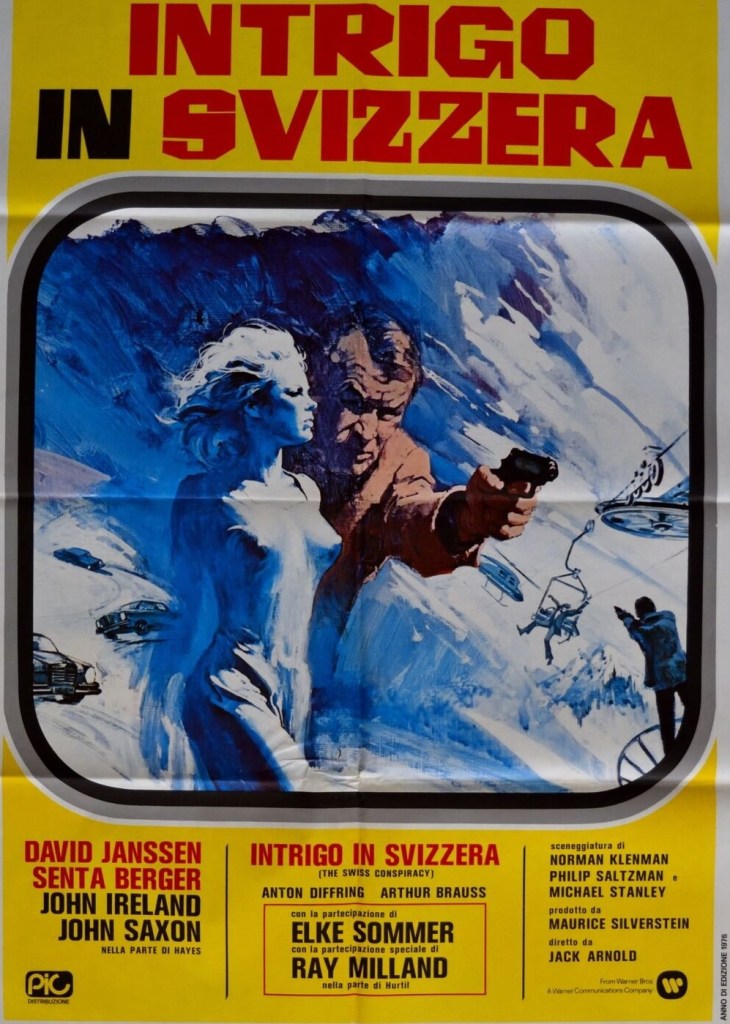
The Swiss Conspiracy (1976) ***

One of those thrillers that only makes sense at the end. Lazy critics, too annoyed to wait or not able to work it out themselves, take out their bafflement on the picture. Or they carp at what they see as overmuch tourist influence instead of admiring the clever use made of Switzerland’s scenic attractions, the twisty cobbled streets, corkscrew highways teetering over ravines, and the apparatus of skiing – the chug-chug trains and lifts.  

Attractive too for the cast. You might put me down as overly fond of leading lady Senta Berger (Bang! Bang! You’re Dead! / Our Man in Marrakesh, 1966) but I’m equally appreciative of the casual charm and realistic qualities brought to the screen by the underrated David Janssen (The Warning Shot, 1967). And that’s before we come to Elke Sommer (The Prize, 1963) and veteran Hollywood star Ray Milland (Hostile Witness, 1969), not to mention character actors John Saxon (The Appaloosa / Southwest to Sonora, 1966) and John Ireland (Faces in the Dark, 1961).

Poster designer gives himself a bit of leeway here, suggesting a lass is going to be striding around the Alps in such clingy clothing.

Former U.S. Treasury Agent David Christopher (David Janssen) is called in by Swiss bank owner Johann Hurtil (Ray Milland) to investigate a threat to expose the clients hiding behind the country’s infamous secret numbered accounts. Five clients, in particular, have been targeted including the glamorous Denise Abbott (Senta Berger), whom David first encounters in what would in other circumstances be deemed a clever meet-cute with the woman getting the upper hand.

One client is already dead, murdered in the opening sequence, as a warning. Of the others, Robert Hayes (John Saxon) is a mobster depositing illicit gains for money-laundering purposes, Dwight McGowan (John Ireland) a shady businessman on his last legs, while Kosta (Curt Lowans) equally operates in the shadows. And all is not well with the bank deputy Franz Benninger (Anton Diffring), involved in an affair with another client, Rita Jensen (Elke Sommer). On top of that, Swiss cops are on the trail of Hayes and hit men are tailing Christopher.

Christopher quickly surmises that the victims have been targeted for their undercover dealings, even the uber-glam Denise is blackmailing a former lover. But Hurtil, fearing a public and media scandal, and for whom the gangster’s demands are a mere drop in the ocean compared to the bank’s overall wealth, decides to meet their terms, which is payment of 15 million Swiss francs (equating to several million U.S. dollars, I guess) in uncut diamonds.

But before that we have a punch-up and shoot-out in a parking garage, a chase on foot on those famous narrow cobbled twisty streets with a speeding car giving the thugs unfair advantage, a race of seduction a la On Her Majesty’s Secret Service (1970) along those aforementioned treacherous mountainous roads, a literal cliffhanger in the vein of The Italian Job (1969), and one of those luscious romances beloved of the upmarket thriller (think The Thomas Crown Affair, 1968).  

While Christopher is painstakingly putting together the clues and keeping the suspicious Swiss police off his back and avoiding being killed, there’s a deadline to meet, the usual race against time, while the audience is having to fend off a surprising number of red herrings.

It’s not only glamorous, it’s short, and there’s more than enough going on, characters played by interesting actors, to keep the viewer involved. And I defy you to guess the ending. So, enough thrills, sufficient mystery, great scenery, and a female contingent (even Christopher’s secretary fits that category) with brains to match their sexiness who appear to have the upper hand in relationships with the opposite sex.

This is David Janssen at his best, that outward diffidence concealing a harder inner core, exuding a guy-next-door appeal that was never properly utilised by Hollywood, who preferred him just to reveal character by squinting. The scene where he takes in the extent of the luxury of Denise’s hotel penthouse is one of those that, while not knocking on Oscar’s door, demands true acting skills. He’s never in your face, and the camera loves him for it.

Of course, Senta Berger, what can you say, another under-rated actress never given her due in Hollywood, here finds a plum role that allows her to switch from confidence to vulnerability at the drop of a hat. John Saxon and John Ireland, as ever, are value for money. And Ray Milland keeps the show on the road.

A modern audience would be more at home with the multiplicity of plot angles and probably worked out in their own heads all that couldn’t find a place on screen, ensuring that what seemed like plot holes were anything but.

Jack Arnold (The Creature from the Black Lagoon, 1953) handles the scheming and dealing with ease. Norman Klenman (Ivy League Killers, 1959), and two television writers in their movie debuts, Michael Stanley and Philip Saltzman, wove the intricate screenplay.

Triple Bill of Duds: “May December” (2023) * / “Saltburn” (2023) ** / “A Forgotten Man” **

The selection process for my weekly Monday visit to the cinema has sorely let me down. I never refer to reviews in advance, not wishing to learn anything, however inadvertently, about the story. So, I went into this arthouse trio – all showing I hasten to add at my local multiplex – with high hopes.

May December

I find it impossible work out how anyone, least of all a brace of Oscar-winners like Natalie Portman (here listed as producer) and Julianne Moore, could seriously consider making a movie about someone convicted of child sex abuse. In this case, I guess, the excuse is that because it’s a woman it’s either a) understandable or b) excusable. But if the subject was a male sex abuser I doubt if he would be given the same latitude.

This is one of those films that would have been far better dealt with as a documentary where the facts can be treated more straightforwardly rather than deliberately clouded by fictional elements and sympathetic treatment. Supposedly, the audience is provided with perspective since the movie revolves around an actress Elizabeth (Natalie Portman) doing preparatory  work 20 years after the event as a prelude to playing the character in a television movie.

The fact that Gracie (Julianne Moore), the married woman convicted of having sex with a 13-year-old boy, denies that she committed any crime, maintaining a) that it was true love and b) that she was the victim, that the boy was “in charge” and the seducer, seems a very deliberate attempt to muddy the waters. Especially, when it becomes clear that the boy, Joe (Charles Melton), now of course a man, has been forced to bury his true feelings about the subject.

With the usual showbiz entitlement, Elizabeth sees nothing wrong with disrupting what is, on the surface at least, a reasonably happy family, forcing the children of this relationship to come to terms with the fact that at least one of them was born from an illegal coupling.

Not to mention the damage this will do to the innocent children of the couple on whom the story was based, Mary Kay Letourneau (since dead) and Vili Fualaau. That Elizabeth turns out to be pretty creepy herself – explaining to a shocked teenage audience that she gets aroused during sex scenes and seducing Joe – seems to be an attempt at mitigation (oh, look, we all do crazy things once in a while!).

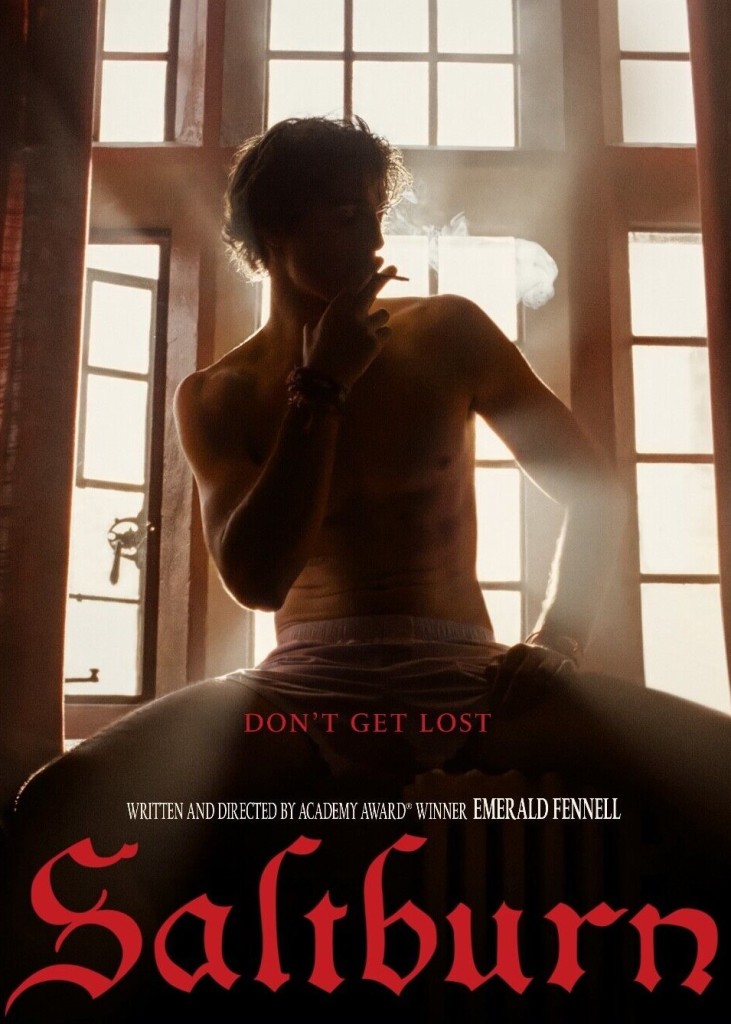
Saltburn

Brideshead Revisited Meets Carry On Downton Abbey. Wouldn’t surprise me if that’s the way it was actually pitched, it’s just so uneven, veering through several different styles without ever finding a target. The shock elements are, unfortunately, just risible. Via the trailer this appeared to be a moody, atmospheric picture about entitlement, the downside, if you like, of Downton.

Instead, it’s just plain barmy, which might well have worked if its take on the bizarre had been consistent, but, really it’s a contender for the coveted So-Bad-It’s-Good Award with Rosamund Pike odds-on to nab a gong for Best Maggie Smith Impression. .

Oliver (Barry Keoghan) is supposedly a scholarship student at Oxford, coming from a sinkhole estate in Liverpool, parents drug dealers etc etc. Out of his depth, by chance he latches on to sex god Felix (Jacob Elordi) and is invited to spend the summer at the latter’s stately home complete with sneering butlers and demonic family all graduates of the Over-Acting Academy.

Turns out we’ve not been watching Downton Abbey at all, but The Usual Suspects, Oliver not an innocent little bookworm but an extremely malevolent character who manages – in the absence (luckily) of post-mortems – to bump off the entire family in order to inherit (don’t ask!) Saltburn in order to, in a bizarre nod to Risky Business, dance naked through it.

The only reason it gets any points at all is Jacob Elordi, who exhibits tremendous screen charisma, and because the barmy extremely self-centred and out-of-it Rosamund Pike does elicit a few laughs and maybe, courtesy of Richard E. Grant, has a haircut to enter some kind of Hall of Fame.

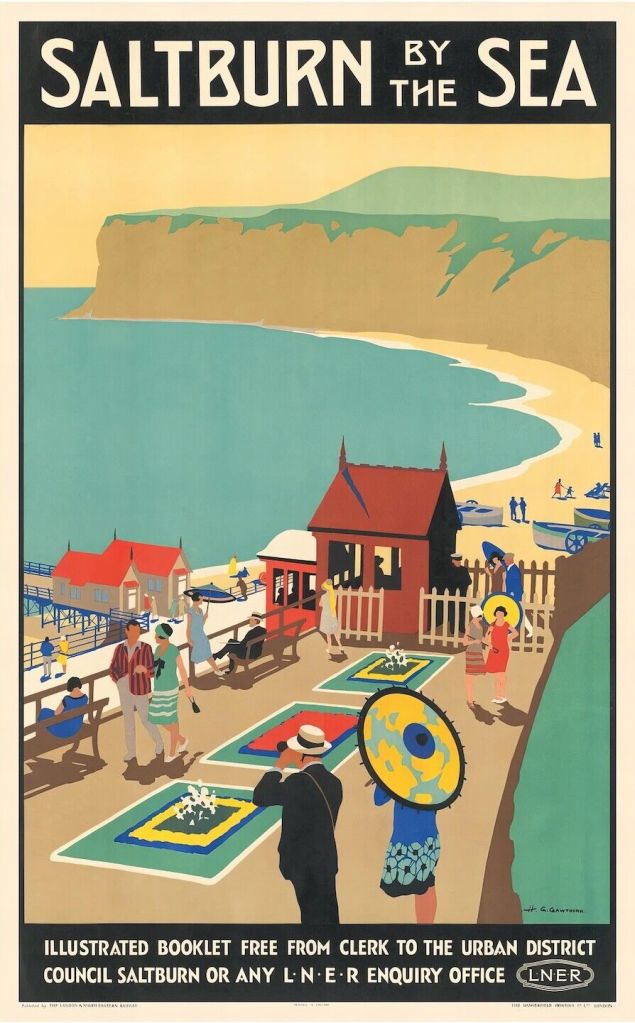
Couldn’t find a poster for “A Forgotten Man” so thought I would temper proceedings
with this old British poster for a seaside resort.

A Forgotten Man

This wants to say something important about the neutrality stance of Switzerland during the Second World War. But unless you live in Switzerland, you won’t have a clue what it’s trying to say. And if you thought The Crown was off-the-wall in summoning up the ghost of Princess Diana, wait till you start counting the number of ghostly apparitions here of young Swiss chap Maurice (Viktor Poltier), whom the protagonist Henrich (Michael Neuenschwander), while Swiss Ambassador to Berlin during the war, failed to prevent being executed.

I’ve no idea if this aspect is based on a true story. Either way, fictional or not, it’s a preposterous central conceit. Supposedly, Maurice had been arrested for trying to assassinate Adolf Hitler. Theoretically, we should all be applauding his actions. He should get a free pass for trying to rid the world of a monster. But, in reality, how would you expect an Ambassador to go about pleading clemency for one of his citizens who tried to murder the ruler of Germany?

There’s clearly some angst about the fact that Switzerland managed to emerge unscathed after a war which left the rest of Europe in turmoil. But it’s pretty hard to summon any sympathy for anybody, least of all the director because whatever point he’s trying to make is made so obliquely it fails to register. That it gets any points at all is due to its brevity and that, as the first movie in my self-selected triple bill, I came out of it in a far better mood than the other two.   

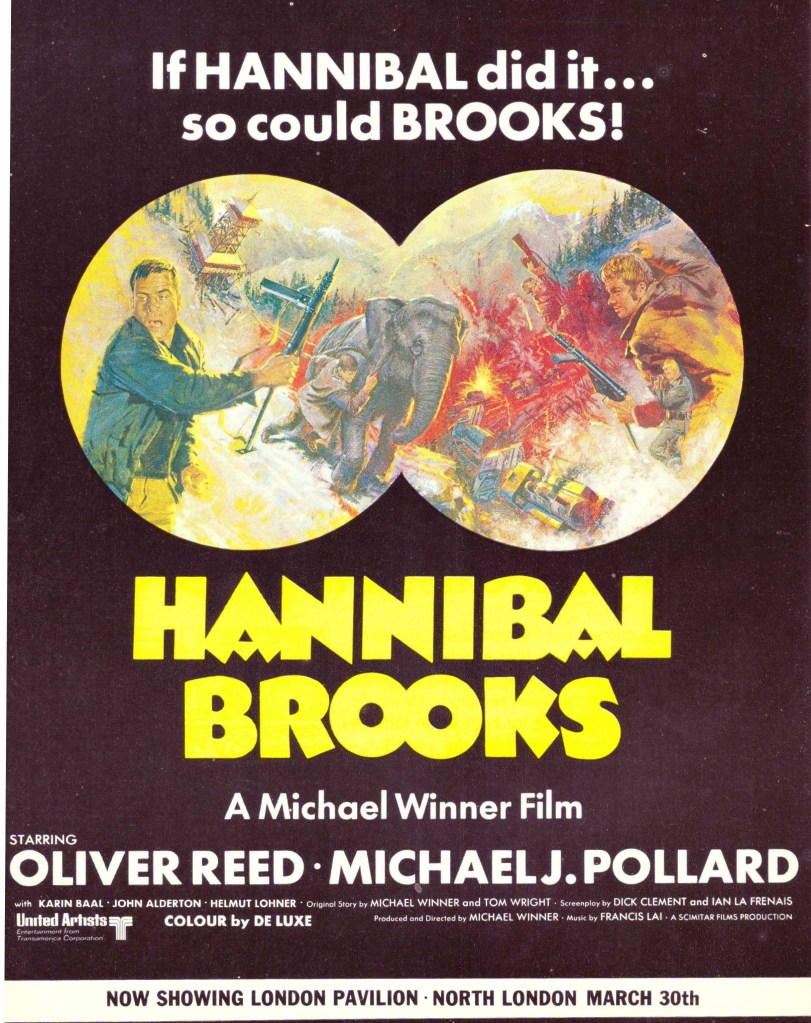
Hannibal Brooks (1969) ***

Gruff British star Oliver Reed shows his tender side in this entertaining offbeat POW escape picture. With local German men called up for war, Berlin Zoo relies on local prisoners-of-war to help look after the animals. Stephen Brooks (Oliver Reed) is detailed to look after an elephant (considerably more discreet in his toilette than those employed on Babylon). When Berlin is bombed, Brooks takes the elephant to Innsbruck in Austria.

His nickname is a bit of a misnomer. You would think he was going to emulate his famous predecessor and take the elephant over the Alps and into Italy, which would be possibly a safe destination because at this stage of the war the Americans have invaded and are marching north. But, instead, sadly, he only plans to make it as far as neutral Switzerland, where he would be equally safe.

Naturally he is pursued – and captured, and pursued and captured. But there always seems to be a convenient pile of logs that, a la Swiss Family Robinson, can be weaponised. And should you need any obstacle pulled down, well, an elephant comes in pretty handy on that score too.

Ineffectual American escapee Packy (Michael J. Pollard) turns up from time to time, usually in some piece of action that goes wrong, once to interrupt a romantic dalliance with Brooks’ occasional companion Anna (Maria Brockefhoff). And this being the Tyrol, it seems a shame not to halt proceedings every once in a while to take in a marching band or a traditional wedding or fair and for every damsel to have her cleavage on display.

Heading up the pursuit is Colonel von Haller (Wolfgang Preiss) although you might imagine he had more important things on his mind at this stage of the war than chase an elephant. Various troopers are so easily duped by Brooks they might have gone under the collective expression of “dolts.”

Where the elephant has to take the long way – he could as easily have been called “Slowly” – the Germans can travel by road, rail and cable car. It’s pretty episodic stuff, enlivened here and there by explosions and gunfights and the like and the question of whose side Anna is really on.

In some respects it’s a buddy picture. When the buddy is the elephant it works pretty well. Brooks is surprisingly tender and caring. But when Packy enters the equation and it’s the old question of three into two won’t go it becomes a bit lopsided. You get the impression it’s one of these picture that, to accommodate the budget, required an American star and Michael J. Pollard, with his already-established schtick, was nearest to hand.

It’s just as well Reed has toned down his scene-stealing growls and sideways glances because nobody can steal a scene like Pollard. If the elephant was ever in the slightest genuine danger, then you might have had a better picture, but nobody in those days was going to slaughter such a magnificent beast just to give a movie a harder edge.

Elephant is surplus to requirements in this action-based poster.

So the harder edge never comes, and it skips along uneasily between gentle comedy and action, with a potential screen partnership of unlikely personalities never quite gelling. If director Michael Winner had stuck with Reed and the elephant it would probably have worked much better. Or if the escapees had to blow up some vital factory or carry out another mission deep inside enemy territory it might have carried more narrative thrust.

It’s like two separate pictures, Reed and the elephant and Pollard and his bunch of generally hapless escapees. Harmless enough stuff and interesting mostly for seeing Oliver Reed upending his usual screen persona.

At this point in his career, Michael Winner (You Must Be Joking, 1965) was better known for comedy so perhaps this was his passport to suggesting to Hollywood he could handle action. Certainly, it suggested he could merit a bigger budget, for his next movie was The Games (1970) before stepping into the more comfortable territory of Lawman (1971).

I’d suggest this was equally a stepping stone for Reed (The Assassination Bureau, 1969). This film is largely ignored in assessments of the changes to his acting style that he made to accommodate the critically-acclaimed Women in Love (1969). And you can certainly draw a development line between the Michael J. Pollard of Bonnie and Clyde (1967) and his character in Little Fauss and Big Halsy (1970) where he successfully buddied up with Robert Redford. Dick Clement (The Jokers, 1967) devised the screenplay from a story by the director and Tom Wright, on whose own story of being a POW zookeeper this is based.

Most movies perceived as stepping stones are made of stronger material, and although this is more lightweight, it’s entertaining enough and certainly helped director and both stars switch career tracks.

Kaleidoscope (1966) ***

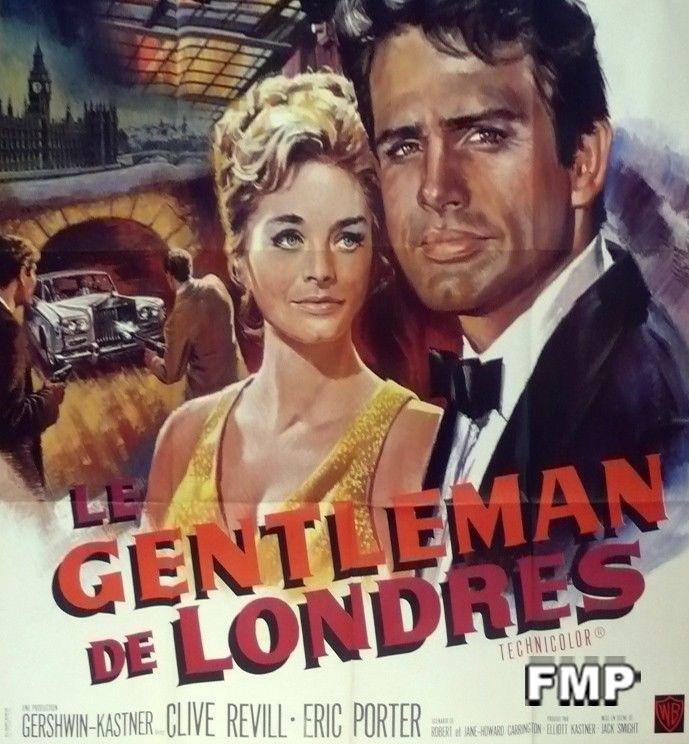
Amazing the tension that can emanate from one turn of a card. Or, more correctly, waiting for one. Only problem is we’re two-thirds through the movie before high-stakes poker begins – the pot nudging £250,00 (close on a cool £5 million now). Mostly, the earlier tension derives from not knowing what the hell is going on in this enjoyable thriller made at the height of the Swinging Sixties as playboy gambler Barney (Warren Beatty), a walking Carnaby St model driving an Aston Martin DB5, tilts the odds dramatically in his favor.

Barney is a gambler but the problem with gambling is the odds. They can be against you too much. So Barney decides to turn himself into a burglar, the kind that can clamber over rooftops, abseil between buildings, and break into – a printing business called Kaleidoscope. This just happens to print the playing cards supplied to all the major European casinos. So Barney does a little doctoring of the master printing plates. Bingo, the odds are a bit more even now that he knows what cards are coming out of the shoe – he plays chemin de fer (as it is known in posh casinos; pontoon or 21 to you and me).

While cleaning up he bumps again into fashion designer Angel – their original meet-cute taking place in a traffic jam – who he dated once in London. Unbeknownst to him, she is on a scouting mission, looking to snare the kind of high-rolling gambler who can take on and completely fleece drugs kingpin Harry (Eric Porter) being pursued by her father Manny (Clive Revill), a cop who, rather than waste so much time collecting the required evidence to put the villain behind bars, decides it would easier done by making him broke. Unable to pay his debts, some other villain would put him out of business in the traditional cemented-boot fashion.

It takes a while for the movie to line up all its ducks in a row, mainly by holding back the vital information the audience requires. But the audience is privy to details of the way Manny works that Barney is not. Even for ruthless villains, Manny has a peculiar calling card, one that would make any gambler think twice about entering his lair. Of course, it doesn’t take long for Manny to rumble Barney’s game so the stakes are much higher than the charmer imagines.

Throw in as much fashion as London was capable of generating at this time, the burgeoning romance, some exotic European locations, a castle with a moat, and the usual tourist guide stuff of red buses, Big Ben, Piccadilly Circus, pubs and Tower Bridge and you have all the ingredients of an easy on the eye thriller.

A bit over-reliant on star power. That is, if you don’t need Beatty to do much more than be Beatty, all teeth and charm. At this point Beatty’s career looked as if it was fast approaching its end. The box office success of Splendor in the Grass (1961) had been followed by a string of flops, romantic dramas and comedies that should have had audiences queuing up plus an occasional wild card like Arthur Penn’s Mickey One (1965), the biggest flop of all. He does make an engaging crook, and he never loses his screen charisma here, but there ain’t quite the right number of twists that moviegoers weaned on the likes of Topkapi (1964) had come to expect.

Hollywood had been doing its best to position Susannah York as a top box office attraction and she had snagged leading female roles in The 7th Dawn (1964) opposite William Holden and Stanley Baker in Sands of the Kalahari (1965)  but she was recovering from the colossal flop of Scruggs (1965) by ‘poet of the cinema’ David Hart.  Kaleidoscope offered  the kind of role York could do with her eyes closed. So while the screen pair were not exactly sleep-walking it was not the kind of story that was going to create sparks.

Character actor Clive Revill (Fathom, 1967) and Eric Portman (The Pumpkin Eater, 1964) take more leeway with their roles, the latter almost chewing he scenery, the former content with just chewing his lips. Look out for Jane Birkin (Blow-Up, 1966) and British television stalwarts Yootha Joyce, George Sewell and John Junkin.  

The title would have been more enigmatic, original meaning of images twisted out of shape, had it not also applied, straightforwardly, to the card-making company. Giving Harry the surname of Dominion seems overkill.

Director Jack Smight (No Way to Treat a Lady, 1969) came to this after twisty private eye picture Harper/The Moving Target (1966), a big hit starring Paul Newman, but this is too lightweight a feature to command such interest, but he does keep the story rolling along and it’s an effortless watch and it has a certain offbeat quality. The screenplay was fashioned by Robert Harrington and Jane-Howard Hammerstein, making their movie debut, who also co-wrote Wait until Dark (1967). It was also the debut for Winkast Productions, the Jerry Gershwin-Elliott Kastner production team who went on to make Where Eagles Dare (1968).

Seven Golden Men (1965) ****

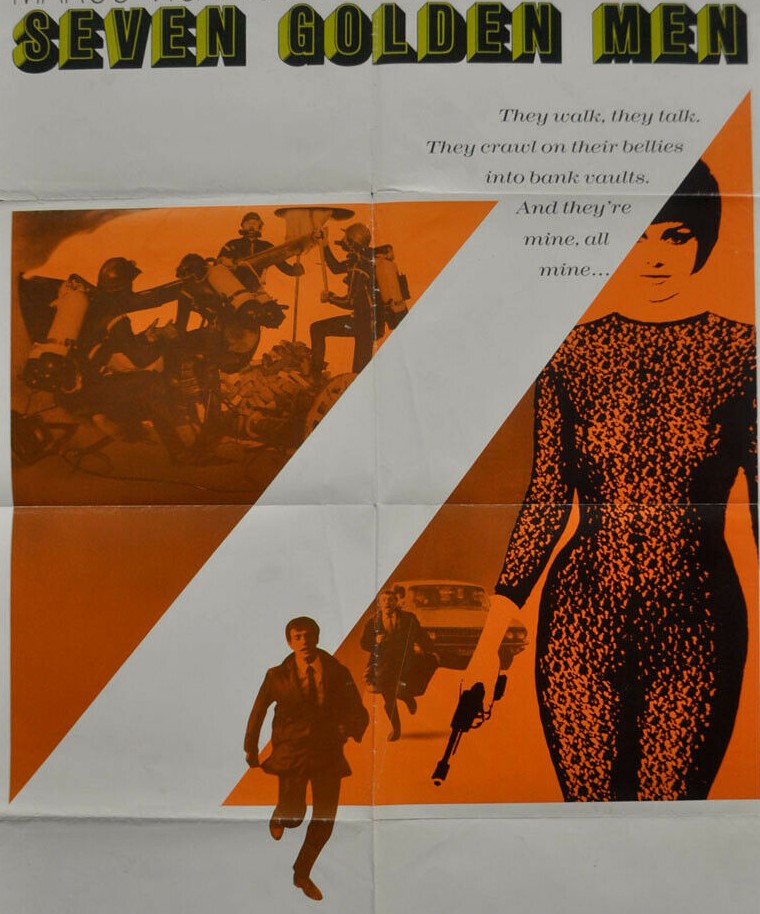
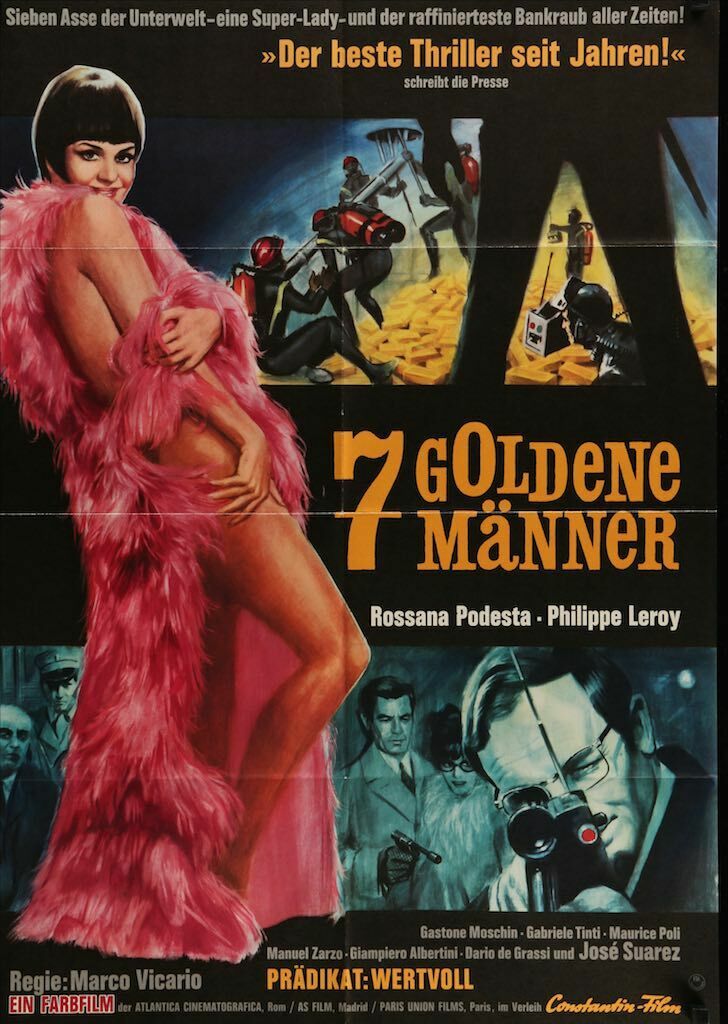
Very stylish caper picture that dispenses with the recruitment section, the ingenious hi-tech robbery accounting for the first half, escape and double-cross the second, a slinky Rosanna Podesta (the eponymous Helen of Troy, 1956, in case you’ve forgotten, and also appearing in Sodom and Gomorrah, 1962) an added attraction/distraction. The Professor (Phillippe Leroy), in bowler hat and umbrella, orchestrates the gold bullion theft from an uber-secure bank using hidden microphones, cameras and a host of electronic equipment, the inch-perfect heist organized to mathematical precision and timed to the second.

His team, disguised as manual workers, dig under the road, don scuba gear to negotiate a sewer, drill up into the gigantic vault and then suck out the gold bars using travelators and hoists. Giorgia (Podesta), sometimes wearing cat-shaped spectacles, a body stocking and other times not very much, causes the necessary diversions and plants a homing device in a safety deposit box adjacent to the vault. Occasionally her attractiveness causes problems, priests in the neighboring block complaining she is putting too much on show.

It’s not all plain sailing. A cop complains about the workmen working during the sacrosanct siesta, a bureaucrat insists on paperwork, a radio ham picks up communication suggesting a robbery in progress, the police appear on the point of sabotaging the plan.

But the whole thing is brilliantly done, the calm professor congratulating himself on his brilliance, Giorgia seduction on legs. The getaway is superbly handled, the loot smuggled out in exemplary fashion, its destination designed to confuse. Then it is double-cross, triple-cross and whatever-cross comes after that, and with every reversal no idea what is going to happen next. It is twist after twist after twist. Some of the criminals are slick and some are dumb so as well as the high drama there are moments of exquisite comedy.

Italian writer-director Mario Vicario (The Naked Hours, 1964) handles this European co-production with considerable verve and although, minus the normal recruitment section, we don’t get to know the team very well except for The Professor and Giorgia each is still given some little identity marker and in any case by the time they come to split the proceeds we are already hooked. Frenchman Phillippe Leroy (Castle of the Living Dead, 1964) is the standout as a mastermind in the British mold, a stickler for accuracy, calm under pressure, working with military discipline. Podesta (also The Naked Hours) has no problem catching the camera’s attention or playing with the emotions of the gang  to fulfill her own agenda. The gang is multi-national – German, French, Italian, Spanish, Portuguese, Irish – with only Gabriel Tinti likely to be recognized by modern audiences.

And there is a terrific score by Armando Trovajoli (Marriage Italian Style, 1964) that changes mood instantly scene by scene. One minute it is hip and cool jazz, the next jaunty, and then tense.

If ever a picture was pure cult, this is it.

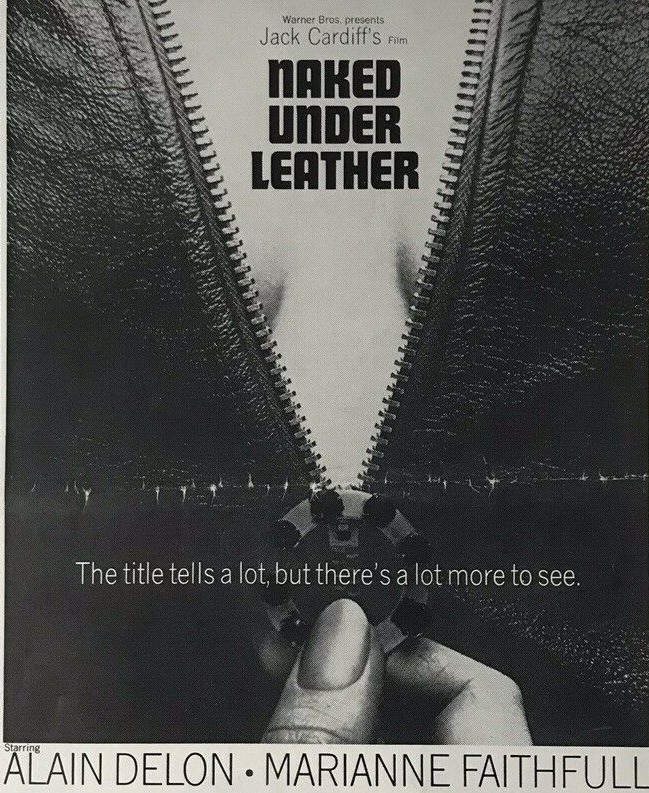
Behind the Scenes: “The Girl on a Motorcycle” / “Naked under Leather” (1968)

Although multi-country co-productions were very common in the 1960s, British-French co-productions were particularly thin on the ground, as if the cultural identities were so far apart there was nowhere they could ever meet. This was only the third such co-production in three years. British Lion, a long-established operation, had recently been overhauled with a new boss in John Boulting, a renowned filmmaker of Boulting Brothers (The Family Way, 1966) fame.

The film was based on a prestigious prize-winning French novel by Andre Pieyre de Manidargues. The budget was set at a modest $1.5 million with location shoots in Geneva, Heidelberg and Strasbourg with interiors shot at Shepperton. Director Jack Cardiff (Dark of the Sun, 1967) had originally hired a German actress, a Playboy centerfold,  for the leading role of the young girl who marries a timid young man while obsessed with a less conventional ex-lover. But the actress suffered a drug overdose and dropped out. Ironically, Marianne Faithful, her replacement, was also a drug addict and famed as a singer and as girlfriend of Mick Jagger.

Although her acting  experience was limited to television film Anna (1967) and a small part in Michael Winner’s I’ll Never Forget Whatsisname (1967), Cardiff was captivated by her sensuality which was ideal for her character. Bear in mind that Cardiff knew what a camera captured. He had made his name as a cinematographer and worked with great beauties like Ava Gardner (The Barefoot Contessa, 1954), Sophia Loren (Legend of the Lost, 1957) and Marilyn Monroe (The Prince and the Showgirl, 1957) so if he thought Faithfull fitted that category then there was no reason to doubt his assessment. He commented: “Never since I saw Marilyn Monroe through the camera lens have I seen such irresistible beauty. To focus on her is to focus the camera on your innermost heart.”  

Cardiff took advantage of a new trend to film movies in both English and French to open up distribution channels. Claude Chabrol’s The Road to Corinth (1967) was shot in this manner as was Farewell Friend / Adieu L’Ami (1968) with Charles Bronson and Alain Delon.   

Faithfull could not ride a motorbike so a stunt double was utilised for long shots. But instead of resorting to back projection, for medium shots and close-ups the actress was towed on a trailer behind a camera car. Not having to worry about the controls also meant that Faithfull could look dreamlike while driving and with Cardiff not having to think about the actress he could turn the camera in a 360-degree pan while she rode along.

Since Faithfull was going to be seen on a motorbike for long sections of the movie, Cardiff came up with a method of creating variety. One of the techniques employed was “solarization.” This was, in effect, a half-positive half-negative exposure, but it had only been used in the past in very small doses, nothing like what Cardiff had in mind. BBC boffin Laurie Atkin had invented a computer system that allowed solarization to be used more extensively. Footage shot during the day was taken immediately to the BBC lab at night where Cardiff could tinker about with creating his effects.   

One of the biggest beneficiaries of this technique were the sex scenes. Without the solarization which hid naked bodies under a psychedelic whirl the sex scenes would never have got past the censor.  There was an unfortunate downside, however. The Girl on a Motorcycle had been invited to the Cannes Film Festival. Critical approval there would have given the picture artistic momentum. Unfortunately, delays caused by the laboratory work meant the film missed its scheduled screening slot. Even so, French critics gave it the thumbs-up. British critics, on the other hand, gave it the thumbs-down. Lack of critical estimation did not appear to matter to British audiences who came out in their droves.

But it was a different story in the United States.

No wonder that to some extent this is one of the great lost pictures because Warner Brothers could not find a way to sell it in the U.S. Having paid a record $1.5 million advance, the studio (known at that time as Warner-Seven Arts) was hit by a double whammy. The picture was the first to receive an X-rating from the newly-established MPAA censorship system which replaced the previous Production Code. The new system was supposed to allow filmmakers greater latitude in terms of sex, violence and language.

Theoretically, that should have been a marketing bonus and the film should have ridden the “sex-art” wave and turned into an arthouse hit with the mainstream, captivated by solid grosses, to follow.  In reality, many exhibitors refused to touch it, regarding the X-rating as a separate category catering for the worst of the adults-only smut market. Newspapers refused to carry advertising for films so rated. Critics hated it, all the New York critics giving negative reviews.

Warners slotted it into a handful of arthouse houses before pulling all prints out of circulation in May 1970 and sending to back for re-editing with the intention of re-submitting it, shorn of some of the nudity, to the MPAA in a bid to win a more acceptable R-rating. In other words, to “re-gear the picture for the general market rather than the adult sex-art trade originally in mind.”  

To ensure that its reputation was not “soiled” the picture was re-titled Naked under Leather – if the content was tamer, the title was certainly not. Initially, that appeared to do the trick when it was re-released a full year later. It pulled in a “boff” $125,000 (worth around $864,000 now – a whopping $36,000 per-screen average) in 24 houses in wide release in Los Angeles, was “hot” in Denver and “tidy” in Chicago and found a few bookings elsewhere. But then it stalled and could not find the extra gear. In reality it did not do much better than on initial release. In the 1969 annual box office chart it featured at No 231 and for the corresponding 1970 chart it placed at number 253.

Sources: Jack Cardiff, Magic Hour, Faber and Faber, 1996, p242-243; “New British Lion Mgt. Gets Motorcyle Rights in UK,” Variety, October 18, 1967, 23; “Stylistic Dash Marks Cannes Films,” Variety, May 22, 1968, 26“British Lion Wraps Up Distribution Deal with W-7 for U.S., Towa for Japan,” Variety, August 28, 1968, 29, “Features Passing Through MPAA,” Variety, December 4, 1968, 20; “All Imports; N.Y. Critics All Bad,” Variety, December 4, 1968, 7; “Recall and Re-Edits W-7’s Motorcycle; X-Rating Now R,” Variety, January 29, 1969, 7; “Computer Tally of 729, 1968,” Variety,  May 7, 1969, 36; “Naked under Leather,” Variety, April 22, 1970, 4; “L.A. First Run Healthy,” Variety, May 13, 1970, 9; “Top 330 Pix in U.S. for 1970,” Variety, May 12, 1971, 37.

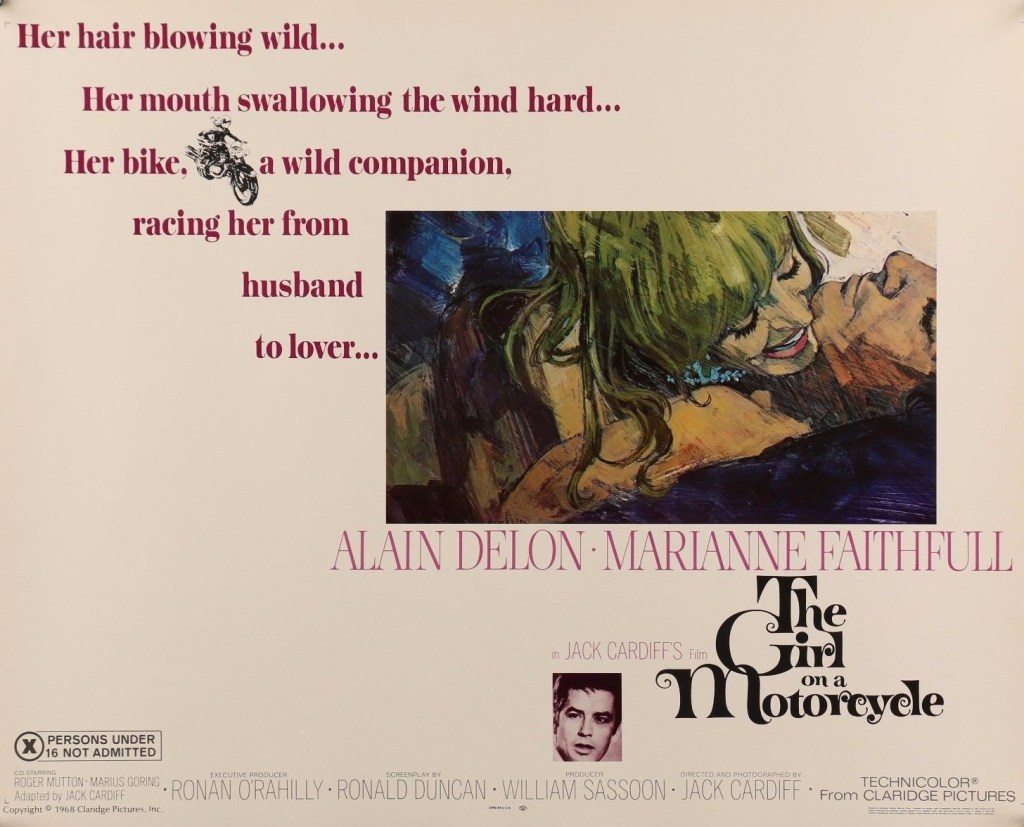
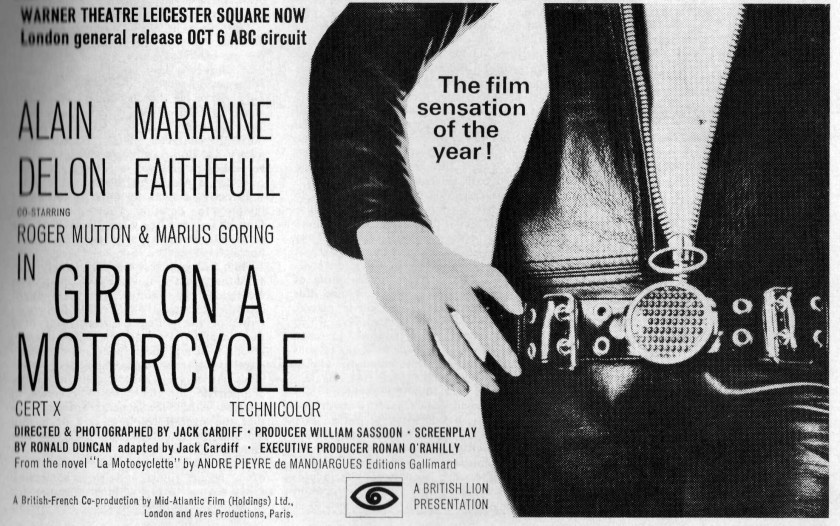
The Girl on a Motorcycle / Naked under Leather (1968) ***

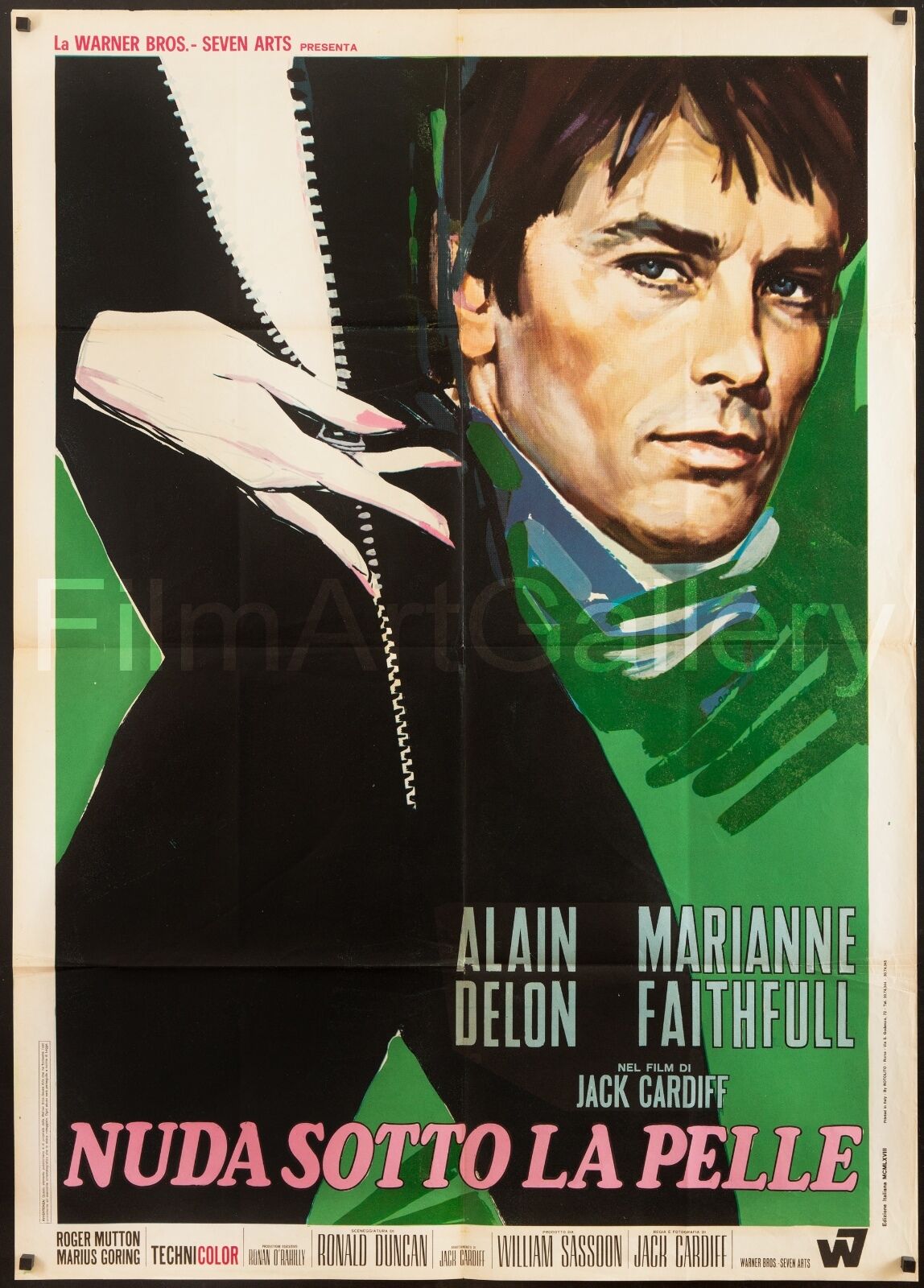
An erotic charge deftly switched this picture from the Hell’s Angels default of violent biker pictures spun out cheaply by American International.  Where Easy Rider (1969) was powered by drugs, this gets its highs from sex. Rebecca (Marianne Faithful), gifted a Harley Davidson Electra Glide motorbike by lover Daniel (Alain Delon) two months before marriage to staid teacher Raymond (Roger Mutton), takes to the highways to find herself.

This ode to speed (of the mechanical kind) allows her to shake off her preconceptions and fully express her personality, beginning with the one-piece black leather outfit, whose zip, in one famous scene, Daniel pulls down with his teeth. The bike is masculine. “There he is,” she intones and there is a none-too-subtle succession of images where she clearly treats it as a male appendage.

She is both self-aware and lost. In some respects Raymond is an ideal partner since he respects her wild nature and gives her space, and she views marriage to him as a method of avoiding “becoming a tart.” In other words he represents respectability, just like her father (Marius Goring) who owns the bookshop where she works. But he is just too reasonable for her and, in reality, as she would inevitably discover that is just a cover for his weakness. The only scene in which she does not appear is given over to Raymond being tormented by young pupils who have him chasing round the class hunting for a transistor radio.

But Daniel is not quite up to scratch either. He believes in “free love”, i.e. sex without commitment and he is not inclined to romantic gestures and she knows she could just become another in a long line of discarded conquests should they continue. Raymond is a “protection against” Daniel and her ending up as an adulteress teenage bride and potential nymphomaniac. She seeks abandon not reality.

As well as sexy interludes with Daniel, her head is filled with sexual images, not to mention dabbling with masochism, in a dream her leather outfit being stripped off piece by piece by a whip-wielding Daniel, in a bar imagining taking off her clothes in front of the aged drinkers.

Jack Cardiff’s film is certainly an interesting meditation on freedom and sexual liberation at a time when such notions were beginning to take hold, but it suffers from over-reliance on internal monologue and Marianne Faithful’s lack of acting experience. Cardiff went straight into this from violent actioner Dark of the Sun (1968) and audiences remembering him from The Liquidator (1965) and The Long Ships (1964) would need reminded that he braced romance before in the touching and Oscar-nominated Sons and Lovers (1960). In that film he elicited an Oscar-nominated performance from Mary Ure, something that was unlikely here.

Pipe-smoking was generally the preserve of the old, or detectives, unless you were a young intellectual as Delon is here, but it does seem an odd conceit to force the actor into such a contrivance. Delon is accustomed to playing amoral characters, so this part is no great stretch, but, minus the pipe, he is, of course, one of the great male stars of the era and his charisma sees him through.

It was also interesting to compare Cardiff’s soundtrack to that of Easy Rider. Here, the music by Les Reed – making his movie debut but better known as a songwriter of classic singles like “Delilah” sung by Tom Jones – is strictly in the romantic vein rather than an energetic paeon to freedom such as “Born to Be Wild.” 

Cardiff’s skill as an acclaimed cinematographer (Oscar-winner for Black Narcissus, 1947) helps the picture along and clever use of the psychedelic helped some of the sexual scenes escape the British censor’s wrath, though not so in the U.S. where it was deemed an “X”. 

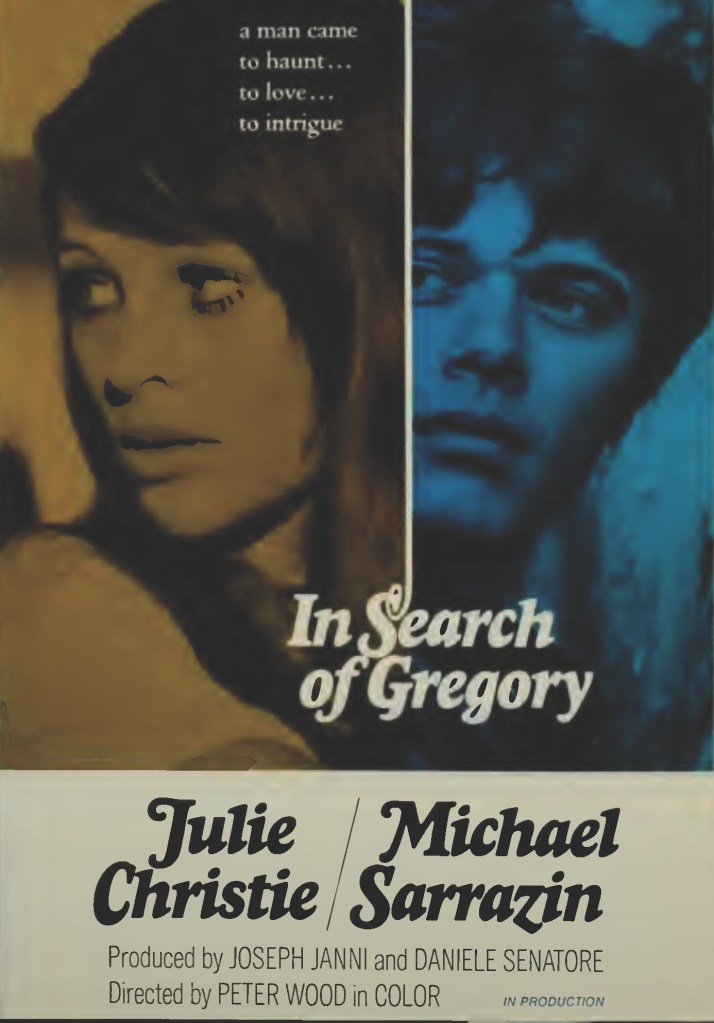
In Search of Gregory (1969) ****

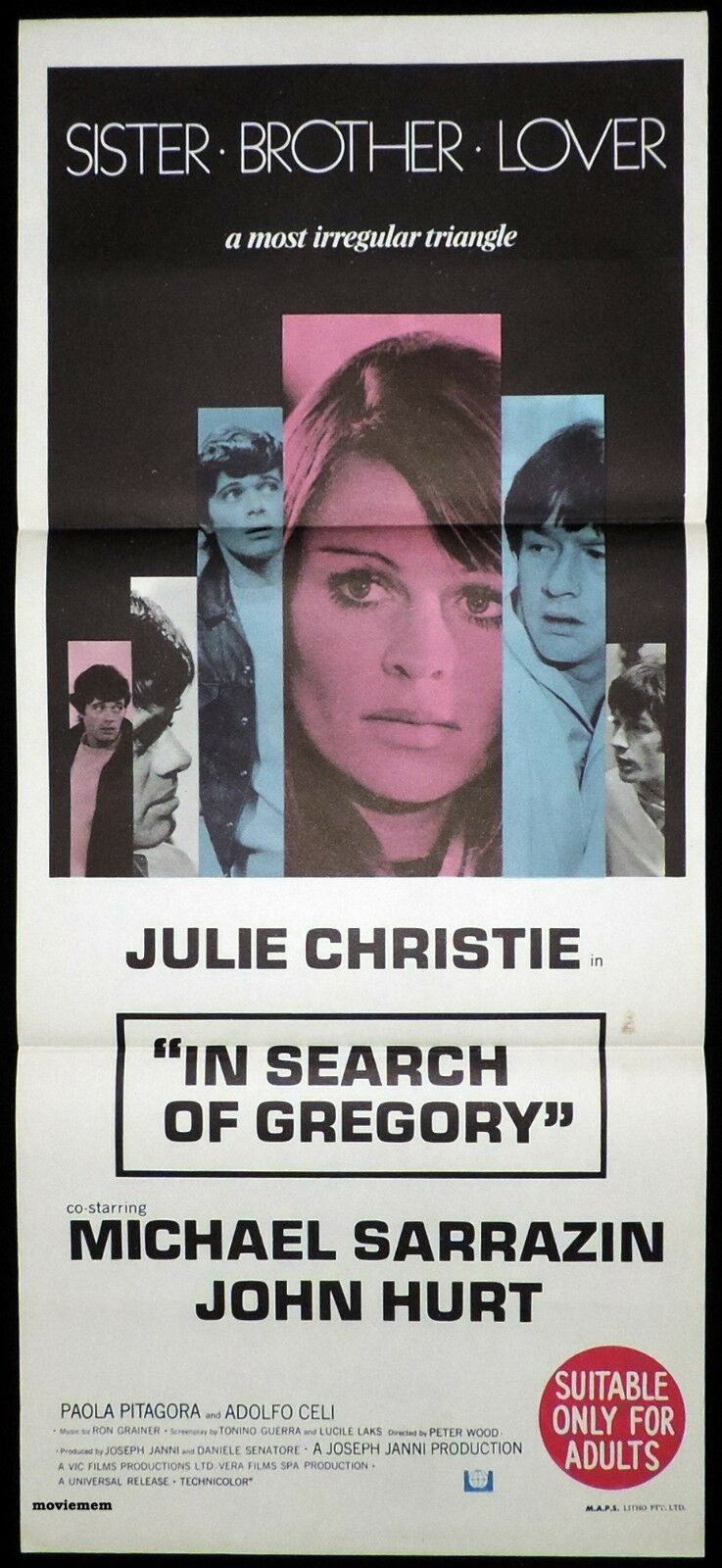
Off-beat examination of the fantasy vs. reality conundrum with an ever-watchable Julie Christie as the woman on the titular hunt. One of the great lost pictures – the only film of acclaimed British theater director Peter Wood is a more whimsical cousin to the more deliberately obscure works of Alain Resnais (Last Year at Marienbad, 1961) and Michelangelo Antonioni (Blow-Up, 1966) which pivoted upon the question of whether events presented actually occur or exist only in the head of the leading character.    

Catherine (Julie Christie) is enticed to Geneva by her father (Adolfo Celi) for his latest wedding on the basis that she will meet the impossibly handsome Gregory (Michael Sarrazin). On arrival she discovers the agoraphobia of younger brother Daniel (John Hurt) has been temporarily lifted by Gregory. Catherine appears set to meet Gregory on a number of occasions, but either he does not turn up (the wedding) or somehow they miss each other, even at one point occupying adjoining phone booths. And it would have been a pretty dull picture if that was all that was going on. But whether the result of reality or Catherine’s imagination, the Gregory we see is a vivid screen presence. The world the character inhabits is unusual to say the least, so unique that it is either obviously real or fake, but virtually impossible to determine which.

The best Gregory sequence, of which Steve McQueen would be proud, involves the character moving by means of the windscreen from one side to the other of a car driven at high speed. In another scene Gregory plays the equally perilous game of Autoball, a kind of polo with stock cars. As convincing is Gregory’s avant-garde orchestra consisting of two guitars, bottles, a bicycle wheel, a waste bin and coins in a glass. 

The detail is so extraordinary that it must be real. The brother seems real enough, too real if anything, close to enjoying (or pining for – the poster promises more than the picture delivers) an incestuous relationship with his sister. But for every moment that appears questionable – did she really witness Gregory making love to her future mother-in-law – there are others where doubts are immediately quelled (an address which appears non-existent is not). And long before anybody came up with the idea of selling bottled water, Gregory is apparently in the business of selling tinned Alpine air. Other moments she does not witness – Daniel riding a Lambretta/Vespa with feet on the handlebars – add to the prospect of genuine reality.

Catherine might even have met Gregory except that in going to bed with the man who looks very much like what we believe Gregory to look like she determines that he shall remain anonymous. So it’s anybody’s guess whether Gregory is a figment or phantom of her imagination. And why, of course, should such invention be necessary? Does it mean that her father and brother do not exist either? These days the unreliable narrator is a common literary device but that was not the case at the tail end of the 1960s, so in some senses this was way ahead of its time.

It’s interesting, of course, to attach logic to the idea that it all takes place in Catherine’s imagination. You can kind of understand that maybe she thinks her father’s latest bride is going to betray him at the slightest opportunity. But it’s some imagination that sends Gregory into devilry in the car with Daniel. And it begs the question if none of it is real why does she keep on missing Gregory all the time? Does that relate to an even deeper psychological feeling that she is always going to miss out?

It’s an entertaining mystery. There’s no great angst. Antonioni had the sense or cunning to ensure that consequence mattered in Blow-Up – a murderer escaping justice. But there’s no such tension here. While Catherine is tabbed a nympho by her brother (who never questions her father’s predilection for multiple marriages), the suggestion that she’d fly from Rome (where she lives with her boyfriend) to Geneva is the hope of a hook-up seems too far-fetched. Despite the presence of Julie Christie – who can certainly carry even as slight a picture as this – and a quixotic turn from John Hurt (Sinful Davy, 1969) it’s neither obscure enough to be arthouse nor sufficiently plot-driven to be mainstream and remains an oddity.

If you are going to be irritated beyond belief that will occur in the first fifteen minutes or so, but if you stay the course, you will find it a highly rewarding watch rather than a cinematic car crash.

Your best bet to catch this film is Ebay or other secondhand routes.

Discover WordPress

A daily selection of the best content published on WordPress, collected for you by humans who love to read.

The Atavist Magazine

by Brian Hannan

WordPress.com News

The latest news on WordPress.com and the WordPress community.