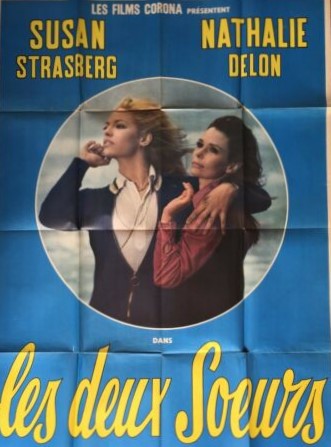
The Sisters / Le Sorelle (1969) ****

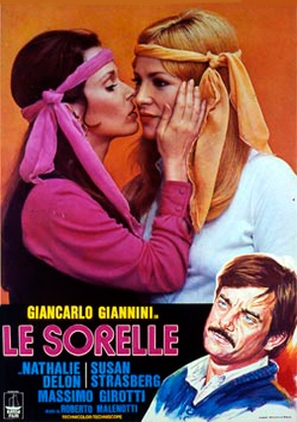
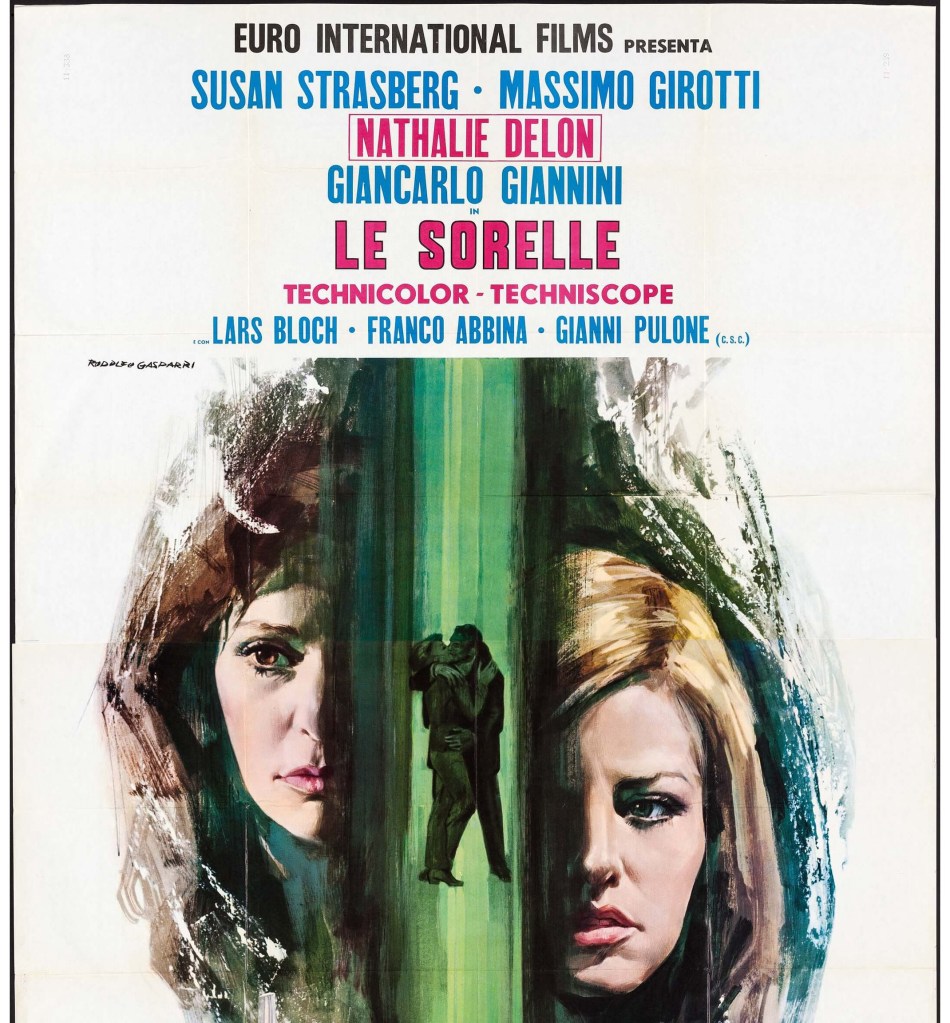
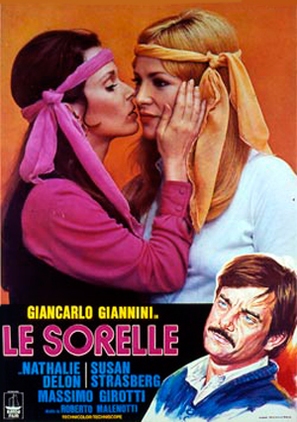
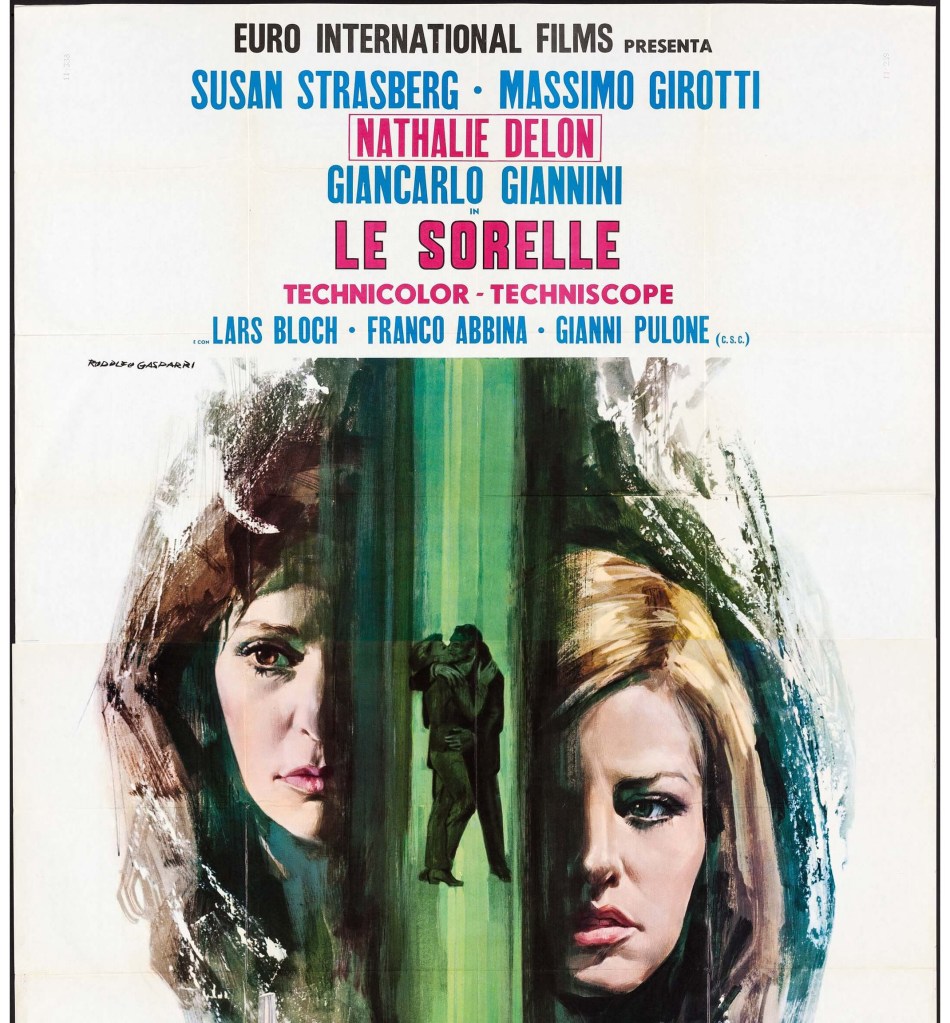
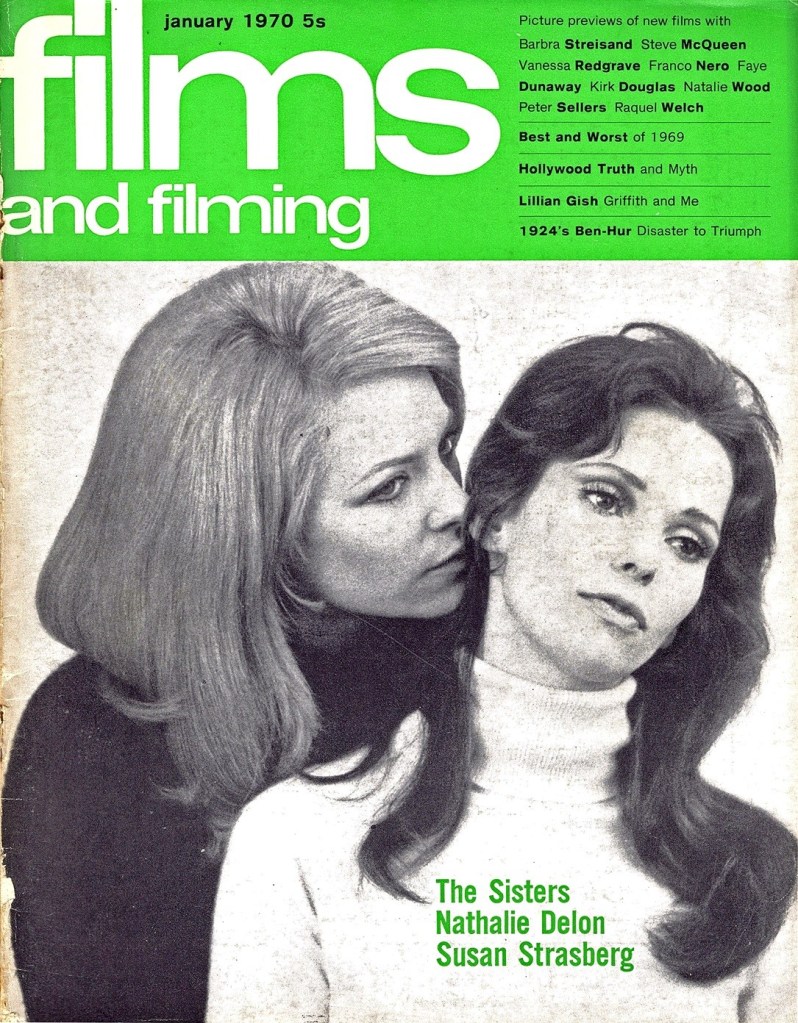
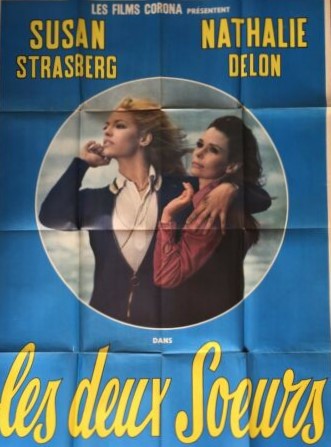
Erotically-charged, symbolically-heavy French drama of siblings trying to re-establish the intense relationship they enjoyed as teenagers. After a nervous breakdown and on the point of divorce, blonde translator Diana (Nathalie Delon) seeks respite at the home of younger sister Martha (Susan Strasberg), a brunette happily married to the wealthy and indulgent Alex (Massimo Girotti).

Initially, the more worldly Diana, the more flamboyant dresser, appears the superior but it soon transpires she is the more fragile. The apparently timid Martha allows her husband to control her life to the point of buying all her clothes and confesses to feeling as if she is on “a perpetual cruise.” While on the surface, it seems as if she has given up too much, in reality she disapproves of disorder and seeks perfection. She comes across as needing protection, and believes the woman’s role is to sacrifice, but in fact has managed to arrange her life to her own satisfaction.

Their competitive streaks emerge in different ways, Diana in obvious fashion, seeking to beat her sister while out horse-riding, Martha in more subtle and sensual manner, flaunting her sexual relations with her husband, almost offering her sister to her husband, and having a lover (Lars Bloch) on the side. There is a sense of each attempting to impose their world view on the other. Diana gives her sister a make-over, a new look which Alex adores, Martha hates it. There’s a sense of a chess game, with two or more players, with the males subservient. pawns.

Sensuality is never far away. Diana nuzzles her sister’s neck to smell her perfume. Alex is photographed, encouraged by Martha, in almost intimate mode with Alex. Dario (Giancarlo Giannini) is brought in to tempt Diana. And a scene where the girls experiment with colorful scarves suggests libertarianism. 

But it is clear that both sisters live empty lives devoid of true love and equally obvious as the picture progresses that both have arrived at the conclusion that they were at their happiest when together. There are subtle hints of incest, comforting each other in bed, the sensuality electric and the film begins to examine whether this taboo can be crossed and, if so, will it provide the necessary escape?

Despite Martha’s apparent subjugation, there is more than an inkling of feminism, the girls are involved in a complicated game in which the males are pawns, either rejected or made to look fools. While not fulfilled, Martha has turned as much as possible to her own advantage and Diana seems perfectly capable of taking what she wants.

Alex provides the symbolism. He cultivates rare plants that need to hide from the sun, in a greenhouse, lengthy exposure to whose atmosphere would be fatal to humans. He endlessly photographs them because they won’t last long. And in similar fashion provides a haven for the apparently vulnerable Martha.

Nathalie Delon (When Eight Bells Toll, 1970), married at this point to Alain Delon, shows a subtlety of expression that is rare for someone appearing in just her third film, and effects a gradual character transition throughout. Susan Strasberg, daughter of famed acting coach, Lee Strasberg, inventor of the Method Style of Acting, was one of the boldest actors of her generation, appearing in drug pictures The Trip (1967) and Psych Out (1968). She delivers an excellent portrait of a woman who manages to keep her true personality hidden, and for whom sexuality has few barriers.

This is the puppy-fat version of Giancarlo Giannini (Swept Away, 1974), barely recognizable as the future arthouse superstar whose physical appearance relied on gaunt, angst-riddles features.  Massimo Girotti (Theorem, 1968) is good as the man who thinks he has everything, not realizing how little he has. 

Although this was an accomplished directorial debut from Roberto Malenotti, he only made one more movie. Perhaps he made enough from directing the famous Coke commercial I’d Like To Teach The World To Sing (1971).

Always intriguing, revelations continually undercutting what we think we know of the characters, but delivered in subtle European tones rather than employing Hollywood shock, each of the four main people involved changing considerably due to their interaction with the others. While certainly skirting close to the borders of what was permissible at the end of the 1960s, it does so without exploiting the actresses.

Intriguing.

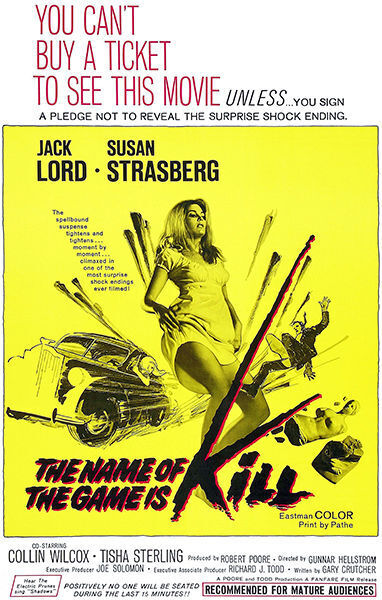
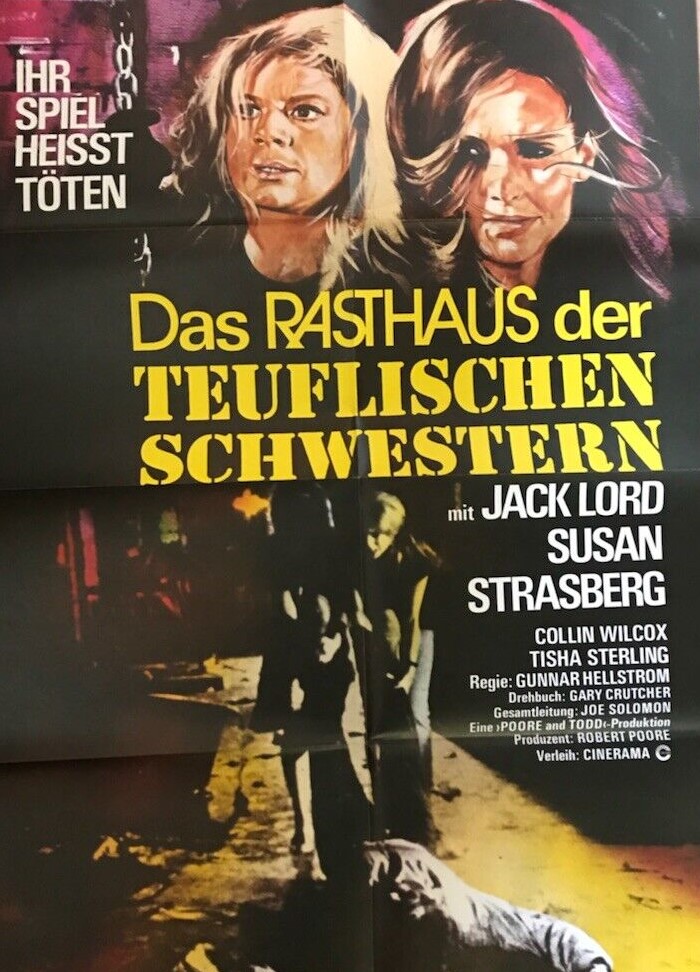
The Name of the Game Is Kill (1968) ***

Surprisingly effective thriller headlined by Jack Lord (Dr No, 1962) and providing Susan Strasberg (The Sisters, 1969) with a more complex role than hitherto.

Hungarian drifter Symcha (Jack Lord) hitches a lift in the desert with Mickey (Susan Strasberg), one of three sisters living with their mother (T.C.Jones) and running a filling station in a backwater. And before you can say Bates Motel, it’s clear not all is right. Youngest sister Nan (Tisha Sterling) keeps a rattler and a tarantula as pets and has the awkward personality trait of tending to set cats on fire.

Oldest sister Diz (Collin Wilcox Patton) eyes up the visitor for herself, even though Mickey is clearly hell-bent on him and is short in the fiancé department, her last boyfriend mysteriously disappearing. There’s more than a hint of the later The Beguiled (1970) in that each of the girls, Nan the most blatant, Diz the most persistent, shows keen sexual interest in the visitor.

And there’s some mystery, too, about the dead father. Everyone has a different tale to offer: he was murdered and incinerated by the mother; he committed suicide; he was run over by Nan. It’s this take-your-pick element that throws Symcha, though, admittedly, his brain might be addled after surviving a hit-and-run. Three days in a coma and all he has to show for it is a plaster on his head. He would need to be dumb, or just lusting after Mickey, to return to the house after that.

He makes no bones about being incapable of love, after witnessing friends and family slaughtered after the Hungarian Revolution of 1956. He “wants” her, but doesn’t commit to love. Mickey, in the manner of such romantics, reckons he’ll soon fall into a swoon over her. “Don’t let your past ruin our future,” she opines, in one of several good lines in the picture. “You have a sick mind,” Mickey tells Diz. “No,” she retorts, “I have a sick sister.” The bulk  of the good lines are the family taking verbal chunks out of each other so tension is kept high.

Mostly, Symcha’s job is to act like an involuntarily detective, getting close enough to each of the women to let them spill their secrets, though he’s less adept at working out what’s the truth. Is Mickey a “cheap lay” or virginal? Did Julio, the aforementioned fiancé, disappear once he realized what he was letting himself in for, or was he done away with?

And Symcha’s even less adept at looking after himself. There’s a kind of clever gender switch here. It’s usually the girl who’s foolish enough to return to the haunted house, or who doesn’t recognize danger, or who lets love (in this case, lust) get in the way of rational decision.

Family here is the disturbing element. Anyone attempting to break it up – by heading for San Francisco for example with one of them – is viewed as a threat.

You’ll probably guess the ending from two unnecessary giveaways at the beginning and a flaw in the make-up department, but, in fact, though the poster pleads with you not to give away the ending, it doesn’t say which ending it’s referring to. For this ends with a bang, three twists in quick succession. And don’t be tempted to switch off before the final freeze-frame (I always did wonder where Butch Cassidy and the Sundance Kid, 1969, got that idea).

Swedish director Gunnar Hellstrom (Just Once More, 1962) cleverly plays with expectations. He has you thinking, from the way Symcha makes his intentions clear, and from his wandering eye, that he’s the predator descending on a bunch of vulnerable women. He’s got that strong masculine air. He’s soft-voiced, too, and that carries a greater aura of confidence (ask Clint Eastwood) than a loud-mouth more physically-dominant specimen. But it soon becomes clear he might have stumbled into a web.

Jack Lord is more impressive than I expected and if he hadn’t gone straight from this into a dozen years of Hawaii Five-O (1968-1980) he might have blossomed into a decent male lead in the movies. Susan Strasberg gets to run up an entire scale of acting notes, showing that she is far more accomplished and deserved more than just supporting roles.

But everyone gets their moment in the sun. Tisha Sterling (Coogan’s Bluff, 1968) is good, a mixture of  temptation personified and dangerous instinct. Collin Wilcox Paxton (The Baby Maker, 1970) as the dominant sister sometimes overacts to express that character trait, but that’s not to the movie’s detriment as sometimes it is a bit too low-key. Screenwriter Gary Crutcher (The House of Zodiac, 1969) ran with the rattler notion in Stanley (1972).

Would have been more suspenseful minus the early give-aways.

Damn good for a B-picture.

Catch it on Amazon Prime.

https://amzn.to/3uNCxdo

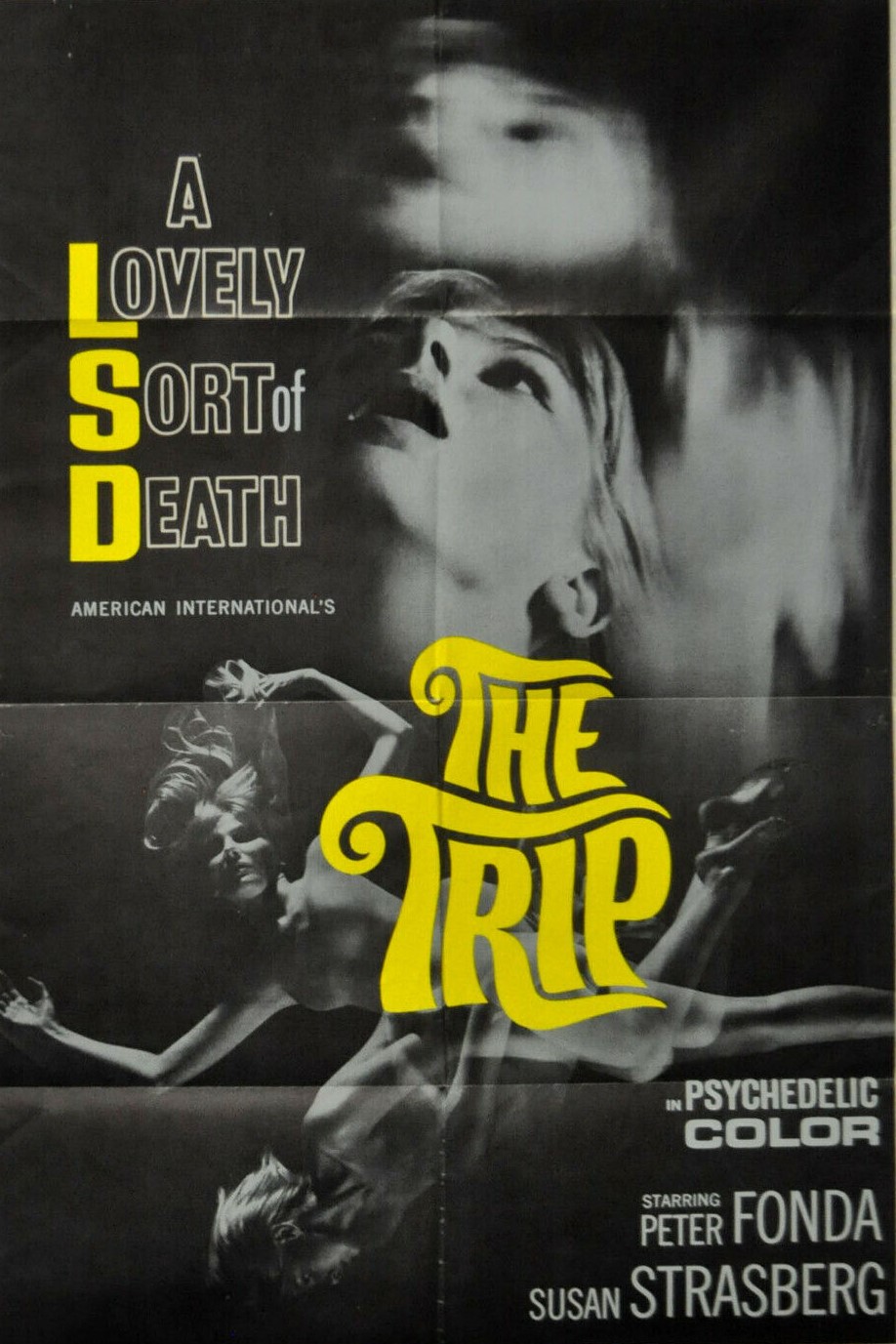
The Trip (1967) ***

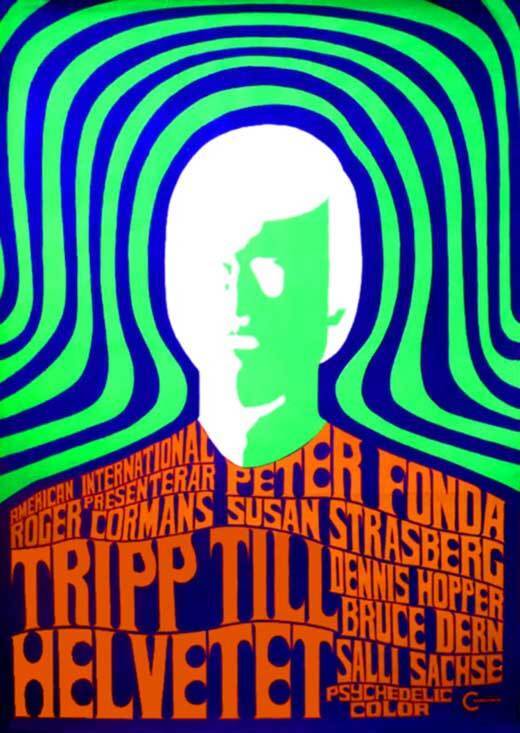
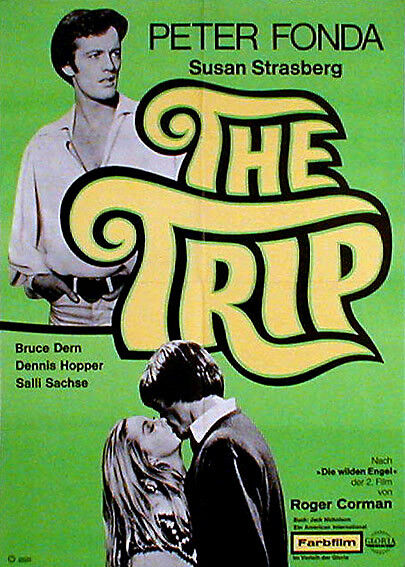
Give any neophyte (word of the week!) independent film director a camera and a small budget ($100,000 in this case) and they might well have come up with something like this. Has the feel of being an advert for promoters of LSD who felt they had to play fair and show the potential downside. Meanwhile, they can jam in an absolute phantasmagoria of imagery and sit back and wait for Stanley Kubrick to rip off some of their ideas and give the whole head-spinning malarkey some credence for the conclusion of 2001: A Space Odyssey.

If there’s a story, it’s as thin as they come. Commercials director Paul (Peter Fonda), trying to understand himself better, and why, for example, wife Sally (Susan Strasberg) has left him for another man, enlists the help of self-help guru John (Bruce) to guide him through an LSD trip. The notion that there are drug guides comes as a surprise to me, and this feels like the kind of the warning you get on the side of cigarette packets, although quite what guidance anyone can expect while under the influence is anybody’s guess. If you’re high as a kite, it’s unlikely you’re on an even enough keel to do what you’re told.

Anyway, off we go. And lo and behold, before you can utter the words “groovy” or even “psychedelic,” suddenly the screen is invaded with all sorts of images, coming so quick and fast that even the ones that might makes sense – i.e. indicating paranoia – get little time to settle before the next appear. Some of the images look like they’re offcuts from an AIP horror picture, haunted houses, medieval backdrops, torture, people being mummified or hanged or drowned or all three (maybe all at once).

And from there it’s an easy step into being dazzled by headlights or climbing a cliff or running through a desert or being chased by masked men on horseback and hearing high-pitched giggling. Some of the images, while dreamlike, remain realistic, such as topless body-painted go-go dancers. And the oddest image of a woman in curlers eating a chicken leg in a laundromat feels easily like something out of a bizarre dream when in fact it isn’t.

Some stuff you might expect. Items like an orange are experienced with more intensity. And Paul is disembodied when he observes people making love. Sometimes you’re looking through a kaleidoscope, other times it’s with grim clarity. Strobe lights, hallucination, add to the dreamy expressionistic quality. Not sure the movie had much to say except drugs can be fun – or not. But, inevitably, the imagery, instead of assisting with characterization, gets in its way.

Looks strange to see so many hippies with short hair. Peter Fonda, Dennis Hopper and Jack Nicholson (here only in his capacity as the screenwriter) would come together with greater effect in Easy Rider (1969). This resembles nothing more than an audition for the later film but directed by someone (Hopper) with a bit more sense, adding a proper narrative and cutting the tripping down to the minimum.

Roger Corman (The Secret Invasion, 1964) directed but Susan Strasberg (The Sisters, 1969), Bruce Dern (Castle Keep, 1969)  and Dennis Hopper have such small parts they are almost only there to add marquee value. Not quite the ode to counter culture envisaged.

Shows how difficult it is to film the unfilmable.

https://amzn.to/3Rz1mCW

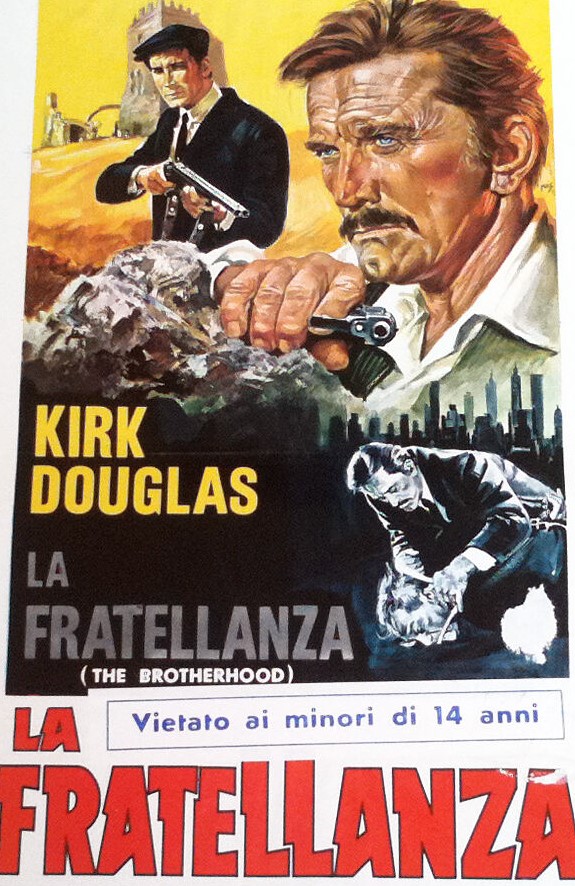
The Brotherhood (1968) ****

Minimal violence and no sex was the wrong recipe for this Mafia picture – as proven at the box office – but this is an absorbing, underrated drama nonetheless.

It bears a surprising number of parallels to The Godfather (1972). Pure coincidence, extraordinary though that may appear, because The Brotherhood premiered in December 1968 while the Mario Puzo novel was printed in March 1969 (and delivered to the printers long before), so no opportunity at all for plagiarism.

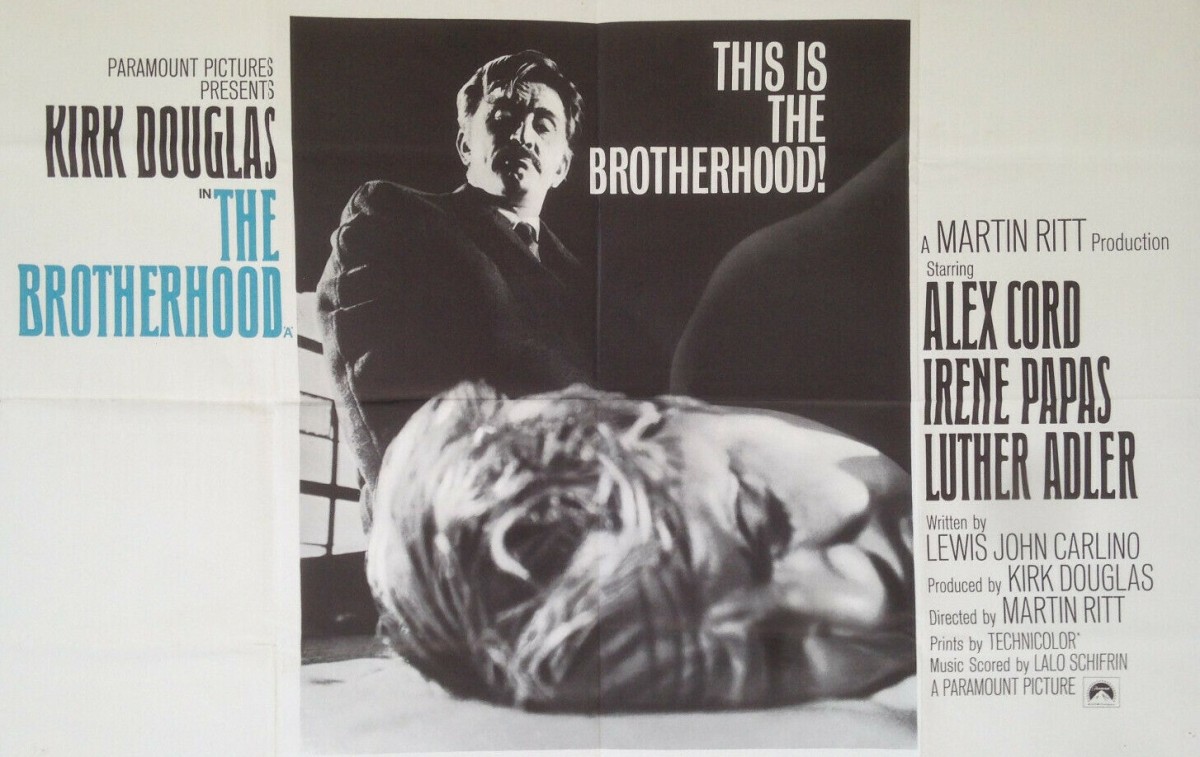
The two films could be opposite sides of the same coin. For a start, both begin with a wedding. Vince Ginetta (Alex Cord), brother of Mafia kingpin Frank (Kirk Douglas), is marrying Emma (Susan Strasberg), daughter of another Mafia chief Dominick (Luther Adler). Like Michael (Al Pacino) in The Godfather, Vince is just out of the army, well-educated and primed for a life outside the business. And like Michael is called upon to commit an act of supreme violence. There’s even a hint of Tom Hagen (Robert Duvall) in the relationship between the brothers, Frank having brought up the much younger Vince after his father’s premature death.

And just as Don Corleone (Marlon Brando) refuses to join the other Mafia families in a new business venture (in that case, drugs) so Frank bows out of an incredibly high risk (but amazingly prescient) scheme to invest in electronic firms involved in military work for the government, a deal that not only promises huge profits but a potential hold over the powers-that-be.

Frank’s wife Ida (Irene Papas) is like Don Corleone’s wife, not wanting to know anything about the business, but both Emma and Frank’s daughter Carmela (Connie Scott) are thematic cousins to Kay Adams (Diane Keaton) as initial implicit trust is wiped away. When Frank dances with Carmela at the wedding, that is reflected in Don Corleone dancing with his daughter at her wedding. Like The Godfather our first sight of the other Mafia chieftains – including Jim Hagen (Murray Hamilton) and Don Peppino (Eduardo Cianelli) – is at the feast where they are viewed with suspicion by Frank’s clan. And the scene where Frank uses a banana to tease his nephew will remind you of Don Corleone spooking his grandson with an orange.

However, the twist, if you like, is that, unlike Michael, Vince is desperate to join the Family and is instrumental in developing legitimate enterprises, which is echoed by Michael Corleone’s strategic shift to Las Vegas. In some respects, Frank is more like Sonny (James Caan), happy to take personal command of murders which the other Mafia chiefs now scrupulously delegate to “mechanics” in Los Angeles. He is more old-school whereas the others have assumed the personas of respectable businessmen.

And then it becomes a question of loyalty. Which side the ambitious Vinnie will take is crucial to the story. Frank is under pressure on all sides, from the other Mafia leaders, a government investigation, Vinnie, and the need to exact revenge on the man who caused his father’s death.

There is authentic detail here as well – religious procession in Sicily, Frank playing boccia (the Italian version of the French boules) with his old pals, family dinner, canary stuffed in the mouth of a stool pigeon, but it is less spaghetti-drenched than The Godfather. Screenwriter Lewis John Carlino (The Fox, 1967), also listed as technical adviser, claimed to be drawing on his intimate knowledge of organized crime.

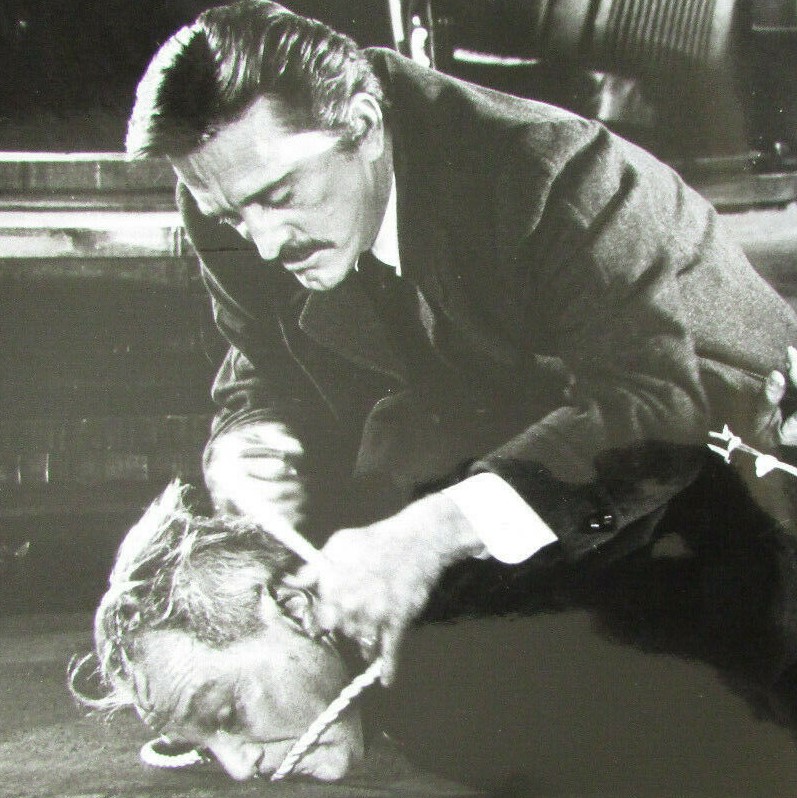
There are only three moments of violence – four if you count a shocking moment of someone spitting on a corpse at a wake – a pair of straightforward murders that bookend the film, plus a scene of Godfather-style brutality in which a man slowly strangles himself to death after being hogtied. Everyone is happily married, Ida very old-school to the extent of removing her husband’s clothes (and shoes) when he returns home drunk, Vince in a good relationship.

Kirk Douglas (Cast a Giant Shadow, 1966) is excellent in a difficult role that presents a fully rounded character, playful with his daughter, loyal to his wife, holding his own against the other mob bosses, enjoying the company of the old-timers who resemble his father, and the changing nature of his relationship with brother Vince. Alex Cord, whose work I initially dismissed (Stiletto, 1969), I have come to more fully appreciate, especially here, where he makes the transition from adoring brother to threat. It is a masterpiece of restraint.

The supporting cast is terrific, a rare Hollywood sojourn for Irene Papas (The Guns of Navarone, 1961), Luther Adler  (Cast a Giant Shadow, 1966) as one of the hoodlums exasperated by Frank’s recalcitrance,  Murray Hamilton (The Graduate, 1967) but, except at the start, Susan Strasberg (The Trip, 1967) is underused.

While director Martin Ritt (Hombre, 1967) is at times guilty of melodrama, his rendering of family life is much more nuanced than Coppola’s. There are very tender moments between Frank and his wife and Frank and his daughter, as well as moments where Ida plays a more maternal role.

For nearly half a century, The Brotherhood has lain in the shadow of The Godfather simply because they both deal with the Mafia. But this is an excellent movie in its own right.

The High Bright Sun / Maguire, Go Home (1964) ****

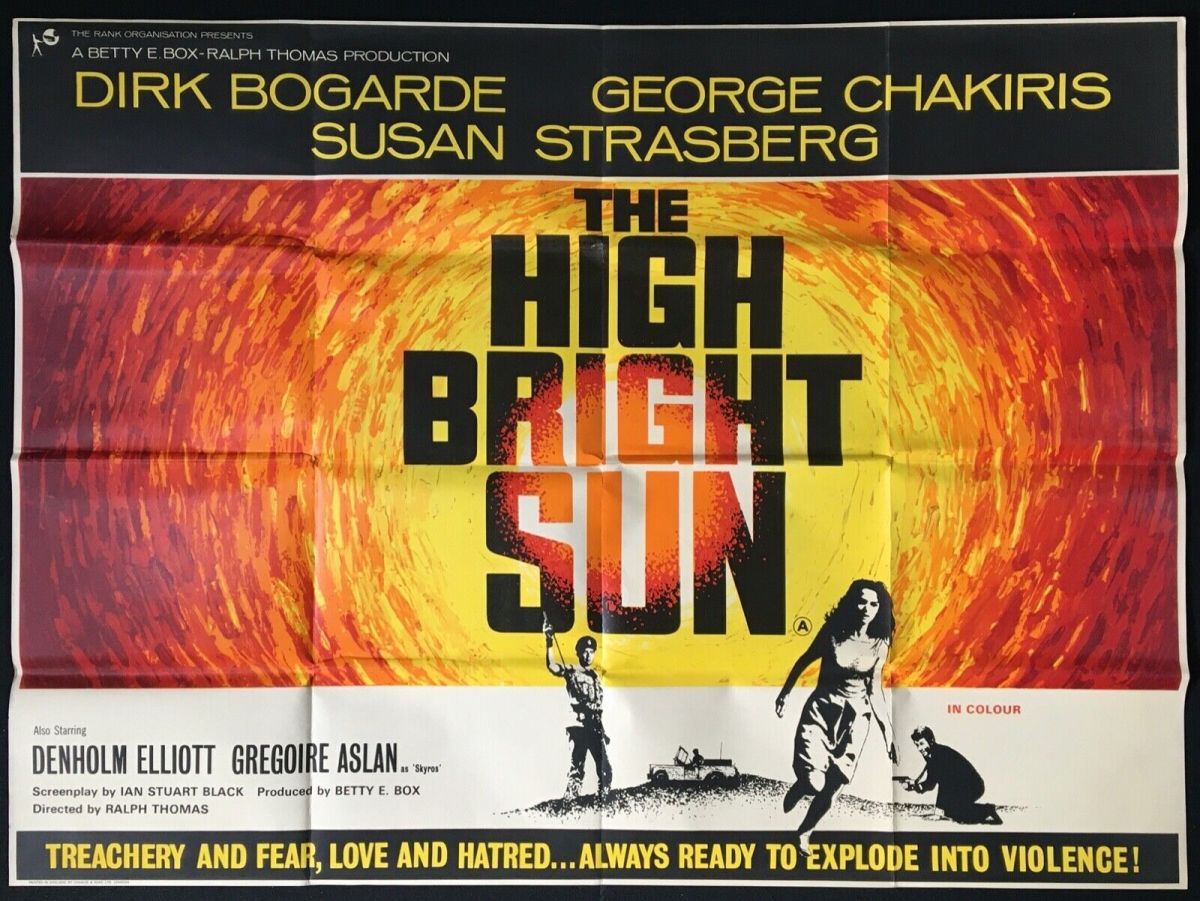
Surprisingly good thriller about loyalties in war time. Elevated above the norm by a series of stunning scenes often turning on the psychological. And taking a helluva bold risk as far as the billing is concerned. In dramatic and structural terms top-billed British star Dirk Bogarde (Justine, 1969) and rising American star George Chakiris (Diamond Head, 1962) take second place to the third-billed Susan Strasberg (The Sisters, 1969), although Bogarde’s stiff upper lip is tested in just about the most despicable fashion.

Also derives an interesting agency from differing audience perspectives. The British audience will view Major Maguire (Dirk Bogarde) as a hero trying to keep the peace in terrorist-racked Mediterranean island Cyprus. But virtually everyone else will side with Haghios (George Chakiris) and his bunch of freedom fighters in what was effectively a war of independence. Stuck in the middle, and expecting to be given a free pass, is Juno (Susan Strasberg), a young geologist staying with family friends named Andros but who, as an American, would be viewed as a neutral.

However, she has witnessed the arrival at the Andros home of terrorists, not just Haghios but General Skyros (Gregoire Aslan), leader of the Resistance. Not wanting to get her friends in trouble, and assuming they are not involved in terrorism, she resists the attempts of Maguire to get her to name names. But it’s only the cooler head of the general and the youngest member of the Andros clan, son Emile (Colin Campbell), that prevents her being shot dead on the spot.

Bluff and double bluff are the order of the day. She’s a prisoner – and a shocked one at that having witnessed British soldiers murdered by terrorists – but if she is seen to be prevented from leaving the house it will give the game away. So Maguire comes up with an acceptable ploy to get her out so that, in a calmer situation, he can gently interrogate her.

Unfortunately taking her out to dinner backfires, as they are spotted by Haghios who, assuming they are romantically involved, realises she can’t be trusted and signs her death warrant.

But she’s far from the plucky female and no good at playing the game of being hunted. In a brilliant sequence she takes all the wrong actions and it’s only happenstance and sacrifice that prevent her capture. And this is followed by an even edgier scene when she hitches a ride late at night with a lascivious local. But that’s nothing to her treatment by Maguire who, furious at her refusal to talk, parades her in the streets “like a sitting duck.”

There’s a whole strata of soldiers in open rebellion of a different kind. Maguire mocks his commanding officer, the inept Col Park (Nigel Stock), and he in turn is mocked by his junior, Lt Baker (Denholm Elliott) who taunts him about the affair he had with Maguire’s wife. And there are any number of stings in the tail. Believing she has finally escaped, Juno is confronted by Haghios and no Maguire in sight to come to her aid.

But the central tale is given over to Juno, the innocent caught up in bloody warfare, forced to witness barbarity at first hand, and unless she hankers after personal sacrifice inevitably  induced to take sides.

Susan Strasberg is simply superb. At no time is she the feminine hero springing into reluctant action in some espionage or wartime drama. Instead, she is the innocent bystander who at any moment will turn into collateral damage. And she’s too confused even to summon up outrage at betrayal by both sides.

Dirk Bogarde looks as if he is playing your standard British officer of high breeding who can trade barbs and bullets with the enemy but mostly tries to extract information by gentler means. But he turns out to be just as savage in his ideals as the opposition. And his armour is pierced not only by having an adulterous wife but having to take abuse from her lover.

It was a typical Hollywood ploy to stick an innocent American in a war zone in order to expose a situation or attract audience sympathy either for the underdog or the oppressors – think Jack Lemmon in Chile in Missing (1982) or Sally Field in Iran in Not Without My Daughter (1991) – but I doubt if director Ralph Thomas was as naïve or politically-inclined to attempt that here and instead he treads a finer line of personal decision as he would later do in The High Commissioner/Nobody Runs Forever (1968).  Sticking to the storyline and relying on actors who never resort to emotional extremes pretty much does the trick.

George Chakiris is wasted and I can only assume this was a sign of his career going downhill.

Not just far better than I expected, but bordering on the excellent.

Sisters (1969) ****

Erotically-charged, symbolically-heavy French drama of siblings trying to re-establish the intense relationship they enjoyed as teenagers. After a nervous breakdown and on the point of divorce, blonde translator Diana (Nathalie Delon) seeks respite at the home of younger sister Martha (Susan Strasberg), a brunette happily married to the wealthy and indulgent Alex (Massimo Girotti).

Initially, the more worldly Diana, the more flamboyant dresser, appears the superior but it soon transpires she is the more fragile. The apparently timid Martha allows her husband to control her life to the point of buying all her clothes and she confesses to feeling as if she is on “a perpetual cruise.” While on the surface, it seems as if she has given up too much, in reality she disapproves of disorder and seeks perfection. She comes across as needing protection, and believes the woman’s role is to sacrifice, but in fact has managed to arrange her life to her own satisfaction.

Their competitive streaks emerge in different ways, Diana in obvious fashion, seeking to beat her sister while out horse-riding, Martha in more subtle and sensual manner, flaunting her sexual relations with her husband, almost offering her sister to her husband, and having a lover (Lars Bloch) on the side. There is a sense of each attempting to impose their world view on the other. Diana gives her sister a make-over, a new look which Alex adores, Martha hates it. There’s a sense of a chess game, males the obvious pawns.

Sensuality is never far away. Diana nuzzles her sister’s neck to smell her perfume. Alex is photographed, encouraged by Martha, in almost intimate mode with Diana. Dario (Giancarlo Giannini) is brought in to tempt Diana. And a scene where the girls experiment with colorful scarves suggests libertarianism. 

But it is clear that both sisters live empty lives devoid of true love and equally obvious as the picture progresses that both have arrived at the conclusion that they were at their most happiest when together. There are subtle hints of incest, comforting each other in bed, the sensuality electric and the film begins to examine whether this taboo can be crossed and, if so, will it provide the necessary escape.

Despite Martha’s apparent subjugation, there is more than an inkling of feminism, the girls involved in a complicated scenario in which males are either rejected or made to look fools. While not fulfilled, Martha has turned as much as possible to her own advantage and Diana seems perfectly capable of taking what she wants.

Alex provides the symbolism. He cultivates rare plants in a greenhouse that need to hide from the sun, lengthy exposure to whose atmosphere would be fatal to humans. He endlessly photographs them because they won’t last long. And in similar fashion provides a haven for the apparently vulnerable Martha.

Nathalie Delon (When Eight Bells Toll, 1970), married at this point to Alain Delon, shows a subtlety of expression that is rare for someone appearing in just her third film, and effects a gradual character transition throughout. Susan Strasberg, daughter of famed acting coach, Lee Strasberg, inventor of the Method Style of Acting, was one of the boldest actors of her generation, appearing in drug pictures The Trip (1967) and Psych Out (1968). She delivers an excellent portrait of a woman who manages to keep her true personality hidden, and for whom sexuality has few barriers.

This is the puppy-fat version of Giancarlo Giannini (Swept Away, 1974), barely recognizable as the future arthouse superstar whose physical appearance relied on gaunt, angst-riddles features.  Massimo Girotti (Theorem, 1968) is good as the husband who thinks he has everything, not realising how little he has.  

Although this was an accomplished directorial debut from Roberto Malenotti, he only made one more movie. Perhaps he made enough from directing the famous Coke commercial I’d Like To Teach The World To Sing (1971).

Always intriguing, revelations continually undercutting what we think we know of the characters, but delivered in subtle European tones rather than employing Hollywood shock, each of the four main people involved changing considerably due to their interaction with the others. While certainly skirting close to the borders of what was permissible at the end of the 1960s, it does so without exploiting the actresses.

Not an easy one to find, your best bet is a secondhand copy on Ebay.

The Brotherhood (1968) ****

Minimal violence and no sex was the wrong recipe for this Mafia picture – as proven at the box office – but this is an absorbing, underrated drama nonetheless.

It bears a surprising number of parallels to The Godfather (1972). Pure coincidence, extraordinary though that may appear, because The Brotherhood premiered in December 1968 while the Mario Puzo novel was printed in March 1969 (and delivered to the printers long before), so no opportunity at all for plagiarism.

The two films could be opposite sides of the same coin. For a start, both begin with a wedding. Vince Ginetta (Alex Cord), brother of Mafia kingpin Frank (Kirk Douglas), is marrying Emma (Susan Strasberg), daughter of another Mafia chief Dominick (Luther Adler). Like Michael (Al Pacino) in The Godfather, Vince is just out of the army, well-educated and primed for a life outside the business. And like Michael is called upon to commit an act of supreme violence. There’s even a hint of Tom Hagen (Robert Duvall) in the relationship between the brothers, Frank having brought up the much younger Vince after his father’s premature death.

And just as Don Corleone (Marlon Brando) refuses to join the other Mafia families in a new business venture (in that case, drugs) so Frank bows out of an incredibly high risk (but amazingly prescient) scheme to invest in electronic firms involved in military work for the government, a deal that not only promises huge profits but a potential hold over the powers-that-be.

Frank’s wife Ida (Irene Papas) is like Don Corleone’s wife, not wanting to know anything about the business, but both Emma and Frank’s daughter Carmela (Connie Scott) are thematic cousins to Kay Adams (Diane Keaton) as initial implicit trust is wiped away. When Frank dances with Carmela at the wedding, that is reflected in Don Corleone dancing with his daughter at her wedding. Like The Godfather our first sight of the other Mafia chieftains – including Jim Hagen (Murray Hamilton) and Don Peppino (Eduardo Cianelli) – is at the feast where they are viewed with suspicion by Frank’s clan. And the scene where Frank uses a banana to tease his nephew will remind you of Don Corleone spooking his grandson with an orange.

However, the twist, if you like, is that, unlike Michael, Vince is desperate to join the Family and is instrumental in developing legitimate enterprises, which is echoed by Michael Corleone’s strategic shift to Las Vegas. In some respects, Frank is more like Sonny (James Caan), happy to assume personal command of murders which the other Mafia chiefs now scrupulously delegate to “mechanics” in Los Angeles. He is more old-school whereas the others act as respectable businessmen.

And then it becomes a question of loyalty. Which side the ambitious Vinnie will take is crucial to the story. Frank is under pressure on all sides, from the other Mafia leaders, a government investigation, Vinnie, and the need to exact revenge on the man who caused his father’s death.

There is authentic detail here as well – religious procession in Sicily, Frank playing boccia (the Italian version of the French boules) with his old pals, family dinner, canary stuffed in the mouth of a stool pigeon, but it is less spaghetti-drenched than The Godfather. Screenwriter Lewis John Carlino (The Fox, 1967), also listed as technical adviser, claimed to be drawing on his intimate knowledge of organized crime.

There are only three moments of violence – four if you count a shocking moment of someone spitting on a corpse at a wake – a pair of straightforward murders that bookend the film, plus a scene of Godfather-style brutality in which a man slowly strangles himself to death after being hogtied. Everyone is happily married, Ida very old-school to the extent of removing her husband’s clothes (and shoes) when he returns home drunk, Vince in a good relationship.

Kirk Douglas (Cast a Giant Shadow, 1966) is excellent in a difficult role that presents a fully rounded character, playful with his daughter, loyal to his wife, holding his own against the other mob bosses, enjoying the company of the old-timers who resemble his father, and the changing nature of his relationship with brother Vince. Alex Cord, whose work I initially dismissed (Stiletto, 1969), I have come to more fully appreciate, especially here, where, in a masterpiece of restraint, he makes the transition from adoring brother to threat.

The supporting cast is terrific, a rare Hollywood sojourn for Irene Papas (The Guns of Navarone, 1961), Luther Adler  (Cast a Giant Shadow, 1966) as one of the hoodlums exasperated by Frank’s recalcitrance,  Murray Hamilton (The Graduate, 1967) but, except at the start, Susan Strasberg (The Trip, 1967) is underused.

While director Martin Ritt (Hombre, 1967) is at times guilty of melodrama, his rendering of family life is much more nuanced than Coppola’s. There are very tender moments between Frank and his wife and Frank and his daughter, as well as moments where Ida plays a more maternal role.

For nearly half a century, The Brotherhood has lain in the shadow of The Godfather simply because they both deal with the Mafia. But this is an excellent movie in its own right.

Discover WordPress

A daily selection of the best content published on WordPress, collected for you by humans who love to read.

The Atavist Magazine

by Brian Hannan

WordPress.com News

The latest news on WordPress.com and the WordPress community.