P.J. / New Face in Hell (1968) ****

Exceptional down-and-dirty thriller and throwback film noir woefully underrated on release but with a brilliant mystery (or two), a touch of satire, red herrings, some great lines, and believable characters. Private eye P.J. Detweiler (George Peppard) is so down on his luck he is willing to play the lover so an errant wife can be photographed in a motel room. What little he earns goes on paying is debts. So he can hardly down the chance of serious money as bodyguard to Maureen (Gayle Hunnicutt), mistress of rich businessman William Orbison (Raymond Burr), never mind that she initially treats him as a servant.

Orbison has a legendary mean streak – secretaries have to type closer to the edge of sheets of paper, he forces wife Betty (Colette Gray) to account for every dime of her allowance to the point of almost making her beg. Sadism is another character trait. He is happy not to kill off animals he has shot. The childless millionaire adds Maureen to his will for the sole purpose of upsetting every other potential heir. In front of guests at a prestigious party he forces Betty to acknowledge Maureen’s existence.

This apparently wealthy world is riddled with seedy inhabitants, whose only motivation is  greed, all desperate to retain status or inheritance and enjoying Orbison’s largesse, which, despite his miserly nature, he nonetheless flaunts. As well as Betty enduring ritual humiliation to remain his wife and enjoy a gilded lifestyle, his executive assistant Jason (Jason Evers) accepts being treated as a gofer in order to keep his position and the perks that go with it, and Maureen makes no bones about prostituting herself for temporary and future gain. Everyone has to kowtow, even the occupants of a West Indian island dependent on Orbison for investment, not only a kids choir welcoming Orbison on arrival, but a calypso performer singing a song in his praise.

As various threats, including narrowly missing a bullet, are made against Maureen, making a classical entrance in a red dress and alternating between helpless victim and femme fatale, with her creepy manservant Quell (Severn Darden) reporting on her every move, inevitably Detweiler grows closer to his client, unaware that Orbison is planning to have someone killed.

That someone turns out to be Jason, whom Orbison suspects of clandestine activity with his wife, and whom Detweiler innocently kills. As this takes place on the island, where the death is easily hushed up, Detweiler begins to wonder if he’s a patsy and, paid off by Orbison, undertakes his own investigation, quickly entering more dangerous waters, viciously beaten up at Quell’s behest in a gay bar, narrowly avoiding death in the subway and literally finding himself in the firing line.

Detweiler’s character undergoes transition, too. From begging for scraps and turning the other way so as not to jeopardize easy income, he rediscovers his suit of shining armor, walking down some pretty mean streets, a diligent private eye who can no longer be bought off, determined to get to the bottom of what turns out to be a complicated mystery.

Detweiler is no Marlowe or even Tony Rome, but rather despicable at the outset, employing all sorts of dodges, his interest in Maureen not slackening even after he knows she indulges in a quickie with Orbison. He takes too much at face value.

The unfolding mystery is superbly handled, involving proper clues and investigation, shoot-outs and fisticuffs, the outcome not what you might initially imagine. Although primarily an old school private eye picture, it’s great fun, with some wonderful comedy involving a dog, gentle satire on the West Indian island where whitewash is the order of the day, and some touching romantic foreplay.

Peppard (Pendulum, 1969) is outstanding as the dupe who rediscovers his moral code and his Detweiler is an excellent addition to the ranks of the private eye.  Raymond Burr, a far cry from his Perry Mason (1957-1966) television persona,  is easily one of the worst screen millionaires – on a par with Ralph Richardson in Woman of Straw (1964) in his contempt for humanity – and with his silver hair and bulk and scheming proves a slick adversary. Gayle Hunnicutt (Eye of the Cat, 1969) is allure on legs, brilliantly playing every man in sight, eye never diverted from the main chance.

Brock Peters (The Pawnbroker, 1964) has a standout cameo as the island’s cynical police chief. Susan Saint James (The Name of the Game, 1968-1971) makes her movie debut as Orbison’s slinky sex-mad niece.  Also putting in an appearance are Wilfrid Whyte-Hyde (The Liquidator, 1965) as the island’s accommodating governor, Colleen Gray (Red River, 1948) as the humiliated wife, Severn Darden as the odious Quell, and John Ford regular John Qualen (The Man Who Shot Liberty Valance, 1962).

This was the second of director John Guillermin’s George Peppard trilogy following The Blue Max (1966) and prior to House of Cards (1968). Generally dismissed as a journeyman, Guillermin brings a sly eye to this picture, the send-up of British colonialism, the master-servant aspects, an over-the-shoulder shot of an unknown assassin, the scenes in the bar which is effectively Detweiler’s office, and a brilliant subway death adding layers to the movie. He is bold in his use of close-ups with Hunnicutt, some scenes almost a homage to the Bogart-Bacall chemistry, and brings out a world-weary performance from the usually cocky Peppard.

Philip Reisman Jr. (All the Way Home, 1963) fashioned the screenplay, delivering one of cinema’s most memorable final lines.

Bracketed with Pendulum and House of Cards demonstrates that Peppard is under-rated.

Well worth a watch.

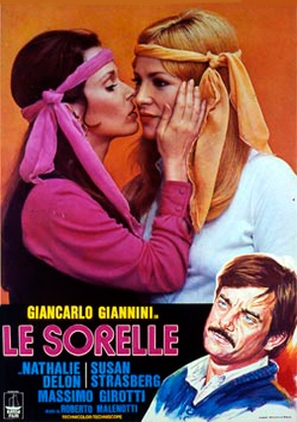
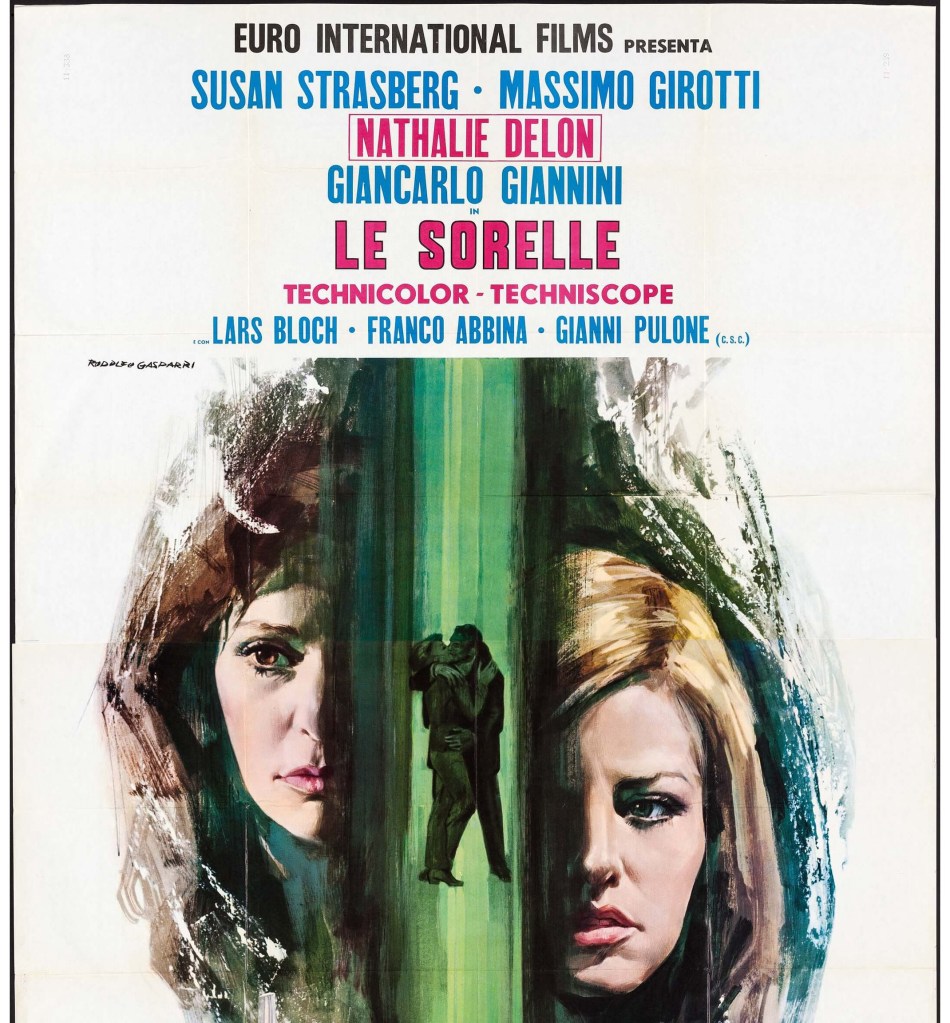
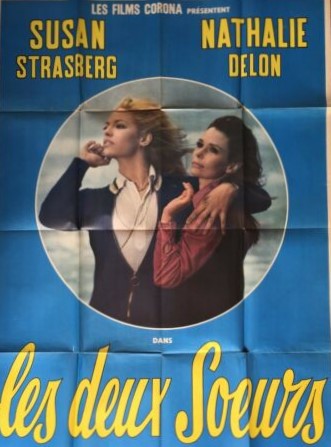
The Sisters / Le Sorelle (1969) ****

Erotically-charged, symbolically-heavy French drama of siblings trying to re-establish the intense relationship they enjoyed as teenagers. After a nervous breakdown and on the point of divorce, blonde translator Diana (Nathalie Delon) seeks respite at the home of younger sister Martha (Susan Strasberg), a brunette happily married to the wealthy and indulgent Alex (Massimo Girotti).

Initially, the more worldly Diana, the more flamboyant dresser, appears the superior but it soon transpires she is the more fragile. The apparently timid Martha allows her husband to control her life to the point of buying all her clothes and confesses to feeling as if she is on “a perpetual cruise.” While on the surface, it seems as if she has given up too much, in reality she disapproves of disorder and seeks perfection. She comes across as needing protection, and believes the woman’s role is to sacrifice, but in fact has managed to arrange her life to her own satisfaction.

Their competitive streaks emerge in different ways, Diana in obvious fashion, seeking to beat her sister while out horse-riding, Martha in more subtle and sensual manner, flaunting her sexual relations with her husband, almost offering her sister to her husband, and having a lover (Lars Bloch) on the side. There is a sense of each attempting to impose their world view on the other. Diana gives her sister a make-over, a new look which Alex adores, Martha hates it. There’s a sense of a chess game, with two or more players, with the males subservient. pawns.

Sensuality is never far away. Diana nuzzles her sister’s neck to smell her perfume. Alex is photographed, encouraged by Martha, in almost intimate mode with Alex. Dario (Giancarlo Giannini) is brought in to tempt Diana. And a scene where the girls experiment with colorful scarves suggests libertarianism. 

But it is clear that both sisters live empty lives devoid of true love and equally obvious as the picture progresses that both have arrived at the conclusion that they were at their happiest when together. There are subtle hints of incest, comforting each other in bed, the sensuality electric and the film begins to examine whether this taboo can be crossed and, if so, will it provide the necessary escape?

Despite Martha’s apparent subjugation, there is more than an inkling of feminism, the girls are involved in a complicated game in which the males are pawns, either rejected or made to look fools. While not fulfilled, Martha has turned as much as possible to her own advantage and Diana seems perfectly capable of taking what she wants.

Alex provides the symbolism. He cultivates rare plants that need to hide from the sun, in a greenhouse, lengthy exposure to whose atmosphere would be fatal to humans. He endlessly photographs them because they won’t last long. And in similar fashion provides a haven for the apparently vulnerable Martha.

Nathalie Delon (When Eight Bells Toll, 1970), married at this point to Alain Delon, shows a subtlety of expression that is rare for someone appearing in just her third film, and effects a gradual character transition throughout. Susan Strasberg, daughter of famed acting coach, Lee Strasberg, inventor of the Method Style of Acting, was one of the boldest actors of her generation, appearing in drug pictures The Trip (1967) and Psych Out (1968). She delivers an excellent portrait of a woman who manages to keep her true personality hidden, and for whom sexuality has few barriers.

This is the puppy-fat version of Giancarlo Giannini (Swept Away, 1974), barely recognizable as the future arthouse superstar whose physical appearance relied on gaunt, angst-riddles features.  Massimo Girotti (Theorem, 1968) is good as the man who thinks he has everything, not realizing how little he has. 

Although this was an accomplished directorial debut from Roberto Malenotti, he only made one more movie. Perhaps he made enough from directing the famous Coke commercial I’d Like To Teach The World To Sing (1971).

Always intriguing, revelations continually undercutting what we think we know of the characters, but delivered in subtle European tones rather than employing Hollywood shock, each of the four main people involved changing considerably due to their interaction with the others. While certainly skirting close to the borders of what was permissible at the end of the 1960s, it does so without exploiting the actresses.

Intriguing.

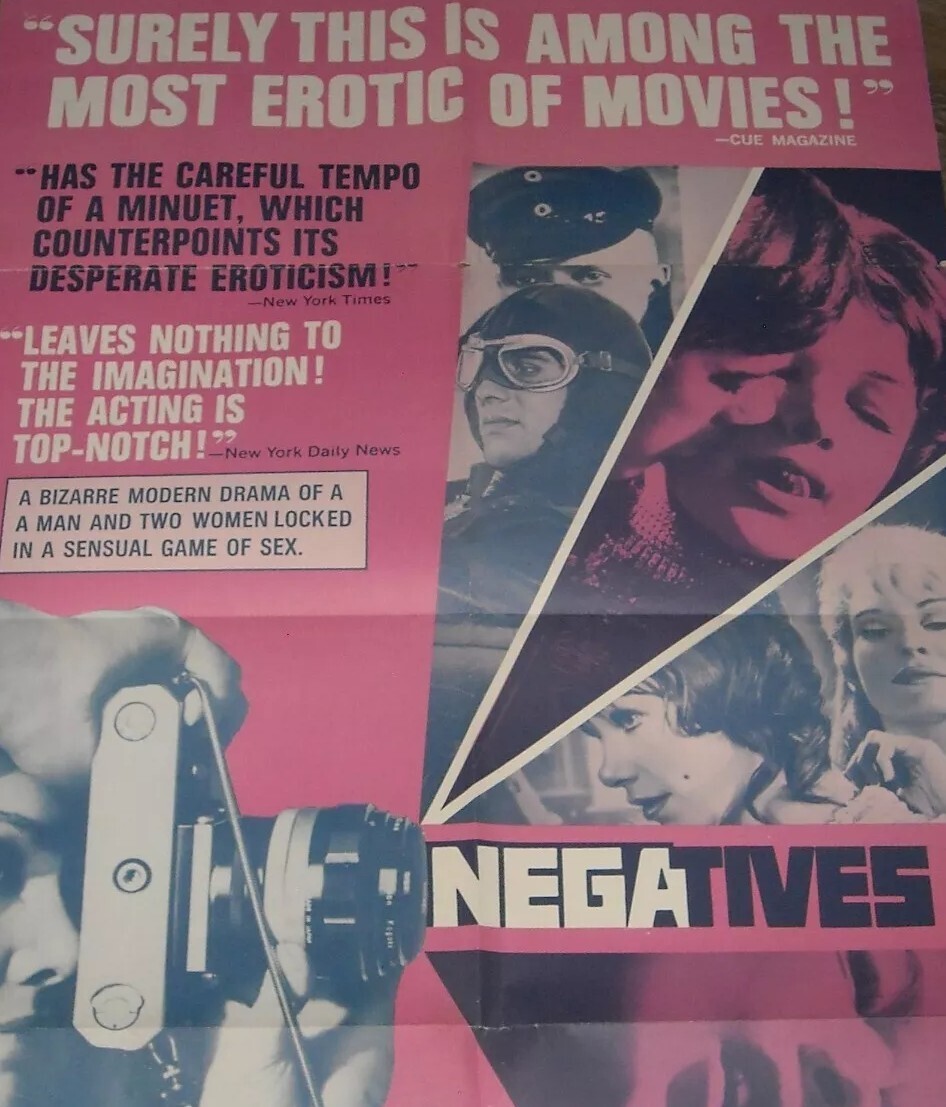
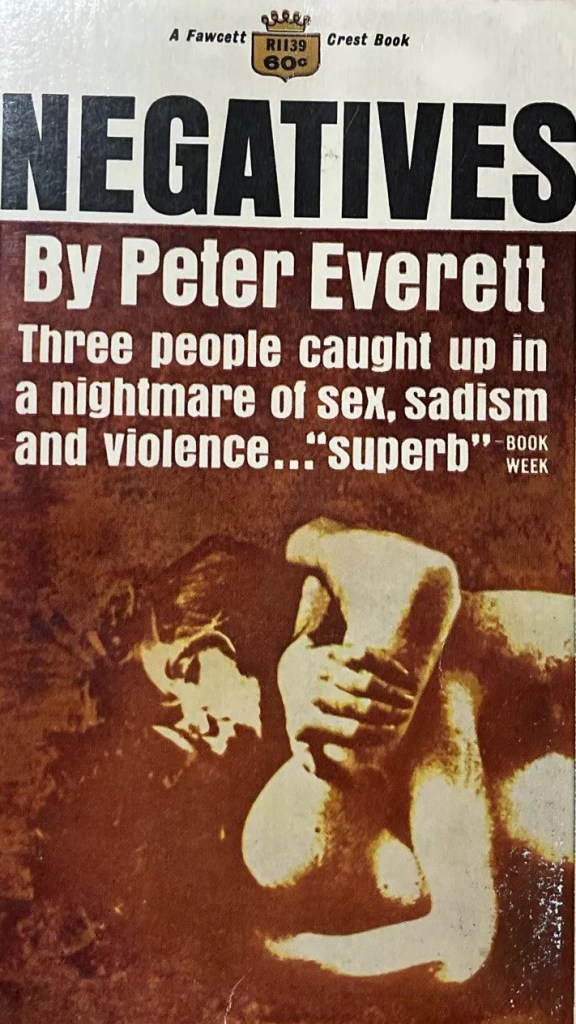
Negatives (1968) ***

Role play wasn’t the sub-culture it is now. Though fashion had injected more of a sense of dressing up what with Russian furs courtesy of Doctor Zhivago (1965) and snazzy berets from Bonnie and Clyde (1967), the idea of people living out their lives in costume had not taken hold. So consider this a precursor – and maybe a warning – as to what can go wrong if taken too far.

Obscurity to the point of obfuscation was an arthouse default especially prevalent in more commercial ventures like Blow-Up (1966) and In Search of Gregory (1969) so no need to bother yourself with hunting out motivation or background.

The erotic subtext – voyeurism too – here takes on a disturbing quality as it touches on the notion of male justified in using violence in response to female provocation.  Drama centers on a clash of role model sensibilities with a weak male shifting from interpreting a murderous villain to imitating a heroic pilot.

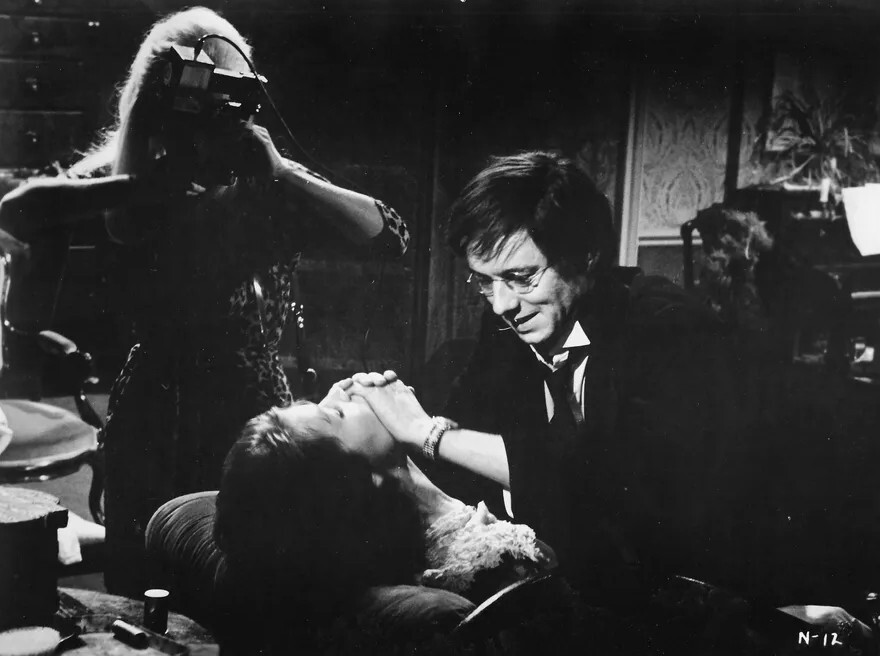
Antiques dealer Theo (Peter McEnery) spices up his stale marriage to Vivien (Glenda Jackson) by dressing up as serial killer Dr Crippen. She invests in the role of his complaisant lover Ethel. Play-acting, at her behest it appears, doesn’t prevent her verbally tearing into him. Into this unconventional nest arrives German photographer Reingard (Diane Cilento) who has been spying on him for several weeks. She has her own fantasy and soon has him rigged out as World War One flying ace Baron von Richtofen, complete with ancient biplane. He responds to the militaristic characteristics of the pilot, entering more into the spirit of the game than the famed killer.

Naturally, Vivien doesn’t take kindly to this intrusion, not least because she realizes she isn’t the only one who can manipulate her malleable husband and violence and tragedy ensue. It’s not entirely clear why either female character indulges in such fantasies and does give rise to the cliche notion, and redolent of the times, of the female wishing to give in to the dominant male, even when the man shows little sign of being a dominant personality.

Apart from Theo visiting his father (Maurice Denham) who appears to be dying in hospital, the picture doesn’t shift much from its three-cornered narrative. The idea of the ongoing masquerade is emphasized by a sequence set in Madame Tussaud’s. Given the censorship of the times, the eroticism is largely of the discreet variety, rather than going down the full-blown sexual fantasy of The Girl on a Motorcycle (1969).

Glenda Jackson both plays a character right up her street and brings far more to the role than either Peter McEnery (The Moonspinners, 1964) or Diane Cilento (The Third Secret, 1964) who give the appearance of slumming it in a low-budget production in the hope it might bring career kudos.

Unwilling to dig any deeper into the characters, director Peter Medak (The Ruling Class, 1972), in his debut,  merely toys with technique, elaborate shots following a character round a room or unusual compositions.

With the trendy crowd parading down King’s Road with all the latest hip gear including military uniforms and Victorian garb, this might have seemed to fit right in, except that the main characters have little in common with the “Youthquake” of the era.

On the one hand a true oddity with McEnery and Cilento well out of their comfort zones, on the other proof of what Jackson and Medak had to offer.

Might appeal to the role-playing crowd, more likely to those interested in early Glenda Jackson.

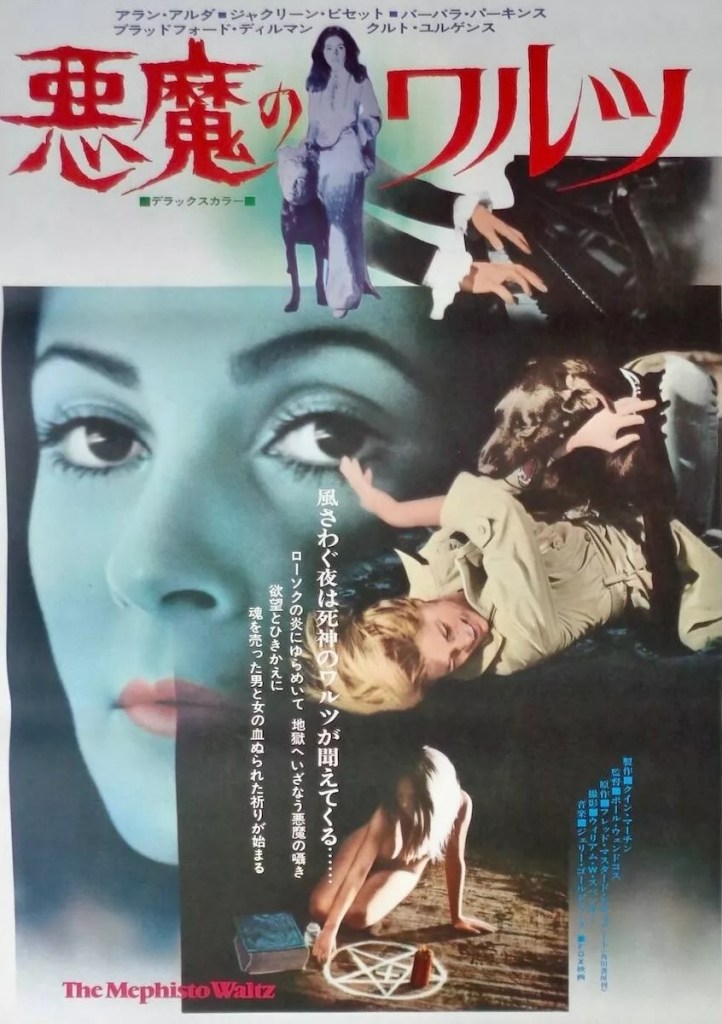
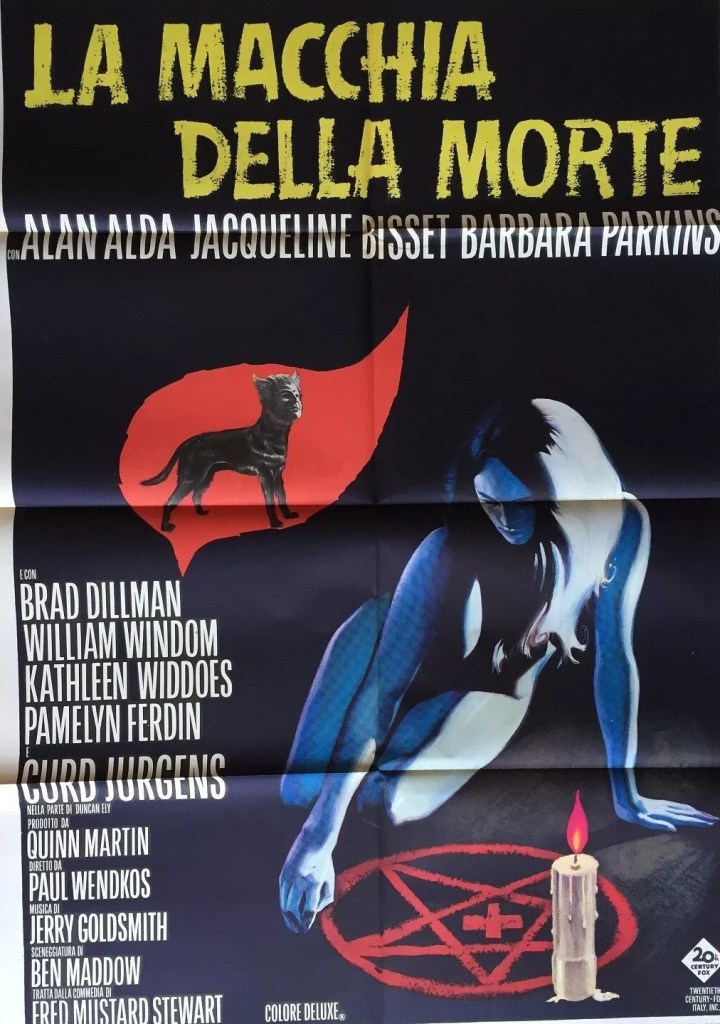
The Mephisto Waltz (1971) ****

Jacqueline Bisset’s good looks often got in the way of her acting. Or, more correctly, in the way of producer perception about what she could do.  Too often she was the female lead that simply hung on the arm of the male lead. But, here, to my surprise, she is not only the narrative fulcrum, but steals the show from Alan Alda, mostly remembered these days for TV’s M*A*S*H (1972-1983) but at the start of the 1970s being heralded in Hollywood as the next big thing and top-billed.  

Alda’s character here is little more than his screen persona in embryo – glib, wise-cracking, cocky. In an earlier Hollywood he would have been the smooth-talking gangster beefing up B-pictures.

Appearing between the demonic high-spots of Rosemary’s Baby (1968) and The Omen (1976), director Paul Wendkos (Cannon for Cordoba, 1970) escapes his journeyman roots to suffuse the picture with nightmarish scenes, and clever use of the fish-eye lens, treating Satanism with the most subtle of brushes, restricted to a mark daubed in a forehead and a pentagram on the floor but minus any chorus of witches or warning from priests or sundry other holy persons.

Myles (Alan Alda), piano prodigy who never made the cut, now a journalist, is encouraged by interviewee, concert pianist Duncan Ely (Curt Jurgens), to take it up again. Under the older man’s tutelage, he thrives, promising career beckons, plus an entrée into quite a heady world of parties, sex and wealth. Wife Paula (Jacqueline Bisset) is more sceptical especially once Duncan and his buddies start buying up everything in sight in her new antiques emporium. She’s especially perturbed to see Duncan sharing an intimate kiss with his married daughter Roxanne (Barbara Parkins) never mind wondering whether her husband is going to fall prey to the daughter’s seductive technique.

Just what’s going on is never entirely obvious, making the audience work rather than bombarding them with shock scenes. I’m not sure what you’d call it in demonic terms, some kind of transference, body and soul. Once Duncan dies, Myles’s life is transformed, not just thanks to an extremely generous bequest in the old man’s will, but a dramatic increase in his piano-playing prowess, plus, almost as a bonus, the increased attentions of Roxanne.

True scares are limited, mostly a huge drooling black mastiff who may or may not be a killer, and so the tale remains more subtle and eventually boils down to whether Paula will follow her husband on his satanic journey or lose him to the wiles of Roxanne and, perhaps more importantly, never enjoy him as the personality he once was.

We all know that, where money and career is concerned, Myles has a cynical bone in his body and has already demonstrated a capacity for the finer things in life, whether they be animate or inanimate. So his character carries little dramatic tension. And so Paula carries the dramatic burden and she bears that, too, with surprising subtlety.

There’s almost a reverse Gaslight vibe to the whole exercise, Paula convincing herself that she must take this step into what would otherwise be considered madness. It’s worth noting that nobody’s pushing her. She makes the decision herself, although takes you a while (that subtlety again) before you cotton on to consequence. And while we’re on the subject of subtlety, full marks to Wendkos for treating two scenes in particular of Bisset nudity with commendable restraint.  

Quite where Satan’s apparent mission to bring classical music to the masses fits into his plans for global domination is never made clear, leanings of such an esoteric nature rarely a prerequisite of the evil mastermind.

Still, a much classier feast than I was expecting, Bisset (The Sweet Ride, 1968) the standout. Her performance served to give Hollywood notice of a classier star than merely the barely seen girlfriend of Steve McQueen in Bullitt (1968). From here on in she would catch the eye of a better grade of director, including Francois Truffaut in Day for Night (1974) though it can be arguedthat it was her looks that sent her into the stratosphere after the wet t-shirt modelling in The Deep (1977).

Alda, meanwhile, jumped straight into M*A*S*H and didn’t resurface as a creditable movie marquee name until California Suite (1978) and The Seduction of Joe Tynan (1979).  Curt Jurgens (Psyche ’59) as ever is good value, Barbara Parkins (Puppet on a Chain, 1970) his rather slinky associate and Bradford Dillman (The Bridge at Remagen, 1969) also pops up.

Wendkos in top gear. Screenplay by Ben Maddow (The Way West, 1967) from the Fred Mustard Stewart bestseller. Excellent Jerry Goldsmith score.

Well worth a look.

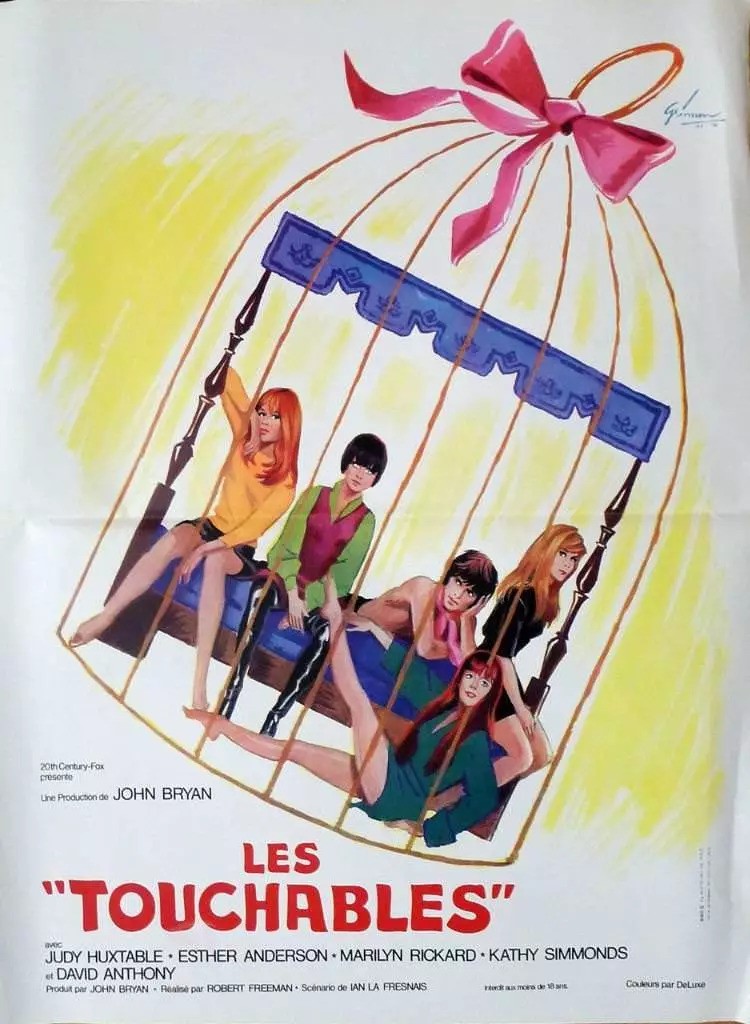
The Touchables (1968) **

Take a giant bubble, yellow Mini, an abundance of mini-skirts, Michael Caine waxwork,  one pop star, four models, a masked wrestler, nuns, table football, a pinball machine, a circular bed, various sunsets, a shotgun and a lass milking a fake cow. And what do you get? Not much? A dry run for Performance (1971), given Donald Cammell’s involvement, but otherwise a largely soporific feature hoping for redemption on the cult circuit. But with the unsavory subject matter, even with a proto-feminist outlook, that might struggle might to win approval from a contemporary audience.

Unlike Privilege (1967) it’s not saved by ironic comment on the music scene or even anything in the way of decent performances and looks more like an attempt to guy up the nascent careers of a bunch of young actresses and get by with a day-glo pop art sensibility. At no point are we invited to disapprove of the model quartet who decide, having tried out their kidnapping skills on a Michael Caine waxwork, that they might as well go the whole hog and abduct pop star Christian (David Anthony) and tie him to a bed and take their turns having their wicked way with him.

This is all purportedly acceptable stuff because a) it’s a gender switch and b) the poor pop singer is only too happy to escape the drudgery of making millions and not have to even consort with groupies and c) is presented as if he is thoroughly enjoying the whole experience. That is, if you ignore him being chloroformed, shot, and whacked over the head, then of course it’s all very pleasant.

Naturally, these being cunning wenches, they hide him in plain sight. Who would think to look for him in a giant transparent bubble?

Although drawn with villainous strokes, as were all the managers in Privilege who put unnecessary pressure on the pop star they have created, it’s hard to view Anthony’s upper class manager Twynyng (James Villiers) as a bad guy for wanting his safe return.

So what happens once the ladies take charge of their victim? Beyond sex, not much, playing with the various items mentioned, not even any jealousy rearing its ugly head, just the kind of cinematography that might well pass for advertising.

It’s hard to see what the point of it all was. Screenwriter Ian La Fresnais (The Jokers, 1967) might have been brought in to add a touch of levity to what otherwise – kidnap, rape – was a dodgy subject based on an original by Donald and David Cammell. Even taking a comedy approach wasn’t going to work if it was saddled with little interaction between characters and nobody, to put it bluntly, who could act.

I would tend to think with the “talent” involved that this was made by a neophyte producer. But, in fact, this is the oddest part of the whole debacle. John Bryson was an Oscar-winner – admittedly for art direction for Great Expectations (1948) – but also an experienced producer, this being the last of the dozen he made. But they included Man with a Million (1954) and The Purple Plain (1954), both toplining Gregory Peck, The Spanish Gardener (1956) with Dirk Bogarde, The Horse’s Mouth (1958) starring Alec Guinness, Tamahine (1963) – reviewed in this Blog – and Peter Sellers in After the Fox (1966).

It didn’t do anything for anyone’s career, which was the least you could expect for the actors forced into such mindless cavorting. Judy Huxtable appeared in a similar lightweight advertising-led concoction Les Bicyclettes de Belsize (1968) and bit parts in the likes of Die Screaming, Marianne (1971) and Up the Chastity Belt (1972). Ester Anderson did somewhat better, female lead to Sidney Poitier in A Warm December (1973), her last movie. For Kathy Simmonds this was her first and last movie, but she was better known as a genuine pop star’s girlfriend, dating George Harrison, Rod Stewart and Harry Nilsson. Only movie of David Anthony. Seems it’s too easy to confuse Marilyn Rickard with German Monica Ringwald so she may or may not have a string of bit parts in sexploitationers. Arts presenter Joan Bakewell put in an appearance as did Michael Chow, later a famous restaurateur and artist, and wrestler Ricki Starr.

Director Roger Freeman made one more picture, Secret World (1969) with Jacqueline Bisset which at least had a decent premise.

File under awful.

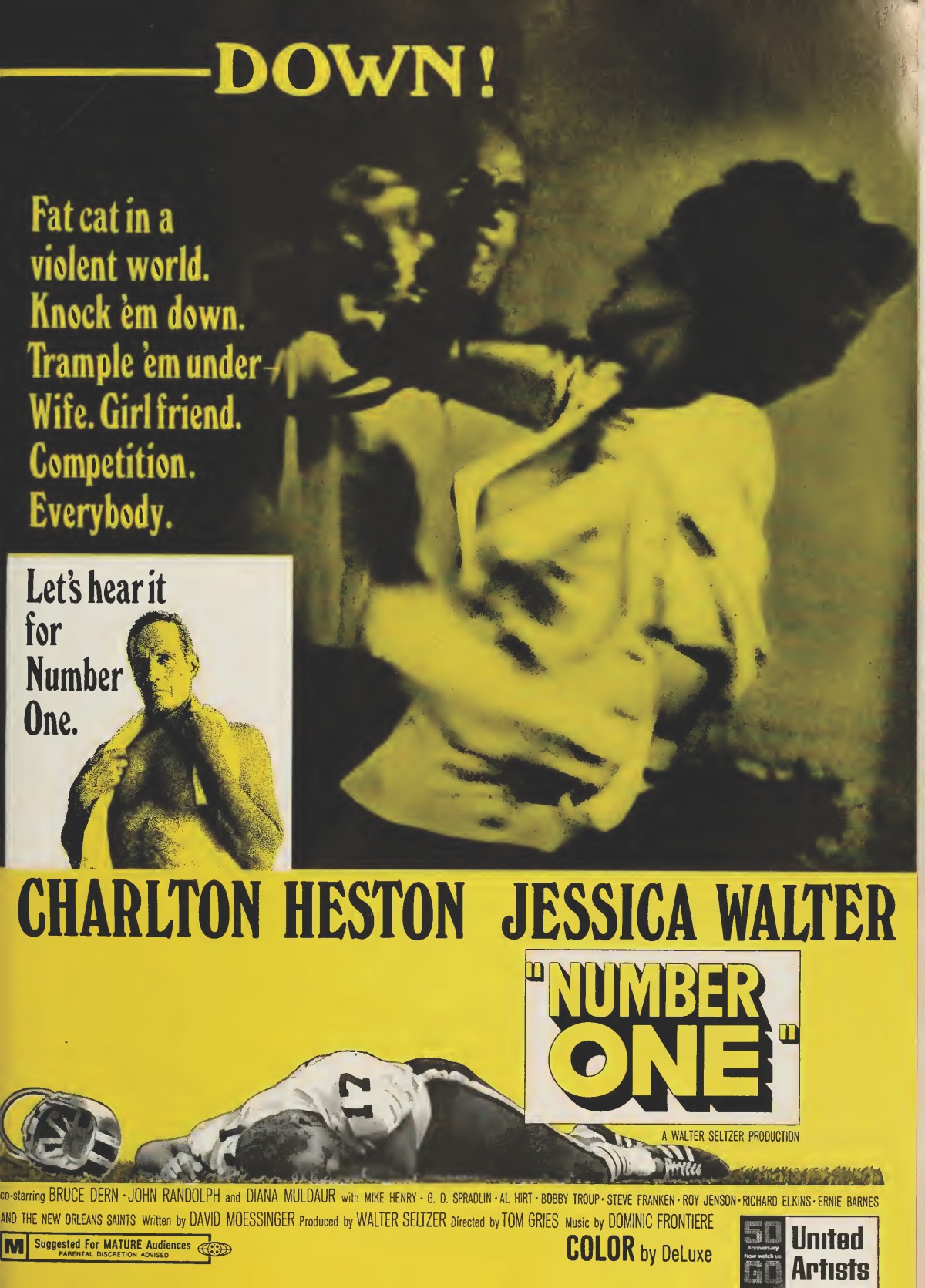
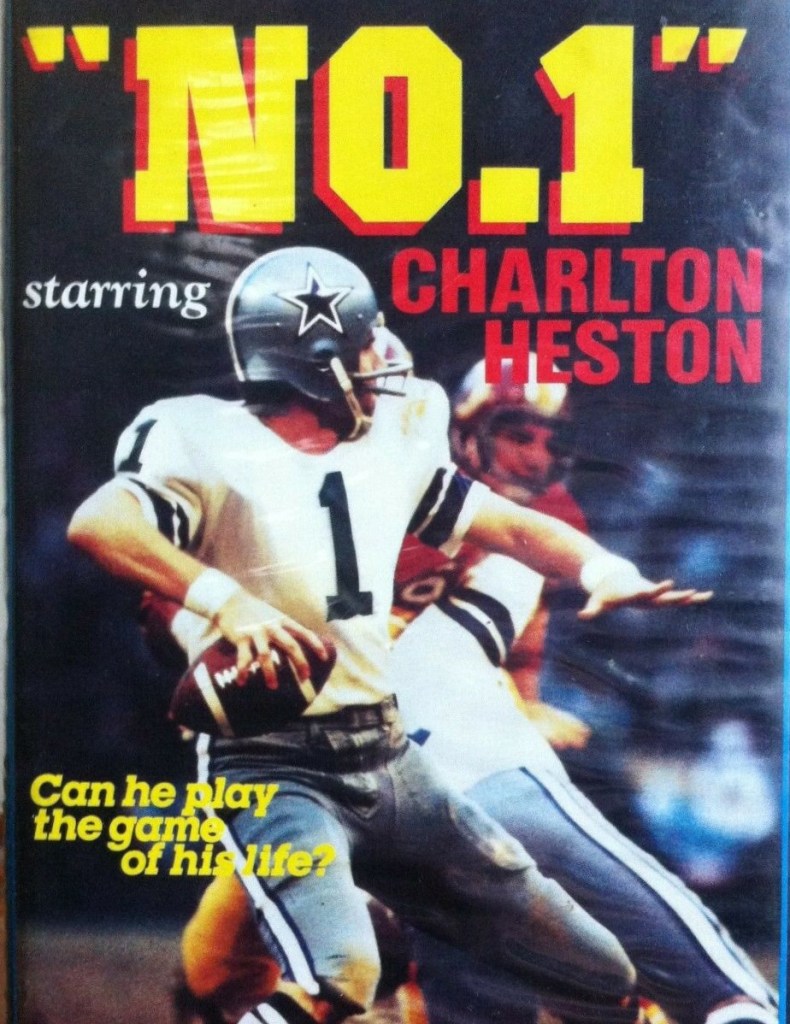
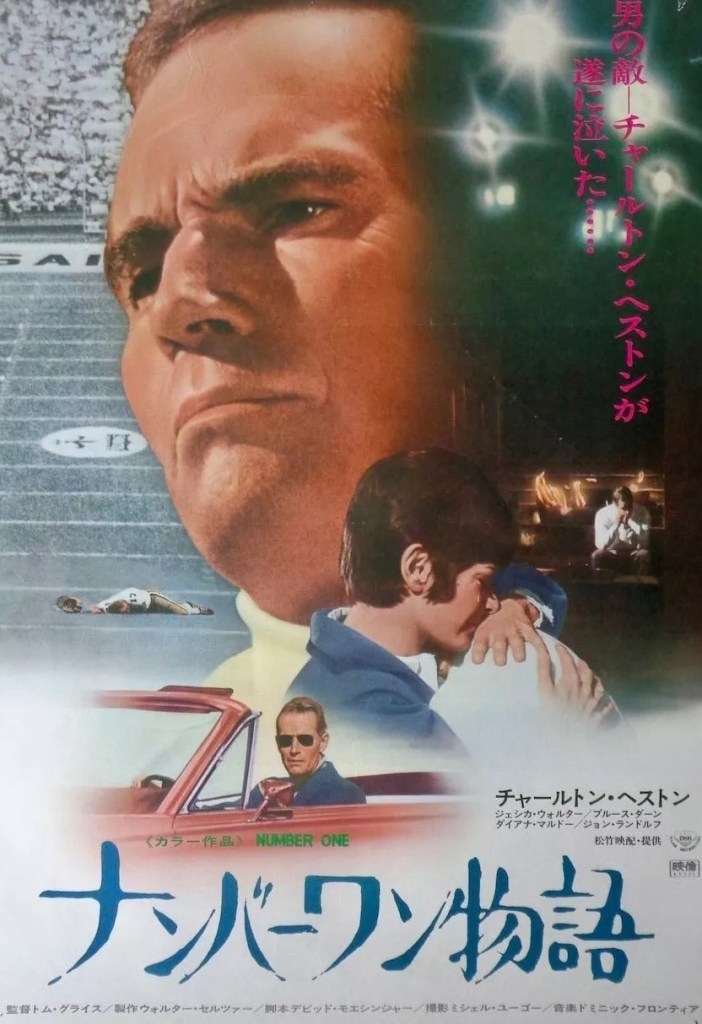
Number One / Pro (1969) ****

Quite possibly Charlton Heston’s best performance – as an ageing pro footballer refusing to bow down to the inevitable. Ron Catland (Heston) has much in common with Ned Merrill (Burt Lancaster) in The Swimmer (1968) as characters who believe they have been let down by the American Dream. And like that picture, plot is in short supply, it’s mostly a character study with sideswipes at the realities and inanities of American football.

An injury puts star quarterback Catland’s career in doubt. The media write him off, a younger quarterback Kelly (Richard Elkins) is waiting in line, while former colleague Ritchie Fowler (Bruce Dern) offers him a job in his car leasing business, or he could opt for a second career in computers, but Catland wants the only life he has ever known to go on forever.

There’s nothing inherently likeable about Catland. In fact, he’s downright mean most of the time, in part because of the falsity of his profession, management buttering you up when it’s contract time, then on your back once you have re-signed. He’s got a hero’s arrogance, has ignored from the outset the coach’s instructions, at odds with independent fashion-designer wife Julie (Jessica Walter), no children to shore up their marriage. Hardly surprising he drifts into another affair, “an occupational hazard” his wife calls it, this time with the fey Ann (Diana Muldaur) who owns a tennis shop.

You are probably familiar with the kind of football picture which climaxes with a last-minute touchdown or the more realistic movies like North Dallas Forty (1979) or the superlative Any Given Sunday (1999) where nonetheless the focus is on winning and characters are ramped up for dramatic effect. Or you might imagine Hollywood had been routinely churning out football movies like Knute Rockne All-American (1940) and Jim Thorpe All American (1951) for decades. But strangely enough the movie industry had not focused on this particular sport for well over a decade until the NFL documentary They Call It Pro Football (1967) and comedy Paper Lion (1968).

Number One sets out to set the record straight on the reality of being a football hero. And it’s by far the most realistic of the species. For every good-looking gal wanting to pass him a note on a napkin in a restaurant there are plenty fans turning on him for refusing to sign an autograph. For every sports reporter writing a puff piece, there are others tearing him to pieces in print.

The documentary-style approach by director Tom Gries (100 Rifles, 1969) serves the film well. This is a different kind of football team to the later fictional depictions. It’s a lonely life for a start. The players are rivals, not comrades.  There’s little camaraderie. The dressing room is like a morgue. No practical jokes and tomfoolery. No over-the-top team talk by the coach and thank goodness no padre who pretends to walk every aching mile in their shoes. Any exhortation is almost a plea. Injury is mostly ignored. Legs are constantly strapped up. And when your career is over you might be reduced to bumming a loan from a current star. The politics are brutal.

New Orleans Saints cooperated with the production so the game scenes come across well though not obviously with the razzamatazz of Any Given Sunday and Heston has the physique for a sportsman. Primarily a television writer, David Moessinger (The Caper of the Golden Bulls, 1967) only crafted two films in the 1960s and this, the second and last, was an unusual effort, as the character twists and turns trying on the one hand to escape the cage of his career and on the other determined to squeeze the last drop out of his golden imprisonment.

Catlan still sees himself (at the age of 40, no less) as the best quarterback in the business and simmers with anger that his body is letting him down and that he has nothing in place to fill the gap that abandoning the game will create. Underneath the volatility is a hole of pain. There’s no sense either that he has enjoyed his time at the top, just that it has always one way or another been a struggle.

Although the movie was marketed with Heston as an aggressive individual, in fact it calls for a far wider range of emotions from Heston, and for this part he delivers in spades. Jessica Walter (Grand Prix, 1966)  gives as good as she gets, Bruce Dern (Hang ‘Em High, 1968) as the fast-talking salesman and Diana Muldaur (The Swimmer, 1968) are excellent. But this is Heston’s film. It’s more of a reflective piece, none of the dramatic highs and lows of other football pictures.

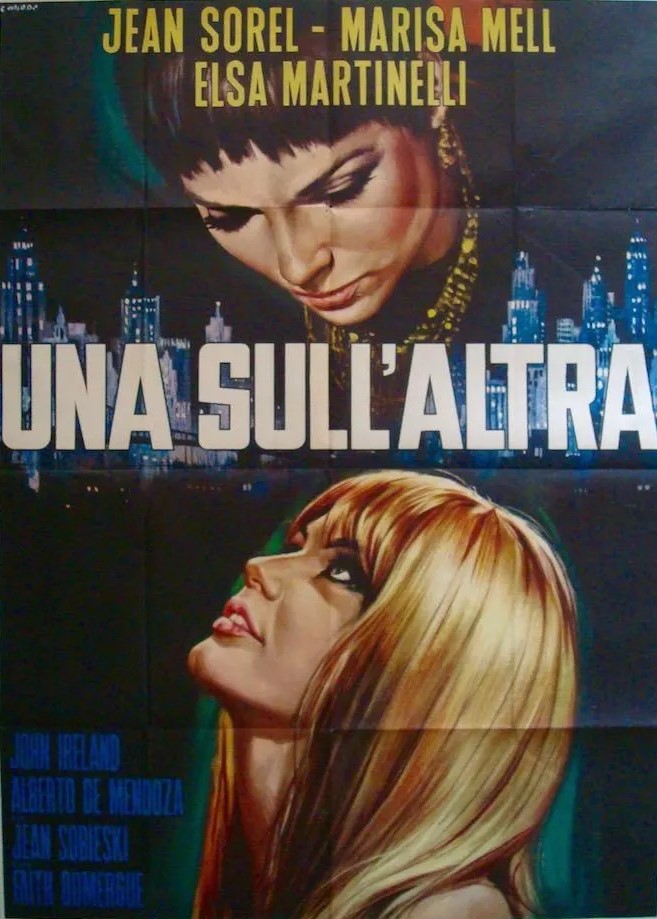
One on Top of the Other / Perversion Story (1969) ****

No idea how they thought they’d market this one. Neither of these titles would recommend it to first run, more likely sending it down the exploitation route. Which would be a pity because, although there is enough nudity and sex to satisfy those patrons, it is, almost to the very end, clever noir, femme fatales to the fore, and the kind of male patsy who would later decorate the likes of Body Heat  (1981). And if it played out as all instinct – except that of a happy ending – told you, it would have been an absolute cracker. As it is, it’s more Hitchcock than giallo, director Lucio Fulci’s, known at that time for comedies, first dabble in crime, and with excellent cinematography and plot twists.

As it is, said sucker has a hell of a time, turned inside, beset by paranoia and trickery until he’s all set for the electric chair and it boasts a classy cast. It’s set in San Francisco, though I found those hilly streets a distraction as any minute I expected to see Bullitt racing over the top or Sean Connery demolishing a streetcar before heading to The Rock.

Asthmatic sickly wife Susan of top surgeon George (Jean Sorel) dies from accidental overdose in the first few minutes. The good doctor isn’t so upset, he’s having an affair with fashion photographer Jane (Elsa Martinelli) and is astonished to discover he’s about to inherit a couple of million from her insurance. That’ll come in handy because his business is going down the tubes.

But an anonymous tip sends him into a topless bar where the star performer and sometime sex worker Monica (Marisa Mell) bears a startling resemblance to his wife, blonde where she was brunette, brown eyes rather than green, but otherwise almost a dead ringer. But he’s seen his wife’s stone-cold corpse so he gets the doppelganger heebie-jeebies. Still, it’s not long before he’s testing out his theory and in the most intimate fashion.

But there’s an insurance agent on his tail, taking note of the philandering, and his concerns force the cops to re-open the case and discover Susan was poisoned and with George the obvious beneficiary that makes him the obvious suspect. Meanwhile, Jane’s trying to find out what’s Monica’s game, to the extent of giving her a fashion gig that goes a few steps beyond the Blow-Up playbook.

Top cop (John Ireland) isn’t slow to put two and two together and reckon Monica and George are in it together and bumped off Susan. He finds evidence of Monica perfecting Susan’s signature. But while Monica skedaddles, George is on the hook and eliminating all that annoying courtroom guilty/not guilty objection sustained  palaver, the movie cuts to the chase and the surgeon is lined up for an appointment with the chair, knowing full well he’s innocent.

In a terrific twist I didn’t see coming turns out his brother Henry (Alberto de Mendoza), partner in the business, has been having an affair for years with Susan who – yep – is Monica after all, and takes delight in telling George what a sucker he’s been. Henry will inherit the dosh and take up where he left off with Monica/Susan. George hasn’t exactly elicited audience sympathy, although he’s occasionally staring moodily in the camera as his brain can’t compute what’s going on, and he’s a two-timing swine – no, make that three-timing – no, two-timing if Monica actually is his wife. Anyway, he doesn’t cover himself in glory whereas Monica is a class act, not just sexy as all-get-out but playing him beautifully, so you kind of want her to get away with it especially as you didn’t see the brother angle coming, and you just marvel at how cleverly George has been duped.

George is saved and the picture unaccountably suffers at the last minute when out of the blue a jealous client Benjamin (Riccardo Cucciolla) turns on the getting-away-with-it pair and blasts them to high heaven.

George is an unusual character, dominated by both women. When we first encounter Jane she’s on the point of dumping him, after a bout of sex first of course, and he’s the one who chases after her. But Susan clearly enjoys stringing George along, taking control in their lovemaking in a manner she clearly didn’t when being Susan, as if her new-found has freed her from her inhibitions.

My guess is this was heavily cut for U.S. and U.K. release and also that the moviegoers coming along expecting sexploitation might have been somewhat surprised to find themselves watching a Hitchcockian homage, but with the bad girl as the heroine.

A few plot flaws don’t hole this beneath the waterline. Great acting all round, Marisa Mell (Danger: Diabolik, 1968) the pick, but Elsa Martinelli (Hatari!, 1962) every bit as calculating and seductive. You feel sorry for Jean Sorel (Belle de Jour, 1967) caught between the two.

Lucio Fulci (A Lizard in a Woman’s Skin, 1971) makes the most of the locations and ensures the women, rather than the man, take center stage.

Take away the exploitation elements and you’ve still got a great thriller that turns on its head all expectations.

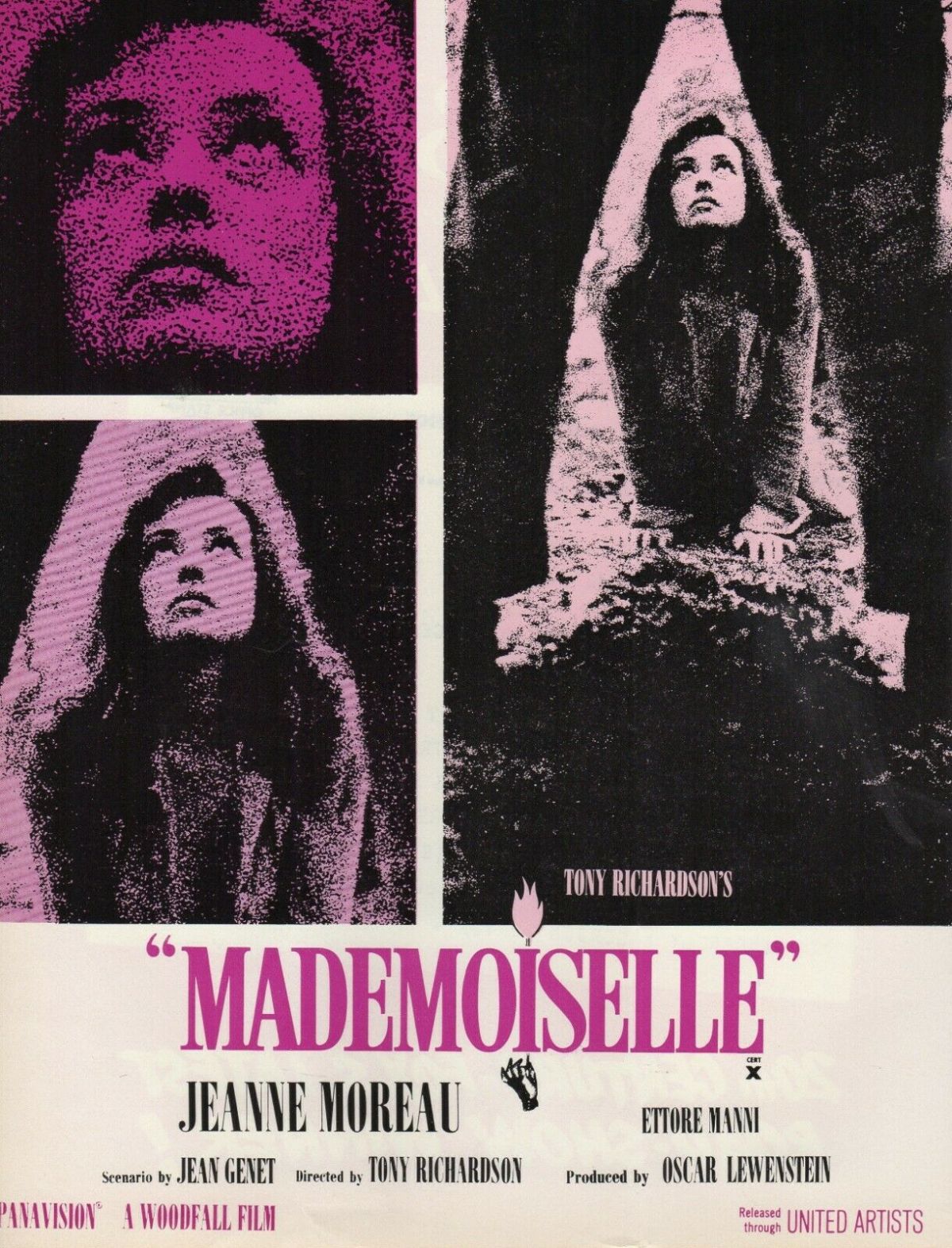
Mademoiselle (1966) ****

Arthouse noir? Cross between an Ingmar Bergman movie, except that the protagonist acts on her repression, and a Claude Chabrol with a character harboring festering desire. Certainly a bold choice for star Jeanne Moreau, excepting Brigitte Bardot France’s biggest female star, to play someone so malignant with scarcely a redeeming feature. Bold, too, in the setting, not the picturesque French village peppered with bright boulangeries and patisseries and with restaurant gatherings knocking back the wine. This is the reality of country life, ruled by religion and officialdom, little sign of ooh-la-la, and distinctly xenophobic – the minute anything goes wrong, blame the foreigner, in this case an itinerant Italian woodcutter.

It’s a distinctly arthouse notion to let the audience know straight off who the villain is while the villagers themselves are left in the dark about who caused two recent fires, their suspicions landing on Manou (Ettori Manni), the forester who arrives once a year so not quite an unknown entity, and too keen on seducing the local women.

We don’t know who the arsonist is, yet, either, but we might get a good idea from the opening sequence where some annual religious pageant, involving blessing fish caught in the river, is disrupted after a woman in high heels and black lace gloves opens a dyke, allowing a torrent of water to flood a farmyard, nearly drowning the animals, only the priest and a few boys left to continue the parade once the adults have raced back to the farm to save the livestock.

The woman is careful to wipe her high heels clear of grass as she places them in a wardrobe on a high shelf that contains other high-heeled shoes. We soon learn she is not just the schoolteacher but also volunteers her typing skills to the police, therefore keeping fully abreast of any investigation, and that she is held in such high esteem in the village that she goes by the name of Mademoiselle (Jeanne Moreau). While she defends Manou against accusations thrown around by the police, she victimises Manou’s son Bruno (Keith Skinner), ridiculing his clothing, making him stand in the corner or against a tree in the playground.

Turns out she’s the fire-raiser and in a small farming village there’s no shortage of houses with adjacent barns stacked full of straw that it only takes a match and a spill of flaming paper to set aflame. Foreigner Manou doesn’t act like an outsider, but dives in to help, at one point needing to leap to safety himself from a burning building. He doesn’t give his son much leeway either, ridiculing him and belting him across the face.

Only the camera catches Mademoiselle’s brooding intensity, the villagers intent on seeing only the upstanding part of her nature, judging her by the job that in an impoverished ill-educated area elevates her to a position of some standing in local society. Nobody dares come a-wooing. Maybe there’s a local squire somewhere around who might fit the bill. And certainly, she won’t lower herself like certain of the younger village females to make the first move.

As the fires grow more common, greater suspicion falls on Manou whom she secretly desires. Contrary to expectation, given the real power she wields in the classroom, and the secret power she wields over the community, her sexual hankerings run in the opposite direction. She wants to be debased, kissing the shoes of Manou when at last she makes her feelings known, howling like a dog, submitting to his domination which includes being spat upon and her clothes torn. You get the impression this might just be her playing out a fantasy except when she returns to the village with her clothes ripped and the women presume she has been raped she points the finger at Manou.

There’s no climax. We don’t see Manou being chased by a baying mob or being arrested as the film ends with her being driven away in a taxi, presumably to move onto the next village where she can continue her life of crime.

So, very much a character study. It’s hard to know when it’s set, but then raw village life hardly changes from one century to the next. Director Tony Richardson (The Loved One, 1965) makes no attempt to evoke sympathy for her. A few decades on when audiences took a liking to serial killers played by terrific actors (Silence of the Lambs, 1991, for example), moviegoers would have been more rapt by her exploits, almost willing her on, but this decade followed a different morality, filmgoers expecting villains of either gender to be punished.

Those sullen sulky features that Moreau previously used as part of her undeniable sexuality now seem turned-in, as defining of incipient evil as deformity was back in the early days of Hollywood.

Sensational performance by Jeanne Moreau (Viva Maria!, 1965) and also by Ettore Manni (The Battle of the Villa Florita, 1965) who proves far more sadistic than your run-of-the-mill seducer with attitudes to women that wouldn’t be out of place in the later giallo genre.

You might feel short-changed that there’s no resolution and that, in a sense, just like Bitter Harvest (1963), the director has skipped the third act and that there’s no real detection of her crimes, no cat-and-mouse between sleuth and villain. But it’s all the better for leaving out those elements. Written by Jean Genet (The Balcony, 1963).  

Brooding and pitiless.  

The Reckoning (1969) ****

Fans of Succession will love the boardroom battles and fans of Get Carter the gritty violence. Michael Marler (Nicol Williamson) is a thug whichever way you cut it. He’s a business hard-ass, at his nicest he’s obnoxious, at this worst brutal. He drives like a demon. Even in love, he’s fueled by hate, sex with wife Rosemary (Ann Bell) infernal. And all of this made acceptable, according to the left-wing tenets that underwrite the film, because he is a working-class man battling upper-class hypocrisy, never mind that his upper-class wife was hardly foisted upon him, nor that he was forced to live in luxury.

Unexpectedly, the film also explores other themes which have contemporary significance. Computers play a pivotal role and so does honor killing. The picture’s original title – A Matter of Honor – was ironic given that in the upper-class worlds in which he moved, courtesy of his job and marriage, he is considered to have little in the way of chivalry. But in the working-class world he has escaped he must avenge his father’s death in this manner.   

The sudden death of his father sends him back to Liverpool where he discovers the old man was killed in a pub brawl. But the local doctor and police, disinterested in complicating what must be a regular occurrence, view his death as accidental. So Marler takes it upon himself to uncover the culprits and wreak revenge, any kind of revenge on any kind of culprit, regardless of the fact that from the outset it is clear they will hardly be gangsters.  While contemplating violence, he strikes up a sexual relationship with the married Joyce (Rachel Roberts).

The story jumps between the back-stabbing corporate world to a scarcely less violent working class environment. The combination of charm and brute energy holds a certain appeal for Rosemary (Ann Bell) and helps keep him in the good books of his boss. He is otherwise a bully, targeting the weak spots of anyone who stands in his way on his climb to the top, and while heading up the sales division of a company in trouble blaming everyone else for his own failings. And while scorning his wife’s upper-class friends is quite happy to enjoy the benefits of her lifestyle, the flashy car might be the result of his endeavors but not the huge posh house. Marler stitches up another associate with the assistance of another lover, secretary Hilda (Zena Walker), and his long-suffering wife finally takes umbrage at his venomous manner.

Marler hides his hypocrisy behind the façade of a left-wing class-struggle. John McGrath’s screenplay clearly intends Marler’s working-class background to provide him with a get-out-of-jail-free card as well as to launch an attack on an upper classes seen as namby-pamby except when it comes to putting the poor in their place. The anti-class polemic has somewhat eroded over time but in its place can be found an accurate portrayal of social history.  For  ordinary people, alcohol, the drug du jour, plays a massive part.  The endless terraces, houses without a single car parked outside, the vast pub which hosts wrestling matches and is a tinder spark away from erupting in a brawl, a culture where the first graspings at sex are likely to take place up a close or in a car, are in stark contrast to the high-life Marler enjoys in London.

He has no desire to go back home, hasn’t visited in five years, escaping there deemed a sign of success, and mostly returns metaphorically to draw on memories with which to scourge the upper-class and excuse his own behaviour. 

Nicol Williamson (Inadmissable Evidence, 1968) delivers a tour de force, his screen presence never so vibrant, exhibiting the same raw appeal as Caine in Get Carter. At this point in is career, with a critically-acclaimed Hamlet on stage, he was perceived as the natural successor to Laurence Olivier and Columbia held up the release of The Reckoning to allow the Tony Richardson film of the stage production, in which he starred, to pick up critical momentum. Oddly enough Rachel Roberts had not capitalized on her Oscar-nominated role in This Sporting Life (1963) and this was only her second movie in seven years. Initially coming across as brassy, she soon softens into a surprisingly wistful character. Both Ann Bell and Zena Walker bring greater dimension to their characters rather than as adoring doormats. You can catch Paul Rogers (Three Into Two Won’t Go, 1969) and Tom Kempinski in supporting roles.

Director Jack Gold, who had worked with both Williamson and McGrath on his movie debut The Bofors Gun (based on the writer’s play), does a great job of capturing a particular period of British social history as well as Williamson stomping around in his pomp. Written by john McGrath (The Bofors Gun, 1967) and, in his debut, Patrick Hall.

Terrific performance stands up well.

The Chapman Report (1962) ***

In the 1950s new talent was largely bloodied via small parts in big movies. In the 1960s, the easier route was to first build them up as television stars. This picture represents the nadir of that plan – female roles filled with established talent, males roles with actors who had made their names in television. And, boy, does it show, to the overall detriment of the picture.

Warner Bros even had the temerity to top-bill Efrem Zimbalist Jr (hauled in from 77 Sunset Strip, 1958-1964) over more famous actresses. Zimbalist Jr at least had some marquee value after starring in low-budget A Fever in the Blood (1961) and second male lead in the classier By Love Possessed (1961) and Ray Danton (The Alaskans, 1959-1960) had played the title role in B-picture The George Raft Story (1961), but Ty Hardin was unknown beyond Bronco (1958-1962) and Chad Everett drafted in from The Dakotas (1962-1963).

Little surprise, therefore, that director George Cukor (Justine, 1969) concentrated his efforts on the females in the cast. But it was curious to find Cukor taking on this sensationalist project based on the surveys of sexuality that had taken the country by storm. Had it been made by a less important studio than Warner Bros it would have been classed as exploitation.

The bestseller by Irving Wallace on which it was based was a take on the Kinsey Report a decade before and others of the species and, theoretically at least, opened up the dry material of the more scientific reports into how men and women behaved behind closed doors.

Amazing that this was passed by the Production Code since dialog and action are pretty ripe. Interviewed women are asked about “heavy petting” and how often they have sex and if they find the act gratifying. One interviewer crosses the line and has an affair; these days that would be viewed as taking advantage of a vulnerable woman. And there’s a gang rape.

Given the movie’s source Cukor takes the portmanteau approach, four women undergoing different experiences. The problem with this picture is that there’s little psychological exploration. Women are presented by their actions not by their thought patterns or by their treatment by their husband.

In what, in movie terms, is the standout section, Naomi (Claire Bloom), an alcoholic nymphomaniac, is so desperate for attention she throws herself at the delivery boy (Chad Everett), then at a married jazz musician (Corey Allen), with devastating effect, as he hands her over to his buddies, causing sufficient degradation that she commits suicide. Since we first come across her crying in bed, sure signs of depression, these days you would expect more exploration of her psychiatric state.

Similarly, the widowed Kathleen (Jane Fonda) has been tabbed frigid by her husband and nobody thinks to call into question his inadequacies as a sex partner rather than hers. Here it’s put down to daddy issues and growing up in a household heavy with morality.

Kathleen is taken aback by the researcher even asking her about sex, “physical love” the technical term, rather than a purer kind but her consternation at the questions being posed in very cold-hearted manner by an anonymous voice – researcher hidden behind a wall – does reveal how ill-equipped some people are to even talk about sex. Her story develops into some kind of happy ending, despite the fact that her interviewer Radford (Efrem Zimblist Jr) would be busted these days for taking advantage.

Teresa (Glynis Johns) is convinced by the interviewer’s tone that the simple normality of her own marriage must be abnormal and so, determined to fit in, embarks on a clumsy attempt to  seduce footballer Ed (Ty Hardin), coming to her senses when it comes to the clinch.

The interview also has a major impact on the adulteress Sarah (Shelley Winters). After confessing her affair to husband Frank (Harold J. Stone) she rushes off to lover, theater director Fred (Ray Danton), only to find, to her astonishment, that he’s a married man. Her husband accepts her back.

To keep you straight, the “good” women are dressed in white, the “bad” ones in black. The filming is distinctly odd. The man behind the wall is filmed with no ostentation, but the style completely changes when the director turns to the women who often end up in floods of tears.

Claire Bloom (Two into Three Won’t Go, 1969) and Jane Fonda (Barbarella, 1968) are the standouts because they have the most emotion to play around with. Oscar-nominated Glynis Johns (The Cabinet of Caligari, 1962) is the comic turn. Over-eager over-confident Oscar-winner Shelley Winters (A House Is Not a Home, 1964) gets her come-uppance. None of the men make any impact.

The book took some knocking into shape. Perhaps because, of the four names on the credits only one had signal screenwriting experience, Don Mankiewicz (I Want to Live, 1958). For the others, better known for different occupations in the business, this was their only screenwriting credit. Wyatt Cooper was an actor married to Gloria Vanderbilt, Gene Allen art director on many Cukor pictures and production designer on this, and Grant Stuart was a boom operator though not on this picture.

Best viewed through a time capsule.

Discover WordPress

A daily selection of the best content published on WordPress, collected for you by humans who love to read.

The Atavist Magazine

by Brian Hannan

WordPress.com News

The latest news on WordPress.com and the WordPress community.