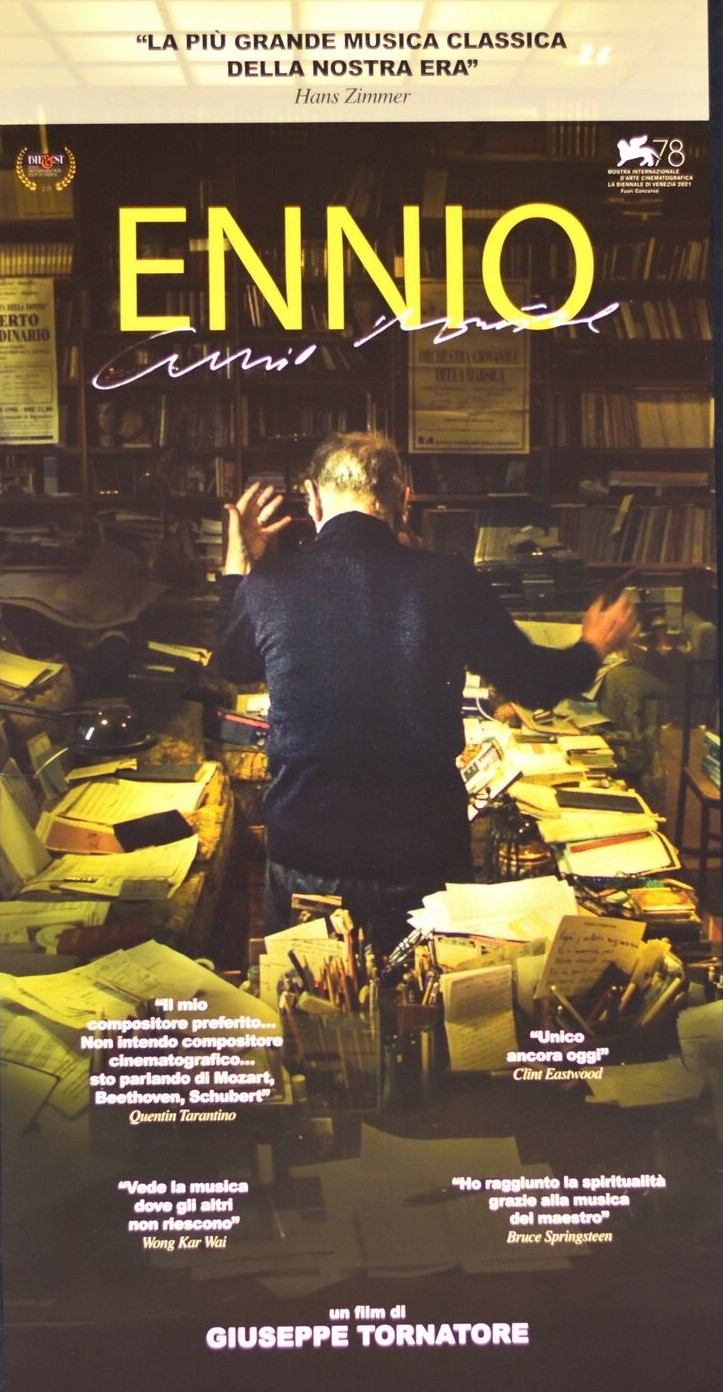
Ennio (2021) ***** – Seen at the Cinema

I became an instant fan of Ennio Morricone after watching dance troupe Pan’s People performing on BBC TV’s weekly Top of the Pops to Hugo Montenegro’s version of The Good, the Bad and the Ugly when it topped the singles charts in Britain in 1968. Sure, there had been successful theme songs in the charts before like Shirley Bassey’s rendering of Goldfinger, but never a pure instrumental and not a wailing guitar. This is quite simply an extraordinary documentary, and although it comes with an indulgence of anecdotes, what is considerably more compelling is the concentration, in accessible fashion, on the artist’s compositional skills. I could have watched four hours of this, never mind that clocking in at 156 minutes it’s already on the lengthy side for a documentary.

Morricone should never have been a film composer or a composer of any kind. He was too poor. His father was a trumpet-player and Morricone only took up music, designated instrument the trumpet, because his father believed a good trumpet player would always make a living and provide for his family. He was not a good trumpet player. At least, not at the start. Given that once orchestras and dance bands went out of favor, trumpet playing would have been a precarious existence, it was lucky his father’s insisted he also study harmony and composition. He won a place at a conservatoire, where the pupils, all except him, were the sons and daughters of the wealthy elite. And a conservatoire in those days was academically inclined, intending to produce classical composers and players, not people who would work as arrangers and composers of pop songs or commit the unpardonable sin of writing for the movies.

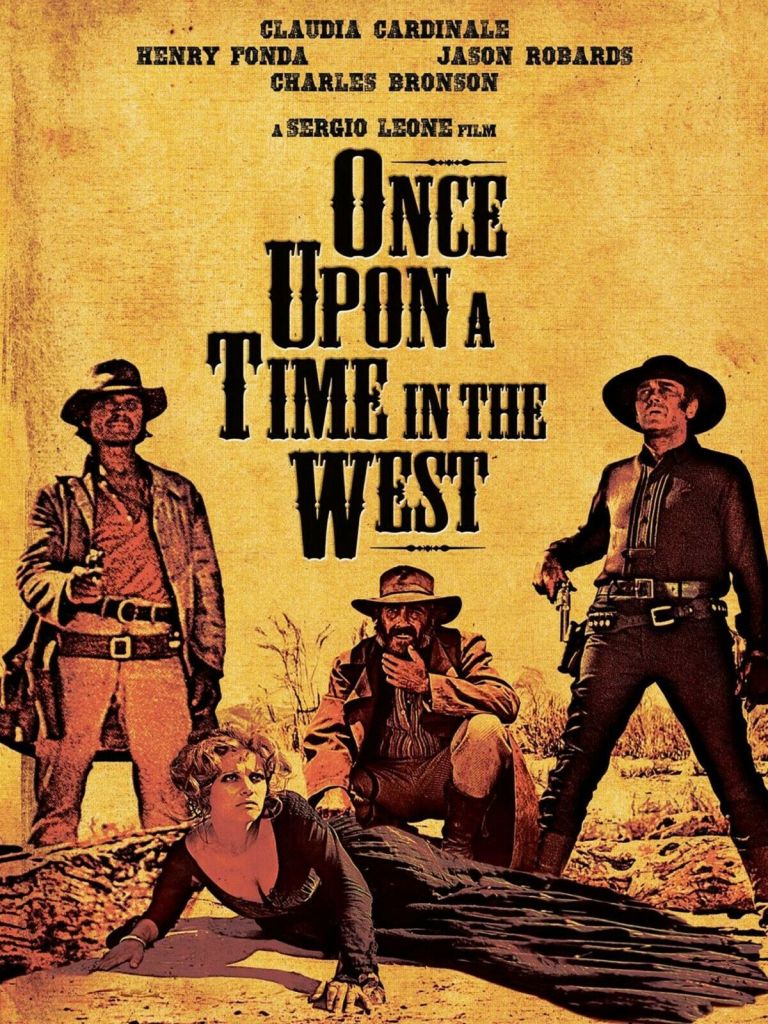
Morricone, always prolific, started working as an arranger of pop tunes for the RCA label in Italy and then for RAI, the Italian state television. But he was also an innovator and many of his songs began with a distinctive sound rather than the music being merely a backdrop to the song. He founded an experimental music group, making music out of anything but a musical instrument. You can see the benefits of that inquiring mind from the first 20 minutes of Once Upon a Time in the West (1968), for me his compositional masterpiece and my favorite western.

When he started working for Sergio Leone, he realized they had once been classmates. Leone came to him because Morricone had already written music for Italian westerns. Of course, the collaboration became legendary. As you will be aware, Leone liked the music recorded before filming began and played it during filming. While an interesting approach, I always thought it odd, until I witnessed, here, Robert De Niro making an entrance in one scene of Once Upon a Time in America (1984).

While his themes were often complex, he had a genius for catching the ear of the listener. Many scenes showed Morricone with voice and fingers tapping out a theme you will instantly recognize because all his best work was instantly recognizable. Although an extremely shy person, he was not above walking out – or threatening to do so – if a film was not going according to plan, if a director insisted on making a change or incorporating other material. Nor, for such a genius, was he full of self-confidence. Eventually, he relied on his wife as a listening board to decide if his work was any good. For what he called the “triumphant” scene from The Untouchables (1987), where cops brandishing shotguns prompted by Sean Connery burst in on bootleggers, he supplied nine ideas for director Brian De Palma, who proceeded to use the one Morricone considered the weakest. Other times, he was the one suddenly requiring an extra piece of work, calling upon Joan Baez to supply lyrics at the last minute to his theme for Sacco and Vanzetti (1971) that became the memorable “Here’s To You.”

One of the most enjoyable elements of the movie is seeing concert renditions of his themes, “Here’s To You” with a massive choral ensemble making the hairs on the back of your head stand on end. You could probably make a case for Morricone reinventing the chorus, paving the way for such practitioners as Hans Zimmer. Until then, there was many a heavenly chorus, but Morricone found better use for a chorus. And you could also argue that he influenced the likes of Ridley Scott (Gladiator, 1999) in using female opera singers to introduce a completely new sound to movies. 

One of Morricone’s stated aims was to use music to bring something else out of a scene, not to merely provide a relevant sound. So for the death of Sean Connery in The Untouchables or the baby carriage scene his music goes completely against what you are watching but nonetheless adds a deeper understanding. We also see how he folds different themes into the one piece of music.

There are a number of very moving sequences, when Morricone, for example recalls his father – he would not use a trumpet in his compositions until his father died – or when he explains his hurt at being made to feel an outcast by his classical peers, and there is one extraordinary moment when one of those who has disdained him writes a letter asking forgiveness for having so under-rated his work. And certainly there is clear petulance at being passed over for the Oscar for The Mission (1986), a piece of work that director Roland Joffe said made the movie a completely different experience. Morricone complained that half the music that won Herbie Hancock the Oscar for Round Midnight (1986) was actually old, rather than new, music.

My favorite anecdote is how Gillo Pontecorvo, hearing heard a piece of music Morricone had composed for The Year of the Cannibals (1970) promptly stole it for his own Queimade/Burn (1969) before settling, after an argumemt, for a similar piece. Actors, composers and directors in the anecdote queue include Quentin Tarantino (The Hateful Eight, 2015) , Clint Eastwood, Terence Malick (Days of Heaven, 1978), Dario Argento (Four Flies on Grey Velvet, 1971), John Williams, Hans Zimmer, Oliver Stone (U Turn, 1997) Marco Bellochio (Fists in the Pocket, 1965) and Bernardo Bertolucci (1900, 1976).

Morricone’s film music changed over the decades. Following the westerns were giallos, marked by dissonance rather than melody, then Hollywood came calling. I hadn’t quite realized what an audience Morricone commanded – over 70 million albums sold. He had hit singles In Italy –  A Fistful of Dollars ranked fourth in the charts, For a Few Dollars one place below, “Here’s To You” also fourth. In Britain, “Chi Mai” reached the second spot; in France “Man with Harmonica” from Once Upon a Time in the West went to number one, as did “Chi Mai” while “Here’s To You” was at number two. And, of course, his music has been adopted by a host of rock bands, most notably Bruce Springsteen and Metallica.

Director Giuseppe Tornatore, who has a special place in the Morricone catalog thanks to Cinema Paradiso (1988), has produced a magnificent tribute to the genius. In my half century of regular cinema going, there are four composers I rank above all the rest, John Barry, John Williams, Hans Zimmer and Ennio Morricone, but of them all, the latter is the number one for not just his enormous output – 500 scores including 29 in one year – and his wide range of melodies, but because they are so many memorable pieces. Once Upon a Time in the West is never off my CD player and especially gets worn out in the car. For sheer enjoyment this is an undeniable five-star treat. 

I am sure this will end being streamed somewhere but I urge you to try and catch it at the cinema, the effect will be lost on the small screen of the massed choruses or Morricone conducting in vast amphitheaters.

Bronson Unwanted

That Farewell, Friend / Adieu L’Ami (1968) was a smash hit in France did nothing for Charles Bronson’s Hollywood career. Hollywood had form in disregarding U.S.-born stars that Europe had taken to its box office bosom. Example number one of course was Clint Eastwood, ignored by the big American studios until four years after his movies had cut a commercial swathe through foreign territories. Charles Bronson took about the same length of time for his box office grosses abroad to make an impact back home.

While we tend to look upon The Dirty Dozen (1967) as a career-making vehicle for many of the supporting stars, that wasn’t actually the case. Jim Brown was quickest out of the blocks, a full-blown top-billed star a year later in The Split (1968). Otherwise, John Cassavetes had the biggest crack at stardom after landing the male lead in box office smash Rosemary’s Baby (1968). But the rest of the gang – Telly Savalas, Donald Sutherland, Charles Bronson, Richard Jaeckal et al – remained at least for the time being strictly supporting players.

For Charles Bronson, the year of The Dirty Dozen produced nothing more than television guest spots in Dundee and the Culhane, The Fugitive and The Virginian. Beyond that he had a berth in two flop westerns Villa Rides (1968) and Guns for San Sebstian (1968) and no guarantee his career was moving in an upward direction. But the latter picture was primarily a French-Mexican co-production, the Gallic end set up by top French producer Jacques Bar under the aegis of Cipra which had previously been responsible for Alain Delon vehicles Any Number Can Win (1963), Joy House (1964) and Once a Thief (1965).

There was another, as vital, French connection. Henri Verneuil directed both Any Number Can Win and Guns for San Sebastian so could attest to Bronson’s screen presence. And another legendary French producer, the Polish-born Serge Silberman, best known for Luis Bunuel’s Diary of a Chambermaid (1964), had taken note of Bronson, whose screen persona was similar to that of French stars Lino Ventura and Jean Gabin. Silberman’s Greenwich Films production shingle was in the process of setting up Farewell Friend / Adieu L’Ami.

Like The Girl on a Motorcycle (1968), Farewell Friend was part of a new trend to make French productions in English as well as French, in this case the English version viewed as “the working one.” But that ploy failed to convince U.S. distributors to take a chance and the film sat on the shelf for five years. And little that Bronson did in the meantime increased his chances of a serious stab at the Hollywood big time.

Although Paramount had piled cash into the Italian-made Once upon a Time in the West (1968) it was counting on Henry Fonda – undergoing a career renaissance after Madigan (1968), The Boston Strangler (1968) and Yours, Mine and Ours (1968) – to provide the box office momentum. Bronson was billed fourth after Claudia Cardinale, Fonda and Jason Robards, so still in Hollywood’s eyes a supporting player.

And while the Sergio Leone picture flopped Stateside, the success of Farewell, Friend in France turned Bronson into a star and was instrumental in the western breaking box office records in Paris (where it ran for a year) and throughout the country.

Fortunately for Bronson, European producers recognized his potential. His next picture should have been an Italian-French-German co-production of Michael Strogoff, for which he was announced as the top billed star (Advert, Variety, May 8, 1968, p136-137).  When that fell through, Italian company Euro International, bidding to become the top foreign studio outside Hollywood, gave him top-billing in Richard Donner drama Twinky (aka Lola, aka London Affair, 1970) and Serge Silberman tapped him for Rene Clement thriller Rider on the Rain (1970), another French hit.

British director Peter Collinson (The Italian Job, 1969) was responsible for recruiting him for You Can’t Win ‘Em All (aka The Dubious Patriots, 1970), but with Tony Curtis taking top billing. Again, though funded by an American studio, this time Columbia, it was another big flop, mostly because the studio did not know how to market the picture, Curtis in a box office slump and Bronson considered to have little appeal.

But still the Europeans kept the faith. Another French-Italian co-production Sergio Sollima’s Violent City (1970) gave him top billing over exiles Telly Savalas and Jill Ireland, Bronson’s wife. That was also the case with Cold Sweat (1970), helmed by British director Terence Young (Dr No, 1962).  He had another French-made hit with Someone Behind the Door (1971) and Terence Young hired him again, along with Farewell, Friend co-star Alain Delon, Japanese star Toshiro Mifune (Seven Samurai, 1954) and Dr No alumni Ursula Andress for international co-production Red Sun. While this western sent box office tills whirring all over the world, it only made a fair impression in the U.S., ranking 53rd in the annual box office chase.

Riding on the back of The Godfather phenomenon, Italian producer Dino De Laurentiis chose Bronson for Mafia thriller The Valachi Papers (1972), again directed by Terence Young, which produced something of a box office breakthrough in the U.S., ending the year just outside the Top 20. But it took another British director, Michael Winner, to help solidify the Bronson screen persona and boost his global appeal. Four – and all of the hits – out of the star’s next six pictures were directed by Winner.  These were the western Chato’s Land (1972), The Mechanic (1972), The Stone Killer (1973) and Death Wish (1975). The Mechanic was such a big hit Stateside it did better in its second year of release than the first and Columbia redeemed itself by giving prison escape thriller Breakout (1975) the widest release – up to that point – of all time.

That America had little interest in developing Bronson as a breakout star could be judged by the distribution treatment of his pictures. As mentioned above, Farewell, Friend had to wait until 1973 for its U.S. debut and then renamed Honor among Thieves. Twinky was denied a cinema release in the U.S. and went straight to television in 1972. Violent City had to wait until 1973 for a distribution deal, Cold Sweat until 1974 and even Red Sun took nine months before it hit American shores.  Until The Valachi Papers did the business, Bronson was not considered the kind of star who could open a picture in the U.S.

By then, of course, Bronson had reversed the normal box office rules. Usually, for films starring American actors, foreign revenues were the icing on the cake. For Bronson it was the other way round. Along with Clint Eastwood he was the first of the global superstars, whose name resonated around the world, and whose pictures made huge amounts of money regardless of American acceptance or interest. But had it been left to Hollywood, Bronson would never have made the grade.

Point Blank (1967)****

The Man With Half A Name doesn’t have quite the same ring to it as The Man With No Name. Lee Marvin’s professional thief Walker (first name absent) is a close cousin of the spaghetti western’s amoral gunslinger. But where Leone is disinclined to fill in the emotional blanks in his anti-hero’s story, British director John Boorman, making his Hollywood debut, feels obliged to look for redemptive features in keeping with American tradition.

Along with several unnecessary arty elements, that gets in the way of a brilliant character portrait. The movie also suffers from critical assessment, not in the manner of bad reviews, but from an irrelevant and misleading insistence on discovering  the film’s “true meaning.”

However, where Boorman gets it right, the movie is a cracker. The bursts of brutal explosive violence still shock, Walker a force as unstoppable as The Terminator, while representing the Mafia as a faceless corporation is a stunning concept. Walker refuses to recognize the dictum that there is no honor among thieves and expects repaid the money stolen from him by a Mafia henchman. In his mind payment will come either in cash or retribution. There is double-crossing aplenty, but Walker is ready for it.

Boorman’s palette is fascinating, the grey bleakness of early scenes giving way to yellow (even the pillar in a parking garage is painted yellow) and other colors. And he has learned from Hitchcock how to apply silence and use natural sound effects like footsteps.

But there are some changes to Richard Stark’s original novel that the movie can do without. The introduction of the abandoned Alcatraz, for a start, is an illogical nonsense, cinematically stylistic though it is. Walker, as shown in the original novel is far too clever to allow himself to be led to a place so open to ambush. Nor would he allow himself to be emotionally blackmailed into doing the job that caused the trouble; he would have walked away from someone as unstable as the double-crossing Mal Reese (John Vernon).

The ambiguous ending, where Walker appears to fade away, issues unresolved, also attracted odd critical theories when, having spent ninety minutes demonstrating the gangster’s destructive capacity, it seems more likely to me that the two Mafia gents left alone with him on Alcatraz would be in the greater peril.

That said, the rest of the picture has an inbuilt dynamic and Marvin’s laconic menacing performance is mesmeric. By comparison Major Reisman in The Dirty Dozen was garrulous. The original novel was called The Hunter and Walker ruthlessly stalks his prey even though they are some of the most dangerous men alive. Angie Dickinson is dropped in to provide some emotional core and a scene of him as a younger man courting his wife is along the same lines. Ignore the arthouse elements and run a mile from critical theories and you are in for one hell of a ride.    

Discover WordPress

A daily selection of the best content published on WordPress, collected for you by humans who love to read.

The Atavist Magazine

by Brian Hannan

WordPress.com News

The latest news on WordPress.com and the WordPress community.