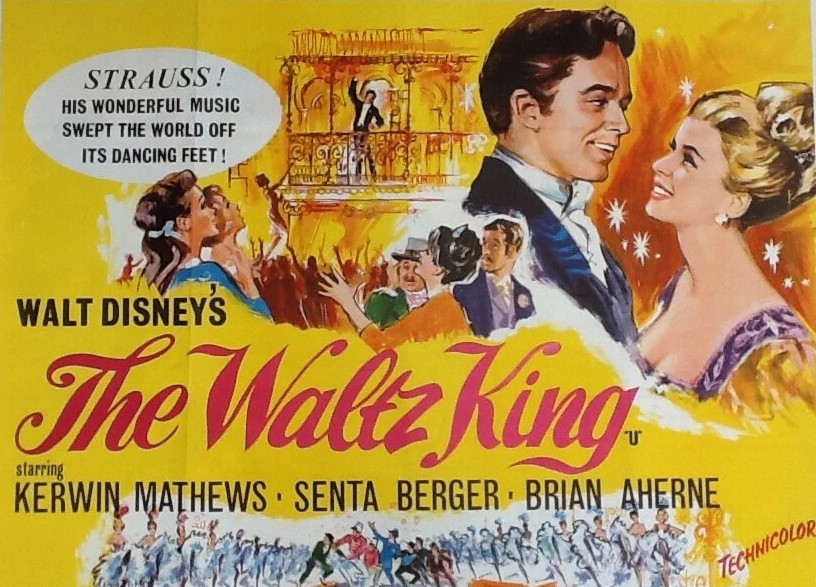
The Waltz King (1963) ***

The Twist, the Macarena, Twerking, none of these routines can hold a candle to the Waltz, which has dominated the dance world for centuries. You think maybe Queen invented the idea of audience participating in a tune by dancing and clapping in “We Will Rock You”, well, that had been an integral element of waltzes with a faster rhythm equally for centuries.

The movie had an unusual trigger. Walt Disney, taking time out from overseeing theme parks and enjoying a period of dominance in Hollywood, had spent some time in Vienna which resulted in this film and the same year’s Miracle of the White Stallions about the World War Two escapades of the Spanish Riding School in Vienna.
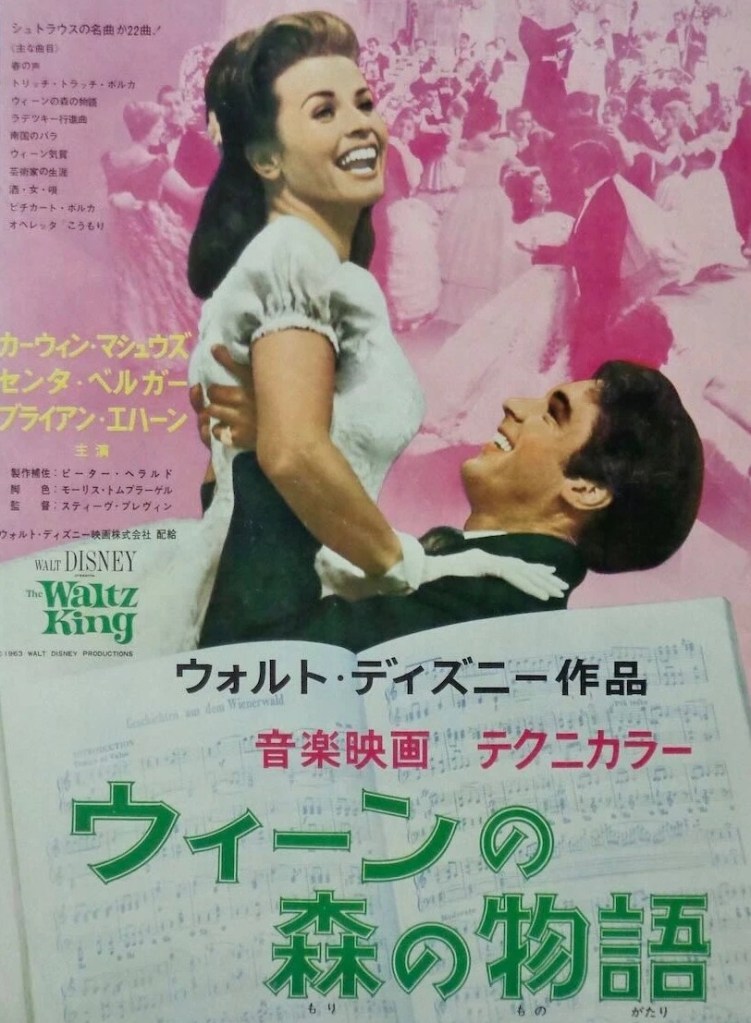
As you know I am a conscientious researcher in the matter of Senta Berger Studies and came to this via that connection, but I have always enjoyed movies about creativity whether it is struggling writers, struggling painters, struggling sculptors and struggling composers – you notice the prefix “struggling” is an essential component of such films.

And this will chime also with a contemporary obsession – the nepo baby. There already was a Waltz King in Vienna – Johan Strauss’s (Kerwin Matthews) father (Brian Aherne) also called Johan. He didn’t want this son following in his footsteps not so much because he feared the competition but because he disdained his own work, being at the beck and call of greedy concert promoters and music publishers, being assailed by hundreds of female fans behaving in much the same way as female fans during the rock/pop era, though instead of throwing underwear onto the stage they were apt to bombard the composer with bouquets of flowers each delivered with a note expressing ardent passion.

Father Johan Strauss (known to classical music fans as Johan Strauss I) insists son Johan Strauss ( Johan Strauss II in the classical music business) enter a proper profession, one where position in society was not dependent on the whims of the public. So the young lad was forced to become a lawyer, moonlighting as a violinist with other orchestras hoping his father would not find out. When old man Strauss did find out he was apt to take strenuous action and destroy the young man’s violin.

The elder Strauss was so powerful in his field that music publishers did not dare take on any of the works of his son. So it was lucky that in order to persuade a music publisher to listen to his composition he sits down at a piano in the shop and begins to play at the same time as opera singer Henriette Treffz (Senta Berger) is present. She likes the music and takes a shine to Johan and coughs up so he can employ his own orchestra.
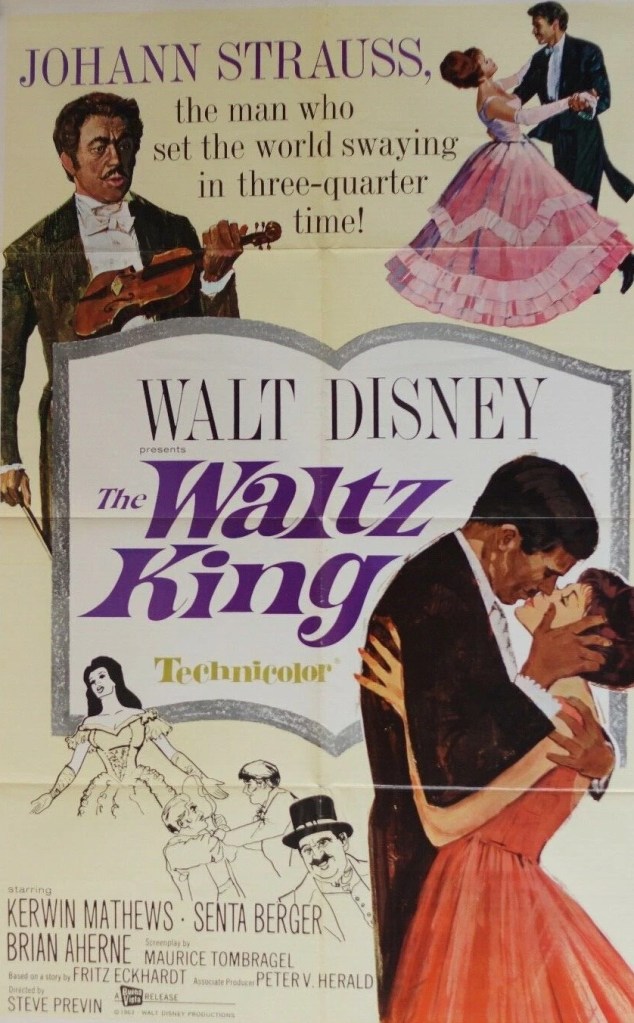
The old man is so angry at being usurped that he conspires to wreck the son’s debut concert by employing a small army of people to hiss, boo and catcall and disrupt the event. Luckily, that plan fails and audiences applaud and the son is on his way. Paternal enmity continues but that matters less as Johan Strauss II becomes a brand name, although he’s subjected to the by-product of fan mania when jealous husbands threaten him with a duel.

But just as The Who and other bands aspired to something more than popular music, so Johan wanted to move beyond the simplicity (in musical terms) of the waltz and up the classical music hierarchy by putting his mind to creating operettas and more sophisticated tunes. That battle involved finding his own voice and once again overcoming opposition.

This being a Disney confection it skirts over politics. Father and son were on opposite sides during the failed Austrian Revolution of 1848 – Strauss Snr composing one of his most famous pieces, the Radetsky March, as a result, the son out of royal favor for a long time. Nor is there time to regale audiences with how Strauss Jr changed his religion to get out of a tricky second marriage.

But like most biopics about classic composers including such Oscar-acclaimed fare as Amadeus (1984) this is a jukebox piece and if nothing else takes your fancy you can sit back and listen to the Johnan Strauss II’s greatest hits which include “The Blue Danube Waltz,” Die Fledermaus and Tales from the Vienna Woods.

Kerwin Matthews (Maniac, 1963) is solid enough in role that in a Disney picture requires less than the likes of Amadeus. And anyway he makes the mistake of signing on for a picture with Senta Berger (Kali-Yug, 1963) who is at her dazzling best. Brian Aherne (Lancelot and Guinevere, 1962) almost twirls his moustache as villain of the piece.

Director Steve Previn (Escapade in Florence, 1962) does a decent enough job with the music an eternal get-out-of-jail-free card. Written by Fritz Eckhardt (Rendezvous in Vienna, 1959) and  Maurice Trombagel.(Monkeys, Go Home!, 1967).

Lightweight, for sure, but entertaining and informative enough.
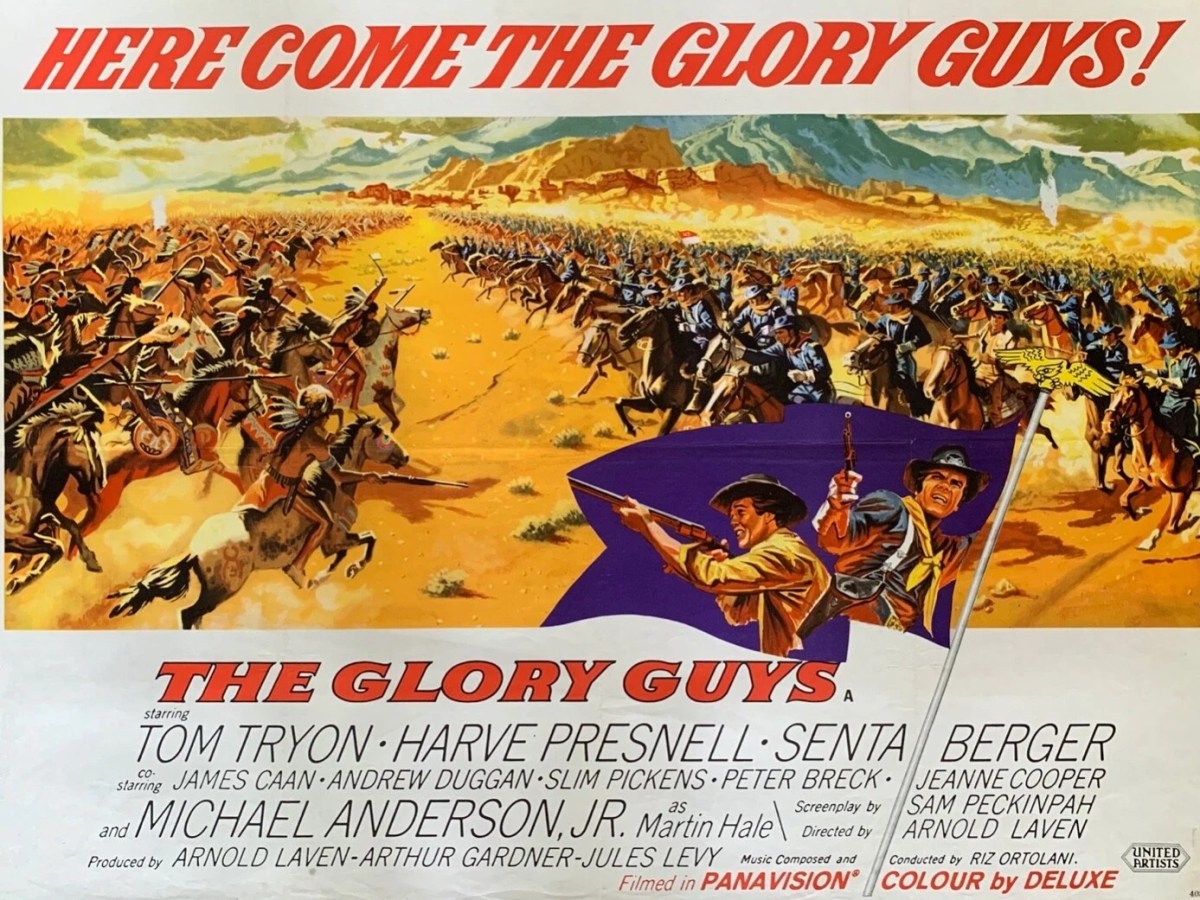
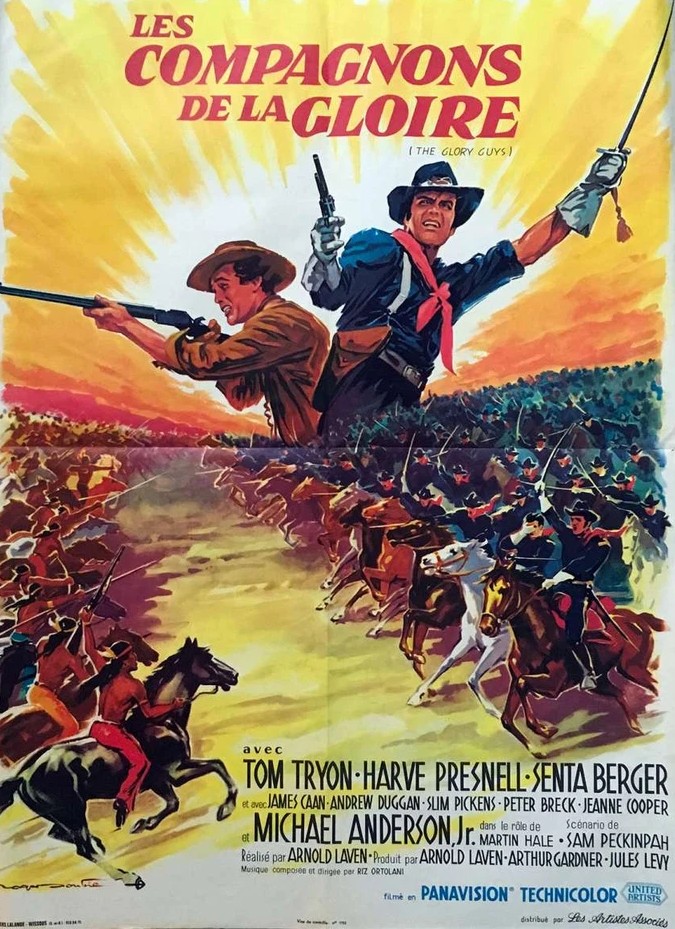
The Glory Guys (1965) ****

The dismissive verdict of Sam Peckinpah (he wrote the script) is the main reason this remains unfairly underrated. This came out the same year as that director’s over-rated Major Dundee and covers some of the same themes – the training of raw recruits and the woman requiring a protector.  

But this is the first cavalry picture I’ve seen where training covers more than recruits falling off their horses, picking fights with each other and getting drunk and into scrapes. The main task of Capt Harrod (Tom Tryon), apart from teaching them to shoot, is to ensure they ride in formation and are ready to take part in action. There’s a brilliant scene where Harrod fakes an Indian attack where they are all in a flash knocked off their horses. And another superb scene where, having achieved an almost impossible goal in double-quick time, Harrod leads them in a ride-past in front of General McCabe (Andrew Duggan) and they ride in about ten rows six abreast, keeping time and distance. When the soldiers dismount during combat, how they arrange for the horses to get out of the way but not run off is also revealed. The scene of the whole detachment leaving the fort is also breathtaking. They are lined up in columns, five or six abreast, and you begin to see, for really the first time, how the U.S. Army operates as a trained unit.

But that’s just the cream of a very finely worked crop. Harrod and McCabe are at odds because the captain’s previous company of raw recruits was virtually wiped out in a previous engagement when the general used them as bait. McCabe is the “glory guy” of the title, everyone else is just trying to keep alive. The only certainty of going into battle, Harrod reminds his men, is that they have a fair chance of not returning home.

Widow Lou Woddard (Senta Berger) pops up to wreak romantic havoc. She owns a gunsmith business, and responsible for driving up sales, so not quite the vulnerable woman. What’s most at stake is her standing in town, her honor if you like, and she can’t be seen to be playing the field. While hardly promiscuous, she has two men on the go, Harrod, who seems disinclined to take the romance beyond a fling, and Army scout Sol Rogers (Harve Pressnell) who is off earning the chunk of money it will take for them to settle down elsewhere.

She doesn’t let on they are rivals and when they discover this it triggers an all-out slugging match – you almost wince with the power of the blows. This ain’t a brawl but a last man standing punch-up where literally they trade blows, one at a time. And she keeps dithering between the two. She reckons Sol isn’t the settling down kind while Harrod’s not keen on commitment. So any time she’s spurned by Harrod she flaunts Rogers.

If she gets her come-uppance, it’s not from either of the men. Attempting to trade barbs with McCabe’s snippy wife Rachael (Jeanne Cooper) she is publicly humiliated. And there’s a terrific scene as the calvary is set to leave the fort and the physical distance between Lou standing on the sidelines with the wives waving husbands goodbye and Harrod on horseback stretches into an emotional chasm simply from the way director Arnold Laven lines up his camera.

The action is clearly based on the Battle of the Little Big Horn. McCabe, instructed to form one half of a pincer movement, races his men ahead to beat his rival general into battle. True to form, he uses Harrod’s men as decoys, theoretically sent out to protect his flank, in reality to draw out the enemy, permitting the general to attack their unguarded rear.

The battle scene is just superb, hordes of cavalry charging towards the enemy, then turning tail when facing superior forces, dismounting to take up positions, then retreating again to the rocks, pursued but managing, mostly, to survive. The scene where Harrod comes across McCabe’s wiped-out army is like the beginning of Zulu (1964). (In fact, it’s worth bearing in mind that Little Big Horn and Isandlwana took place just three years apart and had there been instant global communication in those days the combined events would have sent shockwaves throughout the world.)

It is an excellent script regardless of how Peckinpah felt about the outcome. But it is also a very good western with sufficient changes rendered to the genre’s standard tropes. The compulsory saloon brawl is elevated by an ongoing comic element of Trooper Dugan (James Caan) being constantly defeated in his determination to smash a bottle over someone’s head.

Senta Berger completists should enjoy this far more than her performance in Major Dundee. She essays a more complete realistic character, not quite grasping, but not far short, and in chasing a dream coming close to heartbreak. Tom Tryon (The Cardinal, 1963) is better than I expected and hoofer Harve Pressnell (Paint Your Wagon, 1969) is a revelation. James Caan (El Dorado, 1967), playing a “miserable whining sugar”,  is awful, a terrible Irish accent sinking all his attempts at scene stealing  

Arnold Laven might have felt hard-done-by in regard to Peckinpah, given the director, in his capacity as producer, had dreamed up The Rifleman television series on which Peckinpah made his name.  While this isn’t quite in the same league as Rough Night in Jericho (1967) but better than Sam Whiskey (1969) it deserves reappraisal. Had it featured bigger stars in the two male principal roles it would have attracted more attention at the outset instead of demanding it now.

Well worth a look.

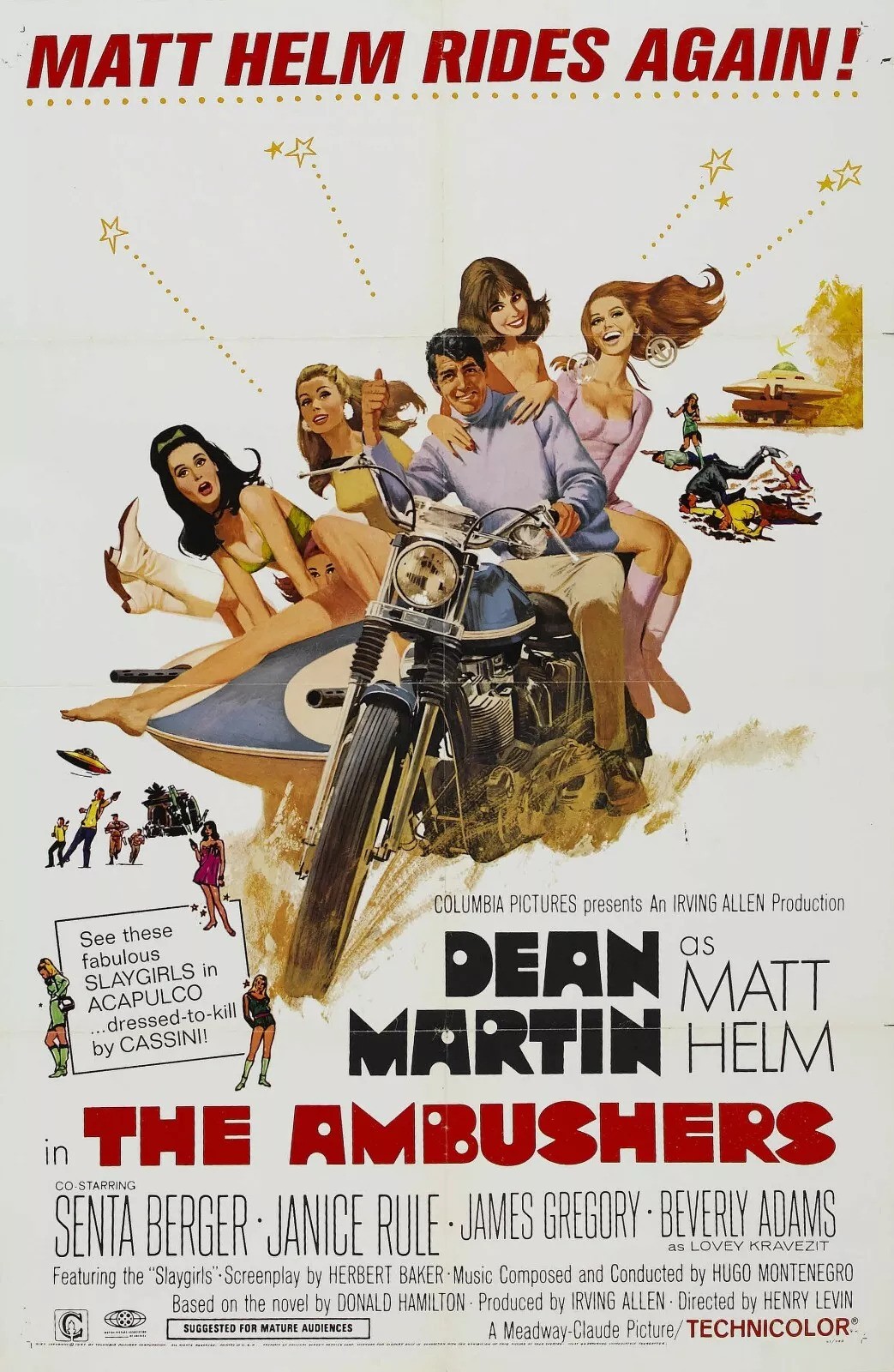
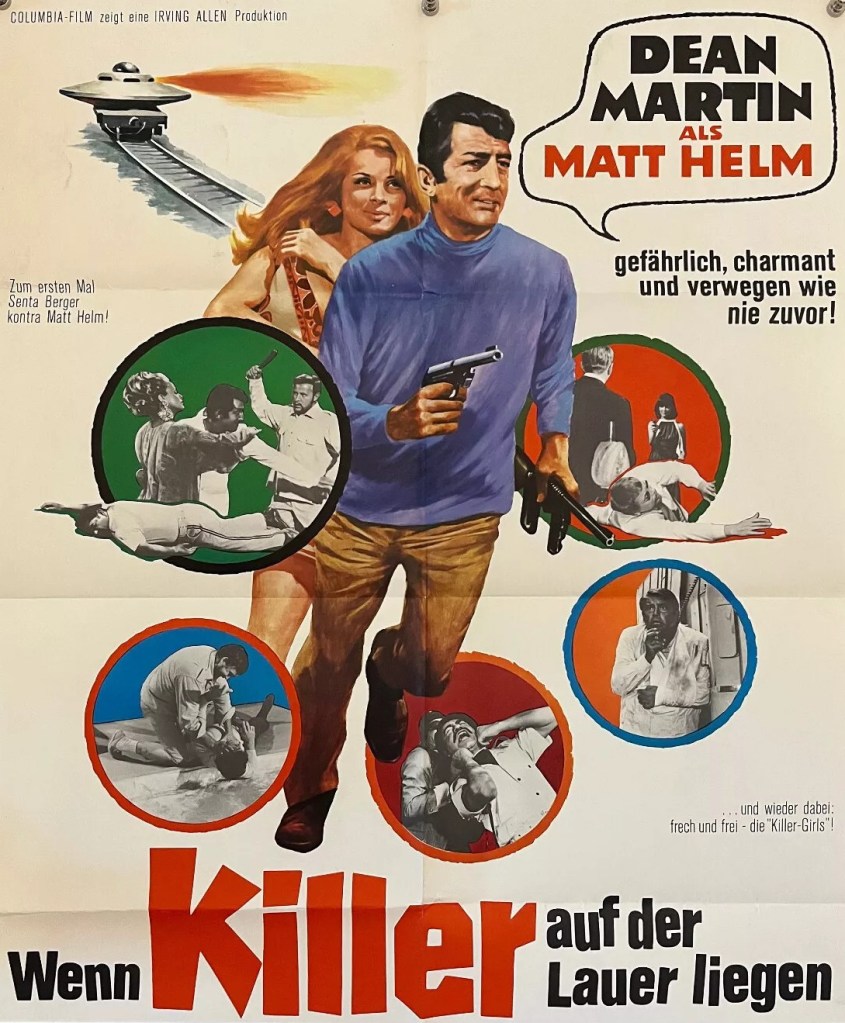
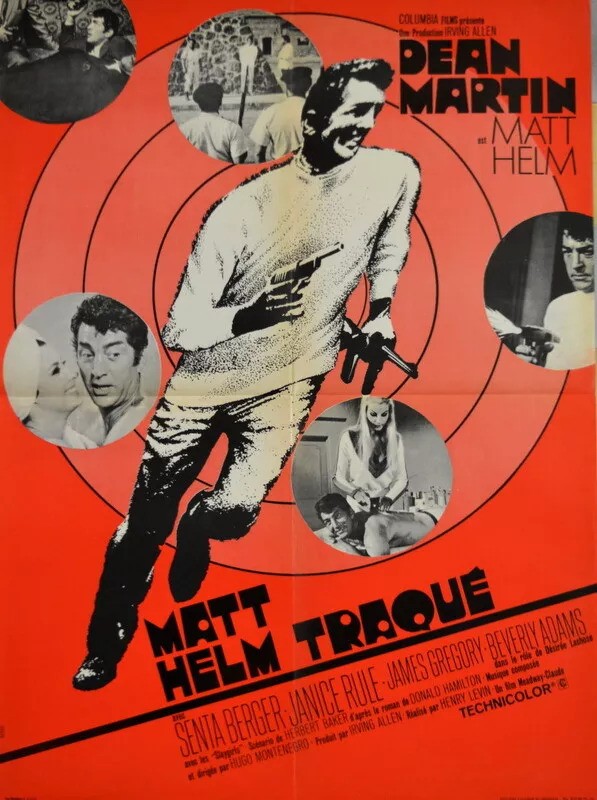
The Ambushers (1967) ***

Don’t get too hung up on the supposed rampant sexism in this third iteration the Matt Helm series. These women – bikini-clad or not – are weaponized to the hilt rather than our hero Matt Helm (Dean Martin) who has to make do with a gun disguised as a camera. In fact, he makes pretty good use of the gadget created for the females – the one that melts metal, designed to get rid of the clasp on men’s belts, forcing their trousers to fall down, which, as any student of farce knows, is the easiest way to disable the male.

There’s also a weapon triggered from a bra and a sedative concealed inside lipstick so that males seduced into intimacy will soon be snookered. And it’s also a woman, secret agent Sheila (Janice Rule), who’s impervious to the electromagnetic waves which kill off the opposite gender. Of course, to be fair, it’s not Matt Helm we see sinuously dancing around a playboy mansion in Acapulco the way the women do, although for Francesca (Senta Berger) that appears a clever method of entering the enemy’s lair. Who’s going to question another sexy dancing queen? And the bad guy has one of those devices that make the zips on female attire unzip. (James Bond purloined that one.) But it’s Matt who has the ideal rescue weapon, the levitation gun.

If you’re looking for a more male-oriented theme, how about beer? At various points Matt Helm is literally swimming in the stuff. I wouldn’t have been at all surprised had the plot concerned beer manufacturer Ortega (Albert Salmi) planning world domination through poisoning the global supply of beer or arming his beer gals with bullet-spraying bras. Even though this is largely a spoof, more so than the first in the series, it’s not that much of a spoof and Ortega has more serious intent. Using lasers, he’s hijacked the U.S. Government’s secret flying saucer and plans to sell it to the highest bidder.

Sheila, the pilot, also hijacked, has gone off piste after her experience, and is thrown together with Matt Helm as husband-and-wife, a role they previously played on another mission, to hunt down the villain and recover the missing spaceship. Francesca is also after same, and happy to seduce, trick or sedate Matt in order to achieve that end. Despite believing (from the previous encounter) that she is still Matt’s wife, Stella, despite an instant blow-up tent being laid on, takes a while to understand her duties include getting hot’n’heavy even if she’s less comfortable in the bikini department. Eventually, Matt and Sheila team up with Francesca. Turns out she works for supervillain Big O but is first to find the flying saucer.

More than the earlier entries in the series, this one relies on a series of unlikely events. The switcheroos when the lights in the train go out. But the firing squad sequence is hilarious. The in-jokes about Dean Martin’s recording rivals continue, but the bevy of bikini girls disappear from view pretty much after the opening section.

Janice Rule (Alvarez Kelly, 1966) is generally seen as a class above the previous female leads in the series but that would only be if you ignored Ann-Margret’s performance in Once a Thief (1965), the Stella Stevens of Rage (1966), the Senta Berger of The Quiller Memorandum (1966) and especially the stunning playing of Daliah Lavi in The Demon (1964). Dean Martin was on the cusp of much finer work in Rough Night in Jericho (1967) and Firecreek (1968) so this might just have been a warm-up.

Directed by Henry Levin (Genghis Khan) from a screenplay by Herbert Baker based on the Donald Hamilton novel.

Doesn’t take it itself seriously, which is just as well.

Behind the Scenes: Senta Berger Speaks

Only a candidate for the position of Emeritus Professor of Senta Berger Studies would spend time chasing up information about the star. So when I came across this interview by Italian film historian and academic Giannalberto Bendazzi (more famous later for his history of cinema animation) I couldn’t wait to share it with you. It was written while she was filming Lonely Heart / Cuoro Solitari (1970) in Italy directed by Franco Giraldi and co-starring Ugo Toganazzi. The interview took place in the foyer of the Manzoni Theatre in Milan after the film’s premiere.

The interview is repeated verbatim.

Bendazzi: I praised her performance and on consideration of her beauty and acting ability questioned her involvement with anything as bad as the last Matt Helm (The Ambushers, 1967).

Senta Berger: It was practically blackmail. I was under contract to an American company and although I had the right to refuse any script I didn’t like, they threatened that if I didn’t make the film I wouldn’t be offered any others. It’s a common enough practice.

I asked her how her career had began.

Senta Berger: I was born in Vienna and as a child had always wanted to either be an actress or a ballet dancer, so I took ballet lessons then went to the Staatsoper school of dancing and acting and on to the Max Reindhardt Academy. I appeared in a lot of theatre until one day an impresario from Berlin suggested I try the cinema.

So you went to Germany.

Senta Berger: Exactly. I made a number of films in a short time. Naturally they weren’t very good but at least I had made a start at being recognized as an actress. From there I went to London to make a film with Richard Widmark (The Secret Ways, 1961) and also that great epic The Victors (1963) which was my first big Anglo-Saxon success and earnt me the Hollywood contract. But I didn’t like California and in 1968 I came back to Europe and decided to stay.

What did you do in Europe?

Senta Berger: I made some films in Italy, Operation San Gennaro and the Casanova film with the long title, Vocation and First Experiences of Casanova in Venice. Then I did a lot of television in Germany when I had my own program, The Senta Berger Show.

Are you pleased with tonight’s film, Lonely Heart?

Senta Berger: I consider it one of my best, second only to The Quiller Memorandum (1966). It’s a film with a twist, beginning as a comedy but leaving its audience examining their conscience. It gives them something to think about. I must say that the rest of the cast made a very pleasant and affable troupe. I had no idea how nice it could be working among friends without all the usual professional difficulties.

How about your co-star Tognazzi?

Senta Berger: He’s marvelous. One of Italy’s greatest actors. So intelligent – so expressive. His every thought can be read in the expression on his face.

What do you think of sexy films?

Senta Berger: There are two kinds of sexy films. Those in which sex is used for expressive reasons, thereby making it sacrosanct. And those which use sex purely to draw an audience. In either case, it’s very simple, if you want to see it you buy a ticket, if not you stay home. The problem isn’t really of sex or morality, but of money. You see, in Germany for example, television is so good that the cinemas are empty, so film producers are forced to offer what television can’t show. The forbidden fruit.

I still wanted to know what the real Setna Berger was like.

Senta Berger: I’m really quite normal. I don’t own a big house with two thousand rooms and I’m not as rich as people think. I would have been rich had I made all the films producers suggested to me but I’ve always preferred to choose for myself. Of course I like money. It gives me the freedom to do what I want – make the films I want to make. My husband and I have already produced a film and we intend to do another.

Your husband is a director?

Senta Berger: Writer and director. He’s Michael Verhoeven, the son of Paul Verhoeven who was a director in the twenties. At one time I could think of nothing more than Michael, all I ever wanted to do was rush home and be by his side. Now, although he is still the most important thing in my life we find we have established a more mature friendship.

Have you made any more films with your husband?

Senta Berger: Up till now I haven’t had the courage, but his next film looks like being a good story, so we’ll see.

(Senta Berger produced but did not star in Verhoeven’s first picture Paarungen, 1967. She was credited as producer on another film and television productions including her husband’s pictures The White Rose, 1982, and the Oscar-nominated The Nasty Girl, 1990).

Do you feel more an actress of the cinema or the theater?

Senta Berger: The cinema, certainly. Even though I am one of the few people who find it harder to act in front of the movie camera than on the stage. But I think the most important medium of the future will be television.

Television?

Senta Berger: Yes, I know that up till now programs haven’t been that good but it’s a lot harder to present art on television than it is for the cinema. Only ten years ago programs were infinitely more rudimental than now so given another ten years or so, you’ll see.

(Senta Berger’s last film, in which she was top-billed, was Weist du Noch in 2023. She’s still alive at the time of writing).

SOURCE: Cinema X, Vol 2 No 6, p23-32.

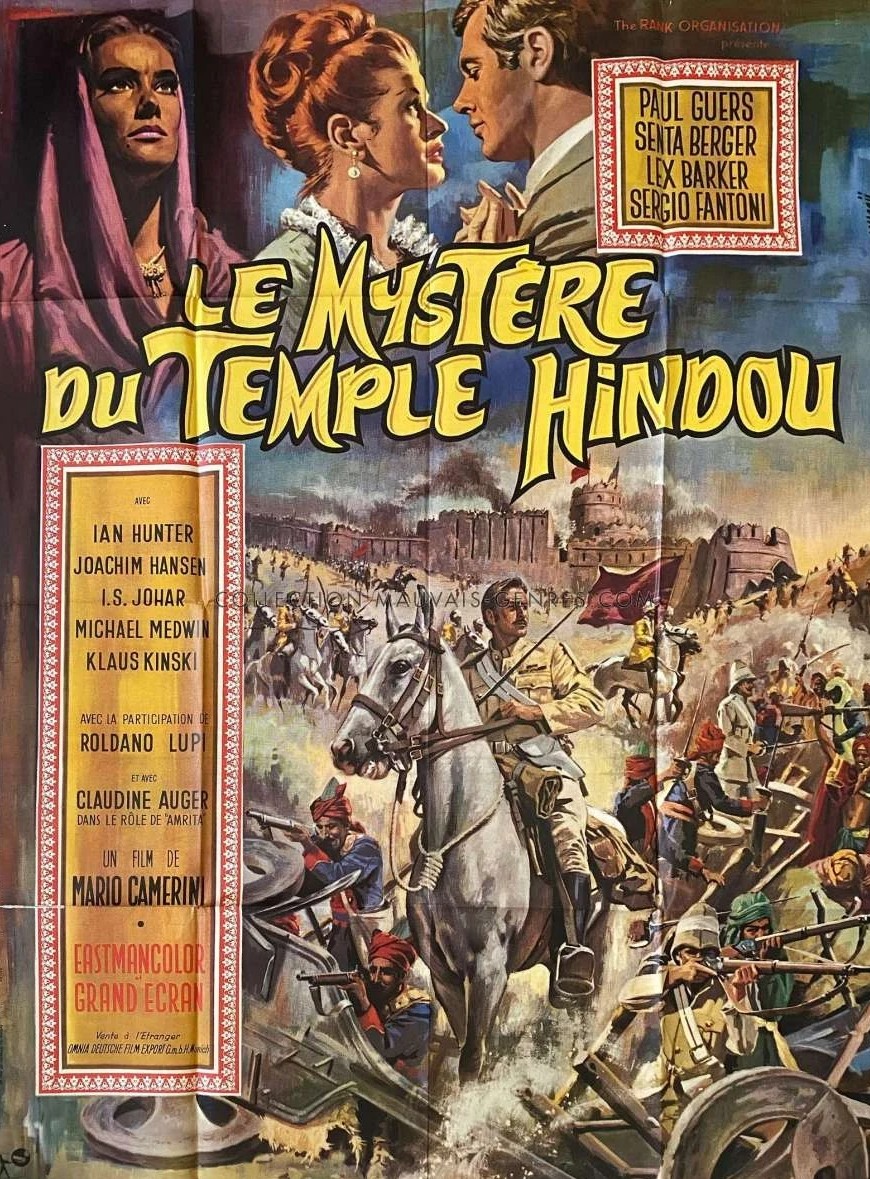
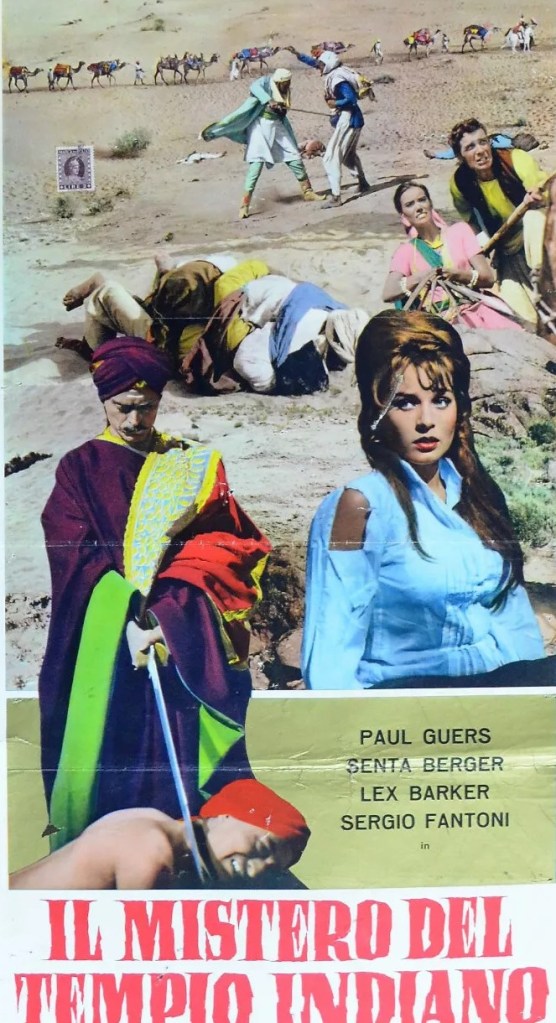
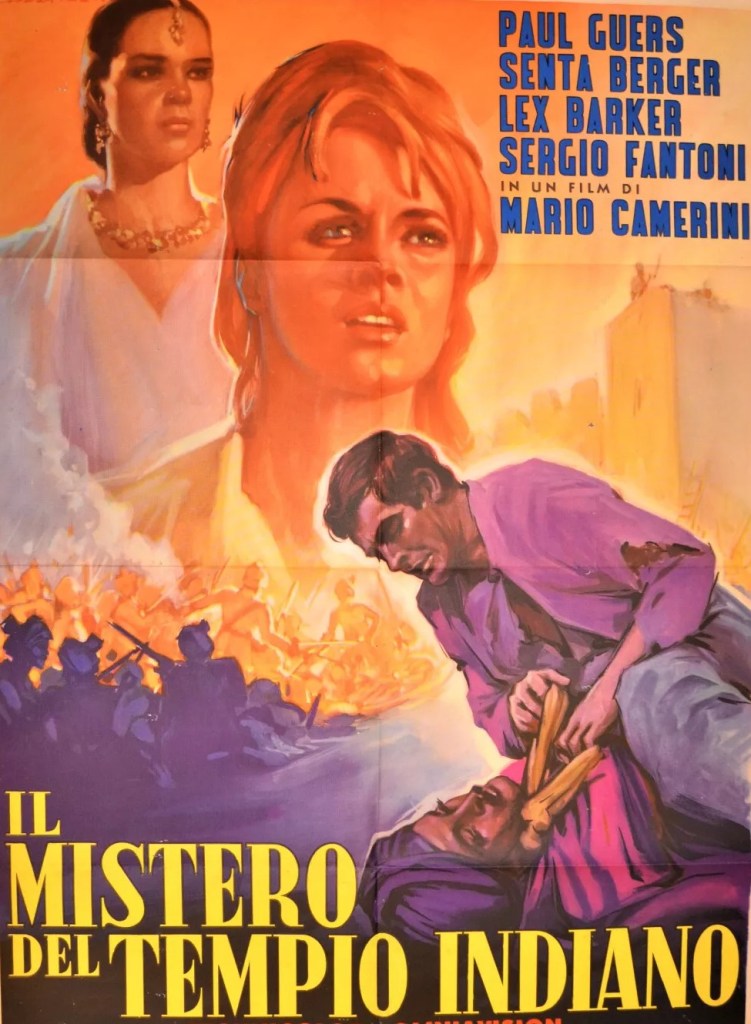
Kali-Yug Part II: The Mystery of the Indian Temple (1963) ***

Earnest students of the Senta Berger Syllabus may be somewhat disappointed, I’m afraid. This turns out to be an epic movie – in two parts – but even with a three-hour running time there’s hardly any space for the second-billed Ms Berger. Instead it’s the second female lead Claudine Auger who leads the way.

And as if it’s forerunner of the contemporary serial there’s a (longish) recap of part one, though this time recounted as if it’s nightmare into which our hero Englishman Dr Simon Palmer (Paul Guers) has unwittingly tumbled. He’s not, as I had imagined from the end of episode one, free. He’s still imprisoned by the Maharajah (Roldano Lupi) along with servant Gopal (I.S. Johar) although he has begun to deduce that all is not what it seems and that an insurrection may be on the cards under the guise of a revival of the cult devoted to the Goddess Kali.

And when exotic dancer (in the old sense, not the contemporary) Amrita (Claudine Auger) fails to convince the Maharajah of Palmer’s innocence she organizes his escape via the old snake in the basket trick. But this is not altogether from altruism. The good doctor is whisked away to treat three children who have caught diphtheria, unaware one of them is the Maharajah’s grandson, kidnapped (in Part One) by the Kali cult of which she is a key participant. However, she is beginning to thaw in her attitude to the Englishman and wonder why the goddess Kali, to whom she is bound by oath, is so determined to kill such a good man.

They end up in the caravanserai of cult leader Siddhu (Klaus Kinski), but Amrita, who’s undergoing a crisis of faith, organizes their escape, along with the boy. She has betrayed her calling – her father was a priest of Kali – in order to save Palmer. They manage to evade the pursuing pack of thugs. When the road back to Hasnabad is blocked, they decide to make for the enemy lair, an abandoned fort in the desert turned into the rebel stronghold, on the basis of hiding in plain sight, nobody expecting them to head in that direction.

Meanwhile, on his way to the fort, the Prince (Sergio Fantoni), now showing his true colors, has kidnapped Catherine Talbot (Senta Berger), planning to trade her for the Maharajah’s grandson who is “absolutely essential” to his plans. Theoretically, there’s nothing her husband can do to save her. According to the Treaty of Delhi, British forces cannot cross state lines. However, Talbot (Ian Hunter) reckons that, as he’s technically a civilian, that rule doesn’t apply to him and Major Ford (Lex Barker) comes up with a similar ploy, explaining that he’s given his soldiers ten days’ leave leave and to his “great surprise” they all decided to spend it in the fort.

Meanwhile, to complicate matters, Amrita decides Palmer is so far from being a bad guy that he’s worth kissing. But that romance is nipped in the bud when Palmer spots Catherine being dragged along in the Prince’s caravanserai and decides to rescue her. Furious at discovering that Catherine takes precedence in Talbot’s romantic scheme, and correctly assuming she’s going to be dumped, she knocks him out and turns him and the boy over to the Prince. While the child is acclaimed as the “sacred prince” and figurehead of the revolution, Palmer is to be sacrificed to the goddess. While waiting for that, he’s chained up next to Catherine.

So now you know we’re going to be perming two from four. This doesn’t feel like it’s heading in the bold direction of everyone coming out of it bitterly disappointed on the romance front.

And so it transpires. Talbot the Resident, more courageous than you might expect, dies in the attack on the fort while Amrita is killed trying to protect Palmer. Although for a time it’s a close run thing, what with the attackers outnumbered and running out of ammunition, luckily they are saved by the arrival of the Maharajah’s army. And with Amrita and the Resident out of the way, the path is clear for the old flames to renew their romance though that’s implied rather than shown.

No tigers or elephants this time round, wildlife limited to a dancing bear and a performing monkey.

Hardly a story that requires such an epic scale and I’m wondering if it was so long they had to edit it into two parts or whether it was filmed in the fashion of The Three Musketeers (1973)/The Four Musketeers (1974) with both sections shot at the same time. I’m not sure how audiences reacted. From what I can gather moviegoers in some parts of the world only saw part one while others were limited to part two, that recap helping make the narrative comprehensible.

Senta Berger (Cast a Giant Shadow, 1966) completists will come away disappointed given how restricted her role is. But she does bring the necessary emotions of remorse and humiliation to the part. Claudine Auger (Thunderball, 1965) has the better role, femme fatale, conspirator, lovestruck, spurned, and at various points leaping into action. Lex Barker (24 Hours to Kill, 1965) looks as though he’s signed up for a role requiring a hero only to be not called upon to act as one. Fans of Klaus Kinski (Five Golden Dragons, 1967) will be similarly disappointed.

Paul Guers (The Magnificent Cuckold, 1964) looks thoroughly puzzled throughout although he gives plenty lectures on general fairness while Sergio Fantoni (Esther and the King, 1960) concentrates on how unfair the British – considered the exponents of fair play – actually are.

Given it was made outside the British studio system, the producers are free to be quite critical of the British in India and there are pointed remarks about “dirty little Hindus” and about how the British treat even the Indian elite with obvious contempt. In order to retain autonomy, the Maharajah has been forced into becoming a merchant to save his people from starvation thanks to the amount he is taxed. And the story pivots on the lack of medication supplied by the British to natives. The Resident hasn’t even bothered to reply to Palmer’s letters begging for medicine.

The picture is even-handed in its depiction of British rule. Film makers were always in a dichotomy about rebels. Sometimes they were the good guys rising up against despicable authority, sometimes they were the bad guys disrupting a just system. Here, since the rebels belong to a vicious cult that would kill regardless of cause, they come off as the villains of the piece.

Mario Camerini (Ulysses, 1954) directs without the budget to make the most of the story, the battles or the location. Along with writing partners Leonardo Benvenuti and Piero De Bernardi (Marriage Italian Style, 1964) and Guy Elmes (Submarine X-1, 1968), he had a hand in the script adapted from the Robert Westerby novel.

Not complex enough to be an epic, and not enough of Senta Berger to satisfy your reviewer, still interesting enough if you are thinking of seeking it out. Good prints of both parts are on YouTube.

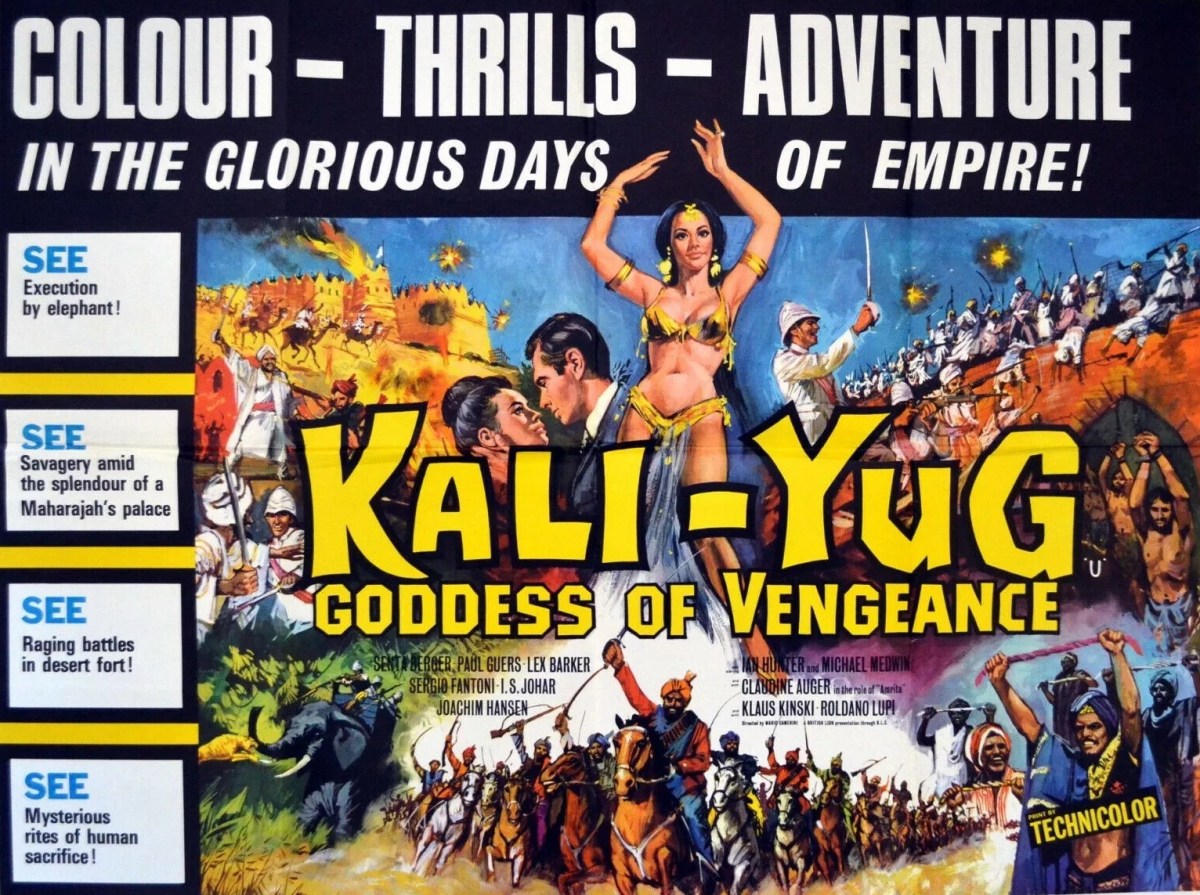
Kali-Yug Goddess of Vengeance (1963) ***

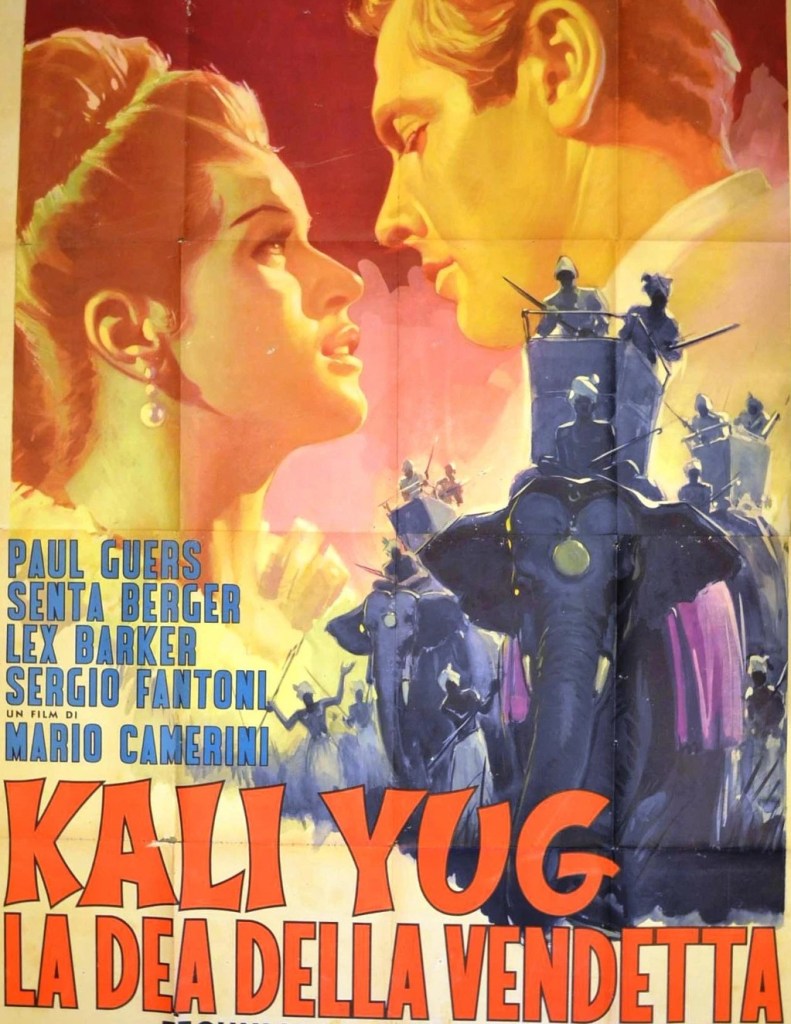
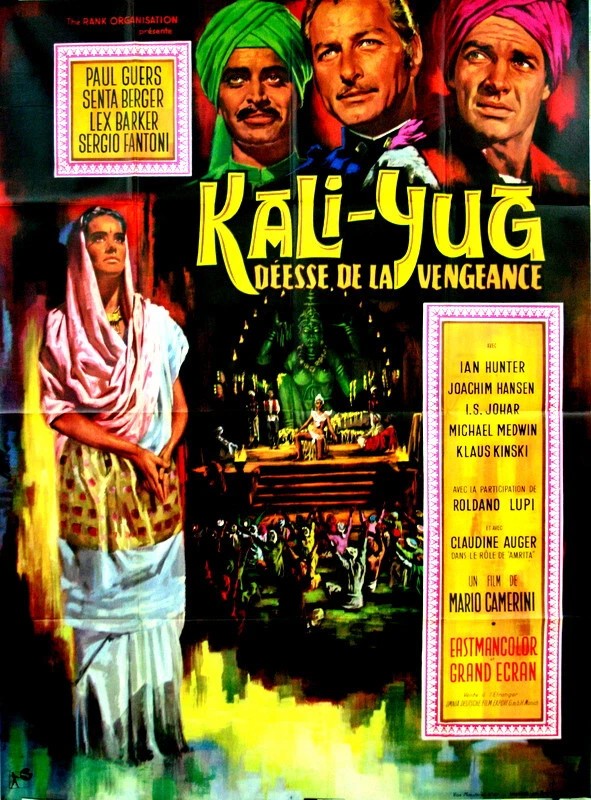
You can’t aspire to being Emeritus Professor of Senta Berger Studies unless you are willing to track down this early effort. Your curiosity can now be sated without much effort since it’s currently playing on YouTube. You’ll notice a preponderance of brownface (Klaus Kinski, Sergio Fantoni, Claudine Auger and eventually, though in legitimate disguise, Paul Guers) among a multicultural cast comprising actors from Germany, Poland, Switzerland, France, Italy, Austria, South Africa, the USA and Britain.  

To avoid confusion, the title of this German-made Indian adventure requires some explanation and once again I have undertaken the necessary research. As long as you make the distinction between “Kali-Yug” and “Kali Yuga” you will be on safe ground. The former refers to a cult while the latter refers to Hindu cosmology and the final age of the yuga cycle – the one predominant at the time – defined as an age of darkness, of moral and spiritual decline.

Even with that out of the way it takes quite a while to get your bearings here. This is India in the 1880s, four years after Queen Victoria has been declared Empress of India, at the height of British rule.  

We begin in rather traditional style with the kind of tale that would provide an Englishman with good reason to be in an impoverished Indian village. Dr Simon Palmer (Paul Guers) is fighting an epidemic of smallpox. Running out of medicine, he despatches a servant with a small convoy to the capital of Madanpur to secure further supplies to combat the disease. On its return this group is ambushed, so Palmer takes it upon himself to personally plead with local Governor (known here as The Resident) Talbot (Ian Hunter) of Madanpur..

It’s worth pointing out that, as this is relevant to the later narrative, a Resident has been appointed in those states such as Madanpur which the British took by force. Other states, which gave in to the British without a fight, such as the neighboring state of Hasnabad continue to enjoy autonomous rule by a Maharajah or Prince, but only in return for paying massive tributes to their conquerors.

After a satisfactory meeting with the Resident, Palmer encounters drunken British officer Capt Walsh (Michael Medwin) and retaliates when insulted. He also meets old flame Catherine Talbot (Senta Berger) who married the Resident. She’s not a gold-digger in the standard sense. Palmer had met her in Calcutta but when he went off to London to complete his medical studies her father died, leaving her impoverished, so in his continued absence she married the older man for security.

Capt Walsh is murdered and after their previous altercation blame falls on Palmer. He should get off scot-free. He has an alibi. At the time of the murder he was dallying with Mrs Talbot. But that wouldn’t go down well in British society. There would be a scandal. A good deal would be read into a moonlit assignation with a man other than her husband. And Palmer, in traditional stiff upper lip fashion, wouldn’t like to get her into trouble.  

So Palmer contacts elite dancer Amrita (Claudine Auger) because he thinks she knows who killed Walsh. Although promising to help, Amrita, it turns out, apart from charming the pants off (possibly quite literally) everyone in sight, is secretly in league with the characters, led by Siddhu (Klaus Kinski), responsible for the robbery and murder. So while Palmer is ambushed yet again, she is sent to Hasnabad where she will undertake her “next mission.”  

Which appears to be to dance for the Maharajah (Roldano Lupi) as entertainment for visiting merchants. Helped by servant Gopal (I.S. Johar), Palmer goes on the run and manages to fake his own death. In this regard, an entire corpse is not required as proof, just a torn limb, stolen from the local vultures, and a torn jacket. (Thus far the highlight of the show with white hunters and Mrs Talbot swaying in baskets atop elephants). To keep him safe, Gopal provides Palmer with brownface disguise. They witness a Kali ritual and follow Siddhu’s gang as they break into the palace to prevent the kidnap of his Maharajah’s grandson.

But Palmer is blamed for that too and condemned to death. That involves being buried up to  your neck in the sand while an elephant stomps on your head. But he is released because the Maharajah doesn’t want trouble with the English. Meanwhile Catherine has fessed up to her husband which, as expected, does not go down at all well.

The End.

So you can imagine my puzzlement. YouTube promotes Klaus Kinski (Grand Slam, 1967) as the reason to watch this, but so far, he’s only appeared briefly, though clearly wielding significant power as chief thug. But we’ve seen as little of third-billed Lex Barker (Old Shatterhand, 1964) as Major Ford. His contribution is to prevent Capt Walsh get even drunker and, as a member of the shooting party, pick up Mrs Talbot when she faints at the thought of Palmer being dead. Sightings of fourth-billed Sergio Fantoni (Hornets’ Nest, 1970) have been as fleeting, his main role as Prince Ram Chand to try and score points off The Resident by arguing about the unfairness of British rule and to partner Catherine briefly on the dance floor.

So this is beginning to look as though it’s a small-scale version of those big-budget pictures featuring an “all-star cast” which consists either of marquee names long past their best or various foreign stars recruited to cover all the bases for the international release rollout.  

The ending is so sudden and with so much unresolved, I also began to think it was one of those elaborate foreign jobs with stars who meant so little to British and American moviegoers that it was drastically edited to fit domestic distribution patterns.

On further research (the bane of any Emeritus Professor’s life) I got to the bottom of the problem.

This was only Part One. It wasn’t the end after all.

Luckily, I’ve found Part Two and will review that (as no doubt you’re delighted to hear) tomorrow.

The Poppy Is Also A Flower / Danger Grows Wild (1966) ***

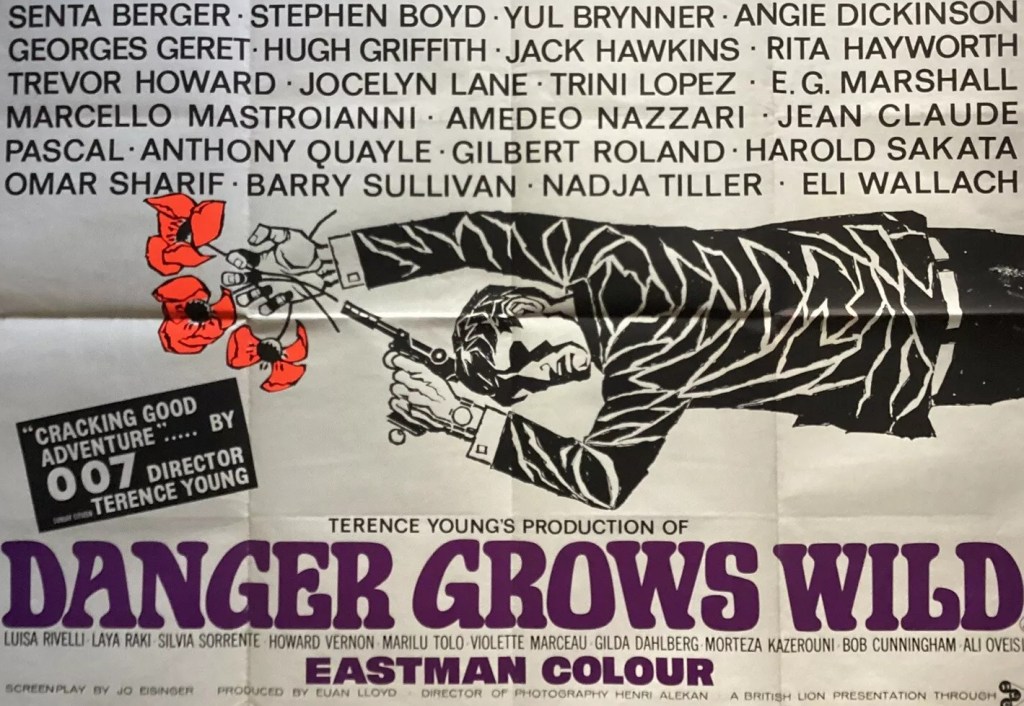
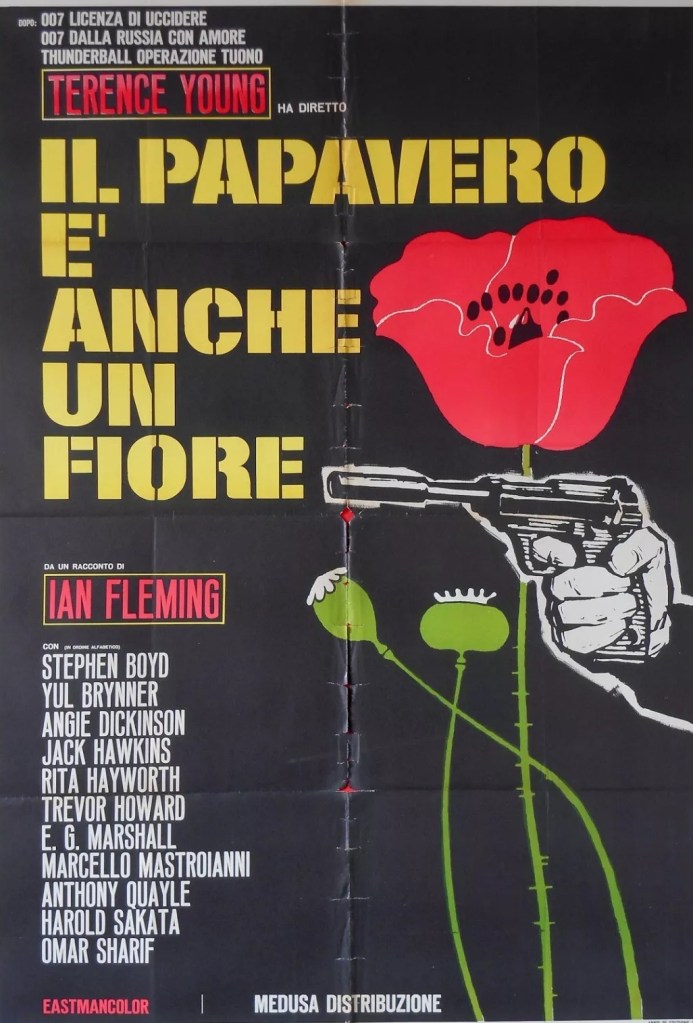
Audiences were likely disgruntled to discover that out of a heavyweight cast boasting the likes of Omar Sharif (Doctor Zhivago, 1965), Yul Brynner (The Magnificent Seven, 1960), Rita Hayworth (Circus World/The Magnificent Showman, 1964), Senta Berger (Cast a Giant Shadow, 1966) and Stephen Boyd (Genghis Khan, 1965), that the heavy lifting was done by a couple of supporting actors in Trevor Howard (Von Ryan’s Express, 1965) and E.G. Marshall (The Chase, 1966).

Most of the all-star cast barely last a few minutes, Stephen Boyd’s character killed in the opening sequence, Senta Berger and Rita Hayworth putting in fleeting appearances as junkies. Like many of the gangster pictures of the decade, it’s set up as a docu-drama, giving the down’n’dirty, courtesy of United Nations which funded the picture, on the international drugs trade.

Benson (Stephen Boyd) heads up an infiltration operation targeting drug suppliers in Iran, where poppies “grow wild as weeds.” Though quickly bumped off, and the goods he’s purchased stolen, he’s replaced by Col Salem (Yul Brynner) who has the Bond-esque notion of enriching the opium with radiation and then tracing it using Geiger counters.

When that scheme fails, it’s down to agents Sam Lincoln (Trevor Howard) and Coley Jones (E.G. Marshall) to hunt down the drugs. Considering themselves unlikely lotharios, they compete over women and play a neat game of stone-scissors-paper to decide who is assigned which task, varying from chatting up Linda (Angie Dickinson), the gorgeous widow of Benson, or searching her room. Linda isn’t all she seems, not least she may not be a widow, carries a gun, and turns up in too many unsavory dives to be on the side of the angels.

Given drug-dealing was not the rampant business it later became, audiences might not be so shocked to discover that opium was transported by cargo ship and refined in Naples before being shipped all over the world. Possibly as interesting is the use of ancetic anhydride in the refining process. As Sam and Coley trudge across half of Europe, from Naples to Geneva to Nice, the audience is filled in on the details of the drug business and they latch on to a Mr Big, Serge Marko (Gilbert Roland).

There’s a hard realism about the project – though not to the levels of The French Connection (1971) -: nightclub dancer needing make-up to hide the tracks on her arms; Marko’s wife (Rita Hayward) stoned out of her skull; director Terence Young (Dr No, 1962) pulling a fast one Hitchcock-style in killing off Sam; and, despite a climax which sees Coley collar Marko, it ends with a pessimistic air – “someone else to take his place.” There’s a good fistfight on a train, and you’ll have guessed what Linda is up to. But there’s an odd softer centre, the movie taking a couple of breaks to highlight the singing of Trini Lopez and female wrestlers.

Before virtue-signalling was invented this was a do-gooder movie, the cameo players signing up for a buck, Grace Kelly on hand for the introduction. These days it stands as an almighty alarm that was scarcely heeded, not as the drug-fuelled counter-culture was about to burst onto the world, and with middle-class drop-outs championing the illicit there was little chance of the warning being heeded.

More like The Longest Day (1962) than Lawrence of Arabia (1962) in its use of the all-star cast. Still manages to make its points with the least amount of lecturing and hectoring.

Terence Young comes into his own in the action highpoints. Written by Jo Eiseinger (Oscar Wilde, 1960) and Jack Davies (Gambit, 1966) from an idea by Ian Fleming.

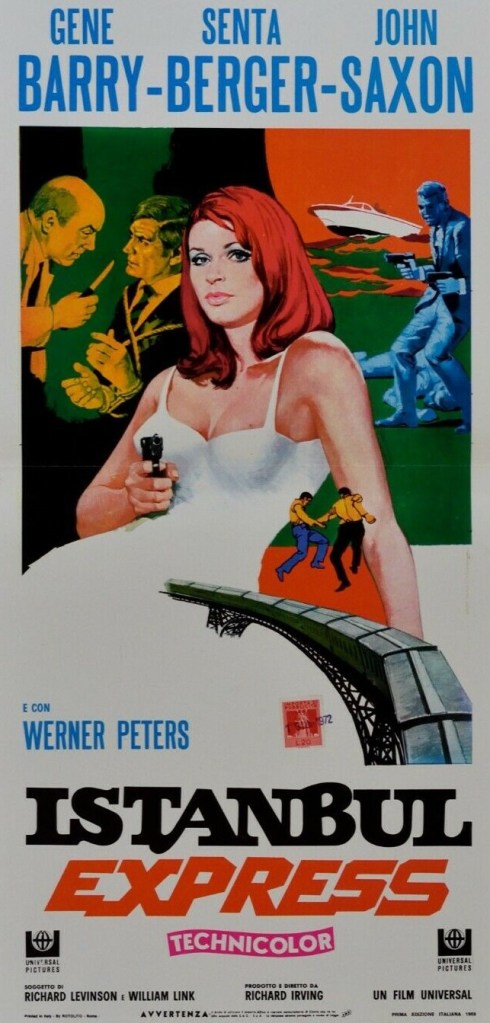
Istanbul Express (1968) ***

Calling this a by-the-numbers spy thriller does this movie no disservice since numbers are crucial to the complicated plot. On the one hand it’s quite a simple set up. Suave high-living art dealer-cum-spy Michael London (Gene Barry) travels from Paris to Istanbul on the Orient Express to bid for secret papers in a secret auction. The complication: he must pick up the auction money from a bank in Istanbul using a code given to him along the way, each number by a different unknown person. On his side are train security chief Cheval (John Saxon), investigative journalist Leland McCord (Tom Simcox) and colleague Peggy (Mary Ann Mobley). Out to get him are Mila Darvos (Senta Berger) and Dr Lenz (Werner Peters).

The numbers business is an interesting addition to the usual spy picture formula of scenic location – Venice and the Eastern bloc as well as the other famous cities – violence and beautiful, sometimes deadly, women. You spend a good time guessing just how the numbers will be passed on and let me warn you it is sometime by inanimate means while the numbers themselves come with a twist.

There’s also a truth serum, bomb threat, a traitor and every obstacle possible put in London’s way to prevent him completing his mission. London is about the world’s worst passenger, always missing the train as it sets off on the next leg of its journey, and requiring alternative modes of transport to catch up. But it’s as much about quick thinking as action and ends with a couple of unexpected twists. And it’s darned clever at times where the numbers are concerned.

Admittedly, the plot is a tad over-complicated but it’s fun to see London wriggle his way out of situations and for Cheval and McCord to turn up unexpectedly to provide assistance.

Gene Barry (Maroc 7, 1967) is little more than his television alter ego from Burke’s Law but he has an easy screen presence, never flustered, tough but charming and a winning way with the ladies. John Saxon (The Appaloosa, 1966) is the surprise turn, on the side of the angels rather than a villain, and equally commanding on screen, and certainly given one of his better roles. Senta Berger (Major Dundee, 1965) is not given as much screen time as you would like – a long way from being set up as the normal espionage femme fatale – but is certainly a convincing adversary.

This was only a movie if you saw it outside of the United States. There it was shown on television. But it had high production values for a television movie and director Richard Irving, who directed the television feature that introduced Columbo (Prescription Murder, 1968), keeps it moving at a healthy clip.  The numbers idea was probably a television device, allowing the opportunity for timed breaks in the action, Writers Richard Levinson and William Link were a class television act, creating Columbo, and prior to that the Jericho (1966-1967) and Mannix (1967-1975) television series. 

Interestingly, Senta Berger, John Saxon, Gene Barry, Levinson/Link and Richard Irving were all at various points involved in the groundbreaking U.S. television series The Name of the Game (1968-1971).

I had not realized Istanbul Express was a made-for-TV picture until I had finished watching it and in that case found it a superior piece of television and a decent-enough rift on the spy movie.

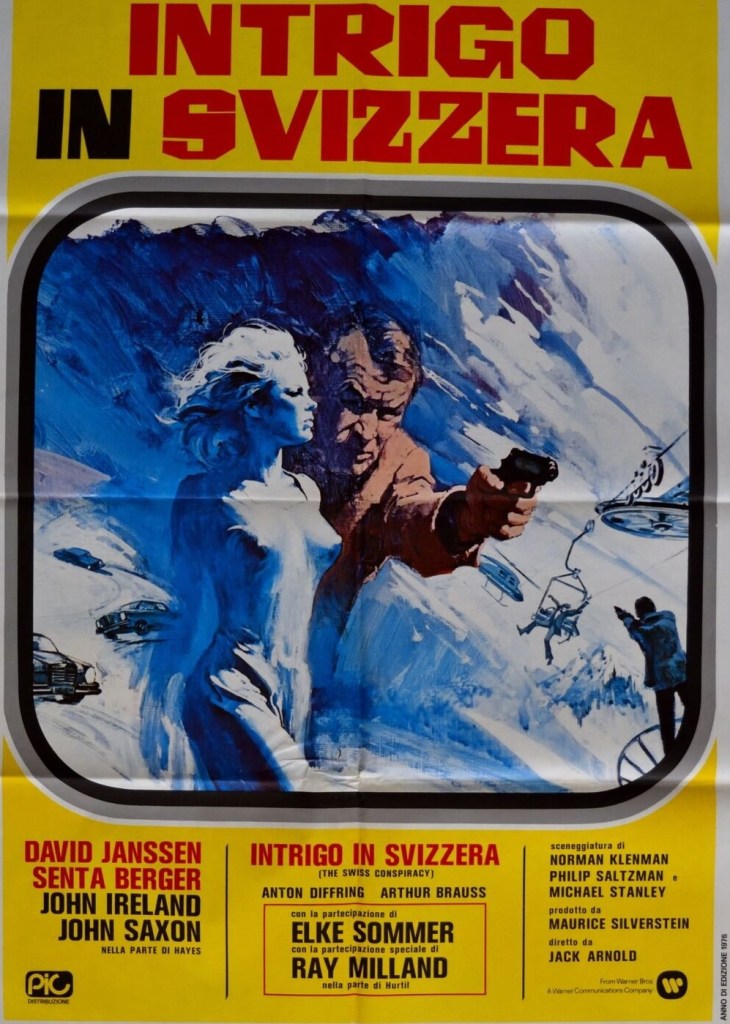
The Swiss Conspiracy (1976) ***

One of those thrillers that only makes sense at the end. Lazy critics, too annoyed to wait or not able to work it out themselves, take out their bafflement on the picture. Or they carp at what they see as overmuch tourist influence instead of admiring the clever use made of Switzerland’s scenic attractions, the twisty cobbled streets, corkscrew highways teetering over ravines, and the apparatus of skiing – the chug-chug trains and lifts.  

Attractive too for the cast. You might put me down as overly fond of leading lady Senta Berger (Bang! Bang! You’re Dead! / Our Man in Marrakesh, 1966) but I’m equally appreciative of the casual charm and realistic qualities brought to the screen by the underrated David Janssen (The Warning Shot, 1967). And that’s before we come to Elke Sommer (The Prize, 1963) and veteran Hollywood star Ray Milland (Hostile Witness, 1969), not to mention character actors John Saxon (The Appaloosa / Southwest to Sonora, 1966) and John Ireland (Faces in the Dark, 1961).

Poster designer gives himself a bit of leeway here, suggesting a lass is going to be striding around the Alps in such clingy clothing.

Former U.S. Treasury Agent David Christopher (David Janssen) is called in by Swiss bank owner Johann Hurtil (Ray Milland) to investigate a threat to expose the clients hiding behind the country’s infamous secret numbered accounts. Five clients, in particular, have been targeted including the glamorous Denise Abbott (Senta Berger), whom David first encounters in what would in other circumstances be deemed a clever meet-cute with the woman getting the upper hand.

One client is already dead, murdered in the opening sequence, as a warning. Of the others, Robert Hayes (John Saxon) is a mobster depositing illicit gains for money-laundering purposes, Dwight McGowan (John Ireland) a shady businessman on his last legs, while Kosta (Curt Lowans) equally operates in the shadows. And all is not well with the bank deputy Franz Benninger (Anton Diffring), involved in an affair with another client, Rita Jensen (Elke Sommer). On top of that, Swiss cops are on the trail of Hayes and hit men are tailing Christopher.

Christopher quickly surmises that the victims have been targeted for their undercover dealings, even the uber-glam Denise is blackmailing a former lover. But Hurtil, fearing a public and media scandal, and for whom the gangster’s demands are a mere drop in the ocean compared to the bank’s overall wealth, decides to meet their terms, which is payment of 15 million Swiss francs (equating to several million U.S. dollars, I guess) in uncut diamonds.

But before that we have a punch-up and shoot-out in a parking garage, a chase on foot on those famous narrow cobbled twisty streets with a speeding car giving the thugs unfair advantage, a race of seduction a la On Her Majesty’s Secret Service (1970) along those aforementioned treacherous mountainous roads, a literal cliffhanger in the vein of The Italian Job (1969), and one of those luscious romances beloved of the upmarket thriller (think The Thomas Crown Affair, 1968).  

While Christopher is painstakingly putting together the clues and keeping the suspicious Swiss police off his back and avoiding being killed, there’s a deadline to meet, the usual race against time, while the audience is having to fend off a surprising number of red herrings.

It’s not only glamorous, it’s short, and there’s more than enough going on, characters played by interesting actors, to keep the viewer involved. And I defy you to guess the ending. So, enough thrills, sufficient mystery, great scenery, and a female contingent (even Christopher’s secretary fits that category) with brains to match their sexiness who appear to have the upper hand in relationships with the opposite sex.

This is David Janssen at his best, that outward diffidence concealing a harder inner core, exuding a guy-next-door appeal that was never properly utilised by Hollywood, who preferred him just to reveal character by squinting. The scene where he takes in the extent of the luxury of Denise’s hotel penthouse is one of those that, while not knocking on Oscar’s door, demands true acting skills. He’s never in your face, and the camera loves him for it.

Of course, Senta Berger, what can you say, another under-rated actress never given her due in Hollywood, here finds a plum role that allows her to switch from confidence to vulnerability at the drop of a hat. John Saxon and John Ireland, as ever, are value for money. And Ray Milland keeps the show on the road.

A modern audience would be more at home with the multiplicity of plot angles and probably worked out in their own heads all that couldn’t find a place on screen, ensuring that what seemed like plot holes were anything but.

Jack Arnold (The Creature from the Black Lagoon, 1953) handles the scheming and dealing with ease. Norman Klenman (Ivy League Killers, 1959), and two television writers in their movie debuts, Michael Stanley and Philip Saltzman, wove the intricate screenplay.

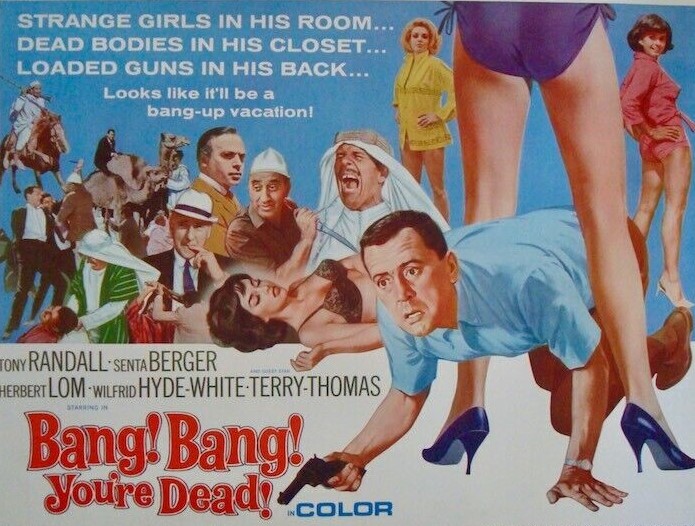
Our Man in Marrakesh / Bang! Bang! You’re Dead! (1966) ***

All hail Senta Berger! Another from the Harry Alan Towers (Five Golden Dragons, 1967) portfolio, this is a spy-thriller mash-up with a bagful of mysteries and a clutch of corpses. At last given a decent leading role, Senta Berger (Istanbul Express, 1968) steals the show from the top-billed Tony Randall (as miscast as Robert Cummings in Five Golden Dragons) and a smorgasbord of European talent including Herbert Lom (The Frightened City, 1961), Terry-Thomas (Danger: Diabolik, 1968), Klaus Kinski (Five Golden Dragons), John Le Mesurier (The Moon-Spinners, 1964) and Wilfrid Hyde-White (Ada, 1961).

In this company, the glamorous Margaret Lee (Five Golden Dragons), as the villain’s  cynical lover (“you are never wrong, cherie, you told me so yourself,” she tells him) is an amuse-bouche. Six travellers – including architect passing himself off as oilman Andrew Jessel (Tony Randall), travel agent George Lilywhite (John Le Mesurier), salesman Arthur Fairbrother (Wilfrid Hyde-White) and tourist Kyra Sanovy (Senta Berger), meeting her fiancé – board a bus from Casablanca airport to Marrakesh. One is carrying $2 million as a bribe to ease through a vote in the United Nations, but the villainous Mr Casimir (Herbert Lom) doesn’t know which one it is.

When Kyra’s fiance’s corpse tumbles out of Andrew’s cupboard, the pair become entangled. Kyra is a born femme fatale, trumping the incompetent Andrew at every turn.  With no shortage of complications, the tale zips along, directed on occasion with considerable verve by Don Sharp (The Devil-Ship Pirates, 1964).

It’s lightweight but no less enjoyable for that and makes a change from the more serious espionage fare (The Spy Who Came in from the Cold, 1965, and The Quiller Memorandum, 1966) beginning to capture the public’s attention. It might make it sound better to say it’s a mixture of The Man Who Knew Too Much (1956) and North by Northwest (1959) and throws a homage bone to Our Man in Havana (1959), but while it plays around with those riffs, it doesn’t give two hoots about focusing on Hitchcockian thrills. It’s more about the fish-out-of-water Yank Andrew being led astray by the sexy Kyra.

There are some inventive double-plays – with a body in the boot Kyra and Andrew are stopped by a cop who tells them their boot is open. An excellent rooftop chase is matched by a car chase. And there’s a terrific shootout. Kinski is at his sinister best and Terry-Thomas a standout in an unusual role as a Berber.

The film was shot on location including the city’s souks, the ruined El Badi Palace and La Mamounia hotel (featured in The Man Who Knew Too Much, 1956).

But Senta Berger seamlessly holds the whole box of tricks together, at once glamorous and sinuous, practical and tough and exuding sympathy, and it’s a joy to see her for a large part of the picture leading Randall by the nose. Quite why this did not lead to bigger Hollywood roles than The Ambushers (1967) remains a mystery.

A blast.

https://amzn.to/46T68Ax

Discover WordPress

A daily selection of the best content published on WordPress, collected for you by humans who love to read.

The Atavist Magazine

by Brian Hannan

WordPress.com News

The latest news on WordPress.com and the WordPress community.