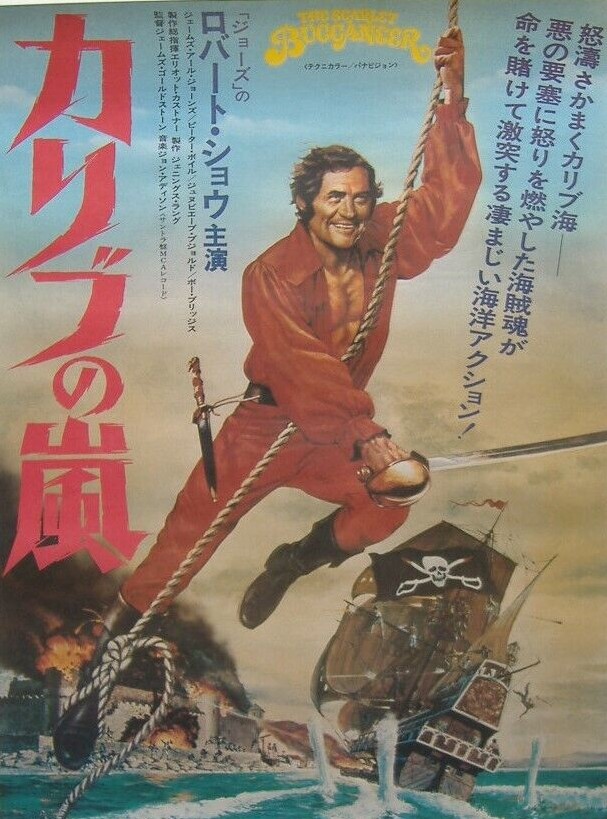
Swashbuckler (1976) **

Red faces all round. Uneasy pirate spoof that misses all its targets, coming close to resembling the kind of movie that gives turkeys a bad name and saved only by a spirited performance by Genevieve Bujold. Uber-producers Jennings Lang (Rollercoaster, 1977) and Elliott Kastner (Where Eagles Dare, 1968) should have known better but were seduced by the tantalizing returns for Richard Donner’s The Three Musketeers (1974) and its sequel which had revived the moribund swashbuckling genre.

Robert Shaw (Custer of the West, 1967) was nailed-on for the leading role since had made his name playing a pirate in British television series The Buccaneers (1956-1957) and was as hot as he was going to get after the double whammy of The Sting (1973) and Jaws (1975). However, the movie takes its cue from one of the chief supporting actors Major Folly (Beau Bridges).

It’s color-coded. In case we can’t tell a good guy from a bad guy, we’ve got the Man in Red, pirate Ned Lynch (Robert Shaw), shaping up against the Man in Black, unscrupulous Jamaican governor Lord Durant (Peter Boyle). Ned is presented as a seagoing Robin Hood, Durant as the wicked Sheriff of Nottingham, his ruthlessness somewhat undermined by his predilection for playing with toy boats in his bath and for getting his hairy back waxed.

Twin narratives quickly unspool. Ned rescues from being hanged shipmate Nick Debrett (James Earl Jones) while Durant jails island chief justice Sir James Barnet (Bernard Behrens) and steals his treasure.

Stolen treasure being fair game, Ned and Nick hijack a coach-load of it, while Sir James’s on-the-run daughter Jane (Genevieve Bujold) ends up in their hands. Not being as black-hearted as his nemesis, Ned puts Jane ashore, but still a bit black-hearted humiliates her in a swordfight, and is disinclined to help her save her imprisoned father.

However, Jane has a trump card. For reasons unknown, Durant is heading back to England with a cargo of 10,000 dubloons, too tempting a target for any pirate. Naturally, nothing goes as planned but, as you might expect, there is a happy ending.

This might have worked, since all the ingredients are there, the laughing cavalier, the spirited woman, the humorous sidekick, the unprincipled villain. You’ve got an historically-accurate pirate ship for once, unlikely romance between high-born woman and charming scallywag, simple rescue-imprisonment-rescue scenario, and ample scope for swordplay.
Except the dialog is awful, the ship too small to accommodate any fighting so the pirates are landlubbers for the most part, and except for the duels between Ned and Jane and Ned and Durant, the swordfights are all kind of bundled together, and every now and then the action stops so we can hear a verse or two of a sea shanty sung by nobody in particular.

Though Ned and Nick trade cringeworthy, and in one case downright offensive, limericks, the best (only) laugh comes when Ned chucks Jane off a roof onto a canopy and follows up with the line “It worked.”  It doesn’t help that Durant’s pederastic tendences are played as a joke. Everywhere you look people are turning cartwheels or are “blithering idiots” or “pawns” and as you might expect there’s a cat-fight and a monkey around to relieve a jailer of his keys. You are just praying for a shark to come along to put the cast out of their misery.

In the midst of this feast of over-acting along comes Genevieve Bujold (Anne of the Thousand Days, 1969) who must think she’s in a different picture. She is a feisty one all right, not above putting a knife to a man’s cojones, or kneeing them in that region, and, given the lawless state of the island, branded a criminal for wounding a rapist.   At least she takes the whole thing seriously rather than as if being in a Mel Brooks picture.

It’s hard to know who to blame: the stars for acting as if enjoying a holiday from more serious fare; director James Goldstone (Winning, 1969) for failing to get the recipe right and employing a jaunty score that undercut everything, or writers Jeffrey Bloom (11 Harrowhouse, 1974) and Paul Wheeler (Caravan to Vaccares, 1974) for making a mess of the ingredients in the first place.

Of course, I am hardly blameless in drawing your attention to this, a sudden enthusiasm for pirate pictures sending me dashing into the wrong decade.

Watch for: Robert Shaw making a bid for the all-time Golden Raspberry; an unrecognizable Peter Boyle (Taxi Driver, 1976); Beau Bridges (Gaily, Gaily, 1969) doing his best Frankie Howerd impression; James Earl Jones (The Comedians, 1967) sounding normal, minus the deep-throated vocal tic on which he made his name; and so many inanities it falls easily into the So Bad It’s Good category.  

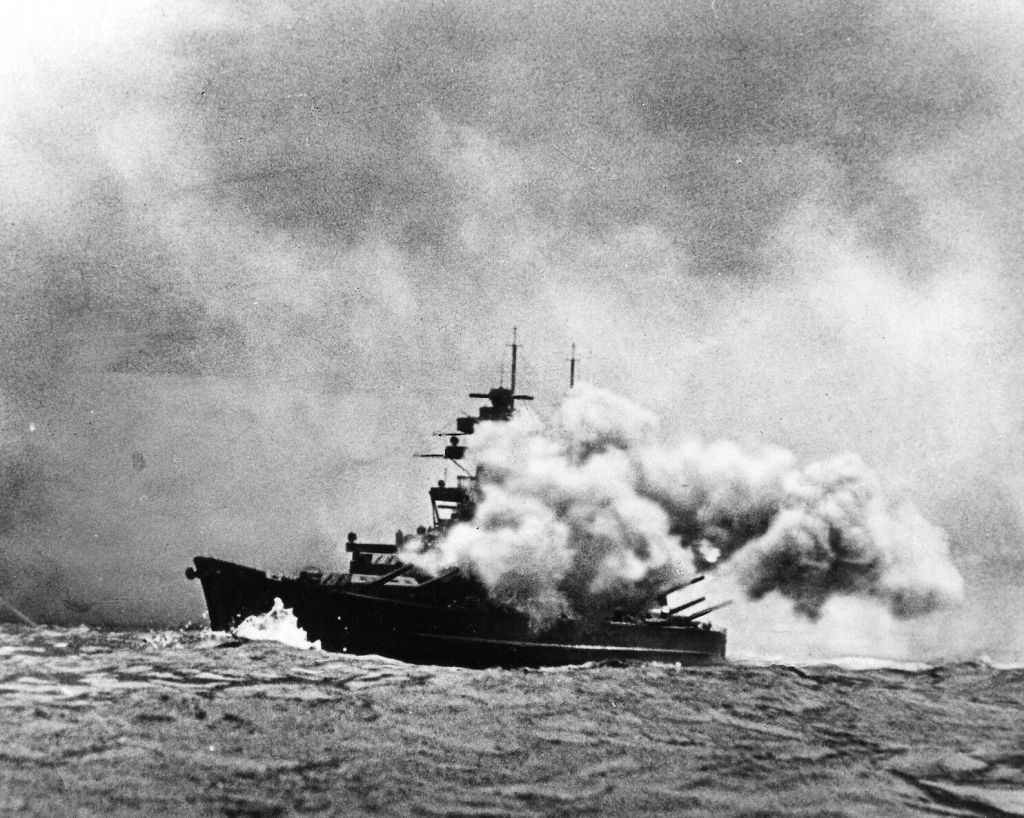
Sink The Bismarck! (1960) ****

Hard to believe but outside of the Hollywood big-budget Bridge on the River Kwai (1957), this was the biggest British film at the U.S. box office in the previous decade. In fact, the British war films that did so well in the home territory, The Cruel Sea (1953) and Reach for the Sky (1956), sank like a stone when exported to in America while earnings for Ealing comedies,  limited to arthouses, hardly made a dent in the box office.

What makes this so appealing is the very lack of Britishness and the intrusion of a Yank, famed reporter Edward  R Morrow (playing himself), interrupting the action at various points to keep audiences up to speed. The fact that the sinking of the Bismarck, the biggest battleship ever built, was one of the few British actions at the start of the Second World War to be counted a success probably helped. Watching the Brits being lionized for defeat was not an attractive notion for global audiences.

But in the main it is a thrilling docu-drama, very much a departure for the genre, with every nuance of potential consequence spelled out. Dialog and models being moved across maps announce the risks inherent in the British attack: the superiority of the newly-built German battleship, the multiple options the Germans had in 1941 to escape, the difficulties in pinpointing the German vessel in the fog-bound waters of the North Sea, and the devastation the battleship could inflict on the beleaguered convoys on which Britain depended to stay afloat. In addition, even when targeted the Germans could flee to occupied France or potentially summon U-boats or air support.

So in the manner or Operation Crossbow (1965) or Day of the Jackal (1973) the audience is primed for a minute-by-minute enterprise, the battleship deemed so dangerous that the Admiralty is willing to risk its own scarce supplies of battleships, destroyers, cruisers and aircraft carriers in a bid sink the enemy. It is so much a documentary that the beyond the thrill of the hunt there is little room left for drama and certainly little of the stirring kind that had become such a byword for the British version of the genre – and such a turn-off for foreign audiences who could hardly make out what the actors were saying never mind work out why such-and-such a mission they had never heard of was so important.

In any case emotion is forbidden in the subterranean claustrophobic Admiralty War Office where new operational commander Capt Shepherd (Kenneth More) holds sway. A martinet, “cold as a witch’s heart,” on arrival he rids staff of what he sees as the rank indiscipline of addressing colleagues by forename rather than surname, eating sandwiches at a desk to which the workforce have been chained for hours  and various minor offences against the strict code of a uniform.

It was inherent in this type of picture that the land-based unit suffer the casualties of war, husbands dead or missing in action, wives and children killed by German bombs. But the tightening of the stiff-upper-lip ensures that when such revelations become known, they appeared like emotional depth-charges on this otherwise staid ocean. And Capt Shepherd, through his choices, as would be true of many high-ranking officers, might be sending his own son to is death.

This is also one of the first instances in war pictures where the Germans are not treated as stock villains, but intelligent people, like Admiral Lutyens (Karel Stepanek) with his own vanity and a hunger for redemption, and Capt Lindemann (Carl Mohner), as valiant an opponent in the cat-and-mouse duel where outwitting the British enemy could wreak untold carnage and hasten – unusually from the German point-of-view rather than from the Allies – the end of the war.

A few months after launch the Bismarck is spotted leaving its home port, destination North Atlantic to feast on convoys travelling from America with invaluable supplies. There are four possible routes open to get round the top of Britain. To prevent the Germans reaching any of them British ships must be sacrificed, including HMS Hood – three survivors out of a crew of 1400.

It’s David vs Goliath except David is a terrier capable of inflicting tiny wounds that drain the battleship of some of its power, loss of fuel and rudder problems limiting movement. It’s a different kind of war picture, as well as the big guns blasting at each other over huge distances, the British employ biplanes loaded with torpedoes, a weapon also used in some instances by its ships.

To keep audiences more heavily involved, there are snippets of dialog involving characters on board the various ships, some in distinctly un-stiff-upper-lip mode, and montages of the various vessels getting ready for action, as well as shots of devastation should a shell find its target.

But basically it’s  brilliantly-told tactic-heavy war picture that shows the shifting battleground, how the various ships are deployed, with no shortage of telling the audience how crucial success is and how crushing defeat. There’s no reliance on individual heroism, no snappy soldier defying authority, no hunch being played out, none of the usual cliches of the genre, instead, as with The Longest Day (1962) a clear explanation of what’s going on with superb battle scenes for the action-inclined.

It’s fair to say that even on the small screen, the models look a bit iffy, but this is more than compensated by other scenes on real warships, the use of newsreel footage, and fast cutting.  That action never takes place under a clear blue sky but always in murky waters also adds to the realism.

In a role that would have been custom-made for Kenneth More (The Comedy Man, 1964), king of the stiff-upper-lip, rather than simply spouting his lines, he adds considerable emotional depth. Dana Wynter (Something of Value, 1957) is excellent as his equally buttoned-up assistant.

There’s a full crew of supporting British character actors including Michael Hordern (Khartoum, 1966), Laurence Naismith (Jason and the Argonauts, 1963), Geoffrey Keen (Dr Syn, Alias The Scarecrow, 1963) and Maurice Denham (Some Girls Do, 1969) while the Czech-born Karel Stepanek (Operation Crossbow, 1965) and Carl Mohner (Assignment K, 1968) inject humanity into the Germans.

Lewis Gilbert (The 7th Dawn, 1964) does a brilliant job of bringing this all together, adding touches of emotion and humour to what could have been a too-dry concoction, drawing on a screenplay by Edmund H. North (HMS Defiant/Damn the Defiant, 1962) which was based on the book by C.S. Forester of Hornblower fame.

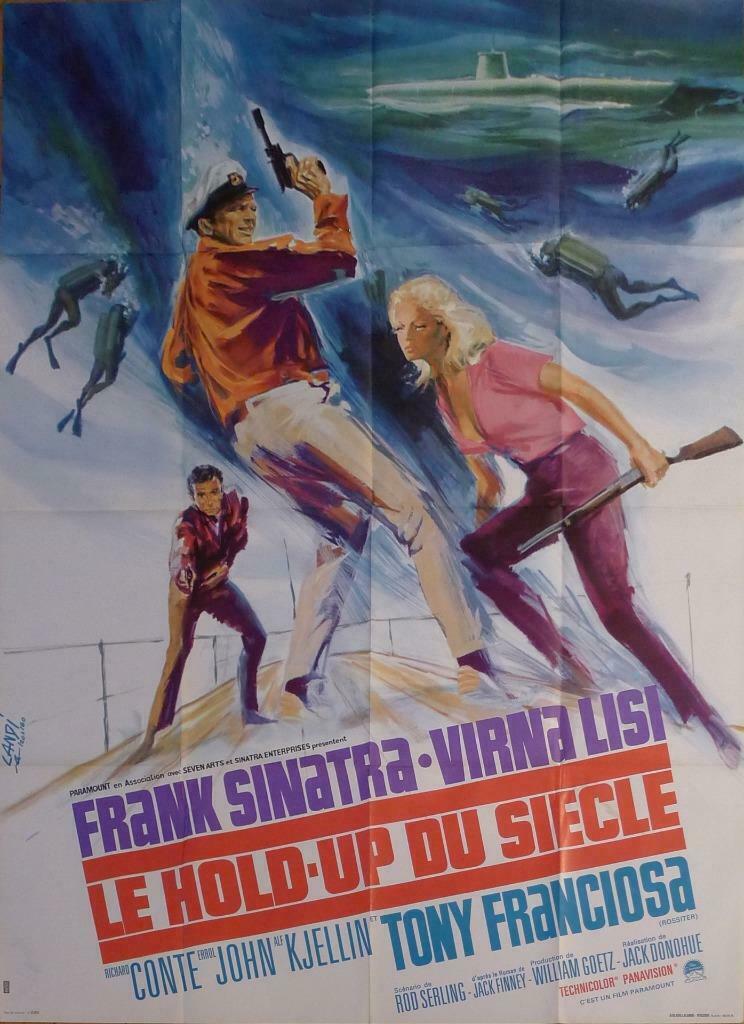
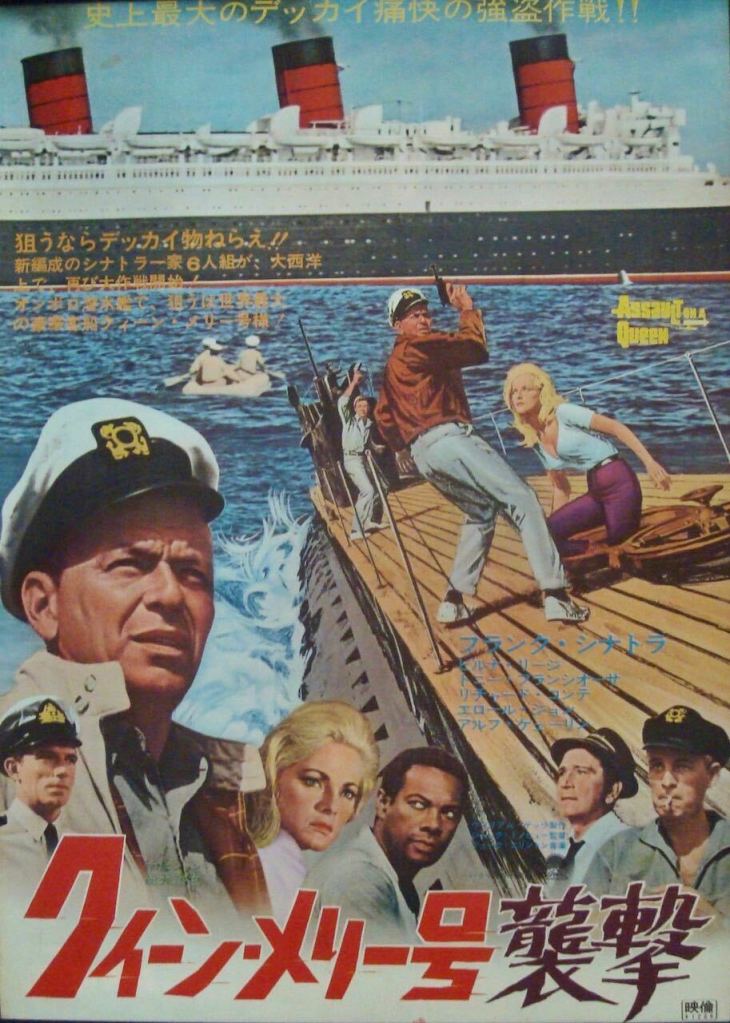
Assault on a Queen (1966) ***

I always wondered why this was a flop. I’m still baffled. Not only is it a perfectly serviceable caper picture, but it’s also high-concept before the term was invented, a World War Two submarine involved in holding up high-end ocean liner Queen Mary (yep, the real thing, thanks to cooperation from owners Cunard). 

The dialogue’s crisp, the robbery well-planned, a good number of twists, plenty underwater thrills, hostility between crew members, and sexual tension kept high by the presence on board of the Italian Miss Big. Diver Mark Brittain (Frank Sinatra) is sucked into a treasure hunt in part because he needs the money and in part through the sexual magnetism of Rosa (Virna Lisi), the expedition backer, who already has suave Vic (Anthony Franciosca) on a string.

The plan evolves into piracy when Brittain discovers a World War Two German submarine on the seabed. As it happens, skippering the salvage vessel is former German U-boat captain Eric (Alf Kjellin). After Mark successfully raises  the sub, it’s game on, Vic’s qualms wilting under Rosa’s seductive gaze. The other team members are engineer Tony (Richard Conte) and wireless operator Linc (Errol John). The prize is a cool million in cash and gold bullion.

Catch No 1: the sub can’t stay submerged for more than an hour. Catch No 2: it’s not that seaworthy and could spring a leak at any time (“don’t just look for water, listen for it,” advises Eric). Catch No 3: in order to successfully board the Queen Mary looking for vital equipment, one of these very American Yanks has to pass himself off as a British sub captain on a secret mission.

Potential Catch No 4 has already been dealt with – if the Queen Mary officers rumble the ruse and call the thieves’ bluff the hijackers plan to put a dummy torpedo up the spout and fire it into the ship’s hull. Catch No 5: there’s so much pent-up hostility among the team the whole endeavor could be sunk. Mark and Vic are vying for Rosa’s favors and clever bombshell that she is she intends to keep it that way, stringing both along.

Racist Vic takes against Eric and also resents splitting the loot with late arrival Tony. Alf not only resents Mark, also a former sub officer, for ending up on the war’s winning side, but exhibits psychopathic tendencies and might just for the hell of it blow a passing tanker out of the water. Like any gang, each member brings something specific to the party. And without giving too much away, the  endgame turns into a battle of wits, especially when the unexpected occurs.

I’m a big fan of Sinatra’s acting style. He is so natural, his gestures don’t look like they’ve been rehearsed for hours in a mirror, you’ll never accuse him of Method acting, or picking parts with Oscars in mind, but somehow he still manages to inhabit his characters.

This is a fascinating role for Virna Lisi (How to Murder Your Wife, 1965), reminiscent of film noir in the way she handles men, but also years ahead of her time not just in combining  sexual and financial independence but of being the boss funding the heist and recruiting the team, and soon has the reluctant Mark playing ball with no sense that’s ultimately she’s going to fall at his feet.

Anthony Franciosca (Rio Conchos, 1964) is mostly a distraction, engaged in a private feud with James Coburn as to who has the brightest and biggest screen teeth. Richard Conte (Lady in Cement, 1969) and Alf Kjellin (Midas Run, 1969) are the physical and mental muscle, respectively, and Trinidadian Errol John (Man in the Middle, 1965) essays an interesting role. Jack Donohue (Marriage on the Rocks, 1965) keeps it all ticking along.

Rod Serling (Planet of the Apes, 1968) devised the screenplay from the novel by Jack Finney (Good Neighbor Sam, 1964). So why did critics and the public have such a downer on the picture? Critical attitudes to the star were easier to understand. Sinatra’s films were generally disliked, and knowledge of his one-take preference allowed critics to thumb their collective noses at his acting, assuming he put no effort into it.

Rumors of his underworld connections were beginning to emerge, he had just married Mia Farrow, less than half his age, and the Beatles and the British invasion had usurped his position in the pop rankings. The general feeling was he was on the way out so why not boot him while he was down. This was despite him receiving some of the best notices of his career for Von Ryan’s Express (1965).

Audiences might have been expecting another Rat Pack lark in the vein of Ocean’s 11 (1960) or felt the supporting cast lacked lustre, Lisi a little known commodity, this only her second Hollywood picture, Franciosca still the second banana, and Hardy Kruger would certainly have invested the German with more malevolence. Otherwise, it’s hard to see what there is to complain about. As I mentioned the dialogue was good, characters simmering, and the story satisfying enough.

Sure, a better director might have extracted more tension from the set pieces, lifted the pace, and added a booming score as with Ice Station Zebra (1968).

It might not be the best heist picture ever made, but it’s too good to be dismissed.

Discover WordPress

A daily selection of the best content published on WordPress, collected for you by humans who love to read.

The Atavist Magazine

by Brian Hannan

WordPress.com News

The latest news on WordPress.com and the WordPress community.