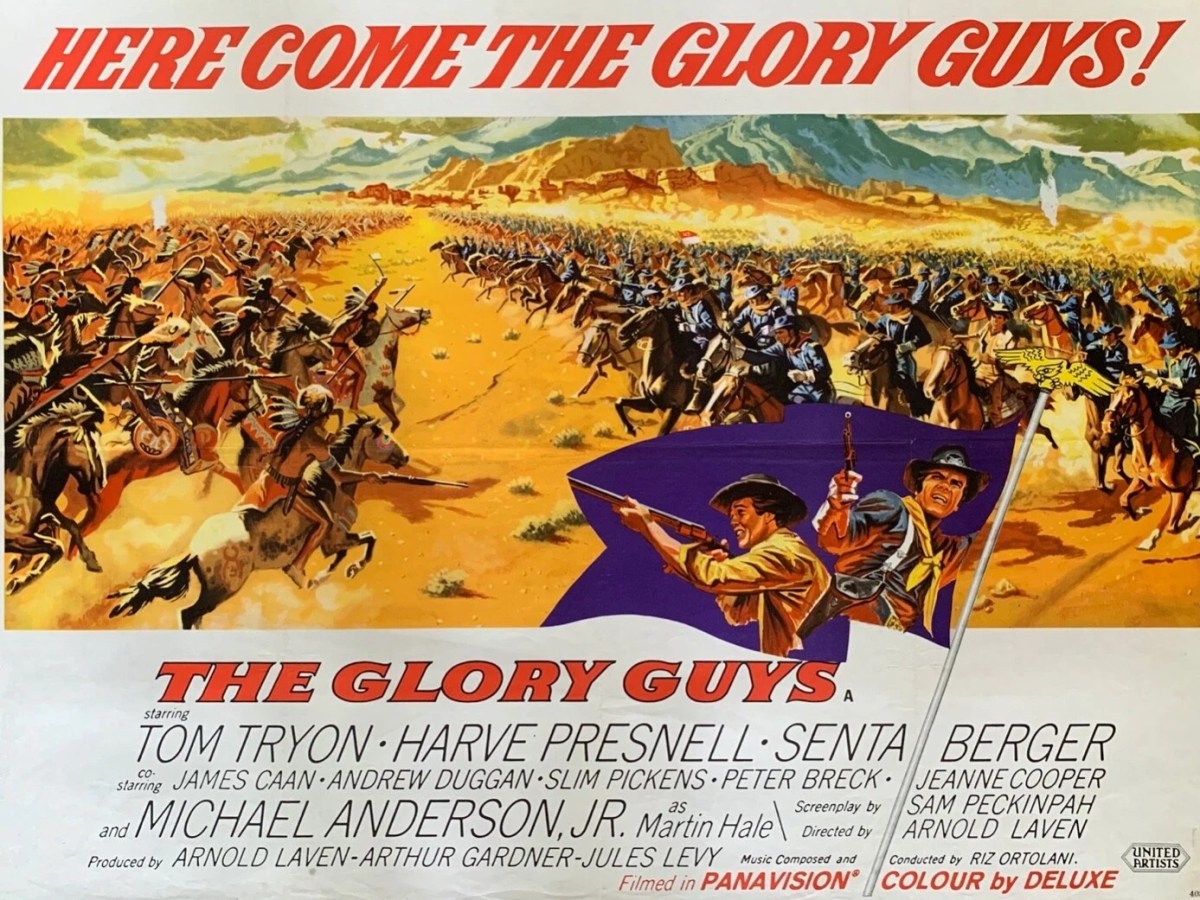
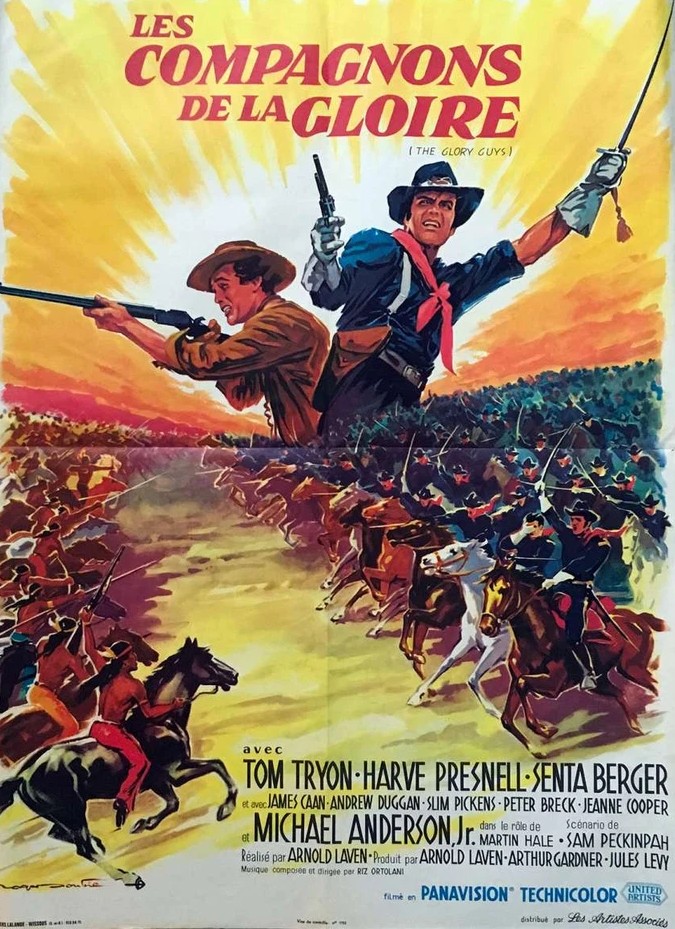
The dismissive verdict of Sam Peckinpah (he wrote the script) is the main reason this remains unfairly underrated. This came out the same year as that director’s over-rated Major Dundee and covers some of the same themes – the training of raw recruits and the woman requiring a protector.
But this is the first cavalry picture I’ve seen where training covers more than recruits falling off their horses, picking fights with each other and getting drunk and into scrapes. The main task of Capt Harrod (Tom Tryon), apart from teaching them to shoot, is to ensure they ride in formation and are ready to take part in action. There’s a brilliant scene where Harrod fakes an Indian attack where they are all in a flash knocked off their horses. And another superb scene where, having achieved an almost impossible goal in double-quick time, Harrod leads them in a ride-past in front of General McCabe (Andrew Duggan) and they ride in about ten rows six abreast, keeping time and distance. When the soldiers dismount during combat, how they arrange for the horses to get out of the way but not run off is also revealed. The scene of the whole detachment leaving the fort is also breathtaking. They are lined up in columns, five or six abreast, and you begin to see, for really the first time, how the U.S. Army operates as a trained unit.
But that’s just the cream of a very finely worked crop. Harrod and McCabe are at odds because the captain’s previous company of raw recruits was virtually wiped out in a previous engagement when the general used them as bait. McCabe is the “glory guy” of the title, everyone else is just trying to keep alive. The only certainty of going into battle, Harrod reminds his men, is that they have a fair chance of not returning home.
Widow Lou Woddard (Senta Berger) pops up to wreak romantic havoc. She owns a gunsmith business, and responsible for driving up sales, so not quite the vulnerable woman. What’s most at stake is her standing in town, her honor if you like, and she can’t be seen to be playing the field. While hardly promiscuous, she has two men on the go, Harrod, who seems disinclined to take the romance beyond a fling, and Army scout Sol Rogers (Harve Pressnell) who is off earning the chunk of money it will take for them to settle down elsewhere.
She doesn’t let on they are rivals and when they discover this it triggers an all-out slugging match – you almost wince with the power of the blows. This ain’t a brawl but a last man standing punch-up where literally they trade blows, one at a time. And she keeps dithering between the two. She reckons Sol isn’t the settling down kind while Harrod’s not keen on commitment. So any time she’s spurned by Harrod she flaunts Rogers.
If she gets her come-uppance, it’s not from either of the men. Attempting to trade barbs with McCabe’s snippy wife Rachael (Jeanne Cooper) she is publicly humiliated. And there’s a terrific scene as the calvary is set to leave the fort and the physical distance between Lou standing on the sidelines with the wives waving husbands goodbye and Harrod on horseback stretches into an emotional chasm simply from the way director Arnold Laven lines up his camera.
The action is clearly based on the Battle of the Little Big Horn. McCabe, instructed to form one half of a pincer movement, races his men ahead to beat his rival general into battle. True to form, he uses Harrod’s men as decoys, theoretically sent out to protect his flank, in reality to draw out the enemy, permitting the general to attack their unguarded rear.
The battle scene is just superb, hordes of cavalry charging towards the enemy, then turning tail when facing superior forces, dismounting to take up positions, then retreating again to the rocks, pursued but managing, mostly, to survive. The scene where Harrod comes across McCabe’s wiped-out army is like the beginning of Zulu (1964). (In fact, it’s worth bearing in mind that Little Big Horn and Isandlwana took place just three years apart and had there been instant global communication in those days the combined events would have sent shockwaves throughout the world.)
It is an excellent script regardless of how Peckinpah felt about the outcome. But it is also a very good western with sufficient changes rendered to the genre’s standard tropes. The compulsory saloon brawl is elevated by an ongoing comic element of Trooper Dugan (James Caan) being constantly defeated in his determination to smash a bottle over someone’s head.
Senta Berger completists should enjoy this far more than her performance in Major Dundee. She essays a more complete realistic character, not quite grasping, but not far short, and in chasing a dream coming close to heartbreak. Tom Tryon (The Cardinal, 1963) is better than I expected and hoofer Harve Pressnell (Paint Your Wagon, 1969) is a revelation. James Caan (El Dorado, 1967), playing a “miserable whining sugar”, is awful, a terrible Irish accent sinking all his attempts at scene stealing
Arnold Laven might have felt hard-done-by in regard to Peckinpah, given the director, in his capacity as producer, had dreamed up The Rifleman television series on which Peckinpah made his name. While this isn’t quite in the same league as Rough Night in Jericho (1967) but better than Sam Whiskey (1969) it deserves reappraisal. Had it featured bigger stars in the two male principal roles it would have attracted more attention at the outset instead of demanding it now.
A three-hour western epic directed by Stanley Kubrick (2001: A Space Odyssey, 1968), written by Sam Peckinpah (The Wild Bunch, 1969) and The Twilight Zone’s Rod Serling and starring Spencer Tracy (Judgement at Nuremberg, 1961) and Marlon Brando. What’s not to like? That all of these major players, with the exception of Brando, had nothing to do with the final product was par for the course for a movie that didn’t reach cinema screens until two years after shooting was completed.
Marlon Brando was riding high when the project was first mooted in 1956. The box office and critical sensation of the 1950s, four Oscar nominations in successive years, winner for On the Waterfront (1954), his price was rising by the minute. And he had ambitions to take control of his career, set up his own production shingle, a trend that was beginning to gather pace.
He established Pennebaker (named after his mother) Productions in 1957 with ex-marketeer Walter Seltzer, producer of 711 Ocean Drive (1950), and George Glass, a former partner in Stanley Kramer’s independent production company. Paramount agreed to back the company. A western, A Burst of Vermilion, was intended as the company’s first offering. Soon there were five movies on the schedule including The Authentic Death of Hendry Jones by Charles Neider.
Brando had paid $150,000 for the rights to the book and a script by Sam Peckinpah. The original title was changed to Guns Up. It was going to mark the debut of the new Pennebaker outfit ahead of other projected movies like Shake Hands with the Devil to star James Cagney and Anthony Perkins (he didn’t make it to the final cast), The Raging Man and Ride, Comancheros (no relation to The Comancheros, 1961) and C’Est La Vie to be filmed in Paris.
Paramount paid through the nose, committing to an unprecedented deal. The studio would fund the entire cost of Guns Up and as well as $150,000 upfront Brando would receive 100 per cent of the profits, Paramount relying on its 27% of the gross as a distribution fee to turn a profit. Stanley Kubrick, riding high after Paths of Glory (1957), was hired to direct. While the studio preferred Spencer Tracy as co-star, Brando wanted old buddy Karl Malden who had co-starred with Brando in A Streetcar Named Desire (1951) and On the Waterfront, winning an Oscar for the former and a nomination for the latter.
And in part to reflect the Asian community in Monterey, location of the main section of the film, he also wanted current squeeze France Nuyen (A Girl Named Tamiko, 1962) to play his lover in the film, but Kubrick was aghast and instead cast Mexican debutante Pina Pellicer (Rogelia, 1962). There were roles for Katy Jurado (Barabbas, 1962) and recognizable western types like Ben Johnson (The Undefeated, 1969), Slim Pickens (Firecreek, 1968) and Elisha Cook Jr (The Great Bank Robbery, 1969).
Shooting was set for June 1958, then it shifted to September and then November. To Brando’s shock, Kubrick pulled out two weeks before production was due to begin, citing pre-production on Lolita (which, ironically, didn’t go ahead for a couple of years). To salvage the situation, Brando decided to direct. He wasn’t the first actor to go down this route, especially if you count Charlie Chaplin, Buster Keaton and Orson Welles as actors first and foremost. Laurence Olivier helmed Henry V (1944) and three others, Jose Ferrer The Cockleshell Heroes (1955), hoofer Gene Kelly Singin’ in the Rain (1951) and Charles Laughton Night of the Hunter, 1955. So he was in good company.
Cameras turned on December 2, 1958. It was an auspicious era for westerns, a total of 41 had appeared that year. Although budgeted for three months, it took six months to shoot in locations like Sonora in Mexico and Monterey in California (where the film was set) as well as Pfeiffer Beach on the Big Sur and the Warner Ranch.
Although prior to shooting commencing the title had changed to One-Eyed Jacks, scoring and editing were well in hand and Paramount announced it as one of its 17 pictures set for 1959 release. In the end Shake Hands with the Devil beat it to the punch as Pennebaker’s initial release, in 1959. But it didn’t favor so well, skipping the more lucrative but riskier Broadway first run in favour of hitting the circuits.
Meanwhile, Brando was angling for a three-hour running time. The budget kept increasing. The original $2m budget had doubled. Eventually, Paramount acknowledged it had cost $5 million though other estimates put it closer to $6 million.
Part of the problem in readying it for release was Brando’s other commitments. He was still a working actor and could hardly resist the offer of a record-setting one million bucks to star in The Fugitive Kind (1960). Even so, the bigger problem was not time, but experience and a first-time director being unable to make up his mind, having shot a colossal amount of footage and having tremendous difficulty trimming it down to workable length. Paramount still had it on the release agenda in 1960. It was going to be a “special release,” which most people took, especially given the running time, to be roadshow.
But by December 1960, the studio had waited long enough and just before Xmas the studio took over the editing and after editing out around 40 minutes from Brando’s three hour cut, Paramount scheduled it for a world premiere in New York in March 20, 1961, in a kind of semi-roadshow – moviegoers could buy in advance but the tickets did not come with reserved seats, which was the whole point of roadshow. Nor were prices hiked, which was gave roadshow its prestige.
Already deemed “Brando’s Folly” and coming in the wake of The Alamo (1960), the John Wayne-directed epic which had flopped in roadshow, commercial hopes were not high. In part, because production had been so long ago it had skipped under the journalistic radar which was concentrating on skewering The Alamo and the equally troubled The Misfits (1961). So it didn’t come trailing disaster. Still, it seemed more likely, audiences would not take to the odd tale which didn’t fit so easily into the western genre. Plus Brando’s previous effort The Fugitive Kind had been his first outright flop.
Turned out, though, Brando still was a major attraction. It snaffled a “huge” $81,000 in its opener at the 4,820-seat Capitol in New York. There was a “smasheroo” $21,000 in Detroit, a “big” $14,000 in Buffalo, a “hotsy” $15,000 in Cincinnati. “Giant” was the preferred adjective, covering $60,000 in Chicago, $32,000 in Philadelphia and $15,000 in Boston.
Rentals (what studios make after cinemas have taken their share of the gross) amounted to a very decent $4.3 million, enough to rank seventeenth for the year. And whereas those figures were considered decent enough, it did “substantially better abroad.”
So, more than likely, against all the self-destructive odds, it earned a profit.
SOURCES: Stefan Kanfer, Somebody, The Reckless Life and Remarkable Career of MarlonBrando (Faber & Faber, 2008); “Glass, Seltzer in Brando Co Berths,” Variety, April 17, 1957, p22; “Chatter, Hollywood,” Variety, May 22, 1957, p62; “Marlon Brando Guns Up for Paramount,” Variety, April 30, 1958, p22; “Chatter, Paris,” Variety, July 30, 1958, p126; “Brando Gets 100% of Film Profit!”, Variety, August 6, 1958, p1; “Briefs from Lots,” Variety, September 24, 1958, p15; “Marlon Brando’s Own,” Variety, November 26, 1958, p5; “Shake Hands First with Circuits,” Variety, May 6, 1959, p4; “Brando’s Ugly American,” Variety, July 1, 1959, p3; “Par 17 Pix Set for Release,” Variety, July 15, 1959, p5; “Par Division Eyes Upcoming Product,” Variety, November 25, 1959, p22; “Doubt or Delay re Brando’s Jacks,” Variety, August 10, 1960, p3; “Brando Jacks Editing,” Variety, December 21, 1960, p7; Advert, Variety, January 6, 1960, p32; Box Office Figures, Variety, April 5-Jul 24, 1961; “Hoss Operas in O’Seas Gallop,” Variety, August 23, 1961, p16; “1961 Rentals and Potential,” Variety, January 10, 1962, p13.
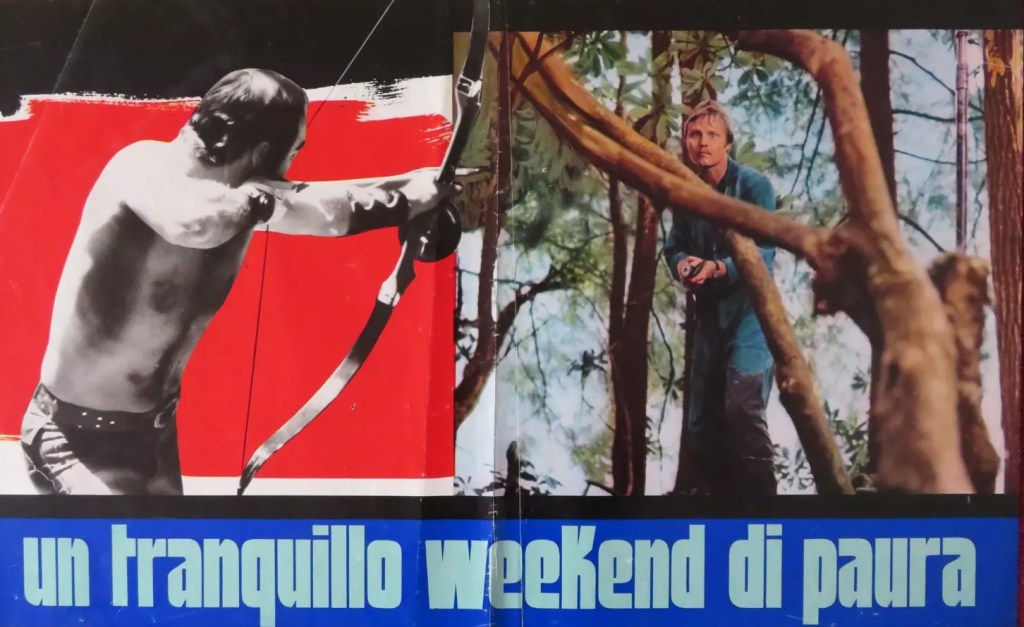
You couldn’t make it like that now, so the ill-informed tale goes. Actors doing their own paddling in canoes, climbing a cliff. But anyone who has watched Leonard DiCaprio and Kate Winslet half-drowning in Titanic (1997) is well aware that it’s just not always possible to use a stand-in for key sequences. Or, for that matter, William Holden breaking in a horse in Wild Rovers (1971).
For a start, there actually were four stunt men on Deliverance, one who was star Jon Voigt’s stunt double. None were credited in the picture, not so unusual in those days, and anyone who knows anything about filming climbing scenes, not least the one where actors are actually crawling across a floor, or where there are, out of sight of cameras, safety facilities underneath, will know that the actors here, though it might get a tad tough, were not risking life and limb. Greater injuries were endured by the stars during the storm scenes of The Guns of Navarone (1961). That said, the movie does benefit from sufficient shots of the actors braving the waters and Ned Beatty nearly drowned and Burt Reynolds cracked his tailbone.
But, of course, danger in moviemaking is relative. There’s scarcely any equivalent to the numbers of deaths that occur in other professions, mining, for example, or industry, and I’m always suprised how easily the Hollywood PR machine is so easily accepted by the public when the peril mentioned is rarely actually perilous at all.
For the scene where the canoe broke, director John Boorman had found a more serene location on a river which was dammed, so he was able to close the sluice gates and lay a rail on the river bed. However, in the event, the sluice gates were opened too soon and the actors engulfed in an avalanche of water.
Should any of the actors show temerity, Boorman would leap into a canoe himself, and paddle downriver over and around various obstacles to show how easy it was.
Deliverance was an unexpected bestseller in 1970, the author an unlikely candidate to hit the commercial jackpot or even to pen such a tale. Ex-adman James Dickey was known for his poetry. Warner Bros bought the book pre-publication about “four decent fellows killing to survive” for $200,000 and more for Dickey to pen the screenplay without working out how it could be filmed. The studio was going through a major transition. In 1970 only three releases had cleared $1 million in rentals; in 1971 the number tripled and the studio was high on a release slate that included Death in Venice, A Clockwork Orange, Summer of ’42, Klute, The Devils, Dirty Harry and Billy Jack.
The studio alighted on John Boorman because he had made Hell in the Pacific (1968) starring Lee Marvin and Toshiro Mifune, that, while a certified flop, was made under arduous physical conditions in the western Pacific.
After the surprise success of Point Blank, British director Boorman had helmed two flops, Leo the Last (1970) being the other, so he was in the market for the kind of hard-nosed project with which he had made his name. Warner “felt I was the man to take it on,” explained Boorman.
At one point, Warner Brothers planned to team up Jack Nicholson (hot after Easy Rider, 1969, and Carnal Knowledge, 1971) and Marlon Brando, still largely in the pre-The Godfather wilderness. The studio tried to tempt Charlton Heston, who turned it down (“I probably won’t have time to do it”) but consoled himself that WB considered him “employable.” Donald Sutherland also gave it a pass. Dickey agitated for Sam Peckinpah to direct and Gene Hackman to star while Boorman was keen to work a third time with Lee Marvin. Theoretically, Robert Redford, Henry Fonda, George C. Scott and Warren Beatty were considered, but such big names would hardly be compatible with the lean budget.
The final budget was a mere $2 million, not sufficient to attract big name – or even to pay for a score. WB had reservations about a picture without any women in lead roles. Jon Voigt was not a proven marquee name, despite the success of Midnight Cowboy (1969). He only had a bit part in Catch 22 (1970) and his other films, Out of It (1969) and The Revolutionary (1970) had performed dismally while The All-American Boy was sitting on the WB shelf, only winning a release to cash in on Deliverance.
Despite a less than buoyant career, Voigt was reluctant to commit. He resisted making the movie till the last minute. Even after trying to convince himself about the film’s worth by reading out the entire screenplay to his girlfriend Marcheline Bertrand (Angelina Jolie’s mother), it took a telephone call from the director and Boorman demanding a decision before he counted to ten before Voigt signed up. Voigt viewed the film as about how men “lose part of their manhood by hiding, coddling themselves into thinking we’re safe.”
Burt Reynolds was treading water in action B-films like Skullduggery (1970), as the second male lead in bigger films like 100 Rifles (1969) and in television (Dan August, 1970-1971). In his favor, he had the lead in offbeat cop picture Fuzz (1972). But it looks like Voigt and Reynolds took casting to the wire. Both were announced for the film a few weeks before it began shooting on May 17, 1971.
Whether it boosted his career is open to question, but Burt Reynolds’ name achieve notoriety in April 1972, a few months before Deliverance opened, by becoming the first male centerspread in Cosmopolitan. Billy Redden, as the banjo player, was hired for his physical appearance, clever use of the camera disguising the fact that there was a genuine banjo player concealed behind him doing all the playing. Boorman used snatches of the banjo music instead of coughing up for a proper score. While the credits claimed the “Dueling Banjos” number had been devised by Eric Weissberg and Steve Mandel, Arthur Smith, writer of “Feudin’ Banjos” in 1955, took the studio to court and won a landmark copyright ruling. The tune had received a gold record for sales.
Setting aside any inherent danger in the water, the shore could just be as perilous. A script altercation between Dickey and Boorman ended with the director losing four teeth. Cinematographer Vilmos Zsigmond got into a spat with his union and was slapped on the wrists for operating the camera too often. Filming of the rape scene was uncomfortable for all concerned, even observers. When Reynolds complained the director let the sequence last too long, Boorman countered that he let it run till he reckoned Reynolds, in his character, would intervene.
Despite WB including it in a promotion to its international partners in May 1971 Deliverance, filmed between May 17 – a week later than originally envisaged – and August 1971, sat on the shelf for nearly a year before being premiered at the Atlanta Film Festival in July 1972 with Playboy picking up the tab for flying Reynolds to the event.
These days it would be called a platform release. Deliverance opened in one small house in New York – the 558-seat Loews Tower East – at the end of July and except for Los Angeles didn’t go any wider until early October. Reviews were good, four faves out of five in New York. But it was the box office that caught the eye. An opening day record and an eye-popping $45,000 for the first week took the industry by surprise. It remained at Loews until December. Chicago led the applause in October with a “brawny” $49,000. Everywhere it was hot – “lusty” $26,000 in Washington DC, “socko” $21,000 in Philadelphia were typical examples of the public response.
In what these days would be called counter-programming it went into the New York showcases at Xmas – making off with a huge $589,000 from 46 the first week and $500,000 the second. WB had predicted it might hit $15 million in rentals. The studio was wrong. It scrambled up $21 million. The 1973 tally made it the second best at the box office that year.
SOURCES: Phil Hoad, “How We Made Deliverance,” The Guardian, May 29, 2017; Oliver Lyttleton, “5 Things You Might Not Know about Deliverance, Released 40 Years Ago,” IndieWire, July 30, 2012; Charlton Heston, The Actor’s Life (Penguin, 1980); “Bow and Arrow Party,” Variety, May 20, 1970, p30; “Dickey Ga-Bound,” Variety, January 21, 1971, p4; “Reps of 45 Flags,” Variety, April 14, 1971, p5; “Voigt in Deliverance,” Variety, May 12, 1971, p14; “Runaway Robert Altman,” Variety, December 15, 1971, p4; Advert, Variety, August 9, 1972, p23; “Big Rental Films of 1972,” Variety, Janaury 3, 1973, p7; “Big Rental Films of 1973,” Variety, January 9, 1974, p19. Box office figures from Variety October 11, 1972.
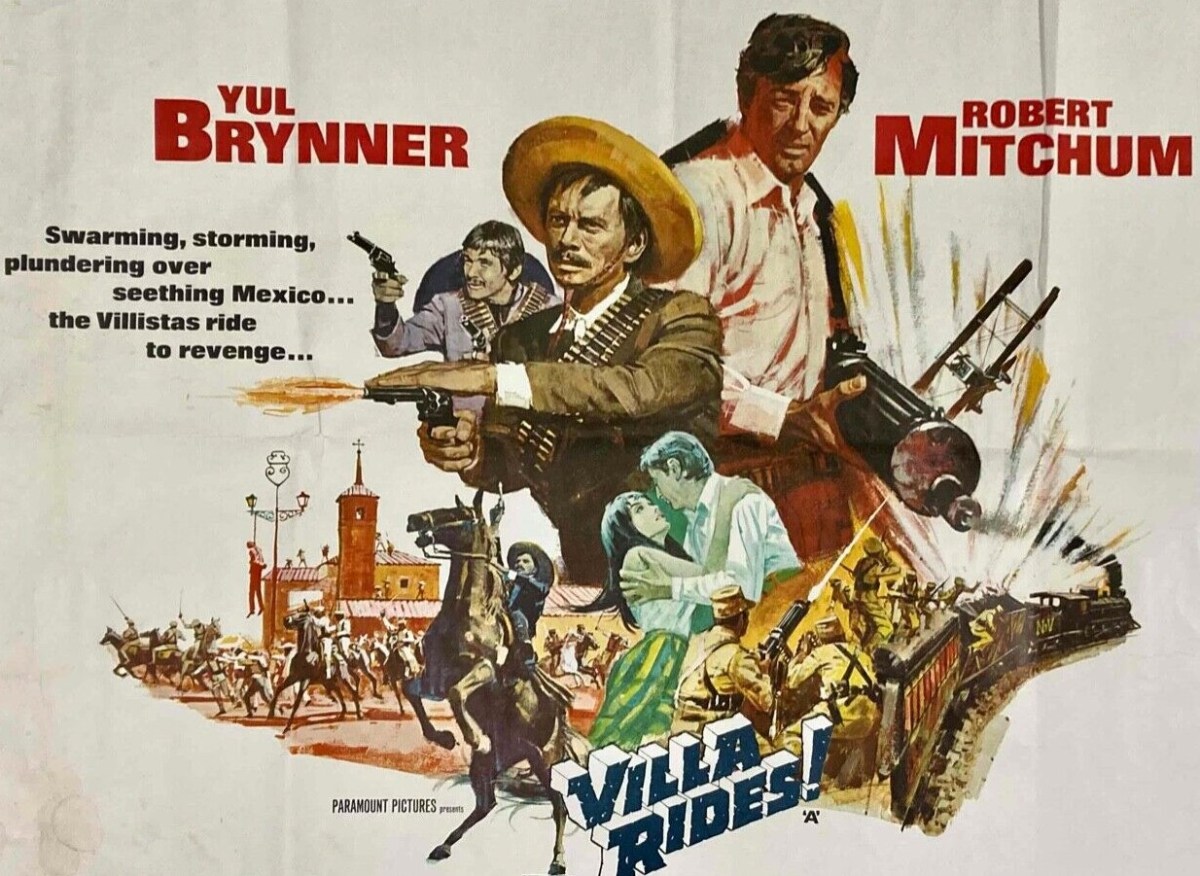
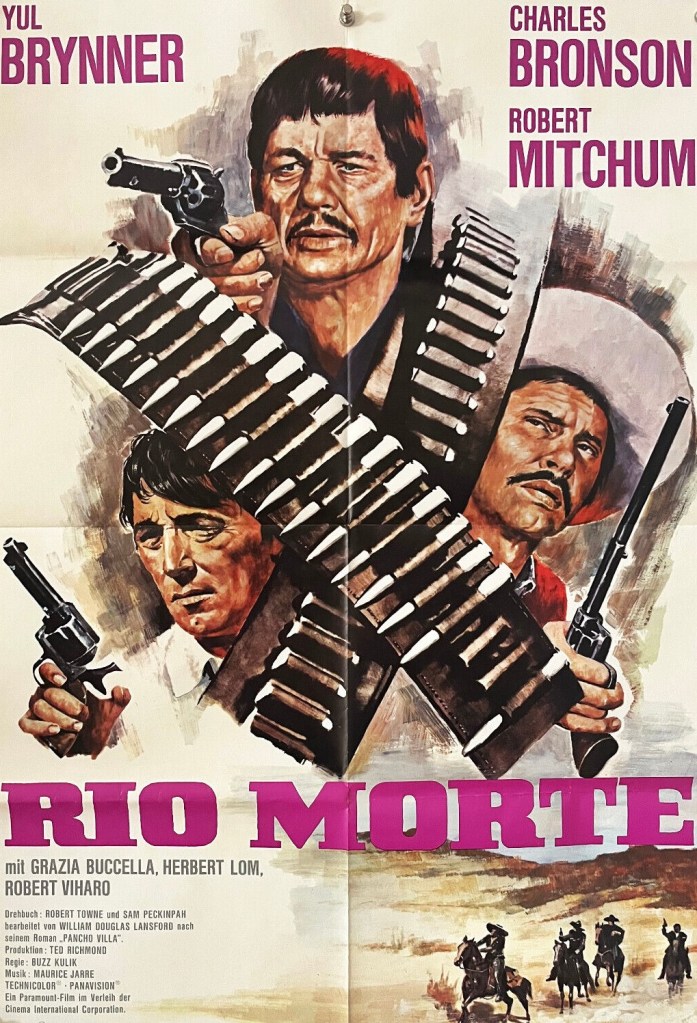
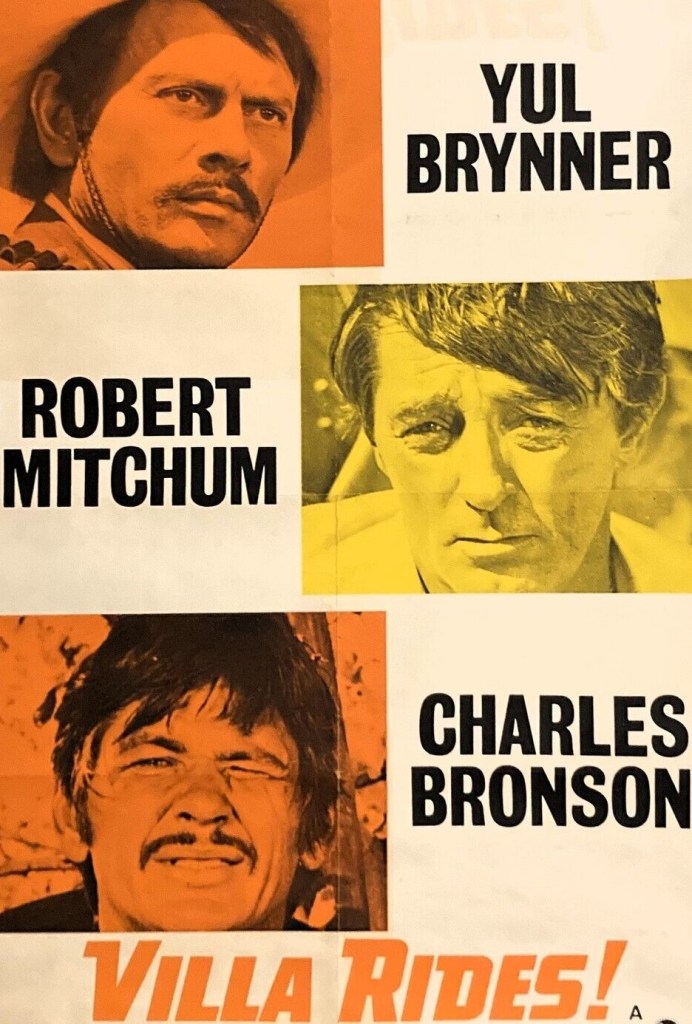
Best viewed as Charles Bronson’s breakout movie. Yes, he had played supporting roles in The Magnificent Seven, The Great Escape and The Dirty Dozen, but these had all been versions of the same dour, almost monosyllabic, persona. Here, though somewhat ruthless, he steals the show from the top-billed Robert Mitchum and Yul Brynner with many of the best lines and best situations with an extra slice of humor (make that first-ever slice of humor) to add to the mix. He is the most interesting of the three main characters, in part because he does not have to spout any of the “good revolution/bad revolution” dialog that falls to the other two.
Villa (Brynner) is fighting the Colorados but his superior General Huertas (Herbert Lom) is planning to overthrow President Madero (Alexander Knox). Mitchum is an aeronautical gun-runner from El Paso, initially against the revolutionaries, stranded in Mexico when his plane breaks down. He has just about time to romance a local woman Fina (Maria Grazia Buccello) before the Colorados arrive, take over the village, start hanging the leaders and raping Fina. Villa saves them, Bronson slaughtering the Colorados with a Gatling gun on the rooftop. Faced with the one-man firing squad that is Bronson, Mitchum turns sides. His plane comes in handy for scouting the enemy, then bombing them.
The actions sequences are terrific especially Villa’s attack on a troop train. To get Villa out of the way, Huertas puts him in the front line in a suicidal attack on a heavily-defended stronghold which turns into another brilliant set-piece with cavalry charges. The plot is constantly interrupted by politics of one kind or another and comes to dead stop when Villa is arrested by Heurtas and Villa demands a proper trial. It’s kind of hard to take when a murdering bandit, no matter how legendary, decides that he has been hard done by.
That aside, there are interesting attempts to build up his legend. He doesn’t want power for himself, but to give it to the people, although he has sat back and let the first village be attacked so that the people there learn to hate the Colorados enough to join the fight. There’s not really any good guys – Brynner and Bronson are stone-cold killers, Mitchum a mercenary. But Brynner does marry Fina in order to prove that a raped woman should not be treated with dishonor, though he has a tendency to marry other women as well.
Bronson’s unusual one-man firing squad involves him laying on the ground with a pistol in each hand and giving prisoners the opportunity to escape before he shoots them. After all that hard work, he bathes his hands. Then he decides he can kill three men with one bullet, lining them up exactly so he can drill them all in the heart. But he’s also the one who shoots a molester in a cantina, then delivers the classic line: “Go outside and die, where are your manners?” He is at the heart of some well-judged comedy – continually sending back his meals and trying to get out of getting into a plane with Mitchum. Without him, there would be too much justification of slaughter (Brynner) and arguments against (Mitchum). This is the first time in the kind of action role that suits him that he has an expanded characterization.
Brynner did not like Sam Peckinpah’s original script so Robert Towne (Chinatown) was brought in to present Villa in a more appealing light. Bronson (Adieu L’Ami/Farewell Friend, 1968) shows hints of the screen persona that would so appeal to the French. Yul Brynner (The Double Man, 1967) adorns his character with many shades of grey, but Robert Mitchum (Secret Ceremony, 1969) has less to do. Buzz Kulik (Warning Shot, 19660 has great fun with the action, less fun with some of the turgid dialog-ridden scenes.
There was enough controversy surrounding the launch of this picture without even invoking the behavior of director Sam Peckinpah. For a start its production heralded a revolution in exhibition. Cinema owners were intent on breaking the industry’s one sacrosanct law.
Since 1948 and the Paramount Decree which forced studios to shed their cinemas, it had been forbidden for a studio to operate as an exibitor and vice-versa. But the financial tsumani that hit the business at the end of the 1950s resulted in a shortfall of new releases and left exhibitors scratching around for product.
Taking the view that the situation was so dire that studios could not resolve it and imagining that the government would not look unkindly on the idea, exhibitors set up a company called Motion Pictures Investment Inc. Initially, the outfit was not so confrontational. The plan was simply to repackage old movies and send them out as reissues. There was no law against that since the exhibitors were not acting as production companies.
It was ambitious scheme, calling in 1958 for $25 million to be raised to fund a whole stream of old movies, sending them into reissue achieving the double aim of filling release gaps and preventing them from falling into the maw of television – Twentieth Century Fox in the process of selling 50 pictures dating from 1950-1955 to television for $10 million.
The Actors’ Strike of 1960 halved production, making a dire situation intolerable. MPI bought the rights to Gary Cooper western Friendly Persuasion (1957) and put together a hefty marketing campaign to get that picture back on the market. Recognising that studios were likely to prevent their gems from being reissued when they could be sold so easily to television, MPI bit the bullet and moved into production. Pathe-America was the vehicle, “a production-distribution-exhibition project predicated on the theory that exhibitors can sense better than anybody what the pubic want on the screens.”
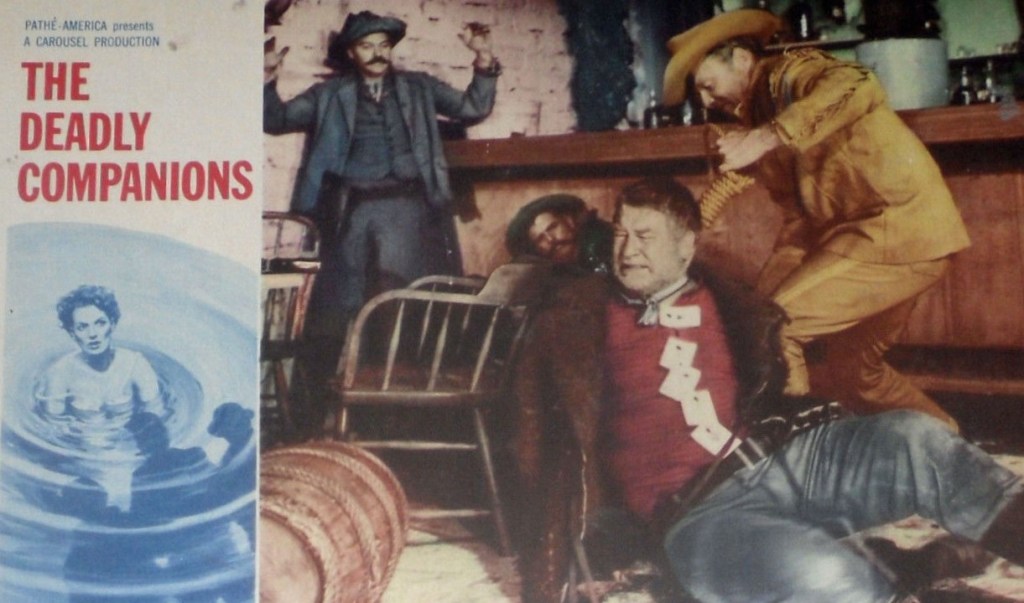
First film on the agenda – The Deadly Companions.
The driving force behind that picture was a female star intent on a bit of revolution of her own – Maureen O’Hara. The flame-haired actress – a star for over two decades, as comfortable in westerns like Rio Grande (1950) as dramas (The Quiet Man, 1952) and swashbucklers (The Spanish Main, 1945) had decided her career was in need of a rejig. Demand for her services was slowing down – only four movies in the second half of the 1950s compared to 14 in the first half.
In reality, her career was sinking fast and it felt like panic to imagine she could reconfigure herself at this late stage as a singer, signing a contract for an album first with RCA Victor in 1958 and then CBS in 1960 and starring in the Broadway musical Christine in 1960, a flop despite her “good singing voice and assured stage presence.”
But a bigger measure of her fall was that she ended up in television, spurred on initially by her brother, Charles B. Fitzsimons, who thought he could help better manage her career. Initially an actor, he had segued into production via independent producer Edward L. Alperson but without particular distinction.
They set up Tarafilm in 1958 with the aim of co-producing a series Women In the Case with CBS, profits to be evenly split. But that never surfaced and instead she was an actress for hire and at modest fees at that for, even for bigger stars, the small screen did not pay fees comparable with the movies. For the first time in her career a year passed without a single movie. In 1960 only television beckoned – Open Window, The Scarlet Pimpernel, Mrs Miniver and the DuPont Show of the Month. And there was something plaintive when O’Hara, who had espoused the freelance approach to her career, advised young stars to take a studio contracts if offered.
But Fitzsimons was feverishly working behind the scenes, trying to raise money for their Carousel movie production shingle, even going so far as applying to the U.S. Government’s Small Business Loan scheme. Without exhibitors determined to break the law, it’s doubtful they would have sourced the funding for The Deadly Companions. MPI put up nearly half the $390,000 budget for The Deadly Companions after Fitzsimons had commissioned a screenplay from novelist A.S. Fleischman.
Brian Keith was available because the television series The Westerner (1960) that had made him temporarily a star was cancelled after not even lasting a season. He came cheap – a steal even for a low-budget picture – at $30,000. Sam Peckinpah, who had originated The Westerner, was primarily a television writer and director thirsting for an opportunity to make his mark on the big screen. So, also out of work after The Westerner was canned, he came cheap too, earning half Keith’s salary.
Peckinpah later complained about script problems, but that was par for the course with the director; if a movie failed it was someone else’s fault. O’Hara, who had worked with the best including Hitchcock and Ford, and like most top stars knew a fair bit about how and where to point a camera, later complained that Peckinpah was out of his depth. But that, too, was par for the course. Her autobiography Tis Herself was almost a litany of complaints.
The problem for O’Hara was more financial. While Peckinpah was guaranteed payment, she was not. As producer, she would be working for a fraction of her normal fee of $150,000, expecting to make that back – and more – when the movie went into profit. There was no reason to assume it would not make a decent sum, low-budget westerns having a habit of making money.
The movie was filmed on location in Arizona. The picture’s Gila City, where the bank robbery took place, was based on the Tucson of a hundred years before. Seeking authenticity, the set was constructed following artist drawings culled from the early 1860s. Props were also authentic – the doctor’s chair was from the period, the surgical instruments remnants from the era and even the apothecary jars had come from an early pharmacist shop.
Extras were genuine cowboys or Native Americans. Apaches and Papagos were hired as Native Americans. At a casting call at the Ramada Inn, producer Fitzsimons found the genuine cowboy article in the in the lobby “their Stetsons stained by sweat and faded by the sun and most of them wore working jeans and multi-colored shirts that had been washed but not ironed…leathery-faced men…speaking in low voices of how bum the cattle business was from all this drought and how fine it was a man could pick up a few dollars riding with the movie company.” Even the cactus was authentic, the director favoring scenes which featured the giant Sauaro species.
The cave for one scene was also genuine, not a stage set, the result of an earthquake fault, 50-foot high and 40-foot across at the opening, spiralling hundreds of feet into the mountain. The roof, made up of boulders, was particularly precarious as any rumble could send it tumbling to the ground. Only essential crew were permitted for the scene which saw O’Hara firing a shotgun at an Apache. Fearing the sound of detonation might affect the roof, flash powder was used instead of cartridges.
Stunts involved included overturning a stagecoach and falling 35-feet. Stuntman Chuck Hayward nearly died during rehearsal when the horse bolted and the stagecoach struck a tree. He was married to Ellen Hayward, daughter of Joan Blondell and Dick Powell.
Perhaps the most immediately unusual aspect of the movie was the score. Among instruments used by composer Marlin Skiles were a toy trumpet, xylophone, vibraphone, kettle drum and cracked belt.
To help promote the picture the screenplay was novelized and went on to sell half a million copies, though it went out under the title Yellowleg and was not noticeably a movie tie-in.
The movie received good reviews. Box Office, which might be expected to back any exhibitor initiative, deemed it a “well above average western” with “superb performances” and “exacting direction.” Variety, which sided more with studios than exhibitors, nonetheless was mostly positive, except for “lapses and weaknesses” finding it “fairly engrossing” with O’Hara’s performance “one of her best for some time.”
As you might expect, exhibitors, too, got behind the picture. There was double “Gala World Premiere” in Tucson and Phoenix, on June 6 for the former the following night for the latter, attended by the stars. Surprisingly, given it was a target for saturation (i.e. multiple release region-by-region) and a low-budget number, it was shown in some major houses, in Detroit the 5,000-seater Fox, in Pittsburgh the 3,700-seater Stanley, a 3,600-seater in St Louis, in Buffalo the 3,000-eater Lafayette, in Cleveland the 2,739-seater Palace and in Seattle the 2,200-seater Music Hall. But bookings were scattered between June and September 1961.
But giving a movie a helping hand would not necessarily translate into decent box office. Takings were poor – the best result a “good” $15,000 in Detroit. Cleveland produced a “fair” $9,000, St Louis a “fair” $10,000, Pittsburgh a “drab” $8,500, Buffalo a “thin” $5,000 and there was but $2,500 in Seattle. No major first run theaters signed up in Los Angeles or Kansas City, in each location going out in small multiple release, edging a “dim” $8,5000 from three cinemas in the former and a “moderate” $15,000 from three in Kansas City. Nor did first run line up to host it in New York and by the time it reached Portland it was playing on the lower half of a double bill.
In an attempt to recover some of its $60,000 loss, MPI changed the title in 1962 to Trigger Happy, altered the poster to focus on action rather than sex, and programmed it in a double bill with its second production The Checkered Flag. That proved a failure and MPI was wound up.
Buoyed by the unexpected success of The Parent Trap (1961), O’Hara’s career recovered and she was paired with James Stewart in Mr Hobbs Takes a Vacation (1962) and reunited with John Wayne for McLintock (1963). Brian Keith never became a major star but still had a very decent career toplining smaller-budgeted films and in supporting roles. Charles B. Fitzsimons made a success of production, though mainly in television. We all know what happened to Sam Peckinpah.
SOURCES: Brian Hannan, Coming Back to a Theater Near You, A History of Hollywood Reissues 1914-2014 (McFarland, 2016) p117-120; Pressbook, The Deadly Companions; “Maureen O’Hara As Disker,” Variety, May 7, 1958, p59; “Maureen O’Hara Bagged for Series,” Variety, August 27, 1958, p27; “Christine Gives Columbia 3 On Showtime Shelf,” Variety, March 23, 1960, p45; Review, Christine, Variety, May 4, 1960, p56; “Longplay Shorts,” Variety, September 28, 1960, p58; “Family Classics,” Variety, November 2, 1960, p27; “MP Investment Trust Puts Coin into Pathe America Release,” Variety, January 25, 1961, p5; “Pathe America’s First Star: Maureen O’Hara,” Variety, November 9, 1960, p4; “Pathe Companions into Saturation Playoff,” Variety, June 7, 1961, p5; Review, Variety, June 10, 1961, p10; Review, Box Office, Jun 12, 1961, pA11; “Gala World Premiere for Deadly Companions,” Box Office, June 12, 1961, p10; “Don’t Do As I Do,” Variety, August 2, 1961, p4; “Fitzsimons Switches Pitch,” Variety, August 29, 1962, p16; “Motion Pic Investors Draws Criticism for Faltering Achievement,” Variety, December 12, 1962, p3; “Missouri-Made Feature in Second Round,” Variety, June 5, 1963, p18. Box office results: “Picture Grosses,” Variety – June 14 and 28, July 19, August 16 and 23, September 6, 13 and 20.
Bank robbers ride into town. They pass kids playing a vicious game. There’s something unusual on a roof. Innocents are killed in the resulting shootout.
Remind you of anything?
Sam Peckinpah’s debut is best viewed as an early dummy run for The Wild Bunch (1969) but the title could refer to any of his westerns since there is always malevolence afoot among any of his marauders, be they soldiers, lawmen or outlaws.
By the simple device of waiting a year until “The Parent Trap” had charmed audiences everywhere, UK exhibitors were able to launch “The Deadly Companions” on the back of it, as if O’Hara and Keith were re-teaming for the western rather than the other way round. “The Deadly Companions” wasn’t released in Britain until summer 1962, a year after its launch Stateside, and on the lower half of a double bill.
He’s done no favors by a genuine oddity of a script which has to shoehorn in various odd characters around a basic premise of escorting a woman across Indian Territory. And, it has to be said, more than occasionally the film doesn’t make much sense.
Strangers Yellowleg (Brian Keith), better known as The Man With The Hat since he refuses to take it off in case he reveals his scalped head, gunslinger Billy (Steve Cochran) and Turk (Chill Wills), former Confederate deserter, team up to rob a bank after the first two save card cheat Turk from an impromptu hanging.
But they discover they’re not the first to come up with robbing the new bank and in the shootout with the other robbers Yellowleg inadvertently kills the son of single mum and dance hall hostess Kit (Maureen O’Hara). She decides she doesn’t want to bury the boy in a town where she is openly despised but plans to put him to rest beside the grave of her husband in an abandoned village in Apache country.
Pricked by conscience Yellowleg offers assistance. But Billy goes along with the idea because, and there’s no getting round this, he wants to rape her. Turk goes where Billy goes. At first she resists all offers of assistance and manages to fend off the amorous Billy but of course she’s not able to fix broken wagon wheels or catch a runaway horse. Eventually, it’s just her and Yellowleg, though the other two turn up at the end, Billy not having given up on the notion of bedding her.
The Native Americans they encounter, as in The Pistolero of Red River/ The Last Challenge (1967) are mostly drunk and no threat. In fact, civilization is deadlier, Kit even cold-shouldered at church, and with travelling companions like Billy danger is a constant. Kit might have done better not to get herself wet so often, since that involves either a) being nude behind a wagon to dry off or b) splashing around in full view.
Surprisingly, the hat provides a couple of tender moments. But mostly it’s kept on because Turk is the guy who scalped Yellowleg. There’s an odd presumption that, although his facial features can’t have changed, that only removing it will alert Turk to his true identity. Yellowleg wants to scalp Turk in revenge. He’s only just found him after five years looking. So when he occasionally abandons Kit in dangerous Apache territory it’s to make sure his quarry hasn’t gone far.
There are some nice touches here, although the tendency towards gorgeous sunsets seems out of place. The person on the roof is, for unexplained reasons, Kit’s son playing a harmonica. The town has odd priorities. It may have a new bank but the local saloon has to double as the church, various paintings of nudes on the walls covered up for the occasion, the preacher (Strother Martin) happily challenging our trio to remove their hats in the presence of God. Yellowleg has “something wrong with his shooting arm,” a bullet embedded close to his collarbone that having found his prey he doesn’t have time for the convalescence required after an operation. Authenticity impinges – a rig carrying a coffin and two people is a lot more cumbersome than a single horse dragging a sled, body wrapped in cloth.
Maureen O’Hara (The Rare Breed, 1966) in tempestuous mode is the star attraction here. She’s independent, sassy, tender in turn, and able, for the most part, to defend herself against Billy. It seems a tad inconceivable that she would fall for her son’s killer much as, for purely practical reasons, she might accept his protection.
Brian Keith’s character doesn’t quite come off since it takes too long for his quest to be spelled out. Neither do he and O’Hara gell as they would in their next teaming, The Parent Trap (1961) .
Steve Cochran (Mozambique, 1964) is mostly in scene-stealing mode and it would have helped his character if it had been spelled out whether Kit was a mere dance hall hostess or one who gave out extras for a price. Chill Wills (The Alamo, 1960) also seems to be on a different planet when it comes to acting. But it does seem a shame all the boys put so much effort into trying to steal scenes when Maureen O’Hara without doing very much sneaks away with the entire picture. A.S. Fleischman (The Adventures of Bullwhip Griffin, 1967) wrote the screenplay based on his own novel, O’Hara’s brother produced, and, you might as well know, it’s the actress who sings the theme song.
Far from routine western with director Sam Peckinpah, in his sophomore picture, channelling territory that would later become more familiar, old friends turning enemies, the encroachment of civilization, the passing of the Old West, and sharing with The Misfits (1961) incredulity that the once noble occupation of cowboy/lawman has become redundant. In Major Dundee (1965) and The Wild Bunch (1969), the story turns on former friends turned enemies, here that aspect is in its infancy.
Down on his luck former lawman Steve Judd (Joel McCrea), shirt collar frayed, holes in his boots, eyesight not what it was, recruits old pal Gil Westrum (Randolph Scott), reduced to running a western sideshow, to help him escort a load of gold down from the mountains. Gil brings along his younger sidekick Heck Longtree (Ron Starr). Along the way, romance beckons for the ever romantically-inclined Heck when he encounters young Elsa (Mariette Hartley), daughter of Bible-thumping farmer Joshua. When she runs off, intending to marry prospector Billy Hammond (James Drury) at the mining camp, they act as her escort.
Gil turns out not to be the straight-shooter he originally appeared, planning to rob the gold consignment on the way back, with or without Steve’s assistance. The plot takes a wild detour in the mining settlement when Elsa realizes that her marriage will take place in a brothel, her fiancé is a drunk, and that his four brothers reckon they will have equal claim on her sex-wise. Gil arranges for the marriage to be apparently annulled, which doesn’t for a moment fool the Hammond brothers, and the return journey, already splintered by Steve working out what was on Gil’s mind, turns into one ambush after another.
The narrative switch away from the cowboys bewailing their lot, or, in Gil’s case planning payback for a life gone awry, to the plight of the vulnerable woman in the last of the lawless western wildernesses, is a nifty one. But you can’t help seeing Gil’s point, all the gun wounds, gunfights, months in hospitals, jobs lost as a result of confinement, make a man’s mind turn to the notion he has not been correctly reward for his endeavours. And not quite as convinced as Steve that honor makes up for everything.
There is some very lively dialog, great banter as Gil tries to sow sedition in Steve’s ear, Steve with an endless fund of humorous retorts, gently explaining that the hole in his boot is a masterpiece of the shoemaker’s art, a clever method of hidden ventilation, at each point deflecting a wily tongue probing for weakness. Steve is soon revealed as anything but a gunman past his past, or even a bare-knuckled fighter, knocking out cold a disbelieving Heck.
The romance is well done, Heck convinced he has prised Elsa away from her father, only to discover he is not included in her plans, and the isolated virgin unlikely to respond to male ardor. But when the reality of marriage strikes home, a slap in the face required to guarantee compliance, Elsa is extremely lucky not just to find Steve and Gil willing to come to her rescue, but for the less upstanding Gil to take legal matters into his own hand, although you can’t help feeling, in terms of the subsequent mortality rate, this is a hell of a price to pay for a young girl who was not aware of the realities of married life. But, hell, every decent western requires sacrifice.
Peckinpah introduces some excellent twists on more common scenes. A horse race is won by a camel, belly dancers instead of saloon girls, the restaurant bust up in the traditional fistfight is Chinese, Steve assumes the crowds lining the streets to witness the race are extending a hospitable welcome to him, courtesy of his previous exploits. And to Gil’s consternation, the fat pot of gold, literally, diminishes by the minute, the original quarter of a million dollars reduced first to twenty thousand and then a mere eleven, almost hardly worth reneging on a lifetime friendship. Unusually, the lusty young Heck begins to question turning criminal. And the clue to Joshua’s behavior is visual, as we glimpse his wife’s headstone, marked “harlot.”
But when it comes to the showdown you will see an early rehearsal of the famed shootout in The Wild Bunch. But here observation takes the place of action and the steady drip-drip of Gil’s moans serve to highlight a life wasted in community service and Steve’s stoical insistence on law and order, a code that demands good humor in the face of adversity.
This was a splendid last hurrah for Randolph Scott (Western Union, 1941) , well past his Hollywood heyday and now consigned to B-movie westerns, though lucky enough to team up with Budd Boetticher for the seven late-1950s pictures known as the Ranown Cycle, now held in very high esteem. Joel McCrea (Union Pacific, 1939), too, was on the downward Hollywood slide, pretty much restricted to westerns for the whole of the 1950s. This proved to be his final movie of this decade and he only made three more. So, for both, Ride the High Country, was a fitting send-off. Future Wild Bunch alumni Warren Oates and L.Q Jones had small parts.
Ron Starr (G.I. Blues, 1960) and Mariette Hartley (Marnie, 1964) were unlucky that their performances did not reach a wider audience, especially among producers, because they both created multi-faceted characters. Sam Peckinpah was far luckier, Ride the High Country becoming a calling card among foreign critics.
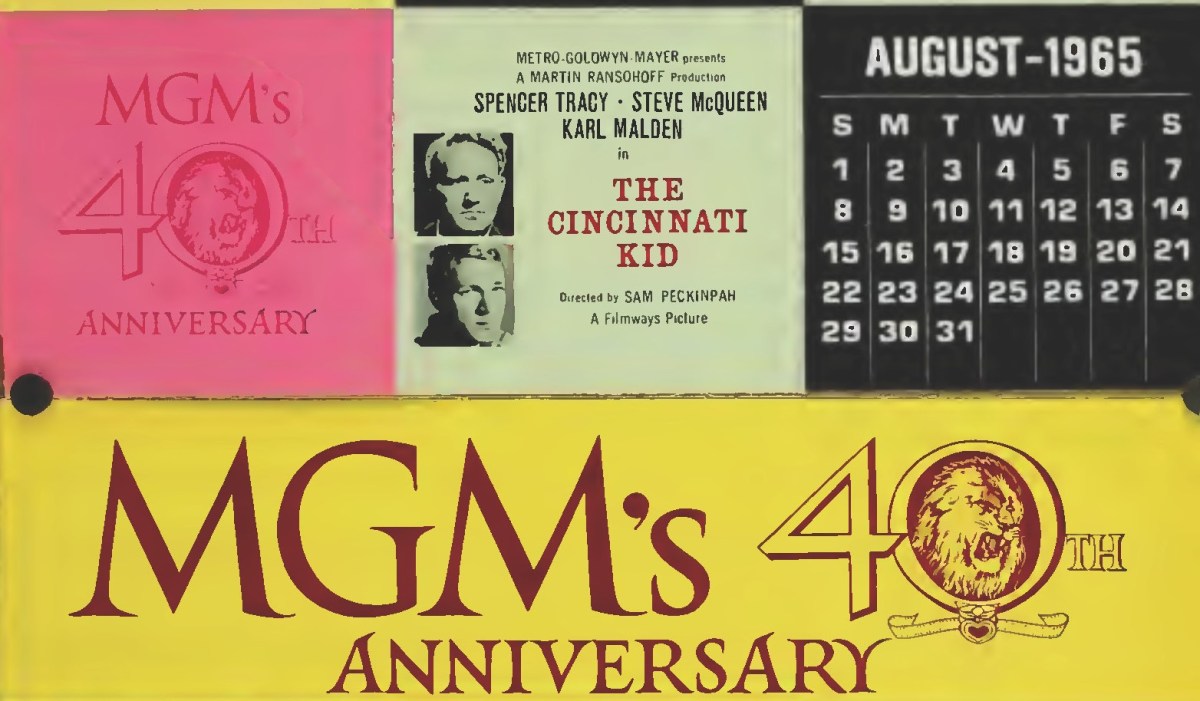
As you can see from the advertisement above, this was originally intended to be quite a different film, directed by Sam Peckinpah and starring Spencer Tracy in the role of ageing poker champ Lancey. The director had just come off one troubled shoot, Major Dundee (1965), and was seeking Hollywood redemption. Two-time Oscar winner Tracy was also hoping to revive his career. Except for what amounted to little more than a extended cameo on It’s A Mad, Mad,, Mad, Mad World (1963) he had not worked since Judgement at Nuremberg (1961). Also initially on board in a small role was Sharon Tate (Valley of the Dolls, 1967)
This was also a big gamble for industry outsider Martin Ransohoff who had moved to the forefront of independent production after The Americanization of Emily (1964) with Julie Andrews and James Garner and The Sandpiper (1965) starring current top-billed royalty Elizabeth Taylor and Richard Burton. He had wheeled and dealed with top studios – MGM, Columbia and United Artists – desperate for quality product. He was planning the biggest movie of his career having purchased the rights to the Alistair MacLean bestseller Ice Station Zebra. Ransohoff was a marketing innovator and long before Robert Evans pumped tens of thousands of Paramount dollars into advertising the book of Love Story (1970) to ensure it rode high on the bestseller charts and thus increased public awareness, Ransohoff had pulled off the same trick for Richard Jessup’s novel The Cincinnati Kid.
Tracy was first to quit, infuriated that he was denied script approval. Essentially, he wanted his role beefed up. But Ransohoff “would not expand his role in any way” and angered at the prospect of playing second fiddle to McQueen the actor walked out, to be replaced by a star with considerably less marquee appeal, Edward G. Robinson.
At least Tracy was able to depart with head held high. Peckinpah was ignominiously fired after shooting had begun. The intemperate director had already locked horns with the producer over a story which had now taken the efforts of four screenwriters – Oscar-winner Paddy Chayefsky (The Americanization of Emily), Oscar-winner Ring Lardner Jr. (Woman of the Year, 1943), Oscar nominee Terry Southern (Dr Strangelove, 1964) and newcomer Charles Eastman (Little Fauss and Big Halsy, 1970) – to knock the book into a workable screenplay without the extra bother of Peckinpah adding his own scenes.
Trade newspaper Variety reported: “Peckinpah’s problems stemmed from his filming of a nude scene that wasn’t in the script but which the director wrote on his own. Last Friday (November 4, 1964) he reportedly excused the featured cast and began to lense the nudie scene using an extra from the cast.” Whether this was indeed Sharon Tate, of whom Peckinpah was reported to have filmed in a flimsy shirt without a bra so that her nipples were showing, is unclear. And although there is an undertone of sex in the actual picture, as delivered by Ann-Margret, it was considerably more discreet.
Strangely enough, Ransohoff was no stranger to the benefits of nudity in his pictures and had fought a losing battle with the all-powerful MPAA, the industry ruling body in matters of censorship, to have nude scenes included in The Americanization of Emily. The nude statue of Elizabeth Taylor in The Sandpiper was permitted, however, and Ransohoff sent hundreds of miniature statues out to influencers as a gift.
Peckinpah did not have final cut so Ransohoff could easily have excised any nude scenes from the finished movie. What was considerably more alarming was that Peckinpah was shooting in black-and-white. Later, Ransohoff would contend that he was outraged by this notion but he surely must have signed off on it at the outset. Whatever the reasons, and some believed fisticuffs were involved, Peckinpah was sacked, leaving a $750,000 hole in the budget.
Production closed for over a month while Ransohoff scrambled for a new director. McQueen was pay-or-play, so if the film was cancelled, the actor was due his entire fee. McQueen had signed on for a fee of $200,000 – or $350,000 depending on who you believe – and $30,000 a week in overtime plus 25 per cent of the profit and a host of extras. McQueen had been initially lined up for a Ranoshoff remake of Boys Town to co-star James Garner, but that proved little more than a publicity flyer.
Replacement Norman Jewison had no reputation for hard-line drama – more at home with light comedy such as Send Me No Flowers (1964) – but was available and more likely to toe the Ransohoff line. However, initially he demurred. It was against the rules of the Directors Guild to step in in such a manner and Jewison required reassurance that Peckinpah was indeed out of the picture, and the film had been shut down, before accepting the job. Theoretically, Jewison received more control of the final cut than Peckinpah. His contract called for him to be in sole charge of the completed picture until after the third public preview. If it wasn’t working by that point, Ransohoff had the right to take over. Jewison exerted control in other ways, denying actors a chance to look at the rushes
Theoretically, McQueen had conceded top billing to Spencer Tracy, but that was not reflected in the artwork MGM put out – the illustration at the top of the Blog appeared in the trade press prior to production. To keep McQueen sweet during the layoff, Ransohoff handed him $25,000 to play the tables in Vegas. Edward G. Robinson had the same worries as Spencer Tracy, fearing his part would be cut to build up the star. In reality, McQueen welcomed going head-to-head with an older star, a situation he had not experienced since The Magnificent Seven (1960) with Yul Brynner.
But if the male stars, under the confident direction of Jewison, gave no trouble, that was not the case with the female contingent. Tuesday Weld came with a heap of personal issues related to becoming, as a child model, the family breadwinner at an early age – nervous breakdown at nine, alcoholic at ten, suicide attempt at twelve. She had never quite achieved stardom, in part as a result of turning down roles like Lolita (1962)
Ann-Margret was the opposite. She could earn nearly as much as McQueen – her fee at some studios was $250,000. However, Twentieth Century Fox was holding her to an earlier four-picture deal which paid a miserly $25,000 per movie, forcing her to lose out on a $150,000 payday in Europe for The 10th Victim (1965) with Marcello Mastroianni – known at the time as The Seventh Victim, Ursula Andress her replacement – in order to take up a contracted role in the remake of Stagecoach (1966). Her over-sexed screen persona had caused playwright William Inge to remove his name from Bus Riley’s Back in Town (1965).
One of the hottest young stars in the business, she intended to stay that way, and her portrayal of Melba in The Cincinnati Kid pretty much fitted in with audience expectation. She was in such demand that she was under contract to make a total of 17 pictures for five separate studios plus Frank Sinatra’s independent production company. Her deals were with Universal (six pictures), Fox (four), MGM (three), Columbia (three) and United Artists (one). But after dropping out of Marriage on the Rocks (1965) with Sinatra her output for the rest of the decade comprised one movie apiece for Paramount, MGM, Fox and Columbia and four independent pictures in Italy.
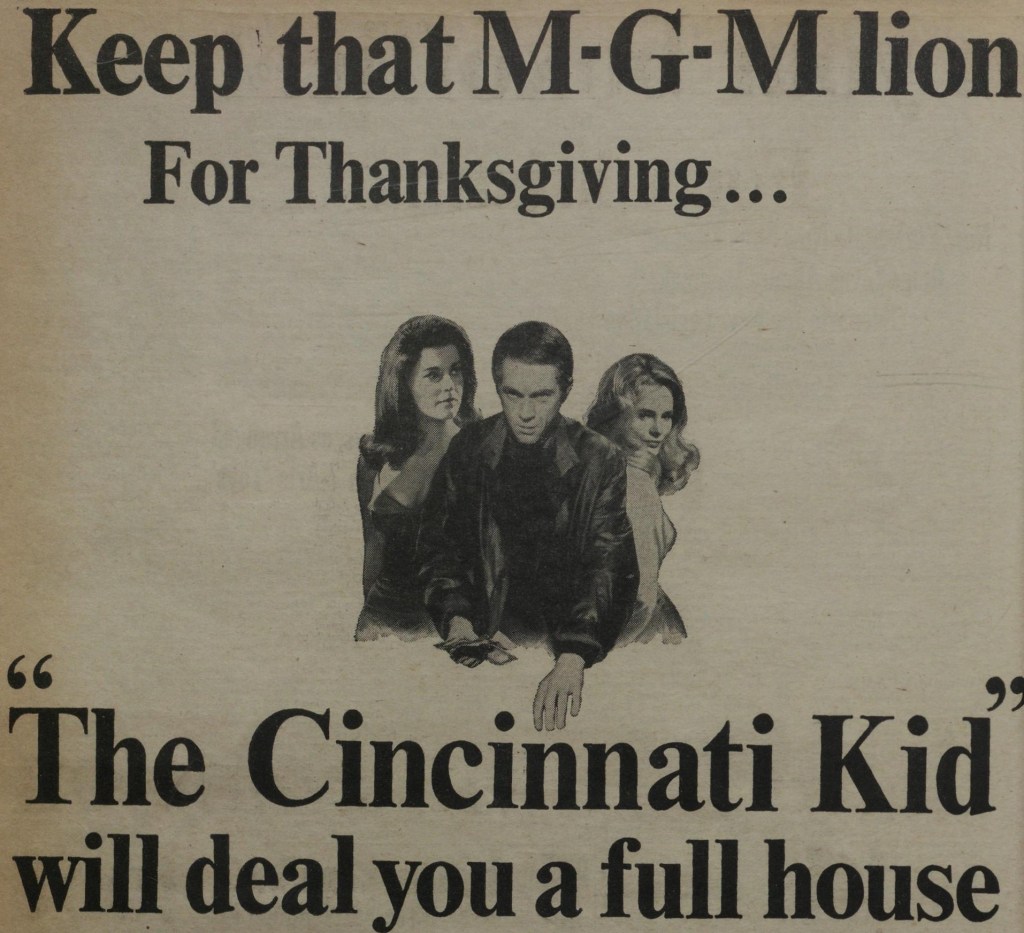
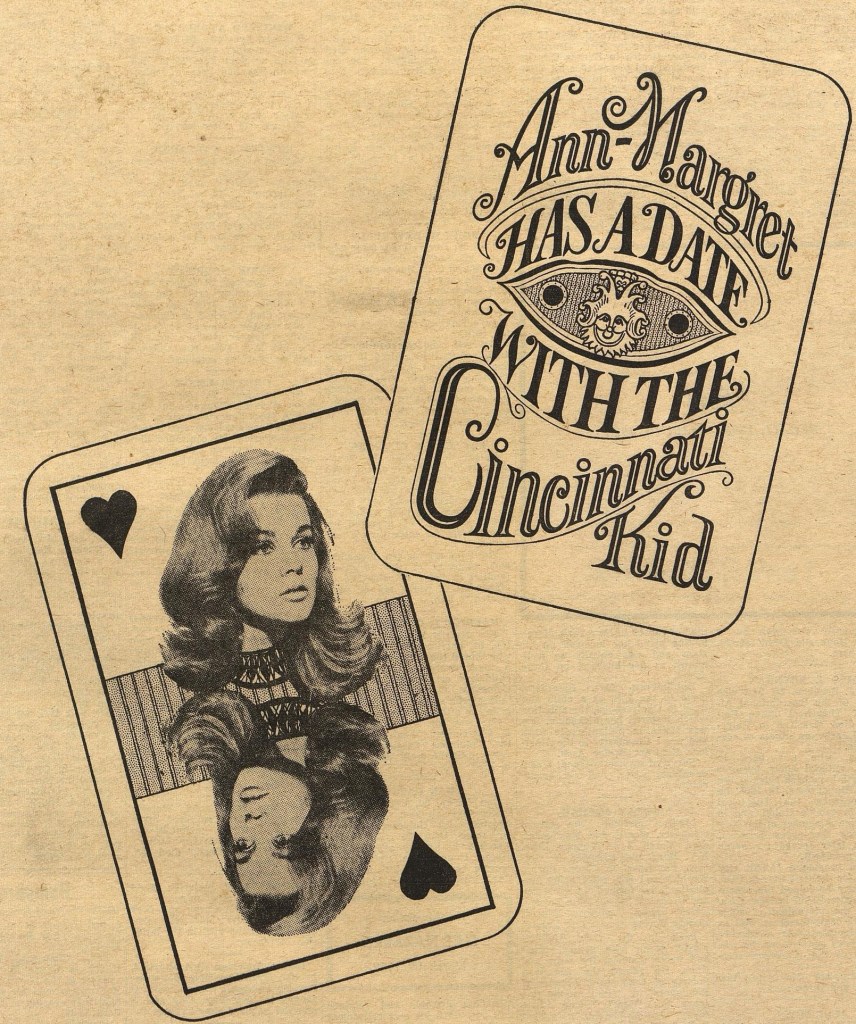
MGM spent big bucks promoting the picture and, in particular, the Ann-Margret connection. The studio had put a marker down on Thanksgiving 1965 for the launch date, but was marketing the movie more than six months ahead, the kind of exposure that was normally only allotted to roadshow features.
SOURCES: Christopher Sandford, McQueen: The Biography, Harper Collins paperback (2002) pages 165, 170-176; Penina Spiegel, Steve McQueen: The Untold Story of a Bad Boy in Hollywood, Collins, 1986, p162, 169-173; “Ransohoff To Start Five Films in 6-Month Period,” Box Office, June 17, 1963, p27; “Marty Ransohoff To Seek Code Changes,” Box Office, November 25, 1963, p6; “Ann-Margret Into The Cash Splash,” Variety, July 22, 1964, p5; advert, Box Office, October 9, 1964, p9; “More Cincinnati Kid Books,” Box Office, October 24, 1964, pW-5; “Refuse Spencer Tracy Xincy Kid Script Okay So Actor Takes Powder,” Variety, November 11, 1964, p24; “Jewison Replacement for Sam Peckinpah,” Variety, December 9, 1964, p24; Advert, Variety, March 10, 1965, p80; “Fear Ann-Margret Going Wrongo In Her Screen Image,” Variety, March 24, 1965, p5; “Fox Holds Ann-Margret To Stagecoach, Denying Her For Mastroianni,” Variety, April 14, 1965, 4; Advert, Variety, May 19, 1965, p20.
Best viewed as Charles Bronson’s breakout movie. Yes, he had played supporting roles in The Magnificent Seven, The Great Escape and The Dirty Dozen, but these had all been versions of the same dour, almost monosyllabic, persona. Here, though somewhat ruthless, he steals the show from the top-billed Robert Mitchum and Yul Brynner with many of the best lines and best situations with an extra slice of humor (make that first-ever slice of humor) to add to the mix. He is the most interesting of the three main characters, in part because he does not have to spout any of the “good revolution/bad revolution” dialog that falls to the other two.
Villa (Brynner) is fighting the Colorados but his superior General Huertas (Herbert Lom) is planning to overthrow President Madero (Alexander Knox). Mitchum is an aeronautical gun-runner from El Paso, initially against the revolutionaries, stranded in Mexico when his plane breaks down. He has just about time to romance a local woman Fina (Maria Grazia Buccello) before the Colorados arrive, take over the village, start hanging the leaders and raping Fina. Villa saves them, Bronson slaughtering the Colorados with a Gatling gun on the rooftop. Faced with the one-man firing squad that is Bronson, Mitchum turns sides. His plane comes in handy for scouting the enemy, then bombing them.
The actions sequences are terrific especially Villa’s attack on a troop train. To get Villa out of the way, Huertas puts him in the front line in a suicidal attack on a heavily-defended stronghold which turns into another brilliant set-piece with cavalry charges. The plot is constantly interrupted by politics of one kind or another and comes to dead stop when Villa is arrested by Heurtas and Villa demands a proper trial. It’s kind of hard to take when a murdering bandit, no matter how legendary, decides that he has been hard done by in the justice department.
That aside, there are interesting attempts to build up his legend. He doesn’t want power for himself, but to give it to the people, although he has sat back and let the first village be attacked so that the people there learn to hate the Colorados enough to join the fight. There’s not really any good guys – Brynner and Bronson are stone-cold killers, Mitchum a mercenary. But Brynner does marry Fina in order to prove that a raped woman should not be treated with dishonor, though he has a tendency to marry other women as well.
Bronson’s unusual one-man firing squad involves him laying on the ground with a pistol in each hand and giving prisoners the opportunity to escape before he shoots them. After all that hard work, he bathes his hands. Then he decides he can kill three men with one bullet, lining them up exactly so he can drill them all in the heart. But he’s also the one who shoots a molester in a cantina, then delivers the classic line: “Go outside and die, where are your manners?” He is at the heart of some well-judged comedy – continually sending back his meals and trying to get out of getting into a plane with Mitchum. Without him, there would be too much justification of slaughter (Brynner) and arguments against (Mitchum). This is the first time in the kind of action role that suits him that he has an expanded characterization.
Brynner did not like Sam Peckinpah’s original script so Robert Towne (Chinatown) was brought in to present Villa in a more appealing light. Jill Ireland (Mrs Bronson) has a small part and you can also spot Fernando Rey.
The links below seem somewhat dodgy but you could try the Talking Pictures channel which is free.
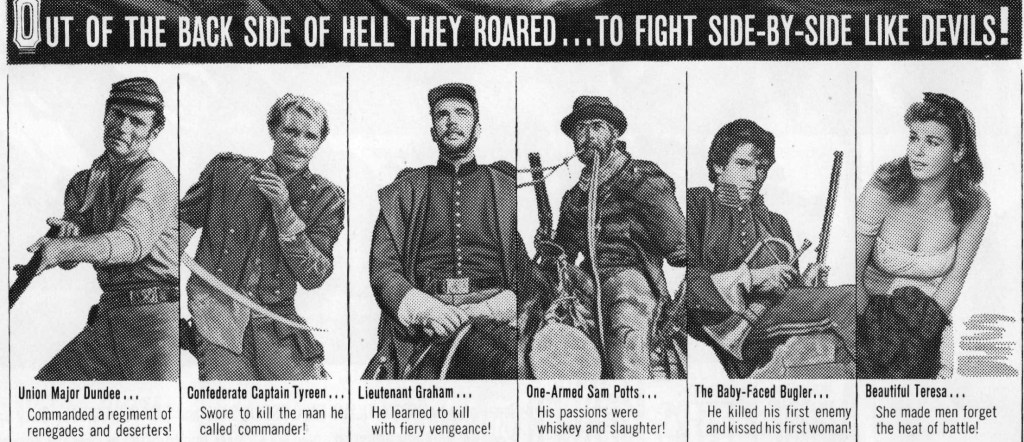
Best viewed as a rehearsal for his classic The Wild Bunch (1969), this Sam Peckinpah western covers much of the same thematic ground – feuding friends, Mexico, betrayal, comradeship, brutality, and a grand gesture climax. But the set-up is more complicated than The Wild Bunch. This time out Unionist Charlton Heston in the titular role and former friend Confederate Richard Harris team up towards the end of the American Civil War to hunt down a band of Apaches. Heston’s prisoner, Harris faces the choice of joining his unit or being shot. Since both lived in the South, Harris sees Heston as a traitor for siding with the North. After the Apaches are destroyed, Harris plans to kill Heston.
If the set-up was as straightforward as that, it would have probably resulted in a better film. But once Heston’s soldiers cross the Rio Grande they also come up against the French. And the timescale of the picture covers a complete campaign from November 1864 to April 1865, barely a month before the end of the Civil War so the pace is sluggish despite being packed with incident. And it struggles with allowing the weight of narration – via the cliched diary – to fall on a young bugler (Michael Anderson Jr.), the only survivor of an Apache attack.
That said, the action sequences are terrific, especially the battle on the Rio Grande itself. Like the best military movies, there are clever maneuvers and deceptions – from both sides. And since the unit comprises not only the quarreling Heston and Harris but warring Unionists and Confederates, freed former slaves and a bunch of criminals in the same league as Robert Ryan’s Wild Bunch gang the tension remains high throughout. Subsidiary characters are given a full story arc – the raw lieutenant (Jim Hutton) making his bones, the bugler losing his virginity. Added to this, Major Dundee is clearly in the last chance saloon, his posting seen as a punishment, and several times his military decisions are, rightly, called into question. His attitude to command is also questionable, minus his uniform in the field and legs on the table while addressing junior officers. And, as with The Wild Bunch, this is no idealized Mexico, but an impoverished, savaged, ravaged country.
There was no romance in Peckinpah’s original take on the story. But the presence of Senta Berger as a widowed Austrian stranded in Mexico brings out the humanity in Heston. Unlike many of her more volatile Latin counterparts, Berger is soft-spoken and gentle. Here, that acts very much as a counterbalance to the pugnacious Heston. She is fearless, effectively acting as the leader of the Mexican village the soldiers initially intend to pillage, persuading them otherwise. She demonstrates considerable intelligence: “The war won’t last forever,” says Heston; “It will for you,” she replies. But, ultimately, she is betrayed by the womanizing Heston.
In the duel between old friends, Harris comes off best in terms of principle. He defuses an ugly racial incident and clearly commands more authority among his men. When difficult action must be taken regarding a deserter again he does not hesitate to act. And he keeps to his word of honoring a flag he despises as long as he is under Heston’s leadership. In some senses, he has the better part since he has to keep normal impulse in check. Many critics considered Heston miscast but that was mostly after the fact when Peckinpah was able to line up a more dissolute William Holden in The Wild Bunch because by that time the actor was already wasted physically from alcoholism. But Major Dundee’s inability to meet his own high standards is exactly the kind of role you want to see a physical specimen like Heston take on.
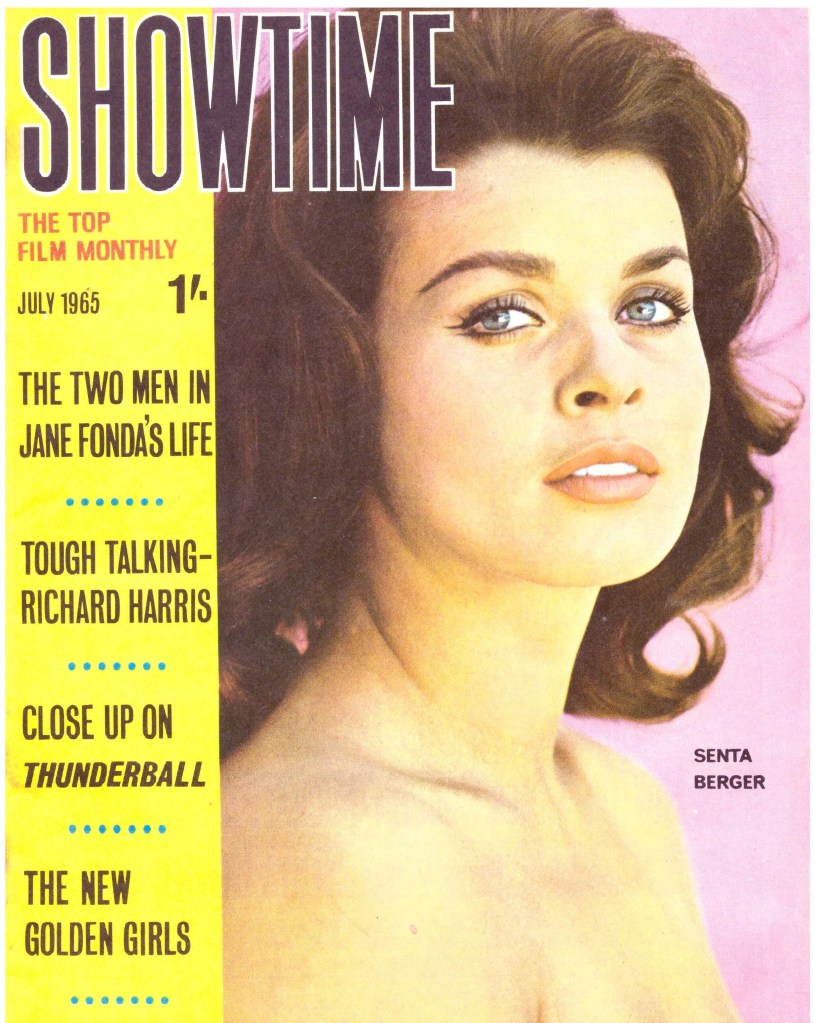
Senta Berger was the cover girl for “Showtime,” the monthly magazine for the Odeon cinema circuit in the U.K. and there was also feature inside on the film’s star Richard Harris.
Half a century after initial release, another dozen minutes were added to the movie as part of an overall restoration, and the film was acclaimed by critics as a lost masterpiece. That was a rather rose-tinted perspective and, although the extra footage clarified some points, in general it did not lift the confusion surrounding the narrative. The movie needed fewer minutes not more. The deletion of the entire French section would have prevented the movie sinking under the weight of its own ambition. Certainly, the studio Columbia played its part in undermining the movie by shaving too much from the budget just as shooting was about to begin. It is still a decent effort and without it, and perhaps learning from his mistakes, the director might never had turned The Wild Bunch into a masterpiece.
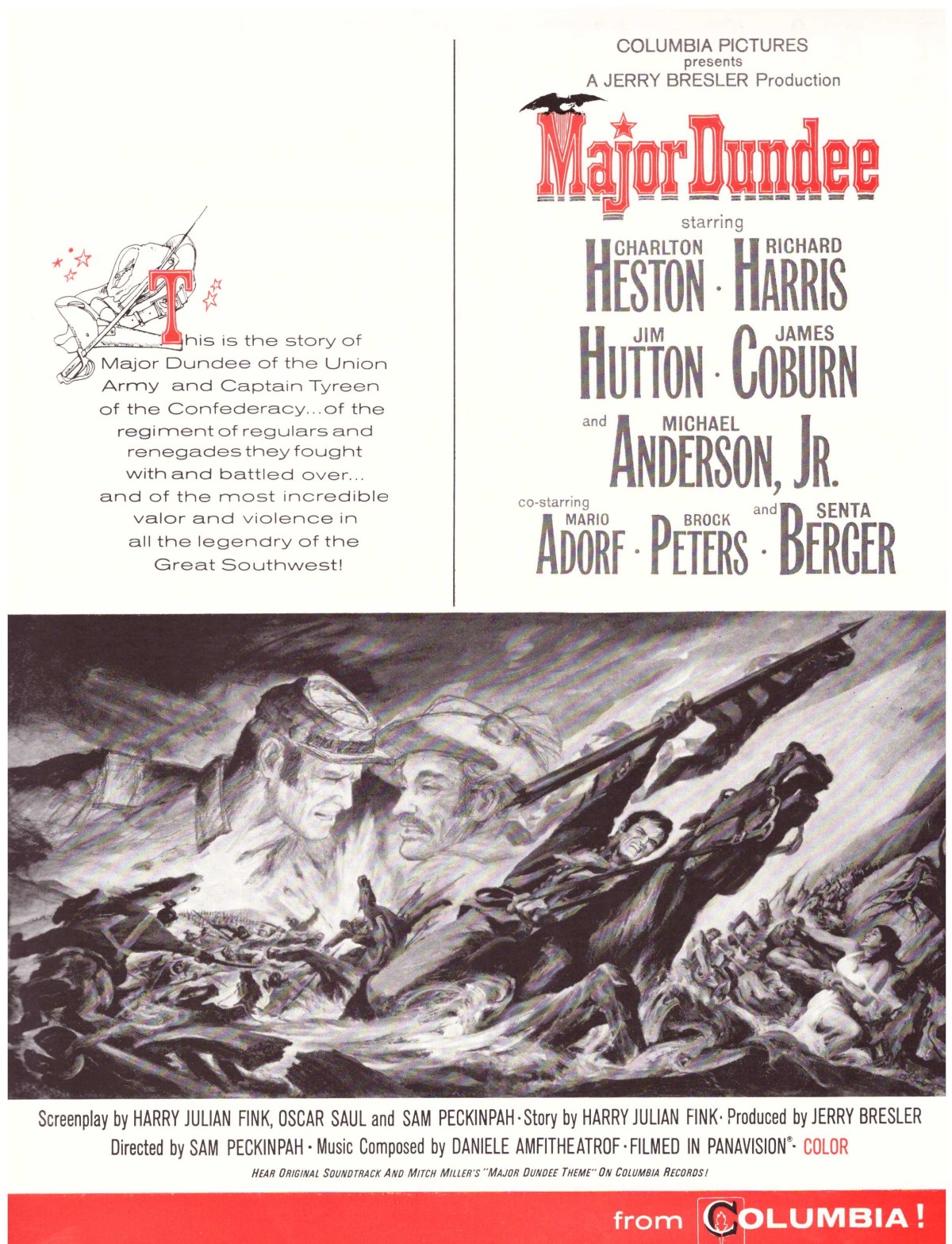
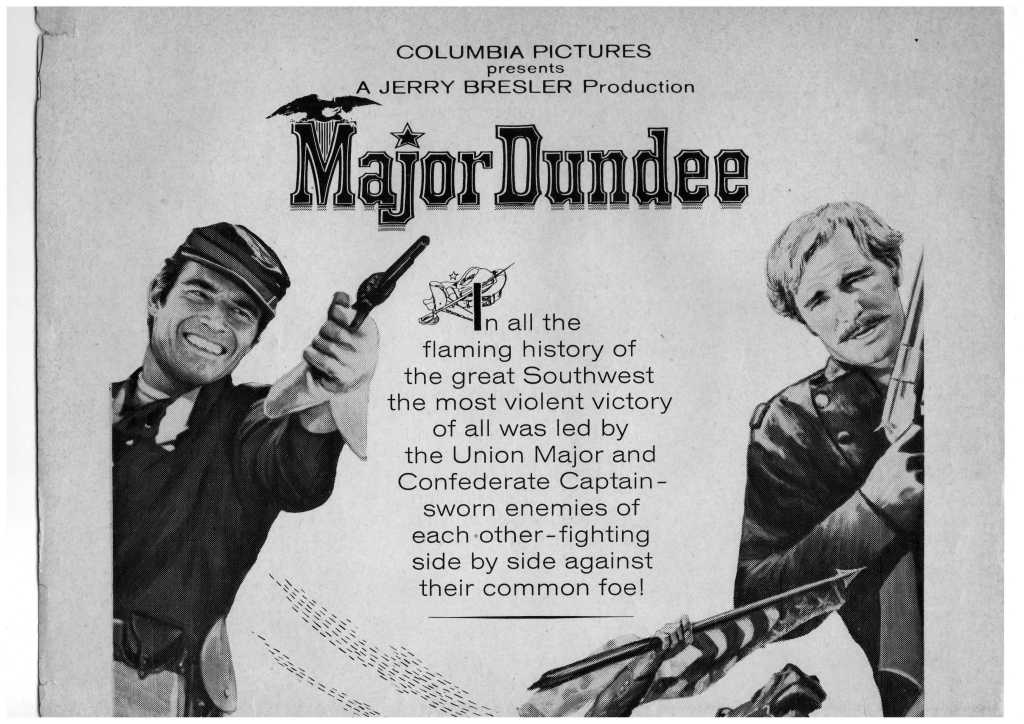
Virtually the entire marketing program for “Major Dundee” was based around the military. The film appeared on the centenary of the ending of the Civil War. The movie most likely to take advantage of that anniversary – Gone with the Wind – was in cold storage, having already taken advantage of the centenary of the start of the war for its umpteenth reissue. So exhibitors were encouraged to put on displays of battle flags sourced from a museum or collector or to arrange a parade with buglers enrolled from youth groups or the church. A horseman dressed in Union colors could ride through the streets to raise awareness and the cinema lobby could be decorated with military equipment and both Union and Confederate flags. Any local person named Dundee might be rounded up. On a different note, Charlton Heston had rustled up his own version of Mexican chili and the recipe was being offered to newspapers. Harry Julian Fink had novelized his screenplay so there was the possibility of bookshop displays and Columbia Records had issued the “Major Dundee March” as a single. Unusually, there was an 8mm film about the film’s stunt men which was intended for sale in cinema lobbies.
Many of the films from the 1960s are to be found free of charge on TCM and Sony Movies and the British Talking Pictures as well as mainstream television channels. But if this film is not available through these routes, then here is the link to the DVD and/or streaming service.









 The Magnificent 60s