I Thank a Fool (1962) ***

One of those bonkers pictures whose nuttiness is initially irritating but ends up being thoroughly enjoyable once you give in to the barmy plot and overheated melodrama. Murder, suicide, madness, illicit sex, blackmail – and that’s just the start of this farrago of nonsense. And set in Liverpool before The Beatles made it famous.

Christine (Susan Hayward), a doctor, is jailed when she kills her married seriously ill lover in a mercy killing. She’s not convicted of the murder but of the lesser crime of medical malpractice, but after serving an 18-month sentence finds she is unemployable, even in more lowly professions where her prison stretch counts against her.

When she is hired by the attorney Stephen (Peter Finch) who prosecuted her to look after his mentally ill wife Liane (Diane Cilento), the audience will already smell a rat given that Christine has changed her name and therefore the lawyer must have made considerable effort to track her down. His argument is that since she is no longer a qualified practitioner, she cannot advocate to have his wife committed to a mental institute, as a proper doctor would be required to, since Liane is clearly a danger to herself and other people. Your immediate suspicion is that Christine has been hired to take the rap once Liane is bumped off.

And it doesn’t take long for Christine to work out that not everything adds up. Liane is given enough rope to hang herself, access to a car to cause an accident, access to a horse which could easily bolt or fall.

Liane has been told her Irish father died in an accident where she was driving, the incident that triggered her madness. But when we discover the father, Captain Ferris (Cyril Cusack), is very much alive that’s the cue for a slew of unlikely events. When Liane finds her father, he’s not in the least a candidate for canonization, but an alcoholic. That triggers further mental trauma. And another accident, self-inflicted. After Christine administers pills, the young woman is found dead.

Bit of a stretch to compare it to the movies
mentioned in this poster.

Naturally, an inquest brings up Christine’s past and suspicion falls on her. And that would be par for the course, and it would be up to the condemned woman to find a way to prove her innocence. But that takes us into even murkier depths.

There’s bad blood between Capt Ferris and Stephen and the inference that this was only resolved by the father offering his underage daughter to the lawyer to be followed by the unscrupulous father blackmailing Stephen. Then it turns out there’s no case to answer and that Christine is innocent because, blow me down, Liane committed suicide.

But what should have been a straightforward, if unlikely, murder plot comes unstuck because it can’t make up its mind what it wants to be. Too many ingredients are thrown into the pot and the result is a mess.

Even the queen of melodrama Susan Hayward (Stolen Hours, 1963) can’t rescue this. And the pairing with Peter Finch (Accident, 1966) doesn’t produce the necessary sparks. Despite a variable Irish accent, Diane Cilento (Hombre, 1967) comes off best as the wayward deluded young woman.

Robert Stevens (In the Cool of the Day, 1963) directs from a screenplay by Oscar-nominated  Karl Tunberg (The 7th Dawn, 1964) adapting the bestseller by Audrey Erskine-Lindop.

Had every opportunity to be a star attraction in the So Bad It’s Good sub-genre but fails miserably. Still, if you enter into the swing of things, remarkably tolerable.
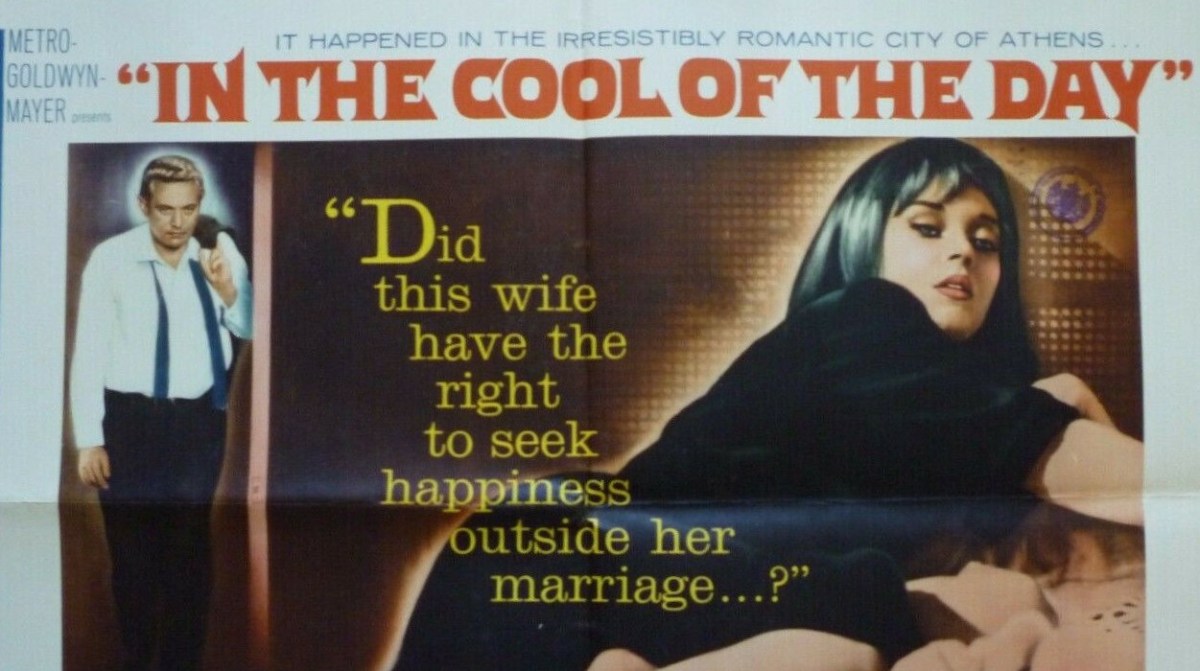
In the Cool of the Day (1963) ***

Jane Fonda tagged this the worst film of her career but that’s a bit harsh and I suspect it owed a lot to the actress being dressed up Audrey Hepburn-style in outfits that scarcely suited her. While it’s certainly overheated, melodramatic moments indicated by thundering music, a marvellous supporting cast, including a quite bitchy Angela Lansbury, provides ample compensation.

It’s  romance in the Love Story vein, rich young flighty heroine Christine (Jane Fonda) at death’s door half her life, but feeling smothered by understandably over-protective husband Sam (Arthur Hill). When she falls for married publisher Murray (Peter Finch) and sets off on a trip to Greece, chaperoned it turns out by Murray’s bitter wife Sybil (Angela Lansbury), it takes a while for romance to physically bud. That it does at all is only because   Sybil has taken off with suave traveling salesman Leonard (Nigel Davenport).

The movie takes a long time to heat up because, as in The Bramble Bush fashion, there’s overmuch character filling-in to do. Part of the interest in this picture is how the bad guys are effectively good guys, more victims of their partner’s behaviour than anything else, though for story purposes, the audience has to be persuaded otherwise.

So besotted Sam, having dealt with umpteen bouts of his wife’s pneumonia and lung operations, a “slave” to her illnesses, is deemed as treating her like a child rather than a wife, preferring her ill rather than well, and denying her the adventure to which she feels entitled. When she meets Murray she has run away. Murray’s wife has a downer on her husband because, wait for it, he killed her child and left her facially scarred (hidden now by hair but she’s still very sensitive about it) in a car accident he caused.

But she’s portrayed as over-sensitive, worried about her appearance, snippy, blaming him for her distraught life, and worse, a philistine, hating being dragged around ancient Greek monuments. Aware of her husband’s proclivities, she mocks, “You’d be an idiot to fall in love with her.” And any time she ventures out, the music rises to a crescendo as if she is a character straight out of film noir.

When she goes off with Leonard, her love affair is viewed as sneaky rather than redemptive, even though he restores her faith in herself. Triumphantly, she tells Christine, “He’s all yours” and her husband “nobody need feel sorry for me any more.”Admittedly, she does take revenge by informing Christine’s husband, who has entrusted his wife to Murray’s care, of their affair. And you would be hard put to argue, although the film wants you to believe otherwise, that Sybil and Sam have been ill-treated by their partners, Sam, in particular, funding her trip to Greece in the hope that allowing her the freedom she needs will save their marriage.

Of course, the characters of both partners, even if their self-pitying is the result of circumstance, do mean that Christine and Murray are presented as people trapped in bad marriages and for whom love, however brief, provides sanctuary from tortured lives, her physical, his more mental, since he is not averse to guilt. 

Sybil’s lack of interest in tourist Greece handily gives the prospective lovers plenty time to fall in love, amid gorgeous scenery, and breathing in air rich in culture. With all film made in the 1960s and set in foreign parts – Pretty Polly (1967) another example – sometimes the story takes second place to the scenery, so it’s lucky that the romance is played out against such an interesting background, an ideal combination, killing two birds with one stone if you like. Given this is prior to Zorba the Greek (1964), the filmmakers have even managed to sneak in some traditional Greek dancing, albeit on the deck of a ferryboat.

Dress-wise, the lovers are ill-matched, Murray plodding around in a suit while Christine parades the latest often clingy fashion. When Sybil departs the scene, that leaves one happy character of the happy couple free of marital encumbrance, but still leaves open the question of how Christine will rid herself of Sam and, more importantly, will Murray wish to take on the all-consuming job of nursing Christine. He never gets the chance to find out. When she does fall ill – as the result of Murray recklessly keeping her out in a thunderstorm – her mother Lily (Valerie Kendrick) swoops in to rush her to hospital.

Spoiler Alert – I’m telling you that she dies because it seems to me that the ending the filmmakers hoped for is not how the audience will perceive it. Beautiful young woman dies too young, yep that’s there, but the man, now free and able to shake off his dull life and start afresh as a writer, seems a long shot. Given he has now, thanks to the thunderstorm episode, killed two people, I would surprised if guilt was not uppermost in his mind.

Not so-good-it’s-bad, and despite the complications, and perhaps because of the Sybil-Leonard romance, it’s certainly an interesting picture as much, perhaps, because it fails to send the audience in the desired direction.

In only her fifth movie, Jane Fonda (They Shoot Horses, Don’t They, 1969), exhibiting the nervous friskiness that would become a hallmark, does pretty well with a febrile, spoiled, character. If she falls down at all it’s that she appears uncomfortable wearing Orry Kelly’s fabulous gowns and it would take Hollywood some time to work out she was not a natural successor to Audrey Hepburn. Peter Finch (The Pumpkin Eater, 1964) is perfectly at ease with the illicit.

But Angela Lansbury (Harlow, 1965), a hoot as the wife who turns rejection into triumph, steals the show. Throw in Arthur Hill (Moment to Moment, 1966), Nigel Davenport (Sands of the Kalahari, 1965), for once neither smug nor snippy, Alexander Knox (Khartoum, 1966), veterans Constance Cummings (The Criminal Code, 1930) and Valerie Taylor (Went the Day Well, 1942), John Le Mesurier (The Liquidator, 1965) and Alec McCowan (Frenzy, 1972) and you have a movie where hardly a moment goes by without admiring a performance.

Robert Stevens (I Thank a Fool, 1962) directed from a screenplay by Meade Roberts (Danger Route, 1967) based on the novel by Susan Ertz.

Discover WordPress

A daily selection of the best content published on WordPress, collected for you by humans who love to read.

The Atavist Magazine

by Brian Hannan

WordPress.com News

The latest news on WordPress.com and the WordPress community.