Beau Geste (1966) ***

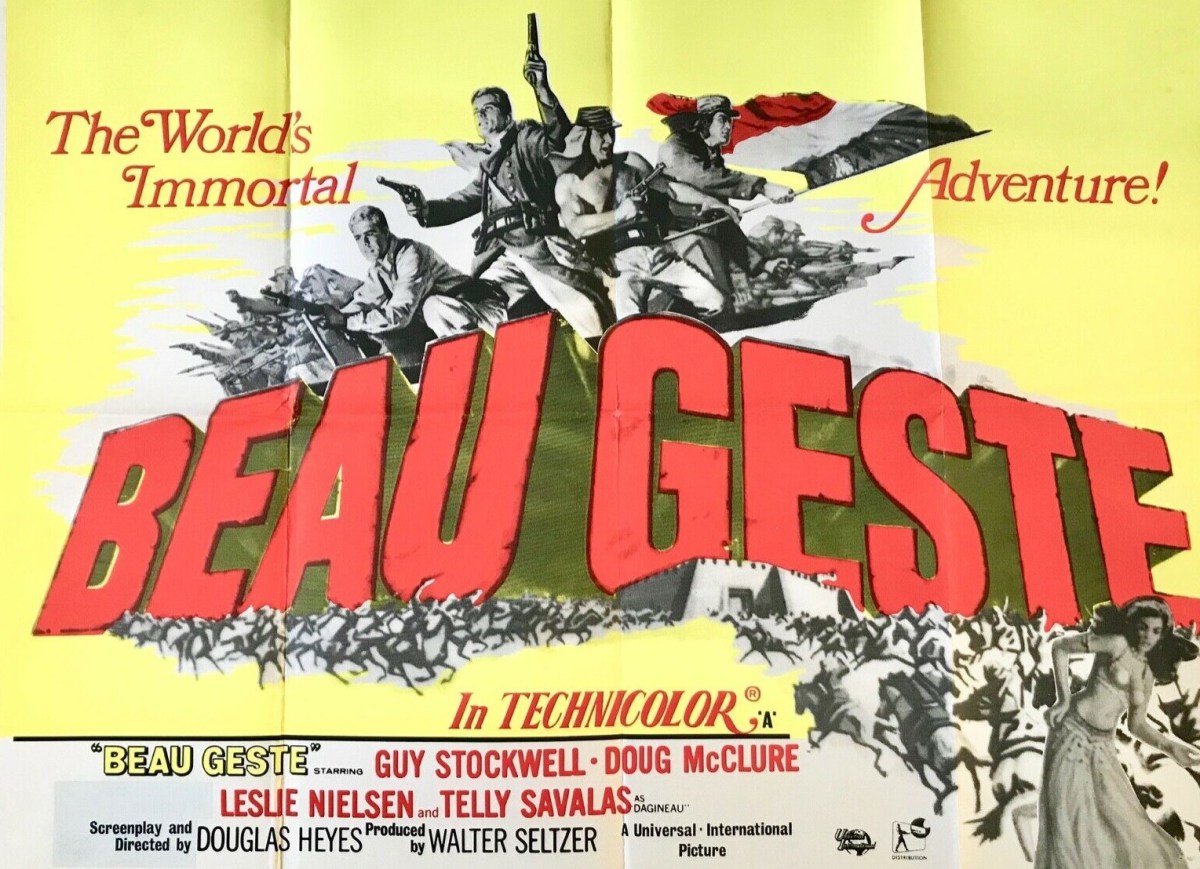
Two brothers battle inhospitable terrain, warring tribes and a sadistic sergeant major in a  remake of the classic tale. The title translates as “noble and generous gesture” and is a pun on the name of hero Michael Geste (Guy Stockwell), an American hiding out in the French Foreign Legion in shame for being involved, innocently as it happens, in embezzlement. His attitude is markedly different to the “scum of the earth” who make up the battalion and his quick wit and refusal to kowtow make him a target for Sgt Major Dagineau (Telly Savalas), a former officer busted to the ranks.

Dagineau delights in imposing hardship and devising mental torture, making some recruits including Geste walk around blindfold at the top of a cliff. Geste’s resistance to his superior is almost suicidal and he even volunteers to take a whipping on behalf of his comrades. “It’s me he wants,” says Geste, “if not now the next time.” At another point he is buried up to his neck in the blazing sun.
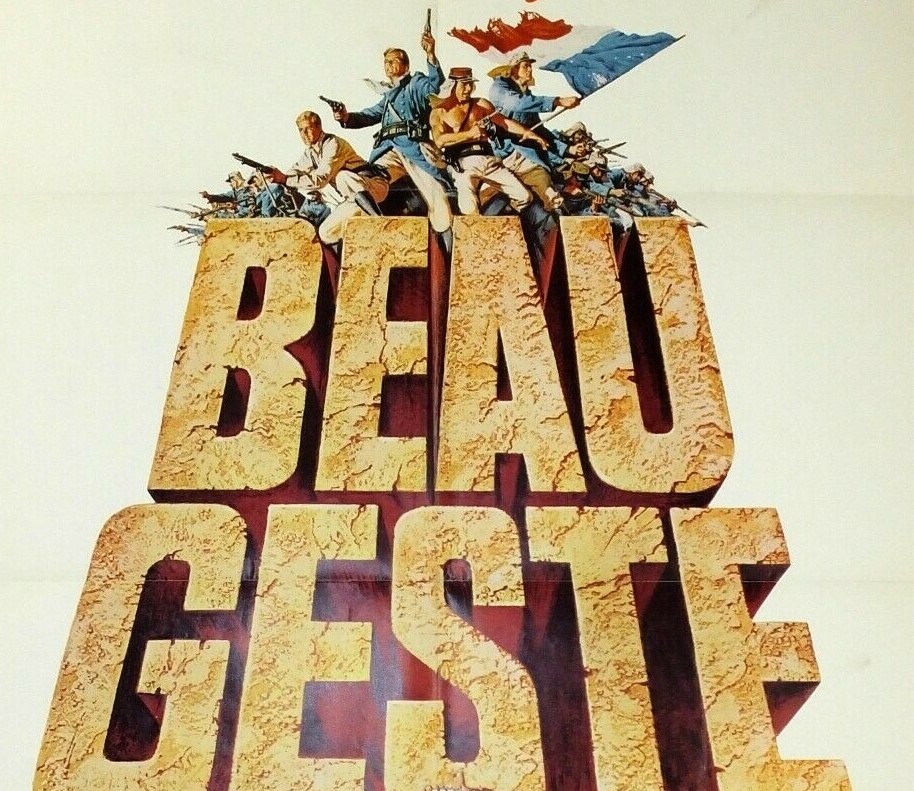
Joined by his brother John (Doug McClure), the battalion sets out as a relief force for a remote fort but when commanding officer Lt De Ruse (Leslie Nielsen) is seriously wounded, the sergeant-major takes charge. Under siege from the Tuareg tribe, honor, treachery, mutiny, fighting skills and courage all come into play in a final section.

The action and the various episodes and confrontations are strong enough and Geste has a good line in witty retort, but blame the casting for the fact that it turns into Saturday afternoon matinee material. It was always going to be a stretch to match Gary Cooper, Ray Milland and Susan Hayward from the 1939 hit version.

Stagecoach, remade the same year, was able to rustle up a bona fide box office star in Ann-Margret (Viva Las Vegas, 1964) and a host of supporting players with considerable marquee appeal including Bing Crosby (Robin and the 7 Hoods, 1964), Robert Cummings (Promise Her Anything, 1965) and Van Heflin (Cry of Battle, 1963). Nobody in the cast of Beau Geste could compare. Apart from the Spanish-made Sword of Zorro (1963), Guy Stockwell usually came second or third in the credits, as did Doug McClure (Shenandoah, 1965) while Telly Savalas, despite or because of an Oscar nomination for The Birdman of Alcatraz (1962), was viewed as a character actor.

But that was the point. Universal gambled on turning the latest graduates from its talent school into major box office commodities. The set pieces and the action are well handled and while there are excellent lines especially in the verbal duels between hero and villain, it’s not helped by the most interesting character being Dagineau, who, despite his failings, accepted his fall from grace, worked his way back up the career ladder, believing brutality the only way to control the soldiers, and in the end out of the two is the one who has the greater sense of honor, refusing to allow a lie to befoul the truth, rejecting the notion of when the legend becomes fact print the legend, And it’s a shame that the movie has to present his character in more black-and-white terms rather than invest more time in his background or accept his version of reality.   
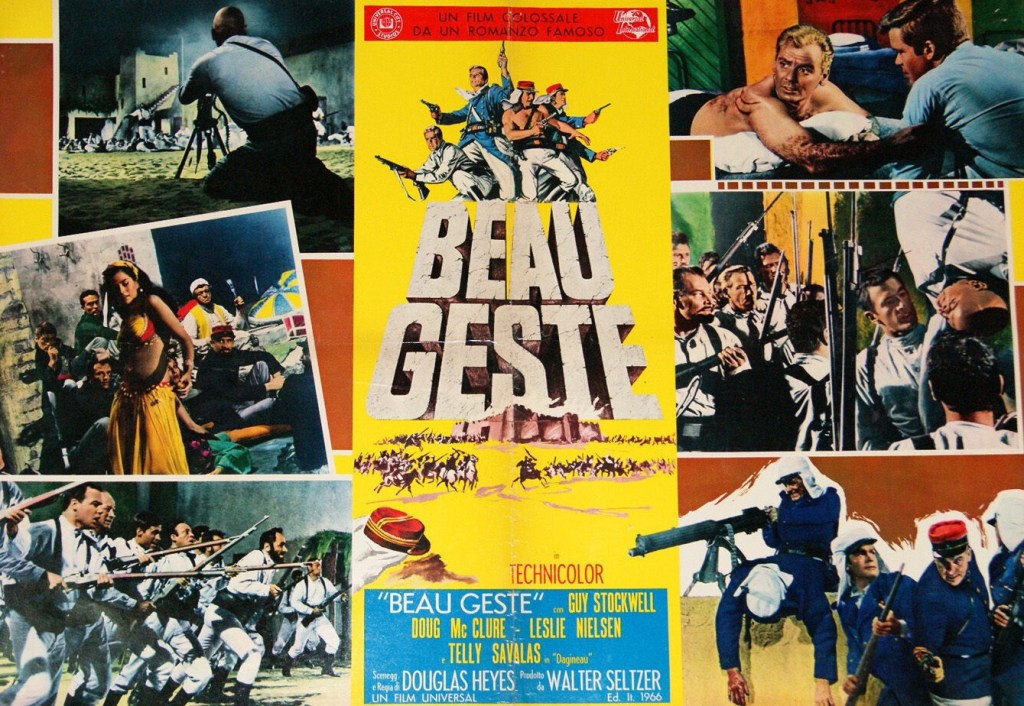
Telly Savalas (The Scalphunters, 1968) steals the show with a performance of considerable subtlety. Guy Stockwell (Tobruk, 1967) is little more than a stalwart, the heroic hero, with little sense of the irony of his situation. Doug McClure (The King’s Pirate, 1967) presents as straighforward a matinee idol. If you only know Leslie Neilsen from his later spoof comedies like Airplane! (1980) you will be surprised to see him deliver a dramatic performance as the drunken commander who still insists, in an echo of El Cid, in rising from his sick bed to lead his troops. Normally this kind of macho movie – The Magnificent Seven (1960) and The Dirty Dozen (1967) prime examples – throws up burgeoning talent who go on to make it big. It’s one of the disappointments here that this does not occur.

This was the second and final movie of Douglas Heyes (Kitten with a Whip, 1964).  
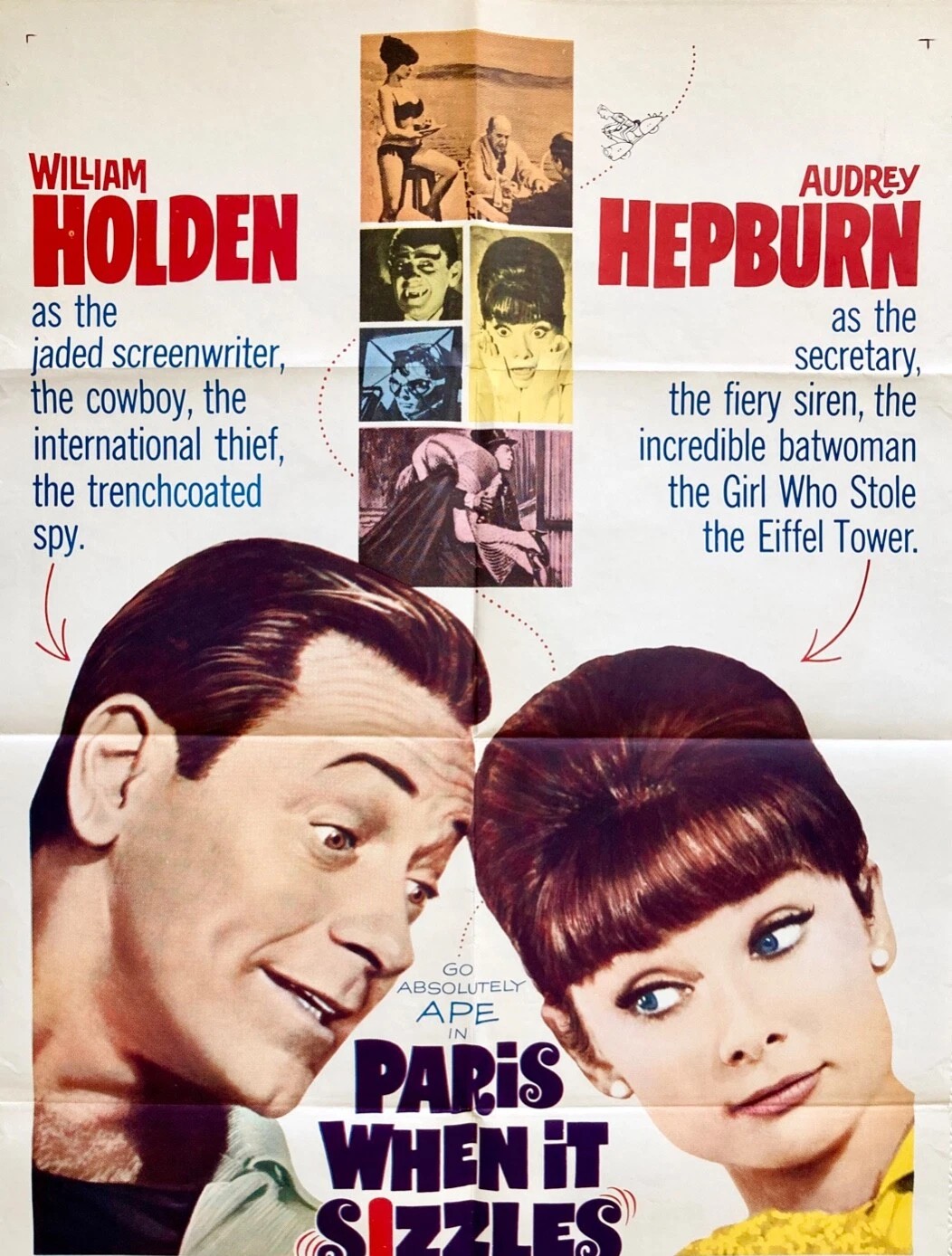
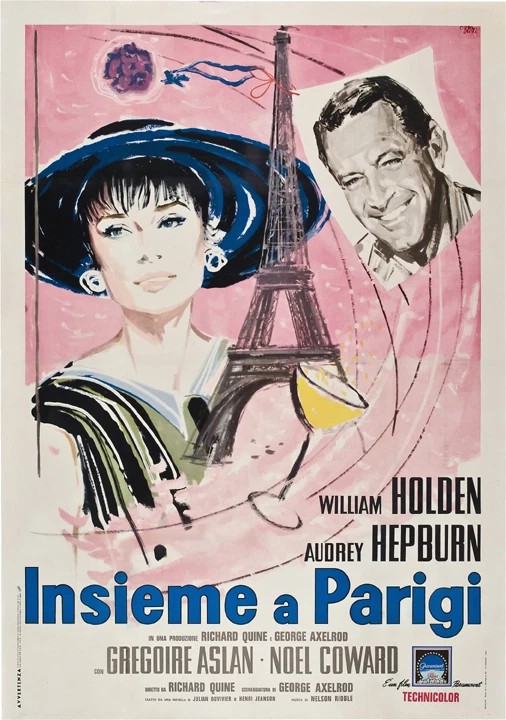
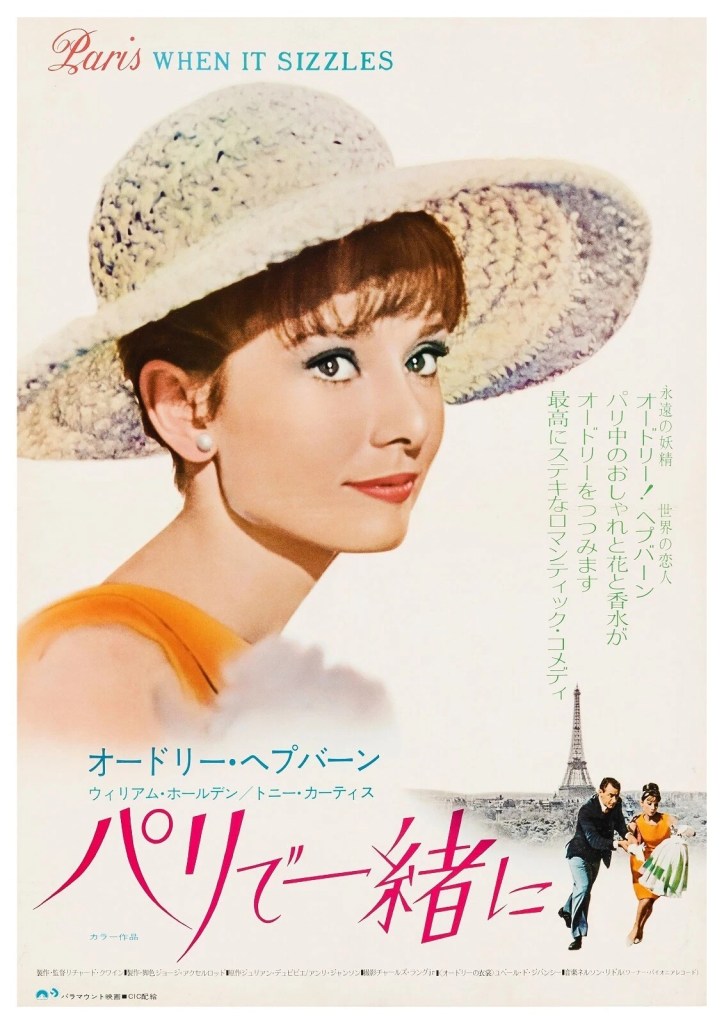
Paris When It Sizzles (1964) ***

Screen charisma can only get you so far. The pairing of William Holden and Audrey Hepburn must have seemed certain to create a box office tsunami given they had worked together before on the hit Sabrina (1954) and were coming off hits, the former in The World of Suzie Wong (1960) and the latter having reinvented herself as a ditzy fashion icon in Breakfast at Tiffanys (1961). But clearly studio Paramount knew something about the outcome of this production that it was keeping to itself, otherwise how to explain that a movie completed in 1962 languished on the shelves for nearly 18 months.

By the time it appeared Hepburn was still a big box office noise after Hitchcockian thriller Charade (1963) but Holden’s flame was dying out following three successive flops, The Devil Never Sleeps, The Counterfeit Traitor and The Lion all released in 1962. Had the studio played an even longer waiting game and held off release until the end of 1964 when Hepburn was enjoying sensational success with My Fair Lady, audiences might have been more likely to be suckered in to this romantic comedy. Although whether they’d be any more appreciative is doubtful.

Problem is, the narrative hardly exists. And what remains is too clever by half. It might have appealed as an insight into how Hollywood works, but it lacks backbone and is more of a series of spoofs as we wait inevitably for the two stars to fall in love.

Alcoholic Richard Benson (William Holden) has writer’s block and having frittered away his time drinking, traveling and romancing, now has two days to deliver a screenplay for producer Meyerheim (Noel Coward) – who incidentally seems to spend his time in the sunshine drinking and surrounded by beautiful women. Benson hires typist Gabrielle (Audrey Hepburn) both to speed up the process and have someone to bounce ideas off.

Primarily a two-hander and virtually contained on a single set, his swanky apartment in Paris, it only ventures out to assist his imagination by playing out various concepts in which the pair act out various scenes in what turns into a relatively ham-fisted satire of the movie business. The only really interesting Hollywood expose is when Benson explains the tricks of the screenwriting trade, the various reversals (they were called “switches” in those days) and conflicts to keep the audience on their toes and prevent the potential lovers getting to the actual loving stage too quickly.

So we watch Gabrielle initially fending off his moves before becoming entranced and ridding herself of a carapace of dustiness before transforming into a flighty fun lass. But when the dialog often centers on arguments over the meanings of words there’s not a great deal for the audience to get its teeth into.

The concept, such as it is, allows Richard and Gabrielle to act out various scenarios, rattling through the genres – spies, musical, the jungle, horror, whodunit and western – while they manage to find a way to turn his title The Girl Who Stole the Eiffel Tower into a movie.

Even though the last thing this needs is further levity – any more froth and it would disintegrate – Tony Curtis (The Boston Strangler, 1968) has a recurrent role in a variety of cameos and you can spot an uncredited Marlene Dietrich (Judgement at Nuremberg, 1961) and Mel Ferrer (Brannigan, 1975). Perhaps the most unusual angle was that it was a remake of the French La Fete a Henriette (1952) directed by Julien Duvivier. Or that it was the first screen credit for Givenchy, who devised Hepburn’s clothes.

While both Holden and Hepburn are very easy on the eye, the actor often topless, and Hepburn  going through the fashions, it only works if you want to see screen chemistry at work and are not remotely interested in narrative or if you are so unaware – and of course genuinely interested – in the screenwriter’s craft that you are  find out how words on paper are translated into images on the screen. It might well be an audience’s first encounter with such gems as “Exterior:Day.”

Oddly, both Holden and Hepburn are good and it’s solidly directed by Richard Quine (The World of Suzie Wong) from a script by George Axelrod (Breakfast at Tiffany’s) adapting the previous film.

A harmless trifle, you might say, but just too bad that with the talents involved it doesn’t even rise to a soufflé.

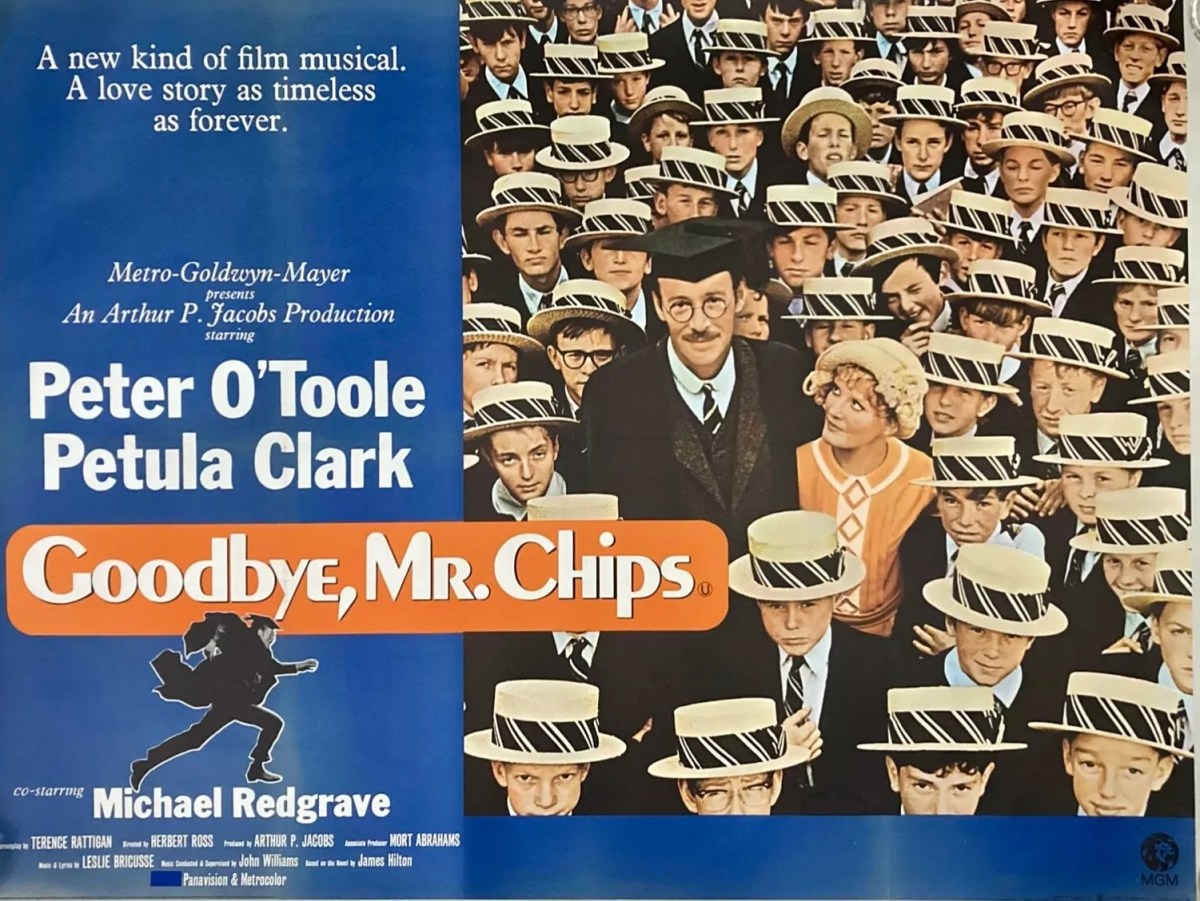
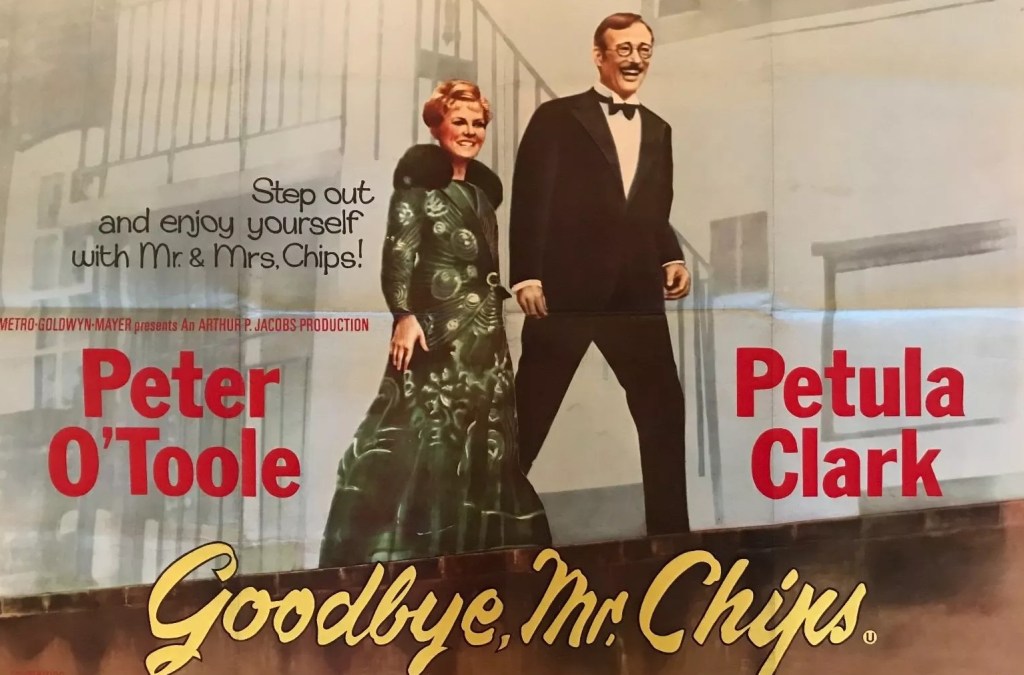
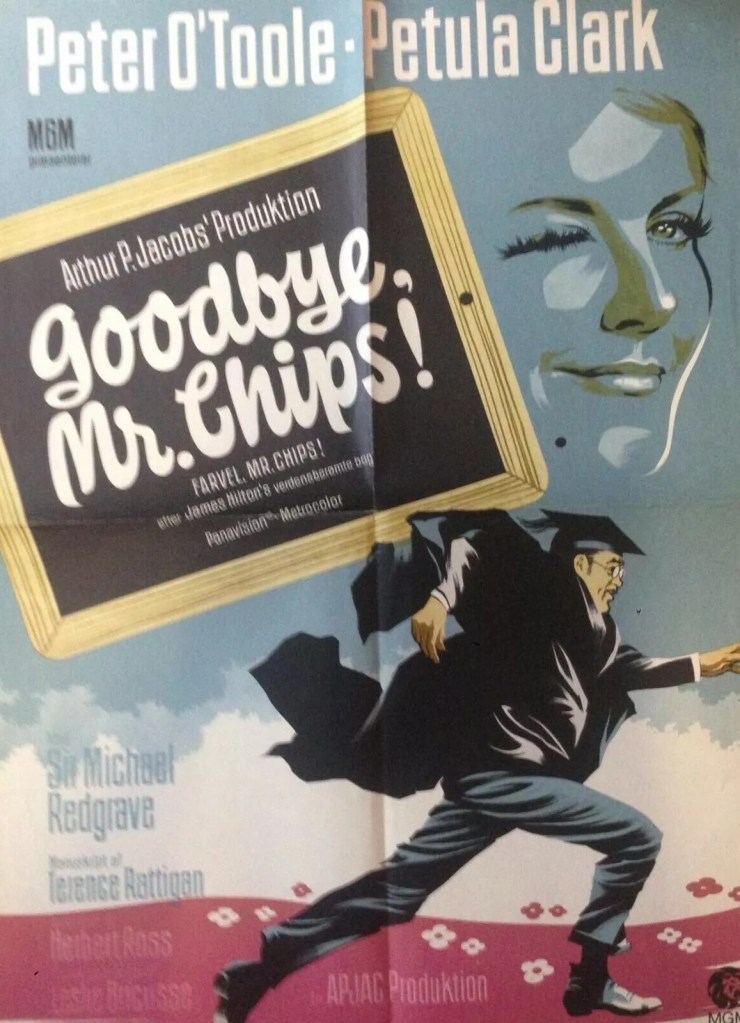
Goodbye, Mr Chips (1969) ****

Stunning revelatory performance by Peter O’Toole (The Night of the Generals, 1967) and unexpected screen chemistry with former British child star turned pop singer Petula Clark (Finian’s Rainbow, 1968) lift a relatively humdrum musical remake of the 1939 classic. Musicals entrusted with roadshow-sized budgets usually came with the proviso that they had already conquered London’s West End or Broadway – The Sound of Music (1965), Oliver! (1968) et al – and so came with an inbuilt audience. A movie musical original with little audience familiarity was always a risk.

There had been a trend away from the choreographic splendor, star exuberance and lightweight narratives that held the key to the golden era of Hollywood musicals. The movie musical had embraced both the introspective and weightier tales – Camelot (1967) the most obvious example. Male stars who couldn’t sing could simply “talk” their way through a tune following the example of Rex Harrison in My Fair Lady (1964).

The proper stretching of vocal chords is sensibly left to Petula Clark, but none of the songs by Leslie Bricusse (Doctor Dolittle, 1967) leave much of an imprint, and you might question why MGM was in such a hurry to commission a remake at all except for O’Toole’s Oscar-nominated turn. By now audiences were well aware of the actor’s screen tics and the intensity he could bring. But moviegoers might as well have been embracing a new star because everything you ever knew about O’Toole was left at the door.

In some respects the realism of his performance plays against the picture, which, effectively, save for the ending, has a lightweight narrative. There’s nothing remotely charming about his characterization of Arthur Chipping. He’s not the kind of eccentric fuddy-duddy that was a common feature of the British movie. Duty has got in the way of likeability. We are introduced to him denying a poor lad the opportunity to become a school tennis champion on the last day of term simply because the match had been scheduled to take place within teaching hours. Small surprise that he is actively disliked, although he takes that, in some respects, as a mark of his teaching prowess.

Unexpectedly, he is introduced to music hall singer Katherine (Petula Clark). What would be the standard meet-cute turns into a meet-awful as unintentionally he delivers a series of insults. Unexpectedly, they meet again, this time in the kind of surroundings that suit his mentality, a Greek amphitheater where he can demonstrate his academic skill, filling her on the acoustics and on the fact that sound travels upward so it’s easier for the person seated above to hear the person standing below than the other way round. Cinematically, this is superbly done, the best scene in the picture from a visual perspective.

Even though, initially, he has no recollection of their previous meeting, a spark is lit and catches fire so that when he returns to school it’s with a somewhat “unsuitable” bride. The best scene in the movie from an emotional perspective is driven by Katherine as she injects some verve into the stodgy school hymn so much so that she soon has the entire school singing with gusto and as though they have for the first time understood the lyrics.

It’s not long before her influence softens the harsh schoolmaster. But she is not a welcome addition in many eyes, her background not what would be expected of a schoolmaster’s wife, and a couple of sub-plots revolve around the impact of her unsuitability on her husband’s career. There’s not much more to go on beyond the sad ending and as I said the songs are treated in low-key fashion rather than full-on energy with dancing schoolboys in the background.

But you don’t really need the songs to enjoy this. Peter O’Toole’s sensational performance more than justifies the remake while the pairing with Petula Clark works surprisingly well.

Herbert Ross (Play It, Again, Sam, 1972) makes his directorial debut. Terrence Rattigan who had previously delved into the public school system to find lonely teachers with The Browning Version (1948) updates the original tale by James Hilton. This is not the performance Peter O’Toole fans would generally nudge you towards, because it’s such an oddity in his portfolio, but, truly, this deserves much wider appreciation

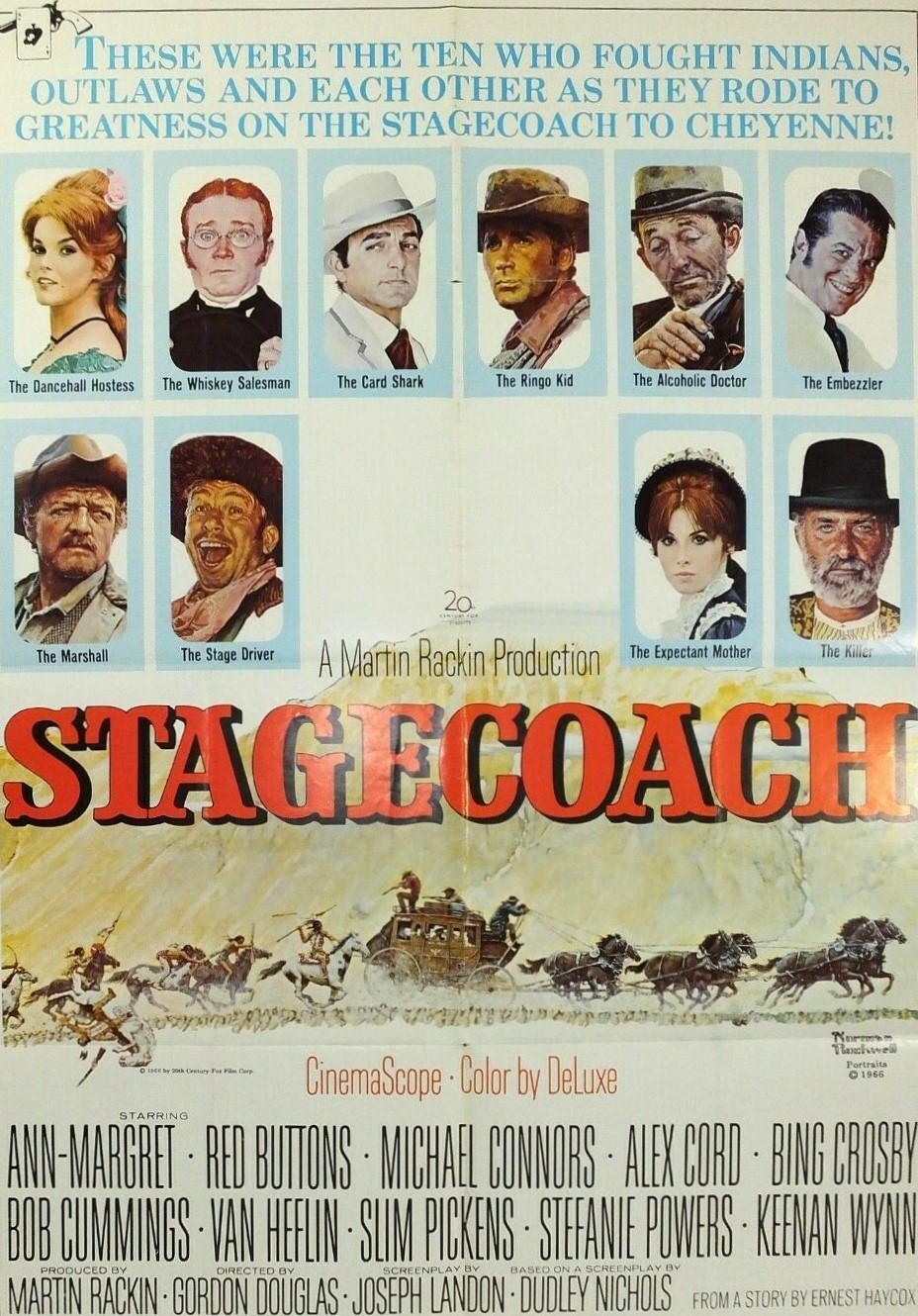
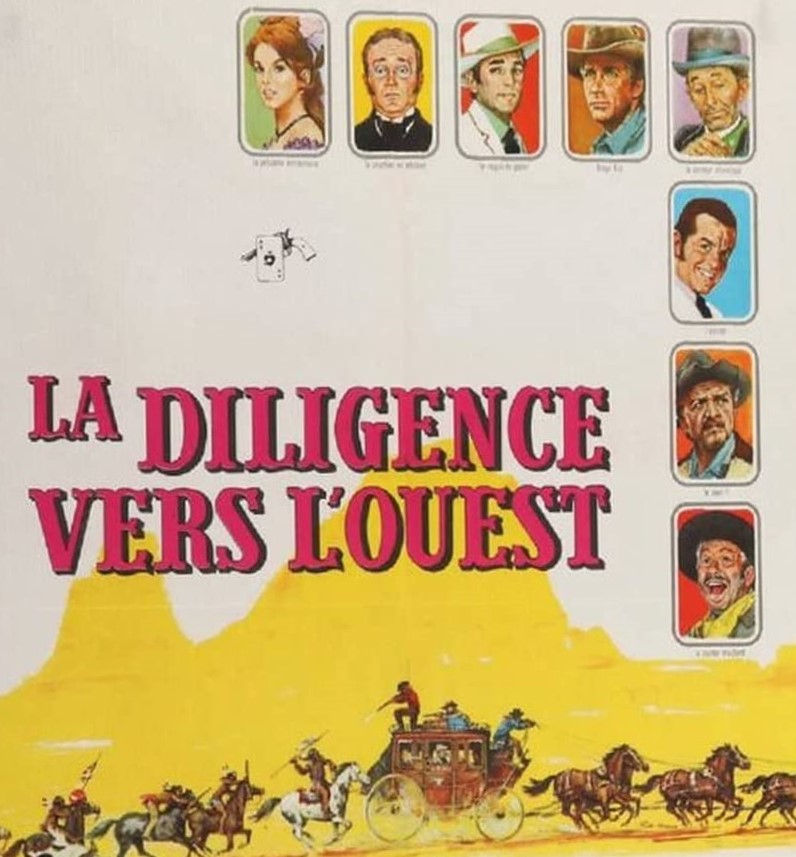
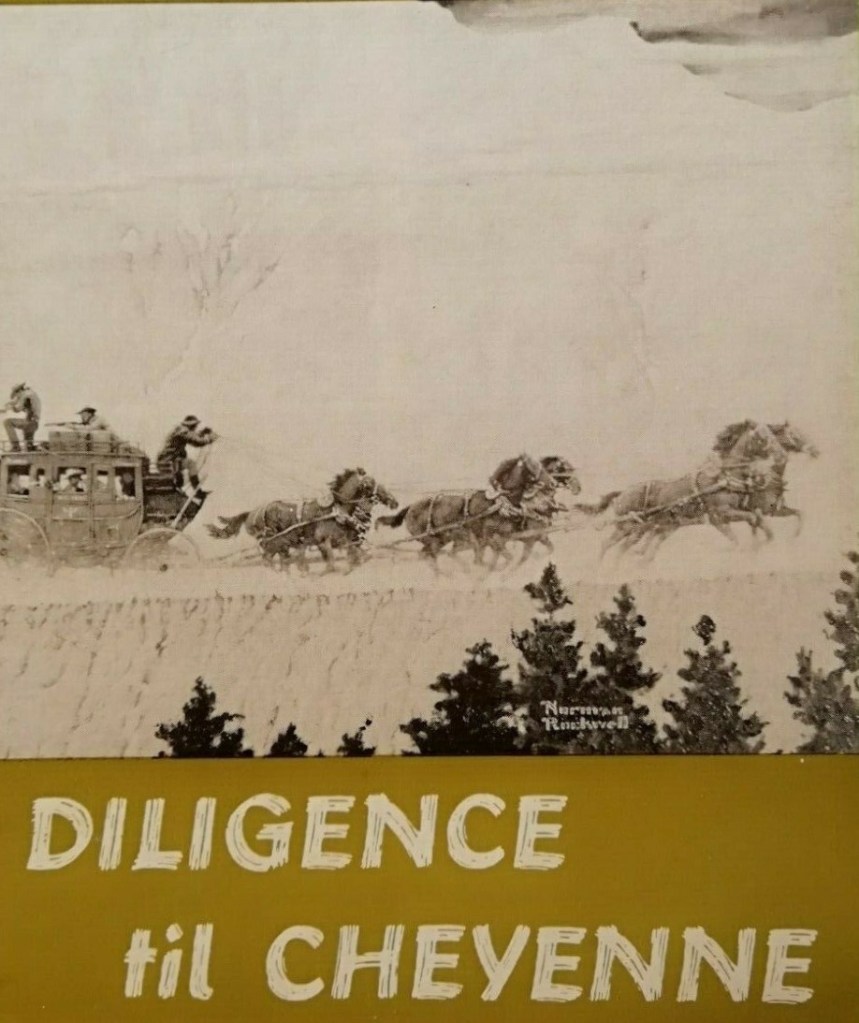
Stagecoach (1966) ****

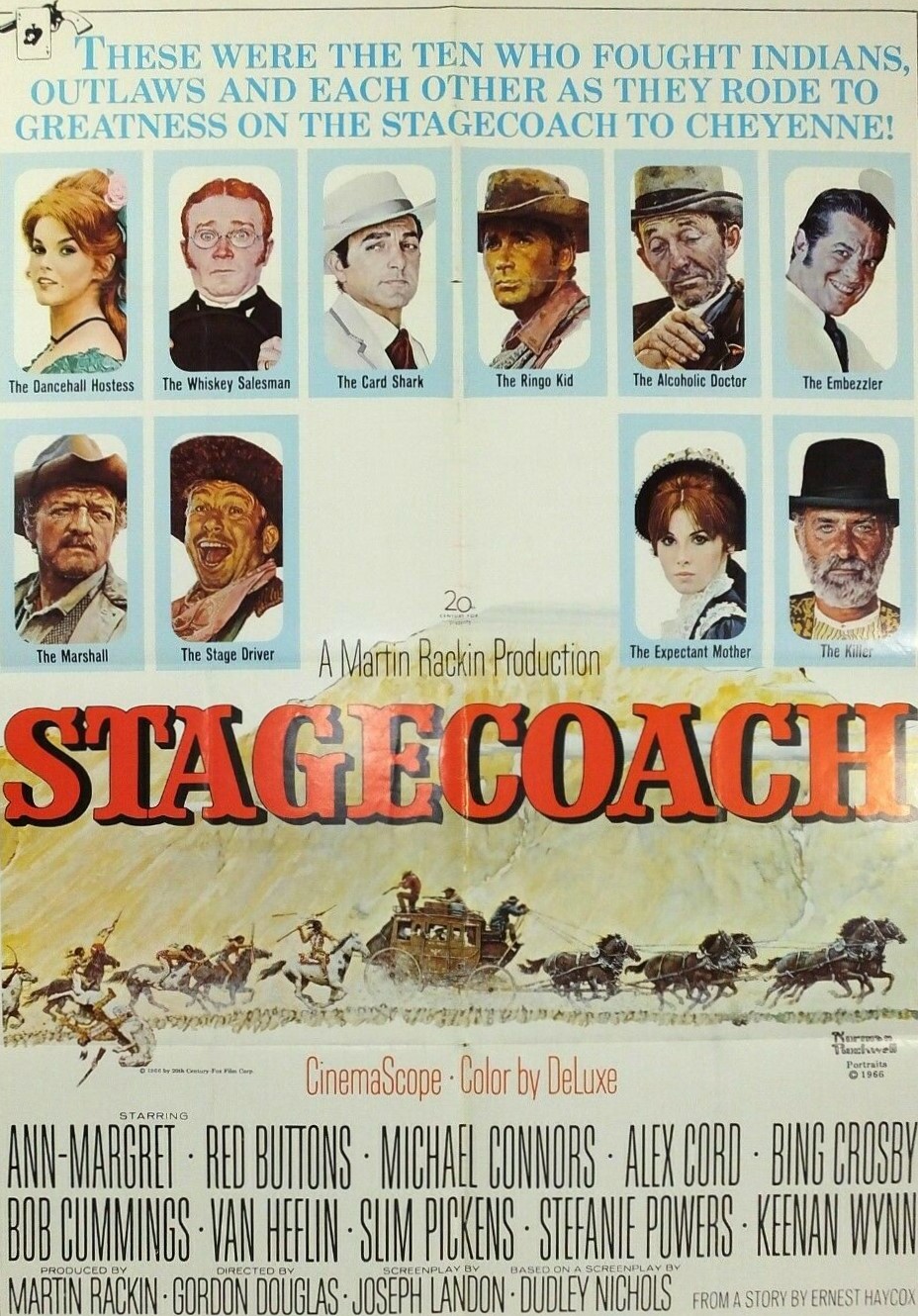
It’s probably sacrilege to admit that I quite enjoyed this. Also it’s been so long since I’ve seen the John Ford original that I could remember very little of the specifics and I haven’t seen the remake before so this was just like watching a new movie. Basically, it’s the story of a group of six passengers taking the stagecoach to Cheyenne for different reasons who are joined by an escaped murderer and shepherded along by the driver and a town marshal. There is some excellent action but mostly it’s a relationship picture, how the characters react to one another and their response to crisis.

Good-time girl Dallas (Ann-Margret) is on the run, banker Gatewood (Bob Cummings) is hiding a stash of stolen money, alcoholic doctor Boone (Bing Crosby) is penniless, liquor salesman Peacock (Red Buttons) is a coward, gambler Hatfield (Mike Connors) has Civil War secrets, pregnant Lucy Mallory (Stefanie Powers) is meeting her cavalry husband in Cheyenne. The ornery Buck (Slim Pickens) is the driver and Curley (Van Heflin) is riding shotgun and when he comes upon stranded escaped murderer the Ringo Kid (Alex Cord) promptly arrests him.

The passengers have heard rumors of the Sioux on the warpath. The audience knows it’s not a rumor because the picture starts with the Sioux slaughtering camped cavalry. Soon enough, the passengers know it, too, coming across a patrol dead at a staging post, and of course they are soon battling for their lives when ambushed.

The drama unfolds as the characters confront each other or their own weaknesses. Dallas, who has a high old time as a saloon girl, is way out of her depth in respectable company, feeling out of place even dining with the others, hiding the secret of her affair with the married Gatewood. Ringo coaxes her along, bringing her out of her shell, giving her back self-respect, and of course falling in love. Curley, with his eyes on the $500 reward for bringing Ringo in, has no intention of letting the gunslinger take his revenge in Cheyenne on Luke Plummer (Keenan Wynn) who killed his family. Boone and Peacock are the most fun, the doctor spending most of his time separating the salesman from his cargo of booze.

There are endless permutations with a story like this, the kind of material that was mined in the disaster movies of the 1970s like Airport (1970) and The Towering Inferno (1974), a group of disparate characters forced to battle for survival. The action is only part of the deal. The picture only truly works if the characters are believable. For that, you need a heap of good acting. The audience could certainly rely on old dependables like Bing Crosby (The Road to Hong Kong, 1962) in his big screen swansong, Van Heflin (Shane, 1953), Red Buttons (Oscar-winner for Sayonara, 1957), Robert Cummings (Saboteur, 1942) and cowboy picture veteran Slim Pickens to put on a good show. But the main dramatic load was to be carried by relative newcomers Ann-Margret and Alex Cord.

Ann-Margret has made her name with sassy light-hearted numbers like The Pleasure Seekers (1964) and had only just stepped up to the dramatic plate with Once a Thief (1965). This was Alex Cord’s sophomore outing after Synanon (1965) and he was stepping into some mighty big boots, the odds stacked against him playing the role John Wayne made famous – and which turned John Wayne into a star. 

Amazingly, the casting works. Ann-Margret moves from feisty to restrained, meek to the point of being cowed, and for most of the film, far removed from the false gaiety of the saloon, seeks redemption. The trouble-making minx emerges only once, to knock the wind out of Mrs Mallory, but, after taking a tumble down the humility route, gradually steers her way towards a better self, preventing Gatewood from causing chaos, nursing Mallory and inching her way towards true feelings for Ringo. As in the best movies, it’s not for her to open up about her woeful life but for another character, in this case Ringo, to identify her flaws: “What you doin’ about your scars, you got ‘em even if they don’t show…when you goin’ to stand up and stop crawlin’?” When they finally kiss it is one of the most beautiful tender kisses you will ever see and most of that is down to Ann-Margret’s reaction.

I had already taken back all my reservations about Alex Cord’s acting skills that were mostly due to his moustachioed performance in Stiletto (1969) after seeing him in The Scorpio Letters (1967) and this is another completely different portrayal. As much as he can deliver on the action front, it’s in the dramatic scenes that he really scores, gentle, vulnerable, caring. He certainly matches the Duke’s trademark diffidence in terms of romance. There’s a point where the camera just holds on their faces to nine depth of expression and we are not disappointed.

Gordon Douglas (The Detective, 1968) is the director who had the gall to take on the remake, and he delivers a character-sensitive picture shaded with action. Written by Joseph Landon (Von Ryan’s Express, 1965) based on the original by Dudley Nichols and Ernest Haycox.

Pretty damn good effort.

The Jackals (1967) **

A hoot. Definitely a contender for that most sought-after of categories – the cult movie.

When I tell you it’s Vincent Price in a western you’ll see how much fun this could be. Price spent virtually a whole decade locked into horror typecasting, those distinctive tones dealing out doom. But like all typecast actors, no doubt he was desperate to show what he could do when the horror shackles were removed.

Trouble is – he does too much. This a lollapalooza performance, so wild and barmy it will have you in stitches, at the same time as wondering what the hell was going on in his head, and why he thought such barnstorming was required, as if he felt he had to steal a picture of which he was the denoted star.

Though effectively a western with all the tropes of that genre, and a remake to boot of Yellow Sky (1948), this, adding further hilarity and extending the cult status, is set in South Africa, with variable attention paid to accent.

Stretch Hawkins (Robert Gunner) is leader of a gang of outlaws robbing banks in the Transvaal during a gold strike. They escape the pursuing posse by heading into desert territory and eventually, parched, exhausted and suffering from heat stroke, seek refuge in a ghost town, former mining town Yellow Rock abandoned except for two inhabitants, Oupa Decker (Vincent Price) and his grand-daughter Willi (Diana Ivarson).

Naturally, on spotting the lone woman, the outlaws get the wrong ideas. But she soon puts them right. When she’s not holding them at bay with a rifle she’s decking Stretch with a neat right hook. Refusing to offer them any hospitality whatsoever seems particularly mean given the poor chaps are starving and this area is bereft of the animal population- lions, elephants, hogs – that had popped up previously in the way of the random stock inserts you found in any picture set in Africa.

So the fellows spread themselves out along the riverbank which provides the only water in the vicinity and where Willi must come calling, leading to further episodes of predatory sexual behaviour. By now Stretch has taken a liking to Willi, which is eventually reciprocated, and he tends to leap to her defence.

For no apparent reason, the outlaws surmise that the only reason the old man and his daughter are still hanging around this deserted spot is because they have found gold. Instead of doing the obvious and holding the younger woman hostage, Stretch attempts to strike a deal, agreeing to take only half the old man’s £20,000 stake in return for letting them go free.

This doesn’t go down so well with the rest of the gang and the shoot-out, when it occurs, sees Stretch siding with the good guys and turning over such a good leaf that he returns the money he stole to the bank.

Despite Vincent Price threatening to ruin the picture with his mugging there are some nice touches. After Stretch’s romantic overtures are derisively dismissed for him being too smelly, he smartens himself up, coming a-courting (or a rough version of it) in fresh shirt, armpits washed and hair combed. Stretch had a touch of religion in the past when a law-observing farmer. And you can tell what a change is wrought in him when at the end he buys rather than steals a pretty hat for Willi.

It’s true there is a transformation in Vincent Price (The Oblong Box, 1969). But not for the better. The lugubrious delivery is toned down, the iconic full beard reduced to a wisp, he wears a floppy hat, cackles like a madman and every time he looks at the camera it’s with a one-eyed leer. There’s something of the country bumpkin in his interpretation of the part, and that might just be a show put on to fool the outlaws. Whatever it is, it comes across as the barmiest performance this side of the Razzies.

On the other hand Diana Ivarson (Macho Callahan, 1970), in her debut, makes a pretty good stab at the feisty independent western women, channelling her inner Barbara Stanwyck, or in those tight jeans Jane Fonda in Cat Ballou (1965). She’s a sharpshooter, capable of missing “that close on purpose.” Robert Gunner (Planet of the Apes, 1968) is scarcely a decent substitute for Gregory Peck in the original.

Director Robert Webb (The Cape Town Affair, 1967) can do little to rein Price in. Written by Harold Medford (The Cape Town Affair), adapting the original by Lamar Trotti and W.R. Burnett.

But, really, there’s little to save it from being awful except that cult pictures are judged by different criteria and this has all the making of a cult.

Must-see for all the wrong reasons.

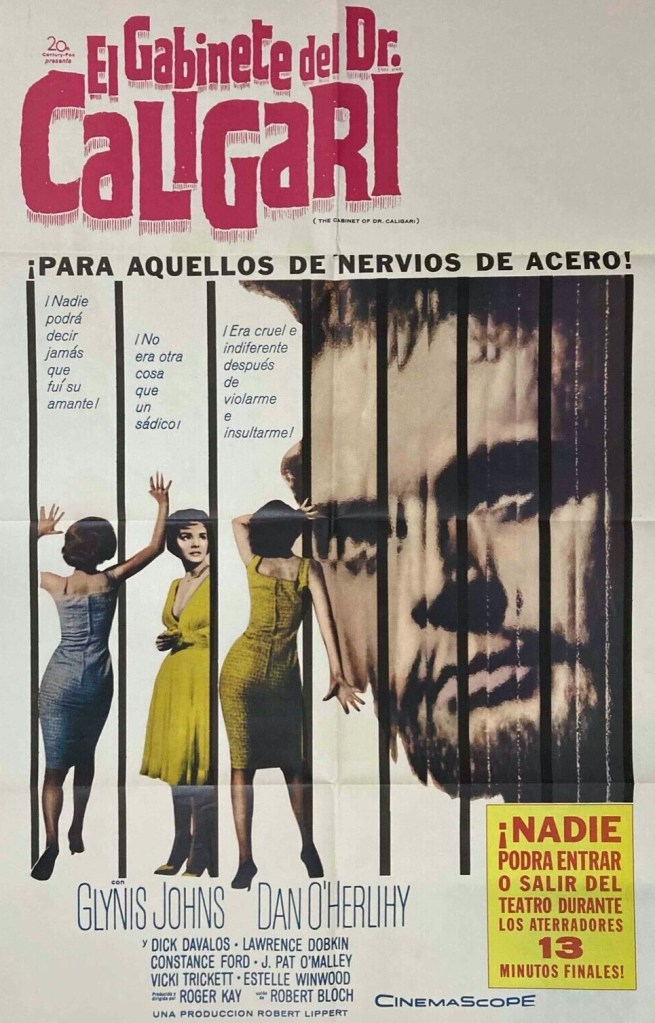
The Cabinet of Caligari (1962) ***

If you’re going to put an English rose through the mill who better than husky-voiced Glynis Johns and except for the giveaway title you might expect from her previous screen ventures that when her car breaks down in a foreign country we’re all set for romance. But you’re probably on the alert anyway after realizing Robert Bloch (Psycho, 1960) wrote the script. The narrative engine runs on twists and the chances would be poor of audiences comprehending the psychiatric devices involved so it’s pretty much a contemporary haunted house mystery with our heroine trapped in an ever-worsening situation and most of the terror emanating from her own mind.

After her tire blowout, and exhausted from trudging along country roads, Jane (Glynis Johns) seeks help from Swede Caligari (Dan O’Herlihy) who owns a large estate in the country. But when she wakes up in the morning, she is unable to leave or telephone for help. There follows a series of disturbing events including (a la Psycho) a peeping tom (bath not shower), being presented with pornographic photographs, interrogated, witnessing torture and being chased by revolving glass. Other images are terrifying, babies baked in ovens, people buried up to their necks, a torture rack. Nothing and nobody are what they seem.

The twist is that she’s in a mental asylum, the car breakdown a fiction to make acceptable to herself her presence there, the other incidents all explained as various versions of psychiatric treatment including electric shock. The central conceit, that she’s trapped, is well-maintained what with other guests dressing in glamorous fashion for dinner and none behaving like inmates. But when Jane tries to make friends with them in order to organize a breakout or escape, she doesn’t know who to trust, and even attempts seduction.

It kind of works and kind of doesn’t. When the camera explains seconds later the reality behind her crazy visions, it ruins the effect. The expressionistic approach helps in presenting the visuals but can’t provide proper insight into her state of mind. The images are odd rather than helping the story. There’s a disjointed feel to the whole thing, as if director and star were on different planets. And there’s a major plot flaw suggesting Jane must be truly out of her mind if she can’t recognize that Caligari and inmate Paul are the same person, give or take a false beard.

It was a bold career choice for Glynis Johns (Dear Brigitte, 1965), generally the sassiest of heroines, to be so out of control. In his only movie, television director Roger Kay makes a bid for the big time with his visuals but too often loses sight of the characters. Of course, it was always going to be a tough ask to match the original German The Cabinet of Dr Caligari (1920) though I doubt many who saw the loose remake would be aware of its existence.

Interesting for the visuals and Glynis Johns losing the rag.

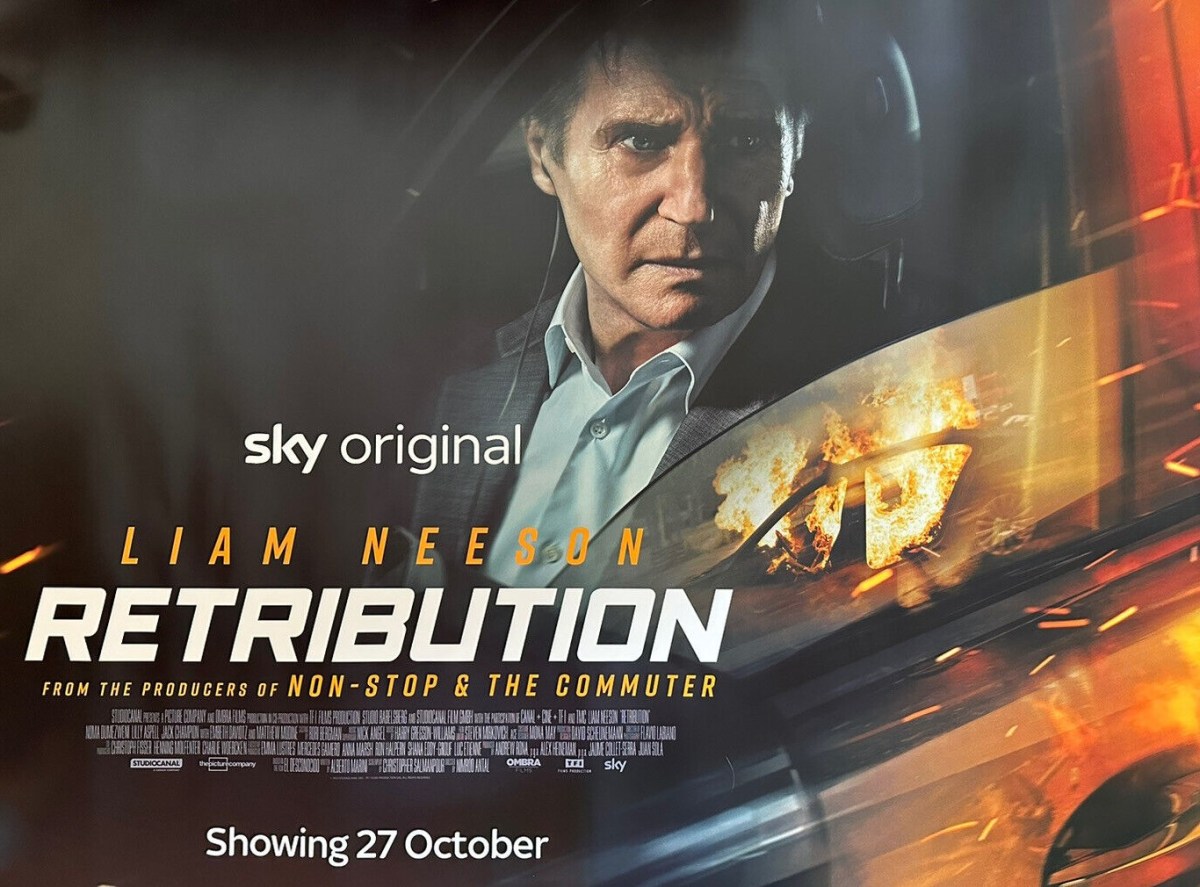
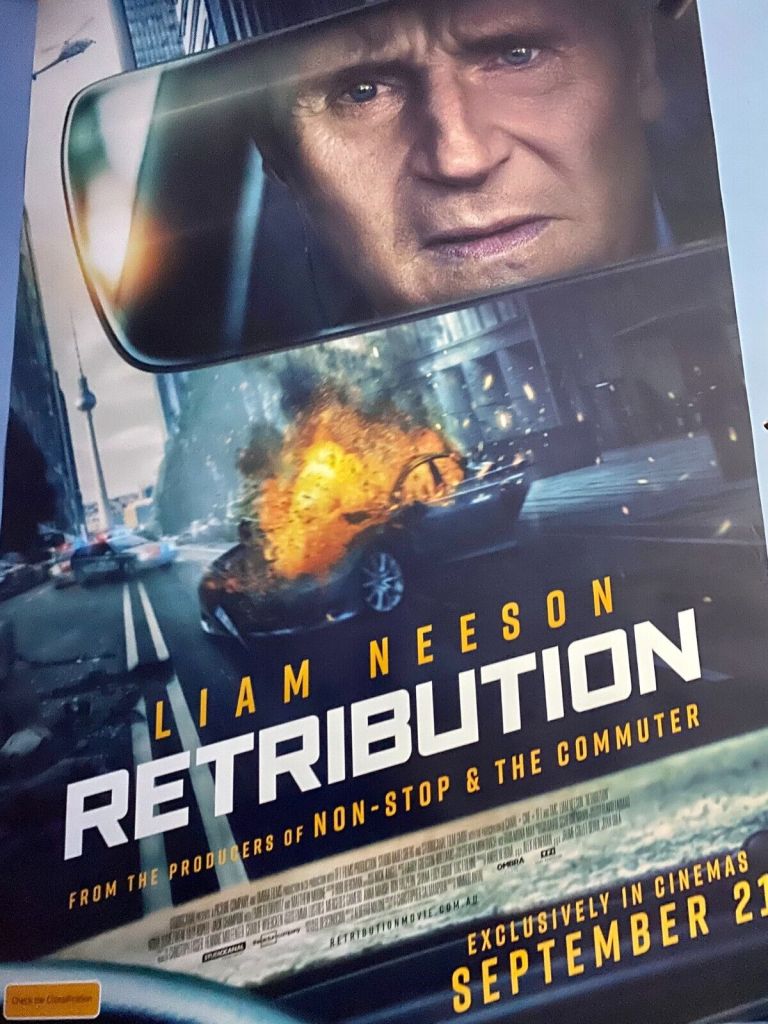
Retribution (2023) **** – Seen at the Cinema

Take a renowned screen tough guy and turn him into a nervous wreck. Stick a bomb under his car seat. Hobble him further by saddling him with his kids in the back. Ensure he is so  frazzled by constant explosions that he lacks the time to do the clever things that heroes in his position, no matter how dicey the situation, generally manage. And the usual running and gunplay is out of the question. Screw that lid down tight.

And play around with Liam Neeson’s Taken (2008) screen persona, show him demolishing a punch bag at the very start to convince us he still has the cojones, with a special set of skills to take down the bad guys. But that image is quickly shredded.

Once he is blamed for a series of devastating car explosions and can’t escape the electronic voice in his ear and the bad guy five steps ahead of everyone, this just ramps up the stakes and in the Neeson portfolio nestles a shade below Unknown (2011) where the actor was equally disorientated, though that time by amnesia.

Matt (Liam Neeson) is a financier having a tough time. It’s just his bad luck he needs to take the kids, rebellious Zach (Jack Champion) and precocious Emily (Lilly Aspinall), to school because, unknown to him, wife Heather (Embeth Davidz) needs time out to consult a divorce lawyer. Now he’s being held hostage in his own car by a tech whiz kidnapper.

Sure, there are shades of Speed (1994) but thank goodness fewer echoes of the likes of Phone Booth (2002) and a few plot holes and a fair bit of misdirection – wife Heather (Embeth Davidz) perhaps having a lesbian affair, financial shenanigans catching up with him, mysterious motorcyclist on his tail – but precisely because Matt has no leeway and the running time is lean (under 90 minutes once you remove the credits) it works like a dream. Just no let-up.

There’s a surprise reveal at the end and a neat get-out-of-jail that Bryan Mills in his element might have dreamed up but mostly it’s pedal-to-the-metal.

After a few direct-to-streaming losers like Marlowe (2022), this is Neeson back at his best, relying far more on his acting talent than his action chops. Even the title is against type. Mention the word retribution and you expect it will be the actor doing the seeking, not being its object.

With the exception of Schindler’s List (1993) – and that’s three decades away – most people can’t remember when Liam Neeson was being touted as a genuine Oscar contender. Producers didn’t seem to know what to do with him. Every star turn in a compelling drama was accompanied by a supporting role in some big-budget extravaganza (not least his Star Wars episodes). And, miraculously, just as it appeared his career was winding down, he reinvented himself as Bryan Mills and was forever typecast in thrillers, but the law of diminishing returns meant that he was as synonymous with Nicolas Cage in making pictures that couldn’t get a cinema release break.

Here’s a movie that depends entirely on facial expression. And no escape from that. Which means relying on whatever he can tick in the acting box. Which, luckily, Neeson still has in spades.

This is kind of movie Sky used to make, a low-budget effort with a big name down on his luck, killed off by poor production values and low-end direction. But if this is the way Sky is heading, upping its game in the face of Netflix and Apple’s clever manipulation of cinematic release, then this movie deserves a wider showing.

Remake of a 2015 Spanish picture, directed by Dani de la Tore and scripted by Alberto Marini, the new version sticks to the knitting, no complicated sub-plots involving the kids, just them sitting in the back waiting to become collateral damage.

Nimrod Antal (Predators, 2010) does an excellent job teasing out the tale, throwing in a car chase through the streets of Berlin, but keeping the camera squarely on the trapped trio. With an inferior star, this could easily have failed to grip, but Neeson pulls it off with ease.

If you can’t catch it in the cinema, where my guess it will only last a week, put it on your must-watch list elsewhere.

Destined to become a DVD “sleeper.”

https://amzn.to/3QDjHhH

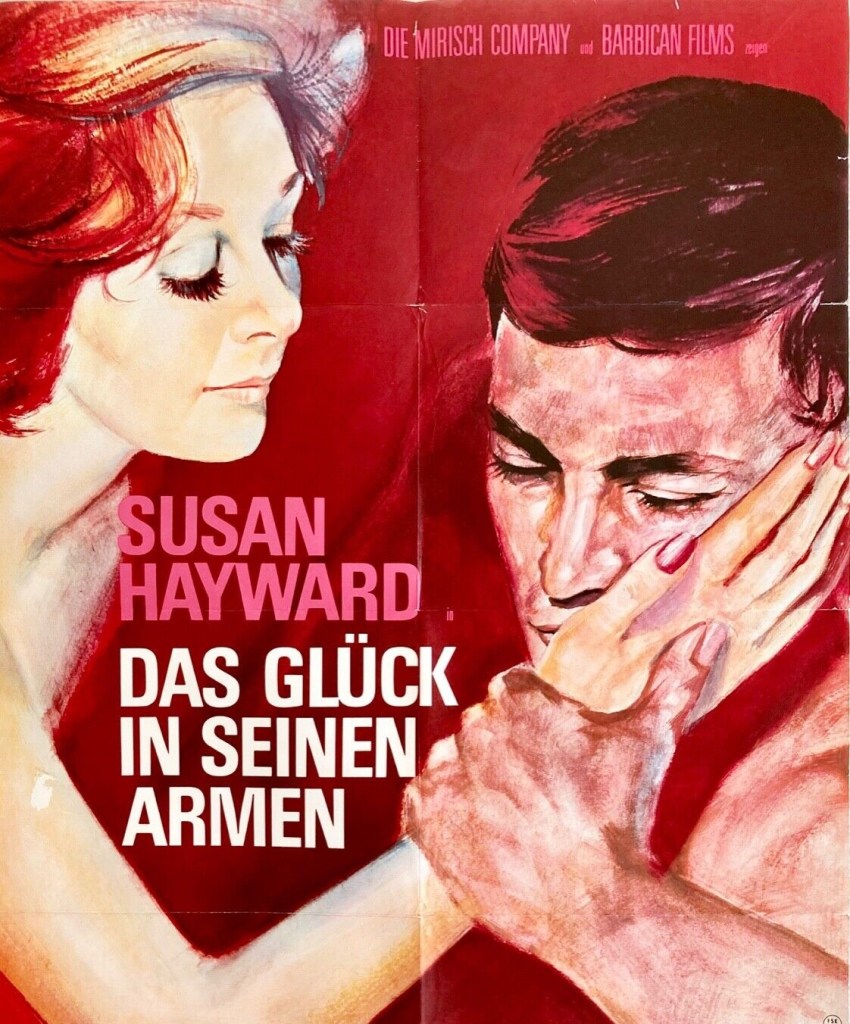
Stolen Hours / Summer Flight (1963) ***

New York Times critic Bosley Crowther famously took Susan Hayward to task for over-acting in the first half of this picture before turning subtle in the second without realizing that was the whole point. Hayward was always full-on, either because he played tougher-than-tough characters (weakness their Achilles heel) or was squaring up against macho males like Clark Gable (Soldier of Fortune, 1954) or John Wayne (The Conqueror, 1956).

Here, she duped audiences. Anyone expecting to view her normal feisty screen persona would come away happy with the first half, bewildered by the second. But, as I said, that was the whole point, a superb effort turning expectations on their head. In any case it was a pretty bold undertaking. In the 1960s, Hollywood went on a cycle of regurgitating old classics but mostly with newcomers like Alex Cord standing in for John Wayne in Stagecoach (1966) or Doug McClure for Gary Cooper in Beau Geste (1966).

There were not many actresses who would think of trying to match the legendary Bette Davis in one of her legendary roles. But Susan Hayward was not just larger than life but a queen of melodrama, able to ratchet up emotions with a look. No actress in the early 1960s could match Davis’s record of two Oscars and a further eight nominations (she would win another one later). By that point Katharine Hepburn equalled her on number of wins but had two fewer nominations (her other wins also came later).  But Hayward ran both pretty close, one win (for I Want To Live, 1959) and four nominations.

So if you were going to select an actress to take on the Davis role in a remake of Dark Victory (1939) you could do worse than choose Hayward. The plot’s been transitioned to England but it follows the same formula as before – in other words stand by for a full-scale weepie. Jet-setting divorced socialite Laura (Susan Hayward) lives life to the full – and then some. When diagnosed with a brain tumor, her reaction is to let all her wildness hang out, reviving romance with old racing driver boyfriend Mike (Edward Judd) before taking stock and abandoning the high life and settling down in the back of beyond (remote Cornwall) with Dr Carmody (Michael Craig).

It’s basically a film of two halves. The almost otherworldly life of the rich and famous who chase after every expensive delight without any notable increase in their happiness quotient contrasts with life in a Cornish village where problems, although apparently smaller, are every bit as vital to those affected. The gaudy section is filled with fine costumes, grand houses and glorious scenery. The serious part is a good bit more down-to-earth as the grande dame discovers her neighborly and maternal qualities. The characters inhabiting the rich life appear flimsy, the poorer people much more realistic. It is almost as if she has swapped fantasy for reality and uncovered a different kind of richness.

There’s not much more to the story than that so it requires acting of the highest caliber to keep us hooked all the way through. Well, for that, you’ve certainly come to the right place. What appears over-acting in the first section is just that, and deliberately so, since the personality switch is the ideal hook. The film’s emotional impact will hit you hard especially the ending. What initially appears to be heading for the sensational soon pulls back to reveal an ordinary person trying to overcome adversity, not with a grand gesture, but simply by living an ordinary life to the full.

While Michael Craig (Life at the Top, 1965) is pretty much a bystander, his calming approach sorely needed in the first half is redundant in the second as Laura comes into her own, developing an inner life she never knew was possible. Hitchcock protege Diane Baker (Mirage, 1965) continues to show early-career promise.

Perhaps more attention should be focused on director Daniel Petrie (The Main Attraction, 1962) who slides out from under his journeyman tab to over-egg the first section and under-egg (if there is such a word) the second. You could almost get the impression of a conductor fine-tuning an orchestra of one.

Superb showing from Hayward certainly gives Bette Davis a run for her money though you could argue she was too old for the role, Davis half her age in Dark Victory, but it’s to Hayward’s credit that you feel the loss of such a vibrant middle-aged personality as you do with Davis’s younger protagonist.

They don’t do melodrama like this anymore, mostly because there isn’t the likes of a Susan Hayward to make them work.

The Lie (2018) ***

I rarely feel inclined to dig around the two streamers – Netflix and Amazon – available to me what with a vast backlog of 1960s DVD/VHS still to plough through and interest in contemporary cinema sated though a weekly visit to the multiplex.  It’s rare that I can sit through more than five minutes of the movies funded or picked up by streamers, so poor is their quality control. So this came as a surprise.

The acting’s not the best and just when you are beginning to run out of patience suddenly the real twist kicks in and it makes terrible, terrible sense and a situation that has spiralled out of control ends up in a bottomless pit. I say the real twist because I had guessed the first twist, an obvious consequence of the set-up of these kind of films. But the real twist is much darker and eminently more savage.

So, the basic story is rock musician Jay (Peter Sarsgard), estranged from wife Rebecca (Mireille Enos), takes teenage daughter Kayla (Joey King) to dance camp and on the way picks up her best pal Trini (Dani Kind) and somewhere in the middle of an ice-bound wilderness said friend needs the toilet. Kayla and pal go off but only Kayla returns, admitting she has pushed friend off a bridge into icy river.

Jay’s now got to decide how to protect his murderous daughter, hide any evidence of Trini being in the car etc. He confides in Rebecca, and protecting their daughter brings the couple closer together. Meanwhile, Kayla is acting as if what’s all the fuss about. This is dysfunctional on the rocks.

Luckily, it turns out Trini has a record of running away and her dad Sam (Cas Anwar) has a terrible temper and may be abusing her so it’s relatively easy to get the police to consider him the main suspect, especially as he’s very lax in reporting the child missing. Plus, Rebecca seems to know her way about the police and Sam makes the mistake of causing a scene in the street.

But, of course, nothing goes according to plan, the situation gets worse, as the innocent parents try to fabricate something that will make the police go away. There’s a lot of other subtle stuff that complicates the situation. But essentially it’s two parallel stories diverging along psychological lines.

With those malevolent eyes, Peter Sarsgard (The Batman, 2022) has some difficulty passing for innocent, and of course his character is not exactly saintly, so that muddies the waters, as I guess is the intention, while the casting of Mirielle Enos (best-known as the detective in the U.S. television adaptation of Nordic hit The Killing, 2011-2014) also suggests the director is hoping to mislead the audience.

Joey King (Bullet Train, 2022) is so sulky and petulant from the outset that you wouldn’t be remotely surprised that her teenage hormones could escalate into murder and then for her sit back and enjoy watching her parents try to deal with the consequences.

And you might nitpick and wonder exactly what kind of town this is when there’s not a single neighbour to appear at the sound of an argument or a fight or a car accident, and no cameras on the streets. But generally, this is a tight mostly three-hander with tension quietly building, wrong decisions taken by people who think they are cleverer than they are, a finely balanced pyramid of parental attitudes to children and vice-versa and throwing out the one question every parent hopes to avoid: how will your react if your beloved child commits a heinous crime? What lengths will you go to protect them?

So in the context of the shattering ending, everything makes far worse sense.

A very neat thriller and almost a made-for-streamer feel about it, in the old made-for-television sense.

Writer-director Veena Sud (The Salton Sea, 2016) keeps a keen grip on a tale that is a remake of German picture Wir Monster (2015).

On Amazon Prime.

Stagecoach (1966) ****

It’s probably sacrilege to admit that I quite enjoyed this. Also it’s been so long since I’ve seen the John Ford original that I could remember very little of the specifics and I haven’t seen the remake before so this was just like watching a new movie.

Basically, it’s the story of a group of passengers taking the stagecoach to Cheyenne for different reasons who are joined by an escaped murderer and shepherded along by the driver and a town marshal. There is some excellent action but mostly it’s a relationship picture, how the characters react to one another and their response to crisis.

Good-time girl Dallas (Ann-Margret) is on the run, banker Gatewood (Bob Cummings) is hiding a stash of stolen money, alcoholic doctor Boone (Bing Crosby) is penniless, liquor salesman Peacock (Red Buttons) is a coward, gambler Hatfield (Mike Connors) has Civil War secrets, pregnant Lucy Mallory (Stefanie Powers) is meeting her cavalry husband in Cheyenne. Ornery Buck (Slim Pickens) is the driver. Curley (Van Heflin) is riding shotgun and when he comes upon stranded escaped murderer the Ringo Kid (Alex Cord) promptly arrests him.

The drama unfolds as the characters confront each other or their own weaknesses. Dallas, who had a high old time as a saloon girl, is way out of her depth in respectable company,  concealing the secret of her affair with the married Gatewood. Ringo coaxes her along, bringing her out of her shell, giving her back self-respect, and of course falling in love. Curley, with his eyes on the $500 reward for bringing Ringo in, has no intention of letting the gunslinger take his revenge in Cheyenne on Luke Plummer (Keenan Wynn) who killed his family. Boone and Peacock provide the fun, the doctor spending most of his time separating the salesman from his cargo of booze.

There are endless permutations with a story like this, the kind of material favoured in  disaster movies like Airport (1970) and The Towering Inferno (1974) where disparate characters battle for survival. The action is only part of the deal. The picture only truly works if the characters are believable. For that, you need a heap of good acting. The audience could certainly rely on old dependables like Bing Crosby (The Road to Hong Kong, 1962) in his big screen swansong, Van Heflin (Shane, 1953), Red Buttons (Oscar-winner for Sayonara, 1957), Robert Cummings (Saboteur, 1942) and cowboy picture veteran Slim Pickens to put on a good show. But the main dramatic load was to be carried by relative newcomers Ann-Margret and Alex Cord.

Ann-Margret has made her name with sassy light-hearted numbers like The Pleasure Seekers (1964) and had only just stepped up to the dramatic plate with Once a Thief (1965). This was Alex Cord’s sophomore outing after Synanon (1965), the odds stacked against him making any impact in the role which turned John Wayne into a star. 

Amazingly, the casting works. Ann-Margret moves from feisty to restrained, meek to the point of being cowed, and for most of the film, far removed from the false gaiety of the saloon, seeks redemption. The cocky trouble-making minx emerges only once, to knock the wind out of Mrs Mallory, but, after taking a tumble down the humility route, gradually steers her way towards a better self, preventing Gatewood from causing chaos, nursing Mallory and inching her way towards true feelings for Ringo. As in the best movies, it’s not for her to open up about her woeful life but for another character, in this case Ringo, to identify her predicament: “What you doin’ about your scars, you got ‘em even if they don’t show…when you goin’ to stand up and stop crawlin’?” When they finally kiss it is one of the most tender kisses you will ever see.  

My reservations about Alex Cord’s acting skills were based on his moustachioed performance in Stiletto (1969) but I reversed my opinion after seeing him in The Scorpio Letters (1967) and this is another revelation. As much as he can deliver on the action front, and sports on occasion a mean-eyed look,  it’s in the dramatic scenes that he really scores, gentle, vulnerable, caring. He certainly matches the Duke’s trademark diffidence in terms of romance. That the camera can mine depths of expression from both faces proves the calibre of their acting.

If director Gordon Douglas (Rio Conchos, 1964) had more critical standing, his bold long opening aerial tracking shot over rugged forest, mountain and plain before reaching the stagecoach would have received the acclaim accorded Stanley Kubrick for a similar shot in The Shining (1980). The opening also makes it clear how far removed this is from the original, not just in colour obviously, but (although filmed in Colorado) in a different locale, Wyoming, rather than the arid Arizona of Monument Valley. After a brief glimpse of the stagecoach, Douglas switches to a cavalry troop making camp. A soldier going into a wagon is met by a hatchet in the head. The camera tracks the corpse’s blood as it flows down a stream where it alerts another soldier washing clothes. Before he can raise the alarm, he gets a lance in the back.

Where the passengers have heard rumors, quickly dismissed (“nobody got scalped by an old rumor”) of the Sioux (Apaches in the original) on the warpath, the audience has seen the cavalry troop slaughtered, so (in effectively a Hitchcockian device) provides the movie with the tension the on-screen characters initially lack The passengers soon grasp reality when they come across another patrol dead at a staging post, and eventually are battling for their lives when ambushed. But prior to that there is a tense sequence of leading the stagecoach across a narrow mountain ridge during a storm.

There’s a clever reversal before the Sioux onslaught. The passengers think they have seen soldiers approaching, but it is the Sioux wearing cavalry uniforms. There is no river to cross as in the original, but the chase along a mountainous path is breathtaking, aerial and tracking shots given full rein, ending in a shoot-out without (as in the original) the cavalry riding to the rescue.

Douglas has his work cut out with the drama, as various characters confront their issues, and his staging is superb, characters always given reason to move. Screenwriter Joseph Landon (Rio Conchos) borrowed material from the Dudley Nichols original but added and subtracted quite a bit.

At the time critical deification of John Ford had not begun and Hollywood was in a cyclical remake mood – new versions of Beau Geste and Madame X appearing the same year – so Gordon Douglas didn’t quite face a critical backlash, although praise was generally sparse. Judging by the box office it received an audience thumbs-up – as it does from yours truly.

You can rent this on Amazon Prime.

Discover WordPress

A daily selection of the best content published on WordPress, collected for you by humans who love to read.

The Atavist Magazine

by Brian Hannan

WordPress.com News

The latest news on WordPress.com and the WordPress community.