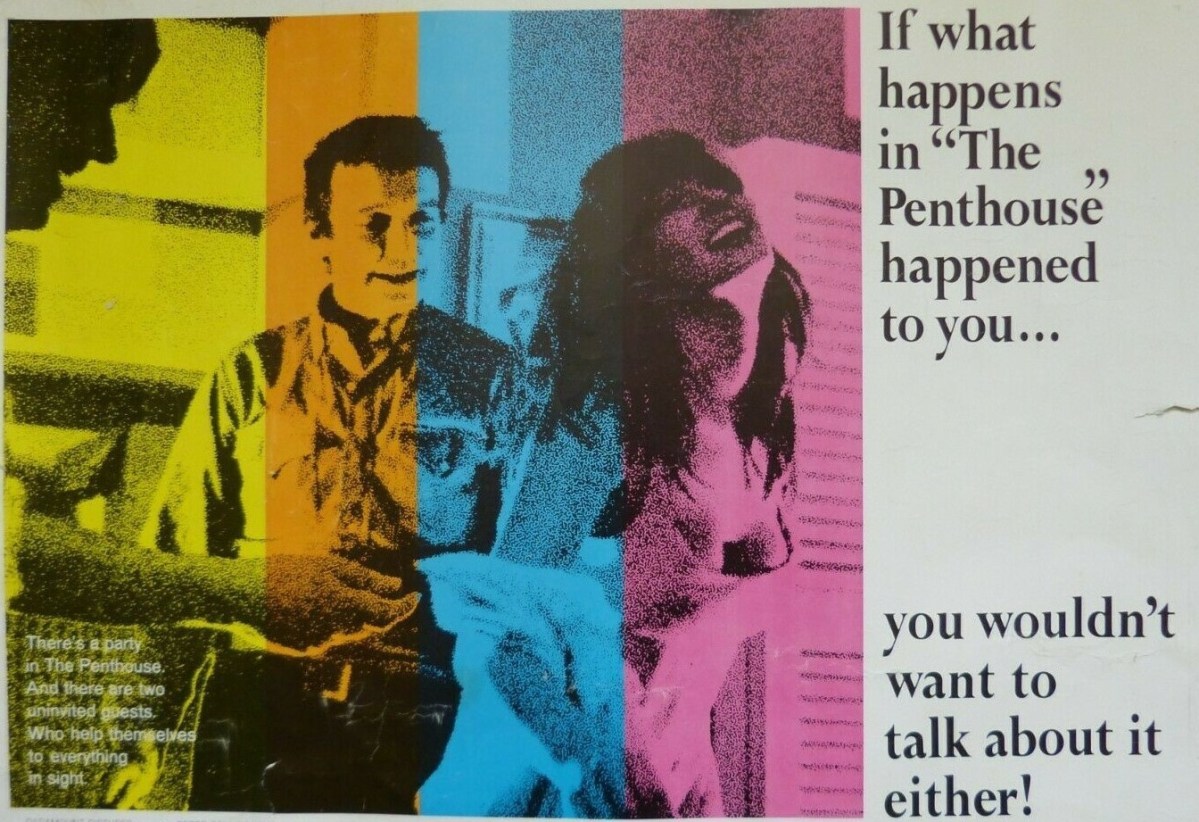
Visceral home invasion thriller that ignited the genre and triggered later more controversial offerings like The Straw Dogs (1971) and A Clockwork Orange (1971). Made virtually on one set for the indescribably minute sum of £100,000, it is charged with Pinteresque dialog and aberrant philosophy. The genre splits into those pictures where the occupants have more than a good chance of avoiding their fate, the focus on the invaded pitting their wits against the invaders – classic examples being The Straw Dogs or more recently Panic Room (2002) – and those where the victims are mercilessly tormented, such as, in grueling detail, here.
As one of the perks of his job cocky married real estate agent Bruce (Terence Morgan) takes advantage of an expensive unoccupied apartment on his company’s books – “in the happy position to take advantage of my clients’ generosity in their absence” as he puts it – to enjoy an illicit tryst with mistress Barbara (Suzy Kendall). But when she answers to the door to two men coming to read the gas meter, their lives are turned upside down.
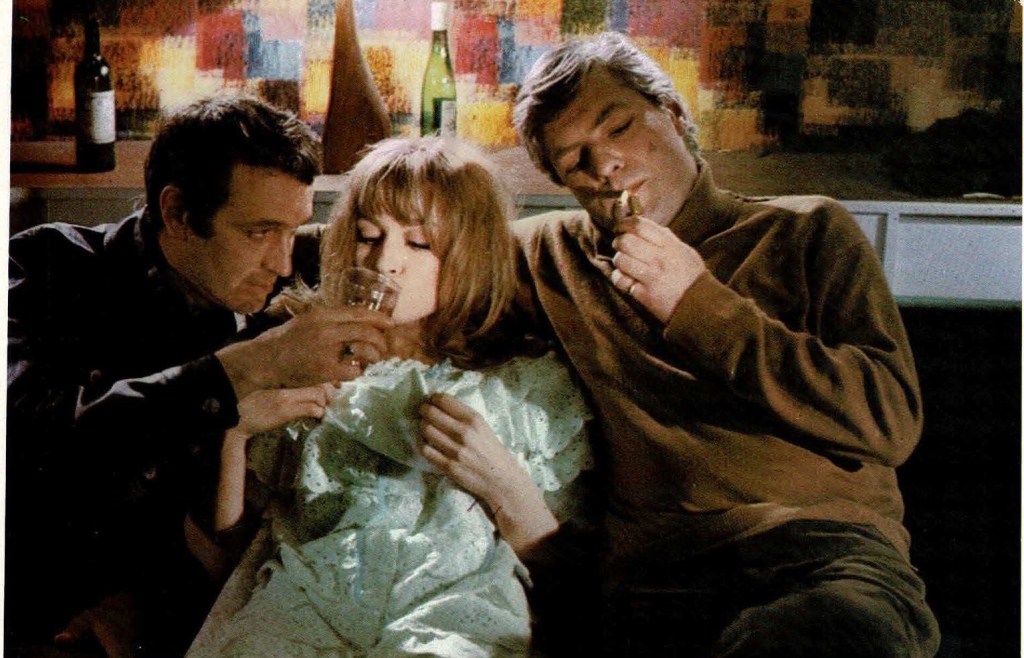
Tom (Tony Beckley) and Dick (Norman Rodway) are, of course, bogus and armed with a knife quickly take control, trying up Bruce and pouring alcohol down Barbara’s throat. As part of the overall creepiness, there is a sense that this is no casual visit, but that it has been planned, as if someone somewhere is familiar with the set-up, and there a debt, if only a moralistic one, to pay as a deterrent to the era’s permissiveness. Minus the knife, they would have passed as harmless. But never was their such difference between word and action, except for what they are capable of you could easily be persuaded that are in fact camp and bitchy.
The bound Bruce’s is spun round in a chair and can only watch as the men begin to strip Barbara. His only defence is verbal, trying to set the two men against each other, suggesting that Tom treats Dick as his assistant. But the relationship between the two criminals constantly shifts as if they were in passive-aggressive relationship. You don’t learn much about them until the end, so basically you have to rely on what they say about themselves, which is very little. They are prone to philosophic observation or interrogate Bruce about his possessions or extract from Barbara an unexpected ambition to be a painter.
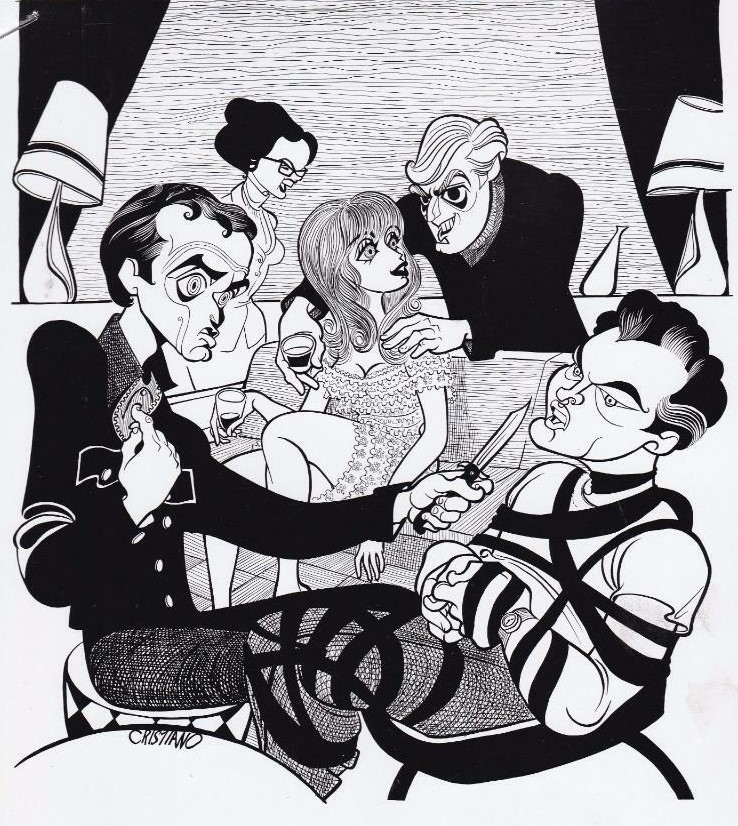
One of the oddest pieces of promotional material ever produced. Studios were keen on this kind of jokey cartoon in the hope that it would be picked up by newspaper editors who might be less inclined to run a still from the picture. But it is completely out of touch with the tone of the movie.
The men take it in turns to torment Bruce while the other is in the bedroom with Barbara. Where Bruce resists verbally, Barbara gives in almost right away, but there is never the sense that this is in any way consensual, just that she is too drunk to defend herself – the first drink is a full glass of whisky forced down her throat – and the men have a knife. The invaders make constant reference to a character called Harry. That person’s eventual appearance provides a whole new range of twists.
It’s a film full of menace. Sexual tension, mind games, claustrophobia and the threat of physical violence never dissipate. Because it is rationed out, the brutality is all the more shocking. But it is brilliantly directed. In his debut British director Peter Collinson (The Italian Job, 1969) uses the camera to suggest we are in anything but an enclosed space. In one long sequence the camera does not move, in another scene it turns 360 degrees – Antonioni’s use of this device in The Passenger (1975) was credited as innovative – and at other times it twists and turns as if turning the characters inside out, suggesting some of the dizziness, the dramatic speed of change of feelings, that the stunned victims are enduring. At times it feels like an arthouse movie. At other times like a deranged B-picture.
The cast are all excellent. Tony Beckley (The Lost Continent, 1968) makes the best of a role of a lifetime, Norman Rodway (Four in the Morning, 1965) the more quietly psychotic sidekick. Terence Morgan (The Sea Pirate, 1966) has less to do but Suzy Kendall (Fraulein Doktor, 1969) is superb as the enigmatic girlfriend. Look out for Martine Beswick (Prehistoric Women, 1967) in a small part. Collinson wrote the screenplay based on a play The Meter Men by Scott Forbes.
Cultural note: “Tom, Dick and Harry” are considered such quintessentially British names that anyone familiar with this would understand immediately that they were a) pseudonyms and b) intended as a twisted kind of joke.
No sign of this being available on Amazon. Ebay is probably your best bet. There’s a copy on YouTube but it ain’t a good print.
The indie movement wasn’t embraced back in the day the way it is now. Occasionally an indie auteur would find favor – John Cassavetes (Shadows, 1958), for example – although it was another decade before he made another movie that carried his particular stamp. With such an abundance of movies arriving from Sweden, Italy and France, critics didn’t have to go far to find material from outside the limited Hollywood prism that they could pump up and make themselves feel important.
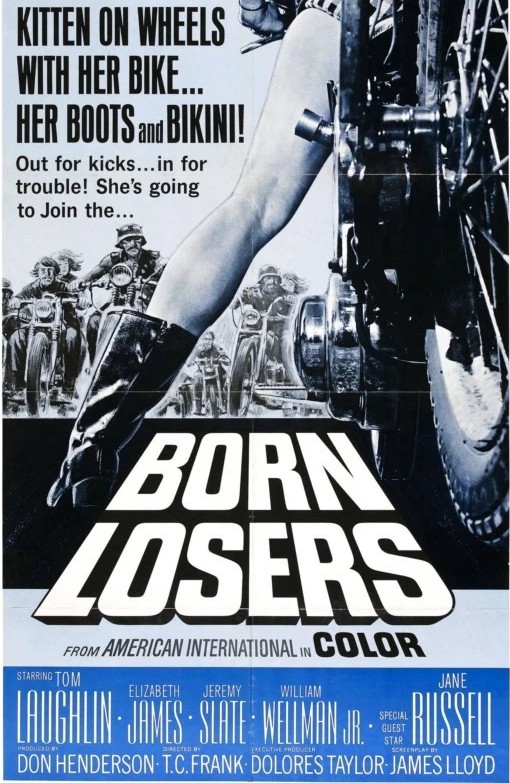
So indie writer-producer-director-actor Tom Laughlin failed to gain notice. There had been no upsurge of critical support for his first two features, The Young Sinner (1961) and The Proper Time (1962), both of whose subject matters should have generated some coverage. In fact, they’re still ignored, not a single reviews for either on Imdb unless you count TV Guide. So when he came to his third picture, The Born Losers, he hid behind anonymity, the movie helmed by “T.C. Frank” and produced by “Don Henderson” with “James Lloyd” (in reality female lead Elizabeth James) allocated the screenwriting credit.
And it was, ostensibly, a biker pic, so no self-respecting critic was going to give it the time of day even though The Wild Angels – 83 critical reviews on Imdb – the previous year had attracted attention though largely through its nepo cast, Peter Fonda and Nancy Sinatra the children of Hollywood legends, in which the bikers were cast as innocent victims of authority.
So critics failed to note that The Born Losers was pretty much the first movie with an ecological theme and that it was probably only the second to deal with racism against Native Americans – Abraham Polonsky, on the other hand, got massive critical mileage for covering the same theme in Tell Them Willie Boy Is Here (1969).
And there’s nothing redemptive about these bikers, not given a free pass as in Wild Angels or deified as in Easy Rider (1969). But the picture certainly emphasizes their attraction, especially to teenage females entranced by what they view as an exciting alternative to Dullsville, USA. Girls are seduced by the image of bikers being akin to old-style cowboys, pioneers of the west enjoying a freedom few others dared even pursue. In the Californian sun girls jiggle around in bikinis, excited at the revving bikes.
Nor is Billy Jack (Tom Laughlin) the kind of two-fisted vigilante protector of the underdog as exemplified by Clint Eastwood and Charles Bronson. In fact, where Eastwood and Bronson generally dodge judgement of their maverick style, Billy Jack gets into more trouble with the law for preventing a young man being beaten to death than the bikers attempting to beat the victim to death.
But unlike the Eastwood and Bronson vehicles, the actor Laughlin isn’t center stage all the time. And that’s primarily what makes the picture work. The director in Laughlin is very even-handed, covering the various aspects that produce a more than tolerable narrative and one that also reflected what would be a later Hollywood trope, the victims too frightened to come forward for fear of further retaliation.
There’s an unusually idyllic opening for a biker picture that telegraphs to the audience this going to be different, Billy Jack surviving with ease in the mountains and bathing under a waterfall. Likewise, Laughlin allows time to build up the two other main characters. Equally, unusually, they both have daddy issues. Wealthy Vicky (Elizabeth James) is devastated when her globe-trotting father fails to turn up for a long-promised rendezvous and biker leader Danny (Jeremy Slate) defies his bullying cop father, who spits in his son’s face. Whatever judgement you pass on the rest of Danny’s actions, he passes muster as a father, affectionately ruffling his son’s hair, and as a brother, standing up for his younger sibling.
You might also be surprised at the fashion statements. Vicky is decked out like Audrey Hepburn with those trademark sunglasses and is apt to take to the road on her two-wheeler wearing a white bikini. Danny wears an ironic version of the Hepburn shades. Whether Vicky’s ensemble is a deliberate attempt to draw comparison with Nancy Sinatra is anybody’s guess but the white boots the college girl wears are remarkably similar to the footwear in Sinatra’s most famous hit.
Once Billy Jack heads for the town, seeking work as a horse wrangler, he hits trouble in part due to overt racism, in part because he refuses to be a bystander when the authorities and citizens fail to act.
There’s an audacious jump-cut that would be the hallmark of more critically-acclaimed directors such as Tarantino, and a scene of bikers arriving over the hill that’s reminiscent of John Ford westerns. And there’s a hint of homosexuality.
Five rapes take place offstage, but their harrowing consequence is not passed over. Mental health is damaged beyond repair, LuAnn (Julie Cohn) afraid to show her face in public, while Vicky is treated as a freak. With the town boasting its “weakest sheriff” and the girls capitulating to intimidation, it’s left to Linda Prang (Susan Foster) to agree to go to court. Luann, though under police protection, is kidnapped, and the bikers capture Vicky and Billy Jack, both girls facing further rape.
There are three stunning twists. Vicky, rather than Billy Jack, saves the day, sacrificing herself to save the Native American. Linda confesses she wasn’t raped, but had gone of her own free will with the bikers before and after the rape charge, in order to spite her mother because the bikers were “everything you hate.” And once justice is done Billy Jack is mistakenly shot by the cops.
While Billy Jack occasionally intervenes, mostly he’s outnumbered and beaten up, so he doesn’t fit the same template as Eastwood and Bronson. And that’s also to the picture’s benefit. This isn’t about the male hero, but male shortcomings and female suffering.
While there’s no great acting, the story is decently-plotted and the emotional jigsaw knits together.
Worth a look, but not if you’re expecting a typical biker picture.
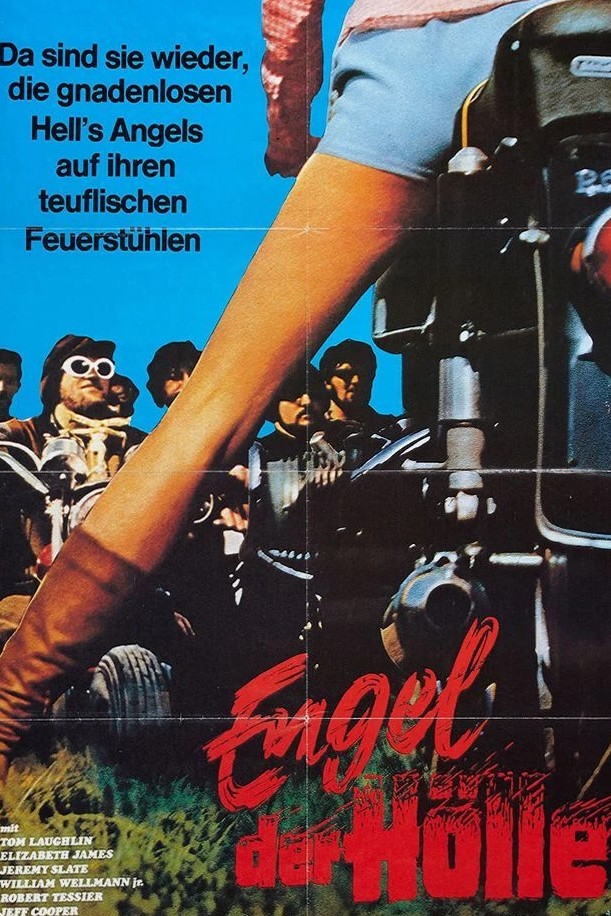
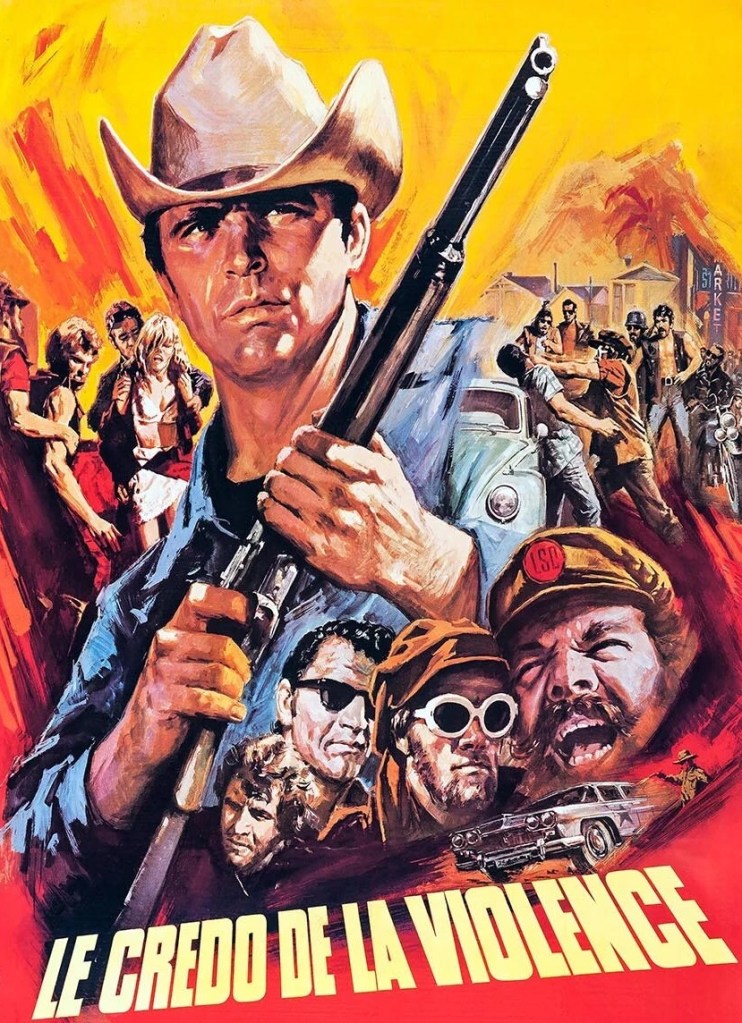
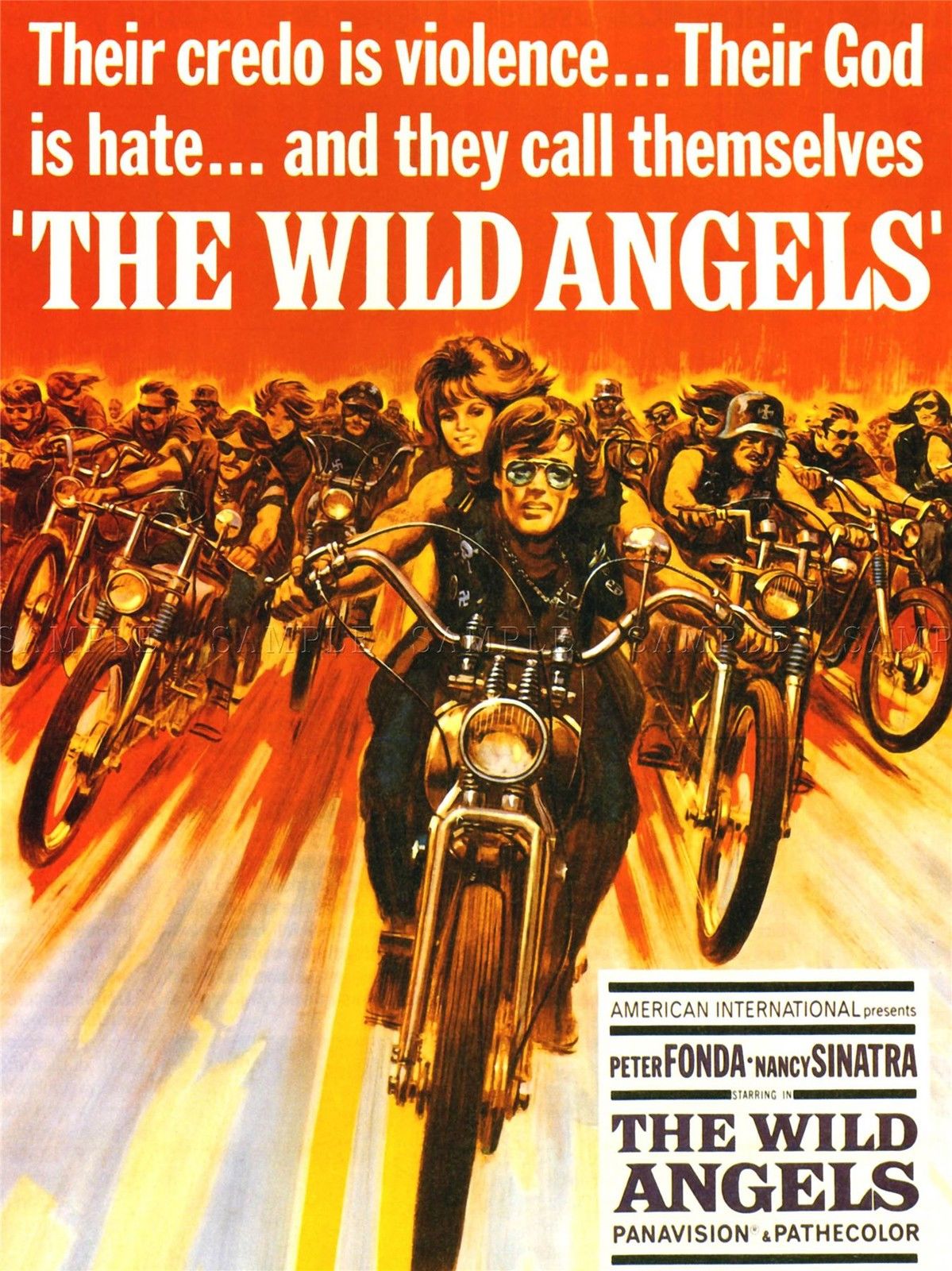
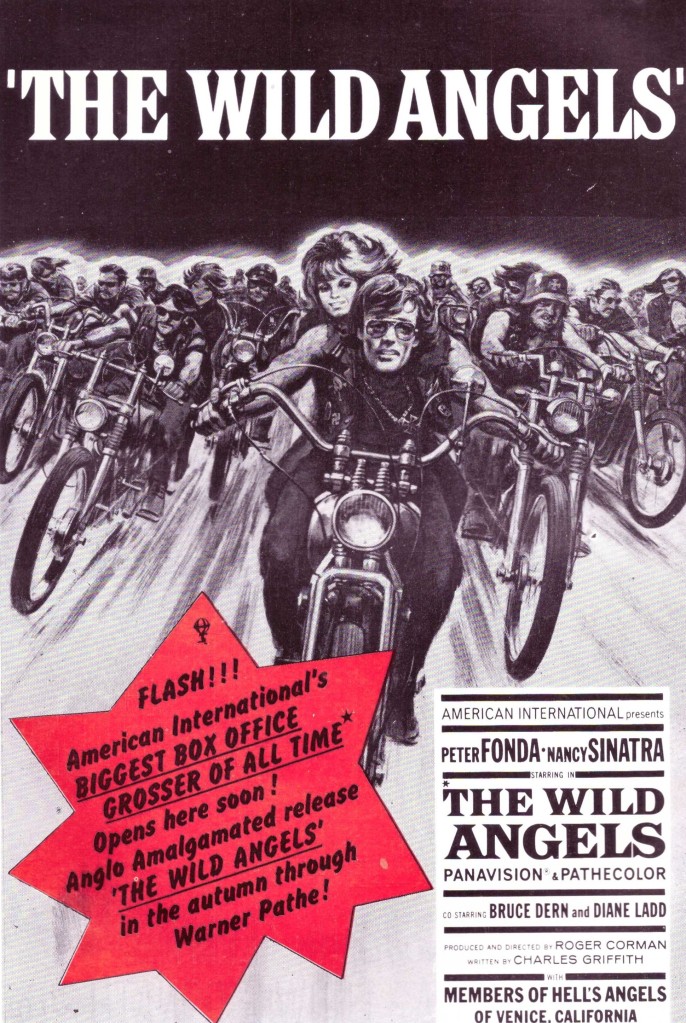
Riders stretched out across a sun-baked valley – you could be harking back to the heyday of the John Ford cavalry western instead of the biker picture, the first in the American International series, that sent shockwaves through society and laid the groundwork for the more philosophical Easy Rider (1969) a few years later. Long tracking shots are in abundance. You might wonder had director Roger Corman spent a bit more on the soundtrack, the bikers just worn beads instead of swastikas, and been the victims rather than the perpetrators of violence how this picture would have played out critics- and box office-wise.
The Wild Angels set up a template for biker pictures, one almost slavishly followed by Easy Rider, a good 15 per cent of the screen time allocated to shots of the Harley-Davidson riders and scenery, and a slim plot. Here Heavenly Blues (Peter Fonda), trying to recover a stolen bike, leads his gang into a small town where they beat up a bunch of Mexican mechanics, are pursued by the cops, hang out and indulge in booze, drugs and sex, and then decide to rescue the badly-injured Joe (Bruce Dern) from a police station. This insane act doesn’t go well and after Joe dies they hijack a preacher for a funeral service that ends in a running battle with outraged locals and the police.
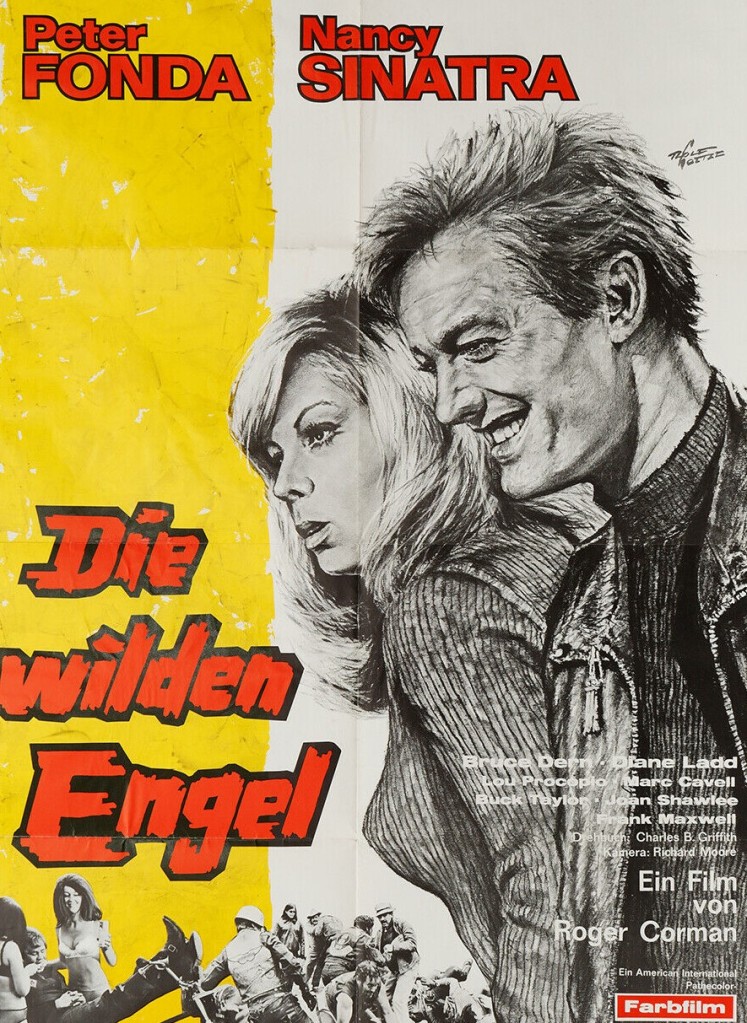
One of the weirdest posters of all time – at first sight it looks like Nancy Sinatra is holding the decapitated head of Peter Fonda in front of her.
There’s an odd subplot, given the lifestyle of freedom and independence, of Monkey (Nancy Sinatra) trying to get a romantic commitment out of Heavenly. Conversely, Heavenly, rejecting the traditional shackles of love, finds himself trapped by grief, eventually and quite rightly blaming himself for Joe’s death, and apparently turning his back on the Angels to mourn his buddy. The decline – or growing-up – of Heavenly provides a humane core to a movie that otherwise takes great pride in parading (and never questioning) excess, not just the alcohol and drugs, but rape of a nurse, gang-bang of Joe’s widow (Diane Ladd), violence, corpse abuse, and wanton destruction.
A ground-breaking film of the wrong, dangerous, kind according to censors worldwide and anyone representing traditional decency, but which appealed to a young audience desperate to find new heroes who stood against anything their parents stood for. In a decade that celebrated freedom, the bikers strangely enough represented repression, a world where women were commodities, passed from man to man, often taken without consent, and racism was prevalent.
Roger Corman (The Secret Invasion, 1964) was already moving away from the horror of his early oeuvre and directs here with some style, the story, though slim, kept moving along thanks to the obvious and latent tensions within the group. If he had set out to assault society’s sacred cows – the police, the church, funeral rites – as well as a loathing of everything Nazi, he certainly achieved those aims but still within the context of a group that epitomized some elements of the burgeoning counterculture.
In retrospect this appears an ideal fit for Peter Fonda, but that’s only if viewed through the prism of Easy Rider for, prior to this (see the “Hot Prospects” Blog) he was being groomed as a romantic leading man along the lines of The Young Lovers (1964). Bruce Dern (They Shoot Horses, Don’t They, 1969) was better suited, his screen persona possessing more of the essential edginess while Michael J. Pollard (Bonnie and Clyde, 1967) was the eternal outsider.
Rather surprising additions to the cast, either in full-out rebel mode as with Nancy Sinatra (The Ghost in the Invisible Bikini, 1966) or hoping appearance here would provide career stimulus as with movie virgins Diane Ladd (Chinatown, 1974) and Gayle Hunnicutt (P.J. / A New Face in Hell, 1968). Sinatra certainly received the bulk of the media attention, if only for the perceived outrage of papa Frank, but Hunnicutt easily stole the picture. Minus an attention-grabbing role, Hunnicutt, long hair in constant swirl, her vivid presence and especially her red top ensured she caught the camera’s attention.
Charles B. Griffiths (Creature from the Haunted Sea, 1961) is credited with a screenplay that was largely rewritten by an uncredited Peter Bogdanovich (The Last Picture Show, 1971).
Like many an ambitious – not to say greedy – actor, Gregory Peck had decided to go into the production business. In theory, there were two good reasons for this: actors could take control of their careers and they could make vanity projects. In reality, there were other over-riding reasons: after years in the business they thought they knew better than their Hollywood bosses and, more importantly, with a bigger stake in a picture they thought they could make more money. First of all came the tax advantages. As a producer, they could spread income over a number of years rather than just one. And they could take advantage of a loophole in the tax laws by making movies abroad. And then if all went as well as the actor imagined, they would get a bigger share of the spoils. If it proved a flop, then the studio carried the can and the actor walked off scot-free.
In 1956 Peck set up Melville Productions with screenwriter Sy Bartlett, with whom he had worked on Twelve O’Clock High (1950). They signed a two-picture deal with United Artists, the go-to studio for actors wanting to become producers. The first projected ideas fell by the wayside, Affair of Honor based on a Broadway play that subsequently flopped and Thieves Market – with William Wyler on board as director – whose commissioned script didn’t meet Peck’s standards. Also on the agenda was Winged Horse with a script by Bartlett and James R. Webb.
Instead, Peck set up The Big Country (1958) through another production shingle, Anthony Productions, and co-produced it with director William Wyler’s outfit, World Wide Productions. The budget rocketed from $2.5 million to $4.1 million, which limited the potential for profit.
Melville Productions launched with Korean War picture Pork Chop Hill (1959). When that flopped it was the end of the UA deal. Peck moved his shingle to Universal. The production company lay dormant while Peck returned to actor-for-hire for Beloved Infidel (1959) and On the Beach (1959), both flops, before jumping back into the top league with the biggest hit of his career The Guns of Navarone (1961) directed by J. Lee Thompson.
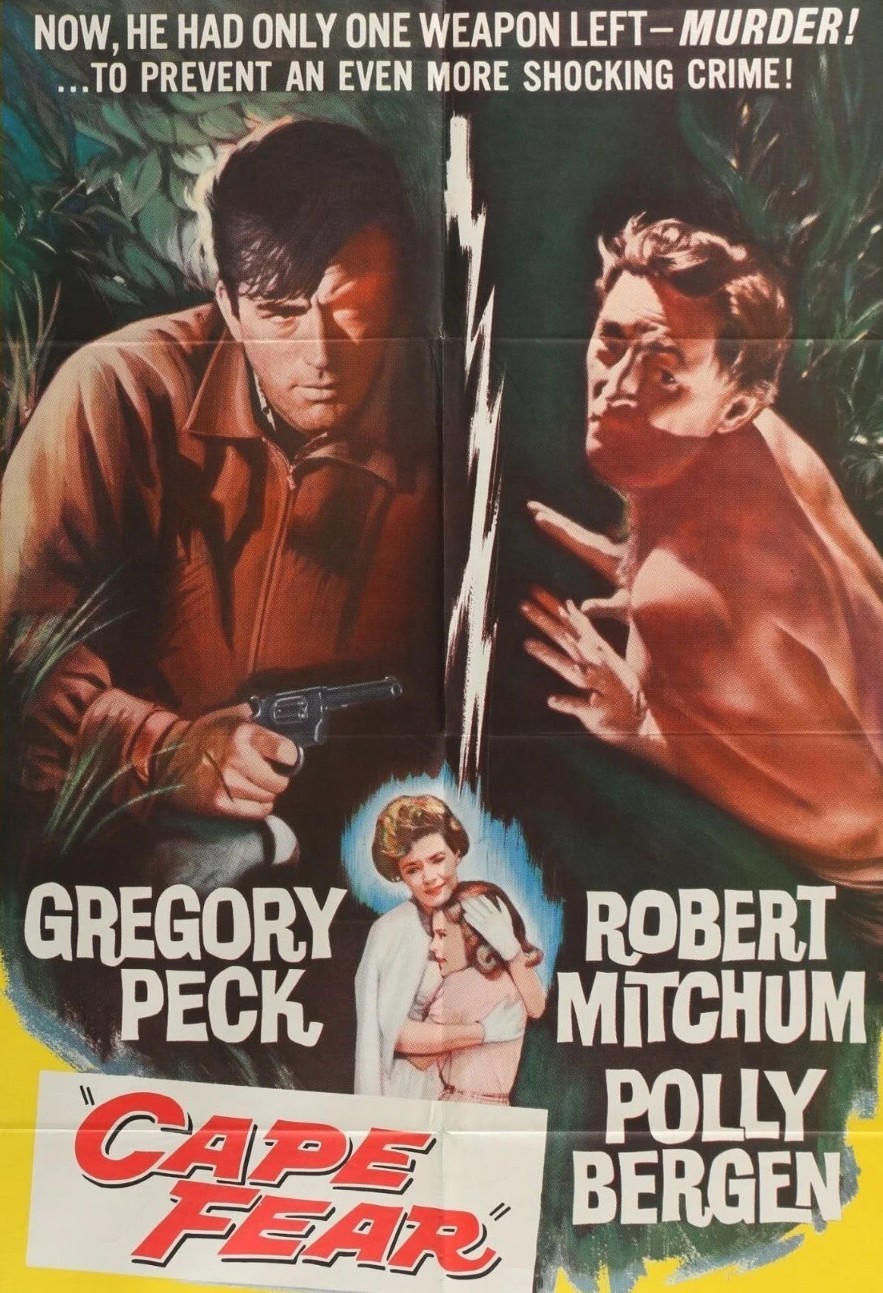
Melville Productions was resuscitated for Cape Fear. Peck and Barlett had purchased in 1958 a piece of pulp fiction (novels that bypassed hardback publication and went straight into paperback) by John D. MacDonald called The Executioners. Bartlett passed on screenwriting duties which were handed to James R. Webb (How the West Was Won, 1962).
Director and star had bonded on The Guns of Navarone. “We were working so well together,” recalled Thompson that when Peck handed him the script of Cape Fear he was intrigued. “I liked the book very much,” said Thompson. “Greg had a script prepared, we signed the contracts, and I came to make my first picture in Hollywood.” (The Guns of Navarone had been filmed in Greece and London).
Though author John D. MacDonald had written a hard-boiled thriller with a merciless killer, screenwriter James R. Webb (Pork Chop Hill) racked up the tension and added a thicker layer of predatory sexuality in the vein of Psycho (1960). The final touch was a Bernard Hermann (Psycho) score brimming with menace.
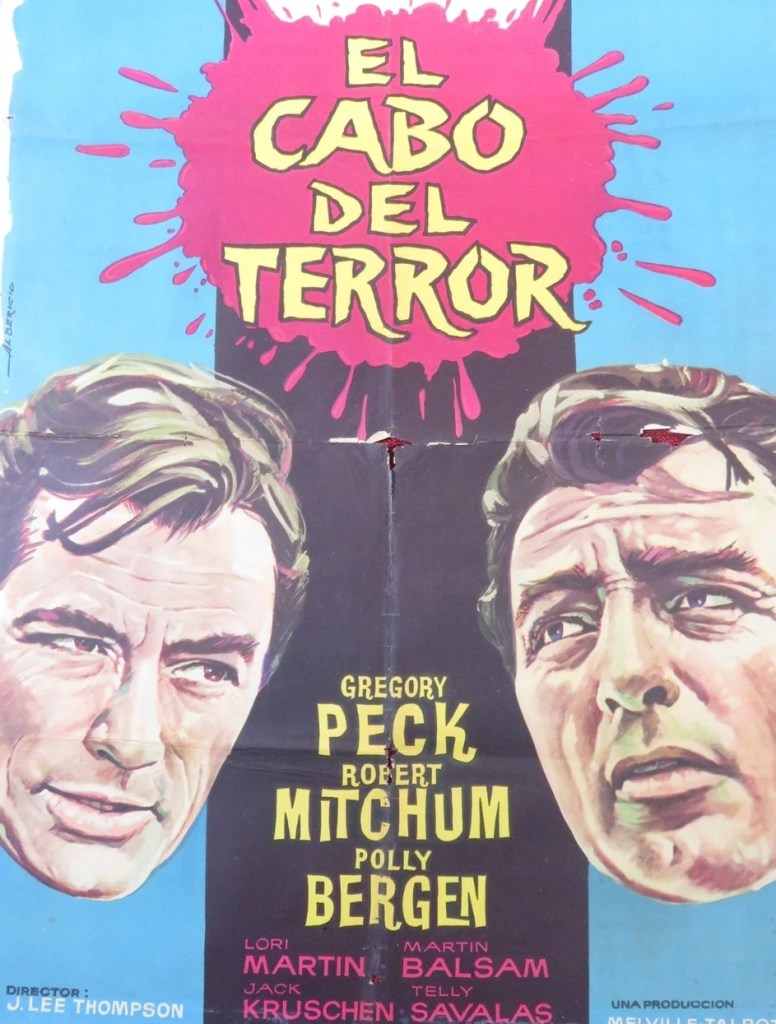
Ernest Borgnine (Go Naked in the World, 1961) was first choice to play psychopathic killer Max Cady. Rod Steiger (The Pawnbroker, 1964), Jack Palance (Once a Thief, 1965) and Telly Savalas (Birdman of Alcatraz, 1962) were also considered. “We actually tested Savalas and he gave a very good test for the part,” explained Thompson. “But these were character actors or at least secondary actors compared to Greg. At some point discussing it together we began to talk about having the villain played by an actor of equal importance, making it a much stronger match-up from the audience’s point of view and (Robert) Mitchum immediately came to mind.”
But Mitchum had essayed a similar venal character in Night of the Hunter (1955) and didn’t want to repeat himself. However, he liked the way the tale showed just how corrupt law enforcement could be and how easily the cards were stacked. Mitchum understood the character from the outset. “The whole thing with Cady is that snakelike charm. Me, Officer, I never laid a hand on the girl, you must be mistaken.”
“When we heard Mitchum’s thoughts,” noted Thompson, “we were more convinced than ever he would be terrific for the role. And I think by the end of the meeting he now realized that himself.” But he still held back, unsure. The producers sent him a case of bourbon. He drank the bourbon and signed up. There was the additional inducement of sharing in the profits by being made a co-producer which involved nothing more taxing than signing on the dotted line. Universal took it on as the first in two-picture deal with Melville.
Mitchum’s career was following its usual up-and-down course, a couple of flops always seemed to be followed by a big hit. His acclaimed performance in Fred Zinnemann’s The Sundowners (1960) had offset The Night Fighters / A Terrible Beauty (1960) and Home from the Hill (1960). His latest picture, The Last Time I Saw Archie (1961) was filed in the negative column.
Peck and Mitchum had opposite approaches to their profession, the former diligent and serious, the latter not able to get off a set quickly enough, not even bothering to learn his lines because thanks to a photographic memory he could scan his lines just before a scene began and be word perfect.
Locations were scouted in the Carolinas where MacDonald had set the book, but failing to find anything suitable exteriors were switched to Savannah in Georgia. Where Peck rented a house and went home every night, Mitchum took a room in the DeSoto Hotel and when work was finished for the day went out drinking, an assistant director taken along as ballast to keep him out of trouble. The town held bad memories for Mitchum. Last time he had visited he had been arrested for vagrancy and did a stint on a chain gang, which recollection possibly put steely bitterness in his portrayal of the ex-convict. Although he hated the town, he liked the idea that on his return everyone was kowtowing to the big movie star, including a bevy of hairdressers in town for a convention.
Fortunately, the Savanah sojourn was short, bad weather getting in the way, barely two weeks before the unit repaired to Hollywood (some of the boat scenes were filmed around Ventura but the climactic fight took place on the studio lake) where the production overshot its schedule by a month, wrapping on July 5 instead of June 8, and racking up $2.6 million in costs.
Mitchum appeared determined to demonstrate quite how different their approaches were. In one scene, off camera, Mitchum stripped naked to get a reaction from the stolid co-star, who remained immune to such provocation. In reality, Mitchum was very professional. “He would work perfectly,” said Thompson. “He just goes in and does it. He was superb.”
Though far from a Method Actor, Mitchum was chillingly close to the part. “I live character and this character drinks and rapes,” he confessed. During the scenes of violence he worked himself up. “He made people frightened,” acknowledged Thompson.
And that included Peck, especially during the slugfest in the water which took nearly a week of a night shoot to complete. Despite warmers being put in the water, it was freezing. “Sometimes, Mitchum overstepped the line,” said Thompson. “He was meant to be drowning Greg and he really took it to the limit…but Peck never complained.”
The final scene filmed was the rape of Polly Bergen playing Peck’s wife. Bare-chested and sweating, Mitchum built himself up into a fury. “You felt any moment he would explode,” said Thompson. “But there was no rehearsal, so nobody really knew what to expect. Thompson improvised the business with the eggs. But Mitchum was more brutal with the eggs than could ever be shown in a cinema, smearing the yolk over Bergen’s breasts. He cut his arm flailing wildly and he used the actress to break open the cabin door, so she finished the scene with the front of her dress sodden with egg yolk and the back covered in blood.”
While Peck expressed confidence in director J. Lee Thompson and could count on Mitchum’s experience to see him through, female lead Polly Bergen was making her first film in eight years, after a small part in western Escape from Fort Bravo (1953) starring William Holden. She had come to wider attention for winning an Emmy for The Helen MorganStory (1958).
“Greg spent an enormous amount of time with me,” said a nervous Bergen, “He was wonderful and he was very, very supportive.” She added, “I wouldn’t have let anyone know how insecure and frightened I was. But he, I think, knew that instinctively and was there to set me at ease and be helpful and nurturing.”
Peck had no worries about Thompson, the situation helped by the director appearing to take the line the producer-star wanted. When it came to editing, Peck played fair with Mitchum, resisting the temptation to tone down his co-star’s performance which threatened to overshadow his own.
The censors were livid. They eliminated all mention of the word “rape”, removed most of Mitchum’s ogling of Peck’s daughter and cut to the bone the sexual assault.
While critics tended to agree that Mitchum stole the show, the movie was mauled by the New York Herald-Tribune as a “masochistic exercise” and the New Yorker took Peck to task for becoming involved in “an exercise in sadism.”
Initially, it appeared to be doing well enough. There was a “big” $37,000 in New York, a “giant” $29,000 in Chicago, a “fancy” $14,000 in Cleveland, a “rousing” $18,000 in San Francisco and a “proud” $14,000 in Boston. But the “expectancy of lush performance” did not materialize. Final tally was $1.6 million in rentals, a poor 47th in the annual box office rankings, so there were no profits for Peck or Mitchum to share.
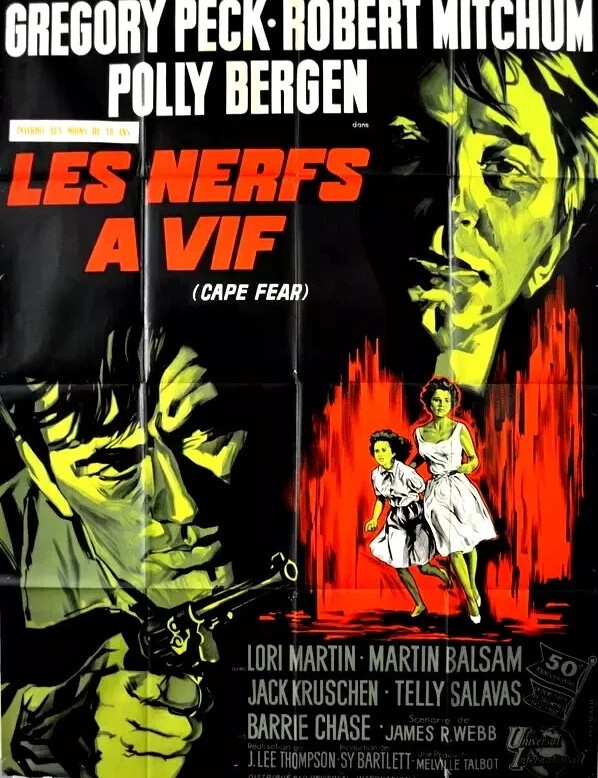
The British censor demanded five minutes of cuts. Thompson made headlines by claiming that 161 individual cuts, a record, had destroyed the film but censor John Trevelyan argued it was just 15. Despite claiming the movie would not be shelved until the controversy had died down, in fact it lost its May 1962 premiere slot at the Odeon Leicester Square in London’s West End and was held back until the following January when it opened at the less prestigious Odeon Marble Arch, setting a record for a Universal release. Bergen was furious at the cuts in her role. “I really blasted British censorship.”
Ironically, Peck made more money from selling the rights to Martin Scorsese for the 1991 remake, in which he had a small part, and whether it’s the Peck estate or Scorsese who benefits there’s a 10-part mini-series on the way starring Patrick Wilson (The Conjuring: Last Rites, 2025) as the attorney, Amy Adams (Nightbitch, 2024) as his wife and Javier Bardem (Dune, Part Two, 2024) as their tormentor.
SOURCES: Gary Fishgall, Gregory Peck, A Biography (Scribner, 2002) pp197-198, 208, 225-228; Lee Server, Robert Mitchum, Baby, I Don’t Care (Faber & Faber, 2001) p43-437; “Peck-Bartlett Spanish Pic Halts,” Variety, February 13, 1957, p2; “U Gets Melville Pair,” Variety, July 29, 1959, p18; “U Repacts Bartlett,” Variety, September 28, 1960, p4; “Director of Cape Fear Claims British Censor Demands Too Many Cuts,” Variety, May 9, 1962, p26; “Censor Replies to J. Lee Thompson,” Kine Weekly, June 28, 1962, p6; “Classification-Plus-Mutilation,” Variety, December 19, 1962, p5; “Your Films,” Kine Weekly, February 7, 1963, p14. Box Office figures: Variety April-May 1962 and “Big Rental Pictures of 1962,” Variety, January 9, p13,
Portraying legal poster boy Atticus Finch in To Kill A Mockingbird (1962) might well have been an act of redemption for Gregory Peck after his portrayal, a few months earlier, of this attorney who has little compunction in walking down the same mean streets as the criminals he wishes to see put away. And it just goes to show how thin the line is between upstanding façade and killer, no matter the excuse or provocation.
Attorney Sam Bowden (Gregory Peck) isn’t permitted as much leeway as you might expect when ex-con Max Cody (Robert Mitchum) turns up in his small town. This could as easily have played out as the virtuously good guy and family being hounded by a thug who would have spent most of his life being prosecuted for crimes except his victims usually failed to bring charges on account of their fear of retribution. Trigger the animal in him for sexual purposes and you’re lighting a fuse that leads directly to violence.
From the audience perspective, the cards should have been stacked against the villain, but that’s not the case here, not when the good guy begins to act more and more like a bad guy, persecuting him, through his police connections, with a string of arrests for crimes of which he is innocent, unable to put the finger on him for the vicious assault he does commit and generally been outwitted by a fella who knows the law a damn sight more than the lawyer.
Bowden isn’t your usual harassed victim, standing up stoutly against criminality, but a man crumbling under pressure and the frustration of being out-thought by the enemy and itching to get it over with the easiest way possible by finding an excuse to kill the perpetrator.
So, yes, if you’re that way inclined, you can view it as an attack on the American justice system that allows villains with criminal intent not to be incarcerated for considering committing a crime. But that’s not the way it plays out, not when Bowden uses every sleazy trick in the legal book to head off Cody, eventually attempting bribery, and when that doesn’t work hiring a gang of thugs to beat him up and when that also fails planning how to draw him into the kind of trap that would allow legal assassination.
So, now Bowden’s every bit as devious as his pursuer and much worse because he’s willing to stake out wife and daughter as bait for a known sexual predator. He seems to have no inkling of the fate that could be in store for his family should his clever plan go wrong and little compunction or remorse about the criminal intent in his own mind.
Back in the day it would have been easier to accept this kind of narrative, that you can step outside the law to protect your family (a trope that would burn through the 1970s once the vigilante was represented by the likes of Charles Bronson and others), but a contemporary audience is more likely to take a more jaundiced view of the good guy “forced” into bad action. Instead of hiring a private detective (Telly Savalas) to keep tabs on Cody, Bowden could as easily invest – and he has more than enough money – in a security guard to watch over the house and family.
So, even as we’re fearing for wife Peggy (Polly Bergen0 and teenage daughter Nancy (Lori Martin) we’re beginning to put the blame for their plight plumb on the shoulders of the upstanding lawyer who thinks he’s smarter than the most dangerous villain this side of Hannibal Lecter.
If there’s a happy ending, you’re left with wondering just what the heck that’s going to look like. Bowden has allowed his wife to be raped and his daughter scared so witless she’ll be mentally scarred for life, and him unemployable, courtesy of being struck off for breaking the law.
And this is all filmed in classic noir style, moody lighting, shadows and darkness squeezing out what little light there is, emphasizing the danger that lurks on the dark side. And a terrific showdown on a boat. But director J Lee Thompson (The Guns of Navarone, 1961) does just as well without going down the obvious noir route. Robert Mitchum never just strolls. He walks with intent, combining panther walk and erect carriage. So, the tracking shots of him approaching the camera, and therefore some potential victim, are enough to give the audience the message.
Robert Mitchum (The Sundowners, 1960) steals the show with his quiet menace and soft drawl. This appeared before How the West Was Won (1962) where Gregory Peck played a con man and after The Guns of Navarone (1961) where he played the action hero’s hero, so this would be the first audience had seen of a switch in the actor’s screen persona. Usually, he’s the guy who can handle pressure.
Polly Bergen (Kisses for My President, 1964) is excellent as is Lori Martin (The Chase, 1966) whose default early on, for narrative purposes, is fear. Look out for Martin Balsam (The Anderson Tapes, 1971) as a complicit cop and Telly Savalas (The Assassination Bureau, 1969).
Superbly directed by J. Lee Thompson. Written by James R. Webb (How the West Was Won) from the novel by John D. MacDonald (Darker than Amber, 1970).
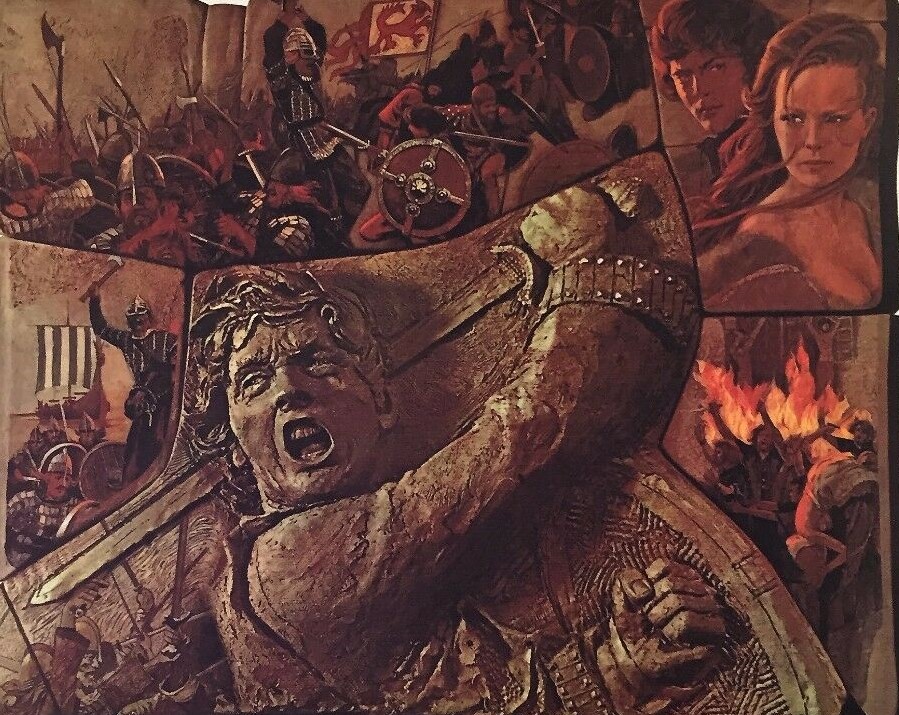
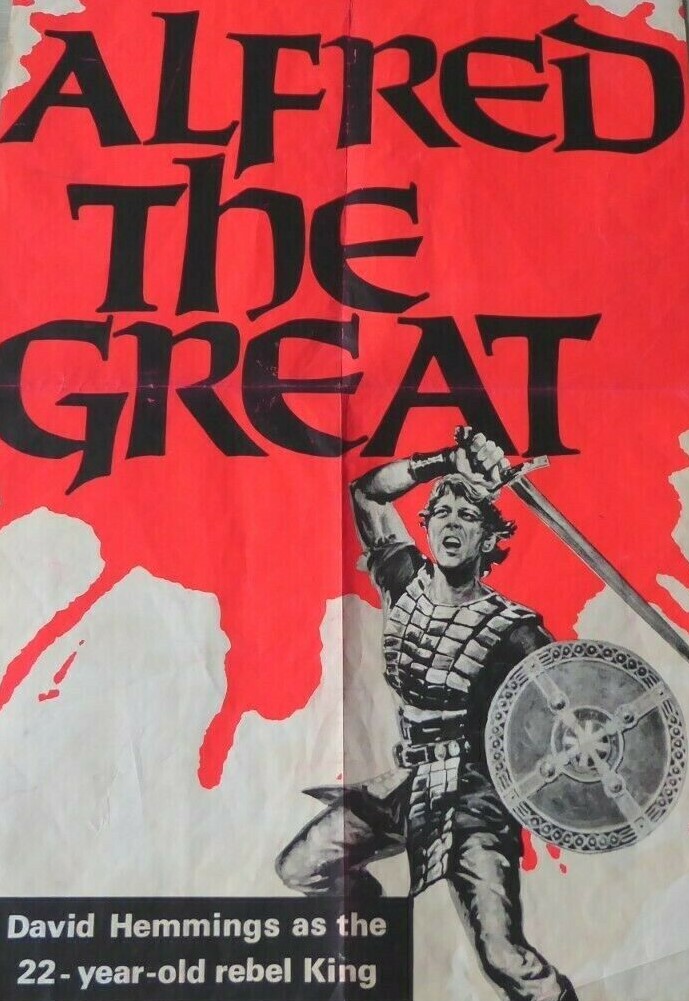
The Prince Who Wanted To Be A Priest. The King Who Didn’t Want To Fight. The Husband Who Raped His Wife.
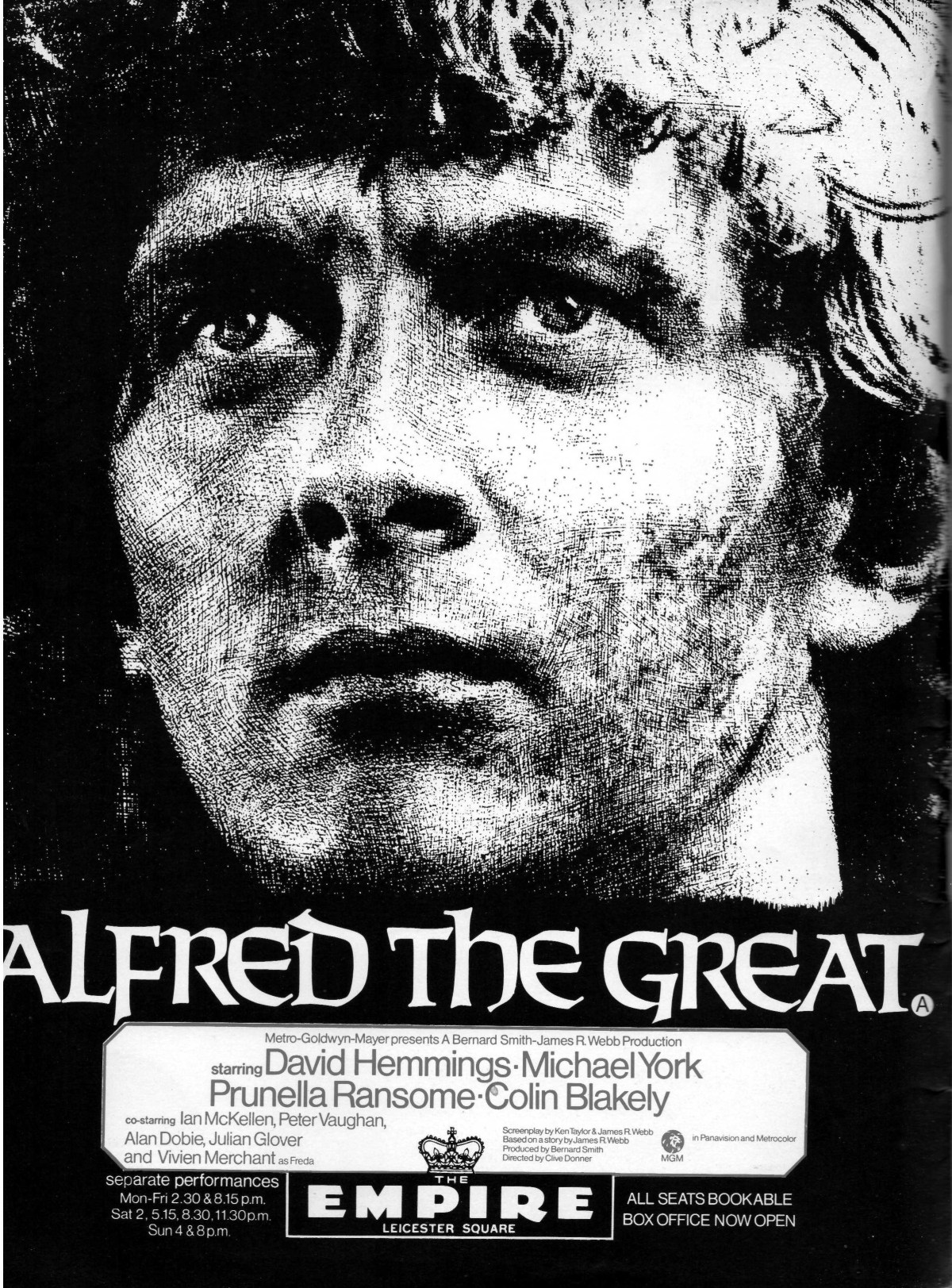
Not exactly taglines in the grand tradition of Gladiator (1999), but a succinct analysis of a Film That Wanted To Be A Roadshow. This is almost an anti-epic, a down-n-dirty historical movie far removed from El Cid (1961), Lawrence of Arabia (1962) and The Fall of the Roman Empire (1964). And one element that has to be taken into consideration when making a historical picture set in Britain in AD 871, if you are aiming for realism, is the rain. The battles in the three movies mentioned, as with virtually every historical movie of the decade, took place in bright sunshine on hard ground, not in the rain on mud-soaked fields. Director Clive Donner lacks the genius of an Akira Kurosawa who turned rain into a glorious image in Seven Samurai (1954) or even Ridley Scott whose first battle in Gladiator took place in a snowstorm. But he does make a battleground reflect the grim reality.
Alfred (David Hemmings) was fifth in line to the throne – and just to a small region of England called Wessex – and as was common practice all set, quite happily, for a career in the priesthood. So it was not surprising, envisioning religion as a mark of civilization, and the priesthood guaranteeing an education, that he was loathe to become a warrior just because his brother King Ethelred (Alan Dobie) was a useless leader. The price of taking on the warrior’s mantle and, after his brother’s death, of ascending to the throne is that Alfred must not only cast away his priestly ambition but his chastity in order to get married to unify rival kingdoms and produce an heir. So there’s a good deal of the religious quandary of El Cid and the sexual ambivalence of Lawrence of Arabia.
So repelled by what he is forced to do, that on his wedding night Alfred rapes new wife Aelhswith (Prunella Ransome) and when the marauding Vikings win a decisive battle and the price of peace is the wife taken in hostage Alfred offers no great protestation. So Alfred is hardly an appealing character. His wife hates him so much that she conceals her pregnancy from him. If you were an Englishman you might well prefer the straightforward lustful Viking leader Guthrun (Michael York) whose men are not restrained by Christianity – “it’s a strange religion,” he mulls, “ that wars with everything your flesh and your blood cries out for” – who makes a better fist of wooing Aelswith, whom he could as easily rape, than Alfred.
Eventually, of course, Alfred gets it together, rallies a bunch of outlaws and steals back wife and son (now four years old). However, there is no romantic reunion. Instead, he plans to imprison her for life, “the whore shall rot in silence.” Nonetheless, Alfred has acquired some tactical skills, adopting the old Roman infantry tactic of forming his troops up in a phalanx behind a wall of shields. His battlefield address is to promise ordinary people a set of laws that will give them equality with the wealthy and powerful.
Given there are no castles and this is indeed the Dark Ages as far as costume and interior design is concerned and that therefore the camera cannot, for respite, be turned onto some glorious image, Clive Donner (Here We Go Round the Mulberry Bush, 1968) concentrates on character rather than scenery. There are a couple of inspired touches. For a start, in permitting various characters to offer prayers to God, he introduces a number of soliloquies which take us to the heart of troubled souls, and then he does a clever split-screen number to effect a transition. You can’t blame him for British weather and the battles are well-staged. He does show the courage of his convictions in making the film concentrate on conflicted character rather than going along the easier heroic route of underdog rallying people to a cause.
David Hemmings (Blow-Up, 1966) is both the film’s strength and weakness. He is excellent at capturing the torment, the soul divided, and the inherent arrogance as well as the preference for peace instead of war. But in terms of his leadership skills he is on a par with Orlando Bloom in Kingdom of Heaven (2005). That part was originally intended for Russell Crowe and Peter O’Toole was first choice for Alfred and you can’t help thinking both would have been a substantial improvement. On the other hand, Alfred was just 22 when he became king and for someone intent on the priesthood there would be no need for him to develop his physique or political skills. So this is a far cry from your typical Hollywood hero and in that regard the casting makes perfect sense and Hemmings a bold actor to take on such an unlikeable character.
Prunella Ransome (Man in the Wilderness, 1971) does well in her first leading role, suggesting both vulnerability and independence and while virtually imprisoned by both Alfred and Guthrun remaining principled. Michael York (Justine, 1969) was a definite rising star at this point and plays the Viking with considerably more gusto than his tendency towards passive characters would suggest.
There’s virtually a legion of excellent supporting players in Colin Blakely (The Vengeance of She, 1968), Alan Dobie (The Comedy Man, 1964), Ian McKellen (Lords of the Rings and X-Men), Peter Vaughan (A Twist of Sand, 1968), Vivien Merchant (Accident, 1967), Barry Evans (Here We Go Round the Mulberry Bush, 1968), Sinead Cusack (Hoffman, 1970), Christopher Timothy (All Creatures Great and Small, 1978-1990) and Robin Askwith (Confessions of a Window Cleaner, 1974).
Oscar-winner James R. Webb (How the West Was Won, 1963) was an improbable name to be attached to a British screenplay. But this was a pet project he had been trying to get made since 1964. Ken Taylor (Web of Evidence, 1959) was brought in to lend a hand.
Not being a student of English history but familiar with the ways of the movie business, I am sure the picture has many historical inaccuracies, but it does present one of the most complex individuals ever to feature in a historical film of the period, when audiences preferred their heroes more black-and-white. So it is a significant achievement in the canon.
As his popularity in the 1960s faded, Marlon Brando was often called upon to save, or greenlight, a picture unworthy of his talent. Except that director Hubert Cornfield failed to extract enough tension from a kidnap thriller with an inbuilt deadline and a double-crossing sub-plot this might have been one to rise out of the mediocrity.
It’s not unknown for strangers working together on a robbery to adopt pseudonyms, colors in the case of Reservoir Dogs (1992) or cities as in Spanish television hit The Money Heist. Here they are known by their designated tasks, which seemed a nod towards artistic pretension at the time. Even so, the gang have too many frailties for taking on a caper like this, the pressure of a deadline and the publicity their crime attracts exacerbating the situation. So kidnapping a millionaire’s daughter (Pamela Franklin) are: Chauffeur (Marlon Brando), in on the job because he owes a favour to Friendly (Jess Hahn), whose sister Blonde (Rita Moreno) is also the chauffeur’s drug-addict girlfriend, the psychopathic Leer (Richard Boone) and a pilot (Al Lettieri).
All except the pilot are holed up in a remote beach house in France. The first signs of cracks show when Blonde is so drugged up she fails to collect her colleagues from a small local airport and, when suspecting the chauffeur of having sex with the girl, she explodes in a tantrum. And because she can’t get her story straight she attracts the attention of a local cop (Gerard Buhr). Despite making a good job of calming down the terrified girl, Leer has other plans for her which the Chauffeur is constantly trying to thwart. At various points various people try to quit. At various points romantic and family ties are pulled tight.
The details of the cash hand-over are well done as is the unexpected double-cross and the diversion allowing them to escape but about ten minutes of the running time is people driving around in cars, only at the later stages to any useful dramatic purpose, time that would been better spent filling us in on the characters. Most of the tension derives from a gang with two loose cannons and certainly the wait for the confrontation between Chauffeur and Leer is worthwhile.
The biggest plus point is Marlon Brando (The Chase, 1966) and even – perhaps because of – sporting a blonde wig and black tee-shirt remains a compelling screen presence. He might have been slumming it but he is certainly believable as the minor criminal way out of his depth. It’s a mistake to think of him as intended to exude menace along the line of Quint in The Nightcomers (1971) because this is actually a complicated role. On the one hand he clearly never wanted to be involved, participation triggered by a sense of honor, trying to keep his girlfriend and the kidnappee safe while at the same time happy to resort to considerable violence to achieve his ends.
The malevolent Boone (The Arrangement, 1969) almost steals the show, beginning as the voice of reason and gradually succumbing to his inner vices. The love interest benefits from Brando and Moreno (West Side Story, 1961), also in blonde wig, being ex-lovers in real life and it takes little to ignite the anger in Moreno. But her portrayal of the addict who cannot stay off her chosen poison long enough to carry out a simple task is excellent. Pamela Franklin (The Prime of Miss Jean Brodie, 1968) has little to do except look scared and she has one revealing scene when in attempting to seduce the Chauffeur sets up the prospect of a different kind of liaison with Leer.
Hubert Cornfield had not directed a picture since Pressure Point (1962) which acted as a decent calling-card and showed how good he was at creating tension between opposing individuals. Instead of focusing here on the characters, Cornfield seems more interested in the visuals, none of which as it turns out are particular arresting and in one instance virtually impossible to see what is going on.
Not so much a curiosity as a masterclass in how to blow a once-in-a-lifetime gig with Marlon Brando and what not to do with a thriller.
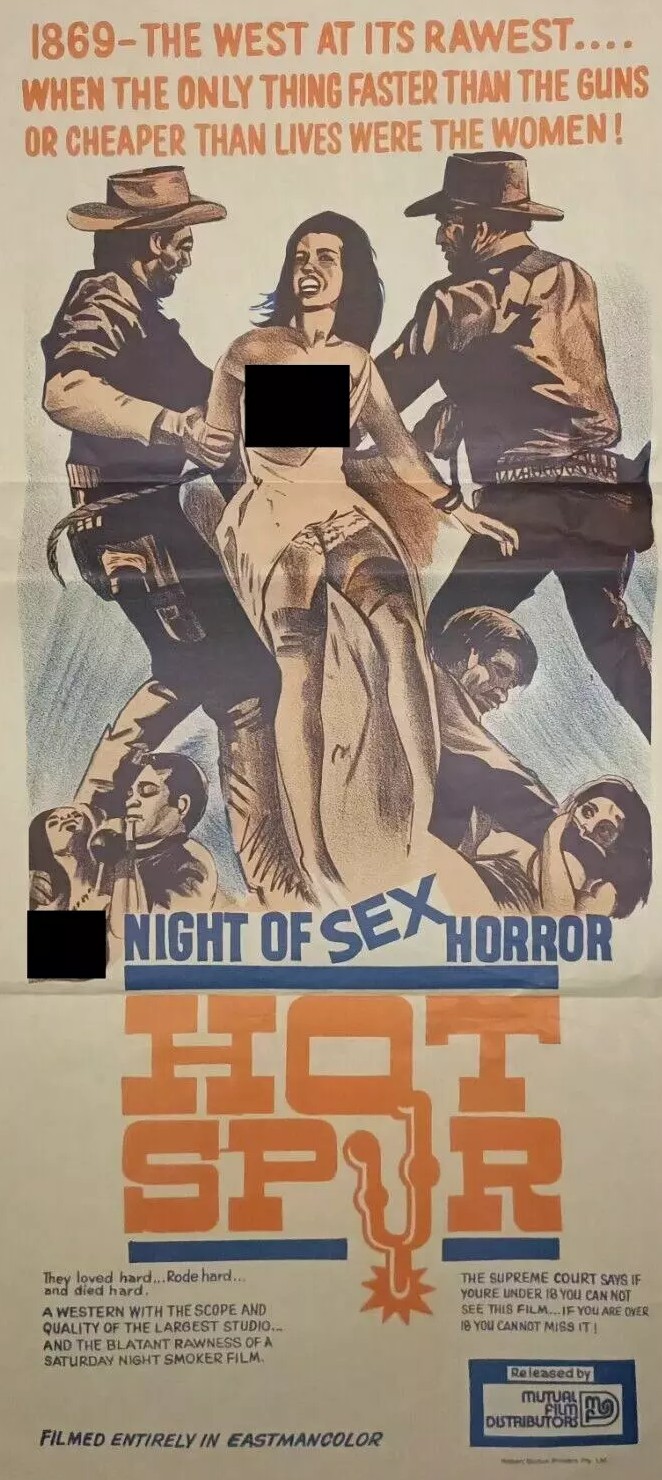
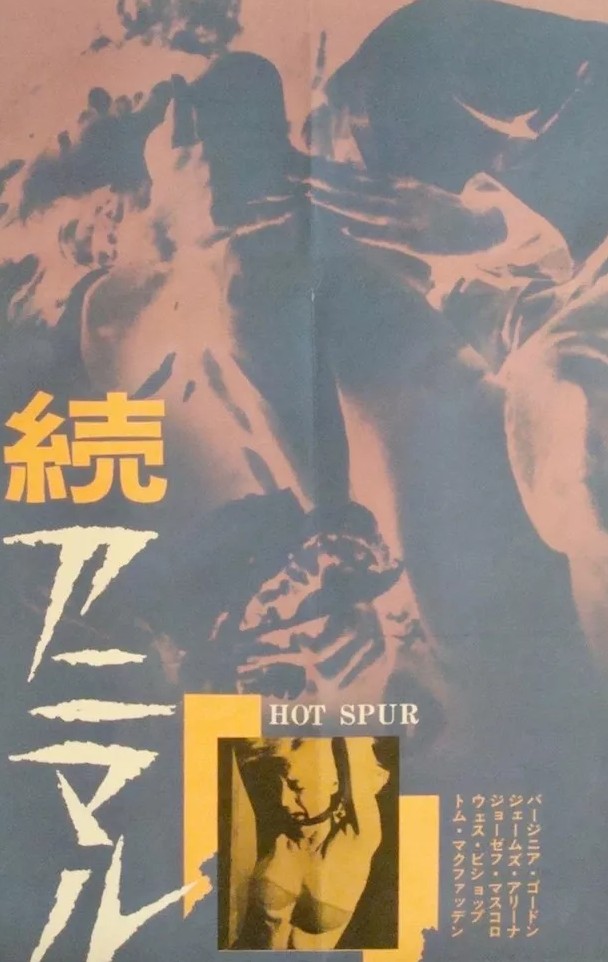
Blame the algorithm. Once I had to my great surprise found The Hunting Party (1971) on Amazon Prime the streamer decided that my next port of call should be another rape-filled western. There are only two things to recommend this – firstly, it makes The Hunting Party look like a masterpiece, and secondly it was filmed at the Spahn Ranch made famous by Quentin Tarantino’s Once Upon a Time in Hollywood (2019) and as the place where the Charles Manson gang hung out before going on a murder spree.
One element of this picture will chime with the contemporary audience. Here, rape is used as a weapon, an unfortunate development in the last half century during a variety of vicious wars. As ever, woman is the innocent victim while man has convinced himself this is not only necessary but justified.
There’s maybe another echo if you want to be generous – of the sequence in Once Upon a Time in the West (1969) where Harmonica (Charles Bronson) is forced to witness the death of his older brother. Here Mexican stable hand Carlo (James Arena) witnesses the multiple rape and beating of his older sister who subsequently commits suicide. So he’s on a mission to track down the perpetrators.
Which leads him to the O’Hara ranch, where he is treated with racist and physical abuse. Ranch owner Jason (Joseph Mascolo) handles wife Susan (Virginia Gordon) badly, blaming her for not providing him with a son and heir. Their love-making is on the rough side and she seeks comfort among the cowhands, who prefer keeping their jobs to a roll in the hay with the boss’s wife.
Carlo kidnaps her. And at first you think she’s going to be used as bait to attract Jason, the last of the rapists of his sister, to a remote mountain shack. But, in fact, Carlo plans to eliminate pretty much the entire complement of ranch hands, hiding weapons at various ambush points on the trail and planting a bear trap in the ground.
But he’s got worse in mind. And apologetic though he is towards Susan, his plan is to make her suffer like his sister, which means tying her up, raping her and striping her back with a whip. The only good bit, if you can call it that, in this picture is that at the end Susan knifes to death her husband and escapes.
There’s one other bit that initially looks good and then tumbles into incomprehension. Jason has sent an advance scout up the mountain and told him to fire one shot if his wife is up there and two if she’s not. The cowboy doesn’t get the chance, Carlo killing him with two shots. So, registering this, Jason believes they’re on the wrong trail but then for no apparent reason continues up the same route.
From the amount of sexuality and nudity on show I guess, given the times when Hollywood was still only nibbling away at the edges of what was permissible, this was made for an entirely different audience than the standard fan of westerns. All women are present just to be used and abused.
Directed by one Lee Frost, whom imdb rates as “one of the most talented and versatile filmmakers in the annals of exploitation cinema.” Cowritten with producer Bob Cresse.
As it happens, those Amazon Prime algorithms did send me to a whole horde of westerns, some of which like Hombre (1967) and Support Your Local Sheriff (1969), I’ve already reviewed here. I’ll plunder this stack some more but take a more judicious view of what I watch.
Colossal flop and deservedly so. One of the most repellant pictures of a down’n’dirty decade.
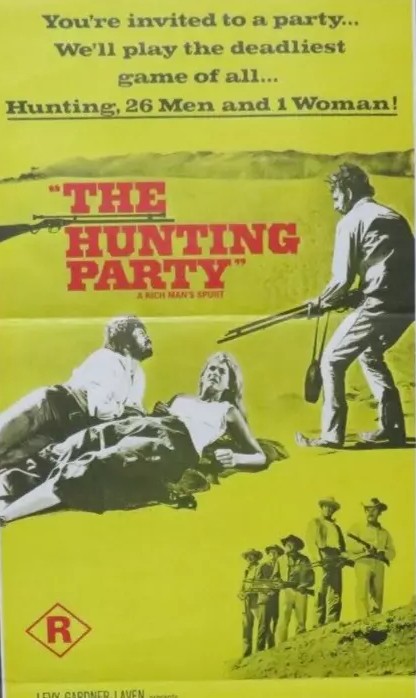
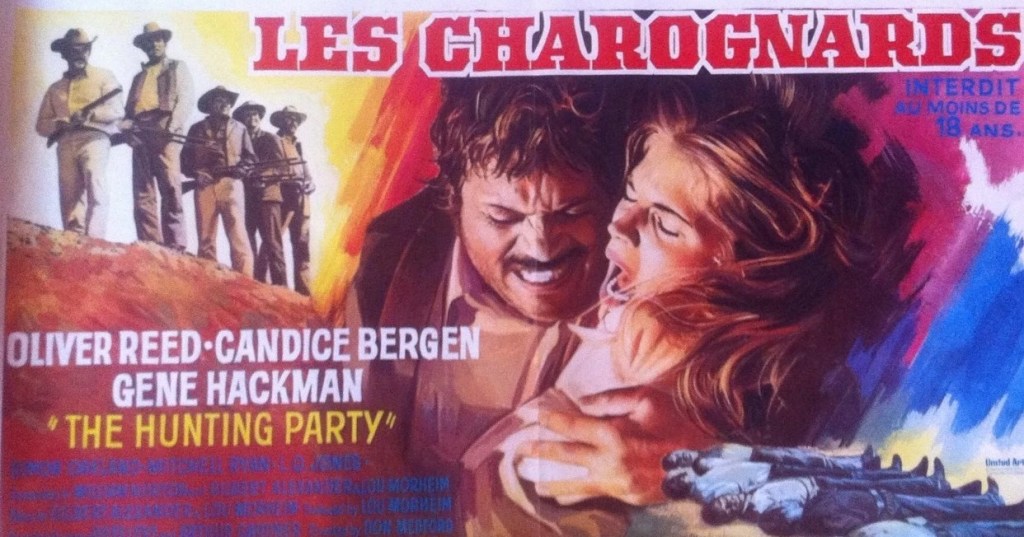
It’s not just that rape takes center stage – two completed both supposedly by men in love with her and two attempts by more obvious scum – but that cattle baron’s wife Melissa (Candice Bergen) has to choose between murdering rapist husband Brandt (Gene Hackman) and murdering rapist outlaw Frank (Oliver Reed).
There was an unwelcome trend for consensualizing rape – Straw Dogs (1971) took the same approach – that a woman in a state of some terror would nevertheless warm to her molester. This is the worst kind of male fantasy fulfilment and that taking a women by force will nonetheless make her fall in love with you.
Just how keen Melissa is on her rapist is shown by her various attempts to knife him and escape. Which, of course, Frank dismisses in a version of that old trope, “you’re beautiful when you’re angry” in that he likes a spirited woman.
The otherwise cold-blooded Lee Marvin character in Prime Cut (1972) proved likeable because he had an honor code and didn’t take advantage of a vulnerable woman. It’s impossible to feel any sympathy for Frank especially as Melissa, a teacher, has been kidnapped not for ransom but for the sole purpose of teaching Frank to read. Presumably, being an outlaw who robs banks, he can already count. Maybe he needs help writing ransom notes.
Frank should have been taught to read in childhood, we discover in a twist at the end, because his father could read, which suggests he had a different upbringing to the rest of his gang, but, on account of being determined to annoy his old man, he refused to learn. So although he has a yearning to educate himself he’s not educated enough to work out that learning and kidnapping and rape don’t exactly go hand-in-hand.
The only way any attempt at romance is going to work, even theoretically, is if what awaits Melissa when rescued is worse. Husband Brandt is a venal individual. The movie opens with him raping his wife. Compared to his treatment of sex workers, she gets off lightly. And he balks at paying any supposed ransom on the grounds that his wife will most likely have been raped and return with an unwanted bastard son and he’s not going to pay $50,000 for that privilege. Ever since A Fistful of Dollars western heroes have been every amoral shade of grey but Brandt must be the darkest shade ever.
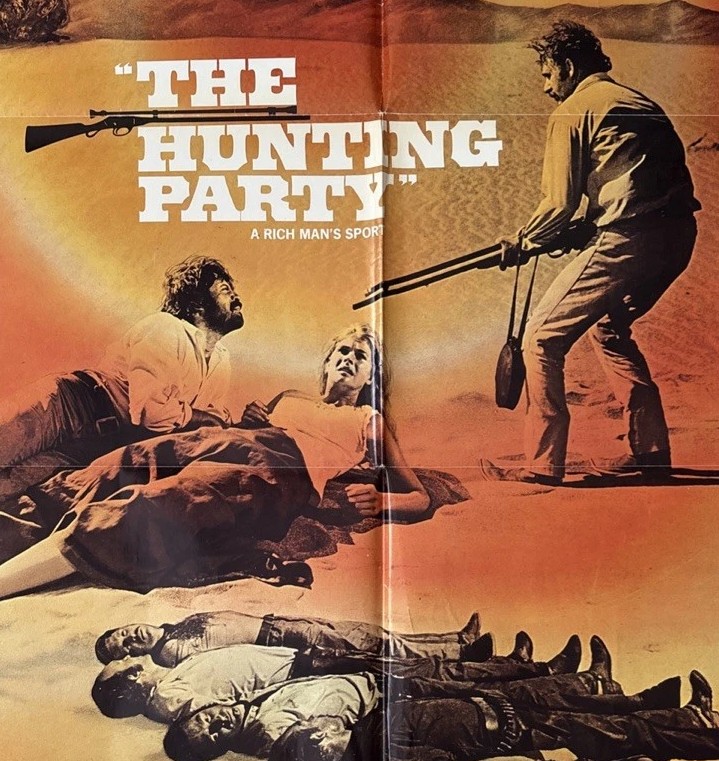
Plus he’s just taken delivery of rifles with telescopic sights that have a firing range of about half a mile so he’s up for a little sport, and with four other rich buddies sets out to hunt humans. The rifle is the equivalent to the Gatling Gun in The Wild Bunch (1969), a weapon of awesome power, and every time it hits home the camera focuses on the gory outcome. The 26 men in the outlaw bunch are soon whittled down.
This might have worked if the narrative had followed a different arc. Had Frank turned out to be Melissa’s protector rather than the most successful of her molesters. If the whole gang had show signs of seeking something maternal rather than just sexual in a woman or were all queuing up for a bit of education. And Frank’s treatment of her from the outset had been protective and she had shared with him her fear of her husband.
The best you can say about Frank is he’s a gentler kind of rapist. But he’s still a rapist and taking advantage when Melissa is at her most terrified, soaking wet from falling into a river while trying to escape. If he had continued just trying to soothe her and comfort her that might have taken the tale in a more acceptable direction, but, no, he decides a bit of rape is in order.
Frank’s too dumb to see that his men are going to turn against him if he doesn’t share out his captive and once he’s aware exactly who she is he should at least, in the eyes of the men, either demand a ransom or hand her back.
Although the long-range rifles tilt the odds heavily in favor of the pursuers, one of them is killed, and two, once they have decimated the outlaws, decide the hunt has gone far enough. Another, later on, takes the same view. But Brandt, determined on revenge, pursues the “lovebirds” into the desert where he kills both.
This was intended to launch British actor Oliver Reed (Hannibal Brooks, 1969) into the Hollywood mainstream but he’s miscast. Candice Bergen (Soldier Blue, 1970) can do little with a role that makes no coherent sense – unlike Michele Carey in The Animals (1971) she shows no sign of accepting an unwelcome protector just to survive. Had it not been for The French Connection (1971) and, taken in conjunction with Prime Cut (1972), Gene Hackman’s career might have spun off into playing a succession of villains.
One other notable turns up on the credits. This is produced by Lou Morheim who originally owned the remake rights to Seven Samurai (1954) and failed to finesse that into a significant credit on The Magnificent Seven (1960).
Discounting To Trap a Spy (1964), a movie combining two episodes of The Man from U.N.C.L.E series, this marked the debut of director Don Medford. Lou Morheim (The Beast from 20,000 Fathoms, 1953), Gilbert Ralston (Willard, 1971) and Bill Norton (The Scalphunters, 1968). contributed to the screenplay.
The bizarre premise set a low bar. Every shade of ugh.
Unusually nuanced thriller. Unusually lean, too, barely passing the 90-minute mark. There’s a Hitchcockian appreciation of the danger lurking in wide open spaces. And the background is the Middle America of annual fairs, marching bands, pie-eating competitions, rural pride in farming and marksmanship.
But there’s an undercurrent that will strike a contemporary audience. The contempt of big business for its customers. The sex trafficking, too, will sound an all-too-common note especially as the young women come from an orphanage set in the heart of homespun America in what appears to be a streamlined service.
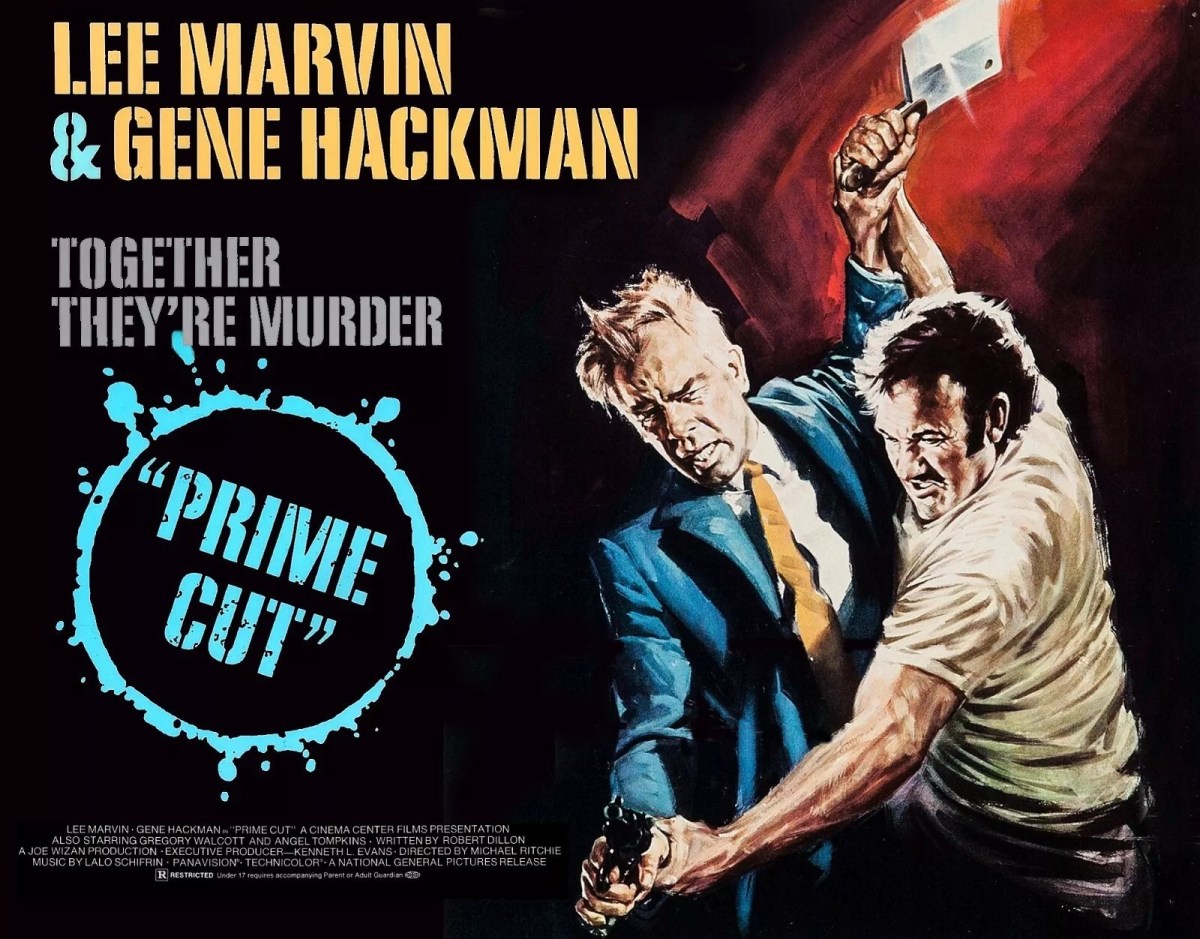
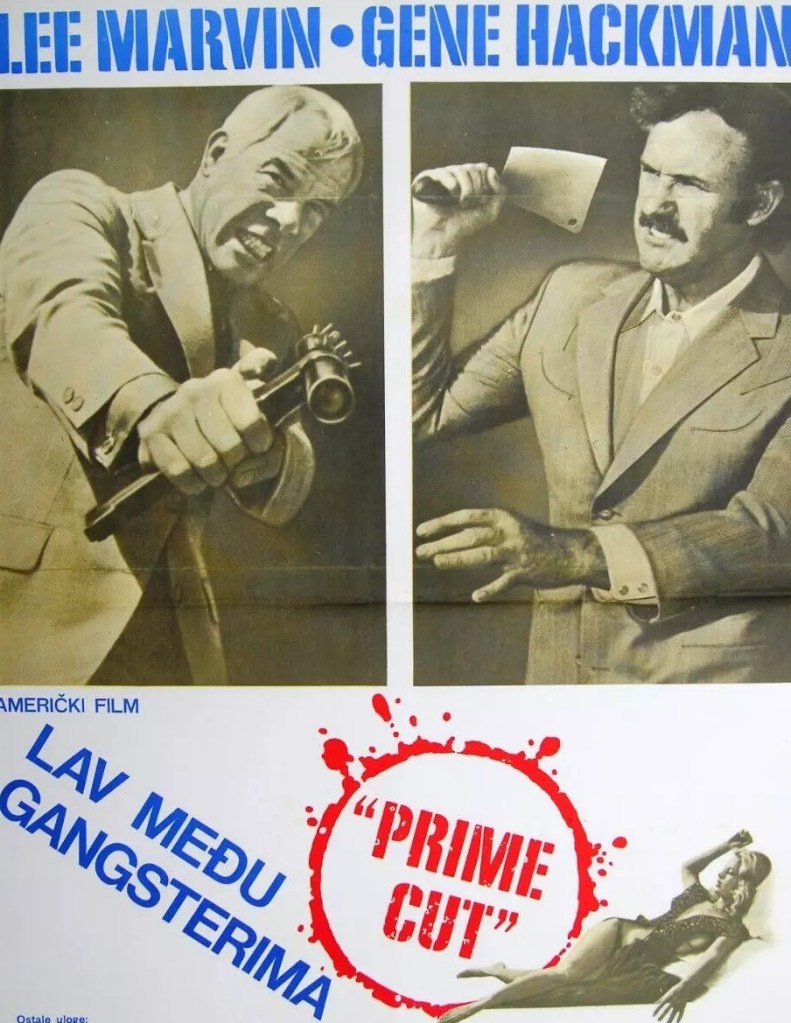
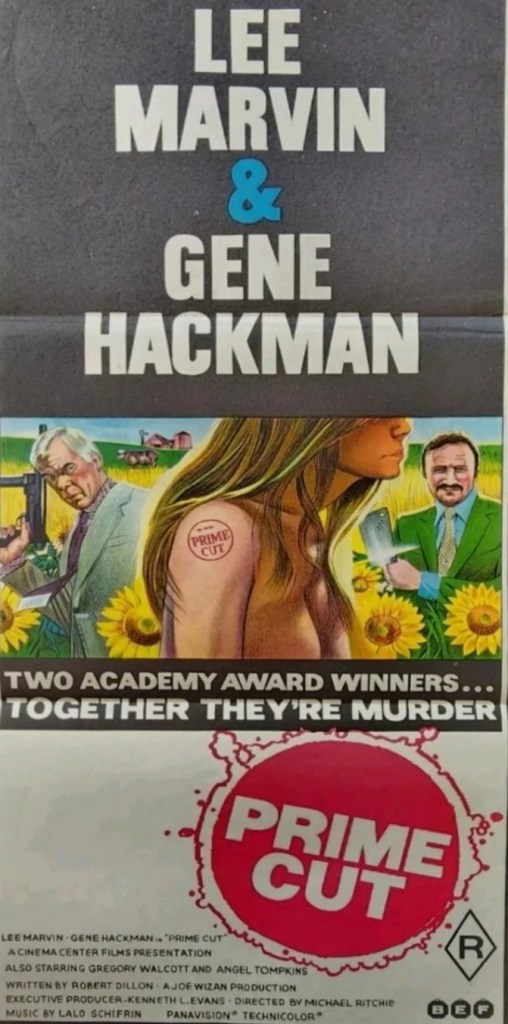
In the actual screen credits, Hackman was not above the title.
We shouldn’t at all take to hitman Nick (Lee Marvin) except that he’s got a code of honor and sparing with words. He’s been sent from Chicago to Kansas to sort out with what would later be termed “extreme prejudice” Mafia boss and meat-packer Mary Ann (Gene Hackman) who’s been skimming off the top. As back-up Nick is handed a trio of young gunslingers anxious to prove themselves while his faithful chauffeur owes Nick his life.
Mary Ann doesn’t just have a factory, he has a fort, a posse of shotgun-wielding henchman standing guard. So Nick has to plunge right in and confront the miscreant. As well as dealing with animal flesh, Mary Ann has a side hustle in sex trafficking, displaying naked women in the same straw-covered pens as his beef.
Responding to a whispered “help me” by Poppy (Sissy Spacek) Nick buys her freedom, but Mary Ann isn’t for knuckling down to the high-ups in Chicago and since he’s already despatched a handful of other hoods sent on a similar mission as Nick he’s intent on turning the tables.
The action, when it comes, is remarkably low-key and all the more effective for it. Swap a crop duster for a combine harvester and the head-high prairie corn for the usual city back streets and you realize someone has dreamed up a quite original twist on the standard thriller. No need for a car chase here to elevate tension, it’s already a quite efficient slow burn.
By the time this came out Hackman had won an Oscar for “The French Connection” (1971), Marvin already in that exalted league thanks to “Cat Ballou” (1965)
This could be an ode to machinery. The entire credit sequence is devoted to the way machines chew up cow flesh and turn it into strings of sausages and the like. The combine harvester chews up and spits out an entire automobile, grinding the metal through its maw. And then there’s the machinery of business, the ability, at whatever cost, to give the public what it wants, in whatever kind of flesh takes its fancy.
You’ll remember the combine harvester sequence and the shootout in the cornfields, but you will come away with much more than that. Remember I mentioned nuance. Sure Mary Ann is an arrogant gangster and you’d think with hardly an ounce of humanity, but that’s until you witness his relationship with his simple-minded brother Weenie (Gregory Walcott). That could as easily have fallen into the trap of cliché sentimentality. Instead, there’s roughhouse play between the pair and it’s all the more touching for being realistic.
There’s a tiny scene where one of the young hoods asks Nick to meet his mother, in the way of a young employee wanting to show off that he was working for a top man. And Nick also goes out of his way to praise what’s on offer at the fair from a couple of women anxious for praise.
One of the tests of a good actor is what they do when they enter an unfamiliar room. Your instinct and mine, like ordinary people, would be to look around not just lock eyes on the person you’ve come to meet. So when Poppy wakes up in a luxurious hotel room she doesn’t go into all that eye-rubbing nonsense, but instead marvels at her surroundings. And although she hangs on his every word – and his arm – Nick isn’t in the seduction business, instead spoiling the young woman with expensive clothes.
There are several other scenes elevated just by touches. The credit sequence ends with a shoe appearing among the meat being processed – Mary Ann’s victims don’t sleep with the fishes but with the sausages. Poppy recalls a childhood spent in a rural wonderland, squirrels, rabbits, the splendors of nature, and reveals a lesbian relationship with another orphan Violet that is the most innocent description of love and sexual exploration you’ll ever hear.
Violet is the victim of multiple rapists. Weenie has passed her onto a bunch of down-and-outs for the price of a nickel. When Nick unclenches her clenched fist you’ll be horrified to see how many nickels tumble out.
Lee Marvin (Point Blank, 1967) is at his laconic best and Sissy Spacek (Carrie, 1976) makes a notable debut but Gene Hackman (Downhill Racer, 1969) overplays his hand.
Director Michael Ritchie (Downhill Racer) was on a roll, following this with The Candidate (1972), Smile (1975), The Bad News Bears (1976) and Semi-Tough (1977) before the execrable The Island (1980) badly damaged his career.
Written by Robert Dillon (The French Connection II, 1975).


 The Magnificent 60s