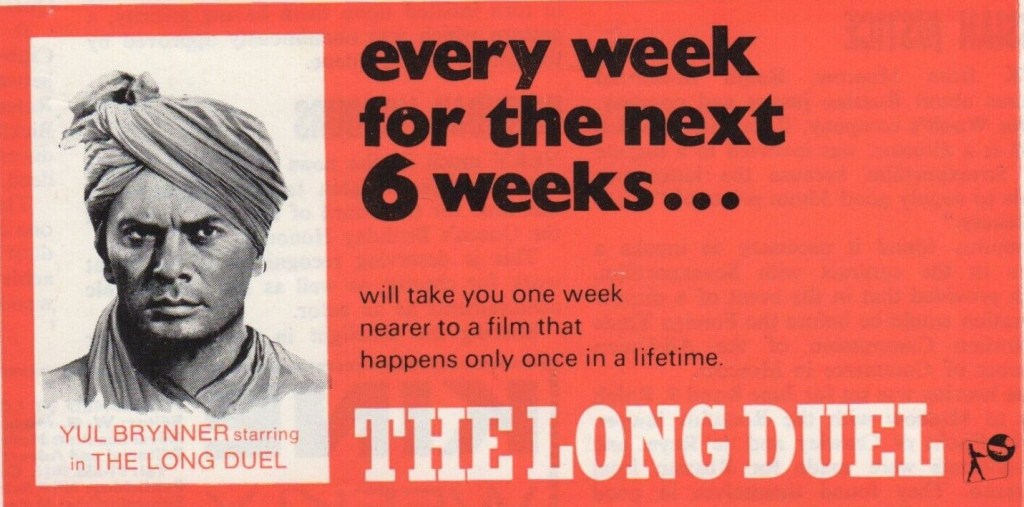
The Long Duel (1967) ****

Surprisingly thoughtful action-packed “eastern western”  with obvious parallels to the plight of the Native American. Here, the British attempt to shift nomadic tribesmen from their traditional hunting grounds in north-west India to “resettlements.” Set in post World War One India, the duel in question between tribal chief Sultan (Yul Brynner) and police chief Young (Trevor Howard) brims over with mutual respect.

Unusually intelligent approach for what could otherwise have been a more straight forward action picture, more critical of the British, whose idea of civilization is to turn everything into “a bad replica of Surrey,” than you would have expected for the period. Ruthless pursuit in large part because the British “can’t afford local heroes.”   
After his tribe is taken captive with a view to forced repatriation by boorish police superintendent Stafford (Harry Andrews), Sultan organises a breakout, taking with him heavily pregnant wife Tara (Imogen Hassall) who dies while on the run. The Governor (Maurice Denham) of the province brings in Young – who knows the territory and is more familiar, through a previous career as an anthropologist, with the nomadic lifestyle, and largely sympathetic to their cause – to head up an elite force and bring to justice Sultan, whose men are now murderers.

Young seems lacking in the stiff upper lip department, condemned for “misplaced chivatry,” unwilling to just do his job, and certainly not to blindly obey the more ruthless ignorant Stafford. Aware he is unable to stop what the British would like to call progress, hopes he can ease the transition, avoid driving the tribesmen into the ground and prevent a noble leader like Sultan ending up a despised bandit, the kind who were forever presented as the bad guys in films like North West Frontier / Flame over India (1959).

Young has the sense not to be dragged all over the country searching for his quarry, and sets up his team in more sensible fashion, but still, is largely outwitted by Sultan, especially as Stafford, who later gets in on the act, is too dumb to fall for obvious lures. Adding  complication is the arrival of Stafford’s equally intelligent daughter Jane (Charlotte Rampling), a Cambridge University graduate, who falls for Young.

Thankfully, there’s no need for the British hero to transition from brute into someone more appreciative of the way of life he is forced to destroy – a trope in the American western – and equally there’s no corrupt businessman selling the tribesman weaponry and there’s no savage attack either on innocent women and children, and removal of these narrative cliches allows the movie more freedom to debate the central questions of freedom. The tribesmen acquire rifles and the occasional Gatling gun simply by stealing them from the more inept British soldiers.

Anyone expecting a shoot-out or more likely a swordfght between Sultan and Young will be disappointed, the title, as with the entire picture, is more subtle than that, especially as each, in turn, have the opportunity to save each other’s lives. Eventually, Young’s sympathetic approach is deemed ineffective and Stafford is put in charge, leading to a superb climax.

While Sultan’s nomadic lifestyle is eased by dancing girl Champa (Virginia North), whose loyalty to her lover is soon put to the test, and who is not, surprisingly, necessarily looking for love, his emotions center more around his younger son, whom he doesn’t want to grow up wearting the tag of bandit’s son. The solution to that problem seems a tad simplistic, but still seems to work.

With the feeling of western with splendid use of superb mountainous locales, and excellent widescreen, an astute script opts as much for intelligence as adventure.

One of Yul Brynner’s (The Double Man, 1967) last great roles before he turned into a parody of himself and certainly more than matched by Trevor Howard (Von Ryan’s Express, 1967), given a role with considerable depth and scope. Charlotte Rampling (Three, 1969) also impresses while Virginia North (Deadlier than the Male, 1967) and Imogen Hassall (El Condor, 1970) provide support. Harry Andrews (The Night They Raided Minsky’s / The Night They Invented Striptease, 1968) has played this role before. You can catch Edward Fox (Day of the Jackal, 1973) in a tiny role.

Superbly directed by Ken Annakin (Battle of the Bulge, 1965) from a script by Peter Yeldham (Age of Consent, 1969), Ernest Borneman (Game of Danger, 1954) and Ranveer Singh in his debut.

Well worth a look.
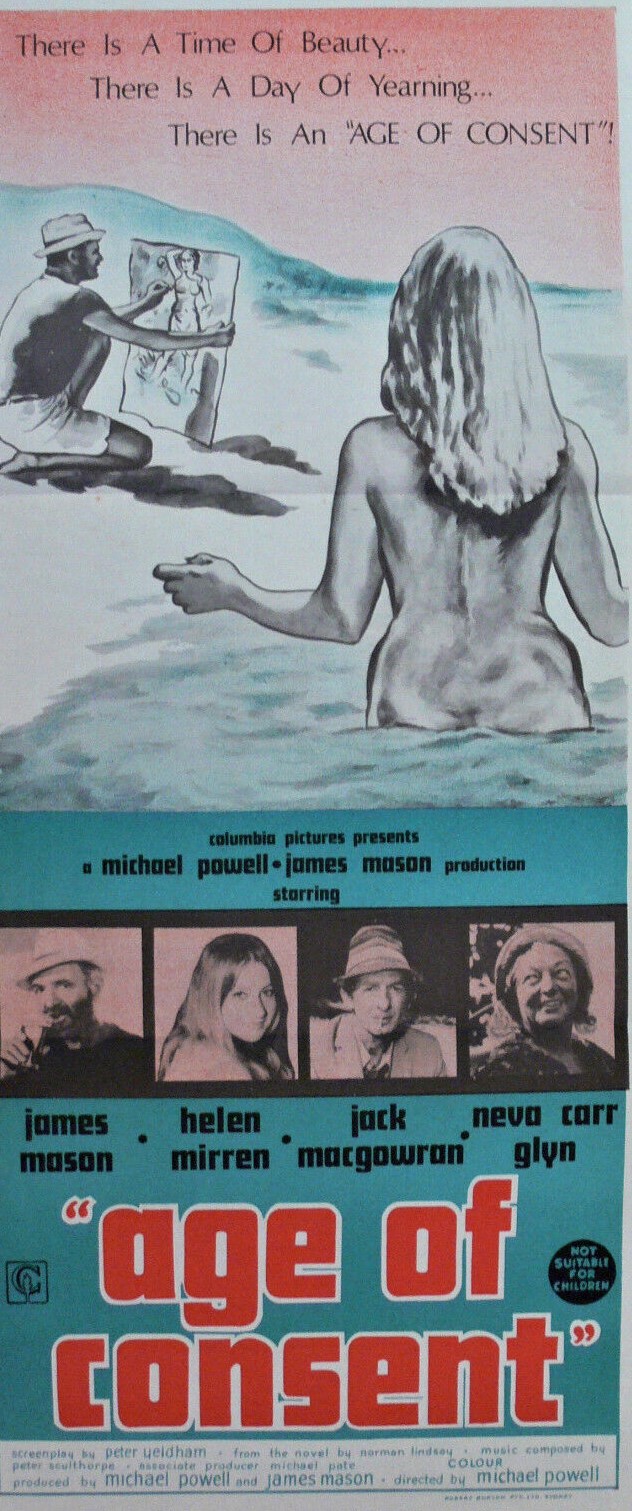
Age of Consent (1969) ***

Reputations were made and broken on this tale of a jaded artist returning to his homeland to rediscover his mojo. Director Michael Powell had, in tandem with partner Emeric Pressburger, created some of the most acclaimed films of the 1940s – A Matter of Life and Death (1946), Black Narcissus (1947) and The Red Shoes (1948) – but the partnership had ended the next decade. Powell’s solo effort Peeping Tom (1960) was greeted with a revulsion from which his career never recovered. Age of Consent was his penultimate picture but the extensive nudity and the age gap between the principals left critics shaking their heads.

For Helen Mirren, on the other hand, it was a triumphant start to a career that has now spanned over half a century, one Oscar and three nominations. She was a burgeoning theatrical talent at the Royal Shakespeare Company when she made her movie debut as Mason’s muse. It should also be pointed out that when it came to scene-stealing she had a rival in the pooch Godfrey.

You would rightly be concerned that there was some grooming going on. Although 24 at the time of the film’s release, Cora (Helen Mirren), an under-age nymph, spends a great deal of time innocently cavorting naked in the sea off the Great Barrier Reef in Australia. But there are a couple of provisos. In the first place, Cora was not swimming for pleasure, she was diving for seafood to augment her impoverished lifestyle. In the second place, she was so poor she would hardly have afforded a bikini and was the kind of free spirit anyway who might have shucked one off.

Thirdly, and more importantly, artist Bradley Morahan (James Mason) wasn’t interested. He wasn’t the kind of painter who needed to perve on young girls. An early scene showed him in bed with a girlfriend and it was clear that he was an object of lust elsewhere. Morahan, fit and tanned, obsessed like any other artist about his talent, and was in this remote stretch not to hunt for young naked girls but to find inspiration. As well as eventually painting Cora, he also transforms the shack he rents into something of beauty.

Morahan is vital to Cora’s self-development. The money he pays her for modelling goes towards her escape fund. Her mother being a useless thieving alcoholic, she has little in the way of role model. And the world of seafood supply is competitive. She is lost in paradise and the scene of her buying a tacky handbag demonstrates the extent of her initial ambition. Although her physical attributes attract male attention, it is only on forming a relationship with the painter that Cora begins to believe in herself. There’s not much more to the central story than the artist rediscovering his creative spark and helping Cora’s personal development along the way.

Morahan is a believable character. He is not an impoverished artist. Far from being self-deluded, he is a questing individual, turning his back on easy money and the temptations of big city life in order to reinvent himself. He isn’t going to starve and he has no problems with women. And he is perfectly capable of looking after himself.  A more rounded artist would be hard to find. Precisely because there is no sexual relationship with Cora, the movie, as a film about character development, is ideally balanced.

The movie is gorgeously filmed, with many aerial shots of the reef and underwater photography by Ron and Valerie Taylor. 

What does let the show down is a proliferation of cliched characters who over-act. Nat Kelly (Jack McGowran), sponging friend, ruthless seducer and thief, leads that list closely followed by Cora’s grandmother (Neva Carr-Glynn) who looks like a reject from a Dickens novel. There’s also a dumb and dumber cop and a neighbor so bent on sex that she falls for Kelly. It’s not the first time that comedy has got in the way of art, but it’s a shame it had to interrupt so often what is otherwise a touching film.

At its heart is a portrait of the artist as an older man and his sensitive relationship with a young girl. In later years, Powell married film editor Thelma Schoonmaker and after his death she oversaw the restoration of Age of Consent, with eight minutes added and the Stanley Myers score replaced by the original by Peter Sculthorpe. 

Unusually sensitive screenplay from Peter Yeldham who, as my readers will know, is more usually associated with Harry Alan Towers productions like Bang! Bang! You’re Dead / Our Man in Marrakesh (1966), based on the novel by Norman Lindsay.  

Intriguing, occasionally moving, superb debut from Mirren plus it works.

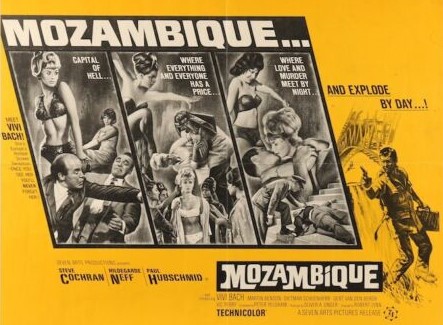
Mozambique (1964) ***

Here’s a great idea for a movie. A pair of nubile young girls sign on for a yacht trip with a renowned Hollywood lothario. A couple of days in the star dies. Neither of the girls knows anything about sailing. The boat drifts. If this was a Hollywood movie there would be circling sharks and at least a squall. But it’s not, the girls are picked up 10 days later complete with festering corpse. Witness the sad end of Steve Cochran.

He never made it as a big star, Sometime top-billed in B-movies, but mostly supporting roles, so it was somehow ironic that producer Harry Alan Towers, on the look-out for any kind of name who didn’t mind spending a couple of weeks on location in a remote African spot, gave him his first starring role in six years as down-on-his-luck pilot Brad sent to infiltrate a smuggling gang in the eponymous country.

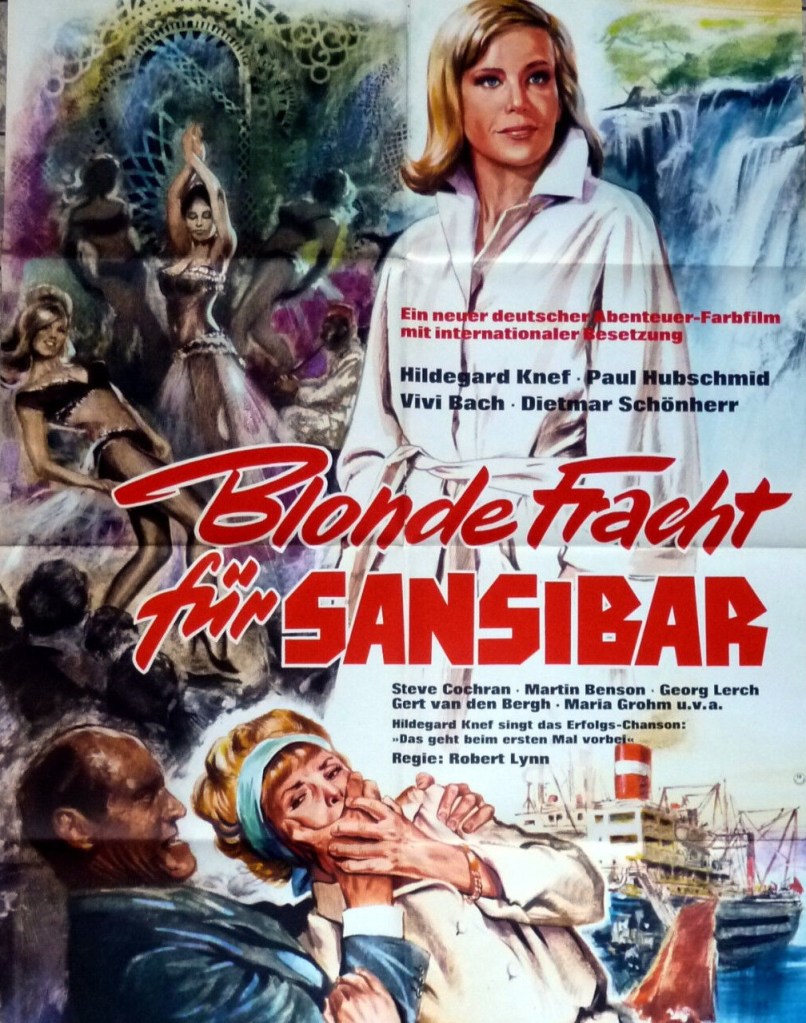
In the German market, the Germans were the stars, Steve Cochran relegated below the title.

And this would have been a fitting send-off because, in among the sleaze, there’s a decent story and some pretty good lines. But it really needed the dry delivery of a Rod Taylor to give those lines the zest they required.

There’s a sudden contemporary feel courtesy of former kickboxing champ and influencer Andrew Tate, arrested in Romania for alleged human trafficking, because the underlying story here is white slave trade. Or, put another way, the one-way ticket. The prospect of a job, any job, anywhere, is sometimes enough, no time, or need, to think how you will get back home. Here, a place of dreams for those running out of anything else that might fit the bill, might become home.

Christine (Vivi Bach) is one such dreamer, a singer. What she doesn’t realise is that in the club where she is employed the girls are part of the deal, a commodity. Her one-way ticket is destination human trafficking. What used to be called in those sensationalist times as the “white” slave trade, as if any other type of slave trade was acceptable or less worrisome. She is sold to an Arab sheik (Gert can den Bergh), to form part of his harem.

Luckily for Christine, Brad has taken a shine to her so when the Arab appears on his smuggling radar their paths converge. But trafficking is a sub-plot. Brad has been hired as a pilot for Col Valdez but he has died intestate so his wife Ilona (Hildegarde Knef), in this corrupt country, is also up for grabs and has to (literally) sing for her supper before segueing from black widow to femme fatale. Standing in Ilona’s way are her husband’s associate Da Silva (Martin Benson) and his one-time business rival Henderson (Dietmar Schonherr) and quickly those two guys are in Brad’s way too.

So it’s a solid old-fashioned tale, Brad digging up the dirt, pausing for a bit of romance, chasing the villains. Smashing the human trafficking isn’t part of his brief, so that’s put to one side, but a missing will, which could rescue Ilona from her impoverished situation, runs parallel to the plot.

The exotic locale was typical Harry Alan Towers. But this has a better plot than most of the ones reviewed so far in the Blog, it’s not rammed with cameos (Five Golden Dragons, 1967) or a star out of his depth (Bang! Bang! You’re Dead!, 1966) or a story that takes forever to come to the boil (24 Hours to Kill, 1965).

And, discounting the tribal dancers shaking their booty in a nightclub, it displays some finesse and comedic touches. Stonewalled by Da Silva on arrival, Brad insists on seeing his employer only to be led into a funeral parlor. A waiter knocks back unfinished drinks. “Nobody’s seen her since last night,” is followed by “then, we’d better stop looking for her, hadn’t we?” And did I mention the snake on the plane?

But Towers always got his money’s worth. Although making a (plot) point, there was another reason for Ilona singing. Knef had relaunched her career in the early 1960s as a singer, so her voice was a welcome interlude, and an improvement on that of Vivi Bach, married to Dieter Schonherr, so perhaps hired as a package.

Steve Cochran (The Deadly Companions, 1961) really only requires masculinity to see this through, though has a way with throwaway lines. Hildegard Knef (The Lost Continent, 1968) adds a touch of class but Vivi Bach (Assignment K, 1968) is merely competent.

Robert Lynn (Dr Crippen, 1963) directed from a script by Peter Yeldham (The Liquidator, 1965).

More topical than most Towers’ pictures and in fact one of his best.

The Liquidator (1965) ****

Brilliant premise, brilliant execution, brilliant acting. The best send-ups are driven by their own internal logic and this is no exception: spy boss, known simply as The Chief (Wilfred Hyde White), determines in most un-British fashion to get rid off a mole in the operation by eliminating all potential suspects. Bristling Colonel Mostyn (Trevor Howard) recruits Boysie Oakes (Rod Taylor) for the job, believing Oakes showed particular gallantry during World War Two, unaware this was pure accident. Oakes is given all the perks of a super spy – fast cars, fashionable apartment – and attracts women in a way that suggest this is also a perk and once realizing that being a killer is outside his comfort zone delegates the dirty work to another hit man Griffen (Eric Sykes).

The sweet life begins to unravel when Oakes takes a weekend abroad with Mostyn’s secretary Iris MacIntosh (Jill St John) and is kidnapped. Forced to battle for survival, another Oakes emerges, a proper killer.  Cue the final section which involves trapping the mole.

Where films featuring Matt Helm and Derek Flint imitated the grand-scale espionage they aimed to spoof, the laughs here come from small-scale observation and attacks on bureaucracy. According to regulations, Oakes’ liaison with MacIntosh is illicit. There is endless paperwork. Apart from an aversion to needless killing, Oakes has terrible fear of flying. Nobody can remember code names or passwords. Oakes’ automobile numberplate is BO 1 (the letters in those days being a standard acronym for “body odor”). It is all logical lunacy. And even when the story gets serious, it follows logic, a ruse, a dupe, a climax pitting resolve against human weakness.

Best of all, the parts appear custom-made for the players. Rod Taylor (The Birds, 1963), in his first venture into comedy, displays a knack for the genre without resorting to the slapstick and double takes requisite in the Doris Day pictures to follow. And he is a definite screen charmer.

By this point in his career the screen persona of Trevor Howard (Von Ryan’s Express, 1965) had been shorn of subtlety. He was generally one choleric snort away from a heart attack. Here, while the narrative pricks his pomposity, he remains otherwise ramrod certain. The audience is in on the joke, but nonetheless his genuine ability as a spy master is not in question. On the other hand Jill St John (Who’s Minding the Store, 1963) is allowed considerable leeway in the subtlety department, as a demure English rose rather than the sexier roles into which she was later typecast.  In some respects British television comedian Eric Sykes is miscast. It is a particular English joke to present him as a killer since on television (in shows unlikely to be shown in America) he was hapless.

And it is worth mentioning Akim Tamiroff whose villainous stock-in-trade is allowed greater depth. David Tomlinson (Mary Poppins, 1964) and Gabriella Licudi (You Must Be Joking!, 1965), have small parts. Aso watch out for future British television stars Derek Nimmo (Oh, Brother, 1968-1970) and John Le Mesurier (Dad’s Army, 1968-1977) as well as Jennifer Jayne (Hysteria,1965) and Betty McDowall (First Men in the Moon, 1964).

Director Jack Cardiff had tried his hand at comedy before with My Geisha (1962) starring Shirley Maclaine but was better known for Oscar-nominated drama Sons and Lovers (1960) and action picture The Long Ships (1964).  John Gardner, who wrote seven books in the Boysie Oakes series, later penned James Bond novels.

It is well worth considering whether The Liquidator would have punctured the success of both Our Man Flint (1966) and The Silencers (1966) and sent spy spoofery in a different direction. It had premiered in the U.K. prior to both but litigation held up its American launch  until long after that pair had gone on to hit box office heights.

Catch-Up: Previously reviewed in the Blog are Jack Cardiff’s The Long Ships, Rod Taylor in The Glass Bottom Boat (1966) and Hotel (1967) and Trevor Howard in Operation Crossbow (1965) and Von Ryan’s Express (1965).

Discover WordPress

A daily selection of the best content published on WordPress, collected for you by humans who love to read.

The Atavist Magazine

by Brian Hannan

WordPress.com News

The latest news on WordPress.com and the WordPress community.