Behind the Scenes: Selling the New-Look Paul Newman – Pressbook for “The Hustler” (1961)

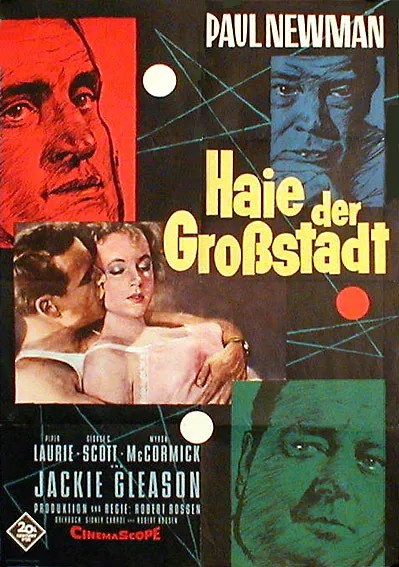
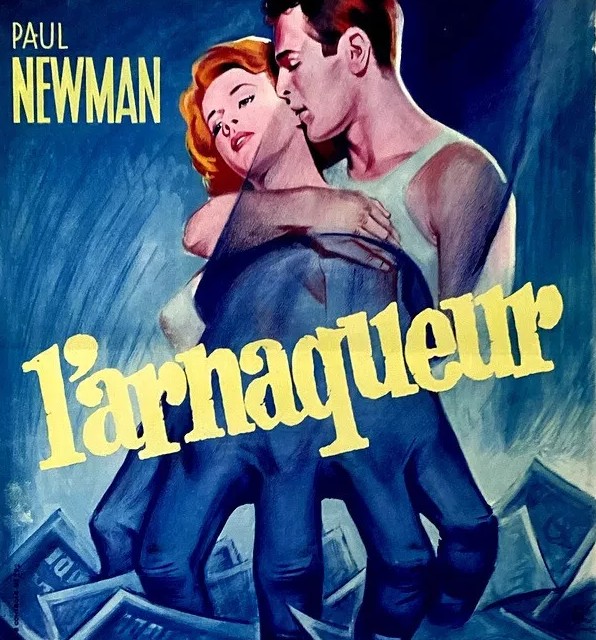
While Twentieth Century Fox head honcho Spyros Skouras initially balked at the title, with its connotations of prostitution, by the time the movie appeared that subject matter was less contentious thanks to critical and commercial big hitters Butterfield 8 (1960) and Never on Sunday (1960). Given that the idea of a movie set in a poolroom was going to be a hard sell to a female audience, despite the marquee lure of Paul Newman, the studio gave marketeers free rein to pitch it as a raw, sex-oriented drama.

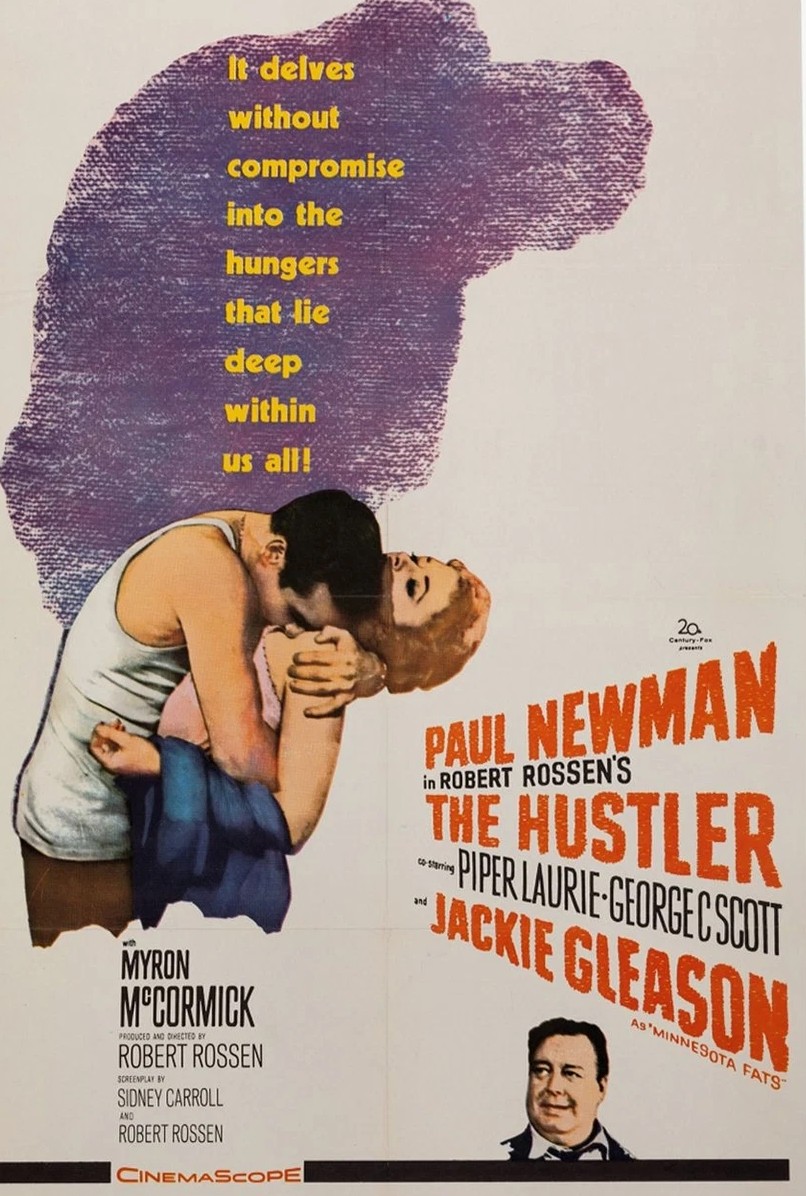
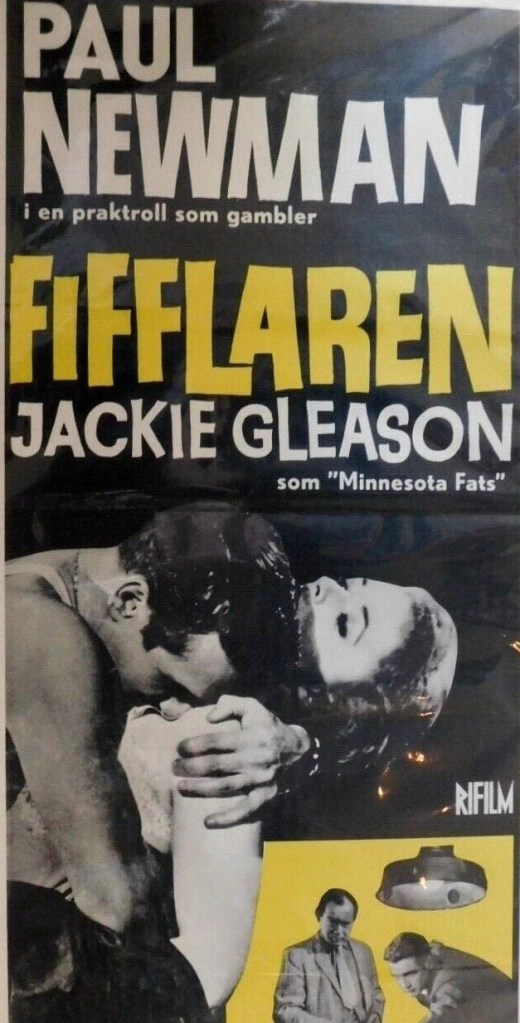
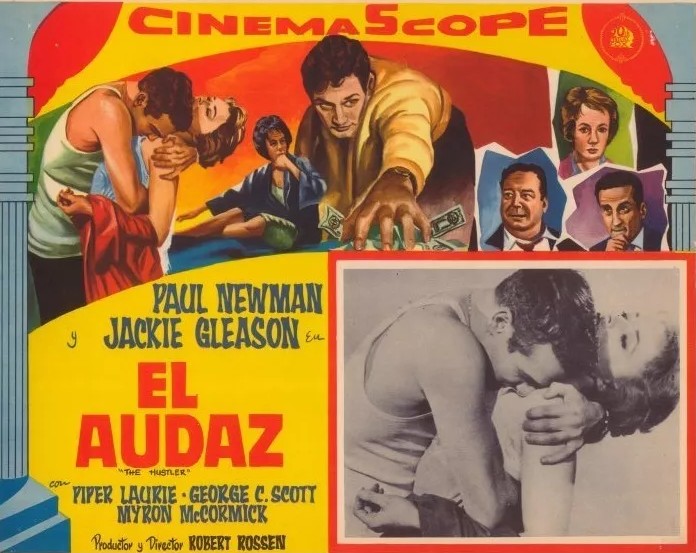
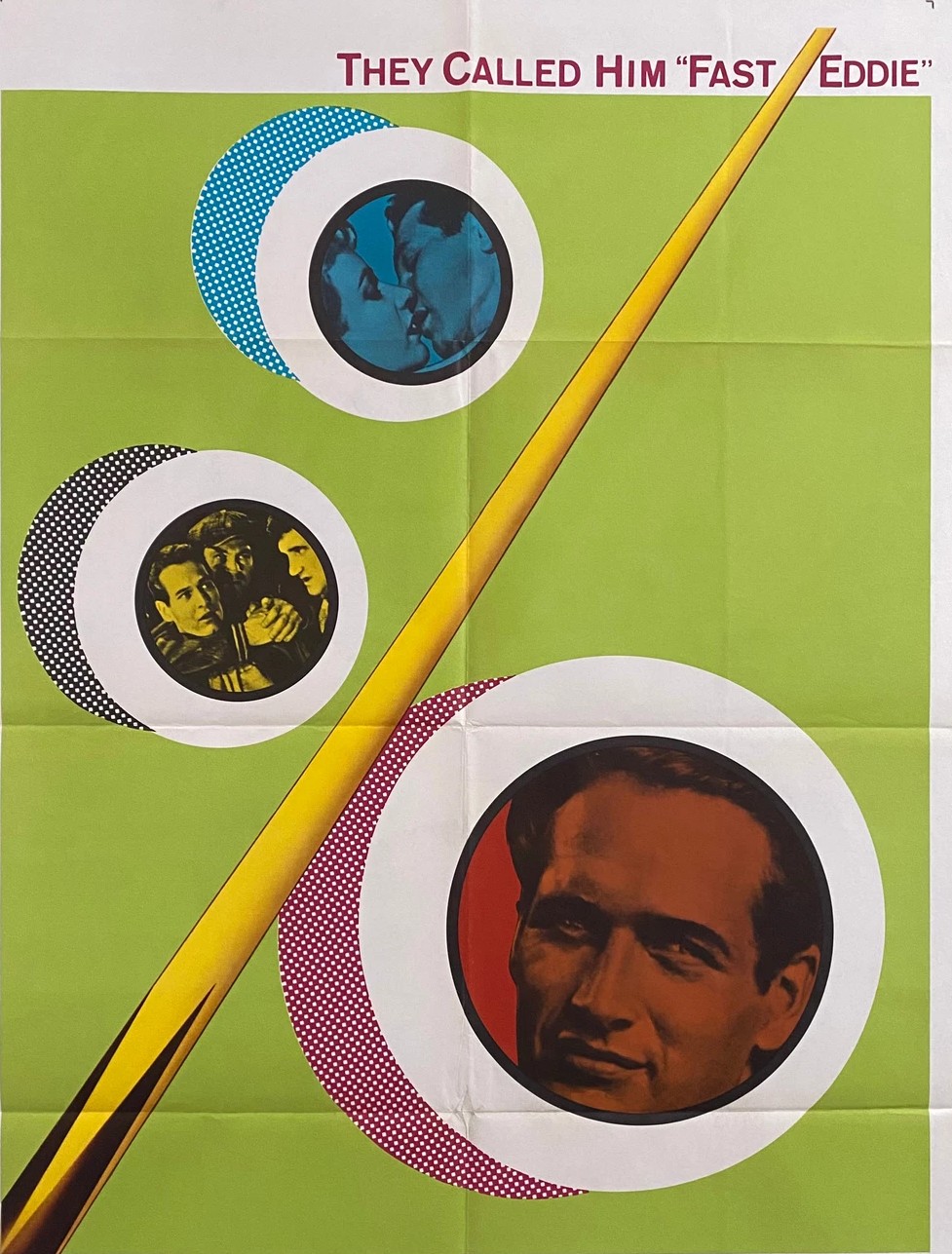
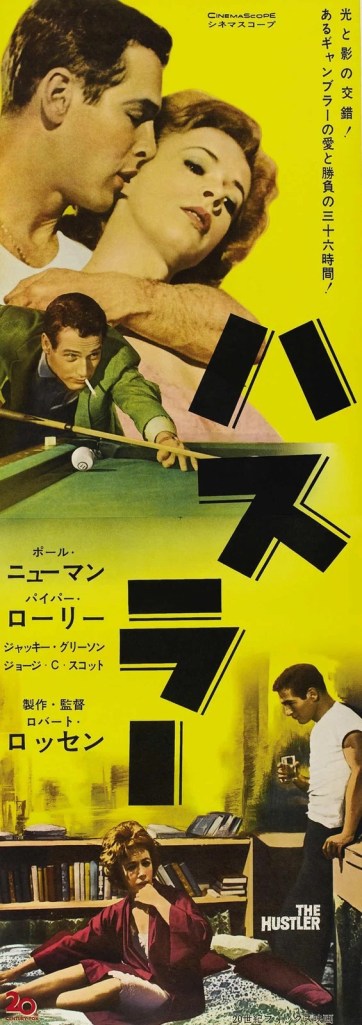
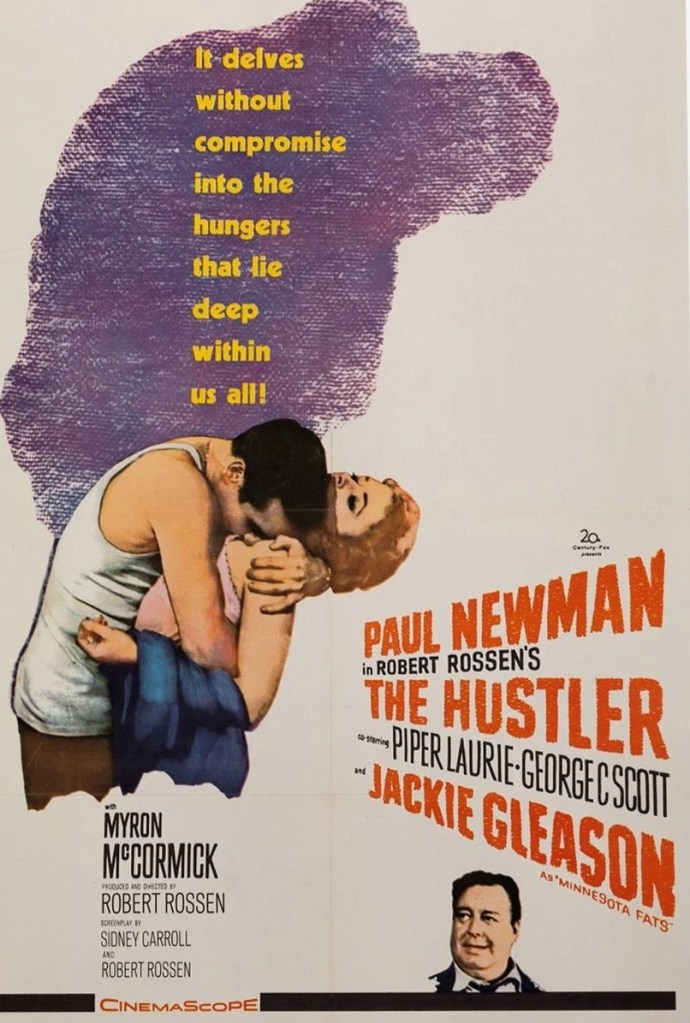
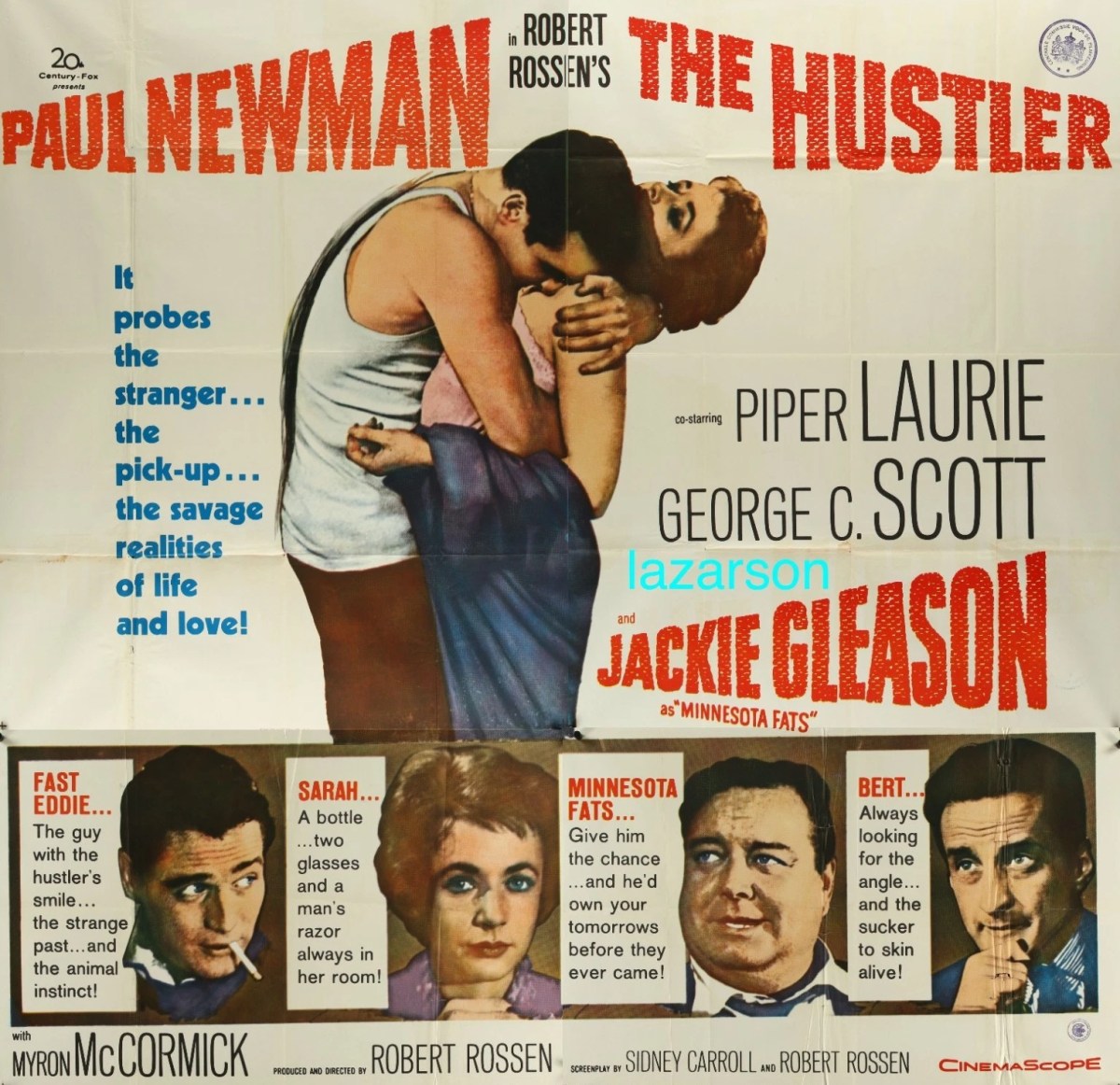
There’s little sign of a pool cue in some of the artwork. Instead, we have Paul Newman lustily nuzzling Piper Laurie’s neck or bosom. The taglines promise something far removed from a sports picture.

“It probes the stranger…the pick up…the  savage realities,” screamed the main tagline. Another tempted with: “It delves without compromise into the inner loneliness and hunger that lie deep within us all!” In other words we’re talking about sex, not love, and casual sex at that, the world of the one-night stand between consenting adults for whom marriage is the last thing on their minds. “The word for Robert Rossen’s The Hustler is prim-i-tive” suggested out of control lust.

Fast Eddie Felson (Newman) has “the animal instinct.” Sarah (Piper Laurie) has a “bottle, two glasses and a man’s razor always in her room.” Bert (George C. Scott) is on the look-out for the “sucker to skin alive.”

Those images which did show a cue and pool balls did not suggest an august sport like football or baseball, not with a tagline like “he was a winner, he was a loser, he was a hustler.”

With such talented actors to hand, the Pressbook wasn’t short of good stories relating to the actual movie rather than the kind of snippets that might appeal to an editor on a slow news day. So we learn that Piper Laurie continually limped, Method-style, around on the set. “When I limp in the picture, I don’t want to act it. It’s something that has to be a part of me, something of which I am no longer conscious, apart from its being a physical defect. I must be able to limp as if I had a bad foot from birth.”

Laurie had made so few pictures that her name wouldn’t be on any director’s wanted list and what she was best known for – ingénue roles when a contract player for Universal (who gave out that she bathed in milk to keep her skin soft) opposite  the likes of Tony Curtis – wouldn’t have inspired confidence. Robert Rossen might well have spotted her in two Emmy-nominated performances in successive years including Days of Wine and Roses (1958), but instead said he remembered her for “a sensitive characterization” from a stage production of Rosemary.

Ames Billiards Academy had once been a Chinese restaurant so boasted a balcony. This was unseen in the picture but allowed director Robert Rossen to shoot from widely varied overhead angles. The crew took over the Manhattan Bus Terminal for a day and a night. A row of lunch booths was constructed in front of the existing lunch counter. “It looked so real,” we are told, “that passers-by sat down and waited for their orders to be taken.” A nice story, and the kind often furnished by Pressbook journos, but rather fanciful, since it would be obvious what with the crew milling around and the lights and cameras and miles of cable that this was a movie set with security posted to prevent trespassing.

Just how good a pool player was Jackie Gleason, who came to the picture with a reputation for handling a cue? Well, at one point, the affable television comedian with a top-rated show, potted 96 consecutive balls.

Paul Newman plays the iconic hero as a “figure cut from the fabric of our time.” He had a firm grasp of the character. “With him it’s a question of commitment. He is so wrapped up in his drive to win and be somebody that he has no time to give of himself that which others need. It is a disease of our time, both the ambition and the isolation. I want him to be understood.”

Needless to say there was no mention of author Walter Tevis. That wasn’t so unusual in the make-up of Pressbooks, but if the marketeers these days were looking for something to write about the eclectic Tevis would be prime. He followed up The Hustler, published in 1959, four years later with sci fi The Man Who Fell to Earth, filmed in 1976 with David Bowie. A sequel to The Hustler, The Color of Money, was directed in 1986 by Martin Scorsese with Newman reprising his role and managing Tom Cruise. Tevis also wrote The Queen’s Gambit, turned into an acclaimed television mini-series in 2020 with Anya Taylor-Joy.

Behind the Scenes: “The Hustler” (1961)

It should have been Frank Sinatra in the leading role, not Newman. Sinatra acquired the rights to the Walter Tevis semi-biographical novel published in 1959. When Sinatra moved onto something else and director Robert Rossen took up the slack still Newman should have been ruled out courtesy of a planned re-teaming with Elizabeth Taylor – they had worked together on Cat on a Hot Tin Roof (1959) – for the screen adaptation of Broadway hit Two for a Seesaw. Bobby Darin (Pressure Point, 1962) was being lined up instead. When illness put paid to Taylor’s involvement, Newman would have remained tied to Two for the Seesaw except he had co-star approval and none of the actresses suggested measured up.

Based on reading half the script, Newman, calling his agent at six o’clock in the morning to confirm interest, jumped at the role. Though Exodus (1960) had been a success, and he had managed to ease himself out of his contract with Warner Bros, he was not considered hot box office and he needed a part not just to consolidate his commercial standing but to provide a professional springboard that would shape his career. His previous outing, Paris Blues (1961), hadn’t carved out a clear path. As well as his salary, the actor was in line for ten per cent of the profits.

Initially, the picture was backed by United Artists and it featured in their adverts in the trade magazines in 1959. The studio had shelled out an advance to Rossen to option the rights. But when the director couldn’t find a “box office star as insurance” UA pulled out. By this point, the end of 1959, there was at least a screenplay, Rossen having called upon the services of Sydney Carroll (Big Deal at Dodge City, 1966).

Rossen shopped the package to Twentieth Century Fox which, somewhat surprisingly, signed up to the project when no major star was attached, especially as, according to Rossen, the picture “pulled no punches” with its “frank approach to people and life.” UA had promoted itself as the go-to studio for independents but by Rossen’s reckoning Fox was superior in that department because backing the movie “took some guts.”

Fox chief Spyros Skouras wasn’t keen on the title, believing, understandably, that The Hustler might signal to audiences that it was a story about prostitution. It was changed first of all to A Stroke of Luck and then to Sin of Angels. However, UA objected to the latter title on the grounds it had already registered a similar title The Side of the Angels and with some reluctance Skouras agreed to go with the original title.

It was a critical picture for Rossen, who hadn’t had a solid hit in a decade and hadn’t made a picture that could be mentioned in the same breath as All the King’s Men (1949). In part his low output was due to being blacklisted during the anti-Communist witch hunt of the early 1950s, although finally cleared. But it was as much due to his unusual method of working. “You gamble time which is money,” he said, “because you may work for six months or a year then realize the property is not quite right and your drop the while idea.” That ran counter to the general Hollywood practice where studios would press ahead with inferior product precisely because so much time and money had been spent on it. Rossen’s office was littered with abandoned projects.

Female lead Piper Laurie was also in the market for a comeback. She had bowed out of the business after Until They Sail (1958) – also starring Newman – fed up with ingénue parts, although the director had initially favored daughter Carole Rossen (The Arrangement, 1969) for the role. At one point Rossen identified Yves Montand for a top supporting role. Co-star Jackie Gleason (Soldier in the Rain, 1963), known at this time as a television comedy actor, was already a decent pool player and Newman was coached by Willie Mosconi, a fourteen-time world billiards champ. Except for one maneuver the two actors managed to achieve all the shots caught on camera. Newman believed he was good enough to beat Gleason and it cost him $50 to be proved wrong.

George C. Scott, primarily known for his work on the stage, had attracted attention with an Oscar-nominated turn in Otto Preminger courtroom drama Anatomy of a Murder (1959).

The film, budgeted at $2.1 million, was shot on location in New York City in the winter and spring of 1961. “You get certain values,” noted Rossen, “ in New York that you can’t get on the Coast (Hollywood).” The pool scenes were filmed at Ames Billiard Academy, established in 1946, near Times Square and McGirr’s. Other locations included a townhouse on East 82nd St which doubled as the Louisville home of the billiard player Findley and the Greyhound Bus Station in Manhattan even though it lacked a dining area and the one built on the premises confused regular customers.

Rossen spent five weeks of the 10-week schedule on the pool action. Sarah’s apartment, however, was located on a sound stage. The director, under pressure to revive his career and suffering from diabetes, was tough on the crew but went easy on the cast. He hired street thugs as extras to add authenticity. He fell foul of electricians and they fell foul of him after he exposed a blackmail scam whereby the electricians responsible for inspecting the unit  complained of code violations when it was the same inspectors who should have ensured everything complied with regulations. .

The part was custom-made for Newman. “I spent the first thirty years of my life looking for a way to explode,” recalled the actor. He found an outlet for that problem through acting and he reckoned for Fast Eddie Felson it was pool. “It was one of those movies when you woke every day and could hardly wait to get to work because you knew it was so good that nobody was going to be able to louse it up.”

Though studio 20th Century Fox did its best to louse it up, originally objecting to the location shoot, looking to cut down the running time, especially telescoping the pool sequences it felt might bore the female audience. Desperate to hold onto his vision, Rossen hired Arthur P. Jacobs, then a top-flight PR honcho (and later producer of Planet of the Apes, 1968), who contrived to set up a celebrity screening where the positive response stopped Fox in its interfering tracks. Due to the Actors Strike the previous year, product was in short supply, so although The Hustler was one of 19 pictures opening in September 1961 it didn’t face tough competition, the biggest movies it contended with were Rock Hudson-Gina Lollobrigida comedy Come September and upscale horror The Innocents with Deborah Kerr.

Reviews were positive although in an editorial Box Office magazine railed against a picture which cinemas could not sell to a family audience for a matinee performance.

A surprise box office hit, at least initially, in first run in the big cities, The Hustler creamed  a “wow” $64,000 in opening week at the 3,665-seat Paramount in New York. There was a “boffo” $36,000 in Chicago, a “fast” $20,000 in Detroit, a “hotsy” $15,000 in Cleveland, a “wow” $14,000 in Pittsburgh and a “smash” $11,000 in Providence. The poster which effectively showed Paul Newman thrusting his head into Piper Laurie’s bosom attracted adverse criticism and caused Chicago newspapers to take a stronger line on movie ads.

It was nominated for nine Oscars with Newman, Laurie, Gleason and Scott all earning acting nods, and Rossen up for two gongs in his capacity as director and producer, as well as potentially sharing one with Sydney Carroll for the screenplay. In the event the only winners were for Eugen Schufftan for Cinematography and Harry Horner and Gene Callahan for Art Direction. At the Baftas it was named Best Film while Newman won Best Foreign Actor and Piper Laurie was also nominated.

Oscar nominations ensured the picture went out on speedy reissue in February and March 1962 resulting in domestic rentals of $2.8 million and a decent run abroad.

Robert Rossen only made one more picture. Paul Newman reconfigured his career and George C. Scott added to his lustre. Jackie Gleason got a shot at top billing with Gigot (1962) but Piper Laurie didn’t make another movie until Carrie (1976).

SOURCES: Daniel O’Brien, Paul Newman (Faber & Faber, 2005) pp79-85; Shawn Levy, Paul Newman, A Life (Aurum, 2009) pp 175-182; Aubrey Solomon, Twentieth Century Fox, (Scarecrow Press, 2002) p229 and p253; Advertisement, United Artists, Variety, June 24, 1959, p21; “New York Sound Track,” Variety, August 12, 1959, p17; “Gleaned on a Gondola,” Variety, August 26, 1959, p20; “New York Sound Track,” Variety, November 16, 1960, p17; “Fox Nicer to Indies than UA,” Variety, March 8, 1961, p3; “New York Electrical Inspectors,” Variety, March 29, 1961, p5; “Sins of Angels Tag disputed,” Variety, March 29, 1961, p7; “Artistic Comeback,” Variety, May 24, 1961, p4; “Skinpix Can’t See,” Variety, October 18, 1961, p17; “Hustler Re-Release,” Box Office, January 22, 1962, pSW8. Box office figures: Variety October-November 1961.  

The Hustler (1961) ****

You get the impression this is the kind of movie that contemporary “visionary” directors think they are making when they focus on an unlikeable obsessive character causing chaos all around. It’s not just star quality they are missing – who wouldn’t give their eyeteeth for a Paul Newman to get behind a movie with poor commercial prospects, especially one tackling a sport that is guaranteed to put off the female element of the audience. Without Newman’s involvement you didn’t have a hope in hell of getting anywhere near the female audience.

And this was quite a different Paul Newman. In the first of his iconic roles, he’s far from the traditional hero. He’s an obsessive loner. But you are drawn towards him because of both the intensity and vulnerability of this character. He could as easily be the loser, the last thing an audience wants, he’s often accused of being, the bottler looking for an excuse for not going the extra mile it takes to win. And even when he does win, triumph comes with loss, of love and his avowed profession.

And it takes a heck of a confident director – Robert Rossen (Lilith, 1964) – to lock us into the dark prison of a pool room for virtually the first 30 minutes of the picture. If you don’t know the rules of American pool – as opposed to billiards and snooker – you’re not going to learn them here. “Fast” Eddie Felson (Paul Newman) has spent years on the road, hustling in small town poolrooms, to built up the kind of cash stack he requires to take on the greatest name in pool, Minnesota Fats (Jackie Gleason) whose unbeaten run stretches back a decade and a half.

And the movie should be over in that first half hour – or at the very least turned into a very different kind of picture, the one where the champ squanders his fortune – because Felson has thumped Fats. He’s $18,000 ahead at one point. In any other sport that should be mean he’s not just won but he’s won in style. Except it doesn’t work that way here. Fats has to concede. And Fats won’t concede because this is a marathon and despite his bulk Fats is better built for a 40-hour match than his slimmer opponent. And so it proves.

Felson is back to the beginning, welshing on his business partner Charlie (Myron McCormick) and heading out into the night. Where he meets alcoholic Sarah (Piper Laurie) who’s sitting in a bus station in the early morning sipping coffee until the liquor stores open. She’s not your usual easy pick-up, she knocks him back easily and in an idiosyncratic manner. She nearly does the same again, but relents and they start a relationship that’s built on nothing except ships passing in the night. She’s a lush, he’s a has-been. She’s a bit of a cultured lush, reads, writes short stories, but still booze is her first love.

If he’s not down enough, here comes the kicker. Thugs in a poolroom object to being hustled and break his thumbs. But she’s not very maternal and he’s not the kind of man who wants to be looked after in that fashion.

Eventually, he hooks up with another backer, a shady underworld character, Bert Gordon (George C Scott) whose first move is to break up Felson’s relationship, attempting to belittle Sarah, getting her smashed and putting the moves on her as if free sex is part of the deal. Felson gets badly hustled by wealthy Louisville Findley (Murray Hamilton), duped into playing billiards instead of pool, and the potential loss might well have slammed the door on the deal with Gordon. But Gordon gets his pound of flesh, literally, and Sarah, clearly better versed in the ways of the world than Felson, gives in to her lover’s manager and then is so disgusted with herself that she commits suicide.

Felson gains his revenge on both Minnesota Fats and Gordon but at a cost, lover lost, and kicked out of his profession. Victory has never been so negative.

While the acting all round is superb, all four principals plus the director Oscar-nominated, it’s the feel of the piece and the obsessiveness of the characters that resonates. Robert Rossen makes no concessions to the audience. He doesn’t explain the game and he doesn’t, as would be par for the course anywhere else, show how Felson learned how to handle a cue a different way after his thumbs were broken and there’s a distinct lack of the triumphalism that generally comes with the territory.

Behind the Scenes article tomorrow.

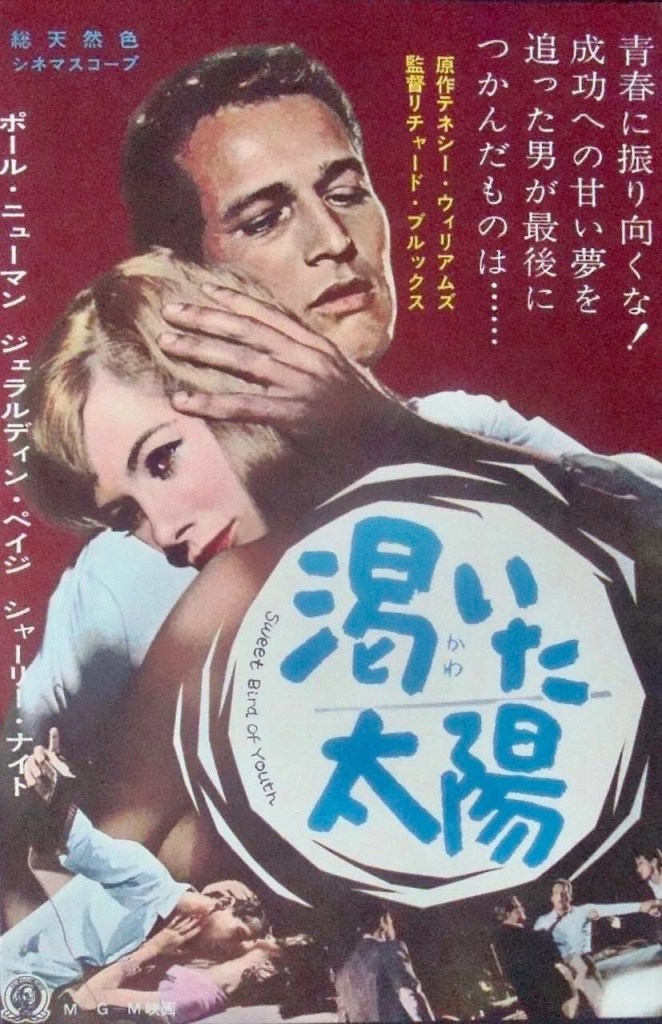
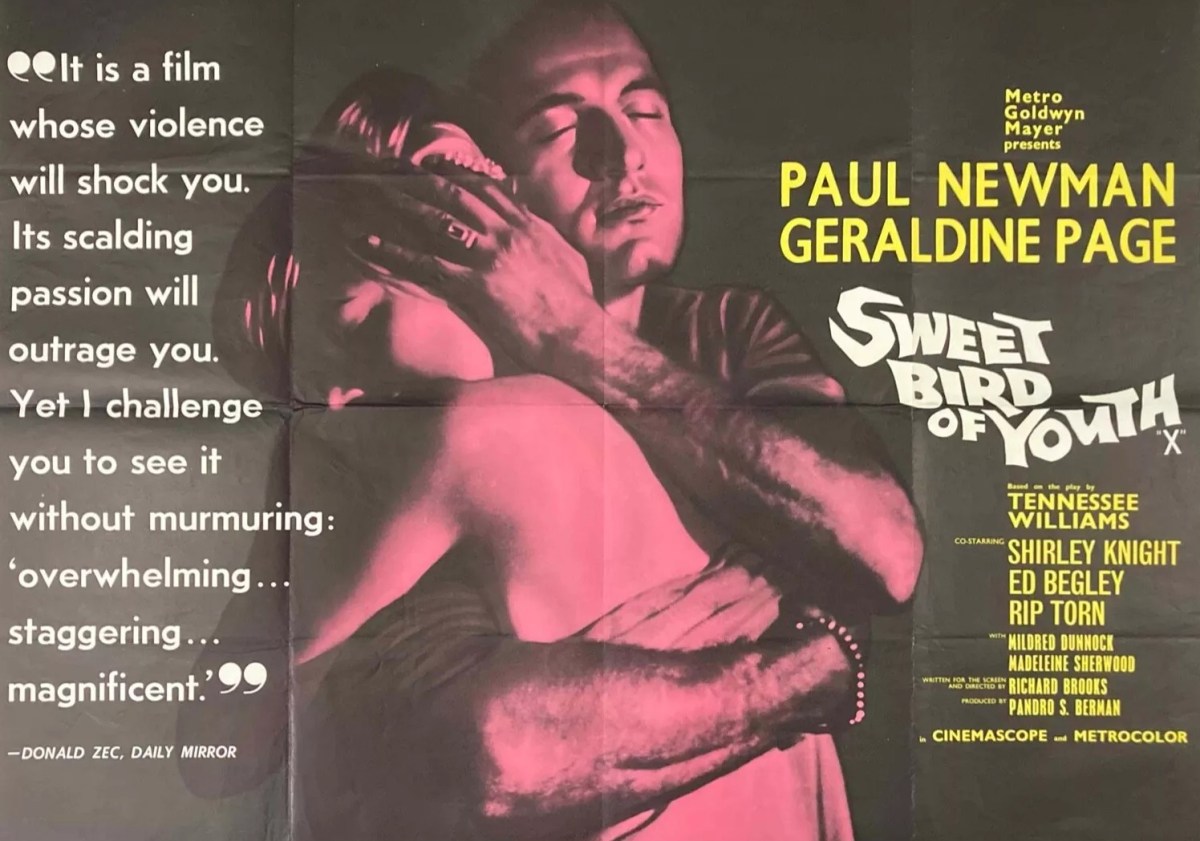
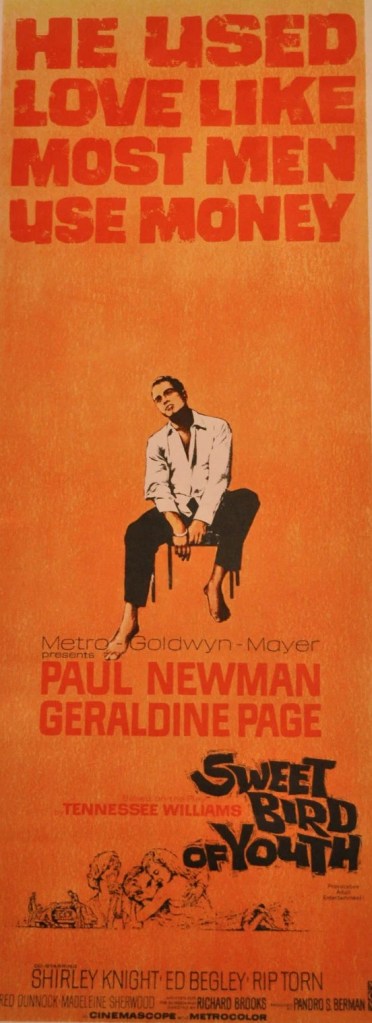
Behind the Scenes: “Sweet Bird of Youth” (1962)

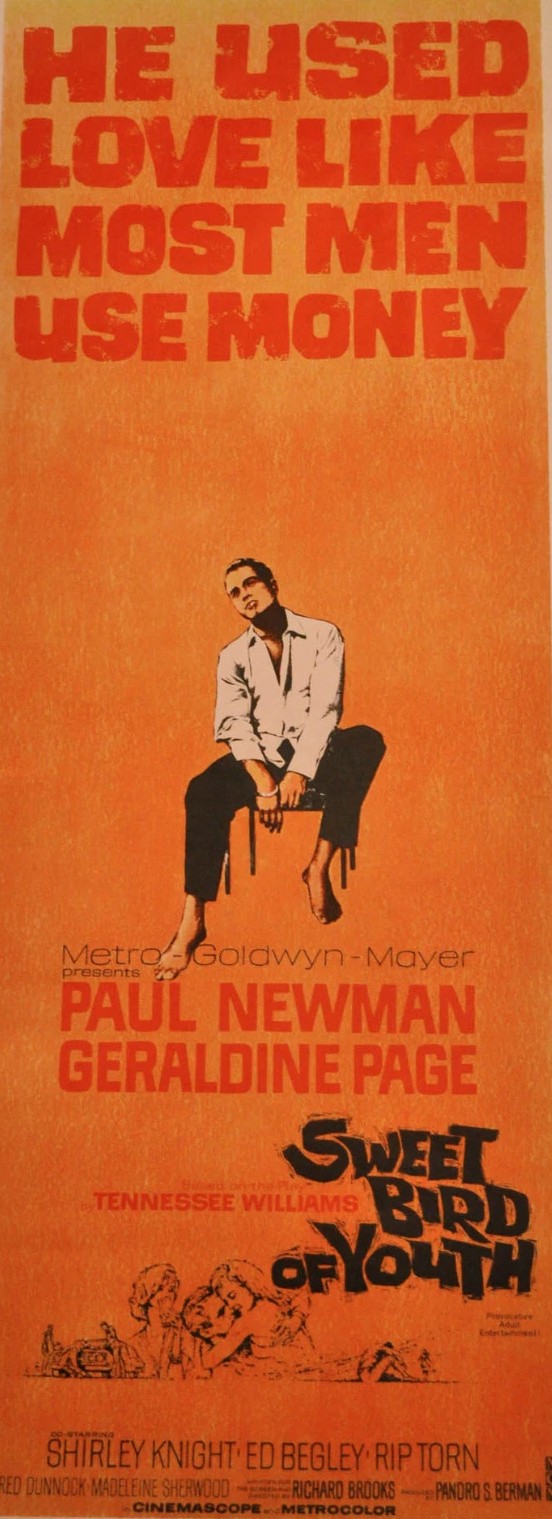
Writer-director Richard Brooks had built a reputation adapting heavyweight literary works – ranging from Dostoevsky’s The Brothers Karamazov (1958), Tennessee Williams play Cat on a Hot Tin Roof (1958) and Sinclair Lewis’s evangelism opus Elmer Gantry (1960) – the last two box office and critical hits –  and though he had Joseph Conrad’s Lord Jim in his sights he had a hankering after more simple fare. He planned to go out on his own and had paid $30,000 to acquire Arthur Woolson’s Goodbye, My Son focusing on mental health and $70,000 on The Streetwalker, written anonymously by a sex worker, and more nitty-gritty than the current stream of high-end good-time-girl pictures. The Streetwalker would take a semi-documentary approach. Brooks aimed for budgets around the $700,000 mark.

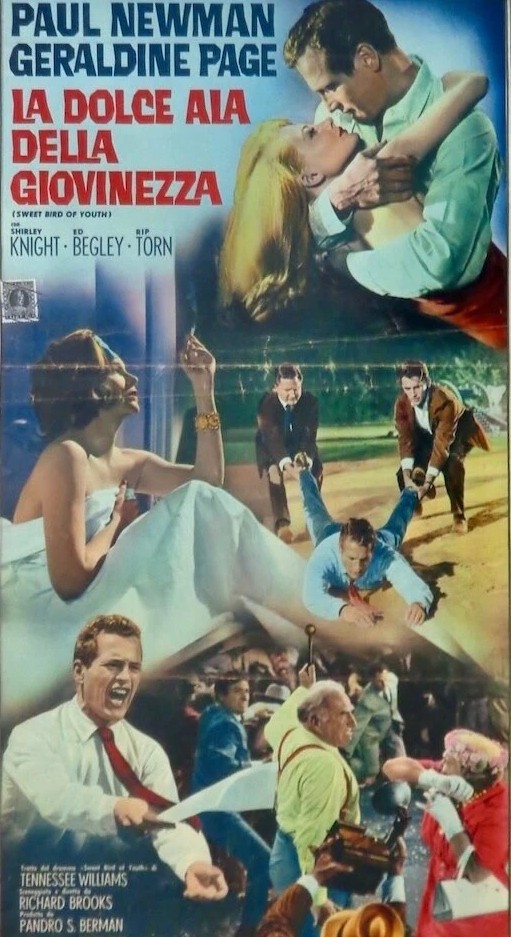
But in the end, he fell for the blandishments of producer Pandro S. Berman, for whom he had made Cat on a Hot Tin Roof, one of MGM’s biggest hits, and Paul Newman, who had played the part of Chance in the original Broadway play. It had run for nearly a year and the cast included Geraldine Page, Rip Torn and Madeleine Sherwood who reprised their roles in the film. Ed Begley had worked with Brooks on Deadline USA (1952).

By this point Newman was rid of the shackles of his Warner Bros contract and spread his wings artistically and commercially, following up Exodus (1960) with Martin Ritt’s Paris Blues and the first of his iconic roles in Robert Rossen’s The Hustler. Newman was paid $350,000, half the total sum allocated to the cast. The play cost a total of $600,000 against a budget of $2.8 million. Even so, Newman’s stock was not as high as later in the decade and even with his name attached a film based on John Hersey’s The Wall about the Warsaw Uprising failed to get backing.

Brooks was reluctant to get back into the ring with Tennessee Williams, still smarting from the “repeated sniping” that followed Cat on a Hot Tin Roof. Brooks recalled that “during filming I talked with Tennessee on the phone a number of times and all was peachy.” But later the author complained Brooks had “butchered” the play. He was especially incandescent because Williams pocketed $1.4 million while the director made do with just $68,000. Brooks demanded “a signed letter written by Williams and published in Variety to the effect that he (Williams) liked the film version” before he agreed to helm Sweet Bird of Youth.

There’s no sign that Williams acquiesced and Brooks proceeded with his version which turned into flashbacks some of the incidents dealt with on stage through dialog.

“Most people go out to Hollywood with a seven-year contract to work,” noted female lead Geraldine Page, wryly, “It looks like I had a seven-year contract to stay away.”  A rising star when selected for the female lead for John Wayne 3D western  Hondo (1954), she didn’t make another movie for seven years, largely as the result of not being considered photogenic enough. For Hondo, a scene had been added, “in which she was called upon to acknowledge that she was not beautiful,” and that designation, although intended purely to reflect a self-deprecating character, stuck. Although another explanation for her absence was that she was blacklisted for her association with Uta Hagen, but it’s unlikely that noted right-winger Wayne would have employed her in the first place has that been the case.

Despite an Oscar nomination for Hondo, she made her way on the stage instead, to critical approval, New York Drama Critics Award and Tony nomination for Sweet Bird of Youth. After an Oscar nomination for another Williams adaptation Summer and Smoke (1961), her career was revived, after the industry “found out how to employ one of the top performing talents of the last decade.” No surprise, however, that she wasn’t MGM’s first choice. The studio preferred the likes of Ava Gardner, Lana Turner and Rita Hayworth, who would be doing little acting to portray themselves as fading stars.

“When I saw how they fixed me up (for Sweet Bird),” said Page, “I said, look at me I’m gorgeous.” Brooks made her get rid of “those fluttering gestures” that he reckoned “subconsciously were efforts to cover her face.”

Shirley Knight didn’t have to audition. She and Brooks met at the Oscar ceremony. All he asked of her was that she lighten and grow her hair.

“He was a man who really knew what he wanted,” recalled Knight, “He wanted you to do a certain thing and was clear about the look of it.” She was so in thrall to the director that she followed his instruction to the steer a boat in one direction even though she knew it would lead her to smash straight into a dock.

Given the controversial nature of the play, there were concerns the entire project would be blocked by the Production Code, the U.S. censorship body. But Berman was quick with the reassurance. He claimed it would be “the cleanest picture ever made…clean as any Disney film.”  To achieve that would require considerable trimming as the play involved abortion, hysterectomy and castration. Berman ensured these elements were eliminated. Brooks changed the ending.

Commented Williams, “Richard Brooks did a fabulous screenplay of Sweet Bird of Youth but he did the same f…ing thing (as Cat on a Hot Tin Roof.) He had a happy ending. He had Heavenly and Chance go on together which is contradictory  to the meaning of the play. It was a brilliant film up to that point.”

Actually, Brooks was undecided about the ending. He wanted to shoot two endings, one as unhappy as the play. “But once the ending was on film – the one the studio wanted – production was shut down.”

Newman was more relaxed about any changes. “You have to make peace with the idea when you make a motion picture version of a play, it’s so difficult and it’s no sense struggling with things that were in the play.” With enough controversy riding on the picture, the studio banned the actors from talking to the media.

Initially, box office expectations were high when the movie hit first run. A $72,000 first week take in New York was considered “boffo.” It scored “a lusty” $28,000 in Chicago, a “bang-up” $15,000 in Buffalo, a “brilliant” $28,000 in Los Angeles, a “lush” $14,000 in Pittsburgh, a “bright” $16,000 in St Louis, and a “wow” $17,000 in Detroit. It generated a “loud” $4,500 in Portland, a “wham” $15,000 in Minneapolis and was “sockeroo” in Washington DC with $21,000.

But once it left the rarified atmosphere of the big cities, it stumbled. There was precent, the touring production of the play had also flopped once it left the environs of Broadway. Variety reckoned the timing was to blame as audiences showed “more aloofness to this type of fare” than they did a couple of years before.

The movie limped to $2.7 million in rentals – and a lowly 30th spot on the annual rankings – at the U.S. box office though foreign was more promising, ninth overall in France and 10th in Italy.

SOURCES: Douglass K. Daniel, Tough as Nails, The Life and Films of Richard Brooks (University of Wisconsin Press). pp146-154; Daniel O’Brien, Paul Newman (Faber and Faber, 2005), pp86-7; Shawn Levy, Paul Newman, A Life  (Aurum Press, 2009), pp169-171; “Folks Don’t Dig That Freud,” Variety, May 9, 1960, p1; “Metro Hot for Brooks,” Variety, June 15, 1960, p2; “Sweet Bird of Youth Will Be Ok for Kiddies,” Variety, September 13, 1961, p5; “Brooks Prostie and Psycho Indies,” Variety, September 13, 1961, p4; Vincent Canby,  “Seven Years After Her Film Discovery, Geraldine Page May Be Accepted,” Variety, November 15, 1961, p2; “Picture Grosses”, March-May 1962, Variety; “Fun-Sex Plays, ‘Sick’ Slowing,” Variety, August 8, 1962, p11; “Big Rental Pictures of 1962,” Variety, Jan 9, 1963, p13; “Yank Films,” January 23, 1963, p18.

Sweet Bird of Youth (1962) ***

Tennessee Williams wrote better parts for women than he did for men. You can start with Vivien Leigh, Oscar-winner for A Streetcar Named Desire (1951) – Marlon Brando only nominated – and Anna Magnani Oscar-winner for The Rose Tattoo (1955) with Maria Pavan nominated and star Burt Lancaster left out of gong consideration. Carroll Baker and Mildred Dunnock were nominated for Baby Doll (1956) with star Karl Malden ignored. Paul Newman did receive an Oscar nomination for Cat on a Hot Tin Roof (1958) as did Elizabeth Taylor.

Montgomery Clift was frozen out of Oscar consideration for Suddenly, Last Summer (1959) while both Elizabeth Taylor and Katharine Hepburn scored nominations.  Marlon Brando received no Oscar recognition for The Fugitive Kind (1960). Ditto Laurence Harvey for Summer and Smoke (1961) though Geraldine Page and Una Merkel received nominations. Lotte Lenya was recognised with a nomination for The Roman Spring of Mrs Stone (1961).

So the omens were not particularly good for Paul Newman when he repeated the role he had essayed on Broadway of Chance Wayne in Sweet Bird of Youth. In the stage version, while he received respectable notices, it was Geraldine Page who picked up the glory, winning the New York Drama Critics Award and nominated for a Tony.

So it was going to be a long shot that Newman could outshine her in the film version, even though he received considerably more screen time – Page and Shirley Knight were nominated, Newman was not.

The flaws in the tale are more obvious in the screen version. On stage, sheer force of personality can win over an audience, on screen that’s more difficult. And in truth Chance was another of Williams’ male losers. The main difference between Williams’ male and female characters is that not only are the women more reflective and aware of their shortcomings while the men simply bulldoze ahead but they are more able to express their feelings without dialog.

Chance is a failed actor turned gigolo taking advantage of alcoholic over-the-hill movie actress Alexandra Del Lago (Geraldine Page), running away from what she believes will be her final and calamitous movie, who half the time doesn’t know where she is or who he is. Chance has dreams of using her to hustle his way into the movie business, blackmailing Del Lago over her drugs abuse to front a new picture, and begins knocking on doors, but long-distance, since he’s returned to his home town in the hope of winning back his childhood sweetheart Heavenly Finley (Shirley Knight), planning to set her up as a movie star.

Expectations that there might be a welcome for a young man made good are dashed when everybody continues to treat him as the waitperson he once was or wants to run him out of town. To protect his daughter from such an unworthy suitor, the town’s most prominent citizen and political heavyweight Tom Finley (Ed Begley) had previously managed to pay Chance to leave town. His son Tom Jr (Rip Torn)  shares his father’s aspirations.

Despite the odds Chance determines to woo Heavenly but his Hollywood dream is scuppered when Del Lago realizes that her last picture looks like becoming an unexpected success and she can once again write her own ticket rather than rely on a con man like Chance.

It doesn’t end well though, for reasons best known to him, writer-director Richard Brooks tacked on a happy ending – the play had an unhappy ending – that doesn’t ring true.

There’s nothing wrong with Paul Newman’s acting even if it didn’t attract the attention of the Oscar voters, but there’s not enough meat on the character. On the other hand, Geraldine Page and Shirley Knight (The Group, 1966) in part excel because their characters are better written. Rip Torn (Beach Red, 1967) develops his screen menace. Ed Begley’s (Warning Shot, 1966) over-the-top performance snagged him an Oscar.

The story’s just too thin and the hard edges of the play have been trimmed back so it was less appealing to an audience.

Lacks the usual Tennessee Williams bite but the female performances are well worth a watch.

I’m doing a Behind the Scenes article tomorrow so look out for that.

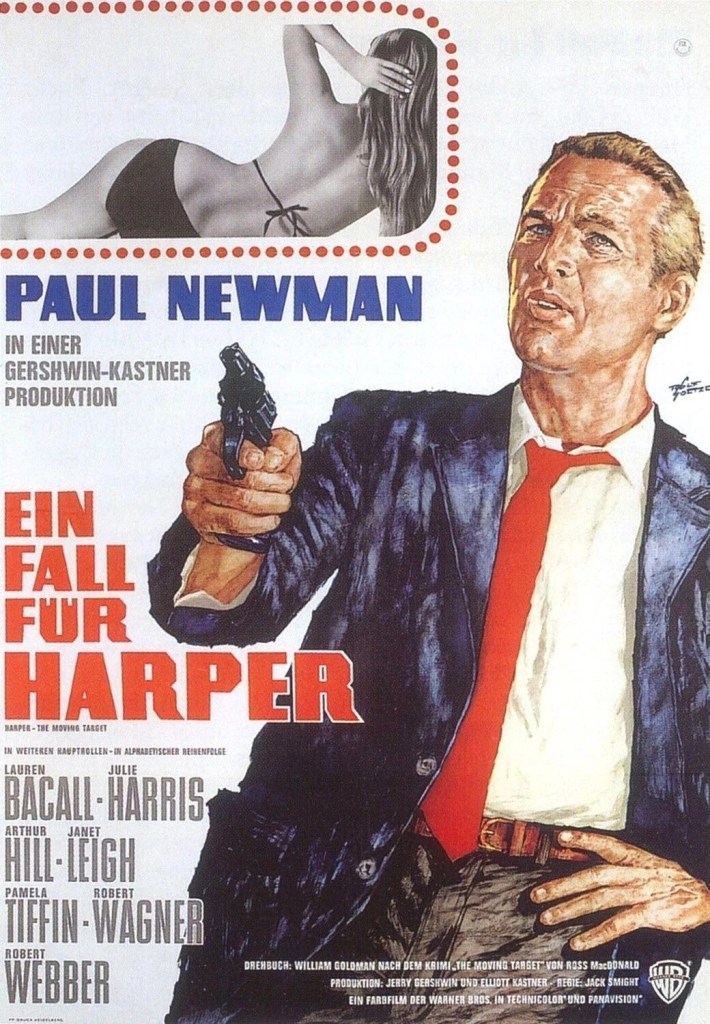
Harper / The Moving Target (1966) ****

Inventive screenplay by William Goldman (Masquerade, 1965), the ideal combination of witty lines and others that strike to the heart, and Paul Newman’s most naturalistic performance, and a family at each other’s throats, create a genuine addition to the private eye genre. Punch-ups are limited, generally the sleuth comes out worse, his skull an easy target apparently for any villain wanting to give him a good biff.

Most people remember the celebrated credit sequence. But, in fact, most people do not. They remember that this is a guy who will reuse old coffee grinds, which is as good a character definition as you’re going to get. But the opening sequence says much more – he sleeps in a pull-out couch, he falls asleep with the television on, dunking his face in ice suggests a hangover, and – the killer – he sleeps in his office. You won’t forget the ending either, the freeze frame, as fed-up Harper (Paul Newman) just gives up on the stupidity of mankind. And just before that there’s a delicious moment when crippled mother Elaine Sampson (Lauren Bacall) trills to the daughter she loathes Miranda (Pamela Tiffin) in a voice that would denote happiness but is anything but, “I’ve got some news for you,” as she looks forward to informing the child that the father she adores and that Elaine equally loathes is dead.

Not surprisingly, Harper’s on the verge of divorce from wife Susan (Janet Leigh), but he still hankers after being a knight in shining armor, those few days every year when he puts the world to rights rather than chasing down errant husbands in seedy hotel rooms.

The tale is a tad convoluted, involving initially tracking down Elaine’s estranged missing millionaire husband that turns into kidnapping and then murder with a side order of a fake cult headed by Claude (Strother Martin) that’s a front for an illegal immigrant operation, and going through the gears, character-wise, with malicious wife, an extremely flirtatious Miranda who gets her come-uppance when she tangles with Harper, faded alcoholic star Fay Estabrook (Shelley Winters) and junkie Betty (Julie Harris) sometime lover of lothario pilot Allan Taggert (Robert Wagner).

Two distinctive thugs Dwight Troy (Robert Webber) – Fay’s husband – and Puddler (Roy Jenson) offset the dumbest of dumb cops led by Sheriff  Spanner (Harold Gould) and lovesick attorney Albert Graves (Arthur Hill), Harper’s longtime buddy, who pines for Miranda.

Torture comes in two guises – the junkie gets the treatment from Dwight and Harper is put through the wringer listening to the endless whining of Fay as he tries to pump her for information. Harper avoids beatings and takes beatings and various characters bounce through doors with a gun – both Taggert and Graves save Harper from being shot.

Harper’s got a slick way about him, but mostly his charm is used to weasel information. He hasn’t got enough of it left to work on his wife.

When Harper’s not racing his sports car along twisting mountain roads, the action shifts to a cult temple, the docks and an abandoned oil tanker. Even when Harper works out who’s in on the kidnapping, it turns out he’s now got a murder to solve since someone’s bumped off the kidnappee.

Despite the endless complications, this whizzes along, helped enormously by Paul Newman’s (Cool Hand Luke, 1967) winning characterization. He’s brought a new trick to his acting arsenal, mastering a method of not listening to a conversation by tilting his head away from the speaker, and there’s a number of novel gestures. The scene where he rejects Miranda is a cracker. Tough guy running short of a soft center, he makes a very believable human being. And he’s got his work cut out because Lauren Bacall (Shock Treatment, 1964) is on scene-stealing duties. As is Pamela Tiffin (The Pleasure Seekers, 1964) though she can hardly match the older woman for arch delivery.

It’s a top-notch cast all the way down. Fans of Strother Martin (Cool Hand Luke) will enjoy his fake healer, Arthur Hill (Moment to Moment, 1966) is engaging, Robert Wagner (Banning, 1967) adds another notch to his rising star bow while Robert Webber (Don’t Make Waves, 1967) emanates menace with his “old stick” routine. Shelley Winters (The Scalphunters, 1968) is a great lush, Julie Harris (The Split, 1968) a junkie trying to pretend she’s not and Janet Leigh (Psycho, 1960), having kicked her husband out, still hoping he might come back in more acceptable form.

Jack Smight (The Third Day, 1965) directs with some zap. This should have had everyone singing the praises of crime writer Ross MacDonald, who in inventing the character (Lew Archer in the original) had inherited the Raymond Chandler mantle, but instead they came away whistling Dixie for screenwriter William Goldman.

Class act.

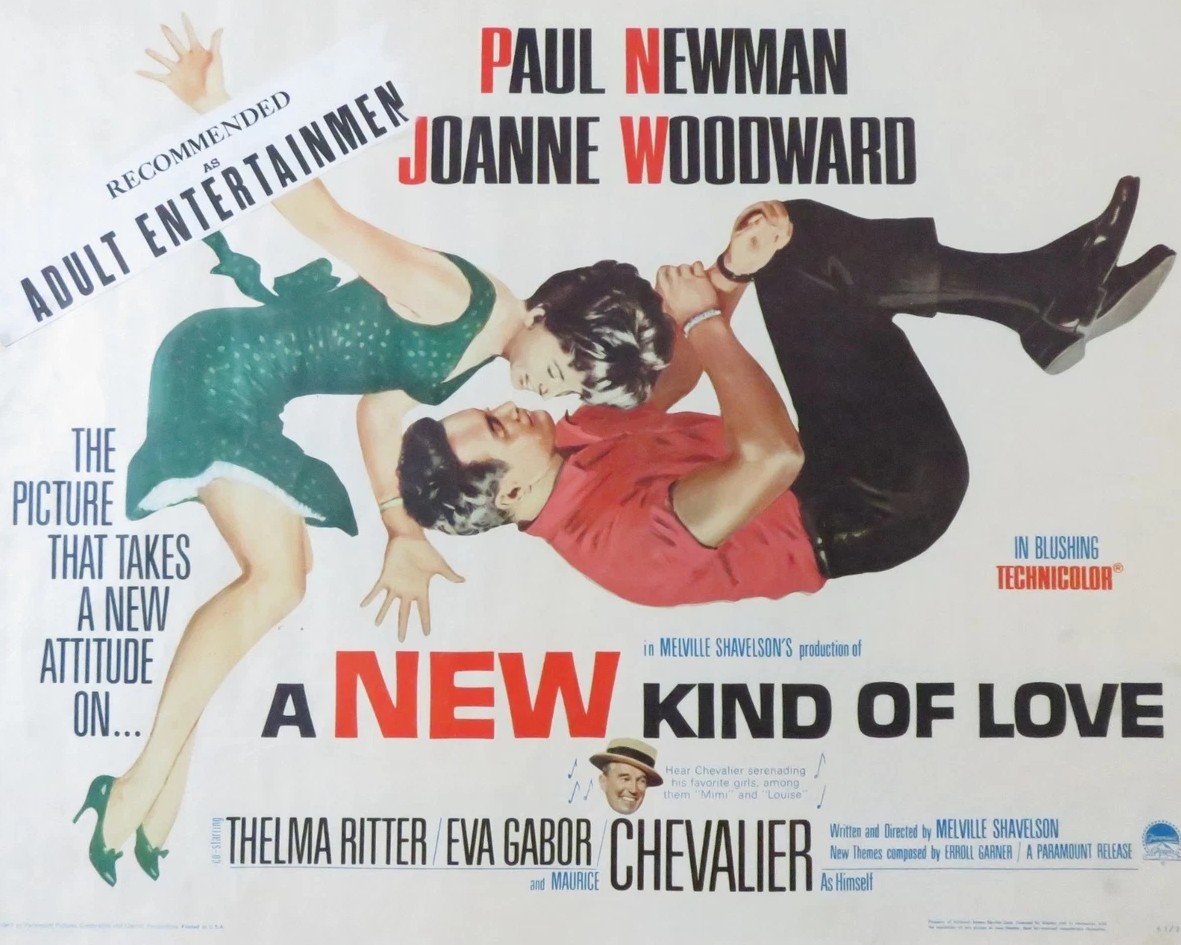
A New Kind of Love (1963) ***

Just about scrapes by, small thanks to Paul Newman’s atrocious Texan accent, Joanne Woodward’s frightful blonde wig – more Lady Penelope than classy Parisian – and Maurice Chevalier serenading a horde of drunken women. Maurice Chevalier? Well, of course this is Paris and Chevalier always sings regardless of being peripheral to the story.

Suffers, too, from being a smart-ass picture, in the vain hope of hitting the satirical bullseye taking swipes at everything in sight, from women barging into a sale to haute couture, airline stewardesses, journalism and even Paris. And there’s a string of fantasy sequences that might (or might not) have worked at the time but fail to gell now. Takes forever for the principals to even be brought close enough together to envisage romance and it doesn’t help that that supposedly most eagle-eyed of creatures, the reporter, can’t see through a simple disguise.

Tomboy Sam Blake (Joanne Woodward) is a pirate. Not the swashbuckling kind, leaping through the rigging, which would be worth seeing I’m sure, but the industrial kind, stealing the designs of better designers for a New York department store.

Steve Sherman (Paul Newman) is piratical, stealing other people’s wives. When his latest conquest turns out to be married to his boss, he is shifted off to Paris as – punishment? Yep, you can see the awry thinking behind this one.

Meanwhile, Sam and a gang from her store, boss Joe (George Tobias) and colleague Lena (Thelma Ritter), are off to Paris on a spying expedition to the annual fashion shows. Lena has her eyes on romance with the boss but is beaten to that prize by the glamorous Felicienne (Eva Gabor). Sam isn’t interested in romance. She’s a career woman, or in the parlance of the day, a “semi-virgin” (though I suspect that description was a screenwriter’s invention). Neither is Steve, for that matter, at least not of the long-lasting kind, he’s happily tearing around with a woman on each arm, enjoying the more nefarious sights of the French capital while Sam is knee deep in work.

After Sam gets a makeover, complete with long cigarette-holder Lady Penelope style, resulting in the bouffant hair style and is sitting in a café, she is approached by Steve who, assuming she is a high-class courtesan, attempts to interview her for the article he hopes will save his job. They’ve bumped into each other, she disdaining his obvious approaches, a couple of times but then she was rigged out in a short haircut and dark glasses. And this is such a complete transformation he doesn’t recognize her. And, in order to make this movie work, the audience has to play along.

As does Sam, keeping up the pretense of being a high-class hooker in order to get her revenge on the man she despises. The fictions she dishes up, of dalliances with powerful men, are published in his column and their success ensures he’s not fired. Felicienne is edged out of the way, revealed as previously a sex worker, so Lena can make her play for Joe.

Before that ploy can work, Steve sets up Sam with Joe who sees through the disguise. There’s a whole bundle of other unlikely shenanigans before we reach the compulsory happy ending.

Hollywood was fairly enamored with the sex worker or goodtime girl – Never on Sunday (1960), Butterfield 8 (1960), Irma La Douce (1963), for example, with the Oscars chipping in to show their support – and another (yes, this had been done before) comedic twist seemed to offer potential especially with two big stars going all risqué.

Paul Newman (The Prize, 1963) never quite worked out how to manage comedy until Butch Cassidy and the Sundance Kid (1969) where he maintained his usual persona and just delivered the lines rather than trying to wring laughs out of them. He also has a bad habit of trying to demonstrate character by fidgeting, so his face, eyes and hands are all over the place.

Joanne Woodward (A Big Hand for the Little Lady/ Big Deal in Dodge City, 1966) is better value initially but when she takes on the disguise there’s too much of the knowing wink. Six-time Oscar nominee Thelma Ritter (Boeing, Boeing, 1965) has a better idea of how to play comedy by just sticking to the knitting.  

Writer-director Melville Shavelson (The Pigeon That Took Rome, 1962) just about makes it work and when it doesn’t throws in sufficient distraction.

Not the Newman-Woodward team’s finest hour.

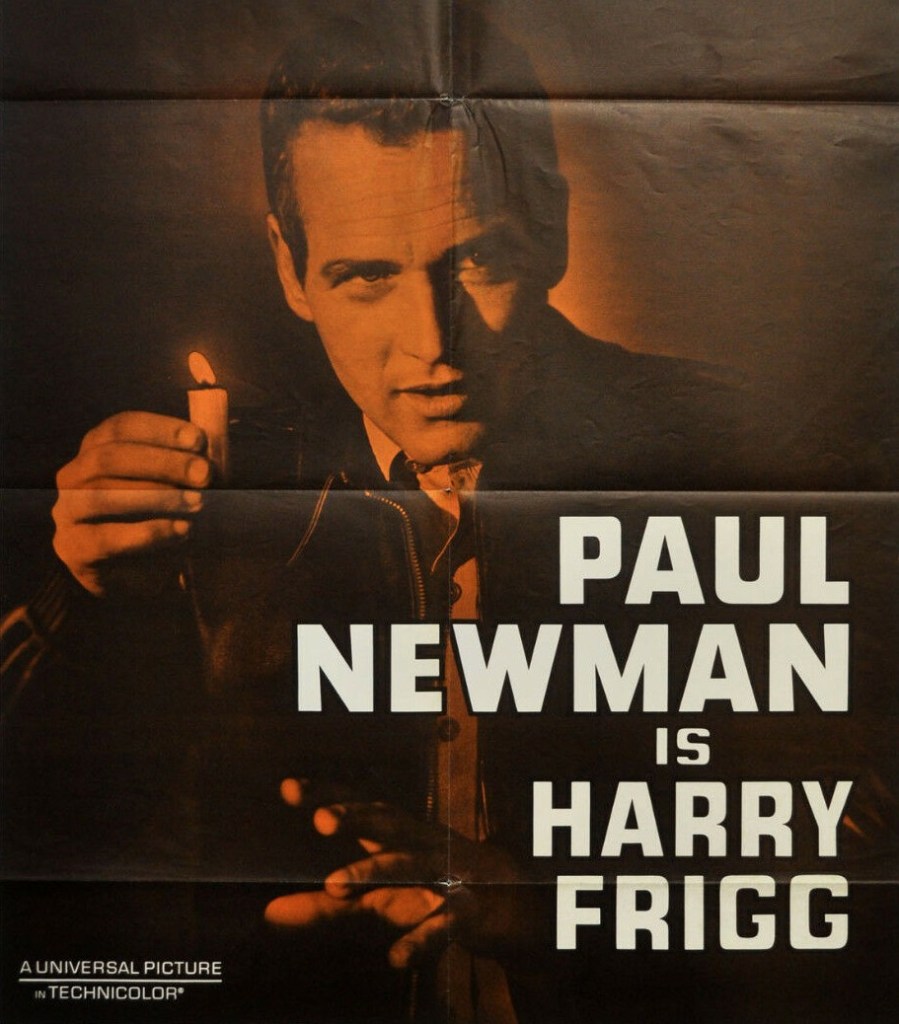
The Secret War of Harry Frigg (1968) ***

Except for an ingenious escape attempt and Paul Newman spoofing his Cool Hand Luke (1967) persona, this World War Two POW number falls into the “sounded like a good idea at the time” category. Harry Frigg (Newman), the American army’s most notorious escapee (though from British military prisons), is promoted from buck private to two-star general and parachuted into northern Italy to organize a breakout of five one-star generals.

The premise that the war effort is hampered by embarrassment at the generals being captured seems far-fetched as is the notion that the quintet are hopelessly incompetent when it comes to doing anything that sounds like proper army stuff. Adding another offbeat element is that they are being held in effectively a deluxe POW camp, an ancient castle run by Colonel Ferrucci (Vito Scotti), a former Ritz hotel manager with a lapdog attitude to the rich and powerful.

Almost immediately Frigg discovers an escape route through a secret door but is disinclined to go any further since it leads into the boudoir of the Countess Francesca (Sylva Koscina). New Jersey inhabitant Frigg feels out of the place with the high-falutin’ generals and proceeds to get himself a cultural education. Meanwhile, the countess, obtaining her position through marriage rather than birth, trying to bolster his confidence naturally triggers his romantic impulses.

The humor is of the gentlest kind – Frigg taking advantage of his superiority, Italians speaking tortured English – and not much in the way of bellylaffs either. Director Jack Smight, who collaborated so well with Newman in Harper (1966) and manages to achieve a tricky balance in No Way to Treat a Lady (1968), loses his way here, not least structurally, as the movie pingpongs between the generals, the commandant and Frigg and, thematically, issues of power. Crucially, he fails to rein in Newman.

The generals, squabbling among themselves for power, would be caricatures except that their characters are rounded out by the players, Charles Gray (The Devil Rides Out, 1968) as Cox-Roberts and Tom Bosley (Divorce American Style, 1967) as Pennypacker. The other generals are played by Andrew Duggan (Seven Days in May, 1964), John Williams (Harlow, 1965) and Jacques Roux (The List of Adrian Messenger, 1963). Representing the American top brass in England are James Gregory (a repeat role in the Matt Helm series) and Norman Fell (The Graduate, 1967)

After her excellent turn as a mischievous and vengeful villain in Deadlier than the Male (1967), Yugoslavian Sylva Koscina comes down to earth with a less rewarding role as charming leading lady with a sly sense of humor rather than the femme fatale of A Lovely Way to Die (1968). Werner Peters (The Corrupt Ones / The Peking Medallion, 1968) makes a late appearance as a Nazi and you might spot screenwriter Buck Henry (The Graduate) in a bit part.

The screenplay by Peter Stone (Arabesque, 1966) and Oscar-winner Frank Tarloff (Father Goose, 1968) is an odd mixture of occasional sharp dialog and labored story. The set-up takes too long and you keep on wondering when it is going to get to the pay-off.

No doubt looking for some light relief after a quartet of heavier dramatic roles – Harper (1966), Torn Curtain (1966), Hombre (1967) and Harper (1967) – Newman acts like he has escaped the straitjacket of a considered performance and instead indulges in mugging and hamming it up, his body freeing a barrage of mannerisms previously held in check.

Hombre (1967) ****

Shock beginning, shock ending. In between, while a rift on Stagecoach (1939/1966) – disparate bunch of passengers threatened by renegades – takes a revisionist slant on the western, with a tougher look at the corruption and flaws of the American Government’s policy to Native Americans. Helps, of course, if you have an actor as sensitive as Paul Newman making all your points.

The theme of the adopted or indigenous child raised by Native Americans peaked early on with John Ford’s The Searchers (1956) but John Huston made a play for similar territory in The Unforgiven (1960) and, somewhat unexpectedly, Andrew V. McLaglen makes it an  important element of The Undefeated (1969).

This begins with a close-up of a very tanned (think George Hamilton) Paul Newman complete with long hair and bedecked in Native American costume. Apache-raised John Russell (Paul Newman) returns to his roots to claim an inheritance – a boarding house –  after the death of his white father. That Russell is a pretty smart dude is shown in the opening sequence where he traps a herd of wild horses after tempting them to drink at a pool. He decides to sell the boarding house to buy more wild horses.

That puts him on a stagecoach with six other passengers – Jessie (Diane Cilento), the now out-of-work manager of the boarding house, retired Indian Agent Professor Favor (Fredric March) and haughty wife Audra (Barbara Rush), unhappily married youngsters Billy Lee (Peter Lazer) and Doris (Margaret Blye), and loud-mouthed cowboy Cicero (Richard Boone). Driving the coach is Mexican Henry (Martin Balsam).

Getting wind that outlaws might be on their trail, Henry takes a different route. But the cowboys still catch up and turns out Cicero is their leader. He takes Audra hostage, though she appears quite willing having tired of her much older husband, steals the thousands of dollars that the corrupt Favor has stolen from the Native Americans, and, also taking much of the available water, leaves the stranded passengers to die in the wilderness.

The passengers might have lucked out given Russell is acquainted with the terrain but they’ve upset the Apache by their overt racism, insisting he ride up with the driver rather than contaminate the coach interior. And the outlaws, having snatched the loot, and Cicero his female prize, should have galloped off into the distance and left it to lawmen to chase after them.

But Russell, faster on the uptake than anyone expects, manages to separate the gangsters from the money, forcing them to come after it. Russell wants the cash to alleviate the plight of starving Native Americans as was originally intended, but he has little interest in doing the “decent thing” and shepherding the others to safety. Ruthless to the point of callous, he nonetheless takes time out from surviving to educate the entitled passengers to the plight of his adopted people.

A fair chunk of the dialog is devoted to Russell explaining why he’s not going to do the decent thing and giving chapter and verse on the indignities inflicted on his people, and that alone would have given the picture narrative heft, especially as the corrupt Favor is more interesting in retrieving the money than his wife.

But in true western fashion, Russell is also a natural tactician and manages to pick off the outlaws when they come calling, impervious to the cries of Audra staked out in the blazing sun as bait. Eventually, against his better judgement, Russell gives in to the entreaties of Jessie and attempts to rescue the stricken women only to be cut down by the gunmen. I certainly didn’t expect that.

So, it’s both action and character-led drama. Paul Newman (The Prize, 1963) is superb (though not favored by an Oscar nod), especially his clipped diction, and oozing contempt with every glance, and the whiplash of his actions which is countered by shrewd judgement of circumstances. But Diane Cilento (Negatives, 1968) is also better than I’ve seen her, playing the foil to Newman, sassy enough to deal with him on a male-female level, but with sufficient depth to challenge his philosophy. Strike one, too, for Martin Balsam (Tora! Tora! Tora!, 1970) in a lower-keyed performance than was his norm. Richard Boone (Rio Conchos, 1964) and the oily Fredric March (Inherit the Wind, 1960) are too obvious as the bad guys. Representing the more calculating side of the female are Barbara Rush (The Bramble Bush, 1960) and movie debutant Margaret Blye.

The solid acting is matched by the direction of Martin Ritt (The Spy Who Came in from the Cold, 1965). Prone to preferring to make picture that make a point, he has his hands full here. But the intelligent screenplay by Irving Ravetch and Harriet Frank Jr. (Hud, 1963), adapting the Elmore Leonard novel, make the task easier, offsetting the potentially heavy tone with some salty dialog about sex and married life.

Thought-provoking without skimping on the action.    

Behind the Scenes: “The Silencers” (1966)

Producer Irving Allen remains best known as the fella who turned down James Bond. While partnered with Cubby Broccoli in Warwick Films, he decided the Ian Fleming books were not big screen material. Their production shingle, based in Britain, had turned out movies like The Red Beret (1953) with Alan Ladd and Fire Down Below (1957) pairing Robert Mitchum and Rita Hayworth. Divorced from Broccoli, Allen headed down the big-budget historical adventure route but neither The Long Ships (1964) spearheaded by Richard Widmark and Sidney Poitier nor Omar Sharif as Genghis Khan (1965) hit the box office target.

Luckily, Allen had already made an investment in espionage, owning the rights to the hard-edged Matt Helm novels, knocked out at the rate of one or two a year since 1960 by Donald Hamilton whose most notable brush with Hollywood was selling the rights to his novel The Big Country (1958) filmed by William Wyler with a top-class cast.  The Matt Helm series was praised by the top thriller critic of the era, Anthony Boucher, who noted that Hamilton brought “sordid truth” to the espionage genre and “the authentic hard realism of Dashiell Hammett.”

Having optioned the books, Allen persuaded Columbia to buy the rights to eight, with the notion of setting up a direct rival to James Bond, that idea given an extra fillip when the Sean Connery series which had appeared on an annual basis skipped 1966. Initially, Allen planned to make films that followed the novel’s serious approach to espionage, intending to cast a  marquee name like Paul Newman (The Prize, 1963) – who ironically proved major competition for the first offering through Hitchcock’s Torn Curtain (1966) – or conversely a relative unknown such as Mike Connors (Harlow, 1965).

To hook Dean Martin, Allen had to make him a partner, resulting in the actor making more dough out of a spy film than Sean Connery did from Bond. Martin was something of a Hollywood enigma. Audiences who flocked to the Rat Pack outings tended to disdain his stand-alone efforts such as Toys in the Attic (1963) and Kiss Me, Stupid (1964) and if he was a current household name that owed much more to his recording and television career.

But Allen shifted the emphasis away from straight adaptation to tongue-in-cheek, setting up the series initially as gentle parody rather than out-and-out spoof though as the movies progressed they fell more into the latter category.

Playing to Martin’s strengths of urbane charm and effortless style, as well as his reputation as a lothario, and accommodating his age (he was 48) by ensuring his character was brought out of retirement, and with comedy writer Herbert Baker brought in at Dean Martin’s behest to beef up Oscar Saul’s script, and by surrounding him with more heavyweight damsels than the Bonds, the series was good to go. Baker had written early Dean Martin-Jerry Lewis vehicles like Jumping Jacks (1952) and Scared Stiff (1953). The script drew upon two Hamilton novels, Death of a Citizen (the first in the series) and The Silencers (the fourth). The idea of Helm being married was dropped to allow him the same sexual license as James Bond.

Stella Stevens and Daliah Lavi were unusual choices for the leading ladies of a spy picture, their proven marquee appeal considerably in excess of that of  Ursula Andress (Dr No, 1962), Honor Blackman (Goldfinger, 1964) and Claudine Auger (Thunderball, 1965), that trio of movies opening Hollywood doors for the actresses rather than as with Stevens and Lavi already being welcome attractions. Lavi had starred in The Demon (1963) and Lord Jim (1965) while Stella Stevens had been female lead in The Nutty Professor (1963) and Advance to the Rear (1964). The Slaygirls, however, a direct imitation of the Bond Girls, also owed something to Playboy’s Playmates.

Other cast members had some distinction, Victor Buono Oscar-nominated for Whatever Happened to Baby Jane (1962) and James Gregory acclaimed for his role in The Manchurian Candidate (1962). Both had worked previously with Martin, Gregory on The Sons of Katie Elder (1965) and Buono on 4 for Texas (1963) and Robin and the 7 Hoods (1964).

Martin also called upon President Lyndon B. Johnson’s personal shirtmaker Sy Devore, previously personal clothier to Martin and Lewis, to come up with his stylish attire.

Budgeted at just under $4 million, The Silencers began shooting on 12 July 1965, the 12-week schedule (ending 16 September) taking in locations like Carsbad Caverns, White Sands, El Paso and Juarez with the car chases filmed in Santa Fe and Phoenix, Arizona. Columbia’s backlot was deemed too small for interiors, and two of Desilu’s largest soundstages were joined together to make Big O’s underground HQ.

Director Phil Karlson (The Secret Ways, 1961) and the producer didn’t see eye-to-eye. Despite ostensibly aiming for a comedy, Allen wanted Karlson to adopt the style of the more serious The Ipcress File (1965) and shoot “through chandeliers, under tables.” It turned out that movie’s director Sidney J. Furie had relied on Karlson for most of his cinematic flourishes.

Like Sinatra, Martin preferred one take. “Dean was always great to work with,” recalled James Gregory, “because he never took himself seriously…Dean was always relaxed – if it doesn’t work do it over, but for heaven’s sake you oughta not need more than that one or two times to get it right.”

Despite the easy-going atmosphere, there were casualties. Buono was out of action for four days after slipping while climbing a wall, foot in an unseen cast for the rest of his time on the picture. Supporting actor Arthur O’Connell’s face was sliced open during an explosion. He completed the scene with the bandage covering the wound hidden under a turtleneck sweater. Stunt man Tom Hennessey lost three front teeth. There was a bill of several thousand dollars to cover an unexpected explosion on set, combustible dust igniting after one of the grenades went off on the Big O set.

Astonishingly the movie came in $500,000 under budget and $1 million was recouped from television sales. Columbia was so taken with the end result that prior to its release two sequels were announced.

The Slaygirls featured prominently in promotional activities in the U.S. with six sent overseas to hustle up interest. As well as a movie tie-in paperback and album, merchandising included toy guns from Crescent Toys and Louis Marx. Martin wasn’t available for the Chicago world premiere (he was shooting Texas Across the River, 1966) on 16 February 1966. The movie was gangbusters from the start, clocking up $7.35 million in U.S. rentals (the studio’s cut of the box office), enough for 85th spot (by my exclusive count) on the list of the top earning films of the decade.

SOURCES: Brian Hannan, The Magnificent ‘60s, The 100 Most Popular Films of a Revolutionary Decade (McFarland, 2022); Bruce Scivally, Booze, Bullets and Broads, Behind the Scenes with Dean Martin’s Matt Helm Films of the 1960s (Henry Gray, 2013); William Schoell, Martini Man: The Life of Dean Martin (Cooper Square Press, 2003); Cinema Retro Movie Classics Issue No 9: Matt Helm’s Back in Town.   

Discover WordPress

A daily selection of the best content published on WordPress, collected for you by humans who love to read.

The Atavist Magazine

by Brian Hannan

WordPress.com News

The latest news on WordPress.com and the WordPress community.