Hang ‘Em High (1968) ****

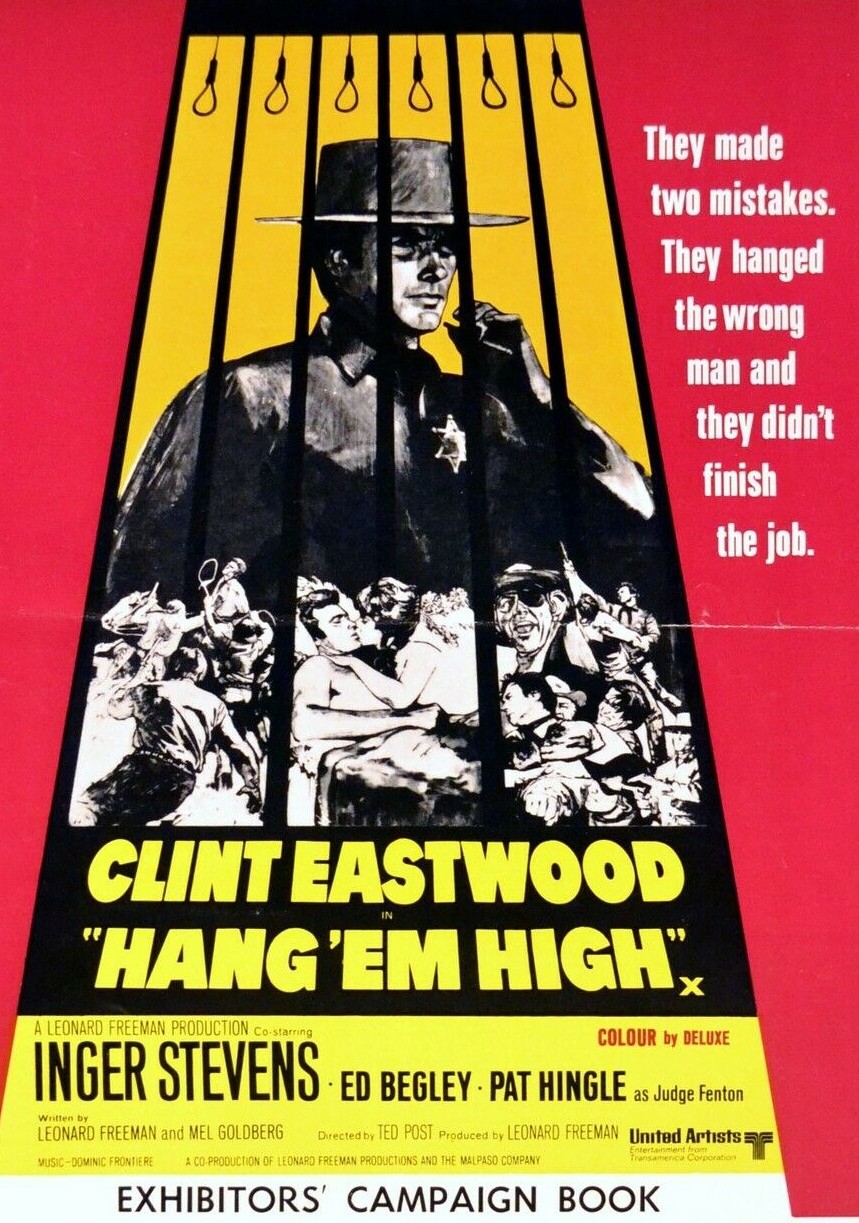
Clint Eastwood didn’t waste much time capitalizing on the unexpected success of the Dollars Trilogy. But the first was not released in the United States till 1967 and despite the success of the series across Europe was generally dismissed as a fluke, until American audiences suggested otherwise. The following year Eastwood appeared in three pictures, Hang ‘Em High, Coogan’s Bluff and Where Eagles Dare, which solidified his screen persona as portraying more with a twitch or a raised eyebrow than digging deep into the dialog.

Contrary to my expectations, Hang ‘Em High doesn’t quite fall into the trademark revenge mode of later westerns. It’s somewhat episodic, Jed (Clint Eastwood) often sent off on a tangent by Judge Fenton (Pat Hingle), allowing the lynch mob who failed to hang him in the first place a second chance at completing the job.

Following the success of the James Bond double bills,
United Artists spun out its Clint Eastwood portfolio at every opportunity.

And while the presence of the second-billed Inger Stevens (Firecreek, 1968) suggests heady romance that doesn’t kick in until the third act and it’s more tentative than anything and its purpose is more, in narrative terms, to provide Jed with a correlative with which to compare his own obsession, bringing to justice the nine men who attempted to kill him.

Just to confuse things, the middle section isn’t about revenge or romance, but about justice. Specifically, it’s about showing that justice will be done, that in the unruly West, with insufficient enforcers of law and order, that crimes will not go unpunished, a gallows on constant display to make the point.

Surprisingly, it’s Jed who argues that some of this justice is just too summarily executed. He tries in vain to prevent the execution of two young rustlers who fell in with one of his potential assassins, Miller (Bruce Dern), but who refuse to take advantage of the situation when Miller overpowers Jed while he’s bringing the trio in to face the judge. Admittedly, they don’t go to his aid either, but the fact they resist piling in allows Jed to escape. However, rustling is a hanging offence, so they cannot escape the noose, certainly not in Fenton’s town.

There’s a switch in the mentality of Jed. Before he’s co-opted by Fenton to return to his former profession of lawman, Jed is of the school of thought that decides to take the law into his own hands. Even wearing a badge, you are allowed to shoot a man stone dead if he’s trying to escape, even if such action is severely hampered by him already being badly wounded, as lawman Bliss (Ben Johnson) demonstrates. But Bliss isn’t as callous as he sounds. He’s a contradiction, too, racing to the aid of Jed dangling in a noose in a tree, freeing him so he can face justice, even if that will most likely result in hanging.

So Jed upholds the law, preventing other citizens from taking the law into their own hands, Miller a target of the family of the owners he slaughtered before making off with their cattle.  

We only see shop owner Rachel (Inger Stevens) fleetingly for most of the picture. She appears any time a new wagon load of criminals is jailed, scanning their faces for who knows what, though likely we’ve guessed it’ll be to find the killer of a loved one. Not only has her husband been killed by two strangers but while his corpse is lying on the ground beside her she’s raped. And although she eventually responds to Jed’s gentle moves, she still can’t let go of her “ghosts.”

Jed is put through the wringer. Not only an inch from death following the initial hanging but ambushed again by the same gang and nearly dying of pneumonia after being caught in a storm, the latter incidents permitting the kind of nursing that often fuels romance.

There’s an ironic ending. Captain Wilson (Ed Begley), leader of the gang, hangs himself rather than be shot by Jed.

The score by Dominic Frontiere (Number One, 1969) lurches. We go from heavy-handed villain-on-the-loose music to eminently hummable echoes of Ennio Morricone.

Clint Eastwood reinforces his marquee appeal, Inger Stevens delivers another of her wounded creatures, and Pat Hingle (The Gauntlet, 1977) is an effective foil. Bruce Dern (Castle Keep, 1969) does his best to steal every scene without realizing that over-playing never works in a movie featuring the master of under-playing.

Host of cameos include veterans Ben Johnson (The Undefeated, 1969), Charles McGraw (Pendulum, 1969) and L.Q. Jones (Major Dundee, 1965) plus two who had not lived up to their initial promise in Dennis Hopper (though he would revive his career the following year with Easy Rider) and James MacArthur (Battle of the Bulge, 1965).

Journeyman director Ted Post made a big enough impact for Eastwood to work with him again on Magnum Force (1973). Written by Leonard Freeman (Claudelle Inglish, 1961) and Mel Goldberg (Murder Inc., 1960).

More than satisfactory Hollywood debut for Eastwood and worth checking out to see that even at this early stage he had nailed down his screen persona.

The Gauntlet (1977) ****

Clint Eastwood the dumb schmuck. Never thought I’d be writing that. But our hero has parked his Dirty Harry persona and channelled much of his inner James Stewart or Tom Hanks, the upright fella who may be a bit of a jerk but is a decent guy underneath.

Our patsy, Phoenix, Arizona, detective Ben Shockley (Clint Eastwood), unshaven drunken bum, is dumb enough to imagine he’s been selected for a special mission because he’s the kind of cop who gets the job done, rather than because he’s the one most likely to fail. He’s sent off to Las Vegas to collect a witness for a trial. No big deal. Two-bit witness, two-bit trial. As soon becomes par for the course, people are apt to make fun of him, in this case a Las Vegas cop turning him away for asking for a guy by the name of Gus Mally. Guffaws all round till the cop takes pity on Shockley and informs him the witness is a woman (Sondra Locke), a feisty sex worker, who spends pretty much the whole of the movie making fun of him and every other sonova.

Shockley’s kinda disturbed to see that someone has made a book on Mally reaching Phoenix, the opening odds of 50-1 soon lengthening to 100-1. But he’s a trusting sort of fella (translated as dumb schmuck) so he thinks it’s a joke but everywhere he goes he gets ambushed and it takes a helluva long time – and only with Gus’s constant nudging – to realize that every time he phones back his position to his boss Commissioner Blakelock (William Prince) there’s awful consequence.

The firepower at everyone’s disposal – both Mob hoods and the cops – is so fearful that cars and houses are destroyed in a ferocious hail of bullets. The only time Shockley comes into his own, cop-style, is when he hustles some Hell’s Angels down and steals a motorbike. But guess what, the bad guys are still not just one step ahead, but in a different class altogether when it comes to pursuit, calling upon a helicopter armed with a sharpshooter.

Shockley even quails when another cop, co-opted into giving them a ride, starts making creepy sexual remarks to Gus, not realizing she can more than take care of herself as if she’s been dealing with hecklers all her life. Gus is quite a character. When she’s not screaming her head off to gain sympathy from Shockley, she’s trying to seduce him, or taking the piss out of him or just plain mocking his ineptitude and trusting personality.

She’s got better weapons at her disposal than he’ll ever have, a tongue that could strip paint, and a body she’s not frightened to use to get herself out of a sticky situation. Or in one particular instance, to save Shockley’s hide. It’s only after this that Shockley gives her any respect. And they come to more than a mutual understanding, as she begins to show genuine feelings for her escort, and we end up with the kind of relationship that’s always going to be raggedy around the edges because, as you’ve guessed, he’s one for keeping his emotions in check and makes do with a catchphrase, “Nag, nag, nag.”

Just what her purpose is in said trial you couldn’t care less about, she’s just a Maguffin to bring opposites together, soften her hard edges and toughen up his unsuspicious nature. There’s a heck of climax as they ride into town in an armor-plated bus and straight into the same kind of fusillade as they previously endured until between them they manage to nail the corrupt bad guys.

This is a hell of a ride, great concept, terrific believable characters, she’s sharp and sassy, and he’s toned down the arrogance. There’s genuine charisma between Clint Eastwood (Coogan’s Bluff, 1968) and Sondra Locke (The Heart Is A Lonely Hunter, 1968), helped by the fact they were already in an adulterous relationship, and in between falling into difficult situations it’s a blast watching them getting out of them.

Despite the virtual non-stop action, it’s a change of pace for Eastwood, a shift away from the screen persona on which his commercial attraction was built, and in some senses, even counting in the violence, it owes more to the dynamics of the screwball comedy than anything else, especially when the more practical woman is called upon to save the out-of-his-depth man. Written by Michael Butler and Dennis Shryack (they teamed up again for Pale Rider, 1985).

Ably directed by Eastwood, a belter.

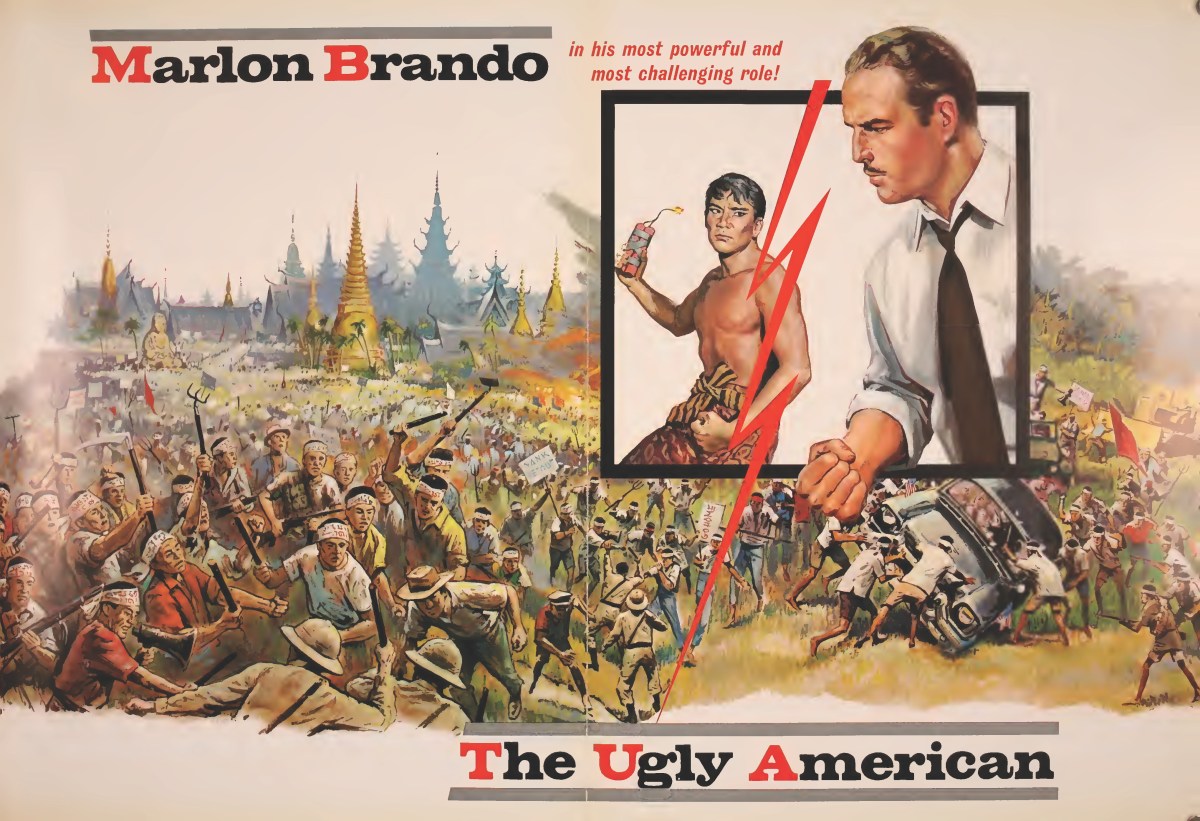
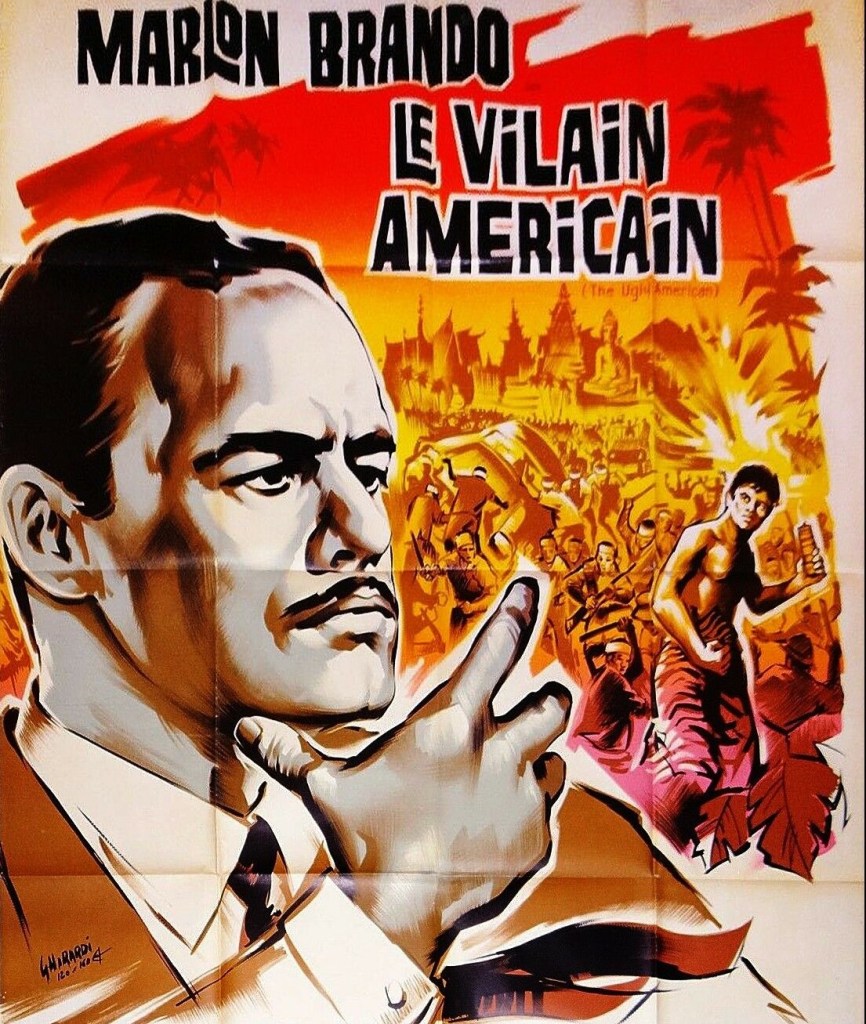
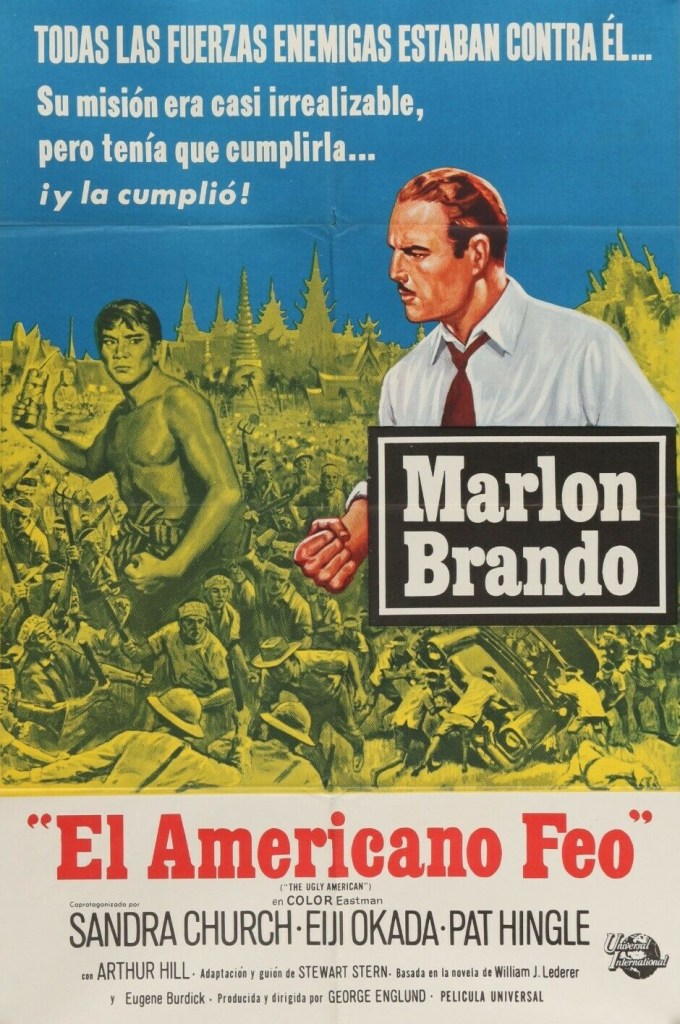
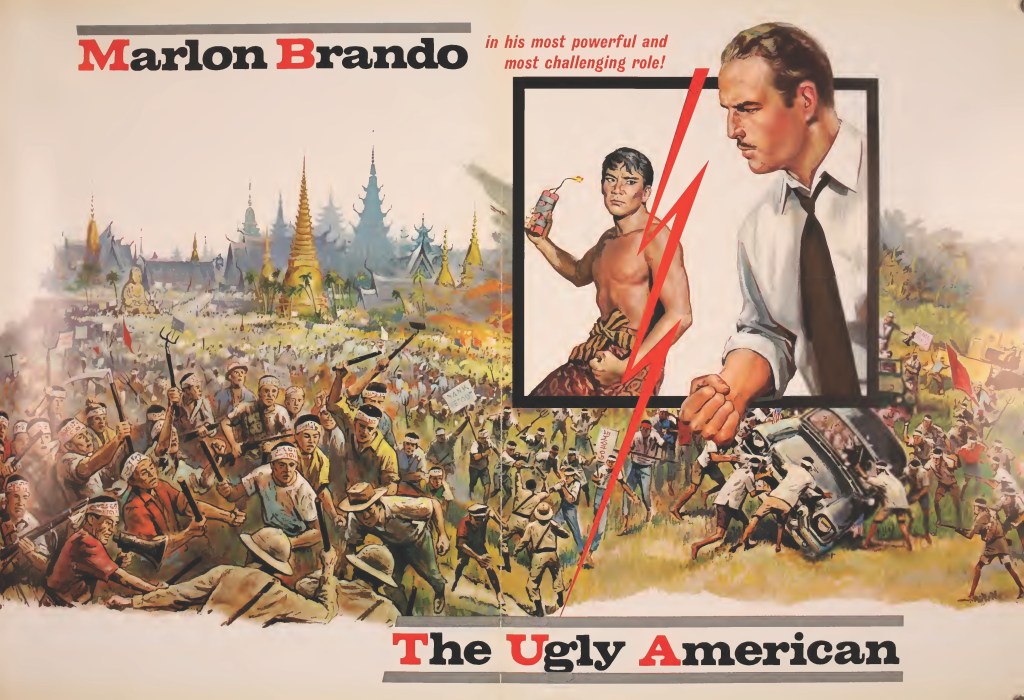
The Ugly American (1963) ***

Terrific performance from Marlon Brando saves this prescient but preachy meditation on Vietnam. Harrison MacWhite (Marlon Brando) is the new ambassador, whose political credentials are questioned by many,  parachuted into the fictional South-East Asia country of Sarkhan, knee-deep in civil war, Communist north versus westernized south. The battleground is the American construction of a “Freedom Road” north to China which dissenters fear will be a conduit for the military. MacWhite owes his appointment to his friendship with Deong (Eeji Okada), a charismatic leader.

On arrival, the ambassadorial car is engulfed in a riot, car rocked, windscreens smashed. MacWhite shakes up a complacent embassy and though articulate and scholarly believes he holds the solution to the tricky situation, not willing to accept that national self-determination does not necessarily mean complete hatred of the Americans. There is duplicity on both sides, rebels blaming U.S. truck drivers for deaths they caused, the Americans so used to getting their way they don’t stop to think if it is the right way.

Anxious not to be seen as a lapdog for Communism, MacWhite’s actions inflame the situation, while Deong falls victim to internal forces. Construction boss Homer Atkins (Pat Hingle) promotes the clever use of building hospitals along the road, thus encouraging locals to back it, but nobody falls for such honest skull-duggery masquerading as well-meaning intent.

Friends turning into enemies is a decent premise for any movie but this is over-burdened with debate that while interesting and providing a reflection of the times is basically a mixture of virtue-signalling and apportioning blame and, most heinous of failings, doesn’t really advance the story.

First-time director George Englund handles the action sequences well and captures the essence of a country about to explode against a background of growing tension and political machination. Use of Thailand as a location adds authenticity.

Based on a controversial novel by political scientist Eugene Burdick (who also wrote a more straightforward cold War thriller Fail Safe) and William Lederer, navy veteran and CIA officer, so it carried the stamp of authority in terms of putting forth the arguments for both sides. However, while the film bears only a “passing resemblance” to the book, according to co-author Burdick, he deemed it a superior achievement on the basis of its more dramatic treatment. Stewart Stern (Rachel, Rachel, 1969) was the screenwriter who received blame and praise in equal measure.

Marlon Brando (Burn! / Quiemada, 1969) exudes authority, broad shoulders packed into a suit, and brilliant captures the anguish of a man led into disaster by arrogance. Coming off back-to-back flops One-Eyed Jacks (1961) and Mutiny on the Bounty (1962), this was a considerable change of pace, the first of several excursions into political territory. Eeji Okada (Hiroshima, Mon Amour, 1958) proves a worthy opponent. Pat Hingle (Sol Madrid, 1968), Arthur Hill (Moment to Moment, 1965) and Jocelyn Brando (The Chase, 1966) provide sterling support.

The movie did not just predict what would happen if the U.S. lost the battle for hearts and minds but a similar situation confronting the U.S. Ambassador to Indonesia in 1965 whose appointment was unwelcome in that country.

Nevada Smith (1966) ****

Half breed Max Sand (Steve McQueen) has little truck with the notion that revenge is a dish best served cold. But he’s too young and raw, far from Lee Marvin’s callous killer in Point Blank (1969), to properly avenge the slaughter of his family by three outlaws.

This is a coming-of-age tale with a distinct difference. Max’s development includes, apart from initiation into sex of course, learning to read and write so he can make sense of signposts in order to track down the murderers and receiving tuition from gunsmith Jonas Cord (Brian Keith) so that he can at least loose off some shots without doing himself damage. Vengeance burns so deep that he even stages a bumbled robbery so he can be sent to the prison where the second of his targets is incarcerated. Now that’s dedication for you. And along the way he learns the most important lesson of all, how to live, and not destroy himself through vengeance.

Even so, all Cord’s tuition counts for nought when Max needs a knife to dispatch his first victim Coe (Martin Landau). And he’s not yet so slick with a weapon to avoid serious injury himself. Kiowa saloon girl Neesa (Janet Margolin) nurses him back to health at her tribe’s camp. They become lovers but he rejects the wisdom of the elders and the opportunity to make a life with her.

Unfortunately, Bowdre (Arthur Kennedy)  is a jailbird. And worse, held prisoner in a swamp. Probably the worst bank robbery ever committed sends Nevada there. Max enrols another woman, Cajun Pilar (Suzanne Pleshette) working in nearby rice fields – fraternisation between the jailbirds and these women permitted – to steal a boat to help him and Bowdre escape. Bowdre gets his and this time it’s Pilar who is the collateral damage.

A genuine outlaw now, Max has no trouble joining a band of robbers headed by Fitch (Karl Malden), the final prey. By now calling himself Nevada Smith, Max’s plans are thrown into confusion when it becomes apparent Fitch is aware of his true identity. A surprise ending is on the cards whichever way you cut it, and especially thrilling since it occurs during a well-planned gold bullion robbery.

It’s a film of two parts but divided into three if you like, the unusual swamp setting fitting in between two sections of more straightforward western. Though in the hands of director Henry Hathaway (True Grit, 1969), there is little that’s so straightforward given his mastery of the widescreen and his hallmark extreme long shot. He’s capable of moving from the extreme violence of the vicious murder and rape of Max’s mother to the son’s discovery of the bodies shown just through Max’s physical reaction. And there’s some irony at play, too: gold triggers slaughter and climax; mental dereliction not as feared as its physical counterpart.

Although Hathaway was a true veteran, he was not best known for westerns in the manner of John Ford, more at home with film noir (Kiss of Death, 1947), war (The Desert Fox, 1951) and big-budget pictures like Niagara (1954) with Marilyn Monroe and Legend of the Lost (1957) teaming John Wayne and Sophia Loren. In a 30-year career he had only made three westerns of note – The Trail of the Lonesome Pine (1936), Rawhide (1951) and Garden of Evil (1954). So it was something of a surprise that in the 1960s over half his output was in the western genre. And unlike Ford and Howard Hawks who stuck to the formula of action within a defined community, Hathaway tended towards films of adventure, where the main character, often of a somewhat shady disposition, wandered far and wide.

Steve McQueen (The Cincinnati Kid, 1965) carries the picture with some aplomb, moving deftly from the wet-behind-the-ears youngster to a clever and calculated killer and still retaining enough humanity to enjoy a romantic dalliance. There’s enough action here to satisfy McQueen’s fans spoiled by The Magnificent Seven (1960) and The Great Escape (1963) and for those who had come to appreciate his acting plenty to enjoy. This and The Cincinnati Kid, where perforce as a poker player, he had to do a great deal of brooding, solidified his screen persona, a star you can’t keep your eyes off, wondering what on earth is going on in his mind. As much as he’s playing a character finding his feet, this is McQueen at very nearly the top of his game.

Brian Keith (The Rare Breed, 1966) is the pick of the support, adding a little softness to his usual more hard-nosed screen characters. The villains – Karl Malden (The Cincinnati Kid), Martin Landau (The Hallelujah Trail, 1965) and Arthur Kennedy (Claudelle Inglish, 1961) – are all good in their own different ways, and in the hands of excellent actors, easily differentiated. Suzanne Pleshette (Fate is the Hunter, 1964) shines in a too-brief role.

The sterling supporting cast includes Janet Margolin (Bus Riley’s Back in Town, 1965), Pat Hingle (Sol Madrid, 1968) and Raf Vallone (The Secret Invasion, 1964). John Michael Hayes (Harlow, 1965) fashioned the screenplay from The Carpetbaggers by Harold Robbins. 

Although Hollywood had been prone to sequels – Father’s Little Dividend (1951) following Father of the Bride (1950), Return to Peyton Place (1961), Return of the Seven (1966) etc – there had been no perceived market for prequels, so this was something of a first, Alan Ladd having essayed an older and considerably more sophisticated Nevada Smith in the 1964 film of Harold Robbins bestseller. 

The Ugly American (1963) ***

Terrific performance from Marlon Brando saves this prescient but preachy meditation on Vietnam. Harrison MacWhite (Marlon Brando) is the new ambassador, whose political credentials are questioned by many,  parachuted into the fictional South-East Asia country of Sarkhan, knee-deep in civil war, communist north versus westernized south. The battleground is the American construction of a “Freedom Road” north to China which dissenters fear will be a conduit for the military. MacWhite owes his appointment to his friendship with Deong (Eeji Okada), a charismatic leader.

On arrival, the ambassadorial car is engulfed in a riot, car rocked, windscreens smashed. MacWhite shakes up a complacent embassy and though articulate and scholarly believes he holds the solution to the tricky situation while unwilling to accept that national self-determination does not necessarily mean complete hatred of the Americans. There is duplicity on both sides, rebels blaming U.S. truck drivers for deaths they caused, the Americans so used to getting their way they don’t stop to think if it is the right way.

Anxious not to be seen as a lapdog for Communism, MacWhite’s actions inflame the situation, while Deong falls victim to internal forces. Construction boss Homer Atkins (Pat Hingle) promotes the clever use of building hospitals along the road, thus encouraging locals to back it, but nobody falls for such honest skull-duggery masquerading as well-meaning intent.

Friends turning into enemies is a decent premise for any movie but this is over-burdened with debate that while interesting and providing a reflection of the times is basically a mixture of virtue-signalling and apportioning blame and, most heinous of failings, doesn’t really advance the story.

First-time director George Englund handles the action sequences well and captures the essence of a country about to explode against a background of growing tension and political machination. Use of Thailand as a location added authenticity.

The movie was based on a controversial novel by political scientist Eugene Burdick (who also wrote a more straightforward cold War thriller Fail Safe) and William Lederer, navy veteran and CIA officer, so it carried the stamp of authority in terms of putting forth the arguments for both sides. However, while the film bore only a “passing resemblance” to the book, according to co-author Burdick, he deemed it a superior achievement on the basis of its more dramatic treatment. Stewart Stern (Rebel Without a Cause, 1955) was the screenwriter who received blame and praise in equal measure.

Marlon Brando (Bedtime Story, 1964) exudes authority, broad shoulders packed into a suit, and brilliantly captures the anguish of a man led into disaster by arrogance. Coming off back-to-back flops One-Eyed Jacks (1961) and Mutiny on the Bounty (1962), this was a considerable change of pace for the actor, the first of several excursions into political territory. Eeji Okada (Hiroshima, Mon Amour, 1958) proves a worth opponent. Pat Hingle (Sol Madrid, 1968), Arthur Hill (Moment to Moment, 1965) and Jocelyn Brando (The Chase, 1966) provide sterling support.

The movie did not just predict what would happen if the U.S. lost the battle for hearts and minds but a similar situation confronting the U.S. Ambassador to Indonesia in 1965 whose appointment was unwelcome in that country.

You can catch this on Amazon Prime.

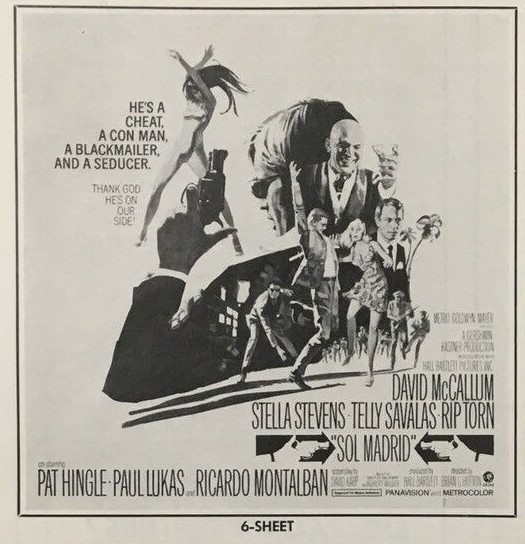
Sol Madrid / The Heroin Gang (1968) ***

Was it David McCallum’s floppy-haired blondness that prevented him making the jump to movie action hero because, with the ruthlessness of a Dirty Harry, he certainly makes a good stab at it in this slightly convoluted drugs thriller. Never mind being saddled with an odd moniker, the name devised surely only in the hope it would linger in the memory, Sol Madrid (McCallum) is an undercover cop on the trail of the equally blonde, though somewhat more statuesque, Stacey Woodward (Stella Stevens) and Harry Mitchell (Pat Hingle) who have scarpered with a half a million Mafia dollars. Hingle is the Mafia “human computer” who knows everything about the Cosa Nostra’s dealings, Woodward the girlfriend of Mafia don Villanova (Rip Torn).

Sol tracks down Stella easy enough and embarks on the audacious plan of using her share of the loot, a cool quarter of a million, to fund a heroin deal in Mexico with the intention of bringing down both Mexican kingpin Emil Dietrich (Telly Savalas) and, using the on-the-run pair as bait, Villanova. A couple of neat action sequences light this picture up. When Sol and Stella are set upon by two knife-wielding hoods in a car park, he employs a car aerial as a weapon while she taking refuge in a car watches in terror as an assailant batters down the window. Sol has hit on a neat method of transferring the heroin from Tijuana to San Diego and that is filled with genuine tension as is the hand-over where Sol with an unexpected whipcrack slap puts his opposite number in his place.

Meanwhile, Villanova has sent a hitman to Mexico and when that fails turns up himself, kidnapping Stella and planning a degrading revenge. Most of the movie is Sol duelling with Dietrich, suspicion of the other’s motives getting in the way of the trust required to seal a deal, with Mitchell, hiding out in Dietrich’s fortified lair, soon being deemed surplus to requirements. Various complications heighten the tension in their flimsy relationship.

Madrid is Dirty Harry in embryo, determined to bring down the gangsters by whatever means even if that involves going outside the law he is supposed to uphold, incipient romance with Woodward merely a means to an end. McCallum certainly holds his own in the tough guy stakes, whether trading punches or coolly gunning down or ruthlessly drowning enemies he is meant to just capture, and trading  steely-eyed looks with his nemesis.

It’s a decent enough effort from director Brian G. Hutton (Where Eagles Dare, 1968), but is let down by the film’s structure, the expected confrontation with Villanova taking far too long, too much time spent on his revenge with Woodward, for whom audience sympathy is slight. Just at the time when Hollywood was exploring the fun side of drug taking – Easy Rider just a year away – this was a more realistic portrayal of the evil of narcotics.

It is also quite prescient, foreshadowing both The Godfather Part II (1974) in the way Villanova has modernised the Mafia, achieving respectability through money laundering, and this century’s television obsession with South American drug cartels with all-out police battles with the Narcos. And there is a bullet-through-the-glasses composition that will be very familiar to fans of The Godfather (1972), and you will also notice a similarity between the feared Luca Brasi and the Mafia hitman Scarpi (Michael Conrad) here. And why we’re at it, Woodward’s predicament is close to Gene Hackman’s in French Connction II (1975).

The action sequences are excellent and fresh. Think Madeleine cowering in terror as the car window is battered in No Time to Die (2021) and you get an idea of the power Hutton brings to the scene of a terrified Woodward hiding in the car. Incidentally, you might think McCallum was more of a secret agent than a cop with the cold-blooded ruthlessness with which he dispatches his enemies.

Stella Stevens (The Silencers, 1966) is the weak link, too shrill and not willing to sully her make-up or hair when her role requires degradation. Her part is better written (“I never met a man who didn’t want to use me”) than Stevens can act and she gets a clincher of the film’s final line. Telly Savalas (The Dirty Dozen, 1967) with his playful villain, though the trademark laugh is in occasional evidence, is in sharp contrast to Rip Torn who is all snarling bad guy. Ricardo Montalban (Madame X, 1966) is Sol’s Mexican sidekick and Paul Lukas, a star of the Hollywood “golden age”, puts in a fleeting appearance.

Discover WordPress

A daily selection of the best content published on WordPress, collected for you by humans who love to read.

The Atavist Magazine

by Brian Hannan

WordPress.com News

The latest news on WordPress.com and the WordPress community.