On Swift Horses (2025) *** – Seen at the Cinema

Authentic story stymied by unlikely plot. Set in a post-Korean War American when the United States is still a land of opportunity even for blue collar workers but sexuality and other forms of self-expression are stifled and the homosexual world is only accessible through secret codes. Married Muriel (Daisy Edgar-Jones) hankers after something of the wilder life apparently enjoyed by the brother Julius (Jacob Elordi) of her staid husband Lee (Will Poulter). Truth be told she hankers after an illicit relationship with Julius.

Muriel harbors two other secrets. Firstly, she wants to gamble, a notion that would never gain approval from her husband, who accounts for every penny in his bid to own his own home and thus move up in society. Secondly, she has lesbian tendencies and gradually, encouraged by the self-confidence generated through successful betting at the racetrack, she assumes a different persona, surprisingly capable of making the first move.

Lee is aware of his brother’s proclivities, though these, too, are measured in guarded tones. Julius lives “in another world”, not just the low-down hustling and gambling and earning a living as a gigolo and card cheat. His homosexuality is repressed but his barriers are broken down by Mexican hustler Henry (Diego Calva). But while Julius is willing to settle for a life of energetic sex with Henry, his lover has greater ambition and plans to move up in society via the scam route.

Muriel’s affection for Julius is not hampered by the fact that he constantly steals from her, pocketing the cash she sends him for a bus fare home, burglarizing their house while they sleep. And while she is happy to indulge in a casual affair with gay neighbor Sandra (Sasha Calle) she’s not whole-heartedly committed to that lifestyle. And it’s hard to see just how committed she is to Lee – the horde of cash she wins at the racecourse she keeps hidden from her husband even though it would miraculously ease their upwardly mobility.

While Muriel negotiates the hidden world with some care – gay people of both sexes meet at a certain hotel or come together under the guise of a book club – Julius is less wary and is beaten up and robbed a couple of times.

This isn’t quite the lush America of 1950s Hollywood with women bedecked in colorful dresses and enjoying cocktails, but there’s still satisfaction to be had in hauling yourself up and owning a tract of land and your own house. And it’s still down’n’dirty. Casinos spy on customers through two-mirror mirrors set in the ceiling and beat the life out of anyone caught cheating.

What wins your heart is the yearning. Muriel is caught in a half-world, even when she finds a willing lesbian partner she still aches for a heterosexual whirl with Julius. And Julius who believes he has found a safe sexual haven with Henry discovers that the latter’s naked ambition will destroy their tryst.

What doesn’t work are the fairy tale aspects. Julius isn’t a particularly good card cheat, a hidden ace or a partner at another table providing him with illicit advantage at the poker table. You’d expect he’d be rumbled quite easily. But the plot says no.

Similarly, Muriel enjoys an unbelievable good run on the horses, able to turn tips overheard from customers in the diner where she works into winning bets. Pretty quickly, and without a stumble, she has amassed a stash of $20,000. As if.

The ending doesn’t work either, Julius galloping on a horse (yep!) from San Diego to Las Vegas – a distance of some 350 miles (that’s some horse!) – after he realizes that, in fact, his heart belongs to Muriel, whose marriage has at last broken up, and she’s decided to follow her heart and become a gambler.

It leaves you wondering what kind of relationship they would have, a lavender marriage, where both are free to indulge in other aspects of their sexuality, no doubt living high on the hog from her racetrack winnings and his cheating at cards.

It looks to me like the director has bottled out of the third act, the one where supposedly they are the person of each other’s dreams and manage to make a life together as happy gamblers, until one or other decides that a person of their own sex is more fulfilling ultimately than a person of the opposite sex.

You didn’t need the barmy plot for this to work. And in fact it’s the barmy plot that gets in the way of it working. Both Julius and Muriel are entirely believable in looking for a love that dare not speak its name but can yet be easily located if you can follow the codes or if your gaydar is sufficiently developed.

Oddly enough, the most heart-breaking scene is the one before the barmy galloping. On the message board inside a gay meeting place are notes revealing the heartbreak caused not just by the dashing of love’s hopes but the destruction of marriages by men unable to conceal their secret desires.

The acting is uniformly good, though Jacob Elordi (Saltburn, 2023) thanks to his vulnerability, wins by a nose from Daisy Edgar-Jones (Twisters, 2024). But Will Poulter (Warfare, 2025) and Diego Calva (Babylon, 2022) also score points. Movie directing debut from Daniel Minahan from a script by Bryce Kass (Lizzie, 2018) based on the novel by Shannon Pufahl.

While you have to admire the actors for taking a gamble on this project – Elordi and Edgar-Jones are down as executive producers so they might also have taken pay cuts. But it has been  an unmitigated financial bomb. Even the leanest movies these days appear to cost upwards of $10 million and this has barely touched the $1 million mark in global box offices. I attended the only daily screening at my local multiplex and there was only one other person in the audience. It probably deserves better and might have an afterlife on a streamer.

Enjoy the performances and ignore the plot.

Tamahine (1963) ****

Columbia sold this as if Nancy Kwan was a Bond girl with massive images of the star in a bikini (see above) – the advert in the trade magazine comprised a drop-down A2 pull-out i.e. three times the size of a normal page. But anyone expecting a salacious time would have been in for surprise. For although Kwan swam underwater during the credits (not Helen Mirren style as in The Age of Consent, 1969) and did reveal a naked posterior, you could not have imagined a more innocent, joyous, movie.

Tahitian teenager Tamahine (Nancy Kwan) wreaks havoc on the British stiff upper lip when after the death of her father she is sent to the all-male English public school run by his cousin Poole (Dennis Price), a widower. But it’s not a sex comedy with all the misunderstandings and double entendres that genre normally entails. Instead, it’s a clash of cultures, free love and expression versus prudery and repression. Poole has trouble enough on the female front, his daughter Diana (Justine Lord) inclined to enjoy a gin-soaked afternoon and in the middle of an affair with art master Clove (Derek Nimmo).

The advertising department, however, could not resist the temptation
to stick a double entendre in the poster.

Without mischievous intent, Tamahine causes chaos, assuming an artist’s model would be naked she scandalizes the petrified Clove and egged on by a gaggle of schoolboys whose hormones are off the scale she jams a chamber pot on the school weather vane. The plot, if there is one, is mostly Tamahine fending off suitors, Clove and Poole’s son Richard (John Fraser), and attempting to persuade Poole to take a paternal interest in her well-being.

But mostly it’s about how a sweet-hearted woman struggles to survive in a world where attitudes to sex remain Victorian and in which the avowed aim of education is to build character through manly pursuits such as beating the living daylights out of each other rather than teaching them to express emotion. And certainly the movie takes a more benevolent view of public schools than the later, brutal, If…(1968).

While endorsing free love, Tamahine draws the line at crossing the line in the matter of Richard, whom she deems a relation, no matter how distant. Challenging all conventions, she takes part in sports day.

But the comedy is so gentle and Tamahine so charming that this is best described as a delight. I found myself chuckling throughout and I felt I had just watched a genuine feel-good movie. On paper it certainly doesn’t sound so potentially good, especially when you consider the clichéd portrayals you might expect from the supporting cast, but in reality it exerts an extraordinary appeal.

Hardly off-screen, Kwan (The World of Suzie Wong, 1960), in only her fourth film, easily carries the movie as if she scarcely felt the weight of stardom on her shoulders and is a revelation as the imparter of tender wisdom. What aids the film enormously is that Dennis Price and Derek Nimmo play more interesting parts than their movie personas suggest. Price (Tunes of Glory, 1960), in a far cry from his Ealing comedy heyday, dispenses with his wry delivery and cynical demeanor. Unusual for a character actor, his character actually has a story arc and turns what could have been a stereotypical role into a moving performance. Before his strangulated vowels got the better off him, Derek Nimmo (The Liquidator, 1965), too, delivers probably his best performance.

Justine Lord (Night after Night after Night, 1969) is good as the rebellious daughter but James Fox offers none of the intensity he brought to the screen a year later in The Servant (1964) and neither does John Fraser (El Cid, 1961) light up the screen. In small parts you can spot Michael Gough (Batman, 1985) and Coral Browne (The Killing of Sister George, 1968).

Full marks to director Philip Leacock (The War Lover, 1962), himself a former public school boy, for not taking the easy way out with loutish comedy but instead crafting a film full of sensitivity and sensibility. Denis Cannan (Why Bother to Knock, 1961) based his screenplay on the Thelma Nicklaus novel.

You might be surprised at the four-star rating and I do confess it is a shade optimistic but it is worth more than three stars. It’s worth taking a moment to examine the whole issue of ratings. You might be asking how can Tamahine be given four stars, the same as The Battle of the Villa Florita and a tad below the very few I deem five-star pictures. The answer is I compare like with like. If the best films in your opinion must concern social comment or excel technically, then there will be little place in your world for a sheer confection like Tamahine. But if you watch a wide variety of films and recognize those that contain a high enjoyment factor then you will want to draw attention to such. Hence, the rating.

It’s true that sometimes we do want movies to tackle difficult issues or take us into other worlds, but other times there is nothing to beat an old-fashioned good-hearted picture like this.

Honey, Don’t! (2025) ** – Seen at the Cinema

Had I still been in the magazine business I would have welcomed this with open arms because it would have provided an ideal headline – “Honey, Don’t Go.”

I’m not sure what Ethan Coen (True Grit, 2010) thought he was making and even if it was a shaggy dog story as often were the tales he concocted with his brother this has turned out more like a dog’s breakfast. Which is a shame because it’s about time Margaret Qualley (The Substance, 2024) was elevated from indie product to mainstream. She’s certainly got a screen presence and if someone could only fit a movie around what she has to offer she’d be on her way.

Excepting some salty dialog, this comes up short on every front. The narrative is so thin it’s disappeared down every convenient rabbit hole, the characters are equally lacking (though my guess is they’re meant to be slices of cliché, that’s the game) and there’s a deliberate emphasis on keeping emotion to the bare minimum.

The two main characters, private eye Honey Donohue (Margaret Qualley) and cop M G Falcone (Aubrey Plaza), congratulate themselves on being so completely self-centered that all dalliances are strictly confined to one-nighters, such restrictions imposed before the other person gets all weepy and emotional. Honey and MG, both being lesbians, are able to get away with such notions. Imagine a male attempting to classify all females as just too emotional.

I say Honey is a private eye but it’s kind of hard for her to keep clients because they keep on being bumped off before she can take any action. And when she does, she doesn’t prove much cop. In fact, she’s actually that old film noir fallback – the dupe. And she only realizes she’s been played for a patsy when she sees – another old fallback – two cups on a table (it’s an old-fashioned house hence the teacups).

It’s a strange construct. The audience knows what’s going on but poor Honey is kept in the dark and at the climax it looks very much like she’s setting herself up to be the dupe again.

So what the audience knows that Honey doesn’t is that a woman who died in a car accident has had a distinctive ring stolen by a woman on a moped, Chere (Lera Abova), who in another old-time fallback can’t pass a pool without skinny dipping. The ring has a logo that ties in with that of the religious scam being run by uber hunk preacher Rev Drew Devlin (Chris Evans).who uses the church as a cover for some drug-running for Chere and to provide him a harem of submissive females.

A sub-plot that then becomes a main plot sees Honey putting in some time helping out her aunt’s wayward daughter Corinne (Talia Ryder) though you suspect she’s there just to let Honey beat the bejasus out of her niece’s abusive boyfriend.

There’s also an old creepy homeless fella hanging around that starts out as a red herring, looks as though it could dovetail into an emotional scene, but then shies well clear of that because, well heck, Honey doesn’t do emotion.

I’ve got a sneaky feeling that the director wasn’t trying to make a Coen Bros movie so much as a Tarantino one. There’s a helluva lot riding on the word “Macaroni” for example. And the application of lipstick. And there’s a helluva lot of nudges towards the hardcore – in the way of sex not music – a dishwashing scene and a bar sequence come to mind.

Sure, Honey snaps off a few one-liners but mostly you’re going to remember her sashaying along in a tight skirt and clackety high heels – which may well have the director’s intention for all I know.

This feels like a clumsier retread of Drive-Away Dolls (2024), a similar dive into lesbian-led crime, also starring Qualley, directed by Coen and co-written by Tricia Cooke, who performs the same service here.

More a collection of mismatched sequences with a myriad of oddball characters none distinctive enough to make you sit up than anything in the way of a coherent plot.

Logan’s Run (1976) ****

Shortly after this appeared the movie sci fi world imploded/exploded with the release of Star Wars (1977), followed by Close Encounters of the Third Kind (1977) and Alien (1979), which probably accounts for why this is such a throwback joy to watch and now very much a cult item. Takes in ageism, obsession with youth, death cult, the pleasure principle written in capital letters, some kind of primitive Tinder (where women place themselves on “the circuit”), Terminators, runaways, dystopia, escapees, eco-friendly food, mobile phones, computers in charge, lasers, plastic surgery, cannibalism, robots, an icy tomb, nuclear holocaust and the Lincoln Memorial.

There’s some shooting with futuristic weaponry but these handguns are virtually useless given how poor their accuracy – though that may be down to the incompetence of their users – and a couple of fist fights. And while the remainder of Earth’s population enjoys an idyllic life in a series of sealed domes, there is, as the posters point out, a catch. When you reach the age of 30 you are killed, although this occurs in the guise of rebirth in a ritual known as the Carrousel.  

There’s no individual responsibility. Children are separated at birth from their parents and brought up in communal fashion. They eat, drink and have sex – there’s even a section set aside for sexual pleasure, full of naked writhing bodies. But generally, sex is on tap, any woman signing up to be on “the circuit” literally delivered to your door.

In this fashion Logan 5 (Michael York) encounters Jessica 6 (Jenny Agutter). He’s a terminator, chasing after runaways, she’s a virgin and much to his annoyance proves not an easy conquest, in fact sex doesn’t take place at all. However, she wears an ankh. And he’s just picked up an ankh from a runaway he just totaled. So he asks the computer for advice about the emblem. Turns out it’s worn by a rebel group – there are over 1,000 of them living in a “sanctuary” in the city – and Logan is delegated to pretend to be a runaway and with Jessica’s help infiltrate the radical organization. Unfortunately, his buddy Francis 7 (Richard Jordan) is suspicious and follows him.

After many adventures and escaping from Francis and the robot Box (voiced by Roscoe Lee Brown) who wants to freeze them, they emerge into a land that while it shows signs of devastation is not uninhabitable. They meet an old man (Peter Ustinov) and realize that it’s possible to live beyond the age of 30 and that somehow their apparent utopia is actually a dystopia. Furthermore, once outside the tomb, the internal clocks that dictate the date of their death automatically switch themselves off.

The prisoners of the dome are freed shortly afterwards.

There’s a kind of innocence about the sci fi world portrayed. Everyone dresses in primary colors, both sexes wear flimsy outfits all the easier to remove when pleasure appears imminent.  Taking place three centuries on from the date of the movie’s release, the world is the kind that would be dreamed by illustrators imagining the future for an Exposition with everything streamlined.

There’s no time and really no effort to make a serious point about any of the issues raised and it’s more a smorgasbord of ideas – quite a few of which have come to fruition. The two main characters are likeable rather than charismatic and the onset of sudden romance appears narrative contrivance rather than “across a crowded room.” Logan’s dilemma, that he is switched from having four years to live to being at death’s door, gives him incentive to escape, not to complete his mission. And at times the dialog is cumbersome but equally often just flies – that cats have three names, for example.

I never saw this on initial release and didn’t hire it on VHS or DVD but gradually it acquired cult status and I was keen to see why.

It works, is the real reason for that. It exists outside the Star Wars/Close Encounters/Alien dynamic.  I liked the jigsaw nature of the ideas and that they are thrown together and at you like you were on a rollercoaster, and you can pick and mix. The conversations with the computer sound very contemporary.

Michael York (Justine, 1969) and Jenny Agutter (East of Sudan, 1964) are pleasant company to spend time with. While Richard Jordan (Valdez Is Coming, 1971) is not much short of an eye-rolling villain, Peter Ustinov is remarkably good value in a role that could easily have been cliché. You might spot Farrah Fawcett-Major (newly-inducted as one of Charlie’s Angels, 1976-1980).

Directed by Michael Anderson (The Shoes of the Fisherman, 1968) and written by David Zelag Goodman (Straw Dogs, 1971) from the novel by William F. Nolan and George Clayton Johnson.

Any notion that it was intended to be groundbreaking was knocked on is head by Star Wars et al, and it’s for that very fact that it’s so watchable, as in, the direction sci fi could have gone had lightsabers and Death Stars, creatures phoning home and monsters erupting from stomachs, not entered the Hollywood universe.

Surprised how much I enjoyed it.

Hot Spur (1968) *

Blame the algorithm. Once I had to my great surprise found The Hunting Party (1971) on Amazon Prime the streamer decided that my next port of call should be another rape-filled western. There are only two things to recommend this – firstly, it makes The Hunting Party look like a masterpiece, and secondly it was filmed at the Spahn Ranch made famous by Quentin Tarantino’s Once Upon a Time in Hollywood (2019) and as the place where the Charles Manson gang hung out before going on a murder spree.

One element of this picture will chime with the contemporary audience. Here, rape is used as a weapon, an unfortunate development in the last half century during a variety of vicious wars.  As ever, woman is the innocent victim while man has convinced himself this is not only necessary but justified.

There’s maybe another echo if you want to be generous – of the sequence in Once Upon a Time in the West (1969) where Harmonica (Charles Bronson) is forced to witness the death of his older brother. Here Mexican stable hand  Carlo (James Arena) witnesses the multiple rape and beating of his older sister who subsequently commits suicide. So he’s on a mission to track down the perpetrators.

Which leads him to the O’Hara ranch, where he is treated with racist and physical abuse. Ranch owner Jason (Joseph Mascolo) handles wife Susan (Virginia Gordon) badly, blaming her for not providing him with a son and heir. Their love-making is on the rough side and she seeks comfort among the cowhands, who prefer keeping their jobs to a roll in the hay with the boss’s wife.

Carlo kidnaps her. And at first you think she’s going to be used as bait to attract Jason, the last of the rapists of his sister, to a remote mountain shack. But, in fact, Carlo plans to eliminate pretty much the entire complement of ranch hands, hiding weapons at various ambush points on the trail and planting a bear trap in the ground.   

But he’s got worse in mind. And apologetic though he is towards Susan, his plan is to make her suffer like his sister, which means tying her up, raping her and striping her back with a whip. The only good bit, if you can call it that, in this picture is that at the end Susan knifes to death her husband and escapes.

There’s one other bit that initially looks good and then tumbles into incomprehension. Jason has sent an advance scout up the mountain and told him to fire one shot if his wife is up there and two if she’s not. The cowboy doesn’t get the chance, Carlo killing him with two shots. So, registering this, Jason believes they’re on the wrong trail but then for no apparent reason continues up the same route.

From the amount of sexuality and nudity on show I guess, given the times when Hollywood was still only nibbling away at the edges of what was permissible, this was made for an entirely different audience than the standard fan of westerns. All women are present just to be used and abused.

Directed by one Lee Frost, whom imdb rates as “one of the most talented and versatile filmmakers in the annals of exploitation cinema.” Cowritten with producer Bob Cresse.

As it happens, those Amazon Prime algorithms did send me to a whole horde of westerns, some of which like Hombre (1967) and Support Your Local Sheriff  (1969), I’ve already reviewed here. I’ll plunder this stack some more but take a more judicious view of what I watch.

Ugharama.

The Hunting Party (1971) **

Colossal flop and deservedly so. One of the most repellant pictures of a down’n’dirty decade.

It’s not just that rape takes center stage – two completed both supposedly by men in love with her and two attempts by more obvious scum – but that cattle baron’s wife Melissa (Candice Bergen) has to choose between murdering rapist husband Brandt (Gene Hackman) and murdering rapist outlaw Frank (Oliver Reed).

There was an unwelcome trend for consensualizing rape – Straw Dogs (1971) took the  same approach – that a woman in a state of some terror would nevertheless warm to her molester. This is the worst kind of male fantasy fulfilment and that taking a women by force will nonetheless make her fall in love with you.  

Just how keen Melissa is on her rapist is shown by her various attempts to knife him and escape. Which, of course, Frank dismisses in a version of that old trope, “you’re beautiful when you’re angry” in that he likes a spirited woman.

The otherwise cold-blooded Lee Marvin character in Prime Cut (1972) proved likeable because he had an honor code and didn’t take advantage of a vulnerable woman. It’s impossible to feel any sympathy for Frank especially as Melissa, a teacher, has been kidnapped not for ransom but for the sole purpose of teaching Frank to read. Presumably, being an outlaw who robs banks, he can already count. Maybe he needs help writing ransom notes.

Frank should have been taught to read in childhood, we discover in a twist at the end, because his father could read, which suggests he had a different upbringing to the rest of his gang, but, on account of being determined to annoy his old man, he refused to learn. So although he has a yearning to educate himself he’s not educated enough to work out that learning and kidnapping and rape don’t exactly go hand-in-hand.

The only way any attempt at romance is going to work, even theoretically, is if what awaits Melissa when rescued is worse. Husband Brandt is a venal individual. The movie opens with him raping his wife. Compared to his treatment of sex workers, she gets off lightly. And he balks at paying any supposed ransom on the grounds that his wife will most likely have been raped and return with an unwanted bastard son and he’s not going to pay $50,000 for that privilege. Ever since A Fistful of Dollars western heroes have been every amoral shade of grey but Brandt must be the darkest shade ever.

Plus he’s just taken delivery of rifles with telescopic sights that have a firing range of about half a mile so he’s up for a little sport, and with four other rich buddies sets out to hunt humans. The rifle is the equivalent to the Gatling Gun in The Wild Bunch (1969), a weapon of awesome power, and every time it hits home the camera focuses on the gory outcome. The 26 men in the outlaw bunch are soon whittled down.

This might have worked if the narrative had followed a different arc. Had Frank turned out to be Melissa’s protector rather than the most successful of her molesters. If the whole gang had show signs of seeking something maternal rather than just sexual in a woman or were all queuing up for a bit of education. And Frank’s treatment of her from the outset had been protective and she had shared with him her fear of her husband.

The best you can say about Frank is he’s a gentler kind of rapist. But he’s still a rapist and taking advantage when Melissa is at her most terrified, soaking wet from falling into a river while trying to escape. If he had continued just trying to soothe her and comfort her that might have taken the tale in a more acceptable direction, but, no, he decides a bit of rape is in order.

Frank’s too dumb to see that his men are going to turn against him if he doesn’t share out his captive and once he’s aware exactly who she is he should at least, in the eyes of the men, either demand a ransom or hand her back.

Although the long-range rifles tilt the odds heavily in favor of the pursuers, one of them is killed, and two, once they have decimated the outlaws, decide the hunt has gone far enough. Another, later on, takes the same view. But Brandt, determined on revenge, pursues the “lovebirds” into the desert where he kills both.

This was intended to launch British actor Oliver Reed (Hannibal Brooks, 1969) into the Hollywood mainstream but he’s miscast. Candice Bergen (Soldier Blue, 1970) can do little with a role that makes no coherent sense – unlike Michele Carey in The Animals (1971) she shows no sign of accepting an unwelcome protector just to survive. Had it not been for The French Connection (1971) and, taken in conjunction with Prime Cut (1972), Gene Hackman’s career might have spun off into playing a succession of villains.

One other notable turns up on the credits. This is produced by Lou Morheim who originally owned the remake rights to Seven Samurai (1954) and failed to finesse that into a significant credit on The Magnificent Seven (1960).

Discounting To Trap a Spy (1964), a movie combining two episodes of The Man from U.N.C.L.E series, this marked the debut of director Don Medford. Lou Morheim (The Beast from 20,000 Fathoms, 1953), Gilbert Ralston (Willard, 1971) and Bill Norton (The Scalphunters, 1968). contributed to the screenplay.

The bizarre premise set a low bar. Every shade of ugh.

Prime Cut (1972) ****

Unusually nuanced thriller. Unusually lean, too, barely passing the 90-minute mark. There’s a Hitchcockian appreciation of the danger lurking in wide open spaces. And the background is the Middle America of annual fairs, marching bands, pie-eating competitions, rural pride in farming and marksmanship.

But there’s an undercurrent that will strike a contemporary audience. The contempt of big business for its customers. The sex trafficking, too, will sound an all-too-common note especially as the young women come from an orphanage set in the heart of homespun America in what appears to be a streamlined service.

In the actual screen credits, Hackman was not above the title.

We shouldn’t at all take to hitman Nick (Lee Marvin) except that he’s got a code of honor and sparing with words. He’s been sent from Chicago to Kansas to sort out with what would later be termed “extreme prejudice” Mafia boss and meat-packer Mary Ann (Gene Hackman) who’s been skimming off the top. As back-up Nick is handed a trio of young gunslingers anxious to prove themselves while his faithful chauffeur owes Nick his life.

Mary Ann doesn’t just have a factory, he has a fort, a posse of shotgun-wielding henchman standing guard. So Nick has to plunge right in and confront the miscreant. As well as dealing with animal flesh, Mary Ann has a side hustle in sex trafficking, displaying naked women in the same straw-covered pens as his beef.

Responding to a whispered “help me” by Poppy (Sissy Spacek) Nick buys her freedom, but Mary Ann isn’t for knuckling down to the high-ups in Chicago and since he’s already despatched a handful of other hoods sent on a similar mission as Nick he’s intent on turning the tables.

The action, when it comes, is remarkably low-key and all the more effective for it. Swap a crop duster for a combine harvester and the head-high prairie corn for the usual city back streets and you realize someone has dreamed up a quite original twist on the standard thriller. No need for a car chase here to elevate tension, it’s already a quite efficient slow burn.

By the time this came out Hackman had won an Oscar for “The French Connection” (1971), Marvin already in that exalted league thanks to “Cat Ballou” (1965)

This could be an ode to machinery. The entire credit sequence is devoted to the way machines chew up cow flesh and turn it into strings of sausages and the like. The combine harvester chews up and spits out an entire automobile, grinding the metal through its maw. And then there’s the machinery of business, the ability, at whatever cost, to give the public what it wants, in whatever kind of flesh takes its fancy.

You’ll remember the combine harvester sequence and the shootout in the cornfields, but you will come away with much more than that. Remember I mentioned nuance. Sure Mary Ann is an arrogant gangster and you’d think with hardly an ounce of humanity, but that’s until you witness his relationship with his simple-minded brother Weenie (Gregory Walcott). That could as easily have fallen into the trap of cliché sentimentality. Instead, there’s roughhouse play between the pair and it’s all the more touching for being realistic.

There’s a tiny scene where one of the young hoods asks Nick to meet his mother, in the way of a young employee wanting to show off that he was working for a top man. And Nick also goes out of his way to praise what’s on offer at the fair from a couple of women anxious for praise.

One of the tests of a good actor is what they do when they enter an unfamiliar room. Your instinct and mine, like ordinary people, would be to look around not just lock eyes on the person you’ve come to meet. So when Poppy wakes up in a luxurious hotel room she doesn’t go into all that eye-rubbing nonsense, but instead marvels at her surroundings. And although she hangs on his every word – and his arm – Nick isn’t in the seduction business, instead spoiling the young woman with expensive clothes.

There are several other scenes elevated just by touches. The credit sequence ends with a shoe appearing among the meat being processed – Mary Ann’s victims don’t sleep with the fishes but with the sausages. Poppy recalls a childhood spent in a rural wonderland, squirrels, rabbits, the splendors of nature, and reveals a lesbian relationship with another orphan Violet that is the most innocent description of love and sexual exploration you’ll ever hear.

Violet is the victim of multiple rapists. Weenie has passed her onto a bunch of down-and-outs for the price of a nickel. When Nick unclenches her clenched fist you’ll be horrified to see how many nickels tumble out.

Lee Marvin (Point Blank, 1967) is at his laconic best and Sissy Spacek (Carrie, 1976) makes a notable debut but Gene Hackman (Downhill Racer, 1969) overplays his hand.

Director Michael Ritchie (Downhill Racer) was on a roll, following this with The Candidate (1972), Smile (1975), The Bad News Bears (1976) and Semi-Tough (1977) before the execrable The Island (1980) badly damaged his career.

Written by Robert Dillon (The French Connection II, 1975).

Well worth a look.

The Swimming Pool / La Piscine (1969) ****

A drunk falls into a swimming pool in the middle of the night and drowns. He has already crashed his car into the gate post of the villa. There’s no sign of foul play. No sign of the fact that his attempts to clamber out are hindered by someone holding his head down under the water until he loses consciousness.

The perfect murder? Well, no, actually, because in the aftermath of the murder, recovering alcoholic killer Jean-Paul (Alain Delon) does about the dumbest thing you’ve ever seen. And that significantly detracts from what otherwise is a superb examination of sexual tension and hidden secrets.

So instead of leaving the corpse of best friend Harry (Maurice Ronet) floating fully clothed in the titular pool, Jean-Paul decides it would look better if it appeared that Harry had foolishly gone for a late night swim. So he pulls the dead guy out, strips off his clothes and decks him out in swimming trunks and slides him back into the watery grave.

He hides the sodden clothes somewhere and at the side of the pool puts a small stack of fresh clothes stolen from Harry’s wardrobe – he was a guest at the villa. But for some reason in pulling off Harry’s shirt he omits to remove his expensive watch which isn’t waterproof. Inspector Leveque’s (Paul Crauchet) suspicions are aroused by that simple fact. Although, theoretically, Harry might have been too drunk to notice, even though, obviously, the watch strap and the bulky watch would have caught on his shirt sleeve as he was taking off the item of clothing.

So the cop, in examining the clothes, is mightily surprised to discover they are fresh, unworn, not a sign of sweat or crumpled-ness, which is odd given Harry had been out dancing and enjoying himself for hours.

Psychologically, most of the aftermath is not just whether the cold-blooded killer – the otherwise very handsome, relatively charming writer Jean-Paul – will get away with it  but whether his girlfriend Marianne (Romy Scheider), who has her own suspicions, will stand by him.

They have enjoyed a very intense sexual relationship and she clearly adores him. But she’s also the ex-lover of Harry and when Jean-Paul’s old pal, who is decidedly smooth with the ladies, turns up, the old sexual jealousy is rekindled. Either to get revenge or because he’s in any case that way inclined Jean-Paul has been making discreet moves on Harry’s eighteen-year-old daughter Penelope (Jane Birkin) who clearly despises her father.

We discover that Jean-Paul owes a great deal of his success to Harry who nurtured him through a severe depression that ended in attempted suicide. Rather than making Jean-Paul eternally grateful, it’s turned him into a spoiled brat, focused primarily on his own needs and without a loyal bone in his body when it comes to women.

For quite a while it looks like record producer Harry is going to steal away Marianne, if only for a brief affair, as Jean-Paul gives in to the sulks. But since Jean-Paul is already eyeing up Penelope, you would have thought any slip by Marianne would provide him with justification.

The murder is spur-of-the-moment. Jean-Paul has been drinking again and when Harry turns up drunk and launches into an attack on Jean-Paul’s character and hidden past, that’s when he ends up in the pool. Every time he tries to get out, Jean-Paul pushes him back in and eventually holds his head down underwater.

And he might have got away with the perfect murder except for stripping the body and forgetting about the watch, but when he decides to end his relationship with Marianne, the focus switches to whether she will betray him or not. There are a couple of twists on that score at the end.

So severely flawed psychological thriller. I’m guessing you could argue that anyone who kills someone out of the blue could easily be suffering from the kind of brain overload that prevents him thinking straight, but I didn’t fall for it. It would have been as easy to continue with the psychological stuff enough with Marianne maybe finding the wet clothes and facing the same choices that she eventually does.

What does elevate it are the performances. Austrian actress Romy Scheider (Otley, 1969), who had previously had an affair with Delon, is superb as a woman not sure if she has any principles given she is so easily in the thrall of attractive men. Although Alain Delon (Le Samourai, 1967) had played bad guys and immoral sorts before, this still feels like a fresh approach, the watchful, withdrawn calculating killer masquerading as something else.

Maurice Ronet (Lost Command, 1966) and Jane Birkin (Blow-Up, 1966) make significant contributions.

And director Jacques Deray (Borsalino, 1970) would have turned out another masterpiece had the movie not stumbled over the oddness of the murder. Written by the director, Alain Page (in his debut) and Jean-Claude Carriere  (Viva Maria!, 1965).

Excepting the murder mishmash, superb.

They Call Me Mister Tibbs (1970) ***

United Artists had reinvented the sequel business, shifting it away from the low-burn low-budget Tarzan adventure or Gene Autry western or any inexpensive picture movie capable of maintaining a series character, to bigger-budgeted numbers like James Bond (four sequels so far), The Magnificent Seven (two), The Beatles (four) and The Pink Panther (two). Even Hawaii (1966) spawned The Hawaiians (1970). So when the company hit commercial and critical gold – five Oscars including Best Picture and Best Actor – with In the Heat of the Night (1967) it seemed too good an opportunity to miss not to try for a repeat.

You might have expected UA to continue with the pairing of Sidney Poitier and Oscar-winner Rod Steiger and locate a sequel again in the Deep South. Instead, Steiger was junked and the Poitier character Virgil Tibbs relocated from his Philadelphia hometown to the more snazzy environs of San Francisco, recently popularized by such items as Bullitt (1968).

But minus the racism element what you’re left with is pretty much a standard detective tale with domestic issues thrown in. Tibbs isn’t the kind of cop we’ve come to expect, sinking into alcoholic oblivion or having thrown away a marriage. Instead, and this would strike a contemporary chord, he’s struggling with fatherhood. His son comes off best in arguments and at one point Tibbs resorts to giving the child a few slaps. That looks initially as if emotions will quickly heal and the repentant dad quickly administers a comforting hug, but any bonding is blown apart when the resentful boy complains, as if this represents betrayal, that his father made him cry.

Tibbs is also the old-fashioned kind of male who believes the only way to teach his son not to fall into bad ways like smoking and drinking is to force him to puff on a big cigar and knock back a stiff one until the child throws up.

But Tibbs does do a diligent enough job of detection, evidence relating to the murder of a high-priced sex worker hinging upon whether the killer had long fingernails. The most obvious suspect is street preacher Rev Logan Sharpe (Martin Landau), who visited the prostitute in his capacity as spiritual adviser and who’s heading up a campaign to clean up the streets. But his alibi holds up.

Next in line is building owner Woody Garfield (Ed Asner), exposed, to the shame of wife Marge (Norma Crane) as being a client of the prostitute, and then a janitor of low intelligence called Mealie (Juano Hernandez) and pimp Weedon (Anthony Zerbe), the kind of hood who enjoys taunting cops.

While Tibbs doesn’t indulge in the blatant maverick approach to the job of the earlier Madigan (1968) or the later Dirty Harry (1971) he’s not above putting the squeeze on witnesses.  

Rather foolishly, but perhaps feeling this has now become de rigeur, there’s a car chase which hardly compares to Bullitt. In fact, we’re stuck in an automobile rather too often but these only result in desultory conversations between Tibbs and his sidekick. While in some respects it’s refreshing that Tibbs isn’t subject to any racism, and the picture doesn’t head down the blaxploitation route, the result lacks edge.

Tibbs’ reactions to his child bring him down sharply from the ivory tower of sainthood from the previous picture, and the family stuff, while building up his character, doesn’t make up for what the story lacks.

Gordon Douglas, who had previously excelled in this genre via Tony Rome (1967), The Detective (1968) and Lady in Cement (1968), found out the hard way that Frank Sinatra was more appealing as an investigator and cop than Sidney Poitier and, without steaminess or wise-cracking to fall back on, the sequel quietly runs out of steam.

Screenplay by Alan Trustman (The Thomas Crown Affair, 1968) and James Webb (Alfred the Great, 1969) from the bestseller by John Ball. Not a patch on the original

Hang ‘Em High (1968) ****

Clint Eastwood didn’t waste much time capitalizing on the unexpected success of the Dollars Trilogy. But the first was not released in the United States till 1967 and despite the success of the series across Europe was generally dismissed as a fluke, until American audiences suggested otherwise. The following year Eastwood appeared in three pictures, Hang ‘Em High, Coogan’s Bluff and Where Eagles Dare, which solidified his screen persona as portraying more with a twitch or a raised eyebrow than digging deep into the dialog.

Contrary to my expectations, Hang ‘Em High doesn’t quite fall into the trademark revenge mode of later westerns. It’s somewhat episodic, Jed (Clint Eastwood) often sent off on a tangent by Judge Fenton (Pat Hingle), allowing the lynch mob who failed to hang him in the first place a second chance at completing the job.

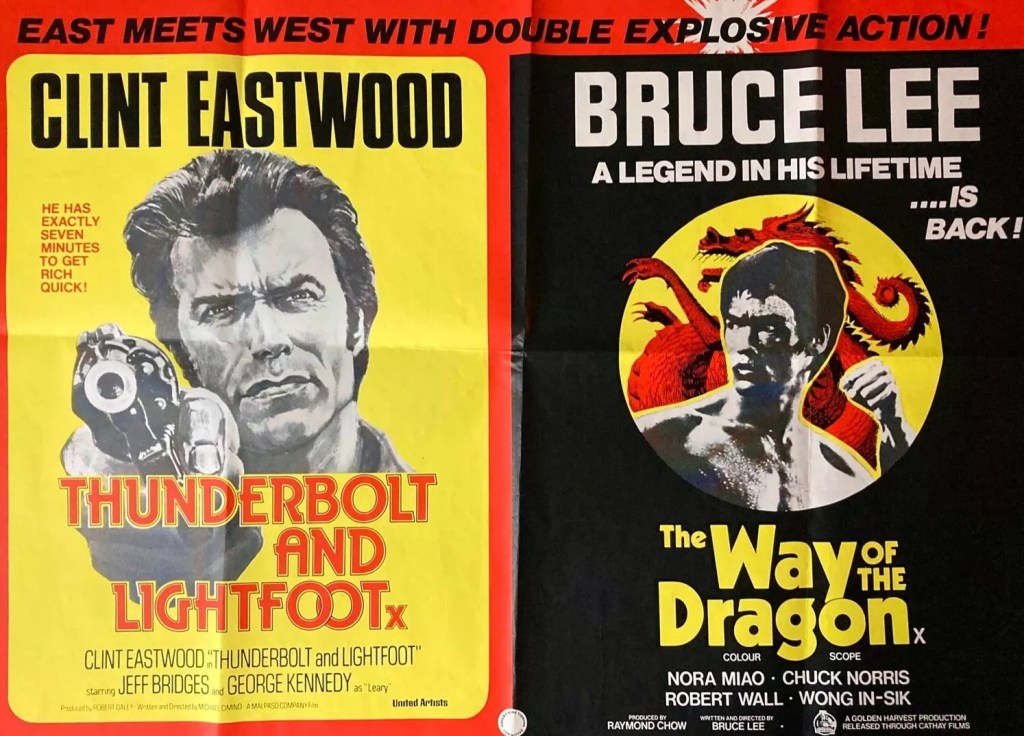
Following the success of the James Bond double bills,
United Artists spun out its Clint Eastwood portfolio at every opportunity.

And while the presence of the second-billed Inger Stevens (Firecreek, 1968) suggests heady romance that doesn’t kick in until the third act and it’s more tentative than anything and its purpose is more, in narrative terms, to provide Jed with a correlative with which to compare his own obsession, bringing to justice the nine men who attempted to kill him.

Just to confuse things, the middle section isn’t about revenge or romance, but about justice. Specifically, it’s about showing that justice will be done, that in the unruly West, with insufficient enforcers of law and order, that crimes will not go unpunished, a gallows on constant display to make the point.

Surprisingly, it’s Jed who argues that some of this justice is just too summarily executed. He tries in vain to prevent the execution of two young rustlers who fell in with one of his potential assassins, Miller (Bruce Dern), but who refuse to take advantage of the situation when Miller overpowers Jed while he’s bringing the trio in to face the judge. Admittedly, they don’t go to his aid either, but the fact they resist piling in allows Jed to escape. However, rustling is a hanging offence, so they cannot escape the noose, certainly not in Fenton’s town.

There’s a switch in the mentality of Jed. Before he’s co-opted by Fenton to return to his former profession of lawman, Jed is of the school of thought that decides to take the law into his own hands. Even wearing a badge, you are allowed to shoot a man stone dead if he’s trying to escape, even if such action is severely hampered by him already being badly wounded, as lawman Bliss (Ben Johnson) demonstrates. But Bliss isn’t as callous as he sounds. He’s a contradiction, too, racing to the aid of Jed dangling in a noose in a tree, freeing him so he can face justice, even if that will most likely result in hanging.

So Jed upholds the law, preventing other citizens from taking the law into their own hands, Miller a target of the family of the owners he slaughtered before making off with their cattle.  

We only see shop owner Rachel (Inger Stevens) fleetingly for most of the picture. She appears any time a new wagon load of criminals is jailed, scanning their faces for who knows what, though likely we’ve guessed it’ll be to find the killer of a loved one. Not only has her husband been killed by two strangers but while his corpse is lying on the ground beside her she’s raped. And although she eventually responds to Jed’s gentle moves, she still can’t let go of her “ghosts.”

Jed is put through the wringer. Not only an inch from death following the initial hanging but ambushed again by the same gang and nearly dying of pneumonia after being caught in a storm, the latter incidents permitting the kind of nursing that often fuels romance.

There’s an ironic ending. Captain Wilson (Ed Begley), leader of the gang, hangs himself rather than be shot by Jed.

The score by Dominic Frontiere (Number One, 1969) lurches. We go from heavy-handed villain-on-the-loose music to eminently hummable echoes of Ennio Morricone.

Clint Eastwood reinforces his marquee appeal, Inger Stevens delivers another of her wounded creatures, and Pat Hingle (The Gauntlet, 1977) is an effective foil. Bruce Dern (Castle Keep, 1969) does his best to steal every scene without realizing that over-playing never works in a movie featuring the master of under-playing.

Host of cameos include veterans Ben Johnson (The Undefeated, 1969), Charles McGraw (Pendulum, 1969) and L.Q. Jones (Major Dundee, 1965) plus two who had not lived up to their initial promise in Dennis Hopper (though he would revive his career the following year with Easy Rider) and James MacArthur (Battle of the Bulge, 1965).

Journeyman director Ted Post made a big enough impact for Eastwood to work with him again on Magnum Force (1973). Written by Leonard Freeman (Claudelle Inglish, 1961) and Mel Goldberg (Murder Inc., 1960).

More than satisfactory Hollywood debut for Eastwood and worth checking out to see that even at this early stage he had nailed down his screen persona.

Discover WordPress

A daily selection of the best content published on WordPress, collected for you by humans who love to read.

The Atavist Magazine

by Brian Hannan

WordPress.com News

The latest news on WordPress.com and the WordPress community.