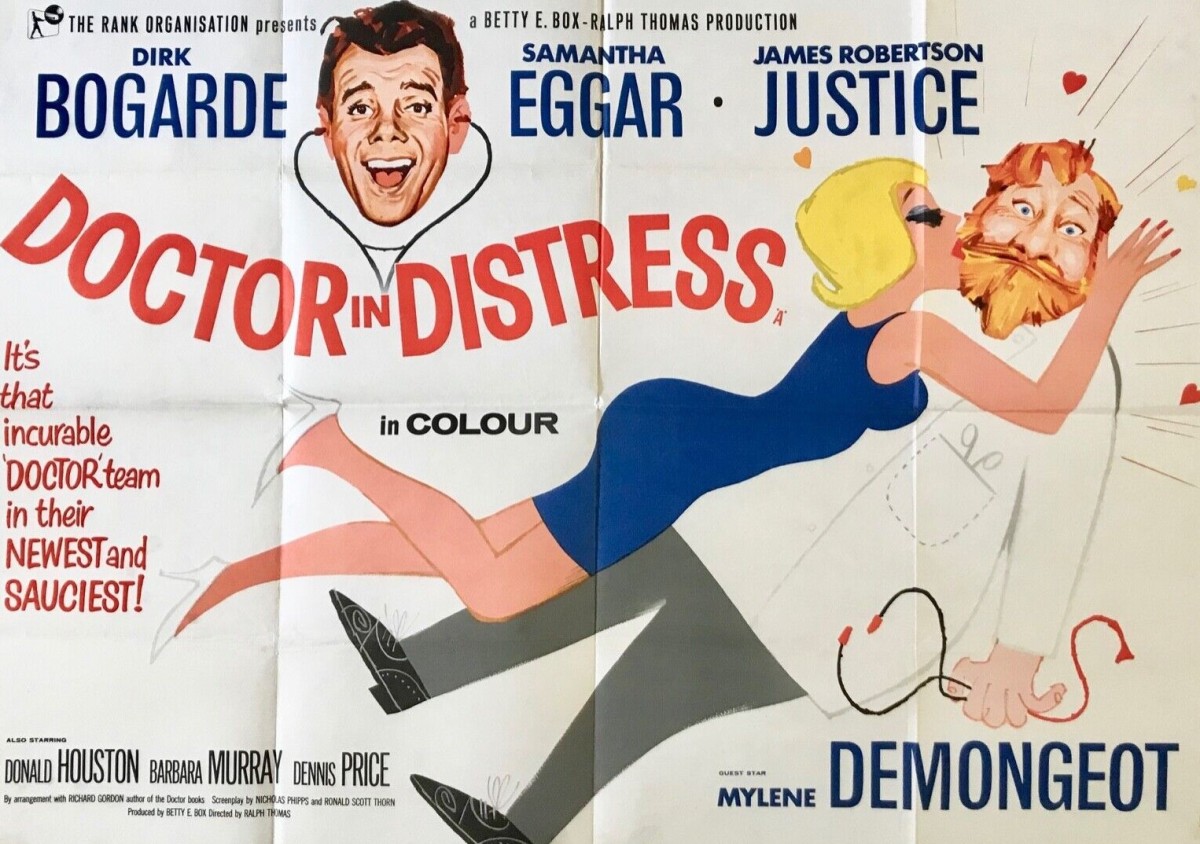
Doctor in Distress (1963) ***

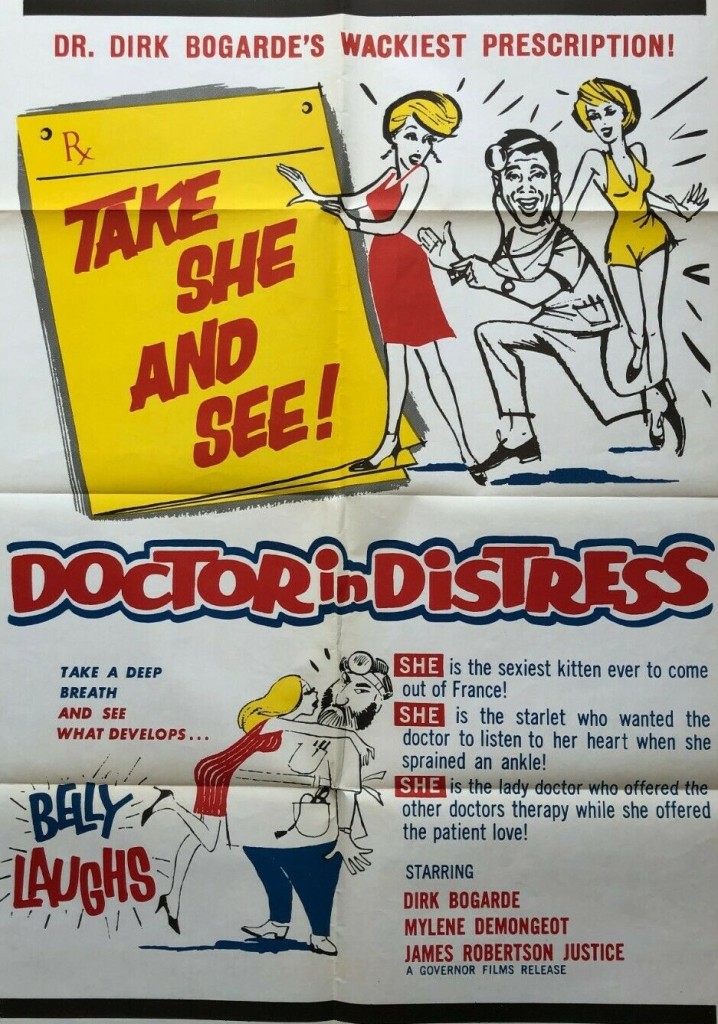
Bait-and-switch as the romantic complications of the grumpy Dr Spratt (James Robertson Justice) take precedence over the by-now pretty competent Dr Sparrow (Dirk Bogarde). Just about getting by on Bogarde’s charm in his fourth and final outing in a role that had made him a British box office star and possibly more notable as his final film as an out-and-out matinee idol before he shifted into the arthouse arena.

Dr Sparrow has come a hell of a long way since being a shy junior doctor, mercilessly bullied by Spratt and a love life that was filled with tangle. Here, he not only stands up to Spratt, but is something of a lothario, happily ditching new love Delia (Samantha Eggar), a model, albeit temporarily, in favor of French masseuse Sonia (Mylene Demongeot).
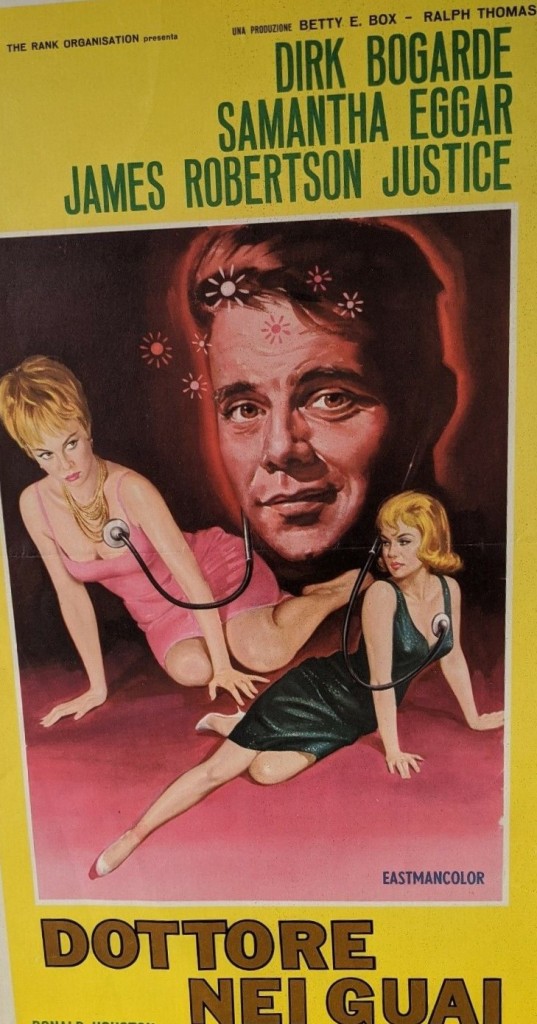
There is very little of the traditional rom-com-love-on-the-rocks in Bogarde’s relationship with Delia, who arrives as a patient with a sprained ankle at the hospital and is whisked home by Sparrow for a spot of practised seduction. Spratt, on the other hand, has fallen for physiotherapist Iris (Barbara Murray) and in trying to win her hand undergoes weight loss treatment at a health clinic, endures the indignity of wearing a corset, hires a private detective to get the lowdown on her, and finally, donning a disguise of dark glasses and hiding his bulky frame behind an umbrella, proceeds to attempt to discover who is his rival for her affections.

Sparrow is left to occasionally swat out of the way the interfering Spratt and alternatively offer him advice or a shoulder to cry on while trying to prevent Delia pursuing a movie career. So it’s just a series of situations, none of which are particularly funny, apart from the idea of Spratt getting his come-uppance.

It’s worth noting that for a British sex comedy, the females are in charge. Iris knocks back her various suitors, Delia refuses to let romance interfere with her career, jetting off to Rome over Sparrow’s objections, and the diminutive and muscular Sonia is more than a match for any man and just as predatory.
What’s most surprising is that a genial comedy like this can get away with so much permissiveness. This was opposite of the in-your-face snigger-snigger Carry On series so for Sparrow to be successfully spreading his wild oats seemed somewhat out of character. But you can see most of the jokes a mile off though probably in a packed cinema these would provoke more laughter than watching it at home on the small screen.

It’s probably worth it to see Leo McKern (Hot Enough for June, 1964) as a movie producer who envisages Sparrow as his new star and Frank Finlay as a corset salesman, a completely different role to his part in Robbery (1967). Fenella Fielding (Lock Up Your Daughters, 1969) has a cameo as a neurotic passenger on a train and Dennis Price (Tunes of Glory, 1960) as a sadistic health clinic manager while Donald Houston (A Study in Terror, 1965) has a larger part as another of Iris’s suitors.  

Dirk Bogarde (Justine, 1969) can essay this kind of character in his sleep but there is no doubting his screen charisma or charm. But I doubt if James Robertson Justice (Mayerling, 1968) varied his character much from picture to picture, perhaps louder and more bumptious here but unlikely to attract audience sympathy. Samantha Eggar (The Collector, 1965) doesn’t get enough to do and has her thunder stolen by the late arrival of Mylene Demongeot (Fantomas, 1964).

Director Ralph Thomas had made more than a half-a-dozen films with Bogarde including more dramatic ventures like Campbell’s Kingdom (1957) and The Wind Cannot Read (1958) and makes the most of this undemanding feature. You would have thought this was the end of the line for the series but with Leslie Phillips (Maroc 7, 1967) as Bogarde’s replacement it soldiered on for another couple of episodes.

Proof that a true star can always help a film rise above its material.

Robbery (1967) ****

The explosive gut-wrenching high octane car chase that kicked off this thriller – and provided British director Peter Yates (Bullitt, 1968) with a Hollywood calling card – is somewhat out of place in this intriguing documentary-style fictionalised account of the British heist of the century, the Great Train Robbery of 1963. Setting aside that the chase would have been better employed as the climax, it does provide the cops with enough leads to keep tabs on some of the criminals, ensuring the authorities become aware of the gigantic theft planned.

But Yates’ unusual approach takes us away from the usual crime picture. You can say goodbye to the cliched villain for a start. Mastermind Paul Clifton (Stanley Baker) dresses like a suave businessman. Wife Kate (Joanna Pettet) rails against him for betrayal, not sexual infidelity, but for pretending he had given up the life of crime. And there is any amount of nuance. We don’t discover that Clifton lives in a huge mansion with a massive drive until the very end, we don’t know who else the police are tailing until they are picked up, we are not let in on the secret of Clifton’s escape until suddenly he is taking off in a light airplane. And there is the unexpected. A suspect is identified in a line-up by a witness slapping his face, a message sent to Kate from Paul via a dog.

Cop James Booth questions gangster’s moll Joanna Pettet.

Nor, beyond the basics, are we let in on the details of the plan, more time spent on recruitment, and not the usual suspects either, Robinson (Frank Finlay) – broken out of prison for this specific job – brought unwillingly on board because, as a former bank employee, he can check the stolen notes. I should point out, which may not be obvious to a contemporary audience, that banks shifted money over the weekend via the London-Glasgow night train that carried the mail. Given the £3 million being transported, the train is staffed not by a regiment of security guards but by postal workers sorting letters.

There’s nothing desperately clever about the plan anyway beyond its audacity. Signals are changed to make the train stop at the allotted point, the robbery takes place in military fashion, timed to the minute, some sacks left behind when time is up.

What’s cleverest is the hideout, an abandoned airfield, with underground passages. The gang doesn’t intend to run while the heat is at its hottest but some time later, the cash divvied up, Clifton’s share sent as cargo overseas. Clifton knows the consequences will involve road blocks, house searches, cars impounded, arrests but “without the money they can’t prove anything.” A junkyard owner is paid – too handsomely as it transpires – to clean the vehicles used of fingerprints and other potential giveaways (not much else in the days before DNA). And no matter Clifton ruling with a rod of iron, there is always the idiot who doesn’t quite stick to the plan.   

Most of the picture is detail, not just the meticulous planning but the equally meticulous hounding by the cops, interrogating getaway driver Jack (Clinton Greyn), identity parades, telephones tapped (or a crude version of it), with only the occasional hunch to keep the police, led by the dogged Inspector Langdon (James Booth),  on the right track. A few years before cops in movies were uniformly identified as either corrupt or useless, sometimes both, this bunch are shown to be relatively efficient, though still prone to underhand means.

Dominating proceedings is the moustached figure of Stanley Baker (Sands of the Kalahari, 1965) whose brusque no-nonsense manner sets the tone. He’s a cut above the normal criminal not just in ambition but ingenuity and while he rules the roost in the gang he’s less at home at home where Kate gives him a hard time. James Booth (Fraulein Doktor, 1969) is impressive as the pursuer, well-versed in gangland lore, inclined to look beyond the obvious. With only  a few scenes Joanna Pettet (The Best House in London, 1969) makes a mark.

In supporting parts you will spot Barry Foster (The Family Way, 1966), who seems to have the knack of catching the camera’s attention with a look or the turn of his head, and Frank Finlay (A Study in Terror, 1965), and a host of British character actors like George Sewell (The Vengeance of She, 1968) and Glynn Edwards (The Blood Beast Terror, 1968).

But the honors go to Peter Yates (Summer Holiday, 1963), not just for the stunning car chase which Hollywood would forever emulate, but the constant tension, the cutting back and forth between cops and robbers, and between the overtly dramatic and the subtle. He also had a hand in the screenplay along with George Markstein (The Odessa File, 1974) and in his only movie Edward Boyd (The View from Daniel Pike, 1971-1973).

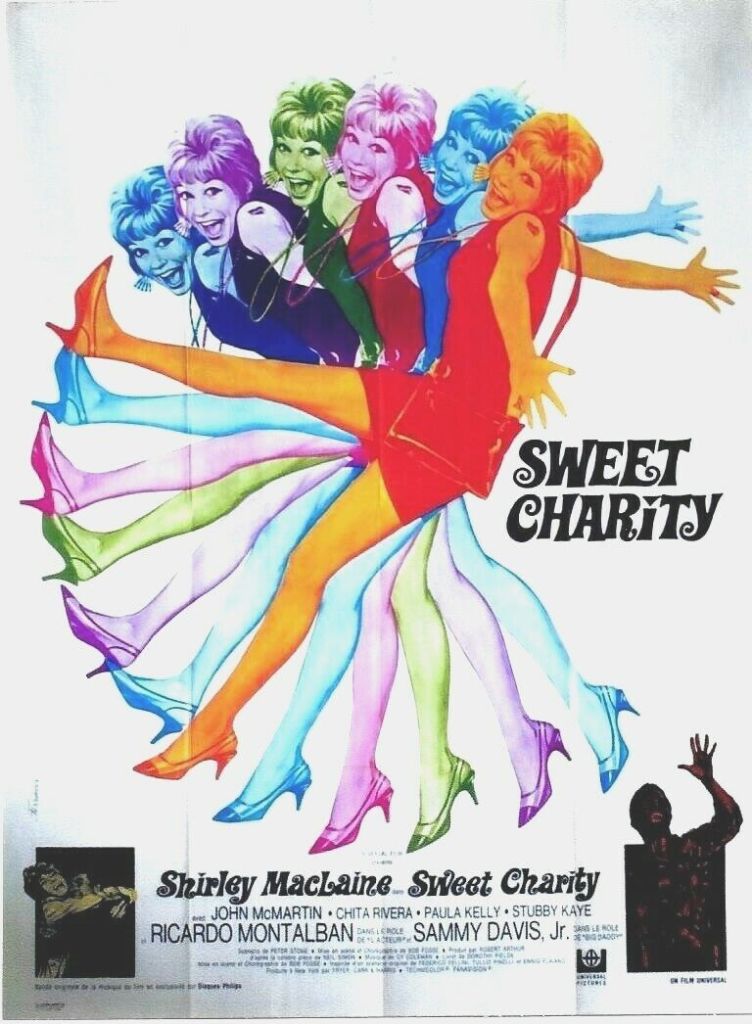
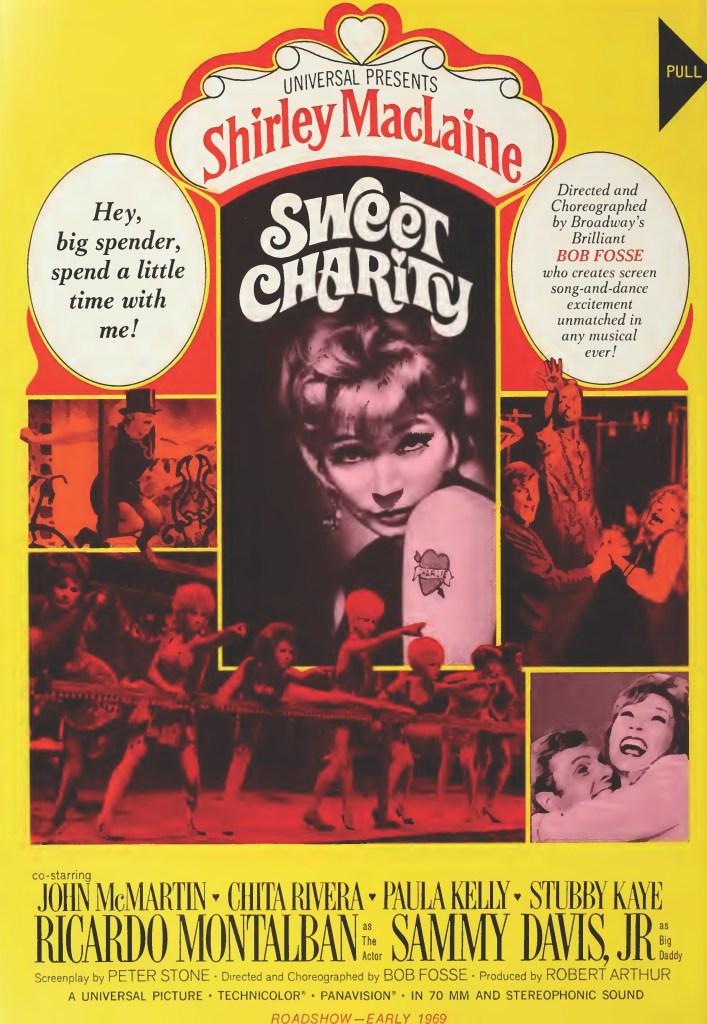
Sweet Charity (1969) **** – Seen at the Cinema

Never mind Bob Fosse’s debut, this was unusual for a number of reasons: a hilarious meet-cute, a raft of one-liners and being based on Fellini’s Nights of Cabiria (1957). So it could easily have been remembered mostly as a quiz question. But with Fosse at the helm it was a lot more than the sum of those particular parts and introduced a new-style director whose verve, choreography, stylistic flourishes and adult subject matter had wowed Broadway audiences.

Star Shirley MacLaine (Gambit, 1966) adds another layer to her trademark portfolio of losers in love. Hope Valentine Charity (MacLaine) is overly optimistic given her circumstances, robbed of her savings by her fiancé, nearly drowning in the process, the prospects of her switching from a career as a dance hall hostess severely limited by her lack of formal education and basic office skills.

So it’s just as well that she lands millionaire Vittorio (Ricardo Montalban) and might have enjoyed an indulgent romantic interlude had their evening not been interrupted by his wife Ursula (Barbara Bouchet), Charity condemned to spend a humiliating night hiding in the closet.

A chance meeting with the claustrophobic Oscar (John McMartin), doom-laden and intensely shy, appears to lead to unlikely redemption. Her presence cures him of a bunch of neuroses and marriage is on the cards until reality raises its ugly head, and the movie ends on a surprisingly negative note for a musical.

A dance hall hostess – taxi dancer in the parlance because she is hired by the half hour – is equivalent to the modern laptop dancer except that there is no nudity involved. On the other hand, there is none of the hands-off policy exercised in such contemporary operations, and  men buying her time believe that she should accommodate their straying hands. So it’s somewhat unexpected that her colleagues remain so good-tempered and backstage is presented as a bitching-free zone, some accepting their reality, others, like Charity, inclined to the fantasy that a Prince Charming will rescue them.

In terms of song quality it’s not in The Sound of Music (1965) league, boasting only two numbers – “Hey Big Spender” and “If My Friends Could See Me Now” – that you were likely leave the cinema humming. And it certainly suffers by MacLaine not having the voice of a Julie Andrews or Barbra Streisand, or the dance skills of Gwen Verdon who originated the part on Broadway, but otherwise she invests the character with enough believability and exudes charm by the bucketload. She has to be applauded for taking on such a gritty role in the first place.

Of course, the movie belongs to the director, the embryonic Fosse, who brings a new look to the movie musical, from the bored dancers draped in unexpected physical shapes during “Hey Big Spender” to the finger-snapping, angled choreography and the celebration of the seedy, the opposite of the glossier Rodgers & Hammerstein, Lerner & Loew vehicles. A few years later, further acceptance of permissiveness would allow him to explore such worlds in more realistic depth, check out Cabaret (1972) and All That Jazz (1979).

There’s a great turn from Sammy Davis Jr (Ocean’s Eleven, 1960) as a snake-hipped hippie preacher, his appearance somewhat out of place though offering contemporary comment, Oscar taking Charity to this literally underground service because he belongs to a Church-of-the-Month Club.

There’s a goodly number of laughs courtesy of the original Neil Simon book for the musical and the meet-cute of the couple trapped in an elevator is very funny.

John McMartin, in a rare movie leading role, is good as the hapless romantic, Ricardo Montalban (Sol Madrid, 1968) as his opposite, and there’s sterling support from Stubby Kaye (Cat Ballou, 1965), Barbara Bouchet (In Harm’s Way, 1965) and Chita Rivera in her debut.

It was probably too much to ask that this hit the ground running, what with Hollywood in financial meltdown in part as a result of budgetary excesses like this (it cost $10 million), a movie that never quite extended a grip on the roadshow audiences necessary to turn it into a hit, a star lacking an exceptional voice, and a storyline that appeared to alienate musical lovers. Most people who viewed it on initial general release saw a heavily truncated version.

It stands up much better today, mostly thanks to Fosse’s direction, but also due to the sleazy background, and it has to be said, setting aside any vocal deficiencies, this is one of Shirley MacLaine’s best performances.

Of course, I saw it at its best, on the big screen at the Widescreen Weekend in Bradford, so I might be slightly biased, but it does have genuine vigor and a refreshing originality.

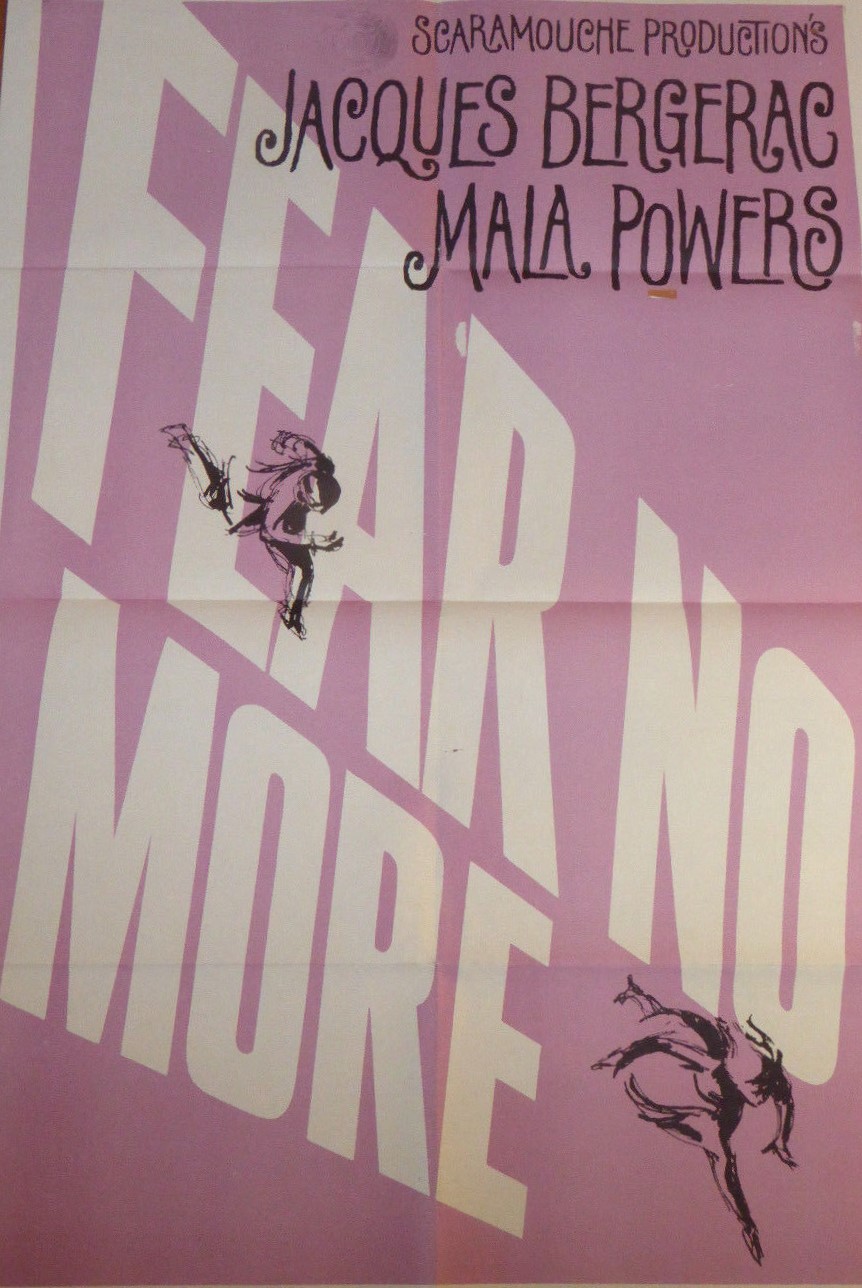
Fear No More (1961) ****

Had Alain Resnais taken the paranoia/gaslighting B-movie route for the esoteric Last Year in Marienbad he might well have ended up with a twisty concoction like this. Whereas Marienbad struggles to get anywhere near a third act, Bernard Wiesen’s unheralded under-rated debut thriller has a stonker of one. It’s the last 15 minutes when the unravelling from an unexpected source takes place that makes this well worth watching. So, I’m sorry to say, spoiler alert, as I take you through why this is so good.

It’s a twist to top all the previous twists, of which there have been many. Movies like this generally rely on story much more than character, but here we see the two main characters substantially alter, almost, psychologiclly-speaking, changing places.

Secretary Sharon (Mala Powers) on an overnight business trip by train discovers a male killer and a female corpse in her cabin. Knocked out, she regains consciousness to find herself accused of murder by cop Joe Brady (Robert Karnes). Managing to escape, she is almost run down by handsome divorced Frenchman Paul (Jacques Bergerac), delivering his son back to wife Denise (Anna Lee Carroll), who gives her a lift to Los Angeles.

Paul, an erstwhile alcoholic it later transpires, pursues her with romantic notions in mind, but she gives him the brush-off. Back in her apartment she finds sozzled ex-lover Keith (John Baer). Paul, not the kind to be so easily brushed off, persuades her to go for a coffee but when she returns to her apartment Keith is dead. Chased by the killer, she is rescued by Paul.

Gradually, she reveals that she once had a nervous breakdown and was committed to a mental institution. But when she goes to see her employer Milo (John Seymour) to explain she has lost the package with which she was entrusted, quite a different scenario awaits.

Brady is there and denies all knowledge of ever having met her. Milo denies sending her on a trip. Worse, Keith is not dead and the package she was carrying contains $3,000 stolen from Milo’s safe, to which she has access.

No wonder the most likely reason for all this confusion is that she is losing grip of her mental faculties. But, if nothing else, Sharon is quick-witted and concludes that too many pieces of this jigsaw are missing and in the absence of Milo’s wife and chauffeur Steve (Peter Brocco) that he has murdered his wealthy partner and is setting up her up to take the rap. That idea only lasts as long as it takes for wife (Helena Nash) and chauffeur to turn up.

Worse, Sharon was committed for killing the woman in her care. She pleaded self-defence and got away with it but her mind crumbled with guilt.

So just when we’re going along with the notion that this is one crazy woman and that “recollections may vary” not as much as she would like and that she is not inhabiting a parallel universe, the Frenchman does a bit of investigating on his own and finds Keith’s corpse.

In more prosperous times in her career, Powers was the female lead here.

Now here’s when it turns very tricky indeed. Although by this point Sharon should be dead in the water, mentally at least, she sparks into life, continues along the line of Milo killing his wife (the body on the train), and begins to point to all the flaws in his plan, beginning with his bungling associates. Milo, who had initially appeared in complete control, now begins to lose his temper and snap at his employees.

Milo and his associates take her to a cabin in the woods. The stronger she grows, the weaker Milo becomes, as she continues her barrage of accusation, picking more holes in his grand plan, until he realises that the police are not going to do his job for him, in condemning Sharon for his wife’s murder. The supposed wife turns out to be Milo’s sister and she, too, begins to crumble with the fear of being found out and her beloved brother going down.

So it’s heading for a complete turn-around, the supposed maniac having been gaslighted, the supposed upright employer turning shadier by the minute and unable to deal with the consequences of an action that has gone so badly wrong. Milo ends up the gibbering idiot with Sharon regaining the faculties she thought she had lost.

The Frenchman comes to the physical rescue and even though at one point the doting sister has the drop on him, she falls to pieces at the thought of what she would have to do to safeguard her deluded brother.

Quite a third act.

But there are a couple of other interesting sequences. When Paul rams on the brakes to prevent his car running over Sharon, that sends his son sitting in the front seat, in the days before seat belts, straight into the dashboard, a rather overly realistic event as regards kids in those days. Picking up Sharon and pacifying his son means Paul is late bringing the boy home to his mother and she lets rip, refusing him any future access. But, unexpectedly, later she turns up in his apartment, asking forgiveness, realising her son was so excited spending time with his father that it would not be right to deny him that.

And with all great B-films this is short and snappy, barely 80-minutes long, and hardly one of those minutes going by without a twist. Sharon is a very interesting character from a psychiatric perspective. Although cleared of killing the woman in her charge, she clearly feels enormous guilt that she allowed it to happen, and once you start falling into a mental trap of your own making it’s pretty hard to get out.

You can always pick holes in movies like this, but the two main characters, Sharon and Milo, seem to me very believable, lost in their own fantasies, especially Milo, who saw his perfect plan falling to pieces.

Unfairly, this was pretty much a dead end for all concerned. Mala Powers (Daddy’s Gone A-Hunting, 1969), the object of Cyrano de Bergerac’s affection in Cyrano (1950) and star of Rose of Cimarron (1952), had lost her way in Hollywood and not been in a movie for three years since The Colossus of New York (1958). Despite giving an excellent performance, Fear No More didn’t prove the answer to her Hollywood prayers and she only had three further movie roles in the 1960s.

Jacques Bergerac – better known for marriage to Ginger Rogers – made his final picture in 1966 but didn’t rise much above the likes of Taffy and the Jungle Hunter (1965). Prior to this director Bernard Wiesen was a producer-director on television and after it that’s what he went back to.

Catch it on YouTube.

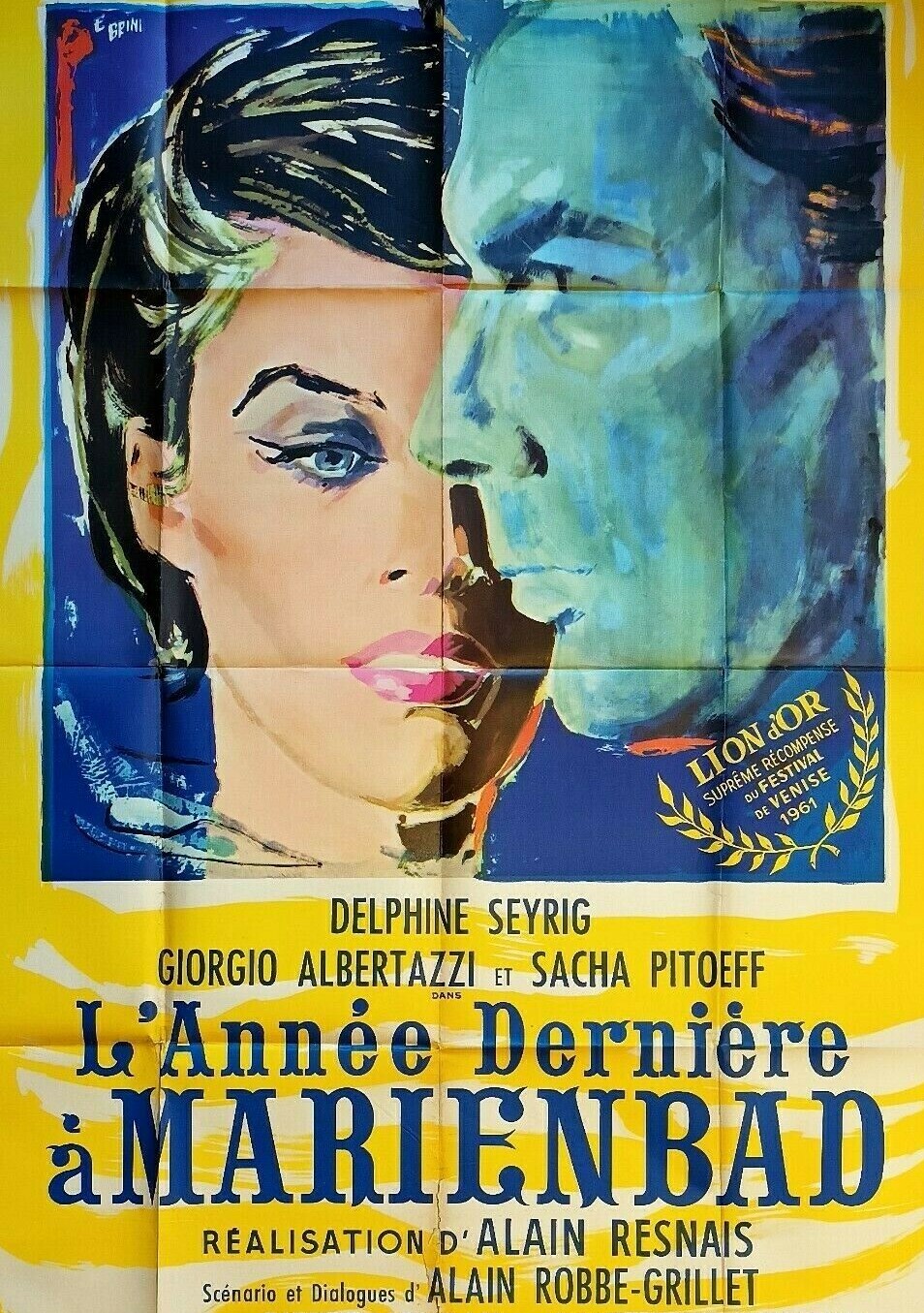
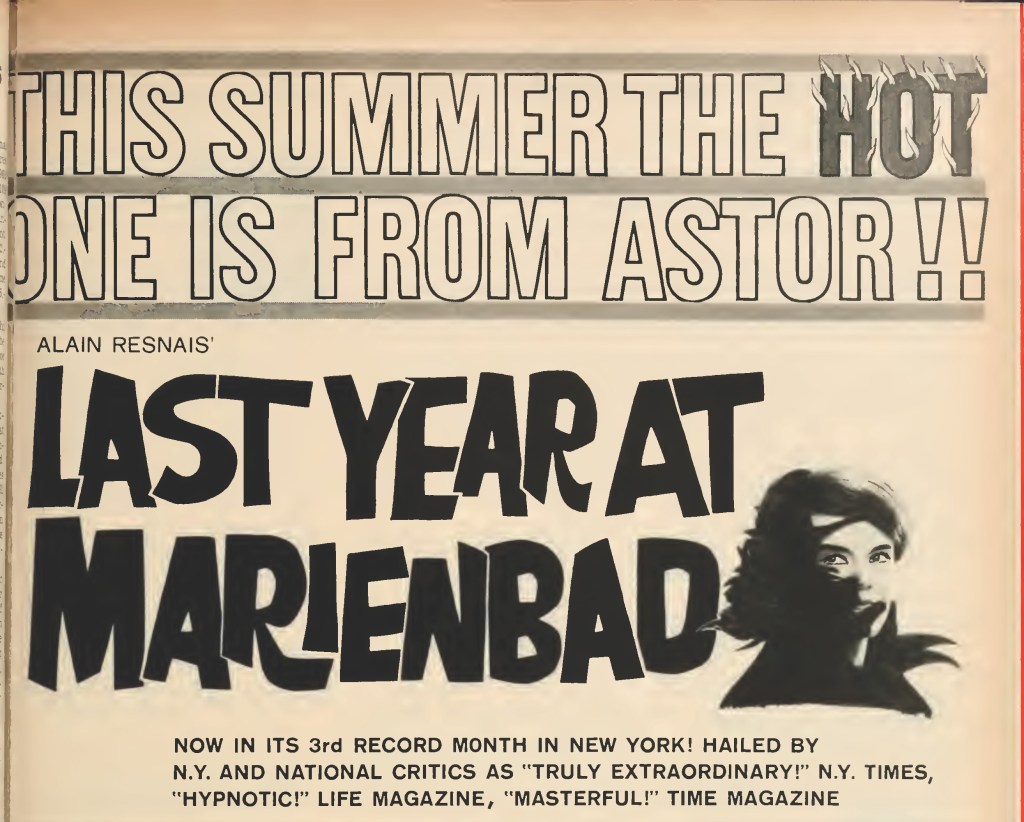
Last Year in Marienbad / L’Annee Derniere a Marienbad (1961) *****

Six decades later this miraculously emerges as a compendium of contemporary themes. Starting off with “my truth,” and segueing through unreliable narrator, false memory, parallel universe, stream of consciousness, dream vs. reality, repetitive voice-over, and still the most tantalising – or infuriating – movie ever made. A cinematic jigsaw with every piece of the puzzle highly stylized.

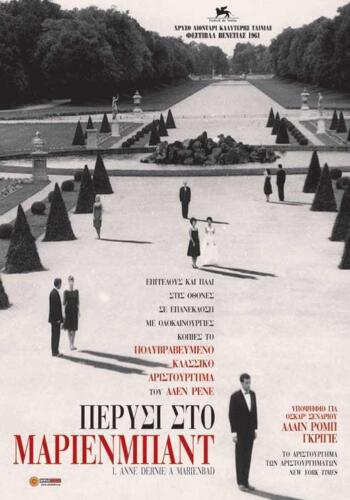
People have shadows but not the trees, the interpretation of a statue is disputed, characters in backgrounds are as frozen as mannequins, there’s a game you cannot win, no one has a name, and every now and then a row of men as if choreographed by Busby Berkeley wivel in turn and shoot at targets. Set in a huge baroque chateau with fabulous meticulous grounds, this fantasy building proves the ideal locale for an endless discussion of reality. And whatever happened last year in Marienbad could have occurred instead  in a number of other locations.

The trees have no shadows. These days CGI would rid trees of shadows but in those days it was the other way round and the shadows of the characters
were painted on the ground.

Two men, a prospective lover (Giorgio Abertazzi) and potentially a husband (Sacha Pitoeff), buzz around a woman (Delphine Seyrig). The would-be lover conjures up a tremendous amount of detail about when he met the woman, only for her to deny all knowledge of the incident, to the extent of failing to recall the reason they are meeting again, one year on. According to him, she had refused to enter into an affair the previous year but vowed to consider his ardent proclamations of love a year later. He has come to claim his reward.

That plot, slim as it is, is all you’re going to get. The movie goes all around the houses trying to establish not only was such an agreement actually struck but also whether she has ever met him at all and where exactly this supposed event might have taken place.

And were it not for the hypnotic tone, the mastery of camerawork, the cleverness of the situation, and the long tracking shots – for me an enormous plus – you might have given up the moment the man repeats, with mild differences, sentences he has already uttered. It’s the equivalent of the crime novel’s closed room mystery, except there is no solution.

So you either dismiss it as a typical French New Wave farrago, fall out with your friends over its meaning, or just sit back and enjoy it, as I did.

For a start, it’s one of the best films ever made in black-and-white, the contrast between the two so striking, the white glowing, the black occasionally ethereal, the lack of dialog almost insisting this is in reality a silent film. There are all sorts of pieces of experimental cinema, flash cuts in conflict with the languorous stately progress of the tracking camera, the aforementioned shadows and mannequins, greater emphasis given to the ceilings and corridors than to the people.

Time and place are distorted, different versions of events presented, the initial story given substance by the husband attempting to put the lover in his place by continuously beating him at an obscure game of cards (the Japanese Nim). And much to my astonishment, just as I was well settled in to letting the director take me where he wanted and expecting no conclusion, there is a climax of sorts that may point the audience in the direction of the correct reality.

By that point, did we even care, the whole essence of the movie being the inability to detect truth, the slipperiness of meaning, the elusiveness of intent and the certainty that what was clear one year is not the next. Cinema is built on conflict, and the most obvious one is difference of opinion. What one person regards as fact, the other dismisses as supposition. This could have been played out in dialog, endless discussion about meaning and veracity, we see it all the time in crime pictures and romance, what exists in one mind not having the same resonance in another, but instead we are treated to one long glorious cinematic essay.  

Director Alain Resnais had already set cinema alight with Hiroshima Mon Amour (1959) and there can have been few artists who hit the arthouse ground running in such style. That the script had been written by eternal bad-boy and future director Alain Robbe-Grillet (Trans-Europ Express, 1966) ensured that it was always going to be controversial. Unusually, Resnais, apparently, stuck very close to the script, so in that sense it was a collaboration rather than the usual loose interpretation of a screenplay.

The stars all took different subsequent routes. Delphine Seyrig, in her debut, would go on to become an arthouse darling in Accident (1966), Francois Truffaut’s Stolen Kisses (1968) and Jacques Demy’s La Peau Deuce/Donkey Skin (1970). Italian Giorgio Albertazzi did not become an arthouse darling, more likely to turn up in bit parts in a historical drama like Caroline Cherie (1968) or in a supporting role in giallo Five Women for the Killer (1974). You might remember Sacha Pitoeff from The Golden Claws of the Cat Girl (1968) and he, too, headed down the support/bit part route.

You might end up resistant to what you see, but everyone with an interest in cinema should see Last Year at Marienbad at least once.

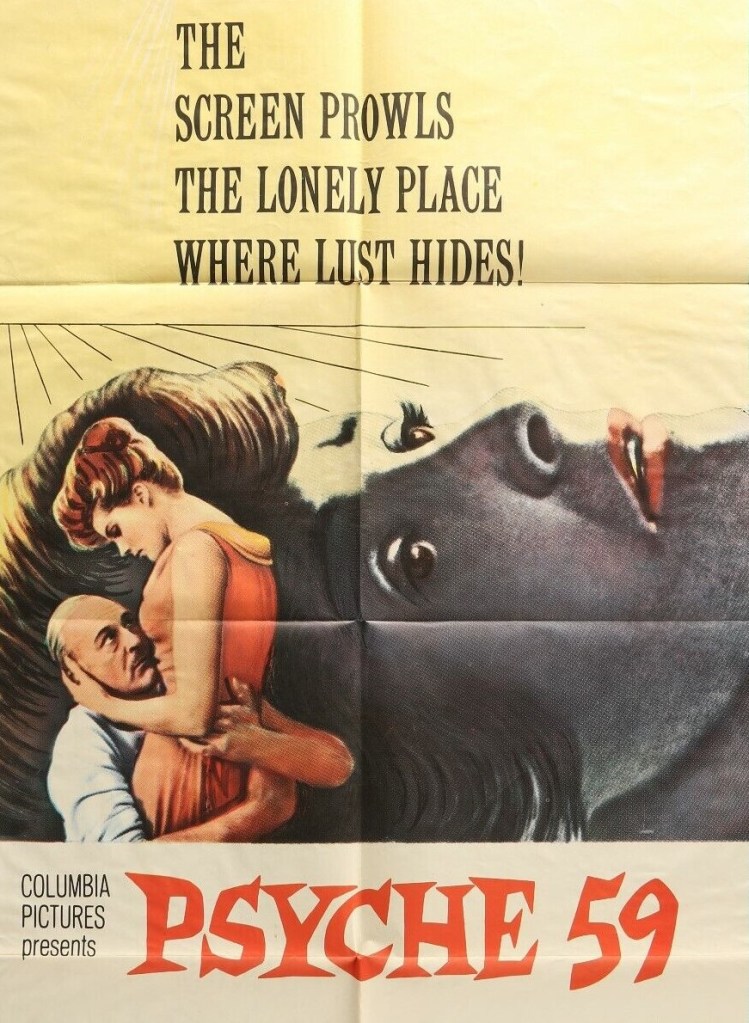
Psyche 59 (1964) ****

This is a low-budget gem, an exploration of the psychological consequences of grooming. You can probably guess from the outset where it is headed but simmering tension has rarely been handled so stylistically.

With the exception of Patricia Neal, an unexpected Best Actress Oscar-winner for her previous film Hud (1963), there were no stars in the cast. Curd Jurgens was only beginning to play characters for whom a German accent was not essential, Samantha Eggar one movie shy of her breakout picture The Collector (1965), Ian Bannen, essentially a character actor, building on his success in Station Six Sahara (1963).

Blinded after an unexplained psychological trauma, Allison (Patricia Neal) welcomes back, over the objections of husband Eric (Curd Jurgens), her much younger sister Robin (Samantha Eggar) to the family home. Family friend Paul (Ian Bannen) cares (possibly overmuch) for Allison while hankering after Robin. The screenplay by veteran Julian Zimet (Saigon, 1947, with Alan Ladd) is taut as a drum, every line a threat, suppressed emotion or piece of exposition that could bring the whole house of cards tumbling down.

The blindness is exceptionally well handled, Allison’s need for physical contact with her husband sensual in its expression. Though she can a ride a horse, her vulnerability is implicit; as she is led across a beach you wonder what would happen were she to be abandoned. What she cannot see becomes central to the movie. That Robin – vivacious but damaged – clearly has some hold over Eric is demonstrated in a tete-a-tete between them but as tensions mount such scenes cannot be kept secret. When Eric grabs Robin’s hair and she retaliates by jabbing him with scissors, neither party emits a sound, leaving Allison oblivious to it all.

Robin takes delight in exposing what has lain on the surface for too long. When Paul begins to fall for Robin, the younger woman astutely remarks to her sister: “Am I taking him away from you?”  Allison, however, is self-aware, convinced she could see if she wanted to, if she was prepared to lift the psychological barrier that keeps the past safely hidden. “I’m afraid to see,” says Allison, “there’s something I’m scared to look at.”

Given the period when it was made there was a lot that could not said – or shown – and even so the film was censored prior to release, but it is the direction by Alexander Singer (A Cold Wind in August, 1961) that lifts the picture up. An acolyte of Stanley Kubrick, the movie teems with imagination, close-ups and extreme close-ups are balanced by long two-shots, a conversation in a car between Eric and Paul mostly direct to camera a prime example.

Emotion is captured at every turn and Singer avoids the cardinal sin of treating Allison like an invalid or focusing on her reaction to what she cannot possibly see, her eyes hidden behind dark glasses for much of the time. Levity is provided by Mrs Crawford (Beatrix Lehmann), Eric’s sci-fi-reading horoscope-obsessed mother and by a couple of excitable children.

The grooming is in the past but the after-effects are very real. In a film like this it is tempting to consider that certain attitudes are dated, but it is clear from this film that nothing has changed, that men believe they can take what they want regardless of the impact on their victims.

Amsterdam (2022) **** – Seen at the Cinema

Shaggy dog story wrapped up in paranoia thriller. A shade overlong, with too many characters and too much plot but such flaws should not detract from that rare cinematic animal, a truly original movie. Brilliant screenplay, believable characters and superb acting prove an irresistible combination.

Though you can see why this sank like a stone at the box office, the all-star cast generally acting against type, idiosyncratic director given vast sums to play with, a tale that goes in too many directions at once, and the unconstitutional events of January 6, 2021, bringing this too close to home for fractured American audiences.

You don’t get this kind of writing much anymore. When individuals come together on a project – to save the world the most likely reason these days – their individuality is usually subsumed to the plot. Here, instead, the reactions of the characters remain distinct and no matter what is going on there is always time for individuality. And some of the invention is just deliciously insane, the nonsense songs for example.

Touching on the World War One aftermath of recovering from mental and physical wounds plus profiteering glee, a sense of a country racked by the Depression on the brink, mind-inducing experimentation of the political and pharmaceutical kind. A trio of war veterans, soldiers Burt (Christian Bale) and Harold (John Davidson Washington) and nurse Valerie (Margot Robbie) investigate a mysterious death, an illegal autopsy uncovering poison, only to find themselves framed for murder.

Burt is not a prime-time player according to wife Beatrice (Andrea Riseborough), and her wealthy family had dispatched him to the war in the hope he would return with bankable glory, but generally treat him as an unwanted black sheep. Valerie now makes art out of war debris, bullet shells and shrapnel, her charming brother Tom (Rami Malek) and his wife Libby (Anya Taylor-Joy) embedded in malevolence. Harold is a lawyer, for whom racism is a constant.

American and British secret service operatives, Norcross (Michael Shannon) and Canterbury (Mike Myers), float in and out. The moneyed business elite, despising White House incumbent Roosevelt, cast envious eyes at the dictatorial economic miracle of Mussolini in Italy.

On everyone’s dance card is General Dillenbeck (Robert De Niro), sought out by our intrepid trio and a mysterious cabal. All he has to do is make a speech at a veteran’s dinner. Make the right kind of speech and the trio are vindicated. Make the wrong kind and he could be assassinated.   

Like Chinatown (1974), Amsterdam is representative, a state of mind, but of freedom rather than endemic corruption. This is an intricate piece and a bit slow for today’s fast-paced generation and with more dialog than might sit well with a modern audience and flights of fancy that are far more original than anything you would find in the MCU. But it’s a hell of an intelligent thriller driven by a bunch of deadbeats.

It never goes down the obvious route. Instead of a love triangle – Valerie and Harold a pair – it’s an evocation of friendship. You don’t need umpteen clues to find the villains, they’re upfront, and they don’t think they are baddies, but cleverer people coming to the aid of the dumb masses putting too much blind faith in democracy. While this is based on a true story, in reality it’s based on the constant of the rich trying to get richer and the wealthy believing they are the best, even if unelected, candidates to run the world.

All that political stuff could have been a big turn-off if it had gone down the preachy route, but it doesn’t, instead it’s almost a miracle that it arrives at any conclusion given in whose hands the narrative has been placed. The Three Stooges would have done a better job of getting there quicker, but then you wouldn’t have had so much fun.

Not only are all the stars on their A-game but acting-wise it delivers some career-reviving turns not least from Christian Bale (Ford v Ferrari, 2019), devoid of a lifetime’s acquisition of irritating tics, John David Washington (Tenet, 2020) called upon to develop a character rather than an action-driven hero. I had to check the end credits to find out it was Mike Myers (Bohemian Rhapsody, 2018) playing the understated Canterbury and hogging the screen with none of the acting pyrotechnics that dogged previous attempts at mainstream work. Ditto Robert De Niro (The Irishman, 2019) and Rami Malek (Bohemian Rhapsody), no grandstanding this time round – don’t worry I recognized both from the off – and Anya Taylor-Joy finally delivering on the promise of The Queen’s Gambit (2020).

Margot Robbie (The Suicide Squad, 2021) is already on the rise and this will add to her growing portfolio of fascinating characters. And if you’re fed up watching any of these stars in brilliant form, there are other distractions in the form of Chris Rock (Spiral, 2021), Taylor Swift (Cats, 2019), Andrea Riseborough (The Electrical Life of Louis Wain, 2021) and Alessandro Nivolo (The Many Saints of Newark, 2021).

You often hear the term “visionary director” thrown about with indiscriminate regard, but this is the right kind of visionary, director David O. Russell (Joy, 2015) with his own way of seeing the world, and delivering it in distinctive fashion, with less of an eye on camera movement and more on dialog and motivation and staying true to a coterie of original individuals.  

I guess the money was spent on atmosphere, this is 1930s USA regurgitated in enormous detail. But you’ll forget the background, the costumes and sets, and be dazzled instead by the script and the acting, and the enveloping tale of friendship.   

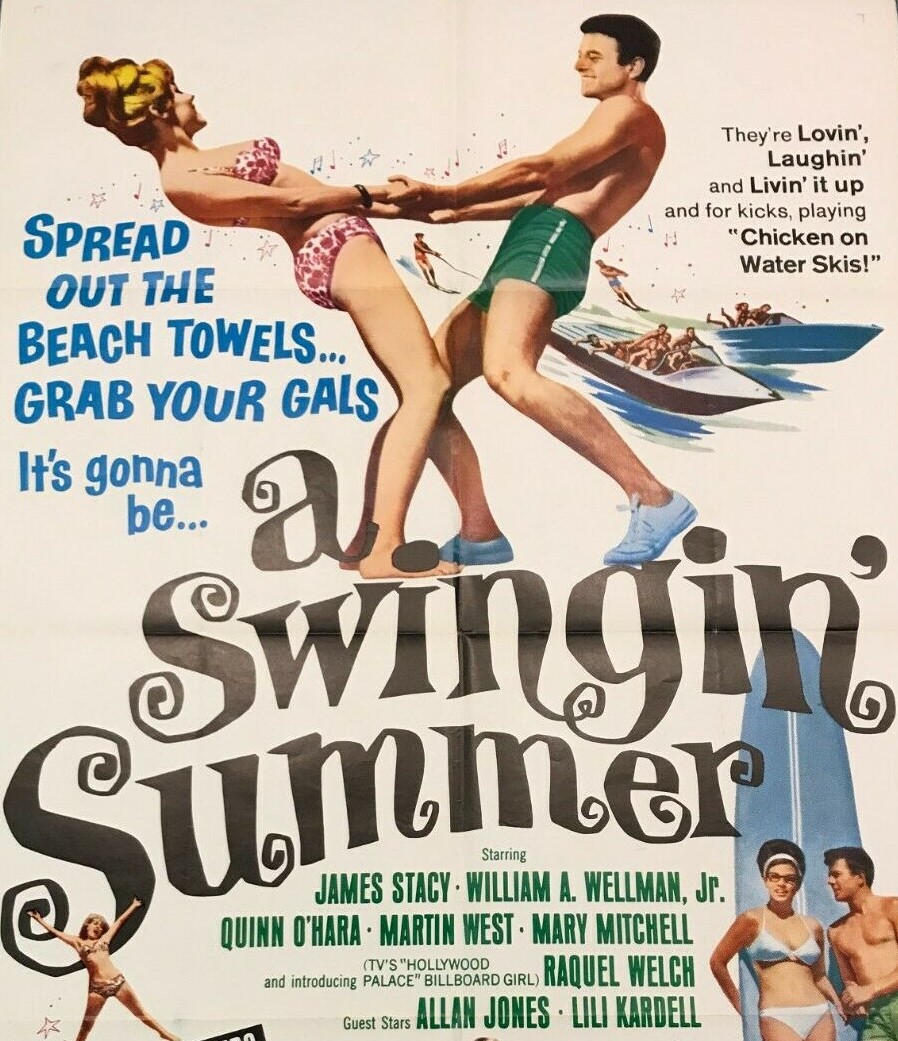
A Swingin’ Summer (1965)***

I admit it: spotting this on YouTube I couldn’t resist. After all, someone has to report on the first proper Raquel Welch picture. Plus, I had never seen a beach movie, such a staple of the decade. Plus, depending on your point of view, Raquel gets to sing.

But why waste any brainpower coming up with a new idea when you can recycle an old one – let’s put the show on in the barn. Or a version of it.

Raquel Welch – distinctive in any language.

When their summer plans are dashed, students Mickey (James Stacey) and Rick (William Wellman Jr.) decide to promote a series of beach concerts. That doesn’t sit too well with lifeguard Turk (Martin West) who takes an unwelcome shine to Mickey’s neglected girlfriend Cindy (Quinn O’Hara). Rick, meanwhile, is intrigued by nerdy Jeri (Raquel Welch) but a bit put off to discover she’s more interested in a meeting of minds than anything more obvious, and possibly by her independent, proto-feminist streak, in that she selected him for her “summer romance.”

Just in case you thought there wasn’t much else to do but wait till the wannabe promoters got their act together and people fell in and out of love, there’s a hefty amount of subplot: a fistfight, a robbery and a water-ski version of “chicken.” Plus if there was any chance of you getting bored, house band Gary and the Playboys and a variety of other acts, including as the climax The Righteous Brothers, hit the stage and, in the interests of gender equality, the platoon of good-looking women hanging around are matched by a squad of good-looking men. 

There’s even some effort at comedy, a few pratfalls, mostly thanks to the distractions of Jeri, and one gender-switch sight gag which seemed pretty daring for the times, and even a nod in the direction of health food fads. Perhaps, more surprisingly, are the solid characterisations, the principled Mickey who refuses to sponge off Cindy’s rich father. Discovering she bailed him out behind his back, securing the sum required for the project from her father, he accepts the money as a loan but renegotiates the interest rate.

Jeri is way ahead of her time, analysing the men she fancies and with the repartee to keep them in line. It’s pretty even-handed in the beach costume department, for every girl in a bikini or tight top there’s a bare-chested topless hunk, though it still manages to be overtly sexist, girls needing measured by an obliging male in order to enter a beauty contest.

Scottish actress Quinn O’Hara (The Ghost in the Invisible Bikini, 1966), a former beauty queen and girlfriend of pop star Fabian (Mr Hobbs Takes a Vacation, 1963), must have thought the prospect of becoming the breakout star pretty high, what with her reimagining of the Lana Turner/Jayne Mansfield tight top. Her only rival was the girl playing the nerd who hooked the male lead’s best friend. Ostensibly, the nerd was not much of a part, spouting psycho-babble most of the time.

A nerd is still a nerd, O’Hara must have assumed. Unless she’s Raquel Welch.

Welch handles the dialog very well, probably longer speeches than anyone else, but even with  her horn rim glasses and hair in a bun, and determined to measure potential partners by their brain cells, she stands out as an independent thinker long before she releases her secret weapon, a yellow bikini, and smart enough to work out that if that doesn’t set a man’s pulse racing to head for second base – jumping onto the stage to strut her stuff.

It’s a bit of a stretch to argue that an appearance in a low-budget beach movie ushered her into the Hollywood fast lane, but, hey, timing is everything, especially if you happened to catch the eye of a producer looking for someone to model a fur bikini.

None of the men made much of a splash in the movie business though James Stacy was the male lead opposite Welch in Flareup (1969). Supporting actor Allan Jones was the biggest name in the cast but well past his heyday as a Marx Bros stooge.

Some of the singers were better known than the actors. Topping the bill in that respect were The Righteous Brothers – hot after “You’ve Lost That Lovin’ Feeling and “Unchained Melody” – who sang “Justine” (no smash, reaching just No 85 in the U.S. singles chart). Gary Lewis and the Playboys also topped the charts in 1965 with “This Diamond Ring.” But The Rip Chords were coming to the end of their chart life. Raquel’s song “I’m Ready to Groove” did not set the house on fire, it’s fair to say.

Robert Sparr (More Dead Than Alive, 1969) was at the helm. Leigh Chapman (Dirty Mary Crazy Larry, 1974) and Reno Carrell (Winter a-Go-Go, 1965), also the producer,  collaborated on the screenplay.

A harmless curio – a neat 80 minutes long – and if you’re intent on watching a beach movie it might as well be this.

Guns for San Sebastian (1968) ****

Pre-Stagecoach (1939) Hollywood used to differentiate between historical adventure pictures and westerns. Given it’s set in 1746, before there was such a thing as a revolver or repeater rifle, so a complete absence of gunslingers, this falls squarely into the former camp though its format displays western credentials. A tad top-heavy with religious allegory, “miracles,” peasant piety and an Ennio Morricone score mainlining on the celestial, nonetheless it manages to achieve a character-driven narrative and some powerful action sequences.  

However, it’s a lengthy set-up. Outlaw Leon (Anthony Quinn), on the run from Mexican troops, takes refuge in a church. As punishment for giving him sanctuary Fr Joseph (Sam Jaffe) is expelled to the abandoned church of San Sebastian in an equally abandoned village. Ringing the bell to attract parishioners only alerts bandits who kill him. Donning his garb, Leon is mistaken for a priest by Yaqui leader Teclo (Charles Bronson) and strung up crucifixion style. But he’s rescued by villagers who almost elevate him to sainthood courtesy of a couple of accidental “miracles.”

Enjoying his newfound status, but still attracted to peasant Kinita (Anjanette Comer), he directs the parishioners to build a dam to flood the fields to assist in corn-growing. Teclo objects to challenges to his authority and burns down the village. The villagers turn against Leon, and although initially intending to vanish, he decides instead to blackmail his mistress, the wife of the local governor (Fernard Gravey) who agrees to supply him with weapons. Leon builds a fortress to withstand the expected attack setting up a very engaging climax in which the dam plays a critical role.

A modern audience might expect a sturdier narrative rather than one that seems to shift at whim, not helped by Leon’s indecision. And it’s too slight a vehicle to carry the political points, the state of Mexico at the time, the settlers vs. original occupants (i.e. Native Indians) scenario, the problems facing half-breeds (Leon and Teclo both), but it’s better at exploring the power of the church, the worship bestowed on any priest who turns up, regardless of how ill-suited he appears.  The occasional comic sequence, banter with an architect, negotiation with a Mexican colonel, seems out of place.

On the other hand there is a truly mesmerizing performance from Anthony Quinn (Lost Command, 1966) as a womanizing low-life who happens upon redemption, so deep does his impersonation of a priest go that he can’t bring himself to touch the compliant Kinita, who is aware of his true identity. Switching between shiftiness and godliness at the drop of a hat and deriding villagers for their lack of character his turning point comes when he realizes he has fallen into the same trap. That he emerges as a wily man of conscience is no mean feat.

The other big bonus is to see someone at last recognize Charles Bronson (Once upon a Time in the West, 1969). Here he is given cinematic status, camera pitched up at his face, and allowed to eliminate the growl and monosyllabic delivery that has been his wont in lesser roles. He’s a rather decent villain at the end.

There are a couple of inconsistencies. Teclo wants villagers to take to the hills but on the other hand somehow to spend enough time tending the corn that come harvest time he can steal. And it’s a bit too neat how he falls into the dam trap.

All in all, enjoyable and very under-rated primarily, i suspect, because people come at it expecting a western rather than a historical film in the adventure vein. But it’s elevated by the intriguing narrative, the questionable hero, Quinn’s performance and the introduction to a new-look Bronson.

Frenchman Henri Verneuil (The Sicilian Clan, 1969) does well to probe so many issues for an audience probably expecting something more straightforward. James Webb (Alfred the Great, 1969) wrote the screenplay based on novel by a William Faherty, a Jesuit priest. In the book, the hero was a soldier who became a priest rather than an atheist opportunistic outlaw.

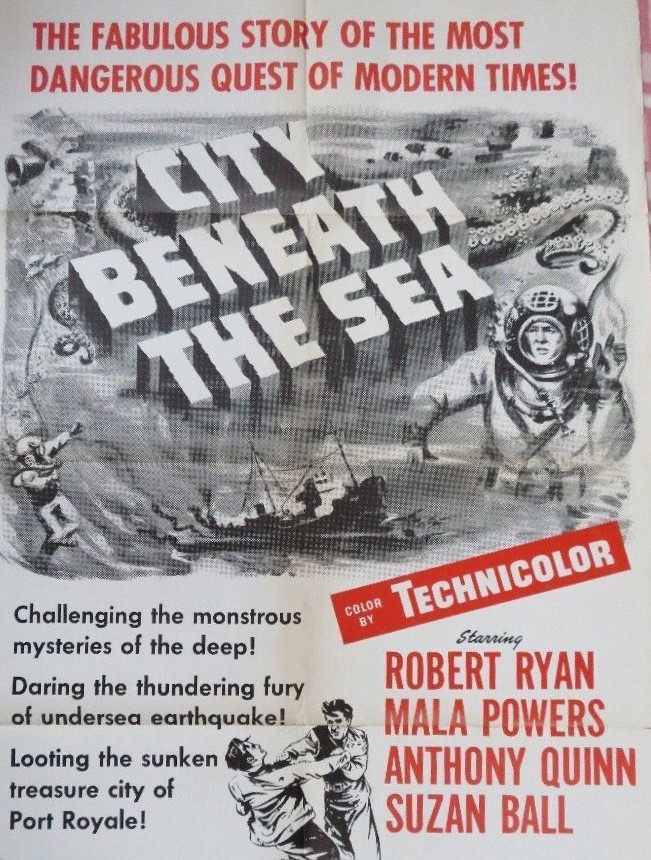
War-Gods of the Deep / City Under the Sea (1965) ***

Hollywood careers rarely end in a blaze of cinematic glory. Sudden death ensured Clark Gable and Marilyn Monroe (The Misfits, 1961) and Spencer Tracy (Guess Who’s Coming to Dinner, 1967) went out with a bang but more likely a  career is just going to tail off and end with this kind of whimper. Director Jacques Tourneur, in any case, was long past a heyday that saw him set the horror genre agog with Cat People (1942), I Walked with a Zombie (1943) and The Leopard Man (1943).

If that wasn’t enough to solidify his credentials he dipped into another genre, the nascent film noir, and helmed gems like Experiment Perilous (1944) with Hedy Lamarr and Out of the Past (1947) with Robert Mitchum. Thereafter came swashbucklers The Flame and the Arrow (1950) headlining Burt Lancaster and Anne of the Indies (1951) plus crime drama Appointment in Honduras (1953) with the ever-dependable Glenn Ford and Joel McCrea western Wichita (1955). Then, miraculously, it was back to horror with Night of the Demon (1957) and the late flurry of The Comedy of Terrors (1963).

You can tell where I’m going with all this. War-Gods of the Deep has nothing on any of these pictures. The backstory is much more interesting than the actual film.

Basically, this is one of those pictures where an unlikely pair, American Ben Harris (Tab Harris) and eccentric Brit Harold Tufnell-Jones (David Tomlinson) get themselves into an unlikely situation and have to get themselves out of it.

Set in the smugglers’ paradise of the British Cornish coast around the turn of the last century, on a hotel on top of a cliff, the duo need to track down another American, Jill (Susan Hart), who has disappeared down a plughole, sorry mini-whirlpool. This leads to a legendary underwater city where smugglers led by Sir Hugh (Vincent Price) have found the secret of eternal life, a paradise now endangered by tremors from a nearby volcano.

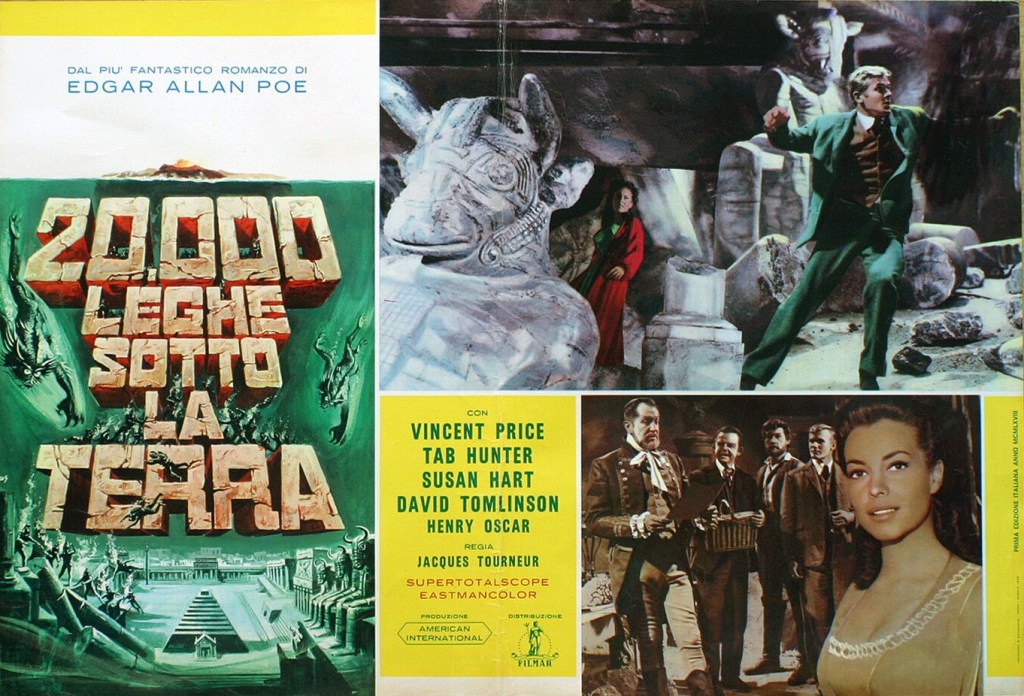
The Italians didn’t fancy the two titles on offer so came up with their own
by purloining the Jules Verne classic.

He sent his enslaved Gill-Men to kidnap Jill in the erroneous belief that she is his dead wife. Bored out of their minds with listening to Sir Hugh prattling on endlessly about how the underwater city came into being and how important he is to the whole affair and what imminent dangers the inhabitants now face, and of course faced with their own imminent demise as sacrificial victims, the pair decide to scoot, having found a willing accomplice.

There’s a chase and whatever, and some undersea adventure, but there’s not much to it.

However, what you do get when you add someone like Tourneur – and to that extent Vincent Price and his ominous tones – to this listless mix is atmosphere. Tourneur can inject eeriness almost just by switching on a camera, despite a very stage-bound picture, and he knows how to add a music score that tremendously aids his enterprise. The opening section by the shore and in the hotel adds the necessary element of mystery to make the whole idea float.

There clearly wasn’t enough of a budget for the Gill-Men to appear as anything but peripheral figures which actually might have helped since, the state of special effects in that time might have made them laughable rather than distantly disturbing.

The best you can say is that Tourneur made the best of a bad job. Vincent Price (Diary of a Madman, 1963) only has to turn up to inject an element of danger. Tab Hunter (Ride the Wild Surf, 1963) and Susan Hart (Dr Goldfoot and the Bikini Machine, 1965) needn’t have bothered turning up for all they bring to the party. And David Tomlinson (Bedknobs and Broomsticks, 1971)  brings far too much, saddled with a pet comic chicken for no apparent reason except to extract a few laughs.

AIP, having made its name in the horror department by raiding the portfolio of Edgar Allan Poe, turned up this source material deep in that vault. But the only connection to Poe is the original idea –  which was not that original, other poets having plumbed those depths prior –  and that appears only in occasional desultory recitations of the poem. But, as a marketing tool, hey, Edgar Allan Poe, that’ll scare their socks off!

So, you are warned, but also you can’t help but warm to this final movie by one of the Hollywood greats as he tries to put a sheen on something that in other hands would have sunk like a stone.

Discover WordPress

A daily selection of the best content published on WordPress, collected for you by humans who love to read.

The Atavist Magazine

by Brian Hannan

WordPress.com News

The latest news on WordPress.com and the WordPress community.