Nothing to live on but dreams and, in those days, no social media to bail them out. Spare sad lives in Small Town U.S.A. told with an occasional grand guignol touch. Look elsewhere for the laconic loner of Steve McQueen legend, to, for example, The Cincinnati Kid, out the same year.
This has the feel of a vanity project, the actor’s Solar outfit taking a production credit, as if the star felt he wouldn’t properly be recognized as an actor unless he had a ton of lines to chew through. And he might be right to feel aggrieved, wildly contrasting roles from Daniel Day-Lewis in movies that opened the same day in New York two decades later had critics reaching for the superlatives.
By my reckoning, this was the last year, save for occasional outliers like In Cold Blood (1967), when studios accepted the hi-falutin’ notion that filming in black-and-white added artistic luster regardless of the damage it might do to a picture’s commercial prospects. The mono approach is taken to extremes from time to time, the contrast so sharp it might have emanated from the Ingmar Bergman school of cinematography. And given the desultory lives picked over, this might have fared better with subtitles, the kind of foreign picture that arthouse audiences fawned over.
Prison parolee Henry (Steve McQueen), entitlement hormone running amok, has got it into his head that if only he had the funds to reach Hollywood or Nashville (either would do) his singing and song-writing talent would be recognised. This puts wife Georgette (Lee Remick), newly arrived with small daughter, in the position of going out to work to keep the family, altering her domestic situation from independent single mother to wife in thrall to waster husband.
She’s supposedly no dupe either, rejecting the kindness of strangers, as if aware it usually comes with strings attached. It’s a given that any time a child enters a romantic equation you can be sure the narrative will turn on parenthood and responsibility. And that’s pretty much all the story there is.
You can guess from the outset that while Henry’s singing might set a few female hearts zinging, it’s not likely to win him a contract. So the question is, really, whether Henry can settle down and not be so swift to resort to his knife when confronted with a messy situation.
It’s marred by a couple of truly terrible scenes, a poorly-choreographed fight and a really odd sequence that has Henry declaiming with his back to a tableau of motley characters with the contrast at its sharpest. And in what looks like nothing more than an old haunted house.
It’s well-meaning enough and for the most part McQueen dispenses with the tough-guy attitude, but he doesn’t really offer enough in its place. It’s the kind of role that could easily have been delivered as effectively by any number of actors with nothing approaching his star quality. And that’s a shame because he really is trying – though it’s the trying that gets in the way, you keep on waiting for the real Steve McQueen to turn up.
If director Robert Mulligan (Up the Down Staircase, 1967) hadn’t been so determined to paint it in downbeat arthouse tones, the actor might have felt free enough to come up with a genuinely original turn. Though I accept it’s a bit unfair to complain about McQueen attempting something different, there’s no real excuse for him creating the worst singer ever to hit the screen.
You might also note, by the way that whereas McQueen takes pole position on the poster, in the screen credits Lee Remick (Days of Wine and Roses, 1962) is top-billed. Remick is better than McQueen because she has a deeper well of emotions and wider range of characterizations to choose from. You never feel she is acting to save her career or hope that Oscar voters might nod in her direction.
The movie makes more sense once you understand it really belongs to the 1950s – the Horton Foote (To Kill a Mockingbird, 1962) Broadway play on which it is based was staged in 1954. The movie fatally switches focus from Georgette to Henry before working out which actor was likely to best convey the happiness drought on which the work depends. There’s more than enough sadness to go round but it just seems solidified from the outset. No great harm – that may well be the truth of it – but it prevents the movie taking off, stuck as it is in recycling Henry’s weary past. Don Murray (The Viking Queen, 1967) makes a good fist of a widowed sheriff.
Worth a look to see McQueen tackling something different. You decide whether he succeeds or fails.
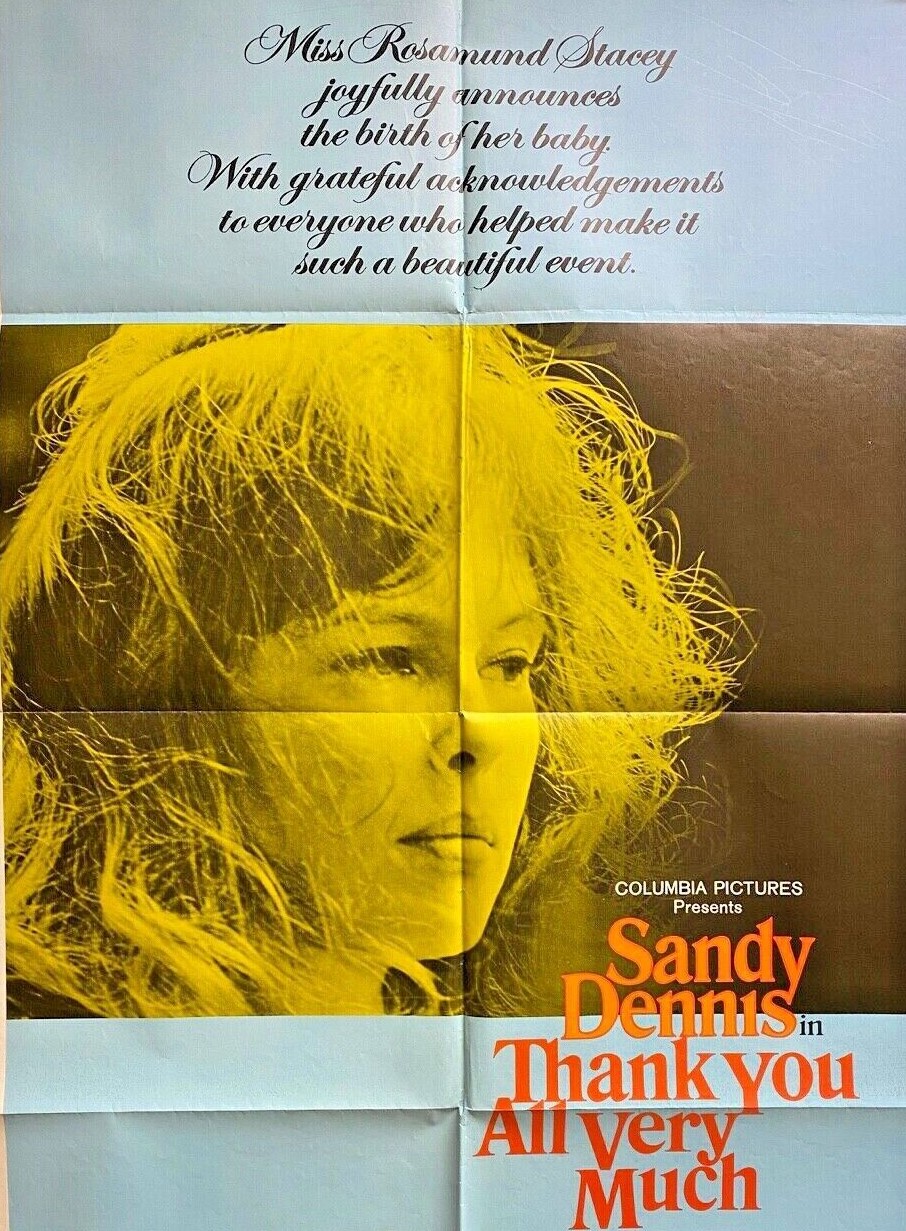
The combination of Amicus and pregnancy might lead audiences to expect a monster baby of It’s Alive (1974) dimensions. Nor would you associate the studio, which made its name in horror pictures where women were either victims or sex objects, with feminism. But producer Milton Subotsky plays it straight, the only concession to the Margaret Drabble source novel is to change the title, from the obvious The Millstone to the more ironic Thank You All Very Much (in the U.S.) and A Touch of Love (in the U.K.).
It doesn’t go down the single mum kitchen sink route either, abandoned female struggling in poverty and desperate for a man. In fact, except in one instance, dependable men are in short supply. Though, it has to be said, female support isn’t much better.
Now there’s counter-programming. A “woman’s picture” supported by low-budget actioner aimed at men.
Pregnant after a one-night stand with television personality George (Ian McKellen), post graduate student Rosamund (Sandy Dennis), after toying with home-made efforts at abortion, decides to have her baby. Luckily, she can afford it, living in a splendid apartment in what looks like South Kensington rather than a bedsit in a more squalid area of London. Her parents are more remote, tending towards the upper rather than the middle classes, the type who park their offspring in boarding school to minimize a child’s impact on their busy social lives.
Sandy Dennis (Up the Down Staircase, 1967) has quite a trick in her screen persona. She is generally initially presented as weak, whiny, vulnerable, trademark quavering voice helping this along, a potential victim until her inner steel exerts itself and you realize she is not the person you think she is. Almost an actorly version of the Christopher Nolan trope of letting you believe a character is one type of person until he/she turns out to be another.
There isn’t too much of the mother being tormented out of her skull by a baby screaming its head off – or as in Nolan’s latest opus Oppenheimer, a mother unable to cope handing the child over to someone else to look after – but she is very much alone, unable to reveal to the father his part in the pregnancy, despite having another one-night stand with him. So mostly it’s her coping with the system, suffering in silence in the traditional British manner endless bureaucracy, sitting in a long queue in a waiting room, and being beset by the very people you might expect to be more sympathetic.
Supporting feature given more prominence here.
But the nurses seem very much cut from the same pragmatic cloth as her parents. Prior to birth, one nurse informs her that it’s selfish not to give the child up for adoption. When the baby is convalescing in hospital after a heart operation, matron (Rachel Kempson), a graduate from the Nurse Ratchet school of health care, consistently refuses to let the mother see the baby as it’s apparently against hospital rules until in the best scene in the movie, and the one that achieves the Dennis trick, she literally screams the place down.
That nurses on a maternity ward full of little more than I would imagine at times screaming children are so disturbed by the prospect of an adult rebelling against the stiff upper lip conventions of British society says a great deal about the kind of uniformity and subservience expected of the public by those in charge of any large organization. None of the Angry Young Men of earlier in the decade would dream of such a simple solution to a problem.
Eventually, being allowed to sit by her child’s bedside until late into the night permits Rosamund to complete her thesis and win her PhD. She’s not quite as hard-nosed about George as she likes to imagine but since he’s not sufficiently taken with her child to allow it to disrupt a projected trip abroad, she realizes what had been plainly obvious to the audience that she is better off without men – or at least this particular, ineffective, individual – for the time being.
So most of the film is about Rosamund learning to enjoy her independence, able to achieve her goals without male assistance, and that’s generally done by action rather than dialogue or monologue, some heated debate or major crisis. Excepting the incident with Nurse Ratchet, it’s just about coping, and awareness that maternity need not cramp ambition.
Her arty friends (and parents for that matter) are all too keen on having a good time – the males mostly trying to bed her – to lend much support. Some like Lydia (Eleanor Bron) have a warped view of life.
In his movie debut Waris Hussein (The Possession of Joel Delaney, 1972) takes the striking narrative route of not allowing the picture to become tangled up with romantic complication, keeping it squarely focused on feminism, succeeding on your own terms, not reliant on men, embracing both motherhood and career. Margaret Drabble wrote the screenplay.
Sandy Dennis (Up the Down Staircase, 1967) delivers another telling performance, one of the few actresses permitted to be center stage in a non-romantic narrative, because this is the kind of role she can easily pull off. She manages a convincing British accent without falling prey to too much Britishness.
Minus the tell-tale diction that marked his later career, Ian McKellen (Alfred the Great, 1969) has an effective debut as the charming though selfish lover. Eleanor Bron (Two for the Road, 1967) is the pick of the supporting cast as the soft-hearted best friend who is too pragmatic by half. Others popping up include John Standing (Walk, Don’t Run, 1966), Margaret Tyzack (2001: A Space Odyssey, 1968), Maurice Denham (Midas Run, 1969) with Rachel Kempson (The Charge of the Light Brigade, 1968).
Unfussy direction matched with another brilliant turn by Sandy Dennis makes this a must-watch.
Farce is particularly difficult to pull off on screen. What is so effective on stage where the audience has full view of doors opening and characters appearing/disappearing and can often view, like a pantomime, circumstance changing ahead of the characters, grinds to a halt when the camera has to cut between various characters.
A speeded-up Tony Curtis (The Boston Strangler, 1968) doesn’t help though lack of his usual zaniness provides Jerry Lewis (The Nutty Professor, 1963) with the opportunity to present a more grounded character. To some extent, there’s little director John Rich (Wives and Lovers, 1963) needs to do than to keep the ample supply of balls rolling.
The movie displays its sexist credentials – listing the measurements of the female stars – not just in posters such as the one above but also in the film’s credit.
Though it sticks to the normal formula of girls falling out of the woodwork at inappropriate times, the Parisian set-up is a beaut. Journalist Bernard (Tony Curtis) has three girls on the go, all airline stewardesses, all believing themselves to be his fiancée, and by dint of assiduous study of flight schedules ensures that their paths never cross. His acidic housekeeper Bertha (Thelma Ritter) keeps the love machine well-oiled by switched around framed photos are changed and relocating underwear to suit the next imminent arrival.
Things go awry when American airline Boeing introduces a faster model, meaning that his lovers return sooner than anticipated. Stakes are raised when reporter rival Robert (Jerry Lewis) queers his pitch. So mostly it’s Bernard trying vainly to keep all his balls in the air without being rumbled while Robert attempts to sabotage the operation.
There’s not much more to it than that, the girls’ consternation at finding another woman in the apartment, Bernard gamely finding excuses for their presence.
Nor is it as risqué sex-wise as you might expect. The period didn’t allow for the hostess trio to actually be engaging in hanky-panky with Bernard. They are all allocated separate bedrooms so it will seem to a modern audience that all his frantic energy is wasted, though the initial stage audiences would accept the bedroom shenanigans as long as conventions were respected. Amorality goes only as far as keeping three girls on a string rather than actually taking them all to bed.
Of course it builds up into a riotous outcome but the farce remains forced.
Tony Curtis mugs his way through the entire thing, face twisted a million ways, eyeballs rolling so much you think they are going to bounce clear of the sockets, and delivering dialog so fast he can hardly get to the end of one thought before another has interjected. Jerry Lewis is better value as the straight man, not relying on the physical comedy of previous roles, nor any obvious mugging, and creating a sly believable character intent on getting revenge.
Suzanna Leigh (The Pleasure Girls, 1965) is the pick of the hostesses but that’s not saying much since each has tumbled straight out of the cliché barrel. Dany Saval (Moon Pilot, 1962) flies the French flag while Christine Schmidtmer (Ship of Fools, 1965) is the dominating German.
The biggest joke is on producer Hal Wallis (The Sons of Katie Elder, 1965). A past expert at choosing properties, he purchased the rights to the successful stage play by Marc Camoletti when it was enjoying a hugely successful run in London’s West End. But when the production transferred to Broadway it was a resounding flop, leaving the movie with none of the usual hit play hype to build upon.
With only A Girl Named Tamiko (1963) in his portfolio as evidence of his familiarity with comedy (and that gentle in nature), Edward Anhalt (The Sins of Rachel Cade, 1961) was an odd choice for the screenplay except that he had recently adapted for Wallis hit Broadway play Becket (1964). (As a footnote, you might be interested to know that Mark Rylance won a Tony for playing Robert in a Broadway revival.)
Lightweight matinee material, but worth it for Jerry Lewis playing against type.
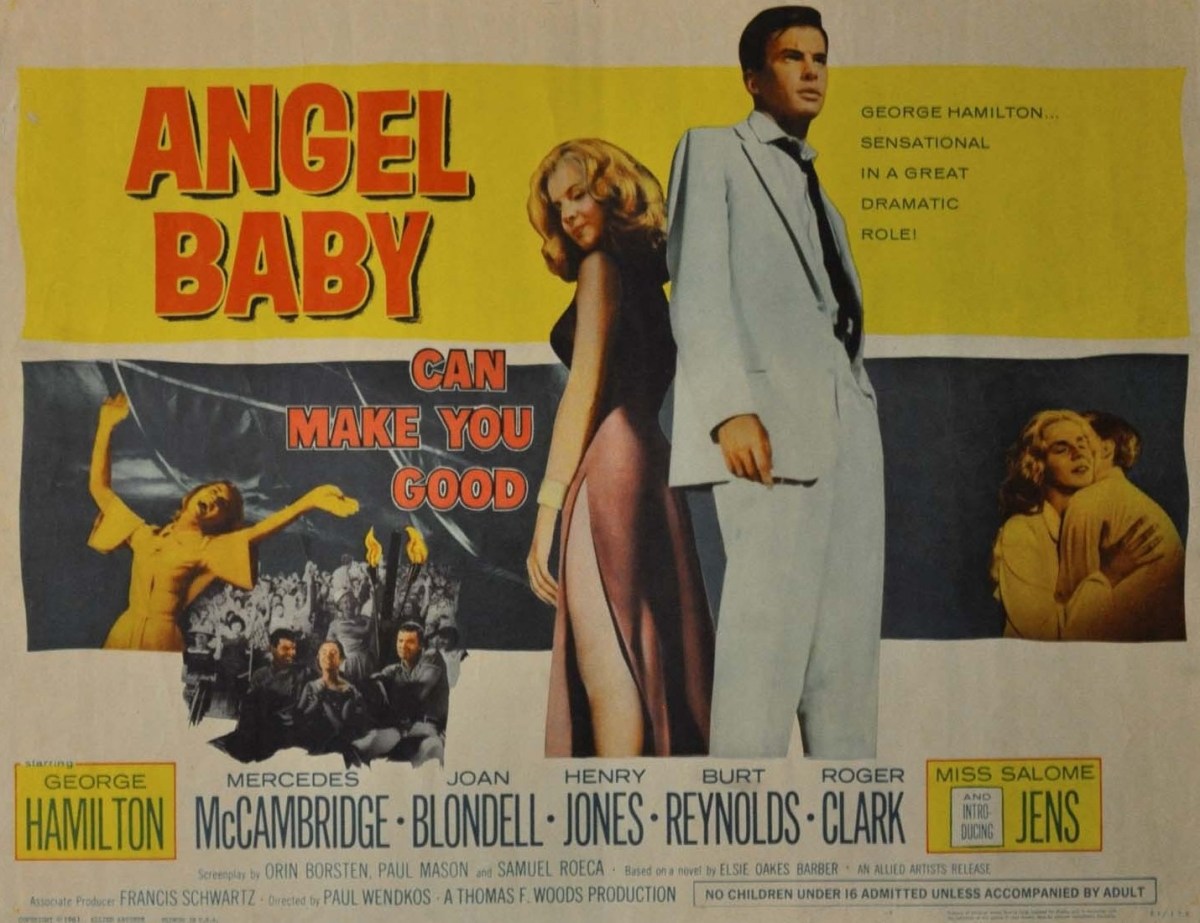
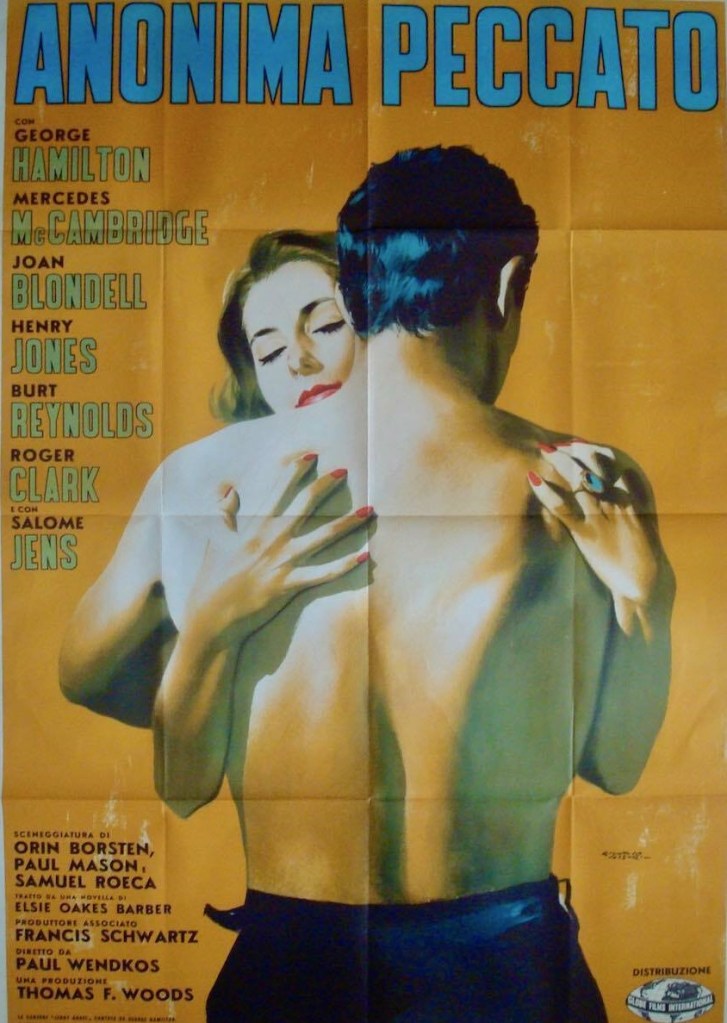
Stunning cast – George Hamilton, Burt Reynolds, Mercedes McCambridge, Joan Blondell – in low-rent version of that ode to evangelism Elmer Gantry (1960) but here focusing on misplaced zeal and corruptible innocence. Strikes a contemporary note with “MeToo” reversal – elder woman grooming a choir boy – and fake news, how else to describe public gullibility for the so-called miracles that were the stock-in-trade of the revivalist business.
Would have been an interesting addition to the portfolio of the erratic director Hubert Cornfield (Pressure Point, 1962 a high, but Night of the Following Day, 1969, a low) except he took ill and passed the reins to Paul Wendkos (Guns of The Magnificent Seven, 1969).
Takes an interesting narrative slant, the three original principals bowing out after a strong start, leaving the way free for the titular character to come unstuck in the sleazy world of religious make-believe before they all turn up again for a rip-roaring finale.
Young charismatic preacher Paul (George Hamilton) is at odds with his dominating older wife Sarah (Mercedes McCambridge). She is all hellfire-and-brimstone while he wants to preach about love. They are in an “unholy marriage,” he plucked from the choir as a teenager and molded by her, her invocations to prayer always accompanied by sex, and once Jenny Angel (Salome Jens), a mute he heals and with an unwelcome boyfriend Hoke (Burt Reynolds), appears on the scene he begins to question his sexual and religious grooming.
Recognizing a love rival, Sarah bribes ambitious couple, resident alcoholics Mollie (Joan Blondell) and Ben (Henry Jones), to take her on and they, in turn, trade her to Sam (Roger Clark) who turns her unfulfilled potential as a preacher into box office dynamite by capitalizing first on her beauty, low-cut gowns emphasizing her physical attributes, and then by fake healings, not realizing, in his greed, that a preacher who can make reputedly make the blind see is asking for trouble.
Having seen the error of his way, Paul chases after Angel, Sarah chases after Paul and Hoke just happens to be in vicinity to ensure it all ends in colossal disaster, though with an unusual twist ending.
But it’s surprisingly good in an old-fashioned way. The depiction of the corrupt evangelists and, more importantly, the spiritual and actual poverty of the congregations, desperately looking for salvation, occasionally blaming God for their woes, and hoping sheer blind faith will see them through, is well done, even if Paul’s preaching sails close to the unsavory, with rather lewd accompaniments.
Jenny’s conviction in the face of initial failure that she can bring solace to the people is also believable. All innocence, no idea she is being duped, she simply perseveres, undaunted at the scale of her task, faced with dozens of critically-ill expecting cure.
Sam’s real scam is selling some kind of miracle potion that Jenny has apparently endorsed, the phone ringing off the hook with customers wishing to buy it once the preacher’s fame spreads. He, too, despite apparently God-fearing ways, is partial to liquor.
Given Jenny never doubts her vocation, you’d expect an innocence-sized hole at the center of the drama, but that’s filled up by the growing conflict between Paul and Sarah and a very humorous section dealing with the idiotic Mollie and Ben, especially in an inspired drunken scene.
It could easily have been a more cynical take on the dumb audience, so easily taken in, but instead, they are presented as individuals at the end of their tether with nowhere else to go but the Almighty in the hope that the burden of living terrible lives will be eased. How easily they are manipulated is no surprise.
George Hamilton (A Time for Killing, 1967) is unrecognizable, not just in the acting which at times has the charming creepiness of Anthony Perkins, but because, since this is made in black-and-white, he is devoid of his usual inches-thick tan. I was reminded a lot of Carrie (1976) in that Piper Laurie’s portrayal of the obsessed mother appeared modelled on that of Mercedes McCambridge (99 Women, 1969) as the scary wife and in Sissy Spacek’s imperturbability as she strides through the chaos she has caused that was a throwback to the gait of Salome Jens (Seconds, 1966) as she walks unharmed away from the wreck of her work.
Except for her physical presence, Jens isn’t given sufficient contemplation to make her stand out, and to some extent is just an object of other people’s satisfaction, but is at her best when clearly puzzled that, believing herself touched by God, her initial ministry fails to take off.
Burt Reynolds (Fade In, 1968) makes the kind of debut that would have gone unnoticed had he not a decade later transmogrified into a superstar. Hollywood Golden Age star Joan Blondell (Model Wife, 1941) has a sparkling turn as the blowsy alcoholic who invents Jenny’s stage name of Angel Baby.
Paul Wendkos makes the whole thing work by concentrating on two-character scenes, limited movement creating intensity, that works equally well for conflict and humor, while deftly managing the crowd scenes and pulling off the unexpected ending. Took considerable effort to knock Elsie Oakes Barber’s novel into shape, three screenwriters, neophytes in the main, involved – Orin Borstein in his debut and only screenplay, Paul Mason, no other screenplay credit until The Ladies Club (1986) and Samuel Roeca (Fluffy, 1965).
An interesting watch, not just for the cast, but as a reminder that it’s never too difficult to dupe a willing audience.
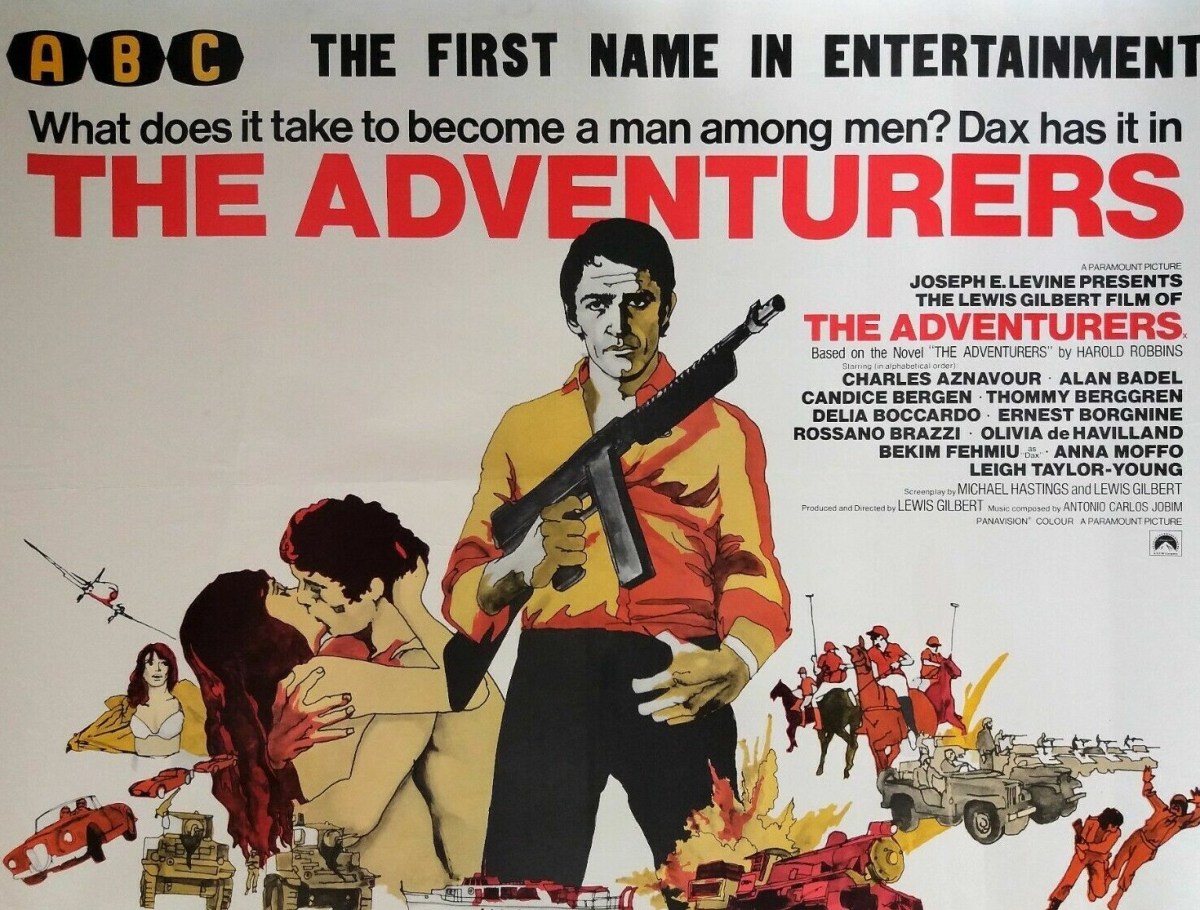
Class A Trash. Adaptation of Harold Robbins (Nevada Smith, 1966) bestseller goes straight to the top of the heap in the So-Bad- It’s-Good category. Only Alan Badel (Arabesque, 1966) as a double-dealing revolutionary comes out of this with any honors.
The likes of Candice Bergen (Soldier Blue, 1970), Rossano Brazzi (Rome Adventure/Lovers Must Learn, 1962), double Oscar-winner Olivia de Havilland (Hush, Hush, Sweet Charlotte, 1964), Leigh Taylor-Young (The Big Bounce, 1969) and Ernest Borgnine (The Wild Bunch, 1969) must have wondered how they were talked into this.
And director Lewis Gilbert (Loss of Innocence/The Greengage Summer, 1961) must have wondered how he talked himself into recruiting unknown Yugoslavian Bekim Fehmiu (The Deserter/The Devil’s Backbone, 1970), nobody’s idea of a suave lothario, for the lead.
One of the taglines was “Nothing has been left out” and that’s to the movie’s detriment because it’s overloaded with sex, violence, more sex, more violence, in among a narrative that races from South American revolution (in the fictional country of Corteguay) through the European jet set, fashion, polo, fast cars, orgies, and back again with revenge always high on the agenda. At close on three hours, it piles melodrama on top of melodrama with characters who infuriatingly fail to come to life.
Sensitivity is hardly going to be in order for Dax (Bekin Fehmiu) who, as a child after watching his family slaughtered and mother raped, makes his bones as a one-man firing squad, machine-gunning down the murderers. From there it’s a hop-skip-and-jump to life as the son of ambassador Jaime (Fernando Rey) in Rome where he belongs to an indulgent aristocracy who play polo, race cars along hairpin bends, swap girlfriends and, given the opportunity, make love at midnight beside the swimming pool.
His fortunes take a turn for the worse when his father backs the wrong horse, the rebel El Condor (Jorge Martinez de Hoyos) in Corteguay, and is killed by the dictator Rojo (Alan Badel). In between an affair with childhood sweetheart Amparo (Leigh Taylor Young), life as a gigolo and cynical marriage to millionairess Sue Ann (Candice Bergen), Dax takes up the rebel cause, initially foolish enough to fall for Rojo’s promises which results in the death of El Condor, and then to join the rebels.
But mostly it’s blood, sex, betrayal and revenge. Anyone Dax befriends is liable to face a death sentence. He only has to look at a woman and they are stripping off. It’s a heady mess. It might have worked if the audience could rustle up some sympathy for Dax, especially as he was entitled to feel vulnerable after his childhood experiences. But he just comes across as arrogant and the film-makers as even more arrogant in assuming that because women fall at his feet that must mean he had bucketloads of charm rather than that was what it said in the script. He’s fine as the thug but not convincing as a lover.
Excepting Badel, the best performances in a male-centric sexist movie come from women, those left in Dax’s wake, particularly Candice Bergen as the lovelorn wife and Olivia De Havilland as the wealthy older woman who funds his lifestyle, aware that at any moment he will leave her for a younger, richer, model. Lewis Gilbert is at his best when he lets female emotion take over, not necessarily wordy intense scenes, because Bergen and De Havilland can accomplish a great deal in a look.
The rest of it looks like someone has thrown millions at a B-picture and positioned every character so that they have nowhere else to go but the cliché.
By this point, Hollywood had played canny with Harold Robbins, toning down the writer’s worst excesses and employing name directors to turn dire material into solid entertainment. Edward Dmytryk (Mirage, 1965) had worked wonders with The Carpetbaggers (1964), whose inherent salaciousness was held in check by the censor and made believable by characters played by George Peppard (Pendulum, 1969), Alan Ladd (Shane, 1953) and Caroll Baker (Station Six Sahara, 1963). Bette Davis and Susan Hayward contrived to turn Where Love Has Gone (1964) into a decent drama. Even Stiletto (1969), in low-budget fashion, managed to toe the line between action and drama.
But here it feels as if all Harold Robbins hell has been let loose. Rather than reining in the writer, it’s as if exploitation was the only perspective. Blame Lewis Gilbert, director, and along with Michael Hastings (The Nightcomers, 1971) in his movie debut, also the screenwriter for the end result.
On the other hand, if you can leave your critical faculties at the door, you might well enjoy how utterly bad a glossy picture can be.
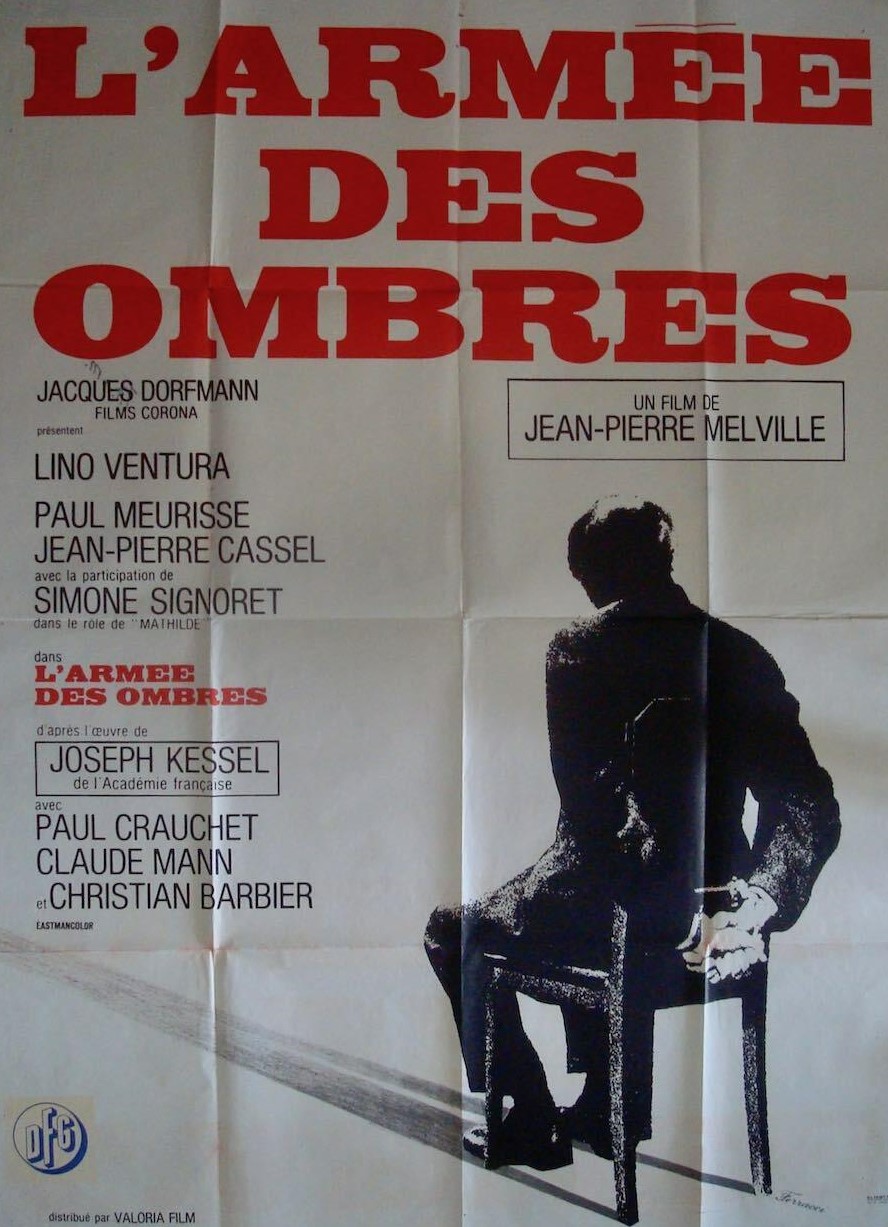
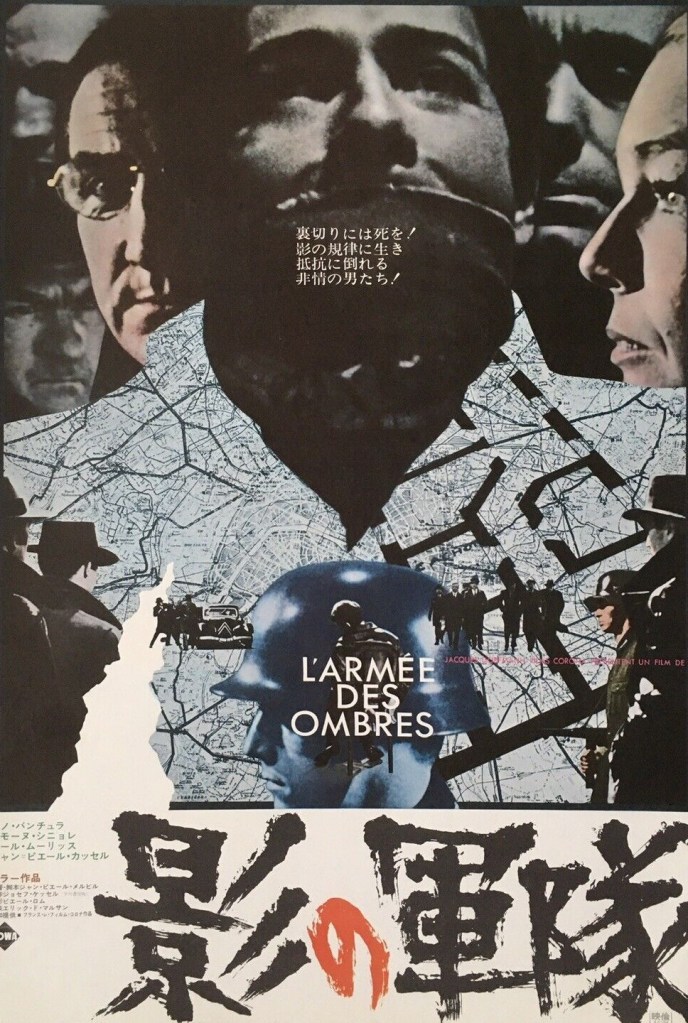
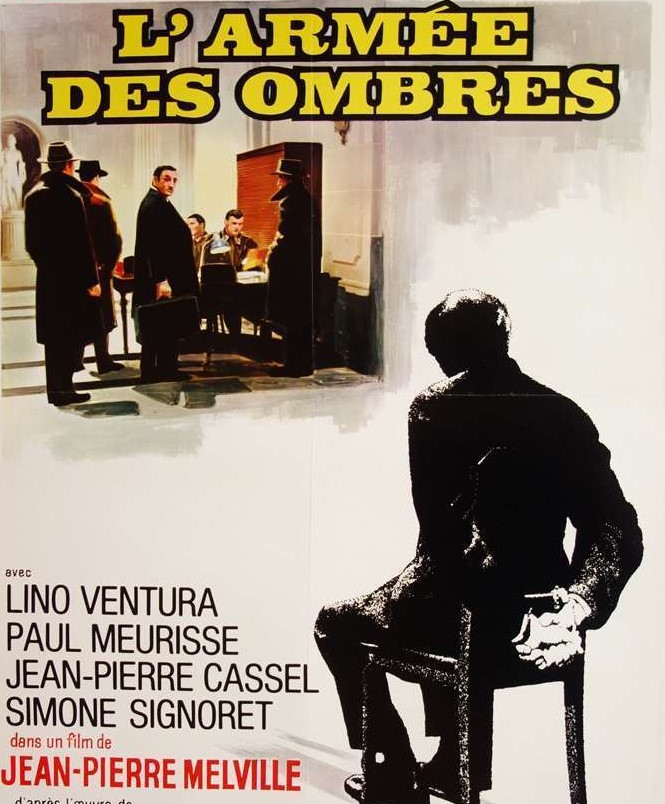
The antidote to the gung-ho World War Two picture. Scarcely any action and certainly none of the French Resistance swagger of The Train (1964) or the popular uprising of Is Paris Burning? (1965). Instead, sombre realism as Resistance leader Gerbier (Lino Ventura) dodges capture in a country pitted with collaborators. Nor is the underground portrayed in heroic fashion, their methods of revenge every bit as pitiless as the occupying forces.
Told in documentary style and based on the real-life exploits of characters taking the battle to the enemy, it’s backroom stuff, Gerbier organising his Resistance cell, meeting with other leaders. But his life is fraught with tension, as he attempts to dodge capture, with little success, it has to be said.
The film opens with Gerbier in captivity, an internment camp, where he is betrayed by an informer. While being transported to Paris, he escapes. His first action, revenge. With three colleagues, in an ordinary Marseille house where use of a gun will give them away, they strangle to death an informer. It’s not pretty.
Some join up for the risk like Jardie (Jean-Pierre Cassel), others maintain a more orderly, outwardly uninvolved, almost philosophic, lifestyle, like his older brother Luc (Paul Meurisse) who turns out to be the “Big Boss” of the Resistance, prominent enough to be transported by submarine to London to meet French leader-in-exile De Gaulle.
Little of what they organise works out. Betrayal a constant, not just from collaborators, but from a fellow member who could be compromised by having a vulnerable child or parent. When one of the Marseille stranglers, Felix (Paul Crauchet) is captured, and likely to crack under torture, Mathilde (Simone Signoret), Gerbier’s assistant, comes up with a daring plan involving Jardie giving himself up so he will be imprisoned with Felix and, at the pessimistic end of expectations, can provide him with a cyanide pill, while the most optimistic outcome is three members disguised as Germans infiltrating the jail and sneaking him away.
The plan fails and Gerbier is subsequently arrested, imprisoned, his execution only denied by a daring rescue attempt – the only kind of typical war picture action. But then Mathilde becomes a liability and is executed.
It’s a cold-blooded kind of film and depicts with far greater realism the endeavors – failure outweighing success of an underground operation during the Occupation. They don’t have the training for the job and their effectiveness is always open to question. Although British and American films might be filled with characters volunteering for dangerous missions, those are activities in isolation, not a commitment to a lifestyle that most likely would end in torture and death, endanger family and friends and leave you living in a sewer of suspicion. This presents an unvarnished truth. Not only are you expecting at any moment the Germans will pounce, there is a constant dread that the Resistance will be undone by their own actions, a plan too ambitious, someone cracking up, firing squad the most likely result. There’s nary a sniff of glory.
The big budget roadshow – The Longest Day (1962), Battle of the Bulge (1965), The Battle of Britain (1969) et al – while covering in some aspects the dangers of war were for the most part fist-pumping patriotic achievements, not this sneaking around, undercover stuff where missions were low-key, and the protagonists rarely in charge of their own destinies.
As far as French critics were concerned, the release timing was off, the film arriving in the wake of the 1968 riots and with De Gaulle in political trouble due to the Algerian situation. So it flopped with critics and audiences alike, and although it found a receptive audience in the U.K. in the late 1970s, it was denied release in the U.S. until 2006, by which point politics could not cloud opinion, and it earned rave reviews.
Lino Ventura (The Sicilian Clan, 1969) on top form is run close by Simone Signoret (The Deadly Affair, 1967). Jean-Pierre Cassell (Is Paris Burning?) comes closest to comic book heroics but even that is eventually reined in.
Everyone is helped by a screenplay by Joseph Kessel (The Night of the Generals, 1967), himself a member of the Resistance, that is light on melodrama and overwrought dialog and concentrates on getting done the job in hand, no matter how unsavory. Equally notable is the lack of grandstanding, of glorious finish, of the Hollywood convention of redemption.
Director Jean-Pierre Melville (Le Samourai, 1967) , also a Resistance fighter and with a hand in the screenplay, brings to bear film noir sensibilities and the cold-bloodedness that informed a previous oeuvre tending towards gangster pictures.
A very bold undertaking of the most dour kind that deserves appreciation.
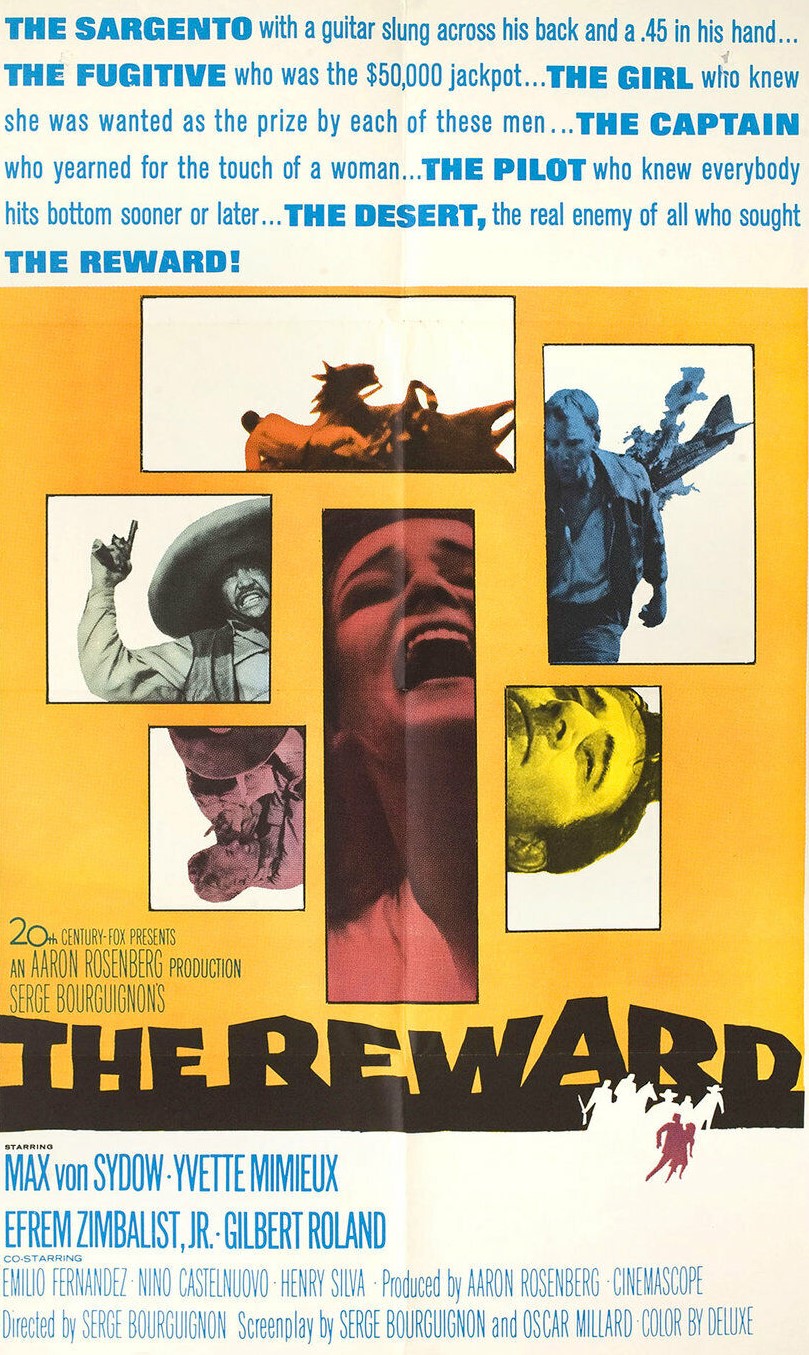
Max von Sydow’s Hollywood career might have gone in a different direction had this brooding modern western remake of The Treasure of the Sierra Madre (1948) taken off. Instead of a screen persona as a heavily-accented somewhat awkward foreigner, he would have been viewed as a lean adventurer in the laconic Steve McQueen mold.
There’s no actual gold here, American airline pilot Scott Swenson (Max von Sydow) and his impromptu gang chasing into the Mexican desert human prey worth $50,000. Frank Bryant (Efrem Zimbalist Jr) is wanted for kidnapping and killing his own child. His virtually monosyllabic girlfriend Sylvia (Yvette Mimieux) is viewed as a bonus, clearly rape in the mind of some of his pursuers.
In normal circumstances, Swenson would spend his time dusting crops but he is being held for inadvertently destroying a water tower that will cost $20,000 to repair. But when he spots old buddy Bryant drive into town, he turns bounty hunter, cutting local English-speaking sheriff Capt Carbajal (Gilbert Roland), an exile in this remote town, in on the deal to repay the debt. The rest of the posse, led by his guitar-playing deputy Sgt Lopez (Emilio Fernandez) are initially misled as regards reward. So,when they do find out, greed will out.
When the escapees run out of road, they take to horses, but are located pretty quickly by the posse, also on horseback. Finding them was easy compared to getting them back. In fact, the posse seems to return via a different route that takes them through an abandoned town complete with church bell that Lopez makes ring through the simple device of battering it with his head.
It’s that kind of movie, filled with odd scenes that reflect character. In one episode, at the start of the chase and in a truck, a flat tyre is caused by one dumb occupant chucking his beer bottle in front, rather than to the side, of the vehicle. Flute-playing Joaquin (Henry Silva) tames a wild horse which, when he’s not around, has a bit of a rebellious streak, apt to lead the other mounts astray.
But it’s realistic, too. There’s not enough food to go round and even that seems limited to tortilla. There’s no reason to tie up the prisoners because there’s no escape in the desert hell. But although Swenson has betrayed an old friend in order to get himself out of a hole, there’s none of the guilty dialog you might expect and Sylvia turns out to be more cynical, not intent on building romance out of a brief fling in Acapulco, and only too aware of what captivity might mean. As is pointed out, the reward will be paid out for a decapitated head as much as a complete living person.
Rather than being devastated at killing his son, Bryant wants sympathy. It was an accident. Blame the police for starting a shoot-out that ended with the child dying in the crossfire. Blame his wife for taking the child away in the first place.
Nobody comes out of this well, except Sylvia whose good deed might result in rape, but whose motives you would also question, given she is harboring a child killer, an action not excused as would be the norm by being rapturously in love with him. She is resigned to her fate rather than flirting with the gang as a way of avoiding it.
So it’s tension all the way, Lopez working on the principle that the fewer claimants of the reward the better. But it’s not just lack of water that’s the most dangerous element in this perilous landscape, but lack of horses. Water isn’t in dramatically short supply anyway not when you can count on the occasional thunderstorm, which, unfortunately, makes Sylvia a more attractive reward when she is soaked to the skin.
The body count, as you might expect, mounts as Lopez takes control, his boss, coming down with a fever, growing weaker by the day.
But it’s not as noir as you might imagine. Mostly, it’s just characters trudging through the desert, enlivened by some flute- and guitar-playing, heading into a doom of their own making. There’s very little in the way of heated dialog and there’s a very bold decision to dispense with subtitles – only the sheriff and Swenson are bilingual, helping them devise a conspiracy to keep the reward to themselves – but it’s easy enough to work out what’s going on with the Spanish-speaking Mexicans and it does explain why Sylvia says so little.
If you managed to get hold of The Picasso Summer (1969) – reviewed earlier in the Blog – this is for you since it has the same director Serge Bourguignon whose style is elliptical to say the least. But cutting down on expository consequence is spot-on. We don’t need characters bewailing their fate to know the potential outcome. Circumstance makes menace implicit rather than explicit.
The actors are good enough not to be laden down with overwrought dialog. This is certainly presents a refreshing aspect of Max von Sydow (The Quiller Memorandum, 1966). Yvette Mimieux (The Picasso Summer) is mostly a bewildered fragile beauty. Emilio Fernandez (The Wild Bunch, 1969) would be at his scene-stealing best except he has to contend with Henry Silva (Secret Invasion, 1964) in one of his few heroic parts. Veteran Gilbert Roland (Cheyenne Autumn, 1964), who made his name as The Cisco Kid, is the surprise turn, authority sapped as illness takes hold.
If you want a peek at a curiosity, it might as well be this one.
Despite being made at the opposite end of the decade to Loss of Innocence/The Greengage Summer (1961) this has a number of similarities, in the main the star-making turn, this time from Ali McGraw in her debut and, though playing a slightly older and much wealthier character, she is also a woman in transition, from puppy love to true love, not entirely in control of her emotions and not willing either to accept responsibility for her actions.
Richard Benjamin, in his first starring role, plays the sometimes gauche, much poorer, more responsible, object of her affections. He’s only connected by religious upbringing to The Graduate’s Dustin Hoffman, far more relaxed with women and comfortable in his own persona. The camera loved McGraw the way it did Susannah York, but in these more permissive times, and given the age difference, there was much more the screen could show of the star’s physical attributes.
I was surprised by the quality of McGraw’s performance, expecting much less from a debutante and ex-model (and studio boss Robert Evans’ fiancée) but she is a delight.
Supremely confident Brenda (Ali McGraw) enjoys a life of privilege and engages in witty repartee with the more down-to-earth Neil (Richard Benjamin) who doesn’t know what to do with his life except not get stuck with a money-making job. He would much rather help a young kid who likes art books.
It’s not a rich girl-poor man scenario but more a lifestyle contrast and both families are exceptionally well portrayed. Brenda’s father Ben (Jack Klugman) has sucked the life out of exasperation while her uptight mother (Nan Martin) has to cope with an oddball son (Michael Meyers) and a spoiled brat of a younger sister (Lorie Shelle). It’s somewhat reassuring that money doesn’t prevent family politics getting out of hand.
But in the main it’s a lyrical love story well told. The zoom shot had just been invented so there’s a bit over-use of that but otherwise it zips along. A major plot point provides a reminder of how quickly men took advantage of female emancipation, the invention of the Pill dumping responsibility for birth control into the woman’s lap, leaving the male free to indulge without the risk of consequence.
In other words, it was still a man’s world. Of course, without the Pill, it would be a different kind of story, romance tinged with fear as both characters worried about unwanted pregnancy and stereotypical humour as the man purchased – or fumbled with – a rubber. Acting-wise Ali McGraw is pretty game until the final scene when her inexperience lets her down. I’m not sure I went for the pay-off which paints McGraw in unsympathetic terms and lets Benjamin off rather lightly.
The romantic stakes were considerably lower than in McGraw’s sophomore outing, Love Story (1970) and for both characters it was not the defining moment of their lives, more a rite-of-passage.
Director Larry Peerce (The Incident, 1967) takes time to build a believable background and uses humor to defuse what could have become an overwrought melodrama. Arnold Schulman (The Night They Raided Minsky’s / The Night They Invented Striptease, 1968) was Oscar-nominated for his screenplay based on the Philip Roth bestseller.
No one ever knows why the camera takes to an individual and given this was long after Hollywood had stopped trying to invent stars it was a wonder that Ali McGraw was turned into an marquee attraction. But there was such a lightness to her screen persona it was a surprise she didn’t become a contender for screwball comedy.
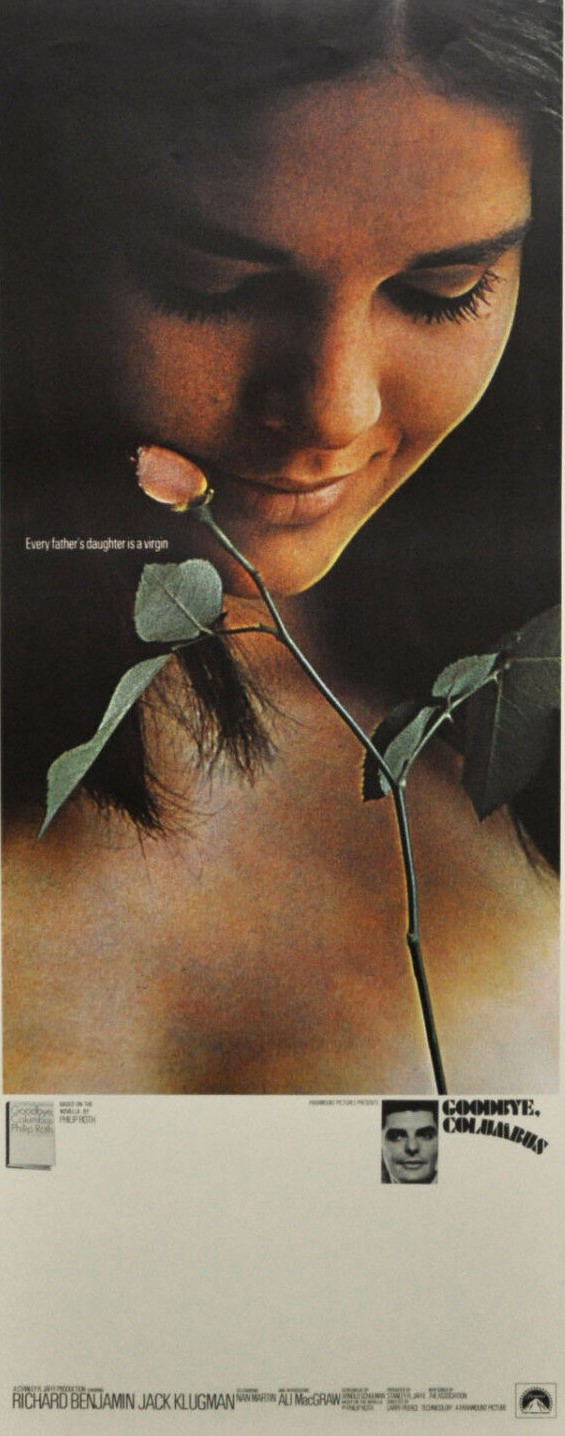
Richard Benajmin (Catch 22, 1970), also making his movie debut, does his best but can’t prevent his co-star stealing the show. It must have been galling for the young actor who must surely have believed he was the one being groomed for stardom after the success of television show He and She (1967-1968). He suffered the indignity of his face being reduced to a postage stamp – almost an afterthought – on a poster on which McGraw dominated. He might have taken top billing but in contractual terms that only permitted his name to come first and could not dictate how he was presented.
Vanity dies hard. It’s not the first time a top-ranked actor was convinced he could show Hollywood how it should be done. A raft of stars in the 1950s and 1960s – from John Wayne and Burt Lancaster to Gregory Peck and Frank Sinatra – had lost their shirts setting up production companies. The notion of the creative hyphenate only made sense as a tax dodge, being able to spread earnings from a big hit over decades rather than paying all your dues in one year. But you could do that anyway, by means of the initial contract, as William Holden had done with Bridge on the River Kwai (1957).
Otherwise, the vanity project was littered with box office and critical disasters. And it’s odd that it took so long for one of the best-known notions in literature – the idea of selling your soul to the Devil in return for earthly reward – to be realized on film. Especially as it had a line – “was this the face that launched a thousand ships?” – to rival “To be or not to be” as the most famous sentence in literature. The Tragical History of Doctor Faustus by Christopher Marlowe, a contemporary of Shakespeare, was published in 1604.
Rosemary’s Baby (1968) was a more diabolical and commercial spin on the same theme but it’s not as if the movies had ignored the idea – The Devil and Daniel Webster (1941), Bedazzled (1967) and later Ghost Rider (2007) and Hellblazer (2013) could lay claim to be inspired by the legend, never mind musician Robert Johnson who famously sold his soul to the devil (beware of crossroads).
Presumably, multiple Oscar nominee and theatrical giant Richard Burton believed nobody had done the original play justice. Films made from historical plays were quite the thing in the late 1960s – Romeo and Juliet (1968) might have in retrospect seemed a sure thing, but The Taming of the Shrew (1967), even with Burton and Taylor in tow, was a considerable risk.
Doctor Faustus, Burton’s follow-up to that bawdy Shakespearian romp, was certainly a low-budget affair, with little more than $1 million available, derived from various sources including the pockets of the star and producer Joseph E. Levine (The Carpetbaggers, 1964) , with Columbia on board as distributor to give it the Hollywood seal of approval.
But, critically, Burton also shouldered directorial duties along with academic Nevill Coghill who had no experience either in that arena. It looks good in an old-fashioned costumed-to-the-hilt fashion but all the actor does is speak the lines. Burdened at times with a wig or thick-framed black glasses he comes across more like smutty British comedian Benny Hill than a classical actor, that comparison not helped by the occasional emergence of naked women with conveniently very long hair to hide most of their nudity.
Beyond an occasional scene filmed through the eye of a skull, there’s no discernible style and since Burton is surrounded by amateur actors no detectable drama, except, theoretically, the battle for his soul. There are some woeful images, Faustus, victorious in battle, prancing around with swords sticking out of his body, and even an appearance of Elizabeth Taylor as Helen of Troy, at one point like a silver version of the gold-painted Shirley Eaton in Goldfinger (1964), offers mere diversion rather than dramatic focus.
So, unlike Ice Palace (1960), we’ve got the sonorous growling whisky-sodden voice but not even a whisper of true drama. A touch of melodrama here would certainly not have gone amiss. Just Faustus sauntering around speaking lines in the iambic pentameter of the period to make the tale even harder to understand.
Even sold under the Burton-Taylor brand, it made little headway with audiences, even those turning up at their local arthouse, which was its default destination. Proof, judging from the poster, that you can always find a laudatory critic when you need one.
Theoretically, it should have gained a lease of life in the So Bad It’s Good cult category but for that to occur you needed an audience to watch it the whole way through and that’s a pretty big ask.
Nudity was not an option for previous child stars attempting to make the leap into adult roles. Shirley Temple in the 1930s and Margaret O’Brien in the 1940s were kids when they played kids and when they outgrew their cuteness audiences proved indifferent.
Being older when playing younger characters increased the chances of career survival. Silent movie superstar Mary Pickford was 22 when she first tackled child heroine Tess of the Storm Country (1914) and 30 for the remake and she made an absolute fortune from these kinds of roles. Judy Garland was 17 when The Wizard of Oz (1939) appeared and managed another 15 years at the top before drugs and drink took their toll, still worthy of supporting roles after A Star Is Born (1954) and even star billing in her last film I Could Go On Singing (1963). But she was fired from Valley of the Dolls (1967), ironically enough given the film’s subject matter, due to alcohol and drug dependency.
Hayley Mills was 14 when her first Disney picture Pollyanna (1960) was released and for the next five years at that studio never played anyone approaching her true age. She was protected from studio abuse because this was Disney and because her father was actor John Mills, who often appeared in her movies. When the Disney contract ended, Sky, West and Crooked (1966), her father’s directorial debut, attempted to refashion her screen persona with a more challenging role.
But The Family Way forced audiences to set aside all preconceptions. Not only did she show her naked derriere, but this was a film essentially about sex. No sex is actually shown because newly-weds Jenny (Hayley Mills) and Arthur (Hywel Bennett) have problems consummating their marriage. You can thank the Carry On films for the snigger-snigger British mindset to sex. The promiscuous and often predatory characters of Darling (1965) and Alfie (1965) occupied a different world, almost a foreign country as far as the inhabitants of this solid working-class town were concerned.
They would have looked askance at such permissiveness. Here, at this particular point in history, both sexes were still expected to be virgins when they married. Sex in Darling and Alfie, for example, carries little emotional overtones. The Family Way is novel in treating sex as fundamental to happiness within marriage.
The subject of impotence would not be first on your list when you set out to make a warm-hearted drama. But here screenwriter Bill Naughton (Alfie) in adapting his play All in Good Time uses the theme to explore family values. But where recrimination – and subsequent confrontation – might be the first port of call for another writer, Naughton foregoes that obvious route to concentrate on the way impotence eats at a man’s self-worth. Two secrets drive the plot but the second is preserved right to the end, resulting in possibly the most moving finale you will ever watch.
In documenting working-class life it is superior to the earlier Saturday Night and Sunday Morning (1960). It is life without inbuilt bitterness. Families are still crammed into small houses, a visit to the housing department – to get a new council house or just be put on the waiting list – an invitation to humiliation, but there is full employment and enjoyment to be found in simple pleasures.
Family dynamics are expertly explored. Arthur, with a shelf load of books and penchant for classical music, is diametrically opposed to his down-to-earth but exceptionally obtuse father Ezra (John Mills), and there is a wonderful scene early on where Arthur seeing how badly his father takes defeat allows him to win an arm-wrestling competition.
Ezra is the standout, devoted to the memory of a long-departed childhood pal and struggling with his position as patriarch especially in the face of perennial sniping by wife Lucy (Marjorie Rhodes). Ezra is so expressive of longing and emotion, and it is he who has the heart-breaking final scene.
The older characters are fully rounded, bluff exteriors concealing fragile emotion. Hard-faced Lucy appears almost fey when she recalls a moment of love. Jenny’s burly father (John Comer) cannot cope with her departure from his household, especially as that leaves him at the mercy of his shrewish wife (stand-up comedienne Avril Angers).
Hywel Bennett begins a successful movie career with a difficult part, an introspective role calling for him to contain his emotions – not venting his spleen like the endlessly complaining Arthur Seaton of Saturday Night – until they erupt in a spectacular fist fight that does not go at all the way you would expect.
Barry Foster (Frenzy, 1972) has the showy part as the rough-edged workmate and Murray Head (later part of the love triangle in Sunday, Bloody Sunday, 1971) also makes his debut in an equally showy role as Bennett’s brother who makes advances to his frustrated sister-in-law.
Even without the nudity, Hayley Mills, the denoted star, makes the transition to movie adulthood with ease. In part, all she had to do was drop the unnatural excitement that appeared essential to her Disney portfolio. Her delivery, her reading of a line, had always been good and she had clearly worked out she was going to be an actress not a sex symbol so there was no exaggerated use of her physicality.
Even the nudity worked in her favor, startled to be disturbed emerging from a bath, genuinely shy, not the mock-shy or reveling in her naked state that was de rigeur in Hollywood. She was also helped by being a light foil to the brooding, gloomy Bennett, her natural bright personality, while affected by their problem, still capable of enjoying harmless pleasures.
This was a distinct change of pace for the fraternal producer-directing team John and Roy Boulting, stalwarts of British production since the 1940s with a host of well-regarded dramas and comedies, often with Peter Sellers, to their name. Generally, they took turns about in the director’s chair – the former putting his name to thriller Brighton Rock (1948) and comedies Lucky Jim (1957) and I’m Alright, Jack (1959), the latter claiming credit for drama Fame Is the Spur (1947), thriller Run for the Sun (1956) and comedy A French Mistress (1960). Occasionally, they shared the directing chore as with thriller Seven Days to Noon (1950), comedy Heavens Above (1963) and in this contemporary drama.
Their approach to The Family Way went against the grain of the gritty working-class dramas in the vein of Saturday Night and Sunday Morning and This Sporting Life (1962). Nobody here has a job they hate or comes home covered in grime. In fact, since the central thrust (pardon the pun) of the movie is about pleasure (sexual, that is), it is set against a background of enjoyment. Both principals have jobs in entertainment, Arthur an assistant projectionist in a cinema, Jenny working in a record store and also seen at a disco and a motocross event. Alcohol plays a role, of course, but not to the extent of over-indulgence, not drinking yourself to oblivion like Arthur Seaton, and its main purpose is to present the father as an amiable host.
What impact the burgeoning affair between Hayley Mills and Roy Boulting (33 years her senior) had on the production is anyone’s guess but possibly it helped steady the star’s nerves when it came to the nude scene. From today’s perspective the nudity appears gratuitous. And certainly back then it was shocking, ensuring an X-certificate (although the subject matter probably already guaranteed that).
Actually, it was social comment. While living in a decent-enough house, the family lacked one particular amenity – an indoor toilet. Washing took place at a communal sink or in the privacy of a bedroom with a bowl of water. A bath was a mobile unit, a zinc item dragged out of the scullery into the living room, filled with endless pots or kettles of hot water.
But for a young woman to take a bath demanded privacy. So when Jenny is interrupted in her ablutions, males and females in the audience had opposite reactions. It would not be unreasonable to suggest that males simply enjoyed the sight of the naked posterior. Women, on the other hand, would wince.
Aversion to nudity may have played a part but more likely women would feel deeply the humiliation at the lack of privacy in such a household, that someone could come upon you at your most vulnerable at any time. Sure, nothing went hidden in such houses, the sounds of any activity would carry through walls, but such a deep personal activity as exposure while taking a bath said far more about the brutal congestion of family life than jokes about hearing someone urinating into a container in the next room.
Paul McCartney contributed a very hummable melody as part of his debut movie score.
American audiences did not respond so well to Hayley Mills’ emergence as an adult actor and the movie failed to click at the box office there. But by that point it was already in profit, a runaway British hit (among the top twelve films of the year) and set the female star up for an adult career, pointed Hywel Bennett in the right direction and gave John Mills one of his most memorable turns.











 The Magnificent 60s