Come September (1961) ***

The quite superb concept that underpins the traditional unsettling of Rock Hudson is sabotaged by the inclusion of an unnecessary generation gap element and because one of the youngsters is singer Bobby Darin that throws a musical spanner into the works. The basic set-up is that Lisa (Gina Lollobrigida), the Italian lover of wealthy American Robert (Rock Hudson), is fed up with the part-time nature of their relationship. Although their affair dates back six years, it only lasts for the one month (September) he vacations each year in his luxurious villa on the Ligurian coast.

She’s so annoyed at his lack of commitment that she’s about to marry posh Englishman Spencer (Ronald Howard), that imminent event only put off by the unexpected earlier-than-usual arrival of Robert. Matters are further complicated because his enterprising Italian butler Maurice (Walter Slezak) hires out the villa to paying guests for the other eleven months. To explain the owner’s sudden arrival, Maurice persuades his guests to go along with the notion that Robert is a former owner fallen on hard times deluded into thinking he still possesses the property.

The guests are a gaggle of young women, including psychology major Sandy (Sandra Dee) who proceeds to analyze Robert, and they are herded around by formidable chaperone Margaret (Brenda de Banzie) who prevents Lisa sneaking into her lover’s bedroom.

So enough plot to be getting on with. You’d assume Spencer is going to turn up, maybe with his equally formidable sisters, to cause ructions at the villa. Lisa appears to enjoy making Robert wait the way he has kept her wait, so a gentle shift in power, and there’s going to be an inevitable bust-up so we expect a quick shift into the will-she-won’t-she scenario. Plus, there’s the whole issue of Robert claiming back his villa and dealing with the over-entrepreneurial Maurice.

Instead, the second act enters a whole new realm. Unless one of the girls was going to make a play for Robert, there’s not much reason for them to be there except for the nuisance value and to allow Margaret to flex her authority. An unwelcome quartet of young men, led by Tony (Bobby Darin), embark on the equally unwelcome task of wooing of the young ladies, Tony having his eyes on Sandy. Although various romantic entanglements are enacted, that’s not what takes center stage.

Instead, the bulk of the middle section scarcely involves the Robert-Lisa quandary and instead it’s devoted to an endless battle between Tony and Robert as the younger specimen attempts to prove he is mentally and physically superior. Now the one element that had made these Rock Hudson comedies work was his helplessness. He may occasionally be smart or wealthy but the whole point of these stories was for a woman to run rings around him or at the very least drag him way out of his comfort zone.

Seeing Robert best Tony – endlessly – takes the shine off the picture and it’s not until Robert is revealed as a sanctimonious hypocrite, living by a double standard, that the movie catches fire again as Lisa storms off in a huff and we can settle down to some good old-fashioned will-she-won’t-she.

This proves a very successful change of pace for Gina Lollobrigida, and she reveals herself to be such a splendid comedienne that it became part of her repertoire – reunited with Hudson for Strange Bedfellows (1965) and leading a pack of men a merry dance in Buona Sera Mrs Campbell (1968).

There’s nothing particularly wrong with Rock Hudson. He’s good comedy value, but the second act ruins it. Bobby Darin (Pressure Point, 1962) and Sandra Dee (A Man Could Get Killed, 1966) act as if they’re in a completely different movie, of the frothy beach variety. Walter Slezak (The Caper of the Golden Bulls, 1967) is an adept scene-stealer. Look out for Joel Grey (Cabaret, 1972) in an early role and Brenda de Banzie (I Thank a Fool, 1962).

Directed by Robert Mulligan (The Stalking Moon, 1969) with a screenplay by Oscar-winning Stanley Shapiro (Bedtime Story, 1964) and Maurice Richlin (All in a Night’s Work, 1961).

A hybrid that rocks the wrong boat.

Valdez Is Coming (1971) *****

Five-star review for a long-forgotten much-maligned western? Let me explain. Let me start with one of the most stunning cinematic images I have ever seen that in the hands of a better director would be considered one of the greatest ever devised. The titular Valdez (Burt Lancaster) appears on the top of a hill arms stretched out back contorted under the weight of a crucifix strapped to his back. Another director, more conscious of the image potential, would probably have had him straighten up at that point and positioned the camera for a close-up so the image could be captured against the sky. Even so, it’s an extraordinary image for a director, Edwin Sherin, making his debut.

But that’s not the only one. We’re familiar with the innocent man being forced to dance as the area around his feet is peppered with bullets from a sadistic gunslinger. Here, the victim of gunman Davis (Richard Jordan) is an old Native American woman. As she walks from a hut to collect water, he assails her with a barrage of shots. Does she dance? Does she dickey! She doesn’t even pause. As though she’s used to worse.

The movie opens with another stunning image. Valdez, a local Arizona Territory constable (presumably a less important title than sheriff though he wears the badge), takes time out from riding shotgun to watch a bunch of young bucks blast away at a target. Which appears to be the hut I mentioned. Takes a while for an explanation to be forthcoming. Said hut houses a fugitive from justice.

There’s another startling image when Valdez is used as target practice by the thugs employed by local bigwig Tanner (Jon Cypher). As if he was the equivalent to the target girl in a knife-throwing act, every space around his body is hit by a bullet.

And that’s before we come to the audacious freeze frame ending which, theoretically at least, leaves matters unresolved.

There’s also a post-modern post-whatever feel to this which should very much appeal to the contemporary audience. Very little is explained. Valdez has anglicized his Christian name of Roberto to Bob. He can’t get rid of his Mexican accent but he talks so softly that mostly you don’t notice. From his later demeanor, it’s quite clear that earlier on he is making a huge effort to fit in, not stand out, in a town dominated by white Americans.

But we also never find out why Tanner is hunting a man. He’s responsible for putting the man in the hut under siege. And although that turns out to be  case of mistaken identity, we never find out who Tanner is chasing or why.

Tanner’s  live-in girlfriend Gay (Susan Clark), a widow, has murdered her husband and we never find out why either. But she’s not the only unusual character. The gunslinger Davies is a misfit, finding out the hard way that intemperance and impulsiveness are not the way to make friends, and even Tanner has little time for a gunslinger too handy with a gun, but despite the callous exterior he has a softer side. And while that softer side turns out to be lucky at one point for Valdez, the lawman still doesn’t trust the capricious youngster.

The tale, such as it is, is one of principle. Valdez has been tricked into killing the man in the hut. Given the man proved innocent, Valdez thinks it right his widow, the Native American victim of the target practice, should receive some compensation. A hundred dollars seems a small price to pay. But Tanner is insulted at the very thought. In his eyes, the dead man was a no-account African American.

When Valdez insists, he is trussed up in the makeshift crucifix and left to make a humiliating walk home. That’s when he reverts, shuffles off his disguise as a soft-spoken relatively harmless lawman in a town where the most he will be called upon to do is ride occasional shotgun and jail an occasional drunk.

It’s vague too – you’d have to be well up on western lore to know the significance of the photograph he keeps under his bed – regarding his past. But hidden under the bed is what was known as a buffalo gun, a long-range rifle, manufactured by Sharps (hence the term “sharpshooter”) and suddenly he’s a different, more threatening, person, kitted out in his old cavalry uniform, hat brim upturned.

He interrupts Tanner and Gay making love to demand his hundred dollars. He only takes  Gay hostage to make his escape, minus the cash, and then kidnaps her to provide him with something to trade. Unlike in The Hunting Party (1971), the weapon doesn’t magically ease his path. He doesn’t just take pot-shots from a distance. He spends most of the time rushing up and down hills, using boulders as cover. He can’t afford to use the gun since that would pinpoint his position. So he’s got to knock out Tanner’s advance scouts in other ways.   

Meanwhile, Gay, who initially sympathized with Valdez, is less keen on him once she’s a victim, and spends most of her time trying to escape. In due course, Valdez’s marksmanship reduces the pursuing force by eleven.

He just about escapes but in a spectacular piece of stunt work involving horses colliding and people being thrown from the saddle, he is surrounded. Chief thug El Segundo (Barton Heyman) realizes that he and Valdez have something in common. Valdez wasn’t a buffalo hunter at all, but a stalker of Apaches, the enemy of El Segundo.

So El Segundo pulls back his men leaving Tanner to face up to Valdez alone. Or perhaps pay up the hundred dollars. We never find out because the image is frozen on the screen as the camera pulls back.

Edwin Scherin was rewarded for his boldness by only being allowed to make one more movie (My Old Man’s Place, 1971). This was the first of Burt Lancaster’s western trilogy that encompassed Michael Winner’s Lawman (1971) and Robert Aldrich’s Ulzana’s Raid (1972), completing his move into more of the flawed character he first essayed in The Swimmer (1969). Susan Clark (Coogan’s Bluff, 1968) makes the most of a role that permits her to switch from sympathetic to hard-nosed. Richard Jordan (Chato’s Land, 1972) has a peach of a part as the swithering gunman desperate for attention. Screenplay by Roland Kibbee (The Appaloosa, 1966) and David Rayfiel (Castle Keep, 1969) based on the novel by Elmore Leonard (Mr Majestyk, 1974).

So, sure, justified vengeance but exceptionally well done.

Catch this on Amazon Prime.

Well worth checking it out.

The Waltz King (1963) ***

The Twist, the Macarena, Twerking, none of these routines can hold a candle to the Waltz, which has dominated the dance world for centuries. You think maybe Queen invented the idea of audience participating in a tune by dancing and clapping in “We Will Rock You”, well, that had been an integral element of waltzes with a faster rhythm equally for centuries.

The movie had an unusual trigger. Walt Disney, taking time out from overseeing theme parks and enjoying a period of dominance in Hollywood, had spent some time in Vienna which resulted in this film and the same year’s Miracle of the White Stallions about the World War Two escapades of the Spanish Riding School in Vienna.

As you know I am a conscientious researcher in the matter of Senta Berger Studies and came to this via that connection, but I have always enjoyed movies about creativity whether it is struggling writers, struggling painters, struggling sculptors and struggling composers – you notice the prefix “struggling” is an essential component of such films.

And this will chime also with a contemporary obsession – the nepo baby. There already was a Waltz King in Vienna – Johan Strauss’s (Kerwin Matthews) father (Brian Aherne) also called Johan. He didn’t want this son following in his footsteps not so much because he feared the competition but because he disdained his own work, being at the beck and call of greedy concert promoters and music publishers, being assailed by hundreds of female fans behaving in much the same way as female fans during the rock/pop era, though instead of throwing underwear onto the stage they were apt to bombard the composer with bouquets of flowers each delivered with a note expressing ardent passion.

Father Johan Strauss (known to classical music fans as Johan Strauss I) insists son Johan Strauss ( Johan Strauss II in the classical music business) enter a proper profession, one where position in society was not dependent on the whims of the public. So the young lad was forced to become a lawyer, moonlighting as a violinist with other orchestras hoping his father would not find out. When old man Strauss did find out he was apt to take strenuous action and destroy the young man’s violin.

The elder Strauss was so powerful in his field that music publishers did not dare take on any of the works of his son. So it was lucky that in order to persuade a music publisher to listen to his composition he sits down at a piano in the shop and begins to play at the same time as opera singer Henriette Treffz (Senta Berger) is present. She likes the music and takes a shine to Johan and coughs up so he can employ his own orchestra.

The old man is so angry at being usurped that he conspires to wreck the son’s debut concert by employing a small army of people to hiss, boo and catcall and disrupt the event. Luckily, that plan fails and audiences applaud and the son is on his way. Paternal enmity continues but that matters less as Johan Strauss II becomes a brand name, although he’s subjected to the by-product of fan mania when jealous husbands threaten him with a duel.

But just as The Who and other bands aspired to something more than popular music, so Johan wanted to move beyond the simplicity (in musical terms) of the waltz and up the classical music hierarchy by putting his mind to creating operettas and more sophisticated tunes. That battle involved finding his own voice and once again overcoming opposition.

This being a Disney confection it skirts over politics. Father and son were on opposite sides during the failed Austrian Revolution of 1848 – Strauss Snr composing one of his most famous pieces, the Radetsky March, as a result, the son out of royal favor for a long time. Nor is there time to regale audiences with how Strauss Jr changed his religion to get out of a tricky second marriage.

But like most biopics about classic composers including such Oscar-acclaimed fare as Amadeus (1984) this is a jukebox piece and if nothing else takes your fancy you can sit back and listen to the Johnan Strauss II’s greatest hits which include “The Blue Danube Waltz,” Die Fledermaus and Tales from the Vienna Woods.

Kerwin Matthews (Maniac, 1963) is solid enough in role that in a Disney picture requires less than the likes of Amadeus. And anyway he makes the mistake of signing on for a picture with Senta Berger (Kali-Yug, 1963) who is at her dazzling best. Brian Aherne (Lancelot and Guinevere, 1962) almost twirls his moustache as villain of the piece.

Director Steve Previn (Escapade in Florence, 1962) does a decent enough job with the music an eternal get-out-of-jail-free card. Written by Fritz Eckhardt (Rendezvous in Vienna, 1959) and  Maurice Trombagel.(Monkeys, Go Home!, 1967).

Lightweight, for sure, but entertaining and informative enough.

Enter Inspector Duval (1961) ***

The first piece of sleight-of-hand is the title, setting audiences up for the opener in a crime series featuring the eponymous French character. A terrific twist at the climax shows exactly why this would not be turned into a series, though one critic who clearly didn’t watch the whole picture thought otherwise. And you can see why because it’s old-fashioned enough to provide you, Agatha Christie style, with a string of suspects, adding in and leaving out enough information that it’s hard to work out who the criminal mastermind might be.

For four years, a burglar has been terrorizing Europe, stealing diamonds almost at will. The expert on his methods is French cop Duval (Anton Diffring), a debonair confident chap with a distinct Gallic charm, who happens to be in London when the thief – known only as Mr March – strikes again. Only this time, taken by surprise, he murders socialite Alice (Angela McCann). British detectives Insp Wilson (Mark Singleton) and Sgt Hastings (Patrick Bedford) are only too happy to welcome Duval’s assistance, especially as he appears to have the keener eye.

In short order we are introduced to Alice’s maid Doreen (Susan Halliman) who discovers the body. She’s recently entered into a relationship with the disreputable Charley (Charles Roberts) and may have deliberately or inadvertently given away the secret of where Alice hid her diamonds – and it wasn’t in the safe. Alice’s friend Jackie (Diane Hart) enters the equation because her boyfriend Mark (Aiden Grennell) has been trying to tempt Alice into investing in a property deal. And may have been sufficiently annoyed with the brusque way she gave him the brush-off to have killed her. Mark has an alibi for the time of the murder, which took place in the middle of the night. But it’s an odd one. He claims he chose that time of night to pay a visit to his lawyer to discuss a business deal. And his manservant Brossier (Charles Mitchell) is an odd fish.

Jackie is revealed as grasping and only too happy to do Mark’s bidding, which includes some unusual instructions. Doreen is too trusting and somewhat dim. Charley is definitely dodgy and has been paid to provide information extracted from Doreen as to the jewels’ whereabouts.

There’s another complication. Because of the murder, the diamonds are now too hot to handle and can’t be quickly shifted by a dealer in stolen goods.

You can wallow in the nostalgia, pipe-smoking cop, nothing wireless about the telephones, a couple of scenes set in a milk bar with youngsters dancing to a record. There’s even a car chase.

The initial sequence is stylish, with a strong hint in the play of light and shadow of film noir, and though it tends to stick to police procedural there are enough twists and characters with hidden agendas to keep the plot wheels turning, with Duval turning his nose up at the ineptitude of the British copper.

With his haughty features and blond hair Anton Diffring (Counterpoint, 1967) had been typecast as the arrogant Nazi or German officer – so this was something of a career break and I guess if a series had developed he might have found a different niche. This proved to be Diane Hart’s (The Crowning Touch, 1959) only movie of the decade, and Angela McCann’s sole picture.

With an abundance of red herrings and twists, director Max Varnel (A Question of Suspense, 1961) keeps the action moving at a clip. Written by J. Henry Piperno (Breath of Life, 1963).

Worth it for the suave Anton Diffring and the twists.

Catch it on British streamer Talking Pictures TV.

Hot Spur (1968) *

Blame the algorithm. Once I had to my great surprise found The Hunting Party (1971) on Amazon Prime the streamer decided that my next port of call should be another rape-filled western. There are only two things to recommend this – firstly, it makes The Hunting Party look like a masterpiece, and secondly it was filmed at the Spahn Ranch made famous by Quentin Tarantino’s Once Upon a Time in Hollywood (2019) and as the place where the Charles Manson gang hung out before going on a murder spree.

One element of this picture will chime with the contemporary audience. Here, rape is used as a weapon, an unfortunate development in the last half century during a variety of vicious wars.  As ever, woman is the innocent victim while man has convinced himself this is not only necessary but justified.

There’s maybe another echo if you want to be generous – of the sequence in Once Upon a Time in the West (1969) where Harmonica (Charles Bronson) is forced to witness the death of his older brother. Here Mexican stable hand  Carlo (James Arena) witnesses the multiple rape and beating of his older sister who subsequently commits suicide. So he’s on a mission to track down the perpetrators.

Which leads him to the O’Hara ranch, where he is treated with racist and physical abuse. Ranch owner Jason (Joseph Mascolo) handles wife Susan (Virginia Gordon) badly, blaming her for not providing him with a son and heir. Their love-making is on the rough side and she seeks comfort among the cowhands, who prefer keeping their jobs to a roll in the hay with the boss’s wife.

Carlo kidnaps her. And at first you think she’s going to be used as bait to attract Jason, the last of the rapists of his sister, to a remote mountain shack. But, in fact, Carlo plans to eliminate pretty much the entire complement of ranch hands, hiding weapons at various ambush points on the trail and planting a bear trap in the ground.   

But he’s got worse in mind. And apologetic though he is towards Susan, his plan is to make her suffer like his sister, which means tying her up, raping her and striping her back with a whip. The only good bit, if you can call it that, in this picture is that at the end Susan knifes to death her husband and escapes.

There’s one other bit that initially looks good and then tumbles into incomprehension. Jason has sent an advance scout up the mountain and told him to fire one shot if his wife is up there and two if she’s not. The cowboy doesn’t get the chance, Carlo killing him with two shots. So, registering this, Jason believes they’re on the wrong trail but then for no apparent reason continues up the same route.

From the amount of sexuality and nudity on show I guess, given the times when Hollywood was still only nibbling away at the edges of what was permissible, this was made for an entirely different audience than the standard fan of westerns. All women are present just to be used and abused.

Directed by one Lee Frost, whom imdb rates as “one of the most talented and versatile filmmakers in the annals of exploitation cinema.” Cowritten with producer Bob Cresse.

As it happens, those Amazon Prime algorithms did send me to a whole horde of westerns, some of which like Hombre (1967) and Support Your Local Sheriff  (1969), I’ve already reviewed here. I’ll plunder this stack some more but take a more judicious view of what I watch.

Ugharama.

The Hunting Party (1971) **

Colossal flop and deservedly so. One of the most repellant pictures of a down’n’dirty decade.

It’s not just that rape takes center stage – two completed both supposedly by men in love with her and two attempts by more obvious scum – but that cattle baron’s wife Melissa (Candice Bergen) has to choose between murdering rapist husband Brandt (Gene Hackman) and murdering rapist outlaw Frank (Oliver Reed).

There was an unwelcome trend for consensualizing rape – Straw Dogs (1971) took the  same approach – that a woman in a state of some terror would nevertheless warm to her molester. This is the worst kind of male fantasy fulfilment and that taking a women by force will nonetheless make her fall in love with you.  

Just how keen Melissa is on her rapist is shown by her various attempts to knife him and escape. Which, of course, Frank dismisses in a version of that old trope, “you’re beautiful when you’re angry” in that he likes a spirited woman.

The otherwise cold-blooded Lee Marvin character in Prime Cut (1972) proved likeable because he had an honor code and didn’t take advantage of a vulnerable woman. It’s impossible to feel any sympathy for Frank especially as Melissa, a teacher, has been kidnapped not for ransom but for the sole purpose of teaching Frank to read. Presumably, being an outlaw who robs banks, he can already count. Maybe he needs help writing ransom notes.

Frank should have been taught to read in childhood, we discover in a twist at the end, because his father could read, which suggests he had a different upbringing to the rest of his gang, but, on account of being determined to annoy his old man, he refused to learn. So although he has a yearning to educate himself he’s not educated enough to work out that learning and kidnapping and rape don’t exactly go hand-in-hand.

The only way any attempt at romance is going to work, even theoretically, is if what awaits Melissa when rescued is worse. Husband Brandt is a venal individual. The movie opens with him raping his wife. Compared to his treatment of sex workers, she gets off lightly. And he balks at paying any supposed ransom on the grounds that his wife will most likely have been raped and return with an unwanted bastard son and he’s not going to pay $50,000 for that privilege. Ever since A Fistful of Dollars western heroes have been every amoral shade of grey but Brandt must be the darkest shade ever.

Plus he’s just taken delivery of rifles with telescopic sights that have a firing range of about half a mile so he’s up for a little sport, and with four other rich buddies sets out to hunt humans. The rifle is the equivalent to the Gatling Gun in The Wild Bunch (1969), a weapon of awesome power, and every time it hits home the camera focuses on the gory outcome. The 26 men in the outlaw bunch are soon whittled down.

This might have worked if the narrative had followed a different arc. Had Frank turned out to be Melissa’s protector rather than the most successful of her molesters. If the whole gang had show signs of seeking something maternal rather than just sexual in a woman or were all queuing up for a bit of education. And Frank’s treatment of her from the outset had been protective and she had shared with him her fear of her husband.

The best you can say about Frank is he’s a gentler kind of rapist. But he’s still a rapist and taking advantage when Melissa is at her most terrified, soaking wet from falling into a river while trying to escape. If he had continued just trying to soothe her and comfort her that might have taken the tale in a more acceptable direction, but, no, he decides a bit of rape is in order.

Frank’s too dumb to see that his men are going to turn against him if he doesn’t share out his captive and once he’s aware exactly who she is he should at least, in the eyes of the men, either demand a ransom or hand her back.

Although the long-range rifles tilt the odds heavily in favor of the pursuers, one of them is killed, and two, once they have decimated the outlaws, decide the hunt has gone far enough. Another, later on, takes the same view. But Brandt, determined on revenge, pursues the “lovebirds” into the desert where he kills both.

This was intended to launch British actor Oliver Reed (Hannibal Brooks, 1969) into the Hollywood mainstream but he’s miscast. Candice Bergen (Soldier Blue, 1970) can do little with a role that makes no coherent sense – unlike Michele Carey in The Animals (1971) she shows no sign of accepting an unwelcome protector just to survive. Had it not been for The French Connection (1971) and, taken in conjunction with Prime Cut (1972), Gene Hackman’s career might have spun off into playing a succession of villains.

One other notable turns up on the credits. This is produced by Lou Morheim who originally owned the remake rights to Seven Samurai (1954) and failed to finesse that into a significant credit on The Magnificent Seven (1960).

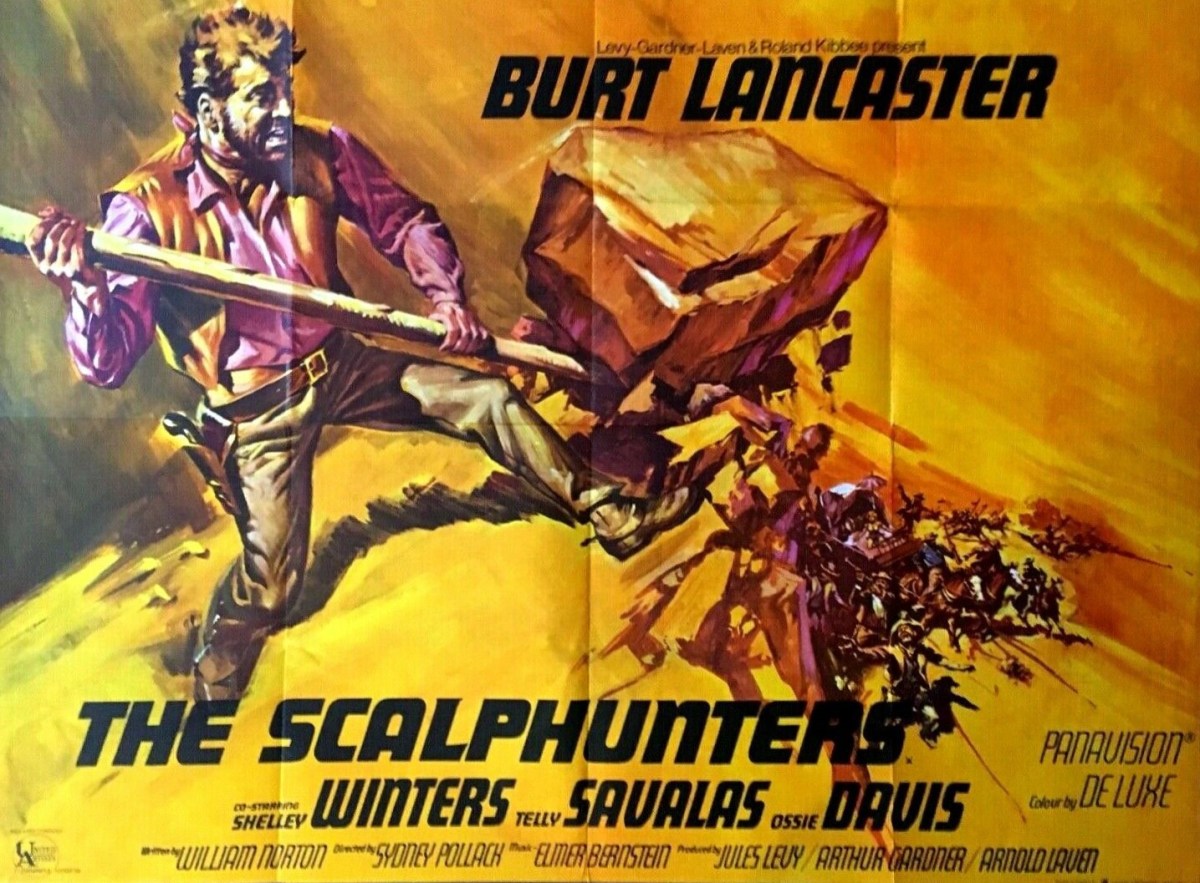
Discounting To Trap a Spy (1964), a movie combining two episodes of The Man from U.N.C.L.E series, this marked the debut of director Don Medford. Lou Morheim (The Beast from 20,000 Fathoms, 1953), Gilbert Ralston (Willard, 1971) and Bill Norton (The Scalphunters, 1968). contributed to the screenplay.

The bizarre premise set a low bar. Every shade of ugh.

The Valley of Gwangi ****

The special effects are in the five-star range while the movie into which they fit is really worth no more than three stars so I’ve compromised, hence the four-star rating. Actually, the story and characters are interesting enough, and there are some stunning cowboy stunts,  though where is a fur-lined bikini when you need one. Although we are treated to prehistoric monsters, humans fail to have managed the transition to the hidden valley where the creatures have kept out of sight for millions of years. Instead, we are in turn-of-the-twentieth-century Mexico.

However, one specimen, a miniature horse, known as El Diablo, has been found and now resides in a rodeo, property of T. J. Breckenridge (Gila Golan) whose showstopping turn involves leaping on horseback from a high platform through a ring of fire into a pool of water.  Ex-flame and sleek salesman Tuck (James Franciscus) and archaeologist Professor Bromley (Laurence Naismith) follow gypsies who aim to return the horse to the Forbidden Valley. T.J. and a band of cowboys are in pursuit.

Widening a tiny gap into the unknown world also of course means it’s not big enough for the monsters to escape. The valley is ruled by Gwangi, an Allosaurus, which to most of the audience looks remarkably like a T. Rex. Various battles ensure. A Pteranadon swoops down from the sky and captures one of the cowboys but is killed by Carlos (Gustavo Rojo). Gwangi fights an Ornithomimus and a Styracosaurus. Even if your knowledge of prehistoric monsters  isn’t up to identifying each creature, no matter, the fights are very well done, and a step up in terms of special effects from similar tussles in Harryhausen’s previous venture in One Million Years B.C. (1966) especially as we are less distracted by females attired in fur bikinis.

Naturally, the intent is to capture Gwangi and put him on show a la King Kong (1933) and it’s equally obvious how this particular maneuver is going to work out. That the story follows this particular angle is down to the fact that this movie was the original idea of Willis O’Brien, the special effects genius to created King Kong. After considerable development, RKO shelved the project on the assumption the public was not interested in dinosaurs.

Meanwhile, back in the human tale, the previously principled T.J. lets greed get the better of her and begins resisting Tuck’s overtures. Even if you can guess the finale, it is pretty well done.

Ray Harryhausen only had a limited fanbase in the 1960s, otherwise this picture would not have done the rounds as the supporting feature to Robert Mitchum western The Good Guys and the Bad Guys (1969). You can tell it lacked the budget of One Million Years B.C. because the creatures fail to remain a consistent color. Even so, this ranks as one of the top special effects achievements and these days Harryhausen’s work is much more appreciated.

Unless you are Raquel Welch, it’s difficult for an actor to compete with prehistoric monsters. At least here, the stars had decent dialog and the tangled romance provides entertainment as do the host of stunning stunts in the rodeo and a bull running amok. Charlton Heston look-alike James Franciscus (Youngblood Hawke, 1964) is a plausible love interest who doesn’t let romance get in the way of a fast buck. The role of Gila Golan (Our Man Flint, 1966) extends to more than eye candy and there’s not a bikini in sight or disrobing of any sort. Richard Carlson (Creature from the Black Lagoon, 1954) was a sci-fi veteran and Laurence Naismith had appeared in Jason and the Argonauts (1963). British actress Freda Jackson (The Third Secret, 1964) plays a witch.

Director Jim O’Connolly (Vendetta for the Saint, 1969) keeps the human elements rolling along and once monsters join in the fun there’s scarcely time to draw breath. William Bast (Hammerhead, 1968) pulled together the human and monster elements for the screenplay.

Harryhausen fans will have a ball.

The Hellbenders (1967) ****

An absolute hoot – and I suspect deliberately so. Forget the spaghetti western tag, this is a black comedy – and wild at that. And while its most obvious antecedent is Treasure of the Sierra Madre (1948) it really belongs in a different sub-genre of the heist-gone-wrong.

After the end of the Civil War, Godfearing Confederate Col Jonas (Joseph Cotten), who had led a regiment called The Hellbenders, plans to re-start the conflict with a million bucks in money stolen from the victorious Union Army.

Along with three sons and two varmints he successfully ambushes the money convoy, slaughtering the escort. The varmints are shot, too. But to get through enemy territory, they need an excuse, so Jonas has co-opted alcoholic girlfriend Kitty (Maria Martin) to play the role of a widow transporting her husband’s coffin, wherein is secreted the stolen loot, to his homelands.

The ploy seems to work fine and dandy when stopped by a Union patrol. Kitty produces the necessary permit and they move on. But Kitty’s got ideas above her station and when Jonas reminds her that she’s not much more than trash, she takes revenge by taking charge of the hearse and racing ahead of the others. Naturally, the wagon hits a rock and crashes.  Intemperate son Jeff (Gino Pernice) knives Kitty to death.

That’s the start of a bunch of quandaries. So Ben (Julian Mateos) is despatched to find a replacement. He returns with professional gambler Claire (Norma Bengell) whom he rescued from a dispute he started. Although being paid $2,000 Claire is not enamored of the job but she quickly earns her keep when they are stopped by a posse of lawmen who are not taken in by the permit and begin to open the coffin until she faints on top of it.

Her reward is to be raped by Jeff. She makes the mistake of going to wash half-naked in a pool and Jeff takes this as an open invitation. She’s saved from the actual act by Ben, who has taken a shine to her. To save on the travelling time and the risk of encountering other trouble, Jonas decides they’ll take a short cut. That takes them through a town where, lo and behold, the preacher is acquainted with the good Capt Allen, though luckily not his wife, and out of the goodness of his heart decides to hold a funeral service. Their fear is someone might turn up who can identify the widow. Someone does. But he’s now blind.

The short cut takes them into the path of marauding Mexicans. But before the outlaws can be overrun by a superior force, they are saved by another unit of Union cavalry which originates from the post Capt Allen used to command. And when a Union officer suggests it would be more in keeping for the captain to be buried there, to Jonas’s fury the widow agrees.

That means that later, on a rainy night, the sons have to dig up the coffin. Jonas’s new route takes them through Native American territory, but they appear harmless except that Jeff catches the eye of a young squaw.

They reach a river and encounter an impoverished panhandler. He’s trickier than anyone could expect. Having slaughtered their horses, he holds them up. Jeff manages to kill him but in the shoot-out Jonas is wounded – for a second time.

Before anyone can catch their breath, Native Americans appear, accusing Jeff – who has been sent to buy replacement horses from them – of rape and murder. The other brother, Nat (Angel Aranda), who is keener on enjoying the money than wasting it on a lost cause, turns on Jeff and in the crossfire those two brothers are killed and Ben wounded. But the Indians appear satisfied with the rudimentary justice.

Jonas crawls off lugging the coffin but only gets as far as a ridge before the coffin tumbles downwards and breaks open. Inside ain’t a million bucks but the corpse of the Mexican bandit leader. They stole the wrong coffin, the last of the absurdities to pile up.

Jonas now crawls in the opposite direction, to the river, at whose edges he dies while the flag of The Hellbenders gently floats away.

While not sticking to the formula of the heist-gone-wrong which would involve the thieves falling out, it’s a pretty good variation on it. Women are their downfall, the first widow furious at being spurned, the second widow angry at being used, at having, as part of the masquerade, to dress up in a dead woman’s clothes, and at being considered easy meat for a passing rapist. Though it’s the rapist who ultimately triggers the bullet-ridden climax, it’s Claire, we realize, who’s done the damage, ensuring the money is buried in that most ironic of locations, an enemy cemetery.

While Nat and Jeff are only a sliver away from cliché, driven by lust and greed, respectively, Jonas is a different kettle of fish, not just a man of principle, and praying for the bodies of people he’s about to kill, but exhibiting an odd tenderness for his sons – he’s first to tend the wounds he causes them. Ben is an outlier in the family, for reasons never explained feels a stranger, while Claire, a card cheat and saloon girl, realizes the lunacy of the situation she has found herself in and finesses a way out of it.

What trips the gang up is generally so mundane it wouldn’t find a place in a traditional crime picture, but here, as devilish unforeseen obstacles mount, it becomes clear that I wasn’t laughing at an inept picture but one that set out to tell a different kind of story.

Joseph Cotten (The Last Sunset, 1961) takes advantage of a rare leading role and throws out different shades of character. Julian Mateos (Return of the Seven, 1966) and Brazilian Norma Bengell (Planet of the Vampires, 1965) are otherwise the pick.

Sergio Carbucci (Django, 1966) directs from a screenplay by Ugo Liberatore (The 300 Spartans, 1962) and Jose Gutierrez Maesso (Rebus/Appointment in Beirut, 1968). On the downside, the color is inconsistent. On the upside, there’s an Ennio Morricone score.

Time for re-evaluation.  

Sanctuary (1960) ***

This overheated melodrama stands as a classic example of Hollywood’s offensive attitudes to women. Nobel prize-winning author William Faulkner could hardly blame the movies for sensationalizing his misogynistic source material since if anything the movie took a softer line.  Told primarily in flashback as headstrong southern belle Temple Drake (Lee Remick) attempts to mitigate the death sentence passed on her maid Nancy (Odetta). Given that such appeals are directed at Drake’s Governor father (Howard St John), and that the maid has been condemned for murdering Drake’s infant child, that’s a whole lot of story to swallow.

Worse is to follow. Drake takes up with Prohibition bootlegger Candy Man (Yves Montand) after being raped by him and thereafter appears happy to live with him in a New Orleans brothel – the “sanctuary,” no irony intended, of the title – despite him slapping her around. The film steers clear of turning her into the prostitute of the original book, but pretty much sets up the notion that high class women will fall for a low-class tough guy whose virility is demonstrated by his brutality. In other words a “real man” rather than the dilettantes she has previously rejected.

After the Candy Man dies, Drake returns home and marries wealthy suitor Gowan Stevens (Bradford Dillman) who blames himself, rightly, for Drake falling into the clutches of the gangster in the first place. But a past threatening to engulf her precipitates the infanticide.

Faulkner was a Hollywood insider, adapting Sanctuary for The Story of Temple Drake (1933) and earning high praise for  his work on Bogart vehicles To Have and Have Not (1944) and The Big Sleep (1946). The success of The Tarnished Angels (1957) starring Rock Hudson, The Long, Hot Summer (1958) with Paul Newman and The Sound and the Fury (1959) headlined by Yul Brynner had sent his cachet rocketing. But all three were directed by Americans – Douglas Sirk and Martin Ritt – who had a distinctive visual style and an ear for what made melodrama work.

Sanctuary had been handed to British director Tony Richardson (Look Back in Anger, 1959) and he didn’t quite understand how to make the best of the difficult project. So while Lee Remick manages to suggest both strength and fragility, and makes her character’s wanton despair believable, Yves Montand is miscast and Bradford Dillman fails to convince even though portraying a weak character. Too many of the smaller roles appear as cliches. And it’s hard to believe the maid’s motivation in turning murderer.

What was acceptable steamy melodrama in the 1930s fails to click three decades on. Faulkner’s thesis that high-falutin’ women want a man to master them and furthermore will fall in love with their rapist seems to lack any understanding of the female mind and will not appeal to the modern sensibility than it did on release. Lee Remick is what holds the picture together, in part because she plays so well the role of a woman embracing degradation, and refusing – no matter how insane the idea appears – to let go of the man she believes is the love of her life. It’s not Fifty Shades of Grey, but it’s not that far off that kind of fantasy figure, and given the success of that book, it’s entirely possible there is a market for what Faulkner has to peddle.

Bring Her Back (2025) ****

Reincarnation gets a bad rep. You could say the same for belief in angels. And of all the weird things to repurpose is the word “grapefruit.”

It used to be easy to define entries to the horror genre as old school (legacy creatures like vampires and werewolves and legacy situations like the old dark house and its modern equivalent). But now in addition we’ve had decades of torture porn, sexuality equating to grisly murder, and more recently high concept and arthouse. The latter two occasionally intertwine, which generally means slow-burn rather than shock jump.

Given Hollywood’s dependency on superheroes and their ever-increasing budgets, no surprise enterprising directors have been turning to the low-budget attractions of horror, where reduced cost equates to limited financial exposure, and creatives are given their head often to devastating effect – witness The Black Phone (2021), Smile (2022) and M3gan (2022).

But we’ve also been introduced to a new generation of sadistic villains, some who wreak havoc through the best of intentions, others, such as Heretic (2024) charmingly demented.

There’s been nobody quite as psychotic as award-winning counsellor Laura (Sally Hawkins) who’s in the kidnapping and fostering business for nefarious purpose. There’s no point trying to work out what’s going on in her head, though we are provided with enough tantalizing clues, because the only person it makes any sense to is Laura.

The title, unfortunately, gives too much away and you can guess from the outset that Laura is in the revival game. Her daughter has drowned and she seeks a replacement. Into her lap fall orphan brother-and-sister Andy (Billy Barratt) and Piper (Sora Wong) struggling to get over the gruesome death of their father.

While ostensibly bonding with the pair through a night of partying, in reality she’s setting up Andy for humiliation (she pours her own urine on him while he sleeps so she can accuse him of wetting the bed), disorientation (playing upon his fears) and ultimately turning his sister against him (Piper believes her brother whacked her in the eye while asleep) and if none of that works then just plain doing away with him. Piper is only partially sighted so her idea of what’s going on is restricted.

But while Andy wrestles with all this and visitations from his dead father, in the background is mute kid Oliver (Jonah Wren Philips) and with his every appearance he steals the show, and that’s despite a convincing performance by double Oscar-nominee Sally Hawkings (The Shape of Water, 2017).

Shaven-headed, mute and locked in his room he resembles an angelic lost boy. But he’s starving and is apt at a moment’s notice to start chomping through wood or his own arm. He’s been fed some demonic nonsense and will not cross over the white painted circle surrounding the remote house. And when he can’t escape he turns turtle and has convulsions.

I’m not sure what rules surround kids in horror films and Jonah is way too young to be able to see the result but standing and crawling around drenched in blood with open scars and teeth missing I’m wondering just how he would be able to go to sleep at night (though, I guess he’s aware it’s prosthetic blood and obviously make-up completing the illusion). So the most demonic child since The Exorcist (1973) and it’s his image that will stick in your mind long after you’ve escaped the cinema.

There are plenty neat touches, the best being that Piper escapes a drowning by calling out “mom”, the title Laura has wanted to hear ever since her daughter passed away.

But slow-burn and certain arthouse aspects might put off the general horror fan.

Sally Hawkins and Jonah duke it out for most memorable turn and if you were going purely on the acting Sally would win, but movies are as much about the image as the word and on that score the boy wins hands down.

The Philippou twins, Danny and   Michael, (Talk to Me, 2022) direct with the former responsible for the screenplay along with Bill Hinzman, his regular collaborator.

Discover WordPress

A daily selection of the best content published on WordPress, collected for you by humans who love to read.

The Atavist Magazine

by Brian Hannan

WordPress.com News

The latest news on WordPress.com and the WordPress community.