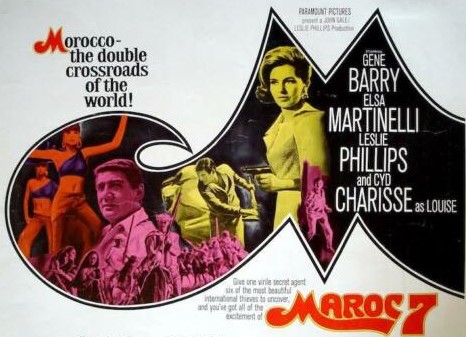
Maroc 7 (1967) ***

With a string of Swinging Sixties fashion models providing the requisite bevy of beauties, a gang of thieves, a Moroccan heist, superb locations, great cast and a touch of archaeology with secret chambers and a long-lost relic thrown, this splendid espionage frolic proves a welcome return to big screen top billing for Gene Barry after nearly a decade in television in Bat Masterson (1958-1961) and Burke’s Law (1963-1966).

Something of a cat burglar himself, Simon Grant (Barry) infiltrates a gang which uses fashion as a cover and whose ingenious specialty is to steal famous heirlooms and replace them with fake ones in the assumption that on their departure from a foreign country the customs officers will not be able to tell the difference. Louise Henderson (Cyd Charisse) and Raymond Lowe (Leslie Phillips) head up the gang while Claudia (Else Martinelli) may or may not be in on the act.

Her dalliance with Simon suggests an inclination towards the right side of the law justice but the fact that she has been involved with the pair for so long sets up the intriguing notion that she is stringing the American agent along. Initially, she rejects Simon’s advances until told by Louise to comply and pump him for information leading to one of the movie’s best lines (and innuendo that a British audience in particular would adore). Says Simon: “We haven’t done much about pumping but maybe that will come later.”  Doubts also surround the intentions of Michelle Craig (Alexandra Stewart).  On their trail is Inspector Barrada (Denholm Elliott).

There is mystery aplenty and a fair quotient of punch-ups, romance, shoot-outs and murder while the unearthing of the hidden treasure is more less heist than Indiana Jones. The fashion is the icing on the cake. The Moroccan fashion shoots are more than merely decorative, an excuse to bare the charms of the gorgeous models. Instead, the shoots would not disgrace Vogue or any of the other glossy magazine temples to haute couture, with that Sixties focus on fabulous clothes, genuine location and outlandish hairstyles.

On top of that, several of the stars are either playing against type or out of their comfort zones. Legendary Hollywood dancer Cyd Charisse famed for such classic musicals as The Bandwagon (1953) and Silk Stockings (1957) sets such fluff aside to essay a criminal mastermind, whose cunning often gets the better of Simon. Leslie Phillips (Crooks Anonymous, 1962), better known as a charming Englishman with an eye for the ladies, is as ruthless a photographer as he is a criminal. Director Gerry O’Hara (The Pleasure Girls, 1965) – from a script by David D. Osborn (Some Girls Do, 1969) has managed to get both Phillips and Denholm Elliott to drop their standard methods of delivery, usually embracing a drawl, making their characterizations a good bit fresher than normal. Phillips was clearly intending to make some kind of career change since he was the producer.
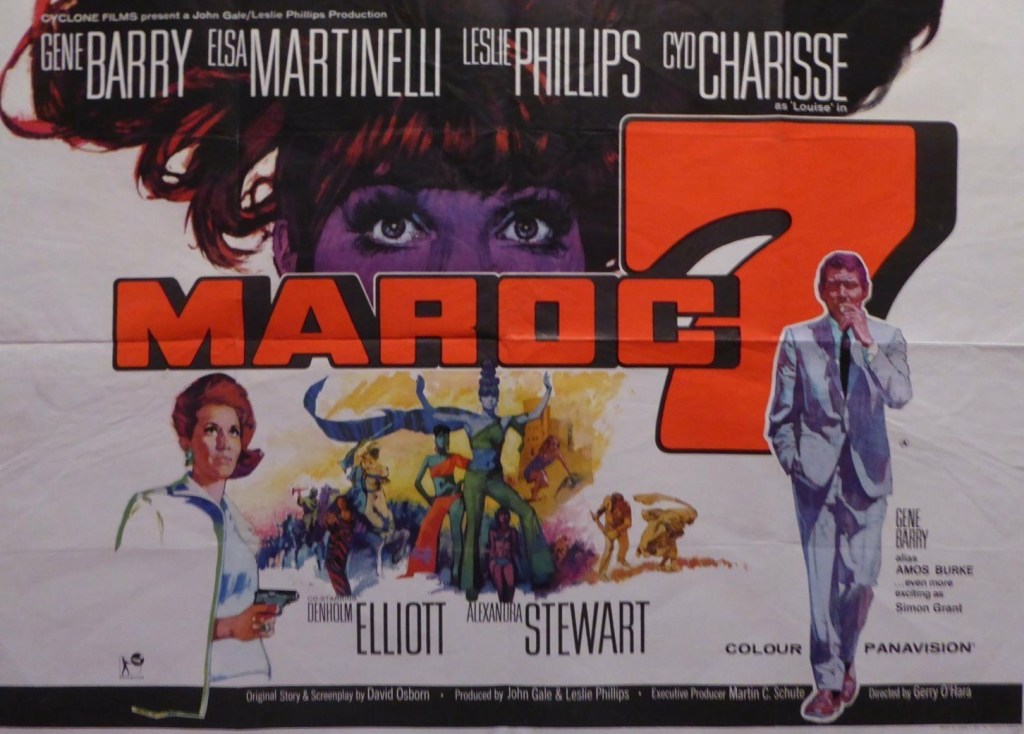
Gene Barry makes a perfect entrance as an adventurer-spy, as confident in his seduction techniques without women falling at his feet like James Bond, with a nice line in self-deprecation and more than able to look after himself. Before being side-tracked by television, Barry had shown movie star potential in Thunder Road (1958) and Hong Kong Potential, and now he delivers on that earlier promise. Elsa Martinelli (Hatari!, 1962) is the femme fatale who may or may not wish to play that role, keeping the audience completely on edge as to which side of the law she is likely to come down. Added bonuses are Alexandra Stewart (Only When I Larf, 1968), Angela Douglas (Carry On Screaming!, 1966), Tracy Reed (Hammerhead, 1968), dancer Lionel Blair (A Hard Day’s Night, 1964) and Maggie London.

Good fun with plenty diversion.

Triple Bill Blues: Fall (2022) ***; The Forgiven (2021) **; Three Thousand Years of Longing (2022) ** – Seen at the Cinema

You may be aware that I am partial to a triple bill on my weekly Monday trip to the cinema. I’m rather an indiscriminate cinemagoer and generally just see what’s available, though it’s true return trips to view Top Gun: Maverick have helped paper over cracks in the current distribution malaise. Sometimes a triple bill can reveal unsung gems, sometimes I am rowing against the critical tide in my opinions and sometimes, not too often thank goodness, I end up seeing movies with few redeeming qualities. That was the circumstance this week.

FALL

So now I know. If I need to get a mobile phone dropped 2,000 feet without it breaking into pieces, the thing to do is stuff it inside a cadaver. That’s one of the more outlandish suggestions in this climbing picture two-hander that for most of the time is quite gripping.

So as not to have to spend the first anniversary of her husband’s death sozzled in booze and despair, Becky (Grace Caroline Currey) agrees to partner YouTube click-hound Hunter (Virginia Gardner) in scaling an extremely high disused radio mast. Becky, a mountaineer, had watched her husband fall to his death, so is pretty iffy about the expedition. When they reach the top they can’t get down again since the ladder they climbed has disintegrated. Although there was mobile phone reception at ground level, there’s none this high up. Hunter has 60,000 followers and reckons if only her phone reached the ground it would automatically activate so they toss it down in a shoe stuffed with a bra.

That doesn’t work nor does firing a flare pistol to alert two guys in a nearby RV – all they are alerted to is the girl’s vehicle which they promptly steal. The girls are trapped without water or drone, both stuck 50ft below on radio dishes. At one point you think this is going to go in an entirely different – murderous – direction after Becky discovers Hunter had an affair with her husband. But they manage to get over that hiccup. Recuing their water and drone results in Hunter being out of action as far as further climbing goes and it’s up to Becky to reach the top of the mast and recharge the drone from the power there, fending off a passing vulture.

There’s definitely one weird bit where it turns out that Hunter, who you imagined was up there all the time supporting a defeatist Becky, is already dead. But, luckily, the corpse provides the cavity in which to bury the mobile phone. I’m not sure much of a human body survives a drop of 2,000 ft, certainly not enough to safeguard a phone, but that’s the way this plays out.

A great mountaineering film is always a welcome find in my book. This isn’t great but it’s certainly passable. And while Becky is more interesting than the gung-ho Hunter, the pair, emotions almost spinning out of control, make a very watchable pair.

Grace Caroline Curry aka Grace Fulton (Shazam!, 2019) does well in her first starring role and Virginia Gardner (Monster Party, 2018) is as convincing. Jeffrey Dean Morgan (Rampage, 2018) has a small role. A novel take on the mountaineering sub-genre, it’s kudos to director Scott Mann (Heist, 2015) – who co-wrote the screenplay with Jonathan Frank (Final Score, 2018)  that I spent a lot of time wondering just how the hell they managed to make it look so realistic.

THE FORGIVEN

Note to studios, no matter how much you plan to tart up a modern version of Appointment in Samarra – aka a tale of unavoidable fate – you ain’t going to get anywhere if it’s filled with entitled obnoxious characters. The worst of it is this is well-made.

Functioning alcoholic doctor David Henninger (Ralph Fiennes) knocks down and kills young Muslim boy Driss (Omar Ghazaoui) while on the way with wife Jo (Jessica Chastain) to a hedonistic weekend party in Morocco hosted by Richard Galloway (Matt Smith) and his partner Dally (Caleb Landry Jones). There are hints that Driss was planning to hijack the tourists, but while his death is deemed an accident by the local cops, David agrees to go back with the boy’s father Ismael (Abdellah Taheri) and observe the local funeral rites and possibly pay the father off.

While her husband is away Jo has a one-night stand with serial seducer Tom (Christopher Abbott) while the rest of the party – including Lord Swanthorne (Alex Jennings) and assorted beautiful men and woman – trade bon mots and make racist and sexist remarks. While the arrogant David changes his perspective and accepts his fate, there is not, himself included, a single likeable person in the whole of the tourist contingent which makes it impossible to care what happens to anybody. Written and directed by John Michael McDonagh (Calvary, 2014) it spends all its time trying to make clever points, not realizing the audience has long lost interest.

THREE THOUSAND YEARS OF LONGING

Note to studios, if you’re going to indulge an action director in a vanity project, make sure he hires actors who don’t just drone on. It might also help if the director could decide what story he wants to tell, and not essentially present a voice-over narrative of stuff that happened in the past, no matter how exotic the timescale.

I was astonished to discover there actually is a job called narratologist. Alithea (Tilda Swinton) is a dried-up old stick of a narratologist who summons up the dullest genie/djinn in movie history known – no names, no pack drill – just as The Djinn  (Idris Elba) who proceeds to bore the audience to death with his stories of how he came to end up in a bottle.  

There’s a bundle of academic nonsense about storytelling, a swathe of tales that sound like rejects from The Arabian Nights, and a lot of unconnected characters. The invention of director George Miller (Mad Max: Fury Road, 2015) just isn’t inventive enough and the visuals just aren’t arresting enough. I’m assuming this got greenlit on the basis Miller would turn in a couple more in the Mad Max franchise.

Maroc 7 (1967) ***

With a string of Swinging Sixties fashion models providing the requisite bevy of beauties, a gang of thieves, a Moroccan heist, superb locations, great cast and a touch of archaeology with secret chambers and a long-lost relic thrown in, this splendid espionage frolic proves a welcome return to big screen top billing for Gene Barry after nearly a decade in television in Bat Masterson (1958-1961) and  Burke’s Law (1963-1966).

Something of a cat burglar himself, Simon Grant (Barry) infiltrates a gang which uses fashion as a cover and whose ingenious speciality is to steal famous heirlooms and replace them with fake ones in the assumption that on their departure from a foreign country the customs officers will not be able to tell the difference. Louise Henderson (Cyd Charisse) and Raymond Lowe (Leslie Phillips) head up the gang while Claudia (Else Martinelli) may or may not be in on the act.

Her dalliance with Simon suggests an inclination towards the right side of the law but the fact that she has been involved with the pair for so long sets up the intriguing notion that she is stringing the American agent along. Initially, she rejects Simon’s advances until told by Louise to comply and pump him for information leading to one of the movie’s best lines (and innuendo that a British audience in particular would adore). Says Simon: “We haven’t done much about pumping but maybe that will come later.”  Doubts also surround the intentions of Michelle Craig (Alexandra Stewart).  On their trail is Inspector Barrada (Denholm Elliott).

There is mystery aplenty and a fair quotient of punch-ups, romance, shoot-outs and murder while the unearthing of the hidden treasure is less heist amd more straightforward Indiana Jones. The fashion is the icing on the cake. The Moroccan fashion shoots are more than merely decorative, or an excuse to bare the charms of the gorgeous models. Instead, the shoots would not disgrace Vogue or any of the other glossy magazine temples to haute couture, with that Sixties focus on fabulous clothes, genuine location and outlandish hairstyles.

On top of that, several of the stars are either playing against type or out of their comfort zones. Legendary Hollywood dancer Cyd Charisse famed for such classic musicals as The Bandwagon (1953) and Silk Stockings (1957) sets such fluff aside to essay a criminal mastermind, whose cunning often gets the better of Simon. Leslie Phillips (Crooks Anonymous, 1962), better known as a charming Englishman with an eye for the ladies, is as ruthless a photographer as he is a criminal. Director Gerry O’Hara (The Pleasure Girls, 1965) has managed to get both Phillips and Denholm Elliott to drop their standard methods of delivery, usually embracing a drawl, making their characterisations a good bit more fresh than normal. Phillips was clearly intending to make some kind of career change since he was the producer.

Gene Barry makes a perfect entrance as an adventurer-spy, as confident in his seduction techniques without women falling at his feet like James Bond, with a nice line in self-deprecation and more than able to look after himself. Before being side-tracked by television, Barry had shown movie star potential in War of the Worlds (1953) and Thunder Road (1958) and now he delivers on that earlier promise. Elsa Martinelli (Hatari!, 1962) is the femme fatale who may or may not wish to play that role, keeping the audience completely on edge as to which side of the law she is likely to come down on. Added bonuses are Alexandra Stewart (Only When I Larf, 1968), Angela Douglas (Carry On Screaming!, 1966), Tracy Reed (Hammerhead, 1968), dancer Lionel Blair (A Hard Day’s Night, 1964) and Maggie London.

Discover WordPress

A daily selection of the best content published on WordPress, collected for you by humans who love to read.

The Atavist Magazine

by Brian Hannan

WordPress.com News

The latest news on WordPress.com and the WordPress community.