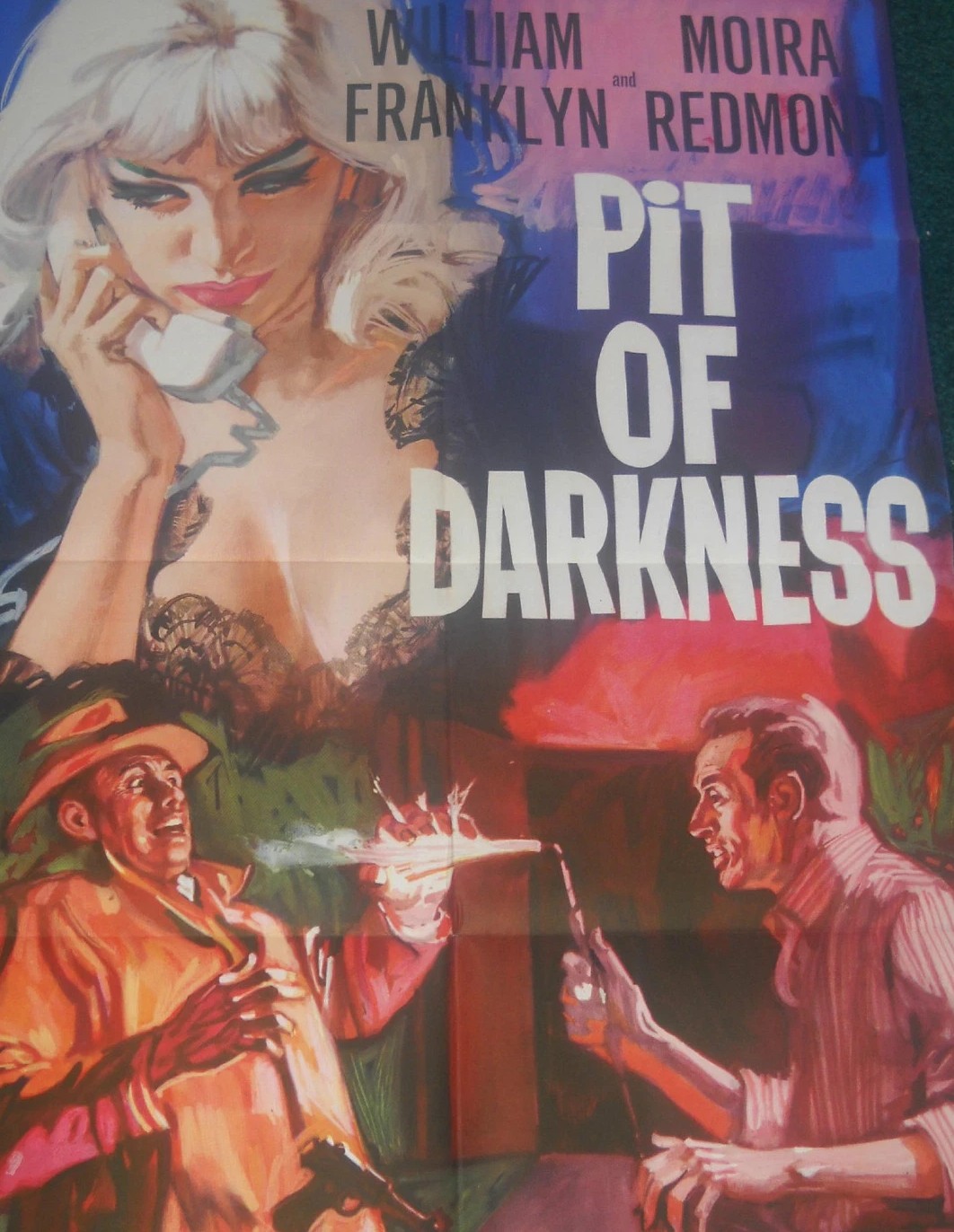
Pit of Darkness (1961) ****

Occasionally I get to wondering when one of these British crime B-pictures is exceptionally well-plotted, refreshing and above all logical, whether it might have benefitted from grander treatment Hollywood-style. You could easily see Cary Grant or Gregory Peck wriggling around in this one and with a Grant or Peck involved they’d be accompanied by a glamor puss of the Sophia Loren, Deborah Kerr vintage. And that would put the whole movie in an entirely different light and ensure it wasn’t lost for decades, as was the fate of this one.

What struck me most about the opening section here, an attitude maintained for about half the picture, was that the actress wife Julie (Moira Redmond) of amnesiac Richard (William Franklyn) didn’t believe for a minute his story that he couldn’t remember where he’d been for the last three weeks. There wasn’t an ounce of sympathy. That struck me as an entirely believable reaction. Rather than going all soppy at his return, she reckoned he’d run off with another woman and only came back because the affair had gone sour.  

And it doesn’t help his case that he was found unconscious on a piece of London waste ground where four days before the private detective she had hired to find him was discovered murdered. Then there are the suspicious phone calls, leaving him to deny the existence of anyone called Mavis.

But just when we start to believe him, suddenly we don’t. He seems to be too familiar with the Mavis who calls him and agrees to meet her at a remote cottage. And then we’re back on his side, as he just avoids being blown up in the cottage. But he leaves his hat behind.

And he doesn’t own up to Mavis about being nearly killed and gives a spurious reason for buying a new hat and not keeping the old one. So we’re on her side, something is going on for sure. And then back on his, when someone tries to sideline him in a hit-and-run accident.
In turn, he’s suspicious of everyone, including his wife, and his colleagues at work, especially Ted (Anthony Booth) who seems an unlikely candidate to have won the heart of his delectable secretary Mary (Nanette Newman).

He works for a firm that makes safes and whatever’s going on appears to be linked to a burglary that occurred in his absence involving one of the safes the company made. Eventually, Julie comes round to his way of thinking. Clues lead him to a nightclub, whose mysterious owner Conrad (Leonard Sachs) somehow seems familiar. He encounters Mavis, a dance hostess, and she agrees to help him but when he goes round to her apartment finds a corpse. There’s something distinctly odd going on in the building across the street from his office. On further investigation, he uncovers an assassin. Luckily, our man is armed with the office pistol and the villain is chucked from the roof.

But, still, nothing makes much sense, even though bit by bit memory is returning. He realizes he shouldn’t have been found unconscious on the waste ground, but dead, murder only interrupted by the sudden arrival of a gang of boys.

But in retracing his steps in order to unlock the lost memories he finds himself undergoing a perilous process a second time. He works out that he was kidnapped and locked in a cellar in the club. When he confronts Conrad, that instigates a repeat.

Conrad locked him away and when bribery and the seductive wiles of Mavis didn’t work, Conrad convinced Richard that his wife was in danger if he didn’t go along with the burglary. And Conrad isn’t one to let a good opportunity go to waste, so second time around, using the same threat that worked the last time, he forces Richard to commit another burglary. But this time there’s a catch and one that Richard’s secretary hasn’t known about to pass on to Ted.

So the bad guys are caught, and in the way of the obligatory happy ending the audience is left to assume that the police will ignore his part in the robbery and the death of the man on the roof.

Not just exceptionally well-plotted, but the addition of the marital strife, the suspicious wife, adds not just to the tension but makes it all the more believable and turns the amnesia trope on its head.

Having wished for a Cary Grant or a Gregory Peck, I have to confess I was more than satisfied with William Franklyn (The Big Day, 1960) who managed to look innocent and guilty at the same time. Certainly Deborah Kerr would have managed more in the acerbic look department than Moira Redmond (The Limbo Line, 1968) but I have no complaints.

Interesting support cast at the start of their careers, so Anthony Booth (Corruption, 1968) displays just a hint of his later trademark sarcastic snarl and there’s no chance for Nigel Green (The Ipcress File, 1965)  to put his steely stare into action or effect his drawl. Nanette Newman (Deadfall, 1968) has little to do except look fetching. Leonard Sachs was taking time off from presenting TV variety show The Good Old Days (1953-1983).

More kudos for the script than the direction this time for Lance Comfort (Blind Corner, 1964).

Given it’s from the Renown stable. I would normally have expected to come upon this picture on Talking Pictures TV, so I was surprised to find it as one of the latest additions to Amazon Prime.

First class.
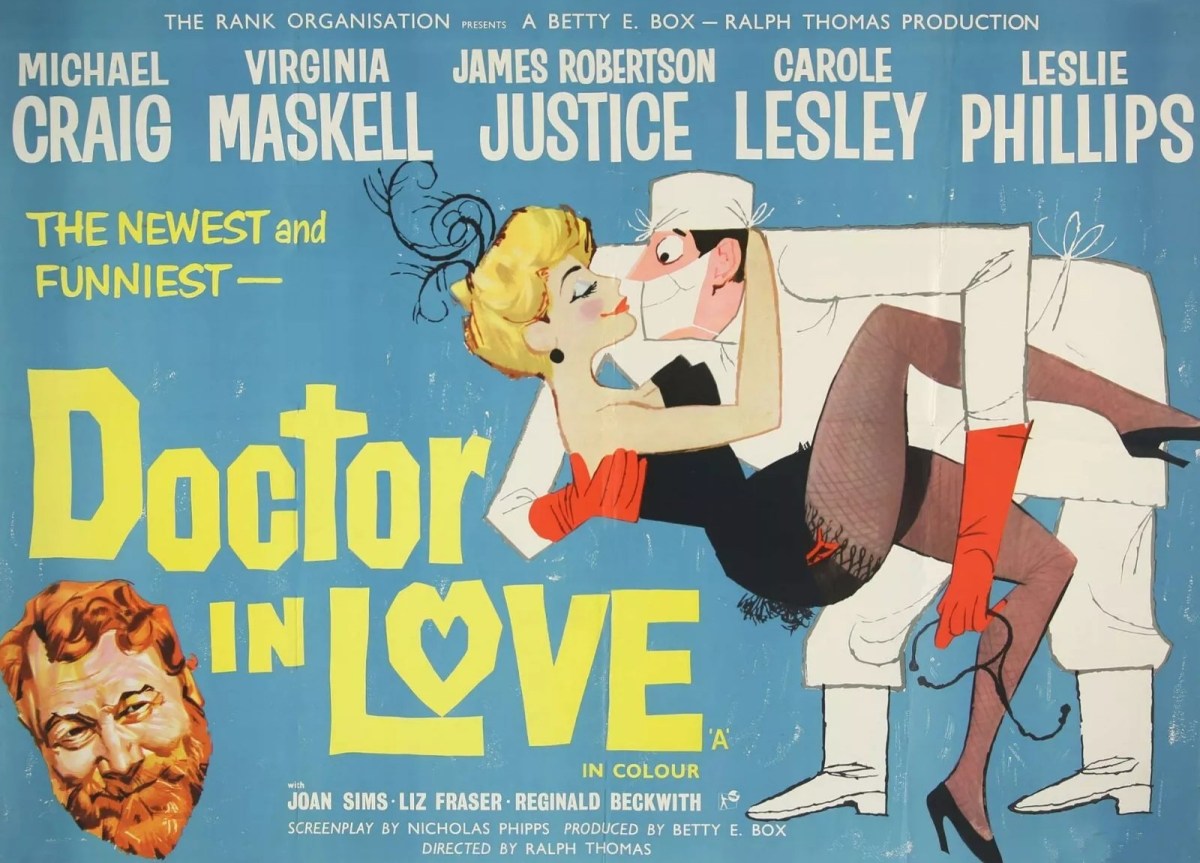
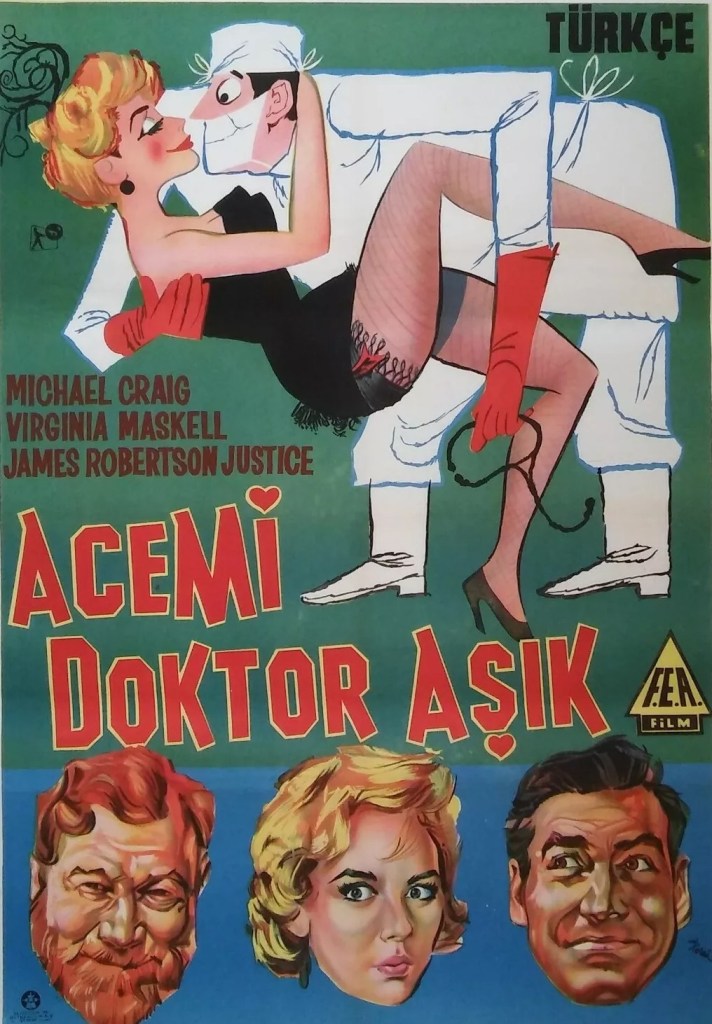
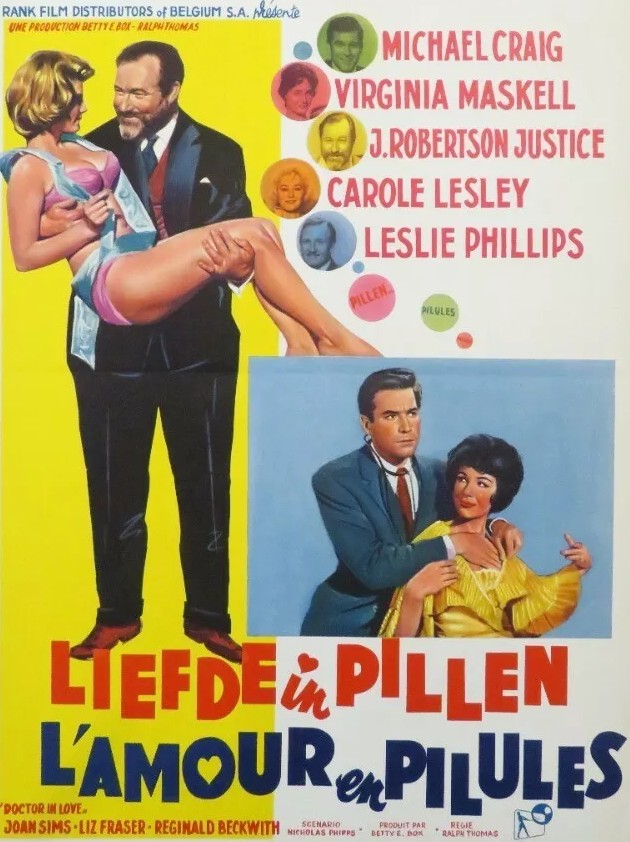
Doctor in Love (1960) ****

Chortled all the way through. You can see why it was the biggest film at the British box office in 1960. Dirk Bogarde had turned up his nose at repeating the character for the fourth time and went off to make more serious pictures like Victim (1961) which, it transpired,  dented his box office appeal. Replacement Michael Craig (Mysterious Island, 1961), while brawnier, passes this particular screen test with flying colors though he has his work cut out to hold his own against such practised scene stealers as James Robertson Justice (Mayerling, 1968) and Leslie Phillips (The Fast Lady, 1962) and once Virginia Maskell (The Wild and the Willing, 1962) enters proceeding her coolness makes the camera her own.

I was surprised how much this relied on innuendo. But this is a gentler exercise in smut than the sniggering guffawing Carry On approach. And there’s little chance of it descending into misogyny since the females hold all the aces. The plot is episodic and none the worse for that and even a diversion into a strip club, which might suggest a narrative clutching at straws,  proves a surprising highpoint.

Basic story shifts Dr Hare (Michael Craig) out of hospital and into general practice which provides ample comedic opportunity via patients and colleagues. But, first of all, just to confuse matters and as if the producers were worried the series might not survive outside the boundaries of St Swithins Hospital, the tale begins with him returning to hospital with what turns out to be jaundice.

Cue the booming interventions of Sir Lancelot Spratt (James Robertson Justice) and the first of the love stories wherein Hare and Dr Hinxman (Nicholas Parsons) are rivals for flighty Nurse Sally Nightingale (Moira Redmond), who, in the first of many knocks to the male ego, while playing off one against the other goes off with another man. Before she does, Dr Hinxman takes revenge by prescribing all sorts of medications which will leave Hare so indisposed he is unable to respond to the nurse’s ardor.

Back in civvy street, as a GP, Dr Hare has to fend off predatory female patients and secretary Kitten Strudwick (Carole Lesley) and deal with standard comedic issues such as the boy who gets his head jammed in a cooking pot and the less common task of explaining the facts of life to a 40-year-old virgin. His boss Dr Cardew (Nicholas Phipps) is under the thumb of a wife who has shipped out to California only to summon her husband every now and then. The ever-amorous Dr Burke (Leslie Phillips) fills in and is the prime mover in an episode that involves strippers Dawn (Joan Sims)  and Leonora (Liz Fraser). There’s a particularly good reversal in a drunken scene where the totally inebriated Wildewinde (Reginal Beckwith) completes all the police drunk tests (if that’s what they’re called) with ease.

When Dr Burke is incapacitated, his place is taken by Dr Nicola Barrington (Moira Redmond). And that should have been enough of a plot to see the picture through but the movie doubles down on complication. Dr Barrington fends off Dr Hare and when Nurse Nightingale reappears Barrington in due course quits. Dr Spratt is also on board for further scene-stealing duties including ruling the roost in a strip club and undergoing an operation.

The romantic situation is resolved, Dr Spratt is put in his place temporarily and our hero effects a return to the hospital.

I wouldn’t say the writing (by Nicholas Phipps) is of the highest caliber but the jokes come at an assembly line pace and the cast are superb, barely a cast member incapable of stealing a scene. You hire James Robertson Justice and Leslie Phillips at your peril. Without Dirk Bogarde hogging the scenery, this flows much better than others in the series, with the supporting cast being more than just foil to a star who was a major box office attraction at the time. And it helps that the women – Moira Redmond (Nightmare, 1964), Virginia Maskell, Carole Lesley (Three on a Spree, 1961), and Carry On regulars Joan Sims and Liz Fraser –  are even more adept at scene-stealing than the men and not merely foil for misogynist jokes as in the Carry On series.

Director Ralph Thomas (The Wild and the Willing) seems to have found a new lease of life without having to deal with Dirk Bogarde and brings a certain verve to proceedings, especially in tripping up male ego.

Comedy is such an odd one to judge. Many a time I have sat through with scarcely a titter movies I’ve been told are hilarious. Other times I’ve been told to give them a free ride because they are making a point. So I stick to my own rule.

Make me laugh – I don’t care how – and this had me laughing all the way through.

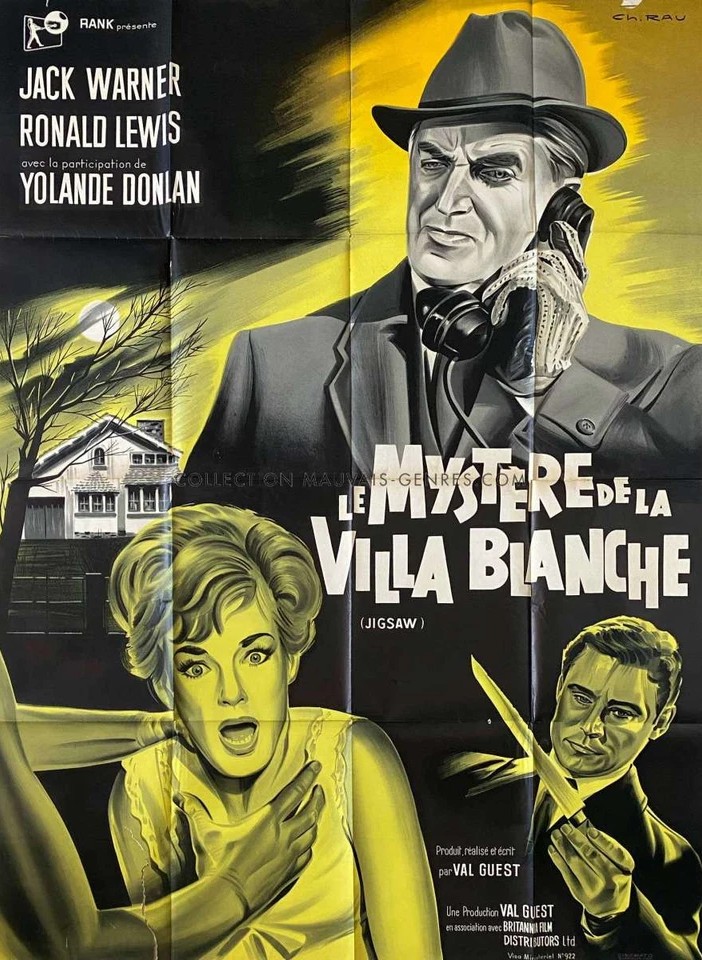
Jigsaw (1962) ***

Unusual crime picture even for the period. Most of these British pictures focused on the crime or an innocent caught up in nefarious activity, not just a straightforward police procedural before the term was even invented. In fact, the plodder was more likely to be a private eye or gifted amateur like Hercule Poirot or Miss Marple.

The title doesn’t refer to mystery but the painstaking element of putting all the pieces together and most likely still not being able to complete the puzzle – as occurs here until the very last scene and even then by pure accident. There are no sudden sparks of insight and the detectives don’t have the luxury of gathering all the suspects in a room Agatha Christie style. In fact for most of the movie not only can they not settle on a suspect they’re struggling to identify the victim. And this being when forensics didn’t exist except for fingerprints, there’s nothing even from that area to help.

At first Detective Inspector Fred Fellowes (Jack Warner) and Det Sgt Jim Wilks (Ronald Lewis) are investigating a break-in at a real estate office. Nothing’s been taken except leases, which suggests someone who either wants to get out of a lease or who doesn’t want their handwriting identified. After an exceptionally long haul it proves to be the latter. A lead takes them to a house in Brighton where they find the corpse of a woman with the initials JS.

I doubt if any police pictures of the period went into as much detail in following clues as this. Hunting for the killer the police interview taxi drivers, delivery men, garage mechanics, grocery clerks, truck drivers working construction, hardware and vacuum cleaner salesmen. Searching for the victim they check out beauty parlors, factories, pawnbrokers, airlines and hairdressers. The only clues are a gray car with a bent wing mirror – but even when they can identify the make it turns out there are thousands in the country – the contents of a vacuum, perfume smells on a pillow, particles of bone found in a furnace. Finally, with an old-fashioned trick Fellowes finds a name – Jean Sherman (Yolande Donlan) – and an address.

But Jean Sherman isn’t dead, though it transpires that she had a one-night stand in the murder house with a man she identifies as Campbell. But they can’t find Campbell either. They do alight on dodgy vacuum cleaner salesman Clyde Burchard (Michael Goodliffe), who has a previous conviction for indecency. Despite being identified by the delivery driver, it turns out he just had sex with the dead woman and nothing else.

Eventually, Fellowes finds Ray Tenby (John Barron) who is identified by Jean. He had picked her up after killing the other woman, Joan (Moira Redmond), and had sex with her in the next room to the corpse. But they can’t prove Tenby didn’t act in self-defense, and it’s only by that piece of unexpected luck that they can pin it on him.

Although most of the dialog focuses on the investigation there are some clever remarks. A journalist pressing a beat cop for information is told that leaving his car running unattended is an offence. Jean’s hardline father (John Le Mesurier) initially decries his daughter’s behaviour as immoral to the point of almost disowning her until, discovering she is dead, he bursts into tears.

With the amount of mileage the investigation covers, this could be done within the usual hour-and-a-bit of the standard British B-movie so it stretches a proper feature length. As written and directed by Val Guest (Assignment K, 1968), it’s not particularly stylistic, nor does it stretch tension too far, but it is still engrossing in the accumulation of detail.

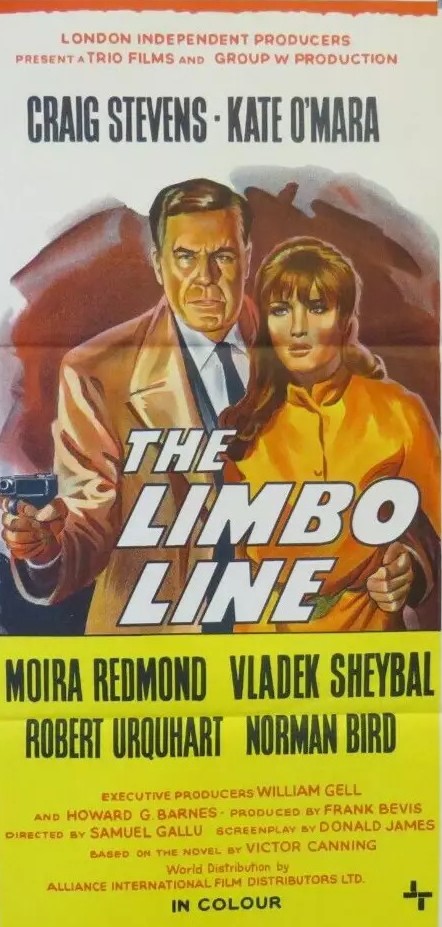
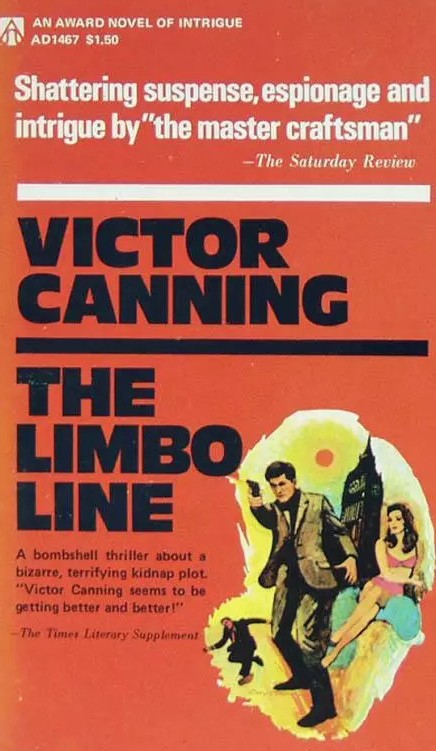
The Limbo Line (1968) ***

Should have been  a classic. The bleakest espionage tale of the decade ends up, unfortunately, in the wrong hands. Betrayal – personal and professional – underlines a sturdy enough narrative of defection, kidnap and rescue, infected with a spread of interesting characters far from the genre cliché.

We open with blonde Russian femme fatale Ludmilla (Moira Redmond), as sleek as they come, killing off her lover once she discovers his true intent. She works for the “Limbo Line,” an organization headed by Oleg (Vladek Sheybal) which whisks Russian defectors back to their home country. In romantic fashion, she inveigles herself into the lives of those who may be, for personal gain, about to take a wrong turn in the service of their country.

Richard Manston (Craig Stevens), meanwhile, is an operative of an undetermined secret unit, getting cosy with Russian ballerina Irina (Kate O’Mara), a defector, in the hope that she will become the next target for Oleg and thus lead him to his quarry. Responding to his amorous advances, she has no concept of this ulterior motives.

But he’s not the only one in the two-timing racket. Oleg lives high on the hog, a lifestyle financed by holding back remuneration due his operatives, who not only want better paid for the risks they are taking, but draw the line at murder. Ludmilla, meanwhile, uses intimacy with Oleg as a way of keeping tabs on him for her superiors.

Everyone, however, is operating under a new code of restraint. Arms limitation talks between the Superpowers currently taking place mean that neither side wants to be publicly seen to be working in the shadows. Hence, the no-holds-barred methods of both Manston and Oleg are frowned upon. Manston and Ludmilla have more in common than one would normally find in the spy movies of the period, the end justifying the means taking precedence over any personal interest in a lover.

The dangerous romantic elements would have been better dealt with in the hands of a more accomplished director. As it is, Samuel Gallu (Theatre of Death, 1967) has his hands full keeping track of a fast-moving tale as Irina is whisked by boat, bus and petrol tanker to Germany, hidden in such confined spaces the more cautious operatives fear she will die.

Nor, despite his fists, is Manston as good as you would expect from a heroic spy, battered to bits by his opposite number, himself imprisoned in the tanker, becoming a pawn to be sold to the highest bidder.

It’s in the tanker that Irina realizes her lover is deceitful, only using her as bait. Similarly, Oleg doesn’t realize he is every bit as dispensable to the ruthless Ludmilla who wishes to avoid public exposure and is only interesting in taking Irina back to Russia where she will be “re-educated.” Chivers (Norman Bird) looks like the nicer sidekick for Manston, the type to demonstrate fair play, except when he has to drown a suspect in a bath. He has the best line in the film, an ironic one at the climax.

The action, while overly complicated, is well done, none of the over-orchestrated fistfights taking place in odd locations. Chivers has a knack of turning up in the nick of time, but he’s the cleverer of the two.

An actress of greater skill than Kate O’Mara (Corruption, 1968) would have brought greater depth to the betrayed lover, but she does well enough to stay alert during the helter-skelter action. Craig Stevens (Gunn, 1967) was never going to be the right fit for a character required to show considerable remorse at his own actions.

The hard core of political reality, the constant betrayal of both innocent and guilty, the shifting sands of romance sit only on the surface and a better director would have brought them more into the foreground, eliciting better performances for deception incurred in the line of duty at the expense of the personal life.

It’s never a good sign when the bad guys are the more interesting characters and while you might expect Vladek Sheybal (Puppet on a Chain, 1970) to steal the show, he is usurped by Moira Redmond (Nightmare, 1964). A bigger budget would have also offered better reward, but even so Gallu comes up with more interesting camera angles than you might expect.  Based on the bestseller by Victor Canning (Masquerade, 1965), he was helped in the screenwriting department by television writer Donald James.

You watch this thinking what might have been.

Nightmare (1964) ****

Now this is what you’re looking for when you take an unguided tour into the British B-movie. A tight gripping thriller with a parcel of twists, clever character perspective, some stunning cinematography, and pivoting on perception of insanity.

The opening is a cracker. Teenager Janet (Jennie Linden) stumbles along a dark prison-like corridor with little light hearing someone call her name. Entering a door, she spies a woman in a white nightgown lurking in the corner. She responds to the gentle calling. But once she lets the door close behind her and can’t get out, the woman screams that now they are both mad. And that’s just the first, atmospherically brilliant, nightmare.

Janet is soon removed from her posh boarding school, her constant nightmares too frightening for the other pupils. Driven home in a Rolls-Royce, accompanied by teacher Mary (Brenda Bruce) she passes the asylum where her mother is an inmate, but is surprised to find her legal guardian, charming lawyer Henry (David Knight), isn’t there to greet her. Instead there’s a nurse, Grace (Moira Redmond).

We soon learn she’s been effectively orphaned by her mother, who killed her father, Janet, eleven at the time, witnessing the murder. But without any proper home life, looked after primarily by kindly chauffeur John (George A. Cooper) and maternal maid Anne (Julie Samuel) and with the married Henry often absent, there’s little done to quieten down her obsession that she will follow her mother into madness.

The movie takes her perspective, watching her watching out for mystery, or in her point of view as she catches fleeting glimpses of a woman in white. The apparition looking only too realistic, not dashing out of view but turning and apparently beckoning Janet on and it doesn’t take much to push a disordered mind further out of kilter, leading to attempted suicide. Imagining Henry’s wife is the ghost, she stabs her to death.

End of Act One. Start of Twist No 1. You would expect the movie to follow Janet to the asylum where she would be reunited with her mother, knowing she had inherited those terrible genes, trapped in her insanity. But it goes somewhere more delicious instead.

Turns out nice Henry is not very nice at all. He contrived a situation to be rid of his wife and marry lover Grace instead. But, once married, it is Grace who becomes disturbed and the movie follows a similar arc in the second half. Unexplained goings-on. She believes Henry has another, secret, lover and is trying to drive his new wife crazy. She finds strange cigarettes in his pocket, a barman at a hotel recognizes him even though he claims never to have been there before.

The marriage quickly deteriorates although she stands her ground, telling him in no uncertain terms that she won’t put up with any philandering and slapping his face. He is charm itself, easily turning aside her insinuations and from his casual and disarming manner it’s easy to believe he is perfectly innocent. Of course, that’s before Janet’s doll turns up and locked doors open and there’s an apparition.

The beauty of this picture is the atmosphere, the intensity of the camera, the concentration on two vulnerable females, convinced by genuine or imagined guilt that they will succumb to the madness that appears to pervade this particular house. You think it’s going down one route and are annoyed you didn’t see the next twist coming.

There’s the kind of cinematic repetition that enamored critics of more critically acclaimed pieces like The Searchers (1956). It’s almost as though there’s a beam of insanity identifying the next victim. And that’s helped immeasurably by the lighting which allows no shadow on faces. Like an inverted film noir, where the light has nowhere to go, no atmospheric shadow to create, except to land square on the faces of those involved. This would be the Old Dark House except never has a building been so illuminated, not bright throughout, the illumination predisposed to land on faces rather than rooms.

There are a couple of finely composed scenes, one viewed through a staircase, neat revelations, visual and verbal, a fabulous ending with one character screaming and a telephone dangling off the hook.

You might be astonished to discover this is a Hammer picture. Nary a monster in sight. But then little is scarier than what happens inside the mind, when imagination runs riot without external assistance. That the victim is a teenager, prone to the mood swings of that age, makes it easier for Jennie Linden (Women in Love, 1969) to ramp up the emotions without her seeming too barmy from the outset. David Knight (The Devil’s Agent, 1962) is excellent, conniving he may be but the general demeanor of bonhomie never slips into stage villain. But Moira Redmond (The Limbo Line, 1968) is the pick as she morphs from accomplished accomplice to prospective victim.

Tightly written by Jimmy Sangster (Maniac, 1963), characters fully evolved, twists cleverly concealed, and with excellent direction by Freddie Francis (The Skull, 1965), not just the visuals but in drawing out of a fairly standard set of actors exactly what he needs to make this tick.

Well worth a look. A much under-rated B-picture.

Youtube has an excellent print.https://www.youtube.com/watch?v=EJizyBez6A0&t=1064s

Discover WordPress

A daily selection of the best content published on WordPress, collected for you by humans who love to read.

The Atavist Magazine

by Brian Hannan

WordPress.com News

The latest news on WordPress.com and the WordPress community.