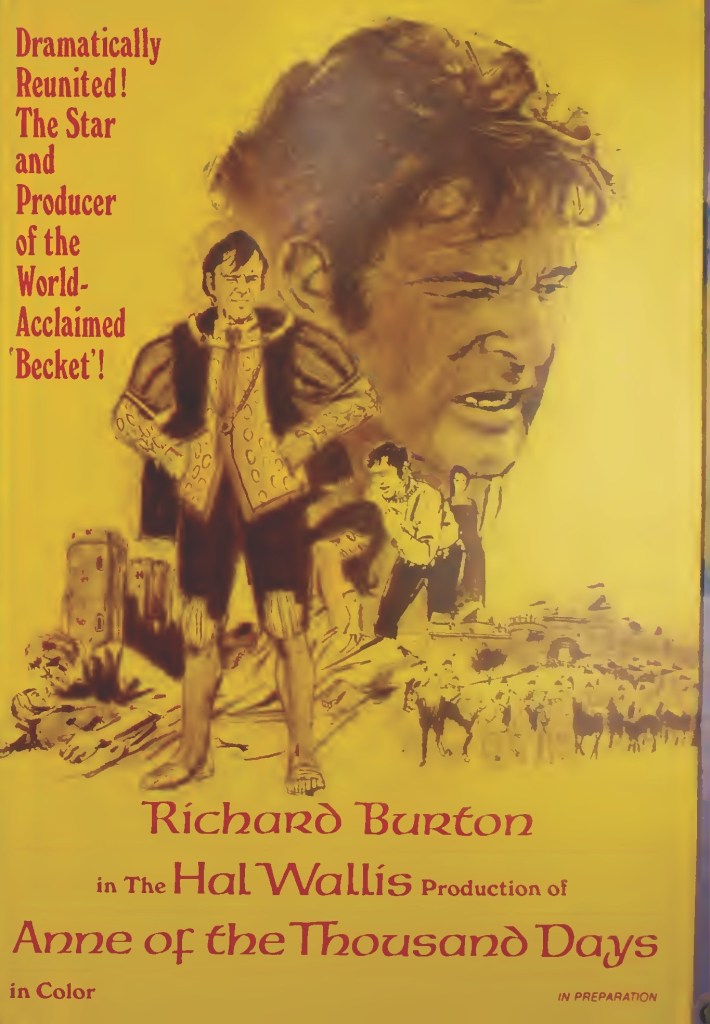
Anne of the Thousand Days (1969) ****

You can keep your Succession dramas with families squabbling over a mere business empire. And even the more woke Snow White (2025) doesn’t remotely tackle the realities of marriage in medieval times when the role of a woman, in an era when more children died in childbirth or soon after than actually survived, was to produce an heir. And not just random in gender. But male.

So, on the one hand, you can sympathize with the dilemma of English King Henry VIII whose Spanish wife Katherine, while eminently fertile – several babies died in childbirth – had managed only one male offspring, who died shortly after birth, and one female, Mary. All the queen had given him, rails Henry (Richard Burton), are “dead sons.” So with the future of one of the biggest kingdoms in the world at stake, Henry isn’t keen to leave it in the hands of a woman. Even if he can arrange a suitable marriage, it would inevitably mean letting the kingdom fall into the hands of someone he doesn’t trust.

But in the twisted world of inheritance, here’s the rub. Henry shouldn’t be king. His elder brother Arthur should have, except he died before he could succeed to the throne. And Katherine, married to Arthur, should have been Queen.  But Spain at that point was as powerful, if not more so, than England, so Henry decided to marry his sister-in-law, on the basis that the marriage was never consummated, and the Pope, the authority in such matters, gave the go-ahead, glossing over the technicality of what was considered in those days incest.

So, Henry comes up with a cunning plan. He will go trophy-hunting and marry a younger wife. This isn’t just because he’s fallen in love with Anne Boleyn (Genevieve Bujold). He doesn’t have to marry her to have sex with her. He’s already having sex with her mother (Valerie Gearon) with the tacit approval of her father (Michael Hordern) who receives benefits in kind.

To add complication, Anne is promised in marriage already, and deeply in love. Siring a bastard son would inevitably cause an inheritance battle. So legitimizing the relationship seems the only way forward. This time the Pope isn’t keen, mostly because the Spanish have invaded the Vatican and if he wants to survive he can hardly annoy his captors.

But when the Pope refuses, Henry takes the nuclear option, and splits from the Catholic Church, not just taking advantage of the old church vs state argument, but also made aware by Thomas Cromwell of the sudden increase in wealth acquiring the items of the Catholic Church would bring.
Sorry to bore you with a history lesson but this intriguing backdrop – as well as the dazzling performances – is what twists this away from lush costume confection into riveting drama. This was the peak of a trend in historical movies that shifted the emphasis from heroic action to the down’n’dirty. Camelot (1967) to some extent had begun the trend but only dealt with infidelity and was given something of a free pass because it focused on the iconic Knights of the Round Table and a legendary love affair. The Lion in Winter (1968) primarily concentrated on  inheritance.

Depending where your sympathies lay this was either corruption writ large or a battle to free the ordinary man from the yoke of religion.

Primarily, it works because it revolves around the human drive, the king refusing to bow the knee to anyone, Anne Boleyn seduced not just by gifts but by this older man who is much more virile and passionate than her younger somewhat effete fiancé (and who couldn’t be dazzled by a man risking his kingdom for her love?) – and the courtiers looking after number one, always seeking a way of winning the king’s favor, and as importantly, not losing it, for that could lead to banishment or execution.

No one dares stand in Henry’s way – except Sir Thomas More (William Squire) and here he’s merely a small subplot (not center stage as in A Man for All Seasons, 1966) – not even the religious hierarchy, especially Cardinal Wolseley (Anthony Quayle), head of the Catholic Church in England, who keeps a mistress.

The tragedy is that the cunning plan unravels. While Anne is fertile enough, she gives birth to a girl, Elizabeth (the later Virgin Queen). Convinced she’s not going to present him with the male heir he so desperately desires, he hatches a conspiracy that sees her executed for adultery and treachery, leaving him free to marry again and continue his mad obsession.

So we’ve got all the back-biting and bitching we expect from court, plus regal revelry, costumes, castles, and in the middle of it all a driven king and a feisty woman, not by any means a pushover, and not either going unwillingly into his bed. This would be a match made in heaven except that’s probably the last place, the way things stand, the king would be welcome. He’s very aware of excommunication and it shows the power of the Catholic Church that its teachings are so embedded in his brain that he fears that consequence.

This is rich in performance – Richard Burton (The Spy Who Came in from the Cold, 1965), Canadian Genevieve Bujold (The Thief of Paris, 1967) and Anthony Quayle (East of Sudan, 1964) were Oscar-nominated. The only significant figure in the production not to receive one of the movie’s ten nominations – including for Best Picture – was director Charles Jarrott who pulled the whole thing together. Maybe it was thought he was rusty, not having helmed a picture since Time to Remember seven years previously.

The acting is particularly well-judged by the two principals, Burton could easily have lurched into cliché, and Bujold into passivity. Others worth noting are Irene Papas (The Guns of Navarone, 1961), Michael Hordern (Khartoum, 1966), Valerie Gearon (Invasion, 1966)  and Peter Jeffrey (The Fixer, 1968).

Based on the play by Maxwell Anderson (The Bad Seed, 1963), screenwriters John Hale in his movie debut and Bridget Boland (Gaslight, 1940) manage to balance what could be dry subject matter with fragility and tragedy.

There couldn’t be a better demonstration of women used as pawns and collateral damage in male power struggles.

Totally absorbing.

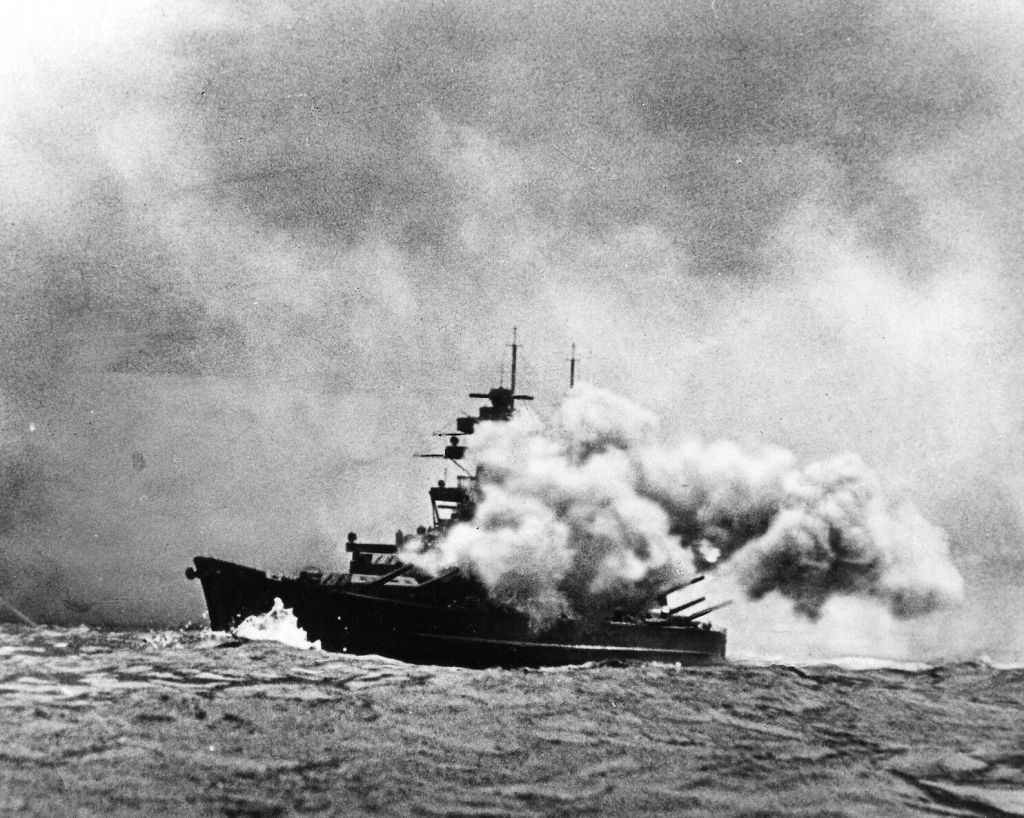
Sink The Bismarck! (1960) ****

Hard to believe but outside of the Hollywood big-budget Bridge on the River Kwai (1957), this was the biggest British film at the U.S. box office in the previous decade. In fact, the British war films that did so well in the home territory, The Cruel Sea (1953) and Reach for the Sky (1956), sank like a stone when exported to in America while earnings for Ealing comedies,  limited to arthouses, hardly made a dent in the box office.

What makes this so appealing is the very lack of Britishness and the intrusion of a Yank, famed reporter Edward  R Morrow (playing himself), interrupting the action at various points to keep audiences up to speed. The fact that the sinking of the Bismarck, the biggest battleship ever built, was one of the few British actions at the start of the Second World War to be counted a success probably helped. Watching the Brits being lionized for defeat was not an attractive notion for global audiences.

But in the main it is a thrilling docu-drama, very much a departure for the genre, with every nuance of potential consequence spelled out. Dialog and models being moved across maps announce the risks inherent in the British attack: the superiority of the newly-built German battleship, the multiple options the Germans had in 1941 to escape, the difficulties in pinpointing the German vessel in the fog-bound waters of the North Sea, and the devastation the battleship could inflict on the beleaguered convoys on which Britain depended to stay afloat. In addition, even when targeted the Germans could flee to occupied France or potentially summon U-boats or air support.

So in the manner or Operation Crossbow (1965) or Day of the Jackal (1973) the audience is primed for a minute-by-minute enterprise, the battleship deemed so dangerous that the Admiralty is willing to risk its own scarce supplies of battleships, destroyers, cruisers and aircraft carriers in a bid sink the enemy. It is so much a documentary that the beyond the thrill of the hunt there is little room left for drama and certainly little of the stirring kind that had become such a byword for the British version of the genre – and such a turn-off for foreign audiences who could hardly make out what the actors were saying never mind work out why such-and-such a mission they had never heard of was so important.

In any case emotion is forbidden in the subterranean claustrophobic Admiralty War Office where new operational commander Capt Shepherd (Kenneth More) holds sway. A martinet, “cold as a witch’s heart,” on arrival he rids staff of what he sees as the rank indiscipline of addressing colleagues by forename rather than surname, eating sandwiches at a desk to which the workforce have been chained for hours  and various minor offences against the strict code of a uniform.

It was inherent in this type of picture that the land-based unit suffer the casualties of war, husbands dead or missing in action, wives and children killed by German bombs. But the tightening of the stiff-upper-lip ensures that when such revelations become known, they appeared like emotional depth-charges on this otherwise staid ocean. And Capt Shepherd, through his choices, as would be true of many high-ranking officers, might be sending his own son to is death.

This is also one of the first instances in war pictures where the Germans are not treated as stock villains, but intelligent people, like Admiral Lutyens (Karel Stepanek) with his own vanity and a hunger for redemption, and Capt Lindemann (Carl Mohner), as valiant an opponent in the cat-and-mouse duel where outwitting the British enemy could wreak untold carnage and hasten – unusually from the German point-of-view rather than from the Allies – the end of the war.

A few months after launch the Bismarck is spotted leaving its home port, destination North Atlantic to feast on convoys travelling from America with invaluable supplies. There are four possible routes open to get round the top of Britain. To prevent the Germans reaching any of them British ships must be sacrificed, including HMS Hood – three survivors out of a crew of 1400.

It’s David vs Goliath except David is a terrier capable of inflicting tiny wounds that drain the battleship of some of its power, loss of fuel and rudder problems limiting movement. It’s a different kind of war picture, as well as the big guns blasting at each other over huge distances, the British employ biplanes loaded with torpedoes, a weapon also used in some instances by its ships.

To keep audiences more heavily involved, there are snippets of dialog involving characters on board the various ships, some in distinctly un-stiff-upper-lip mode, and montages of the various vessels getting ready for action, as well as shots of devastation should a shell find its target.

But basically it’s  brilliantly-told tactic-heavy war picture that shows the shifting battleground, how the various ships are deployed, with no shortage of telling the audience how crucial success is and how crushing defeat. There’s no reliance on individual heroism, no snappy soldier defying authority, no hunch being played out, none of the usual cliches of the genre, instead, as with The Longest Day (1962) a clear explanation of what’s going on with superb battle scenes for the action-inclined.

It’s fair to say that even on the small screen, the models look a bit iffy, but this is more than compensated by other scenes on real warships, the use of newsreel footage, and fast cutting.  That action never takes place under a clear blue sky but always in murky waters also adds to the realism.

In a role that would have been custom-made for Kenneth More (The Comedy Man, 1964), king of the stiff-upper-lip, rather than simply spouting his lines, he adds considerable emotional depth. Dana Wynter (Something of Value, 1957) is excellent as his equally buttoned-up assistant.

There’s a full crew of supporting British character actors including Michael Hordern (Khartoum, 1966), Laurence Naismith (Jason and the Argonauts, 1963), Geoffrey Keen (Dr Syn, Alias The Scarecrow, 1963) and Maurice Denham (Some Girls Do, 1969) while the Czech-born Karel Stepanek (Operation Crossbow, 1965) and Carl Mohner (Assignment K, 1968) inject humanity into the Germans.

Lewis Gilbert (The 7th Dawn, 1964) does a brilliant job of bringing this all together, adding touches of emotion and humour to what could have been a too-dry concoction, drawing on a screenplay by Edmund H. North (HMS Defiant/Damn the Defiant, 1962) which was based on the book by C.S. Forester of Hornblower fame.

A Home of Your Own (1964) ***

The phrase “classic silent British comedy” isn’t one that naturally trips off the tongue. Add in “of the 1960s” and you can guarantee furrowed brows. Thanks to the boom in recycling Hollywood silent classics in the early 1960s – which I may come back to in a later Blog –  there was a subsequent mini-boom in what were called “wordless” pictures, as if using the term “silent” was blasphemous. The oddity is that so many emerged from Britain, primarily in shortened format – not more than one hour long – as the second feature in a double bill.

Blame for this development lay in the hands of producer and later writer and later still director Bob Kellett, Britain’s unsung comedy king.

A Home of Your Own is beautifully structured, following the mishaps in building a block of new apartments. A credit sequence covers the stultifying bureaucracy involved so that what was a pristine site at the beginning of the endeavor turns into a waterlogged dump before the first brick is laid. Sight gags and slapstick abound with mostly everyone getting in each other’s way, or not, the traditional approach of the work-shy British builder being to provide an audience for someone else to dig up a road or a trench.

No paddle goes unsplashed, mud only exists to drench people, and in pursuit of comedy gold most of building materials end up misused. The gatekeeper’s main job is to make tea and there is naturally an union official whose chief task is to obstruct.

Pick of the gags is Ronnie Barker’s laying of cement, delivered with exquisite comedy timing, followed by Bernard Cribbin’s stonemason delicately chiselling out a plaque only to discover at the end in a laugh-out-loud moment that he has misspelled one word, and the carpenter who appropriates the closest implement with which to stir his tea. Some of the jokes grow legs – the morning tea break, a ham-fisted carpenter, the pipe-smoking architect arriving in a sports car, and a patch of ground on the road outside constantly being dug up by different contractors representing water board, gas, electricity.

Once the building is complete, the job has taken long enough for the aspiring apartment-owner, a mere fiancé at the outset, to lift his wife over the threshold accompanied by three kids. Any sense of personal accomplishment – the British thirst for owning property quenched – is undercut by problems the young couple now face thanks to the shoddy workmanship we have witnessed.  

All this is accompanied by a very inventive Ron Goodwin score which provides brilliant musical cues. As a bonus, the film features a roll-call of British television comedy superstars  including Ronnie Barker (The Two Ronnies, 1971-1987), Richard Briers (The Good Life, 1975-1978) and Bill Fraser (Bootsie and Snudge, 1960-1974).  Peter Butterworth and Bernard Cribbins were Carry On alumni. Janet Brown achieved later fame as an impressionist while Tony Tanner hit Broadway as the star of Half a Sixpence before expanding his career to choreographer-director, Tony-nominated for Joseph and his Amazing Technicolor Dreamcoat.

A Home of Your Own went out as the support to the Boulting Brothers’ comedy Rotten to the Core (1964) which gave a debut to Charlotte Rampling. Despite being effectively a B-film, primarily made to take advantage of the Eady Levy (a cashback guarantee for producers), it was surprisingly successful.  “Will delight arthouse patrons” commented Box Office magazine in America (“Review,” October 4, 1965, p160) as British comedy films in those days tended to end up in the arthouses. In part, this was because it was the official British entry to the Berlin Film Festival. It was distributed in the U.S. there by Cinema V in a double bill with Rotten to the Core and launched in what was misleadingly called a “world premiere engagement” at the prestigious Cinema 1 in New York.

Jay Lewis (Live Now, Pay Later, 1962) directed and co-wrote, along with Johnny Whyte, the mini-feature. Kellett continued in this enterprising vein with the 55-minute San Ferry Ann (1965) – which he wrote – about a group of British holidaymakers going abroad and the 49-minute Futtock’s End (1970) – which he directed – featuring a bunch of guests descending on an ancient country house owned by Ronnie Barker.

Television stars showcased in these two featurettes included Wilfred Bramble (Steptoe and Son, 1962-1974), Rodney Bewes (The Likely Lads, 1964-1966), Warren Mitchell (Till Death Do Us Part, 1965-1975) and Richard O’Sullivan (Man About the House, 1973-1976). Ron Moody composed the Oscar-winning Oliver! (1968) while Joan Sims and Barbara Windsor made their names in the Carry On series and theatrical knight Sir Michael Hordern appeared in Khartoum (1965) and Where Eagles Dare (1968).

Though disdained by critics, Kellett went on to become by far the most influential British comedy director of the 1970s. His output included the Frankie Howerd trilogy Up Pompeii (1971), Up the Chastity Belt (1972) and Up the Front (1972), as well as The Alf Garnett Saga (1972). He was well ahead of his time with the transgender comedy Girl Stroke Boy (1972) and female impersonator Danny La Rue in Our Miss Fred (1972).

You can find all four films in a compilation released by Network under the title Futtock’s End and Other Short Stories.  Thanks to Dolphin PR for a copy. You can catch it on DVD, Blu-Ray and digital services.

Dr Syn, Alias The Scarecrow (1963) ****

The mysterious masked Scarecrow was the creepiest character thus far put on celluloid by Disney. A lot of the action takes place at dusk so it is soaked in crepuscular atmosphere. Filmed against the sky, every horse seems to thunder past. Gallows swing ominously. Coupled with a strong storyline and clever ruses by alter ago the mild-mannered clergyman Dr Syn (Patrick McGoohan), this is one for the Under-Rated Hall of Fame.  

While the character has antecedents in folk-hero Robin Hood, the Scarecrow is more rooted in the brutal reality of Britain in the mid-1700s when to fund a host of foreign wars King George taxed already-impoverished peasants to the hilt, making smuggling essential to survival. The Scarecrow is not just the underworld kingpin but has operational skills a spy would be proud of, coded messages, secret rendezvous et al.  

Ruthless General Pugh (Geoffrey Keen), sent to rid the countryside of this menace, makes no bones about putting the squeeze on the wives of villagers to force them into providing the information he requires. Outwitted from the off by Dr Syn, the infuriated general begins torching houses. Helped unwittingly by local squire and judge Thomas Banks (Michael Hordern), the general acquires an informer Joseph Ransley (Patrick Wymark).

This is not the bucolic England of Robin Hood or other historical yarns of Hollywood invention featuring glorious scenery and ample female cleavage. Here, a barmaid is likely to use a meat cleaver to defend herself. This was also the era of press gangs, where government-appointed hoodlums would raid a village and carry off young men as unwilling recruits for the Royal Navy. It was a time of imminent insurrection, the King’s subjects in the North American colonies on the point of sedition. And when money – or its lack – infected every area of society.       

Although like any super-hero the Scarecrow occasionally comes to the rescue, the movie is distinguished by the fact that is more often Dr Syn who subverts the General through cunning subterfuge. Victory through force of arms is impossible since violence visited on the king’s troops would result in a multiplication of their numbers. So it is more a battle of wits. In addition, the Scarecrow faces a dilemma – how to punish a traitor with such severity his authority is never questioned again while at the same time upholding the principles of Dr Syn. Just how these issues and others are resolved make for a very involving picture.

Minor subplots – a romance between the squire’s daughter and an officer, a deserter from the Navy and the presence of an American (Tony Britton) – serve the main story. So the narrative remains taut. And, interestingly, that hangs upon what characters have to lose rather than gain. It is not about greed but survival.

For a Disney picture there is considerable directorial vigor, not just the depiction of the smuggling and pounding hooves accompanying peril or escape, but two terrific trial scenes, a masterly escape conducted in the complete absence of on-screen music and, of course, the terrifying vision of the Scarecrow himself.

The acting has a sterling quality. While Michael Hordern was a stage star, the film primarily called upon actors who later achieved fame on British television programs. Patrick McGoohan headlined The Prisoner (1967-1968), George Cole was in Minder (1979-1994), Patrick Wymark and Alan Dobie in The Plane Makers (1963-1965) Geoffrey Keen in Mogul (1965-1972), and Tony Britton in Robin’s Nest (1977-1981). McGoohan had a previous television incarnation as Danger Man  (1960-1961) and Cole had been a con man in the St Trinian’s films. You can also spot in small roles Kay Walsh, a former British leading lady, and a young Richard O’Sullivan, later star of Man About the House (1973-1976).

Director James Neilson was a Disney favorite, having helmed Moon Pilot (1962), Bon Voyage! (1962) and Summer Magic (1963). But these were all lightweight features and it is to his credit he met the challenge of turning Dr Syn, Alias the Scarecrow into a dramatic actioner. British writer Robert Westerby (The Square Ring, 1953), who also created the source material for Kali-Yug, Goddess of Vengeance (1963),  fashioned the screenplay from the books of William Buchanan and Russell Thorndike

Although Disney had cannibalized the Davy Crockett television series in the 1950s, stitching together episodes for feature films, this was something of a reversal. As part of its The Magical Wonderful World of Disney U.S. television program the studio had shown The Scarecrow of Romney Marsh as a three-part mini-series while Dr Syn, Alias the Scarecrow was released as a movie in Britain.  

You will need to go onto ebay or other secondhand sources to find the movie. The television mini-series can be found below.

Discover WordPress

A daily selection of the best content published on WordPress, collected for you by humans who love to read.

The Atavist Magazine

by Brian Hannan

WordPress.com News

The latest news on WordPress.com and the WordPress community.