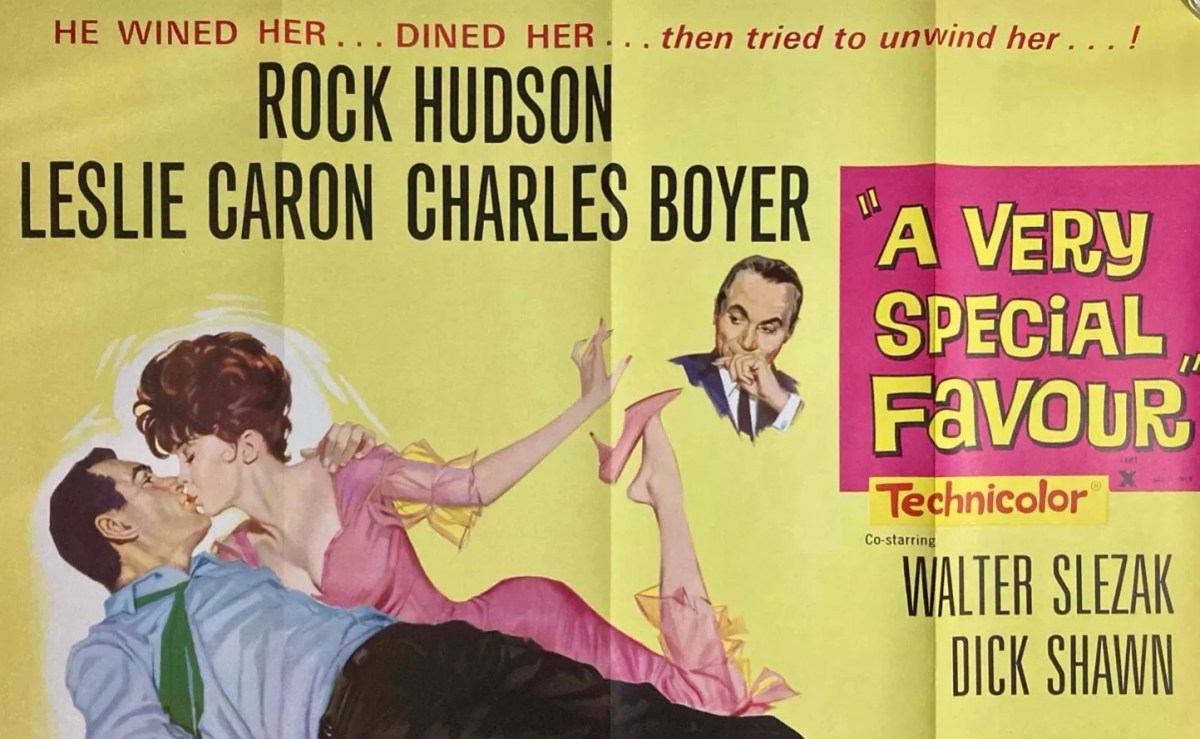
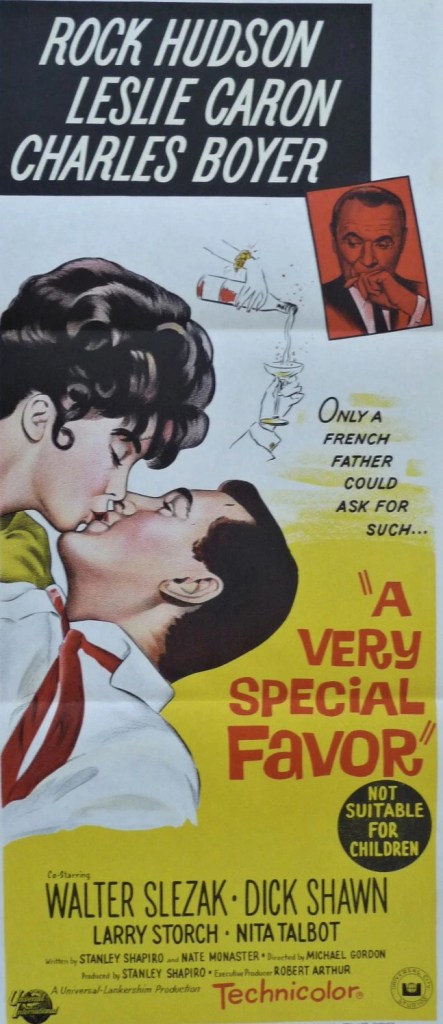
A Very Special Favor (1965) ****

Surprisingly funny for a movie that’s long been out of favor. Starring a Rock Hudson (Seconds, 1966) who was just beginning to lose his grip on the marquee after an incredible run of box office success and Leslie Caron (Guns of Darkness, 1962) who had always seemed to just miss out on the top echelons of audience approval.

You can see why this had rapidly lost whatever appeal it originally possessed and that a contemporary crowd would turn its nose up at a man that has such success with the ladies that he has a whole stream of women carrying out his most basic chores. Except that the tale is really about him getting his come-uppance and everyone enjoys that kind of narrative.
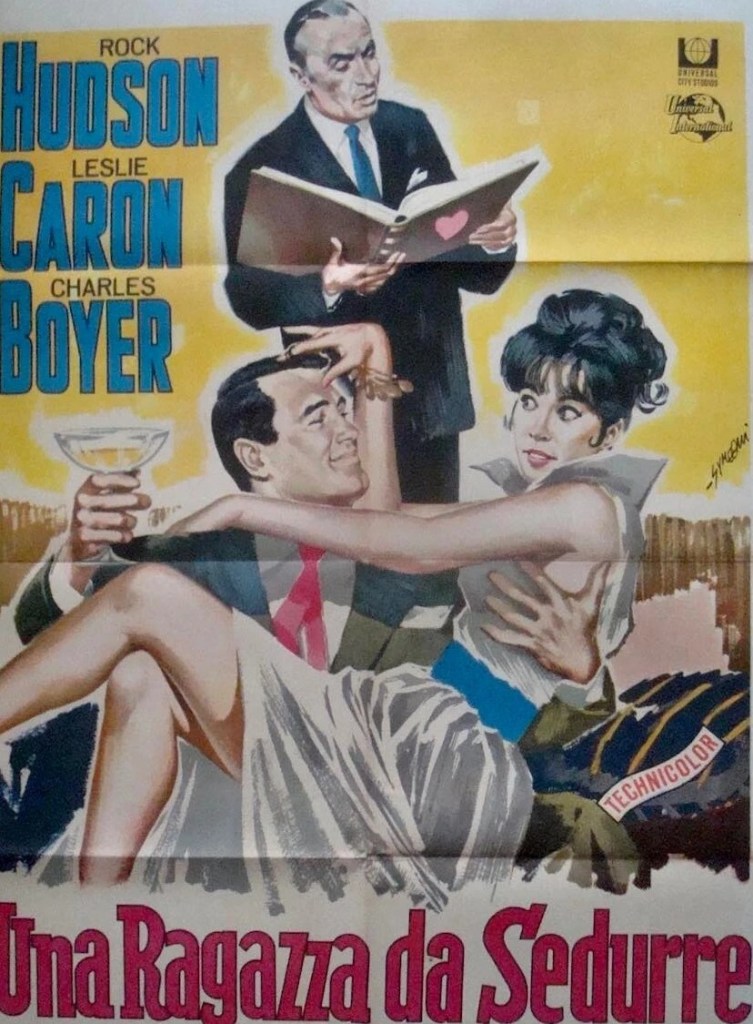
Paul (Rock Hudson) only has to look at a woman and she melts. His job, such as it is, though he is wealthy, is to use his charm to commercial advantage. We open with him in a French court winning a case it transpires because he has seduced the female judge. The opposing lawyer Charles (Charles Boyer) encounters Paul on the way home, observing the American batting back stewardesses with ease, and the Frenchman enlists him to seduce his daughter Lauren (Leslie Caron), so much of a career woman, a high-flying psychologist,  that her father fears she will turn into an old maid.

But Lauren already has a fiancé, Arnold (Dick Shawn) who, like Paul’s harem, is at her beck and call, carrying out the most basic tasks for her. Paul pretends to be a patient, his fake problem being his irresistibility which has caused a girlfriend to commit suicide. Lauren shows very little sign of falling for Paul’s charm. In order to prove that they are making progress, they go to a restaurant. To Paul’s astonishment, Lauren passes out from drinking too much champagne. He takes her back to her apartment and in the morning pretends that she has succumbed to his charms.

So now the twists come. Lauren is upset to discover that she has been seduced by a man she was determined to keep her distance. But when she finds out the truth, the tables are turned. She invents a Spanish lover which knocks Paul’s ego to hell. Plus she accuses him of impotence. Then he turns the tables again, and using one of his many fans – and a ploy that would prove somewhat ironic given Hudson was a closet gay – switchboard operator Mickey (Nita Talbot), makes Lauren so jealous that eventually he contrives to win her back and the two determined singletons, against all odds, get married.
There’s some marvellous stuff here, some slapstick at which Caron is surprisingly adept, but mostly it’s a tale of flustered feathers and vengeance for perceived humiliation, beginning with Boullard who is so annoyed that any of daughter of his is a stuck-up prude. Paul can’t believe Lauren isn’t falling at his feet and equally she is infuriated that Paul isn’t another male slave like her fiancée.

There’s a great turn from Dick Shawn as the slave and his mother (Norma Varden) who keeps on encountering Paul at his least winning. It’s a relief to see Rock Hudson not playing the stuffed shirt of previous comedies and for Leslie Caron not to be a hapless heroine. So it plays as a more effective modern comedy.

Not everyone was so keen on Caron, complaining about the lack of chemistry between the leads and that Paul would never get hooked by such a cold fish. But I disagree. Sure, it called for a lot more from the audience that the leading lady wasn’t the usual ultra-feminine model, but that made the initial romance more believable. Initially, Paul doesn’t fall for her and is seducing her as a “very special favour” to her father but once he sees the other side of her personality he changes his tune.

But I would hazard a guess that, mostly, people were annoyed with Caron because she wasn’t Doris Day and that, while this follows one formula, it steers clear of the Hudson-Day formula in making Caron a high-flying career woman. Dick Shawn (Penelope, 1966) leads an able supporting cast.

Directed by Michael Gordon (Texas Across the River, 1966) from a script by Stanley Shapiro (Bedtime Story, 1964) and Nate Monaster (That Touch of Mink, 1962).

Worth a look.
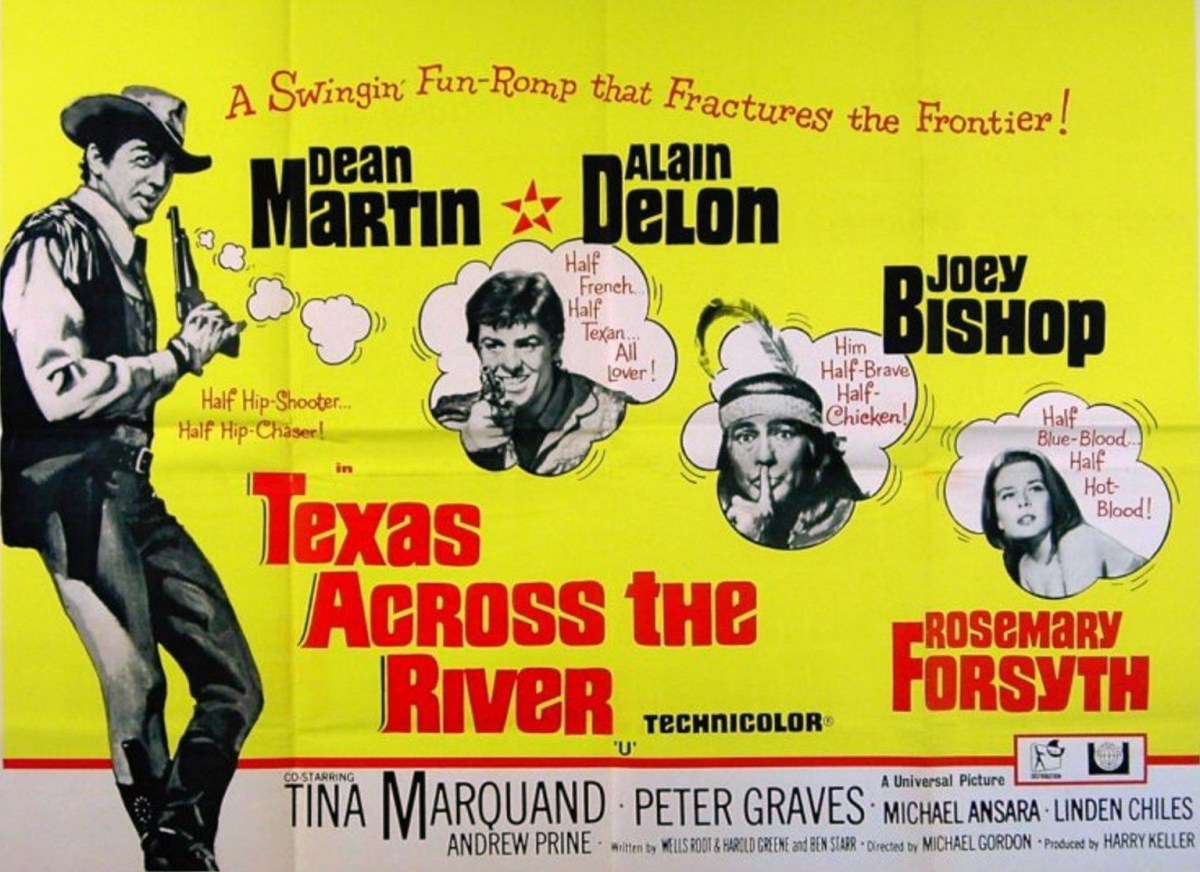
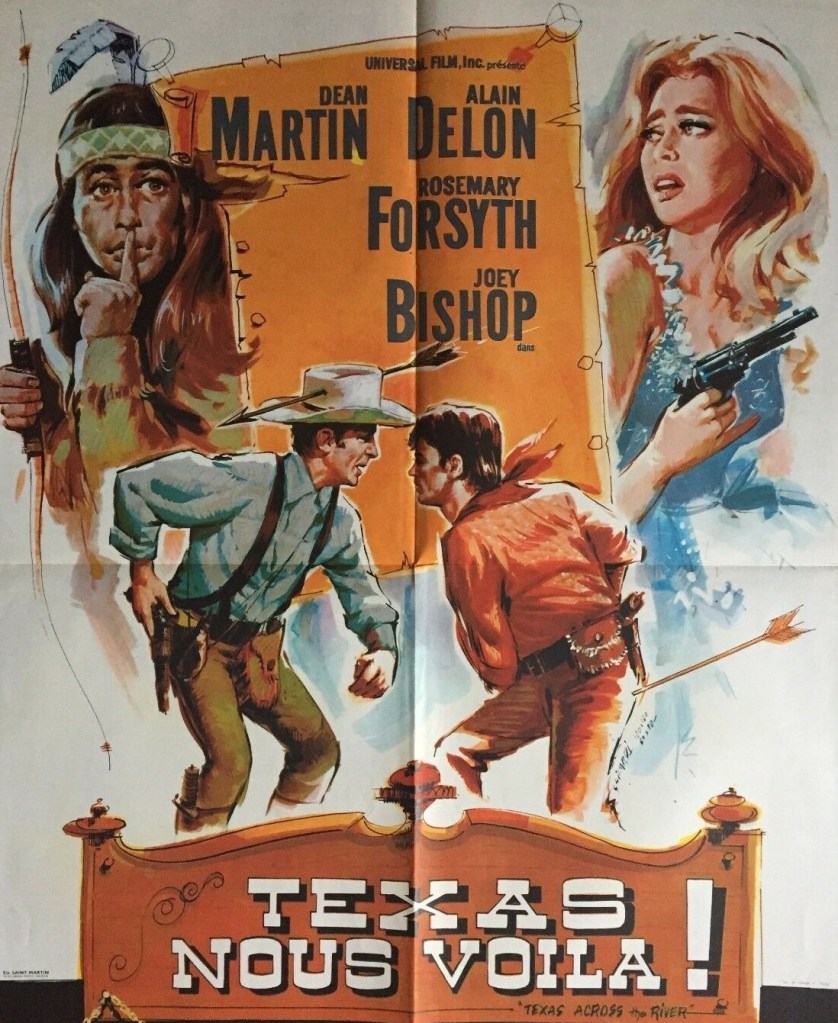
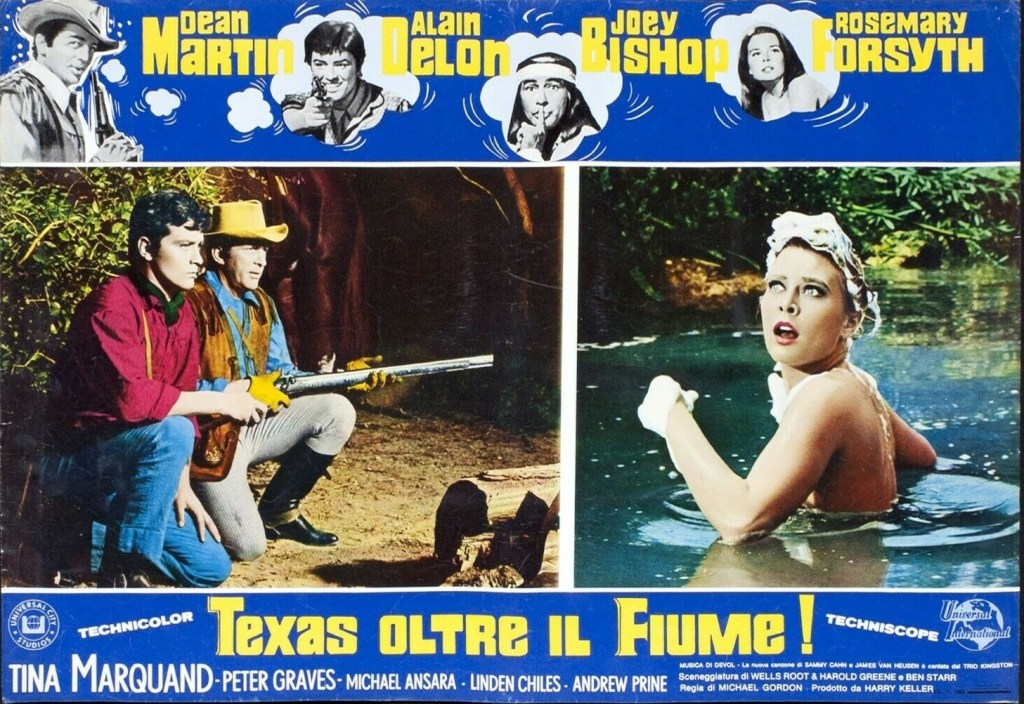
Texas Across the River (1966) ****

Excellent comedy western mixing dry wit and occasional slapstick to joyous effect. The wedding between Spanish duke Don Aldrea (Alain Delon) and Louisiana belle Phoebe (Rosemary Forsyth) is interrupted by her previous suitor Yancy (Stuart Cottle) who is killed in the resulting melee. Escaping to Texas, Don Aldrea’s marksmanship leads settler Sam (Dean Martin) to recruit him to help fight raiding Comanches. Romantic entanglement ensues when the Don rescues Native American Lonetta (Tina Marquand) and Sam has more than a passing interest in Phoebe.

It is so tightly structured that nothing occurs that doesn’t have a pay-off further down the line. Bursting with terrific lines – including a stinger of a final quip – and set pieces, it pokes fun at every western cliché from the gunfight, the cavalry in hot pursuit, and fearsome Native Americans to the snake bite and the naked bathing scene. Incompetence is the order of the day – cavalry captain Stimpson (Peter Graves) issues incomprehensible orders, chief’s son Yellow Knife (Michael Linden) cannot obey any.

The Don, with his obsession with honor and his tendency to kiss men on the cheeks, is a comedy gift. Despite his terrific head of hair, he is stuck with the moniker “Baldy” and every time he is about to save the day he manages to ruin it. Sam is the kind of guy who thinks he is showing class by removing his spurs in bed while retaining his boots. His sidekick Kronk (Joey Bishop), a mickey-take on Tonto, mostly is just that, a guy who stands at the side doing nothing but delivering dry observations.

Lonetta is full of Native American lore and has enough sass to keep the Don in his place. “What is life with honor,” he cries to which she delivers the perfect riposte, “What is honor without life?” Phoebe is a hot ticket with not much in the way of loyalty.

Two sequences stand out – the slapping scene (whaat?) and a piece of exquisite comedy timing when Sam, Phoebe and the Don try an iron out a complicated situation.

Good as Dean Martin (Rough Night in Jericho, 1967) is the picture belongs to Alain Delon (Once a Thief, 1965) and I would argue it is possibly his best performance. Never has an actor so played against type or exploded his screen persona. Delon was known for moody, sullen roles, cameras fixated on his eyes. But here he is a delight, totally immersed in a role, not of an idiot, but a man of high ideals suddenly caught up in a country that is less impressed with ideals. If he had played the part with a knowing wink it would never have worked.

Martin exudes such screen charm you are almost convinced he’s not acting at all, but when you compare this to Rough Night in Jericho it’s easy to see why he was so under-rated. Joey Bishop (Ocean’s 11) is a prize turn, with some of the best quips. Rosemary Forsyth (Shenandoah, 1965) is surprisingly good, having made her bones in more dramatic roles, and Tina Marquand (Modesty Blaise, 1966) more than holds her own. Michael Ansara (Sol Madrid, 1968) played Cochise in the Broken Arrow (1956-1958) television series. Under all the Medicine Man get-up you might spot Richard Farnsworth. Peter Graves of Mission Impossible fame is the hapless cavalry leader.

Director Michael Gordon (Move Over, Darling, 1964) hits the mother lode, the story zipping along, every time it seems to be taking a side-step actually nudging the narrative forward. He draws splendid performances from the entire cast, knowing when to play it straight, when to lob in a piece of slapstick, and when to cut away for a humorous reaction, and especially keeping in check the self-indulgence which marred many Rat Pack pictures – two of the gang are here, Martin and Bishop. There’s even a sly nod to Sergio Leone spaghetti westerns when the electric guitar strikes up any time Native Americans appear. Frank De Vol (Cat Ballou, 1965) did the score. Written by Wells Root (Secrets of Deep Harbor, 1961), Ben Starr (Our Man Flint, 1966) and Harold Greene (Hide and Seek, 1964).

Terrific fun.

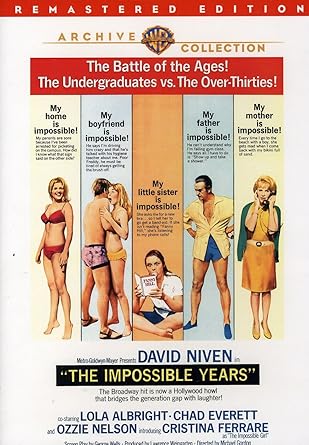
The Impossible Years (1968) ***

Generation gap comedy driven by unmentionables and the prospect of perplexed father getting more pop-eyed by the minute. By default, probably the last bastion of morality before censorship walls – the U.S. Production Code eliminated the following year – came tumbling down and Hollywood was engulfed in an anything goes mentality. Denial enters its final phase, quite astonishing the mileage achieved by not letting the audience in on what’s actually going on.  

Psychiatrist lecturer Jonathan (David Niven) finds his chances of promotion potentially scuppered after lissom teenage daughter Linda (Christine Ferrare) is arrested at a demonstration carrying a banner bearing an unmentionable word. That brings to the boil the notion that Linda may not be quite so sweet as she appears, Jonathan previously willing to overlook minor misdemeanors like smoking and speeding. But it turns out Linda may also have lost her virginity, that word also verboten, and may even be, worse, illegally married.

So the question, beyond just how manic her parents can be driven, is which male is her lover: the main candidates being a trumpet-blowing teenage neighbor and let) or laid-back artist hippie who has painted her in the nude.

Innuendo used to be the copyright of the Brits, in the endlessly smutty Carry On, series, but here the number of words or phrases that can be substituted for “sex” or “virgin” must be approaching a world record, but delivered with gentle obfuscation far removed from the leering approach of the Brits.

It’s a shame this movie appeared in the wake of bolder The Graduate (1967) because it was certainly set in a gentler period and its tone has more in common with Father of the Bride (1950). Setting aside that most of the adults, for fear of offending each other, can’t ever say what they mean, the actual business of a young woman growing up and demanding freedom without ostracising her parents is well done, Linda stuck in the quandary of either being too young or too old to move on in her life.

The scenes where that issue is confronted provide more dramatic and comedic meat than those where everyone is grasping, or gasping like fish, for words that mean the same as the other words they refuse to utter.

Parental issues are complicated in that Jonathan has set himself up as an expert on dealing with the problems growing children present. He views himself as hip when, as you can imagine, to  younger eyes, he’s actually square. And he’s also worried his younger daughter Abbey (Darlene Carr) will start to emulate her sibling.

Compared to today, of course, it’s all very innocent and I’m sure contemporary older viewers might pine for those more carefree times. It doesn’t work as social commentary either, given the rebellion that was in the air although it probably does accurately reflect how adults felt at confronted by children growing up too fast in a more liberal age.

David Niven (Prudence and the Pill, 1968) brings a high degree of polish to a movie that would otherwise splutter. He’s playing the equivalent of the stuffy Rock Hudson/Cary Grant role in the Doris Day comedies who always get their comeuppance from the flighty, feisty female. That fact that it’s father-and-daughter rather than mismatched lovers only adds to the fun. And there were few top-ranked Hollywood actors, outside perhaps of Spencer Tracy (Guess Who’s Coming to Dinner, 1967) who audiences would be interested in seeing play a father.

The unmentionable conceit wears thin at times but Niven and Cristina Ferrare (later better known as the wife of John DeLorean) do nudge it towards a truthful relationship. Former movie hellion Lola Albright (A Cold Wind in August, 1961) is considerably more demure as the Jonathan’s wife. Chad Everett (Claudelle Inglish, 1961) breezes in and out.

Although at times giving off a “beach party” vibe, it manages to examine the mores of the  time.

Director Michael Gordon has moved from outwitted controlling mother (For Love or Money, 1963) to undone controlling father without dropping the ball. It’s based on the Broadway play of the same name by Robert Fisher and Arthur Marx.

Lightweight for sure but worth it for David Niven and the sultry Ferrare.

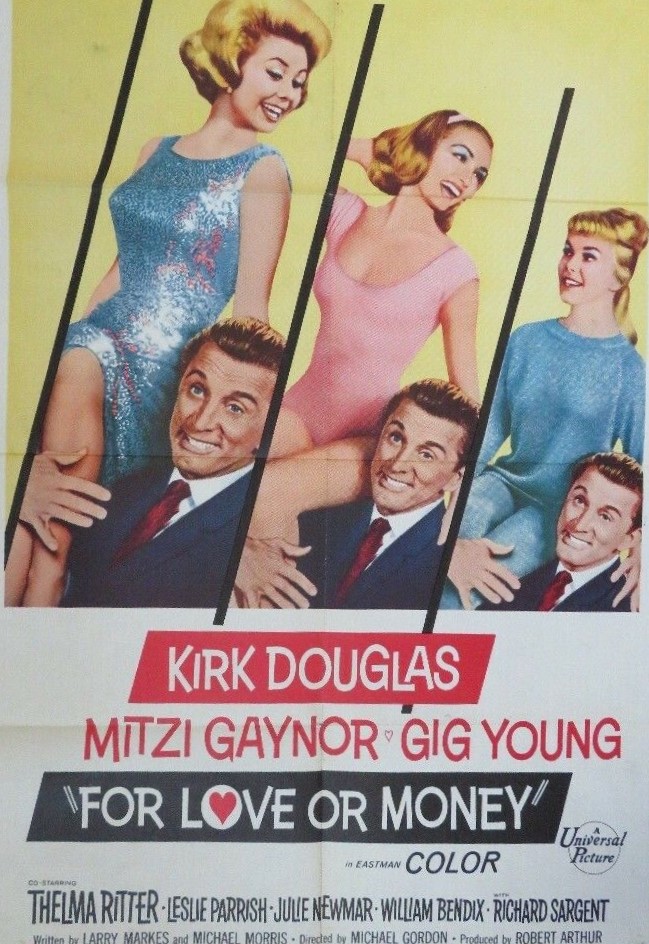
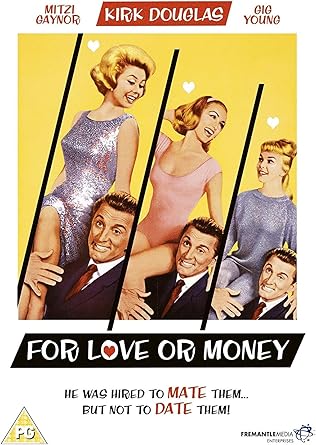
For Love or Money (1963) ***

Kirk Douglas (The Brotherhood, 1968) had been so intent on establishing his dramatic credentials as a Hollywood high flier that he hadn’t appeared in a comedy in six years when he was second-billed to Susan Hayward in Top Secret Affair (1957).  

So after all the sturm und drang of heavyweight numbers like Strangers When We Meet (1960), Spartacus (1961), and Lonely Are the Brave (1962) it was always going to be interesting to see if he could drop the commanding persona long enough to hit the laugh button. He’s helped by a screenplay that while suggesting he is in control shows him run ragged by a quartet of females.

Millionaire widowed mother Chloe (Thelma Ritter) hires singleton lawyer Deke (Kirk Douglas) for $100,000 – enough to pay off his debts –  as some kind of matchmaker, not given the task of finding suitable husbands for her daughters, but to make sure that trio of spoiled women get hitched to men chosen by her.

The plan is for the Kate (Mitzi Gaynor), the most organized, to marry rich playboy Sonny (Gig Young), health nut Bonnie (Julie Newmar) to take up with child love Harvey (Richard Sargent) and hippie art lover Jan (Leslie Parrish) to be landed with dull taxman Sam (William Windom). Sonny is Deke’s best friend, they share a yacht.

Nothing tuns out the way it should in part because Deke is more attractive than any of the other males on offer and in part because the heiresses are disinclined to do what anyone tells them. Deke spends all his time getting into hot water, dashing into another room to take phone calls that inevitably create further confusion, while manfully trying to ensure that the male suitors present their most attractive sides to their potential brides.

There’s not a great deal to it. It’s not exactly farce, but given the daughters live on top of each other, quite easy for Deke to race from one apartment to another, and say the wrong thing at the wrong time. The juggling act is never going to work out, especially as Kate is love struck by Deke, though if she could see how easily he flirts with her siblings she might be less keen. There’s finale on a boat or, should I say, in falling off a boat.

I wouldn’t say it’s a hoot but it’s an excellent lightweight concoction that comes to life by inspired casting. None of the women is your typical Hollywood fluff, all present interesting characters, leaders in their own ways, and with a lifetime of standing up to their domineering mother unlikely to fall over at the sight of any decent male.

Thelma Ritter (Boeing, Boeing, 1965) is easily the pick. The six-time Oscar nominee, generally seen in dowdy parts as a maid or similar, is dressed to the heavens, all glammed up as the millionairess without losing any of her trademark snippiness or drollery. Mitzi Gaynor (South Pacific, 1958), in her final screen role, has a well-written part as an efficient businesswoman and proves more than a match for Deke.

Julie Newmar (The Maltese Bippy, 1969) is a delight as the health nut whose physical demeanor is proof of her regime while Leslie Parrish (The Manchurian Candidate, 1962) bounces along with a coterie of artists.  Gig Young (Strange Bedfellows, 1965) can do this kind of role in his sleep but he’s no less effective for having acquired that skill of the guy who never gets the girl. And there’s a rare sighting of Hollywood tough guy William Bendix (The Blue Dahlia, 1946) in a comedy.

But none of this would work without Kirk Douglas. And it works because he plays it straight. He doesn’t give in to the temptation of mugging to the camera, eye-rolling and pratfalls. You could easily get the idea the actor thought he was in a drama, especially as he’s the one in the kind of quandary that we’ve seen him ignore before, when ambition trumps morality or romance, as with Ace in the Hole (1951) or Strangers When We Meet. In some senses, the casting relies on audiences being aware of that sneaky side of his screen persona, the one where he doesn’t always do the right thing. And here, you could easily see him opting for the loot over the girl.  

Director Michael Gordon (Texas Across the River, 1966) is adept at winkling out the comedic moments in stories that are played straight. The team of Larry Markes and Michael Morris (Wild and Wonderful, 1964) wrote the screenplay with the emphasis on situation comedy rather than farce.

Good, clean fun and great performances.

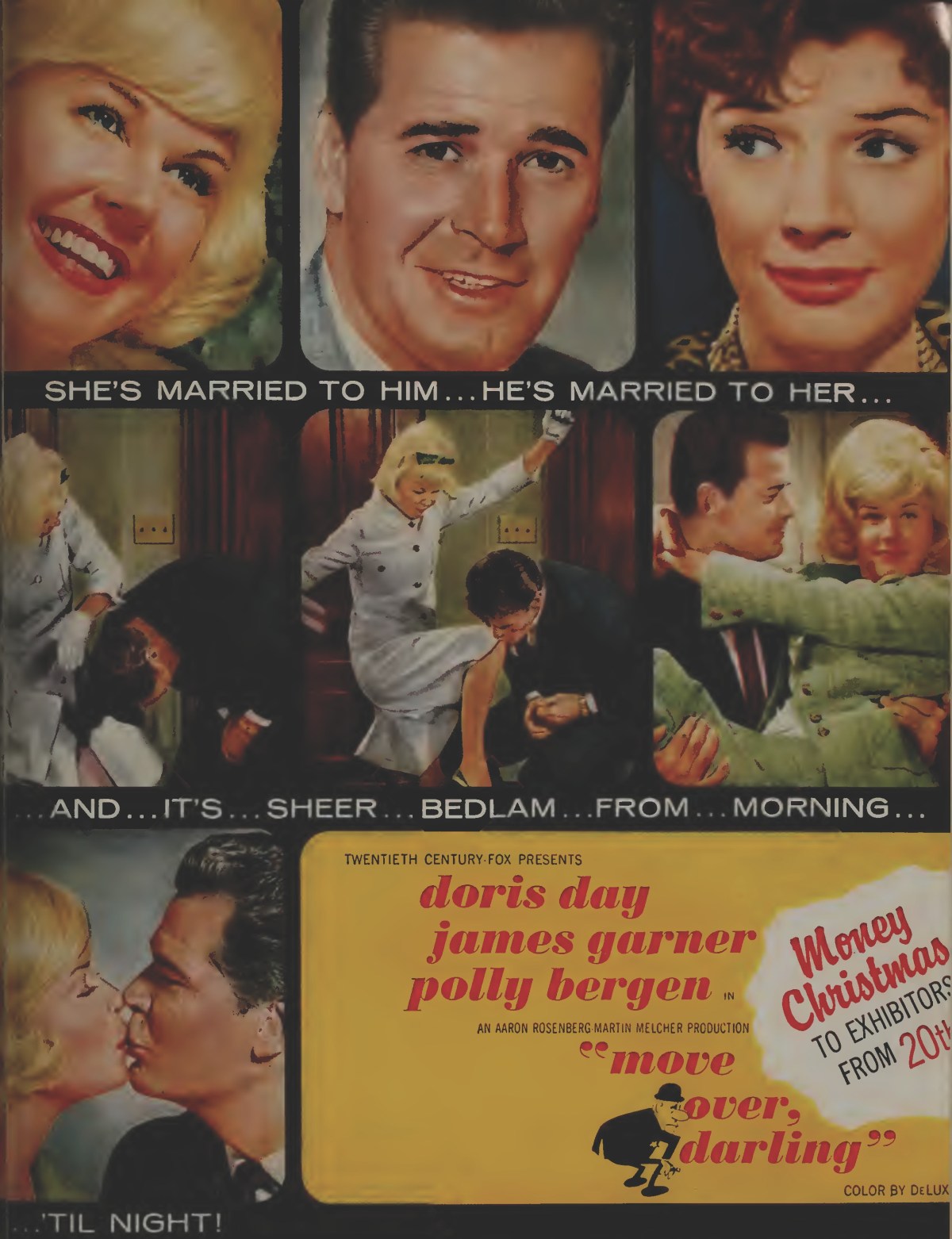
Move Over, Darling (1963) ***

Doris Day never quite replaced Cary Grant or Rock Hudson in her romantic comedy ventures. This is her second outing with James Garner – The Thrill of It All had appeared earlier the same year. Ironically, it’s based on a Cary Grant film, My Favorite Wife (1940) with Irene Dunne. Having been lost at sea for the requisite five years, this version kicks off with Day being pronounced legally dead in court to pave the way for Garner to marry Polly Bergen (Cape Fear, 1962). Naturally, she turns up on the day of their wedding and the first part of the movie is Garner trying to keep the women apart. Cue comic pratfalls, double takes, diving in an out of bedrooms, but Day and Bergen seem to be trying to out-screech each other. The idea of bigamy, scandalous at the time, has lost its power to shock.

While Day spent much of the picture in hysterics, I didn’t, and wished they had moved quicker to the complication which was that she had shared her desert island with a hunk (Chuck Connors). The pace picks up a bit after that as Day has to pretend that it was nerd (Don Knotts) with whom she was stranded while Garner knows the truth. There is some good reversal, her kids, who naturally don’t recognize her, complaining about her singing. A number of set pieces save the day – two court scenes with an exasperated judge (Edgar Buchanan), Day disguised as a Swedish masseuse giving Bergen a savage work-over and Day trapped in car wash.

Michael Gordon had helmed Pillow Talk (1959) but missed the mark here. Don Knotts, prior to his incarnation as The Incredible Mr Limpet (1964) show his potential as the shoe salesman recruited by Day to impersonate Connors. Accomplished comedienne Thelma Ritter holds back on the comedy instead playing a straight role as the meddling mother-in-law. Fred Clark as the alternately bemused and suspicious hotel manager gets the best of the double takes. Garner, unfortunately, has little opportunity to exhibit his sly sense of humor or the laid-style that worked a treat in Support Your Local Sheriff (1969).

Hal Kanter, who worked on the George Gobel and Milton Berle television shows and scripted Blue Hawaii (1961) fashioned the screenplay along with the more versatile and sometime director Jack Sher (Paris Blues, 1961).

When it was known as Something’s Got to Give, George Cukor was set to direct a cast that included Marilyn Monroe, Dean Martin, Cyd Charisse, Tom Tryon and Phil Silvers from a script by Nunnally Johnson and Walter Bernstein. Monroe had nixed working with Garner and Knotts. When Monroe was fired, Kim Novak and Shirley Maclaine refused offers to replace her. Dean Martin refused to continue without Monroe and although re-hired she died before production recommenced.

Discover WordPress

A daily selection of the best content published on WordPress, collected for you by humans who love to read.

The Atavist Magazine

by Brian Hannan

WordPress.com News

The latest news on WordPress.com and the WordPress community.