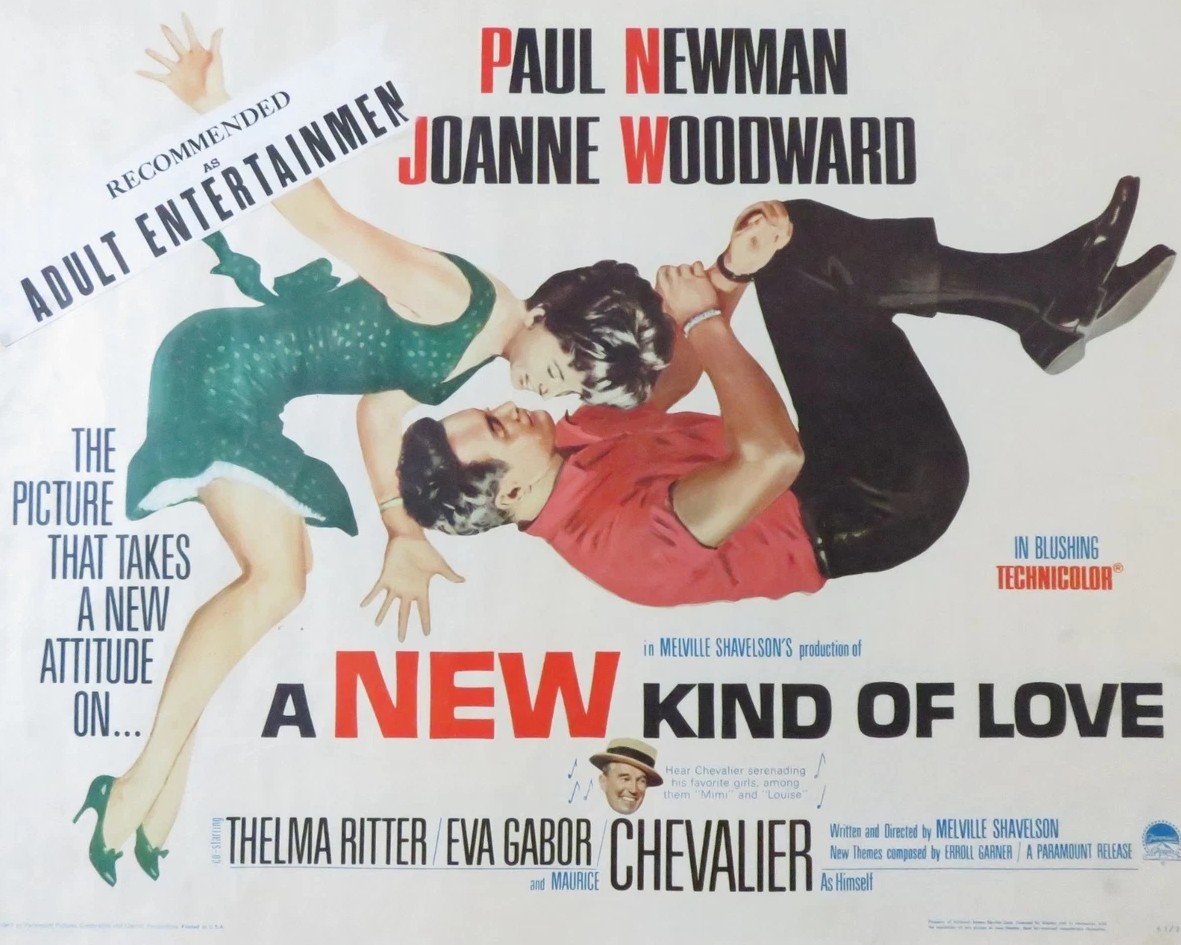
Just about scrapes by, small thanks to Paul Newman’s atrocious Texan accent, Joanne Woodward’s frightful blonde wig – more Lady Penelope than classy Parisian – and Maurice Chevalier serenading a horde of drunken women. Maurice Chevalier? Well, of course this is Paris and Chevalier always sings regardless of being peripheral to the story.
Suffers, too, from being a smart-ass picture, in the vain hope of hitting the satirical bullseye taking swipes at everything in sight, from women barging into a sale to haute couture, airline stewardesses, journalism and even Paris. And there’s a string of fantasy sequences that might (or might not) have worked at the time but fail to gell now. Takes forever for the principals to even be brought close enough together to envisage romance and it doesn’t help that that supposedly most eagle-eyed of creatures, the reporter, can’t see through a simple disguise.
Tomboy Sam Blake (Joanne Woodward) is a pirate. Not the swashbuckling kind, leaping through the rigging, which would be worth seeing I’m sure, but the industrial kind, stealing the designs of better designers for a New York department store.
Steve Sherman (Paul Newman) is piratical, stealing other people’s wives. When his latest conquest turns out to be married to his boss, he is shifted off to Paris as – punishment? Yep, you can see the awry thinking behind this one.
Meanwhile, Sam and a gang from her store, boss Joe (George Tobias) and colleague Lena (Thelma Ritter), are off to Paris on a spying expedition to the annual fashion shows. Lena has her eyes on romance with the boss but is beaten to that prize by the glamorous Felicienne (Eva Gabor). Sam isn’t interested in romance. She’s a career woman, or in the parlance of the day, a “semi-virgin” (though I suspect that description was a screenwriter’s invention). Neither is Steve, for that matter, at least not of the long-lasting kind, he’s happily tearing around with a woman on each arm, enjoying the more nefarious sights of the French capital while Sam is knee deep in work.
After Sam gets a makeover, complete with long cigarette-holder Lady Penelope style, resulting in the bouffant hair style and is sitting in a café, she is approached by Steve who, assuming she is a high-class courtesan, attempts to interview her for the article he hopes will save his job. They’ve bumped into each other, she disdaining his obvious approaches, a couple of times but then she was rigged out in a short haircut and dark glasses. And this is such a complete transformation he doesn’t recognize her. And, in order to make this movie work, the audience has to play along.
As does Sam, keeping up the pretense of being a high-class hooker in order to get her revenge on the man she despises. The fictions she dishes up, of dalliances with powerful men, are published in his column and their success ensures he’s not fired. Felicienne is edged out of the way, revealed as previously a sex worker, so Lena can make her play for Joe.
Before that ploy can work, Steve sets up Sam with Joe who sees through the disguise. There’s a whole bundle of other unlikely shenanigans before we reach the compulsory happy ending.
Hollywood was fairly enamored with the sex worker or goodtime girl – Never on Sunday (1960), Butterfield 8 (1960), Irma La Douce (1963), for example, with the Oscars chipping in to show their support – and another (yes, this had been done before) comedic twist seemed to offer potential especially with two big stars going all risqué.
Paul Newman (The Prize, 1963) never quite worked out how to manage comedy until Butch Cassidy and the Sundance Kid (1969) where he maintained his usual persona and just delivered the lines rather than trying to wring laughs out of them. He also has a bad habit of trying to demonstrate character by fidgeting, so his face, eyes and hands are all over the place.
Joanne Woodward (A Big Hand for the Little Lady/ Big Deal in Dodge City, 1966) is better value initially but when she takes on the disguise there’s too much of the knowing wink. Six-time Oscar nominee Thelma Ritter (Boeing, Boeing, 1965) has a better idea of how to play comedy by just sticking to the knitting.
Writer-director Melville Shavelson (The Pigeon That Took Rome, 1962) just about makes it work and when it doesn’t throws in sufficient distraction.
Charlton Heston was as hot as they come. He was coming off what would prove one of the biggest pictures of all time – and tucked away an Oscar as well – with Ben-Hur (1959) and followed it up with another hit El Cid (1961). He had no shortage of offers. He had pulled out of The Comancheros (1961), part of proposed three-picture deal with Twentieth Century Fox but with an unknown director rather than veteran Michael Curtiz who later helmed it with John Wayne. He had turned down Let’s Make Love (1960) with Marilyn Monroe and a remake of Beau Geste to co-star Dean Martin and Tony Curtis.
He entered into discussions with Nicholas Ray to film the bestseller The Tribe That Lost Its Head (never made) and The Road of the Snail (never made), rejected William the Conqueror (never made) and Cromwell (1970). He was turned down in turn by Otto Preminger for Advise and Consent (1961). “Zanuck’s man called from Paris,” he notes, “they have a new role for me in The Longest Day (1962).” That was another false lead.
In due course he signed up for Easter Dinner for producer Melville Shavelson (Cast a Giant Shadow, 1966) released as The Pigeon That Took Rome (1962). By this point he was being pursued by Samuel Bronston. “I had no idea how determined Sam was to have me follow El Cid with another film for him.” Bronston eventually got his wish. “No sooner had I turned down The Fall of the Roman Empire (1964) than they shoved it back a year on their schedule and began work on 55 Days at Peking (1963), converting the enormous and half-built set representing Rome into an equally enormous and even more beautiful set representing Peking.”
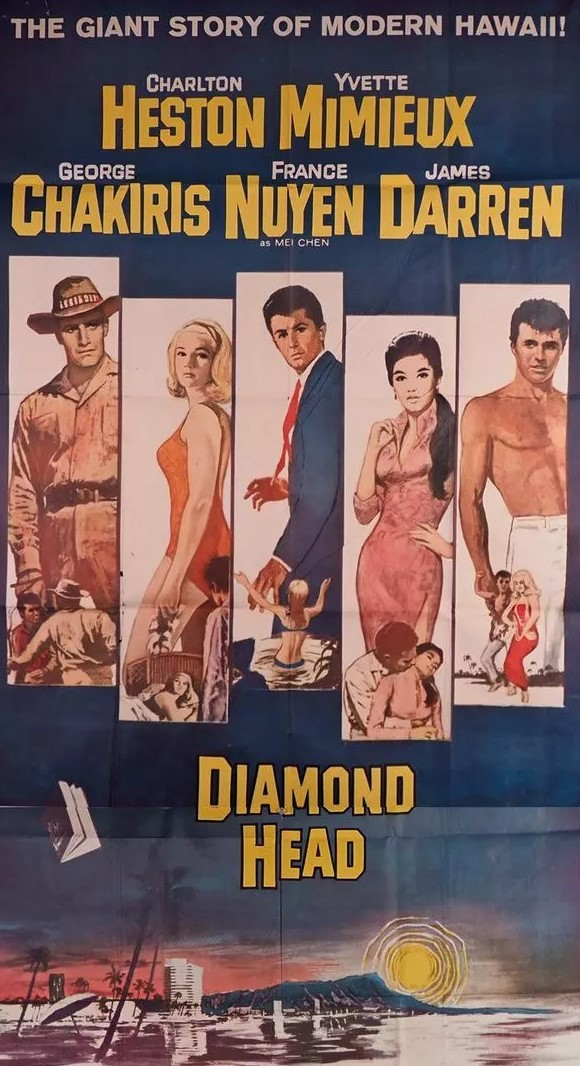
But that meant delay while the massive Bronston machine kicked into gear. In the meatime Heston was “attracted a bit by the opening pages” of Diamond Head with Columbia. “A good part in an overwritten and melodramatic script,” he observed, concluding, “If it’s treated with great care, it might work out all right.”
The project moved along apace. A couple of weeks after receiving the script in December 1961, he was in London meeting director Guy Green (Light in the Piazza, 1962) and producer Jerry Bresler, “an amiable man” though Sam Peckinpah might beg to differ after his experiences on Major Dundee, 1965. “He seems a very intelligent fellow,” Green observed, but queried, “how could a man refer with pride to the fact he had made a film called Gidget Goes Hawaiian?”
George Chakiris (hot after West Side Story, 1961) was already fixed as second male lead and Yvette Mimieux (Light in the Piazza) was being chased for female lead. She wasn’t available but Heston wasn’t keen on second choice Carroll Baker. Luckily, it turned out Mimieux could do the picture. “On the basis of what we saw in Light in the Piazza, she’s ideal for the part.”
But Heston reckoned the script needed work. He was also disgruntled with the costumes for Diamond Head, complaining, “Why is it designers like to costumes instead of clothes? It’s a grievous fault in a period film, but there’s no excuse in a modern story.”
By March, a few months after committing to the picture, he was out in Hawaii, on the island of Kauai, though the trip itself was not without incident, Heston “sick enough to call a doctor.” They were met with unseasonal rain. They were assured this was very unusual. But it wasn’t. In consequence, the first day’s filming was scrapped, filling the actor with the conviction “the whole project was doomed.” It was another three days before filming commenced – the shoot was plagued with rain.
While Heston was impressed enough with the director (“Guy Green works carefully and thoughtfully”) he was distracted by the lighting.
“Those brutes and reflectors loom larger in my mind…One of the banes of my career has been acting in exterior locations with arc lights and reflectors focused in my eyes, which are very light sensitive. (Dark-eyed actors have an unfair advantage, I’ve always felt.) Most people have no idea of the dimensions of this problem. They always ask you how you can remember the lines…they should wonder instead how you can concentrate on the scene when your every nerve is straining simply to keep your eyes open.” Negotiation with the cinematographer ameliorated the situation.
Similarly, Heston found the director responsive to his concerns. For a key scene with Mimieux, he believed “we can both do better” and taking this on board the director agreed on a reshoot the next day. “I have to project Howland’s need to be loved, though he conceals it. You can’t play this, of course, but it has to be in the scene, in the whole film, if we’re going to bring it off.”
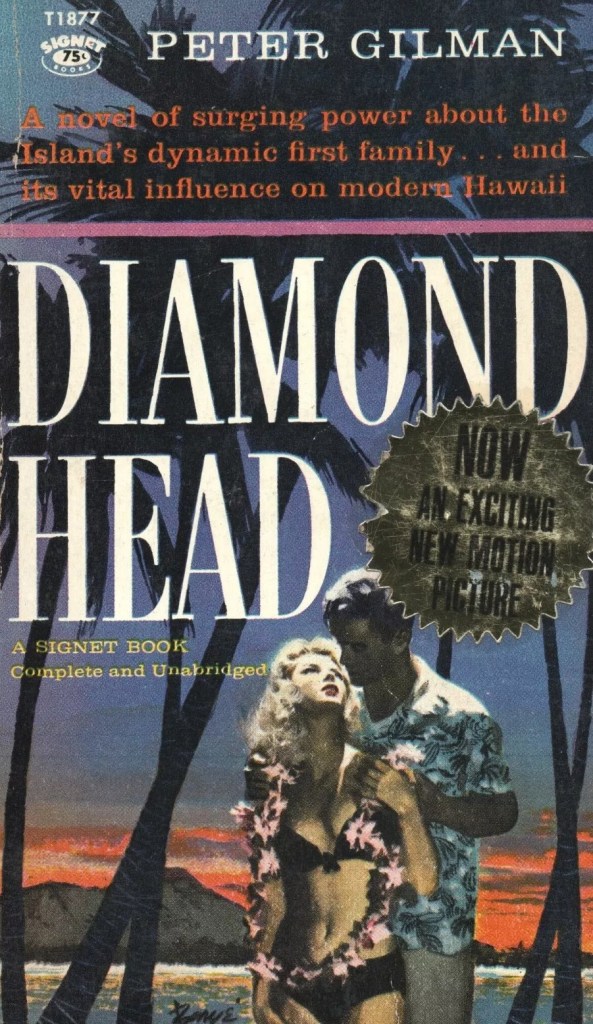
As well as a multitude of media – Hawaii at this stage still a rare location, public interest boosted by the publication of James Michener’s Hawaii in 1958, and to a lesser extent, Diamond Head, a more modest bestseller. Swelling the ranks of visitors to the set was John Ford, obliquely sounding Heston out for an unspecified film, possibly Young Cassidy (1965).
Another issue proved to be the horse-riding. While Heston was an accomplished rider, others were not. “Anxious horse-riding…makes for anxious acting.” Even so, Heston found his mount “harder to handle than I figured.”
Heston’s last day of work was May 18. “I waited round most of the day to do one piddling shot from the dream. No dialog, just my face looming up out of the fog. It’s hard to tell what I think now except that I’m still high on Green. He may have made a film that rises above the melodramatic qualities of the script. He didn’t push me as hard as I should be pushed, but he gave me a lot all the same.”
It was October before Heston viewed the completed picture. His verdict: “Diamond Head looks very slick, smooth, not terribly real, and as though there might be some money in it.” Ever the critic, he added, “I have acted better.”
I’ve mentioned in other Blogs the part played by foreign markets in a star’s appeal – Clint Eastwood and Charles Bronson both owed their breakthroughs to foreign box office. Turns out that Heston was in the same league, though an established name when first discovering the size of his fan club abroad.
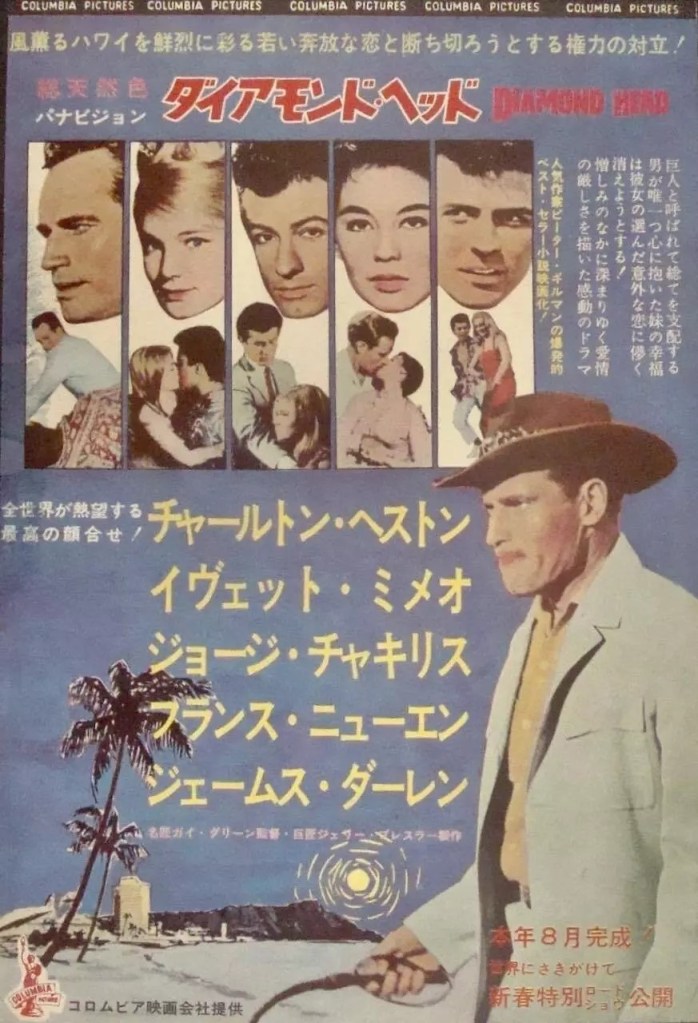
“My films did invariably well in the Far East and throughout Southeast Asia. Films that flopped elsewhere did fairly well, those that were hits elsewhere did incredibly. The fact that this pattern has continued unchanged accounts in no small degree for my continued viability in films.” Apparently, this was because he represented the Confucius virtues of responsibility , justice, courage and moderation. As if to emphasize his overseas appeal, Diamond Head opened first in Japan, in December 1962.
SOURCES: Charlton Heston, The Actor’s Life, Journals 1956-1978 (Penguin, 1980).
Netflix would know how to sell this. Append the “based on a true story” credit and you’ll attract a global audience. I’ve no idea how true this tale is though I assume that at certain points in war using a pigeon may have been the most efficient method of communication. If this had been under the Netflix aegis there would surely have been a scene to explain that you can’t just point the bird in any old direction but that it automatically returns to its home, that aspect being pivotal to the movie, the reason it was made in the first place.
That is, if you believe in the rather fanciful notion, as shown in what appears to be an official newsreel, of said pigeon being presented with a medal for its part in the Allied invasion of Rome in World War Two. Luckily, there’s more to this picture than the intricacies of homing pigeons.
Not much more, I hasten to add, because the other significant plot point, which I suspect has a more substantial basis in truth, is that passing American soldiers had a tendency to impregnate (and abandon) Italian women. If you were to argue that Elsa Martinelli (who had just put John Wayne in his place in Hatari!, 1962) is what saves the picture you wouldn’t be far wrong. But you can’t complain about Hollywood churning out lightweight movies in the 1960s since a chunk of the current output falls into that category.
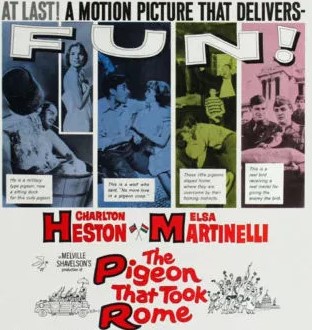
For no apparent reason, no espionage experience for example, Yank soldiers Capt MacDougall (Charlton Heston) and Sgt Angelico (Harry Guardino) are delegated to sneak into Rome, disguised as priests, and spy on the Germans. They are put up in the household of Massimo (Salvatore Baccaloni), an underground figure, but his daughter Antonella (Elsa Martinelli) takes against the pair since they are extra mouths to feed and if only the Americans would hurry up and enter the city the populace wouldn’t be starving. However, she makes nice when her sister Rosalba (Gabriella Pallotta) reveals she is pregnant by a previous Yank (whether he was the espionage business, too, is never revealed) and is desperate need of a husband.
The sergeant is quite happy to romance the girl since a couple smooching in the park makes good cover for him transmitting messages by radio. And when that form of transmission becomes too dangerous, the Americans rely on pigeons. Soon Angelico realises his feelings for Rosalba are real and proposes to her, even after she reveals her condition. But that means celebration to announce their forthcoming nuptials.
Short of any food, Antonella slaughters the pigeons, convincing MacDougall that the meal consists of squab. To cover up, the Italians steal a bunch of pigeons from the Germans. Of course, as you’ll have guessed, that means the pigeons will return to the enemy. But once MacDougall works this out, he starts sending the Germans false messages that prove (apparently) pivotal to the Germans hightailing it out of the city (hence the medal awarding).
Pretty daft and inconsequential sauce to be sure, but Antonella keeps matters lively, knocking back MacDougall at every turn, taking every opportunity to condemn men for starting wars, and presenting herself as something of a conniver, possibly willing to lead on the Germans in return for food (MacDougall when burglarizing a German villa comes across her naked in the shower). Her occasional swipes give the picture a harder edge than you’d expect, but, her fiance killed in the war, she leads MacDougall a merry dance in the manner of the romantic comedies of the day. Otherwise, the comedy is for the most part lame, the old hitting your thumb with a hammer one such moment.
Despite co-starring with Wayne and here Heston and later Robert Mitchum (Rampage, 1963), Martinelli didn’t fit into the Hollywood pattern of taking European stars and slotting them into the female lead opposite a succession of top male stars. Think Sophia Loren with Heston in El Cid (1961), with Gregory Peck in Arabesque (1966) and with Marlon Brando in The Countess from Hong Kong (1967) and headlining a few pictures on her own. Gina Lollobrigida led Rock Hudson by the nose in Come September (1961) and Strange Bedfellows (1965) and Sean Connery a merry dance in Woman of Straw (1964).
Martinelli seemed to fade too quickly from the Hollywood mainstream which was a pity because she’s the glue here. Charlton Heston (Number One, 1969) spends most of the time looking as if he wondered how he managed to allow himself to be talked into this. You want to point the finger, then Melville Shavelson’s (Cast a Giant Shadow, 1966) your man – he wrote, produced and directed it.
By this point in her career Sophia Loren was adopted by Hollywood primarily as a means of rejuvenating the romantic screen careers of much older male stars. John Wayne was over two decades her senior in Legend of the Lost (1957), Frank Sinatra and Gregory Peck nearly two decades older in The Pride and the Passion (1957, and Cary Grant a full three decades in Houseboat (1958). But where Grant was sprightly enough and with superb comic timing and Loren had the charm to make Houseboat work, the May-December notion lost much of its appeal when translated to her Italian homeland and an aging Clark Gable.
While engaging enough, the tale mostly relies on a stereotypical stuffy American’s encounters with a stereotypical down-to-earth Italian although Loren adds considerable zap with her singing-and-dancing numbers. Lawyer Michael Hamilton (Clark Gable), in Italy to settle his deceased brother’s affairs, discovers the dead man has left behind eight-year-old boy Nando (Marietto) being looked after in haphazard fashion and in impoverished circumstances in Capri by his aunt Lucia (Sophia Loren), a nightclub singer. Determined to give the boy a proper American education, Hamilton engages in a tug-of-war with Lucia.
In truth, Lucia lacks maternal instincts, allowing the boy to stay up till one o’clock in the morning handing out nightclub flyers and not even knowing where the local school is. Hamilton is in turns appalled and attracted to Lucia, in some part pretending romantic interest to come to an out-of-court settlement. To complicate matters, Hamilton is due to get married back home.
At times it is more travelog than romantic comedy, with streets packed for fiestas and cafes full well into the night, a speedboat ride round the glorious bay, another expedition under the majestic caves, a cable car trip up the cliffs to view spectacular scenery, and the local population enjoying their version of la dolce vita. But the piece de resistance is Lucia’s performance in the nightclub, ravishing figure accompanied by more than passable voice as she knocks out “Tu vuo fa L’Americano” (which you might remember from the jazz club scene in The Talented Mr Ripley, 1999). She has a zest that her suitor cannot match but which is of course immensely appealing.
Lucia is torn between giving the boy a better start in life, already insisting for example that he speak English, and holding on to him while street urchin Nando is intent on acting as matchmaker. Most of the humor is somewhat heavy-handed except for a few exceptional lines – complaining that he cannot sleep for the noise outside, Hamilton asks a waiter how these people ever sleep only to receive the immortal reply: “together.”
Gable lacks the double-take that served Cary Grant so well and instead of looking perplexed and captivated mostly looks grumpy. But this is still Gable and the camera still loves him even if he has added a few pounds. He was by now a bigger global star than in the Hollywood Golden Era thanks in part to regular reissues of Gone with the Wind (1939) but mostly to a wider range of roles and he was earning far more than at MGM, in the John Wayne/William Holden league of remuneration. Loren was the leading Italian female star, well ahead in Hollywood eyes of competitors Claudia Cardinale and Gina Lollobrigida, and had the skill, despite whatever age difference was foisted upon her, of making believable any unlikely romance. Here, zest and cunning see her through. Vittorio De Sica (The Angel Wore Red, 1960) has a scene-stealing role as an Italian lawyer with an eye for the ladies.
Director Melville Shavelson (Cast a Giant Shadow,1966) thought he had cracked the problems of the older man-younger girl romance having shepherded Houseboat to box office glory . While this picture doesn’t come unstuck it is nowhere near Houseboat. This turned out to be Gable’s penultimate film, not quite the fitting reminder of a glorious career, and he died shortly after its release. While Loren trod water with this picture she was closing in on a career breakthrough with her Oscar-winning Two Women (1960).
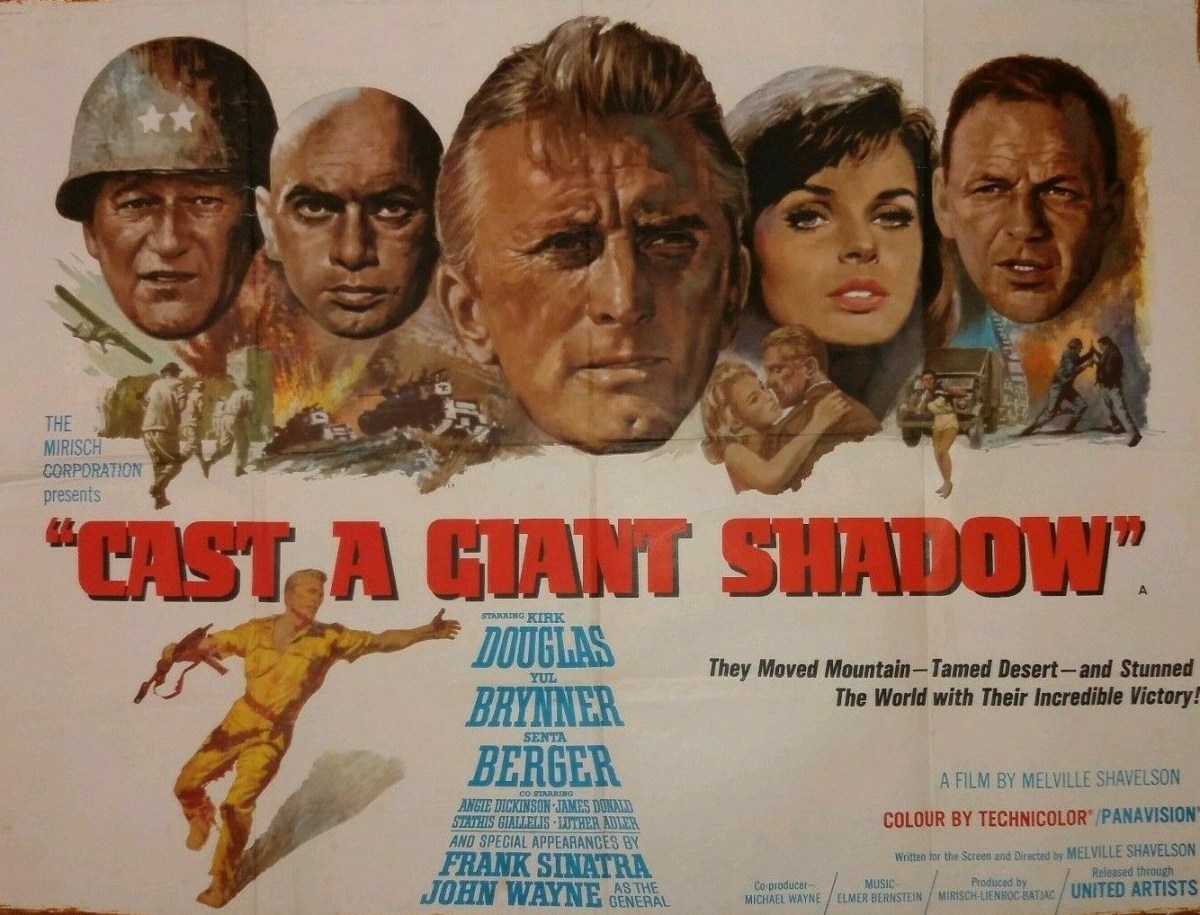
If recruiting John Wayne is essential to getting your new picture off the ground, it would help not to have fallen out with him big-style previously. After every studio in Hollywood had turned down Cast a Giant Shadow, writer-producer-director Melville Shavelson turned to the Duke. The only problem was the pair had hit trouble on football picture Trouble All the Way (1953) should take.
In his capacity as producer of Trouble All the Way, Shavelson, also co-writing the screenplay, had given Wayne one version of the script while behind his back instructing director Michael Curtiz to shoot a different version with subsidiary characters that would change the film’s plotline. When Wayne found out, Shavelson was the loser. When you make an enemy of John Wayne, it takes a lot to win him back as a friend.
After that debacle, Shavelson had gone on to win some kudos and occasional commercial success as a triple hyphenate on pictures like Houseboat (1958), It Started in Naples (1960) and A New Kind of Love (1963) with top-ranked performers in the vein of Cary Grant, Sophia Loren, Clark Gable and Paul Newman. When Shavelson pitched to Wayne the story of Cast a Giant Shadow, about the birth of Israel and based on the bestselling biography of Mickey Marcus by Ted Berkmann, the star’s response was: “That’s the most American story I ever heard.” Wayne was hooked on the idea that America had helped Israel achieve its independence and that top American soldier Colonel Mickey Marcus had died in the process.
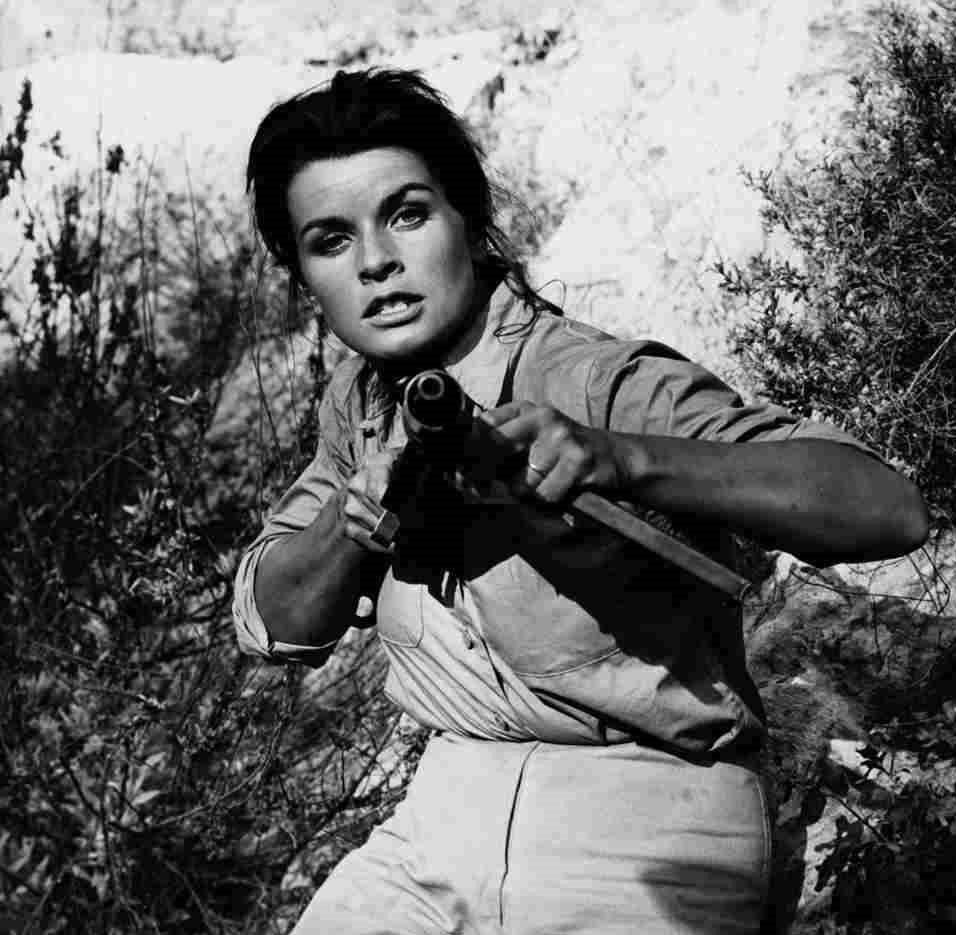
Senta Berger as the gun-toting Magda.
Wayne’s potential involvement came with a proviso – he had script approval. And while Shavelson owned the rights to the book, he didn’t have a screenplay. Nor, with his background as a writer being primarily concerned with comedy, did he consider himself best suited to the job.
He had, however, written a treatment. In his eyes, a treatment was not just about encapsulating the story, but about selling it to a studio. So his first few paragraphs included references to box office behemoths Lawrence of Arabia, The Guns of Navarone and Bridge on the River Kwai – planting in the minds of potential backers the notion that this film was headed down the same route of substantial profit – and a reference to an “American of heroic proportions…with the ability to love,” the latter being code for sex.
But in the end he wrote the screenplay as well. Wayne put his imprimatur on the picture in more ways than one. Part of the deal was that his production outfit Batjac become involved, with son Michael in line for a co-producer credit. Shavelson managed to snag Kirk Douglas for the starring role only by giving up part of his own salary to meet the star’s fee. Douglas and Wayne, with the credit ranking reversed, had starred together in In Harm’s Way (1965).
It was Douglas who insisted his character’s role be change from passive to active. Shavelson invented an American general for John Wayne and a female Israeli soldier (Senta Berger) for Douglas – in reality his character was a married man – to have an affair with. “I’m introducing a fictitious romance into the film with the full consent of Marcus’s widow,” Shavelson told Variety, though it’s doubtful that real-life wife Emma Marcus went along so merrily with this notion.
It wasn’t only Wayne who demanded script approval. The Israeli government, with whom cooperation was essential to guarantee the use of troops and equipment, had made the same condition. The Israelis worried that the film would fall into the usual Hollywood trap and to that extent the government insisted that the picture not end up as a “an Errol Flynn Burma stunt” – a reference to Objective Burma (1945), originally banned in London for Americanizing the film. The government spelled it out: “Col Marcus didn’t win our war, he just helped.” But the production was offered “further facilities than normal.” Two sound stages – the first in the country – were being built in Tel Aviv.
Shavelson was shown military locations that no other civilian had ever seen. When the Israelis did “approve” the script it was with the proviso that 31 changes were made including the deletion of the “sex-starved woman” (Senta Berger), although in reality Shavelson got away with his vision intact.
When the film went ahead it had a crew of 125 plus 800 Israeli soldiers, 1,000 extras and 34 featured players including Yul Brynner, Frank Sinatra, and Angie Dickson. Only some of the film was made in Israel. The interiors for the Macy’s department store were built in Rome, along with the concentration camp sequence, one of the battles, and scenes set in Coney Island that were edited out from the final picture.
The biggest problem was the supply of soldiers and equipment at a price the production could afford. Shavelson was being charged twice as much for the soldiers as the producers of Judith (1966). It took the intervention of the Israeli Prime Minister for sensible negotiation to get under way and for prices to drop to a tolerable level. Neither was it possible to film on the original battle sites in Israel since they were basically in a no man’s land, covered in barbed wire and littered with mines.
Principal photography began on May 18, 1965, in 115 degree heat – so hot the film buckled in the cameras – at the fortress of Iraq Suidan to recreate the Battle of Latrun. Shavelson had been denied permission to access the Latrun fortress itself which stood across the Jordanian border even though the engagement had been an Arab victory. To keep the sun off his face, Kirk Douglas decided to wear an Australian Army forage cap, and it did the job so successfully he kept it on for the entire movie.
On another location – this time when the temperature reached 126 degrees – a $40,000 Panavision camera exploded filming too close to a tank-muzzle firing, the jeeps got vapor lock, three soldiers were wounded by dummy bullets and the charging tanks vanished after the first take when their commander received new instructions from his army superiors.
Shavelson had met Sinatra some years before when he and scripting partner Jack Rose had helped write the Inaugural Gala organized by the singer in honor of President John F. Kennedy. Using that connection and the fact they shared the same agent, Sinatra, who had a pilot’s license, agreed to play a two-day role as a Piper Cub aviator dropping seltzer bottles on tanks. When filming began Shavelson discovered that what he had imagined was his own inspired invention turned out to be close to the actual truth. To write the score, Elmer Bernstein visited Israel to conduct his own research.
He also discovered the real reason for Sinatra’s eagerness to be involved. His salary had been donated to set up the Frank Sinatra Arab-Israeli Youth Centre in Nazareth. Actually, there was another less noble reason for Sinatra signing up. He had begun an aviation business, Cal-Jet Airways, supplying planes to Hollywood, and clearly thought appearing as a pilot in a picture would help promote the new company.
However, when filming of his scenes began Sinatra proved unintelligible. He had taken the script at face value and thought he was playing a Texan and delivered his lines with a Texan accent. Eventually, Sinatra was persuaded to play it with his own normal voice. But Sinatra could only be filmed in the plane on the ground since his insurance didn’t cover him being in the air unless accompanied by a co-pilot.
By the time they came to film the immigrants’ landing scene the picture was already half a million dollars over budget. With the country enjoying full employment and nobody inclined to take time off to work in the blazing sun as an extra, the 800 extras were in reality all newly arrived immigrants – and therefore unemployed – from Hungary, Rumania, Poland, Russia and Czechoslovakia.
The only item that was lacking to complete the landing scene was a ship offshore, but the owners were asking too much money. Instead, the director came up with the idea of a “glass shot.” An artist had painted in smoke billowing from the funnels, but it was blowing in the wrong direction from the wind. The solution – a double-exposure job in the lab – cost as much as hiring the ship.
Once the production headed home, Shavelson discovered that virtually all the sound recordings made in Israel were unusable. Frank Sinatra and Kirk Douglas re-recorded their dialog in Hollywood, Yul Brynner and Senta Berger in London and dozens of Israeli students attending Los Angeles universities were called upon to replicate background Hebrew voices.
For prestige purposes, the movie was launched at the end of March 1966 as a restricted roadshow, just three cinemas in New York – the DeMille in the Broadway area, the Fantasy Theater in Long Island and Cinema 46 in New Jersey. Douglas employed a helicopter to fly from venue to venue. The first wave of first run houses followed in Baltimore, Philadelphia, San Francisco and Miami.
Most of the promotional activity centered on the true story of Mickey Marcus but in London, where the character was unknown, United Artists took the gimmick route, placing an advert in The Times newspaper calling for “giant men” standing over six foot seven inches tall. Expecting to find 25 such giants, they ended up with 100 attending the British premiere, the tallest seven foot three inches. In keeping with this gimmicky approach, tickets for the first performance were also a king-sized twelve inches by nine inches.
SOURCES: Melville Shavelson, How To Make a Jewish Movie, W.H. Allen, 1971; “Wayne To Co-Produce, Star in Israeli War Pic,” Variety, May 27, 1964, 2; “We’ll Lift Part of Local Expenses, Israeli Offer to UA,” Variety, July 1, 1964, p3; “Kirk Douglas Set to Star in Cast a Giant Shadow,” Box Office, March 8, 1965 pW-2; “Batjac Productions Moves to Paramount Lot,” Box Office, March 29, 1965, pW-2; “Shavelson Aim on Mickey Marcus Film: Realism,” Variety, March 31, 1965, p25; “WB-Sinatra Film in October; Sinatra’s Aviation Firm,” Box Office, August 23, 1965, 6; “Elmer Bernstein to Israel for Film Music Research,” Box Office, October 18, 1965, pW-3; “Cast a Giant Shadow Set for 3 N.Y. Roadshow Dates,” Box Office, December 6, 1965, pE3; “Kirk Douglas To Helicopter to All 3 Shadow Openings,” Box Office, March 28, 1966, pE-7; “Cast a Giant Shadow set in 14 Key Centers, April 6-8,” Box Office, April 11, 1966, p6; “Small Ad Brings 100 Giant Men to London Opening of United Artists’ Cast a Giant Shadow,” Box Office, October 3, 1966, pA3.
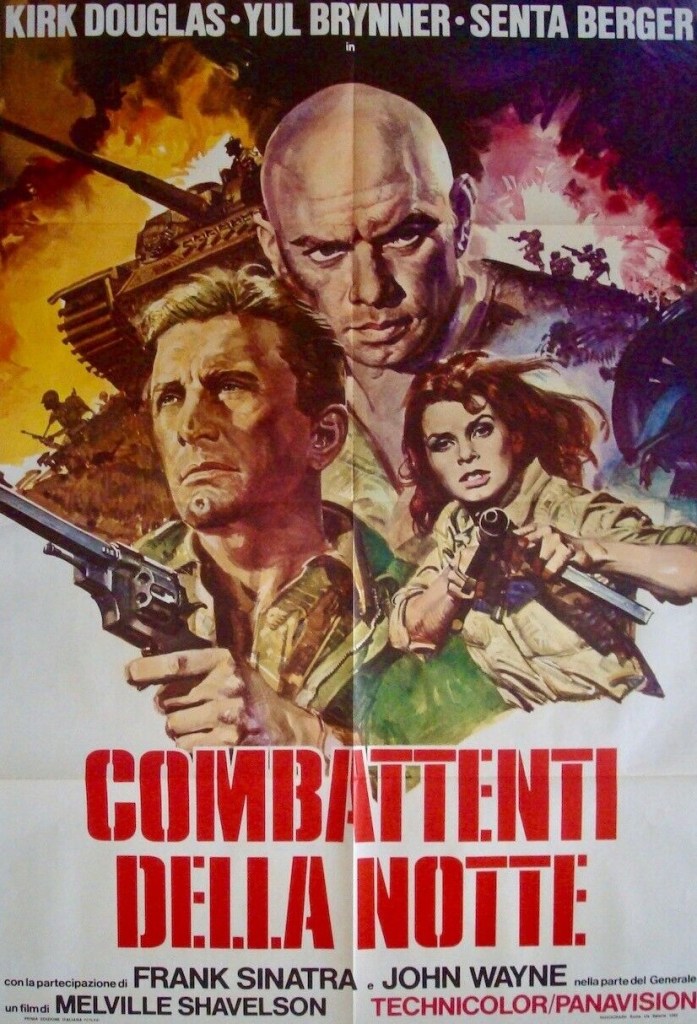
In some respects a sequel to the film Exodus (1960) as Israel, on the eve of independence in 1948, prepares to repel invasion from neighboring Arabs. Colonel Mickey Marcus (Kirk Douglas) is recruited to help organise the Jewish forces even though he has little actual combat experience, having sat out the Second World War behind a desk until D-Day, and having already resumed his legal career.
To facilitate entry to Palestine, he is met at the airport by Magda (Senta Berger), herself a soldier, pretending to be his sister. The journey from the airport in armored bus reveals the perilous reality of the situation, the vehicle strafed as they pass through towns. He finds a rabble of a fighting force, lacking in weaponry, disorganised, and made up of various groups at each other’s throats, and focused on defense rather than attack. Initially, Marcus is strictly an advisor, writing training manuals until he encourages a commando raid and is eventually, at the behest of Asher (Yul Brynner) put in complete command of all the units, effectively the country’s first general.
In the background, General Mike Randolph (John Wayne) is helping organise support in the United States to recognise Israel’s independence. Marcus organises a campaign to lift the siege of Jerusalem, first through direct attack, but then through an incredible foray into impassable mountains, building the “Burma Road,” equivalent in the tactical sense to Lawrence of Arabia’s trek through the desert to attack Aqaba.
A fair bit of the early part of the picture is flashback to establish Marcus’s military credentials, which are scant, in sum total no more than a week of active combat, and it would have been better to concentrate on why he was recruited in the first place, because of the name the real-life Colonel had made for himself in organizing the war crimes trials in Germany.
Apart from the action and military politics, the drama concerns Marcus abandoning wife Emma (Angie Dickinson) in New York, embarking on a romance with Magda and establishing a sense of identity with his adopted country. The action is particularly good, audacity the Israeli’s major weapon.
It is mostly through Magda that we view the Jewish experience. She married Andre (Michael Shillo) in order to save his life, although she did not love him. A veteran of many skirmishes, she suffers a breakdown when trapped in her vehicle during one particularly vicious battle. In what is possibly the most imaginative scene in the film, when Marcus encourages her to keep driving her stalled truck with cries of “Come on, Magda,” in cruel torment the surrounding Arabs take up the cry until it echoes round the hills. Once she falls for Marcus, of course, she never knows if he will return safe from battle.
Kirk Douglas (A Lovely Way to Die, 1968) leads mostly with his chin, never letting subtlety get in the way of his performance, but given the character assigned he has little option and is nonetheless effective as a leader and believable as a man torn between wife and lover. Senta Berger (Major Dundee, 1965) has never been better (or not so far in the films thus reviewed) with a meaty role that shows soldiering from a female perspective in a country where sacrifice is a given.
John Wayne (The Undefeated, 1969) has a small role as a grumpy general and Frank Sinatra (The Naked Runner,1967) a cameo as a commercial pilot who finds himself dragged into the war. Angie Dickinson (Fever in the Blood, 1961) is the long-suffering wife and singer Topol (Sallah, 1964) has a small role. The smattering of Brits includes Michael Hordern (Khartoum, 1966), Gordon Jackson (Danger Route, 1967), Jeremy Kemp (The Blue Max, 1966) and James Donald (The Great Escape, 1963).
Melville Shavelson wouldn’t be your first choice for an action picture given he made his name with comedies like It Started in Naples (1960), but does a fair job of directing, especially the action, the “Come on, Magda” scene and the confrontation with the British when immigrants land. He wrote the screenplay based on the biography by Ted Berkman.






 The Magnificent 60s