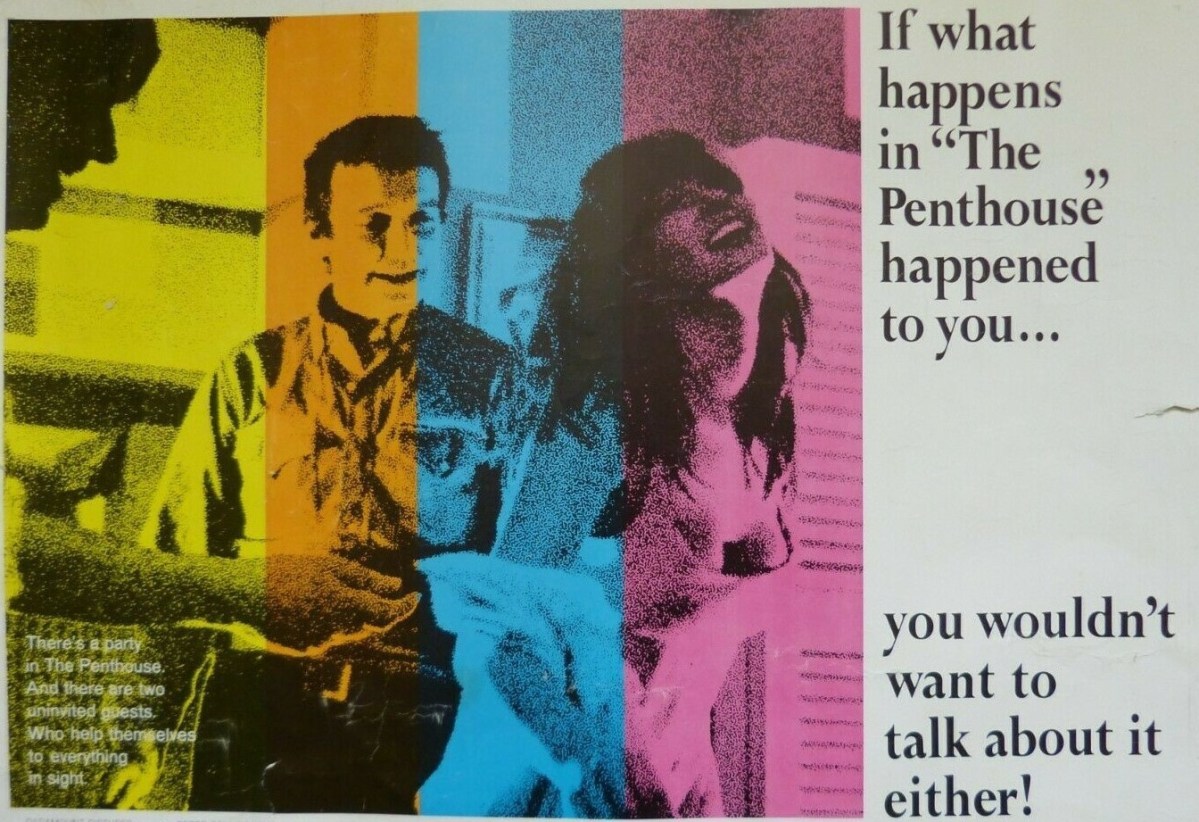
The Penthouse (1967) ****

Visceral home invasion thriller that ignited the genre and triggered later more controversial offerings like The Straw Dogs (1971) and A Clockwork Orange (1971). Made virtually on one set for the indescribably minute sum of £100,000, it is charged with Pinteresque dialog and aberrant philosophy. The genre splits into those pictures where the occupants have more than a good chance of avoiding their fate, the focus on the invaded pitting their wits against the invaders – classic examples being The Straw Dogs or more recently Panic Room (2002) – and those where the victims are mercilessly tormented, such as, in grueling detail, here.
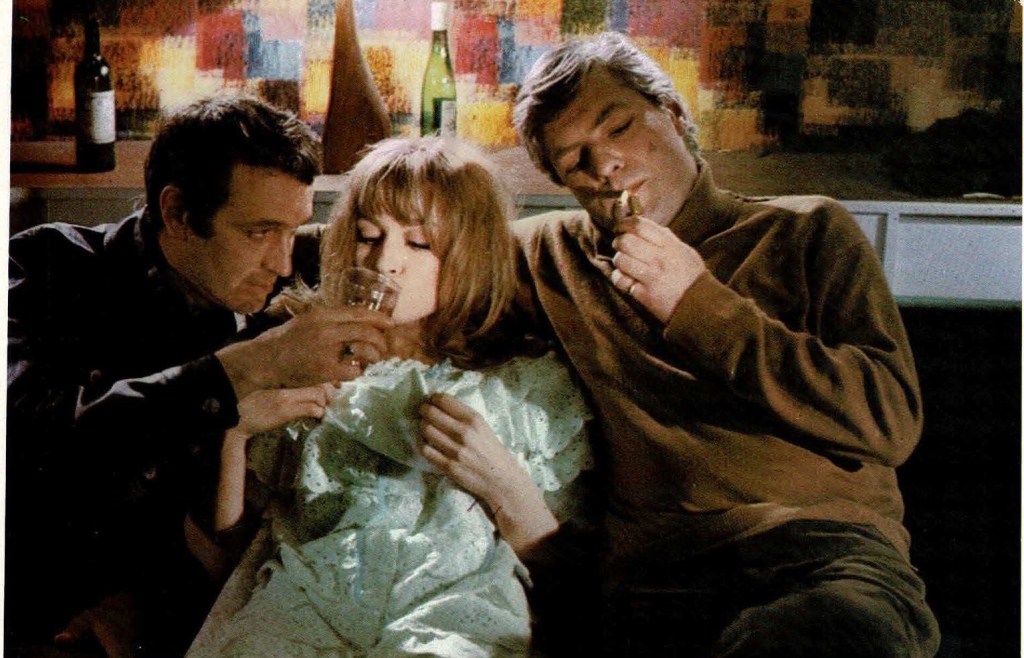
As one of the perks of his job cocky married real estate agent Bruce (Terence Morgan) takes advantage of an expensive unoccupied apartment on his company’s books – “in the happy position to take advantage of my clients’ generosity in their absence” as he puts it – to enjoy an illicit tryst with mistress Barbara (Suzy Kendall). But when she answers to the door to two men coming to read the gas meter, their lives are turned upside down.

Tom (Tony Beckley) and Dick (Norman Rodway) are, of course, bogus and armed with a knife quickly take control, trying up Bruce and pouring alcohol down Barbara’s throat. As part of the overall creepiness, there is a sense that this is no casual visit, but that it has been planned, as if someone somewhere is familiar with the set-up, and there a debt, if only a moralistic one, to pay as a deterrent to the era’s permissiveness. Minus the knife, they would have passed as harmless. But never was their such difference between word and action, except for what they are capable of you could easily be persuaded that are in fact camp and bitchy.

The bound Bruce’s is spun round in a chair and can only watch as the men begin to strip Barbara. His only defence is verbal, trying to set the two men against each other, suggesting that Tom treats Dick as his assistant. But the relationship between the two criminals constantly shifts as if they were in passive-aggressive relationship. You don’t learn much about them until the end, so basically you have to rely on what they say about themselves, which is very little. They are prone to philosophic observation or interrogate Bruce about his possessions or extract from Barbara an unexpected ambition to be a painter.
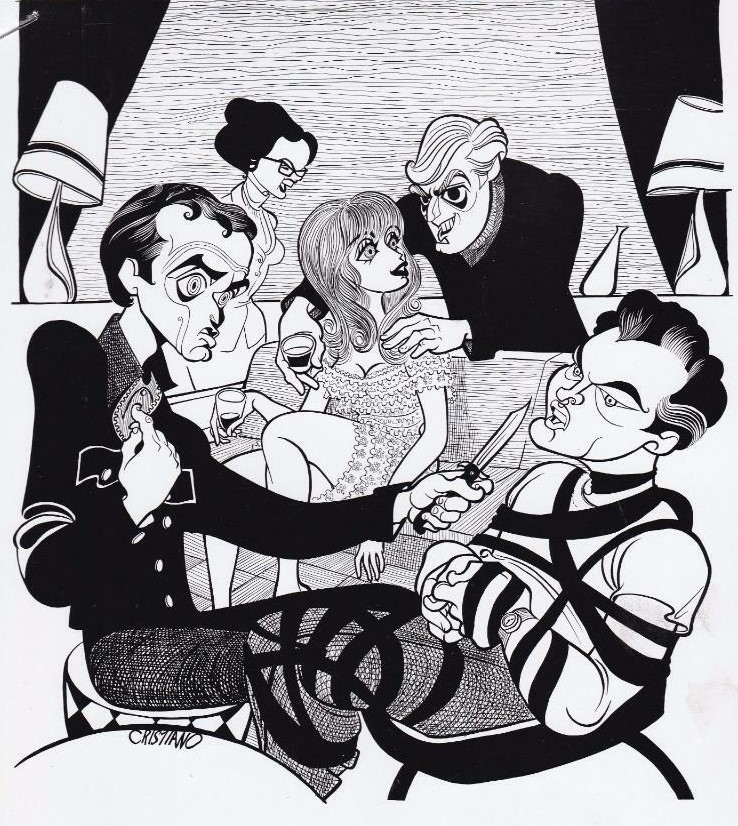
One of the oddest pieces of promotional material ever produced. Studios were keen on this kind of jokey cartoon in the hope that it would be picked up by newspaper editors who might be less inclined to run a still from the picture. But it is completely out of touch with the tone of the movie.

The men take it in turns to torment Bruce while the other is in the bedroom with Barbara. Where Bruce resists verbally, Barbara gives in almost right away, but there is never the sense that this is in any way consensual, just that she is too drunk to defend herself – the first drink is a full glass of whisky forced down her throat – and the men have a knife. The invaders make constant reference to a character called Harry. That person’s eventual appearance provides a whole new range of twists.

It’s a film full of menace. Sexual tension, mind games, claustrophobia and the threat of physical violence never dissipate. Because it is rationed out, the brutality is all the more shocking.  But it is brilliantly directed. In his debut British director Peter Collinson (The Italian Job, 1969) uses the camera to suggest we are in anything but an enclosed space. In one long sequence the camera does not move, in another scene it turns 360 degrees – Antonioni’s use of this device in The Passenger (1975) was credited as innovative – and at other times it twists and turns as if turning the characters inside out, suggesting some of the dizziness, the dramatic speed of change of feelings, that the stunned victims are enduring. At times it feels like an arthouse movie. At other times like a deranged B-picture.

The cast are all excellent. Tony Beckley (The Lost Continent, 1968) makes the best of a role of a lifetime, Norman Rodway (Four in the Morning, 1965) the more quietly psychotic sidekick. Terence Morgan (The Sea Pirate, 1966) has less to do but Suzy Kendall (Fraulein Doktor, 1969) is superb as the enigmatic girlfriend. Look out for Martine Beswick (Prehistoric Women, 1967) in a small part. Collinson wrote the screenplay based on a play The Meter Men by Scott Forbes.

Cultural note: “Tom, Dick and Harry” are considered such quintessentially British names that anyone familiar with this would understand immediately that they were a) pseudonyms and b) intended as a twisted kind of joke.

No sign of this being available on Amazon. Ebay is probably your best bet. There’s a copy on YouTube but it ain’t a good print.
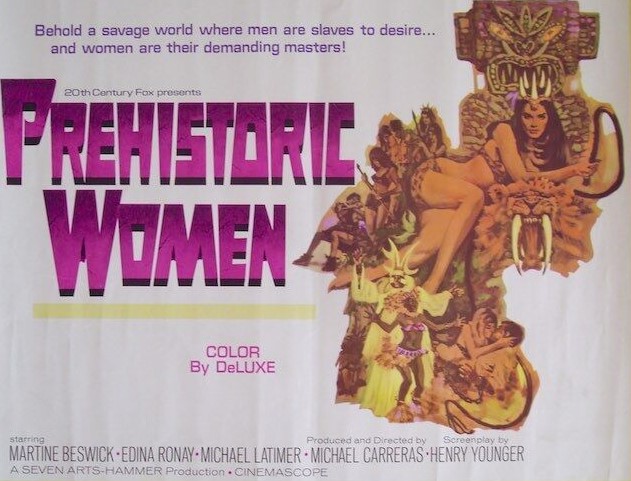
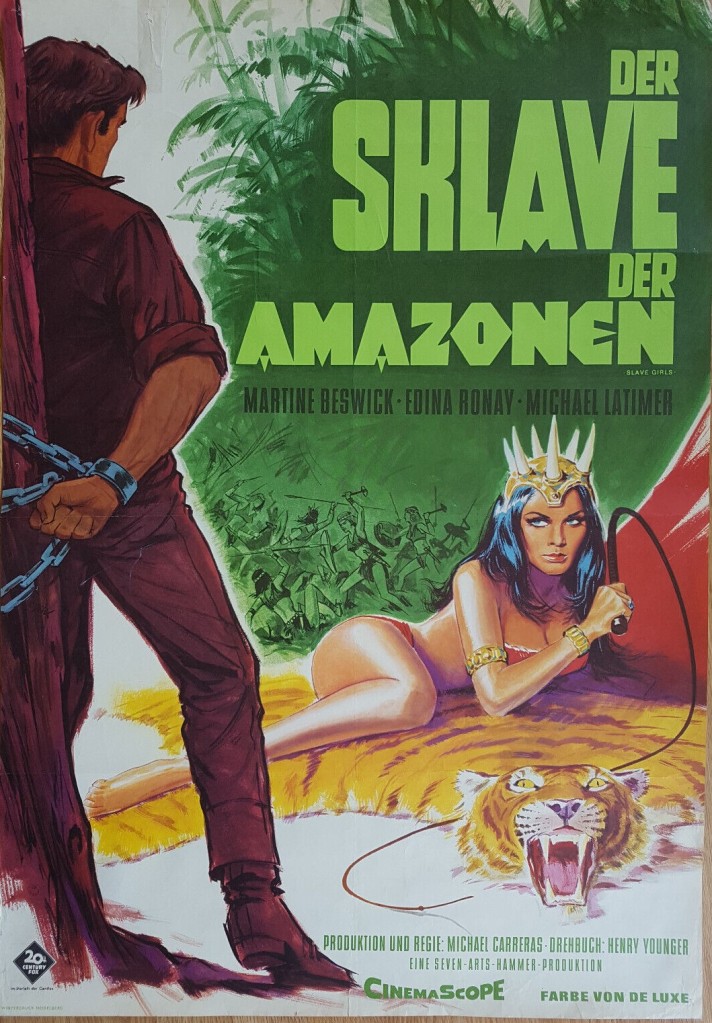
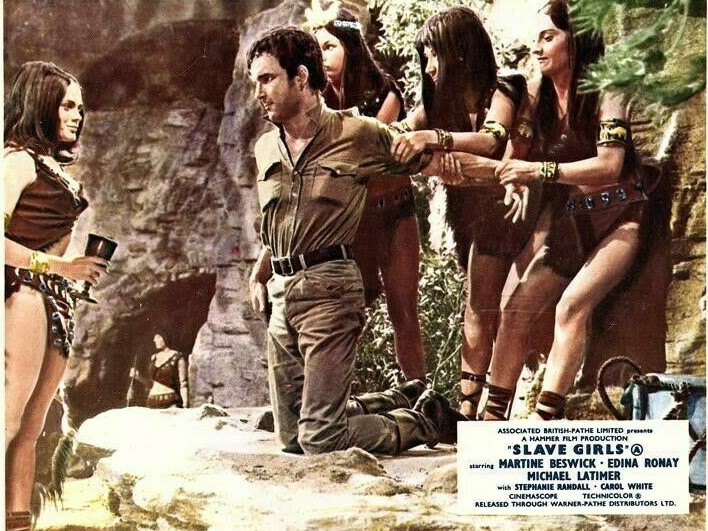
Prehistoric Women / Slave Girls (1967) ***

Can a dash of feminism rescue campy trash? Or even a genetics overload? Or is it enough to wonder what career hole Carol White (Never Let Go, 1960) found herself in to end up here? Or should we just sit back and watch the Pan’s People-style choreography and admire the astute re-use of all those bikinis left over from Hammer’s previous venture into this territory, the much more successful One Million Years B.C. (1966). Whatever, there’s no escaping the wooden acting and the one-note direction.

Dennis Wheatley (The Fabulous Valley, The Lost Continent, They Found Atlantis) and C.S. Lewis for that matter had the knack of transporting characters back in time or into other worlds. There’s usually some routine artefact, door or whatnot, that allows access to an amazing kingdom, or, in this case, queendom.

Here, big game hunter David (Michael Latimer), about to be sacrificed to some pagan African god, instead finds himself thrown back in time, chasing bewitching blonde Saria (Edina Romay), who, unfortunately is on the run, so when she is apprehended, so is he. Queen Kari (Martine Beswick) takes him as her lover. But he’s less keen, repulsed by her harsh rule. When one of her subjects rebels, the queen doesn’t delegate the task of bringing her into line but takes her on mano-a-mano. David, put to work with the other male prisoners, soon plots his escape.  

Setting aside the expected mumbo-jumbo – the tribe worships a mythical white rhino (phallic symbol anyone?) for example – if you want to extract anything more from this, there are fresh fields to plunder. For example, brunettes, such as Kari, are in control, but only after rebelling against the blondes who had subjugated the black-haired women in similar fashion as Kari. As well as having a female ruler, the movie makes a relatively pertinent point that gender scarcely comes into it when a dictator imposes such harsh conditions on their subject, Kari, for example, making the blondes eat off the dirt.

I’m not convinced the irony is deliberate. David, scion no doubt of Victorian nobility who made their pile from scarcely paying their downtrodden peasants a living wage, and who goes around shooting leopards, is hardly in a position to ask the queen to cool it. When she even considers giving him some equality – a big role reversal right there – he wants her to treat everyone in a nicer fashion.

The movie had an unsual history. Made quickly after “One Million Years B.C.” it was released in the U.S. as “Prehistoric Women” in 1967 but flopped so it was heavily cut, re-titled “Slave Girls” and sent out in 1968 in the UK as the support to “The Devil Rides Out.” The new title is a bit of misnomer because her kingdom is as full of slave men. The girls refers to the blondes. It was released in the U.S. in February 1967 by Twentieth Century Fox and managed a tie-in in one city with Cara Nome perfume. Actually, U.S. grosses were not as bad as have been reported – a “good” $25,000 in first run in Detroit, second only to “Grand Prix” there for the week, and decent enough openings in Boston, Minneapolis and San Francisco.

And she has the insecurity of Napoleon, needs to be loved, and not in mercenary fashion, and willing to attempt some form of rudimentary seduction if that’s what it takes to tempt the suddenly high-principled David into her bed. There’s an element of upending the Gentlemen Prefer Blondes trope, as though brunettes have always hankered after putting those ditzy blondes in their place.

Hammer lost sight of the fact that One Million Years B.C. owed as much to Ray Harryhausen as the statuesque temptations of Raquel Welch in a fur bikini and in its haste to cash in on that film’s big box office rushed into production a movie minus the battling dinosaurs. Although, of course, they could merely be making historical amends, since everyone knows dinosaurs and man (never mind women in fur bikinis) did not co-exist. And possibly ignored the fact that the puny Michael Latimer was no substitute for the brawnier John Richardson of the previous picture.   

If you’re not so interested in gender politics, you can always enjoy the dancing, which appears to take up a disproportionate amount of time (well, all those bikinis, need to be used). I was disappointed to discover the choreography was not the work of Flick Colby of the legendary BBC TV Top of the Pops dance troupe, but by one Denys Palmer, an actor it appears, whose main claim to fame was appearing in a classic Dr Who episode.

This was triple-hyphenate job, so blame Michael Carreras (The Lost Continent, 1968) for the screenplay and the direction and for taking on the production duties, or praise him for seeding a campy knock-off with issues that register more strongly today.

This was intended to be a big step-up for Michael Latimer but he was so charisma-free that he didn’t score another movie credit until low-budget British B-picture Man of Violence (1970). Martin Beswick (The Penthouse, 1967) never got another shot at a top-billed role. Carol White did better, next up was Poor Cow (1967) and from there it weas a small step to Daddy’s Gone A-Hunting (1969), but she doesn’t stand out here the way she did in Never Let Go (1960). If anyone stole the show it was Edina Ronay, and much good it did her, her next outing was in the lamentable Three (1969).

A curiosity, half-rubbish, half-interesting.

Discover WordPress

A daily selection of the best content published on WordPress, collected for you by humans who love to read.

The Atavist Magazine

by Brian Hannan

WordPress.com News

The latest news on WordPress.com and the WordPress community.