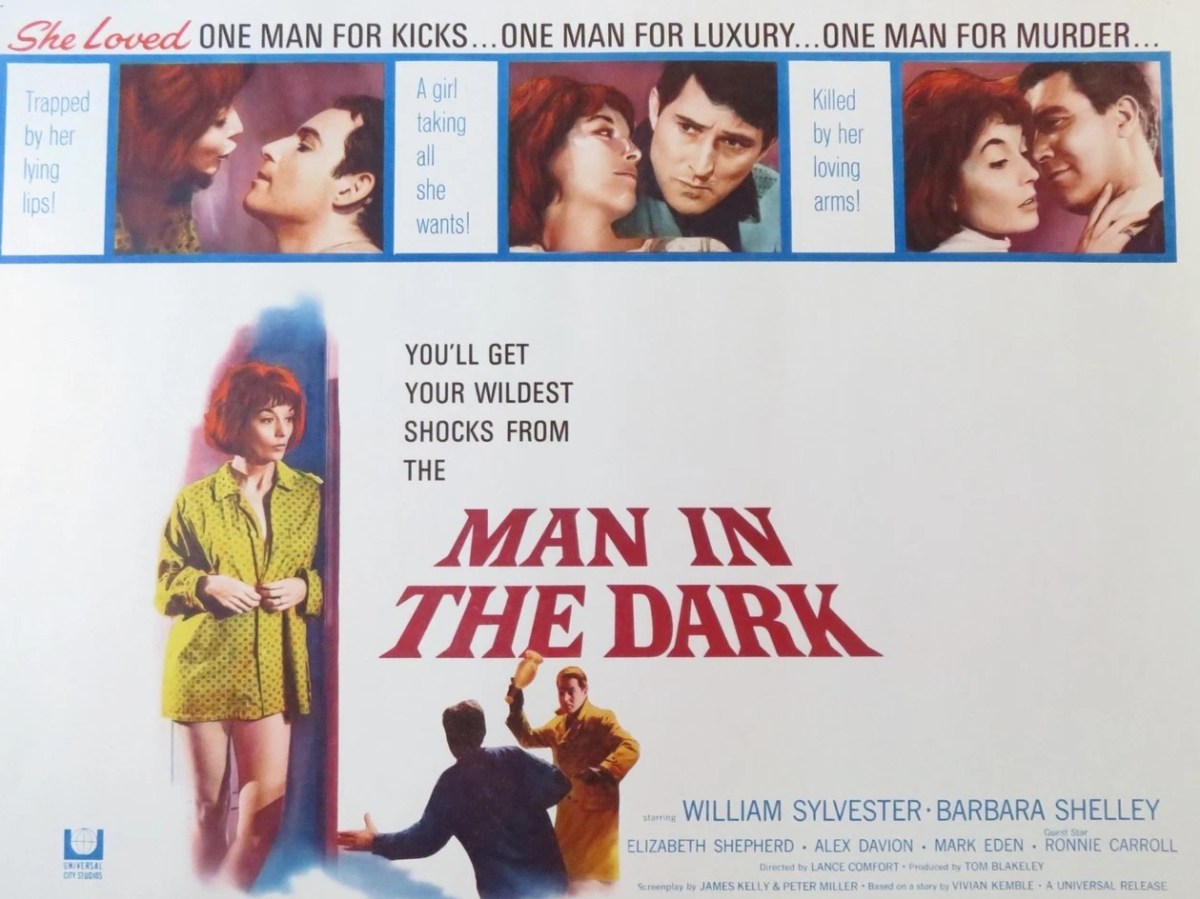
Man in the Dark / Blind Corner (1964) ***

Hammer Scream Queens rarely make an impact outside the genre, so it comes as something of a surprise to find Barbara Shelley effortlessly making the transition from The Gorgon (1964) to a slinky femme fatale spinning a deadly web around three men. While British femme fatales tend not to go all-out full throttle in terms of seduction and revenge, that suits the set-up here which is distinctly slow-burn. In fact, you might be persuaded to accuse the production of time-wasting or padding-out the story with its occasional diversions into song numbers (though that is a trope of these B-features) until you discover later on that there’s a very good reason for listening to the dulcet tones of pop singer Ronnie Carroll.

While there are echoes of Faces in the Dark (1960), blind composer Paul (William Sylvester) here is a far more sympathetic character especially once audiences latch on to what he as to put up with. And where Wait until Dark (1967) majors on terror, here the approach is much more subtle. And while audiences might wince at Audrey Hepburn’s predicament, here they will be appalled to see Paul’s wife Anne (Barbara Shelley) virtually taunt him by not just parading her secret lover Ricky (Alexander Davion), a penniless artist, but caressing him and pecking his cheek with kisses as if to test her husband’s radar.

Not only is Paul the forgiving type – turning a blind eye to his wife’s regular late nights – but he is devoted to Anne and considers himself lucky that she has stuck by him and it never occurs to him that his wealth plays a significant part in that bargain, Anne, a little-known former actress, unlikely to enjoy such bounty any other way. He’s so in love with his wife that he knocks back his secretary Joan (Elizabeth Shepherd) who has a good idea her employer is being played for a fool.

Under the guise of Ricky painting her portrait, Anne manages to legitimately spend a considerable amount of time with her lover and fine-tune her plans to rid herself of Paul. There’s a fairly easy option. Paul is an alcoholic and given to standing in an open balcony. He could easily lose his footing and topple over should there be someone around to give him the initial nudge.

Ricky is pencilled in as the murderer. And though he initially baulks at the idea, the prospect of both losing Anne and resolving at the same time his financial problems is too tempting. By now, Paul is aware of the tryst, having been alerted to the couple smooching in a restaurant, by his best pal and manager Mike (Mark Eden). Once we realize that Paul has been taping his wife’s telephone conversations, you are misdirected into thinking he will be better prepared. But this isn’t America or even sleazy Soho and there’s not a gun to hand or even a knife so Paul is vulnerable to an assailant and even as weak-minded an individual as Ricky seems to grow in confidence the minute the tussling begins.

Even then Ricky is so incompetent Paul needs to coach him into how to get away with the perfect murder and once we get to this stage it’s clear there’s something else going on and we’re in for a torrent of twists, delectably delivered. Ricky is informed that he’s a patsy, that Anne is in love with Mike and that in a courtroom she will act her socks off as the innocent victim of an overzealous lover – “a choked sob will escape her –  she did that in The Act of Cain” or “she might fall into a crumpled but not unattractive faint” as she did in Murder Undaunted.”

When Anne arrives, accompanied by Mike, to check on Ricky’s handiwork, the game is clearly up. But Paul has police hidden in the bedroom to hear what amounts to Anne’s confession. All three are locked up and Paul heads off into the sunset with his secretary.

Barbara Shelley creates a sizzling tension of her own and is a superb femme fatale, dangling three men on a string. Alexander Davion (Paranoiac, 1963) and Mark Eden (Curse of the Crimson Altar, 1968) don’t get a look-in though simply by being stoic and then clever William Sylvester (Devils of Darkness, 1965) manages to hold his own.

Quite a different proposition to Tomorrow at Ten (1963), also helmed by Lance Comfort, where the tension is upfront. You’d say this was a weighted piece of direction, with much of the pressure in the early stages reliant on whether Paul will see through his wife. Those scenes where she toys as much with her lover as her husband are unique. Written by the team of James Kelly and Peter Miller (Tomorrow at Ten) plus Vivian Kemble (Olympus Force, 1988).

Takes a while to come to the boil but well worth the wait.

Catch it on Talking Pictures TV under the title Blind Corner.
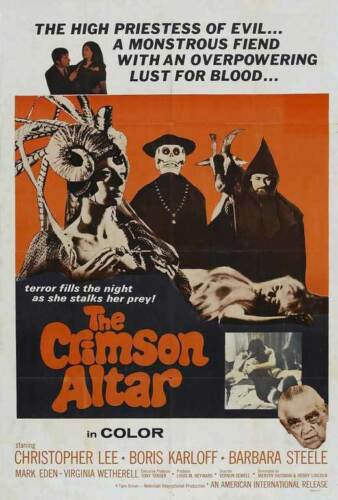
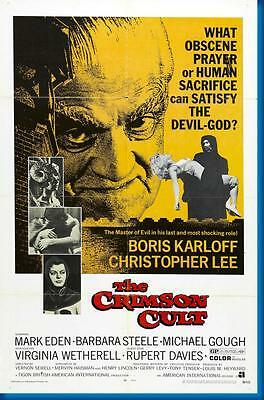
The Crimson Cult / The Crimson Altar/ Curse of the Crimson Altar (1968) ***

Horror is a small world and at any moment you are likely to bump into stars of the caliber of Christopher Lee, Boris Karloff and Barbara Steele – or in this picture all three. Investigating his missing brother Peter sends antiques dealer Robert Manning (Mark Eden) to a remote country mansion where he encounters owner Morley (Christopher Lee), his seductive niece Eve (Virginia Weatherall), the wheelchair-bound authority on witchcraft Professor Marsh (Boris Karloff), deaf mute Elder (Michael Gough) and a centuries-old mystery.

Morley can legitimately deny that Peter has ever set foot on the premises since it was common for the brother to adopt an alias when seeking out significant antiques. By the time Robert amasses sufficient clues to challenge Morley on this particular issue, it appears that further ideas of more sinister goings-on may be illusory. On his first night Robert observes an annual celebration of the Black Witch but although an effigy is burned this festival appears to have more to do with the innocent consumption of alcohol and heady bouts of sex than satanism.

And after a while, Robert indulges in carnal delight with Eve. However, he is plagued by a nightmare that involves a grotesque trial by a jury wearing animal heads. Gradually, he learns Morley, meanwhile, is such a congenial host, and his niece delightful and sybaritic company, that the finger of suspicion points at Elder, who does take a pot shot at Robert, and the professor who has a collection of instruments of torture.

Were it not for veteran director Vernon Sewell (Urge to Kill, 1960) beginning proceedings with some kind of black mass complete with floggings and female sacrificial victim, the audience might have been kept in greater suspense. As it is, the non-violent annual celebration throws us off the scent as does the seduction of Eve and the prospect that Robert’s nightmare is little more than psychedelic hallucination. The denouement is something of a surprise. The ritualistic aspects of the picture are well done and given this is a Tigon film rather than Hammer you can expect harsher treatment of the S&M element, especially for the period.  

The eerie atmosphere and well-staged witchcraft scenes are a plus, but, despite the involvement of a handful of horror gods, the movie’s reliance on lesser players to drive the narrative is a minus. Lee, Karloff and Steele (though in a more minor role) are all excellent as is the demented Michael Gough but Mark Eden (Attack on the Iron Coast, 1968) is too lightweight to carry the picture although Virginia Wetherall in her first big part suggests more promise.  More of Lee, Karloff and Steele would have definitely added to the picture but since this type of film often requires the young and the innocent to take center stage that was not to be.

Directed by Vernon Sewell (The Blood Beast Terror, 1968) from a script by Dr Who writers Mervyn Haisman and Henry Lincoln and Jerry Sohl (Die, Monster, Die, 1965).

Worth a watch.

The L-Shaped Room (1962) ***

Has contemporary bite, given half the picture is about abortion, banned in Britain at that time and the Pill yet to come on-stream. Being a single mother was an equally unwelcome tag unless you were a widow, in which case you were shrouded with respectability.

Pregnant French lass Jane (Leslie Caron) has decided to hang on in Britain rather than face the shameful ordeal of returning home. She knows who the father is, Terry (Mark Eden), to whom she lost her virginity in a week-long affair in Cornwall, but she’s not planning to hustle him into a shotgun wedding and you get the idea that, at 27, her virginity was weighing heavily on her.

Ending up in a bedsit in London – the titular room a landlord’s clever way of turning one decent-sized room into two smaller ones, each with a share of the window – she is clearly au fait with a British legal loophole that permits termination should pregnancy damage her mental health. And there were enough Harley St doctors to mentor her through such a loophole, for a fee of course.

It’s the briskness of Dr Weaver (Emlyn Williams) that puts her off. She has another go, later on, this time with black market pills from one of her neighbors, but they don’t work. Meanwhile, she has fallen in love with aspiring writer Toby (Tom Bell) and divines, correctly, that he won’t want to bring up another man’s child. In the end, she has the baby and scarpers back to France to face the music.

On the face of it an ideal candidate for the “kitchen sink” mini-genre that was pervasive at the time, but actually much more rewarding than many of the genre with dealt with male anger. This is much more about acceptance, without being craven or abject about it.

And there’s much to enjoy in director Bryan Forbes’ understated style. Half the time you could imagine you were in noir from the use he makes of the commonplace manner in which lights in staircases generally went off after a minute or so (not so much an energy-saving device as a money-saving one for the landlord) and he makes clever play of these sudden changes. There are also, unusual for the time, disembodied voices – the camera on Jane as she mounts the stairs, the voice her out-of-sight landlady Doris (Avis Bunnage). And every now and then the camera glides from her room into that of her neighbor, jazz trumpeter Johnny (Brock Peters) who can hear everything through the paper-thin walls, her morning retching and her night-time love-making with Toby.

How Johnny does find out about her baby is beautifully done, the best sequence in the movie. She works in a café where Johnny eats each night and she’s set a little table for him with a flower in a bottle. But he doesn’t turn up. She suspects, for no real reason except the worst, that he’s in the basement making out with one of the sex workers, but it’s Johnny (who had always been a good friend) who tells her that, from a sense of his disgust, he has let her boyfriend know the truth.

Like Darling (1965), this is a fascinating portrait of a woman making the wrong decisions. But Jane lacks Diana’s power. She’s not helpless exactly, and certainly has a good line in getting rid of unwanted attention. Her motives are not entirely clear. She wasn’t in love with Terry and for a long time she fends off Toby. She deludes herself into believing that Toby’s love for her will overcome his distaste that she is carrying another man’s child. That’s when she takes the pills.

You could kind of get the impression, however, that the real reason for Jane’s predicament is so that the actress can follow in the footsteps of Greta Garbo, Katharine Hepburn et al to wallow in grief. But it’s more subtle than that. She hasn’t been thrown aside by a callous male. She had made a decision to lose her virginity without considering the consequences and now that there is consequence changes her mind in impulsive fashion on how to deal with it.

Surrounding this central tale are some snapshots of life in a tawdry rooming-house. Two of the occupants are gay, Johnny and faded actress Mavis (Cicely Courtneidge), the landlady has a succession of gentlemen friends, while in the basement Sonia (Patricia Phoenix) works as a prostitute.

Leslie Caron (Guns of Darkness, 1962) was nominated for an Oscar and won a Bafta and a Golden Globe. The film was nominated for a Bafta and a Golden Globe. Tom Bell (Lock Up Your Daughters!, 1969) is good as the struggling writer. And Brock Peters (The Pawnbroker, 1964) has a peach of a part.

Director Bryan Forbes (Deadfall, 1968) wrote the script from the Lynne Reid Banks bestseller.

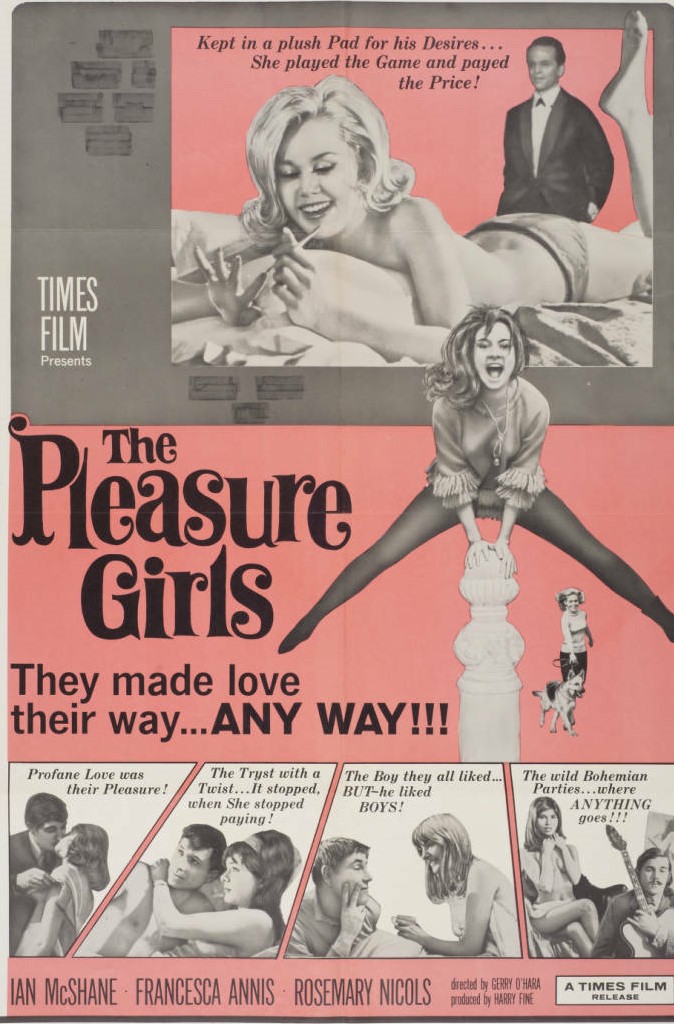
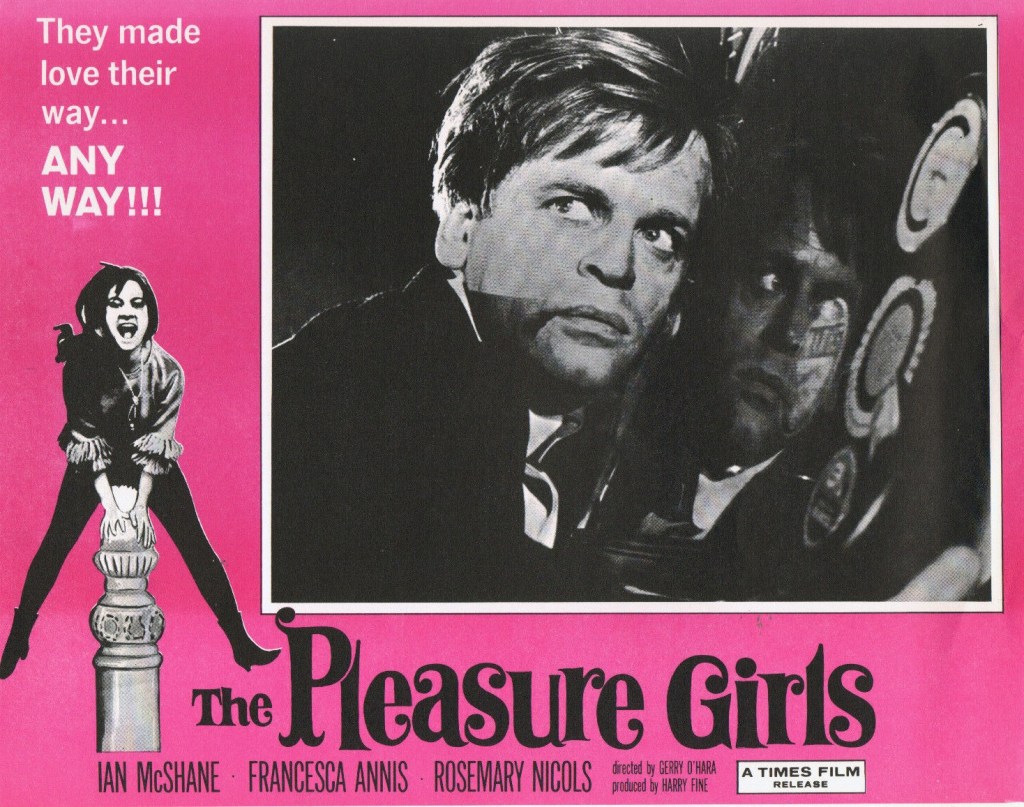
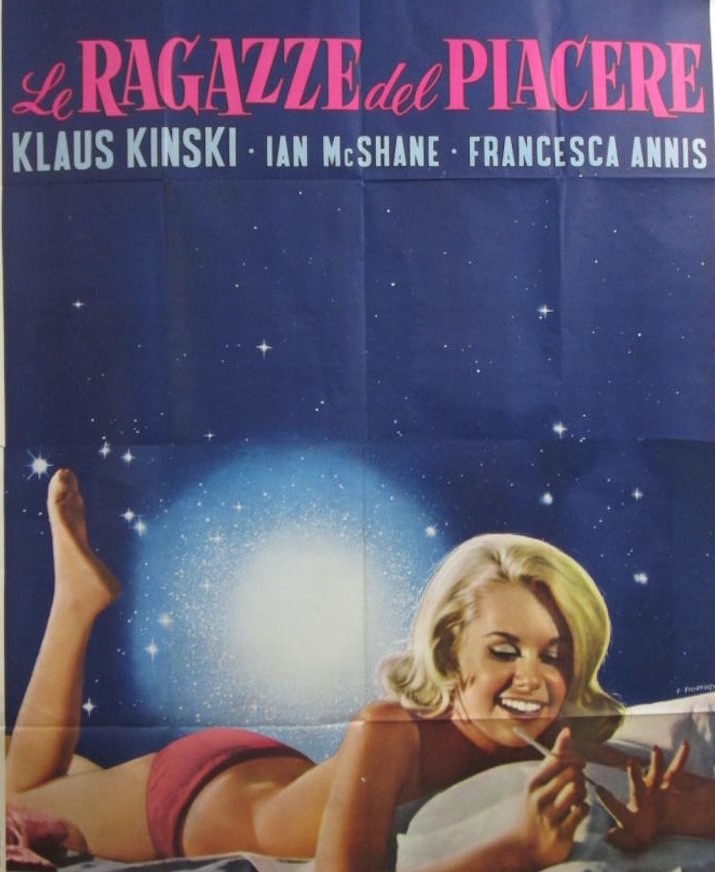
The Pleasure Girls (1965) ***

Klaus Kinski and The Pleasure Girls. What depraved mind dreamed up that concoction?

In reality, given this is early onset Kinski, before he was a fully-developed beast, and because it just precedes the British censor throwing off his shackles to accommodate the likes of Blow Up (1966) and The Fox (1967) it’s pretty tame stuff.

Klaus Kinski – what more did any B-picture of the decade need?

The girls might parade in night attire, and, should they happen to sleep in the nude, flash a bit of less rude skin, but that’s as far as it goes although at least couples are permitted to share a bed unlike the U.S. where that was outlawed by the Production Code (hence, in case you didn’t work it out, why there was so much frolicking via censor loopholes such as the outdoors or in the surf a la From Here to Eternity).

And you might find it hard to believe that John Wick’s Ian McShane has been a star for nearly half a century. Though here on the shifty side here and a shade fresh-faced his trademark cynical eyebrow is perpetually raised. He’s one of the suitors of a posse of girls sharing a house in London. A year later and a photographer like him would have had girls throwing themselves at him rather than primly trying to hold onto their virginity.

A weekend of drama awaits model wannabe and suburban lass Sally (Francesca Annis) on her arrival at the house, a whirlwind of parties beckoning, though drugs and booze in little evidence. Among her flatmates glamorous Dee (Suzanna Leigh) is mistress of slum landlord Nikko (Klaus Kinski) and while happy to be wined and dined and presented with jewellery,  fur coats and cash, draws the line at being put up in an apartment. Compliant Angela (Anneke Wills) is enmeshed with unscrupulous gambler Priddy (Mark Eden).

While there are plenty good-time girls to hand in casinos and there is some discreet nudity at a party it’s not exactly high-end stuff what with scenes set in launderettes and street markets and girls cutting themselves shaving their legs. And while proclaiming himself sex-mad, Keith (Ian McShane) is rather more romantic than he would like, prepared to wait for Sally, even while spouting self-conscious lines like “surely every girl wants you to want to even if she doesn’t want to,” the kind of hypocritical male double standard of the day.

The Sally-Keith relationship doesn’t get much beyond will she-won’t she so the real drama takes place in the lives of Dee-Nikko and Angela-Priddy and Dee’s very outgoing brother Paddy (Tony Tanner). Nikko collects debts with the help of thugs and an Alsatian, while Priddy sells his girlfriend’s precious brooch.

There’s more violence than sex. One man beaten up and tied to the hood of a car to be whipped with a belt. Another is tied to a chair and hung out a window. And, for the time, one man’s homosexuality is unusually tenderly expressed while the prospect of a career being more attractive than marriage is given a fair airing.

It’s surprisingly well acted, all the characters believable with enough development twists to keep you interested, and of course it’s not the degrading or unseemly world the posters would have you believe although in a pre-Pill world the dangers of unprotected sex are only too obvious.

Producers Tony Tenser (later founder of Tigon) and Michael Klinger (Get Carter, 1971) had made their reputations on exploitation pictures like the previously-reviewed London in the Raw (1964) and this attempts, at least for marketing purposes, to go down a similar seedy route, but is confounded by a storyline that is more Peyton Place than Bad Girls Have Sex.

It’s more an opportunity for rising stars to be put though their paces rather than characters put in their place. Ian McShane’s (Sky West and Crooked/Gypsy Girl, 1966) twinkle is never far from view and he demonstrates the charm that will keep him in demand for the next near-50 years. Klaus Kinski (Five Golden Dragons, 1967) is remarkably restrained given his later work, proving he doesn’t have to over-act to make his mark.

Of the others in the talent shop window, Suzanna Leigh (Deadlier than the Male, 1967) makes the biggest impact. It didn’t make a star out of Francesca Annis though Mark Eden (Curse of the Crimson Altar/The Crimson Cult, 1968) had marginally better luck.

Gerry O’Hara (Maroc 7, 1967) directed from his own script.

The Crimson Cult/ Curse of the Crimson Altar (1968) ***

Horror is a small world and at any moment you are likely to bump into stars of the caliber of Christopher Lee, Boris Karloff and Barbara Steele – or in this picture all three. Investigating his missing brother Peter sends antiques dealer Robert Manning (Mark Eden) to a remote country mansion where he encounters owner Morley (Christopher Lee), his seductive niece Eve (Virginia Weatherall), the wheelchair-bound authority on witchcraft Professor Marsh (Boris Karloff), deaf mute Elder (Michael Gough) and a centuries-old mystery.

Morley can legitimately deny that Peter has ever set foot on the premises since it was common for the brother to adopt an alias when seeking out significant antiques. By the time Robert amasses sufficient clues to challenge Morley on this particular issue, it appears that further ideas of more sinister goings-on may be illusory. On his first night Robert observes an annual celebration of the Black Witch but although an effigy is burned this festival appears to have more to do with the innocent consumption of alcohol and heady bouts of sex than satanism.

Thanks to career reinvigoration after Peter Bogdanovich’s “Targets” (1967)
Boris Karloff gained top billing in the British release.

And after a while, Robert indulges in carnal delight with Eve. However, he is plagued by a nightmare that involves a grotesque trial by a jury wearing animal heads. Gradually, he learns that Morley, meanwhile, is such a congenial host, and his niece delightful and sybaritic company, that the finger of suspicion points at Elder, who does take a pot shot at Robert, and the professor who has a collection of instruments of torture.

Were it not for veteran director Vernon Sewell (Urge to Kill, 1960) beginning proceedings with some kind of black mass complete with floggings and female sacrificial victim, the audience might have been kept in greater suspense. As it is, the non-violent annual celebration throws us off the scent as does the seduction of Eve and the prospect that Robert’s nightmare is little more than psychedelic hallucination. The denouement is something of a surprise. The ritualistic aspects of the picture are well done and given this is a Tigon film rather than Hammer you can expect harsher treatment of the S&M element, flagellation delivered by women, especially for the period.  

In the U.S. – where it was shown both as “The Crimson Cult” and “The Crimson Altar” – Christopher Lee was accorded prime billing status.

The eerie atmosphere and well-staged witchcraft scenes are a plus, but, despite the involvement of a handful of horror gods, the movie’s reliance on lesser players to drive the narrative is a minus. Lee, Karloff and Steele (though in a more minor role) are all excellent as is the demented Michael Gough but Mark Eden (Attack on the Iron Coast, 1968) is too lightweight to carry the picture although Virginia Wetherall in her first big part suggests more promise.  More of Lee, Karloff and Steele would have definitely added to the picture but since this type of film often requires the young and the innocent to take center stage that was not to be.

Discover WordPress

A daily selection of the best content published on WordPress, collected for you by humans who love to read.

The Atavist Magazine

by Brian Hannan

WordPress.com News

The latest news on WordPress.com and the WordPress community.