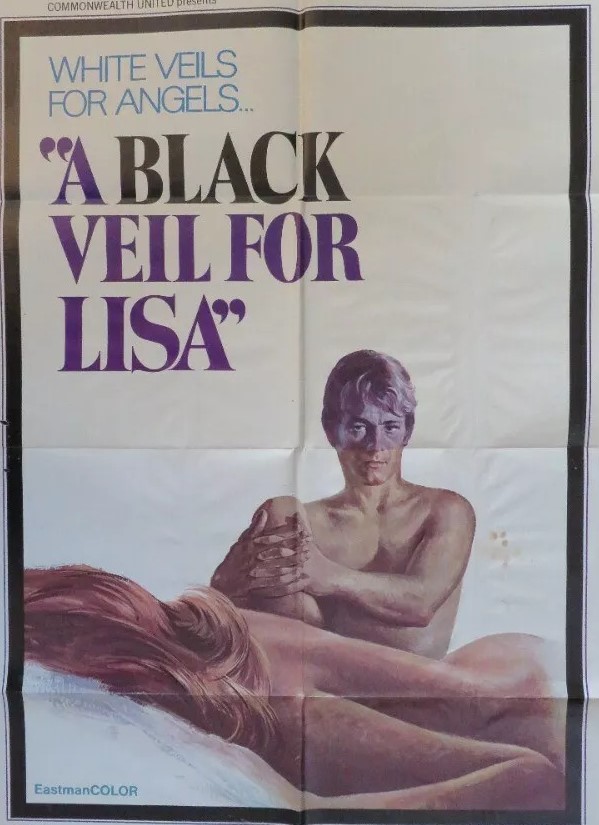
A Black Veil for Lisa (1968) ***

John Mills ventures back into Tunes of Glory (1960) territory as a top official coming apart at the seams. This time it’s not the British Army but the Italian Police where, as Franz Buloff, he heads up the narcotics squad. And this time he’s not the complacent victim but decides to take action against his tormentor.

Closing in on drugs kingpin Scheurermann, he finds that one witness after another is being silenced by an assassin with a deadly knife. He suspects a leak in his department, unaware the traitor is much closer to home. And despite the usual dissatisfied boss Ostermeyer (Tillio Altamura) breathing down his neck, he would be making more headway if it wasn’t for the fact that his head is constantly filled with images of his wife Lisa making love to another man.
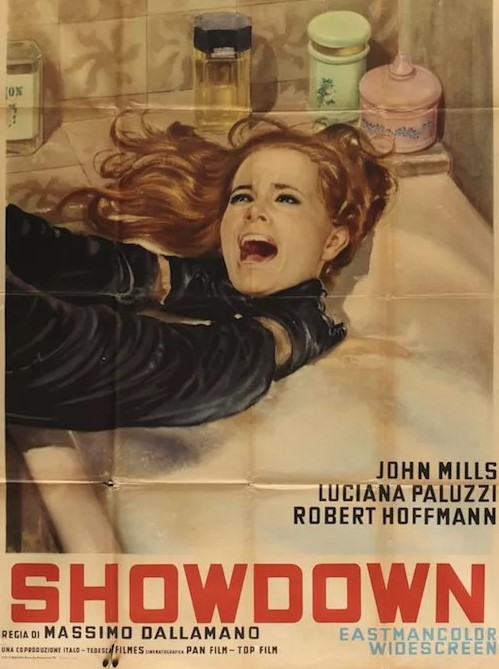
For her part, Lisa seems determined to unhinge her husband, eliciting jealousy at every turn, by never answering the phone at night and always an excuse, when he tracks her down, for not being where was supposed to be. Rather than calming him down, her occasional seduction of her husband only serves to ramp up his fury.

In any case, it’s an odd set-up, he’s much older and the security he offers is not just financial. She was once a suspect herself and being married to a top cop has put a force field between her and suspicion. There’s clearly an unspoken assertion that somehow she has duped the cop, making him fall in love with an apparently innocent woman. They couldn’t be more opposite. “I like danger,” is her mantra.

He breaks open the case after following up a clue dropped at the scene of the crime. After arresting Max (Robert Hoffman), he strikes a deal with the killer. In return for his freedom, the murderer has to take out Lisa. But, of course, it’s not as simple as that. When Buloff realizes the deep water he is treading, he calls off the assassination. But then when he discovers that Max has helped himself to a bonus – beginning an affair with Lisa – he recants and puts the man back on the spot.

So, now, it’s Max who faces the quandary of having to kill his lover. And that puts up square in cat-and-mouse territory.

This isn’t quite giallo, the genre was still in the process of being born, in part because there’s no mystery about the killer, in part because the murders aren’t bloody enough, and in part because the dead aren’t sexy young women. So it’s more a series of character studies, each driven to an edge by an action that otherwise would be out of character.
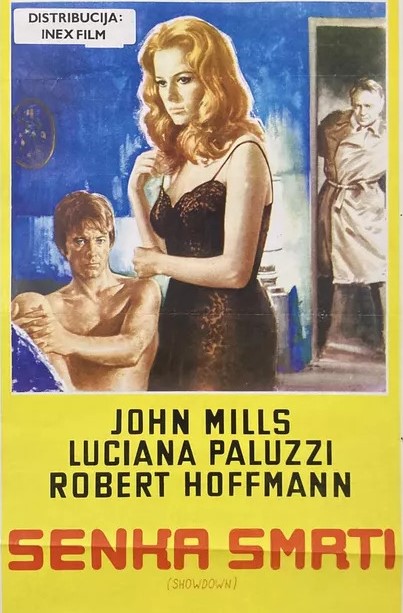
A top cop like Buloff should have been a better judge of character than to fall for Lisa’s wiles in the first place. Lisa, too, should have recognized her penchant for the seedier side of life rather than being as she puts it “too young to be buried alive” in a stifling marriage to a jealous husband. But, she, too, is a poor judge of character, expecting to win back the favor of the drug overlord after she had so openly crossed the tracks to the other side of the law.

And Max, one of the first of a series of killers in movies who wanted out (see The Brotherhood, 1968, and Stiletto, 1969), is trapped into more killing because nowhere is safe. Getting rid of Buloff was never in his plans, as that would draw even more unwelcome attention. But then neither was falling in love with the cop’s wife. There’s still a few twists to go not least when Lisa discovers that the husband she felt she had under control had broken free and was intending to have her killed.

John Mills, a surprising addition to the Brits heading for Italy, is excellent especially as the big flaw in Tunes of Glory was his inability to find the cunning to strike back at his chief tormentor. Here, he might have second thoughts about dispatching his wife, but revenge is always the best weapon.

Luciana Paluzzi (Chuka, 1967, which, incidentally, also featured Mills) gets her teeth into a decent role rather than been saddled in lightweight fare since swanning around in swimwear in Thunderball (1965). Austrian Robert Hoffman (Assignment K, 1968) is given a surprising range of emotions to deal with.

Massimo Dallamano (Venus in Furs, 1969) handles the material well and gets the best out of his cast without taking the bloodier route of the later giallo. He was one of four writers contributing to the screenplay. This was one of the feature films made by new American mini-major Commonwealth United, one of the stack of “instant majors” popping up around this time.

John Mills is always watchable and the twists make this one play.

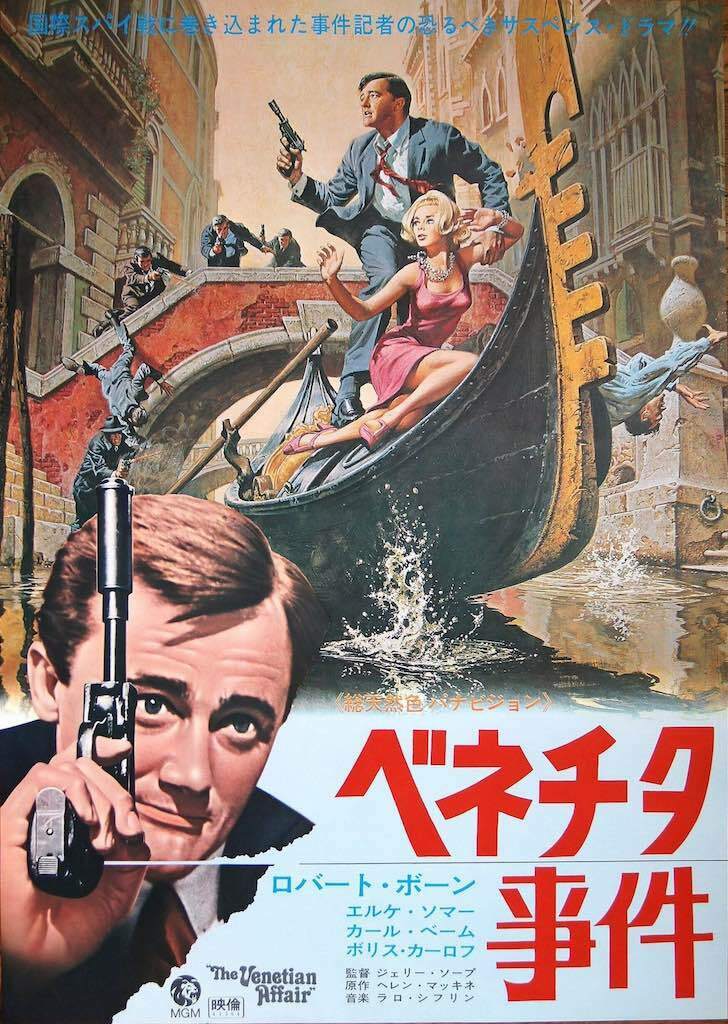
The Venetian Affair (1966) ****

Robert Vaughn gives a terrific performance as a numbed alcoholic ex-C.I.A. journalist Bill Fenner drafted into Venice to investigate a plot involving ex-wife and Communist defector Sandra Fane (Elke Sommer). He’s the spy who lost it rather than a flashy contemporary of James Bond. This occasionally very stylish number kicks off with a terrific credit sequence that concludes with a suicide bomber blowing up a nuclear disarmament conference. Unshaven and with a Columbo cast-off overcoat, Fenner discovers Fane was key to the bombing, the bomber an otherwise distinguished diplomat with no known proclivities in the area of mass murder.

Although sold as an action picture, nobody is ripping through the canals as in a Bond film, and it is altogether a more somber, reflective, intelligent movie. Fenner’s feelings for his ex-wife are palpable when, in her apartment, he tenderly touches her clothes and smells her perfume. Far from being party to the plot, it appears Sandra has had a change of heart and wants to defect back, leaving Fenner in a perilous dilemma. Does he believe her or is she just using him? It is beginning to sound like a modern-day film noir, except he is already being used by the C.I.A., his presence in Venice a device to draw Sandra out, C.I.A chief Rosenfeld (Edward Asner) every bit as ruthless as the villains.

His investigations lead him to Dr Pierre Vaugiraud (Boris Karloff) and power broker Robert Wahl (Karl Boehm) who has a mind-altering drug that can make a man terrified of a mouse, send him into a trance and on his way to deliver savage retribution. There is death aplenty, fisticuffs and chases and Sandra, in hiding disguised as a nun, is worth waiting for.

Based on the bestseller by Scottish novelist Helen MacInnes, who challenged Alistair MacLean in her day, the project was at one point to be directed by Guy Hamilton. Coincidentally, David McCallum, Vaughn’s co-star in The Man from U.N.C.L.E. television series, was in Venice at the same time shooting Three Bites of the Apple.

Television stalwart Jerry Thorpe making his debut contributes some interesting moments. Interpreters listening in to the conference hear the magnified ticking of the bomb moments before explosion. The sequence on a train is well done and the activity surrounding the mouse is first class. Vaughn is superb in a downbeat role – shaking off his Napoleon Solo television persona- never sure if he is being duped, on the rack from falling back in love, and emerging from an alcoholic haze with a few decent ruses up his sleeve.

There’s a solid cast, Asner menacing even as a good guy, Karl Boehm a charismatic villain, Karloff memorable in his last performance in a non-horror picture, and interesting appearances by Felicia Farr as a C.I.A agent masquerading as the murderous diplomat’s unsuspecting mistress and Luciana Paluzzi as the girlfriend of an agent. Lalo Schifrin produces an outstanding score.

It was a flop first time round because audiences, partly duped by the title (all Uncle episodes incorporated the word “Affair” although the book, in fairness, was written long before the television series was envisioned) expected to pay to see Napoleon Solo, or something quite like him, on the big screen, with all the pizzazz and gimmickry of the small-screen show. Unfairly under-rated, this is a really satisfying thriller set against a murky Cold War background with Vaughn, trapped between love and redemption, the only character with a streak of morality.

Time to revive this.

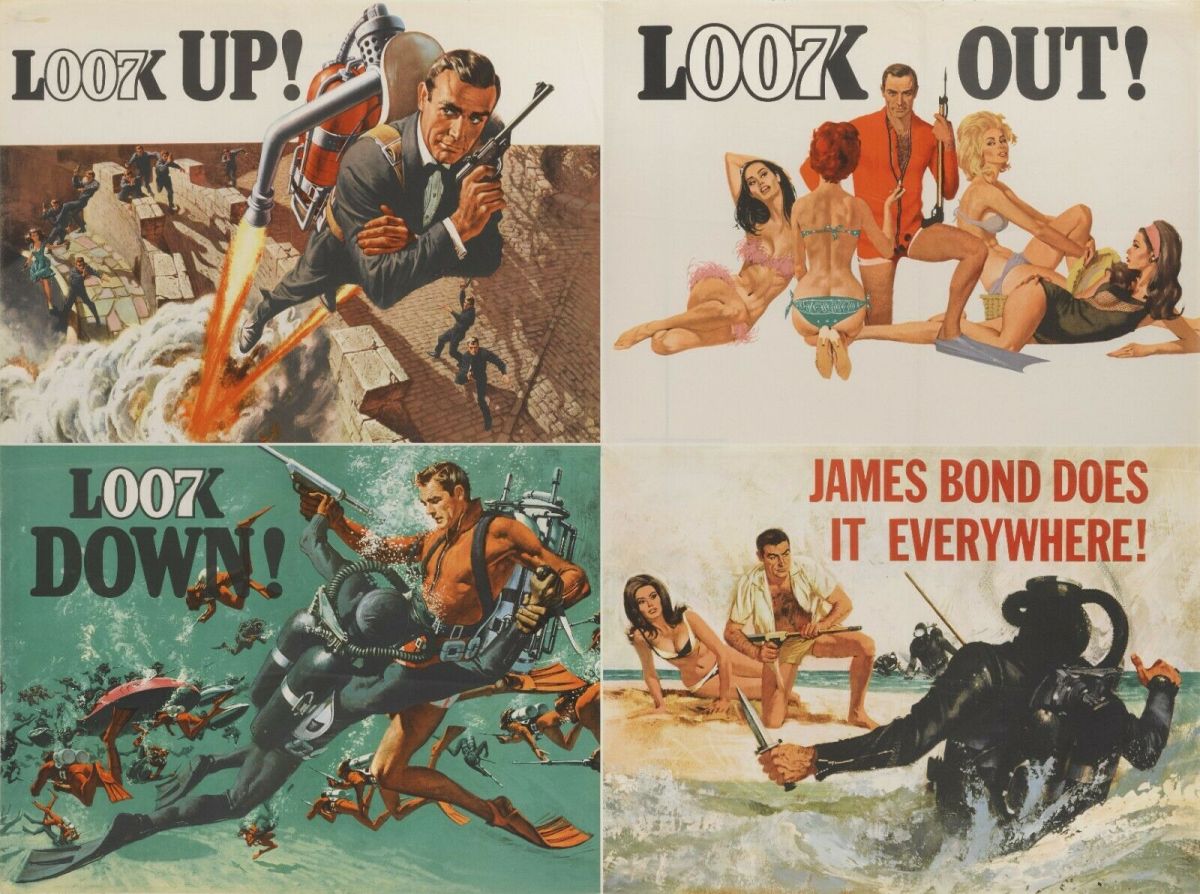
Selling James Bond: Part Two – Pressbook for “Thunderball” (1965)

Wooing the audience was no longer required after Goldfinger (1964) had broken the box office bank. Thunderball, claimed producers Cubby Broccoli and Harry Saltzman, was “the hottest merchandise campaign you have ever handled” as the first four pages of the Pressbook went to show. No longer was there a retailer free-for-all with companies which had nothing to do with endorsements jumping on the Bondwagon.

The potential for promotional tie-in was so high that retailers and manufacturers were willing to spend a fortune to become involved and, in so doing, provide a massive spread of free advertising. Colgate had an entire line of toiletries for men including after shave, shaving lotion, deodorant, and talcum powder, each item branded with the 007 logo with Colgate investing in a massive advertising campaign aimed not just as men but the women who buy for men.

Shoe-wear manufacturer Endicott Johnson set up a nationwide contest through the Montgomery Ward chain of stores. Customers were invited to participate in a free sweepstake and store managers were encouraged to become active in promoting Thunderball at sales points throughout their shops.

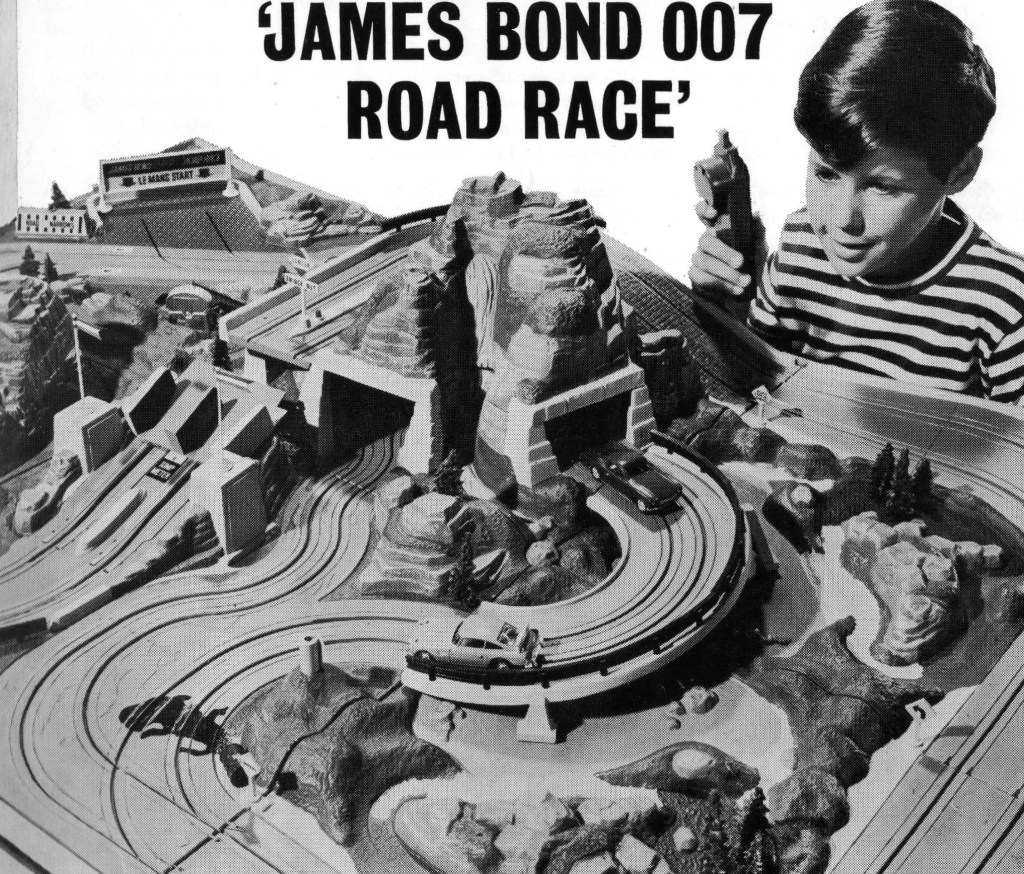
Toy manufactuer A.C. Gilbert had devised a James Bond 007 Road Race which would be promoted in the biggest marketing campaign in Sears Roebuck history to 60 million homes. The catalog would feature a five-page spread. “Beatles fans will be reached through a TV buy that Sears has made advertising the Road Race on ABC-TV’s Beatles Cartoon Show.” Adlers Slacks was the exclusive licensee for James Bond 007 Boys Slacks – with two hidden pockets. Revere Knitting Mills was promoting four sweaters “as worn by James Bond.”

Other licensed products included The Official James Bond Secret Agent 007 Shooting Attache Case, Harry Diamond sports shorts with the Bond logo, Allison tee-shirts and sweat shorts, bubble gum and trading cards from the Philadelphia Chewing Gum Corp, and a walkie-talkie set from Gabriel. In addition, Weldon was selling “007 Pyjamas – Go to Bed Dressed to Kill,” Voit manufactured underwater equipment, Spatz advertised its trenchcoats in Playboy, Trimount clothing range included items for men and boys, and Milton Bradley had four board games and six jigsaw puzzles.

So for the first time in history, exhibitors had to do nothing to attract customers, no zany attention-grabbing gimmicks required, because the massive cross-promotional campaign devised by the producers ensured that potential moviegoers could hardly go anywhere without coming across something alerting customers to the movie.

All this was in addition to the normal standard promotional tools such as original soundtrack album and paperback movie tie-in. Tom Jones had released a single and six other artists had brought out instrumental singles and albums. Trade magazine Cash Box noted that the Bond name signified “something big in the worlds of film and music…many labels have themed LPs after the valuable James Bond Agent 007 image.” Signet had brought out the movie tie-in paperback with artwork on front and back covers.

The bulk of the Pressbook was taken up with advertising and information about the licensed products leaving just three pages for the editorial section. By now of course Sean Connery was a big box office star so he received considerable coverage, explaining that he had been chosen for Dr No as a result of a London newspaper poll. There was space too for the movie’s playgirls – former Miss France Claudine Auger, villainess Luciana Paluzzi best known to American audiences through the Five Fingers television series, Molly Peters and a return for Martine Beswick who had appeared in From Russia with Love.

Not surprisingly, the Aston Martin DB5, which had caused a sensation in Goldfinger, also returned. The customised version cost $45,000 (worth $400,000 today), compared to the usual price of $13,000, and came complete with twin Browning machine guns, tire slashers, revolving number plates, radar screen, ejector seat, and retractable bullet proof shields.

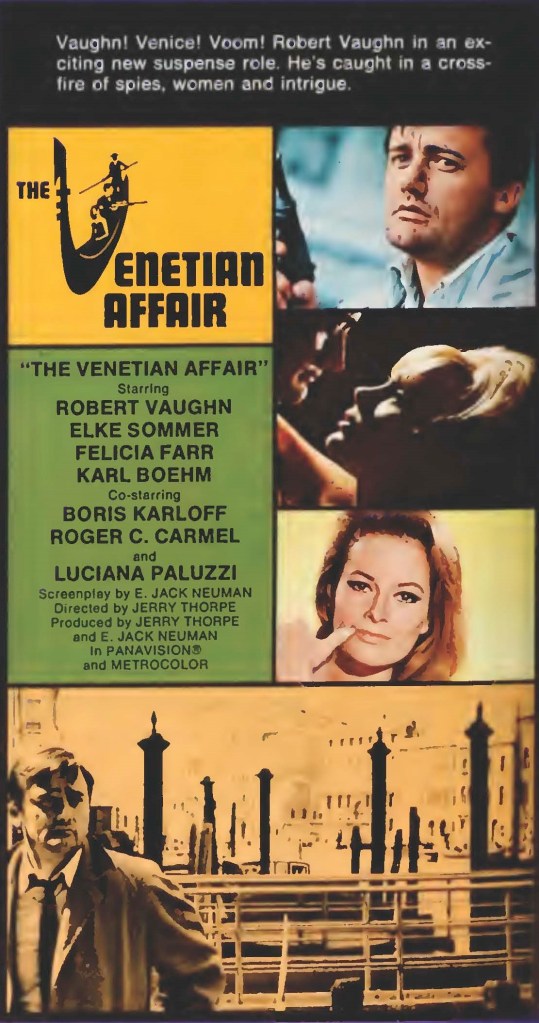
The Venetian Affair (1966) ****

Robert Vaughn gives a terrific performance as a numbed alcoholic ex-C.I.A. journalist drafted into Venice to investigate a plot involving ex-wife and Communist defector Elke Sommer. He’s the spy who lost it rather than a flashy contemporary of James Bond. This occasionally very stylish number kicks off with an excellent credit sequence that concludes with a suicide bomber blowing up a nuclear disarmament conference. Unshaven and with a Columbo cast-off overcoat, Vaughn discovers Sommer was key to the atrocity, the bomber an otherwise distinguished diplomat with no known proclivities in the area of mass murder.

Although sold as an action picture, nobody is ripping through the canals as in a Bond film, and it is altogether a more somber, reflective, intelligent  movie. Vaughn’s feelings for his ex-wife are shown when, in her apartment, he tenderly touches her clothes and smells her perfume. Far from being party to the plot, it appears Sommer has had a change of heart and wants to defect back, leaving Vaughn in a perilous dilemma. Does he believe her or is she just using him? It is beginning to sound like a modern-day film noir, except he is already being used by the C.I.A., his presence in Venice a device to draw Sommer out, C.I.A chief Rosenfeld (Edward Asner) every bit as ruthless as the villains.

His investigations lead him to Dr Pierre Vaugiraud (Boris Karloff) and power broker Robert Wahl (Karl Boehm) who possesses a mind-altering drug that can make a man terrified of a mouse, send him into a trance and on his way to deliver savage retribution. There is death aplenty, fisticuffs and chases and Sommer, in hiding disguised as a nun, is worth waiting for.

Based on the bestseller by Scottish novelist Helen MacInnes, who outsold Alistair Maclean in her day, the project was at one point to be directed by Guy Hamilton. Coincidentally, David McCallum, Vaughn’s co-star in The Man from U.N.C.L.E. television series, was in Venice at the same time shooting Three Bites of the Apple.

Vaughn is superb in a downbeat role – shaking off his Napoleon Solo television persona- never sure if he is being duped, on the rack from falling back in love, and emerging from an alcoholic haze with a few decent ruses up his sleeve. It’s often forgotten that this is an Oscar-nominated (for The Young Philadelphians, 1959) star and that the subtlety of his performance in The Magnificent Seven (1960) is generally overlooked.

Television stalwart Jerry Thorpe making his debut contributes some interesting moments. Interpreters listening in to the conference hear the magnified ticking of the bomb moments before explosion. A sequence on a train is well done and the activity surrounding the mouse is first class. There’s a solid cast, Asner menacing even as a good guy, Karl Boehm a charismatic villain, Karloff memorable in his last performance in a non-horror picture, and interesting appearances by Felicia Farr as a C.I.A agent masquerading as the murderous diplomat’s unsuspecting mistress and Luciana Paluzzi as the girlfriend of an agent. Lalo Schifrin produces an outstanding score.

It was a flop first time round because audiences, partly duped by the title (all Uncle episodes incorporated the word “Affair” although the book, in fairness, was written long before the television series was envisioned) expected to pay to see Napoleon Solo, or something quite like him, on the big screen, with all the pizzazz and gimmickry of the small-screen show. Unfairly under-rated, this is a really satisfying thriller set against a murky Cold War background with Vaughn, trapped between love and redemption, the only character with a streak of morality.

Discover WordPress

A daily selection of the best content published on WordPress, collected for you by humans who love to read.

The Atavist Magazine

by Brian Hannan

WordPress.com News

The latest news on WordPress.com and the WordPress community.