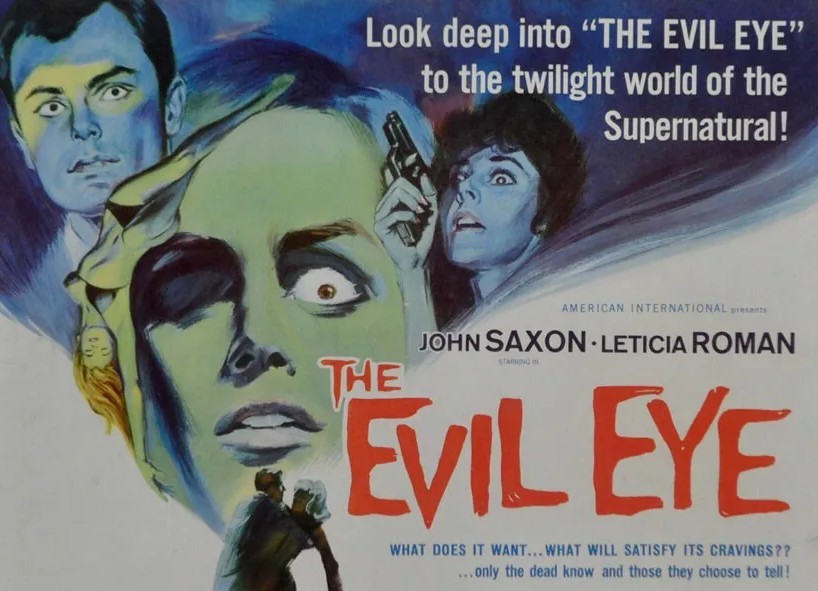
The Evil Eye / The Girl Who Knew Too Much (1963) ***

Don’t be taken in by claims that, since it was directed by Mario Bava, it kicked off the giallo sub-genre. More of the tropes come from mainstream horror – windows banging shut, locked doors, disembodied voices, stalkers, gaslighting, mysterious phone calls, premonition, retrocognition. And just for good measure, striking compositions that wouldn’t be out of place in an arthouse picture. But essentially it’s neo-noir – a woman can’t prove she’s witnessed a murder.

The Evil Eye was the American title, which makes little sense, although eye-popping eyes were in fashion from movies like Village of the Damned (1960), but in fact the original title of The Girl Who Knew Too Much is much more appropriate. This film is about a female character and what she discovers that threatens her life. The American version was chopped about by the distributor but, apparently, copies of that have gone astray so if locate a copy of the picture what you are likely to see if the Italian original.

American tourist Nora (Leticia Roman) is knocked out by a robber in Rome. On waking up she sees a murderer sticking a knife into a woman’s back. Only problem is – there’s no corpse to be found. But, strangely, a murder was committed on that spot a decade ago. So she might be having a vision of the past. But the murderer Straccianeve was caught.

The victim was the sister of Laura (Valentina Cortese), a new friend, whose apartment Nora temporarily occupies. There, Laura discovers newspaper clippings relating to the “alphabet killer”, a serial murderer whose victims’ surnames began with A, B, and C. Once Nora begins her investigations, it looks like she’ll be next on the list since her surname begins with “D”.  Meanwhile, she has struck a romantic vibe with Dr Marcello Bassi (John Saxon). But, of course, he might be not what he seems, sneaking off for assignations with strange women, following her.

Much of this is played out on deserted streets where the tourist sites acquire a dangerous veneer.

The finger points at journalist Landini (Dante DiPaulo), who has been following her. But he is as much a basket case as a potential murderer. He was instrumental in collecting the evidence that trapped the murderer but now believes Straccianeve was innocent.

In due course, after some more deaths, Nora traps the murderer, who comes out of left field, one of those where you think the writer has decided to pin the blame on the least likely suspect and come up with a spurious reason for the murders, so the twists pile up in helter skelter fashion at the end, including one which suggests Nora might well have the gift of seeing into the future.

Leticia Roman, in her debut, is mostly called upon to look baffled or frightened, there’s rather too much of the pop-eyes, and John Saxon (The Appaloosa, 1966) has the rare opportunity to play a hero. Valentina Cortese (Barabbas, 1961) drifts in and out of the tale. Written by future director Sergio Corbucci (Django, 1966), Oscar-winner Ennio De Concini (Divorce, Italian Style, 1963) and Eliana De Sabato (Marco Polo, 1962).

If it hadn’t been directed – and occasionally so stylishly – by Mario Bava (The Whip and the Body, 1963), it would have attracted considerably less contemporary attention. One of this main themes – the conflict between illusion and reality – is given a good airing. You can well believe that Nora is going mad. But it’s atmospheric enough and the director makes unusual use of the standard Rome tourist traps and this picture gives notice that he will move onto greater movies.
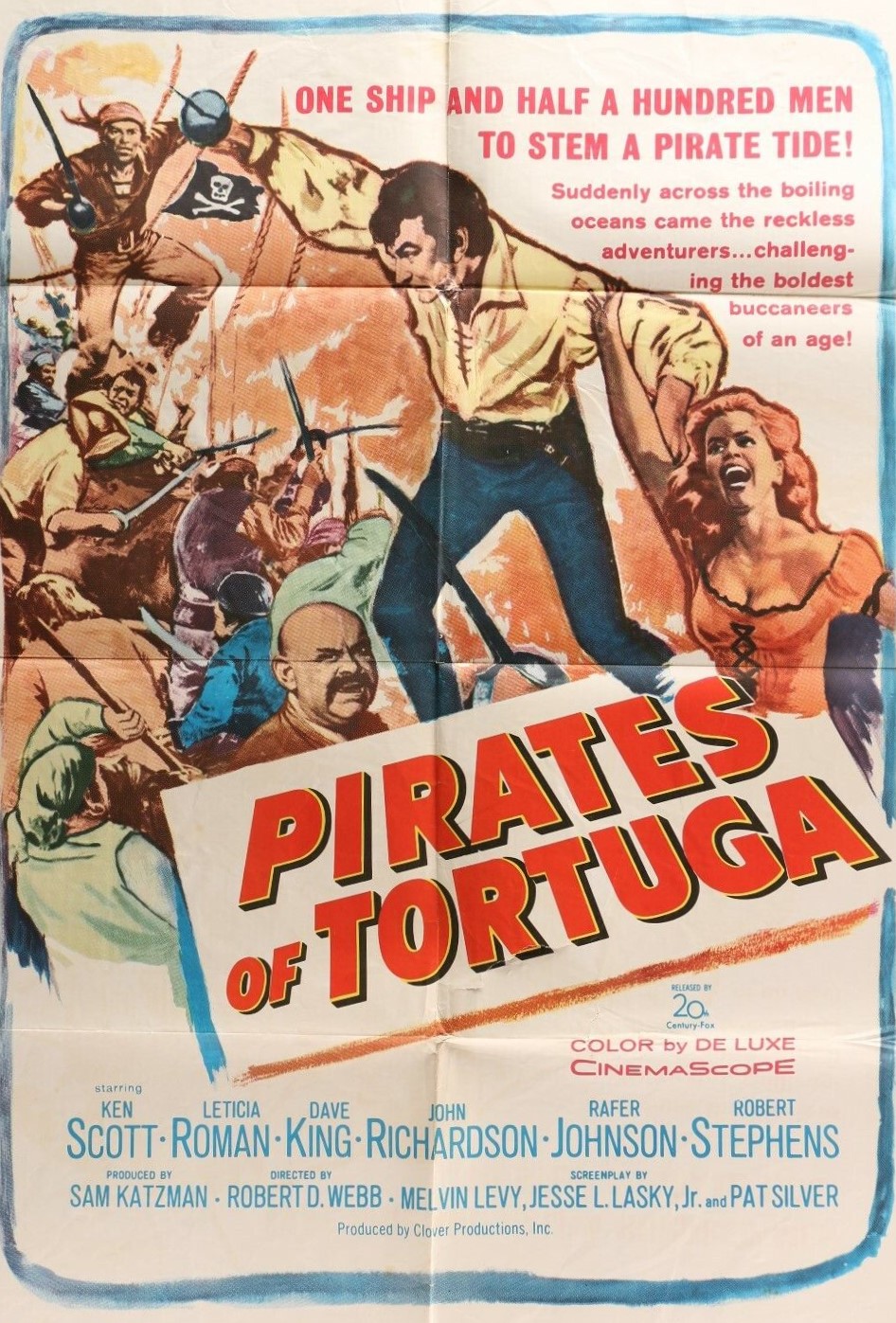
Pirates of Tortuga (1961) ***

In the absence of A-list swashbuckling talent like Errol Flynn (Captain Blood, 1935), Tyrone Power (The Black Swan, 1942) and Burt Lancaster (The Crimson Pirate, 1952) or spitfires in the mold of Maureen O’Hara (The Black Swan) and Jean Peters (Anne of the Indies, 1951) this sidesteps casting issues and in the kind of reversal that sent Pirates of the Caribbean on its merry way for the most part takes the comedic route of putting pirate moll Mg (Leticia Roman) center stage and twisting the usual blockade narrative so that it’s Privateer of the Century Henry Morgan (Robert Stephens) controlling the high seas.

Charge with stopping the pirate is sea captain Bart (Ken Scott). But most of the running in the first half is made by Meg, a thief turned stowaway, whose efforts to acquire the standing of a lady are initially mocked by the crew until they soften towards her, in part with seduction in mind and in part out of pity. But after landing in Jamaica, and mistaken for a Lady, she steps up to the plate, and manages to catch the romantic eye of the Governor before readjusting her sights and snaring Bart.

Bart and his crew infiltrate the buccaneer kingdom and spy out its flaws before arranging for a full-out attack. Boldly rewriting history, something of a surprise since Morgan the Pirate had appeared a year earlier, this Morgan is a shifty alcoholic. Once the action gets going, including a clever ambush of one pirate ship, it has enough swordfights to keep a regular swashbuckling enthusiast happy. There are some nice touches, Pee Wee (Dave King), the de facto fencing instructor, is lefthanded and wears a black glove whose use is historically accurate. The ships in full sail are impressive, the locations work well and it makes good use of Cinemascope color while Meg remains larcenous throughout rather than the good moll of previous entertainments. Though you might not be so impressed by the bear wrestling.

Ken Scott makes the best of a thin script, ignoring Meg’s wiles, and outwitting Morgan. Apart from Roman, who steals the show, British comedian Dave King (Strange Bedfellows, 1965), in his movie debut, is the pick, a jocular personality with lechery a stock-in-trade. I better point out you can spot John Richardson (One Million Years B.C, 1965) otherwise he is so insignificant a performer you would scarcely know he is there.  Robert Stephens (The Prime of Miss Jean Brodie, 1969) turns Morgan into a scallywag rather than a threatening villain.

Worth noting was just how long it took a graduate of the Twentieth Century Fox talent school to graduate – at the end of a five-year contract Ken Scott (Desire in the Dust, 1960) finally achieved leading man status.   Leticia Roman (The Spy in the Green Hat, 1967) was a bit more savvy and turned down a Fox contract in favor of Hal B. Wallis who cast her instead in G.I. Blues (1960). Technically belonging to the European import category of actress so popular during the decade, she never worked in her homeland before being scouted by Wallis. Though she was born in Italy her father, a costume designer, had moved to the U.S. in the late 1950s.  

Producer Sam Katzman, who had just signed a four-picture deal with Fox, made 239 films in every genre,  including Tim McCoy westerns, the Leo Gorcey Bowery Boys series,  Bela Lugosi as The Ape Man (1943), Jungle Jim (1948), Paul Henreid in Last of the Buccaneers (1950),  Mysterious Island (1951), 3D Fort Ti (1953) and Rock Around the Clock (1956) as well as a slew of 1960s Presley musicals.  

On a miserly budget of just $675,000, the sea scenes were shot in the Fox water tank. Robert D. Webb (The Cape Town Affair, 1967) directed.

A harmless trifle with decent action and Leticia Roman turning upside-down the genre female lead.

No need to fork out on a DVD. You can catch this on YouTube.

Discover WordPress

A daily selection of the best content published on WordPress, collected for you by humans who love to read.

The Atavist Magazine

by Brian Hannan

WordPress.com News

The latest news on WordPress.com and the WordPress community.