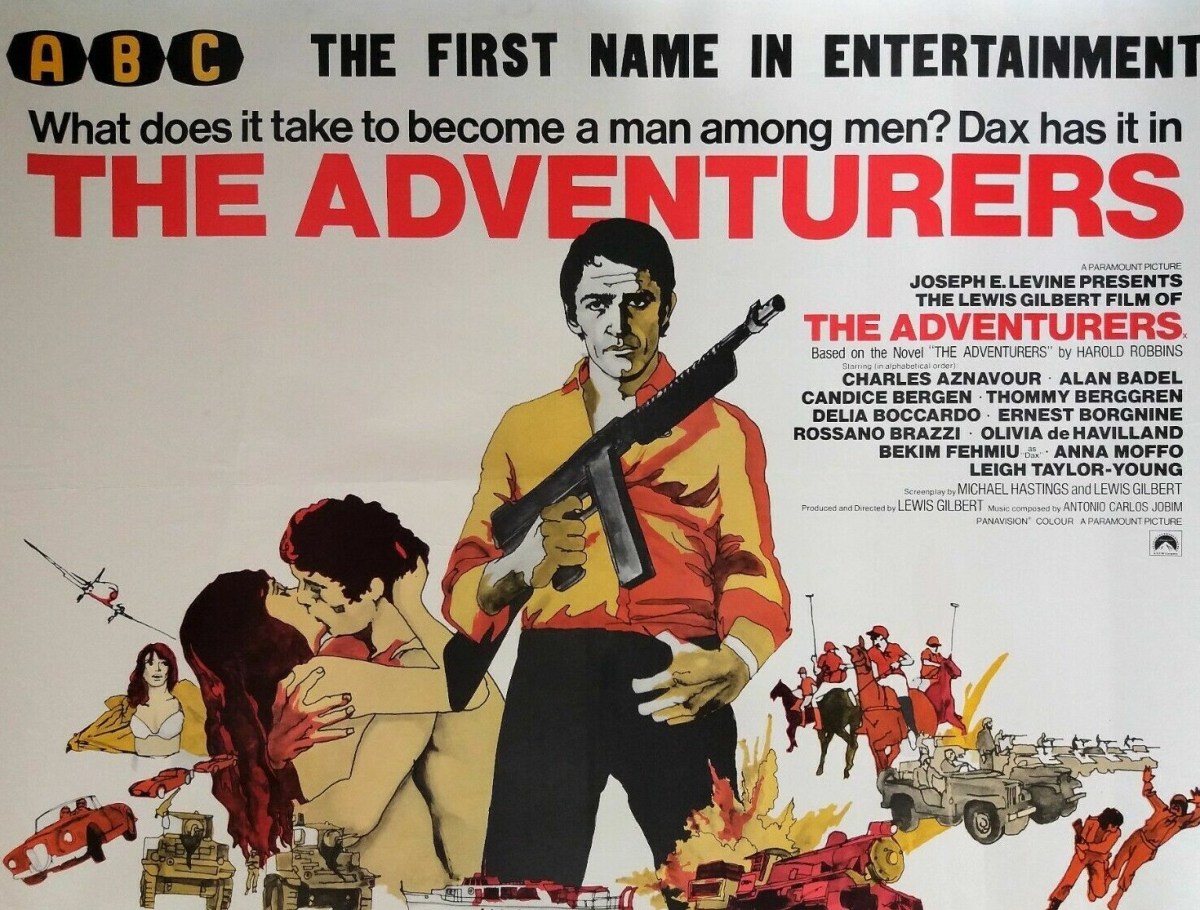
The Adventurers (1970) ***

Class A Trash. Adaptation of Harold Robbins (Nevada Smith, 1966) bestseller goes straight to the top of the heap in the So-Bad- It’s-Good category. Only Alan Badel (Arabesque, 1966) as a double-dealing revolutionary comes out of this with any honors.

The likes of Candice Bergen (Soldier Blue, 1970), Rossano Brazzi (Rome Adventure/Lovers Must Learn, 1962), double Oscar-winner Olivia de Havilland (Hush, Hush, Sweet Charlotte, 1964), Leigh Taylor-Young (The Big Bounce, 1969)  and Ernest Borgnine (The Wild Bunch, 1969) must have wondered how they were talked into this.

And director Lewis Gilbert (Loss of Innocence/The Greengage Summer, 1961) must have wondered how he talked himself into recruiting unknown Yugoslavian Bekim Fehmiu (The Deserter/The Devil’s Backbone, 1970), nobody’s idea of a suave lothario,  for the lead.

One of the taglines was “Nothing has been left out” and that’s to the movie’s detriment because it’s overloaded with sex, violence, more sex, more violence, in among a narrative that races from South American revolution (in the fictional  country of Corteguay) through the European jet set, fashion, polo, fast cars, orgies, and back again with revenge always high on the agenda. At close on three hours, it piles melodrama on top of melodrama with characters who infuriatingly fail to come to life.

Sensitivity is hardly going to be in order for Dax (Bekin Fehmiu) who, as a child after watching his family slaughtered and mother raped, makes his bones as a one-man firing squad, machine-gunning down the murderers. From there it’s a hop-skip-and-jump to life as the son of ambassador Jaime (Fernando Rey) in Rome where he belongs to an indulgent aristocracy who play polo, race cars along hairpin bends, swap girlfriends and, given the opportunity, make love at midnight beside the swimming pool.

His fortunes take a turn for the worse when his father backs the wrong horse, the rebel El Condor (Jorge Martinez de Hoyos)  in Corteguay, and is killed by the dictator Rojo (Alan Badel). In between an affair with childhood sweetheart Amparo (Leigh Taylor Young), life as a gigolo and cynical marriage to millionairess Sue Ann (Candice Bergen), Dax takes up the rebel cause, initially foolish enough to fall for Rojo’s promises which results in the death of El Condor, and then to join the rebels.

But mostly it’s blood, sex, betrayal and revenge. Anyone Dax befriends is liable to face a death sentence. He only has to look at a woman and they are stripping off. It’s a heady mess. It might have worked if the audience could rustle up some sympathy for Dax, especially as he was entitled to feel vulnerable after his childhood experiences. But he just comes across as arrogant and the film-makers as even more arrogant in assuming that because women fall at his feet that must mean he had bucketloads of charm rather than that was what it said in the script. He’s fine as the thug but not convincing as a lover.

Excepting Badel, the best performances  in a male-centric sexist movie come from women, those left in Dax’s wake, particularly Candice Bergen as the lovelorn wife and Olivia De Havilland as the wealthy older woman who funds his lifestyle, aware that at any moment he will leave her for a younger, richer, model. Lewis Gilbert is at his best when he lets female emotion take over, not necessarily wordy intense scenes, because Bergen and De Havilland can accomplish a great deal in a look.

The rest of it looks like someone has thrown millions at a B-picture and positioned every character so that they have nowhere else to go but the cliché.

By this point, Hollywood had played canny with Harold Robbins, toning down the writer’s worst excesses and employing name directors to turn dire material into solid entertainment. Edward Dmytryk (Mirage, 1965) had worked wonders with The Carpetbaggers (1964),  whose inherent salaciousness was held in check by the censor and made believable by characters played by George Peppard (Pendulum, 1969), Alan Ladd (Shane, 1953) and Caroll Baker (Station Six Sahara, 1963). Bette Davis and Susan Hayward contrived to turn Where Love Has Gone (1964) into a decent drama. Even Stiletto (1969), in low-budget fashion, managed to toe the line between action and drama.

But here it feels as if all Harold Robbins hell has been let loose. Rather than reining in the writer, it’s as if exploitation was the only perspective. Blame Lewis Gilbert, director,  and along with Michael Hastings (The Nightcomers, 1971) in his movie debut, also the screenwriter for the end result.

On the other hand, if you can leave your critical faculties at the door, you might well enjoy how utterly bad a glossy picture can be.
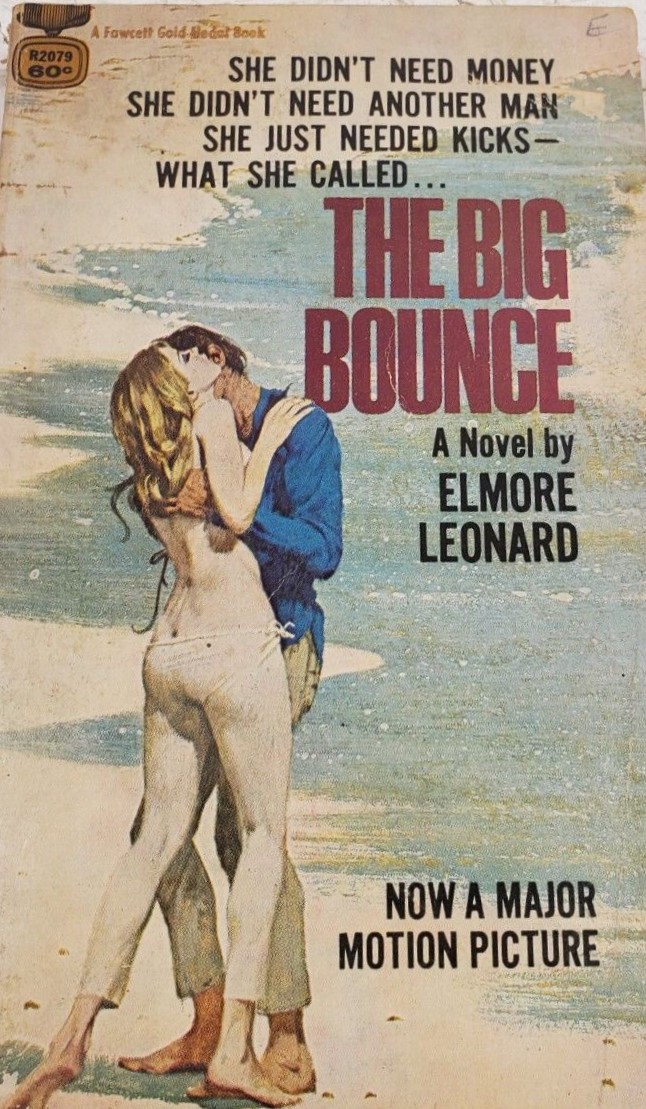
Book Into Film – “The Big Bounce” (1969)

A seminal example of the art of screenwriting, setting aside for the moment that in the future disgruntled novelist Elmore Leonard deemed it “an awful movie.” Which it isn’t, by the way. Not great, but far from awful.

Screenwriter Robert Dozier (The Cardinal, 1963) had his work cut out trying to make something cinematic out of the author’s debut crime novel. At that point Leonard had not been acclaimed as inheriting the mantle of Raymond Chandler and Dashiell Hammett. In fact, as far as critical acceptance went, he was pretty much an unknown. Six novels in nigh on two decades was not guaranteed to attact attention. If he had any reputation at all it rested on providing the source material for the Paul Newman hit Hombre (1967).

One of the reasons he remained so much under the critical radar was that he hadn’t written a novel in eight years, and all his previous output fell into the western category, a genre staunchly ignored by critics, and heavily reliant, commercially, on the pulp paperback. The Big Bounce wasn’t heralded on arrival, no hard cover printing, just a paperback movie tie-in that didn’t even go to the trouble of using a scene from the film or pictures of the stars.

Once again, the foreign distributor produces a better title than the original.

It was up to Robert Dozier to make the source material acceptable to the moviegoer. The book, as written, would never fly. Leonard’s novel lacked a Vietnam veteran, sex in the graveyard, and a nude statue. They were all Dozier’s inventions to bring a character to life who for the most part existed in the novelist’s backstory.

When the novel opens Nancy (Leigh Taylor Young) is due in court to answer the charge of dangerous driving. So rather than leaving that in her backstory, to be dealt with by dialog, Dozier makes that a key element of the film, the episode where Jack (Ryan O’Neal) wonders if he is in over his head as Nancy, annoyed by some pranksters, proceeds to drive a car off the road.

Nor in the book does Jack enjoy a brief dalliance with Joanne (Lee Grant), the single mother renting one of cabanas at the hotel where Jack works as a handyman. In fact, once he knows she has a child in tow, he pointedly avoids making any moves on the mother. His target, as far as the female holidaymakers go, is a single woman Virginia whose look of terror as he seduces her he mistakes for wild passion. The act isn’t consummated as she is struggling too much and it’s only on reflection that Jack, misreading the signals, realizes he had been on the point of raping her.

Jack has been fired from his job as pickle laborer, but he has no Army record. So all the talk about what it’s like to be at war is the screenwriter’s invention. Jack is a failed baseball player (a movie cliché – so that’s left out) and when he loses his job on the pickle farm and prior to hotel handyman turns to a spot of burglary.

He does get a job with hotel owner Sam (Van Heflin) who is also the Justice of the Peace. But Sam’s surname is not Mirakian. It’s – wait for it – Mr Majestyk. Hold on, was there not another movie featuring a guy with that name, starring Charles Bronson? Yep, that appeared in 1974, with Bronson as a melon farmer taking on The Mob. Maybe Robert Dozier thought it was too odd a name for a supporting character, maybe Leonard thought it too good a name to let go. Whatever, Mr Majestyk was left to fight another day.

Where Dozier has been exceptionally clever – rather than just sexing up the movie – is to take sections of the book (as with the car crash scene) and replant them to greater effect. In the book Nancy isn’t pimped out to a Senator by her wealthy lover Ray, but the line that it would take him “oh, a week” to find a replacement mistress comes from the book. In the book Nancy doesn’t swim naked in front of lustful married man Bob (Robert Webber). But she does swim naked in front of a character in the novel who is trying to blackmail her and he envisages holding out a towel to her naked body as she wraps her arms, to pay off her blackmailing debt, around him, rather than that being further teasing of the hapless Bob as in the film.

Dozier has rightly worked out the blackmailing angle would be a sub-plot too many. But it’s the blackmailer she shoots instead of Jack rather than the Comacho (Victor Paul) that Jack has hospitalized at the start of the movie and comes, rather late in the day in the movie, looking for revenge.

Quite a lot of dialog – because Leonard was hot on dialog, and it’s where much of his reputation derives – was taken intact from the book. But there was no way without lots of tedious dialog telling us what we already knew from her teasing Bob and running naked through a graveyard and driving cars off the road that Nancy was a piece of work who took enormous pleasure out of using her sexuality to get the better of men.

The novel explains that as a teenage babysitter she used to come on to the fathers driving her home and if they responded in any way she would blackmail them. One other time when there weren’t enough kicks in letting the neighbors’ kids see her naked, she took fifty bucks apiece from them to have sex with her. And she was always on the look-out for the “big bounce,” the action that would both be exciting and risky and also make her rich.

The Jack in the book is good bit less dumb than in the movie. He is aware that she is using him. He balks at the idea of carrying a gun because that would turn a simple burglary or heist into armed robbery for which, if caught, the sentence was much stiffer.

So, going back to Elmore Leonard’s critique of the movie, I’d be inclined to revise that to an “awful difficult book” to turn into a movie.     

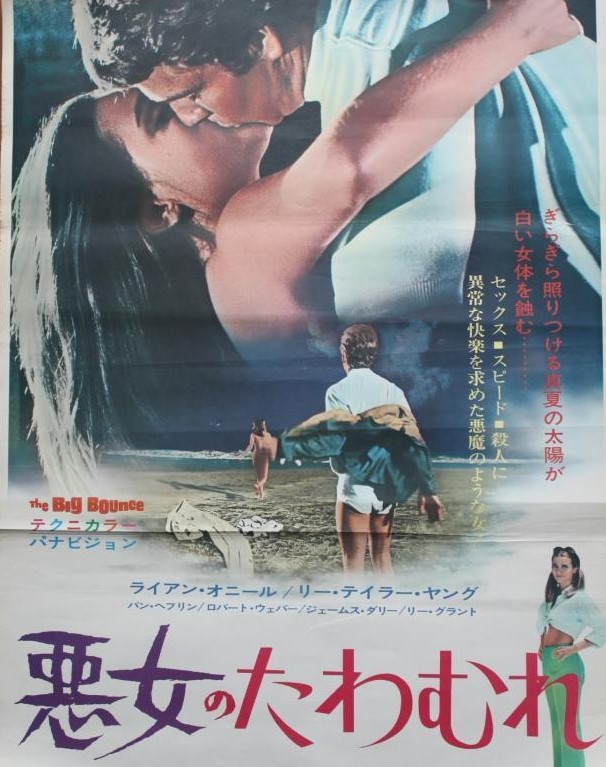
The Big Bounce (1969) ***

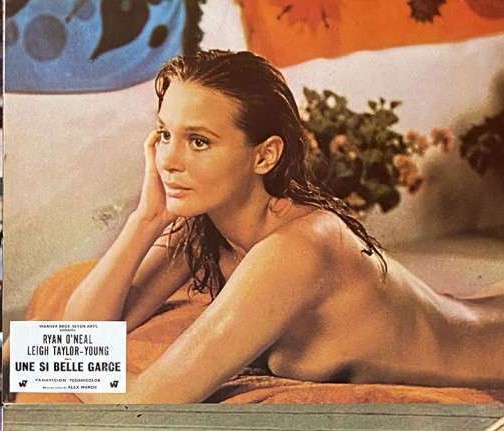
Femme fatale Nancy (Leigh Taylor-Young) makes a fair bid for the coveted Bunny Boiler of the Year Award. Had she chanced upon the right wrong guy who could channel her inherent viciousness she could have turned into Bonnie Parker. The only thing that holds her back from being a feminist icon, taking revenge for male betrayal, is her lack of independence.

Mistress to rich farmer Ray (James Daly), she teases the hell out of his head honcho Bob (Robert Webber), makes love in a graveyard, and fuels her amorality by going from breaking windows, attempted burglary and big-time heist to driving cars off the road and murder.

Temptation – Nancy-style.

Dupe is Vietnam vet Jack (Ryan O’Neal) who works as a hotel handyman and happily two-times her with single mother Joanne (Lee Grant).

Although easy with her charms, it’s sex that comes back to bite her when Ray explains that all this heady living comes at a price, pimping her out to a Senator he wants to impress. Whether that turns her against all men, including the dupe who she suspects of making out with Joanne, or whether she is plotting simple revenge against Ray isn’t made clear, but like the best femme fatales she has her eye on the loot that could bring her freedom and doesn’t much care what it costs to get it.

Nobody much cared for this picture, either, but I can’t see why. Sure, too much time is spent on Jack – he gets slung out of a job picking pickles for getting into a fight, and he lands on his feet with a friendly hotel owner Sam (Van Heflin) who buys him beers and even makes his breakfast, and pretty much could have the pick of any girl who walks into a bar. But that’s the usual narrative for film noir, pointing out, usually over and over, what an easy mark he is for a determined woman.

Unusual for the foreign title to be better than the original but this certainly captures the character better.

Nancy could have been less obvious, but she uses her perceived availability as a potent weapon – the scene where she holds her naked body just enough away from the panting Bob while probing him about his wife and children, is a classic – and she doesn’t make it easy for Jack either, although his reward is a drawn-out striptease. She’s the typical bored young woman looking for kicks, and like Pretty Poison (1968) you have to suspect that there’s considerable calculation behind what appear like spur-of-the-moment decisions, trying to work out just how far the dupe will go to retain her favors.

So while she races through the gears, Jack seems stuck on the starting grid, as his apparent good luck turns into confusion. And although he’s got the looks to attract women, he hasn’t the brains to understand them. He’s so dumb you just want Nancy to get away with it. If there’s a weak spot in the movie it’s that he just isn’t interesting enough to spend any screen time with. He boasts of having committed misdemeanours and he’s got a temper when roused but actually he’s your typical lost Sixties character looking for more stability in his life.

Unusually for a movie that’s drawn so much criticism, the supporting characters are quite appealing.  Sam is also a very worldly Justice of the Peace. Ray, far from being an easy conquest, is a hardass, the scene where he deadpans a line that it would take him, oh, a week to replace her if she fails to sleep with the Senator is priceless. There’s also some decent stuff about war, how Jack never even saw the enemy he was killing. And Joanne is a great study, another woman endlessly drawn to the wrong men, who can keep her dangling while never committing.

And beyond the scene where Nancy poses as a naked statue in a graveyard that is obviously unforgettable, there’s a marvellous scene where Jack wakes up in a strange house to the sound of tapping. When, finally, he opens his eyes, he sees a small girl tapping her cup at the breakfast table;  Joanne has a daughter she omitted to mention.

This was the first of Elmore Leonard’s crime novels to be adapted for the movies. But he wasn’t a Hollywood unknown. He supplied the source material for 3.10 to Yuma (1957) and Hombre (1967). And at this point he was keen on setting his stories in poorer areas, as well as pickle farming here,  the Kentucky backwoods are the setting for The Moonshine War (1970) and melon farming for Mr Majestyk (1974). There’s not a million miles between Mr Majestyk reaching for his gun when threatened and Nancy for one when betrayed, but somehow he’s in the right and she’s in the wrong.

And while you’re at it you might as well reflect on the complexities of Hollywood. Leigh Taylor-Young (I Love You, Alice B. Toklas, 1968) carries this picture and despite what the posters show was top-billed. But she didn’t get one more starring role. Two flops in a row – this and The Games (1970) – and Ryan O’Neal gets Love Story (1971) and he’s king of the hill.

Definitely worth a look.

Discover WordPress

A daily selection of the best content published on WordPress, collected for you by humans who love to read.

The Atavist Magazine

by Brian Hannan

WordPress.com News

The latest news on WordPress.com and the WordPress community.