Brannigan (1975) ***

File under guilty pleasure. And bear in mind in the early 1970s there was no such thing as the police procedural, certainly not as we know it today, when cops have the benefits of DNA, increased forensics and computer technology. Hollywood in this era didn’t waste time with endless knocking on doors or collecting massive amounts of minutiae in the hope of uncovering a clue.

Generally speaking, cops of this period had two things in common. They were mavericks and they constantly fought authority usually represented by some dumb superior. Normally the narrative consisted of the character taking on the  persona of a bull in a china shop and thundering towards a main objective, the more set pieces to demonstrate said bullish tendencies the better, and if in the course of apprehending a criminal he can deliver a catchphrase such as “make my day” or, as here, “knock, knock,” so much the better.
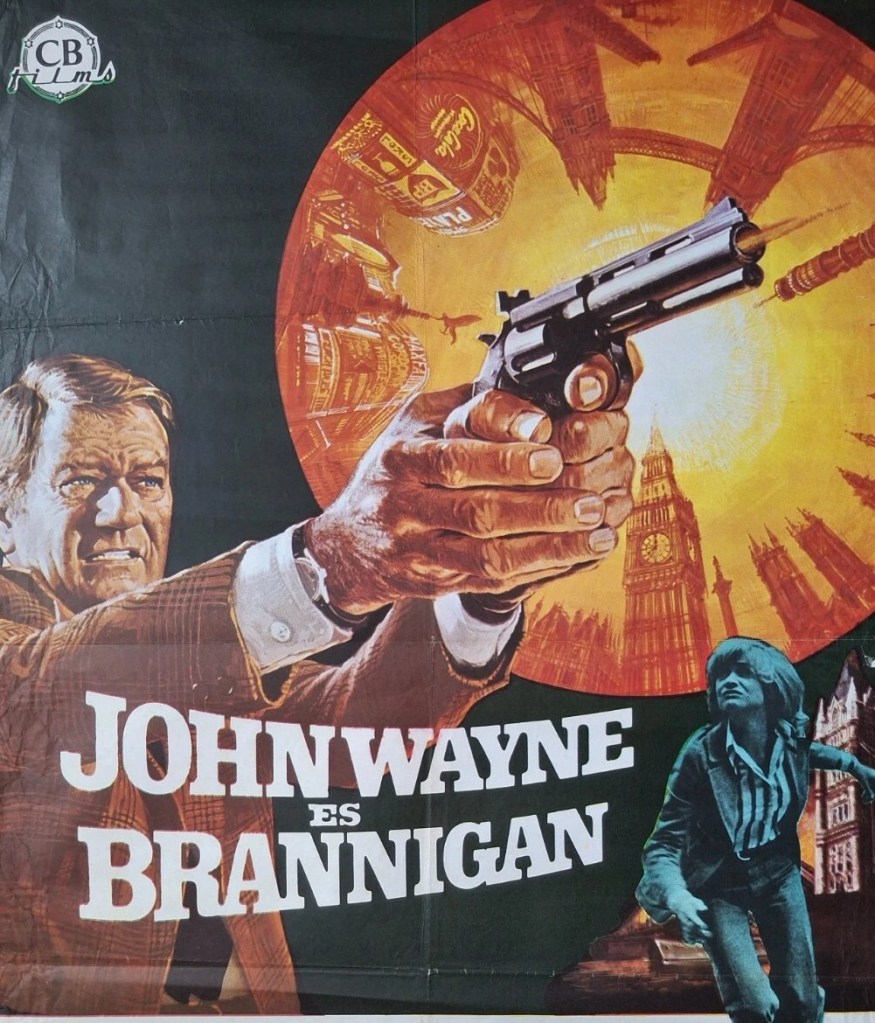
John Wayne had made eight westerns in a row and having turned down Dirty Harry (1971) ventured into the cop genre with McQ (1974) and came straight back for seconds here.

Brannigan (John Wayne) has been shipped over to London to bring back under the extradition treaty Mob gangster Larkin (John Vernon) which would be pretty straightforward except the Brits don’t keep such prisoners in custody – Larkin swans around in a white Rolls Royce – and in any case he’s in custody of another kind, having been kidnapped by some British hoods.

In terms of authority Brannigan battles the sappy Brits who won’t allow him to carry a gun and do things the Chicago way. Luckily, for the picture, top cop Commander Swann (Richard Attenborough) is not the standard stiff-upper-lip buffoon but as likely to pitch in when the fisticuffs begin. There are a couple of excellent car chases and one stunt of French Connection (1971) quality when two cars go sailing over the gap in a raised Tower Bridge. This is a London mixing glory and grit, posh residences and ancient buildings share screen time with rundown docklands. And the movie has the sense not to go all May-December on us and while a certain affection builds up between the U.S. cop and his driver Jennifer (Judy Gesson), it doesn’t teeter into unlikely romance.

The plot’s clever. While in a sauna having a massage Larkin is knocked out cold and bundled into a sweatbox by two apparent delivery guys and then smooth attorney Fields (Mel Ferrer) acts as the go-between, delivering Mob ransom money to the kidnappers, the price increasing with every failed rescue attempt, until the kidnappers are sitting on a cool million. Naturally, there’s some double-crossing and the cops have one tiny magic bullet to use to their advantage.

So mainly the fun is watching Brannigan charge around in a British china shop, mostly bypassing British rules. There’s a subplot involving a hitman hunting Brannigan and even when in a normal cop movie you might think, fair’s fair, the policeman should be able to defend himself with a weapon, that doesn’t equate with the British rules, so you have our hero able to point out that if he wasn’t armed to the teeth Jennifer would be dead, while Swann does his best to insist that it would be better for the young lass to end up on a mortuary slab than British cops go rampaging around with guns.

There’s some gentle fun in poking at British tradition – the obligatory wearing a tie in certain upmarket establishments – and in Swann having to translate to a waitperson Brannigan’s breakfast order.

Except when standing up for rules, Swann is great value, a good match for the American, both in tempering his ruthlessness, and matching him punch-for-punch in a brawl.

Apart from the action sequences, John Wayne is permitted to grow old gracefully, his dialog rarely filled with barbed retorts or salty words and there’s quite nice acting on the Duke’s part when he’s called upon to demonstrate his special skill, which is “reacting”.

Richard Attenborough (Only When I Larf, 1968) has a ball, and not before time, able to let some of the usual repressed intensity burst out. Judy Geeson (The Executioner, 1970) must have been delighted to find a part that didn’t involve her taking off her clothes and she’s afforded some of the best lines. John Vernon (Topaz, 1969) is his usual hardass but Mel Ferrer (The Fall of the Roman Empire, 1964) has a good stab at a bad guy.

Not in the same league as director Douglas Hickox’s Sitting Target (1972). Written by Christopher Trumbo (The Don Is Dead, 1973), William McGivern (The Wrecking Crew, 1968), Michael Butler (The Gauntlet, 1977) and William Norton (The Scalphunters, 1968).  

Erroneously tabbed as a box office disappointment, this was made on a budget of $2.6 million but cleared $7 million in rentals (the studio share of the box office) plus another $1.5 million from television.

Obviously, if you’re in the Clint Eastwood camp this falls short, but otherwise it’s enjoyable stuff.

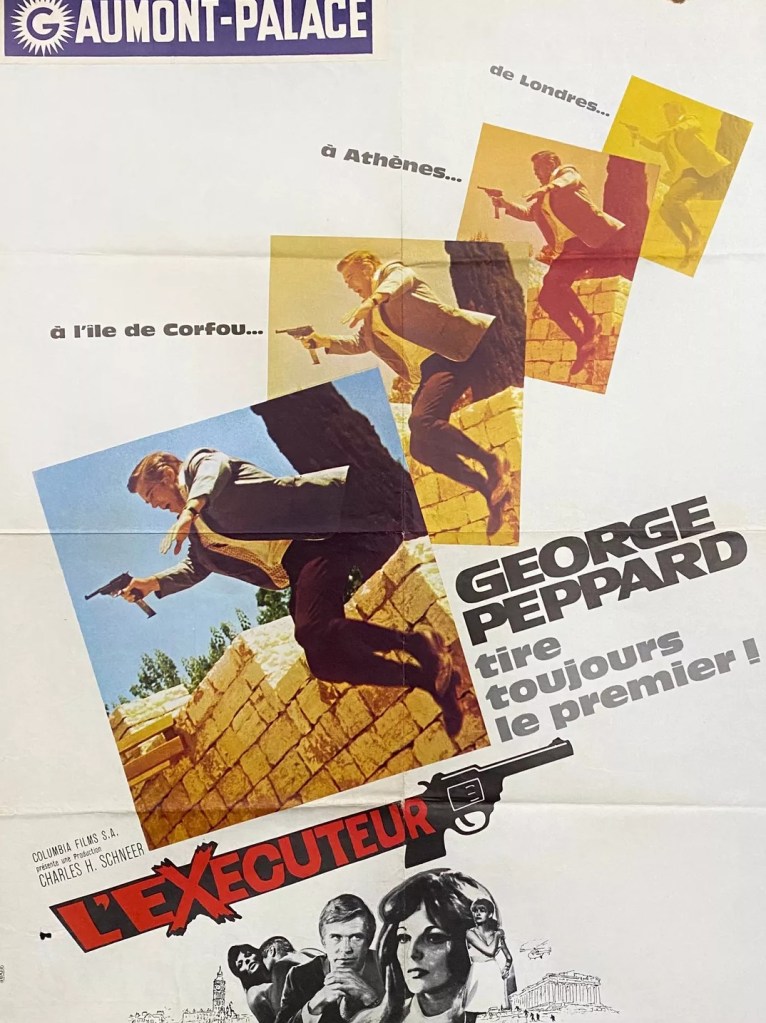
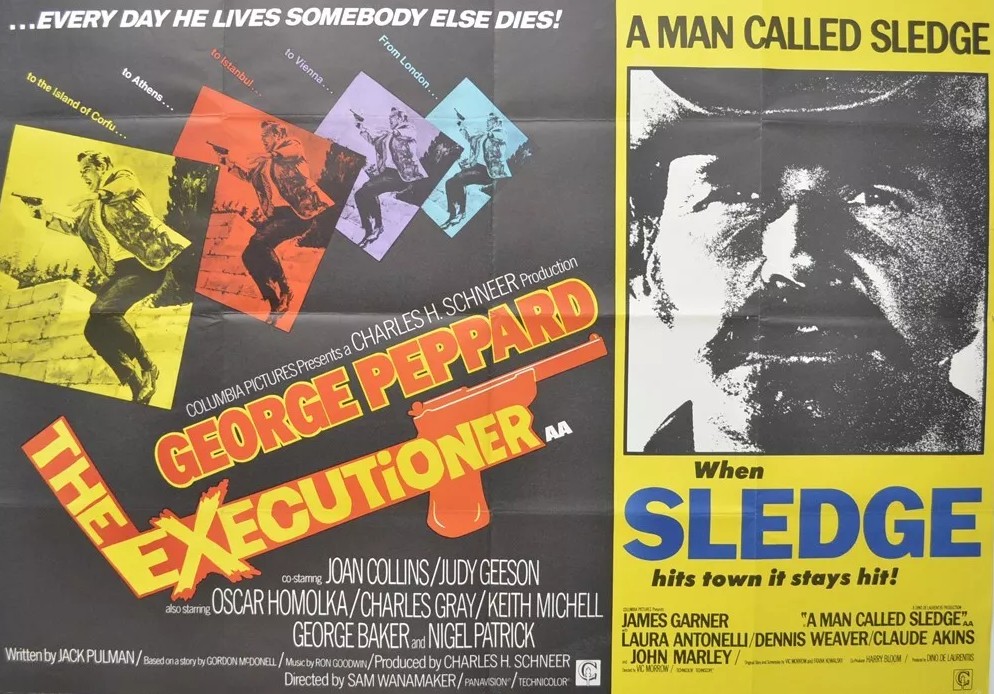
The Executioner (1970) ****

Minor gem. One of the espionage films of the era ignored by audiences because it lacked the verve of James Bond, no car chases or bedhopping hero to maintain interest when the narrative stretched credulity. Ignored by critics because it starred the vastly underrated George Peppard. Yet if you wanted an actor to show pain, to suffer from humiliations to his dignity, there was no one better, in part because on screen (and apparently in real life) arrogance was key to his persona. Here, you can add confusion to that mix of unwelcome emotions.

Beginning a scene with the aftermath of slaughter has become a modern thriller trope – see The Equalizer 3 (2023),  The Accountant 2 (2025) for the most recent examples –  but this is where the idea began and it’s how this picture opens, the only survivor of the massacre being the wife Sarah Booth (Joan Collins) whom our hero John Shay (George Peppard) covets. An immediate flashback shows them consummating their love. So you’re guessing there’s something of the James Bond in Shay, carrying on an illicit love affair.

But in fact that’s just one of the clever titbits of misdirection director Sam Wanamaker (The File of the Golden Goose, 1969) throws our way. And, gradually, we realize this is not so much about dirty dealings in the espionage business, the usual hunting down of a double agent, our hero clashing with disbelieving and frosty upper class bosses, but more about how the flaws in human nature turn characters inside out.

It’s no surprise that Shay is an outsider, not with that American accent standing out a mile in the British secret service run by the cut-glass accents of the likes of Col Scott (Nigel Patrick) and Vaughn Jones (Charles Gray). He’s not a member of the club, old boy. He bristles at not belonging – “belong to me!” wails girlfriend Polly (Judy Geeson). And he’s been passed over  by love of his life Sarah for another agent Adam Booth (Keith Michell) not because the latter has wealth and status but because Shay’s mind is too often elsewhere.

Though you are initially led to believe that Shay is having an affair with Sarah, that turns out to be far from true, although the glances he casts at her are enough to make Polly think they still are. And part of the reason his superiors distrust his assertion that Adam is a double agent is because they think he just wants rid of his rival so he can make another play for his former lover.   

Shay is so convinced that he is right that he gets Polly, who also works in the secret service but in the backroom department, to sneak out top secret files. When he stitches up enough information to make the case against Adam, it backfires and he’s suspended. But then, egged on by a discovery by top boffin Crawford (George Baker) working on some top secret stuff,  he decides to kill Adam and chuck the body out of a plane into the English Channel – hence becoming the executioner of the title.

Then the twist is truly in when Shay takes Adam’s place on a mission to Greece, which has also been planned as a second honeymoon for Adam and Sarah. This latter fact doesn’t dissuade Shay from making a romantic play for Sarah. However, there are nefarious dealings afoot espionage-wise but in what proves the first of many miscalculations Shay comes unstuck and is beaten up by the opposition and Sarah kidnapped. The ransom the Soviets demand is Crawford.

The massacre that we saw at the start solves that problem.

But it turns out Shay has let desire for Sarah muddle his brain for Adam was not a secret agent. Shay has been further duped into that belief by Crawford who also has romantic designs on Sarah, though it has to be said in her defense that Sarah has encouraged neither of these potential suitors.

There is one final twist but that’s just another nail in the coffin.

So what sets out to be a different kind of spy thriller turns into the polar opposite of what audiences might have expected, playing more on the human frailty of the hero than hitherto in the genre.

George Peppard is excellent, especially when expressing emotional pain and confusion, continuing a superb run of acting roles – ignored by the critics of course but tossing his screen persona away – that ran from Rough Night in Jericho (1967) and P.J. (1967) to Pendulum (1969). Judy Geeson (Brannigan, 1975) has the better female role as the disgruntled but faithful girlfriend. Aside from the occasional acidic remark, Joan Collins (Subterfuge, 1968)  is strictly there for the glamor.  Written by Jack Pulman (Best of Enemies, 1961) from a story by Gordon McDonnell (Shadow of a Doubt, 1943).  

Well worth a look.

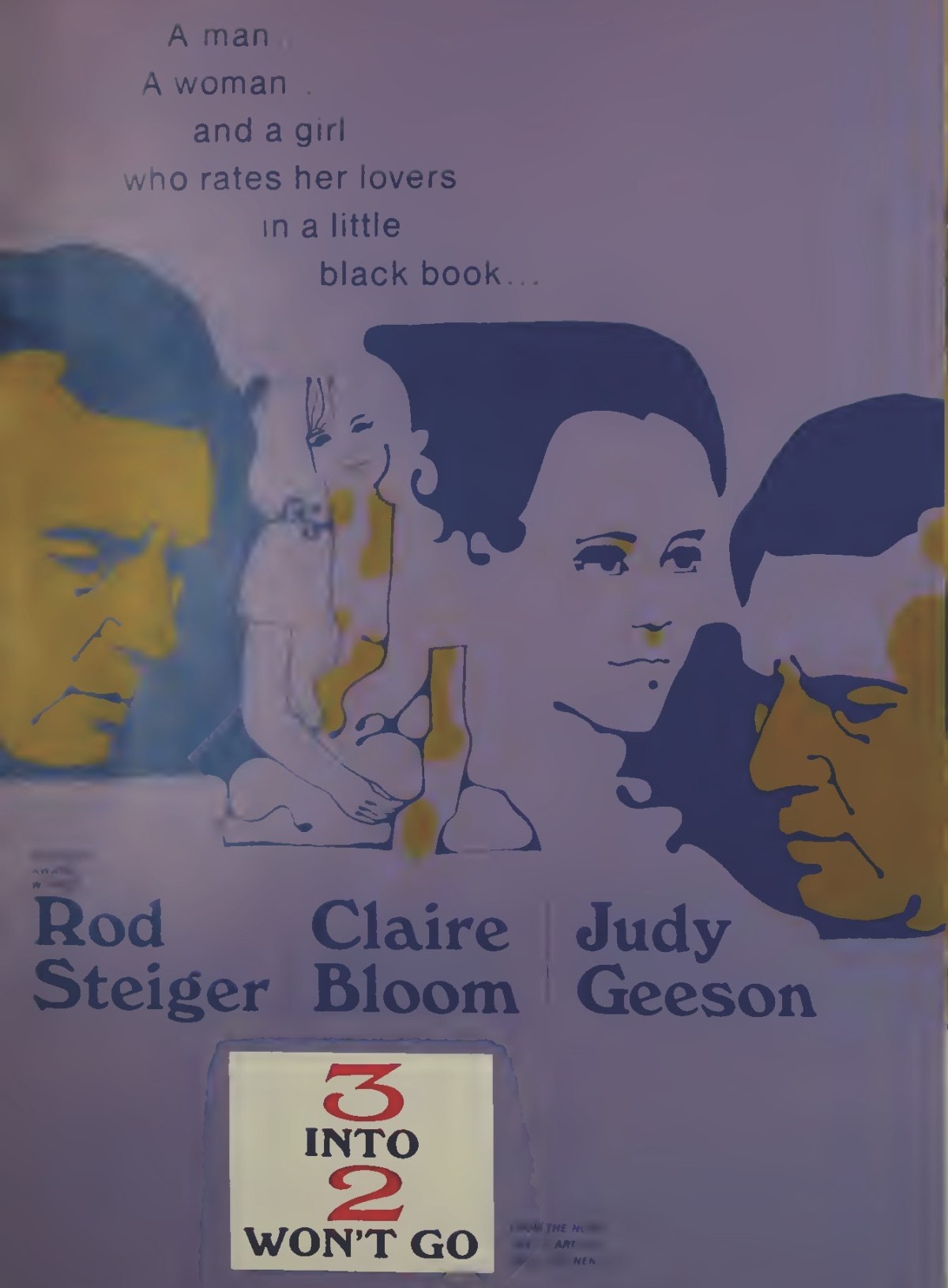
Three into Two Won’t Go (1969) ***

Unhappily married and childless salesman Steve (Rod Steiger) begins an affair with kooky promiscuous hitchhiker Ella (Judy Geeson). A free spirit in control of her life – no VD and on the Pill – and happy to drift from mundane job to mundane job, Ella ranks her many lovers on their sexual performance. Steve has just moved into a new house on a dreary new estate, perhaps in the hope of revitalizing his staid marriage to Frances (Claire Bloom).

While Steve is away on business, Ella turns up at his home where, revealing, without implicating Steve, that she is pregnant, she convinces Frances to let her stay the night. Naturally, it is Steve’s baby, but Ella plans an abortion. Steve wants the baby and so, too, still unaware of the father, does Frances, seeing adoption as the solution to their marital woes. And so a love triangle, or more correctly a baby triangle, plays out, with a few unexpected twists.

Like most of the marital dramas of the 1960s, especially in the wake of the no-holds-barred Who’s Afraid of Virginia Woolf (1966), this is riddled with outspoken protagonists who have no idea how to find real happiness. Based on the book by Andrea Newman and adapted by Edna O’Brien, who both have previously marked out this kind of territory, the picture shifts sympathy from one character to the next. While no one is entirely culpable, none are blameless either. Yet there is an innocence about Steve and Frances in the way they fling themselves in the direction of unlikely salvation. They are not the first couple to find themselves in a marital cul de sac, nor the first to do nothing about it, hoping that somehow through a new house or job promotion things will right themselves.

Audiences, accustomed to seeing Steiger (In the Heat of the Night, 1967) in morose roles, might have been shocked to see him happy and he manages to present a more rounded character than in some previous screen incarnations. In burying herself in domesticity, Claire Bloom (Charly, 1968) essays a far from fragile character, whose resilience and pragmatic character will always find a way forward. Geeson is the surprise package, at once knowing and in charge, and at other times completely out of her depth, and to some extent enjoying the chaos she sparks. The exuberant screen personality she presents here is almost a grown-up more calculating version of the character she portrays in Hammerhead (1968).

Director Peter Hall (Work is a Four-Letter Word, 1968) generates more universal appeal by ensuring the movie is not so obviously grounded in the 1960s that it would quickly become outdated and the snatching at last-minute fantasy to avert marital disharmony will still strike a note. The performances are all excellent, including a turn by Peggy Ashcroft (Secret Ceremony, 1968) and bit parts from British character actors Paul Rogers (Stolen Hours, 1963) and Elizabeth Spriggs in her second movie.

Complex but not hard work.

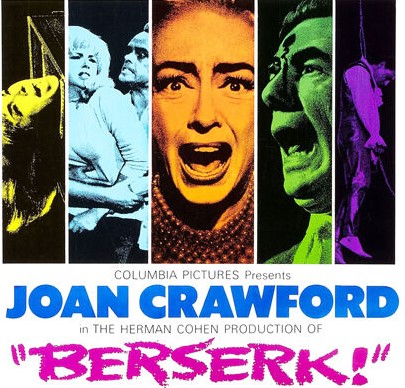
Berserk! (1967) ***

“Murder is good for business,” declares magnificently callous circus boss Monica (Joan Crawford). And so is nostalgia. Interrupting the action every ten minutes or so with the kind of circus act – courtesy of legendary British ringmaster Billy Smart – that you couldn’t see these days is probably going to win more viewers than seeing Joan Crawford in late vintage nastiness. Roll up, roll up for the elephants ridden by glamorous lasses, death-defying (or not so much) high-wire acts, prancing horses, knife-throwing, cutting a woman (and who better than a sequined Diana Dors) in half, and “intelligent” poodles (is there any other kind?).

Step aside John Wayne (Circus World, 1964), whose magnificent showmanship has nothing on circus master Monica, calling the shots and not just in the ring. She rides roughshod over business partner Albert (Michael Gough), pushes back into his box newcomer Frank (Ty Hardin), and packs daughter Angela (Judy Geeson) off to boarding school to shut the book on maternal instinct in case it gets in the way of running the show.

Throw in a good few hapless coppers, including a toff – Monica being such a big noise it requires the involvement of a Commissioner (Geoffrey Keen) and a Superintendent (Robert Hardy) – who pop up sporadically and show surprisingly little skill for detection beyond standing over a corpse or murder implement and making a pronouncement. Naturally, such an atmosphere is riven with jealousy and it doesn’t take much to start a cat fight, no surprise to see Matilda (Diana Dors) in the thick of it.

When her star act dies (murdered) on the high wire and Monica looks around for a replacement, she happens upon pushy Frank (Ty Hardin) who not only walks across the tightrope blindfold, but operates without a safety net and should he fall will land on a series of nasty spikes. He wants to share her bed and her business, but has some dodgy backstory, hints of some incident in Canada seven years ago.

So just as Monica reckons the thrill of possibly seeing death occur in front of their eyes will pull in the punters, that could be (though I doubt it) an ironic nod at the cinema audience since, as in all serial killer pictures, viewers are calculating who will be killed next, and not so much who the murderer is, but who will survive at the end. Luckily, this is British and made in times when the censor exerted a tighter rein, so you can be sure nobody’s going to meet a sticky end just because they’ve had illicit sex.

As if her employees were scary beasts, Monica beats them into submission, though, in fact, outside of Frank, nobody’s got the guts to challenge her. And it being the 1960s and forensics not much in evidence and, frankly, the producers not much interested in rounding up any suspects, you just sit back and wait to see who will be next. Will someone scare the prize elephant into misplacing a foot and crushing to death the beauties lying on the ground so that it can daintily step over them? Will the knife-thrower miss his marks or the spinning wheel containing his human target be rigged to go awry?

My money was on the poodles attacking their mistress for making them jump over a skipping rope. I hadn’t quite seen coming Albert being foolish enough to lean against a post with his head positioned exactly beside a hole so that from behind someone could hammer a spike into it. That should have made Monica a suspect because he wanted out of the business, except she has stolen and burned their contract and not a single soul in the entire circus appears to know that he even was her business partner.

Angela, when she turns up accompanied by a headmistress, appears to be a chip off the old block, turfed out of yet another school for “causing trouble.”  Monica looks as if she was born to be trouble, and you can imagine the machinations that led her to owning a circus. There’s a surprisingly tender mother-daughter reunion and the daughter is soon enrolled in an act.

The ending seems straight out an Agatha Christie novel, take the least likely contender and make them the villain, with psychobabble as justification.

I have to say that I enjoyed this, as much for the circus acts as for seeing noir queen Joan Crawford (Mildred Pierce, 1945) returning to the tough-as-they-come persona of Johnny Guitar (1954) rather than the theatrics of Whatever Happened to Baby Jane (1962). A pre-lugubrious Michael Gough (Batman, 1989) and a non-blousy Diana Dors (Hammerhead, 1968) add to the treats. Maybe Sidney Sweeney (Immaculate, 2024) consulted the Judy Geeson (Prudence and the Pill, 1968) playbook in assessing the career value of appearing in a horror movie. Ty Hardin (Custer of the West, 1967) is miscast, especially in his high-wire wobbles, though anyone thinking they can act Ms Crawford off the screen should be taken away and locked up.

Jim O’Connolly (Vendetta for the Saint, 1969) directed from a script by the team of Aben Kandel and producer Herman Cohen  (Black Zoo, 1963).

Nostalgic fun.

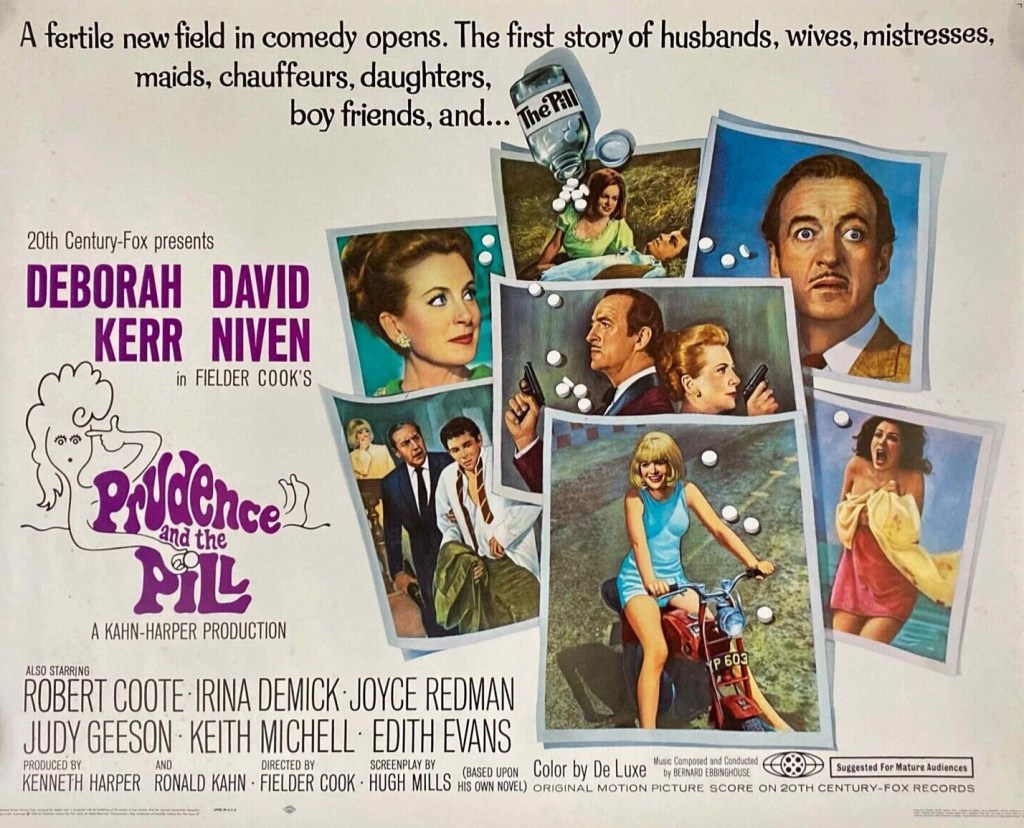
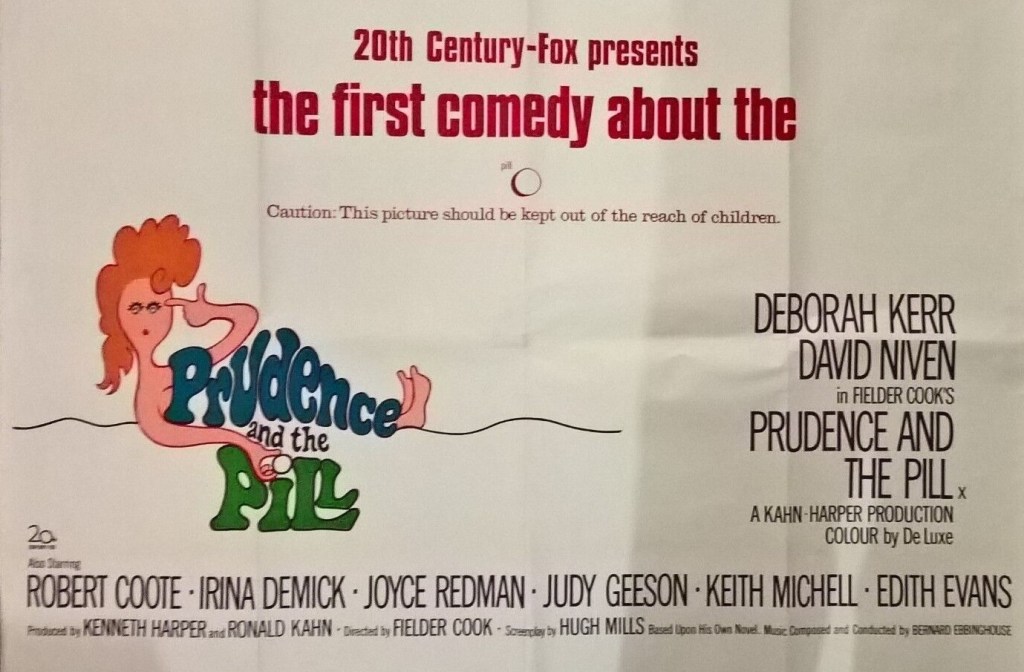
Prudence and the Pill (1968) ****

Cleverly calibrated chuckle-worthy comedy of manners. Far more enjoyable than the basic material might suggest, especially as you will easily guess where it all ends. Anchored by redemptive performances, after disappointing turns in The Eye of the Devil / 13 (1966), by Deborah Kerr and David Niven, playing a middle-aged upper-class childless couple whose marriage survives on civility alone, and a sparkling showing by Judy Geeson (Here We Go Round the Mulberry Bush, 1967).

It’s surprising what a fresh look at cliché can achieve. On the face of it, American director Fielder Cook (How to Save a Marriage and Ruin Your Life, 1968) is the last person to be tackling the upper classes, especially as there’s scarcely a hint of satire. It’s wonderfully pitched, no sexist jokes, no farce, no tourist or Swinging London, and avoids the temptation of aiming for the lowest common denominator (Carry On Up the Pill for example). But authority is constantly confounded, pomposity pricked, and, astonishingly for a  movie about relationships in Britain – the home of the kitchen sink drama – in the late Sixties, everyone ends up happier ever after.

The titular drug in question, in case that term is no longer in common usage, is the contraceptive pill, here sold under the generic name of Thelon. The biggest shocks here might well be that mothers and fathers in middle-age still have sex. Although that is balanced by a contemporary vibe of having children late in life.

So the fun begins when Henry (Robert Cooote) and Grace (Joyce Redman) discover bubbly daughter Geraldine (Judy Geeson) in bed with Tony (David Dundas). Cue howls of anger from staid parents, who divide up the ticking-off, the mother tasked with warning daughter about the dangers of pregnancy – and with it the specter of single motherhood, a high society no-no – the father to whip the young rascal.

The mother is only mollified – though still affronted at such blatant expression of sexuality – when she discovers her daughter is on the Pill. But shocked to discover Geraldine has been pilfering her own supply. Father is taken aback to discover the lover is not only heir to a fortune but has already proposed.

Unlike most movies of the era, where sexuality remained a dirty word, and most illicit romances were conducted in secrecy and ended up in disaster, the vivacious Geraldine could be the poster girl for sex. She is delighted to have lost her virginity, and to expand her sex education, and stands up against her mother’s old-fashioned views.

However, the replacement of mother’s Pill with aspirin presents a dilemma. Robert and Grace are also enthusiastic lovers and the absence of contraception for so long points towards the possibility of a very embarrassing pregnancy.

Meanwhile, Henry’s brother, bored company chairman Gerald (David Niven), who lives in a mansion with servants and swans around in a chauffeur-driven Rolls-Royce, discovers, to his horror, that his wife Prudence (Deborah Kerr) has been taking the Pill, denying him his much-cherished desire to have children. So he swaps it for a vitamin pill. Unknown to him, his young maid Rose (Vickery Turner), warming to the amorous attentions of the chauffeur Ted (Hugh Armstrong), has taken a leaf out of Geraldine’s book and snaffled her mistress’s Pill.

You can see where this is headed. But there’s a complication. Assuming (as a man would) that their lack of children was due to his wife’s infertility, Gerald could have had children by his younger mistress Elizabeth (Irina Demick). But he refuses to seek a divorce (the scandal, don’t you know) and Elizabeth views him as a poor candidate for marriage (would he not just have another mistress) and fatherhood.

Prudence, it soon transpires, also has a lover, Dr Huart (Keith Michell). Equally resistant to divorce, for societal reasons and to prevent her husband marrying his mistress, Prudence soon warms to the thought of having a child, but abhors the prospect of having Gerald as its father.

In the best Hitchcock fashion, the audience is privy to information denied the characters who fluster around in their incompetence.

It should never work. The story is so obvious and, from a narrative perspective – given unplanned pregnancy does not lead to dark deeds, humiliation and abandonment – weak. That it is pretty much a triumph owes as much to the direction (witty use of musical cues, for example) as a script that feasts on reversals. The acting is first-class all round. David Niven and Deborah Kerr, in their final pairing, atone for the under- and over-acting, respectively, of Eye of the Devil. Judy Geeson is a standout as a marvellously gleeful liberated young woman. Edith Evans (The Chalk Garden, 1964) pops up for a delightful cameo.

Pure joy.     

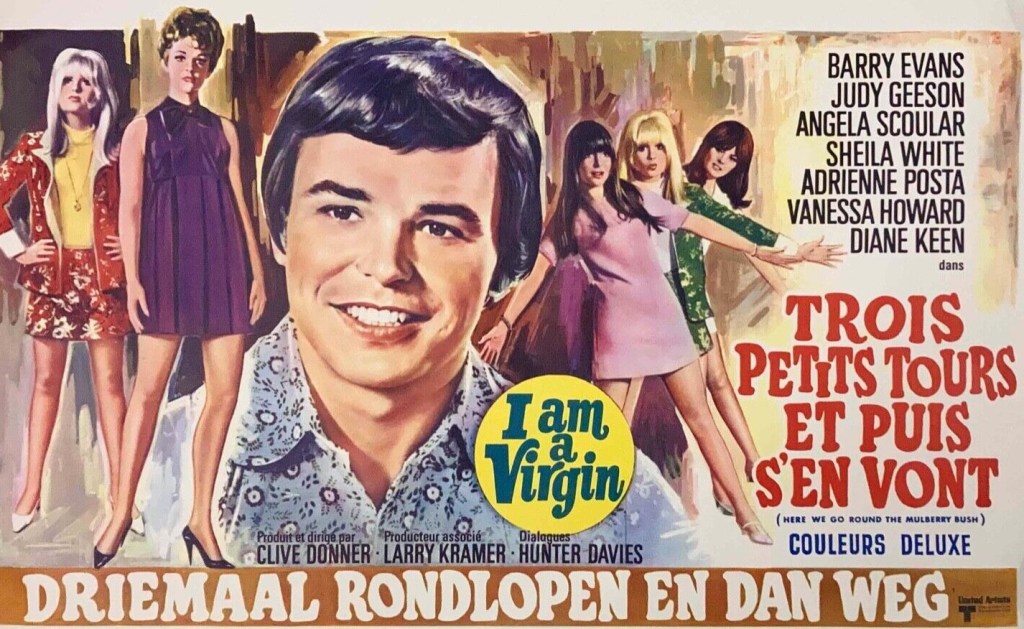
Here We Go Round the Mulberry Bush (1968) **

Breaking the fourth wall has become a common conceit these days, especially in television, so you might be surprised to learn it was the key artistic element of this otherwise straightforward British coming of age drama.

Our teenage guide Jamie (Barry Evans), a delivery boy, spends most of his time lusting after any women he meets. Like a junior version of 10 (1979) women are rated according to their physical attributes. Most, of course, are well out of his league, especially as he lacks for what counts as the smooth patter which his cocky pal Spike (Christopher Timothy) has in abundance.

Essentially a series of episodes with the opposite sex as Jamie tries to lose his virginity. But mostly, it’s just Jamie yakking on about how he’s not lost his virginity and what’s up with all those women that they can’t see what a great catch he is. He’s so determined to have sex he will even go out with the dumbest of dumb blondes, Linda (Adrienne Posta).

Naturally, since reality is too cruel, he succumbs to fantasy with a number of scenarios that seem, inexplicably, torn from silent movies, and nothing approaching the imagination of Hieronymus Merkin. For no particular reason, he strikes lucky with the adventurous Mary (Judy Geeson), whose boyfriends usually run to sports cars, but that liaison is nearly interrupted by a wet dog and Jamie’s inexperience.

Apart from the lusting, there’s little else going on, a couple of women in a fish-and-chip shop complain they are fed up with chicken and beef, his younger brother shows more spark, and his home life is pitifully dull. You can’t really blame the movie for lacking the rebelliousness that was potent at the time, there’s no political awareness and no sign Jamie is going to grow up into one of the Angry Young Man so familiar at the beginning of the decade. It’s a quaint version of American Pie.(1999).

But it’s just boring. While Barry Evans (Alfred the Great, 1969) is personable enough he doesn’t have enough in the wit department to keep you hooked for the duration, most of the humor teetering on the side of inuendo..

Unable to recognise the inherent weakness of the script, and assuming that breaking artistic boundaries with the fourth wall is enough, director Clive Donner (Alfred the Great) spends most of his time trying to visually brush everything up, with little success.

That this was a big British hit at the time might have been more to do with the soundtrack – performed and written by Steve Winwood and Traffic – and the fleeting sight of Judy Geeson (Two into Three Won’t Go, 1969) in the buff. The British censor didn’t take too kindly to the actress revealing all, so in fact audiences were treated to very little, but for teenagers at the time very little was more than usually came their way unless willing to sit through a turgid arthouse picture.

About the only thing to commend it is Geeson’s class, she stands head and shoulders above everyone else in terms of screen charisma, and that there’s a roll call of rising British stars. As well as Christopher Timothy who would achieve fame on television in the original All Creatures Great and Small, the supporting cast includes Vanessa Howard (Corruption, 1968), Angela Scoular (On Her Majesty’s Secret Service, 1969), Diane Keen (The Sex Thief, 1973) and Adrienne Posta (Some Girls Do, 1969) and, to show them all how to do it, Denholm Elliot (Maroc 7, 1967) briefly pops up.

Clive Donner (Alfred the Great) directs. Hunter Davies, making his screen debut, wrote the screenplay based on his bestseller. Generally, any film that scores two stars does so out of incompetence. This is well-enough made but never seems to shift into gear.

Three into Two Won’t Go (1969) ***

Unhappily married and childless salesman Steve (Rod Steiger) begins an affair with kooky promiscuous hitchhiker Ella (Judy Geeson). A free spirit in control of her life – no VD and on the Pill – and happy to drift from mundane job to mundane job, Ella ranks her many lovers on their sexual performance. Steve has just moved into a new house in a dreary new estate, perhaps in the hope of revitalizing his staid marriage to Frances (Claire Bloom).

While Steve is away on business, Ella turns up at his home where, revealing – without implicating Steve – that she is pregnant and convinces Frances to let her stay the night. Naturally, it is Steve’s baby but Ella plans an abortion. Steve wants the baby and so, too, still unaware of the father, does Frances, seeing adoption as the solution to their marital woes. And so a love triangle, or more correctly a baby triangle, plays out, with a few unexpected twists.

Like most of the marital dramas of the 1960s, especially in the wake of the no-holds-barred Who’s Afraid of Virginia Woolf (1966), this is riddled with outspoken protagonists who have no idea how to find real happiness. Based on the book by Andrea Newman and adapted by Edna O’Brien, who both have previously marked out this kind of territory, the picture shifts sympathy from one character to the next. While no one is entirely culpable, none are blameless either. Yet there is an innocence about Steve and Frances in the way they fling themselves at unlikely salvation. They are not the first couple to find themselves in a marital cul de sac, nor the first to do nothing about it, hoping that somehow through a new house or job promotion things will right themselves.

Audiences, accustomed to seeing Steiger (In the Heat of the Night, 1967) in morose roles, might have been shocked to see him happy and he manages to present a more rounded character than in some previous screen incarnations. In burying herself in domesticity, Claire Bloom (Charly, 1968) essays a far from fragile character, whose resilience and pragmatism will always find a way forward. Geeson is the surprise package, at once knowing and in charge, and at other times completely out of her depth, and to some extent enjoying the chaos she sparks. The exuberant screen personality she presents here is almost a grown-up more calculating version of the character she portrays in Hammerhead (1968).

Director Peter Hall (Work is a Four-Letter Word, 1968) ensures more universal appeal by not grounding the movie in the swinging sixties so that it would not quickly become  outdated. The snatching at last-minute fantasy to avert marital disharmony will still strike a note. The performances are all excellent, including a turn by Peggy Ashcroft (Secret Ceremony, 1968) and bit parts from British character actors Paul Rogers (Stolen Hours, 1963) and Elizabeth Spriggs in her second movie.

Make sure you catch the correct version of this picture if you hunt it down. Against the director’s wishes. Universal edited it then added new characters for the version shown on American television.

Readers’ Top 30

I’ve been writing this Blog now for one year, beginning July 2020, so I thought I’d take a look at which posts proved the most popular (in terms of views) with my readers. So here’s the annual top 30 films, ranked in order of views.

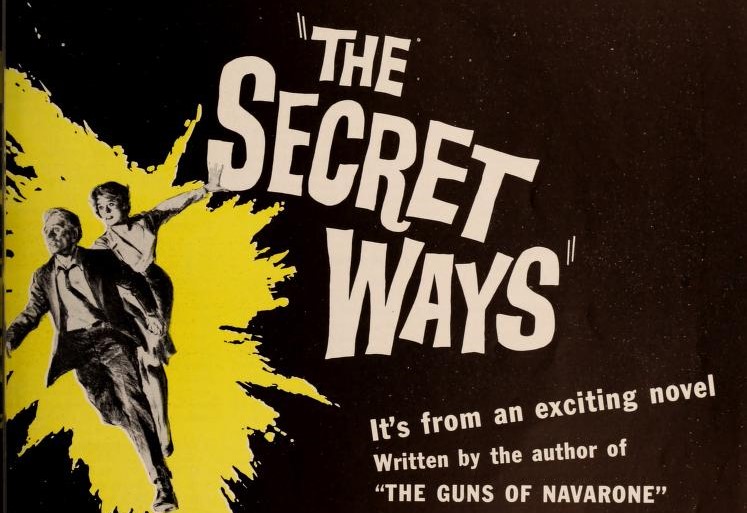
  1. The Secret Ways (1961) – Richard Widmark and Senta Berger – making her Hollywood debut – behind the Iron Curtain in gripping adaptation of the Alistair Maclean thriller.
  2. Ocean’s 11 (1960) – Frank Sinatra, Dean Martin, Sammy Davis Jr. and the Rat Pack in entertaining heist movie set in Las Vegas.
  3. It’s Not All Rock’n’Roll (2020) – remarkable documentary about the other side of the music business as ageing rocker Dave Doughman tries to keep his dreams alive.
  4. Age of Consent (1969) – British actress Helen Mirren makes her movie debut as the often naked muse for painter James Mason in touching drama directed by Michael Powell.
  5. The Venetian Affair (1966) – Robert Vaughn shakes off his The Man from Uncle persona in taut Cold War thriller also starring Elke Sommer as his traitorous wife and Boris Karloff in a rare non-horror role.
  6. The Golden Claws of the Cat Girl / La Louve Solitaire (1968) – French cult thriller starring Daniele Gaubert as sexy cat burglar forced to work for the government.
  7. Pharoah / Faron (1966) – visually stunning Polish epic about the struggle for power in ancient Egypt.
  8. The Swimmer (1968) – astonishing performance by Burt Lancaster as a man losing his grip on the American Dream.
  9. Stiletto (1969) – Mafia thriller with hitman Alex Cord and and illegal immigrant girlfriend Britt Ekland hunted by ruthless cop Patrick O’Neal.
  10. The Naked Runner (1967) – after his son is taken hostage businessman Frank Sinatra is called out of retirement to perform an assassination.
  11. Marnie (1964) – Sean Connery tries to reform compulsive thief Tippi Hedren in Alfred Hitchcock thriller.
  12. Our Man in Marrakesh / Bang! Bang! You’re Dead (1966) – Entertaining thriller sees Tony Randall and Senta Berger mixed up in United Nations plot involving the likes of Klaus Kinski and Herbert Lom.
  13. The Happening (1967) – Anthony Quinn locks horns with Faye Dunaway and a bunch of spoiled rich kids in kidnapping yarn.
  14. Dark of the Sun / The Mercenaries (1968) – Rod Taylor and Jim Brown head into the heart of darkness in war-torn Africa with a trainload of diamonds and refugees including Yvette Mimieux.
  15. The Guns of Navarone (1961) – men-on-a-mission Alistair Maclean World War Two epic with all-star cast including Gregory Peck, David Niven, Anthony Quinn, Anthony Quayle, Stanley Baker, Irene Papas, James Darren and Gia Scala.
  16. The Sicilian Clan (1969) – three generations of French tough guys – Jean Gabin, Lino Ventura and Alain Delon – clash in Mafia-led jewel heist.
  17. 4 for Texas (1963) – Frank Sinatra and Dean Martin as double-dealing businessmen in highly entertaining Robert Aldrich Rat Pack western starring Ursula Andress and Anita Ekberg.
  18. Five Golden Dragons (1967) – Innocent playboy Robert Cummings becomes enmeshed with international crime syndicate led by Christopher Lee, George Raft and Dan Duryea.
  19. Duel at Diablo (1966) – James Garner and Sidney Poitier team up to protect Bibi Andersson in Ralph Nelson western.
  20. Move Over Darling (1963) – after years marooned on a desert island Doris Day returns to find husband James Garner just married to Polly Bergen.
  21. Pressure Point (1962) – prison psychiatrist Sidney Poitier is forced to treat paranoid racist inmate Bobby Darin.
  22. Wonder Woman 84 (2020) – in one of the few films to get a cinematic screening during lockdown, Gal Gadot returns as mythical superhero to battle supervillain Kristen Wiig.
  23. Genghis Khan (1965) – Omar Sharif as the Mongol warrior who conquered most of the known world, tangling with rival Stephen Boyd and Chinese mandarin James Mason on the way.
  24. A Fever in the Blood (1961) – Warner Bros wannabes Efrem Zimbalist Jr, Angie Dickinson, Jack Kelly and veteran Don Ameche in tough political drama.
  25. The Prize (1963) – Paul Newman and Elke Sommer investigate murder in the middle of the annual Nobel Prize awards in Sweden.
  26. In Search of Gregory (1969) – wayward Julie Christie embarks on pursuit of Michael Sarrazin who may – or may not – be a figment of her imagination.
  27. Justine (1969) – Dirk Bogarde and Michael York become entangled in web woven by Anouk Aimee in corrupt pre-World War Two Middle East.
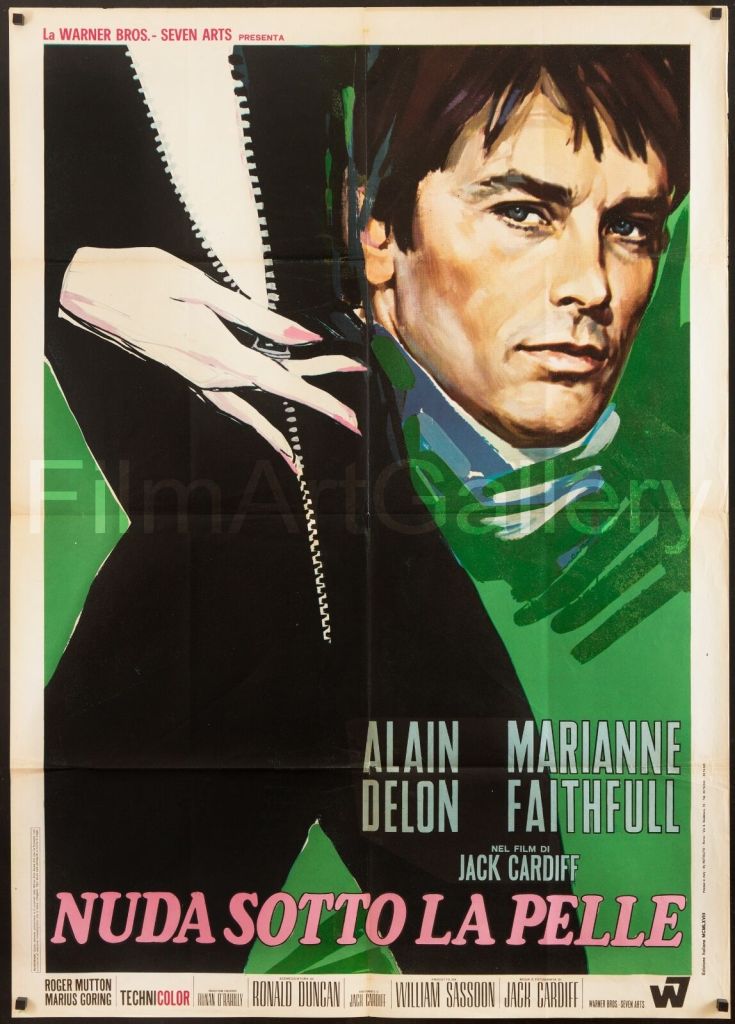
  28. The Girl on a Motorcycle (1968) – singer Marianne Faithful in a hymn to the open road and sexual freedom.
  29. Blindfold (1965) – psychiatrist Rock Hudson and dancer Claudia Cardinale in highly entertaining mystery thriller about missing scientists.
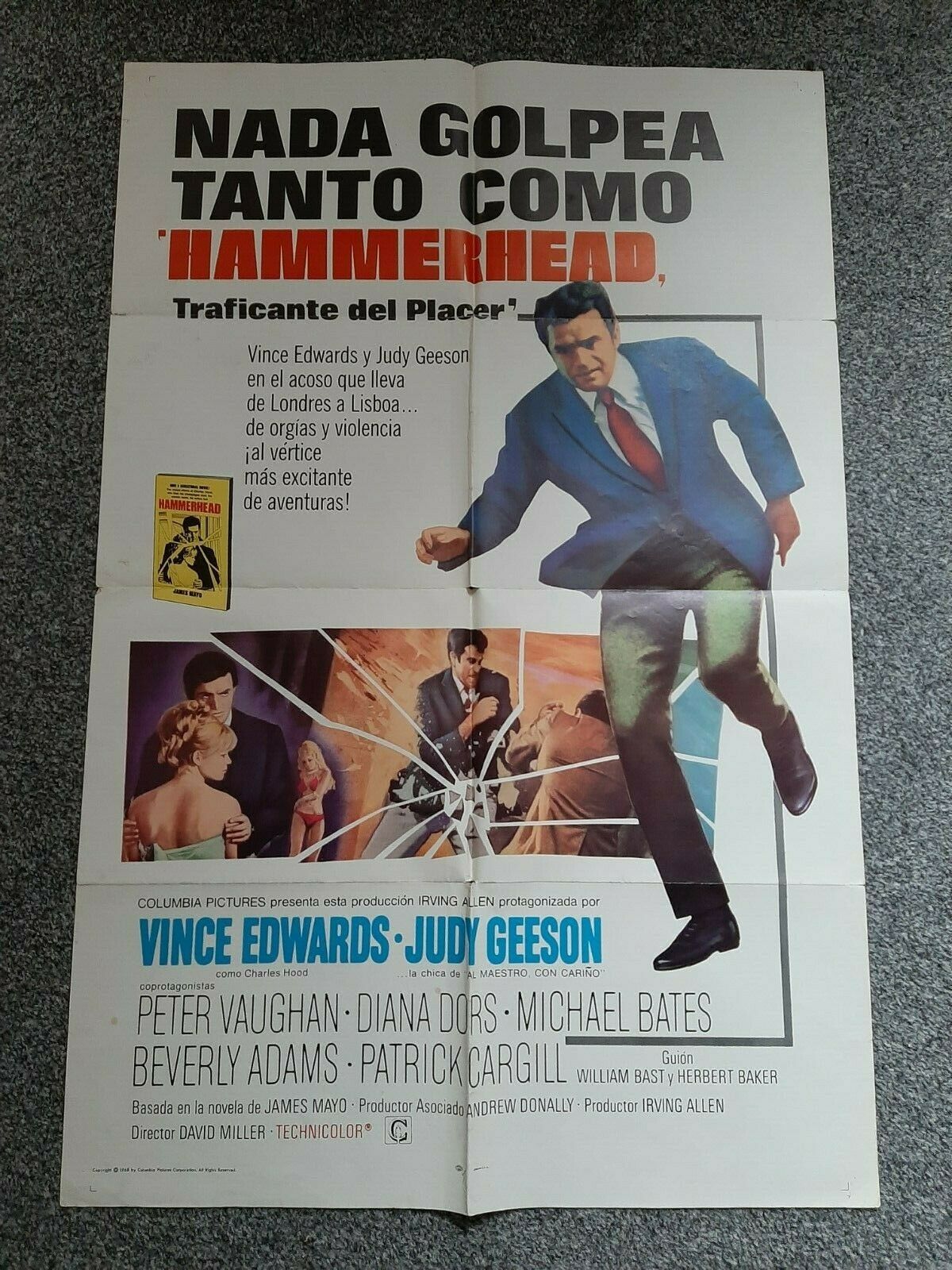
  30. Hammerhead (1968) – secret agent Vince Edwards and goofy Judy Geeson on the trail of evil mastermind Peter Vaughn.

Hammerhead (1968) ***

Zest and Zero might be a more appropriate title for this late “so-bad-it’s-good” addition to the 1960s spy cycle. Judy Geeson (Here We Go Round the Mulberry Bush, 1967) is the firecracker to Vince Edwards’ (television’s Ben Casey) fizzle. It’s colorful vs. colorless. Edwards, as art connoisseur Charles Hood (from the James Mayo book series), is meant to be a cut above the normal spy when in fact he hardly makes the cut. Hood is on the trail of the evil Hammerhead (a white-gloved Peter Vaughan). Sue Trenton’s (Geeson) lust for life takes her from participation in uninhibited art spectacle to classier cabaret, at various points leaping headfirst into the story, sorely disappointed to discover that Hood is not the international jewel thief of her imagination but a mere spy.

A far cry from the audacity of James Bond or the spoofery of Matt Helm or Derek Flint, nonetheless you can’t imagine this was ever taken seriously. But Geeson’s light touch is trampled all over by the ponderous Edwards. Quite how director David Miller went from Back Street (1961), Lonely Are the Brave (1962) and Captain Newman M.D. (1963) straight into this is anyone’s guess. He ran out of ideas pretty quick, the wardrobe budget minimal, Geeson much of the time restricted to a towel or bra and panties, an entire scene of Ivory (Beverley Adams) gyrating in a bikini, other sequences set against a backdrop of scantily-clad females.

The plot is non-existent. Hood doesn’t even know what he’s chasing – a “secret report” of some kind. Halfway between camp and incompetent, the picture scores in unintentional ways. Hammerhead makes a grand entrance – lowered in a cradle from a helicopter! The big chase involves a hearse. Trenton, who can’t sing, gets to sing. Occasionally the comedy is intentional, a taxi driven onto the shore a few scenes later is stranded by the incoming tide. Needing somewhere to screen some stolen footage, Hood invades a blue movie club. Avoiding a villain in a post office, Trenton plays a version of pass-the-parcel. The monosyllabic steal the picture – in reply to Hood’s pestering, a manservant’s inevitable reply is “it depends” and that of the dancing Ivory “louder.” But the biggest opportunity for Bond-style gags, Hood and Trenton trapped in a coffin, is wasted, although there is a nod to Thunderball in the harpoonery department.

Perhaps what best passes the time is the opportunity for star-spotting. British sexpot Diana Dors, complete with lipstick transmitter, puts in an appearance. There is a flock of British television actors in Patrick Cargill (Father, Dear Father), Michael Bates and Windsor Davies (both It Ain’t Half Hot, Mum), William Mervyn (All Gas and Gaiters), Tracy Reed (Doctor Finlay’s Casebook) and Kenneth Cope (Randall and Hopkirk, Deceased). Dave Prowse (Star Wars) makes his movie debut and former top British star Kathleen Byron (Black Narcissus, 1947) has a small role. Beverly Adams is almost a spy film mascot, with The Silencers (1966), Kiss the Girls and Make Them Die (1966), Murderer’s Row (1966) and The Ambushers (1967) in her locker. The gaggle of gals includes future Hammer star Veronica Carlsen (Dracula Has Risen from the Grave, 1968), Maggie Wright (Sex and the Other Woman, 1972) and former Slaygirl and 2001: A Space Odyssey stewardess Penny Brahms (The Games Lovers Play, 1971).

You half expect Judy Geeson to turn out to be a femme fatale or at least a decoy or there to provide a plot twist. But, no, she is just an adventuress, at times inventive and resourceful. Just a shame that an outing with the dull Edwards would put anyone off adventure for life.

A romp of the wrong kind for sure.

Discover WordPress

A daily selection of the best content published on WordPress, collected for you by humans who love to read.

The Atavist Magazine

by Brian Hannan

WordPress.com News

The latest news on WordPress.com and the WordPress community.