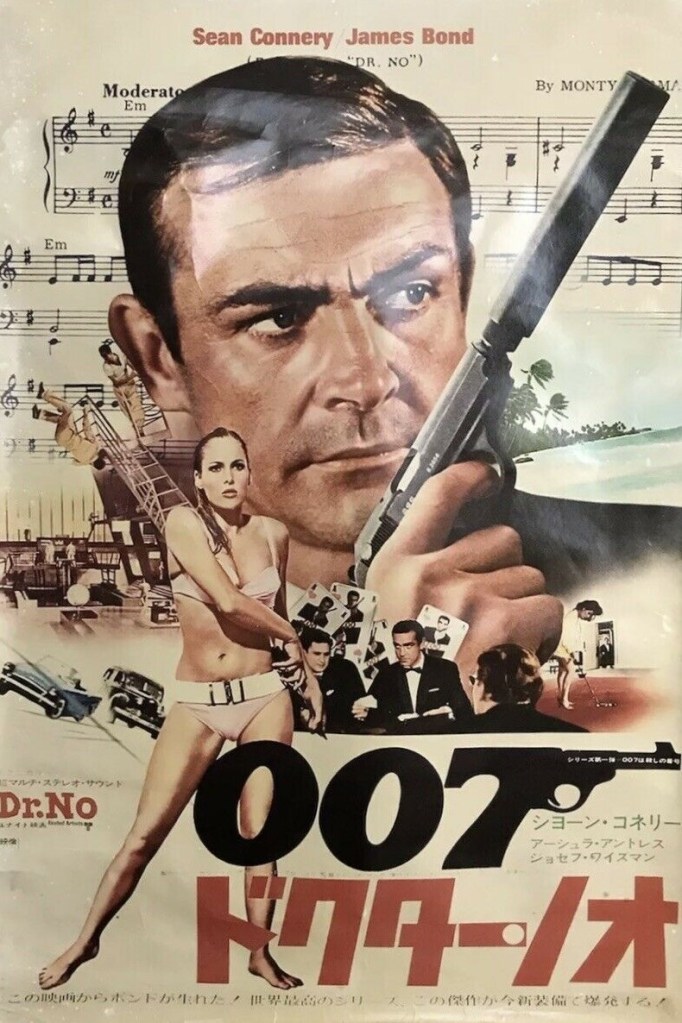
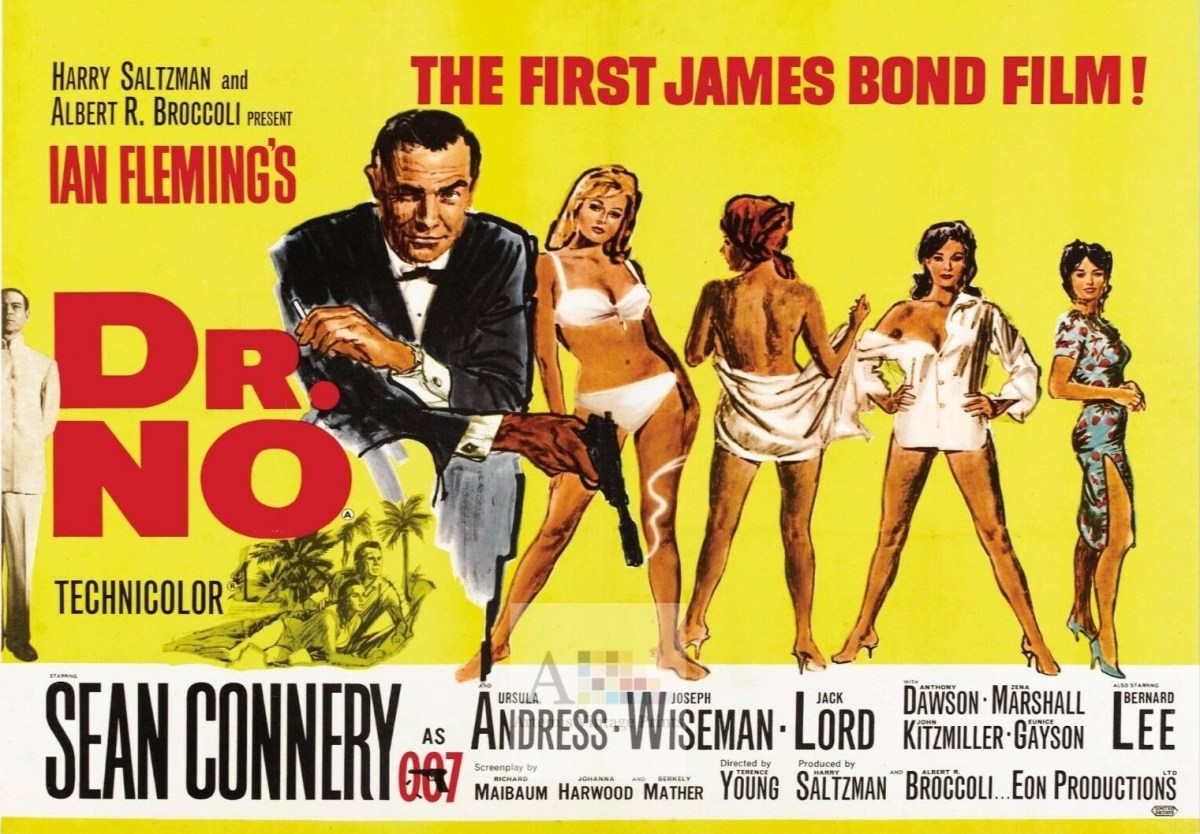
Dr No (1962) *****

Minus the gadgets and the more outlandish plots, the James Bond formula in embryo. With two of the greatest entrances in movie history – and a third if you count the creepy presence of Dr No himself at the beds of his captives – all the main supporting characters in place except Q, plenty of sex and action, plus the credit sequence and the theme tune, this is the spy genre reinvented.

Most previous espionage pictures usually involved a character quickly out of their depth or an innocent caught up in nefarious shenanigans, not a man close to a semi-thug, totally in command, automatically suspicious, and happy to knock off anyone who gets in his way, in fact given government clearance to commit murder should the occasion arise. That this killer comes complete with charm and charisma and oozes sexuality changes all the rules and ups the stakes in the spy thriller.

 Three men disguised as beggars break into the house of British secret service agent Strangeways (Tim Moxon) and kill him and his secretary and steal the file on Dr No (Joseph Wiseman). A glamorous woman in a red dress Sylvia Trench (Eunice Gayson) catches the eye of our handsome devil “Bond, James Bond” (Sean Connery) at a casino before he is interrupted by an urgent message, potential assignation thwarted.

We are briefly introduced to Miss Moneypenny (Lois Maxwell) before Bond is briefed by M (Bernard Lee) and posted out immediately – or “almost immediately” as it transpires – to Jamaica, but not before his beloved Beretta is changed to his signature Walther PPK and mention made that he is recovering from a previous mission. But in what would also become a series signature, liberated women indulging in sexual freedom, and often making the first move, Ms Trench is lying in wait at his flat.

Another change to the espionage trope, this man does not walk into the unknown. Suspicion is his watchword. In other words, he is the consummate professional. On arrival at Jamaica airport he checks out the waiting chauffeur and later the journalist who takes his picture. The first action sequence also sets a new tone. Bond is not easily duped. Three times he outwits the chauffeur. Finally, at the stand-off, Bond employs karate before the man takes cyanide, undercutting the danger with the mordant quip, on delivering the corpse to Government house, “see that he doesn’t get away.” 

Initially, it’s more a detective story as Bond follows up on various clues that lead him to Quarrel (John Kitzmiller), initially appearing as an adversary, and C.I.A. agent Felix Leiter (Jack Lord) before the finger of suspicion points to the mysterious Dr No and the question of why rocks from his island should be radioactive. Certainly, Dr No pulls out all the stops, sending hoods, a tarantula, sexy secretary Miss Taro (Zena Marshall) and the traitor Professor Dent (Anthony Dawson) to waylay or kill Bond.

But it’s only when our hero lands on the island and the bikini-clad Honey Rider (Ursula Andress) emerges from the sea as the epitome of the stunning “Bond Girl” that the series formula truly kicks in: formidable sadistic opponent, shady organization Spectre, amazing  sets, space age plot, a race against time. 

It’s hard not to overstate how novel this entire picture was. For a start, it toyed with the universal perception of the British as the ultimate arbiters of fair play. Yet, here was an anointed killer. Equally, the previous incarnation of the British spy had been the bumbling Alec Guinness in Our Man in Havana (1959). That the British should endorse wanton killing and blatant immorality – remember this was some years before the Swinging Sixties got underway – went against the grain.

Although critics have maligned the sexism of the series, they have generally overlooked the female reaction to a male hunk, or the freedom with which women appeared to enjoy sexual trysts with no fear of moral complication. Bond is not just macho, he is playful with the opposite sex, flirting with Miss Moneypenny, and with a fine line in throwaway quips.

Director Terence Young is rarely more than a few minutes away from a spot of action or sex, exposition is kept to a minimum, so the story zings along, although there is time to flesh out the characters, Bond’s vulnerability after his previous mission mentioned, his attention to detail, and Honey Rider’s backstory, her father disappearing on the island and her own ruthlessness. The insistently repetitive theme tunes – from Monty Norman and John Barry – was an innovation. The special effects mostly worked, testament to the genius of production designer Ken Adam rather than the miserable budget.

Most impressive of all was the director’s command of mood and pace. For all the fast action, he certainly knew how to frame a scene, Bond initially shown from the back, Dr No introduced from the waist downwards, Honey Rider in contrast revealed in all her glory from the outset. The brutal brief interrogation of photographer Annabel Chung (Marguerite LeWars), the unexpected seduction of the enemy Miss Taro and the opulence of the interior of Dr No’s stronghold would have come as surprises. Young was responsible for creating the prototype Bond picture, the lightness of touch in constant contrast to flurries of violence, amorality while blatant delivered with cinematic elan, not least the treatment of willing not to say predatory females, the shot through the bare legs of Ms Trench as Bond returns to his apartment, soon to become par for the course.

Future episodes of course would lavish greater funds on the project, but with what was a B-film budget at best by Hollywood standards, the producers worked wonders. Sean Connery (The Frightened City, 1961) strides into a role that was almost made-to-measure, another unknown Ursula Andress (The Southern Star, 1969) speeded up every male pulse on the planet, Joseph Wiseman (The Happy Thieves, 1961) provided an ideal template for a future string of maniacs and Bernard Lee (The Secret Partner, 1961) grounded the entire operation with a distinctly British headmaster of a boss.

Masterpiece of popular cinema.

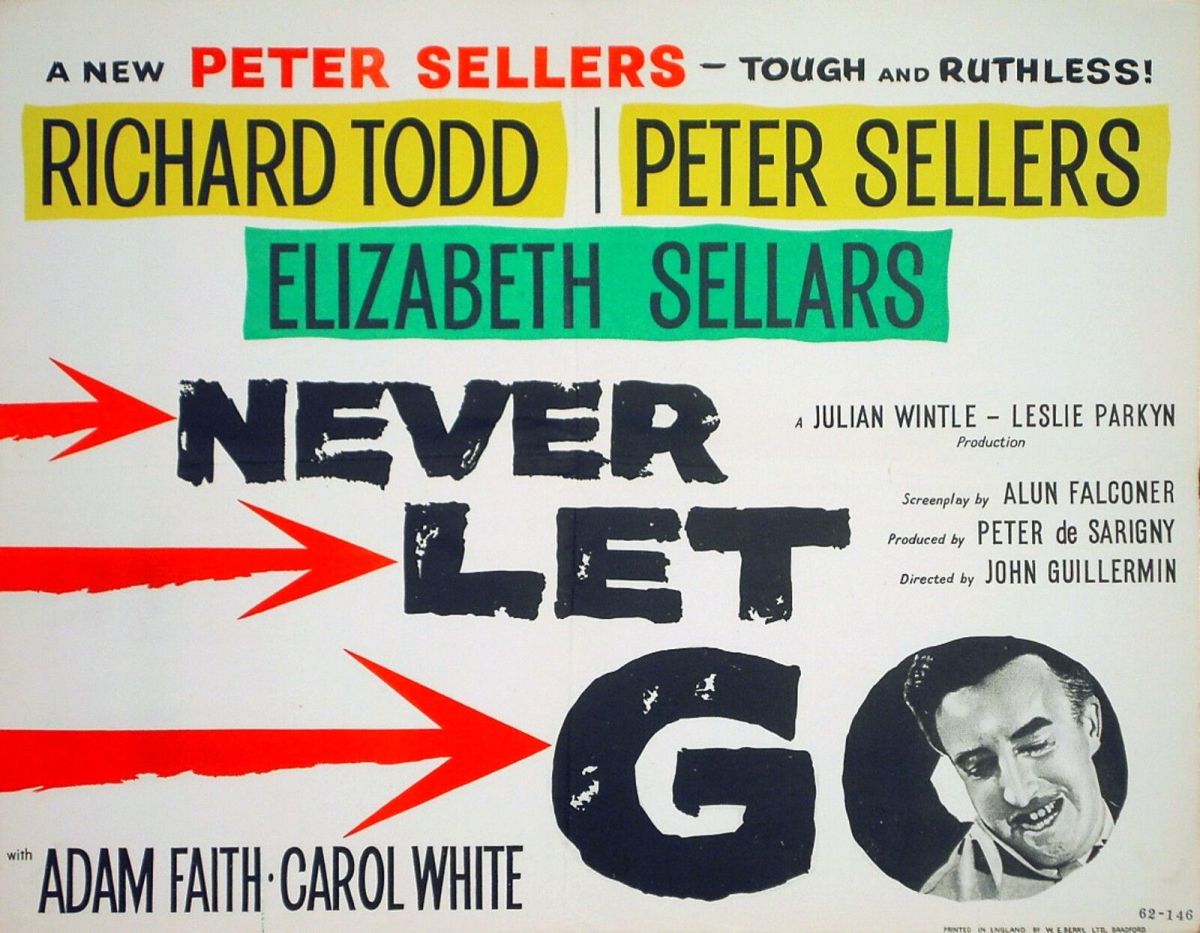
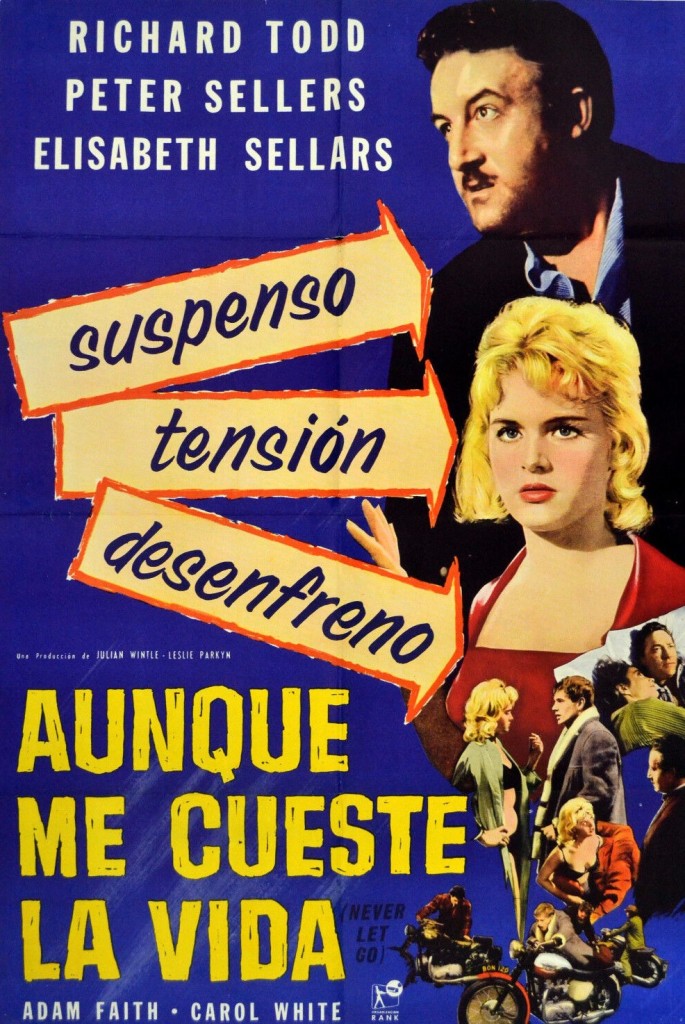
Never Let Go (1960) ****

Under-rated British film noir classic. All the principals playing against type. Comedian Peter Sellers (The Millionairess, 1960) as the villain, British hero Richard Todd (The Dam Busters, 1955) comes seriously unstuck, pop star Adam Faith (Beat Girl / Wild for Kicks, 1960) tosses away his cuddly image. One of the earliest scores by John (James Bond) Barry. First grown-up role for Carol White (Daddy’s Gone A-Hunting, 1969). As much savage violence as the censor would allow at the time.

Down-on-his-luck salesman John (Richard Todd) has his car stolen. It’s uninsured. Without it he can’t get to his appointments on time. The police aren’t interested. So he has to investigate. That leads first to dodgy Teddy Boy Tommy (Adam Faith) who steals cars to order for supposedly legitimate businessman Lionel (Peter Sellers) and makes a play for Lionel’s young mistress Jackie (Carol White).

The interest lies not so much in the investigation as how those involved deal with pressure. John, hardly able to support wife Anne (Elizabeth Sellars) and two kids, has a history of failure, squandering money on get-rich-quick schemes, and apt to blow his top at clients who complain when he fails to keep appointments.

Doesn’t take long for him to lose his job. But instead of knuckling down and finding another, he stubbornly refuses to abandon his investigation, upsetting Scotland Yard Inspector Thomas (Noel Willman) who has much bigger fish to fry.

Lionel is a cocky gangster not afraid to lash out. In fact, he seems to enjoy battering people with his fists, feet and broken bottle. He treats Jackie with contempt, reminding her she’d be a sex worker if it wasn’t for him. He’s got a nice little empire and has kept his nose clean. He pays off corrupt cops.

But the last thing he expects is to be pursued by a loser like John who’s not cut from the John Wick template. Not does he possess the very particular set of skills that appear to be the prerequisite of anyone embarking on a mission of revenge.

If director John Guillermin (El Condor, 1970) hadn’t been obliged to tag on a happy ending, this would have been a downbeat tour-de-force, with the good guy losing everything in order to win back his self-respect.

It just sizzles with tension. Lionel belongs to the generation that spawned the likes of Harold in The Long Good Friday (1980) or the Kray Twins, a simmering, stewing piece of work, all gloss on the outside, a tinderbox on the inside.  

There’s fabulous photography, eyes trapped in pools of light, overhead camera staking out victims, and seedy London picked out in detail. Newspaper vendor Alfie (Mervyn Johns), of pensionable age, the only witness to the crime, has his bedsit ransacked, the tiny terrapin he treasures crushed underfoot, when inadvertently he gives too much away.

Tearaway Tommy isn’t such a tough guy when Lionel comes battering on his door. Jackie is the only one who not so much stands up to Lionel as treats his idea of romance with disdain. Even when John fingers Lionel, Inspector Thomas bluntly tells him he’s too small fry and the cops aren’t interesting in chasing after his plebeian vehicle.

Lionel is the kind of gangster who is never going to realise he can’t always get away with it, that he might have to trim back his ambition until the coast is clearer. Instead, he batters on regardless, determined to terrify everyone into acquiescence.

As the movie progresses, the more you learn about John, the less you sympathise. His wife has stood by him through mostly thin, and will stick by him even if unemployed, but draws the line at antagonising a gangster who doesn’t know when to draw a line. John isn’t Gary Cooper in High Noon. He’s not a principled defender of the law. He’s almost as bad as the gangster, in that he doesn’t know when to stop, regardless of the danger this places his family.

Understandably, Peter Sellers attracted most of the critical plaudits, but this is the role of a lifetime for Richard Todd, who detonates his screen image, battered and bloodied almost beyond recognition, not hiding behind a stiff upper lip. Carol White, too, is superb as the mistress who just about recognises that this is not a good deal, and that she’s a chattel, not a loved one.

John Guillermin’s direction is superb. Coupled with the insistent, jazzy John Barry score, this is British film noir (admittedly, that’s not large pool to draw on) at its best.

https://amzn.to/3GoA77M

The Ipcress File (1965) *****

Stylish take on the espionage genre when it was still in its infancy and could accommodate stylish directors like Sidney J. Furie (The Appaloosa, 1966). Eschewing the bombastic effects and villains of the James Bond series, relying more on intrigue and the elements of betrayal that other practitioners of the dark arts such as John Le Carre espoused, this is as much a character study and presents in some cases a fairer picture of the class struggle in Britain than most kitchen-sink dramas. So it’s either going to put you off entirely or make you appreciate the film more when I tell you that my favorite scene is the fistfight between Harry Palmer (Michael Caine) and shaven-headed thug Housemartin (Oliver MacGreevy) outside the Royal Albert Hall in London that is shot entirely through the windows of a traditional red telephone box. You can’t say bolder than that.

The credit sequence, more famously ripped off by William Goldman for private eye saga Harper/The Moving Target (1966), is equally inspired. An alarm clock wakes Palmer, he reaches out for the girl who shared his bed last night to discover she is gone and then punctiliously and as if time-shifted to the twenty-first century when it would be the norm proceeds to grind fresh coffee beans, fill a cafetiere with only as much liquid as would constitute a small espresso, dresses and last but not least searches among the disturbed bedclothes for his gun.

Palmer is transferred from dull surveillance duties to a team hunting for missing scientists. Given both his insolent and insubordinate manner, he is not expected to fit in to a service riddled with the upper-classes. His new superior Dalby (Nigel Green), a “passed-over major,” owes his present situation to Palmer’s former boss Colonel Ross (Guy Doleman) and both sport three-piece suits, bowler hats and umbrellas and speak in those clipped tones that invariably carry undertones of menace. Where James Bond’s front, the import-export business, is rather more upmarket, here the background is considerably downmarket, Dalby masquerading as the owner of an employment agency and distributor of fireworks. It is insatiably bureaucratic, reams of forms to be filled in. What Palmer has in common with James Bond, beyond fisticuffs, is the ability to think outside the box and in this case picks the brains of a policeman friend to track down the wanted villain, code-named Bluejay (Frank Gatliff)  

As in the best post-Bond espionage, there are traitors everywhere, and the departments employing spies tend to employ other spies to spy upon them, though in this case Palmer has the luck to draw the sexy Jean (Sue Lloyd). When Palmer picks up the trail of Ipcress, the plot thickens. There is no shortage of action, a gun battle, fisticuffs, but it presents a different approach to modern espionage, with a properly rounded hero – one who can cook (as did author Len Deighton who wrote a cookery column) for a start – while the ladies, with whom he shares a roving eye with Bond, are not required to turn up in bikinis.

There is deft employment of that favorite British cultural emblem – irony – and one wonderful scene takes place in a park where Dalby taps his cane in appreciation of a brass band. Throw in a bit of brainwashing and it’s a completely different proposition to Bond who could escape such a dilemma in a trice. There is a clever ending.

Michael Caine (Hurry Sundown, 1967), complete with spectacles, is superb as Palmer, making enough of an impression that the series ran for another  four episodes. The stiff-upper-lip brigade have a field day in Nigel Green (Jason and the Argonauts, 1963) and Guy Doleman (Thunderball, 1965), the latter shading it with his purported sense of humor. Sue Lyon (Corruption, 1968) is excellent as the seemingly unattainable gal who falls within Palmer’s purvey but not entirely due to his charm. The villains, too, are not from the James Bond school of cut-outs, but come across as equally human, and the chief rascal you could argue has the most finely developed sense of humor of the lot. Throw in Gordon Jackson (Danger Route, 1967) and Freda Bamford (Three Bites of the Apple, 1967) as the bureaucratic attack-dog Alice and you have a very well cast movie.

Sidney J. Furie divided critics. Some believed he was ahead of his time, others that he was in thrall to arty French directors, and a reasonable number who didn’t give a stuff as long as he delivered the goods. But his predilection for odd angles here proves a strength, his  compositional excellence also spot-on, one scene in particular where in a library Palmer looks down on the villain with Housemartin on a landing between. And he takes great delight in emphasizing the class distinctions, both bosses have huge offices with a small desk in the corner, and when Ross places briefcase, umbrella and bowler hat on the desk of Dalby it could not be a more clear invasion.

And you can’t forget the score by espionage doyen John Barry (Goldfinger, 1964). W.H. Canaway (A Boy Ten Feet Tall, 1963) and James Doran, making his movie debut, adapted Len Deighton’s classy bestseller but a fair amount of polish was added by thriller writer Lionel Davidson (Hot Enough for June, 1964), Johanna Harwood (Dr No, 1962), Lukas Heller (The Dirty Dozen, 1967) and Ken Hughes (Arrivederci, Baby, 1966).    

A spy classic.

Dr No (1962) *****

Minus the gadgets and the more outlandish plots, the James Bond formula in embryo. With two of the greatest entrances in movie history – and a third if you count the creepy presence of Dr No himself at the beds of his captives – all the main supporting characters in place except Q, plenty of sex and action, plus the Maurice Binder credit sequence and the theme tune, this is the spy genre reinvented.

Most previous espionage pictures usually involved a character quickly out of their depth or an innocent caught up in nefarious shenanigans, not a man close to a semi-thug, totally in command, automatically suspicious, and happy to knock off anyone who gets in his way, in fact given government clearance to commit murder should the occasion arise. That this killer comes complete with charm and charisma and oozes sexuality changes all the rules and ups the stakes in the spy thriller.

 Three men disguised as beggars break into the house of British secret service agent Strangways (Tim Moxon) and kill him and his secretary and steal the file on Dr No (Joseph Wiseman). A glamorous woman in a red dress Sylvia Trench (Eunice Gayson) catches the eye of our handsome devil “Bond, James Bond” (Sean Connery) at a casino before he is interrupted by an urgent message, potential assignation thwarted.

We are briefly introduced to Miss Moneypenny (Lois Maxwell) before Bond is briefed by M (Bernard Lee) and posted out immediately – or “almost immediately” as it transpires – to Jamaica, but not before his beloved Beretta is changed to his signature Walther PPK and mention made that he is recovering from a previous mission. But in what would also become a series signature, liberated women indulging in sexual freedom, and often making the first move, Ms Trench is lying in wait at his flat.

In another change to the espionage trope, this man does not walk into the unknown. Suspicion is his watchword. In other words, he is the consummate professional. On arrival at Jamaica airport he checks out the waiting chauffeur and later the journalist who takes his picture. The first action sequence also sets a new tone. Bond is not easily duped. Three times he outwits the chauffeur. Finally, at the stand-off, Bond fells him with karate before the man takes cyanide, undercutting the danger with the mordant quip, on delivering the corpse to Government house, “see that he doesn’t get away.” 

Initially, it’s more a detective story as Bond follows up on various clues that leads him to Quarrel (John Kitzmiller), initially appearing as an adversary, and C.I.A. agent Felix Leiter (Jack Lord) before the finger of suspicion points to the mysterious Dr No and the question of why rocks from his island should be radioactive. Certainly, Dr No pulls out all the stops, sending hoods, a tarantula, sexy secretary Miss Taro (Zena Marshall) and the traitororous Professor Dent (Anthony Dawson) to waylay or kill Bond.

But it’s only when our hero lands on the island and the bikini-clad Honey Rider (Ursula Andress) emerges from the sea as the epitome of the stunning “Bond Girl” that the series formula truly kicks in: formidable sadistic opponent, shady organization Spectre, amazing  sets, space age plot, a race against time. 

It’s hard not to overstate how novel this entire picture was. For a start, it toyed with the universal perception of the British as the ultimate arbiters of fair play. Here was an anointed killer. Equally, the previous incarnation of the British spy had been the bumbling Alec Guinness in Our Man in Havana (1959). That the British should endorse wanton killing and blatant immorality – remember this was some years before the Swinging Sixties got underway – went against the grain.

Although critics have maligned the sexism of the series, they have generally overlooked the reaction of the female audience to a male hunk, or the freedom with which women appeared to enjoy sexual trysts with no fear of moral complication. Bond is not just macho, he is playful with the opposite sex, flirting with Miss Moneypenny, and with a fine line in throwaway quips.

Director Terence Young is rarely more than a few minutes away from a spot of action or sex, exposition kept to a minimum, so the story zings along, although there is time to flesh out the characters, Bond’s vulnerability after his previous mission mentioned, his attention to detail, and Honey Rider’s backstory, her father disappearing on the island and her own ruthlessness. The insistently repetitive theme tunes- from Monty Norman and John Barry – were innovative. The special effects mostly worked, testament to the genius of production designer Ken Adam rather than the miserable budget.

Most impressive of all was the director’s command of mood and pace. For all the fast action, he certainly knew how to frame a scene, Bond initially shown from the back, Dr No introduced from the waist downwards, Honey Rider in contrast revealed in all her glory from the outset. The brutal brief interrogation of photographer Annabel Chung (Marguerite LeWars), the unexpected seduction of the enemy Miss Taro and the opulence of the interior of Dr No’s stronghold would have come as surprises.

Young was responsible for creating the prototype Bond picture, the lightness of touch in constant contrast to flurries of violence, amorality while blatant delivered with cinematic elan, not least the treatment of willing not to say predatory females, the shot through the bare legs of Ms Trench as Bond returns to his apartment soon to become par for the course.

Future episodes of course would lavish greater funds on the project, but with what was a B-film budget at best  by Hollywood standards, the producers worked wonders. Sean Connery (The Frightened City, 1961) strides into a role that was almost made-to-measure, another unknown Ursula Andress speeded up every male pulse on the planet, Joseph Wiseman (The Happy Thieves, 1961) provided an ideal template for a future string of maniacs and Bernard Lee (The Secret Partner, 1961) grounded the entire operation with a distinctly British headmaster of a boss.

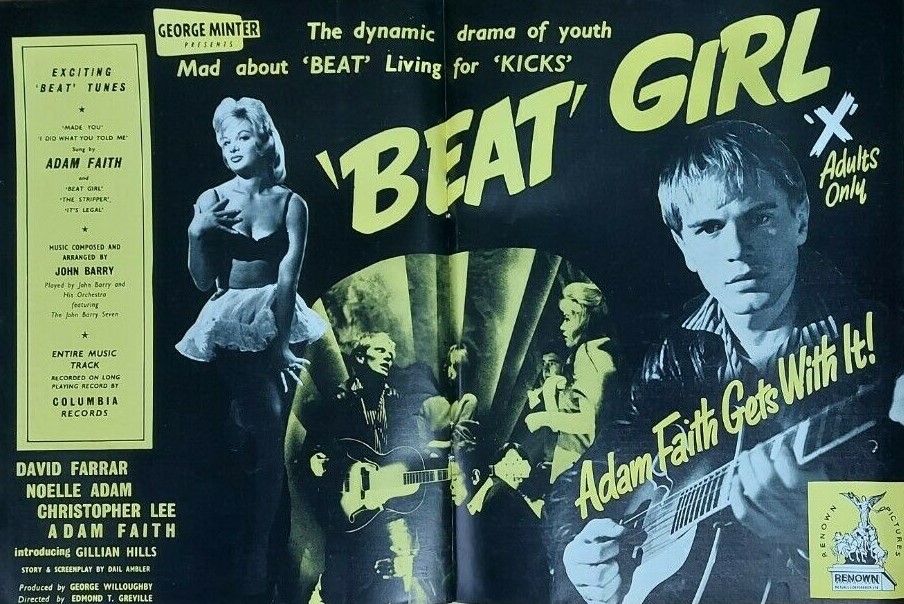
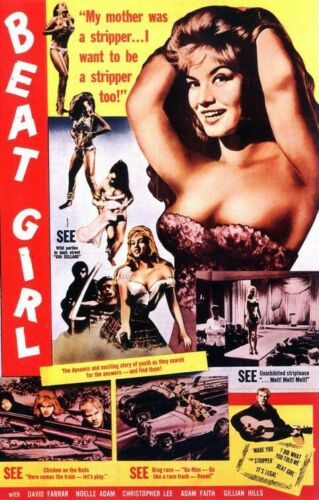
Beat Girl / Wild for Kicks (1960) **

More social document than drama, but that aspect somewhat diluted by the moviemakers’ attempts at exposing rebellious youth while taking for granted more sordid adult behavior. Sold under the exploitation banner – “this could be your teenage daughter” – narrative flow is interrupted now and then to showcase Adam Faith’s singing and to accommodate a few striptease acts. Probably more interesting is the array of new talent on show.

Spoiled teenager Jennifer (Gillian Hills) heads for the wild side of town to experience the beatnik lifestyle in Soho coffee shops and cellars. That there’s no drugs involved and that alcohol is considered “square” – as for that matter is violence – may come as a surprise to students of the period. Apart from one episode of road-racing and playing “chicken” along a railway track, most of the time the gang listen to music or go dancing until Jennifer gets it into her head that joining a striptease show might give her life the thrill it is missing.

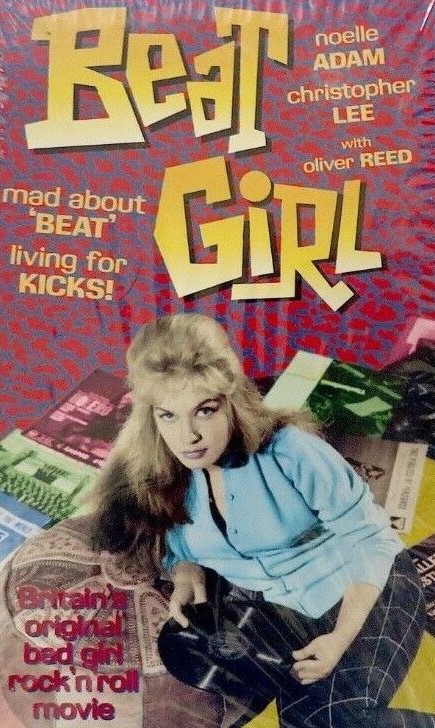
VHS cover.

This is prompted by the discovery that her new too-young stepmother Nichole (Noelle Adams) has been a stripper and most likely a sex worker in Paris before marrying wealthy architect Paul (David Farrar), cueing a round-robin of confrontations. Strangely enough, from the narrative perspective, none of the young bucks appear romantically interested in the provocatively-dressed Jennifer and so it is left to creepy club owner Kenny (Christopher Lee) to make a move.

The gaping hole left by lack of narrative drive is not offset by immersion in the beatnik or striptease scene. Back in the day the British censors took the editing scissors to the striptease  but although restored versions available now contain nudity you are left wishing that there was some lost element to the beatnik sections that would have given the picture the energy it required.

Gillian Hills (Les Liaisions Dangereuses, 1959), comes over as a cross between Brigitte Bardot and Diana Dors without having an ounce of the sex appeal of either. All pout and flounce, she is unable to inject any heart into her two-dimensional character, although given her youth and inexperience this was hardly surprising. Former British star David Farrar (Black Narcissus, 1947) was coming to the end of his career and in a thankless role as a frustrated father could do little to rescue the project.

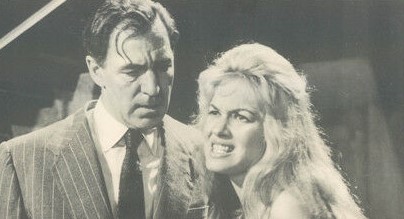
Father and headache of a daughter – David Farrar and Gillian Hills.

French actress Noelle Gordon (Sergeant X of the Foreign Legion, 1960) could have been Jennifer’s mother given her own tendencies towards wiggle and pout but at least she makes a stab at trying to overcome her step-daughter’s hostility.

In the main, the picture’s delight is bringing to the fore a whole chorus of new faces. Pick of the supporting cast is Shirley Anne Field (Saturday Night and Sunday Morning, 1960) who doesn’t just have a knowing look but looks as if she knows what’s she doing acting-wise. Making his movie debut was teen pop idol Adam Faith, who had made his name playing in coffee bars. He had already notched up a couple of number one singles, but doesn’t quite set the screen on fire. Peter McEnery (The Fighting Prince of Donegal, 1966) plays his inebriated pal. You can also spot Oliver Reed (Women in Love, 1969), Julie Christie (Doctor Zhivago, 1965), Claire Gordon (Cool It, Carol, 1970) and Nigel Green (Jason and the Argonauts, 1963).

Perhaps the most important debut belonged to composer John Barry. He had already been working with Adam Faith. Barry’s music for the film was the first British soundtrack album ever released, reaching number eleven on the charts, and opening the doors for future soundtrack albums, not least of which was the rich vein of theme tunes produced by Barry in the next few years. 

French director Edmond T. Greville, who brought little panache to the subject matter, would redeem himself with his next picture The Hands of Orlac (1960). 

This doesn’t fall into the “so-bad-it’s-good” category, nor has it been unfairly overlooked, and probably is better known as an example of the kind of exploitation B-picture that the Americans do so much better and a reminder that, except on rare occasions such as The Wild One (1953), older moviemakers seem incapable of capturing the essence of youth.

Discover WordPress

A daily selection of the best content published on WordPress, collected for you by humans who love to read.

The Atavist Magazine

by Brian Hannan

WordPress.com News

The latest news on WordPress.com and the WordPress community.