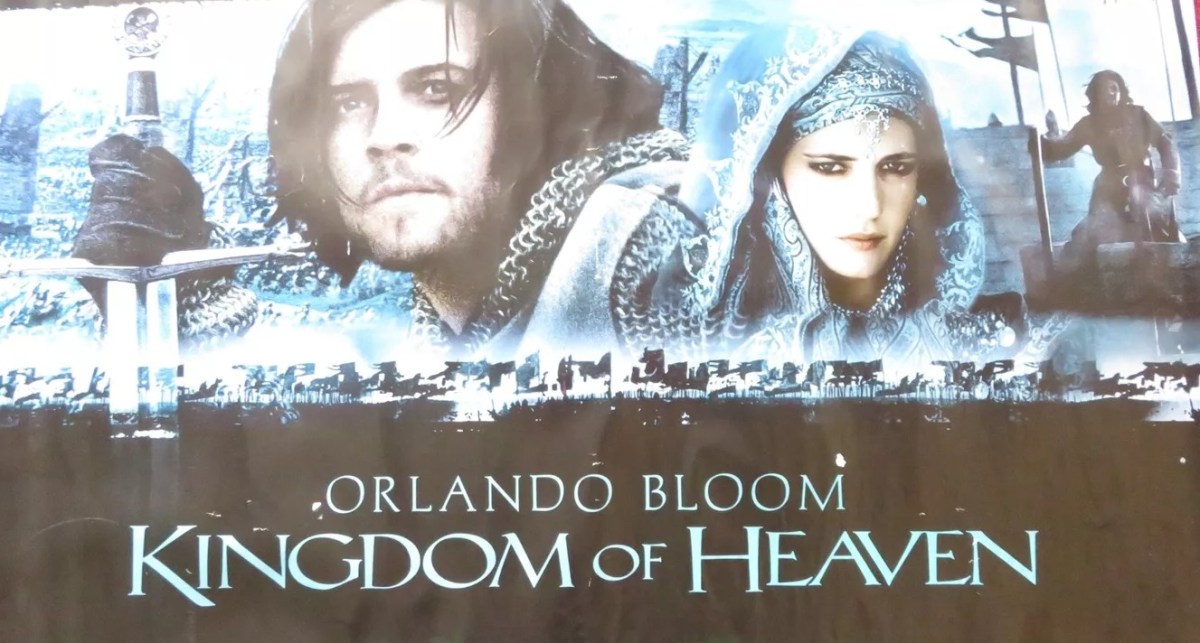
Kingdom of Heaven (2005) ***

I’m conscious of entering contentious waters especially as a new 4K DVD edition of the 195-minute Director’s Cut – expanded from the original 144-minute version – is being released by Twentieth Century Fox to coincide with today’s theatrical 20th anniversary theatrical release. Normally, that would have filled me with joy because I was a huge fan of the original Director’s Cut, which, it is true, added considerable depth to the film as initially screened.

But in watching the Director’s Cut as the first part of a proposed All-Time Top Ten double bill with Any Given Sunday (1999) I discovered to my horror it was not the film I remembered and had for many years championed. The flaws were all too obvious, it was extremely wordy, rammed full of characters and a narrative that ran all over the place trying to keep up with itself.
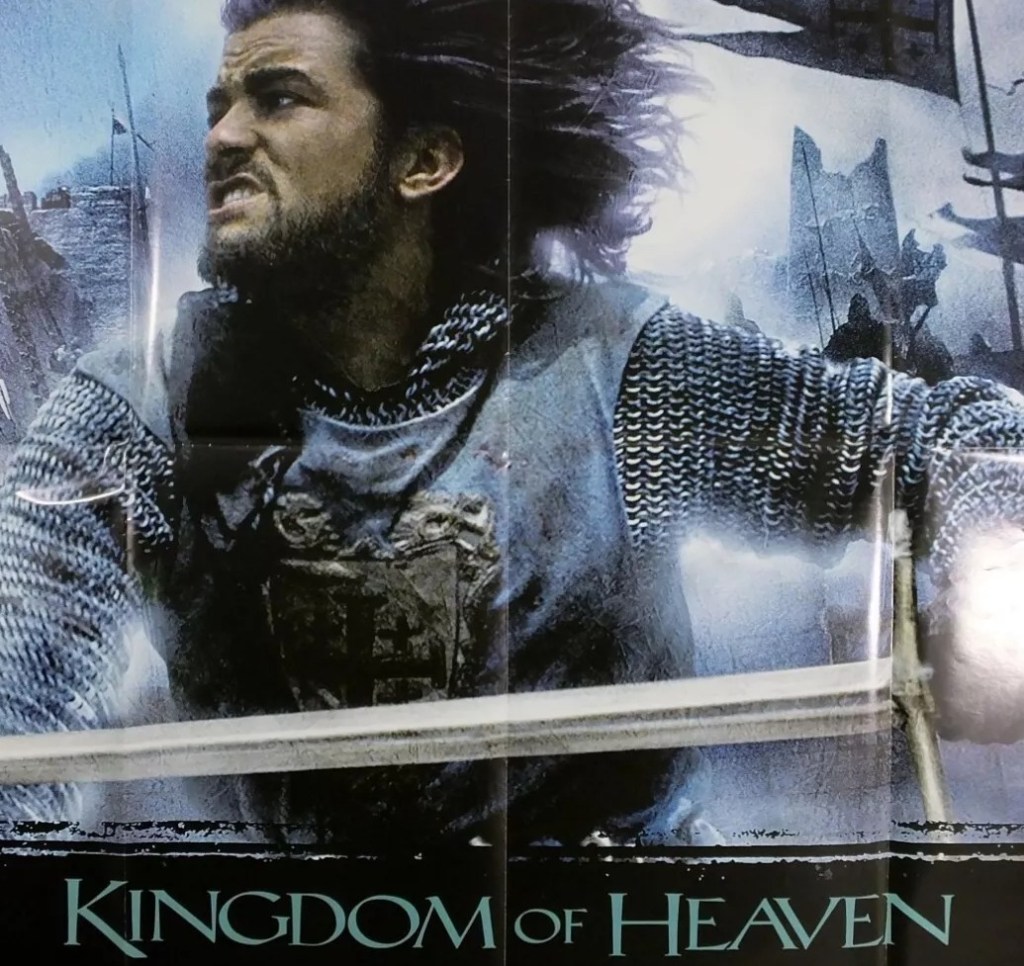
We should begin with the major flaw and that’s the casting of Orlando Bloom, fresh from his breakthrough role in Pirates of the Caribbean: Curse of the Black Pearl (2003), as Balian the blacksmith. The role was written for Russell Crowe but schedule clash prevented his involvement. Director Ridley Scott went ahead anyway and Bloom doesn’t remotely convince as a leader.

Though most of the picture is based on historical fact, the initial MacGuffin doesn’t make sense. For the purposes of the narrative we need to get blacksmith Balian to the Crusades. Balian’s wife (Nathalie Cox), seen briefly (and happily) in flashback, has committed suicide because of a miscarriage which seems a mighty odd reason, and we are never made privy to whatever other  mental problems afflicted her. In those days, if you committed suicide you could not be buried in sacred ground and furthermore your head was chopped off. Now, admittedly, the local priest (Michael Sheen), Balian’s half-brother, is a creepy character, but it hardly seems to justify Balian thrusting a sword through his heart and setting him on fire.

But, don’t you know it, if you run off to the Crusades you win a get-out-of-jail-free card rather than being hung for your crime. So Balian joins up with his dad Godfrey (Liam Neeson) who has returned briefly from the Crusades and initially been rejected by his son. They’re attacked by soldiers seeking to arrest Balian but, wouldn’t you know it, after a few lessons from his old man, Balian turns out to be an ace swordsman.
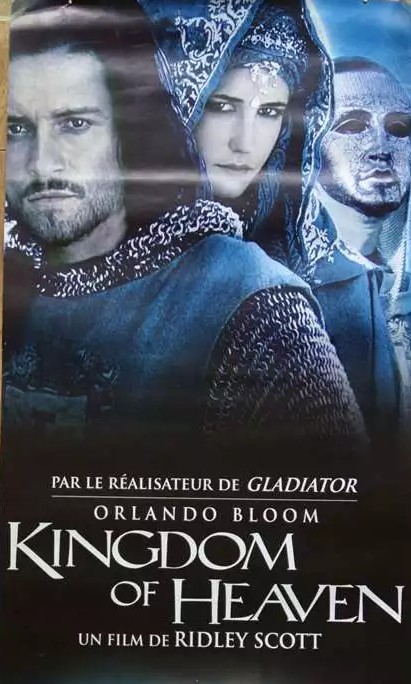
Eventually, after a few adventures and shipwreck and fortuitous encounter with Muslim Imad a-Din – remember the name because he later plays a critical role – he reaches Jerusalem and is confronted with a wordfest, a heavy distillation of philosophy, a narrative that flits around fragile peace between Christian and Muslim, and woman of intrigue Sibylla (Eva Green) whose husband Guy happens to be the leader of the anti-Muslim forces.

It might have helped if Godfrey hadn’t inconveniently died, of wounds while protecting his son, because Liam Neeson strikes you immediately as a leader and not the kind of actor like Bloom who is only a leader because the script says so. Anyways, before we can get down to any of the stirring and visually commanding action for which Ridley Scott is rightly acclaimed, Balian, who remember is a blacksmith, turns before our eyes into a wizard of an engineer and before you know it a parched piece of land is fully irrigated. It’s a lovely sequence, to be sure, and accompanied by my favorite piece of music (score by Harry Gregson-Smith) in the film, but not particularly believable.

Nor is the romance, Sibylla now deciding on adultery with her husband’s enemy. And, again, to be sure, much of the extra footage does fill out her character, but that still leaves a jumble of other characters fighting for political power – the dying masked King of Jerusalem, Baldwin IV (Edward Norton), a leper; City Marshal Tiberias (Jeremy Irons); the aforementioned Guy and his sidekick Raynald (Brendan Gleeson); assorted Knight Templars who are ferociously anti-Muslim; and parked outside the city gates Muslin chief Saladin (Ghassan Massoud).

The story, if you can still keep sight of it amongst all this intrigue, is that Guy and Raynald and the Knights Templar want to spark a Holy War, ending years of peace, restoring Jerusalem to sole ownership of the Christians, rather than being equally shared (though, noticeably, no Muslims on any of the ruling factions).

Anyway, eventually, after we’re done with philosophizing and Balian making hay with Sibylla, we get to the action and at last the movie takes flight, and though you no longer particularly believe in Balian as a leader of men he does show some tactical awareness. There’s a superb pitched battle against superior forces and a magnificent siege. Written by William Monahan (The Departed, 2006).

But watching the Director’s Cut again I came away wishing for the shorter version, though very little could compensate for the casting of Orlando Bloom.

I might change my mind if I get to see it in the cinema again but for the moment it’s lost its coveted place in my All-Time Top Ten.

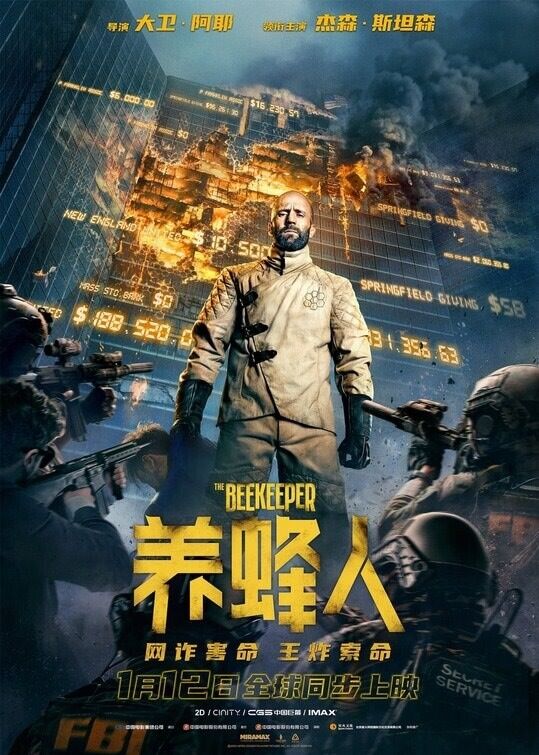
The Beekeeper (2024) **** – Seen at the Cinema

A franchise is born. John Wick may or may not rise again, Jason Bourne is dead in the water, so the gap exists. True, the new film certainly riffs on elements of that pair, the retired assassin bare mention of whom elicits fearful reaction, who belongs to  a secret government elite, and is jolted into action by someone stupidly preying on  the sole beloved aspect of his lonely life.

Eqaully true, Jason Statham (Meg 2, 2023) is certainly viewed in many quarters as the poor man’s Bruce Willis, but, like Liam Neeson, he is one of the few action actors who you would not want to meet in person, on a dark night; he looks as though he growls in his sleep.

Not an obvious candidate for Imax but then neither was “John Wick 4” and that was certainly an experience in the hi-hat format.

But it touches on themes that will strike a chord – the data mining to which we all involuntarily subscribe and which governments and villains alike will employ for their own purposes; the computer nerd multi-millionaire; the politically powerful with overly entitled offspring; and those in control who discover not every annoying person can be easily swatted away.  

And the beekeeping part turns out also to have meaning, not too much gobbledegook about hives, which is just as well because most people we encounter haven’t a clue how honey is made, least of all pay attention to the intricate structure of that insect’s lifestyle, or that there could be a Queenslayer (and this doesn’t originate from Game of Thrones) whose purpose is to remove a dis-functioning head bee. And just when that metaphor looks as though it’s going to run dry, it turns out to have a deeper meaning.

Just as well, too, that we’re not expecting much finesse from re-awakened assassins. Like John Wick, Adam Clay (Jason Statham) takes no prisoners, but whereas the former confined his murderous activities to the underworld, the latter downs anyone who gets in his way, though in fairness, many of the supposed righteous are in the involuntarily thrall of the country’s justice departments. It helps, too, that F.B.I. investigators, Agents Parker (Emmy Raver-Lampman) and Wiley (Bobby Naderi), while not incompetent, are certainly slovenly and bicker like billy-o, and that Parker is inclined to set aside civil liberties.

So, a scammer steals a couple of million from an elderly woman, who has taken a maternal interest in her beekeeping neighbor. Since she is only caretaker of the cash, which belongs to a charity, in shame she commits suicide. Initially, the number one suspect, Clay has dark forces on his side, too, able to access secret information denied both the F.B.I. and the C.I.A.

And he takes route number one to resolving any issues, turning up at the first scammer operation armed with a couple of cans of petrol and proceeding to drench any employee not smart enough to scarper. That’s, of course, after he’s disabled any security guards so low down the pecking order they wouldn’t even be aware of the name that should strike fear in their hearts.

Luckily, we’ve got retired C.I.A. chief Westwyld (Jeremy Irons) to explain enough about the government’s secret beekeeping operation to keep us on our toes. But quite why he’s involved with said nerdy multi-millionaire Danforth (Josh Hutcherson) is cleverly kept from us until the twists begin to mount. But as in the High Table, he can call in top-level assassins to rid him of an irritant.

There’s some clever comedy, too, as Danforth’s equally geeky underlings don’t quite realize exactly what they’re up against,  even while, like gameboys ramping up to participate in a computer game, they hire muscle. But, most of it is Clay daringly outwitting everyone in his path until he ends up at a Presidential hideaway and the extent of the corruption becomes clear.  

There’s nothing desperately new here, there rarely is, and scarcely an ounce of sophistication (and who cares about that). Remember that even John Wick (before it developed into the High Table malarkey) was a bare-bones riff on Bourne. But who needs anything that original, a believable character is all, because there will always be murk that needs cleaned up, and a hero who can take on all-comers. John Wick One, as I recall, was not such a big initial blockbuster, finding a bigger audience on DVD, and it was only when the makers went back to the well, with a bigger budget and expanded the concept, that it really took off.

I can see the same thing happening here. The big surprise of the weekend was not so much the heavily-promoted Mean Girls doing better than expected, but the scarcely-promoted The Beekeeper doing way better than expected, and when it comes to the foreign markets, the latter will blow the former out of the water, because, overseas, action speaks louder than lyrics.

Not entirely sure why this is so heavily pickled with Brits, but as well as Statham, we have Oscar-winner Jeremy Irons (House of Gucci, 2001) with his silky steely tones, Jemma Redgrave (I’ll Be There, 2003) in her biggest movie role in two decades and Minnie Driver  (Chevalier, 2002) as a hard-nosed slinkily-dressed top cat. I can see all three returning as the series develops.

I’ve a sneaky feeling the role of Parker, grieving daughter going all kick ass, was edited down as it became apparent Statham was going to kick all the ass any audience would need, but Emmy Raver-Lampman (graduating from still-running The Umbrella Academy TV series) brings a good dose of authenticity to the part, avoiding the usual glam-potential-rom set-up.  

It’s in very capable hands, director David Ayer bringing a Fury (2014) directness to proceedings rather than being swamped all-ways-up by character overload as in The Suicide Squad (2016). Kurt Zimmer (Salt, 2010) has all the correct experience to layer this with more than eternal action beats.

Let’s hear it for the bee-busters.

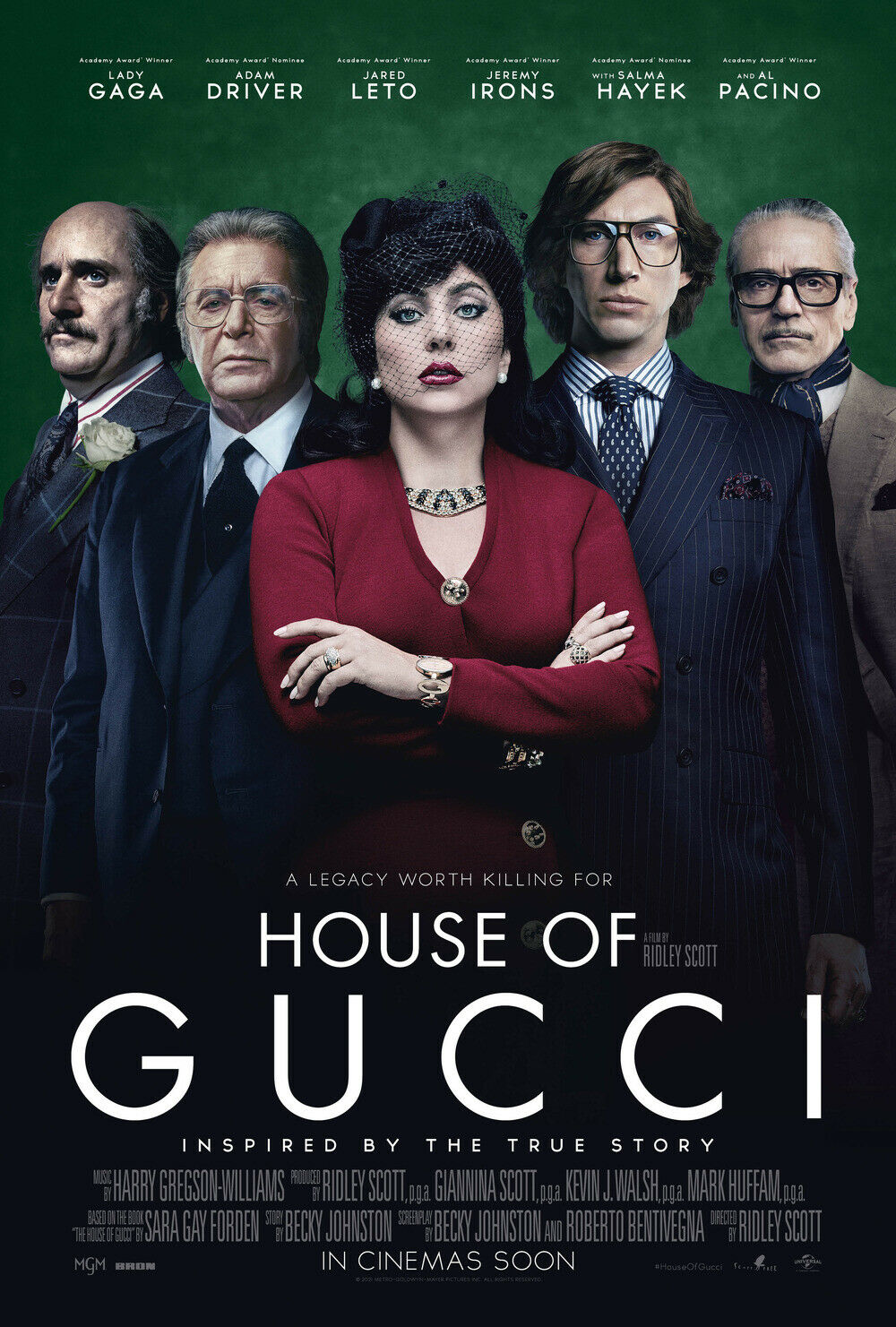
House of Gucci (2021) ***** – Seen at the Cinema

Beautifully constructed, stylish, compelling narrative about passion, betrayal and the death of a dynasty. Just as The Godfather is not just about the Mafia, this is not just about fashion; rather, both fit into the niche of movies about family. In each, there are principled fathers and both weak and strong sons. While decisions are driven by character, ambition clogs the mind and ultimately it is the clear-sighted who win.

In a beautifully-played love story outsider Patrizia (Lady Gaga) manages to snag Gucci heir Maurizio (Adam Driver), her lowly status driving a wedge between him and ill patriarch Rodolfo (Jeremy Irons), who shares control of the company with his brother Aldo (Al Pacino). Almost a geek poster-boy, Maurizio nonetheless fits easily into her world. But when Aldo draws Maurizio into the family business, it triggers conspiracy and betrayal.

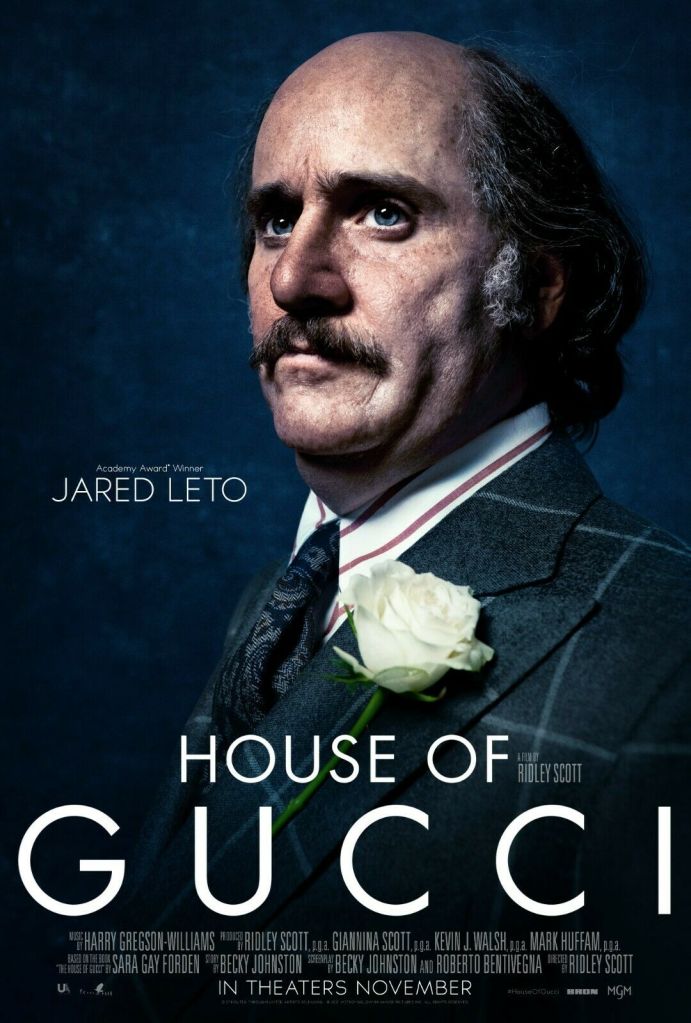
Aldo and Rodolfo are polar opposites, the former willing to dilute the brand in the race for profit, the latter seeing himself as the curator of a more sedate way of doing business. While Rodolfo pines for his dead wife in his palatial Italian sanctuary, Aldo has an eye for the ladies in New York. The weak link in the family chain is Aldo’s “idiot” son Paolo (Jared Leto) who considers himself a fashion genius. But, in reality, they are all weak, seduced by wealth and power, believing themselves untouchable despite wholesale fraud, business folly and self-delusion on a colossal scale.

The quest for power is ostensibly driven by Patrizia, but she proves no match for a flinty-eyed Maurizio. And for his all self-aggrandisement, Maurizio proves no match for the circling predators, his rampant self-indulgence a death wish in a boardroom.

Over-acting could have sent this picture off the rails but everyone is terrific and the soap-opera tag is unfair. In the best Shakespearian style, hubris accounts for tragedy.  Few characters escape humiliation. Paulo may be a figure of fun, but his mortification at the hands of Rodolfo renders him extremely human. Aldo may exalt in his business skill but in the face of betrayal is destroyed. Patrizia receives a massive put-down by Maurizio in front of his high-class friends.

Lady Gaga, who demonstrates the onscreen radiance and incandescence of a latter-day Elizabeth Taylor, is superb as the woman whose prize is snatched away. Adam Driver puts in his best performance yet, so natural, and his scenes with Gaga are electrifying. Al Pacino encompasses a massive range, man in his pomp, loving father, and in the depth of agony at betrayal. Jared Leto is a revelation, and an early Oscar favourite, as the ridiculous and ridiculed son. Jeremy Irons and Jack Huston as the conniving lawyer are excellent

There are so many brilliantly-wrought scenes – seduction on a rowing boat, a rugby match that gets out of hand, a snake-pit of a boardroom, Aldo lavishing attention on his cows, Patrizia indulging a psychic (Salma Hayek), Maurizio leaping around a room for a Vogue photo shoot. A weighty look at the corruption of power but also a fabulously entertaining picture. Better known for visual tropes, here Scott displays his mastery of narrative as we sweep in and out of unbridled egos hell bent on triumph at any cost. And it is the best film about business since Wall St (1987).

When I first watched this, I was inclined to give it a four-star rating but after seeing it a second time on the big screen that appeared niggardly for a work of such awesome majesty. (Now that I’ve seen it a third time, the five-star ranking still stands). Just like American Gangster (2005) and Thelma and Louise (1992), when Scott moves outside his self-appointed sci-fi and historical treasure trove, he does so with effortless style. This just zipped along. I hardly noticed the time at all. Second time around, I just did not want it to finish, I was so immersed. I even found myself laughing at the same jokes and situations.

What a banner year for the 83-year-old British director. The Last Duel could have bookended this piece – wronged woman proved innocent compared to wronged woman found guilty. Given Scott is synonymous more with the historic than anything approaching the contemporary, I thought I would have preferred The Last Duel, but I now consider House of Gucci the greater film.

Discover WordPress

A daily selection of the best content published on WordPress, collected for you by humans who love to read.

The Atavist Magazine

by Brian Hannan

WordPress.com News

The latest news on WordPress.com and the WordPress community.