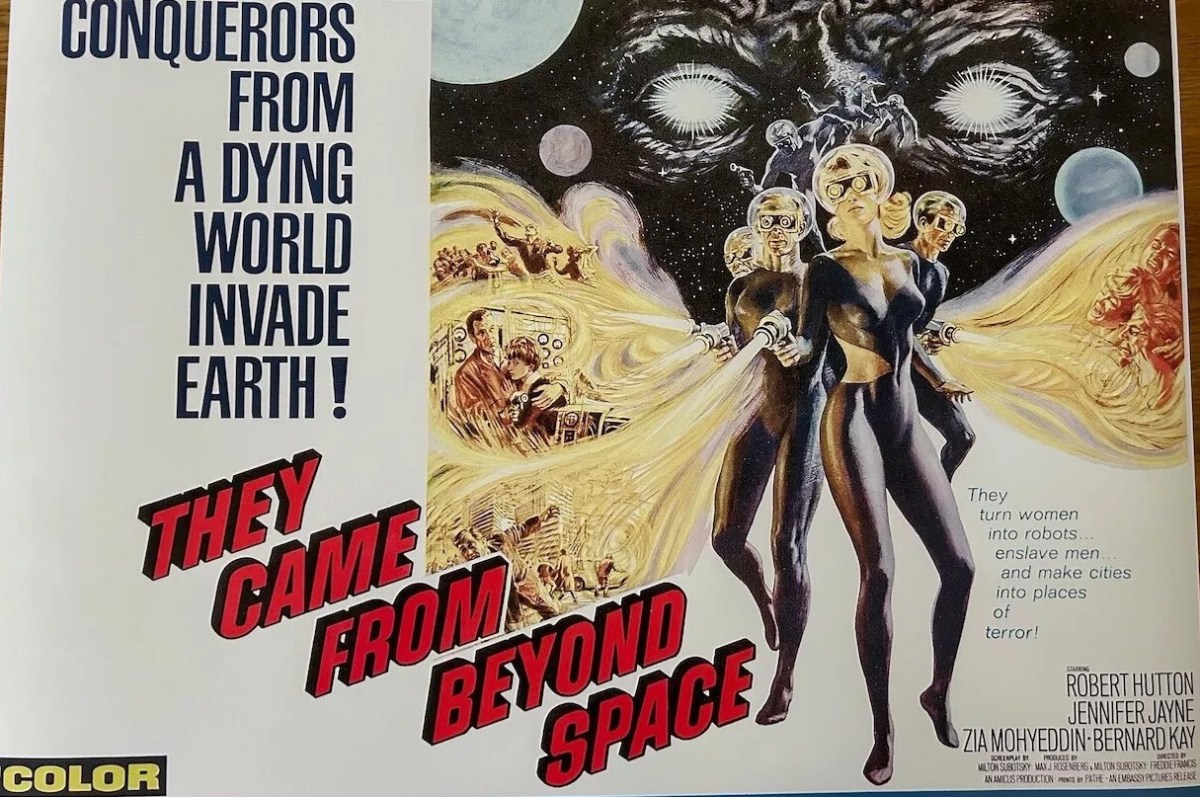
If you’re familiar with the Amicus output from its portmanteau horror movies this excursion into sci fi might come as a surprise. On the other hand, should you be a fan of Dr Who you might well be acquainted with Amicus’s two excursions into this genre – Dr Who and the Daleks (1965) and Daleks’ Invasion Earth 2015 A.D. (1966). In fact, the outfit’s production at this point was evenly split between sci fi and horror and had They Came from Beyond Space and stablemate The Terrornauts (1967) done better the company might have persevered with the genre.
That these two were originally intended to go out as a double bill – they did in the U.S. but not in Britain – is somewhat surprising given they have similar themes of some kind of dying alien species using Earth for survival. And with a bigger budget, They Came from Beyond Space might have made a bigger dent into the box office, instead of heading beyond the realms of cult into oblivion.
There are some neat touches. Meteorites fall on Earth. Nothing odd in that, certainly not in the world of cinematic sci fi. What’s strange is how they land – in a perfect V-formation. What’s more their source is the Moon. You won’t be at all surprised to learn, however, that the aliens bear no resemblance to the amazonian-type women promoted in the poster.
Also peculiar, for the time, is that the scientists sent to investigate are led by a woman, Lee (Jennifer Jayne), her boss and lover Dr Temple (Robert Hutton) left behind because he has a silver plate in his head as the result of an automobile accident. The meteorites exert a strange power and soon Lee and her confederates are organizing some massive scientific project to send a mission to the Moon, funding procured from a million-pound loan from a hypnotized bank manager and the local community falling victim to a strange plague which renders them obedient.
Eventually, alarm raised by Lee commandeering so much expensive equipment, Dr Temple does go to investigate and is baffled by the construction of a military compound complete with armed guards and electrified fence housing a vast underground laboratory and a rocket ready for launch.
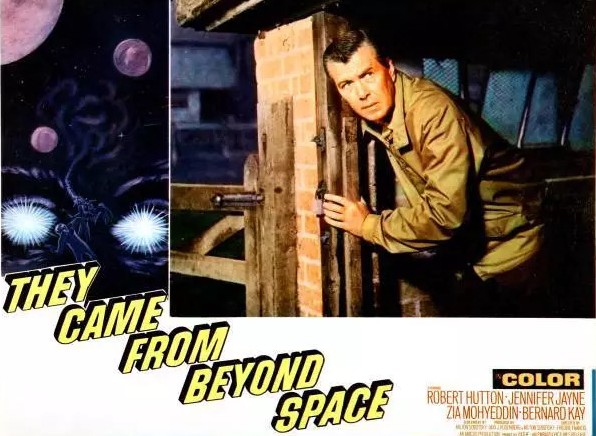
He manages to kidnap Lee, possessed by an alien force, and with buddy Farge (Zia Mohyeddin) comes up with a variation on the kind of common-cold weapon employed to defeat aliens – in this case the use of silver to block the alien rays, you always knew that silver plate in his head would have narrative purpose. Realizing her situation, Lee now pretends to be an alien and the trio sneak aboard a rocket and after a fantastically speedy journey land on the Moon where they are confronted by the Master of the Moon (Michael Gough).
Quite why female sacrifice was a common theme between this and The Terrornauts is anyone’s guess but soon enough the aliens have Lee staked out. And that silver plate has to be surgically removed from Dr Temple’s head so the aliens can get a good look at his brain.
Like The Terrornauts, there are no physical aliens, just some kind of energy source. And like E.T. some decades later they just want to go home. Farge leads the enslaved in revolt and normally that would trigger some violent finale but here, instead, there’s a curious – and welcoming – climax.
A kind of “why didn’t you say so, old chap” ending where the Earthlings agree to help the aliens return to their planet, no collateral damage necessary. This is probably the most unexpected thinking person’s twist that you could ever conceive – a variation on the idea of foes finding common cause. It certainly didn’t fit into the genre and my guess is most audiences were baffled at the outbreak of peace. It just didn’t go with the territory.
None of the acting is anything to write home about, but the picture is generally well done, the special effects more than passable given the budget, and enough in the narrative tank to keep you going.
Robert Hutton (The Vulture, 1966) was coming to the end of a B-picture career. Jennifer Jayne’s (The Liquidator, 1965) hardly really took off. Zia Mohyeddin (Deadlier Than the Male, 1967) had a decent run in supporting roles. Everyone is no more than adequate in roles that demand no depth.
Freddie Francis (The Skull, 1965) does his best with a script by producer Milton Subotsky (The Skull) adapting the novel by Joseph Millard.
Undemanding but holds the interest.


 The Magnificent 60s