Dr Who and the Daleks (1965) ***

The maiden voyage of the time-travelling Tardis is triggered by some unexpected pratfall comedy. On board are the venerable doctor (Peter Cushing), his intrepid great-granddaughter Susan (Roberta Tovey) and a fearful pair, granddaughter Barbara (Jennie Linden) and accident-prone Ian (Roy Castle). They land on a petrified planet ruled by the robotic Daleks with menacing electronic voices.

The malfunctioning Tardis forces them to investigate an abandoned city but they are quickly imprisoned, the steel robots determined to discover why the earthlings should be immune to the radiation that has consumed this planet after nuclear war. Meanwhile, the planet’s remaining inhabitants, the Thals, are planning an uprising.
Budget restrictions ensure that menace is limited, even as the characters endure a heap of traditional obstacles such as swamp and rocky outcrop. Adults who did not grow up in the 1960s when the BBC television series took Britain by storm and apt to come at this without the benefit of nostalgia will certainly look askance at the sets and costumes. And it doesn’t possess the so-bad-it’s-good quality of some 1950s sci-fi pictures. But since it was primarily made for children, then perhaps it’s better to watch it with a younger person and gauge their response – of course, that may be equally harsh from someone brought up on the modern version of the series or already immersed in superheroes.

On the plus side, it does move along at a clip. Roberta Tovey (A High Wind in Jamaica, 1965) charms rather than annoys as the plucky grand-daughter even if her grandfather has mutated from the sterner figure of the television series into an eccentric inventor. Peter Cushing (The Skull, 1965) is only required to ground the production which he does adequately. The innate comic timing of comedian Roy Castle, in his leading man debut, brings a light touch to proceedings as the bumbling boyfriend and generates some decent laughs. Jennie Linden (Women in Love, 1969) has little to do except look scared.

Oddly enough, it was American Milton Subotsky who, in opportunistic fashion, brought the project to the big screen, although the BBC had a track record of providing product that might make such a leap, The Quatermass Experiment in the 1950s the leading example. He wrote the screenplay and acted as producer and had previously worked with Cushing on Dr Terror’s House of Horrors (1965) and was about to embark on horror masterpiece The Skull the same year. He has approached the material with some reverence and the fact that the budget allowed for hordes of Daleks rather than being seen one or two at a time as on the television probably made some child’s day.

Scottish director Gordon Flemyng (The Split, 1968) would make the leap to Hollywood on the back of this picture and its sequel the following year and you can see what made studios have faith in his ability – he deals with multiple characters, works quickly on a low budget and delivers an attractive picture that was a box office hit.

I suspect that audiences will divide into those who watch the film with nostalgia-colored spectacles, those who think it only as good as a bad episode of Star Trek and those who adore any low-budget sci-fi movie.

Nightmare (1964) ****

Now this is what you’re looking for when you take an unguided tour into the British B-movie. A tight gripping thriller with a parcel of twists, clever character perspective, some stunning cinematography, and pivoting on perception of insanity.

The opening is a cracker. Teenager Janet (Jennie Linden) stumbles along a dark prison-like corridor with little light hearing someone call her name. Entering a door, she spies a woman in a white nightgown lurking in the corner. She responds to the gentle calling. But once she lets the door close behind her and can’t get out, the woman screams that now they are both mad. And that’s just the first, atmospherically brilliant, nightmare.

Janet is soon removed from her posh boarding school, her constant nightmares too frightening for the other pupils. Driven home in a Rolls-Royce, accompanied by teacher Mary (Brenda Bruce) she passes the asylum where her mother is an inmate, but is surprised to find her legal guardian, charming lawyer Henry (David Knight), isn’t there to greet her. Instead there’s a nurse, Grace (Moira Redmond).

We soon learn she’s been effectively orphaned by her mother, who killed her father, Janet, eleven at the time, witnessing the murder. But without any proper home life, looked after primarily by kindly chauffeur John (George A. Cooper) and maternal maid Anne (Julie Samuel) and with the married Henry often absent, there’s little done to quieten down her obsession that she will follow her mother into madness.

The movie takes her perspective, watching her watching out for mystery, or in her point of view as she catches fleeting glimpses of a woman in white. The apparition looking only too realistic, not dashing out of view but turning and apparently beckoning Janet on and it doesn’t take much to push a disordered mind further out of kilter, leading to attempted suicide. Imagining Henry’s wife is the ghost, she stabs her to death.

End of Act One. Start of Twist No 1. You would expect the movie to follow Janet to the asylum where she would be reunited with her mother, knowing she had inherited those terrible genes, trapped in her insanity. But it goes somewhere more delicious instead.

Turns out nice Henry is not very nice at all. He contrived a situation to be rid of his wife and marry lover Grace instead. But, once married, it is Grace who becomes disturbed and the movie follows a similar arc in the second half. Unexplained goings-on. She believes Henry has another, secret, lover and is trying to drive his new wife crazy. She finds strange cigarettes in his pocket, a barman at a hotel recognizes him even though he claims never to have been there before.

The marriage quickly deteriorates although she stands her ground, telling him in no uncertain terms that she won’t put up with any philandering and slapping his face. He is charm itself, easily turning aside her insinuations and from his casual and disarming manner it’s easy to believe he is perfectly innocent. Of course, that’s before Janet’s doll turns up and locked doors open and there’s an apparition.

The beauty of this picture is the atmosphere, the intensity of the camera, the concentration on two vulnerable females, convinced by genuine or imagined guilt that they will succumb to the madness that appears to pervade this particular house. You think it’s going down one route and are annoyed you didn’t see the next twist coming.

There’s the kind of cinematic repetition that enamored critics of more critically acclaimed pieces like The Searchers (1956). It’s almost as though there’s a beam of insanity identifying the next victim. And that’s helped immeasurably by the lighting which allows no shadow on faces. Like an inverted film noir, where the light has nowhere to go, no atmospheric shadow to create, except to land square on the faces of those involved. This would be the Old Dark House except never has a building been so illuminated, not bright throughout, the illumination predisposed to land on faces rather than rooms.

There are a couple of finely composed scenes, one viewed through a staircase, neat revelations, visual and verbal, a fabulous ending with one character screaming and a telephone dangling off the hook.

You might be astonished to discover this is a Hammer picture. Nary a monster in sight. But then little is scarier than what happens inside the mind, when imagination runs riot without external assistance. That the victim is a teenager, prone to the mood swings of that age, makes it easier for Jennie Linden (Women in Love, 1969) to ramp up the emotions without her seeming too barmy from the outset. David Knight (The Devil’s Agent, 1962) is excellent, conniving he may be but the general demeanor of bonhomie never slips into stage villain. But Moira Redmond (The Limbo Line, 1968) is the pick as she morphs from accomplished accomplice to prospective victim.

Tightly written by Jimmy Sangster (Maniac, 1963), characters fully evolved, twists cleverly concealed, and with excellent direction by Freddie Francis (The Skull, 1965), not just the visuals but in drawing out of a fairly standard set of actors exactly what he needs to make this tick.

Well worth a look. A much under-rated B-picture.

Youtube has an excellent print.https://www.youtube.com/watch?v=EJizyBez6A0&t=1064s

Dr Who and The Daleks (1965) ***

The maiden voyage of the time-travelling Tardis is triggered by some unexpected pratfall comedy. On board are the venerable doctor (Peter Cushing), his intrepid great-granddaughter Susan (Roberta Tovey) and a fearful pair, granddaughter Barbara (Jennie Linden) and accident-prone Ian (Roy Castle). They land on a petrified planet ruled by robotic Daleks with menacing electronic voices.

The malfunctioning Tardis forces them to investigate an abandoned city but they are quickly imprisoned, the steel robots determined to discover why the earthlings should be immune to the radiation that has consumed the planet after nuclear war. Meanwhile, the planet’s remaining inhabitants, the Thals, are planning an uprising.

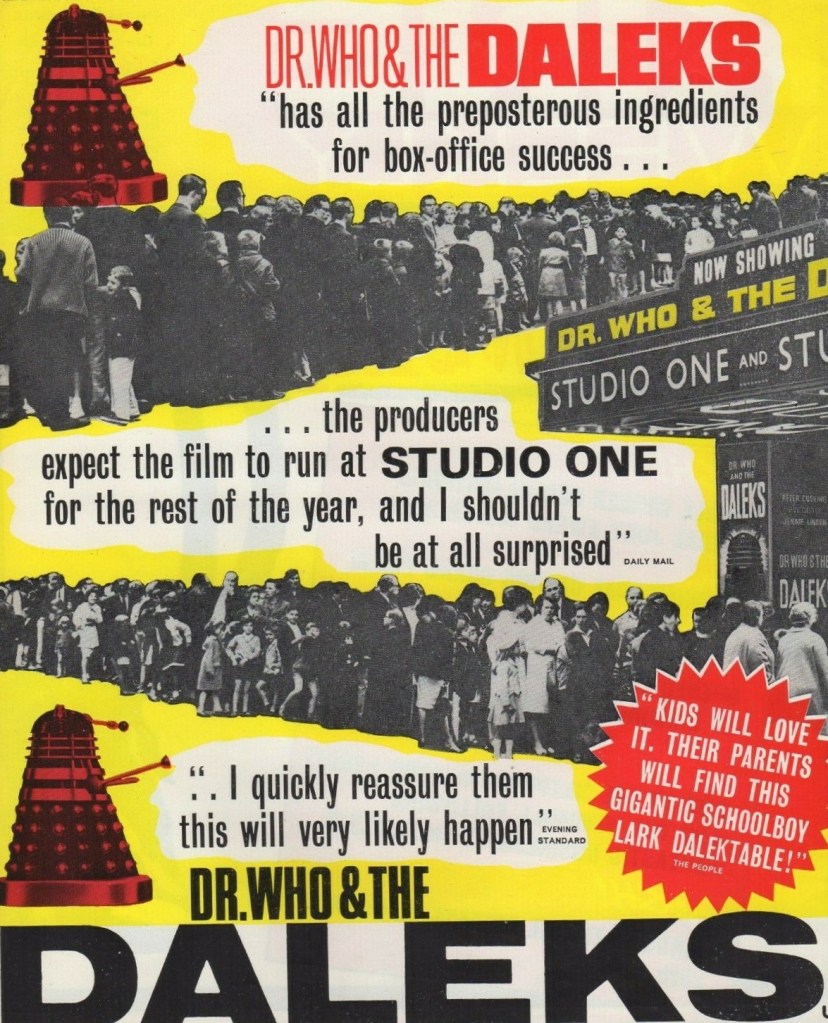
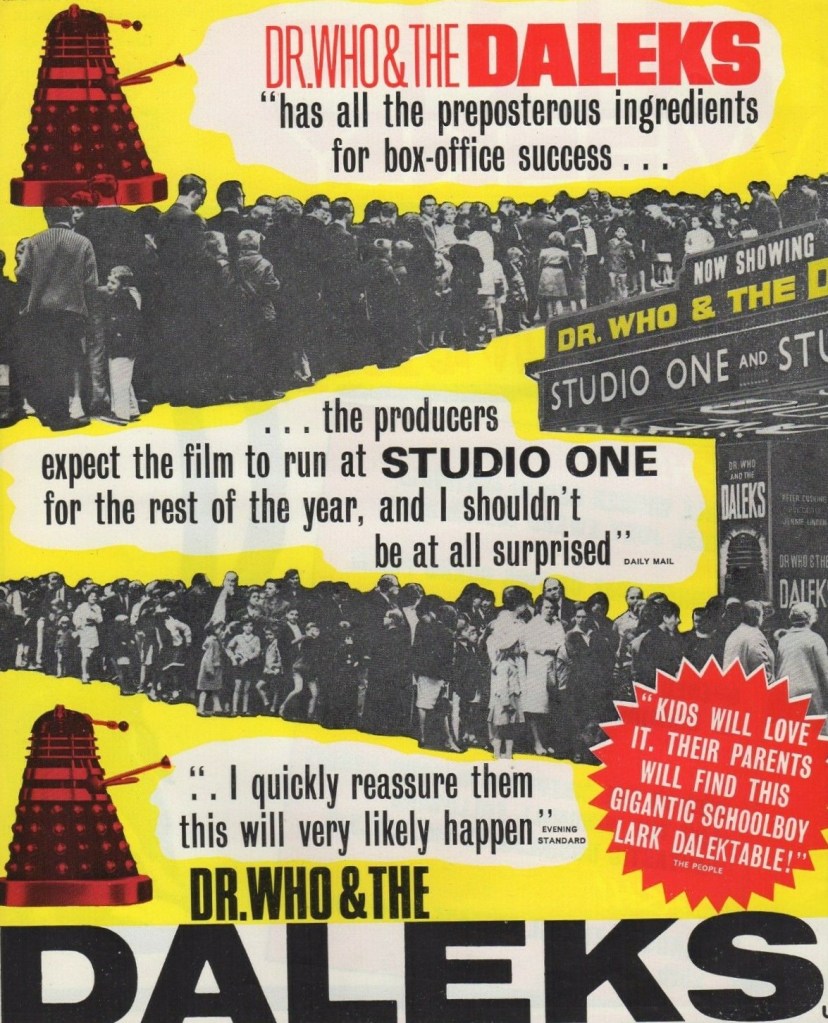
Studio One was one of the smallest cinemas in London’s West End and often used as the launch pad for Disney pictures. Limited capacity ensured that a hit film would run for months and the crowds queueing outside would attract the attention of other passersby.

Budget restrictions ensure that menace is limited, even as the characters endure a heap of traditional obstacles such as swamp and rocky outcrop. Adults who did not grow up in the 1960s when the BBC television series took Britain by storm and apt to come at this without the benefit of nostalgia will certainly look askance at the sets and costumes. And it doesn’t possess the so-bad-it’s-good quality of some 1950s sci-fi pictures. But since it was primarily made for children, then perhaps it’s better to watch it with a younger person and gauge their response – of course, that may be equally harsh from someone brought up on the modern version of the series or already immersed in superheroes.

On the plus side, it does move along at a clip. Roberta Tovey (A High Wind in Jamaica, 1965) charms rather than annoys as the plucky grand-daughter even if her grandfather has mutated from the sterner figure of the television series into an eccentric inventor. Peter Cushing (She, 1965) is only required to ground the production which he does adequately. The innate comic timing of Roy Castle, in his leading man debut, brings a light touch to proceedings as the bumbling boyfriend and generates some decent laughs. Jennie Linden (Women in Love, 1969) has little to do except look scared.

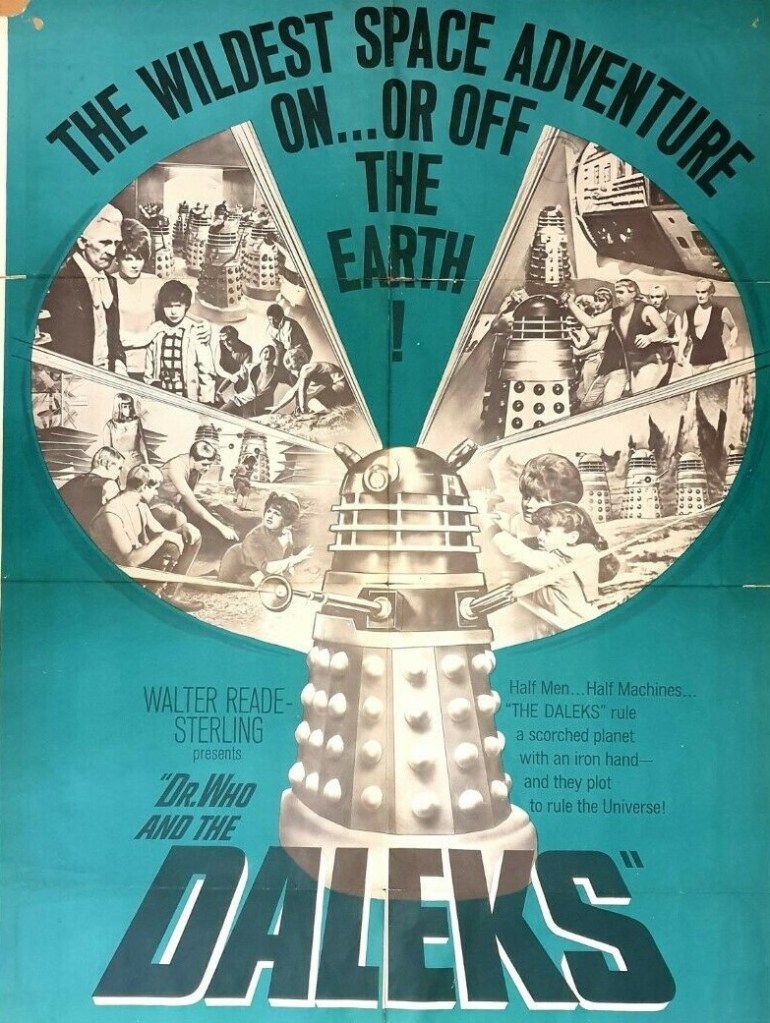
With no built-in audience, the U.S. distributors marketed it in typical fashion – “half men half-machine” – and possibly roped in a bigger adult audience unaware of its origins in children’s television.

Oddly enough, it was American Milton Subotsky who, in opportunistic fashion, brought the project to the big screen, although the BBC had a track record of providing product that might make such a leap, The Quatermass Experiment in the 1950s the leading example. He wrote the screenplay and acted as producer and had previously worked with Cushing on Dr Terror’s House of Horrors (1965) and was about to embark on horror masterpiece The Skull the same year. He has approached the material with some reverence and the fact that the budget allowed for hordes of daleks rather than being seen one or two at a time as on the television probably made some child’s day.

Scottish director Gordon Flemyng (The Split, 1968) would make the leap to Hollywood on the back of this picture and its sequel the following year and you can see what made studios have faith in his ability – he deals with multiple characters, works quickly on a low budget and delivers an attractive picture that was a box office hit.

I suspect that audiences will divide into those who watch the film with nostalgia-colored spectacles, those who think it only as good as a bad episode of Star Trek and those who adore any low-budget sci-fi movie.

You can catch this on Amazon Prime.

Discover WordPress

A daily selection of the best content published on WordPress, collected for you by humans who love to read.

The Atavist Magazine

by Brian Hannan

WordPress.com News

The latest news on WordPress.com and the WordPress community.