Roman Holiday (1953), Three Coins in a Fountain (1956) and Boy on a Dolphin (1956) had set a high bar for Hollywood romances set in Italy. Since Jean Negulesco had directed the last two, he was expected to sprinkle box office magic on this slight tale of young American midwife Jessica Brown Visconti (Angie Dickinson) adrift in a rustic village in Sicily.
She’s the kind of beauty who’s going to raise male temperatures except Jessica, having been widowed on her wedding day, is not romantically inclined. Unfortunately, that doesn’t stop the entire male population becoming so entranced that their wives become so enraged that led by Maria (Agnes Moorehead) they embark on a sex strike, assuming that without any pregnancies (contraception being frowned upon in a Catholic domain) to deal with Jessica will become redundant and go away. And that so annoys Jessica, who is doing a good job as a midwife, that she turns on the flirting to get back at her female tormentors. Luckily, there’s a reclusive landowner (Gabriele Ferzetti) who happens to be a widower, although romance takes a while to stir. There’s also a priest (Maurice Chevalier), in part acting as narrator, who turns to song every now and then.
So it’s a surprise that this unlikely concoction works at all. It’s charming in the obvious ways, the lush scenery, a traditional wedding, gentle comedy. But it’s a decade too late in taking an innocent view of sex. There’s no crudeness, of course; it doesn’t fall victim to the 1960s need to sexualize in an obvious manner. And not every husband is continuously ogling Jessica so Nunzia (Sylva Koscina) and young bride Nicolina (Danielle De Metz) are in the awkward situation of potentially betraying the sisterhood.
But in resolving the central issue the story develops too many subplots and introduces too many characters, often leaving Jessica rather redundant in terms of the plot, with not much to do, especially when her prospective suitor is absent for a long period going fishing.
Angie Dickinson is delightful as the Vespa-riding innocent turned mischievous. However, in some way though this seemed a backward step for Dickinson, a rising star in the Lana Turner/Elizabeth Taylor mold after being John Wayne’s squeeze in Rio Bravo (1959) and Frank Sinatra’s estranged wife in Ocean’s Eleven (1960) and after a meaty supporting role in A Fever in the Blood (1961) elevated to top billing in The Sins of Rachel Cade (1961). It seemed like Hollywood could not make up its mind whether it wanted her to be like Gidget or be given free rein to express her sexuality.
A charmer like Maurice Chevalier (A Breath of Scandal, 1960) was ideal for what was in effect a whimsical part. The singing probably met audience expectation. Perhaps like Sean Connery’s perennial Scottish accent, nobody ever asked Chevalier to drop his pronounced French accent even to play an Italian. But the picture is whimsical enough without him.
There’s a surprisingly strong supporting cast in four-time Oscar nominee Agnes Moorehead (Pollyanna, 1960), Gabriele Ferzetti (Once Upon a Time in the West, 1969) and French actor (and sometime writer-director) Noel-Noel. Yugoslavian Sylva Koscina (Deadlier Than the Male, 1967), Frenchwoman Kerima (Outcast of the Islands, 1951) and Danielle De Metz (The Scorpio Letters, 1967) all make a splash. Screenplay by Edith Sommer (This Property Is Condemned, 1966) from the bestseller by Flora Sandstrom.
Audrey Hepburn and Cary Grant (later a famous duo in Charade, 1963) were the first names associated with Bonjour Tristesse. The former was mooted soon after the movie rights were sold to French producer Ray Ventura. She remained in the frame after Otto Preminger took over in 1955, when the project was intended for MGM rather than Columbia, at which point Grant was being targeted.
But, unfortunately, this was not being proposed as a dream team. Vittorio De Sica was being lined up to play the father in the Hepburn version that was to be directed by Jean Negulesco.
(You can see why uncovering this information prompted me to have a second shot at a “Behind the Scenes” for this picture. When I did the original article, I didn’t have access to my usual online sources. But after a query from a reader over the success/failure of the movie, and with internet access restored, I began to check out its box office and, in so doing, found a treasure trove of new data.)
Even after Preminger dumped Hepburn – and Maggie MacNamara, star of The Moon Is Blue (1953) for that matter – as being too old, at this point Preminger was not looking in the direction of Jean Seberg either. Instead, he was going down a more traditional route to find an actress to play disturbed teenager Cecile. He embarked on a publicity-driven new star hunt. After in 1956 holding a “talent search for femme lead” in France, the director selected 17-year-old Gisele Franchomme for the role.
But she never made the grade either and was quickly jettisoned for Francoise Arnoul (French Cancan, 1955), aged 25 at the time, with another Frenchwoman, Michele Morgan (Lost Command, 1966), as the older woman who snares Cecile’s father, still to be played by Grant.
It’s hard to visualize now just what a hot number the source material was. The novel by Francoise Sagan had been a massive U.S. bestseller. By September 1955 it was in its ninth hardback printing, shifting 110,000 copies, and in 1956 became Dell’s top-selling paperback of the year. The movie rights had originally sold for just $3,000 to Ventura before Preminger ponied up $100,000 (or $150,000 depending on who you believe and in either case still the highest price ever paid for a French novel) and set the movie up at MGM.
So that studio was determined to strike while the novel was hot, taking advantage of the sensational sales figures achieved by Dell. Preminger had different plans. He had a double whammy in mind, planning to pre-empt the movie with a play written by S.N. Berhman (on loan-out from MGM who took first stab at the screenplay) initially scheduled to hit Broadway more than a year before the film appeared.
Preminger had worked the play-into-movie magic before, directing The Moon Is Blue on Broadway in 1951 two years prior to his controversial movie version. In the end Preminger concluded there was “insufficient time” to put a play into production before he was due to begin shooting.
Although it had originally gone along with the idea of the play to the extent of funding the stage production, MGM grew increasingly anxious about the delay in moving onto the picture-making part of the deal. Originally, it was planned as Preminger’s follow-up to The Man with the Golden Arm (1955) which would have seen it released either in later 1956 or early 1957.
The notion of turning the book into a play first probably caused the parting of the ways between MGM and Preminger, the studio unable to pin him down to a start date that would take advantage of phenomenal public interest. He was a hard guy to pin down, already commissioning Alec Coppel to write the screenplay of The Wheel, his proposed biopic of Gandhi, and he also had an ongoing deal with United Artists. So when MGM pulled out, the director turned to Columbia, planning Bonjour Tristesse as the first film in a multi-picture non-exclusive deal.
You could see why MGM were so anxious to get going. The studio was leading the way in a new trend, “the newest film cycle is controversy,” trumpeted Variety in a front-page splash in 1956, tagging Bonjour Tristesse “an unpleasant tale.”
But there was a better reason to act fast rather than just to be seen as with-it. Not only was the paperback market booming, its fastest-growing sector was the movie tie-in. While the 4,500 titles appearing annually accounted for sales of around 200 million copies, publishers also printed movie tie-ins for another 200 titles.
Movie tie-ins had turned into a publishing phenomenon. Sales of Dell movie tie-in paperbacks rocketed year on year, so much so that the rise in 1959 was 23 per cent over the previous year. Ironically, Preminger’s Anatomy of a Murder (1959) has been the publisher’s top title for that year. Peyton Place had taken the top spot in both 1957 and 1958 – 4.2 million copies in print – with Bonjour Tristesse its top seller in 1956.
Typically, a movie tie-in was, in effect, a follow-up to the initial paperback. Often the tie-in print run was much higher than the initial printing. The tie-in edition for Bridge on the River Kwai, for example, topped 750,000 copies, for Sayonara it was 900,000. Don’t Go Near the Water sold one million in a month. The average movie tie-in print run for Bantam was 200,000-350,000 copies; for Dell 250,000-300,000; for Signet 300,000; Popular Library 250,000-300,000; and Pocket 225,000-375,000.
Paperbacks accessed a new market. Apart from traditional bookshops, they were available in drugstores, newsstands, supermarkets, impulse buys when the reader was purchasing something else. But they provided for studios a powerful marketing tool. Dell advertised that its paperback “bestsellers were movie pre-sellers” and for good reason. Front covers adorned with stills from a forthcoming movie offered studios fresh promotional opportunity. When a big picture was due you could hardly walk down a street without your attention being called to a tie-in.
Paperback sales were also viewed as a providing a strong indication of box office potential. Based on its sales, it was predicted that Bonjour Tristesse would do as well as Old Yeller and Don’t Go Near the Water, which turned into, respectively, the 10th and 14th biggest films of the year. Columbia sales chief Rube Jackter was so confident of success for Bonjour Tristesse that he departed from convention, taking a groundbreaking approach, personally undertaking a nationwide tour to sell the project to his local sales teams. Perhaps he didn’t want to be beaten to the punch by A Certain Smile (1958), Sagan’s sophomore novel, rights selling for $150,000 and eight per cent of the gross.
Newcomer Jean Seberg was in the vanguard of a new talent hunt. Undaunted by his experience with Seberg in Saint Joan and the critical pummelling she had personally taken, Preminger defended his protégé. “I think she has talent. If I’m wrong, I’ll pay for it. I don’t say I’m infallible, but neither are the critics.”
Preminger backed new talent, taking a chance on Maggie MacNamara in The Moon Is Blue, Lee Remick in Anatomy of a Murder and, later, Tom Tryon in The Cardinal (1963) and Carol Lynley in Bunny Lake Is Missing (1965). In the late 1950s, Twentieth Century Fox was particularly active in developing younger – and cheaper – stars. But other studios such as Universal and Paramount (who had picked up Audrey Hepburn in a talent hunt in the earlier part of the decade) were also keen.
Lynley and Remick were among those being tipped for the top in 1959 in addition to Rod Taylor (Dark of the Sun, 1968), Jill St John (Tony Rome, 1967), Stuart Whitman (Rio Conchos, 1964), Troy Donohue (Rome Adventure, 1962), Bradford Dillman (The Bridge at Remagen, 1969), Sandra Dee (A Man Could Get Killed, 1966), John Gavin (Psycho, 1960) and Cliff Robertson (Masquerade, 1965).
Preminger’s cinematographer George Perinal (who had taken over Saint Joan, 1957, at short notice) hankered after using Technirama for the picture until the director pointed out “the difficulties of using such a large camera in the tiny interiors of the locations.” These included an art gallery in Montparnasse round the corner from Notre Dame where Preminger negotiated a one-day rental (and the purchase of a Picasso) from the Japanese owner. Following Saint Joan, Perinal was so taken with the experience of working with Preminger that he had turned down several other offers in order to keep himself free for a possible shot at Bonjour Tristesse.
“A large part of my job,” noted Perinal, “ is keeping out of the way once I had lit the set as Preminger wanted,” leaving the physical shooting to the cameraman. He had “great admiration for Preminger’s methods” since “unlike most directors he doesn’t protect himself by having one or two extra cameras covering the scene from different angle. He knows the angle he is after, and he gets it.” If the rushes proved the scene didn’t go as planned, he simply shot it all over again.
The scene in Maxim’s was filmed for a day and a night, extras being rehearsed in the morning. Most of the takes concentrated on chanteuse Juliette Greco. Francoise Sagan was tapped to write the lyrics for the movie’s theme song, but that didn;t work out instead it’s credited to Jacques Datin.
It’s worth remembering the ease with which top stars travelled. Deborah Kerr had booked passage on the Queen Mary sailing from New York to Cherbourg in the north of France for herself and two children, Melanie and Francesca, and after docking took a leisurely drive down to St Tropez.
As well as paperbacks offering marketing opportunities, the theme song to Bonjour Tristesse was also a promotional tool, Gogi Grant released it as a single, Les Baxter as an instrumental and Janet Blair sang it on British television top show Sunday Night at the London Palladium while the soundtrack album was a premier release for RCA Victor, which backed it up with an advertising campaign.
Released in February 1958 in the U.S., Bonjour Tristesse was one of 35 pictures distributed by Columbia over a six-month period. Thanks to the book sales and the cast, expectations were high. David Niven was riding a commercial (blockbuster Around the World in 80 Days, 1956, still in cinemas) and critical wave (Separate Tables, 1958, would earn him an Oscar). Deborah Kerr remained one of the industry’s most sought-after stars, her commercial and critical standing (three Oscar nominations 1956-1958 in a row) far higher than Niven’s. She had hit box office heights in The King and I (1956) and played opposite such top male stars as William Holden (The Proud and the Profane, 1956), Cary Grant (An Affair to Remember, 1957) and Robert Mitchum (Heaven Knows Mister Allison, 1957).
Robert Coyne of exhibitor alliance Compo rated it potentially one of the year’s “big pictures” along with The Young Lions and Peyton Place. But while enjoying some reasonable results in prestigious first run theaters in hi-hat locations, Bonjour Tristesse quickly fizzled out.
Although a dud in the United States – in terms of rentals it didn’t even clear $1 million – it enjoyed greater success elsewhere, ranking fifth in Japan, 20th in the annual Italian box office race, and in the Top 50 in France, “bang-up business” in journalistic parlance. But it was banned in Ireland. However, suggestions it was a box office smash elsewhere had to be taken with a pinch of salt. It only earned $195,000 in rentals in Japan. So, it is doubtful if it ever reached profitability on initial release.
There was some respite in the critical pummeling of Seberg. Hollywood Reporter, in a favorable review, tabbed her a “delicious little eyeful” noting her style was better suited to this than Saint Joan. And despite her experience of working with the director, the actress, one year later, was reported as “hoping Otto Preminger will come through with a commitment to her” not realising he was on the stage of ducking out of her contract, explaining that there wasn’t a suitable role for her in his next three planned pictures. So that contract, too, went the way of Columbia who tested her for a supporting role in The Beach Boys, a starring vehicle for Kim Novak to be helmed by Charles Vidor.
There was some reassessment of the title post-release. When Columbia sold a batch of 60 movies to television in 1964, Bonjour Tristesse was hailed in the trade advertising campaign as the main attraction, photos of the three stars adorning a full-page advert in Variety. It was reissued in Tokyo in 1981. It was featured in a 15-picture Columbia retrospective at the Museum of Modern Art in New York in 1985.
SOURCES: “Europe,” Hollywood Reporter, August 18, 1954, p7; “Otto Preminger Acquires Bonjour Tristesse Novel,” Hollywood Reporter, April 27, 1955, p2; “Tristesse Legit Version Being Financed by MGM,” Hollywood Reporter, May 31, 1955, p1; “Preminger Gets Behrman To Script Play and Film,” Hollywood Reporter, August 5, 1955, p3; Mike Connolly, “Rambling Reporter,” Hollywood Reporter, August 24, 1955, p2; “M-G Bankrolls Tristesse Legiter,” Variety, September 7, 1955, p3; “Literati,” Variety, September 7, 1955, p69; “Preminger Sets Coppel To Script Wheel,” Hollywood Reporter, January 12, 1956, p3; Stuart Schulberg, “Europe’s Unpampered Stars,” Variety, February 15, 1956, p7; “Chatter,” Variety, February 15, 1956, p74; “Paris,” Hollywood Reporter, May 22, 1956, p20; Mike Connolly, “Rambling Reporter,” Hollywood Reporter, June 8, 1956, p2; “Chatter,” Variety, June 13, 1956, p78; “Looky – We’re Controversial,” Variety, June 26, 1956, p5; “Bonjour Tristesse,” Variety, July 25, 1956, p4; “Chatter,” Variety, August 22, 1956, p62; ”Niven and Kerr Will Star in Tristesse,” Hollywood Reporter, February 21, 1957, p2; “Broadway Ballyhoo,” Hollywood Reporter, April 19, 1957, p10; “Insufficient Time for Tristesse Stage Version,” Variety, March 28, 1956, p2; “Cameraman on the Sidelines,” American Cinematographer, August 1957, p510; “The Note-Book,” Hollywood Reporter, August 5, 1957, p7; “Broadway Ballyhoo,” Hollywood Reporter, August 13, 1957, p4; “Broadway Ballyhoo,” Hollywood Reporter, August 20, 1957, p4; “Preminger,” Variety, October 16, 1957, p75; “Jackter Hits Sticks for Bonjour Release,” Variety, December 18, 1957, p3; “Foreign TV Follow-Up,” Variety, December 18, 1957, p38; Advert, “Dell Book Best-Sellers Are Movie Pre-Sellers,” Hollywood Reporter, January 8, 1958, p5; Review, Hollywood Reporter, January 15, 1958, p3; Advert, Variety, January 22, 1958, p56; RCA Victor advert, Variety, January 29, 1958, p56; Advert, Billboard, January 27, 1958, p49; “Columbia Feeds 35 by August,” Variety, February 5, 1958, p18; “A Film ‘Still’ Big Sell on Paperback,” Variety, March 5, 1958, p7; “Irish Want New Film Censoring,” Variety, June 11, 1958, p11; “Broadway Ballyhoo,” Hollywood Reporter, July 1, 1958, p4; “Sindlinger: And Rebuffed,” Variety, July 2, 1958, p5; “Paris First Runs,” Variety, July 16, 1958, p12; “New York Sound Track,” Variety, July 30, 1958, p21; “Columbia To Test Seberg for Beach Boys Role,“ Hollywood Reporter, August 15, 1958, p1; “Yank Films Still Dominate Italy,” Variety, December 3, 1958, p12; “Top Grossers* of 1958,” Variety, Jan 7, 1959, p48; “Kwai Tops in Japan,” Variety, March 18, 1959, p24; “Nine U.S. Pix,” Variety, May 13, 1959, p12; “Hollywood Takes To Tyros,” Variety, September 2, 1959, p3; “Paperback-Film Zowie Tandem,” Variety, February 3, 1960, p5; Advert, Variety, September 9, 1964, p39; “Bull Takes Charge,” Variety, May 25, 1981, p32; “MoMa Columbia Retro Set,” Variety, January 30, 1985, p4.
* NOTE: Just to confuse things, Variety headlined its annual rentals report as “Top Grossers of 1958” but in the small print clarified that these figures related to “domestic market rentals accruing to distributors (i.e. studios) a distinguished from total theater gross.”
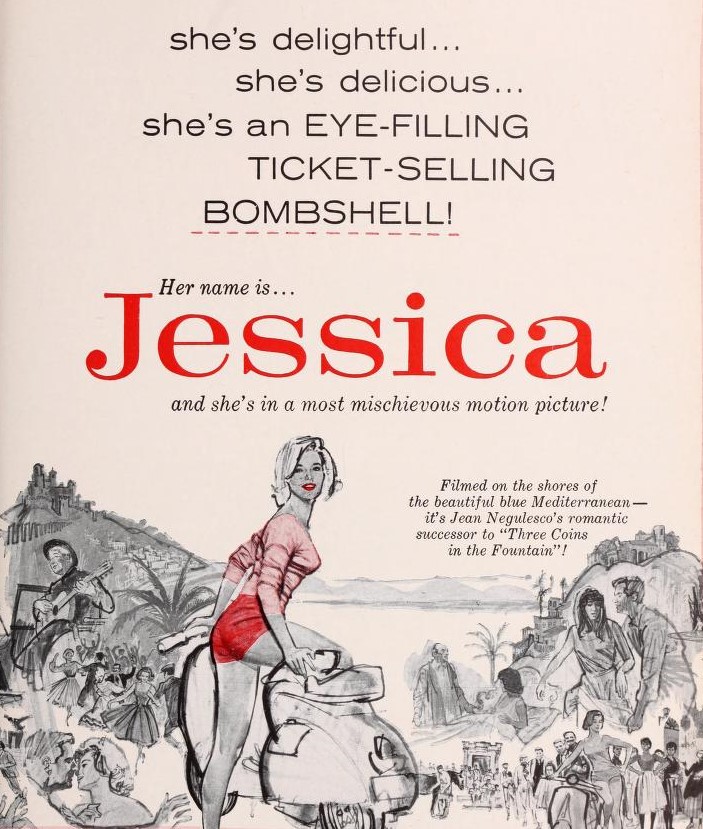
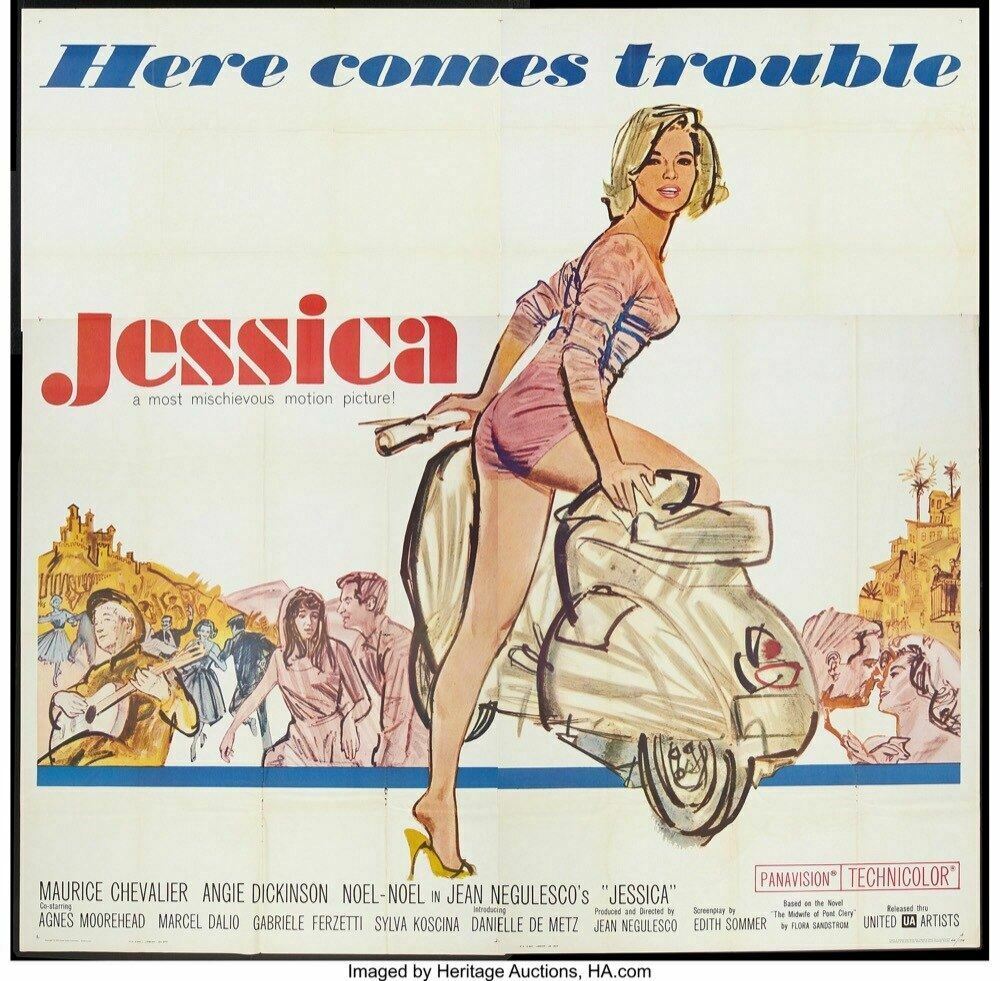
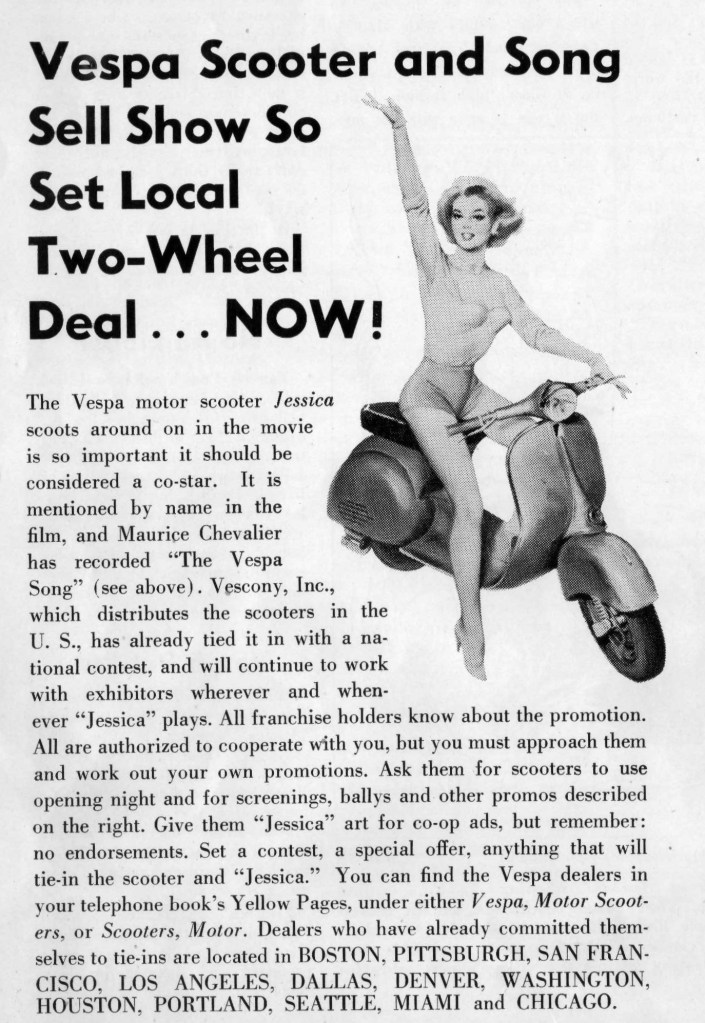
There was an age-old rule of thumb in Hollywood marketing. You can ignore iron-clad contracts as regards credits and billing if you have a sexy girl to promote. The top-billed Maurice Chevalier had been a major Hollywood star for nearly three decade from the likes of The Merry Widow (1934) to Gigi (1958) and twice Oscar-nominated. But you can scarcely see his face in any of the posters. He was passed over in favor of the glorious image of Angie Dickinson astride a Vespa scooter. And, unusually, for an industry that sold females in terms of facial features and bosom, Dickinson’s posterior was given as much prominence as the rest of her figure.
Bearing in mind the Vespa trick had already been used in more fashionable fashion by Audrey Hepburn in Roman Holiday, this was probably a more sensible approach. While there’s no doubt Dickinson was stylish nobody would ever beat Hepburn when it came to haute couture so there was no point trying, although it has to be said the sweater look was something of a throwback to the 1940s.
However, there were two other pieces of more stylish artwork as back-up for an exhibitor looking askance at the obvious and with more discerning patrons. While Mitchell Hooks was responsible for the main poster, also turning their hand to promotional material were director Jean Negulesco (whose effort is pictured at the top) and artist Bernard Buffet who both concentrated on face to the exclusion of figure. Negulesco had begun his career as an expressionist artist in the 1920s and the Pressbook marketeers took this idea further by claiming that “every frame of the film was composed with such care that the picture…can be said to be painted with a camera.”
Negulesco was a noted art collector and paintings by Bernard Buffet, also a French expressionist, adorned his walls. In 1955 Buffet was named the top post-war artist and his first retrospective at the age of just 30 was held three years later.
As readers of these occasional articles on Pressbooks will know, marketing a movie around one image was rare but the image of Jessica (Angie Dickinson) mounting a scooter was used exclusively in all posters even though the background and taglines might change. The background showed the locale, some subsidiary characters and dancing. You have to look close to catch a glimpse of top star Maurice Chevalier – he’s the guy in black toting a guitar.
The taglines centered on the mischievous Jessica causing marital mishap in sun-filled Italy. “Here comes trouble. The most delightful, delicious siren who ever scooted into town and put marriages on the skids!” was the main tagline. The rest were along similar lines. “She’s the most luscious forbidden fruit that ever dropped into the screen’s lap.” / “She lives it up saucily in Italy.” / “Meet the gal who took Italy by storm with a scooter, sweater and a smile.”
The more artistic posters by Negulesco and Buffet had different taglines: “Not in a month of Never on Sundays have you heard such wonderful songs” and “Jean Negulesco, who put Rome on the map with Three Coins in the Fountain, now works wonders on the shores of the blue Mediterranean in Jessica, a most mischievous girl.” The marketeers of course were taking some artistic license since Roman Holiday preceded Three Coinsin the Fountain.
The Pressbook offered a couple of pages of nuggets for hungry newspaper editors with Chevalier at last getting some attention – the “crooning cleric” was described as “the perennially youthful Frenchman (who) had sung, danced and acted his way across the stages of the world enjoying the adulation of several different generations.” Chevalier was given tips on his guitar by a local singing cleric, apparently.
But there was little chance, even in print, of Chevalier stealing Dickinson’s thunder especially when particular reference was made to her nude swimming scene, for which she wore a skin-colored bikini to the disappointment of the hundreds of locals who climbed up a steep slope to the waterfall location.
Jean wasn’t the only artistic member of the Negulesco clan. His wife Dusty, also a painter, designed the wardrobe, wrote lyrics for the film’s songs and taught Dickinson how to ride a scooter. The movie was filmed on location in the village of Forza d’Agro on a clifftop 1,000 feet high. The shoot lasted 55 days with 2,600 people from the surrounding area employed as support staff or in bit parts and extras. The production spent about $113,000 (over $1 million at today’s prices) on accommodation and meals and purchased 8,300 gallons of fuel. Traditional Sicilian music was incorporated into the film.
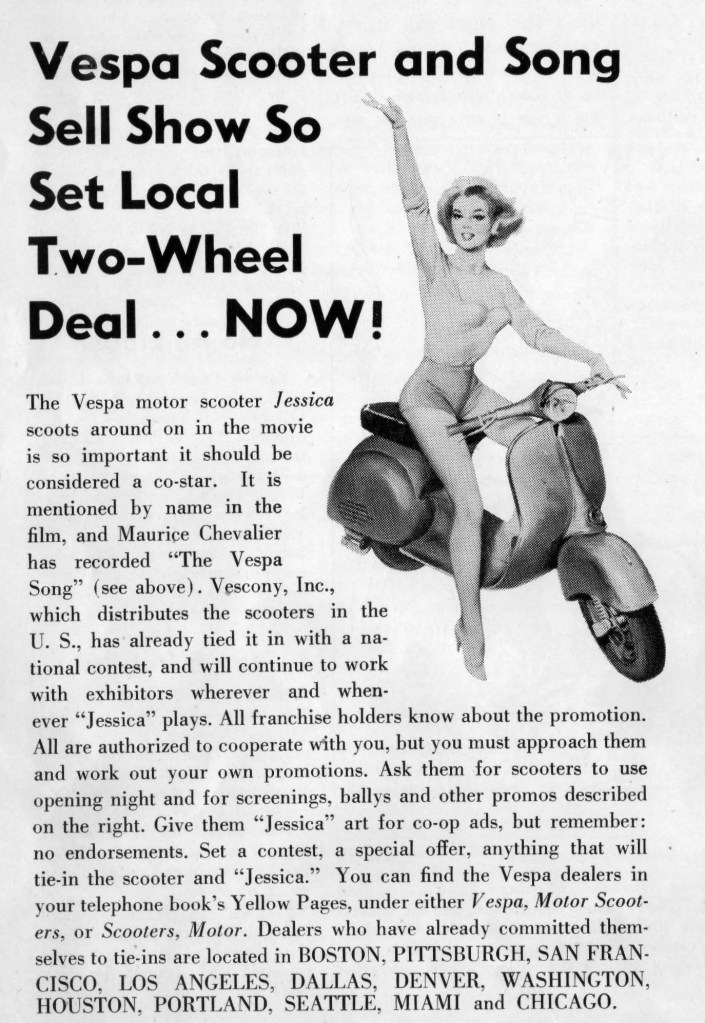
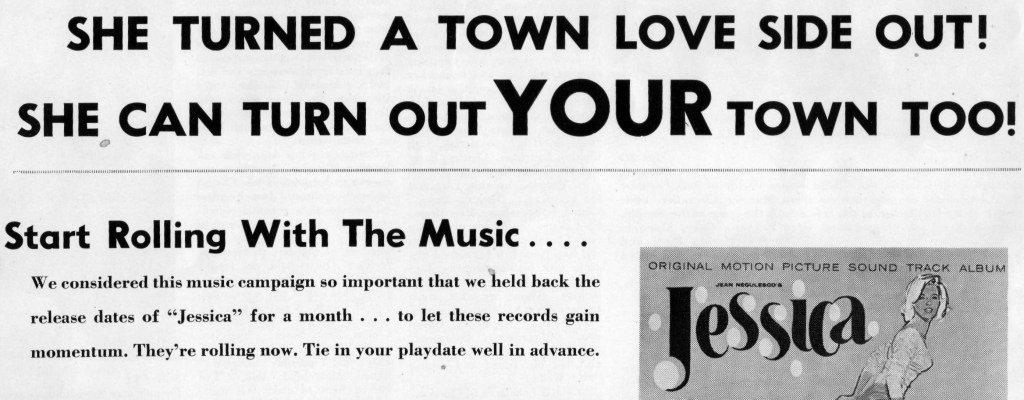
Given Chevalier was singing it was inevitable and promotionally essential to put out a single, this was “Jessica” backed by “The Vespa Song.” There was also an original soundtrack album. Both were ideal material for local radio stations to play during the film’s launch.
A key element of the promotion was a tie-up with Vescony inc which distributed Vespa scooters in the U.S. There was a national competition and franchisees were ready to lend scooters to theaters for openings and special screenings or just to sit in the lobby attracting attention. A subplot involving gardening inspired marketeers to suggest exhibitors give away orchids to women named Jessica and had tied up with supplier Orchids of Hawaii. Other ideas included targeting local midwives – both male and female – and a “Jessica Jump” reflecting the film’s wedding scene. There was book tie-in based on the source novel The Midwife of Pont Clery by Flora Sandstrom published by Pocket books.
Bernard Buffet’s involvement was something of a coup and promised an opportunity to create a promotion appealing to art lovers. “Not since Toulouse-Lautrec made advertisements for nightclubs has an artist of this stature contributed to ads for popular entertainment.”
Roman Holiday (1953) and Three Coins in a Fountain (1956) had set a high bar for Hollywood romances set in Italy. Since Jean Negulesco had directed the latter he was expected to sprinkle box office magic on this slight tale of young American midwife Jessica Brown Visconti (Angie Dickinson) adrift in a rustic village in Sicily.
She’s the kind of beauty who’s going to raise male temperatures except Jessica, having been widowed on her wedding day, is not romantically inclined. Unfortunately, that doesn’t stop the entire male population becoming so entranced that their wives become so enraged that led by Maria (Agnes Moorehead) they embark on a sex strike, assuming that without any pregnancies (contraception being frowned upon in a Catholic domain) to deal with Jessica will become redundant and go away.
And that so annoys Jessica, who is doing a good job as a midwife, that she turns on the flirting to get back at her female tormentors. Luckily, there’s a reclusive landowner (Gabriele Ferzetti) who happens to be a widower, although romance takes a while to stir. There’s also a priest (Maurice Chevalier), in part acting as narrator, who turns to song every now and then.
So it’s a surprise that this unlikely concoction works at all. It’s charming in the obvious ways, the lush scenery, a traditional wedding, gentle comedy. But it’s a decade too late in taking an innocent view of sex. There’s no crudeness, of course; it doesn’t fall victim to the 1960s’ need to sexualise in an obvious manner. And not every husband is continuously ogling Jessica so Nunzia (Sylva Koscina) and young bride Nicolina (Danielle De Metz) are in the awkward situation of potentially betraying the sisterhood.
But in resolving the central issue the story develops too many subplots and introduces too many characters, often leaving Jessica rather redundant in terms of the plot, with not much to do, especially when her prospective suitor is absent for a long period going fishing.
Angie Dickinson is delightful as the Vespa-riding innocent turned mischievous. However, in some way though this seemed a backward step for Dickinson, a rising star in the Lana Turner/Elizabeth Taylor mold after being John Wayne’s squeeze in Rio Bravo (1959) and Frank Sinatra’s estranged wife in Ocean’s 11 (1960) and following a meaty supporting role in A Fever in the Blood (1961) elevated to top billing in The Sins of Rachel Cade (1961). It seemed like Hollywood could not make up its mind whether it wanted her to be like Gidget or be given free rein to express her sexuality.
Ferzetti and Dickinson
A charmer like Maurice Chevalier was ideal for what was in effect a whimsical part. The singing probably met audience expectation. Perhaps like Sean Connery’s perennial Scottish accent, nobody ever asked Chevalier to drop his pronounced French accent even to play an Italian. But the picture is whimsical enough without him.
There’s a surprisingly strong supporting cast in four-time Oscar nominee Agnes Moorehead (Pollyanna, 1960), Gabriele Ferzetti (Once Upon a Time in the West, 1969) and French actor (and sometime writer-director) Noel-Noel. Yugoslavian Sylva Koscina (Deadlier Than the Male, 1967), Frenchwoman Kerima (Outcast of the Islands, 1951) and Danielle De Metz (The Scorpio Letters, 1967) all make a splash.




 The Magnificent 60s