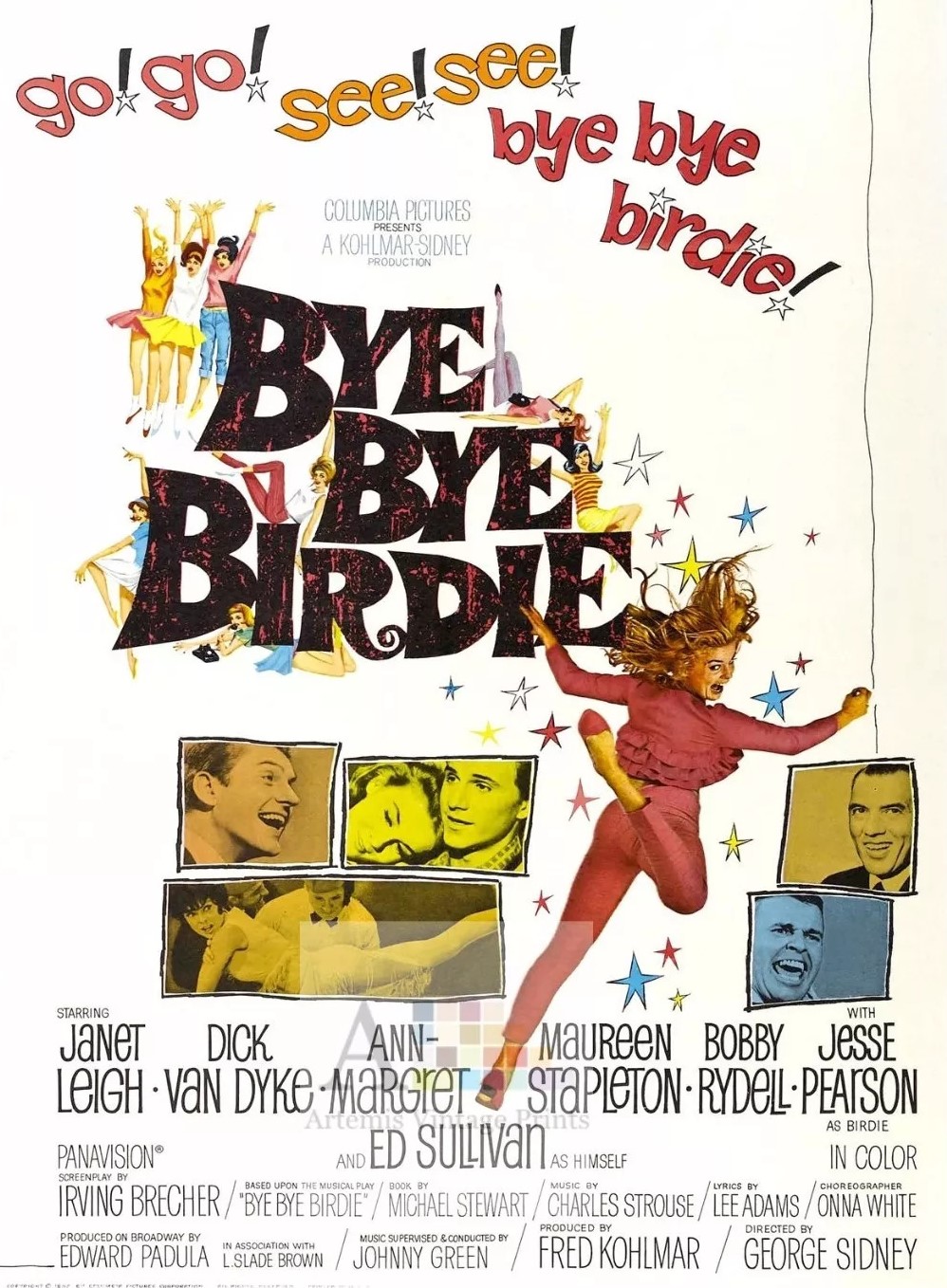
Bye, Bye, Birdie (1963) ***

Marketeers employ a cute trick to get round the contractual billing required on movie posters. The position and size of a star’s name in any movie – even now – is stipulated long before a single camera rolls. This is where all the “name above the title” malarkey stems from comes from, that stipulation setting the reals stars apart from the wannabes.

However, whoever was in charge of drawing up the standard boilerplate template was only concerned with names, not images. That left a loophole to be exploited. Should you have a female rising star, whose face or figure might be a darn sight more attractive than the top-billed male, well, by heck, there was nothing to stop you plugging the contractually-less-dominant person all over the poster at the expense of the top-billed star.
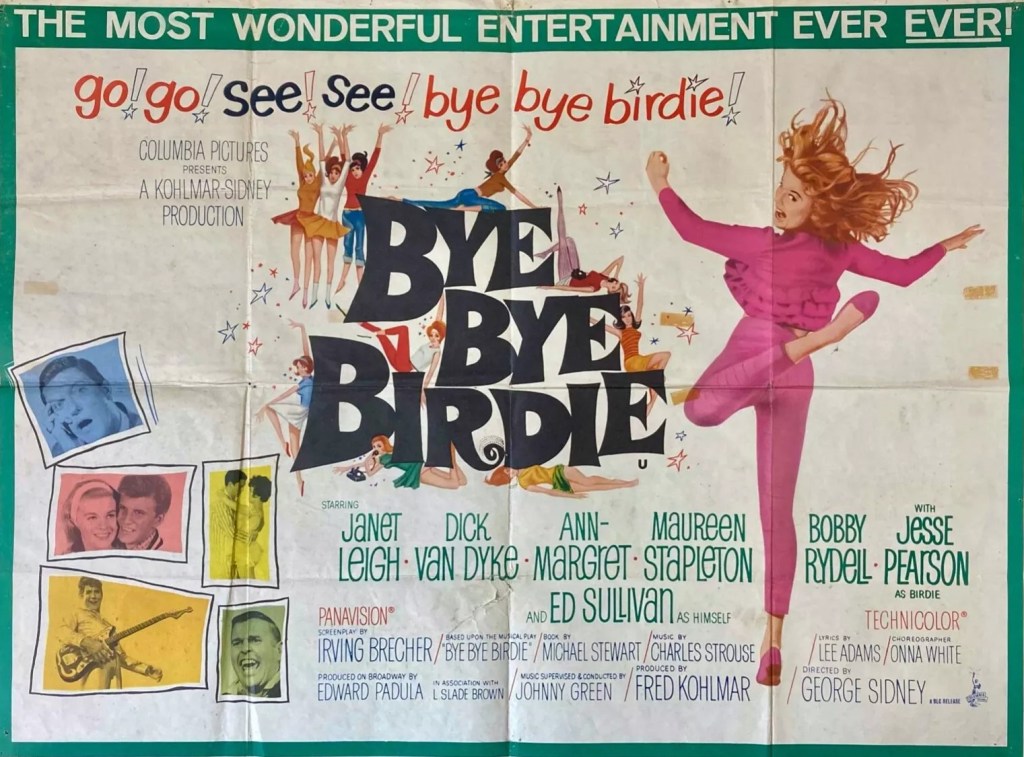
The marketeers did it with Marilyn Monroe, they did it with Audrey Hepburn, and now they’re stooping to the same loophole to promote Ann-Margret as virtually the only star of any importance. Admittedly, this was before top-billed Dick Van Dyke achieved much of a reputation as a hoofer in such spectaculars as Mary Poppins (1964). But his second-billed female lead, Janet Leigh, whose features the camera had very much taken a shine to, was also elbowed out of poster prominence.

And small wonder. Excepting Monroe, no actress ever in the last decade burst onto the screen with such pizzazz. By the time Bye Bye Birdie  – her third movie – opened Ann-Margret’s asking price had zoomed to $250,000 and she had struck a two-picture deal with MGM, was contracted to five for Twentieth Century Fox, three for Columbia and another three for Frank Sinatra’s movie production arm.

So a heck of a lot was in the balance. And, boy, does she deliver. Her energy is untouchable and, excepting again Monroe, there was never a sexier singer.

Shame the musical itself is so trite, at its best in homage to those innocent days of the 1950s, that were a more Technicolor version of those 1940s musicals that invariably were sugary confections. The story rips off the Elvis Presley legend. Conrad Birdie (Jesse Pearson) is a pop singer who has been drafted. Songwriter’s secretary Rosie (Janet Leigh) comes up with a publicity gimmick, Conrad singing a song, “One Last Kiss,” written by Albert (Dick Van Dyke) sung on the Ed Sullivan Show, his last gig before joining the Army, with a specially-chosen gal to be recipient of said smooch.

To fill you in, Rosie has had a tough time getting boyfriend Albert, eight years into their relationship, across the wedding finishing line. Bridie fan Kim (Ann-Margret) also has a boyfriend Hugo (Bobby Rydell) who naturally objects to his beloved kissing the pop singer on air in front of millions even it is a publicity stunt. Meanwhile, Albert’s Mama (Maureen Stapleton) is trying to drive a wedge between Rosie and her son. The out-of-sorts Rosie and Hugo conspire to sabotage the television show.

So pretty much the will-she-won’t-she is delivered in wishy-washy style with the plot (call that a plot!) interrupted every few minutes for a song. The narrative seems out of place for a section involving arrest for statutory rape and racism, but that gives the movie some much-needed muscle.

No question that Ann-Margret (The Swinger, 1966) steals the show. That would hardly be surprising given the lack of competition. But she certainly has the song-and-dance chops, and her energy is second to none. She gets a march on everyone by singing the title number over the credits, the credits themselves very much pushed into the background. The other prospective breakout musical star Dick Van Dyke only has one solo and Janet Leigh (Psycho, 1960) wasn’t going to effect a change of screen persona any time soon.

George Sidney directed from a screenplay by Irving Brecher (Oscar-nominated for Meet Me in St Louis, 1944) and Michael Stewart (Hello, Dolly!, 1969) from the original Broadway hit by Charles Strouse (music), Lee Adams (lyrics) and Stewart (book).

Refreshingly lightweight. Ann-Margret lights up the screen.
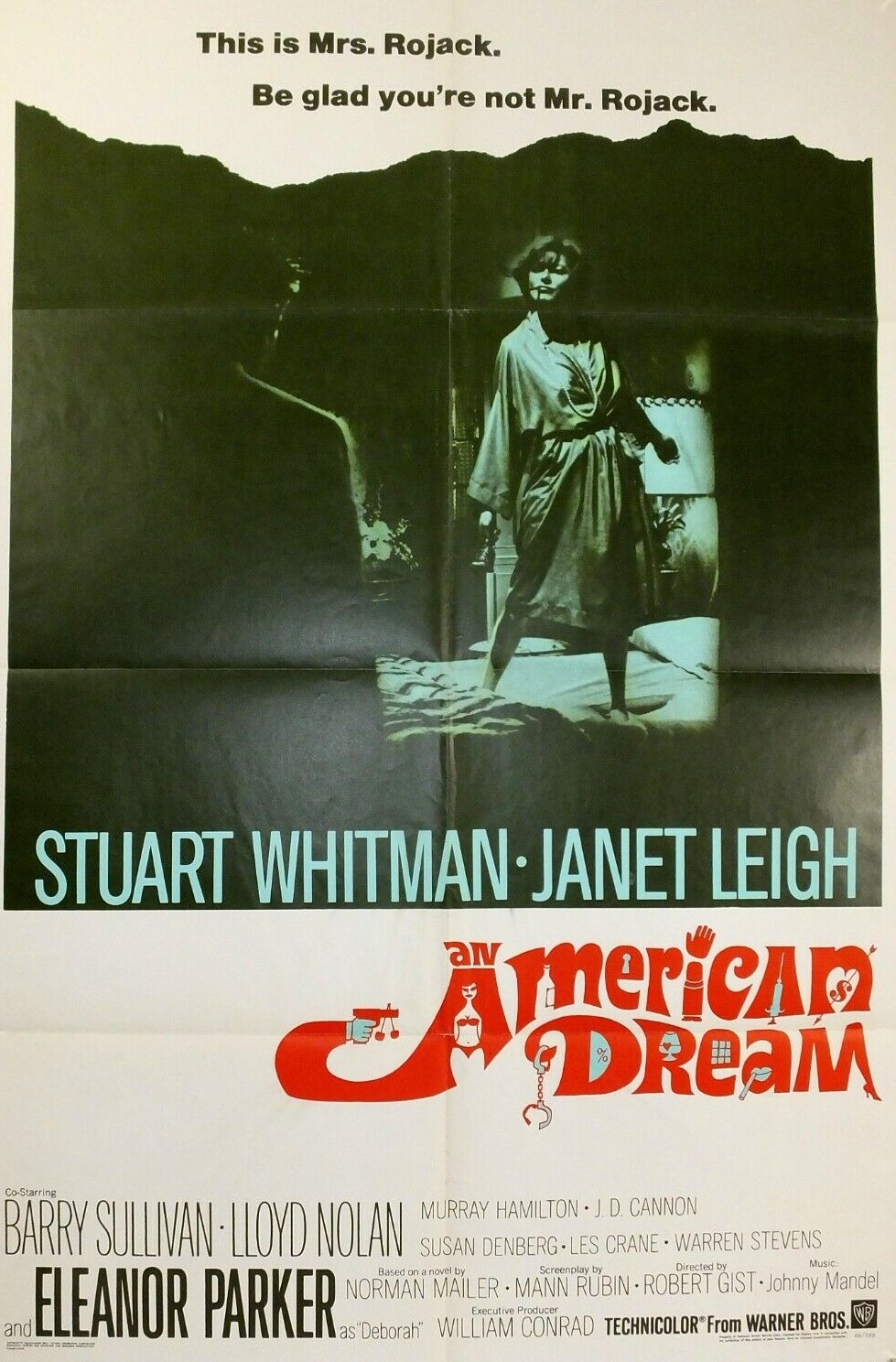
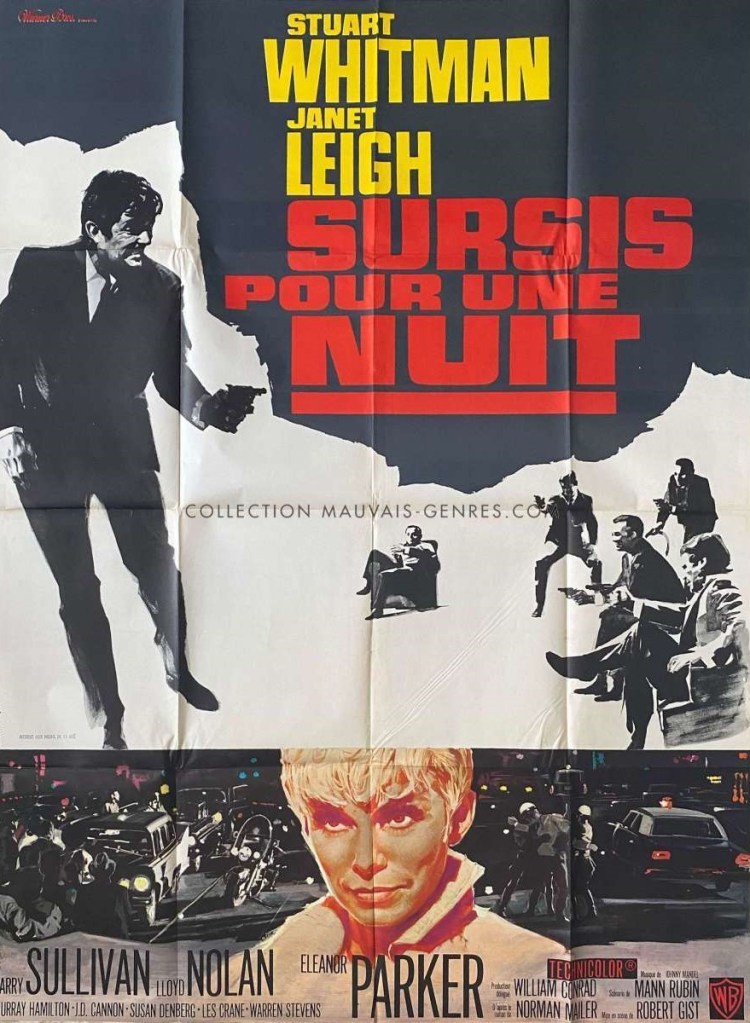
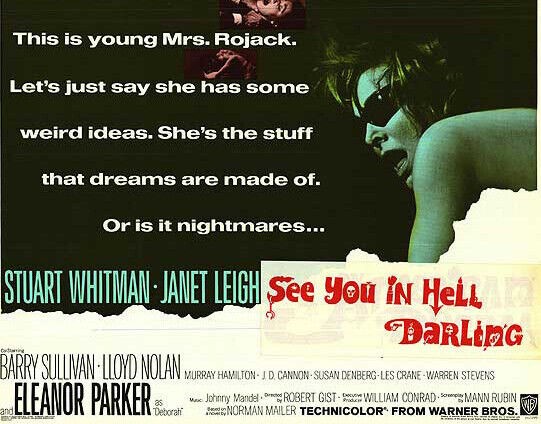
An American Dream / See You in Hell, Darling (1966) ****

The Stuart Whitman Appreciation Society kicks into high gear with this under-rated drama. A huge flop and critically savaged at the time, its bitterly sardonic existentialist center will appeal more to contemporary audiences.

Norman Mailer, author of the source novel, was a hugely controversial public figure. A magnet for alimony, writer of sledgehammer prose, his filmed bestsellers (The Naked and the Dead, 1958) hit the box office with a heavy thud, climaxing in the disastrous Tough Guys Don’t Dance (1987). Politician, avant-garde film-maker (Maidstone, 1970) and leading exponent of the “new journalism” (The Armies of the Night, 1968), his works were exceptionally tricky to translate onto the screen.

This one picks its way through a flotilla of heavyweight themes – corruption, entitlement, the Mafia – by focusing on a trio of flawed characters dogged by ideals amd let down by reality. War hero crusading journalist and television’s version of a “shock jock”, Stephen Rojack (Stuart Whitman) is weary of beating his head against a legal brick wall in his bid to bring to justice Mafia lynchpin Ganucci (Joe de Santis). But he’s also extremely done in coping with adulterous alcoholic heiress wife Deborah (Eleanor Parker).

When he asks for a divorce she retaliates with violence and scathing verbal abuse. In the scuffle that follows she teeters off the ledge of their penthouse apartment. In his defence Stephen might well have claimed self-defence given she tried to crown him with a huge rock, or at the very least relief (although admittedly that has little legal standing), but instead opts for suicide. In revenge for Stephen’s ongoing slating of the police and because the deceased is daughter to exceptionally important entrepreneur Kelly (Lloyd Nolan), the eighth richest man in America, the cops try to pin on him a murder rap. The charge is really a moral one, and equally as ruinous to a fast-rising career, that while he may not have pushed her he didn’t act to save her.

As it happens, and apparently coincidentally, Ganucci happens to be passing the penthouse at the time the woman hits the deck. Equally, coincidentally, riding with him is his moll Cherry (Janet Leigh) a wannabe singer whose only gigs are in Mob-owned night clubs.

But Ganucci’s presence turns out not to be coincidental after all. He was on his way to straighten Stephen out, possibly intending to use blackmail since Cherry is a stain on Stephen’s supposedly unblemished past. The cops are ferocious in their grilling, and adopt an unusual amount of forensic evidence for the time. Stephen would probably have come apart quicker had it not been for rekindling romance with Cherry, which, unexpectedly, provides the hoods with a lure to reel him in.

The satire is mostly reined in – cops unable to catch the real murderous Mafia pick on the guy who’s picking on them, Stephen’s business partners latch on to his sudden publicity/ notoriety to negotiate a multi-million-dollar pay rise with, natch, a rider in the contract negating it should he be found guilty. The drama is characters racing headlong towards fleeting happiness, the tiny morsels of hope that might filter down from the unacheivable American dream.

The performances carry it. What was it in Stuart Whitman (Shock Treatment, 1964) that drew him towards characters given a hard time? Whatever it was, he rode it in spades and here he presents his most complex character to date, oozing suspicion, suffocated by guilt, believing that all will come right in the end if he has a good woman by his side, not realizing that Kelly knows only too well which side her bread is buttered on. Janet Leigh (Grand Slam, 1967) plays very much against type as the hard-eyed chanteuse but Eleanor Parker (Warning Shot, 1966) essays one of the best – and most vicious – drunks (and lost souls drowning in a sea of wealth) you will ever see.

Not to be outdone, director Robert Gist (Della, 1965), pulls off some neat scenes, opening with a shot of a naked Eleanor Parker clad only in dark sunglasses watching television, using camera movement to put claustophobic heat on Whitman during interrogation scenes (Christopher Nolan’s interrogator in Oppenheimer apes his trick of pushing his chair close to his victim), portraying the flimsy sexiness of Parker in flimsy negligee, all the time not letting Whitman escape from his internal demons.

Perhaps, more boldly, rather than, as would be the contemporary temptation, treating Deborah’s death as a mystery, the details only unfolding bit-by-bit and leading to a hairy climax, Gist shows her death and lets the audience make up its mind what part Stephen played in it. The downbeat ending, too, would sit more easily with the contemporary audience. Mann Rubin (The Warning Shot, 1967) knocked out the screenplay.

This finished off Whitman’s career – he didn’t make another movie for four years and then ended up in B-picture limbo, directors more interested in his square jaw than the inner confusion he was so deft at portraying.  

Well worth a look.  

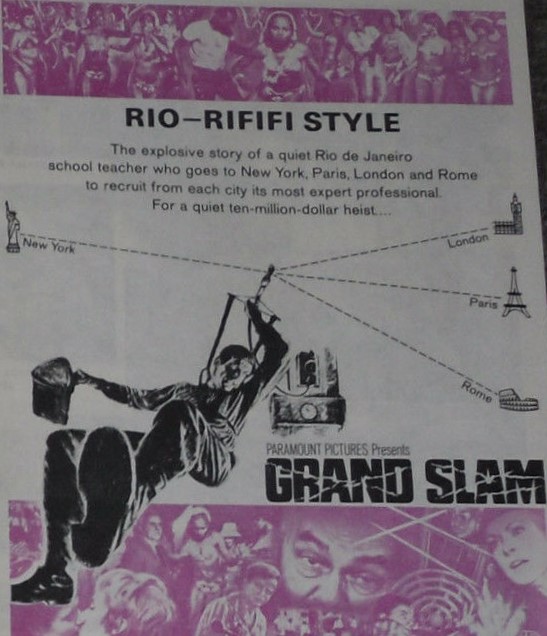
Grand Slam (1967) *****

Stone cold classic. An absolutely riveting watch from start to twist-ridden finish. The best heist picture I have ever seen. Although throwing an occasional nod to acclaimed predecessors Rififi (1955) and Topkapi (1964), in my opinion this majestic opus tops both. And for one simple reason. There is no grandstanding, neither from director nor actors.

Although director Giuliano Montaldo (Machine Gun McCain, 1969) tosses in a few Hitchockian moments, these are never long-drawn-out in the manner of the master, because there’s never any let-up in the suspense and therefore to do otherwise would be to indulge himself.  If there is boldness it’s in the muted tone. The marquee names – Edward G. Robinson (The Biggest Bundle of Them All, 1968), Janet Leigh (The Manchurian Candidate, 1962) and Adolfo Celi (Danger: Diabolik, 1968) – are all low-key, non-intrusive.

The title “Carnival of Thieves” had already been used for another heist movie
-” The Caper of the Golden Bulls.”

The bulk of the Rio-set action is carried out against the background of the annual carnival by what appear to be a bunch of unknown supporting stars who seem honor-bound to make no attempt, except as befits character, to steal the limelight, so we are not faced with a Reservoir Dogs (1992) or The Usual Suspects (1995) where everyone is jockeying for position, expecting stardom to beckon.

Fabulous plot is matched by terrific telling, information cleverly withheld until the last moment so that it is a constant railroad of surprise. For example, a church tower plays a critical part in abseiling into the robbery locale, but what we don’t know until it suddenly rings is that there’s a massive bell that, if otherwise there had not been a carnival going on below, might have caused a few to glance up at an inopportune moment. Nor are we shown its clock until the moment when we realize the thieves are running behind schedule.

The memorable stand-alone moments are reserved for the opening. The first shot is of a cherubic choir singing farewell to their retiring schoolmaster Professor Anders (Edward G. Robinson). The next short sequence has him in New York examining in a shop window a display of expensive cigarette lighters (those, it takes us time to realize, also play a crucial role). Then he arrives at a stunning mansion where he passes through what appears to be an upmarket crowd, dinner jackets and cocktail gowns, watching a classical musical concert. You imagine the woman on stage is an opera singer. As Anders is being shown into another room she starts peeling off her clothes to the classical music.

Anders has come to meet childhood buddy Milford (Adolfo Celi), now a big-time gangster, to ask for help in recruiting a team of four experts to carry out the audacious theft of $10 million in diamonds. You might gaze in astonishment as I did at Milford’s superb filing system, a huge alphabetical bank covering every known area of criminal expertise.

Once the crew are selected Anders bows out and we don’t see him again till the end. You keep on expecting a star of Edward G. Robinson’s caliber to turn up again, but that’s part of the clever ongoing bait-and-switch. The team, recruited from European capitals, comprises English safecracker Gregg (George Rigaud), German muscle Erich (Klaus Kinski), meek Italian electronics whizz Agostino (Riccardo Cucciolla) and French playboy Jean-Paul (Robert Hoffman).

Playboy? What the? Who on earth hires a playboy for a multi-million-dollar heist? Well, his area of expertise is seduction. And the plan requires the secretary, Mary Ann (Janet Leigh), to the vault’s general manager to fall into his arms because she possesses a vital key. As per the norm, there’s a bunch of stuff that doesn’t go according to plan, most notably a newly-installed sound detection device in the vault that requires ingenious invention to beat. But what also doesn’t go according to plan is the seduction.

This is one of the cleverest devices I’ve witnessed for ratcheting up suspense, especially since time is so critical. This should be a slam-dunk for the impossibly handsome Jean-Paul, who has beauties hanging off his arm. Especially as Mary Ann is something of a plain Jane, eyes concealed behind thick spectacles, wearing unflattering clothes, a cold fish with a snippy demeanor, rebuffing his every approach. When finally Jean-Paul succeeds and manages to access her purse wherein lies the key, he finds two key-rings. Having successfully managed to filch the key, three times he is foiled getting it safely to his confederate.

Twist upon twist, oh you haven’t seen the half of it. The usual falling out among thieves is restricted to tough guy Erich instinctively taking against the lightweight playboy and there’s an unexpectedly tender scene of the mild Agostino attracting the attention of a young Brazilian Setuaka (Jussara), so poor she is reduced to squatting on an empty yacht, lack of mutual language scarcely hindering prospective romance.

A couple of times the audience reacts to unspoken tension, at one point the crew think Mary Ann has spotted them from her office window, another time you think she has made the connection between the lighters. And there’s just a stunning scene at the end when Jean-Paul leaves Mary Ann and alone in her apartment she switches off the lights. And the subsequent shock on her face as she realizes she is the patsy. And one scene where the rolling of eyes conveys enormity of reaction.

Silly me, I’ve spent so much time going on about the incidentals I’ve given almost nothing away about the heist. Just as well, I guess. The robbery is timed to take 30 minutes and that’s the screen time allocated, so you follow the team minute-by-minute inch-by-inch as their elaborately complex scheme unfolds.

The confidence of the director in dispensing with dialog and during the heist with music speaks volumes about the quality of the production.

But could you imagine either of the Oceans pictures minus stars Frank Sinatra, Dean Martin, Sammy Davis Jr, George Clooney and Brad Pitt. That’s effectively what Montaldo has set out to do here. The major stars don’t dominate. It’s left up to the workers to carry the movie and in sticking to their characters rather than showboating it all turns out splendidly.

Edward G. Robinson is at his quiet best, completely lacking in the intensity you might anticipate, the calmest criminal mastermind if all time. Janet Leigh is just superb – and I can see where her daughter Jamie Lee Curtis – gets that austere prim look from. Theoretically, Klaus Kinski (Five Golden Dragons, 1967) is the pick of the supporting cast, mainly because eventually he gets to be the Klaus Kinski we all expect, but my money is on Riccardo Cucciolla (Sacco and Vanzetti, 1971) as the unobtrusive lovelorn genius and Argentinian George Rigaud (Guns of the Magnificent Seven, 1969) for his spot-on depiction of a cool upper-class Englishman. It took eight writers to put together the screenplay and you can see why, every detail, every nuance of character, finely wrought.

In all the time I’ve been writing this Blog I have never enjoyed such an unexpectedly  enjoyable experience.

This is one film you just can’t afford to miss.

Psycho (1960) *****

Even though critically reviled at the time – “up to his clavicle in whimsicality” (Variety) /   “fairground sideshow” (Films and Filming) –  Hitchcock blasted wide open the doors to what would be deemed acceptable in modern American cinema. Made on a low budget in black-and-white following the sumptuous color of North by Northwest, it seemed a perverse choice. No studio wanted it. Hitchcock had to fund it himself, Paramount merely the distributor.

On paper, and based on a real-life case, it was certainly an unappealing prospect, leading actress murdered halfway through by a maniac with a predilection for dressing up as his mother. Using the crew from his television series, Hitchcock made it quickly for just over $800,000, a quarter of the cost of North by Northwest. An initial stab at the script from James Cavanaugh was discarded and working with Joseph Stefano (Black Orchid, 1959) the director shifted the focus of the Robert Bloch novel.

Instead of a fat, middle-aged, alcoholic, Norman Bates would become young and attractive like the character from French thriller Les Diaboliques (1959). The story itself changed from “Norman and the role Marion plays in his life…(to) the redemptive but ultimately tragic role Norman plays in her life.”  Although Hitchcock openly claimed he detested filming, having already worked out the entire shoot in his head, this was never entirely true. Some ideas just did not work. In Psycho, for example, the director had planned a helicopter shot tracking into Marion and Sam’s hotel room but “high winds kept jiggling the camera” and it was changed to three separate shots.

Also, by using two cameras, he allowed the opportunity to choose a different shot than originally imagined and, in a change from the shooting script, the post-shower focus changed from Sam to Lila, making her the focus of the film’s final section where she confronts the killer.

Nor is Marion Crane (Janet Leigh) a typical Hitchcock villain. She is not cut out for the work. Alone in his repertoire, she regrets her action, tortured by, not so much her conscience, as the thought of getting caught. Having stolen $40,000 she is so jittery she turns a harmless highway cop suspicious.

Once more, Hitchcock has us rooting for the bad guy or, in this case, the bad girl. In Vertigo (1958), the drive is silent, but here the silence is punctuated by imagining what people are saying about her, knowing pursuit is inevitable. By the time she reaches the Bates Motel, she is repentant, planning to return and face the music, “I stepped in a private trap back there and I’d like to go back and pull myself out of it.” 

Unfortunately, Norman Bates (Anthony Perkins) has other plans. In Rear Window (1954) the peeping tom is a good guy, here he’s anything but. Although Bates is presented as fighting his demons, he always gives in, while Crane never hears a voice urging her on, telling her she will get away with it. Crane has a working conscience, Bates a defunct one.

Bernard Herrmann’s strings-only score behind the jarring opening credits is only the first in a series of taboos broken. In the opening scene beefcake Loomis (John Gavin) is shirtless, nothing unusual there for a male star, but to show an actress three times in her underwear and more flesh glimpsed in the shower is novel.

Killing her off is, obviously, not the done thing either, that scene a colossal shock at the time. Effectively, she is the bait, the sexiest MacGuffin ever, leading us to the mystery of Bates.

There are many brilliant scenes: Crane’s car sinking in the swamp, the murder of private detective Arbogast (Martin Balsam), the shrieking music as the strings hit their topmost register, the discovery by Crane’s sister Lila (Vera Miles) of the corpse of Bates’ mother, the motel’s neon sign flickering in the dark, the spectral house behind the motel filled with strange voices and, of course, the enigmatic Bates, alternating eager smile with defensive reaction. There are a host of great lines: “The first customer of the day is always trouble,” says the salesman; “We’re quickest to doubt people who have a reputation of being honest,” says Arbogast; and the immortal, “A boy’s best friend is his mother.”

On release, the director engineered a publicity coup by insisting nobody be allowed into the cinema after the start. This was an illogical demand for what did it matter if a patron missed the opening 10 or 20 minutes? But it certainly got the public’s attention – for a different reason entirely. It was an assault on their basic rights as theatergoers.

In those days people went into a film 30 minutes, 50 minutes after the start and left when the film came full circle. When it opened, long queues outside the box office, the best kind of word-of-mouth, attracted interest, thus alerting people who might otherwise have simply passed by. Even drive-ins were forced to comply. Trade advertisements showed Hitchcock pointing to his watch, exhorting, “Surely you do not have your meat course after your dessert at dinner?” Exhibitors were promised a special manual, “The Care and Handling of Psycho.” As well as smashing box office records, it demolished another convention by showing in local New York theaters while still playing at major first run theaters in Manhattan. 

The film has enormous visceral power. The shower scene has, rightly, achieved legendary status, every frame dissected by scholars, some images, the curtain wrenched loose, the hand reaching out, the dead eye, the blood draining away, imprinted on the universal brain, and the music unforgettable. The acting from Anthony Perkins (Pretty Poison, 1968) and Janet Leigh (The Manchurian Candidate, 1962) is excellent, Leigh nominated for a Best Supporting Actress Oscar, Perkins not so lucky, ending up typecast. For collectors of trivia, Hitchcock’s daughter, Patricia, plays Crane’s office colleague.  And for academics, especially those with auteur on their minds, this was a good place to start.

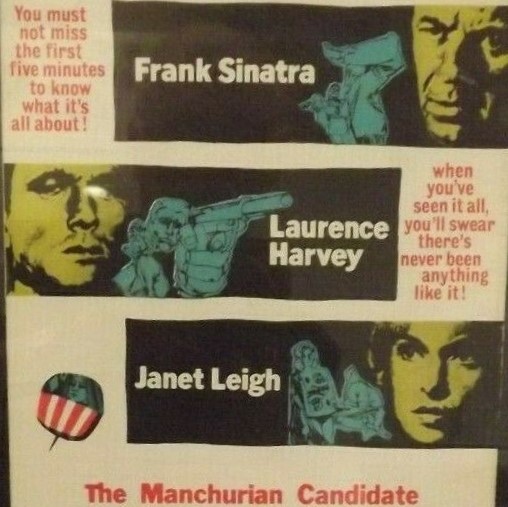
The Manchurian Candidate (1962) *****

The most celebrated of the conspiracy thrillers and rightly so. But I’m not going to start with the Korean brainwashing, extraordinary cinematic sequence that that is, but with the scene on the train, the pickup scene as it might be known in those days, meet-cute now. There is little cute about this picture which stretches the bounds of normality. And I guess I was already so unsettled, and perhaps settling into film noir mode when an easily available woman was always to be distrusted, and thought that the sudden appearance of Eugenie (Janet Leigh) was a plant.

But that wasn’t in itself what lodged that scene in the caboose so firmly in my mind. But the superlative acting of Frank Sinatra as the investigative Major Marco. Sure, we’ve seen good, sometimes great acting before from Sinatra, generally under-rated due to the myth that nobody could seriously give a good performance after just one take, as if stage actors do not do this every night of the week. But this is above and beyond.

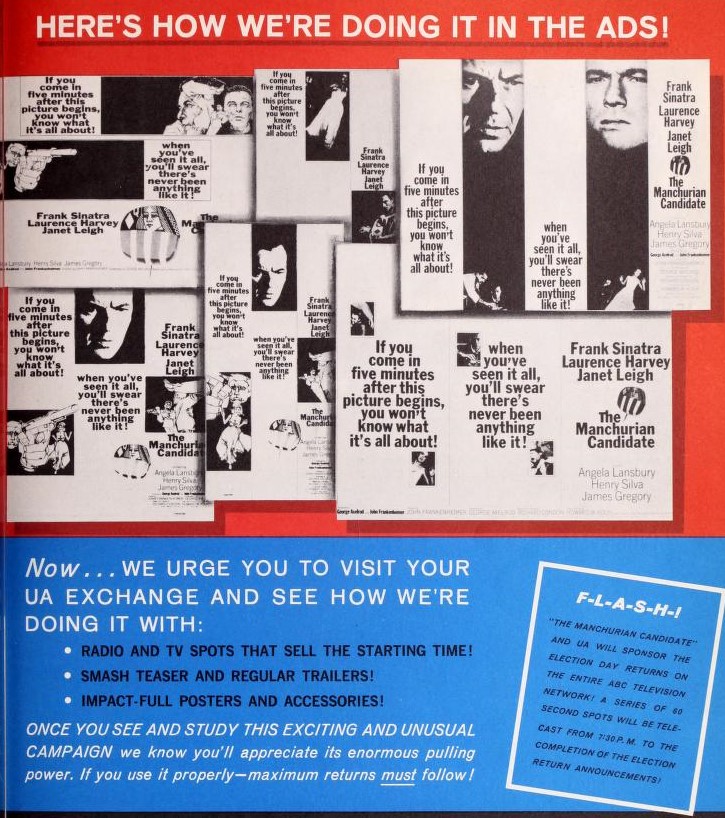
Ads aimed at the cinema manager.

What makes this so outstanding is the depth. Whatever he is saying, that’s not what he’s thinking. He is so dislocated his mind is elsewhere.

Now you give an actor punchy dialog and that’s the way he’s going to treat it, like a punchball, zing zing zing, but that’s not the case here. You can see from his expression that while he is responding well enough to this apparently sympathetic dame that his mind is not completely gone, but that he is barely holding himself together. Another actor would have shown greater signs of mental collapse, signs of a tear perhaps or using an artefact for support, a glass to crush in his hands. But not here. It’s all in the face.

He’s helped of course that the dialog is all about identity. Who is Eugenie? Not as in, who is she really, which would be a good question to ask at this point in the proceedings, but how does someone cope with a name like Eugenie and so the dialog rambles around the various shortenings of her name, while at the same time, recognising he desperately needs a port in a storm, she ensures she knows her address.

The way this movie is going that could be code, too, or a trigger, or that when he turns up at her apartment he’s going to encounter some obstacle, but it doesn’t turn out that way either, even though this is a movie where no one is what he or she seems. Insanely ambitious politician’s wife Eleanor (Angela Lansbury) double crosses her country, the Koreans double cross her by turning her son (rather than any old grunt) into an assassin,  and in the end the son, the rather effete Raymond Shaw (Laurence Harvey), turns on the mother in the most murderous way imaginable. Much as she loves her son, she is willing to sacrifice him for the chance of becoming the President’s wife and when she does will exert her revenge on the Koreans.

The “exchange” is an old industry term, literally like a library, meaning where you would take the movie you had just screened and swap it for your next movie. You would pick up all your advertising material and campaign manual at the same time. Certainly saved on the postage. And the exchange manager, meanwhile, would try to sweet talk you into taking another movie you had never heard of.

I’ve gone on before about the beauty of the single-take movie (Grenfell, 2023) but here I’m in raptures at the single scene, how a movie pivots on superb acting. I could have used the brainwashing as an example, but that’s not about acting, but about directing, about perception, about how the audience as much as the participants is being led around by the nose by director John Frankenheimer, who would return to questions of identity and voluntary brainwashing in Seconds (1966).

But back to the brainwashing. This hits the mother lode. A troop of captured U.S. soldiers face an audience with a ringmaster demonstrating just how much they are under his command and can be hypnotised into carrying out any order, even cold-blooded murder. But each of the soldiers sees a different audience. That’s the cinematic coup. I would have loved to have been part of the original audience back in the day, brought up on war movies or thrillers that followed a straightforward narrative arc. Even critics singing the praises of the French New Wave would have never seen anything like this.

Anyway, it soon occurs to Major Marco that his ongoing nightmares are part of a deeper problem especially as his memory of Shaw does not tally with what he finds himself saying about his troop leader.

We follow two parallel stories, Marco trying to get to the truth before he fries his brain, and the audience being let in on much of the truth by tracking Shaw, who, to spite his hated mother, has taken a job with, effectively, the opposition and has fallen in love again with Jocelyn (Leslie Parrish), the daughter of one of her husband’s most implacable foes.

You couldn’t get a more twisty movie, set against the backdrop of the Communist witch hunt, when a politician could garner headlines just by pretending to name Communists in high office. The political element is just as cynical as the same year’s Advise and Consent and savage as the ineffectual Senator Iselin (James Gregory) is, he’s not much worse than the clowns in the Preminger picture. So it all rings true.

There’s scarcely a moment wasted as the movie screams towards a terrifying climax. The built-in control trigger I didn’t see coming, and Shaw’s transformation from strict man-in-charge to bumbling romantic fool is a joy.

Frank Sinatra (The Detective, 1968) gives the performance of his life, Laurence Harvey (Life at the Top, 1965) proof of the power of love, Angela Lansbury (In the Cool of the Day, 1963), the mother from Hell, are all outstanding. The support cast includes Janet Leigh (Psycho, 1960), Henry Silva (The Secret Invasion, 1964) and John McGiver (Breakfast at Tiffanys, 1961).

Frankenheimer directs with elan from the script by George Axelrod (Breakfast at Tiffanys) based on the Richard Condon (The Happy Thieves, 1961) bestseller.

An absolute must.

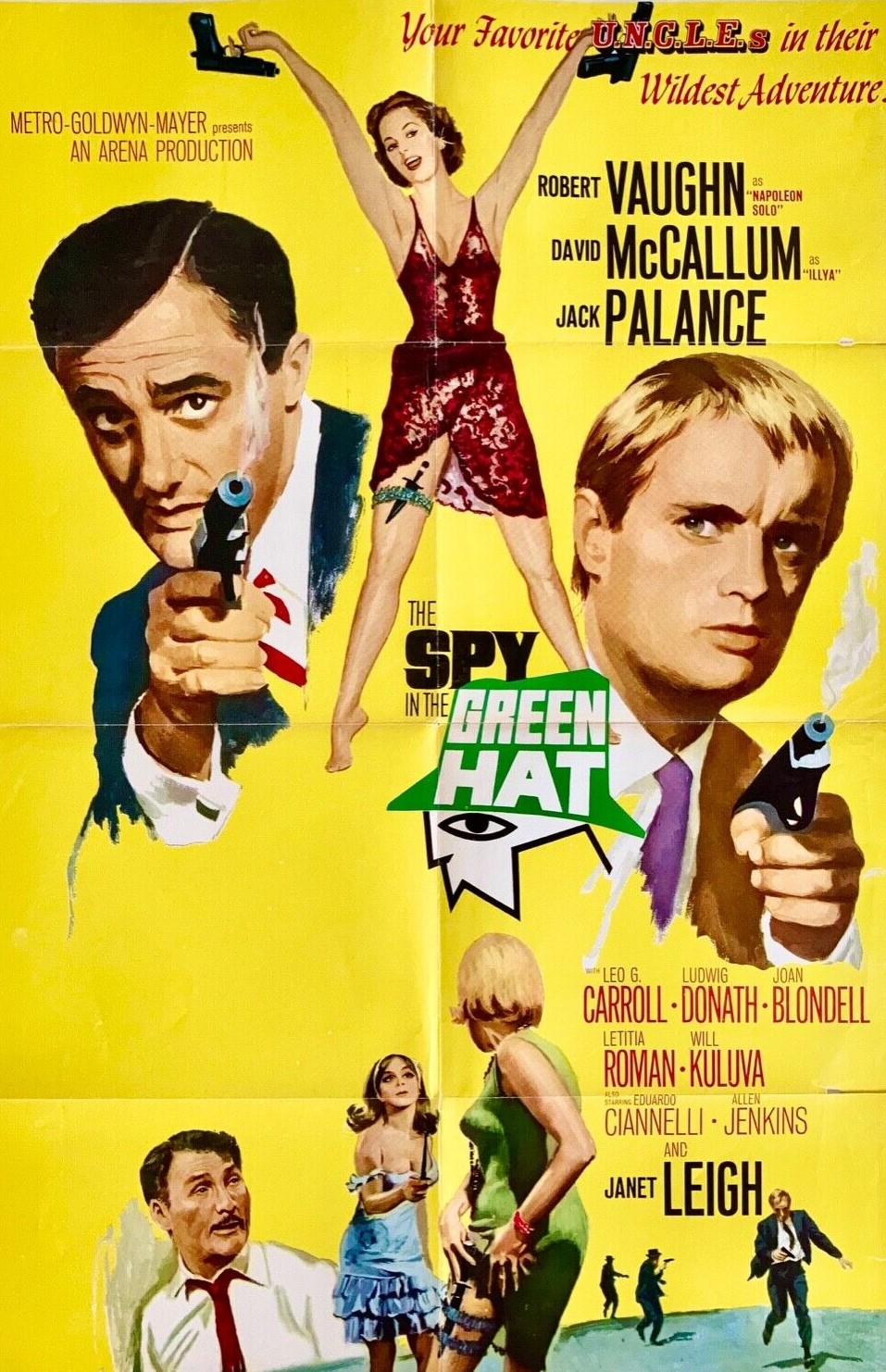
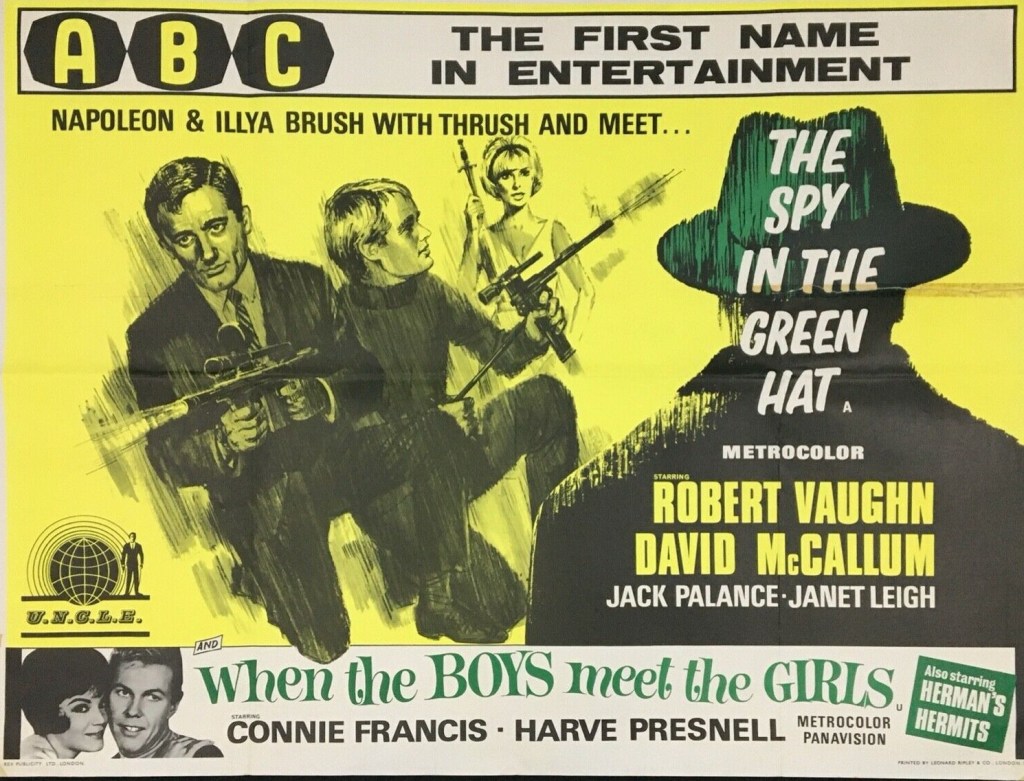
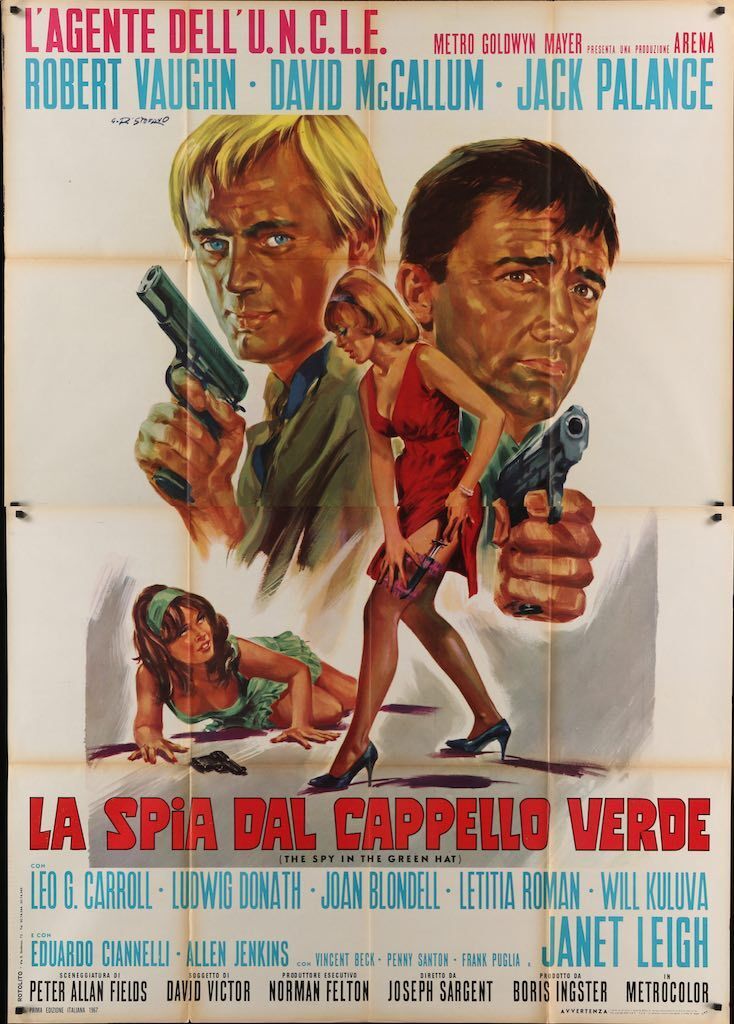
The Spy in The Green Hat (1966) ***

Unable to compete with the influx of big budget espionage pictures, The Man from U.N.C.L.E. throws in the action towel and comes out fighting as a comedy, and a more preposterous storyline you would be hard to find. As if spoofing a genre it helped create, our intrepid heroes find themselves in captivity one way or another, outwitted by a posse of retired Mafia hoods or sadistic females.

Napoleon Solo (Robert Vaughn) and Ilya Kuryakin (David McCallum) can’t even manage a chase, crashing the car in pursuit of former Nazi scientist Dr Von Kronen (Ludwig Donath). The trail leads to Sicily where Solo, again incapacitated, meets the sultry Pia (Leticia Roman) and as a result of a romantic misunderstanding is forced into a shotgun wedding in Chicago by her Mafia uncles, the famed Stilletto Brothers.

Meanwhile, Kuryakin makes the acquaintance of the deliciously sadistic Miss Diketon (Janet Leigh), assistant and masseuse to highly nervous Thrush boss Louis Strago (Jack Palance). The action finally shifts to the Gulf Stream, where Pia is imprisoned and the usual missiles are set to be launched in the presence of head Thrush honcho Mr Thaler (Will Kuluva) in the usual global takeover scenario.

Abandoning any attempt at serious drama, this is just a hoot, a score of sight and visual gags, references to Little Caesar and the St Valentine’s Day Massacre abound. Any time one of our heroes needs speedy access to a villain hideout along comes a guard to be bumped off and uniform purloined. Solo caught hiding under Pia’s bed is let off when discovered by a Thrush operative because he’s not the Uncle agent they are looking for. Not only is Solo constantly whacked over the head, but Kuryakin ends up as the plaything of Miss Diketon.  

Solo and Kuryakin look as if they stepped onto someone else’s parade, trying to keep the narrative on an even keel, while the Mafia gang and Thrush personnel effectively play it for laughs. Pia has Wanted posters of her uncles on her wall on the assumption they are just wonderful guys. Von Kronen gets the hots for Miss Diketon because he admires her skill at torture, although a spurned Miss Diketon turns traitor leading Kuryakin to mutter to Solo when all three meet, “I brought Lucrezia Borgia, you brought the Mafia.”

What makes it work so well are the fabulous performances of the supporting cast. Jack Palance (The Professionals, 1966), completely playing against type, still a villain sure, is a masochistic sweaty bag of nerves. Janet Leigh (Psycho, 1960) camps it up as the deadlier-than-the-male luscious female, dress slit at the thigh to reveal a hidden knife, whose pulse races at the mere thought of the cruelty she can inflict and the slower the better.  Will Kuluva (To Trap a Spy, 1964) is a bonus, the boss who just wants to party and has no idea of the technicalities of firing a missile.

Nobody even bothers to dress it up any more. The missiles look like something you would buy your kid for Xmas, the backdrops are as fake as anything on a backlot. But somehow it all works, as long as you weren’t expecting the original take on The Man from Uncle. And even so, director Joseph Sargent (One Spy Too Many, 1966) adds a few dabs of genuine cinematic icing, characters viewed from the ground-up, a fist fight that’s either in slo-mo or speeded-up freeze frame, the wife (Joan Blondell) of one of the Stiletto Brothers receiving a grapefruit in the mush.

After watching the original movie which came up better than expected in terms of action and spy malarkey, the last thing I anticipated that this would be headed in an entirely different direction. When that quickly became obvious, I feared the worst. Instead, I enjoyed a fun 90 minutes.

Of course, this wasn’t released theatrically in the U.S. just abroad with some added sex and violence, an expanded version, and in color, of a double black-and-white episode of the television series.   

Discover WordPress

A daily selection of the best content published on WordPress, collected for you by humans who love to read.

The Atavist Magazine

by Brian Hannan

WordPress.com News

The latest news on WordPress.com and the WordPress community.