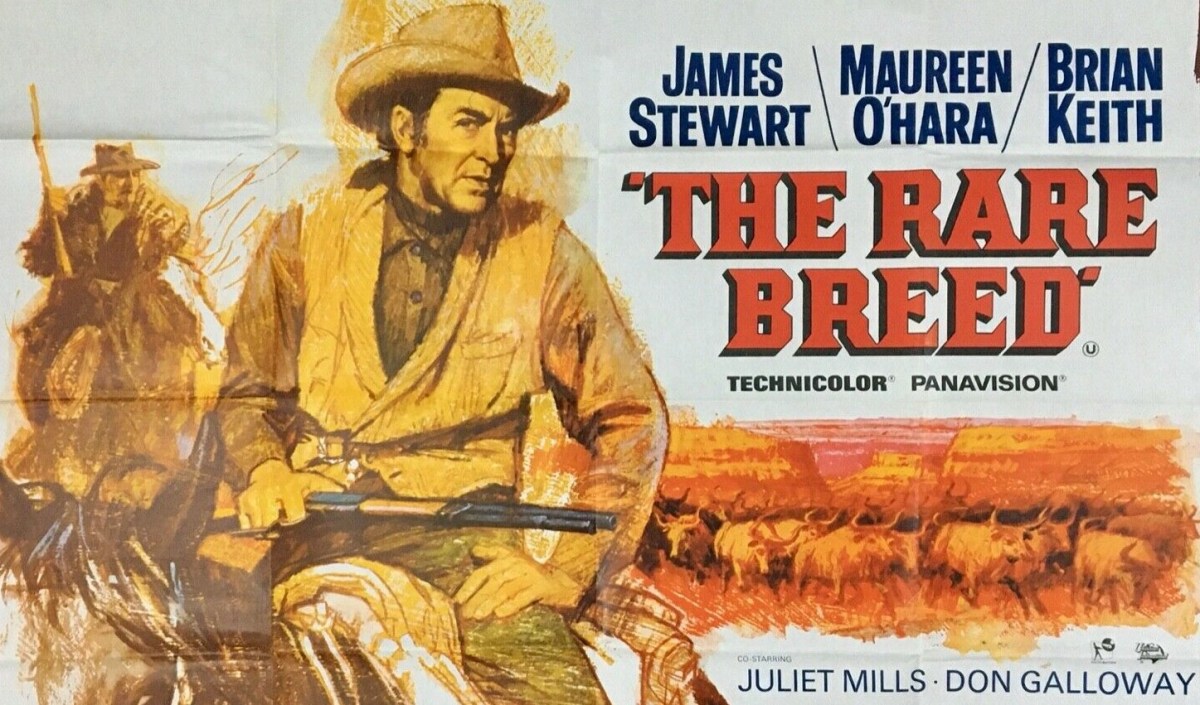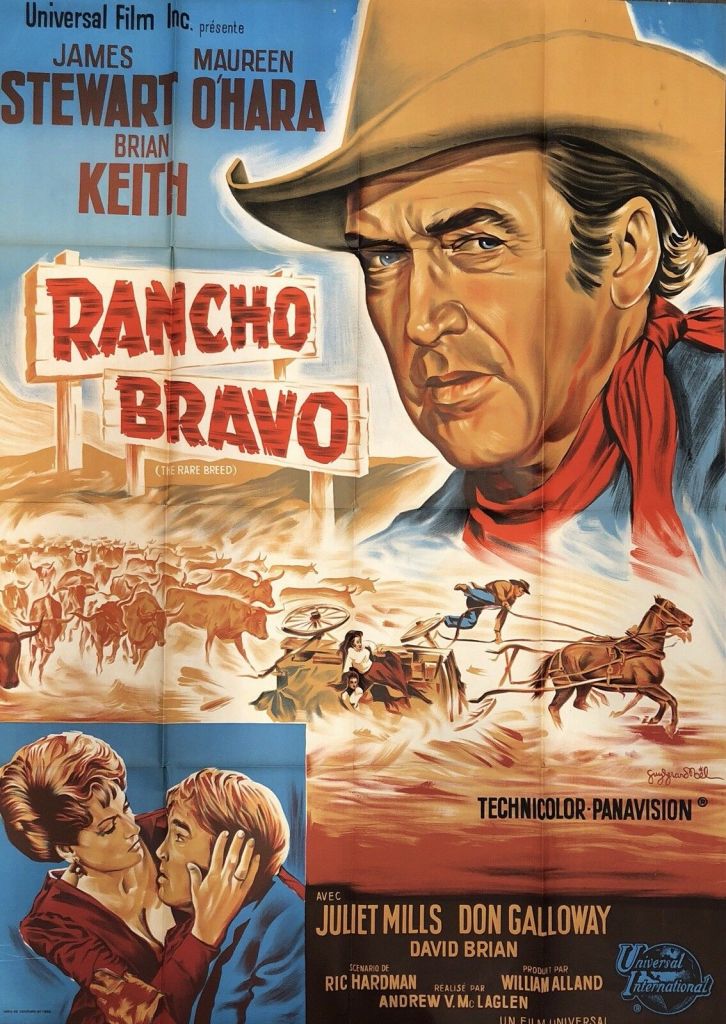
The Rare Breed (1966) ****

Classic themes of hope, resilience and redemption influence director Andrew V. McLaglen’s follow-up to Shenandoah (1965). Add in a battle against widespread misogyny, thieves falling out, a brilliant stampede and a forlorn hunt that has echoes in the decade-old The Searchers. But other more serious issues are explored. At the film’s core is the question of how a nation built on innovation refuses to countenance change, in other words a country where hierarchy (inevitably male) has begun to impose its preference and how those who suggest alternatives must not just buckle to that collective will but admit they are wrong, a problem that in the half century since the film was made has not gone away.

Widow Martha (Maureen O’Hara) and daughter Hilary (Juliet Mills) bring to auction her white-face Hereford bull, a British institution, the first of its kind to be imported (for breeding purposes, you understand) to America where hardy longhorn cattle are the dominant species. Despite being insulted for her temerity in challenging the existing order, Martha is astonished to receive a winning bid of $2,000, only to realize this comes with conditions attached, the buyer assuming his largesse will also win her, a sharp elbow to the ribs dissuading him of this notion.

Determined to see the bull delivered to the Texan ranch, Martha decides to accompany the animal on its journey. Wrangler Sam (James Stewart), hired to transport it instead plans to steal it and to keep the dupe sweet until the time is ripe encourages her to develop romantic ideas towards him. When another cowboy, Simons (Jack Elam), with eyes on the same four-legged prize causes confrontation the game is up, though Sam sees the trip through.

Rancher Bowen (Brian Keith) belittles the Hereford bull although viewing Martha as a better proposition, but the only way to discover whether the beast can survive in the territory is to let it loose on the open range where it was likely to encounter blizzards (not so rare in Texas as you might think). Once the bull is set free, the movie shifts onto a question of endurance, not just of the animal, but of the mindset of Martha and Sam. Her faith in her insane idea is tested to the limit and, almost in compensation, a woman needing security/protection et al, she comes to appreciate the attentions of a less wild Bowen.

Both central characters have much to lose and much to face up to. Martha, in accepting she was wrong and letting Bowen into her life, will almost certainly be surrendering her independence (she can still be feisty but that’s not the same thing). It’s a testament to her acting that you can see that faith wilting. Sam, a conniving thief whichever way you cut it (although the storyline gives him something of a free pass), has to face up to the fact that he was planning to con a woman out of the precious possession on which her precarious future was built.

The scenes between Martha and Sam are superb, especially when he is grooming what he thinks will be an easy dupe. Sam, in a purgatory of his own making, almost certainly an outcast were the truth more widely broadcast, attempts to expiate his guilt.  

James Stewart and Maureen O’Hara had worked together in Mr Hobbs Takes a Vacation (1962) and there is no denying their screen chemistry. But there’s an innocence that O’Hara rarely displays, the woman in love suppressing those emotions not denying them as perhaps in The Quiet Man (1952). She’s both independent and, if the right man comes along, happy to accept his protection (from the male predators of the West), while at the same time keeping him on the right track and sorting out his world of misshapen priorities. There are some brilliant scenes where something else is going on story-wise and O’Hara is internalizing some deeper emotion entirely. It’s an acting coup for an actress like Maureen O’Hara who would never give up to convey so well a character on the verge of surrender.

This is one of James Stewart’s best roles, far removed from the principled hero of Shenandoah (1965) and returning him closer to the shifty character of Vertigo (1958) adept at self-justification. In the scene where he is found out by O’Hara he is outstanding. It’s not a given that the character will find a way to turn things round and his efforts to redeem himself make the latter part of the picture emotionally involving, especially as this is countered by O’Hara’s own internal battle.

It’s worth pointing out that although the narrative mainly concerns the two main characters, the background is filled with ruthlessness. Not only does Sam feel no compunction about stealing a bull worth $2,000, we first encounter Bowen’s son Jamie (Don Galloway) when he is making off with a herd of his father’s longhorns. The cattle barons use their wealth to “buy” a classy woman and cheat cowboys. And there is further murder along the way.

I was going to mark this picture down for the comedy which seems to amount to endless brawls but I wondered if modern audiences, reared on the never-ending fistfights and wanton destruction that usually indicated the finale of a superhero picture, would accept it quite happily, perhaps even welcome it. While Brian Keith (The Deadly Companions, 1961) stands accused not only of one of the worst Scottish accents committed to the screen – and these days of cultural appropriation – that does not take away from a character who, behind the beard, transitions from loathsome father to something more approaching humanity, in other words wild man who realizes the benefits of civilization.  

In fact, the broad comedy serves to obscure a film full of brilliant, cutting, funny lines, generally delivered in scathing tones by the woman.  O’Hara to Stewart: “You may bulldog a steer but you can’t bulldog me.” Stewart to O’Hara: “Can I help you with that” and her response “No, they’re clean and I’d like to keep them that way.” And that’s not forgetting the sight of the cowboys whistling British national anthem “God Save the Queen” in order to bring the bull to heel.

I forgot to mention the romantic subplot involving Hilary – in case you were wondering what role she had in all this – and Bowen’s estranged son, Jamie. Juliet Mills (Avanti!, 1970), older sister of child star Hayley, is excellent as the sassy daughter of a feisty woman, Don Galloway (Rough Night in Jericho, 1967) less of a stand-out in his debut, in part because he has to subsume his rage against his father.

Jack Elam (Once Upon a Time in the West, 1968) is good as always and you will spot in smaller parts Ben Johnson (The Undefeated, 1969), Harry Carey Jr. (The Undefeated), Barbara Werle (Krakatoa, East of Java, 1968) and David Brian (Castle of Evil, 1966). John Williams, masquerading as Johnny Williams, wrote the score.

Setting the comedy aside, this is a more intimate film from director Andrew V. McLaglen compared to the widescreen glory of The Undefeated and the intensity of Shenandoah and for that reason tends to be underrated. There are some wonderful images, not least Sam carrying the injured Jamie in the style of Michelangelo’s La Pieta – an idea stolen by Oliver Stone for Platoon (1986) – but mostly McLaglen concentrates on the actors.

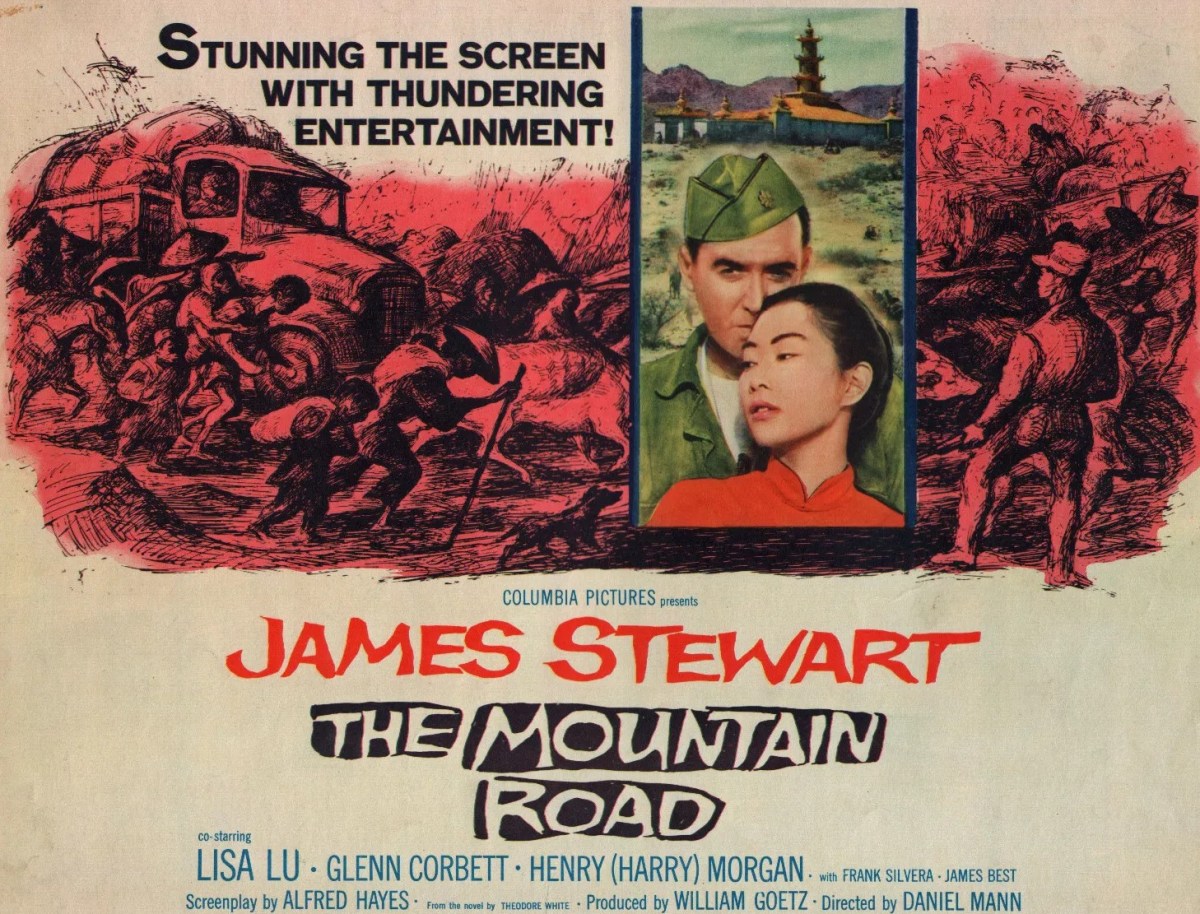
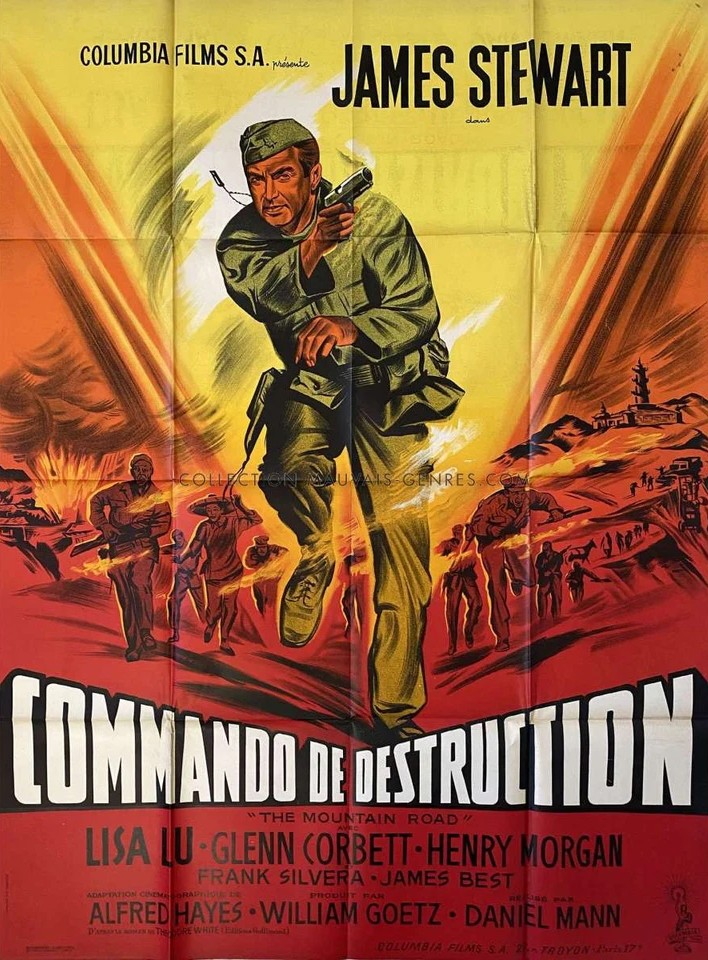
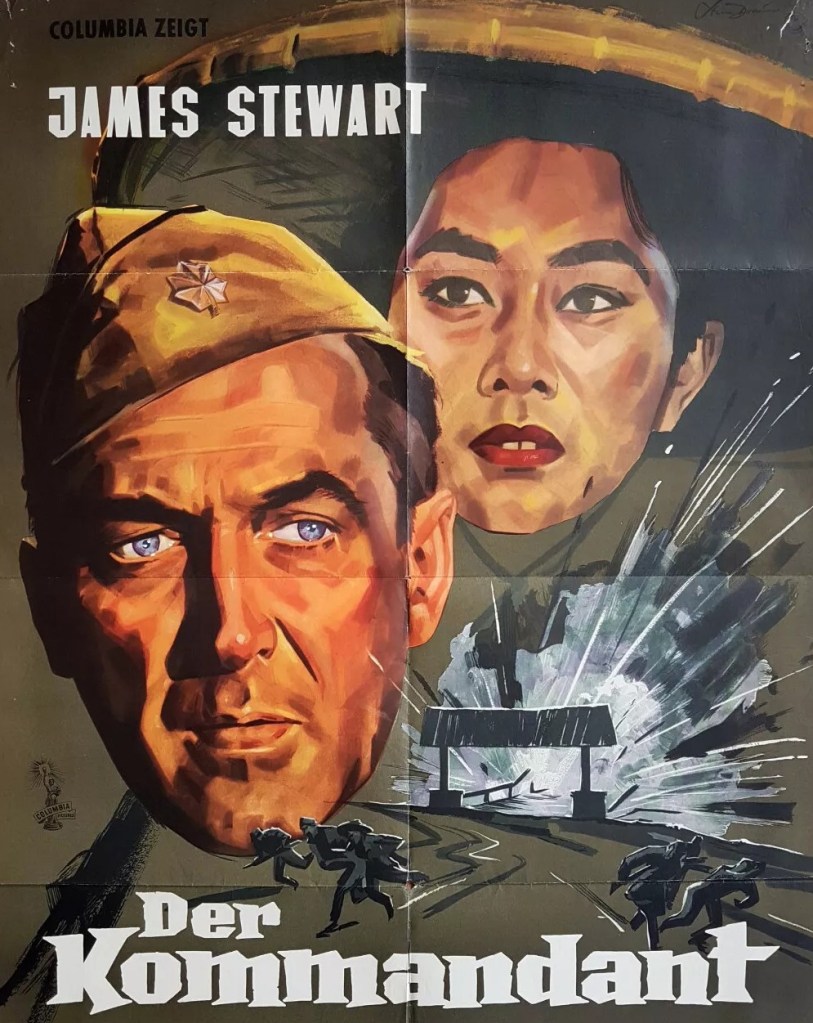
The Mountain Road (1960) ****

First film to deal with U.S. Army war crimes. Though here’s it’s tabbed as abuse of power but amounts to the same thing when it relates to the wanton killing of innocents. Not the first film to examine a commander totally unsuited to command – The Caine Mutiny (1953) would be your first port of call for that, although that was a career officer rather than a conscript. But the blistering under-rated Oscar-ignored performance by James Stewart (The Rare Breed, 1966) is easily comparable to the Oscar-nominated Humphrey Bogart.

And director Daniel Mann (A Dream of Kings, 1969) is helluva sly. He dupes the audience into thinking this is a mission picture, blowing up a massive ammunition dump to prevent it falling into enemy hands. And if you’re one for the easy action of explosions, this is for you, the kind of fireworks not seen till MCU entered the equation.

And here’s a line that’s going to knock you for six. “China and America are friends.” Say again? You what? As far as I can remember in all my decades of moviegoing, China has always been the enemy, either providing a succession of nefarious villains, or on the brink of starting a nuclear war, or just totally ungrateful for all the efforts the West has made bringing to the country Christianity and the western idea of civilization.

But it’s true. Before Communist China reared its ugly head, the U.S. and China were allies against the Japanese in the Second World War. But towards the end of that conflict, the Japanese had invaded and the Yanks were pulling out. Not wanting to leave anything behind for the enemy – like a huge arsenal or thousands of gallons of diesel – is the trigger for the story.

Except it’s not. Major Baldwin (James Baldwin) doesn’t have to go on any mission. His job is just to blow up a much smaller ammunition dump that’s easily accessible without the need to go on a long trek through the mountains. It’s his choice to take on the bigger job. There’s not even any pressure to do so. It’s entirely at his “discretion.” And you can see in the tone of his superior’s voice that it’s not such a good idea. He can just complete the small job and high-tail it out of there.

But Major Baldwin wants to experience command in action. He’s not a glory hunter in the normal sense but there’s definitely something off in a backroom soldier who’s got that on his wish list. It never occurs to him that there’s more to command than ordering about grunts, many of whom he considers “slobs,” and that the position comes with the task of making difficult decisions.

He’s got a very small team, chief among whom is Sgt Michaelson (Harry Morgan) and translator Collins (Glenn Corbett). Chinese officer Col Kwan (Frank Silvera) is meant to smooth his path and the widow of a Chinese general, Sue Mei (Lisa Lu), is thrown his way, initially you would guess to sweeten the load by becoming a love interest, but actually to become his conscience.

Just to fill you in on the background. China and Japan had been at war since 1937. After Pearl Harbor China became critical to US operations in the Pacific by tying down Japanese forces and after the fall of Burma the US airlifted supplies over the Himalayas.

Baldwin soon discovers that leadership equates to callousness. He has little sympathy for the refugees swarming over the mountain roads seeking sanctuary from the invading Japanese. He blows up a bridge and creates an impasse on the road to delay the Japanese without giving any thought to how that will endanger the natives.

He’s pretty inhuman in his treatment of one of his men, suffering, it later transpires, from pneumonia and might be taking all his cues from General Patton who hated all wounded soldiers. While he’s trying to convince the soldier to get back on his feet all the grunt can do is whimper, “Milk! Milk” like a child. Baldwin even sees little problem in stacking the ill man beside a corpse on the back of a lorry.

It would help if Baldwin had been trained in command, in making decisions, rather than picking faults everywhere and letting the pedantic side of his nature run wild. Sei Lei to some extent tries to rein him in, accusing him of blatant racism, treating the Chinese as if they were a lower form of humanity.

When he does relent and orders surplus food to be handed out one of his men is killed in the stampede. The last straw is Chinese bandits who kill and strip three of his men. So he leads a raid on a Chinese village, rolling a barrel of fuel stacked with dynamite down a hill to destroy the village and innocent villagers.

Up till then things were going along nicely on the romantic front, Sei Lei clinging to him when the massive ammunition dump goes up, and kissing on the cards. She’s westernized after all, spent a lot of time in America, well educated, and so easily a contender for marriage. But she tries to stop the barrel-rolling, telling him this action is unjustified, pure revenge.

He thinks she’ll accept an apology, that some madness came over him, he was consumed by power. But she’s having none of it.

Mission accomplished but human flaws exposed.

This isn’t the James Stewart you’ve come to expect, far from it. There’s certainly times in his career when he’s been mean or ornery and in his Hitchcock excursions a bit creepy, but he’s never been so awful as here, the guy desperate for power without knowing how to use it or draw the line. Purely in a technical capacity, working out where to plant explosives and plan a demolition, he’s in his element, but let him loose on human beings and he’s a loose cannon trying to rein himself in, stuck in a mess of his own making, unable to understand consequence. But sometimes even guilt isn’t enough.

This was an unlikely role for Stewart because, after his own experience in World War Two, a pilot in Bomber Command flying missions over Europe, he had turned down every war picture. Perhaps this movie reflected the guilt he felt of dropping bombs and knowing there would be civilian collateral damage, that sense of power over the powerless might equate to the feelings Baldwin has over the Chinese.

This is by far the most human character Stewart ever played, doing away with both the aw shucks everyman and the commanding often truculent cowboy, and instead portraying someone who’s way out of his comfort zone.

Ace scene-stealer Harry Morgan (Support Your Local Sheriff, 1969) is the pick of the support though Lucy Lu (One Eyed Jacks, 1961), being the conscience of the piece, has all the best lines.

Just as with A Dream of Kings, Daniel Mann takes a flawed individual and doesn’t hang him out to dry. But in retrospect, the war crime, of blowing up the innocent civilians, would not have received such a free pass, which puts a different slant on Baldwin. Alfred Hayes (Joy in the Morning,1965) wrote the script from the Theodore H. White bestseller.

Much to ponder.

The Man Who Shot Liberty Valance (1962) *****

A mighty cast headed by John Wayne (True Grit, 1969), James Stewart (Shenandoah, 1965), Lee Marvin (The Dirty Dozen, 1967) and Vera Miles (Pyscho, 1960) with support from Edmond O’Brien (Seven Days in May, 1964) Woody Strode (The Professionals, 1966), Strother Martin (Cool Hand Luke, 1967) and Lee Van Cleef (The Good, the Bad and the Ugly, 1967) do justice to John Ford’s tightly-structured hymn to liberty and equality and reflection on the end of the Wild West. So tight is the picture that despite a love triangle there are no love scenes and no verbal protestations of love.

The thematic depth is astonishing: civilization’s erosion of lawlessness, big business vs. ordinary people and a democracy where “people are the boss.” Throw in a villain with a penchant for whipping and a lack of the standard brawls that often marred the director’s work and you have a western that snaps at the heels of Stagecoach (1939), Fort Apache (1948) and The Searchers (1956).

The story is told in flashback after Senator Ransom Stoddard (James Stewart) and wife Hallie (Vera Miles) turn up unexpectedly in the town of Shinbone for the funeral of a nobody, Tom Donovan (John Wayne), so poor the undertaker has filched his boots and gun belt to pay for  the barest of bare coffins. Intrigued by his arrival, newspapermen descend, and Stoddard explains why he has returned.

Now we are in flashback as, arriving on stagecoach, novice lawyer Ransom is attacked, beaten and whipped by outlaw Liberty Valance (Lee Marvin). He is found by horse-trader Donovan (John Wayne) and taken to a local boarding- house-cum-restaurant where Hallie (Vera Miles) tends his wounds. With a young man’s full quotient of principle, Stoddard is astonished to discover that local marshal Link Appleyard (Andy Devine) has ducked out of responsibility for apprehending Valance on the dubious grounds that it is outside his jurisdiction and that Valance has so mean a reputation he has the town scared witless. When Valance turns up, he humiliates Stoddard and only Donovan stands up to him, rescuing an ungrateful Ransom, who detests violence and any threat of it.

Stoddard soon turns principle into action, setting up his shingle in the local newspaper office run by Dutton Peabody (Edmond O’Brien) and on learning that Hallie is illiterate establishing a school for all ages. In the background is politics, but the push for statehood is inhibited by big ranchers who employ Valance to intimidate. Despite his aversion to violence and insistence that due legal process will eliminate the law of the gun, Stoddard practices shooting. When Donovan gives him a lesson and, to point out his unsuitability to confront such a mean character as Valance, covers him in paint, Stoddard floors him with a punch. 

That principle I mentioned has something in common with Rio Bravo (1959) – Howard Hawks’ riposte to High Noon (1952) – in that Stoddard, determined to fight his own battles, refuses to ask for help when targeted by Valance. The inevitable showdown is extraordinary, not least because it takes place at night and Ford, a la Rashomon (1951), tells it twice from different points of view.  

Precisely because it retains focus throughout with no extraneous scenes, as was occasionally John Ford’s wont, the direction is superb. As in The Searchers, to suggest emotional state-of-mind, the director uses imagery relating to doors. This time the humor is not so broad and limited primarily to one incident. Both main male characters suffer reversals, in the case of Stoddard it is physical but in the instance of Donovan it is emotional. Either way, action is character. In the romantic stakes, they are equals, dancing around their true feelings.

Upfront there is one storyline, the upholding of law and order whether against an individual such as Valance or against the attempts of big business to thwart democracy. But underneath is a subtly told romance. Donovan and Stoddard are allies but in terms of Hallie they are rivals. Neither has an ounce of sense when it comes to women. Neither actually protests their love for Hallie. Although Donovan brings her cactus roses and is, unknown to her, building an extension to his house to accommodate what he hopes is his future bride, his idea of romance is to mutter, in patronizing manner, the old saw of “you look pretty when you’re angry.”  He would have been wiser to have taken note of her spunk, because she can more than direct if need be.

Stoddard isn’t much better. Despite her growing feelings towards him being obvious to the audience, he assumes she prefers Donovan. Action drives the love element, the need to save or destroy.

All three principals are superb. This may seem like a typical Wayne performance, a dominant figure, comfortable with a gun and his abilities, but awkward in matters of the heart. But he shows as great depth as in The Searchers and the despair etched on his face at the possibility of losing Hallie eats into his soul. Stewart combines the man-of-the-people he essayed for Frank Capra with some of the toughness he showed in the Anthony Mann series of westerns. Vera Miles tempers genuine anger with tenderness and practicality. Unlike many Ford heroines she is not a trophy wife, but a worker, mostly seen running a kitchen. Lee Marvin cuts a sadistic figure, with an arrogance that sets him above the law, his tongue as sharp as his whip.

As well as Woody Strode, Strother Martin, Edmond O’Brien and Lee Van Cleef, you will spot various members of the John Ford stock company including Andy Devine (Two Rode Together, 1961) as the cowardly gluttonous marshal, John Carradine (Stagecoach), John Qualen (The Searchers) as the restaurant owner and Jeanette Nolan (Two Rode Together) as his wife.

Written by James Warner Bellah (X-15, 1961), Willis Goldbeck (Sergeant Rutledge, 1960) and Dorothy M. Johnson (A Man Called Horse, 1970).

SPOILER ALERT

Despite its five-star status, I am dubious about the famous “print the legend” conclusion and for two reasons. You could subtitle this picture The Good, the Bad and the Politician. In the first place, what Stoddart tells the newspapermen in the flashbacks is in fact a confession. He did not kill Liberty Valance. Donovan did. By this point in his life Stoddart has served two terms as a Senator, three terms as a governor and been the American Ambassador to Britain. And yet his career is based on bare-faced fraud. He took the glory for an action he did not commit. That is a huge scoop in anybody’s book. And I just can’t imagine a newspaperman turning a blind eye to it.

The second element is that Stoddart does not show the slightest sign of remorse. He built his entire career on this violent action, the antithesis of his supposed stance on the process of law.  He takes all the plaudits and fails to acknowledge Donovan, except when it’s too late, and Donovan has died a pauper, his rootless life perhaps engendered as a result of losing Hallie. Hallie’s character, too, is besmirched. She chose Stoddart precisely because he was a man of principle who risked his life to tackle – and kill – Donovan. Those two elements are indistinguishable. Had she known Stoddart had failed and was only saved by the action of Donovan it is questionable whether she would have chosen the lawyer.  

There are a couple of other quibbles, not so much about the picture itself, but about other quibblers, commonly known as critics.  Alfred Hitchcock famously came under fire for the use of back projection, not just in Marnie (1964) but other later films. That spotlight never appeared to be turned on the at-the-time more famous John Ford. The train sequence at the end of the film uses back projection and the ambush at the beginning is so obviously a set.

Don’t let these put you off, however, this is one very fine western indeed.

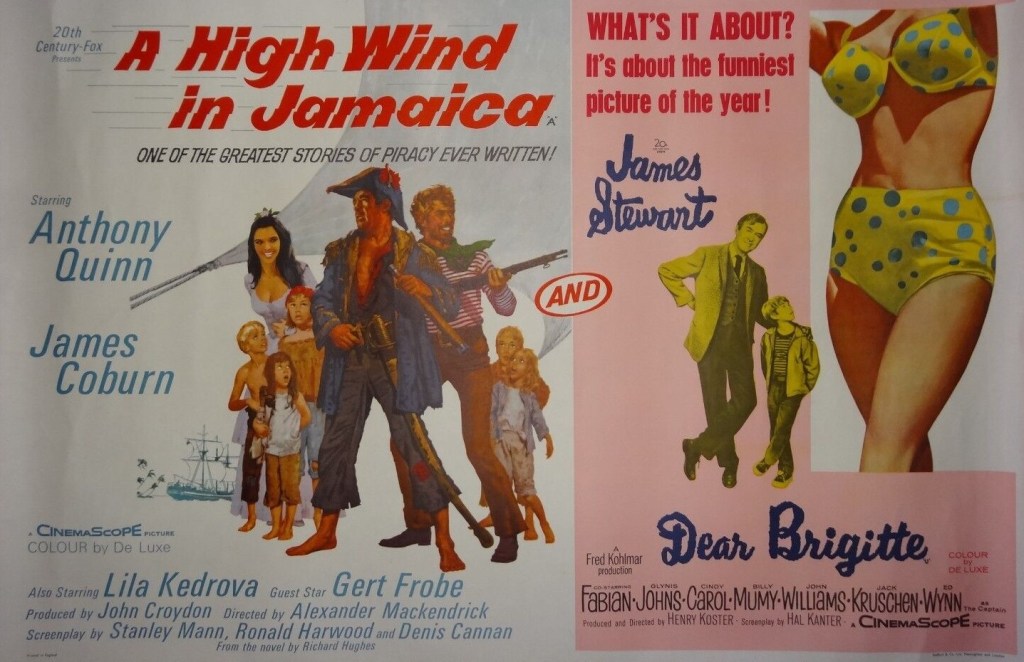
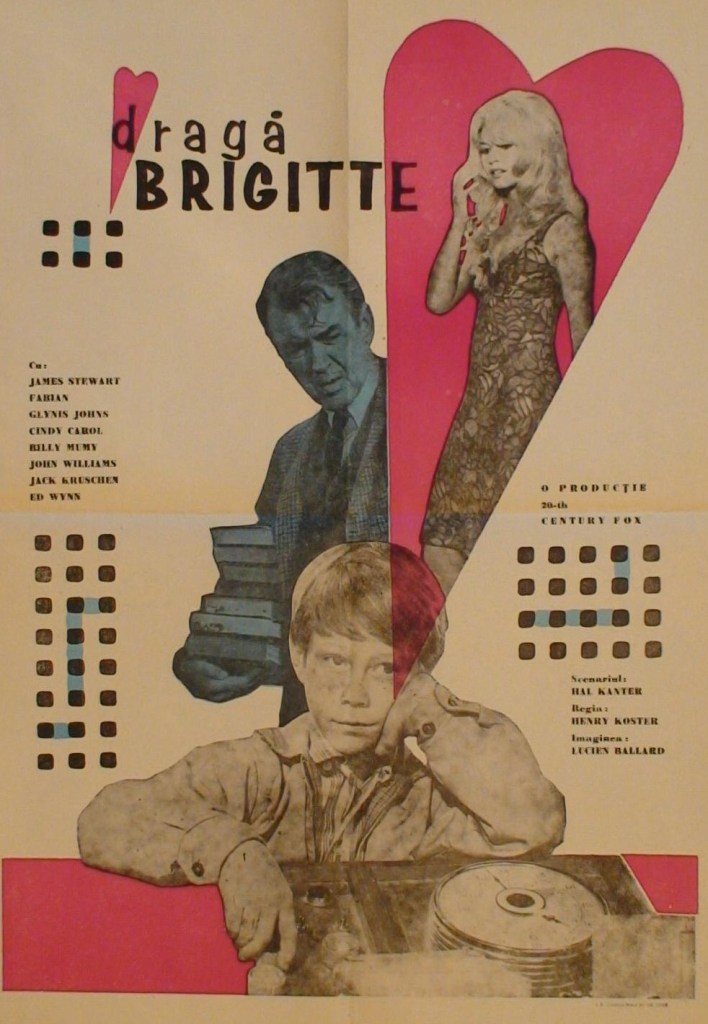
Dear Brigitte (1965) ***

In the same year as his momentous turn in Shenandoah, James Stewart at his exasperating best has the time of his life in this throwback comedy that takes its time getting all its ducks in a row while taking a tilt at nuclear energy, computers and the eternal battle between the arts and science with a fair chunk of whimsy thrown in.

Surprisingly contemporary nod to this whole business of actors speaking directly to the camera, with the ramblings by the Captain (Ed Wynn) in this capacity constantly being interrupted by passersby in the vein of “you talking to me?” or “stop talking to yourself.” Professor Leaf (James Stewart), a distinguished poet constantly at odds with Dean Sawyer (Howard Freeman) at the local college where he teaches – on the few times when he’s not handing in his resignation – and which has a nuclear power station next door, tries to espouse the arts at every opportunity, including a family four-piece outfit playing classical music, only to discover son Erasmus (Bill Mummy) doesn’t have an artistic bone in his body.

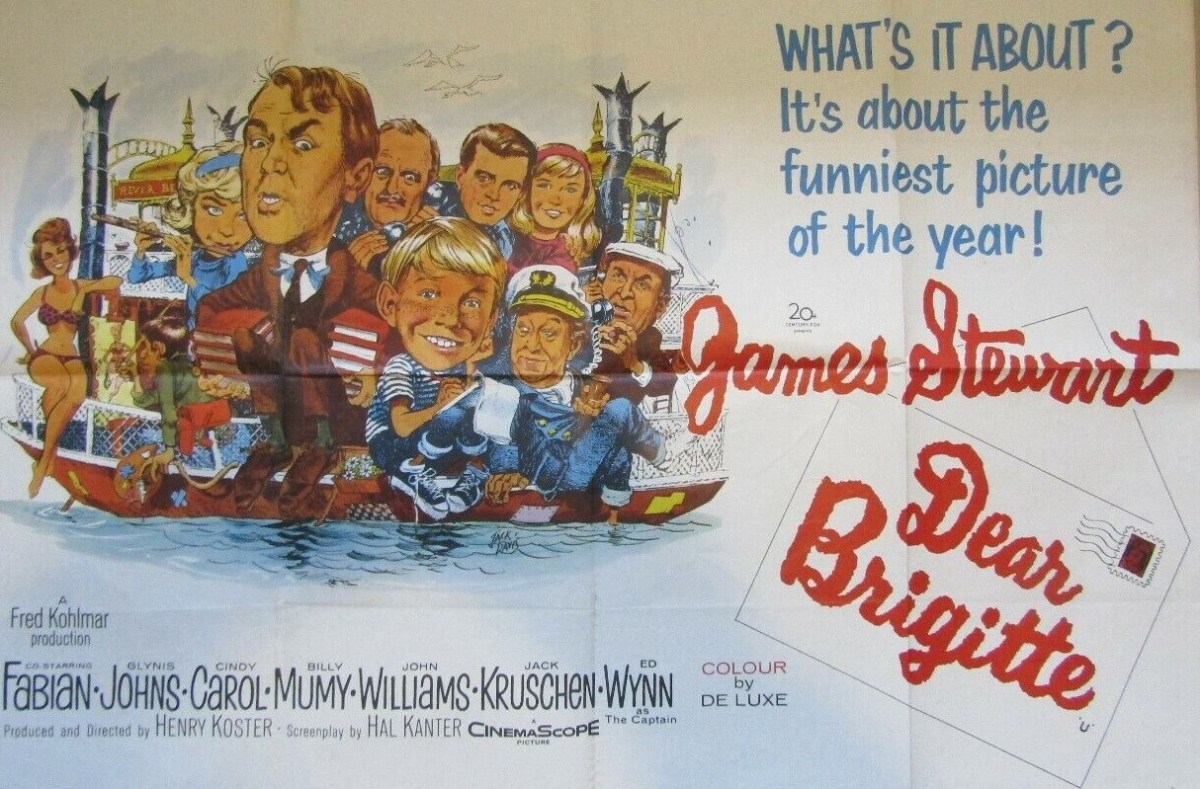
Surprisingy, in the UK down-graded to supporting feature in this kid-centric double bill. The marketing men pulled another fast one in the poster, leading audiences to believe that was BB in the bikini when it was only the usually-nude model of an artist neighbour attempting to be decent.

What Erasmus has, for some reason only now coming to the fore although he must be about ten or so, is that he’s a mathematical prodigy, able to work out complicated sums faster than a computer and pointing out errors in the calculations of the local bank. Leaf’s wife Vina (Glynis johns) doesn’t have a great deal to do except rein in the professor but she has a wonderful scene where she brings the local bank manager to book.

Anyway, eventually, Erasmus gets hooked into helping the boyfriend Kenneth (pop singer Fabian) of Leaf’s daughter Pandora (Cindy Carol) guess the winners of horse races as a way of assisting the couple in raising enough money to get married. By this time, Leaf has finally resigned and worked out he won’t pick up easy cash from the Government – another terrific scene – and is hoodwinked by con artist Peregrine Upjohn (John Williams) into setting up a charity to help disadvantaged students by employing his son’s skills.

Anyone familiar with horse racing will be aware how preposterous the conceit that anyone, no matter how scientifically skilled at working out the odds, can consistently pick winners. But this all flies by since it’s that kind of movie, one that not only defies belief, but basically sucks you into believing the whole thing, the way the untalented youngsters always managed in Hollywood times gone by to muster a great stage show or turned any kind of loser into a winner.

Still, all this goes on before we get close to the nub of the title. Erasmus has fallen in love with Brigitte Bardot and because he’s basically the family’s sole breadwinner eventually dad takes son to France to meet the real-life superstar who is far more charming than you would expect, the sexpot on hold for the occasion.

So, mostly, as I said, it’s an old-fashioned confection, the kind you could still get away with in the mid-1960s before the changing times demanded that comedies take on a harder edge. And with James Stewart in top form and husky-voiced English star Glynis Johns (who had her own television series in the U.S.) jumping in now and then to prevent him from making things worse it works a treat. Stewart exaggerates all those mannerism you might have thought mildly irritating before – he’s all limbs and sentences cut off in their prime and telling people to leave their own houses. But if he had toned any of that down, the air would have quickly escaped the balloon, for really he’s the only thing keeping it afloat.

But that’s stardom for you. A vehicle comes along that in total isn’t really worthy of the involvement of a marquee attraction like Stewart, who could be lending his talents to more solid fare like Shenandoah and The Flight of the Phoenix (also released the same year). While he’s crucial to both those other pictures, giving one of his best performances in the former, perhaps surprisingly, U.S. audiences, voting with their dollars, felt his performance here trumped that of the Aldrich picture.

Ir’s usually believable roles that attract the greatest critical plaudits for stars, but actually their most notable contribution is in making fly movies that should never work on paper but somehow with their magical injection not necessarily makes the screen sizzle but turns doughy material into something lighter and more easily digestible.

Henry Koster (Mr Hobbs Takes a Vacation, 1962) directs with occasional flair from a screenplay by Hal Kanter (Move Over, Darling , 1963) and Nunnally Johnson (The Dirty Dozen, 1967) based on the bestseller by John Haase.

As under-rated as The Trouble with Angels (1966) as lightweight comedies of the decade generally were, this is worth a look for Stewart alone.  

https://amzn.to/3RiMcjX

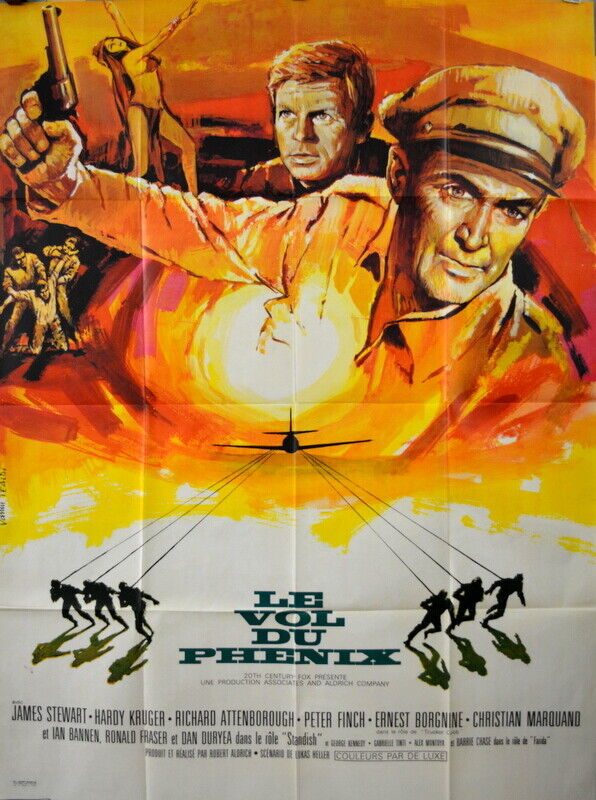
The Flight of the Phoenix (1965) ****

Take twelve condemned men, drop them in the desert hundreds of miles from safety with only enough water to last two weeks, and nothing to eat but dates, and make them work together to effect salvation from their predicament. Not exactly the premise for The Dirty Dozen (1967) but not far off. The Flight of the Phoenix appears a dummy run for director Robert Aldrich’s more ambitious war picture, not least because in terms of structure it is only eight minutes shorter. There are no women in the picture (except those appearing in a mirage) and the men, of all different types, must come together or die in the savage heat.

You might argue that the audience for this kind of picture no longer exists. In the 1960s there was a big market for the Nevil Shute/Hammond Innes/Elleston Trevor type of novel which contained a lot of practical detail at a time when heavy industry – mining, shipbuilding, oil, car manufacture – was a massive employer and the ordinary man had an easy understanding of – and was often fascinated by – the principles of engineering. Bear in mind that this was the era of space rockets and there was excitement about man’s planned flight to the moon.

During a sandstorm a small twin-engined plane carrying passengers from an oil field crash lands in the Sahara. James Stewart as the pilot was a casting trick. In a previous aerial adventure No Highway (1951), Stewart was the ordinary joe challenging authority. Here he is the authority figure, pilot Frank Towns, challenged and part of the film’s guile is the way he has to concede that authority to the one person on board everyone hates, arrogant German aircraft designer Dorfmann (Hardy Kruger).

The global job lot of passengers includes: two soldiers, martinet Capt Harris (Peter Finch) and his mutinous Sgt Watson (Ronald Fraser); alcoholic navigator Moran (Richard Attenborough); oil worker Cobb (Ernest Borgnine) on the brink of insanity; sarcastic Scots troublemaker Crow (Ian Bannen); French Dr Renaud (Christian Marquand0; company accountant Standish (Dan Duryea); Italian Gabriele (Gabriele Tinti); Bellamy (George Kennedy) and Carlos (Alex Montoya); plus a monkey of no fixed abode. The monkey, incidentally, is cleverly utilised. He’s not a sentimental or cute device, there to soften a hard guy or for comic relief, but Aldrich often cuts to his squeals or his face when there is imminent danger.

Two passengers are already dead, one is seriously injured. They have been blown so far off-course they will be impossible to locate. There is only enough water for ten or eleven days. It is a given in such circumstances that tempers will explode and hidden secrets surface. Were they guaranteed rescue those two pegs would be enough to hang a movie on.  Since there is no such guarantee, this becomes a picture about survival. The obvious maneuver comes into play on the fifth day. Capt Harris determines to walk to safety, over 100 miles in deadly heat. But it’s not a trek picture either, the engineers present know the risks. Mountains will cause false compass readings and those going will walk around in circles.

Trevor Dudley-Smith wrote under nine other pseudonyms including Elleston Trevor and Adam Hall for the “Quiller” spy series.

What? I can get that magnetism in the mountains can affect a compass but where does the walking round in circles enter the equation? Because, explains Moran patiently, a person does not automatically walk in a straight line if there is no actual road. If right-handed then you’ll walk in a left-hand direction because the right leg is more developed than the other and takes a longer stride and there’s nothing you can do about it. This doesn’t matter if you are walking along an actual path but in the desert with no road markings it’s lethal. And this is the beginning of a bag of what would otherwise be deemed trivia except that such facts are a matter of life and death. This is a movie about reality in a way that no other realistic or authentic picture has or will be. Physics is the dominant force, not imagination.

Finch’s sergeant fakes an injury to avoid going. The mad Cobb, originally prevented from leaving, sneaks away in the night. Towns, in courageous mode, goes after him. While he is away, Dorfmann carries out a character assassination. And continues on his return – “the only thing outstanding about you is your stupidity.” By now though, Moran has warmed to Dorfmann’s insane idea of building a single-engined plane out of the wreck of the twin-engined one. And that becomes the crux of the story. Can they build this weird contraption? Will they manage it before they die of thirst? Will rising tensions prevent completion? Are they fit enough after days in the boiling heat to manage the herculean tasks involved?

Aldrich keeps psychological tension at fever pitch, helped along by the pessimistic Towns and the wildly pessimistic Crow, needling everyone in sight, who delivers lines like “how I stopped smoking in three days.” Towns and Moran have to come to terms with the parts they played in the plane crashing, Sgt Watson with his cowardice. Issues arise over leadership and water theft.

I won’t spoil it for you by mentioning the incident that threatens to demolish the entire project. But the finale is truly thrilling, edge-of-the-seat stuff and the skeletal monstrosity being constructed looks hardly capable of carrying the monkey let alone a full complement of passengers. Aldrich is a master of the group shot with unerring composition and often movement within the frame or just a simple bit of business by an actor, for example George Kennedy at one point tapping his hand against his leg, ensuring that the film does not solely focus on a couple of characters. Sometimes all Aldrich needs to make his points are reaction shots.

Terrific performances all round with Ian Bannen Oscar-nominated. Aldrich called on Lukas Heller for the screenplay, based on Elleston Trevor’s novel, having worked with him on Whatever Happened to Baby Jane (1962) and Hush, Hush Sweet Charlotte (1964). Aldrich’s son William and son-in-law Peter Bravos had bit parts, killed off during the crash.

Flight of the Phoenix virtually invented the self-help rescue genre that relied on ingenious mechanical ideas – rather than more simplistic notions – such as later absorbed in movies like Apollo 13 (1995) and The Martian  (2015). Aldrich’s mastery of group dynamics would stand in him in good stead for The Dirty Dozen.

The 2004 remake isn’t a patch on the original.

A terrific movie and well worth seeing.

Turning the novel by Elleston Trevor into a movie is illustrative of the process by which the screenwriter eliminates, changes and adds. The Flight of the Phoenix (published in 1964) was a lean 80,000 words, a far cry from the blockbuster airport reads like Exodus by Leon Uris and James Michener’s Hawaii. But its length made it an ideal subject for a film, the shorter novel tending to stick close to the main story. The author’s speciality was authentic detail, an early career as a racing driver and flight engineer inspiring in him a love for all things mechanical.

He knew what made things work and gaps in his knowledge were filled by assiduous research. He was an assiduous man, with 36 books since 1943 under ten pseudonyms, one being Adam Hall whose bestselling spy tale The Berlin Memorandum would be filmed as The Quiller Memorandum. He had tackled aviation before, most prominently in Squadron Airborne (1955).

The film follows the book’s structure with only a couple of deviations. The main one was changing the nationality of the aircraft designer from British to German. Originally named Stringer he was a testy young individual prone to taking offence and going off in big sulks. There was a German in the Trevor version, Kepel, a young man who is injured in the crash. But there was no handy doctor on board and fewer different nationalities.

To build up James Stewart as the heroic pilot and as a consequence to add meat to his clash with German designer Hardy Kruger, in the film he bravely goes out into the desert to find one of the passengers, but that does not occur in the book. Other changes were minor – in the book the passengers are occasionally able to supplement their drinking rations by scraping night frost off  the plane and at a later point in the book they drain the blood from a dead camel in order to dilute their drinking water.

While there is an encounter with Arab nomads in both book and film, the book’s approach to this incident is much more straightforward, ignoring some of the detail supplied in the book.  

Of course, a novel allows for the inclusion of far greater detail. And while that provides the skeleton for story development, Trevor gives greater insight into the characters than can be achieved on screen. The author allows each character an internal monologue, through which device we discover their motivations, history and fears.

This approach combines the present with the past, presenting a more rounded cast of characters. While the inherent tension of the situation drives the story along, the author switches between characters to keep the reader fully engaged. The cowardly sergeant (played by Ronald Fraser in the film) is the biggest beneficiary, portrayed as a more sympathetic person than in the film.

The book is a stand-alone enjoyment, Trevor’s writing skills, his grasp of character, creation of tension and his  engineering knowledge (bear in mind he invented the idea of building another plane out of the wrecked one) make the novel every bit as enthralling as the film.  

Behind the Scenes: “The Sons of Katie Elder” (1965)

The property had been bouncing around Hollywood for over decade. It had its origins in the true-life tale of the five Marlow brothers involving murder, revenge, and jailbreak, the story making national headlines when the case was heard at the U.S. Supreme Court in 1892. Based on the book The Fighting Marlows by Glenn Shirley,William H. Wright (Assignment in Brittany, 1943) shopped around a screenplay, jointly written with Talbot Jennings (Northwest Passage, 1940), that was purchased by Paramount in 1955.

Alan Ladd (Shane, 1953), who owed the studio a movie, was cast in the lead and the script went through rewrites by Frank Burt (The Man from Laramie, 1955) and Noel Langley (Knights of the Round Table, 1953) with shooting scheduled for 1956. John Sturges (The Magnificent Seven, 1960) was set to direct until Ladd quit, having bought his way out of his contract. Burt Lancaster (The Train, 1966) was brought in as his replacement.

When Lancaster dropped out, producer Hal Wallis took over the movie in 1959 and considered replacing him with James Stewart (Shenandoah, 1965) or Charlton Heston (The Hawaiians, 1970) with Dean Martin (Rio Bravo, 1959) as the second lead. But still the movie stalled for another five years before Wallis settled on John Wayne who signed on for $600,000 plus a one-third share of the profits and one-third ownership of the negative (a bounty that would continue to pay off through reissues and leasing to television). Henry Hathaway was paid a flat $200,000.

Wayne and Hathaway had history dating back to The Shepherd of the Hills (1941) based on the million-copy bestseller by Harold Bell Wright, and groundbreaking in its use of Technicolor, then in its infancy. They didn’t work again until desert treasure hunt Legend of the Lost (1957) which teamed Wayne with Sophia Loren. A few years later came North to Alaska (1960) followed by Circus World / The Magnificent Showman (1964).

Despite this long-term relationship, the most the director could offer about his star was that “Wayne is more particular about the pants he wears than anything in the world…unless he gets the thinnest kind of material it drives him crazy.”

When the script was finally knocked into shape, the Marlow siblings had been trimmed from five to four, and that family had been replaced by the Elders, a nod to western aficionados who would recognize the name Katie Elder (“Big Nose Kate”), occasional companion of Doc Holliday whose story Wallis had previously filmed as Gunfight at the O.K. Corral (1957). Even though Elder wasn’t dead enough – she lived till 1940 – to conform to this picture, it seemed an odd decision to choose that name unless resonance was expected.

But it was still far from a done deal because Wayne’s cancer threatened to scupper the picture. Start of shooting scheduled for October 20, 1964, was shuttered when the disease was diagnosed on September 13 following the completion of Otto Preminger WW2 epic In Harm’s Way (1965). Aware surgery might jeopardize the picture, Wayne suggested Wallis replace him with Kirk Douglas (Cast a Giant Shadow, 1966).   

Hathaway rejected the notion, but while neither star nor producer had any idea whether the operation would be successful, and whether Wayne would be even fit enough to work, or – God forbid, that the actor might already have made his last picture – Wallis took an optimistic approach and announced the picture would be delayed for a month and “even a little later.” Hathaway’s optimism was based on the fact that he had survived colon cancer a decade before.

At least the surgeon moved fast, operating four days after diagnosis, and again five days later. As well as fighting the damage surgery and pain had done to his body, Wayne found himself slipping into depression, convinced the operation would render him unemployable. “I’ll never work again if they find out how sick I am. If they think an actor is sick, they won’t hire him,” he said, a legitimate observation given the cost of shutting down a picture should the actor be unable to play his role.

Wallis’s business partner Joseph Hazen shared Wayne’s pessimism and urged the producer to recast with either William Holder (The 7th Dawn, 1964) or Robert Mitchum (The Way West, 1967). Paramount, too, fretted about insurance, the studio couldn’t risk hiring an uninsurable actor. Wallis refused to abandon Wayne and the studio finally agreed to tough conditions from the insurance company. So, on January 6, 1965, the principals gathered in Durango to commence the 46-day shoot on a production budgeted at $3.19 million.

The high elevations – 8,500 ft in places – were not conducive to someone recovering from a lung cancer operation and Wayne found it difficult to breathe. It didn’t help that on the fourth day of shooting Wayne was expected to jump into icy water for the sequence where the brothers were ambushed by the villains. It didn’t help, either, that Wayne was too big to wear a rubber suit to stave off the cold like his fellow actors.

Wayne never complained that Hathaway “worked me like a damn dog.” He realized that it “was the best thing ever happened to me. It meant I got no chance to walk around looking for sympathy.” The star put on a brave front, publicly acknowledging his battle with cancer as a way of giving hope to others while privately terrified not so much of dying but of being helpless. “I just couldn’t see myself lying in bed…no damn good to anybody.”

“He had to be the macho man,” commented Earl Holliman (The Power, 1968), a late substitute for original star Tommy Kirk (Swiss Family Robinson, 1960) who was sacked after being caught smoking marijuana, “he had to have more drinks than the next guy.” And despite the severity of his condition, and although publicly pretending he had given up tobacco, he continued smoking cigars.

Recalled Dean Martin (Rough Night in Jericho, 1967), “He’s two loud-speaking guys in one.” George Kennedy (Cool Hand Luke, 1967) asserted, “If you put him in a group with other movie stars, the eye went to him and that is the ultimate marker of respect. He was John Wayne. He was very real. It didn’t matter if he wasn’t Olivier; Olivier wasn’t John Wayne.”

But there were outward signs of the effect the illness had upon him. He was less sure of himself on a horse, riding with a shorter rein out of fear a horse would get away from under him, trying to minimize the chances of falling or being bucked from the animal. And as the film wore on, an oxygen inhaler was set up beside him on set.

Dennis Hopper (Easy Rider, 1969) was wary of working again with Hathaway after a difficult experience with him on From Hell to Texas (1958) starring Don Murray and Diane Varsi where the actor suffered the indignity of endless takes. Hopper quit three times and for good measure the director put the word around and virtually grounded the actor’s career. Hopper only made one movie in six years. In the interim he had married Brooke Hayward, daughter of actress Margaret Sullavan whom Hathaway respected, and peace was brokered.  

Although on his best behavior on the shoot, Hopper was no less impressed. “He was a primitive director, he rarely moved his camera, the movement came from the actors.”

“Westerns are art,” declared Wayne. “They’ve got simplicity and simplicity is art…There’s simplicity of conflict you can’t beat…Westerns are our folklore and folklore is international…In Europe they understand that better than we do over here. “

Whether it was public sympathy for an ailing star and his resolve to fight cancer, or audience delight that he was back in a western after a gap of a few years, The Sons of Katie Elder was a huge hit with $5 million in initial rentals (what studios were left with after cinemas had taken their share). It earned more later in reissues but that initial sum was enough for thirteenth spot in the annual box office rankings though beaten by both Shenandoah and Cat Ballou. Its foreign earning would probably match domestic, to make it one of Wayne’s biggest earners for the decade.

SOURCES: Scott Eyman, John Wayne: His Life and Legend (Simon and Schuster Paperbacks, 2014) p111, p387-396 ; Ronald L. Davis, Duke: The Life and Image of John Wayne (University of Oklahoma Press, 1998) p266; Hal Wallis Collection, Margaret Herrick Library; Hedda Hopper, “Ladd To Star in Film of Pioneers’ Reunion,” Chicago Daily Tribune, November 9, 1955, p16; Thomas M. Pryor, “Hecht-Lancaster Obtains 2 Novels,” New York Times, January 12, 1956, p22; Oscar Godbout, “TV Movies Extras Get Salary Rises,” New York Times, July 3, 1956, p17; John Wayne, “Me? I Feel Fine,” Los Angeles Times, January 18, 1965; James Bacon, “Wayne’s Biggest Bout vs. Killer Cancer,” Los Angeles Herald Examiner, March 14, 1965; Roderick Mann, “John Wayne – A Natural as The Shootist, Los Angeles Times, March 7, 1976.

Two Rode Together (1961) *****

Never quite considered top drawer John Ford, yet it should rank alongside Stagecoach (1939), The Searchers (1956) and The Man Who Shot Liberty Valance (1962). I’ve been talking recently about a movie completed in a single take (Grenfell, 2023) and the power of a single scene (The Manchurian Candidate, 1962), and now I’m touching upon another piece of cinematic dexterity – the fixed-camera seqeunce.

This is a beauty and it lasts four minutes. Yep, for a four-minute medium-shot scene featuring the  two major characters the camera doesn’t move. Lawman Guthrie McCabe (James Stewart) and Cavalry officer Jim Gary (Richard Widmark) take a break from the 40-mile journey back to the fort. You think this is where Gary is going to spring upon McCabe exactly why his presence is so necessary for Army business. But instead, the scene, driven by Gary, is set up to discover why McCabe is so agreeable to taking a temporary leave of absence from an exceptionally comfortable lifestyle back in his small town.

Sure, this scene boasts a bit of business, the waving about of cigars and some pointing and McCabe’s head bobbing around, but otherwise the camera just observes. First of all we discover that McCabe earns $20 a month more than the soldier – that is, when the officer is paid at all, three months since he saw any money – and that McCabe is on the mean side and sarcastic with it. McCabe starts puffing on a long cigar and has to be nudged to offer Gary one. “You can afford matches,” he notes when Gary produces a packet.

McCabe has temporarily upped sticks it transpires because he’s getting unwelcome heat from his hotel owning lover Belle (Annelle Hayes),  on the sticky subject of marriage. The subject was brought up with a woman’s “animal cunning” when Belle asked why he was content with just taking 10 per cent of her income when, through entering into a partnership via marriage, he could receive 50 per cent. Gary is taken aback that his old pal is getting a slice off the top. And then somewhat shocked to learn that McCabe takes the same percentage from every business in town. McCabe is surprised to learn this comes as news to Gary. How else could the marshal support his lifestyle.

This mild interrogation is interrupted by a nugget about Belle. She has a stiletto strapped to her leg. That’s not news to Gary. McCabe is perturbed. How did he know. You just told me is the speedy retort. That takes a moment to sink in before McCabe’s suspicions are aroused and then allayed.

In other hands, this scene could have lasted a minute. Some speedy dialog would have got to the point faster. But that’s not the point. You can’t attempt this length of fixed camera scene unless you have two wonderful actors. It might appear indulgent but the director wants us to be sucked in by the affable McCabe.

Not sure where they got the image of the women in red being hanged – must be from another movie.

Because until now it has been all economy. The movie opens with a well-heeled fella dozing on a hotel veranda being woken up by a waiter bringing him beer and a cigar, candle at the ready to light the tobacco. The stage arrives. Two cowboys approach asking where they can get a decent drink. The man pulls back his jacket to reveal his badge. The mention of his name, Guthrie McCabe, is enough to make the pair reconsider staying.

A cavalry troop arrives with Gary at the head. Gary’s uniform is covered in dust, so thick you can hardly beat it off, so thick that unless accompanied by McCabe he would have been forbidden entry to the hotel by the owner. There’s snippy dialog here but it’s all delivered by Belle as she provides a series of sharp observations about men. Uninvited, she joins the pair as they sit down, Gary somewhat vague about his mission. Outside, we encounter McCabe’s dumb deputy, escorting a bunch of prisoners back to the jail because the judge was too drunk to appear in the courtroom – it’s that kind of town. McCabe, seeking re-election shortly for his position, sets them free and buys them a drink. Then we’re off on the 40-mile trip.

Still, we don’t know why McCabe’s presence at the fort is so important. John Ford doesn’t usually fall back on mystery as a narrative device unless it’s some personal secret hidden by a character. So McCabe is astonished to be hailed as a conquering hero, cheered by the people inhabiting an encampment outside the fort. One woman even says she can see his halo. What the…

Inside, it transpires Gary is merely doing his superior’s dirty work. And it’s cynical stuff at that. Major Frazer (John McIntyre) wants rid of the rabble who are giving him grief over their sons and daughters long ago kidnapped by the Commanche. Due to the current treaty, the Cavalry can’t just wade in and collect the kids, grown-up by now some of them. So he needs someone who is on nodding terms with the tribal chief (Henry Brandon) and negotiate their release.

McCabe’s first thought is how much he would be paid, given a cavalry officer’s salary would hardly keep him in cigars, reckoning it would be worth $500 a skull. “Whatever the market can bear,” insists McCabe. Both officers are appalled and even more so when McCabe reckons he’ll screw the money out of the distraught families. And that’s what he does. Affable has suddenly turned callous. The camera in this next scene focuses on Gary’s face, until he can take no more of his old buddy’s blatant greed.

Sucker punch number two. McCabe is as mercenary as the later Man With No Name. but he’s not the only one displaying cynicism. To appease his second wife Henry J. Ringle (Willis Bouchey) will cough up $1,000 if McCabe can bring back any child, not the actual one lost, because the kid was so young when kidnapped that his wife won’t know the difference and he has to get her off his back because it’s interfering with his business.

But there’s more sucker punches to come. McCabe won’t accept Gary’s leadership and won’t even agree to work out their approach together. But when it comes to action, it’s soon pretty clear that McCabe is the tougher character, can anticipate the enemy reaction. And he’s right to be cynical because when Elena (Linda Cristal) is returned to the fold, she is despised, all the fort wives want to know is how many Native American braves she slept with, and why she didn’t commit suicide instead.

There’s a sting in the tale for McCabe when he returns home and finds Belle has taken decisive action in his absence.

McCabe is a superb creation, none of that risking your life for nothing in his game plan, possibly the most realistic character in the Ford oeuvre, who doesn’t care a whit what people think about him, as long as he is paid what he feels is his due. Sure, he puts his life on the line, but you can be guaranteed that’s not much of a gamble, he is so accomplished with the gun and can outwit any foe. As corrupt as he is, he’s a lot more straightforward than the apparently high-principled wives and officers who treat Elena so abominably.

There’s a good bit more to this picture than I’ve described. I’ll pass over the usual punch-up to which Ford appears addicted. Gary’s romance with civilian Marty (Shirley Jones) is well done, she carrying the burden of surviving Indian attack when her younger brother was taken, and she is an accomplished pioneer, in another superb scene Gary congratulates her on pitching her tent out of the wind, far enough for the creek to escape mosquitoes and near a dead tree to get firewood.

And there’s another brilliant scene, revolving around a music box, that could have been a cliché but in another sucker punch takes a different, quite awful, direction.

This is so beautifully written and directed I’m just astonished it wasn’t met with acclaim at the time or since. The typical western has ever been so undercut nor typical action met with such dire consequence, the soft underbelly of life at the fort never so cruelly exposed.

You might think James Stewart was taking a chance in assuming the mantle of the man who killed Liberty Valance in order to advance his political career when in reality he did no such thing. But this character is light years away from that simple theft. His character in that Ford picture was exactly the high-principled guy you had come to expect from Stewart, even if, at the last instant, succumbing to a lie.

In the hands of another director McCabe would have been played by a sleazy Lee Marvin or another actor who could not rise above his bad-guy persona. This must be James Stewart’s finest hour, making an unattractive character appealing, so much so you almost appreciate his point of view in relation to the corruption and his antipathy to matrimony, and taking pains to conceal not the goodness underneath but his understanding of the harsher realities of Western life, at which he is more than adept at dealing.

Richard Widmark (The Secret Ways, 1961) also discards his normal screen persona, his job to act as observer to the Stewart character, to lead audience disapproval, and to be hoodwinked as much as McCabe by the cynical Major while enjoying none of the reward. He is gentler than usual, more resigned to his job, expecting little. Good supporting cast including Oscar-winner Shirley Jones (Bedtime Story, 1964), Linda Cristel (The Alamo, 1960) and especially, in her only movie, Annelle Hayes, as an extremely savvy character who gets the better of her slippery lover.

Brilliant film. And if like me you come to the four-minute scene you might just rewind once or twice to enjoy what Ford, Widmark and Stewart achieve. I was so taken with the entire film, which I’d never seen before, that I watched it again the next night.  

No Highway in the Sky / No Highway (1951) ****

Having just read the Nevil Shute novel on which this movie is based, I was keen to see how it transferred to the screen. It got off to a great start with the casting. James Stewart was several classes above the author’s  description of the main character, but Marlene Dietrich more than fitted the bill of the Hollywood star as a passenger in the early days of Transatlantic air travel.

Widowed aeronautics research engineer Dr Honey (James Stewart), accent explained by him being a Rhodes Scholar who stayed on in Britain, is so absent-minded that he tries to enter a neighbor’s house and when he gets angry in a discussion with a visitor to his own house puts on his hat and coat and decides to leave. He has discovered a potential flaw in a new range of British airplanes and is despatched by boss Dennis Scott (Jack Hawkins) to Canada to examine the remains of a crashed prototype, the accident previously ascribed to pilot error.

It was called “No Highway” in Britain as that was the title of the novel.

However, once on board, he discovers the plane is perilously close to the danger level of flying time his research indicated. In between frightening the life out of stewardess Marjorie (Glynis Johns) and star Monica (Marlene Dietrich) with his predictions of doom and instructing them where best to hide in the plane in the event of crash-landing in the ocean, he tries to get the pilot to turn back. When that fails, he inadvertently charms the life out of stewardess and star.

When the plane lands, even closer to the danger zone in terms of flying hours, and still no one listening to his concerns, he manages to render the plane unflyable. The aeroplane company refuses to fly him home, leaving him stranded. That provides enough time for Monica and then Marjorie to turn up unannounced at his home in England to help look after his young daughter Elspeth (Janette Scott). When Honey finally returns, he faces an inquiry, and looks set to lose his job, virtually unemployable thanks to his antics in Canada. At the last minute, he is reprieved, fresh evidence from the crashed plane proving his research correct.

Meanwhile, Monica, forced to return to Hollywood, loses out in the battle for Honey’s affections. Marjorie, a former nurse and imminently more practical, is in any case better placed to help look after a growing girl, and eventually Honey sees sense and asks her to marry him.

Really well done with terrific performances all around, but vastly helped by the screenwriters who dumped three sub-plots in order to stick to the knitting of the tale. Honey, far removed from the man in the street persona that saw James Stewart through his Frank Capra movies, attracted female interest through his principled stand. Most importantly, the writers removed the section where Elspeth is seriously ill in her father’s absence. Secondly, in the book Scott was sent to Canada to find the crashed plane, involving a trek through perilous terrain, but that’s been excised, the search completed off-screen by others, the vital information relayed by letter. Thirdly, the remains of the tail, which had previously not been found, were located in the book by supernatural means, Elspeth being called upon to use a planchette to help find it.

In removing all this material, the movie is re-shaped partly as a Capra movie, with the downtrodden Honey achieving success through persistence, but, more importantly, allowing the movie to focus on the potential love interest. Needless to say that is determinedly old-fashioned, both women having forged successful careers now viewing work that was initially exciting rapidly pall. The book sets Monica thinking how much better life would have been if as a humble office girl she had married the kind but not handsome man who had caught her eye instead of now being thrice-divorced. Marjorie is even more old-fashioned, seeing a genius who needs looked after as much as his daughter requires a mother.

So there’s no point going anywhere near this if you’re not willing to accept a past where a woman’s role was primarily seen as a home-maker. But don’t jump to pointing the finger at the author as being equally old-fashioned because a later book, A Town Like Alice, not only turns the main character into a war hero but depicts her as a successful entrepreneur.

James Stewart (The Rare Breed, 1965) takes a considerable chance on playing the absent-minded professor but his endless well of screen charm allows him to pull it off brilliantly. Marlene Dietrich, top-billed when teamed with Stewart for Destry Rides Again (1939), has an excellent role as a rueful prima donna. Glynis Johns (Lock Up your Daughters!, 1969) is equally at home with a part that calls for her not to just fall at Honey’s feet. She was one of handful of British rising stars. Jack Hawkins (Masquerade, 1965) was on the cusp of being named Britain’s biggest box office attraction while Kenneth More (The Comedy Man, 1964) was a few years away from receiving that honor. Janette Scott (Day of the Triffids, 1963) gave notice of her talent.

As much as James Stewart’s career was linked to Frank Capra and Alfred Hitchcock, Henry Koster (Mr Hobbs Takes a Vacation, 1962) made five pictures with the actor, all excepting this comedies, including Harvey (1950). He does a fine job of keeping Stewart from spinning away too much in the direction of the geek professor and keeping the story pinned down.

Nevil Shute was an engineer to trade – he had worked in the British airship industry – so his books tend to be peppered with the scientific. That’s easy to digest when reading, but harder to absorb when watching a movie. R.C. Sheriff (The Dam Busters, 1955) and Oscar Millard (Angel Face, 1952) do an excellent job of condensing the novel, finding cinematic ways of getting across important material.

I had come at this, as I said, mainly to see how the author’s work was translated to the screen, but came away totally absorbed in a fine picture. What was left out helped the picture while the author’s later A Town Like Alice (1956) lost half its power by ending halfway through the original story which later saw the courageous heroine go onto to become a serial entrepreneur in a male-dominated society in Australia.

Obviously, I’ve deviated from my chosen field of 1960s pictures, but this is well worth a watch.

You can catch it on YouTube in a number of versions – the original, a colorized version, one with English subtitles and one where a musician has made his own edit and dubbed his own modern score on the picture.

Behind the Scenes: “Bandolero” (1968)

A western dream team. Beginning with Winchester ’73 (1950) James Stewart had revived his career post-World War Two with a string of tough westerns and had made seven movies in the genre in the 1960s including The Man Who Shot Liberty Valance (1962) and Shenandoah (1965). Starting with Rio Bravo (1959) Dean Martin had made six including The Sons of Katie Elder (1965). Genre debutante Raquel Welch had hit the box office running with One Million Years B.C. (1966) and Fantastic Voyage (1966). Following McLintock (1963) and Shenandoah, director Andrew V. McLaglen was considered one of the hottest western directors around.

Legendary Twentieth Century Fox producer Darryl F. Zanuck put together the cast and director as a “package” before calling in screenwriter James Lee Barrett (Shenandoah) to shape an idea by producer Stan Hough. McLaglen explained: “It was a Zanuck thing from the beginning.” He was working on another picture when he took a call from Zanuck. “I got a six-page outline for a western,” said Zanuck, “and I figure you ought to direct it. James Lee Barrett out to write it and Jimmy Stewart, Dean Martin and Raquel Welch ought to be in it. Nobody else. That’s the combination I want.” McLaglen took Hough’s six-page outline to Barrett who wrote it based on the actors involved.

Originally entitled Mace after the James Stewart character, the movie quickly became Bandolero!, the exclamation mark possibly to differentiate it from the 1924 Spanish picture of the same name which had been made for Metro-Goldwyn (as the studio was then known).

Despite the success of the Matt Helm spy pictures and a number of decent westerns, Dean Martin ceded top billing to James Stewart (had they shared the billing, Martin would have come first in the traditional alphabetical order).

Marc Eliot, one of Stewart’s biographers, arrived at a more unlikely scenario for the movie being greenlit, concluding that because Martin and Stewart had got on so well when the latter appeared on the former’s television show they decided to make a picture together. Given the show was taped in summer 1967 and the movie went into production a few months later it left an improbable amount of time for the picture to be set up.  

Director Andrew V. McLaglen would be reunited with two of his favorite movie characters – screenwriter James Lee Barrett and James Stewart, both key to Shenandoah. The actor had been the driving force behind McLaglen’s recruitment for that Civil War picture. “I just loved working with him,” said the director, “it got to the point where any time he did a movie he wanted me to direct it.” He viewed Barrett as “one of the best dialog writers I’ve ever known in movies.”

Although theoretically, the movie was set up as a package, with stars and director in place, Dean Martin remained a doubt since he was already committed to a film with Columbia that might clash. And Stewart might easily have dropped out if producer Frank McCarthy’s plans for Patton, with Burt Lancaster in the title role and Stewart as General Omar Bradley, had come to early fruition.

Raquel Welch was on a publicity high, featured on 400 magazine covers, generating such industry buzz that she had been named “International Star of the Year 1967” by U.S. cinema owners, her growing screen popularity ranking her eleventh in Box Office magazine’s female “All-American Favorites of 1968.” Dean Martin, incidentally, came ninth on the corresponding male chart, two places above Clint Eastwood, Paul Newman topping the poll.

George Kennedy (Cool Hand Luke, 1967) had small parts in Shenandoah and The Sons of Katie Elder before graduating to second male lead in McLaglen’s previous western The Ballad of Josie (1967). McLaglen, you might like to know, was highly regarded by the trade as “more concerned with entertaining the public than making intellectual and emotional demands on the audience.” Just after the movie’s launch the director signed a two-picture deal with Fox, The Undefeated (1969) next on his dance card.

One of the few studios to persist with a talent school – Welch claimed as the most recent high-flying graduate – Fox gave current student Clint Ritchie a role in Bandolero!, others in the Class of 1968 including Jacqueline Bisset (The Sweet Ride, 1968) and Linda Harrison (Planet of the Apes, 1968). Relative newcomer Andrew Prine had acted with Martin in Texas Across the River (1966) and enjoyed a supporting role in McLaglen war picture The Devil’s Brigade (1968).

As well as genre newcomers Welch and Ritchie, the cast included western character actors like Will Geer (Winchester ’73), Don “Red” Barry (The Adventures of Red Ryder, 1940) and  Harry Carey Jr. who had appeared in three previous McLaglen westerns. Even current “Tarzan,” Jock Mahoney, who played Maria’s husband, had a string of B-westerns in his portfolio. Possibly as important was the presence of James Stewart’s horse Pie, his onscreen companion for two decades.

Shooting began in Paige, Arizona, on October 2, 1967, before shifting two weeks later to Brackettville and the Shaban ranch where The Alamo (1960) was filmed. Parts of the San Antonio de Bexar set were revamped as the Texan town of Val Verde where the hanging in the film took place, while The Alamo doubled as the Mexican village of Sabinas which provided the action for the climax. Seven buildings were added to the San Antonio set including the jail, while a curio shop was transformed into a bank, a gift shop became a hotel and, conversely, an old hotel was turned into a general store. Thirty-five thousand traditionally-cast adobe bricks were made on site to create the dozen buildings required for Sabinas plus the locale’s arch, fountain, wells and wall.  

Other locations included Arizona, Utah and Texas with interiors filmed at the Fox studios. The shootout between the posse and the outlaws was filmed near Turkey Mountain in Texas. The Rio Grande was forded at Devil’s River but Mace crossed the river at Pinto Creek. Glen Canyon National Recreation Area was utilized for the bandit attack and, naturally enough,  for sequences requiring canyons. Other scenes were shot at Lee’s Ferry in Arizona, Balanced Rocks, and Big Water in Utah. But the first time we view Sabinas is an effects shot.

You do wonder why this film entered the studio books as costing $5 million. None of the principals were in the million-dollar salary range and the cost of 40 days shooting at the Shaban ranch was put at $25,000 a day.

The principals eventually enjoyed on-set camaraderie. Initially, Welch was too serious for the others, bombarding the director and more experienced actors with questions about her character’s motivation and psychology. “I wouldn’t say creativity was the primary concern on that picture,” commented the actress. “Barrett was there mainly because everybody said nobody could write dialog for Jimmy like he could. As far as other things in the script were concerned, they weren’t really supposed to be questioned.

“And with McLaglen it was all by the book. McLaglen created a very constrained atmosphere. It was an inoffensive nine-to-five project with a lot of very senior people, the old John Ford gang. Very cliquish. Except for Jimmy who’d always kind of throw out little things. I felt pretty lonely the whole shoot.”

To “loosen her up,” the two stars invited her out to dinner and “got her good and drunk.” Remembers McLaglen, “Dean and Jimmy and I would take Raquel Welch to dinner and we’d kid around with her.” Quite whether that was sufficient to rid Welch of her feelings of alienation was never established. However, she did register that she was surrounded by talent. Stewart “could cry on cue. No mess, no fuss. Just like that you could see tears in his eyes.

McLaglen equally enjoyed an esprit de corps with the male stars. “When I think of my time with Dean, there’s nothing but joy in my heart…without doubt the most conscientious actor I have ever worked with,” adding, “I think Jimmy had more fun on that location than he ever had.”

Texas was chosen for the June 1968 launch on the grounds that Shenandoah had done so well there. Instead of a city-by-city premiere lasting a week with many stars in attendance, the studio opted for a “new kind of premiere,” opening night at the Majestic in Dallas accompanied by a 30-minute live telecast broadcast to 23 Texas television stations. Also available was a 16mm featurette on Welch promising “an intimate look at a new star.” Welch contributed her vital statistics and preferences to a computer program that would help select the winner in a beauty contest to find the woman closest to the star in looks and personality.

Stewart, of the tub-thumping generation, believed stars should hit the publicity trail, public appearances adding 10 per cent to the gross, rather than insisting it was beneath their dignity or not worthy of their time. He claimed publicity tours were “good for the soul. Unless he has a real bitter selfish attitude (an actor) has to enjoy getting out to different parts of the country and meeting people.” Raquel Welch was one of the stars he chided for adopting the wrong attitude with autograph hunters.

Little of the weaponry seen on screen was from the period, the movie being set in 1867. And even the supposed Remington 1858 New Army revolver used by Martin, Kennedy and Welch, was improvised from another pistol. But Stewart used a genuine Single Action Army “artillery” revolver. There was some cheating going on, Martin firing a Winchester 1892 saddle ring carbine, and others using a Winchester model 1892 rifle and a Winchester Model 1873 carbine.

Despite claims by James Stewart biographer Gary Fishgall that the “film opened to near-instant obscurity” Bandolero! proved a solid box office success in the United States, where it was the top western for the year, finishing 18th in the annual chart, collecting $5.5 million in rentals (not gross) and performing very well overseas. It was a signal year for westerns, though some languished. Hang ‘Em High was 20th with $5 million, The Good, The Bad and the Ugly 24th ($4.5 million), Five Card Stud 34th ($3.5 million) and The Scalphunters 43rd ($2.8 million).  In the flop category were Will Penny in 54th spot ($1.8 million), Villa Rides 75th ($1.2 million), Firecreek 79th ($1.2 million) and Shalako 85th ($1.1m).

SOURCES: Gary Fishgall, Pieces of Time, The Life of James Stewart, (Scribner, 1997) p314; Marc Elliot, James Stewart, A Biography, (Aurum, 2007, paperback) p365; Howard Hughes, “Welch Out West Part 1,” Cinema Retro, Vol 11, Issue 31, 2015, p10-17; internet movie firemarms database; “Raquel Welch To Get Int’l Star Award,” Box Office, February 19, 1967, p4; “Mace Retitled Bandolero!,” Box Office, August 7, 1967, pE6; “Cast Patton and Bradley,” Variety, September 20, 1967, p13; “Bandolero! Moves to Texas Oct 16,” Box Office, October 16, 1967, pC1; “Filming of Bandolero! Ending at Bracketville,” Box Office, December 4, 1967, pSW1; “Fox On Texas Trail for Kickoffs,” Variety, May 15, 1968, p32; “James Stewart: Stars Should Tout Films in Television Age,” Variety, May 29, 1968, p19; “Now There’s A New Kind of Premiere,” advertisement, Variety, June 12, 1968, p17; “Bandolero! Dallas World Premiere Covered Live By 23 TV Stations,” Box Office, June 24, 1968, pSW1; “Fox’s Talent School,” Variety, June 26, 1968, p13; “20th-Fox Signs McLaglen to Two-Picture Pact,” Box Office, August 26, 1968, pW1; “Big Rental Films of 1968,” Variety, January 8, 1969, p15.

Bandolero (1968) ****

Darkest – and possibly the most under-rated – western of the decade featuring a top-class cast playing against type, down-and-dirty in its depiction of the itinerant cowboy, an ending you won’t see coming and if it’s not a heretical notion close cousin to the later The Wild Bunch (1969).

Gang of outlaws led by Dee (Dean Martin), condemned to death for robbing a bank, is rescued by his brother Mace (James Stewart) posing as a hangman.  While a posse led by Sheriff Johnson (George Kennedy) is in hot pursuit and the outlaws kidnap as potential hostage recently widowed Maria (Raquel Welch), Mace, sauntering through the deserted town, indulges in a bit of larceny himself.

All head for Mexico, a pitiless region, where the posse are picked off by bandits, the outlaws directed by the native Maria towards a small town which turns out to offer no safety at all. While there’s plenty action, this is more character-based. Mace and Dee are on the Civil War divide, the former (still sporting his Union uniform) riding with General Sherman, the latter with the Confederate Quantrill’s Raiders, despised by Mace as nothing more than glorified killers.

And while they are both outlaws, Mace blaming his situation on the Civil War, they are divided too by a sense of honor, Mace making it a point of principle never to harm women or children, Dee, far removed from any sense of himself, guilt-ridden, past caring, and lonely, can’t remember the last time he was with a woman he respected.

Sheriff Johnson is in pursuit in part due to unrequited love for Maria. Quick to action  in a professional capacity, he is tongue-tied in her presence. Nor has the newly-wealthy Maria much need of a male protector. A whore since the age of 13 to provide for her extended family, sold into marriage nd acceptance that for security not love, she has been, ironically, set free by violent robbery. Dee’s gang views Maria as plunder, rape imminent should the brothers turn their backs. While Maria has little interest in another male protector she finds herself attracted to Dee.

Mace is mostly peacemaker, prodding his weaker sibling into responsibility, trying to instil into him the kind of code by which the likes of The Wild Bunch swore, but, still on the shifty side himself, concealing from the others the loot from his own robbery. But where The Wild Bunch are essentially sanctified by Peckinpah, especially with their hypocritical codes of honor and their unlikely redemption, the lives of Dee and Mace are unfulfilled, lawful or lawless drifters enjoying little of life.

There’s an ambivalence to Mace, theoretically a law-abiding rancher, but apparently turning outlaw on a whim. We are introduced to an impoverished Mace being ripped off for food and accommodation, spending the night in an overcrowded bunkhouse, his Unionist uniform doing him no favors two years after the end of the Civil War in Confederate Texas. He appears less prone to violence but we are not privy to how he persuaded a hangman to part with his outfit. And he’s a mean hand with a rifle, helping his brother escape his pursuers.

You might wonder just how Mace came to be an outlaw when he witters on so often about his God-fearing mother and his upbringing on a farm and you always have the sense he’s part of that woeful Hollywood creation, the “good” outlaw, as if there was such a thing, certainly no sign of him dispersing ill-gotten gains to the poor. He might just be as deluded as his brother.

Of the three, Maria is the most clear-sighted, no qualms about her behaviour, and,  provided with weaponry, perfectly capable of defending herself. Mexican bandits offer her no clemency either, assuming that, escorted by gringos, she has abandoned the land of her birth, or just because any woman is prey.

So it’s a perfect onion of a western, layers upon layers, the pursued needing to defend themselves not just against the pursuers, but bandits lying in wait, and within their supposed close-knit community the brothers guarding against fellow outlaws and protecting the  woman.  

James Stewart (Shenandoah, 1965) played many a tough guy at the reinvention of his career in the early 1950s in Anthony Mann westerns, and while his characters often displayed venal qualities they were not outlaws. Career-wise this was a dicey role for an established western hero. That he brings the common touch that was the hallmark of his original screen persona to this characterisation of an outlaw with a code of honor does not disguise the fact that he is still an outlaw.

Dean Martin had essayed a really mean bad guy in Rough Night in Jericho (1967) but again this was his debut as an outlaw, and a conflicted one at that, enjoying the boost to his self-esteem that leadership brings, but finding himself enmeshed with the dregs of society, and certainly not on the look-out for any acts of kindness or redemption. This is a beautifully nuanced performance especially when he realizes Maria is responding to him.

Raquel Welch (Fathom, 1967) in what amounts to her first major film opposite two Hollywood legends more than holds her own. Not able to rely upon her overt sex appeal as in her previous outings, she portrays an upstanding women, abused by men in the past, determined not to take that route in the future. Alone of all the characters, having accepted her fate at an early age, she has developed a self-esteem not sacrificed to circumstance. The whore and the outlaw might be the oldest trope in the book but it works very well here as two characters find solace in each other.

George Kennedy (Cool Hand Luke, 1967), more accustomed to playing tough guys, leavens his portrayal by appearing idiotic with women. This, too, is a departure for Andrew V. McLaglen. Anyone aware of Shenandoah or The Undefeated (1969) will be familiar with his dexterity for widescreen composition, but here he tamps down on that stylistic device, concentrating more on group reaction and interaction. James Lee Barrett (Shenandoah) wrote the biting script based on a story by producer Stanley  Hough.  

While there’s plenty action it’s not a rip-roaring western, too much character involvement for that, but certainly ranks as one of the top westerns of the decade.

Apologies again for the premature appearance of the blog “Behind the Scenes: Bandolero!” but that will definitely appear tomorrow.

Discover WordPress

A daily selection of the best content published on WordPress, collected for you by humans who love to read.

The Atavist Magazine

by Brian Hannan

WordPress.com News

The latest news on WordPress.com and the WordPress community.