
All studios believed in their brand name. That the sight of the MGM lion or the Twentieth Century Fox searchlight or the Paramount mountain represented a quality mark that would buffer expectation and reassure an audience they were not going to be rooked. That might have been the case decades before when the Warner Brothers logo might mean gangster pictures or socially aware movies or MGM, with more stars than there are in heaven, pictures with top-notch talent, or Universal determined to scare the pants of you with its horror catalog.
But that was no longer the case, most studios so desperate for survival that they would fork out for whatever trend seemed most likely to make money and the industry lurched from western to musical to adventure and back again whenever a big hit appeared. The only studio which still retained genuine marquee appeal was Disney. As studios dipped into more unsavory fare, according to the older generation, and the prospects of sending your children to the movies without having to check out the picture in advance diminished, a Disney film was a guarantee of fret-free entertainment.
Throughout the decade adults as much as kids swarmed to the Disney repertoire. In 1961 the studio scored a box office triple whammy when The Absent-Minded Professor, The Parent Trap and Swiss Family Robinson took three of the top four slots in the annual box office race. In the following years Bon Voyage (1962), Moon Pilot (1962), Son of Flubber (1963), In Search of the Castaways (1963), The Sword in the Stone (1964), The Misadventures of Merlin Jones and especially Mary Poppins (1964) kept the studio buoyant, not to mention the string of pictures starring Hayley Mills and a stack of animated classics it could reissue at the drop of a hat.
Disney ruled the lightweight world, its films often driven by a simple plot device. And as the rest of the industry coveted sex and violence, exhibitors relied on Disney to bring in the kids (and adults) during holiday periods. It would end the decade on a whopping high with The Love Bug (1969).
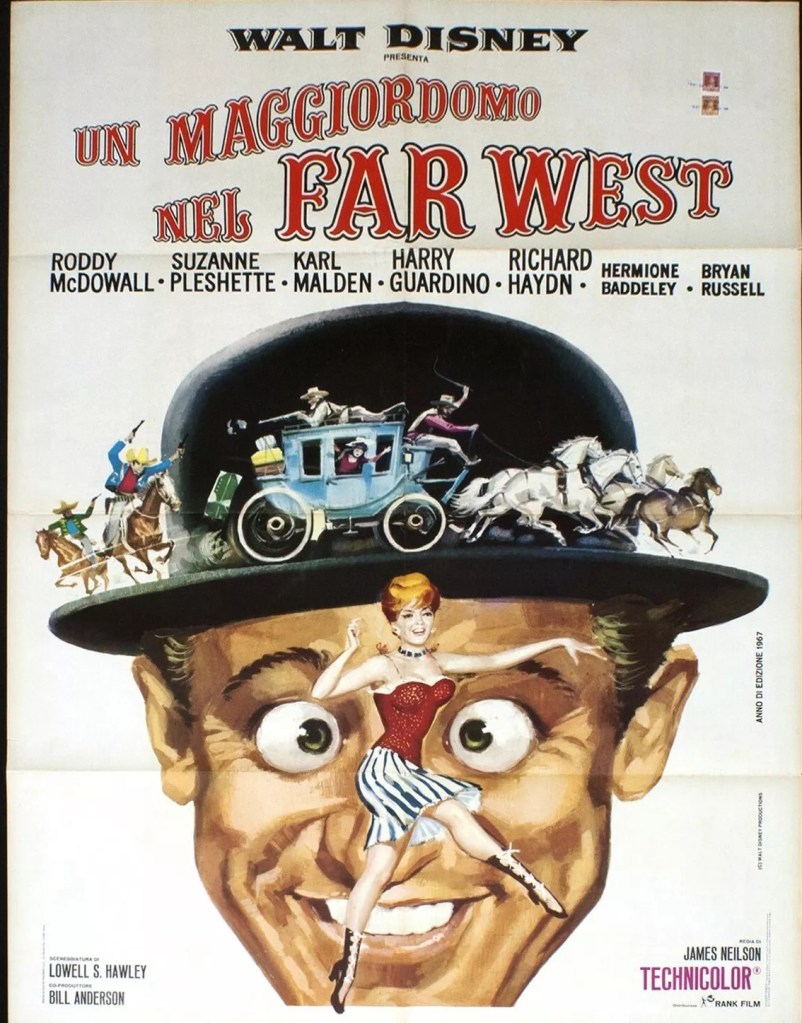
Here, the ploy is as old as the hills, a fish out of water, in this case an English butler. Disney had rung the changes on that particular sub-genre through the governess in Mary Poppins, steadfastly ignoring a trend towards more sinister servants as demonstrated by The Servant (1963) and The Nanny (1965). But Disney did have the ability to hook name actors for its child-friendly movies, here Roddy McDowall (Lord Love a Duck, 1966), Oscar-winner Karl Malden (Nevada Smith, 1966) and Suzanne Pleshette (A Rage to Live, 1965).

If you are expecting whiplashing escapades of the Indiana Jones variety, you will be in for a disappointment. Eric Griffin (Roddy McDowall) is the aforementioned butler escorting a child Jack (Bryan Russell) on a treasure hunt through the gold fever American West. When his charge runs away, Griffin finds the boy stowing away on a ship. The ever-genteel Griffin has skills that see him through any situation, working as cook on the ship, setting up his stall as barber on the mainland, and occastionally employing a devastating right hook to knock seven bells out of giant bully Mountain Ox (Mike Mazurki).
The plot, such as it is, revolves around recovering a treasure map stolen by swindler Judge Higgins (Karl Malden) and eventually when the movie needs some zap the feisty Arabella Flagg (Suzanne Pleshette), Griffin’s bankrupt employer who as it happens fancies the bulter, turns up.
There’s enough action to keep the picture on a steady keel, a storm at sea, a stagecoach hold-up, prizefight and a climactic town-wrecking fire. There are, perhaps surprisingly, a few choice lines.
But there’s a misinterpretation at the center of the movie so it’s as well its made with kids in mind. The fish-out-of-water notion would play better if historically movies fielded idiot butlers rather than ones who tended to take command when things get tough, though it’s unliklely kids would be aware of previous entries in the sub-genre. So, theoretically, it’s a surprise when Griffin outfights the lummox and outwits the swindler.
If the kid isn’t cute enough there are compensations elsewhere, a decent support in Harry Guardino (The Pigeon That Took Rome, 1962) and Hermione Baddeley (Harlow, 1965). Roddy McDowall at least is in a movie that suits his screen persona and deceptively languid acting style while Suzanne Pleshette takes a feminist slant to the Wild West. Whether British comedian Tony Hancock – he was sacked during filming – would have added much to the proceedings is open to debate.
It’s worth remembering that, outside of Hayley Mills offerings, Disney comedies of this period revolved around adults coping with bizarre situation. This doesn’t quite have the gimmicks that drove Son of Flubber, The Ugly Dachshund (1966, also headlining Pleshette) and Lt Robin Crusoe U.S.N. (1966).
Adequately directed by James Neilson (Dr Syn Alias the Scarecrow, 1963) from a screenplay by Lowell S. Hawley (Swiss Family Robinson) drawn from the novel The Great Horn Spoon! by Sid Fleischmann.
I remember seeing this as a kid and feeling pretty content coming out of the cinema, so since it did what it says on the tin, I’m loathe from an adult perspective to take it to pieces.
A movie that says – lighten up!

 The Magnificent 60s