Behind the Scenes: United Artists Goes to War on a Low Budget – “Submarine X-1” (1968) and Five Others

With the contraction of Hollywood production in the 1960s, cinemas worldwide were always crying for pictures – any pictures – that could take up a weekly slot or pad out a double bill. (The single-bill programming that is standard these days was not welcome in most cinemas, except a prestigious few, and audiences expected to see two movies for the price of their ticket). Indie unit Mirisch had scored such a big hit with aerial war number 633 Squadron (1964) – it recouped its entire cost from British distribution so was in profit for the rest of its global run – that Walter Mirisch persuaded distribution partner United Artists to attempt to capitalize on the idea and thus set in progress a series of war pictures to be made in Britain.

There would be cost savings through the Eady Plan. Each film would have a “recognizable American personality in the lead” and have American directors. Budgets would be held under $1 million. Half a dozen movies were planned, the first appearing in 1967, the last in 1970.
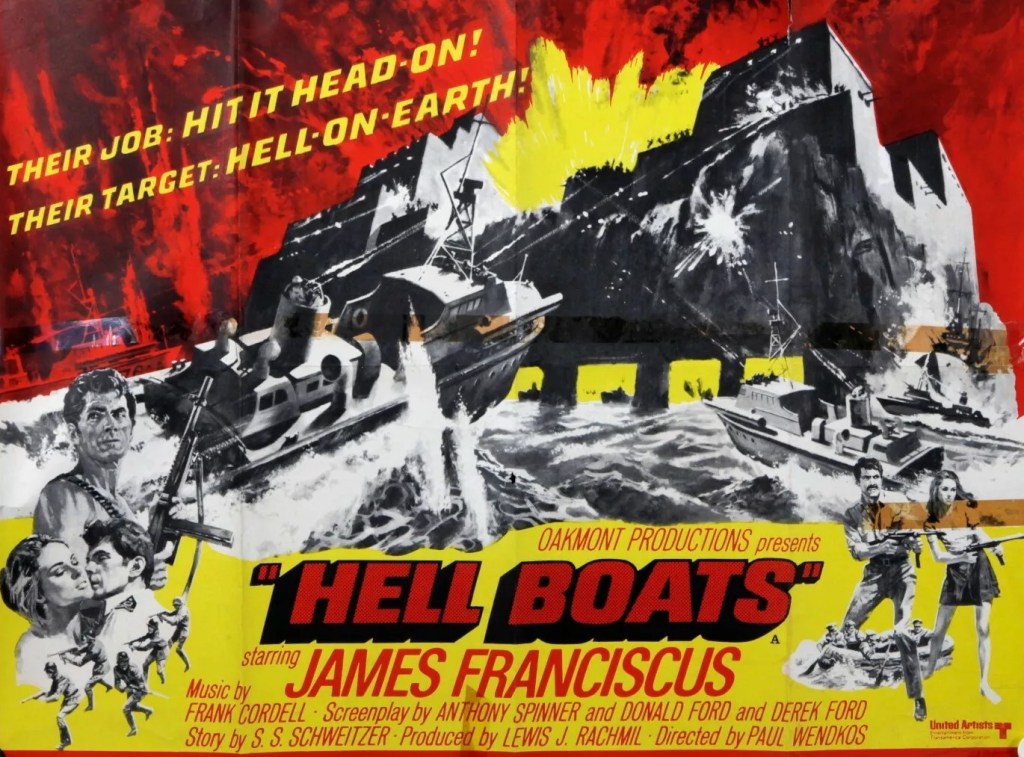
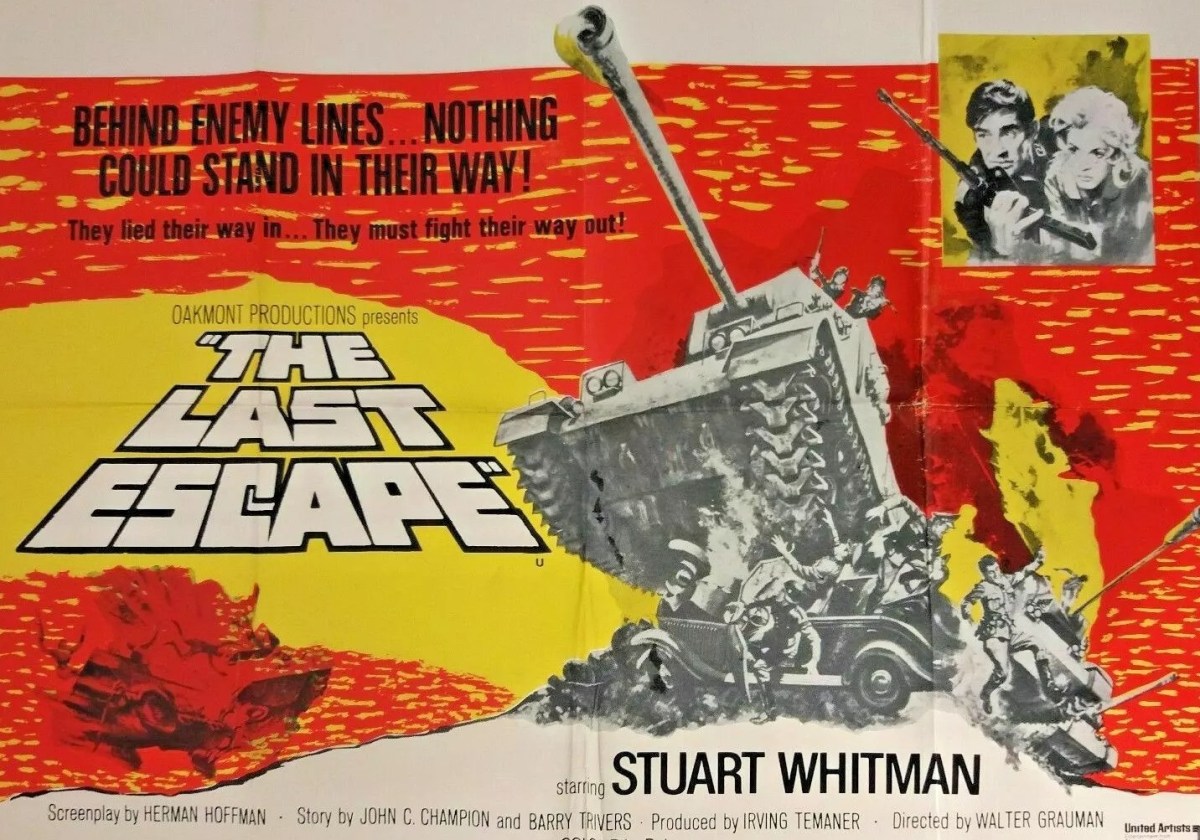
Quite whether James Caan (Red Line 7000, 1965) passed muster as a well-known enough star to qualify as a “personality” at the time he headlined Submarine X-1 (1968) is debatable, as was the presence of James Franciscus (The Valley of Gwangi, 1969) in Hell Boats (1970) and Christopher George (Massacre Harbor, 1968)  in The Thousand Plane Raid (1969) though Stuart Whitman (Rio Conchos, 1964)  exerted a higher marquee appeal for The Last Escape (1970). Veteran Lloyd Bridges (Around the World under the Sea, 1966) who headlined Attack on the Iron Coast (1968) was probably the best known, but these days that was mostly through television. And David McCallum owed whatever fame he had to television as part of The Man from U.N.C.L.E. double act and the idea that would still be enough to attract an audience for Mosquito Squadron (1969) seemed dubious.

Beyond setting up the project, Walter Mirisch had little to do with the actual production, putting that in the hands of Oakmont Production, which beefed up the action with judicious use of footage from other pictures. Invariably, reasons had to be given to explain why actors with American accents were members of the British fighting forces – most commonly they were represented as Canadian volunteers or might have British nationality by dint of having a British mother.

Storylines followed a similar template. At its heart was a dangerous mission. Leaders were invariably hated for some previous misdemeanor or because they were ruthless and drove the men too hard. If there was romance – not a given – it would border on the illicit. And someone required redemption.

And while none of the stars chose – or were chosen to – repeat the experience, Oakmont established something of a repertory company behind the scenes, writers, directors and producers involved in more than one movie.
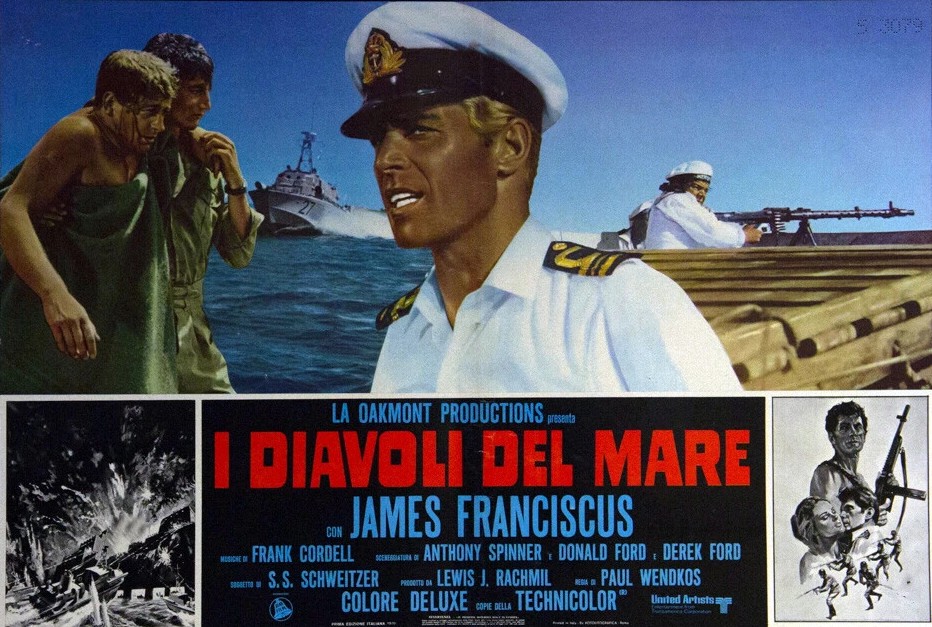
Italian poster (photobusta) for “Hell Boats”. I found Japanese and Australian posters
for most of the films in the series.

Boris Sagal (Made in Paris, 1966) directed both The Thousand Plane Raid and Mosquito Squadron and then made his name with The Omega Man (1971). Paul Wendkos (Angel Baby, 1961) helmed Attack on the Iron Coast and Hell Boats. Walter Grauman who had kicked off the whole shebang with 633 Squadron returned for The Last Escape. William Graham (Waterhole #3, 1967) as the only outlier with just Submarine X-1 to his name.

Veteran producer Lewis Rachmil (A Rage to Live, 1965) oversaw three in the series – Hell Boats, Mosquito Squadron and The Thousand Plane Raid. Another veteran John C. Champion, younger brother of celebrated Broadway choreographer Gower Champion, was involved in a variety of categories. Champion is almost an asterisk these days, best known these days for producing the film Zero Hour! (1957) that inspired disaster parody Airplane! (1980). He was only 25 when he produced his first picture, low-budget western Panhandle (1948). He was behind another four low-budget westerns pictures before Zero Hour!, which had a decent cast in Dana Andrews and Linda Darnell. But that was his last movie for nine years as he switched to television and Laramie (1959-1963), barely reviving his movie career with The Texican (1966) starring Audie Murphy.

He produced Attack on the Iron Coast and Submarine X-1 and was credited with the story for both plus The Last Escape. Irving Temaner produced The Last Escape and received an executive producer credit on Attack on the Iron Coast and Submarine X-1.  Donald Sanford (Battle of Midway, 1976) was the most prolific of the writers, gaining screenplay credits for Submarine X-1, The Thousand Plane Raid and Mosquito Squadron. Herman Hoffman (Guns of the Magnificent Seven) wrote Attack on the Iron Coast and The Last Escape.

Cinema managers were not, it transpired, queuing up for the product. Most commonly, when reviewed in the British trade press, their release date was stated as “not fixed” which generally meant that United Artists was hoping the review would do the trick and alert cinema owners.

In the United States, they rarely featured in the weekly box office reports, though Portland in Oregon appeared partial to the product, Attack on the Iron Coast appearing there as support to Hang ‘Em High (1968), Mosquito Squadron supported The Christine Jorgensen Story (1970), Hell Boats supported Lee Van Cleef western Barquero (1970) while The Last Escape supported Mick Jagger as Ned Kelly (1970). To everyone’s astonishment a double bill of Hell Boats / The Last Escape reported a “big” $10,000 in San Francisco, but that proved an anomaly.

In Britain, the movies fulfilled their purpose as programmers, not good enough to qualify as a proper double bill, but accepted as supporting feature for a circuit release on the Odeon chain. Since UA supplied Odeon with its main features, it proved relatively easy to persuade the circuit to take the war films to fill out a program. This kind of second feature would be sold for a fixed price not sharing in the box office gross. However, they were given the kind of all-action poster they hardly deserved.

So in 1968 Attack on the Iron Coast went out with The Beatles Yellow Submarine. In 1969, Submarine X-1 supported slick heist picture The Thomas Crown Affair, which with Steve McQueen and Faye Dunaway in top form scarcely needed any help securing an audience. Hell Boats was supporting feature in 1970 to Master of the Islands (as The Hawaiians starring Charlton Heston was known). As well as accompanying it on the circuit Mosquito Squadron in 1970 made a very brief foray into London’s West End with thriller I Start Counting and then reappeared a few months later as an alternative choice of support for Billy Wilder flop The Private Life of Sherlock Holmes. If you went to see Burt Lancaster western Lawman in 1971 you might have caught The Last Escape – equally it could have been If It’s Tuesday, It Must Be Belgium (cinema managers could choose either).

United Artists, under the financial cost in the early 1970s, pulled the plug on “programmers” such as these. Walter Mirisch in his biography, disingenuously suggested that the six movies had done relatively well. But that wasn’t supported by the studio’s own figures.

Collectively, they made a loss of $1.7 million. Only Attack on the Iron Coast made it into the black and then by only $59,000. Hell Boats lost $700,000. None of the movies earned more than $200,000 in rentals in the United States.

Although Mirisch managed to keep budgets down to around the million-dollar mark, they would have had to be much smaller to see a profit. Ironically, it was the cheapest, Attack on the Iron Coast costing $901,000,  that made the most. Submarine X-1 lost $150,000 on a $1 million budget, Mosquito Squadron lost $253,000 on a $1.1 million budget while The Thousand Plane Raid lost $50,000 more on the same budget. The longer the series went on, the worse the losses – The Last Escape lost $449,000 on a $995,000 budget while for Hell Boats the budget was $1.36 million.

SOURCES: United Artists Archives, University of Wisconsin; Walter Mirisch, I Thought We Were Making Movies, Not History (University of Wisconsin Press, 2008) p204; Reviews, Kine Weekly – Feb 9 1968, Aug 31 1969, January 1970, April 18 1970; “Flops Loss-Cutting,” Variety, August 26, 1970, p6; “Picture Grosses,” Variety – March 13 1968, May 8 1968, April 24 1968, October 2 1968, June 10 1970, July 1 1970, July 8, 1970, August 12 1970, August 26 1970.

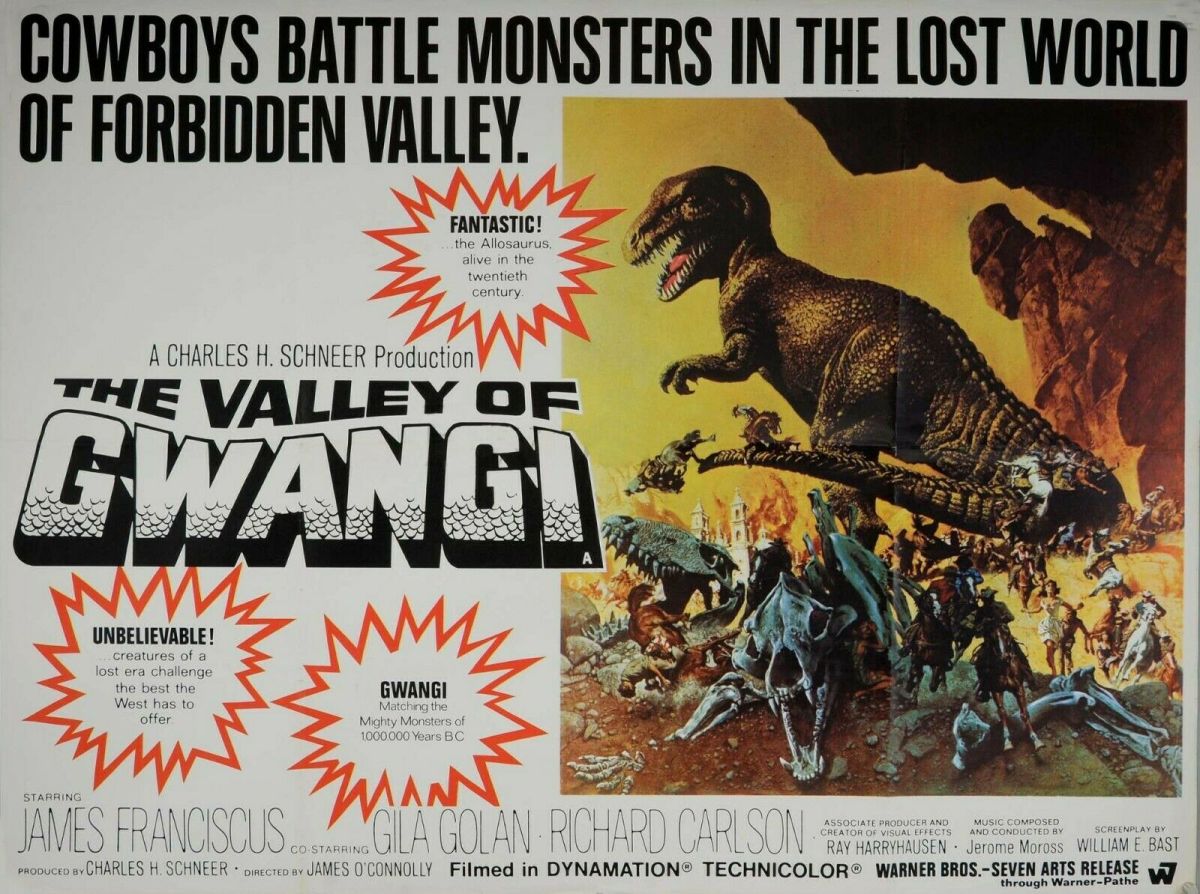
The Valley of Gwangi ****

The special effects are in the five-star range while the movie into which they fit is really worth no more than three stars so I’ve compromised, hence the four-star rating. Actually, the story and characters are interesting enough, and there are some stunning cowboy stunts,  though where is a fur-lined bikini when you need one. Although we are treated to prehistoric monsters, humans fail to have managed the transition to the hidden valley where the creatures have kept out of sight for millions of years. Instead, we are in turn-of-the-twentieth-century Mexico.

However, one specimen, a miniature horse, known as El Diablo, has been found and now resides in a rodeo, property of T. J. Breckenridge (Gila Golan) whose showstopping turn involves leaping on horseback from a high platform through a ring of fire into a pool of water.  Ex-flame and sleek salesman Tuck (James Franciscus) and archaeologist Professor Bromley (Laurence Naismith) follow gypsies who aim to return the horse to the Forbidden Valley. T.J. and a band of cowboys are in pursuit.

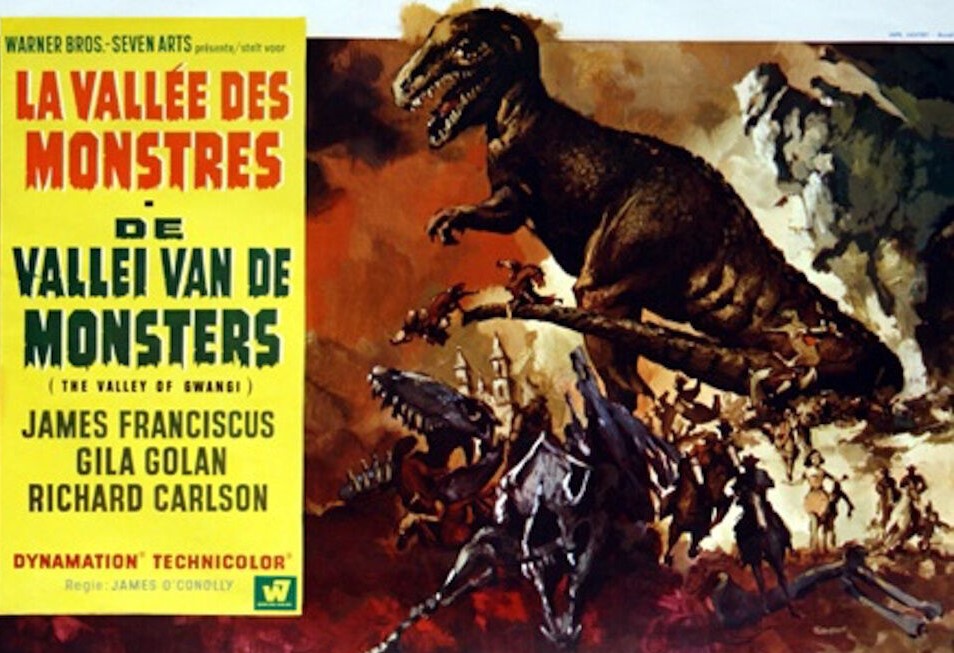
Widening a tiny gap into the unknown world also of course means it’s not big enough for the monsters to escape. The valley is ruled by Gwangi, an Allosaurus, which to most of the audience looks remarkably like a T. Rex. Various battles ensure. A Pteranadon swoops down from the sky and captures one of the cowboys but is killed by Carlos (Gustavo Rojo). Gwangi fights an Ornithomimus and a Styracosaurus. Even if your knowledge of prehistoric monsters  isn’t up to identifying each creature, no matter, the fights are very well done, and a step up in terms of special effects from similar tussles in Harryhausen’s previous venture in One Million Years B.C. (1966) especially as we are less distracted by females attired in fur bikinis.

Naturally, the intent is to capture Gwangi and put him on show a la King Kong (1933) and it’s equally obvious how this particular maneuver is going to work out. That the story follows this particular angle is down to the fact that this movie was the original idea of Willis O’Brien, the special effects genius to created King Kong. After considerable development, RKO shelved the project on the assumption the public was not interested in dinosaurs.

Meanwhile, back in the human tale, the previously principled T.J. lets greed get the better of her and begins resisting Tuck’s overtures. Even if you can guess the finale, it is pretty well done.

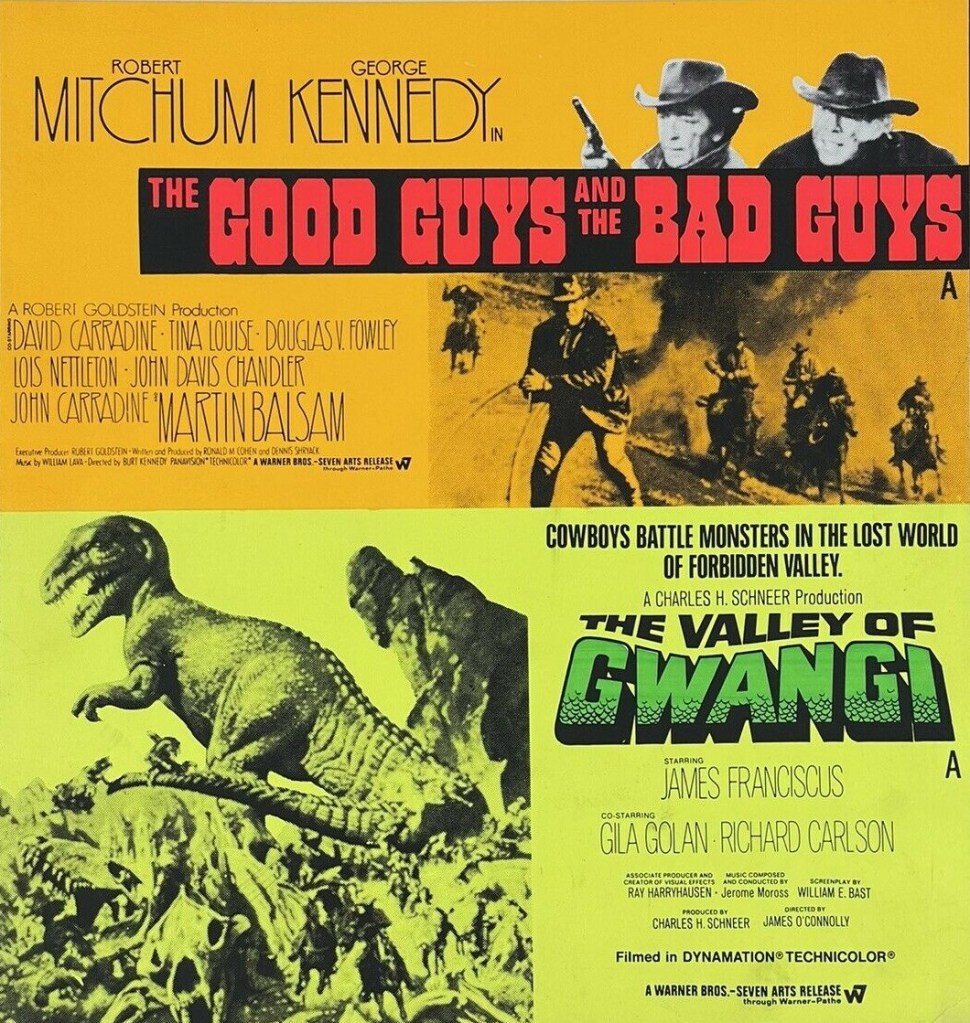
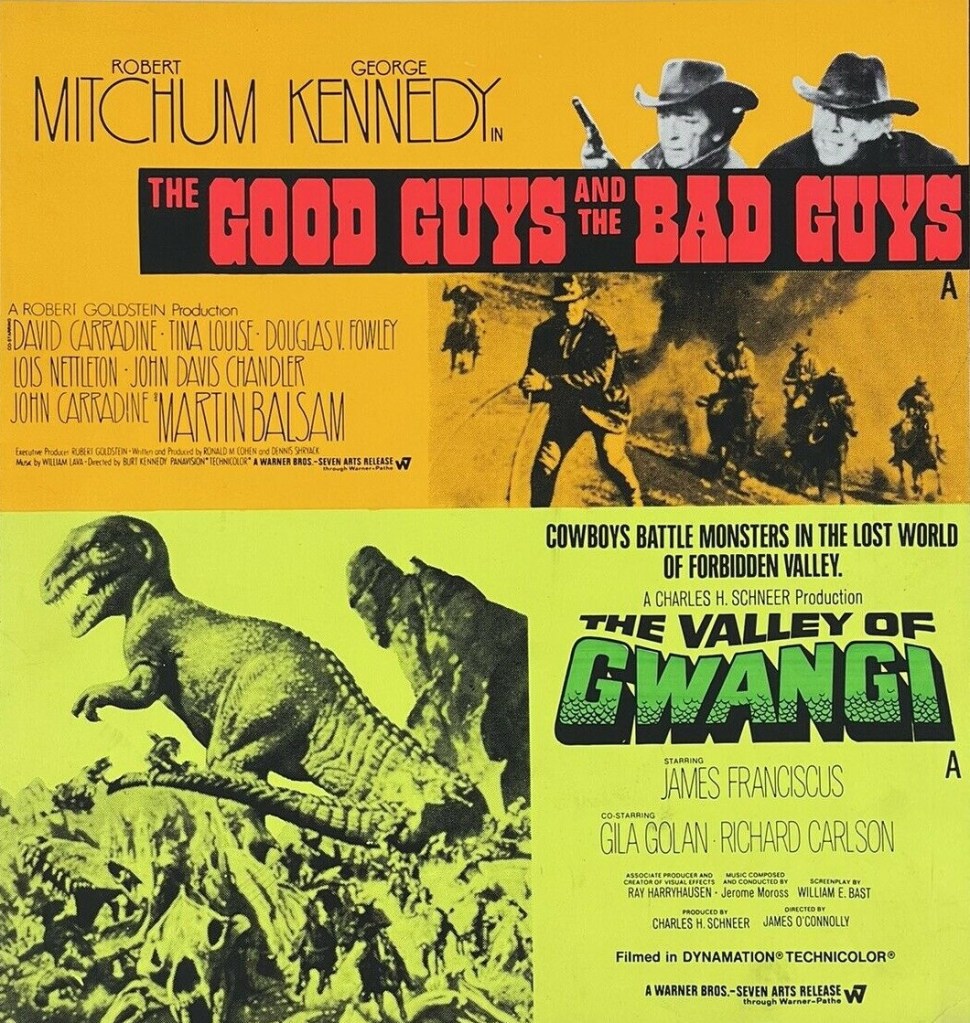
Ray Harryhausen only had a limited fanbase in the 1960s, otherwise this picture would not have done the rounds as the supporting feature to Robert Mitchum western The Good Guys and the Bad Guys (1969). You can tell it lacked the budget of One Million Years B.C. because the creatures fail to remain a consistent color. Even so, this ranks as one of the top special effects achievements and these days Harryhausen’s work is much more appreciated.

Unless you are Raquel Welch, it’s difficult for an actor to compete with prehistoric monsters. At least here, the stars had decent dialog and the tangled romance provides entertainment as do the host of stunning stunts in the rodeo and a bull running amok. Charlton Heston look-alike James Franciscus (Youngblood Hawke, 1964) is a plausible love interest who doesn’t let romance get in the way of a fast buck. The role of Gila Golan (Our Man Flint, 1966) extends to more than eye candy and there’s not a bikini in sight or disrobing of any sort. Richard Carlson (Creature from the Black Lagoon, 1954) was a sci-fi veteran and Laurence Naismith had appeared in Jason and the Argonauts (1963). British actress Freda Jackson (The Third Secret, 1964) plays a witch.

Director Jim O’Connolly (Vendetta for the Saint, 1969) keeps the human elements rolling along and once monsters join in the fun there’s scarcely time to draw breath. William Bast (Hammerhead, 1968) pulled together the human and monster elements for the screenplay.

Harryhausen fans will have a ball.

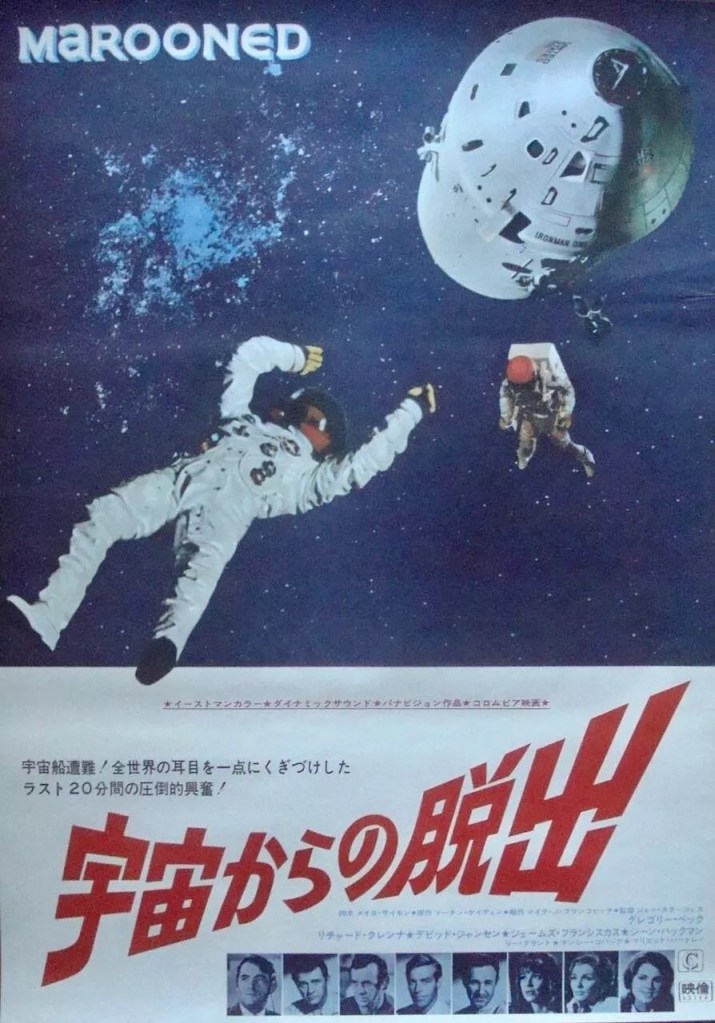
Marooned (1969) ****

The forgotten one. Left out in the cold by audiences and critics alike in the late 60s sci fi boom by the more audacious 2001: A Space Odyssey (1968), Barbarella (1968) and Planet of the Apes (1968). And that’s a shame because it’s by far the most realistic (to the nth degree) of the space movies. Audiences growing up with astronauts saving their own skins with ingenious maneuver – sling shot and whatnot – in Apollo 13 (1995) and The Martian (2015)  might be shocked by the harsh reality of space travel as evidenced here. Astronauts are little more than helpless creatures in a tiny box with ground control in obsessive control. It’s salutary that escape was the audience mindset even after the Challenger Space Shuttle disaster of 1986.

Nobody thought to tell audiences to buckle up because they were in for a hell of a ruthless ride back in the day, but this one really should come with a warning.

Casting makes this work – when it shouldn’t. It’s full of those kind of actors who scarcely move their lips and rarely engage in extraneous facial movement. You can hear director John Sturges issuing instructions: to Gregory Peck, keep those brows knitted; to David Janssen, keep your head lowered and keep with the muttering; to Richard Crenna, don’t move a muscle; to Gene Hackman, limit that trademark chuckle to just once. Why this shouldn’t work is because the big star isn’t in the goldfish bowl of the shuttle cockpit, and since there’s none of the get-to-know-the-crew backstory of The Right Stuff (1983) or Apollo 13 there’s nobody to really root for, especially as the crew is just siting there, doing (by instruction) nothing and awaiting their fate. Which, by the way, which is constantly spelled out, is to suffocate from lack of oxygen.

But there’s a reason Gregory Peck’s on the ground and not in space. Because he’s the one making the life-and-death decisions.

This is by far Gregory Peck’s toughest role. He pulled out of Ice Station Zebra (1968) because he didn’t like the slant of the character, and since then he’d been in typical upstanding heroic mode in The Stalking Moon (1968), Mackenna’s Gold (1969) and The Chairman (1969). Here he’s the king of data management and crisis control, the most ruthless, heartless sonofa you’d ever encounter, not willing to take a risk on greenlighting a rescue mission because the computer says no. The weaselling PR-speak that’s all about saving the space program and making allowance for collateral damage is nothing compared to his terrible delivery of news to one of the wives that her husband is dead. She collapses with emotion, he puts the phone down.

If you’re geek-minded, you’ll give this five stars because there’s information overload. “Go” and “Mark” are the most commonly used words. And in case you can’t judge from the visuals what’s going on, there’s usually some television commentator voice-over to help you out.

So, the Ironman One mission hits trouble when its retro rockets refuse to ignite for return to Earth after several months in space. They’ve got 40 hours or so to effect a rescue before the oxygen runs out for crew members Jim Pruett (Richard Crenna), Buzz Lloyd (Gene Hackman) and Clayton Stone (James Franciscus). The crew are forbidden to try any stunts themselves because any exertion will use up valuable oxygen.

Plan by chief astronaut Ted Dougherty (David Janssen) to mount a rescue operation via an untried spaceship XRV (smaller than a helicopter, by the way) is vetoed as too risky by NASA boss Charles Keith (Gregory Peck) until the President, terrified of public reaction, overrules him. With time running out the impending launch is hindered by an approaching hurricane. But then, in the only nod to ingenuity, someone suggests taking off in the eye of the hurricane, when wind force will be zero.

Meanwhile, up in space, the three stalwarts are slowly coming apart. Buzz, the toughest-looking of the trio, is worst affected, screaming his head off as the prospect of dying looms. Then they are faced with a terrible decision. With the rescue delayed, there’s not enough oxygen to see them through, so one has to sacrifice himself.

I told you it was brutal stuff. About the last 30 minutes are not about whether they can be saved, but who will die and how, the impact of asphyxia on the brain spelled out by resident boffin Clayton. By this point anything they do will almost certain sabotage any rescue and they’re in cloud cuckoo land as Keith tries to keep them in line.

While there’s certainly information overload and a few questionable scientific decisions (can you really open a hatch straight into space?), the reality of the drama more than holds the enterprise together. The realpolitik, the callous use of the wives to go along with the company line as they watch their husbands suffer before their very eyes, the management of potentially bad news, was perhaps a shock for audiences back in the day but would be accepted more easily by contemporary moviegoers.

The acting is first class. Gregory Peck never attempts to lighten his load, to make his character less unattractive and appease his following. David Janssen (Warning Shot, 1966) is as solid as ever. Gene Hackman (The Gypsy Moths, 1969) is the pick of the crew but Richard Crenna’s (Midas Run, 1969) less showy disintegration packs a punch. Lee Grant (The Big Bounce, 1969) is the standout among the wives.

Much as Sturges lets the computerspeak run away with itself, he doesn’t flinch when it comes to the really tough scenes. Written by Mayo Simon (I Could Go On Singing, 1963) from the Matt Caidin source novel.

Under-rated. Worth a look.

When Time Ran Out (1980) / Earth’s Final Fury ***

The Director’s Cut, can you believe? Or less pompously, The Expanded Version. An extra 30 minutes added to the general release version that traveled the world to general disfavor. (The original 121-minute cut was edited to 109 minutes and this version clocks in at 144 minutes.) Was it a sense of disgruntlement – or sheer opportunism – that led to the Director’s Cut, so many of which scarcely improved on the original version. How many versions can an audience take of The Exorcist (1973) or Blade Runner (1982)? And even where extra length definitely added depth to Kingdom of Heaven (2005) that couldn’t overcome its major flaw, in a massive case of hubris, director Ridley Scott believing he could get away with casting Orlando Bloom instead of waiting till Russell Crowe became available.

When Time Ran Out killed off the disaster cycle and the Hollywood career of uber-producer Irwin Allen who had started that particular ball rolling with The Poseidon Adventure (1972), upped the ante with The Towering Inferno (1974) and dropped the ball with The Swarm (1978) and Beyond the Poseidon Adventure (1979).

This doesn’t feel so much like a disaster movie as a picture tying up all the knots, various relationships coming asunder, and having to accommodate a bunch of well-known supporting actors of dubious all-star-cast status before they suddenly spring into dramatic narrative view.   Audiences had never been particularly keen on volcanic pictures, after all what can the trapped characters do but dodge a sludge of soup and hope they don’t run straight into a tidal wave or, worse, have to negotiate a rickety/rope bridge. The chances of you having a tightrope walker coming to the rescue would generally be remote but that’s what we have here (step forward Burgess Meredith).

I had thought from the title and some guy in a hazmat suit wandering over a desolate area that this might be a prophetic eco-disaster, but excepting that there’s, for reasons best known to the scriptwriters, an oil well being drilled close to a volcano and that hotel investor Shelby (William Holden) has the bright idea of using the volcano as a marketing prop, there’s nothing much going on. The special effects are okay on the small screen, but even if they had been spectacular on the big screen their effect on the much smaller environs of DVD would in any case have been diminished.

So, basically, it’s reliant on working up sufficient audience interest in the relationships to make us care for the characters. We’re offered a pair of two-timing teams. First up, we’ve got Shelby’s secretary and marketing guru Kay (Jacqueline Bisset) who’s just turned down the offer to become his sixth “or seventh” wife, but who, presumably is enjoying, this being the 1980s and not the 1930s, some kind of sexual dalliance with him. When Kay meets up with oil driller old flame Hank (Paul Newman), they rekindle their romance, although with doom impending there’s not much time to take it forward beyond a picnic on the beach.

Next up, hotelier Bob (James Franciscus) is cheating on wife Nikki (Veronica Hamel), Shelby’s god-daughter, with staff member Iolani (Barbara Carerra) who is due to be married to childhood sweetheart hotel manager Brian (Edward Albert). To flesh out the tale, both Shelby and Bob have daddy issues, Tom (Ernest Borgnine) is a New York cop on the tail of swindler Francis (Red Buttons), and no doubt audiences will be desperate to find who wins a  cockfighting contest being held in a local saloon.

Modern transport proves no match for an eruption, so in quick succession we see a car and a helicopter tumbling down the mountainside. The tsunami wipes out a good chunk of the actors that didn’t make it into the all-star-cast bracket and everyone else takes to the hills, no doubt hoping they won’t encounter a rickety/rope bridge. Disaster turns enemies into pals, Tom and Francis, for example, though it’s only now that Nikki comes across her husband’s infidelity.

And this would be a disaster all round except that having hooked myself into watching this, courtesy of a freebie on YouTube, and nothing of real dramatic interest going on, I found myself, oddly enough, concentrating on the three principals and was treated, even more odd I guess, to fine examples of just what these stars do to earn their crust. Paul Newman (The Prize, 1963) in particular, with very little to react to, does very little but with incredible facial agility, to genuine effect, portraying emotion with infinitesimal gesture. Sure, he’s always had the shrug and the walk, both far more suggestive of inner turmoil than any other actor I can name, but here, with very little dialog coming to his aid, you can tell exactly what’s going on in those baby blues.

Jacqueline Bisset (The Cape Town Affair, 1969), too, dressed a good bit less suggestively than in the posters, essays a confident woman coming unstuck when confronted with a romantic error. The scenes between the pair are not meant to be scorching, so there’s none of the screen charisma audiences might feel they’ve been sold, but instead it’s a slow-burn, a couple trying to come to terms with each other, passing through disappointment and hopefully onto something better. And you can’t find anyone better to carry disillusion than William Holden (The Devil’s Brigade, 1968).  

Abject swansong for director James Goldstone (Winning, 1969) and Oscar-nominated screenwriter Carl Foreman (The Guns of Navarone, 1961) but Oscar-winning co-writer Stirling Silliphant (Marlowe, 1969) carried on longer. Who wrote the most effective scenes, Shelby’s engagement ploy and Hank’s initial rejection of Kay, is anybody’s guess but there is some quality writing here. Probably the strangest part of the whole debacle was that the source was a piece of non-fiction, The Day the World Ended by Gordon Thomas and Max Morgan Witts, about a 1902 eruption on Martinique that had nothing to do with oil wells or hotel construction.   

There’s always something wrong with a disaster picture if you suggest watching it for the acting, but happily, this is the case.

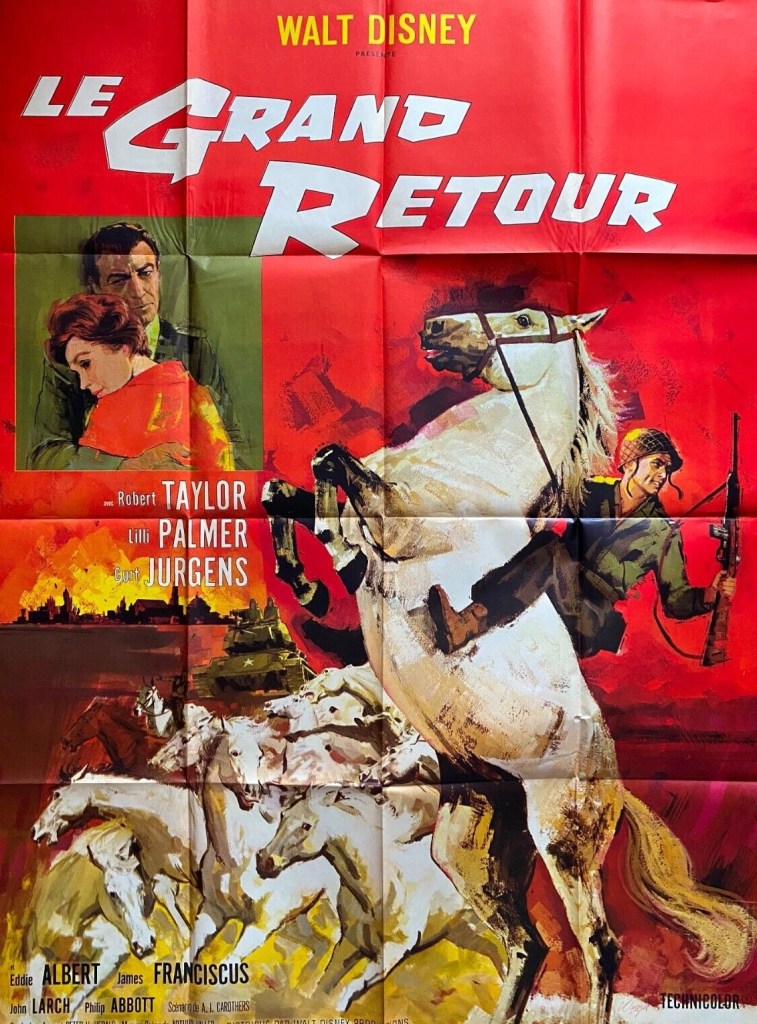
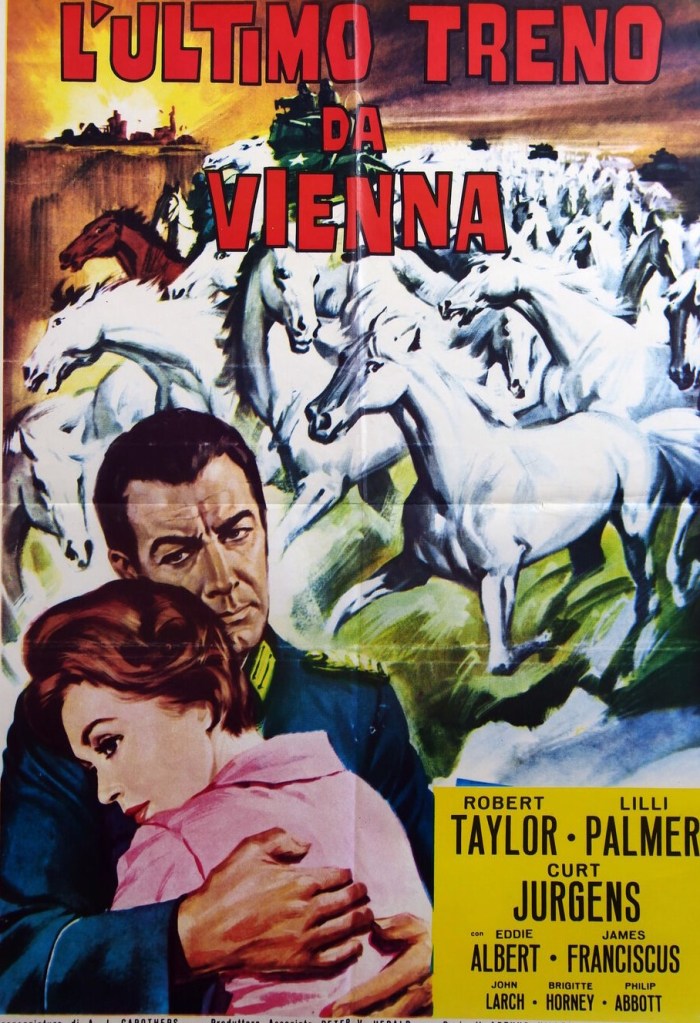
Miracle of the White Stallions (1963) ***

You wouldn’t look to Walt Disney in the 1960s to provide a tyro director with a calling card when so much of that studio’s output was saccharine. But this beautifully-mounted World War Two drama showed there was a new kid in town worth watching, name of Arthur Hiller. And if you always wondered why the later biopic of General Patton showed him in riding gear, that penchant is more clearly explained here.

You might balk, however, at the idea of a bunch of horses being considered in the same category as an art treasure worth protecting from the worst predations of war. And just as with the Von Trapp family, Austrians, despite welcoming the annexation of their country by Hitler in 1938, are given a free pass here.

In case you’re unfamiliar with the subject matter, the Spanish Riding School in Vienna was a celebrated nearly 200-year-old institution in which the famed Lipizzaner white “dancing” horses were put through their paces. With the Second World War coming to a close it was threatened on three fronts: the German Army poached its instructors to man the front line, the invading Russians wanted to appropriate the horses and starving refugees focused on the potential horse meat.

School chief Col Alois Podhajsky (Robert Taylor) and wife Pedena (Lili Palmer) organise an evacuation under the guise of using the horses to draw cartloads of legitimate art treasures. They hole up in the castle of Countess Arco-Valley (Brigitte Horney) but the mares are stolen by the Russians and hidden in Czechoslovakia. (Only the stallions perform, but without the females as breeding stock, the line would become extinct.)

The colonel ditches his German uniform on the arrival of American forces and puts on a performance in a makeshift arena in an attempt to convince Patton (John Larch) to mount a rescue of the captured horses. Patton, we learn here, is a renowned horseman, competed in the equestrian section of the 1912 Olympic Games, and if anyone considers a fabulous horse more valuable than a work of art it’s him. As it happens, there are prisoners to be freed in Czechoslovakia so the horses are included in that mission.

What’s unusual about this animal tale, given Disney’s predilection for anthropomorphising animals, is that it’s not told from the point-of-view of the horses. Nor, as you might have expected, given the studio’s plethora of young talent, turned into  the story of a young girl or boy attached to the horses. Instead, the focal point is the impact of the creatures on those around them.

Of course the colonel is bound to be obsessed. But for the ordinary soldiers, who might never appreciate a work of art, they represent a kind of majesty,  a grandeur, rising above the horror of war, something well worth the effort of rescue.

What’s even more unusual in saccharine-town is the script’s recognition of the effect of war on humanity. At one point Pedena laments that men are asked to possess “the strength and fury of giants…and then be again the men they were before.” And in some respects acknowledging the beauty of the horses is a step in the right direction. The Yanks are neither celebrated as brave nor foolhardy, in fact mostly they are just working grunts, cleaning out the castle, fixing up the arena, cracking jokes.

Hiller is the big find here. There’s a brilliant scene, all of 40 seconds long (I timed it) that would have been cut out of any other Disney picture. In a chiaroscuro of light, the colonel walks from one end of the deserted Vienna riding hall to the other and his wife, entering the frame, goes to join him. Nothing more is needed to indicate loss. Hiller clearly recognised opportunity and while the film itself is no masterpiece every single frame reveals a talented mind at work, his use of colors and costume, movement within the frame, employing Pedena and the Countess to comment on the action, allowing the inbuilt tension to carry the story without extraneous drama.

You’re mostly likely to remember the performing horses, the balletic choreographed movements, the “airs above the ground,” and indeed Hiller wisely devotes a good 15 minutes to this, but without his input this would either be overly sentimental, saccharine or little more than a documentary. This is a very grown-up picture for Disney.

Robert Taylor (A House Is Not A Home, 1964) was at the tag-end of his career, his first film in four years, but he still has the charisma to carry the film and the gravitas to see it over the line. Lili Palmer (The Counterfeit Traitor, 1962) is well cast as a voice of reason and offering commentary on humanity. Curt Jurgens (Pysche ’59, 1964) has an interesting role, lamenting, as he picks out a classical tune at the piano, how Hitler outlawed famous composers.

There’s a stronger supporting cast than you might expect: Eddie Albert (Captain Newman M.D., 1963) , James Franciscus (Valley of Gwangi, 1969) and German actress Brigitte Horney (The Trygon Factor, 1966).

Somebody certainly took notice of Hiller’s talent because his next films were The Wheeler Dealers (1963) with Lee Remick and James Garner and The Americanization of Emily (1964) with Julie Andrews and Garner.  A.J. Carothers (The Happiest Millionaire, 1967) based the screenplay on the book by Alois Podhajsky.

The Valley of Gwangi (1969) ****

The special effects are in the five-star range while the movie into which they fit is really worth no more than three stars so I’ve compromised, hence the four-star rating. Actually, the story and characters are interesting enough, and there are some stunning cowboy stunts,  though where is a fur-lined bikini when you need one. Although we are treated to prehistoric monsters, humans fail to have managed the transition to the hidden valley where the creatures have kept out of sight for millions of years. Instead, we are in turn-of-the-twentieth-century Mexico.

However, one specimen, a miniature horse, known as El Diablo, has been found and now resides in a rodeo, property of T. J. Breckenridge (Gila Golan) whose showstopping turn involves leaping on horseback from a high platform through a ring of fire into a pool of water.  Ex-flame and sleek salesman Tuck (James Franciscus) and archaeologist Professor Bromley (Laurence Naismith) follow gypsies who aim to return the horse to the Forbidden Valley. T.J. and a band of cowboys are in pursuit.

I saw this double bill in 1969 when it was shown on the ABC circuit in Britain.

Widening a tiny gap into the unknown world also of course means it’s not big enough for the monsters to escape. The valley is ruled by Gwangi, an Allosaurus, which to most of the audience looks remarkably like a T. Rex. Various battles ensure. A Pteranadon swoops down from the sky and captures one of the cowboys but is killed by Carlos (Gustavo Rojo). Gwangi fights an Ornithomimus and a Styracosaurus. Even if your knowledge of prehistoric monsters  isn’t up to identifying each creature, no matter, the fights are very well done, and a step up in terms of special effects from similar tussles in Harryhausen’s previous venture in One Million Years B.C. (1966) especially as we are less distracted by females attired in fur bikinis.

Naturally, the intent is to capture Gwangi and put him on show a la King Kong (1933) and it’s equally obvious how this particular maneuver is going to work out. That the story follows this particular angle is down to the fact that the movie was the original idea of Willis O’Brien, the special effects genius to created King Kong. After considerable development, RKO shelved the project on the assumption the public was not interested in dinosaurs.

Meanwhile, back in the human tale, the previously principled T.J. lets greed get the better of her and begins resisting Tuck’s overtures. Even if you can guess the finale, it is pretty well done.

Ray Harryhausen only had a limited fanbase in the 1960s, otherwise this picture would not have done the rounds as the supporting feature to Robert Mitchum western The Good Guys and the Bad Guys (1969). You can tell it lacked the budget of One Million Years B.C. because the creatures fail to remain a consistent color. Even so, this ranks as one of the top special effects achievements and these days Harryhausen’s work is much more appreciated.

Unless you are Raquel Welch, it’s difficult for an actor to compete with prehistoric monsters. At least here, the stars had decent dialogue and the tangled romance provides entertainment as do the host of stunning stunts in the rodeo and a bull running amok. Charlton Heston look-alike James Franciscus (Youngblood Hawke, 1964) is a plausible love interest who doesn’t let romance get in the way of a fast buck. The role of Gila Golan (Our Man Flint, 1966) extends to more than eye candy and there’s not a bikini in sight or disrobing of any sort. Richard Carlson (Creature from the Black Lagoon, 1954) was a sci-fi veteran and Laurence Naismith had appeared in Jason and the Argonauts (1963). British actress Freda Jackson (The Third Secret, 1964) plays a witch.

Director Jim O’Connolly (Vendetta for the Saint, 1969) keeps the human elements rolling along and once monsters join in the fun there’s scarcely time to draw breath. William Bast (Hammerhead, 1968) pulled together the human and monster elements for the screenplay.

Harryhausen fans will have a ball.

Discover WordPress

A daily selection of the best content published on WordPress, collected for you by humans who love to read.

The Atavist Magazine

by Brian Hannan

WordPress.com News

The latest news on WordPress.com and the WordPress community.