Complication. The keenest weapon in the screenwriter’s armory. And the most overused and, conversely, not employed to its greatest potential. Generally, it’s the only device for a romance – boy meets girl, (enter complication as…) boy loses girl, boy gets girl. But, just occasionally, it appears with some skill, layer after layer of deft complication until a whole story is tied up in acceptable and believable knots.
Before we get into all that it’s worth pointing out how language changes. These days mention of “action” will carry connotations of a sexual nature, so, just to be clear, here we’re talking about gambling, betting on horses, the mythical sure thing. And if you want to take a more cosmic perspective, we can apply the scientific rule that every action has a re-action, in other words consequence.
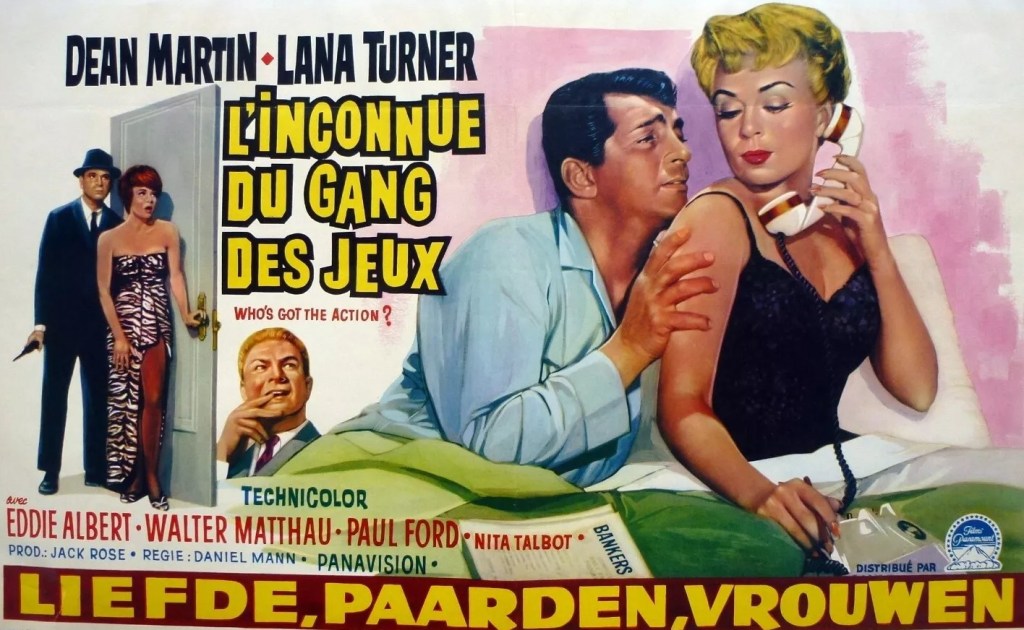
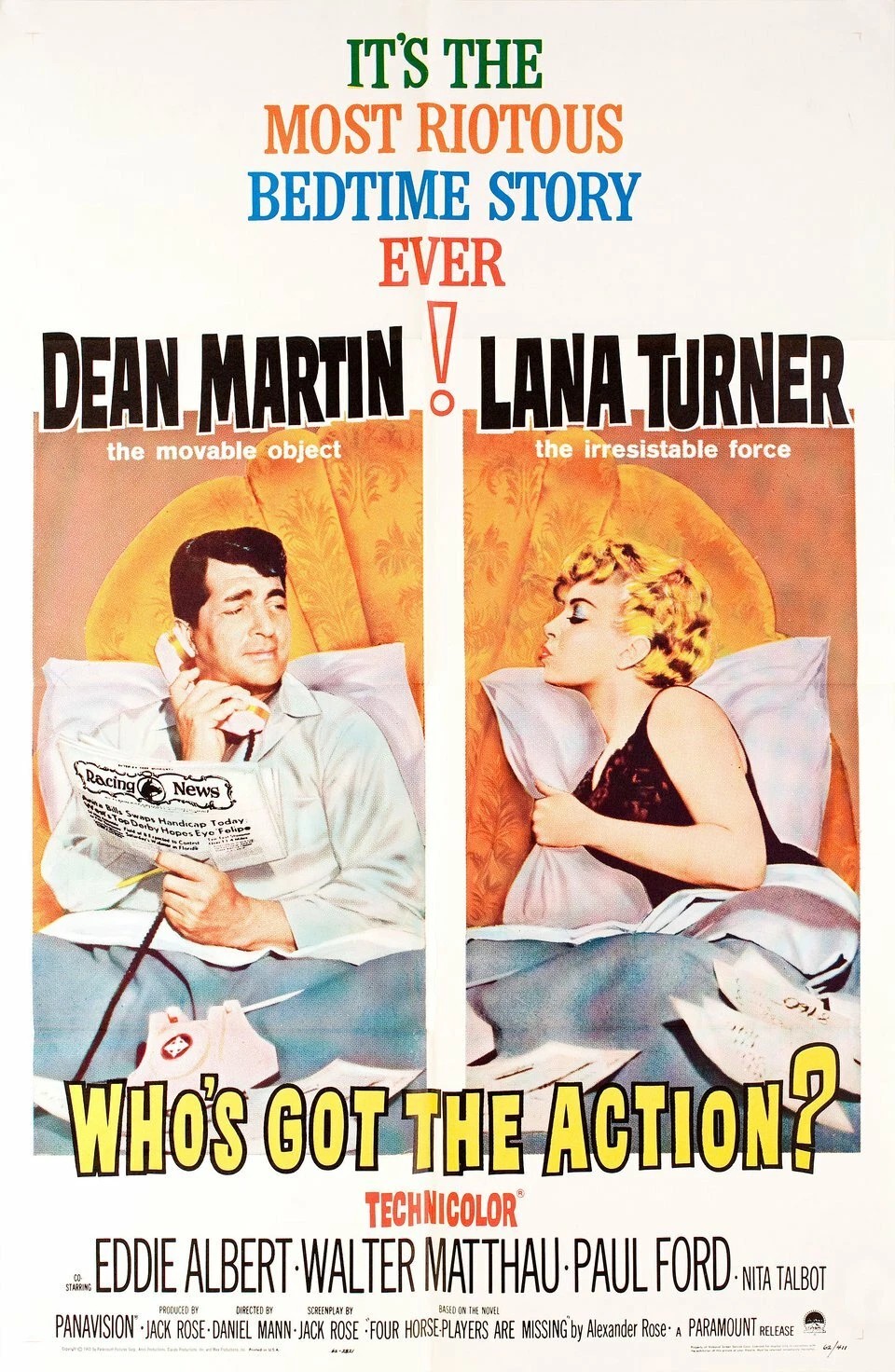
Attorney Steve Flood (Dean Martin) has a gambling addiction. He’s $8,000 in the hole to illegal bookie Clutch (Lewis Charles). Steve’s wife Melanie (Lana Turner) comes up with a clever idea to wean him off his addiction, by creating a fictional bookie, so that her husband’s losses will come to nothing. So she calls in Steve’s partner Clint Morgan (Eddie Albert) triggering Complication No 1. Clint’s always had the hots for Melanie and hopes to take advantage of Steve’s problems, helping her out by agreeing to act as the mythical bookie.
And that would be fine except for Complications No 2 and No 3. Instead of losing, as has been the trend, Steve wins big on his first bet, so now Melanie has to find a large chunk of dough. In dumping Clutch, Steve has come to the attention of mobster Tony Gagouts (Walter Matthau) who’s wondering about the mysterious new bookie queering his pitch and denying him a good customer (such is the definition of a loser).
Steve’s gambling success creates Complication No 4, attracting the interest of a pair of judges who are happy to stake the gambler, whose winning streak shows no sign of stopping.
Complication No 5 – Melanie turns to nightclub singer Saturday Knight (Nita Talbot), her next door neighbor and girlfriend of Tony, for help in raising cash and she obliges by buying some of the couple’s furnishing while Melanie also pawns jewelry.
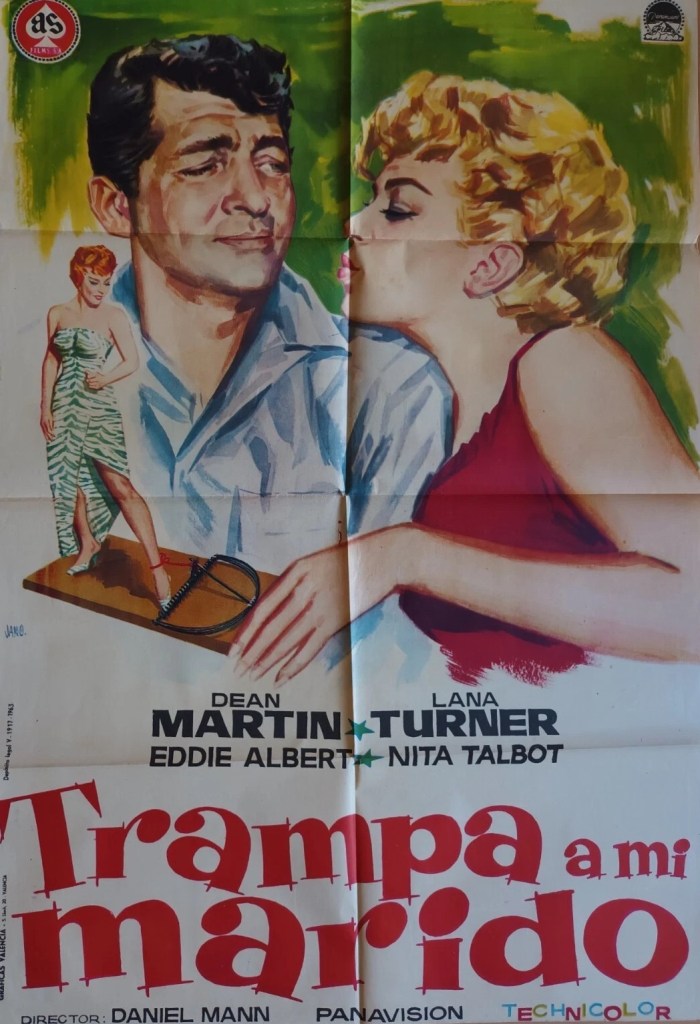
Complication No 6 is created by Tony, who, trying to trace the rival bookie, installs a wiretap that leads him to the Flood apartment. And that should be the end of the tale, and little chance of a happy ending, except for Complication No 7. Tony has incriminated himself via the wiretaps and with an attorney ready to exploit the situation, it all works out fine, original debt to the gangster wiped out and the mobster blackmailed into marrying Saturday.
Now, with so many complications and sub-plots, this isn’t a Dean Martin picture the way the Matt Helm series is, especially not with a co-star like Lana Turner (By Love Possessed, 1961) who, not weighed down by the kind of heavy romantic tangle that seemed her remit at this point of her career, has the chance to steal a good deal of the limelight.
But the strong supporting case also do their best to chisel scenes away from the big stars. Eddie Albert’s (Captain Newman M.D., 1963) idea of a seductive lunch is a cracker and Nita Talbot (Hogan’s Heroes series, 1965), fashion ideas like Audrey Hepburn on speed, can’t help but play up to the camera. Walter Matthau is trying out a characterization for Charade (1963).
The beauty of this is that the narrative follows a neat logic. You can’t just muscle in on the illegal gambling business.
Director Daniel Mann ( A Dream of Kings, 1969) whips up an entertaining Runyonesque comedy from a screenplay by Jack Rose (It Started in Naples, 1960) based on a novel by namesake Alexander Rose who you might have spotted wearing his acting hat in The Hustler (1961).
They seemed to be a lot better at these effortless concoctions back in the day.

 The Magnificent 60s