Ambush Bay (1966) ****

I’m going out on a limb on this one. I don’t think anyone’s done anything but give it a cursory examination and mark it down as a standard programmer of the era. But I saw a lot that was considerably impactful.

Generally speaking, although the war picture had gradually shifted from the gung-ho to the more realistic (Operation Crossbow, 1965, Von Ryan’s Express, 1965), it’s generally accepted that it was The Dirty Dozen (1967), Beach Red (1967) and Play Dirty (1968) that ushered in the new era of authenticity and violence.
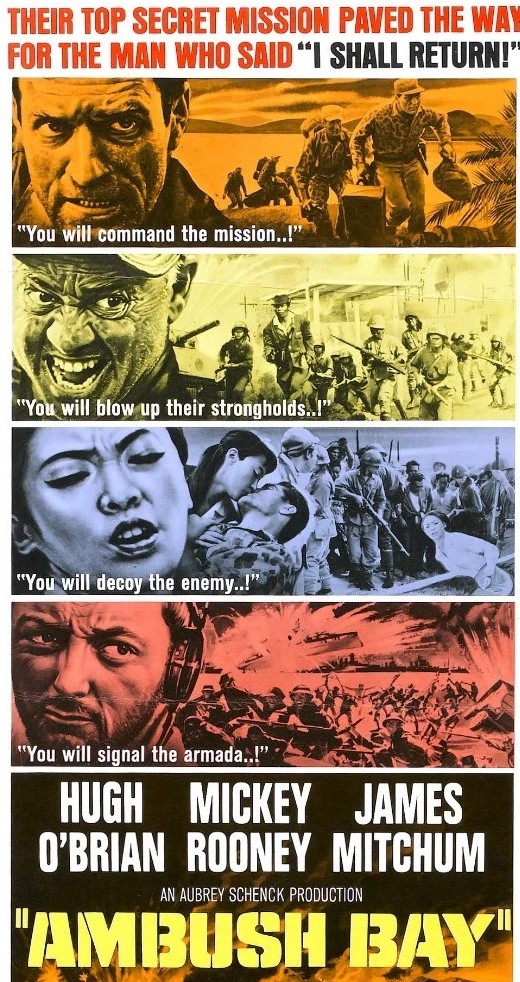
Oddly enough, this little picture, minus the bloodletting, was the bridge. It’s way tougher than you would expect for a low-budget picture only ever intended to fill out the lower half of a double bill and never going to catch the eye of a critic hoping to find an unknown movie to punt.

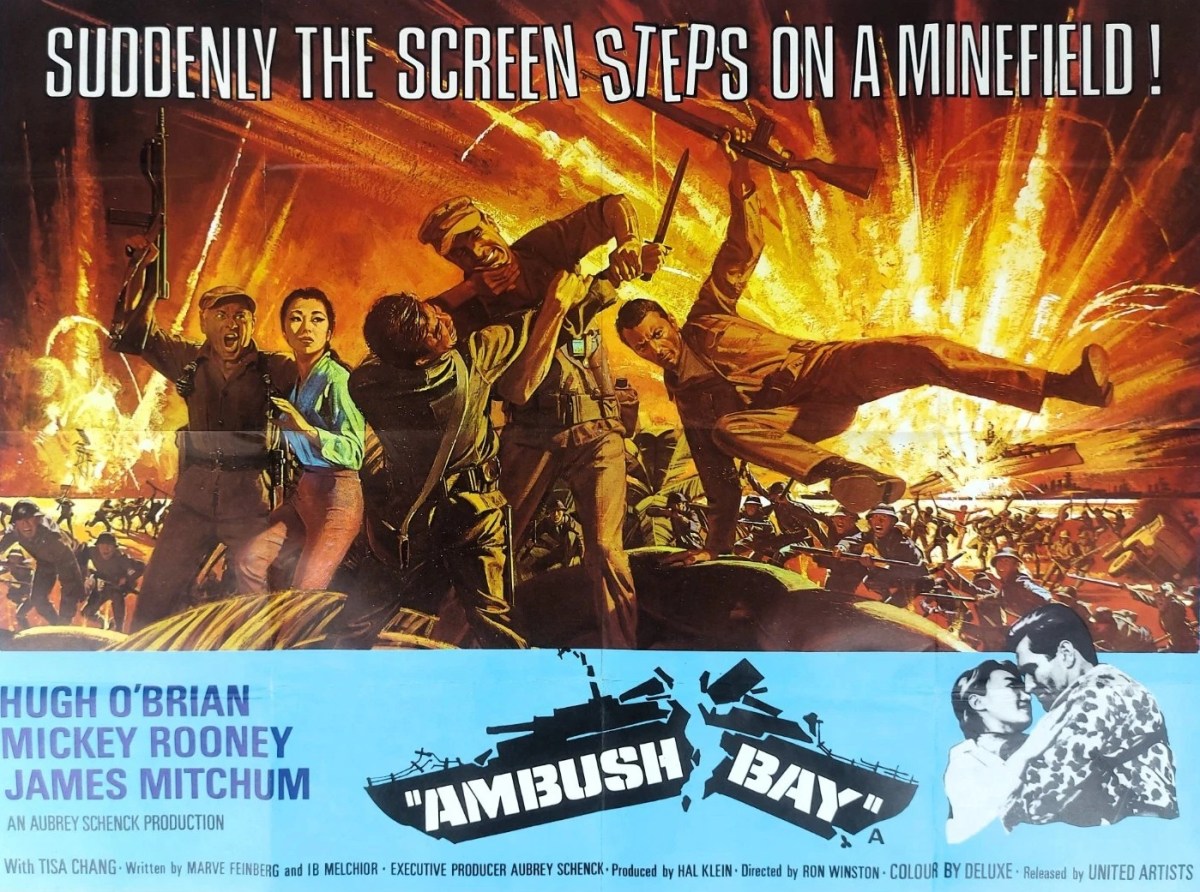
Let’s start with the ruthlessness. A bunch of Yanks on a secret mission in the Philippines are hounded by Japanese soldiers. At their first encounter, knives are the weapon of choice so as not to attract attention. We don’t see the knives going in but we hear them slicing into flesh. They capture one of the enemy who begs to be taken prisoner but nobody’s got time to bother with such niceties so they tie him to a tree and come morning he’s dead. Rather than give away their own position, they don’t fire on the pursuing Japanese which results in one of their own being killed. A female American-born Japanese spy, convinced her natural charms can distract the Japanese, volunteers at one point to stay behind, even if that means becoming the sexual plaything of the Japanese commander and then passed on to his men. And when that ploy fails she is ruthlessly sacrificed.

There are other narrative reversals. The Dirty Dozen, for example, begins with a lengthy introduction to each of the condemned men. Here, as the team prepare to land on the Philippines, we are introduced, via voice-over, to each of the team. And then you learn that the real reason for this is that we’ll count up the number of men in the group and become aware that they are gradually being whittled away.
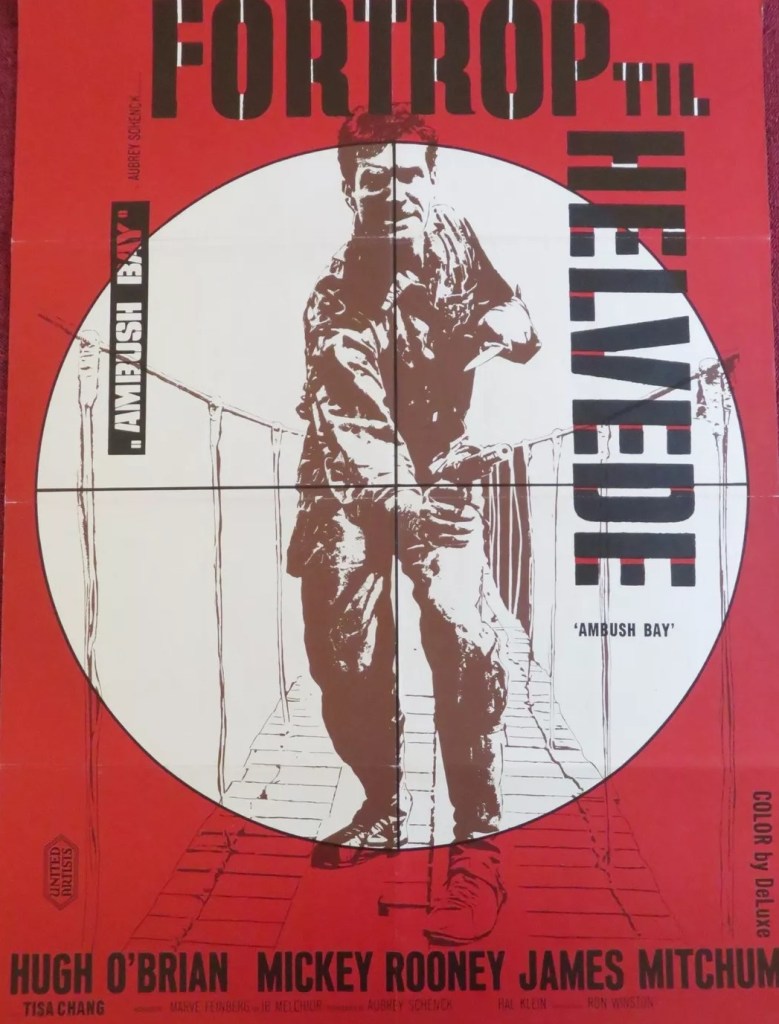
And then there’s the voice-over itself. This not being one of those post-modernist numbers where the narrator is speaking from beyond the grave, audiences know that a narrator is a survivor. But what they’re not going to guess is that he’ll be the only survivor.

Or that he least deserves to survive. Private Grenier (James Mitchum) is a rookie – “six months ago he was stacking shoe boxes” – and he’s truculent and troublesome. His only job is to keep the radio safe, excused fighting duties so that he can broadcast to the waiting General MacArthur the outcome of the mission. But he’s as useless at guarding the radio as he is at everything else and the radio is shot to pieces. He’s so dumb he doesn’t realize the purpose of a Japanese tea house.

There’s not an ounce of the gung-ho. The dialog is delivered in an undertone. Nobody makes a meal of any line of dialog no matter ho juicy. Everything undercuts. When Commander Sgt Corey (Hugh O’Brian) plans to go into serious harm’s way his number two Sgt Wartell (Mickey Rooney) asks what will happen if he doesn’t come back. In matter-of-fact tones, but without the snap of someone thinking he’s delivering a great line, Corey replies, “You get a field promotion and an extra eight bucks a month.”

The Ambush Bay of the title is supremely ironic. It’s the Americans who are going to be ambushed. The Japanese have seeded the sea-bed of the beach where they guess the Americans are going to land with mines. Nothing unusual there. Minesweepers will clear the path. Except these are unusual mines, anchored to the seabed and only loosened by remote control by the enemy.

The initial mission is just to locate the aforementioned spy Miyazaki (Tisa Chang) who turns out to be a sought-after sex worker in the tea house. But when the radio is out of action, they have to disable the radio tower controlling the mines. By this point they’re down to just two men, Corey and Grenier.

Grenier has the ingenious plan of draining fuel from a truck to make a Molotov cocktail, toss it into a fuel dump and in the confusion make their way to the radio tower. Even at this late stage, reversals come thick and fast. Great idea – you got a match? Nope. But the lorry driver is smoking. He discards a lighted cigarette. But when he gets out of his cab he grinds the cigarette with his foot. Luckily, they can revive it.

All the way the dialog is like loaded dice. “Idiot,” muses Grenier, “that’s the nicest thing he’s said to me.”

Miyazaki has some choice lines. “If you’re dead that won’t help me.” And, encountering Corey’s disbelief at her gender,  “Suppose I refused to believe you were my contact.” And in the understated manner of every individual, of the leering Japanese commander, she notes, “He desires me, I think that’s the phrase.”

Visually, this isn’t littered with gems. Most of the visuals are under-stated, brutality generally off-camera but there’s one unforgettable scene. The Japanese commander, having been distracted by Miyazaki puts his pistol in his holster. A few minutes later, realizing he has been duped, he takes it out of its holster.

Hugh O’Brian (Ten Little Indians, 1965) is superb as the non-scene-stealer-in-chief. Mickey Rooney (The Secret Invasion, 1964) has less opportunity for grandstanding than in most of his pictures. And surely this is the recently-deceased James Mitchum’s (In Harm’s Way, 1965) best role, as he shifts from amateur to professional. If you’re looking for an understated scene-stealer Tisa Chang (better known for her stage work – she only appeared in five films) is choice.

Directed by Ron Winston (Banning, 1967) from a script by Ib Melchior (Planet of the Vampires, 1965) and Marve Feinberg in his debut.

The lowest-budgeted film, just $640,000, in the 1966 release schedule of United Artists, on a cost-to-profit scale this proved one of its most successful pictures hammering out $1.7 million in rentals.

Worth going out on a limb for.

Ten Little Indians (1965) ***

This is more like it. Classic Agatha Christie mystery told in classic fashion but devoid of either of her major sleuths, Hercule Poirot or Miss Marple, and set in the grander equivalent of the country house locale that had become something of a trademark. Here it’s the kind of castle perched atop a mountain, accessible only by cable car unless you have mountaineering skills, that you would need the combined services of Clint Eastwood and Richard Burton to affect a rescue, and as with Where Eagles Dare (1968) the conditions are distinctly wintry.

Ten strangers, including the two servants, have been invited to this retreat by the mysterious Mr Owen. They soon learn they are cut off, telephone lines down, cable car out of commission for a couple of days, nearest village a straight drop 15 miles down a perilous cliff.

All they have in common, as they discover via a taped message delivered by their host, is that they all got away with murder or at the very least a dubious death. There is a private eye on hand, former cop Blore (Stanley Holloway), but he’s lacking in the little grey cells that Poirot put to such clever use in such circumstances. So, like a troupe of actors let down by some stage entrepreneur, they have to get the show on the road themselves, a combined effort to solve the problem.

Not so much why they are gathered here, but why they keep on getting bumped off, and rather in the fashion of the titular song. The movie business wasn’t awash with serial killers though this decade would see nascent interest in this sub-genre, witness Psycho (1960) and The Boston Strangler (1968). But Ms Christie mysteries never really seemed to get going until the death toll had reached multiple figures.

The good element of this kind of movie with a large cast is that each character gets a moment in the sun, here that spotlight largely concerned with what crime they committed for which they were never truly punished. Pop singer Mike (played by pop singer Fabian) gets the ball rolling, explaining that his only punishment for killing someone while driving under the influence was a temporary withdrawal of his license.

And so it goes on, everyone wondering who will be next to be despatched and going from the initial conclusion that Owen is responsible and is hidden somewhere in the house to the obvious one that Owen is one of them. I have to confess I’m easily gulled by the murder mystery and I hadn’t reached that conclusion myself.

The movie’s not necessarily filled with that kind of twist – although there certainly are a good few, some people not as guilty as they might appear, not quite who they appear to be –  more you glancing at the cast list and wondering, by dint of billing or box office pull, who will be next for the chop and unless the director has got the Hitchcock vibe it’s not going to be one of the leads.

So it’s a choice of Hugh Lombard (Hugh O’Brian), secretary Ann Clyde (Shirley Eaton), actress Ilona Bergen (Daliah Lavi), General Mandrake (Leo Genn), Judge Cannon (Wilfrid Hyde White), Dr Armstrong (Dennis Price) and the aforementioned Blore plus servants the Grohmanns (Marianne Hoppe and Mario Adorf). And this isn’t your standard serial killer either with a constant modus operandi that will eventually, through standard detection, trap him or her. Instead, variety is the key. Death by fatal injection, knife, poison, slashed rope.

As the numbers whittle down, and you even feel sorry for the actions of some, the actress, for example, whose husband committed suicide when she left him, the tension mounts. You won’t be on the edge of your seat because there are just too many characters involved for you to become overly concerned with their plight but it’s still has you on the hook. You do want to know whodunit and why and you can be sure Ms Christie, as was her wont, will have some clever final twist.

At least, unlike the later variations on the genre, nobody’s been bumped off because they are too fond of sex, and the violence itself is restrained, almost dignified, and there’s no sign of gender favoritism.

All in all, entertaining stuff, though since by now this kind of murder mystery, given we’ve been through various iterations of Poirot – Albert Finney, Peter Ustinov, Kenneth Branagh et al, not to mention numerous Miss Marples – a lot of this feels like cliché (though that’s a bit like a contemporary audience considering John Ford’s Stagecoach old hat, not realizing this was where many of those western tropes were invented or polished to a high level). And I had to say I had a sneaky hankering for some of the out of left field goings-on of The Alphabet Murders (1965).

Sad to see Hollywood not taking advantage of Daliah Lavi’s acting skills, under-estimated in my opinion after her terrific work in The Demon (1963) and The Whip and the Body (1963). But then this wasn’t Hollywood calling but our old friend producer Harry Alan Towers (Five Golden Dragons, 1967) who specialized in dropping a biggish American name into a B-list all-star-cast.

George Pollock, who helmed this decade’s four Miss Marple movies, enjoys keeping the mystery alive without resorting to a central know-it-all. Everyone cast does what they’re expected to do. Towers wrote the screenplay with his usual partner Peter Yeldham.

Worth considering alongside The Alphabet Murders, but stands up well on its own.  

PREVIOUSLY REVIEWED IN THE BLOG: Hugh O’Brian in In Harm’s Way (1965), Texas: Africa Style (1967); Daliah Lavi in The Demon (1963), The Whip and the Body (1964), Lord Jim (1965), The High Commissioner (1968), Some Girls Do (1969).

Africa – Texas Style (1967) ***

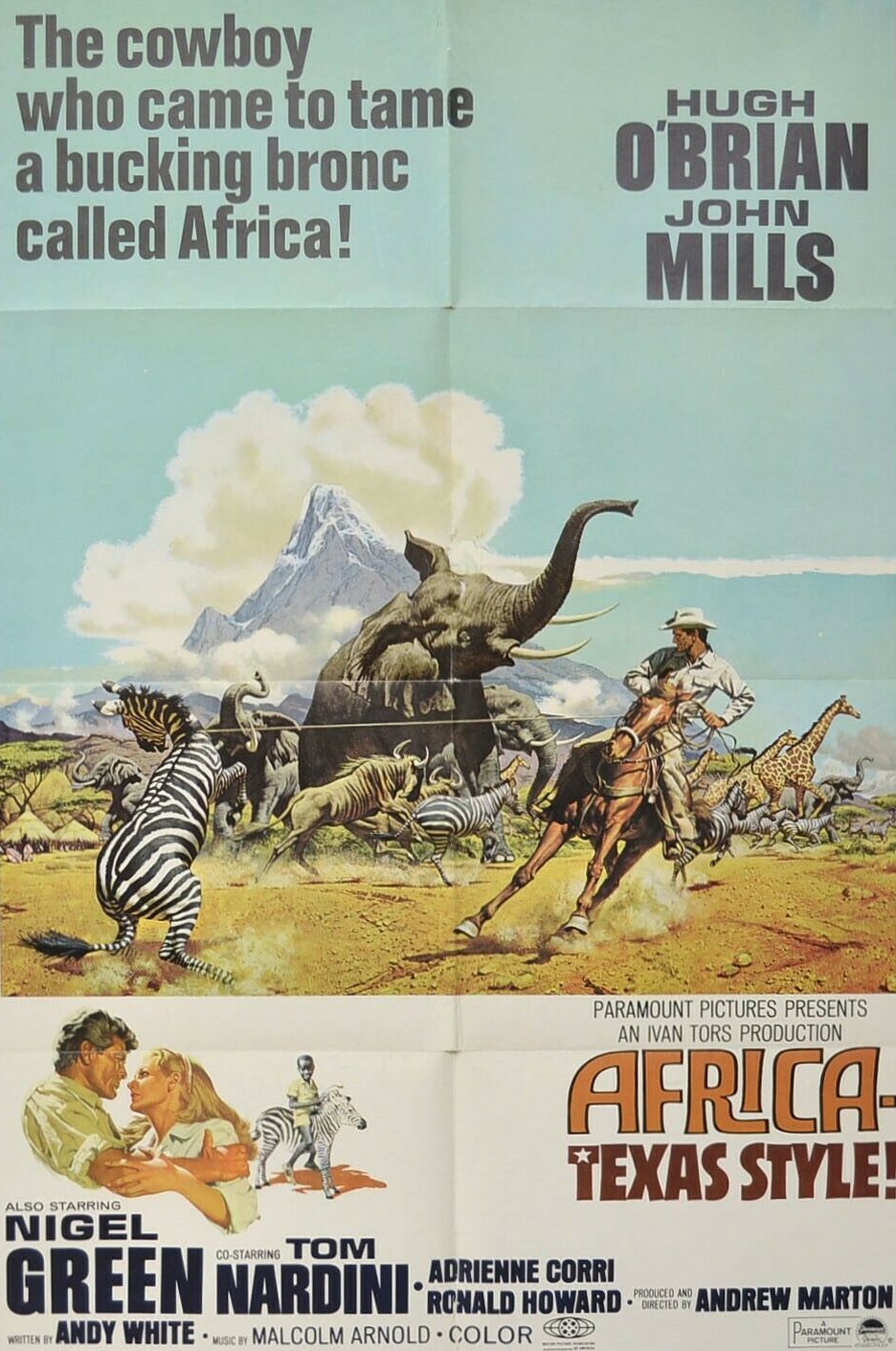
Falling into the unusual category of Saturday afternoon matinee with a message, American cowboy Jim Sinclair (Hugh O’Brian) and sidekick Jim Henry (Tom Nardini) hightail it across the Atlantic to help the wildlife conservation efforts of game rancher Wing Commander Hayes (John Mills) who faces sabotage at every turn by another rancher Karl Bekker (Nigel Green). It combines Hatari!-style action and interesting storylines with Disney-animal-cuteness (a domesticated zebra called Pyjama Tops).

To get the conservation element out of the way – Hayes is concerned that letting animals roam free will result in overgrazing, turning the countryside into a dustbowl and endangering a variety of species. That Hayes is already talking about animals becoming extinct is way ahead of the common perception of Africa at the time. His plan is to round up the wild animals and fence them in, this kind of ranching preventing foodstocks becoming depleted. Bekker’s objection is that wild animals carry infections such as East Coast Fever that will endanger his herd.  

Romantic interest is supplied by the already-engaged nurse Fay Carter (Adrienne Corri) while orphan Sampson (Charles Malinda) tugs at the heart strings. There is a fair measure of authenticity, glorious aerial shots of elephants and buffalo and other species, tribal dances by the Masai while the Sinclair/Henry rodeo-style method of catching wild animals, with lasso rather than giants nets as in Hatari!, ramps up the excitement quotient, not least when Sinclair goes one-on-one with an enraged rhino. As you might expect, there is also ample opportunity for Sinclair to encounter a deadly snake and crocodile and it wouldn’t be an African picture without a stampede.  

Although villainous, Bekker is not without logical argument, not just the fear of infection which would decimate wildlife as much as soil erosion, but his own concerns that taming wild animals would upset the balance of nature, and, on a personal level, the lack of respect for territorial rights. Of course, when push comes to shove, he resorts to rifle and fist to settle  arguments.

Atmospheric, well-made, engaging and at times exciting, there is enough going on here to keep the picture ticking along – a hunt for a lost and bewildered Sinclair, questions about home, and the spectacular wildlife rodeo show. Unlike Born Free (1966) and any other animal picture for that matter although wildlife takes narrative center stage we are not subjected to countless cute four-legged specimens.

Hugh O’Brian (Ambush Bay, 1966) could be a latter-day Tarzan (or more correctly Jungle Jim since he is never in loincloth) but Scottish actress Adrienne Corri (The Viking Queen, 1967) is less jungle adventuress more principled counter to his easy manner. With every chance to rely on the stiff-upper-lip of an English war hero, John Mills (The Family Way, 1966) does anything but and turns in another engaging performance and if you are looking for a decent chap to deliver a conservation message he is definitely your man without being obsessively annoying. Nigel Green (The Skull, 1965) adds to his portfolio of interesting characters as a smooth-talking rough-edged bad guy while Tom Nardini (Cat Ballou, 1965) impresses. Look out for a fleeting glimpse of Hayley Mills  at the start.

Director Andrew Marton, who had been involved in helming The Longest Day (1962) and second unit director of Ben-Hur (1959) and Cleopatra (1963), was something of a wild animal specialist with Clarence, the Cross-Eyed Lion (1965) in the kitty as well as a dozen episodes in total of television series Flipper (1965) and Daktari (1966). But he is at home as much with the human aspects of the story as with the animal. Producer Ivan Tors was a sometime rival to Walt Disney in the family film market with Flipper (1963) and Zebra in the Kitchen (1965) as well as small-screen Flipper and Daktari.

Mistakenly described on imdb as a TV pilot, this was a genuine feature film that happened to produce a television spin-off series Cowboy in Africa. It was screened for the trade in the U.S. on May 5, 1967, reviewed in the feature film section of Variety on May 17, and its U.S. box office figures can be tracked through Variety – opening in 1967 in San Francisco and Kansas City in June, for example, Baltimore in July, Detroit in August and Boston and Louisville in September. In some situations it was double-billed with El Dorado (1967).

CATCH-UP:  John Mills’ versatility can be seen from movies already reviewed in the Blog: The Truth About Spring (1965), Operation Crossbow (1965), The Wrong Box (1966) and The Family Way (1966).

Discover WordPress

A daily selection of the best content published on WordPress, collected for you by humans who love to read.

The Atavist Magazine

by Brian Hannan

WordPress.com News

The latest news on WordPress.com and the WordPress community.