The Chairman / The Most Dangerous Man in the World (1969) ****

The sci-fi elements in this tidy paranoia thriller set in Communist China are not the only issues overlooked at the time and worthy of reconsideration now. Anyone who blasted it for supposedly political jingoism conspicuously failed to read a subtext that chimed with young left-wingers for whom Chairman Mao was not, as now, perceived as a tyrant du jour but as a political god. There’s a distinct whiff of Philip K. Dick in the implanting in a spy’s head of not just a tracking/listening device but one laced with explosive that can be remotely triggered for suicidal or murderous gain. Needless to say, the spy, ignorant of this fact, was a de facto sacrificial lamb. And a key plot thread about genetically modified crops as a means of solving world hunger came about four decades too early.  

Widowed Nobel prize winning scientist Dr Hathaway (Gregory Peck) is despatched into China via Hong Kong to contact a missing scientist with a revolutionary formula for an enzyme. A series of crisp flashbacks set up the scenario of the tracking device and a reverse echo of Marooned (1969) where Army chiefs back at base, led by one-eyed Shelby (Arthur Hill,) can listen in but are helpless to intervene – except in sinister manner. Shelby considers Hathaway “the wrong brilliant man” for the task and that they have sent in “a civilian to do a soldier’s job.”
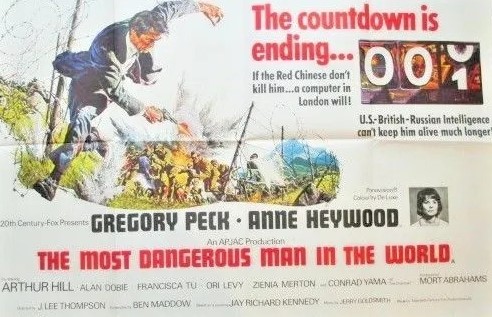
Not able to trust the Brits to know who the title referred to, they came up with a lame alternative. The taglines reveal way too much of the plot.

The hidden transmitter allows Hathaway to keep his superiors posted but the listening device also picks up a creaking bed as Hathaway almost falls into a honey trap in Hong Kong. Amazingly, he doesn’t have to sneak into China but is welcomed with open arms and hustled along to a meeting, and a game of ping-pong (the real thing and the verbal equivalent) with Chairman Mao (Conrad Yama). While spouting some propaganda, Mao is surprisingly open about sharing the secret of the enzyme rather than blackmailing a starving world. Meanwhile, it’s the Americans who are more interested in the double cross, Shelby itching to blow up Hathaway’s head in the assumption the explosion would dispose of the Chinese leader.

Emissions from the transmitter are tangling up the airwaves, making the Chinese secret police highly suspicious of Hathaway as he heads for the secret scientific compound housing Professor Soong Li (Keye Luke), creator of the enzyme, and his daughter Chu (Francesca Tu).

Turns out Hathaway has been summoned by the professor to help find a missing link in molecular chains. Hathaway has to burgle his way to steal the formula, but fails to find it, but when the professor commits suicide and is denounced by his daughter and the Chinese secret police close in, Hathaway has to scarper and head for the Russian border, that country, oddly enough for a spy movie, being on the same side as the Yanks. Meanwhile, Shelby’s trigger finger it itching to blow his man sky high for fear he might give away details of his mission.  
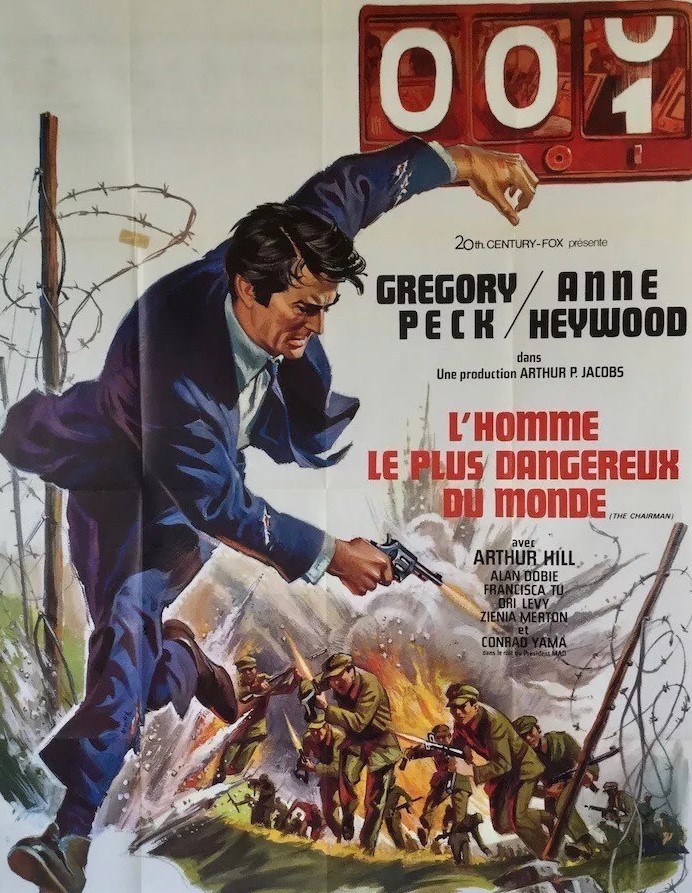
The French, too, had trouble with the original title.

Turns on its head many of the spy film’s truisms: firstly that Hathaway effectively fails in his mission; secondly that patriotism doesn’t blind him to his country’s greed or folly; thirdly that’s he not in constant seduction mode.

Political argument that one point seemed to excessively delay the narrative thrust, now, at half a century’s move, seems more considered and providing an interesting balance between opposing views.

Gregory Peck (Marooned, 1969) is at his quizzical best, deeply-rooted scepticism helping to anchor his character. But if you were attracted by seeing Anne Heywood (The Fox, 1967) second-billed you’re in for a disappointment as she just tops and tails the picture. Arthur Hill (Moment to Moment, 1966) is good value as always.

But it’s testament to J. Lee Thompson (Mackenna’s Gold, 1969, also starring Peck) that his direction brings together diverse political/sci fi/spy/thriller elements in a winning formula, ignoring the obvious. Some interesting detail: someone handing out coffee on a tray to the inmates of the command station; Hathaway’s guilt at his role in the death of his wife barely touched upon, but it explains a lot; Mao’s famous Little Red Book provides a twist.

Occasional flaw: surely the Chinese would have bugged Hathaway’s room and catching him, however soft voiced, filling in his superiors. The idea that the Chinese could be technologically more advanced than the U.S. would have had John Sturges in a fit of fury, but Thompson takes it in his stride. Screenplay by Ben Maddow (The Way West, 1967) and Jay Richard Kennedy (I’ll Cry Tomorrow, 1955).

Reassessment overdue.
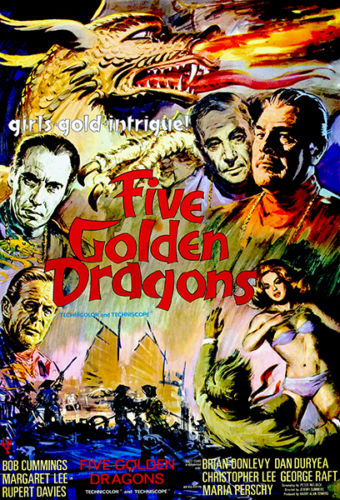
Five Golden Dragons (1967) ***

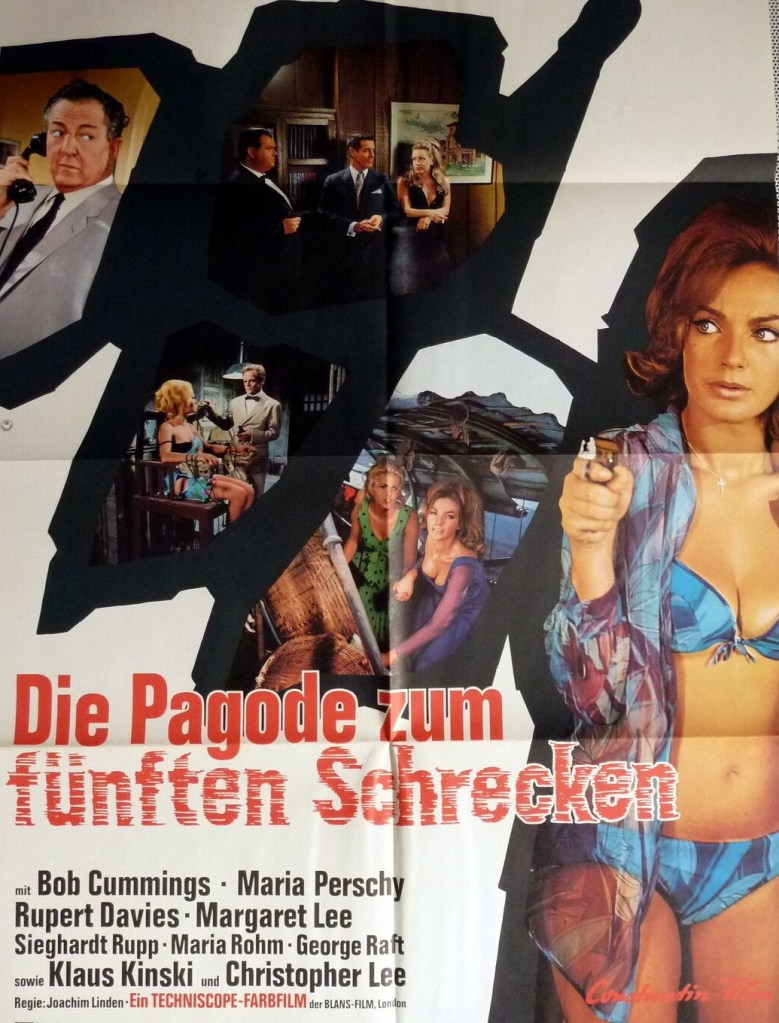
Producer Harry Alan Towers, himself something of a legend, had put together a quite superb cast – rising Eurostar Klaus Kinski (A Bullet for the General, 1967), Hollywood veterans Robert Cummings (Dial M for Murder, 1954), George Raft (Scarface, 1932), Dan Duryea (Black Bart, 1948) and Brian Donlevy (The Great McGinty, 1940) plus British horrormeister Christopher Lee and Rupert Davies (television’s Maigret). Throw in Margaret Lee (Secret Agent, Super Dragon, 1966) and Austrians Maria Perschy (Kiss, Kiss, Kill, Kill, 1966) and  Maria Rohm (Venus in Furs, 1969).

And all in aid of an enjoyable thriller set in Hong Kong that dances between genuine danger and spoof. I mean, what can you make of a chase involving rickshaws? Or a race over bobbing houseboats parked in a harbor? There’s a Shakespeare-quoting cop Sanders (Rupert Davies) whose sidekick Inspector Chiao (Tom Chiao) often out-quotes him. And there’s British-born Margaret Lee, a cult figure in Italian circles,  belting out the title song and just for the hell of it Japanese actress Yukari Ito in a cameo as a nightclub singer.

A newly arrived businessman is chucked off the top of a building by an associate of gangster Gert (Klaus Kinski)  but not before leaving a note that falls into the hands of the police. The note says, “Five Golden Dragons” and is addressed to playboy Bob (Robert Cummings) for no particular reason. No matter. A MacGuffin is still a MacGuffin, and probably best if left unexplained.

Bob is soon involved anyway after falling for two beautiful sisters, Ingrid (Maria Rohm) and Margret (Maria Perschy). Turns out Margret knows more about Bob than he would like, and knows too much for her own good, namely that the titular dragons are the heads of an evil syndicate, specializing in gold trafficking, meeting for the first time in Hong Kong in order to organize the handover of their empire to the Mafia for a cool $50 million  

In a nod at the spy genre, there are secret chambers opened by secret levers. There are double-crosses, chases, confrontations, not to mention a a trope of sunglasses being whipped off, voluntarily I might add.  Apart from breaks here and there for a song or two, director Jeremy Summers (Ferry Across the Mersey, 1964) keeps the whole enterprise zipping along, even if he is stuck with Cummings.

In truth, Cummings (Stagecoach, 1966) is a bit of a liability, acting-wise. While the rest of the cast takes the film seriously, he acts as if he’s a Bob Hope throwback, cracking wisecracks when confronted with danger or beautiful women, or, in fact, most of the time, which would be fine if he wasn’t a couple of decades too old (he was 57) to carry off the part of a playboy and if the jokes were funny. 

Towers (under the pseudonym Peter Welbeck responsible for the screenplay, loosely based on an Edgar Wallace story) was a maverick but prolific British producer who would graduate to the likes of Call of the Wild (1972) with Charlton Heston but at this point was churning out exotic thrillers (The Face of Fu Manchu, 1965) and mysteries (Ten Little Indians, 1965) and had a good eye for what made a movie tick. This one ticks along quite nicely never mind the bonus of a sinister George Raft and the likes of Margaret Lee and Maria Rohm (Towers’ wife).

Cult contender that doesn’t take itself too seriously.

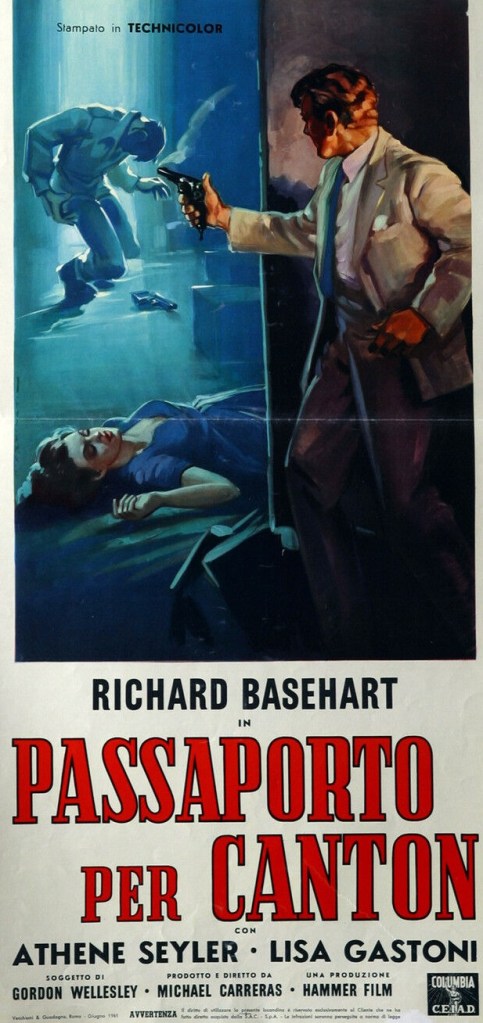
Passport to China / Visa to Canton (1961) **

Marked down for sheer laziness. Another Hammer “thriller,” this time with fading American star Richard Basehart and Italian glamor puss Lisa Gastoni. But mostly a hodge-podge travelog of stock footage with dialog taking the place of action, a tedious voice-over far removed from the snappy one-liners we are accustomed to getting from Chandleresque investigators. And let’s forget the red-eyed Chinese replete with drooping moustaches who pepper the picture.

A plane has gone down in Red China with an American courier carrying vital “scientific” information, Approached to help by US government personnel, snappily-dressed Hong Kong travel agent Benton (Richard Basehart) refuses. But when he discovers the pilot is Jimmy (Burt Kwouk), a member of a Chinese family he has befriended during World War Two, he mounts his own rescue mission. Which consists, by the way, of nothing more than floating a sampan up a river, avoiding a few bullets and whisking the lad away.

But he is blackmailed into rescuing the courier when Hong Kong police imprison Jimmy. So off he trots to Macao and then Canton aided along the way, in the opulent back room of a casino, by Chinese businessman Kong (Eric Pohlmann) who you might mistake for a James Bond villain such is his fondness for being surrounded by women – or such is his girth mistake him for a Robert Morley lookalike. Kong happens to be a Russian spy.

No sneaking into China by parachute or perhaps motor boat is required, Kong simply furnishes him with the visa of the title. Benton, vaguely assisted by a maker of fake porcelain, has clues –  Three Fishes, The Stream of the Willows.

In his hotel bedroom sits the courier, blonde Lola (Lisa Gastoni), held prisoner. But no sooner have they kissed, as you might expect of any self-respecting travel agent doubling as a spy, than they are interrupted by Kong. She disappears. Naturally, Benton finds her easily enough. She doesn’t have papers, instead a photographic memory.

But she’s not working for the Americans. She’s an espionage freelance, working for the highest bidder. She does it for the danger, perhaps like a certain James Bond, danger is the drug, heightens her senses.

But she’s also pretty damn clever. Knowing Kong is a double agent and can’t just snatch her out of China, she starts an auction for her information. Benton offers more. Therefore she is his property. To get over the tickly issue of Kong, in revenge, keeping her prisoner in China, he is conveniently accidentally shot.

So now they have to escape. But in the shoot-out at the docks (in a barn full of hay for some reason she gets shot) so the movie suddenly turns into one of those post-Bond thrillers where all that effort has been expended for no result.

But you might have thought a producer (Michael Carreras) would have introduced Lola much earlier in femme fatale fashion. But then this producer who, as it happens was also the director, seems to think that voice-over will solve all the tedious problems of actually creating a screenplay that works.

You shouldn’t have cared less about a snappy-suited character such as the one played by Gene Barry in his informal espionage trilogy – Maroc 7 (1967), Istanbul Express (1968) and Subterfuge (1968) – he’s about on a par as an actor as Basehart. But those movies at least had proper stories that made sense and were not just a series of jumps explained by voice-over, the hero neither having to undertake any shamus digging or go into harm’s way, or battle his way out of perilous situation.

It’s not even bad enough to eventually win over a cult audience. The problem is it’s well-made up to a point and the story is intriguing up to a point, but that mark is very low.

Richard Basehart (The Satan Bug, 1965) isn’t called upon to do much except act as the storyteller he’s okay and Lisa Gastoni (Maddalena, 1971) isn’t accorded sufficient screen time to really make a mark. Which is the biggest shame because an amoral spy like her would have made a brilliant femme fatale had she been introduced early on and then turned out to be the mercenary she was.

The rest of the cast are caricatures, though interesting to see Burt Kwouk in pre-Pink Panther persona but cringe-worthy to see Bernard Cribbins (You Must Be Joking, 1965)  mangle a foreign accent. Clearly Carreras learned a lesson from this implosion of talent and story because two pictures on he directed taut thriller Maniac (1963).  

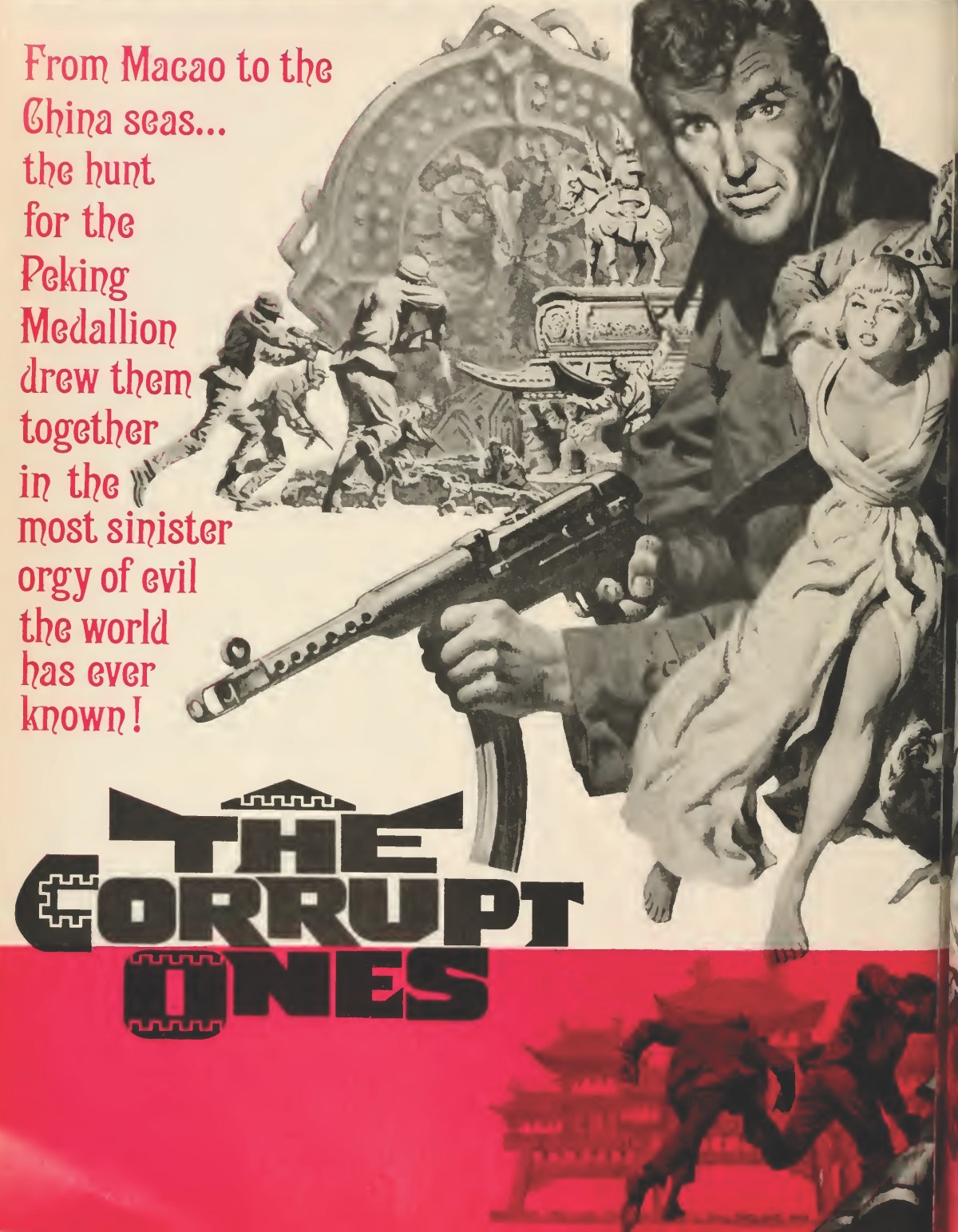
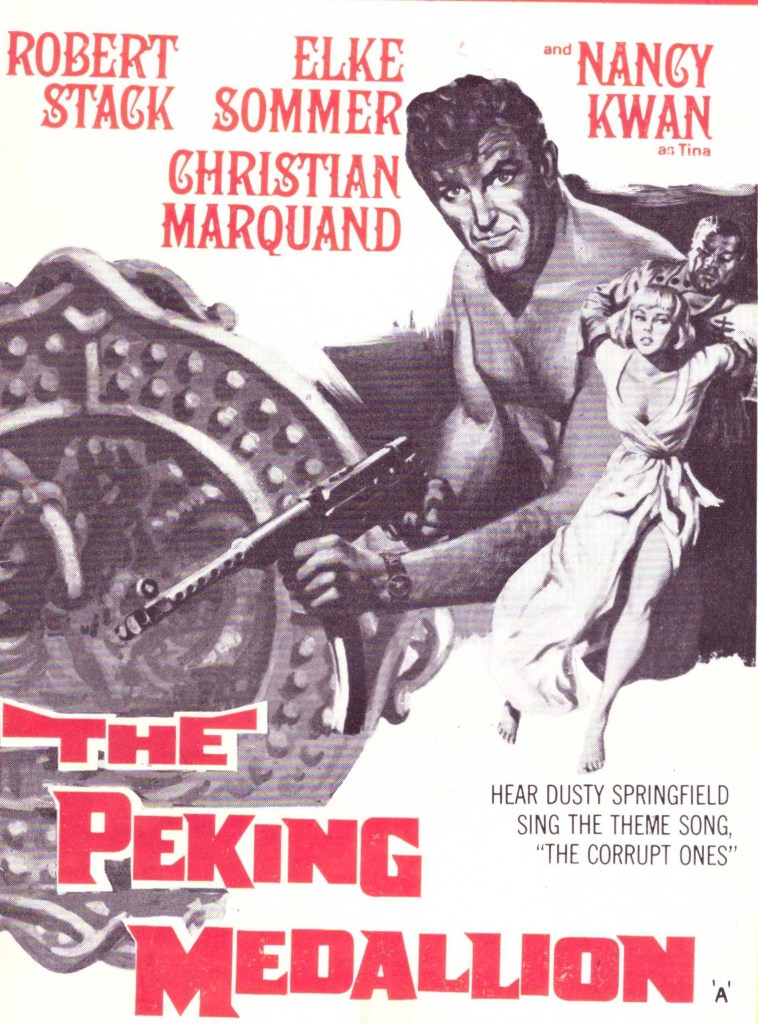
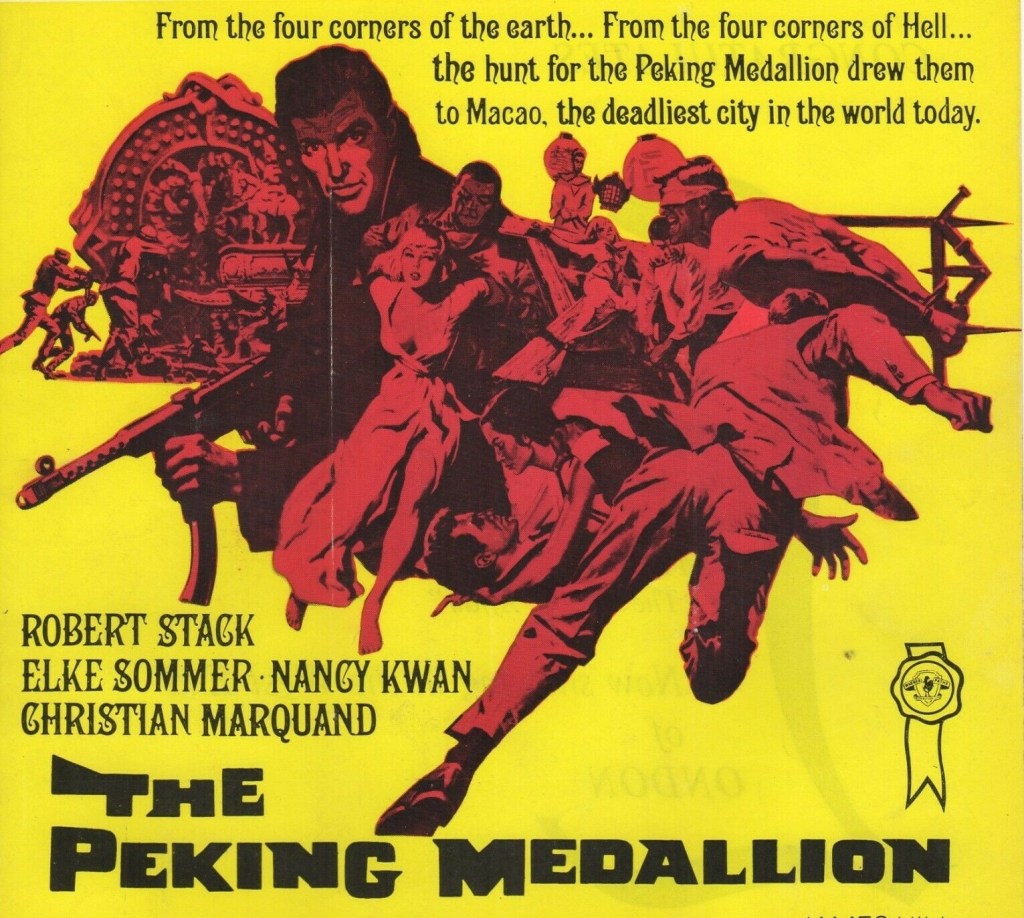
The Corrupt Ones / The Peking Medallion (1967) ****

Non-stop action as spy Robert Stack (The Untouchables tv series) battles a variety of crooks in Macao on the Chinese border as they seek the legendary Peking medallion. Stack hails from the James Bond school of espionage, duty bound to kiss every girl he meets. He might wonder at their compliance until he realizes they are only after his knowledge of the missing medallion.

The violence is criminally brutal – punch-ups, gunfights, samurai swordfights, murder, torture by blowtorch and acid and being dragged behind a motorboat. The string of sexy women is matched by handsome men (Christian Marquand and Maurizio Arena in addition to Stack). The thriller pitches helter-skelter through nightclubs, casinos, caves, temples and palatial mansions, the pace only slowing down for, naturally, a scene in a stately rickshaw.

As well as Stack who briefly – and unknowingly – has the medallion in his possession, others in the hunt include Elke Sommer, wife of the man (Arena) who passed it to Stack before being killed. Sommer is on the wrong side of the femme fatale equation. Once Stack is wise to her seductive charms he quips, “Maybe you’re telling the truth but I can’t trust you.”

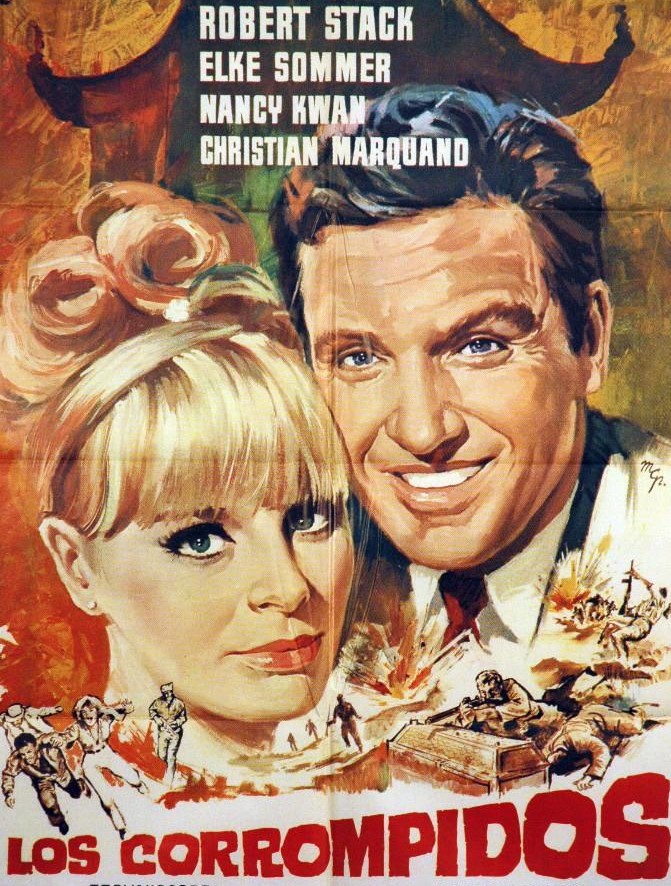
The original title of the picture was “Hell in Macao” and that was used in Germany for example. It was called “The Peking Medallion” in the UK, Italy and Mexico and “The Corrupt Ones” in the US, France and Spain.

Also in hot pursuit are gangster Brandon (Marquand) and a Chinese mob headed by Nancy Kwan (The World of Suzie Wong, 1960). That’s on top of a corrupt cop (“I have never feared death only poverty” is his mantra) who doesn’t care who wins the prize as long as he gets his share. Double cross is the order of the day, alliances forged then broken. The action never stops long enough for one of those tension-building scenes of which Alfred Hitchcock or imitators like Stanley Donen (Charade, 1963, and Arabesque, 1966) were so fond.

Stack faces danger with a quip, a kiss or gritted teeth, an old-fashioned tough guy without the James Bond self-awareness. He carries out his manly duties until his brain kicks in and he realizes this isn’t a spy picture after all but a genuine treasure hunt with clues that have to be deciphered. As this causes the movie to sidetrack down another route, it looks like the picture has lost the plot. But then all hell breaks loose and we are back on the safe ground of fistfights, double-crossing and shooting.

The script by Brian Clemens deftly mixes a variety of genres. What might have been a definite change of pace for British director James Hill given his previous effort was Born Free (1966) was anything but since he was responsible for the most recent Sherlock Holmes thriller A Study in Terror (1965).

Fans of improbable storylines, exotic settings, action, interesting bad guys and twists and turns will love this. How can you fail to love a movie with a fight featuring a samurai sword versus a camera tripod?

Many of the films from the 1960s are to be found free of charge on TCM and Sony Movies and the British Talking Pictures as well as mainstream television channels. But if this film is not available through these routes, then here is the link to the DVD and/or streaming service.

Discover WordPress

A daily selection of the best content published on WordPress, collected for you by humans who love to read.

The Atavist Magazine

by Brian Hannan

WordPress.com News

The latest news on WordPress.com and the WordPress community.