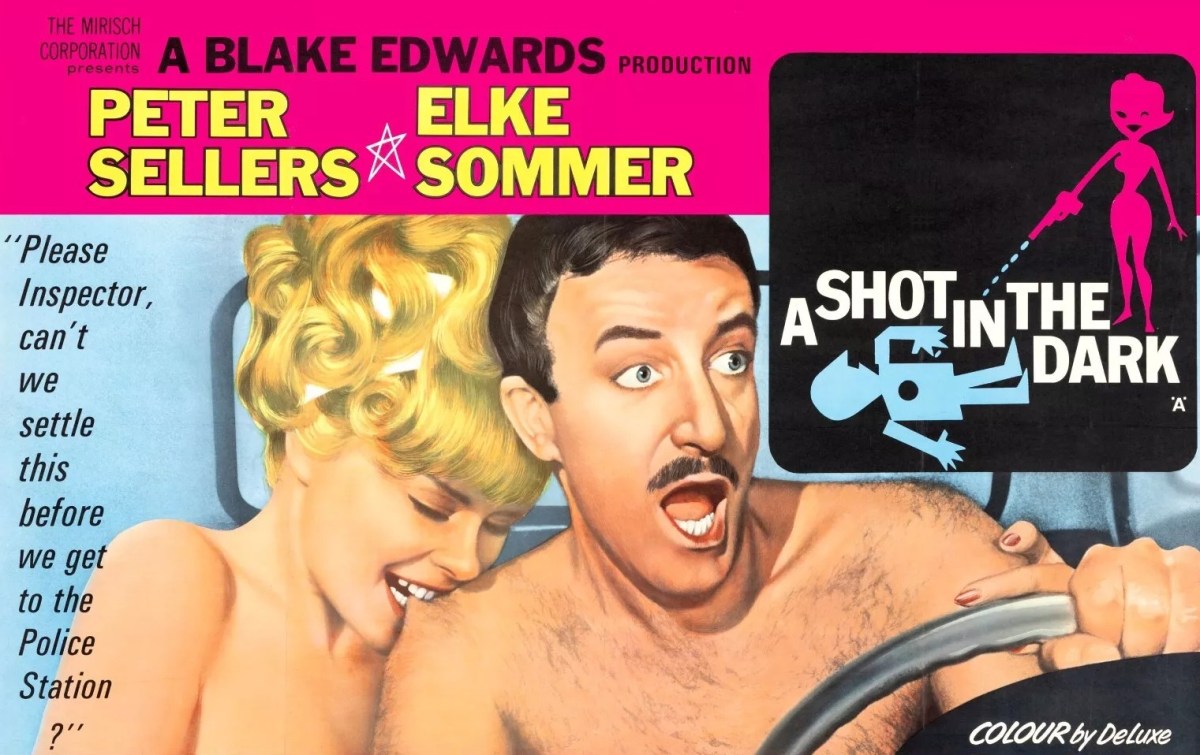
A Shot in the Dark (1964) ***

A pratfall still works wonders. An open door or window, anything that happens to be on the floor, or for that matter any object of any description – billiard cues, for example – within easy reach offers the opportunity for havoc – and a steady stream of laffs. Which is just as well, because this complicated farce, which might get a few extra brownie points today for its satire on serial killers, doesn’t do the movie any favors.

Inspector Clouseau (Peter Sellers) has acquired a more pronounced French accent than since his last incursion in The Pink Panther (1963) but it’s nothing like as excruciatingly hilarious as would be in later episodes. He still falls in love at the drop of a hat though this time the object of his affection is maid Maria (Elke Sommer) who, unfortunately, happens to be the prime murder suspect. She should be in jail but she is constantly released. Clouseau should be sacked for incompetence, but he is constantly reinstated.
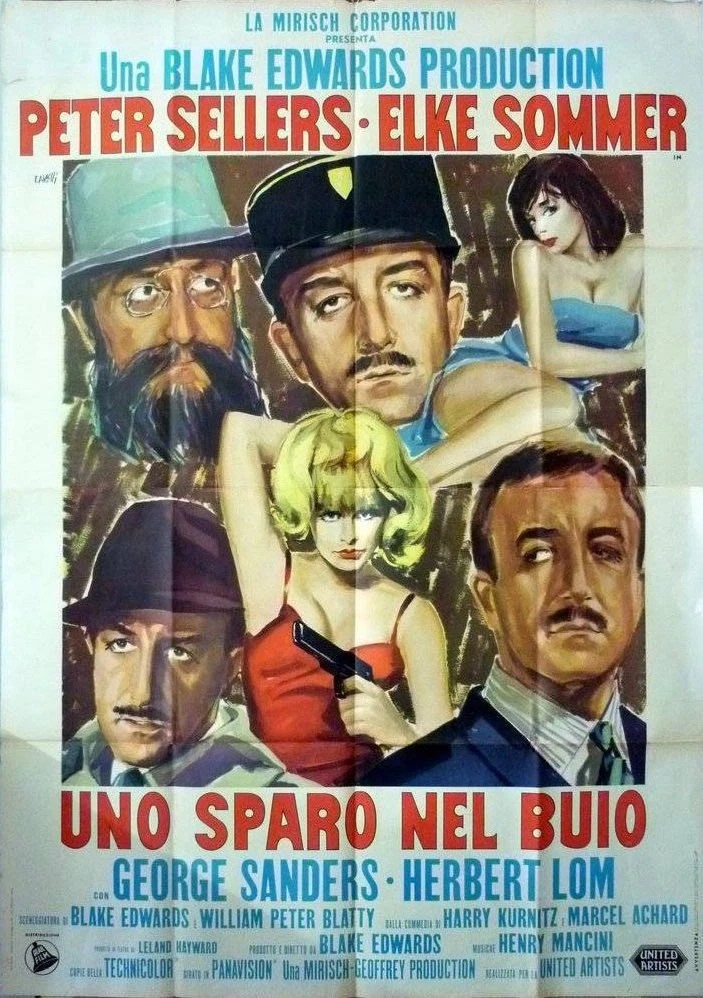
The repertory team of his frustrated boss Dreyfus (Herbert Lom) and karate teacher (Burt Kwouk) interrupt proceedings from time to time but don’t really add to the laugh quotient. A bit more effective is the satire on French bureaucracy, a running gag on the need for an official permit, for example, before you could think of selling balloons on the street or trying to earn a buck as a street artist.

I won’t go into the plot since it’s a series of baffling murders and you could argue that Peter Sellers needs neither plot nor love interest. All he needs is an open door beckoning.

I was astonished how often I laughed out loud at something I knew was coming. The minute someone walked through a door you knew Clouseau would be the other side of it waiting to be buffeted. Any open window and he’d be through it and likely as not water would await.

He doesn’t just get tangled up in words but ask him to replace a billiard cue and you’d think billiard cues had declared war on him. He’s forgetful to the point of forgetting to switch off his cigarette lighter and naturally ignores the signs that he’s set his coat on fire.
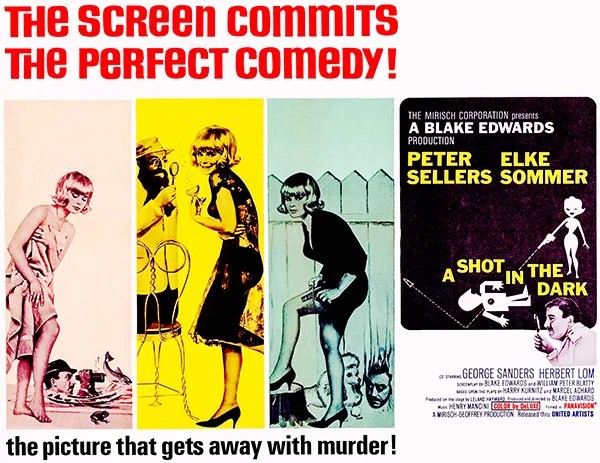
For those more censorious times, there’s a foray into a nudist colony which is primarily an exercise in the various ways that private parts can be hidden from the camera while suggesting the salacious opposite. Clothed or unclothed you can rely on Clouseau to fall down. The only hilarious scene that doesn’t involve him falling down is when Maria miraculously appears in his office and when an attached key tears a whole in his trousers.

The various twists – Dreyfus is the assassin stalking Clouseau – and the lax French attitude to adultery keep the plot going and when the narrative slackens you can always stick a bomb into the mix.

From the outset, there is plenty opportunity for farce, the wrong people entering the wrong doors, continuous mix-up, plenty occasions for the innocent person to be caught red-handed clutching the murder weapon.

It almost looks as though the two aspects of the picture are clashing. Director Blake Edwards (The Pink Panther) appears to be helming a farce within which Inspector Clouseau is encased. You might think there’s a limit to the number of pratfalls you can stick in a picture, but my answer is “try me”.

With Peter Sellers so dominant, the only way the supporting cast could compete was by over-acting (Herbert Lom) or under-acting (all the rest).  Elke Sommer (The Prize, 1963) needs do little more than look winsome.

Written by Edwards and William Peter Blatty (Gunn, 1967) based on the play by Harry Kurnitz.

Occasionally drags but lifted by the genius of Sellers.

Arabesque (1966) ***

By this point in the 1960s, Gregory Peck’s career was pretty much at a standstill. Prestige had not saved Behold a Pale Horse (1964) from commercial disaster, thriller Mirage (1965) went the same way, other projects – The Martian ChroniclesIce Station Zebra – failed to get off the ground or like The Bells of Hell Go Ting-a-Ling-a-Ling were abandoned once filming began.  So, he was the main beneficiary of Cary Grant’s decision to retire.

Stanley Donen had Grant, with whom he had made the highly successful thriller Charade (1963), in mind for the role of the hieroglyphics professor caught in in a web of intrigue in Arabesque.  In some ways Peck was an adequate replacement but lacked the older actor’s gift for comedy and failed to master the art of the double-take. Arabesque was almost a counterpoint to Charade. In the earlier movie Audrey Hepburn is continually suspicious of Cary Grant. The new movie sees a gender reversal, Peck constantly puzzled as to where Sophia Loren’s loyalties lie.

The story itself is quite simple. A code has been put inside a hieroglyphic and a variety of people are trying to get hold of it either to decipher the secret within or to stop someone else finding out what it contains. When the scientist who has the code is killed, the man who ordered the killing, the sinister Beshraavi (Alan Badel), approaches Prof Pollock (Gregory Peck) to unravel the code, but is turned down. The professor is then kidnapped by Arab prime minster Hassan Jena (Carl Duering), whom he admires, to ask him to take up the job. Beshraavi’s provocatively-dressed wife Yazmin (Sophia Loren), flirting outrageously with Pollock, is also after the code. 

There follows more twists and double-crosses than you could shake a stick at, leaving the amenable Pollock mightily confused.  “What is it about you,” he asks Yazmin at one point, “that makes you so hard to believe?” It looks like director Donen is playing a variation of the famous Raymond Chandler maxim, that when a plot begins to flag, “have a man come through the door with a gun in his hand.” Sometimes, there is actually a gun or similar weapon, but mostly it’s just another twist. If Pollock doesn’t know what the hell is going on, then the audience is in the same boat.

But it is stylish, set in appealing parts of Britain (antique university, Ascot), Yazmin decked out in glamorous Dior outfits and even Pollock gets to wear a morning suit. Drop in a couple of action sequences, Hitchcock-style chases in a zoo and pursuit by a combine harvester, Pollock nearly run over by horses in a race, and the pair of them having strayed into a builder’s yard facing demolition by the British equivalent of a wrecking ball. But the standout scene is when Yazmin hides the professor in her shower (curtain drawn) while being interrogated by her suspicious husband and then steps in naked and then they play footsie with dropped soap. And she proceeds to expound, “If I was standing stark naked in front of Mr Pollock, he’d probably yawn.”

Beshraavi’s jealousy over his wife’s flirtation with Pollock adds another element of tension. Beshraavi is a very sinuous, sensuous bad guy, who can turn a harmless massage into a matter of life and death. He also has a pet falcon with a habit of ripping people’s cheeks. But even in the face of obvious threats, Pollock holds his own. In one scene as Beshraaavi  attempts to retrieve what he believes is the code from Pollock’s dinner plate, where it has fallen from the hiding place in the professor’s clothing, Pollock taps the man’s invading fingers with the sharp tines of his fork.

And there is some accomplished dialogue. When Pollock offers the falcon a date and is brusquely told the bird of prey only eats meat, he responds, “I thought he looked at it rather wistfully.” Beshraavi retorts, sharply, “It must have been your fingers.”

Donen had not made a film in the three years since Charade, so there was some critical feeling that he was a bit rusty and used experimentation – big close-ups, odd camera angles – to cover this up. He was living in London by this point and had been for nearly a decade. But there was very little that fazed him in any genre, and he had switched from musicals like Singing in’ the Rain (1952) to romantic drama (Indiscreet, 1958) and comedy (The Grass Is Greener, 1960). And though there is no question the film would have been better with Cary Grant, Peck proves a reasonable substitute.

The movie’s main drawback is the lack of romance since falling in love with someone you believe is either a traitor or a compulsive liar is a hard trick to pull off. But if you like the idea of pitting your wits against the screenwriters – Peter Stone (Charade), Julian Mitchell (Another Country, 1984) and Stanley Price (Gold, 1974), the latter pair in their movie debuts  – then this is one for you.

Two for the Road (1967) ***

This film had everything. The cast was pure A-list: Oscar winner Audrey Hepburn (Breakfast at Tiffany’s, 1961) and Oscar nominee Albert Finney (Tom Jones, 1963). The direction was in the capable hands of Stanley Donen (Arabesque, 1966), working with Hepburn again after the huge success of thriller Charade (1963). The witty sophisticated script about the marriage between ambitious architect Mark Wallace (Albert Finney) and teacher wife Joanna (Audrey Hepburn) unravelling over a period of a dozen years had been written by Frederic Raphael, who had won the Oscar for his previous picture, Darling (1965). Composer Henry Mancini was not only responsible for Breakfast at Tiffany’s – for which he collected a brace of Oscars – but also Charade and Arabesque. And the setting was France at its most fabulous.

So what went wrong? You could start with the flashbacks. The movie zips in and out of about half a dozen different time periods and it’s hard to keep up. We go from the meet-cute to a road trip on their own and another with some irritating American friends to Finney being unfaithful on his own and then Hepburn caught out in a clandestine relationship and finally the couple making a stab at resolving their relationship. I may have got mixed up with what happened when, it was that kind of picture.

A linear narrative might have helped, but not much, because their relationship jars from the start. Mark is such a boor you wonder what the attraction is. His idea of turning on the charm is a Humphrey Bogart imitation. There are some decent lines and some awful ones, but the dialogue too often comes across as epigrammatic instead of the words just flowing. It might have worked as a drama delineating the breakdown of a marriage and it might have worked as a comedy treating marriage as an absurdity but the comedy-drama mix fails to gel.

It’s certainly odd to see a sophisticated writer relying for laughs on runaway cars that catch fire and burn out a building or the annoying whiny daughter of American couple Howard (William Daniels) and Cathy (Eleanor Bron) and a running joke about Mark always losing his passport.

And that’s shame because it starts out on the right foot. The meet-cute is well-done and for a while it looks as though Joanna’s friend Jackie (Jacqueline Bisset) will hook Mark until chicken pox intervenes. But the non-linear flashbacks ensure that beyond Mark overworking we are never sure what caused the marriage breakdown. The result is almost a highlights or lowlights reel. And the section involving Howard and Cathy is overlong. I kept on waiting for the film to settle down but it never did, just whizzed backwards or forwards as if another glimpse of their life would do the trick, and somehow make the whole coalesce. And compared to the full-throttle marital collapse of Who’s Afraid of Virginia Woolf (1966) this was lightweight stuff, skirting round too many fundamental issues.

It’s worth remembering that in movie terms Finney was inexperienced, just three starring roles and two cameos to his name, so the emotional burden falls to Hepburn. Finney is dour throughout while Hepburn captures far more of the changes their life involves. Where he seems at times only too happy to be shot of his wife, she feels more deeply the loss of what they once had as the lightness she displays early on gives way to brooding.

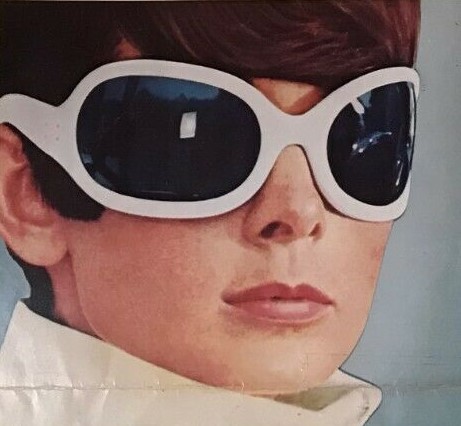
Hepburn as fashion icon gets in the way of the picture and while some of the outfits she wears, not to mention the sunglasses, would not have been carried off by anyone else they are almost a sideshow and add little to the thrust of the film.

If you pay attention you can catch a glimpse, not just of Jacqueline Bissett (Bullitt, 1969) but Romanian star Nadia Gray (The Naked Runner, 1967), Judy Cornwell (The Wild Racers, 1968) in her debut and Olga Georges-Picot (Farewell, Friend, 1968). In more substantial parts are William Daniels (The Graduate, 1968), English comedienne Eleanor Bron (Help!, 1965) woefully miscast as an American, and Claude Dauphin (Grand Prix, 1966).

Hepburn’s million-dollar fee helped put the picture’s budget over $5 million, but it only brought in $3 million in U.S. rentals, although the Hepburn name may have nudged it towards the break-even point worldwide.

Discover WordPress

A daily selection of the best content published on WordPress, collected for you by humans who love to read.

The Atavist Magazine

by Brian Hannan

WordPress.com News

The latest news on WordPress.com and the WordPress community.