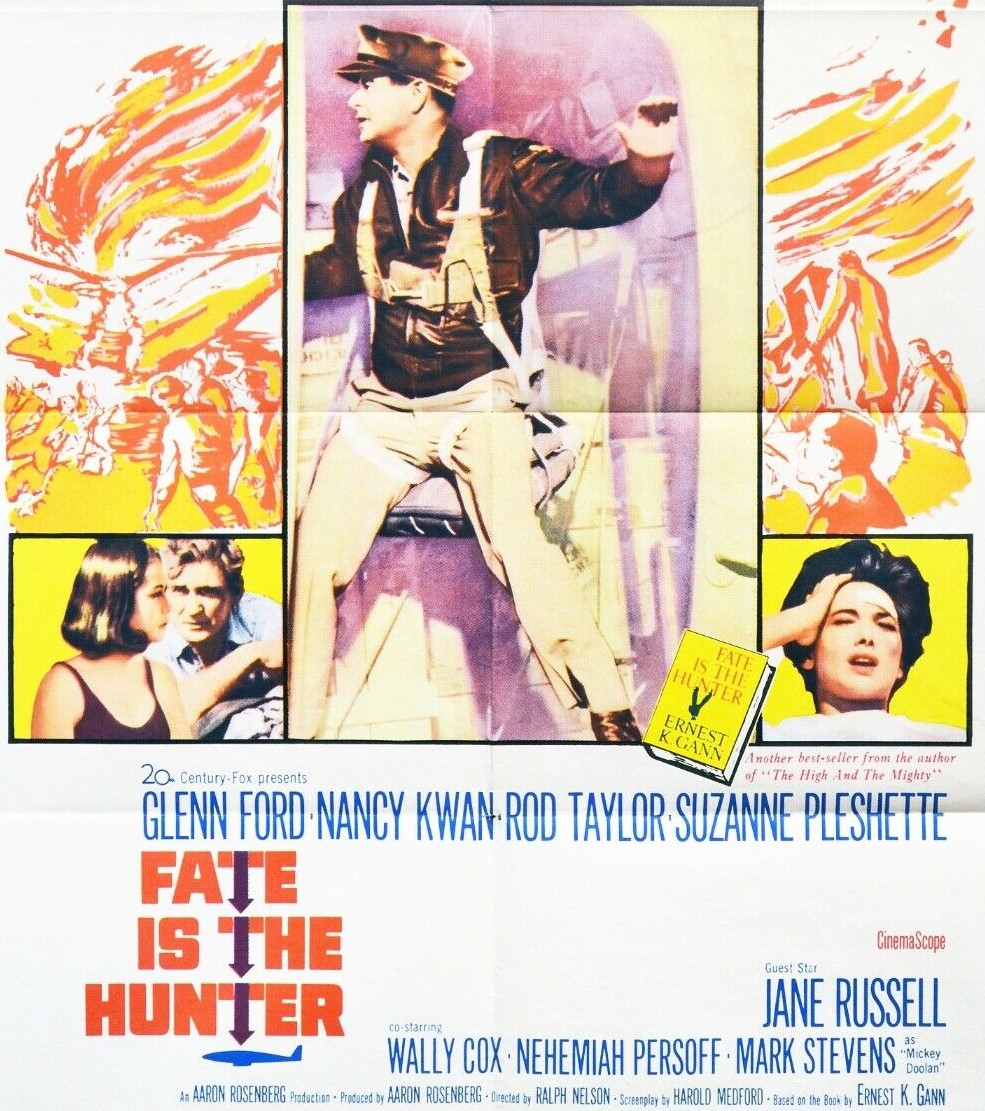
Fate Is the Hunter (1964) ***

More like Flight from Ashiya (1964) than Flight of the Phoenix (1965) in that airline disaster triggers flashback rather than contemporaneously finding a solution to the problem, but similar in tone to the more recent Flight (2012) and Sully (2016) where the automatic response of the authorities was to blame pilot error rather than ascertain mechanical malfunction. Unlike the two modern pictures, pilot Jack Savage (Rod Taylor) cannot be interrogated in court because he died in the explosion. So investigator Sam McBane (Glenn Ford) seeks some corresponding incident in the past which might account for the pilot making such a mistake.

Other options face McBane. Sabotage could be the cause since  a passenger took out a $500,000 insurance policy days before boarding the twin-engine plane. Bird strike cannot be ruled out after feathers are found in the engine. Or it could be simple misfortune. Three inbound planes all running late prevent the plane returning immediately to Los Angeles and it would have landed safely on a beach except for hitting a temporary structure. But engineers hardly need to pore over the evidence. The fault is staring them in the face. Savage had reported two engines catching fire but the wreckage reveals one engine intact.
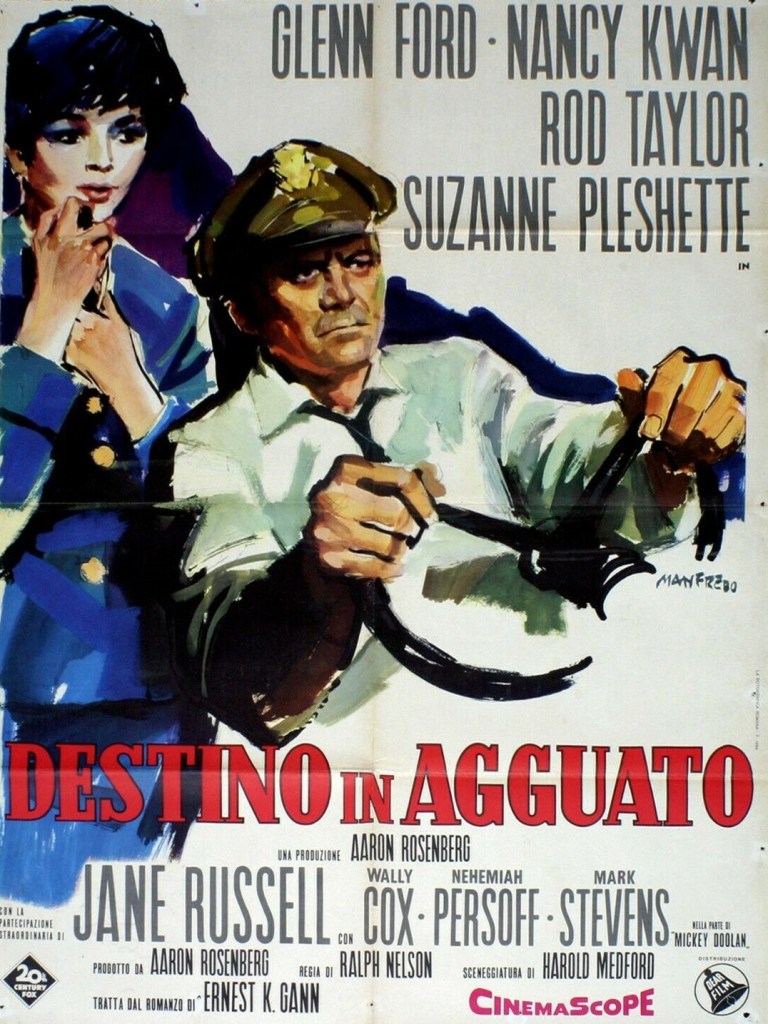
However, the only survivor, stewardess Martha Webster (Suzanne Webster) maintains that two red warning lights were flashing, indicating malfunction in both engines. But since she is badly injured and in a woozy state, this is not taken as gospel. So McBane dips into the playboy past of Savage, a buddy, a man with such appeal he can serenade real-life figures as Jane Russell (playing herself). Two occasions highlight the man’s heroic history of  emergency landings. So can he be the unreliable character painted by a jilted fiancée (Dorothy Malone) or the drinker who should not have been in a bar so soon before take-off?

The tight-lipped shoulder-hunched humorless soulless McBane, described as “one of the best-built machines” known to man, finds himself questioning his own attitudes as he uncovers more of his friend’s life. But when it comes to the big enquiry, televised, he has no better an explanation to ascribe the unexpected collision of different events  than the “fate” of the title. Naturally, that mystical prognosis hardly goes down well with his superiors. Luckily, McBane comes to his senses and suggests a simulation which does, in fact, pinpoint the flaw.

It’s relatively easy to pinpoint the flaw in the picture. Audiences expecting a disaster movie with characters stranded by a crash were disappointed to find that by cinematic sleight-of –hand they were being presented with The Jack Savage Story, which with the larger-than-life character and his various aviation and romantic adventures would easily have made a picture in its own right. Stuck instead with the glum McBane as their guide, who, beyond his steadfastness, does not come into his own until the last 15 minutes, seemed an unfair trick. The explosion of the doomed plane at the 10-minute mark is easily the dramatic highlight and the continued flashbacks rather than adding to the tension often eased it.
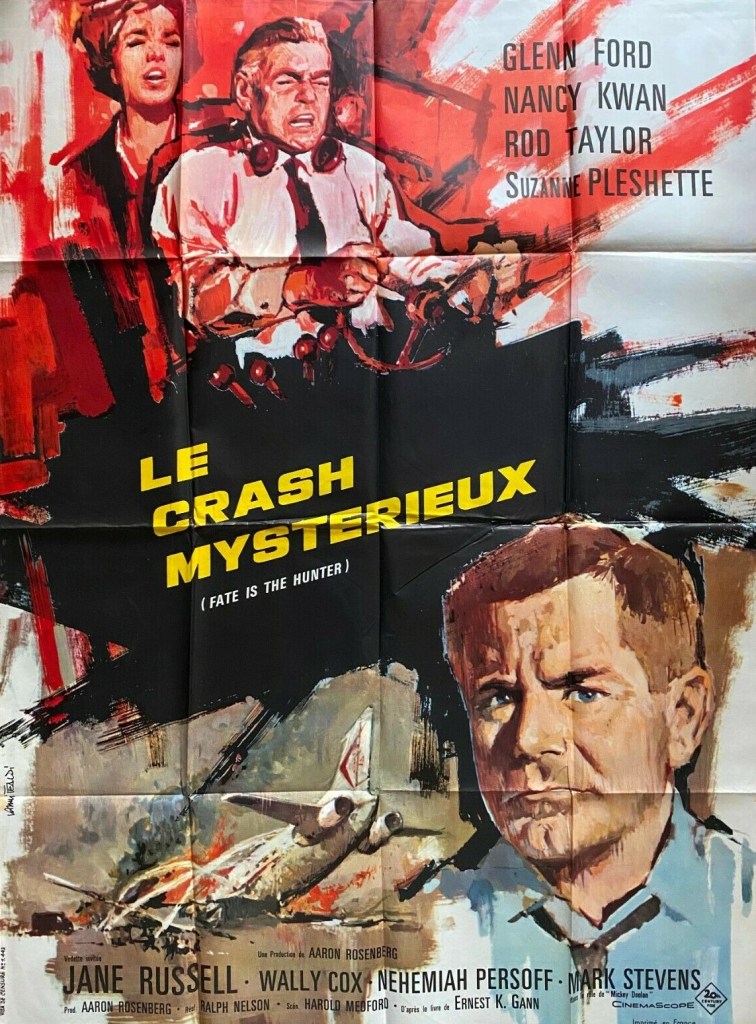
With four stars above the title, audiences might have anticipated some kind of four-sided triangle, but the two female stars scarcely appear although Martha has one excellent scene, shocked when asked to don her uniform again, and Sally (Nancy Kwan) enjoys a fishing meet-cute with Savage.

That said, if you accept as McBane as more of a private eye, his surly demeanor fits, and the Savage life story is certainly a fascinating one and the various aviation episodes unusual enough to maintain interest. Glenn Ford (Is Paris Burning?, 1965), his box office sheen waning and about to shift exclusively to westerns, is always watchable but there’s no real depth to the character. Rod Taylor (Dark of the Sun, 1968) is at his most exuberant and that’s no bad thing, and beneath the bonhomie a good guy at heart, but his portrayal provides little of the shade that would make it thinkable he was to blame. Suzanne Pleshette (The Power, 1968) and Nancy Kwan (Tamahine, 1963) are both under-used. Look out for Mark Stevens (Escape from Hell Island, 1963), Jane Russell (Gentlemen Prefer Blondes, 1953) in her first movie in seven years, and Dorothy Malone (The Last Sunset, 1961).

Ralph Nelson (Once a Thief, 1965) sticks to the knitting but four scenes stand out: the explosion, Martha’s breakdown at the sight of her uniform, the stewardess during the simulation staring down the plane at the empty seats filled with sacks of sand, and an excellent composition (which Steven Spielberg pays homage to in West Side Story) of a character being preceded into a scene by his very long shadow. Also worth pointing out is that, in almost James Bond style,  the opening sequence lasts ten minutes before there is any sign of the credits.

Harold Medford (The Cape Town Affair, 1967) wrote the screenplay based very loosely on the eponymous bestselling memoir by Ernest K. Gann, whose The High and the Mighty had been turned into a hit picture a decade before. The author was so furious with how much the adaptation veered from his biography – which often pointed out the dangers of flying, recurrent pilot death and airplane unworthiness a main theme – that he took his name off the credits, missing out on an ancillary goldmine as the movie, a box office flop, proved a television staple.
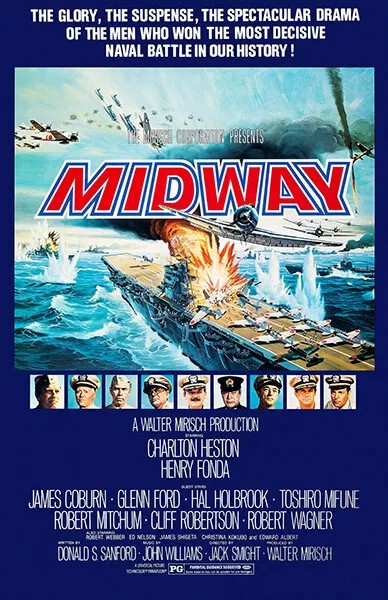
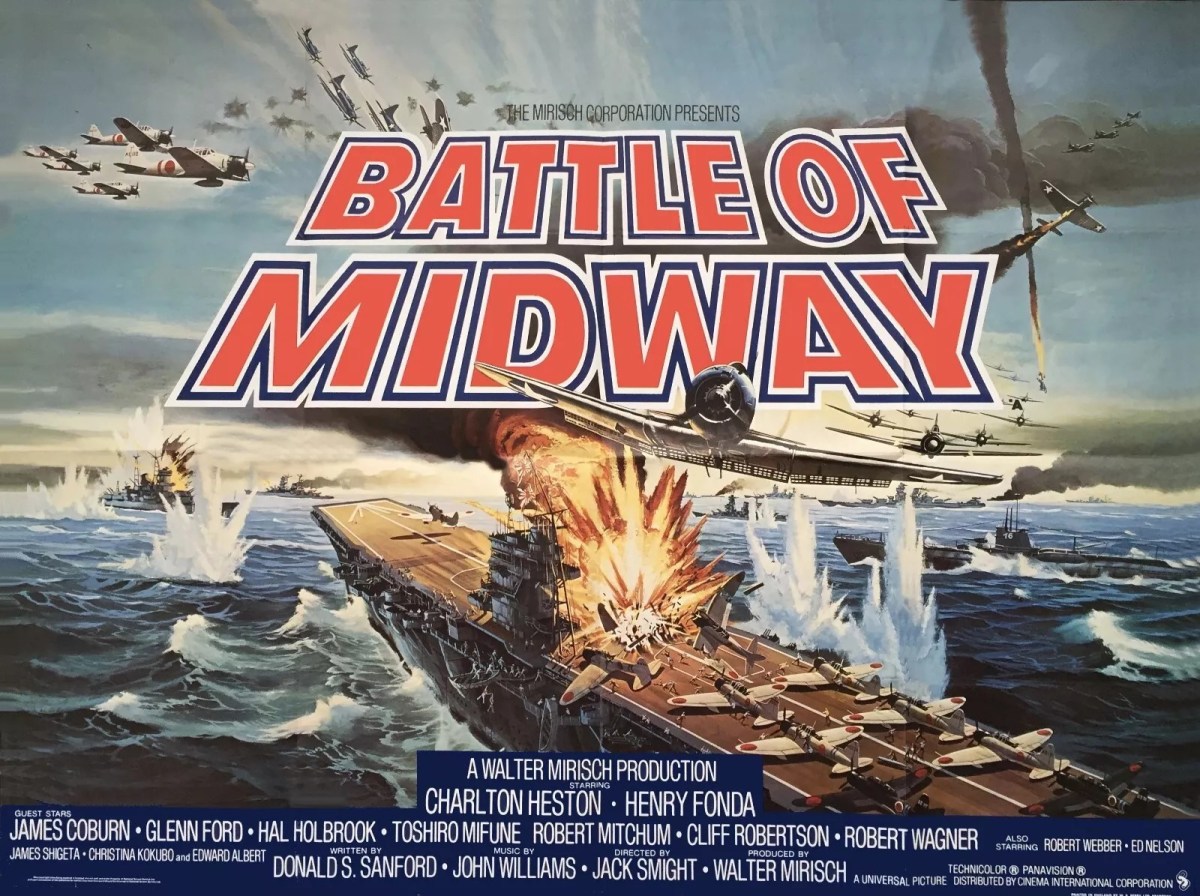
Behind the Scenes: “Battle of Midway” (1976)

Mirisch could easily lay claim to be the top independent production outfit of the 1960s generating hits like The Magnificent Seven (1960),  West Side Story (1961), The Great Escape (1963), The Pink Panther (1964) and its sequel A Shot in the Dark (1964), The Russians Are Coming, Russians Are Coming (1966), In the Heat of the Night (1967) and The Thomas Crown Affair (1968) plus a shelf load of Oscars and Oscar nominations. But dependence on a partnership with Billy Wilder in the 1970s and a more lackluster performance at the box office – with the noted exception of Fiddler on the Roof (1971) – spelled the end of its 17-year relationship with United Artists, which was reeling from financial losses and under new management.

The company found a new partner in Universal which had a series of deals with other major producers like Alfred Hitchcock, Zanuck and Brown (Jaws, 1975) and George Seaton (Airport, 1970). Mirisch was not in any financial trouble, having severed ties with UA after Mr Majestyk (1974), a major success abroad, and recovered its development costs for Wheels, based on the Arthur Hailey novel but the script rejected by UA, from Universal which turned it into a mini-series.

The Universal deal was initially not as good as that enjoyed at UA. Universal charged a twenty-five per cent overhead whereas UA had charged nothing and Universal was now doing direct deals with directors rather than relying on the likes of Mirisch to tie up the talent.

Many years before, Mirisch had commissioned a script on the Battle of Midway from Donald S. Sanford who specialized in war pictures but of the distinctly low-budget variety – Submarine X-1 (1968), The Thousand Plane Raid (1969) and Mosquito Squadron (1969), none of which had enjoyed any success. 

Though all of the Mirisch war pictures had concentrated on Europe, Walter Mirisch, generally the creative driving force for the production company, in his previous incarnation with Allied Artists had some experience of the Pacific War, having produced Flat Top / Eagles of the Fleet (1952), set around an aircraft carrier during the Battle of Leyte Gulf, and was an avid reader of books about the Second World War.

John Ford and Louis de Rochmont had made documentaries about the Pacific naval battles. UA rejected the script twice, a shrewd move in the end because Tora! Tora! Tora! (1970) lost a packet for Twentieth Century Fox. The Sanford screenplay had initially taken more of a documentary approach but after gaining the interest of Charlton Heston, who had starred in Mirisch’s The Hawaiians (1970), the script was tweaked.

Programming a war picture was a risk for the studio. There hadn’t been a big-budget war picture in five years. And while Patton (1970) and Kelly’s Heroes (1970) ended up on the right sight of the ledger book, Tora!, Tora! Tora! and Too Late the Hero (1970) were stiffs.

Mirisch signed a two-picture deal with Universal, for Midway and Wild Card with a screenplay by Elmore Leonard (Mr Majestyk). Mirisch proposed to reduce costs by using footage from naval archives, converting the original 16mm film to 35mm. The producer also  took footage from Japanese film Storm over the Pacific / I Bombed Pearl Harbor (1960) – the rights cost him $96,000. Footage of the Pearl Harbor attack in Tora! Tora! Tora! doubled for shots of the attack on Midway Island.   A clip of the Dolittle raid on Tokyo from Thirty Seconds over Tokyo (1944) was used in the credit sequence after “subjecting it to a sepia bath.”

After the success of Earthquake (1975), Heston was back in the top ranks of box office stars and his involvement guaranteed the green light. The U.S. Navy offered its support, not surprising since Midway was considered its greatest success.

John Guillermin (The Towering Inferno, 1974) was hired to direct and Stirling Silliphant (In the Heat of the Night) signed up for a screenplay rewrite. Mirisch had determined to employ the all-star-cast device that had been an essential ingredient of many of the 1960s roadshow pictures, kicking off with Henry Fonda (The Boston Strangler, 1968), by now pretty much a spent force at the box office – he hadn’t made a picture in three years – but still a well-known name. 

The amount of work involved for the other stars was minimal – mostly just one day – and, astutely, Mirisch called on stars who had worked for him in the past and who, like James Coburn (The Great Escape), Cliff Robertson (633 Squadron, 1964) and Christopher George (The Thousand Plane Raid) owed him something in terms of a career leg-up. Others included Robert Mitchum (The Sundowners, 1960), Robert Wagner (The Biggest Bundle of Them All, 1968) and Tom Selleck in an early role. Mitchum was the first of these stars to sign up, in March 1975, six weeks before the scheduled start date of April 27, followed two days later by Coburn.

Toshiro Mifune (Red Sun, 1971) headed up the Japanese cast and proved so meticulous in his preparations that he had his uniform made by Japanese tailors. The white gloves he wore had a finger shortened on the left hand because his character Admiral Yamamoto was missing a pinky. However, despite coaching in English by actress Miko Taka (Walk, Don’t Run, 1966), his dialog was revoiced by Paul Frees. 

Guillermin demanded a bigger budget to accommodate more airplanes and equipment and a longer shooting period. Two months before filming was due to start, Mirisch put his foot down and told the director he couldn’t accommodate his requests as Universal had only provided funding on the basis of Mirisch’s original idea. Guillermin walked. As far as the public was concerned, the parting of the ways was due to a “conflict of schedules.” Jack Smight, who had directed Airport ’75 (1974), a box office success and also starring Heston, was his replacement.

The Navy lent aircraft carrier U.S.S. Lexington – the last remaining World War Two carrier – while it was at sea training pilots as long as the shoot didn’t interfere with those exercises. A limited number of World War Two vintage planes – in great condition having been cared for by their owners – were permitted on board. The Navy charged the crew for accommodation – Mirisch was housed in Admiral Strean’s quarters – and meals. “We had a detailed contract with the Navy,” recalled Mirisch, “in which we agreed to stay out of their way when asked.”

On board, the crew filmed scenes, some silent and others with dialog, and “made plates for rearview projection and aerial shots of our vintage planes so positioned that we could print them into flights of six or nine.” Charlton Heston, Glenn Ford (Rage, 1966) and Hal Holbrook (The Group, 1966) were aboard and the shoot went well.  A scene involving Henry Fonda was shot at Pensacola. The Florida coast stood in for the Pacific. Additional exteriors were filmed in Los Angeles at Long Beach and Point Dune with interiors at Universal.

The construction of the interiors for the Japanese aircraft carriers was so authentic Mirisch was later asked to reassemble the set for the Smithsonian Institute for a presentation there. The interpolation of the old footage was crucial and it was planned in advance where such shots would appear. The old footage was precut and scenes were shot with actors with “scene missing” in those sequences into which the old footage could be dropped. Other devices were used to ensure the background in the old footage was more lively.

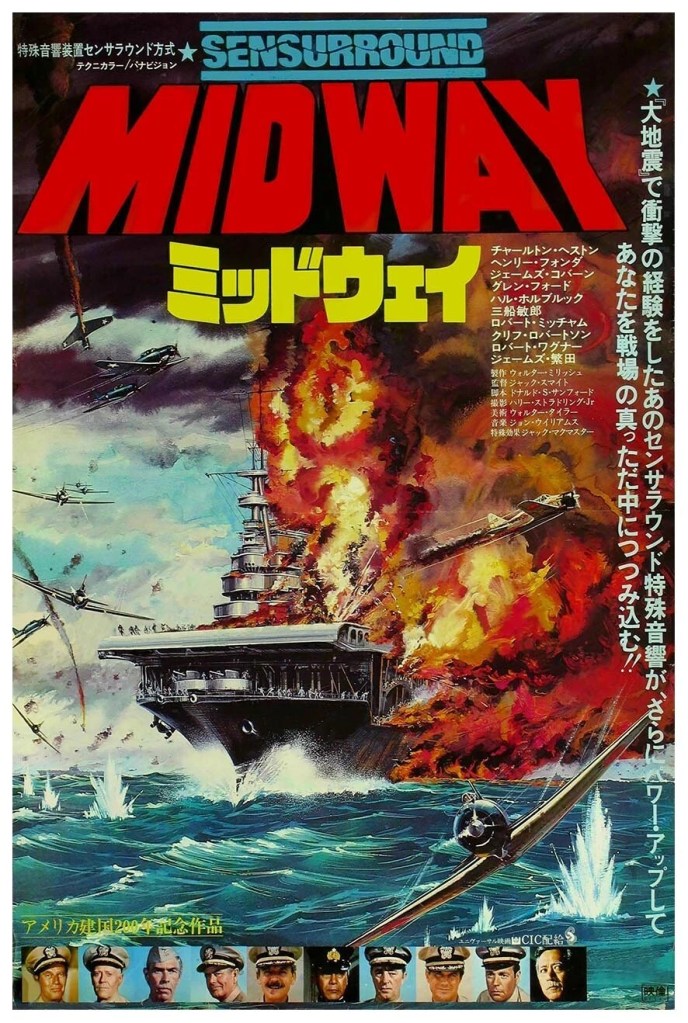
The final element was in cinematic presentation. Sensurround, a precursor of Imax, had been introduced with great success by Universal to Earthquake and this added greater realism to the battle scenes. While limited to those theaters which had installed the expensive equipment, and although the roadshow was long gone, it created an “event” aspect to those viewing it in that system. In his autobiography Mirisch suggested the addition of Sensurround was last minute and sparked  by the success of Earthquake. But, in fact, Universal had announced a year in advance of opening that Battle of Midway would utilize Sensurround.

Some cinema owners were outraged at the stock footage, whose proposed inclusion had been kept from them when they went into the blind-bidding process at the start of the year. Mirisch countered that there was no alternative. “A great many aircraft,” he argued, “used in the battle no longer exist.” Universal’s terms were stiff – a minimum nine-week run starting at a 70/30 split for the first three weeks in the studio’s favor, a $75,000 advance guarantee from cinemas and 5% of the gross for use of Sensurround.

With the budget kept as low as a reported $4 million it was a massive hit, picking up $20.3 million in rentals (what the studio retains of the box office gross) – sixth in the annual box office league beaten only by Oscar-winner One Flew over the Cuckoo’s Nest, All the President’s Men with Robert Redford and Dustin Hoffman, demonic The Omen, Walter Matthau baseball comedy The Bad News Bears and Mel Brooks’ Silent Movie and just ahead of such offerings as Sidney Lumet’s Dog Day Afternoon with Al Pacino, and comedy Murder by Death but nearly doubling the take of the more critically-acclaimed Taxi Driver, Clint Eastwood western The Outlaw Josey Wales and thriller Marathon Man also starring Hoffman. The final domestic figure amounted to $21.8 million.

Foreign figures were astonishing, especially in Japan, where its gross exceeded $4 million. The benefits of the promotional tour undertaken by Heston in the Far East were soon obvious – in Manila it beat both Jaws and Earthquake. In the annual box office league there and Hong Kong, it ranked third. In Italy it proved a “big surprise”, coming in fourth behind King Kong, Taxi Driver and a local offering.

While a successful movie could expect to benefit from television viewings – this was before the video revolution – the movie had an unusual afterlife. NBC, which had bought the rights, wanted the film to be longer, so it could be shown over two nights, thus increasing advertising and setting it up as a more prestigious event. Largely by adding plotlines to the Heston character, the running time increased by nearly an hour, which proved a bonus for the future home screening revolution. 

“Of all the films that I have made,” noted Mirisch, “it produced the greatest amount of profit.”

SOURCES: Walter Mirisch, I Thought We Were Making Movies Not History (University of Wisconsin Press, 2008) pp324-339; “Readying Midway,” Variety, February 5, 1975, p6;  “Universal in New Shake,” Variety, July 23, 1975, p3; “Admiral Mitchum,” Variety, March 12, 1975, p18; ”Jap Feature Footage Inserted into Midway,” Variety, June 6, 1976, p7;  “Midway Big in Manila,” Variety, August 11, 1976, p24; “Big Rental Films of 1976,” Variety, January 5, 1977, p14; “Jaws Led Bangkok,” Variety, February 9, 1977, p39;  “International,” Variety, June 29, 1977, p35.

Battle of Midway (1976) ****

Even-handed documentary-style tale recounting of the most famous U.S. naval battle of all time, a turning point in the struggle for control of the Pacific in 1942. Both sides make mistakes, luck and judgement play an equal part.

I’d always assumed Midway was some abstract geographical position without any idea of its strategic importance – did the name mean it was halfway between the U.S. (or Hawaii) and Japan? But here I learned it was an actual island that the Japs planned to invade and the Americans intended to stop them. In some senses, it was bait, a way to draw the U.S. Navy out of Pearl Harbor. But the bait ran both ways. If the Yanks could coax the enemy out into the Pacific, they had a chance of gaining an advantage, even though the Americans were inferior in shipping tonnage.

The Japs have been stung into action by the audacious American bombing of Tokyo. Admiral Yamamoto (Toshiro Mifune) uses the perceived threat of further attacks to gain official approval for his plan to invade Midway.

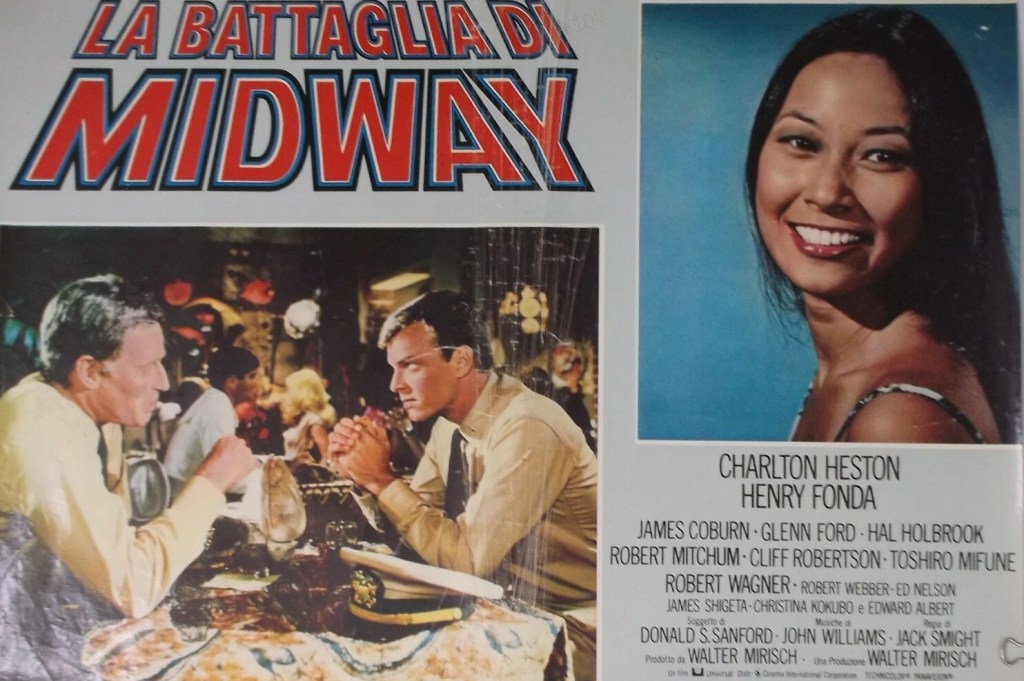
This is strictly a male show. However, in a bid to lower the testosterone levels a romantic subplot is inserted. The aviator son, Lt Thomas Garth (Eddie Albert), of top aide and former pilot Captain Matthew Garth (Charlton Heston) has an American-born lover Haruko (Christina Kobuko) of Japanese descent who’s being investigated for espionage and subsequently interned. On intervening, the father digs up a hodgepodge of racism – from both sides, Haruko’s parents against her forming a relationship with a non-Japanese. But the plan backfires causing a breakdown between father and son.

But that’s very much on the fringes and although it raises interesting cultural aspects, the movie concentrates mostly on the nuts-and-bolts of heading into a major engagement.

American intelligence, headed by Commander Joe Rochefort (Hal Holbrook), gets wind of the planned attack. But the clues are scant – the old trope of increased radio traffic not enough to convince – and while the audience knows the Japs are on the move with a mighty naval force including four top-class airplane carriers, the Americans remain ignorant almost until it’s too late.

Luckily, Admiral Nimitz (Henry Fonda), heading up the American naval contingent, is keen to inflict a blow on the enemy, even though he’s limited to two carriers and another just out of the repair yard. Each side relies on spotter planes to detect the enemy. But the Japanese, by imposing radio silence, shoot themselves in the foot, unable to switch tactics until too late. The hunch plays an important part.

There’s rarely much opportunity for individual heroics on a ship under fire, beyond rescuing someone. The fighter pilots are a better bet, especially since some of their forays are nearly suicidal given the firepower they attract. Matt Garth, who for most of the picture is an upscale backroom boy, is called into action with unexpected results.  

Most battle films tend to concentrate on the heroics often at the expense of understanding in any detail what’s going on. Thankfully, this is different. We are kept informed of every change in the conflict. And whereas you might think that dull, in fact I wouldargue that it adds substantially to the tension, and the fact that the only one of the commanders who looks as if he could throw a punch (Robert Mitchum) in the manner of John Wayne is confined to his bed thus forcing the movie to concentrate as much on brain as brawn.

Audiences at the time welcomed all the talking and this was a substantial hit. Snippets of old war footage were carefully sewn into the lining of the action, bringing the kind of authenticity that moviemakers reckoned moviegoers craved. For me, there was more than enough going on already.

Nimitz’s decision to go for broke rather than dive for cover results in victory but he’s no gung-ho commander, rather presented as a thoughtful but determined individual. The lack of backstage effort especially in the communications department was partly to blame for the humiliation of Pearl Harbor but here these guys share the glory.

Boasting the kind of all-star cast that used to be the hallmark of the 1960s roadshow, this has a bunch of top-notch actors, albeit most just flit in and out of the picture. Charlton Heston (Planet of the Apes, 1968) effortlessly shoulders the main burden with Henry Fonda (Once Upon a Time in the West, 1969) the fulcrum of all decision-making. Robert Mitchum (The Way West, 1967) , James Coburn (Our Man Flint, 1966), Glenn Ford (Rage, 1966), Cliff Robertson (The Devil’s Brigade, 1968) and Toshiro Mifune (Red Sun, 1971) all feature.

Jack Smight (Harper / The Moving Target, 1966) directs from a script by Donald S Sanford (Mosquito Squadron, 1969).

Thoroughly engrossing.

  • I’m doing a Behind the Scenes tomorrow.

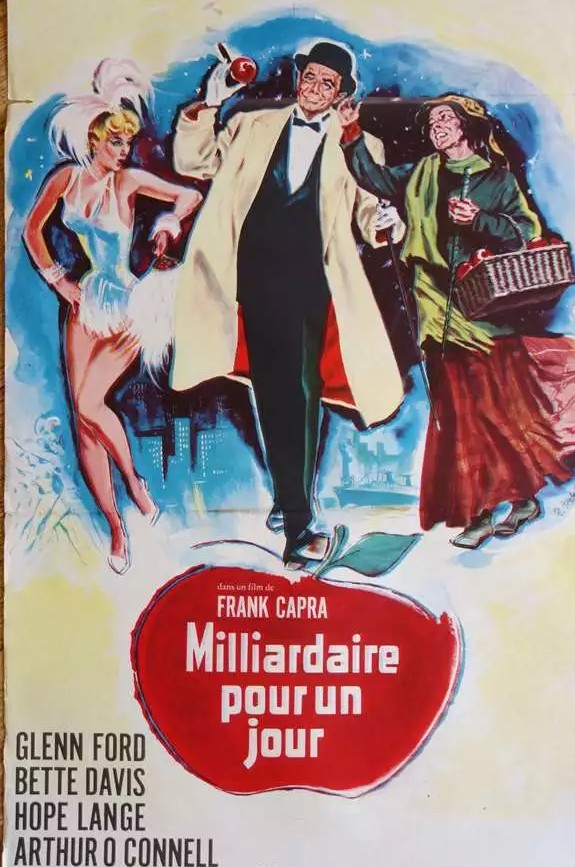
A Pocketful of Miracles (1961) ***

Frank Capra was yesterday’s man – one movie in a decade – and 15 years away from the consolation of knowing that his flop It’s A Wonderful Life (1948) was on its way to becoming, arguably, along with The Wizard of Oz (1939), America’s most beloved picture thanks to annual Xmas showings on television and subsequently in the cinema.

There’s nothing new here, either, it’s a remake of his Lady for a Day (1933) and it’s more of a fable lacking punch than some of his more famous pictures. And the main interest for contemporary audiences may well be that it marks the debut of Ann-Margret (The Swinger, 1966) who gets to sing but not shake her booty in trademark fashion. And it takes forever to wind up to a pitch. We’ve got to wade through three subplots before it gets going.

First of all Prohibition gangster Dave (Glenn Ford) meets up with the daughter Queenie (Hope Lang) of a deceased club owner who’s in hock for $20,000. Dave is much taken by the earnest Queen’s determination to repay the debt at the rate of five bucks a week. For no reason at all except narrative necessity, she’s turned into a nightclub singing sensation.

When Prohibition ends, big-time Chicago gangster Steve Darcey (Sheldon Leonard) plans to muscle in on the New York rackets and it takes all Dave’s suave bluster to keep him, temporarily, at bay. The end of Prohibition comes as a relief to Queenie and with the nightclub shut down she agrees to marry Dave with the proviso that he give up the gangster life and retire to her home town in Maryland and they become an ordinary couple.

Very much on the fringes of this is Apple Annie (Bette Davis), a street panhandler who sells “lucky” apples, one her most satisfied customers being Dave. When her illegitimate daughter Louise (Ann-Margret) returns from Spain to New York with rich beau Carlos (Peter Mann) in tow, Annie’s in a pickle, because she’s been keeping up the pretence of being a wealthy woman.

Queenie insists they help Annie to maintain her charade and Dave goes along with the idea because he’s worried his luck will run out. So Annie is turned into a sophisticate, manners polished, furnished with a luxurious apartment, including a butler, and fake husband Henry (Thomas Mitchell).

None of the stars seem to know how to handle the material, and for most of the time they act as if in a pastiche, like they were throwing winks to the audience. Glenn Ford (Fate Is the Hunter, 1964), generally adept at comedy, plays this all wrong. He wanted the part so badly he helped finance the picture. Bette Davis (Whatever Happened to Baby Jane, 1962) overacts, as does Peter Falk (Murder Inc, 1961), though the Academy didn’t think so and threw him a second Oscar nomination. Hope Lang and Ann-Margret, playing it straight, get it right, though the latter, vivacious personality to the fore, wins that battle by more than a nose. Might well have worked if original choice Frank Sinatra hadn’t ankled the project.

Hal Kanter and Harry Tugend wrote the remake, based on a Damon Runyon story. It was always a tricky business to capture the stylistic essence of Runyon, Guys and Dolls (1955) the most effective transition, Lady for a Day better than this and Little Miss Marker filmed three times.

Once the Bette Davis pretence enters the equation, the tale takes on some narrative drive and the quintessential Capra shines through. But it’s too little too late.

Not the swansong Capra anticipated, but he only has himself to blame.

Dear Heart (1964) ****

Big difference between the manufactured maudlin of a weepie and middle-aged characters so ill-at-ease and discomfited that they are painful to watch, circumstances not redeemed by comedy. Audiences and critics didn’t take too kindly to this because the two stars were way out of their comfort zones. Glenn Ford (Rage, 1966) dropped his take-charge quiet-tough-guy persona, and didn’t even play that for laughs, and Geraldine Page (The Sweet Bird of Youth, 1962) rid herself of the tragic face that sacrificed itself on the altar of Oscar (at this point she was three-eights into her Oscar nominations haul).

The whole unremittingly sad enterprise would have been made for today’s generations, more acceptable of the sour ending and the clunkiness of romance that fails to gell.

Harry (Glenn Ford), a greetings card salesman who falls back on his own profession in his chat-up lines, thinks he has achieved his goal of settling down with widow Phyllis (Angela Lansbury) and becoming father to her young son, enjoying domesticity, extended family round for dinner, playing baseball and larking about with the boy. Evie (Geraldine Page) is too much and not enough, too big in her personality, not enough of whatever it takes to make her a long-term proposition for the opposite sex. They meet at a convention, hers, she’s a postmaster, he’s just staying at the same hotel.

She’s at least the more self-aware, wants more than the one-night stand of convention life, reluctant to take her place among the singletons, can’t work out why if she’s the life and soul of the party that at party’s end she’s still sitting on the shelf. But she also wants recognition – of some kind – makes fictitious calls to hotel reception so that a bellboy will troop round the lobby calling out her name. She brings her own lightbulbs, to replace the low-wattage ones in a bedroom, forever trying to adjust the world o her own vision, teasing bedroom curtains out in a different fashion, mild invention that keeps her sane regardless of how insane some actions are, charging ahead to open every door in the expectation that she shouldn’t count on male gallantry (this is the 1960s after all).

Harry’s the guy who does open doors for women, but cursed with loneliness, caught in embarrassing gaffes, chatting up the dumb kiosk blonde who’s a good bit more savvy. Most of the comedy hurts. He’s late to meet his boss because he stopped off for a martini at the apartment of an occasional lover and when he trips out too many excuses is told, tartly, that while one excuse is acceptable, three or four (train late, weather, can’t get a taxi, taxi stuck in traffic etc) is the sign of a liar. He does the whole unnecessary explanation routine when booking a hotel room for a tryst with the blonde whom he pretends is his wife not noticing the receptionist’s cynical eyebrows, and brought down to earth when said blonde breezes in and calls out a greeting to the receptionist.

Evie works out how to get a table in a packed restaurant, passing onto Harry the clever trick of saying you are waiting for a date and then apologising when they don’t turn up. When he tries this out, the waitress upends him with, “Why not join this lady (Evie), she can’t imagine either what happened to her date.”

There’s nothing cute about either of them so no chance of a meet-cute. She’s continually awkward, independent, and he doesn’t know how to spell out his troubles or work out why he’s walking into an unsuitable marriage. The only room this movie has for comedy is the sudden appearance in Harry’s life of a bearded teenager who usurps his bedroom (girlfriend constantly in the bath). This lad is Phyllis’s grown-up son Patrick (Michael Anderson Jr.) yet Harry’s been led to believe, or thinks he has, that the boy would be much younger, judging by the treasured photo given him by his fiancée. On the one side is a slab of situation comedy, on the other an out-of-his-depth Harry not knowing if he’s been duped and realizing how little he knows of genuine fatherhood. He’s awkwardness grown ten feet tall.

It’s not as if Harry and Evie actually conduct a romance, there’s some kind of attraction that neither can fully recognize, every time it sparks up as likely to wilt, and he’s prone to letting her down, sudden arrangement with son taking precedence over pre-arranged dinner with her, except, she’s mollified because he left her a note at the desk, and she doesn’t get those unless she manufactures them herself  and then in her ungainly way lets everyone know someone has tried to contact her, as if that’s a sign of importance, or explanation for her feeling of being so let-down.

Phyllis turns out not to be the smalltown housewife of whom Harry dreams. She’s had enough of being a housewife. She wants what she sees as the high life, living out of hotels, “From now on I just want to pick up the telephone” and order food, cocktails, laundry, newspapers, whatever. Just what different paths they are on is detailed in a killer of a line. When he complains – it would be an accusatory tone if he could muster up the courage – about why she gave him this particular photo of the boy, as a kid not a man, comes the rejoinder, “Because that’s the best picture of me that’s ever been taken.”

You’d be lucky to find romance in this sullen snarky version of New York, filled with  uncivil, unhelpful staff, bursting with indifference, nary a touch of sympathy for any customer, whether they are seeking a room in a city jam-packed with conventions or just a cup of coffee.

If you believe in the tagged-on happy ending, you’ll believe in anything. This pair are so discordant, so jarring, that they are probably the most realistic couple to ever grace the screen. Ignored as their performances are, they are probably the best of their careers, in part because neither is central to the bigger story that a high-end drama or western or thriller might entail., in part because they go out on an acting limb, light years away from their established screen persona. They are just so darned realistic your heart bleeds because you just know they are doomed into making relationship mistakes, most likely with each other, and will remain among the jittery unfulfilled, wondering how everyone else manages it.

Director Delbert Mann’s been here before – Oscar-winner for Marty (1955), drawing an Oscar-winning performance from David Niven in Separate Tables (1958) and James Garner’s best performance in Buddwing (1966) – and makes acceptable viewing out of what in the hands of a Harold Pinter would be an impossible watch. But even so, it comes close. Tad Mosel (Up the Down Staircase, 1967) wrote the screenplay.

Had this been an an arthouse picture, it would be drenched in awards.

Fabulous performances, heartfelt situation.   

The Four Horsemen of the Apocalypse (1962) **

Hollywood isn’t known for its sensitivity, and this is one of those major misjudgements. An incredibly rich family, ripe with entitlement, find World War Two tough going, in the main because as in Counterpoint (1968), they consider themselves exempt. Being Argentinians, they are neutral.

Unfortunately, it just so happens, with that wealthy person’s penchant for flaunting their wealth in the world’s richest cities, they end up in Paris on the eve of war, ignoring the warning of family patriarch (Lee J. Cobb) who is convinced the titular “four horsemen of the apocalypse” (war, conquest, death and pestilence, in case you don’t know your Bible) are on the march. Not that we see much of that in the French capital, except in newsreel, details of the war delivered in snippets of dialog (“haven’t you heard about Dunkirk?”), and street-loads of refugees.

Because, don’t you know it, our major players, the Desnoyers and Laurient families, are largely immune. Man-about-town and Argentinian art connoisseur Julio Desnoyers (Glenn Ford) – ignoring the entreaties of his father Marcelo (Charles Boyer) to scarper – is making a move on married Frenchwoman Marguerite Laurient (Ingrid Thulin), bored by newspaper editor husband Etienne (Paul Heinreid) who spends way too much time worrying about impending war.

Julio is so rich that even after the German invasion sends the poor of the city – and its Jewish population – racing about terrified for their lives, he can swan around, enjoying fine food in top-class restaurants much as before and even has the temerity to tell a high-ranking German General von Kleig (George Dolenz) that his wealth makes him immune. The general reckons that his rank gives him any woman he wants. “She’s mine,” is Julio’s rather misogynistic retort when the general attempts to appropriate Marguerite.

Meanwhile, though Julio is still slow to catch on, his sister Chi Chi (Yvette Mimieux) has only gone and joined the Resistance and Etienne has also upset the new masters, so Julio has to go begging cousin Heinrich (Carl Boehm), who has exploited his German origins to achieve military high rank, to provide them with a get-out of-jail-free card.  

When Etienne is released, Marguerite is initially inclined to stick with Julio until guilt gets the upper hand. Julio, with no lover to keep him happy, eventually throws his lot in with the Resistance, but there’s no happy ending for anyone.

Director Vincente Minnelli (Two Weeks in Another Town, 1962) is terrific at marshalling his set pieces, using widescreen to excellent advantage, cramming extra bodies in at the edges, but since these sequences tend to be little more than extended talk-fests – the activities that got Chi Chi and Etienne imprisoned are ignored – no amount of directorial skill in the world is going to salvage a movie so weighted down with dead wood.

Glenn Ford (Rage, 1966) does his very best to give the viewer something to hold onto. He avoids every shade of angst in his determination to have as much as fun as possible regardless of any situation. He’s scarcely had the chance to be so carefree on screen and he is at his charming best, and he does lift what is otherwise a somber encounter.

Ingrid Thulin (Return from the Ashes, 1965) has her moments, especially when her diplomatic skills prevent a party being ruined, and she enjoys some flighty repartee with Ford, but once the romance gets heavy her personality undergoes a U-turn and she’s holding onto angst for dear life. And there’s a twist in her character that makes no sense. When Etienne emerges from prison a broken man, she gives him both barrels, and declares her love for Julio only for shortly after to recant and dump Julio. Seems mighty insensitive and bordering on cruelty to deal her husband such a blow when he has been tortured by the Nazis. Though she might not have been so forgiving had she worked out just why Etienne was freed and Chi Chi not.

After the colossal success of Ben-Hur (1959), which set the roadshow ball rolling, MGM was on a remake crusade. As well as Ben-Hur, it had remade Cimarron (1960) – the original 1931 version an Oscar-winner and hot box office. The fact that that flopped didn’t deter the studio. The silent version of The Four Horsemen of the Apocalypse (1921), set against the background of World War I,  transformed Rudolph Valentino into a superstar and netted MGM a fortune. The new version sank like a stone, perhaps because it was too wordy for roadshow, or perhaps, more likely, Judgement at Nuremberg (1961) had taken a bolder look at World War Two.

A mis-hit.

REVIEWED PREVIOUSLY IN THE BLOG: Glenn Ford in Experiment in Terror (1962), Love Is a Ball (1963),  Advance to the Rear / Company of Cowards (1964), Fate Is the Hunter (1964), The Money Trap (1965), Is Paris Burning? (1966), Rage (1966), The Last Challenge / The Pistolero of Red River (1967), A Time for Killing (1967), Day of the Evil Gun (1968), Heaven with a Gun (1969; Ingrid Thulin in Return from the Ashes (1965); Yvette Mimieux in The Time Machine (1960), The Wonderful World of the Brothers Grimm (1962), Diamond Head (1962), Joy in the Morning (1965), The Reward (1965), The Caper of the Golden Bulls (1967), Dark of the Sun (1968), The Picasso Summer (1969); Vincente Minnelli directed Two Weeks in Another Town (1962) and Goodbye Charlie (1964).

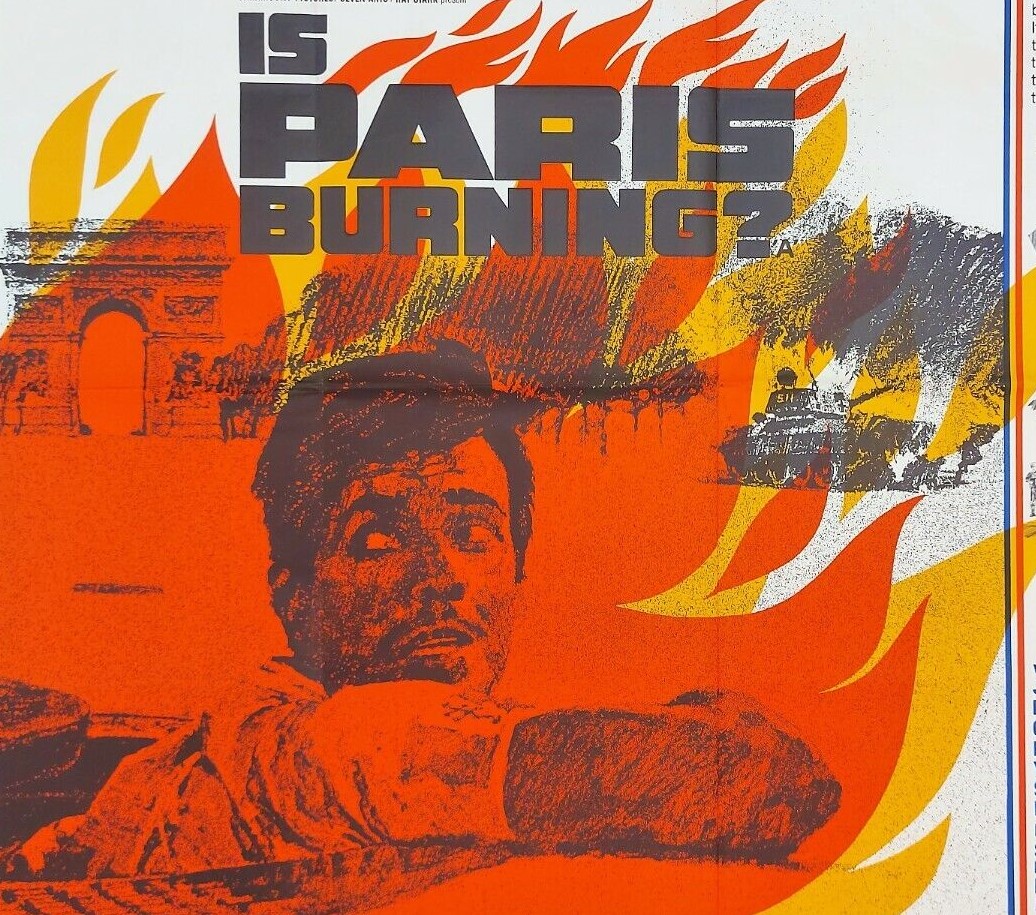
Is Paris Burning (1966) ****

Politics didn’t usually play a part in war films in the 1960s but’s it’s an essential ingredient to Rene Clement’s underrated documentary-style picture. Paris had no strategic importance and after the Normandy landings the Allies intended to bypass the French capital and head  straight for Berlin.

Meanwhile, Hitler, in particular vengeful mood after the attempt on his life, ordered the city destroyed. Resistance groups were splintered, out-numbered and lacking the weaponry to achieve an uprising. Followers of General De Gaulle, the French leader in exile, wanted to wait until the Allies sent in the troops, the Communists planned to seize control before British and American soldiers could arrive. 

When the Communists begin the fight, seizing public buildings, the Germans plant explosives on the Eiffel Tower, the Louvre, and other famous buildings and all the bridges across the River Seine.  The German commandant Von Choltitz (Gert Frobe), no stranger to slaughter having overseen the destruction of Rotterdam, holds off obeying his orders because he believes Hitler is insane and the war already lost.

The Gaullists despatch a messenger to persuade General Omar Bradley (Glenn Ford) to change his mind and send troops to relieve the city. Sorry for the plot-spoiler but as everyone knows the Germans did not destroy the city and the liberation of Paris provided famous newsreel and photographic footage.

Director Clement (Rider on the Rain, 1970) was also aware he could not extract much tension from the question of whether von Choltitz will press the destruct button, so he takes another route and documents in meticulous detail the political in-fighting and the actual street battles that ensued, German tanks and artillery against Molotov cocktails and mostly old-fashioned weaponry. The wide Parisian boulevards provide a fabulous backdrop for the fighting.

Shooting much of the action from above allows Clement to capture the action in vivid cinematic strokes. Like The Longest Day (1962), the film does not follow one individual but is in essence a vast tapestry. Scenes of the utmost brutality – resistance fighters thrown out of a lorry to be machine-gunned, the public are strafed when they venture out to welcome the Americans – contrast with moments of such gentleness they could almost be parody: a shepherd taking a herd through the fighting, an old lady covered in falling plaster watching as soldiers drop home-made bombs on tanks.

This is not a film about heroism but the sheer raw energy required to carry out dangerous duty and many times a character we just saw winning one sally against the enemy is shot the next. The French have to fight street-by-street, enemy-emplacement-by-enemy-emplacement, tank-by-tank.

And Clement allows as much time for humanity. Francophile Sgt Warren (Anthony Perkins), as an American grunt, spends all his time in the middle of the battle trying to determine the location of the sights he longs to see – before he is abruptly killed.  An unnamed café owner (Simone Signoret) helps soldiers phone their loved ones.

Like The Longest Day and In Harm’s Way (1965), the film was shot in black-and-white, but not, as with those movies for the simple reason of incorporating newsreel footage, but because De Gaulle, now the French president, objected to the sight of red swastika. Even so, it permitted the inclusion of newsreel footage, which on the small screen (where most people these days will watch it) appears seamless.

By Hollywood standards this was not an all-star cast, Glenn Ford (as Bradley), Kirk Douglas (General Patton) and Robert Stack (General Sibert) making fleeting glimpses.

But by French standards it was the all-star cast to beat all-star casts – Jean-Paul Belmondo (Breathless, 1960), Alain Delon (Lost Command, 1966), Yves Montand (Grand Prix, 1966), Charles Boyer (Gaslight, 1944), Leslie Caron (Gigi, 1958), Michel Piccoli (Masquerade, 1965), Simone Signoret (Room at the Top, 1959) and Jean-Louis Trintignant (A Man and a Woman, 1966).  Orson Welles, in subdued form, appeared as the Swedish ambassador.

Gore Vidal (The Best Man, 1964) and Francis Coppola (The Godfather, 1962) devised the screenplay based on the bestseller by Larry Collins and Dominic Lapierre

At $6 million, it was the most expensive French film ever made. It had a six-month shooting schedule and was shot on the streets of the city including famous locations like Etoile, Madeleine and the Louvre. It was a big hit in France but flopped in the United States, its box office so poor that Paramount refused to disclose it.

Gripping.

Love Is A Ball (1963) ***

Three main characters playing against type and a feisty, independent, woman are the main pleasures of this conspiratorial rom-com that takes a while to get going. The main obstacle is the subplot involving the education of a klutz, impoverished French Duke Gaspard (Ricardo Montalban), who needs brought up to speed on the niceties of fine dining, horse-riding and dancing in order to represent a decent catch for American heiress Millie (Hope Lange).

So that keeps ex-racing driver John (Glenn Ford), fallen on such hard times he’ll accept a job as chauffeur, confined to the background for the first third of the movie. That is, until he works out that his employer Etienne (Charles Boyer) is a professional matchmaker who makes a living marrying off poverty-stricken aristocrats to wealthy women. However, he poses as a charmer who happens through his connections to put women in contact with eligible men without letting on that he takes a hefty commission or that his clientele is financially illiterate.

But the cunning Etienne realizes that in order to get close to Millie he has to exploit the  weakness of her over-protective uncle Dr Gump (Telly Savalas) for gourmet food. All these complications create delay in getting on with the will-they-won’t-they romance of Millie and John.

Millie, channeling the adventurous spirit of the likes of Amelia Earhart, is car mechanic, wannabe racing driver and neophyte ballet dancer, so not quite the hapless rom-com female. And she’s pretty good at putting John in his place when he lacks the necessary subservience, giving him a tight deadline to wash her family’s huge fleet of cars, and forcing him to wear a despised chauffeur’s cap.

Meanwhile, Gaspard is causing problems of his own, not just by his complete ineptitude, but by falling for Etienne’s secretary Janine (Ulla Jacobson). So it’s hitches all round especially as Millie and John spend all their time upsetting each other, so much so that, determined to get married to please her grandmother, she’s on the brink of marrying the next clod in Etienne’s line-up.

To be honest, the script is a bit of a mess and in sticking to it director David Swift (The Interns, 1962) hasn’t quite been able to play to the movie’s strengths – and making more of them – rather than trying for what amounts to not much more than an ensemble piece. What lifts the movie is watching the usually steadfast and take-charge Glenn Ford (Rage, 1966) being put through the wringer by the heiress and forced to swallow humble pie any time he has had more than enough.

Next up is Telly Savalas (The Scalphunters, 1968) who totally switches his mean if not downright villainous screen persona to portray a character who dithers over epicurean delights and turns into a happy individual as long as his appetite is sated.  A Jolly Telly is indeed a sight to be savoured.

Lastly, we have Ricardo Montalban (Sol Madrid, 1968), again an actor who errs on the tough-guy side, another of the take-charge fraternity, who always appears completely in command. It’s a bold career move for him to chuck that persona into the mixer and let it spin round a hundred times a minute till he comes out looking frazzled.

Hope Lange (A Pocketful of Miracles, 1961), who had a sporadic career as a female lead, and was at the time involved in an affair with Ford, is excellent as the adventurous headstrong spirit clad in overalls but less convincing as the glamorous heiress especially when simpering.

The screenplay, based on the novel The Grand Duke and Mr Pimm, looks as if it wanted to head in too many heads directions at once, was by Swift and Frank Waldman (Inspector Clouseau, 1968). Farce, at which Waldmann later excelled (he wrote the trio of 1970s Pink Panther films), seems is not a good fit for rom-com.

Worth seeing for Glenn Ford, Telly Savalas and Ricardo Montalban all thumbing a nose at their screen personas.

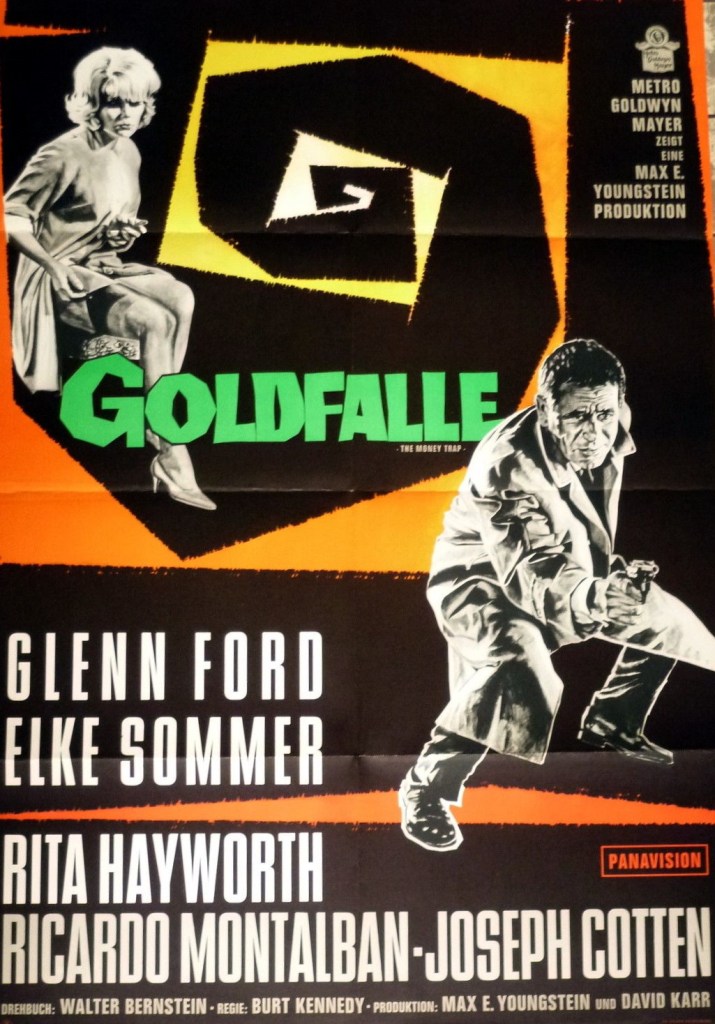
The Money Trap (1965) ****

Film noir morality play. Highly under-rated, especially unfair since all four principals put in excellent performances, plus a nifty screenplay, and generally erratic director Burt Kennedy on very solid cinematic ground, even if he has a predilection for showing legs, and not just of the female variety.

Film noir is at its best when the plot is simple, usually good guy inveigled into taking a wrong turn through avarice, revenge or a femme fatale. This takes an unusual route. Idealistic cop Joe (Glenn Ford) worries beautiful wealthy spendthrift wife Lisa (Elke Sommer) will abandon him for a richer guy since her allowance has dried up.

Assuming she is already making her play, Joe has a one-night stand with old flame Rosalie (Rita Hayworth), a lush married to a murdered burglar. His partner Pete (Ricardo Montalban), envious of his buddy’s wealth, blackmails him into robbing the safe of Mafia doctor Van Tilden (Joseph Cotten) who, in self-defence, killed the burglar. Meanwhile, as contrast,  the pair are investigating the murder of a sex worker trying to earn extra money to shore up her husband’s miserable income.  

While it’s got all the requisite of film noir, atmospheric use of light given it’s shot in black-and-white, that unusual footage of legs, and feet, especially when Rosalie is followed by Tilden’s thug Matthews (Tom Reese), cunning villain, the unexpected twist, neither of the femmes it transpires is much of a fatale, greater backbone than you might expect.

But mostly, it focuses on decision and consequence. Will Joe accept he could lose his wife, will Lisa make the jump into a lower standard of living in order to hold onto her husband, or will Joe distrust that his wife can change and find a way to bring the loot he thinks will keep her satisfied? Lack of trust all round proves their undoing.

There’s the usual, silent, heist, though quite where Joe and Pete acquired their safecracking skills is never discussed. It is the perfect robbery, a dodgy doctor unlikely to call in the cops, especially as they might get suspicious as to just why he is such a common burglary target. Except it’s not. For what’s in the safe is too hot for any cop and Van Tilden, more streetwise than the police, is always one step ahead. Instead of it being the greedy Lisa who could ruin their otherwise stable and loving marriage, it’s Joe.

There are a handful of clever twists, not least that Joe’s dalliance with Rosalie signs her death warrant, but I won’t give those away. It’s too tightly told to spoil it. That’s part of the beauty here, it’s a neat 90 minutes, short and to the point, temptation and consequence.

If ever there was an actor under-rated during this decade it’s Glenn Ford (Rage, 1966). He was hardly ever cast in a big-budget picture except as part of an “all-star cast”, and mostly, given the extravagances elsewhere, in A-pictures whose budgets in reality turned them into B-pictures, and he ended the decade in a rut of westerns, all as under-rated as him. But he brought a tremendous intensity to every role, equally believable as romantic hero and potential heel, and in action, as here, he moves with lethal speed. He had a unusual gift as an actor – you always knew he was thinking. And was very likely to be saying one thing and thinking or meaning another.

Here he acts his socks off. You wonder just what has he got to live in such a fancy house with a rich gorgeous damsel and it doesn’t take long to find out his attraction to him, that right stuff that would rarely come an heiress’s way, more likely to trundle her way through endless marriages and affairs seeking a stability that wealth does not bring.

Elke Sommer (They Came To Rob Las Vegas, 1968) is a revelation, mostly because the script builds her a proper character, loving wife temporarily distracted by potential loss of wealth, but knowing enough about her husband to recognise she’s be better off with him than without him.

Rita Hayworth (The Happy Thieves, 1961) makes the most of her last meaningful role, not lit to shimmering glory by a black-and-white camera, but while shown at her blowsy physical worst redeemed by mental strength. Ricardo Montalban (Cheyenne Autumn, 1964) , usually relegated to a supporting role, provides not only the narrative impetus, but his character twists and turns throughout. Joseph Cotten (Petulia, 1968) has cold blood running through his veins.

This is early-promise Burt Kennedy (Dirty Dingus Magee, 1970) and with a tight script by Walter Bernstein (Fail Safe, 1964) delivers a surprisingly effective very late period film noir.

Terrific acting, by twisty plot held in check by realistic consequence.

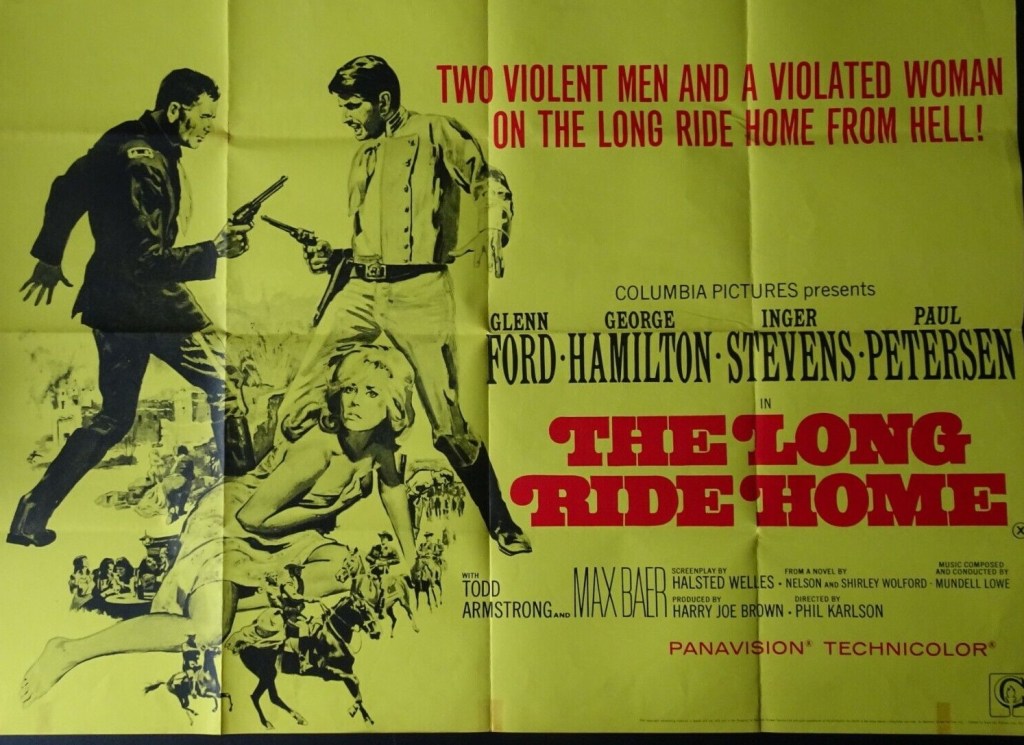
A Time for Killing / The Long Ride Home (1967) ****

The American Civil War is often slotted into the wrong genre. It is not a western. It is a war, with all the inherent wrongheadedness, viciousness and atrocity. We begin with senseless execution and end on a note of humiliating barbarity. Along the way we witness easily the greatest performances in the careers of George Hamilton (The Power, 1968) – a wonder after this how he was ever associated with playboy characters – and Inger Stevens (Firecreek, 1968).

At the tail end of the war in a Confederate POW camp, the disciplinarian commander orders raw recruits to execute an escapee. When they fail to find to the target Major Wolcott (Glenn Ford), witnessed by appalled missionary fiancée Emily (Inger Stevens), steps in to finish the job. In the wake of this Wolcott sends Emily away under escort.

POW leader Captain Bentley (George Hamilton), fully aware the war might end in days, but determined to escape to Mexico and continue the fight, organises a breakout. Instead of sneaking out quietly, in revenge he turns the Union cannons on his captors. And despite being better informed how close the war is to an end, the dutiful Wolcott sets off in pursuit.

Bentley ambushes Emily’s escort, killing the soldiers and stealing their mounts, but promising Emily that as befits a Southern gentleman he will respect her honor. She’s not so innocent of war, anyway, begging Bentley to kill a fatally wounded Union soldier rather than leaving him to the buzzards or, one assumes, marauding Apaches.

Unfortunately, his comrades don’t share that sentiment and when Emily makes the mistake of unloosing her blouse to wet her neck at a stream it inflames their lust. Equally, unfortunately, Emily doesn’t keep to her part of the deal and in attempting to escape hits Bentley a humiliating blow with his own saber.

While unfamiliar with the territory, Wolcott is a pretty good soldier, taking a shortcut over the mountains to cut off their retreat. “How come he knew what we were gonna do before we done it,” wails a Confederate soldier. “Before you even thought it,” snaps the over-confident Emily.

A few miles from the border, the Confederates hole up in a bordello where Bennett finds a despatch announcing the war is over. Ignoring the fact that for the ordinary soldier you couldn’t find a better place to celebrate peace than in a whorehouse, and determined to continue the war, Bennett conceals the information.

In revenge for losing face in front of his soldiers, he (luckily off camera) rapes the half-stripped and bloodied Emily. In the manner of every savage taking advantage of wartime conditions, Bennett tells her, “You think nothing like this can ever happen to you. But you’re lucky because your humiliation will be over soon. You and your major are going to know I won.”

Rape, as currently in the Ukraine and as in many previous conflicts, used as a weapon.

When Wolcott arrives, it’s obvious what has happened and while holding a lid on his own emotions (a Glenn Ford hallmark), once he has proof the war is over, he refuses to give chase. Brutally, he tells her,  “I can see (witness) men die for their country but I can’t see them die for your honor.” It’s Bennett who, oddly, comes to her rescue, opening fire on the Union soldiers, compelling Wolcott, in breach of the rules of war, to cross the border into Mexico in pursuit.

This isn’t a typical Glenn Ford (The Pistolero of Red River/The Last Challenge, 1967) picture where he plays the central character and is scarcely off screen. Here, he disappears for long stretches as the camera focuses on George Hamilton, his squabbling gang and the growing tension between him and Inger Stevens. If you’ve only seen Hamilton in his screen playboy persona, this is a revelation as honor and misguided duty turn into repulsive action.

And this is by far the best performance by Inger Stevens. What she achieved here launched her career, although admittedly as a female lead rather than top-billed star. The emotion her face portrays without the benefit of dialog is quite astonishing. Expecting to be an innocent bystander, unexpectedly thrown into the tumult, physically abused, and then, contrary to her Christian beliefs, she goes from stalwart to victim to, against her Christian principles, showing no sign of turning the other cheek but in full Old Testament mode urging revenge.

The scene when Emily enters a room full of soldiers, attempting to retain some dignity in the face of torn clothes and bloodied face, while acknowledging her humiliation, is stunning. The only scene that comes close to matching its power is at the end, the sequence shot from above, light streaming into a darkened cellar, when, having killed Bennett, Wolcott abandons his potential bride.  

Phil Karlson (The Secret Ways, 1961), a stand-in for original director Roger Corman, does an excellent job of focusing on the brutalities of war, not just the rape and violence, but the recruits, as dumb as they come on both sides, who fail to cope with the pressures. You would have to be fast to spot Harrison Ford (billed as Harrison J. Ford) making his screen debut, but Harry Dean Stanton (Cool Hand Luke, 1967) has a bigger role. Halstead Welles (The Hell with Heroes, 1968) wrote the screenplay based on the novel The Southern Blade by Nelson and Shirley Wolford.

A couple of later westerns might have raided this picture for ideas: continuing the fight in Mexico was the focus of The Undefeated (1969); a constantly carping pair who delight in slaughter evidenced in The Wild Bunch (1969); relentless pursuit a constant theme of 1969 westerns as diverse as Butch Cassidy and the Sundance Kid, True Grit, The Wild Bunch, Mackenna’s Gold and Once Upon a Time in the West.

Regard this as a western and you will be disappointed. Take it more seriously as a war picture and it offers far more. I’m probably being a tad generous in giving it four stars but I was knocked out by the performances of Hamilton and Stevens and a number of excellent scenes, the two in particular mentioned above for example, and the dialogue.

Discover WordPress

A daily selection of the best content published on WordPress, collected for you by humans who love to read.

The Atavist Magazine

by Brian Hannan

WordPress.com News

The latest news on WordPress.com and the WordPress community.