Behind the Scenes: “Diamond Head” (1962)

Charlton Heston was as hot as they come. He was coming off what would prove one of the biggest pictures of all time – and tucked away an Oscar as well – with Ben-Hur (1959) and followed it up with another hit El Cid (1961). He had no shortage of offers. He had pulled out of The Comancheros (1961), part of proposed three-picture deal with Twentieth Century Fox but with an unknown director rather than veteran Michael Curtiz who later helmed it with John Wayne. He had turned down Let’s Make Love (1960) with Marilyn Monroe and a remake of Beau Geste to co-star Dean Martin and Tony Curtis.

He entered into discussions with Nicholas Ray to film the bestseller The Tribe That Lost Its Head (never made) and The Road of the Snail (never made), rejected William the Conqueror (never made) and Cromwell (1970). He was turned down in turn by Otto Preminger for Advise and Consent (1961). “Zanuck’s man called from Paris,” he notes, “they have a new role for me in The Longest Day (1962).” That was another false lead.
In due course he signed up for Easter Dinner for producer Melville Shavelson (Cast a Giant Shadow, 1966) released as The Pigeon That Took Rome (1962). By this point he was being pursued by Samuel Bronston. “I had no idea how determined Sam was to have me follow El Cid with another film for him.” Bronston eventually got his wish. “No sooner had I turned down The Fall of the Roman Empire (1964) than they shoved it back a year on their schedule and began work on 55 Days at Peking (1963), converting the enormous and half-built set representing Rome into an equally enormous and even more beautiful set representing Peking.”

But that meant delay while the massive Bronston machine kicked into gear. In the meatime Heston was “attracted a bit by the opening pages” of Diamond Head with Columbia. “A good part in an overwritten and melodramatic script,” he observed, concluding, “If it’s treated with great care, it might work out all right.”

The project moved along apace. A couple of weeks after receiving the script in December 1961, he was in London meeting director Guy Green (Light in the Piazza, 1962) and producer Jerry Bresler, “an amiable man” though Sam Peckinpah might beg to differ after his experiences on Major Dundee, 1965. “He seems a very intelligent fellow,” Green observed, but queried, “how could a man refer with pride to the fact he had made a film called Gidget Goes Hawaiian?”
George Chakiris (hot after West Side Story, 1961) was already fixed as second male lead and Yvette Mimieux (Light in the Piazza) was being chased for female lead. She wasn’t available but Heston wasn’t keen on second choice Carroll Baker. Luckily, it turned out Mimieux could do the picture. “On the basis of what we saw in Light in the Piazza, she’s ideal for the part.”

But Heston reckoned the script needed work. He was also disgruntled with the costumes for Diamond Head, complaining, “Why is it designers like to costumes instead of clothes? It’s a grievous fault in a period film, but there’s no excuse in a modern story.”

By March, a few months after committing to the picture, he was out in Hawaii, on the island of Kauai, though the trip itself was not without incident, Heston “sick enough to call a doctor.” They were met with unseasonal rain. They were assured this was very unusual. But it wasn’t. In consequence, the first day’s filming was scrapped, filling the actor with the conviction “the whole project was doomed.” It was another three days before filming commenced – the shoot was plagued with rain.

While Heston was impressed enough with the director (“Guy Green works carefully and thoughtfully”) he was distracted by the lighting.

“Those brutes and reflectors loom larger in my mind…One of the banes of my career has been  acting in exterior locations with arc lights and reflectors focused in my eyes, which are very light sensitive. (Dark-eyed actors have an unfair advantage, I’ve always felt.) Most people have no idea of the dimensions of this problem. They always ask you how you can remember the lines…they should wonder instead how you can concentrate on the scene when your every nerve is straining simply to keep your eyes open.” Negotiation with the cinematographer ameliorated the situation.

Similarly, Heston found the director responsive to his concerns. For a key scene with Mimieux, he believed “we can both do better” and taking this on board the director agreed on a reshoot the next day. “I have to project Howland’s need to be loved, though he conceals it. You can’t play this, of course, but it has to be in the scene, in the whole film, if we’re going to bring it off.”

As well as a multitude of media – Hawaii at this stage still a rare location, public interest boosted by the publication of James Michener’s Hawaii in 1958, and to a lesser extent, Diamond Head, a more modest bestseller. Swelling the ranks of visitors to the set was John Ford, obliquely sounding Heston out for an unspecified film, possibly Young Cassidy (1965).

Another issue proved to be the horse-riding. While Heston was an accomplished rider, others were not. “Anxious horse-riding…makes for anxious acting.” Even so, Heston found his mount “harder to handle than I figured.”

Heston’s last day of work was May 18. “I waited round most of the day to do one piddling shot from the dream. No dialog, just my face looming up out of the fog. It’s hard to tell what I think now  except that I’m still high on Green. He may have made a film that rises above the melodramatic qualities of the script. He didn’t push me as hard as I should be pushed, but he gave me a lot all the same.”

It was October before Heston viewed the completed picture. His verdict: “Diamond Head looks very slick, smooth, not terribly real, and as though there might be some money in it.” Ever the critic, he added, “I have acted better.”

I’ve mentioned in other Blogs the part played by foreign markets in a star’s appeal – Clint Eastwood and Charles Bronson both owed their breakthroughs to foreign box office. Turns out that Heston was in the same league, though an established name when first discovering the size of his fan club abroad.

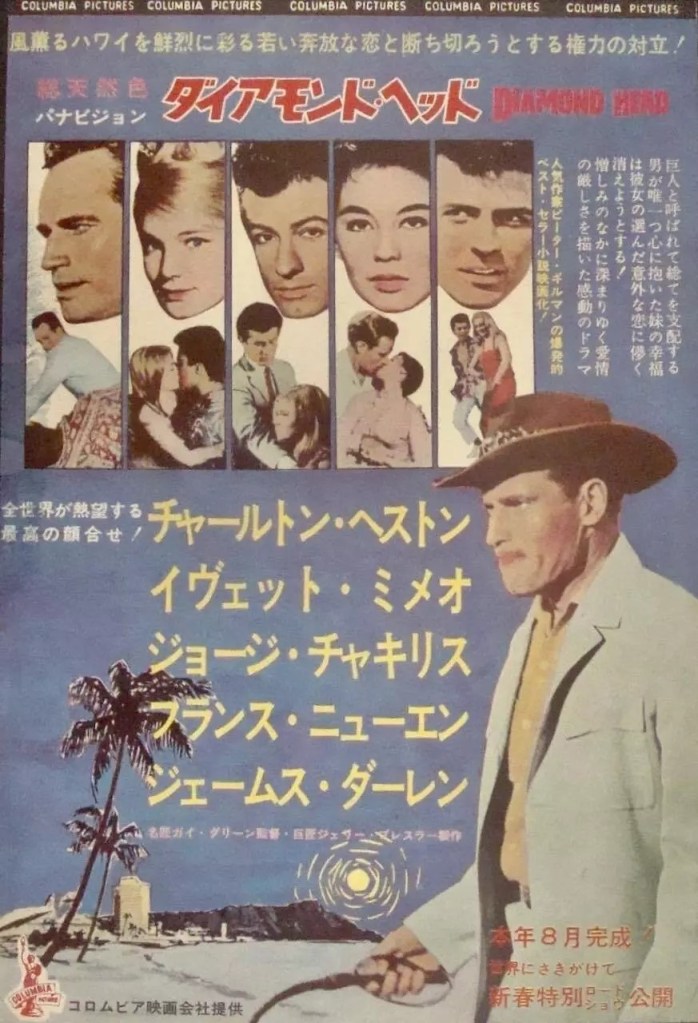
“My films did invariably well in the Far East and throughout Southeast Asia. Films that flopped elsewhere did fairly well, those that were hits elsewhere did incredibly. The fact that this pattern has continued unchanged accounts in no small degree for my continued viability in films.”  Apparently, this was because he represented the Confucius virtues of responsibility , justice, courage and moderation. As if to emphasize his overseas appeal, Diamond Head opened first in Japan, in December 1962.

SOURCES: Charlton Heston, The Actor’s Life, Journals 1956-1978 (Penguin, 1980).

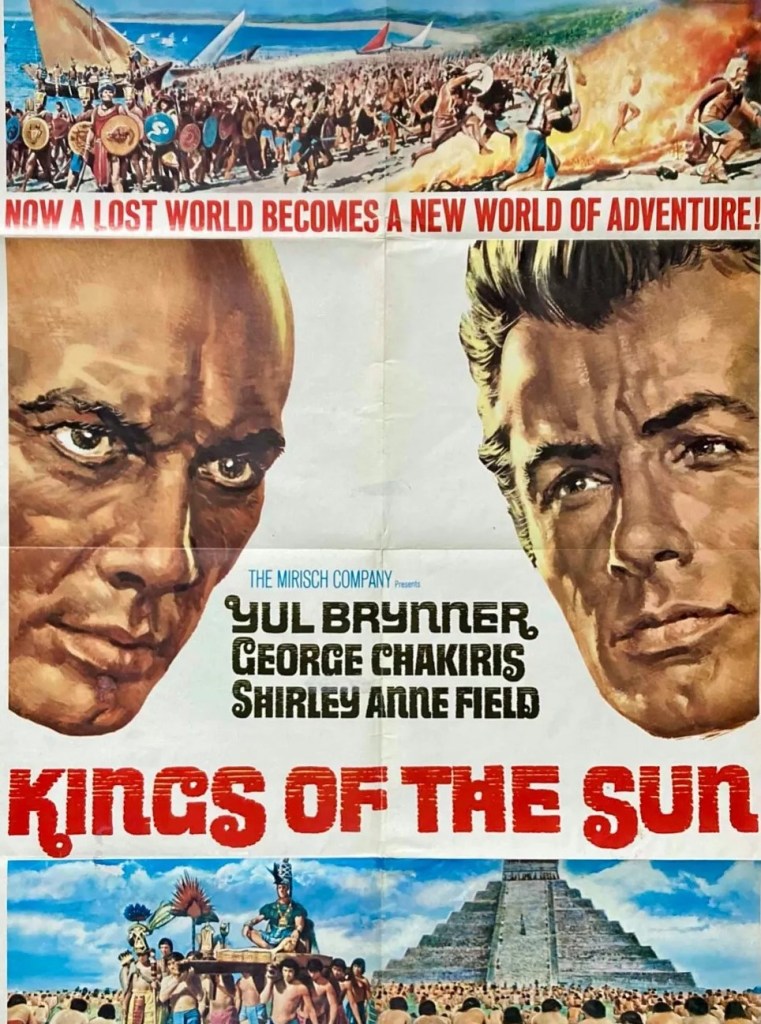
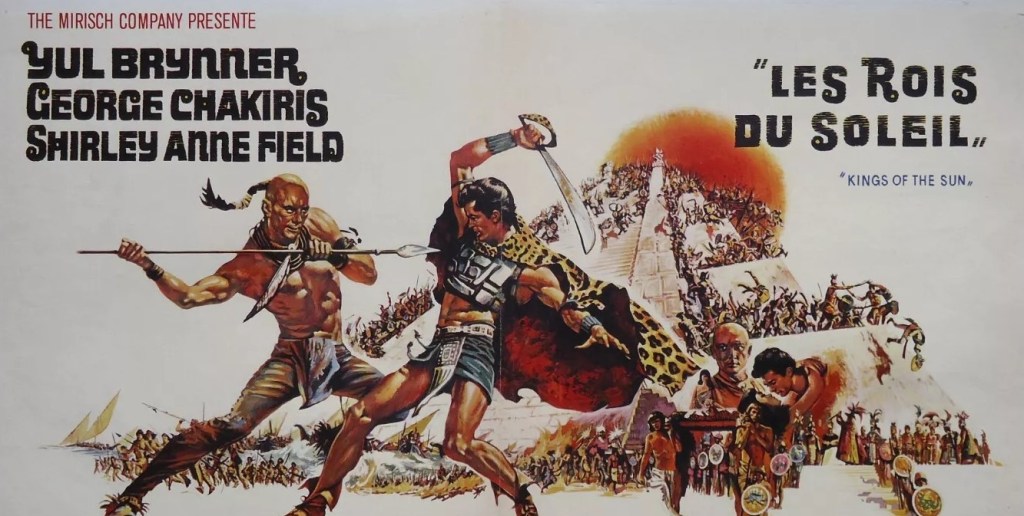
Kings of the Sun (1962) ****

With the current Conclave  bringing the subject of organized religion to the fore, no better time to examine a religion that Christianity put to the sword back in the day. While Christianity centers on unwelcome crucifixion transformed into willing sacrifice, in other cultures sacrifice was viewed as the highpoint of a life. And as demonstrated here, not a cruel expression of power, but a person executed in order to carry a message to the gods.

Of course, that could still be interpreted as barbarity and state vs religion is one of several themes here. Sold as an action picture but actually a thoughtful discussion of contemporary issues and worth viewing alone for an extraordinary performance by Yul Brynner, whose screen persona is turned completely upside down. As epitomized by The Magnificent Seven (1960), Brynner was Mr Cool. He was rarely beaten, and if he couldn’t talk his way out of trouble then guns or fists would do the job for him. For the most part here, he’s a prisoner, setting up the kind of template that Clint Eastwood would later inherit, of the brutally battered hero, except in this case there’s no murderous revenge.

And the movie cleverly switches perspective, so we move from sympathy with a defeated fleeing Mayan tribe and their efforts to rebuild their lives in a foreign land to the problems their unexpected incursion creates among the inhabitants of the new country.

Forced out of his homeland by invaders, King Balam (George Chakiris) leads his tribe across the seas of the Gulf of Mexico, trying to prevent high priest Ah Min (Richard Basehart) giving in to a predilection for sacrifice every few minutes. In order to keep the peace between two warring elements of the tribe, an unwilling Ixchel (Shirley Anne Field) has been promised in marriage to the king.

The Mayans adapt quickly to their new circumstances, fishing, building houses, diverting rivers to grow crops and building a pyramid. When they capture Black Eagle (Yul Brynner), a local Native American chief, they plan to sacrifice him to the gods.

Complicating matters is that Ixchel has taken a shine to the prisoner. As a potential sacrificial victim, living like a king for a day, the prisoner is entitled to impregnate any woman he pleases. Although Black Eagle has also taken a shine to Ixchel, he rejects her when she doesn’t come to him with open arms. She, equally, takes against Balam because, while he can’t prevent such congress (to use a Biblical expression), he doesn’t express his dissatisfaction in the process.

While a prisoner, Brynner has been impressed with the Mayan diligence, their ability to extract a living from what appeared harsh soil, and Balam, for his part, was hoping the two tribes could work out a way of co-existence. Where Black Eagle is voluble, Balam suppresses his emotions. It turns out that Ixchel, while responding to Black Eagle’s ardent wooing, would rather it was the more monosyllabic king uttering such words.

The action is kept to the minimum, probably accounting for initial audience disinterest. And the fact that it seems to be hewing towards peaceful co-existence rather than open warfare ensured that the expected battle took a long time coming. Sure, there’s a duel of sorts between the two leaders, but the more important battle of wits concerns who wins the woman.

In the end, Balam turns against this religion and sets Black Eagle free which is convenient because the armies which have chucked Balam out of his native land have pursued him across the seas and now attempt an invasion. Balam and Black Eagle unite to drive back the invaders. However, Black Eagle dies in the conflict, removing the love triangle.

From the moment Black Eagle was captured, I was expecting a different outcome. There’s some allegorical mischief at play here, with the prisoner splayed out in crucificial fashion,  arms and legs tethered by rope. But I was expecting such an obvious muscle-bound angry hero to escape and wreak revenge. However, that scenario avoided, it permits considerable discussion on co-existence as well as the nature of marriage, the old-fashioned manner (to prevent war or build a dynasty) vs the more liberated version (for true love).

Brynner is easily the standout, provided with far more opportunity for emotion than usual. George Chakiris (Diamond Head, 1962), range of expressions limited through both emotional incontinence and immaturity, appears sulky rather than majestic. Shirley Anne Field (Saturday Night and Sunday Morning, 1960) would appear miscast except she can convey so well inner feelings through her eyes.

No idea why anyone thought a disquisition on ancient religion and morality, with an anti-war sub-theme, would play with audiences of the period brought up on blood and thunder, and even when presented with notions of peaceful co-existence, as with any number of westerns featuring stand-offs between settlers and Native Americans, could rely on gun-runners to kickstart the shooting.

The action scenes, when they come, are good but it’s what happens in between that makes this perhaps more worthy of comment now than on initial release. Directed by J. Lee Thompson (The Guns of Navarone, 1961) with a screenplay by James Webb (How the West Was Won, 1962) and Elliott Arnold (Flight from Ashiya, 1964)

Carries surprising contemporary heft and Yul Brynner as you’ve never seen him before.

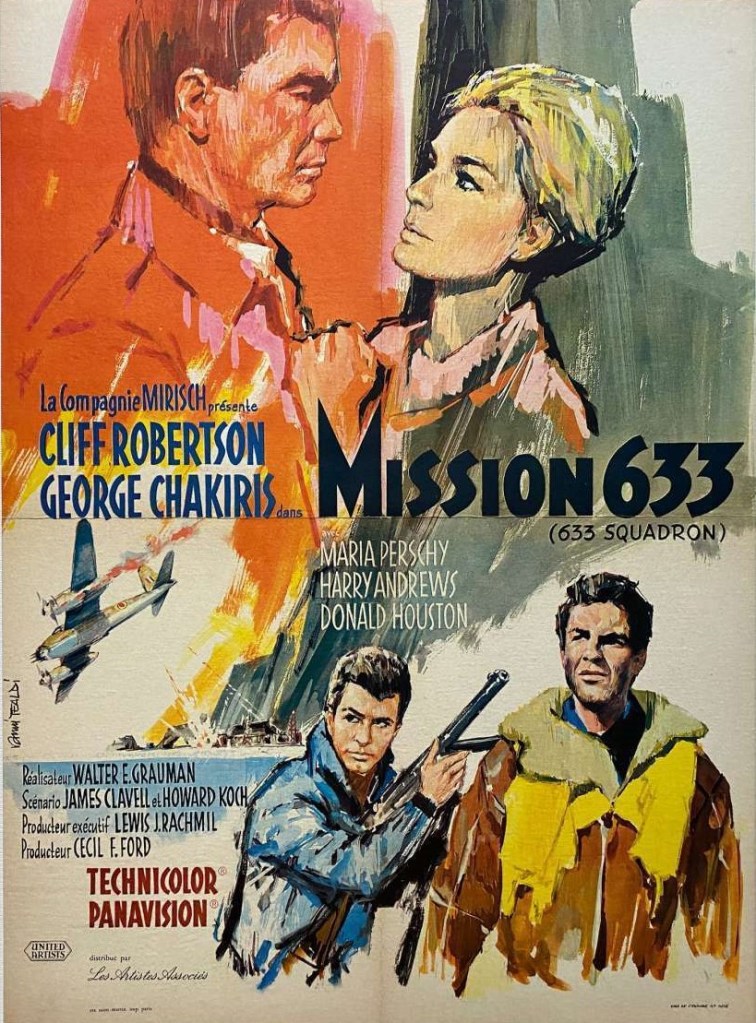
633 Squadron (1964) ***

You can keep your current and future Oscar winners, George Chakiris (for West Side Story, 1961) and Cliff Robertson (for Charly, 1968). The stars here are the mechanical birds, the Mosquito bombers, and the Ron Goodwin score, a thundering rehearsal for Where Eagles Dare (1968).

The aerial photography was pretty amazing for the day, though there were no Top Gun: Maverick shenanigans with actors supposedly actually flying the planes, just sitting there with an occasional turn or yank of the controls.  Even so, watching the planes take off, land, propellers describing perfect arcs, being attacked on ground or in the air, firing back, and the (apologies) bird’s eye view of dashes along precipitous cliffs takes up a huge amount of the running time.

You’ll know by now there was no actual 633 Squadron – but there was an international squadron (see the current Masters of the Air) to accommodate the various accents on show – and that the mission is also fictional, though the idea that the Germans had chosen the Norwegian fjords to hide a factory making rocket fuel for the V1s currently in production elsewhere wasn’t too far off the mark given (see The Heroes of Telemark, 1965) they were using that country for atomic bomb experiments.

The British know the rockets are inevitable, impossible to completely destroy them, but as long as they don’t interfere with D-Day that will be good enough. Wing Commander Grant (Cliff Robertson), although his squadron is exhausted from flying too many daily missions, has his leave curtailed, and told he’s on a strict deadline to destroy the factory.

Like the factory in The Heroes of Telemark, it’s virtually impossible to hit, buried beneath too much rock, but the Germans ain’t that clever, and it’s the rock that is the weakness. The theory is hit the overhang with sufficient bombs and the mountain will come tumbling down and destroy the factory.

Norwegian Resistance fighter Lt Bergman (George Chakiris) is on hand to explain just how difficult the task is, flying at extremely low altitude along fjords guarded by anti-aricraft guns. To add more tension, or just for the hell of it, Air Vice Marshal Davis (Harry Andrews) keeps on truncating the already tight deadline. The pilots have barely got time for a few practice runs along Scottish glens before it’s M-Day (no idea where that daft moniker came from, presumably a D-Day discard).

But there is just enough time for Grant to make pretty with Bergman’s refugee sister Hilde (Maria Perschy). Although after Bergman returns to help out his mates and is unhelpfully captured by the Nazis, Grant has to bomb the Gestapo building to kill him before he can be tortured and give out vital information.

In another film, Hilde would have been a spy or cut off the burgeoning romance after discovering Grant’s mission, but instead she’s not in the espionage line and she thanks the wing commander for sparing her brother torture. In the only major twist in the picture, it turns out Grant was too late, for there’s a nasty welcome committee awaiting the bombers.

Not quite the Boy’s Own derring-do adventure tale I remember, what with the torture and the climax, but it was still in my day one of the few films that appealed heart-and-soul to the pre-teen and teenage boy, along with The Magnificent Seven and The Great Escape, in part, I guess, because it was so thrifty in terms of character development.

No time is wasted giving everyone a character arc, beyond the usual daredevil and someone getting married, the characters are sketchy beyond belief, but who the hell cares, let’s get on with the action. So, it certainly delivers on that score. But watching as an adult, and I’ve probably not seen this in four decades, it’s a good bit tougher than the surface might suggest, eating away at the idealism of war, of the noble sacrifice, and tuning in better than most World War Two pictures to raw finality.

Perhaps it’s emblematic that the best cinematic introduction is given to the arrival of the new-style bombs, although Hilde turning up to a torrent of wolf whistles in the bar runs it close, and she does have a habit of leaning out a window to give the audience a glimpse of cleavage every now and then.

No wonder we all came out humming the Goodwin theme. You can’t escape it. It’s in virtually every scene. Memorable final line uttering by the air vice marshal, “You can’t kill a squadron.”

It would have set the bar high for aerial photography, except that by showing how it could be done, triggered a small flurry of similar pictures, most notably The Blue Max (1966) and The Battle of Britain (1969).

Walter Grauman (A Rage to Live, 1965) clearly adores the machines more than the humans, but the script by James Clavell (The Great Escape, 1963) and Howard Koch (The Fox, 1967) based on the novel by Frederick E. Smith doesn’t give him much option.

Still worth a watch.

Flight from Ashiya (1964) ***

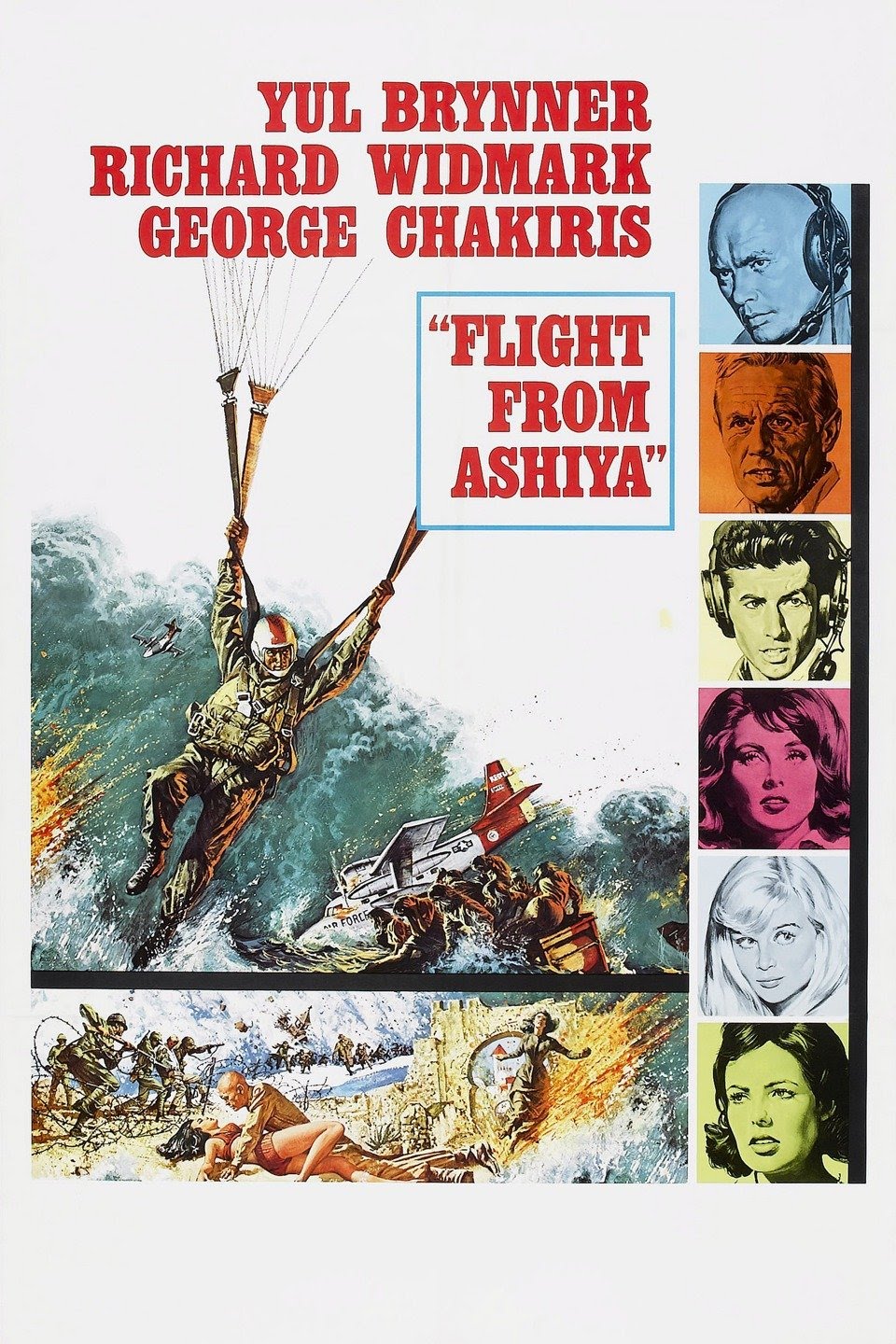
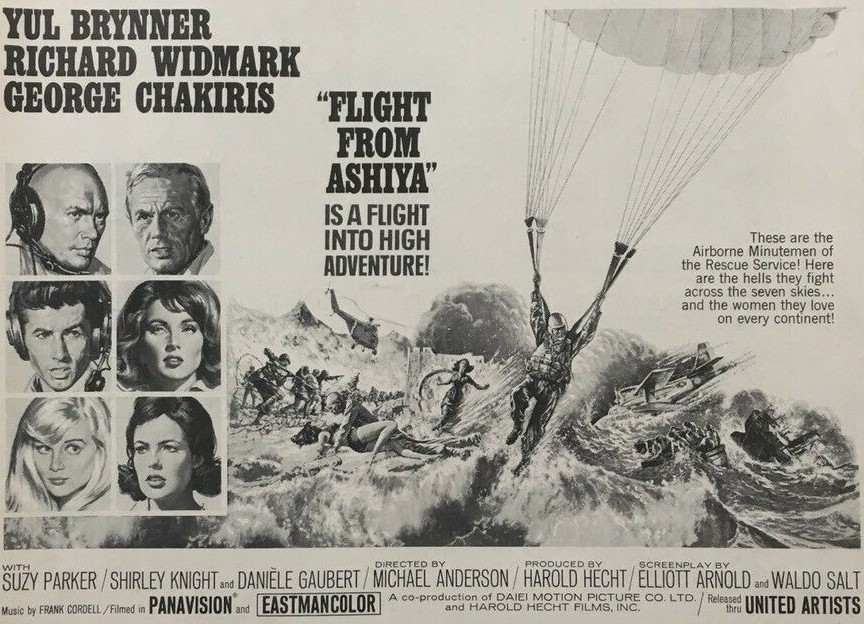
A post-WW2 operation to save a handful of Japanese adrift at sea in a storm is endangered when three members of the U.S. Air Force Air Rescue Service confront conflicts from their past. Despite tense rescue action, this is basically a three-hander about guilt and how men deal – or fail to deal – with emotions. Extended flashbacks illuminate the tangled relationships between Sgt Takashima (Yul Brynner), Lt Col Stevenson (Richard Widmark) and Second Lieut Gregg (George Chakiris). Unusually, for the period, tough guys actually emote.

So really it’s like one of those portmanteau films that are occasionally popular – like Trio (1950) made up of Somerset Maugham short stories or similar to something like the Oscar-winning  Crash (2004) where characters interconnect after an accident. While each of the episodes stands up in its own right, the thrust of the narrative revolves around actions taken in the past having a direct bearing on the present situation.

Gregg is haunted by causing an avalanche after flying his helicopter too close to a mountain and, as a result, by having to leave behind many of the victims, due to restricted capacity on board, and now he is terrified of flying solo.  As a consequence Stevenson has no faith in abilities as a pilot.

Stevenson also has an abiding hatred of Japanese – colleague Takashima of Japanese ancestry also bears his wrath – because his ill wife Caroline (Shirley Knight) and child died in a Japanese prisoner-of-war camp because medical supplies were reserved only for the Japanese. Faced with rescuing Japanese, he is enraged.

For his part, Takashima, a paratrooper during the war, inadvertently caused  the death of his Algerian girlfriend Leila (Daniele Gaubert). It’s not so much an examination of tough guys under pressure as about their inability to deal with the consequences of action. There’s certainly a sense that the only way men like these have of dealing with trauma is to throw themselves into dangerous action.

Yul Brynner (The Double Man, 1967) gives a more thoughtful performance than you might expect while Richard Widmark (The Secret Ways, 1961), himself dabbling in production elsewhere, was good value. Goerge Chakiris (The Young Girls of Rochefort, 1967) was a weaker link. The presence of Suzy Parker (Circle of Deception, 1960) and especially Daniele Gaubert (The Golden Claws of the Cat Girl, 1968) strengthen the film.

Unusually, at a time when product was in short supply and for a film boasting a strong cast, the picture was shelved for two years after completion. Presumably explained by the demise of Harold Hecht’s production company after he split with Burt Lancaster. Michael Anderson (The Shoes of the Fisherman, 1968) directed from a screenplay by Waldo Salt (Midnight Cowboy, 1969) based on the novel by Elliot Arnold (Kings of the Sun, 1963).

The title’s a bit of a misnomer, suggesting someone is trying to escape from Ashiya when, in fact, that is just the name of the air base where the rescue team are located.

Critics complained it was neither one thing nor the other, but in fact I found it a perfectly satisfactory combination of action and drama, especially as it dealt with rarely-recognized male emotions.

https://amzn.to/47p3xP6

The Young Girls of Rocheforte / Les Damoiselles de Rochefort (1967) **** – Seen at the Cinema at Bradford Widescreen Weekend

In effervescence and color palette a close cousin to Barbie (2023) with the bonus of being able to call on one of Hollywood’s greatest hoofers, Gene Kelly, in a surprise cameo. He swoops and sways like he was Singin’ in the Sun. And he’s just the icing on the cake in this exuberant throwback to 1950s Cinemascope but with the sensibility of a 1940s musical in which dreams are delivered after a few minor setbacks.

Throw in a long-lost love, an affair that literally went south, an artist who has painted his ideal woman, a couple of literal-minded running French jokes – a woman called Madame Dame and a young sailor whose departure is immi-Nantes – and given the overall light-hearted treatment you would have to treat the presence of a sadistic murderer as being in the comedy vein.

Twins blonde Delphine (Catherine Deneuve) and brunette Solange (Francoise Dorleac) make a living running a music class. Delphine dreams of meeting the ideal man, having already rejected gallery owner Guillaume (Jacques Riberolles) and not too keen on itinerant carney (George Chakiris), while Solange wants a career as a composer, befriending music shop owner Simon (Michel Piccoli) who can put her in touch with old buddy and now renowned pianist Andy (Gene Kelly).

As you might expect the narrative is driven by misunderstandings and meetings choreographed by the minute to fail. This is the kind of film where an actor playing the role of a piano player is not expected to learn to play the piano, just stare into space as though channeling an internal muse or glancing at the sheet music.

There are songs by the dozen – possibly too many (27 singing or dancing sequences), more like a continuous ballet than a traditional musical – but none we’re still humming today, not like tunes from West Side Story (1961), The Sound of Music (1968) or Funny Girl (1968) – though “The Twins Song” probably comes closest. That’s not to put down Michel Legrand’s inventive score, but perhaps to suggest a cultural/language divide. Outside of Danielle Darrieux (Loss of Innocence / The Greengage Summer, 1961) , the singing voices were dubbed, even that of Gene Kelly who lacked the range for the material.

And probably you don’t need to worry about the quality of individual songs as you’ll be swept along by Jacques Demy’s infectious direction. Most of the dancing style reflects West Side Story but with a lighter edge. And it takes little or nothing for characters to burst into song or dance, sometimes that activity going on spontaneously in the background of another scene.

Set in the real seaside town of Rochefort in France and making use of genuine locations, the action kicks off on an unique type of bridge as the carnival comes to town. While not strictly a feminist endeavour, men are mostly put in their place, overtures rejected, marriage offers turned down and bad employers shown the door.

The appearance of Gene Kelly, who hadn’t worn his dancing shoes in more than a decade, gives this an enormous fillip as his classic style shows the others just how it’s done. But it’s the lightness of touch, as well as being able to plumb a well of emotion, that gives this film its grounding, Deneuve and Dorleac as well as Darrieux carrying the movie. George Chakiris (Diamond Head, 1962) looks more at home here than in any film other than West Side Story.

Jacques Demy and Michel Legrand had teamed up previously for The Umbrellas of Cherbourg / Les Parapluies de Cherbourg (1964). Catherine Deneuve (Mayerling, 1969) and Francoise Dorleac (Genghis Khan, 1965) were sisters. Tragically, Dorleac was killed in a road accident prior to the film opening.  

But the whole enterprise is so effortless and appealing you can’t help being drawn in.

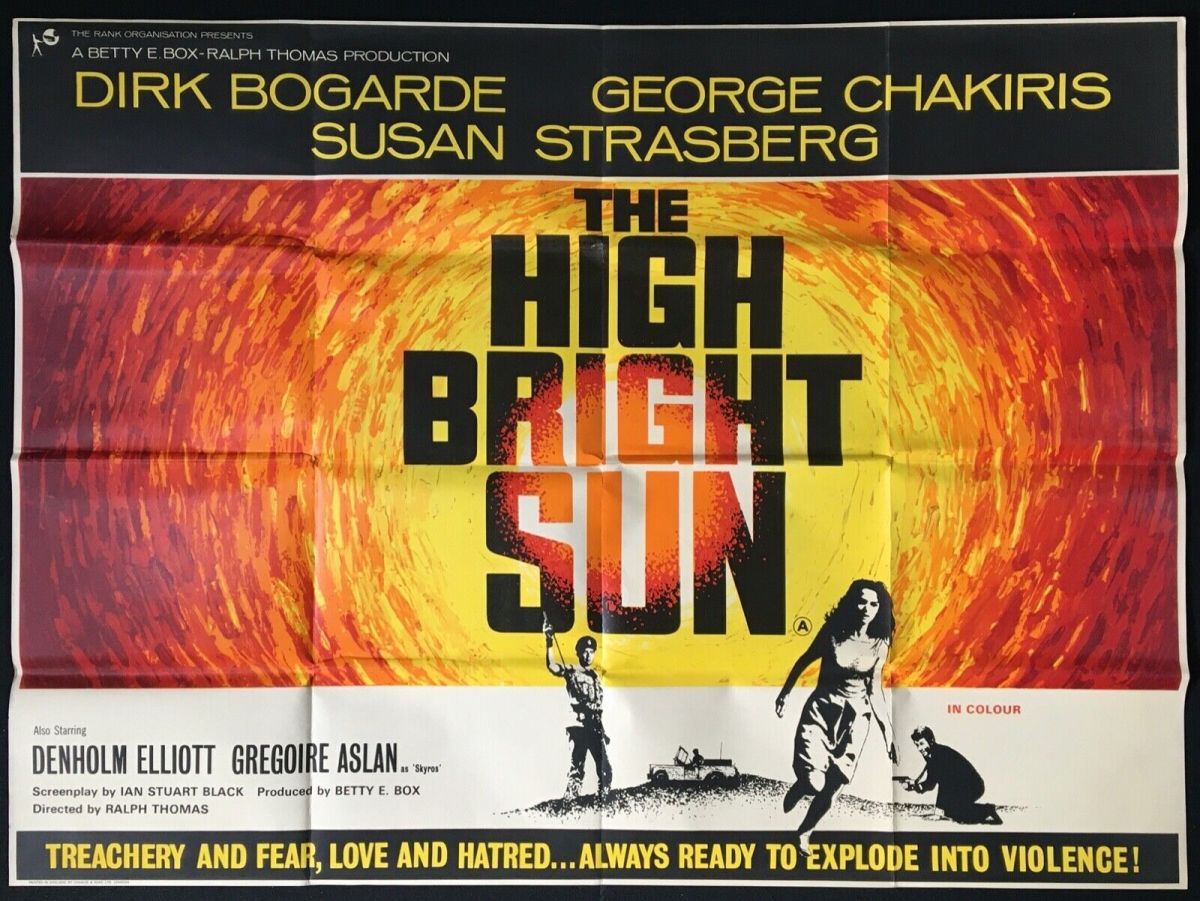
The High Bright Sun / Maguire, Go Home (1964) ****

Surprisingly good thriller about loyalties in war time. Elevated above the norm by a series of stunning scenes often turning on the psychological. And taking a helluva bold risk as far as the billing is concerned. In dramatic and structural terms top-billed British star Dirk Bogarde (Justine, 1969) and rising American star George Chakiris (Diamond Head, 1962) take second place to the third-billed Susan Strasberg (The Sisters, 1969), although Bogarde’s stiff upper lip is tested in just about the most despicable fashion.

Also derives an interesting agency from differing audience perspectives. The British audience will view Major Maguire (Dirk Bogarde) as a hero trying to keep the peace in terrorist-racked Mediterranean island Cyprus. But virtually everyone else will side with Haghios (George Chakiris) and his bunch of freedom fighters in what was effectively a war of independence. Stuck in the middle, and expecting to be given a free pass, is Juno (Susan Strasberg), a young geologist staying with family friends named Andros but who, as an American, would be viewed as a neutral.

However, she has witnessed the arrival at the Andros home of terrorists, not just Haghios but General Skyros (Gregoire Aslan), leader of the Resistance. Not wanting to get her friends in trouble, and assuming they are not involved in terrorism, she resists the attempts of Maguire to get her to name names. But it’s only the cooler head of the general and the youngest member of the Andros clan, son Emile (Colin Campbell), that prevents her being shot dead on the spot.

Bluff and double bluff are the order of the day. She’s a prisoner – and a shocked one at that having witnessed British soldiers murdered by terrorists – but if she is seen to be prevented from leaving the house it will give the game away. So Maguire comes up with an acceptable ploy to get her out so that, in a calmer situation, he can gently interrogate her.

Unfortunately taking her out to dinner backfires, as they are spotted by Haghios who, assuming they are romantically involved, realises she can’t be trusted and signs her death warrant.

But she’s far from the plucky female and no good at playing the game of being hunted. In a brilliant sequence she takes all the wrong actions and it’s only happenstance and sacrifice that prevent her capture. And this is followed by an even edgier scene when she hitches a ride late at night with a lascivious local. But that’s nothing to her treatment by Maguire who, furious at her refusal to talk, parades her in the streets “like a sitting duck.”

There’s a whole strata of soldiers in open rebellion of a different kind. Maguire mocks his commanding officer, the inept Col Park (Nigel Stock), and he in turn is mocked by his junior, Lt Baker (Denholm Elliott) who taunts him about the affair he had with Maguire’s wife. And there are any number of stings in the tail. Believing she has finally escaped, Juno is confronted by Haghios and no Maguire in sight to come to her aid.

But the central tale is given over to Juno, the innocent caught up in bloody warfare, forced to witness barbarity at first hand, and unless she hankers after personal sacrifice inevitably  induced to take sides.

Susan Strasberg is simply superb. At no time is she the feminine hero springing into reluctant action in some espionage or wartime drama. Instead, she is the innocent bystander who at any moment will turn into collateral damage. And she’s too confused even to summon up outrage at betrayal by both sides.

Dirk Bogarde looks as if he is playing your standard British officer of high breeding who can trade barbs and bullets with the enemy but mostly tries to extract information by gentler means. But he turns out to be just as savage in his ideals as the opposition. And his armour is pierced not only by having an adulterous wife but having to take abuse from her lover.

It was a typical Hollywood ploy to stick an innocent American in a war zone in order to expose a situation or attract audience sympathy either for the underdog or the oppressors – think Jack Lemmon in Chile in Missing (1982) or Sally Field in Iran in Not Without My Daughter (1991) – but I doubt if director Ralph Thomas was as naïve or politically-inclined to attempt that here and instead he treads a finer line of personal decision as he would later do in The High Commissioner/Nobody Runs Forever (1968).  Sticking to the storyline and relying on actors who never resort to emotional extremes pretty much does the trick.

George Chakiris is wasted and I can only assume this was a sign of his career going downhill.

Not just far better than I expected, but bordering on the excellent.

Diamond Head (1962) ****

Bold examination of racism years ahead of its time. Narrative not sweetened for audiences by a detective story (In the Heat of the Night, 1967) or grumpy father-of-the-bride comedy (Guess Who’s Coming to Dinner, 1967) or by protagonists unrepresentative of society by being criminal (The Defiant Ones, 1958) and criminally insane (Pressure Point, 1962), the issue of racism – miscegenation and interbreeding – smack bang in the middle. Though it takes place in Hawaii, theoretically at one remove from the violence emanating in the U.S. Deep South, the points made strike home.

If a shade melodramatic, that is undercut by a set of very fine performances by all the principals. Charlton Heston, later lacerated in democratic circles for his defence of the right to bear arms, here employs his marquee value to deal with the ticking time bomb.

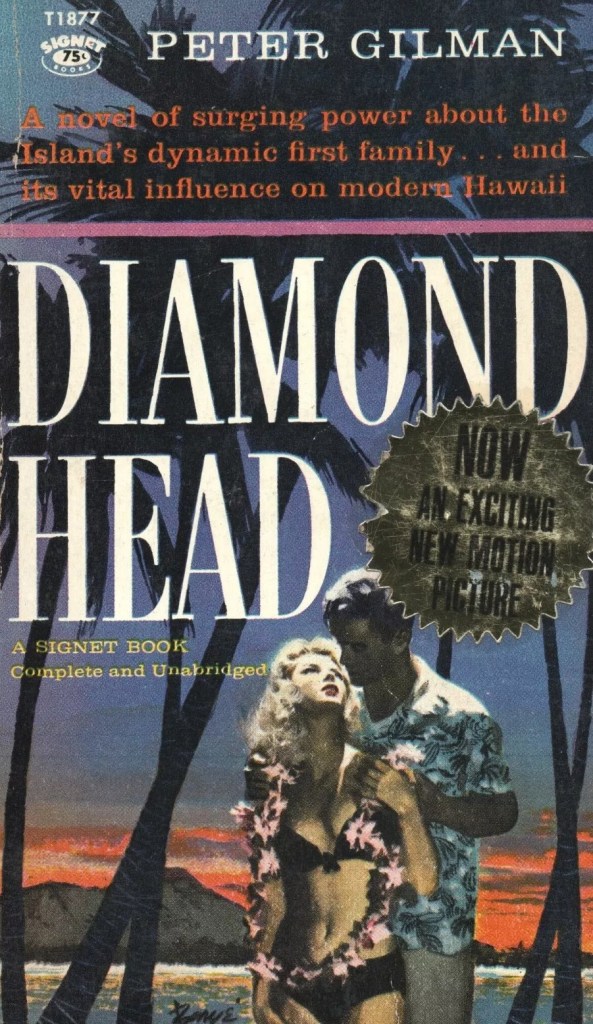
Yep, that is an advert shaped as a diamond. Subtle, huh?

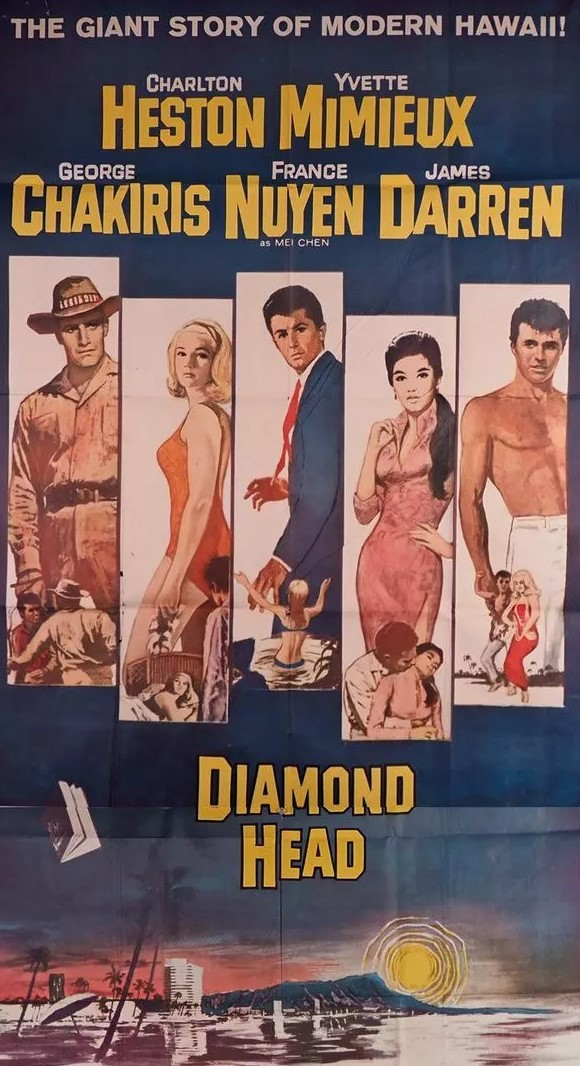
The tale is simple enough. Headstrong Sloane (Yvette Mimieux) decides to marry native-born Paul Kahana (James Darren) against the wishes of her older brother, widowed millionaire landowner “King” Howland (Charlton Heston). Despite using equality as an election platform in a bid to become a Senator, King fiercely objects to the marriage on the grounds that it will dilute his bloodline and, in effect, hand over control of his empire to an outsider. His spinster sister-in-law Laura (Elizabeth Allen) backs him on this score as does, oddly enough, Paul’s mother Kapiolani (Aline McMahon) who complains that interbreeding has reduced the number of native Hawaiians to a mere 12,000.

Complicating matters is King’s hypocrisy. His mistress, Mai Chen (France Nuyen), already is of mixed parentage. But when she announces she is pregnant, he demands she have an abortion. Spicing up that particular complication is her brother Bobbie (Marc Marno) who sponges off the perks King provides and now decides to hit the gold seam by blackmailing King. And just in case that’s not enough in the way of complications Sloane has always had a yen for Paul’s older and more successful brother Dean (George Chakiris), now a hospital doctor. In fact, as outlined in a flashback, Paul was decidedly second-best in Sloane’s eyes and there is a hint she romanced him to spite the more sensible brother.

Bobbie doesn’t get the chance to put his scheme into practice as he is implicated in the death of Paul, who had been trying to stop the blackmailer from drunkenly attacking King at a traditional engagement ceremony. Paul is killed accidentally by King.

That should have simplified matters, but it doesn’t. King is abandoned by Sloane and Laura leave and Mai Chen throws him out. The scandal of Paul’s death should have ended his political ambitions, but despite his backers dropping out, arrogantly he decides to go it alone until receiving the slow-handclap treatment from the public. He is fully aware of the consequences of his action, pointing out that $3 million spent on philanthropy wouldn’t “buy me a tear.”

It could have ended there, proud man brought down by ambition, institutional racism and stubbornness, but it follows a different, and reconciliatory, tack at the end.

And it could have been a heaving brew of melodrama with dilated nostrils and screaming matches but it’s redeemed from that by most of the actors downplaying their roles. There is some impressive playing by Charlton Heston (55 Days at Peking, 1964) who carries off his hypocrisy in some style, but doesn’t descend to the obvious ploy of disinheriting the defiant one or at the very least chucking her out and generally manages to keep the lid on his temper. George Chakiris (Flight from Ashiya, 1964) uncannily captures all the elements of his character. An educated man so can’t be downtrodden but has to watch his step in confronting such a powerful man, so he makes his point with quiet determination.

In an early starring role Yvette Mimieux  (Joy in the Morning, 1965) is given a lot more to do than in some later offerings. She exhibits defiance not just in regard to racism but sexism as well, determining that her marriage would be an equal relationship not one where she would be subservient to her husband. Had she been able to rein in her pig-headedness and present herself as more interested in the business than its perks  she might have allayed her brother’s fears that in endorsing the marriage he was risking handing over his empire to her idiot husband, so lacking in the brain department he needed extra years to graduate at college.

France Nuyen (Man in the Middle, 1964) has a peach of a part, plenty good lines, and the beneficiary of the few scenes not driven by narrative requirements, in particular her observations at watching her lover dress. James Darren (The Guns of Navarone, 1961), given  less to do, is not surprisingly more of a cliché. Oscar-nominated Alice McMahon (Cimarron, 1960) is quietly impressive as the equally torn parent who could, at one point, take legal revenge on King.

Director Guy Green (The Magus, 1968), aware the content is inflammatory enough without the principals going overboard, does pretty well to stick to the issues. Screenwriter Marguerite Roberts (5 Card Stud, 1968), in adapting the bestseller by Peter Gilman, makes several changes to keep the focus on the key element.

In his diary, Charlton Heston noted that that movie was overly melodramatic but with the proper treatment it could work. He was right. The plot has more cogs than any wheel could comfortably accommodate, but by keeping the central issue central the movie would be viewed today as the highpoint of Hollywood’s opposition to racism rather than being  superseded five years later by the pair starring Sidney Poitier.

Flight from Ashiya (1964) ***

A post-WW2 operation to save a handful of Japanese adrift at sea in a storm is endangered when three members of the U.S. Air Force Air Rescue Service confront conflicts from their past. Despite tense rescue action, this is basically a three-hander about guilt and how men deal – or fail to deal – with emotions. Extended flashbacks illuminate the tangled relationships between Yul Brynner, Richard Widmark and George Chakiris.

So really it’s like one of those portmanteau films that were occasionally popular – like Trio (1950) made up of Somerset Maugham short stories or the more recent The VIPs (1963) or The Yellow Rolls Royce (1964). Each of the episodes stands up in its own right, actions taken in the past having a direct bearing on the present situation. Chakiris is haunted by causing an avalanche after flying his helicopter too close to a mountain and by having to leave behind many of the victims, due to restricted capacity on board, and now he is terrified of flying solo. 

As a consequence, Widmark has no faith in abilities as a pilot. Widmark has an ongoing hatred of the Japanese – colleague Brynner of Japanese ancestry also bears his wrath – because his ill wife (Shirley Knight) and child died in a Japanese prisoner-of-war camp where medical supplies were reserved for the Japanese. Faced with rescuing Japanese, he is enraged.  For his part, Brynner, as a paratrooper during the war, inadvertently caused  the death of his Algerian girlfriend.

It’s not so much an examination of tough guys under pressure as about their inability to deal with the consequences of action. There’s certainly a sense that the only way men like these have of dealing with trauma is to throw themselves further into harm’s way. Unusually, at a time when product was in short supply and for a film boasting a strong cast, the picture was shelved for two years after completion. Michael Anderson (Around the World in 80 Days, 1956) directed.

The title’s a bit of a misnomer, suggesting someone is trying to escape from Ashiya when, in fact, that is just the name of the air base where the rescue team are located. Critics complained it was neither one thing nor the other, but in fact I found it a perfectly satisfactory combination of action and drama, especially as it dealt with rarely-recognised male emotions.

Many of the films from the 1960s are to be found free of charge on TCM and Sony Movies and the British Talking Pictures as well as mainstream television channels. But if this film is not available through these routes, then here is the link to the DVD and/or streaming service.

Discover WordPress

A daily selection of the best content published on WordPress, collected for you by humans who love to read.

The Atavist Magazine

by Brian Hannan

WordPress.com News

The latest news on WordPress.com and the WordPress community.