North by Northwest (1959) ***** – Seen at the Cinema in 70mm – Bradford Widescreen Weekend

Only thing better than seeing this on the big screen is seeing it on biggest screen possible, Some clever clog has blown it up to 70mm by scanning  the “original 6-perf 35mm Vistavision camera negative in 13k with all restoration work completed in 6.5k. The 70mm film print was created by filming out a new 65mm negative.” I don’t know what it means either – except that extra 5mm is the soundtrack and perfs refers to height – but I’m delighted with the result.

Not only does the crop spraying scene  bask in  greater glory but the pivotal scrambling on Mount Rushmore where Hitchcock used the wide screen at its widest takes on a vivid clarity that’s just impossible watching a DVD when characters are literally hanging off the furthest edges of the screen.

But setting aside the widest widescreen-ness what seeing it on the big screen more than anything restores is the audience experience and that allows the sly humor to reach its full potential. I hadn’t realized just how funny this darned picture is, not just the eye-rolling mother treating her grown-up son as a michievous scamp, and the zingers of lines but the interplay between the various characters.

And putting to one side Hitchcock’s wizardry it is a tour de force for screenwriter Ernest Lehman. I must have counted at least 20 narrative beats, not just thriller or action twists and turns but changes in our appreciation of the characters, plus the devilishly clever sexual banter. And while hero Roger Thornhill (Cary Grant) is a hero by accident, heroine Eve Kendall (Eva Marie Saint)  is heroine by design, and thanks to her exceptionally callous boss, The Professor (Leo G. Carroll),  likely to pay a heavy price for wanting to do something worthwhile in a life that from her looks seems as if aerated, gliding along with nary a care in the world, her beauty ensuring she would always garner easy attention.

There are some exceptionally clever moments that emanate from Lehman rather than Hitch. The elusive villain hiding behind a variety of identities is finally unmasked as Vandamm (James Mason) at an auction when the auctioneer calls out his name as he buys an artefact that contains stolen microfilm. And so a scene that appeared there for a different purpose – the emotional one of Van Dam realizing he has been cuckolded and Kendall realizing she is going to lose the only man she ever truly loved – turns out to play a vital role in the narrative, critical to the ending.

Given Hitch suffered from accusations of misogyny it’s astonishing how often he serves up exceptionally self-confident women who can string men along, in this case two men, Eve using Roger for mere sexual gratification while seducing Van Dam for the more serious business of snaring a traitor and giving her life meaning. And can there have been a more convincing femme fatale? That is, not the obvious kind as in film noir where a male dupe is easy pickings for a clever female and her seduction techniques over-obvious.

Here, the seduction is not only very gentle, and to some extent baffling, and achieving through language and screen dexterity a marvellous intimacy, but her femme fatale-ness only revealed when she secretly sends a note to Van Dam asking what does she do with her victim in the morning.

There are lot of elements more obviously coming to your attention on the big screen. The irony of a cab firm being called “Kind Taxis” especially in New York where their drivers err on the side of the irate. The train porter whose clothes we think Roger has stolen only for a quick cutaway to reveal him counting his bribe. The cleverness of that disguise. How many red-capped porters will you find in a train station?

A lot of the time Cary Grant (Walk, Don’t Walk, 1966) doesn’t have a great deal to do except react sometimes to very little at all. When he’s waiting to be collected at the crop field he makes his feelings known through shifting his gaze and jiggling with his trouser pockets.

There’s even a scene that might have given Sergio Leone the idea for his famous shootout in Once Upon a Time in the West (1969) where, on first meeting, Roger and Van Dam circle each other with the camera taking each’s POV. 

This is just overloaded with delights – the drunken Roger telling the cops to call the cops, using his only phone call in jail to call mother, escaping from thugs in an elevator by the “women first” device, the amazing innocence when he encounters locked doors, clearly expecting them still to be left open to facilitate his escape.

Hitchcock – and to a greater degree in The Birds (1963) – ushered in the random action explosion (gas tankers always seem to be convenient) that would become de rigeur in the genre and used with less finesse here when the crop plane crashes into the tanker and car passengers stop to gawk allowing our hero the chance to steal one and escape.

It generally passes unnoticed how Hitch sets up his main character. At the start of films, especially these day when viewers are in on the gimmick, most audience eyes are on spotting the directing putting in his trademark appearance, rather than assessing Roger as a workaholic advertising executive, dragging his secretary out of the office when she should be on her way home so he can dictate a few more lines to her in a taxi, and inadvertently setting himself up as the kind of man who tells lies for living who for once must stick to the truth.

Grant’s acting ability was rarely fully recognized. Here the more urgent question seems to be how many suits he got through in filming (16) rather than the way he holds the picture together. And only Hitch would keep the audience waiting 30 minutes before introducing the female lead and make it hard for the maternally-dominated Thornhill to exude any sexual attraction after being under the thumb of mother for the first section.

This was the British premiere of the 70mm version so look out for it turning up at your local arthouse. Perhaps someone will go the whole hog and accord Hitch the contemporary honor of re-tuning his pictures in Imax.

I am assuming that I saw the 70mm version of the new 4k that’s just being released.

Not to be missed on big screen or small.
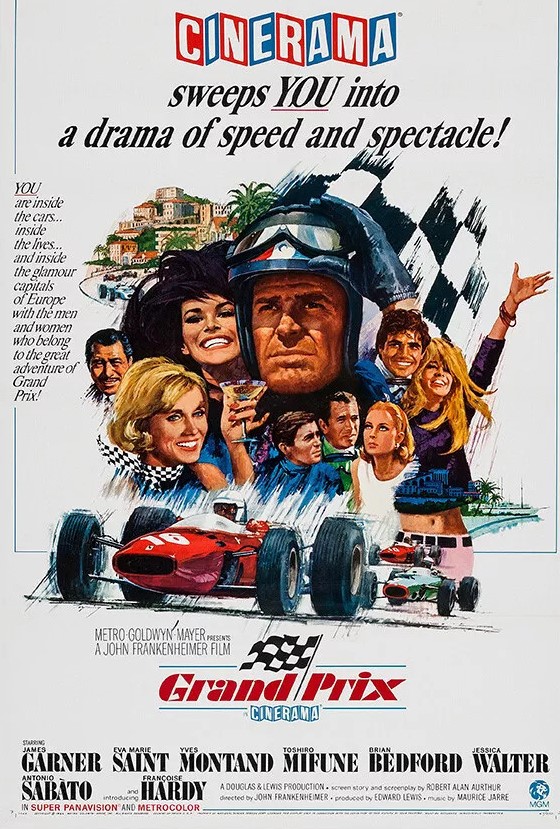
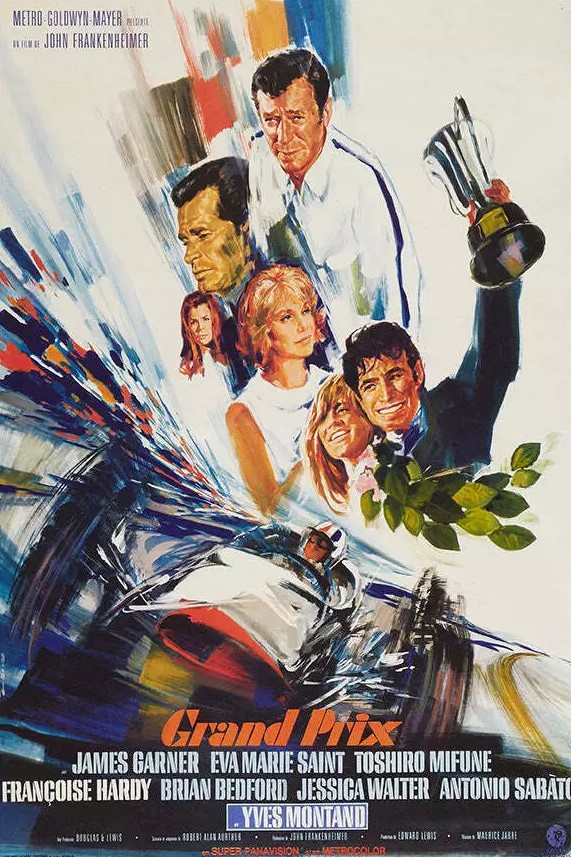
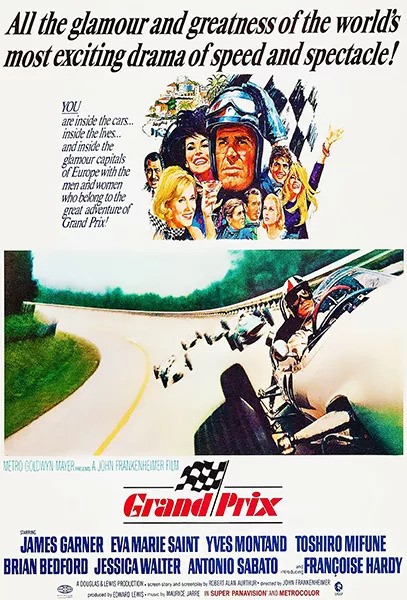
Grand Prix (1966) *****

If ever there was a case to be made for six-track stereophonic sound or, for that matter, split screen Grand Prix would form the first line of defense. That it was made in Cinerama 70mm was merely a bonus. Most roadshow movies start with an overture, a ten-minute or so musical introduction that would thematically at least give the audience some indication of the picture they were about to watch. Thrumming and roaring engines formed the montage opening to Grand Prix, a noise that almost shook a cinema to its foundations.

Cinerama had been built on its ability to create almost primeval effects. There was always a downward rush, a runaway train, a roller coaster, something to set an audience on the edge of its seat in pure exhilaration. But the visual had nothing on the aural and what set Grand Prix apart was danger, that constant thrum of engines rising to impossible crescendos. Split screen allowed the director to tell several stories at once as competitors chased each other round perilous circuits at a time when death was a racing driver’s constant companion and in fact of the thirty-two professional participants including Graham Hill, Jim Clark, Juan Fangio and Jack Brabham five were dead within two years of the movie’s completion. Nobody needed to remind an audience how hazardous the sport was, they could read about the continuous carnage in the newspapers, but what was less easy to convey, although such events were well attended, was the pure thrill of being at a race meeting. Grand Prix set out to rectify that problem.

At nearly three hours long it had room to tell several stories and in that respect it was more of an ensemble picture than something like Lawrence of Arabia (1962) which took even more time to tell just one story. Many of these stories came to an abrupt end as the character died in an accident.

Steve McQueen and Paul Newman, both racing aficionados, were front runners for the leading role but it went instead to James Garner, also a racer who did all his own driving (though not necessarily at the speeds indicated). And to properly represent the competition it required an international flavor so other drivers were played by Yves Montand (The Wages of Fear, 1953) in a part first offered to Jean-Paul Belmondo and Antonio Sabato (in his second film) with Adolfo Celi (Thunderball, 1965) as the Ferrari boss and Toshiro Mifune (Seven Samurai, 1954) as a Japanese team owner. Swedish star Harriet Andersson (Through a Glass Darkly, 1961) was cast as the female lead but dropped in favour of Eva Marie Saint (Exodus, 1960) in a role turned down by Monica Vitti (Modesty Blaise, 1966).

Garner and Saint had previously worked together in thriller 36 Hours (1964) and it said a lot for his marquee credentials that he was still best known for The Great Escape (1963). Although he had reached top billing status, films like The Art of Love (1965) and Mister Buddwing (1966) did not deliver commercially. Saint’s career had been as peripatetic after Exodus (1960) as before, star of All Fall Down (1962) but third-billed in The Sandpiper (1965) and second-billed in The Russians Are Coming, The Russians Are Coming (1966), the latter two both big hits.

Frankenheimer had directed Saint in All Fall Down and enjoyed a distinguished career with The Birdman of Alcatraz (1962), The Manchurian Candidate (1962) and Seven Days in May (1964) although the high regard in which he was generally held was somewhat tarnished by The Train (1965) and thriller Seconds (1966), the latter a spectacular flop. Grand Prix was not only the biggest film of his career, though The Train had given him a grounding in action, but also his first in color.  The movie was filmed on existing legendary circuits with Formula 3 racing cars adapted to look like Formula 1 and a thousand other incidental details including an appearance by a Shelby Mustang (with Carroll Shelby as technical adviser) that made it an accurate depiction of the sport. Eighteen cameras were used to film the races.

The narrative arc follows the Grand Prix season and while the actual competition dominates the movie it is against the background of the emotional turmoil the sport wreaks on the drivers and the wives and girlfriends who have to live with the knowledge that their partners might not come home at the end of the day. Garner is considered too reckless for the top spot in a racing team and in a bid for redemption signs for a new company. Former world champion Montand is coming to the end of his career. English actor Brian Bedford makes his mainstream movie debut as a driver recovering after a horrific crash caused by Garner. The emotional subplots comprise Garner having an affair with Bedford’s wife (Jessica Walter); Montand embarking on an affair with Saint who plays a magazine writer, with French actress  Francoise Hardy (better known as a chanteuse) involved with Sabato. In addition, there are some telling sequences in which the drivers unload about their fears.

Frankenheimer does a terrific job in marshalling all the effects and the minute details, and the fact that there is no big star in the mix makes the battles between the characters more realistic.  

Behind the Scenes: “Number One” (1969)

Apart from Ben-Hur and El Cid, most of Charlton Heston’s movies in the 1960s were domestic box office disappointments. Despite this, he was deemed to be still flying high at the marquee, placed seventh in the annual star rankings just as negotiations began in 1967 for Pro (the title changed to Number One just a few months before release). Given there was little interest in American sports in the rest of the world, it was deemed a gamble. That was not just reflected in the budget – a miserly $1.15 million- but in Heston’s salary of $200,000. He and director Tom Gries (Will Penny, 1968) agreed to “work at substantially lower incomes in exchange for a bigger percentage.”

But to make any decent money, of course the movie had to be a big hit. Compare that to the $750,000 he stashed away for The Hawaiians (1970), admittedly after Planet of the Apes (1968) hit the jackpot, but still. From The War Lord, Heston had “learned actors should not put their own money into scripts,” but taking a pay cut appeared a more sensible route.

The movie was a long time coming to fruition. Initially, the idea had been rejected by National General and Martin Ransohoff of Filmways who worked with MGM. By April 1966, Heston was dejected. “Nothing stirring on Pro,” he recorded in his journal. But he understood the need not to “peddle the project” since “it tarnishes my image as an eminently in-demand actor.” Franklin Schaffner (Planet of the Apes) was initially keen, but dropped out after United Artists insisted on smaller fees against a bigger back end, star, director and producer to share 75 per cent of the profits, the kind of deal you get offered “when you want to make a film more than a studio does.” Tom Gries (Will Penny, 1968) was the next directorial target.

By June 1967, the deal was done for Heston, Gries and Selzer. ”I’m damned if know who will write the script,” noted Heston, “No one very expensive, I guess.” In July, he was in San Diego “investigating pro footballers in their natural habitat.” The NFL agreed to allow the New Orleans Saints to participate. David Moessinger had written two screenplays, Daddy-O (1958) and The Caper of the Golden Bulls (1967), but struggled to meet Heston’s expectations.

The actor felt the writer hadn’t “succeeded in dramatizing the most difficult and the most important element of the story. Why Caitlin feels as he does.” His wife, Lydia, agreed. “If women’s can’t relate to the story, then it’s just a picture about a football player and we’re in trouble.” UA had set a deadline and the screenplay would decide whether it was a go or no. Heston planned to get Gries to work on the script, and he subsequently nailed the vital scene.

Even when UA gave the go-ahead there were problems integrating the shooting schedule with that of the Saints which would require filming training camp in summer 1968 and the rest in the fall. Bob Waterfield was teaching Heston how to quarterback. Soon he would have “delusions of adequacy.”  But the training took its toll in the shape of a pulled muscle. In his first proper game, he was “blitzed” 16 times. He ended one day “taped and doped, in the traditional bed of pain.”

Meanwhile, casting proceeded. Heston had “mixed feelings” about Eva Marie Saint (The Stalking Moon, 1968) and Joanne Woodward (Big Hand for a Little Lady, 1966). Suzanne Pleshette (A Rage to Live, 1965) was considered as well as Jean Simmons (Rough Night in Jericho, 1967) – “I think she’d be good for it,” noted Heston. Finally, he pushed for Jessica Walter (Grand Prix, 1966) – “old enough to be plausible as the wife, young enough to manage the flashbacks” – only to find Gries not so keen and preferring Anne Jackson (How to Save a Marriage and Ruin Your Life, 1968). When the situation was resolved in favor of Walter, Heston discovered she was being lined up for a television drama about pro football. The second female lead went to Diana Muldaur.

Meanwhile, Heston was having trouble with Gries. “His attitude towards this film…is very questionable…perhaps it has to do with his recent achievements as a director in theatrical films…he’s finding the wine a bit heady.” Gries fell behind schedule, but finished ahead of it, saving about $30,000. An important scene showing Walters and Heston in bed before the wedding didn’t work and was cut.

Keeping tabs on the budget was producer Walter Selzer, who had worked with the star on The War Lord (1964) and Will Penny, and, would team up with him again for The Omega Man (1971), Skyjacked (1972), Soylent Green (1973) and The Last Hard Men (1976). “You have to be realistic about the subject matter,” said Selzer. “Every story has a certain price and if you try to cheat on your requirements it shows on screen.” That said, he was king of the penny pinchers. “We didn’t use a single piece of new lumber,” he boasted, meaning they didn’t built a single set, instead adapting or re-using old ones.

On location, he negotiated “locked-in” costs, “a flat pre-arranged price” for variety of elements which had a tendency to become variable, increasing costs, such as space on a sound stage, equipment and the editing suite. Cameraman Michel Hugo had to agree to shoot in any weather. “This is very important. Very often a cameraman will refuse to shoot if the weather is questionable, claiming the shots won’t match and then you have the whole company idle for a day when on location.” He nailed down composer Dominic Frontiere (Hang ‘Em High, 1968), paying him a flat fee, with Frontiere left with the task and cost of hiring an orchestra and rehearsal and recording space.

Despite showing his rear end in Planet of the Apes, Heston was touchy about the sex scene. “It’s not really a nudie scene but an intensely sexual scene,” he explained, “There’s not a bare breast seen.” Heston had enough controversy elsewhere. As president of the Screen Actors Guild he appeared not to note the irony that while he was pocketing hundreds of thousands of dollars a picture, he could complain that extras were the cause of the “major increase in costs” of movies.

He was also accused of being hypocritical, signing for Eagle at Escombray, directed by Alexander Mackendrick, to be made by CBS while at the same time, as union leader, pressurizing the Department of Justice to prevent television companies such as ABC and CBS entering the movie business. (It was never made.) For that matter, he shouldn’t have been trying to get National General to fund Pro either, since it owned a cinema chain, and that, too, went against previous Department of Justice rulings.

While Heston like the movie – “some of the best contemporary work I’ve done” – UA did not. The title changed to Number One. By the time the movie appeared, in August 1969, Heston couldn’t have been hotter, thanks to the unexpected success of Planet of the Apes. So the world premiere in New Orleans was allocated a full array of razzamatazz – in the parade were the New Orleans football team, its mascot, cheerleaders and a stream of antique cars, but there was a fire in Heston’s hotel.

Box office was less rosy. There was a decent $179,000 from 32 in New York, a “big” $9,000 in Washington, a “hotsy” $24,000 in Baltimore (and $20,000 in the second week), a “neat” $12,000 in San Francisco and a “trim” $27,000 in St Louis but mostly the figures were “mild”, “okay”, or “fair.” Outside of first run it couldn’t run up any juice. Estimated rentals were $1.1 million, so just about break-even, but United Artists, understandably despite Heston’s contention that it was about a man not American football, refused to give it any meaningful release overseas.

SOURCES: Charlton Heston, The Actor’s Life, Journals 1956-1976 (Penguin, 1980); “All-American Favorites of 1966,” Box Office, March 20, 1967, p19; “Charlton Heston Denies Conflict Between Eagle Role, SAG Policy,” Box Office, January 15, 1968, pW3; “Sports, Flop-Prone Theme Still Dared,” Variety, September 25, 1968, p2; Army Archerd, “Hollywood Cross-Cuts,” Variety, December 18, 1968, p22; Army Archerd, “Hollywood Cross-Cuts,” Variety, February 5, 1969, p34; “Number One Parade To Precede Premiere,” Box Office, August 18, 1969, pSE5; “Falling Stars,” Variety, September 3, 1969, p70; “Critics Wrap Up,” Variety, September 24, 1969, p26; “Variety Box Office Charts Results 1969,” Variety, April 29, 1970, p26.  Weekly box office figures – Variety, 1969 : August 27, September 3, September 10, September 17, September 24

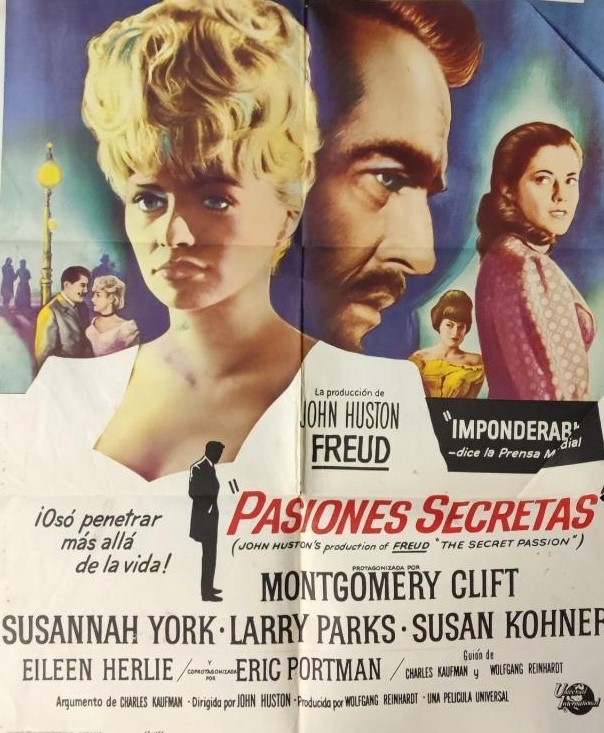
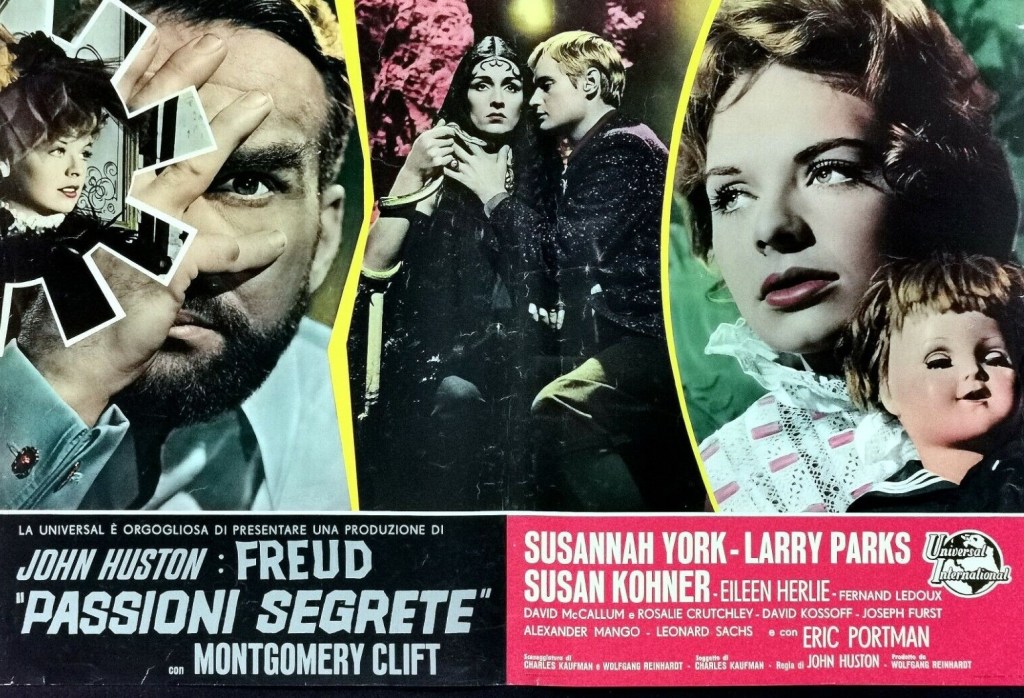
Behind the Scenes: “Freud” / “The Secret Passion” (1962)

Your leading man is an alcoholic drug-addled star with substantially impaired sight. Your leading lady, in her first major role, decides she knows more about acting than the very experienced director. But in the world of victimhood, who gets the blame? Not of course Montgomery Clift (The Defector, 1964) or Susannah York (Sands of the Kalahari, 1965), but  director John Huston (The Night of the Iguana, 1964).

Huston had been trying to put together a movie about the flawed god of psychiatry, Sigmund Freud, for 13 years. In 1949, with a screenplay by Charles Kaufman and backed by Twentieth Century Fox, it was going to be called Dr Freud. That version was still on the stocks a couple of years later. It wasn’t the first attempt to put the Viennese genius’s life on film, in 1940 Warner Brothers announced Edward G. Robinson in The Life of Freud with a script by Gary Endore.

Huston began serious work on the movie in 1956, but it was only greenlit two years later, after he signed a five-picture $20 million deal with new production unit Seven Arts, set up by Ray Stark and Eliot Hyman, future kingpins at Columbia and Warner Bros, respectively. It was to follow The Man Who Would Be King (not finally made until 1975), for which Huston was scouting locations in Afghanistan. At that point Freud was scheduled for 1959. Then it was Unforgiven (1960) and The Misfits (1961) that came first.

Mostly, the delay was caused by the screenplay. Huston had handed the task to celebrated French philosopher and playwright, who with what amounts to contempt for Hollywood, had written a 300-page script. His next attempt was 780-pages. Read that and weep, Christoper Nolan and Martin Scorsese, this was a 10-hour movie. When questioned, Sartre retorted “so make a 10-hour film.” Huston contemplated turning the script into two unrelated movies, perhaps in the vein of Young Tom Edison and Edison, the Man (both 1940).

Sartre spent two weeks at Huston’s home in Ireland, with Reinhardt on hand as well, trying to condense the material. But he spoke so rapidly that Huston confessed “I could barely follow even his basic thought processes….sometimes I’d leave the room in desperation, on the verge of exhaustion from trying to follow what he was saying.” Huston could not fault Sartre’s diligence. The playwright rose at 5am and would have 20-25 pages ready for discussion five hours later.

Sartre was paid $40,000 for his screenplay. Kaufman was brought back on board but his work didn’t gel with Huston’s vision. Wolfgang Reinhardt, whose name also appeared as producer, was more involved on the script. His relationship with Huston went back to Juarez (1939) on which they were co-writers and Dr Ehrlich’s Magic Bullet (1940), for which Huston was credited with one-third of the script and Reinhardt was producer. But Reinhardt hadn’t received a screenplay credit since Juarez and his last Hollywood picture as a producer was Caught (1953). More recently, he had found work in Germany on The Trapp Family (1956). According to Huston, he was “misunderstood, distrusted and ill-used in Hollywood.”

Eliot Hyman questioned Reinhardt’s contribution. In addition to snagging $30,000-$35,000 and a 7.5 per cent profit share for his producer duties, Reinhardt was being paid $300 a week plus expenses for screenwriting, fees Hyman considered “out of line.”

Huston was determined that “Freud’s descent into the unconscious should be as terrifying as Dante’s descent into Hell.” Sartre was viewed as having not just objectivity but as someone who knew Freud’s work intimately. But clearly major work was required to trim the Sartre script. It took six months to reduce the material into a workable script. Naturally, Sartre objected to the reworking and wanted his name removed.

Eventually, with the project at an impasse, Huston turned to leading British psychiatrist Dr David Stafford-Clark to provide clarification. Clift, who as a patient had considerable experience of psychiatrists, insisted on joining their discussions, but “his presence served only to delay and confuse.” When asked to leave, he stood outside the door and cried, then “drank himself  unconscious.”

That should have been warning enough. Having worked with an equally addled Montgomery Clift on The Misfits (1961), Huston might have thought twice about going back into the lion’s den. But, while not covered in box office glory, The Misfits was superlative, with all three principles turning in excellent  performances. And in any case, Clift was the go-to actor for the tortured character.

Eva Marie Saint (The Stalking Moon, 1969) was first choice for the role of troubled teenager Cecily and after she turned it down Huston approached Marilyn Monroe whose psychiatrist advised against it. So, it went to 22-year-old English actress Susannah York, who had attracted Hollywood’s attention after two British films – Tunes of Glory (1960) and Loss of Innocence / The Greengage Summer. Unusually, this was not a romantic part, treatment of this patient critical to Freud’s analytical breakthrough. Karl Malden (Pollyanna, 1960) was offered the second male lead, but due to his unavailability it provided a comeback for Larry Parks (The Jolson Story, 1946) who hadn’t worked in Hollywood since 1954.

Huston recalled, “He had deteriorated to a shocking degree… I should have dropped Monty…but I didn’t. I thought that when we got on the set and he had lines he would be all right.”

Clift continually tried to rewrite the movie. He had got hold of previous copies of the script and produced his own indecipherable version and spoke the lines in an infantile manner. “Finally, I realized this was primarily a stall for time,” said Huston. “Monty was having difficulty memorizing the lines. I was surprized at this because he had done so well during The Misfits.” But those lines were simple compared to the long, complicated speeches of Freud.

“I’m sure Monty had almost no conception of what he said in the picture – yet he had the ability to make you believe what he did.” Eventually, his lines were written on boards, on the labels of bottles, door frames and other places on the set. Added Huston, “There was a mist between him and the rest of the world that you simply couldn’t penetrate.”

Huston also encountered problems with York. “Susannah was the personification of the uninformed arrogance of youth. Shortly, under Monty’s influence, she became convinced she was entitled to scientific opinions regarding a subject of which she was woefully ignorant.”

She and Monty would collaborate to rewrite their scenes. York refused to do a scene as originally written until a call to her agent changed her tune. 

It took all Huston’s experience to hold onto his temper but a confrontation with Clift in his dressing-room resulted in a door slammed so hard it shattered a mirror. That was later conflated into Huston smashing furniture and tearing the couch apart. Huston was also blamed for Clift receiving rope burns during the climbing sequence. In fact, the shots were arranged so that after just holding on to the rope for the short period required, the actor could let go and land a few feet down on a pile of mattresses. Instead, he slid down the rope, holding on with his hands.

“My reputation for cruelty appears to stem directly from this one scene,” complained Huston, convinced the rope burns were Clift “for his own reasons beating himself up.”

Cinematographer Douglas Slocombe developed a technique of three-plane camerawork to help audiences distinguish between reality, dreams and memory. Scenes where characters recalled memories were shot through a small clear-glass plate mounted on the lens matte box. Dreams acquired an extreme black-and-white effect with chalky faces and other details standing out as luminous in tunnels of darkness. This was achieved through a combination of dramatic contrast in photography, stock and lab work.

The production spent five weeks at the Bavaria Studios in Munich before shifting to Vienna, which included 10 days of night shooting.

Universal underwrote the movie, and with To Kill a Mockingbird (1962) also on its roster, intended to celebrate its golden anniversary in fine style with “record rentals” from a raft of movies appealing to the public and the critics.

Freud’s daughter Anna and son Ernest didn’t take kindly to Hollywood’s interpretation of their father’s life and disassociated themselves from the movie and the Viennese hierarchy objected to the film’s louche elements.

Filming began in August 21, 1961, including three weeks on location in Vienna, and was due to wrap on December 5. That it took another two months to complete, (final shooting date was February 10, 1962) inflating the budget, was laid at the foot of Clift. Never mind the drink and drugs he was consuming in mighty proportions, he had cataract problems and could hardly see. 

Universal sued Clift for $686,000 for not acknowledging his cataract problems prior to filming, an issue that prevented him memorizing his lines.  Clift counter-sued for the remaining $150,000 owed from his $200,000 fee, claiming the problems had developed during filming. “I refuse to accede to the defendant’s demand that this condition…was responsible for delays to the picture.” Firemen’s Fund Insurance, whose policy covered the actor for a year from April 1, 1961, with the proviso the movie finished by December 5, 961,  denied liability.

Universal was concerned that the title would mean little to the general public and pre-release toyed with changing the title to Freud: The Dark Passion but agreed, in the end, not to “tamper” with it. However, exhibitors disagreed. And once Minneapolis second-run and neighborhood cinema owners refused to book it under the existing title, it was changed to The Secret Passion, which at least got it through the door with bookers even if the public remained wary. On posters, The Secret Passion part of the title grew bigger and bigger until the Freud element almost disappeared. The film was cut after initial release but the DVD shows the full version.

Despite critical approval and a 12-week run in New York and some decent runs in smaller houses in the country’s bigger cities, it was a flop, not managing the $1 million in rentals required to earn a spot on Variety’s annual box office chart.

SOURCES: John Huston, An Open Book (Columbus books, 1988) p294-305; “Memo from Eliot Hyman,” July 15, 1959, United Artists Archive, University of Wisconsin, Box 7, Folder 7; “Endore for Freud,” Hollywood Reporter, February 24, 1940, p2; “Robinson As Freud,” Box Office, March 2, 1940, p2”; “Dr Freud Bio On Fox Docket,” Box Office, September 17, 1949, p19;  “20th Lead with Five in Biopic Sweepstakes,” Variety, January 24, 1951, p5; “Freud Biopic 1st Hyman 7-Arter,” Variety, July 30, 1958, p3; “John Huston’s Next Spot – Afghanistan,” Variety, October 15, 1958, p19; “Huston Seeks Saint,” Hollywood Reporter, November 10, 1958, p2; “Universal Unchained,” Variety, August 19, 1959, p5; “Huston in on Freud Biography,” Variety, October 28, 1959, p11; “Sartre Script on Freud: 780 Pages,” Variety, June 29, p3; “Freud Rolls August 21,” Variety, July 26, 1961, p5; “Freud Moves Location,” Hollywood Reporter, October 12, 1961, p6; “Freud on Night Shift,” Hollywood Reporter, October 24, 1961, p3; “Freud Film Not To Liking of Kin,” Variety, November 1, 1961, p2; “Three-Plane Photography Developed for Freud,” Hollywood Reporter, December 19, 1961, p11;  “Huston’s Freud Ends Photo Phase,” February 14, 1962, p4; “Universal Sues for $600,000,” Hollywood Reporter, April 30, 1962, p3 “Montgomery Clift’s Eye Trouble,” Variety, June 5, 1963, p5; “U’s Insurance Claim on Monty Clift,” Variety, June 27, 1962, p7;  “It’s Plain Freud, U Won’t Tamper,” Variety, October 3, 1962, p3; “Never Heard of Freud,” Variety, October 9, 1963, p5; ’“Top Rental Films of 1963,” Variety, January 8, 1964, p37.

https://amzn.to/404Z2q1

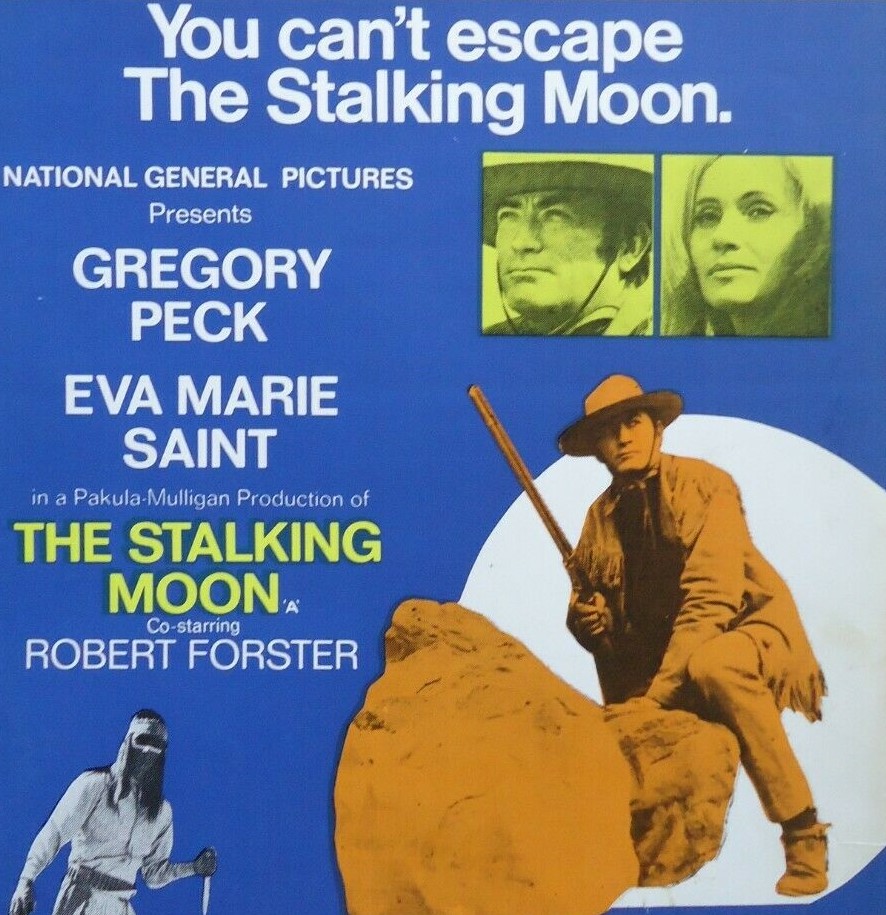
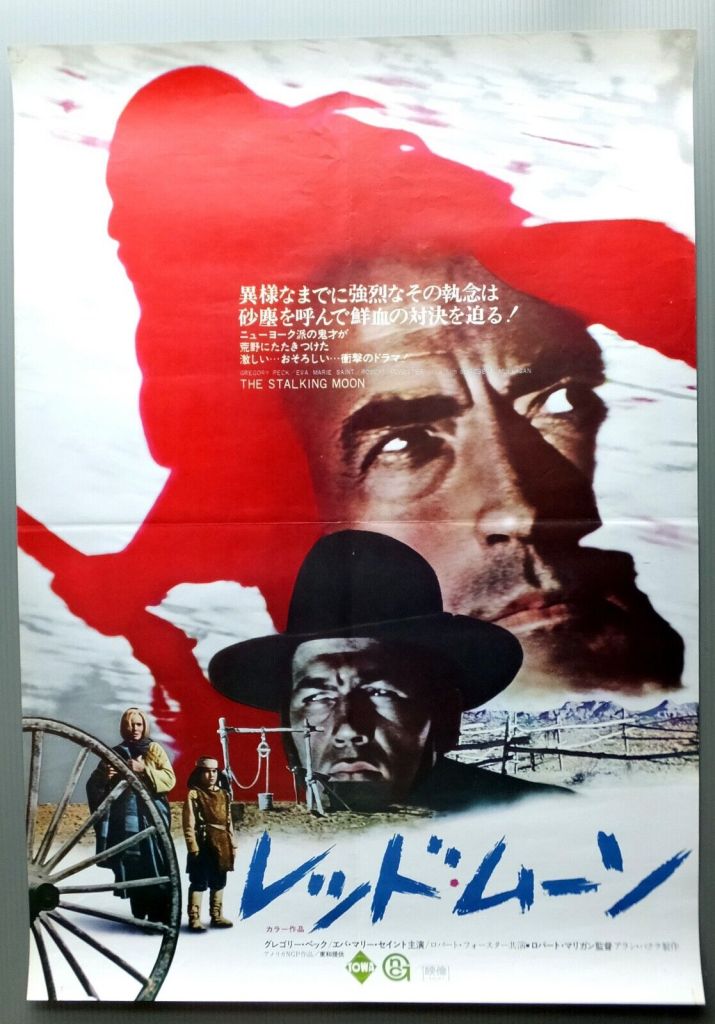
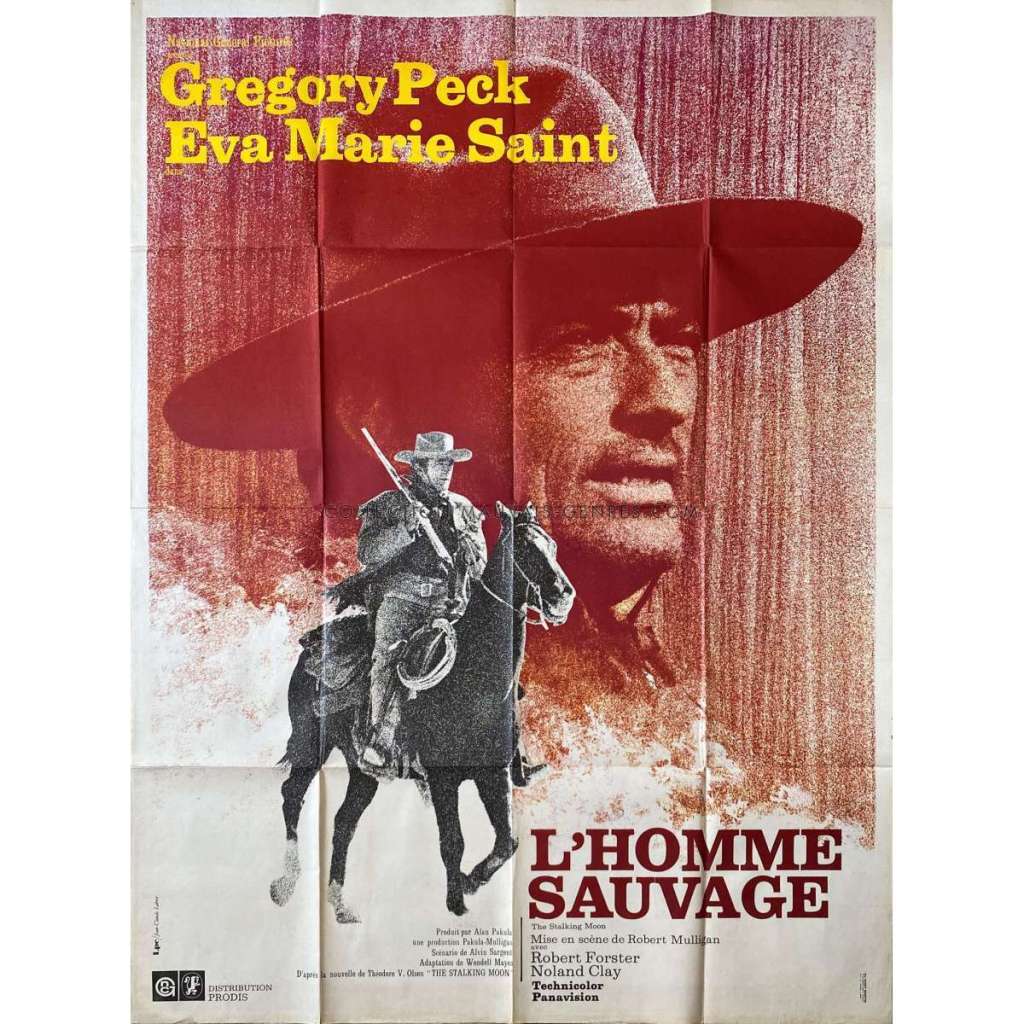
The Stalking Moon (1969) ****

About-to-retire Indian scout Sam Varner (Gregory Peck) helps the U.S. Cavalry round up Indians to take to reservations. One of these is American Sarah Carver (Eva Marie Saint) who, with her Apache son, is attempting to escape her vengeful Apache husband Salvaje (Nathaniel Narcisco). Varner agrees to take her to the nearest stage coach post, and then to a train depot, and, finally, to his ranch in New Mexico where they enjoy a period of security. But wherever she goes, death follows, culminating in a shootout in the hills around his ranch.

But the treatment by director Robert Mulligan (Up the Down Staircase, 1967) is far more complicated, often asking questions that cannot be answered, and placing the principals in situations that cannot be easily resolved. Sarah Carver has not gone running in order to find a man to save her; she does not think she can be saved and accepts the inevitable. She feels guilty for “lacking the courage to die,” of accepting Salvaje as her husband instead of dying along with the rest of her family when attacked a decade before by Indians.

She is weak in other ways, hiding the identity of her husband from the Army and everyone else in case she is abandoned. She shows no great bond with her son, who, several times, attempts to escape.

Sam Varner is very much an ordinary guy, just wanting to quit the Army and work his ranch. He is not the traditional extrovert western hero, nor the man who reluctantly takes up arms.  He has no wish to get involved with Carver and each time he does agree to help it is with a time-limited condition attached and these scenes lack any sense of meet-cuteness, no romantic interplay hastening him to a decision, little expectation that either party is angling to fall in love.

It is practicality rather than intimacy that makes them share a blanket during a dust storm and he asks her to come to his ranch because he will get on with the work quicker if he has someone to cook. In fact, his honesty prevents that: he confronts her over the fact that she “put us out here knowing all the time that he’d come after us” and making her face the corpses of men who died because she hid the truth. He is honest with his emotions and he is determined (“I got a place to go and I’m going”). But he bears none of the normal western hero’s traits, neither a hard drinker, loner, or gunman. He is not gauche like James Stewart or malevolent like Clint Eastwood. 

Even more unusual is the treatment of Salvaje. Despite the savagery of his actions, there is within him a sense of honor. He only chases his wife because she has stolen his son; there could be no greater affront to his dignity. The story is told from the point of view of the pursued i.e. Sarah Carver. But, by turning that perspective on its head, The Stalking Moon more easily fits into the category of revenge western, characteristically a picture concerning chase and pursuit by someone who has been wronged.

The director takes a bold step in the presentation of Salvaje. He is not seen at all in the first hour, then in just a few glimpses of a shape, his face only revealed at the climax. He is a ghost and a killing machine combined. Like a latter-day “Terminator,” he cannot be stopped, so skilful he evades capture, and relentless.

It is also, unusually for a western, a thriller. The tension mounts from the discovery, at the 10-minute mark, of Salvaje’s first three victims, all fully-armed soldiers, and the news, one minute later, that he single-handedly killed four troopers previously. At Hennessy, a staging post, when Varner and Carver go out into a dust-storm to search for her son who has run away, they return to find all dead. Everyone they left behind at Silverton, a train depot, is also killed.

Initially, Carver appears impatient, not willing to wait five days for an Army escort, but once she reveals who the boy’s father is, the reason becomes clear, and her desire for speedier transition creates more tension. Even in New Mexico, the death toll mounts, once Salvaje arrives. Now the trap closes in on them. Even the ranch house cannot prevent Salvaje from sneaking in and kidnapping his wife, leaving her for dead outside.

When Varner and a fellow scout, the half-breed Nick Tana (Robert Forster), attempt to turn the tables on Salvaje and track him down, it ends in Tana’s death. Although most of the tension comes from the will- he-won’t-he dynamic, there are number of Hitchcockian touches such as offscreen sound cues triggering alarm in characters. In two instances, a door provides shock.

Far from providing the expected relief, the ranch house merely provides a claustrophobic setting for the characters. Varner is trapped with an inarticulate pair. Instead of arrival at the ranch house precipitating emotional response and romantic interlude, as would be par for the course for other westerns, Varner finds himself stuck with a woman who refuses to talk and a boy who does not understand a word he says. The seven-minute scene where he sits down to eat and then has to virtually command mother and son to join him and encourage them to talk even if it is just to say “pass the peas” is one of the most awkward ever filmed. 

The movie is so darned awkward that you never laugh even at the few moments of comedy, the complicated issuing of train tickets, Varner keeping up a one-sided conversation at the table, Nick’s attempts to teach the boy poker. Relationships are more likely to remain in limbo than move on to any romantic or sentimental plane.

The film has a tight structure, the first 40-odd minutes setting up the story and tracing Varner and Sarah’s journey to the ranch house, the next 20 minutes at the ranch alternating between comfort and discomfort as emotional release battles with restraint, the final 40 minutes the physical battle between the mostly unseen enemy and the farm occupants. 

Stylistically, it is exceptional. The first section is all open vistas, characters minute figures on vast landscapes, the middle section suggests harmony with nature, and the final battle alternating between being the hunter and the hunted. When we first see Varner he is picked out along the edges of the screen as he leaps up or down or across rocky hillsides. That he appears and disappears at will could almost be the motif for the film.

Virtually everyone is in long shot or medium shot for the first half. Varner appears on the periphery of the screen and the action. He enters scenes where something important is being discussed, such as Sarah’s pleading to be allowed to leave the Army camp quickly. Most directors present Gregory Peck with aura intact, keeping him motionless on the screen to maintain his authority, but here he is always on the move, walking across open ground or confined spaces or darting across hillsides or through bushes, dashing on foot down slopes or racing on horseback.

Although the script – by Alvin Sargent (Gambit, 1966) and Wendell Mayes (Von Ryan’s Express, 1965) based on the T.V. Olson (Soldier Blue, 1970) novel –  was viewed in many quarters as being underwritten, in particular Sarah’s role, and that there were too many silences for comfort, in the view of many  that is the strength of the picture. There is none of the easy dialogue, crackling lines, coarse confrontation, sentiment or raw emotion of other westerns.

The movie hardly even skirts a cliché. This is in a class of its own in terms of the distance characters maintain between each other. Varner has very little to say, Sarah’s guilt restricts her vocabulary. In one regard the thriller element gets in the way of a study of two remote characters.

If I have any reservations about The Stalking Moon it is that is neither enough of a thriller nor enough of a character study. George Stevens might have sought emotional resolution and producer Alan J. Pakula, who later went on to direct Klute (1971) and The Parallax View (1974), might have proved more adept at marrying the thriller elements to personal anguish. Although The Stalking Moon may not have entered the pantheon of the greatest westerns, it is a very noble effort indeed, its slow pace and lack of dialogue providing it with a very modern appeal.

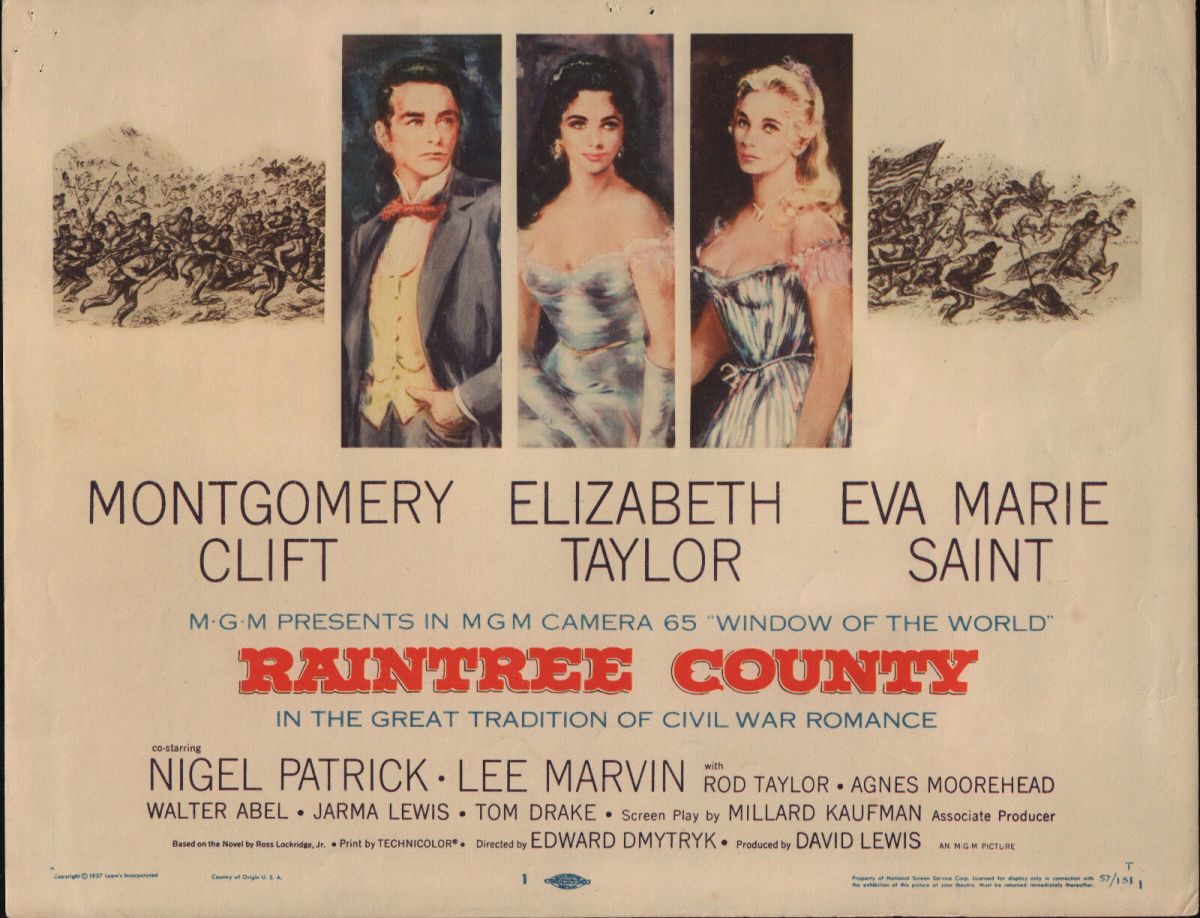
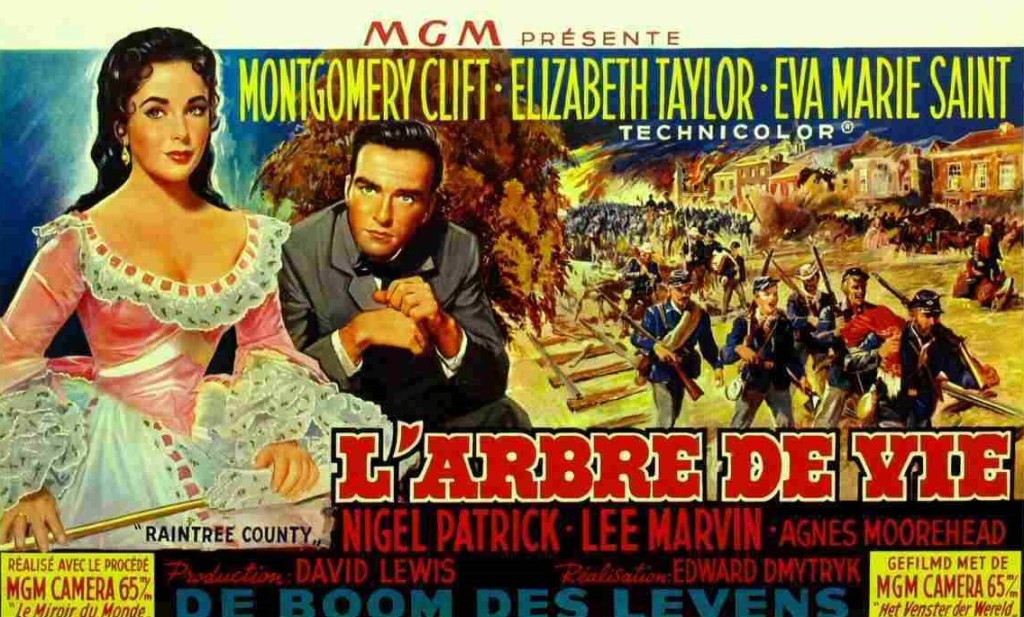
Raintree County (1957) ****

Much-maligned melodrama. No more episodic over a three-hour running time than Ben-Hur (1959) or Doctor Zhivago (1965) and though bookended by the American Civil War has less grandiose views on history. Part of the problem is that, faced with such length, critics expected something with greater depth rather than just ordinary people caught up in circumstance.  As if a stunning treatment of madness was not enough, inside the warring mind of a beautiful woman, whose realisation of her condition sets her on the road to tragedy. But it is riddled throughout by an element of fantasy, the fabled “rain tree” with golden leaves  triggers a moment of madness in all who seek to find it in the swamps.

Like Zhivago, the narrative arc is a love triangle between principled teacher John Shawnessy (Montgomery Clift), southern belle Susana (Elizabeth Taylor) and reporter Nell (Eva Marie Saint). Sub-plots involved drunken gregarious Flash (Lee Marvin), bumptious Garwood (Rod Taylor) and the charming adulterous Professor (Nigel Patrick). The characters intertwine at various points and John, Flash and the Professor come together during the war while Garwood tries to make political capital out of it afterwards.

John and Nell have known each other since childhood, but there’s no real sense that they are childhood sweethearts. If they have passion for each other, it’s well hidden, and when Susana turns up, she steals him away, in part by the ruse of pregnancy. Despite her incipient madness, perhaps because of it, John sticking by her no matter what, there’s grand passion in full view. But the best scenes are Susana talking not about her condition, but what she believes to be true and her fears that her truth may be false. She lies, for example, about her age when a fire killed her father and his lover. She leaves her husband a note  that she discovers she has never written. Her confusion at the depth of her illness, fear that she might have inherit the genes of her mother (also insane), is very touching.

She also does one thing that smacks of “Hollywood madness,” the crazy action that is shorthand for insanity, but within the twisted confines of her mind that is out of love for John. She has a dark secret about her role in the events surrounding the fire. But she overcomes her innate racism out of love for him, prior to the war freeing her slaves. She clings to John because she knows he is the one route out of her madness.

Audiences wouldn’t buy a three-hour picture about madness. You might perceive the other episodes as mere filler, and in some senses that’s true, but the episodes in themselves are quite entertaining and revealing. Though told the “rain tree” is a local myth, a kind of “holy grail”, John is the only character who tries to find it, out of idealism or insanity who knows, and nearly drowns as a result. Flash has come by his nickname for his running exploits and is challenged to a race by John and the otherwise outwardly idealistic Professor, a gambler, tries to influence the outcome.

Though a stranger in town Susana (“I’ll arrange it”) positions herself to place the garland of victory upon his head. When the Professor tries to make off with another man’s wife, John’s skills with a bullwhip prevent him getting shot. Although John’s mother and Nell push him towards politics, Susana leaves him be, recognizing the joy and fulfilment he gets from teaching.

The war is primarily viewed through the perspective of the Professor, a non-combatant who has found himself a job as a war correspondent, making wry comment as he illustrates various battles. By the end of it, soldiers on both sides are weary of the slaughter.

This was intended as one of the first roadshows, MGM’s initial attempt at incorporating its innovative widescreen process Camera 65 (meaning 65mm – the other 5mm in the more common 70mm taken up with the sound strip) that was later used to tremendous effect on Ben-Hur. And while this lacks the scope or action sequences of the Biblical epic, it looks just sumptuous on the wide screen.

Director Edward Dmytryk (Mirage, 1965) has a keen compositional eye and he also favors actors over showing off his directorial skills. But there are exceptional scenes from the directorial perspective. In one the camera remains fixed on Montgomery Clift at the side of the screen while in the background Lee Marvin is creating havoc. In another we follow a female warden as she unlocks door after door in an asylum before Montgomery Clift is led to Elizabeth Taylor.

The acting is superb, Elizabeth Taylor was nominated for an Oscar and might well have won except Joanne Woodward was playing a character with a split personality in The Three Faces of Eve. But it was a bold role for a young star like Taylor, and a tremendous piece of casting. As much as she uses words to try to explain or understand herself, when the camera cuts to her face you can see the terror in her eyes.

Clift had disfigured his face during an accident during shooting and that clearly physically affected his performance. Eva Marie Saint (36 Hours, 1964) is very effective as the rejected lover. Lee Marvin (Point Blank, 1967) takes the showboating approach to his role while Rod Taylor (Chuka, 1967) is not above some scene-stealing himself. But then both are competing with the over-the-top Nigel Patrick (The Battle of Britain, 1969). Millard Kaufman (The War Lord, 1965) wrote the screenplay from the Ross Lockridge Jr. bestseller.

The kind of film to immerse yourself in the performances and let the running time take care of itself.

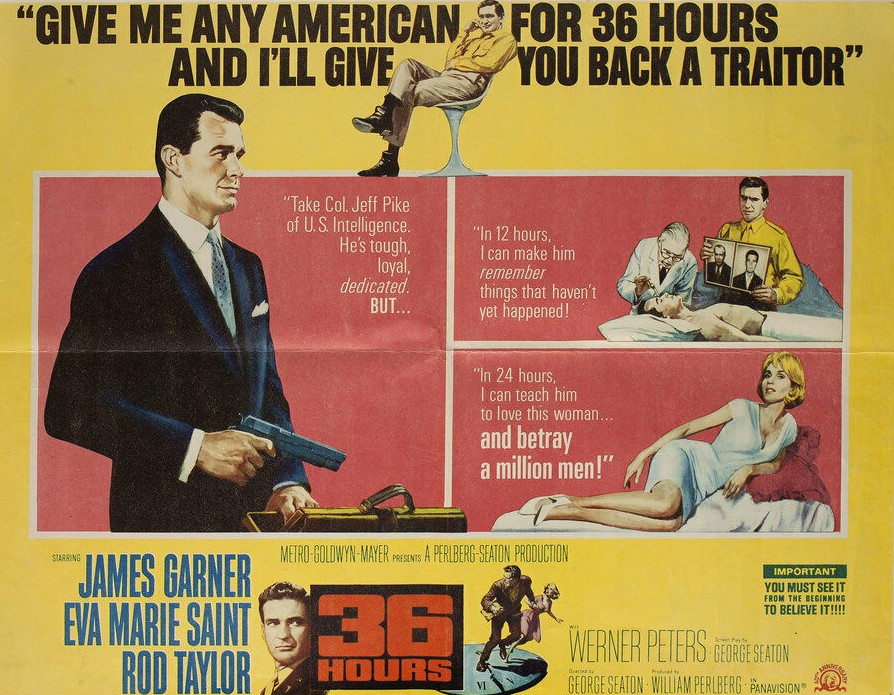
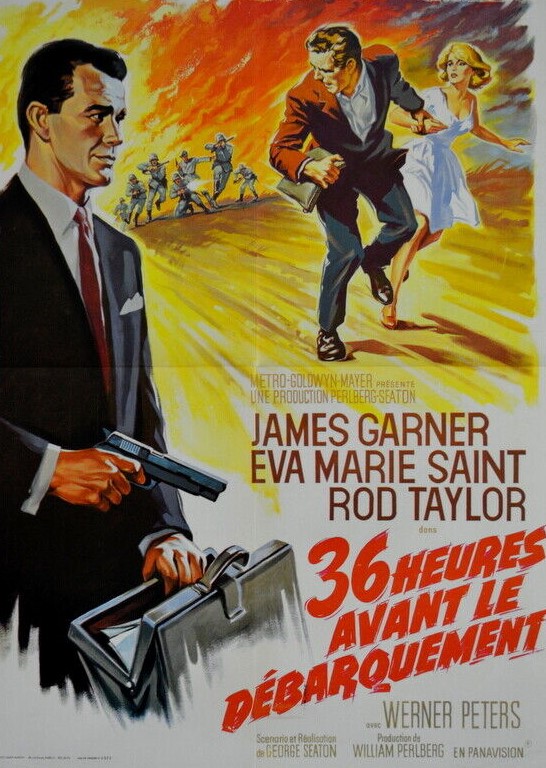
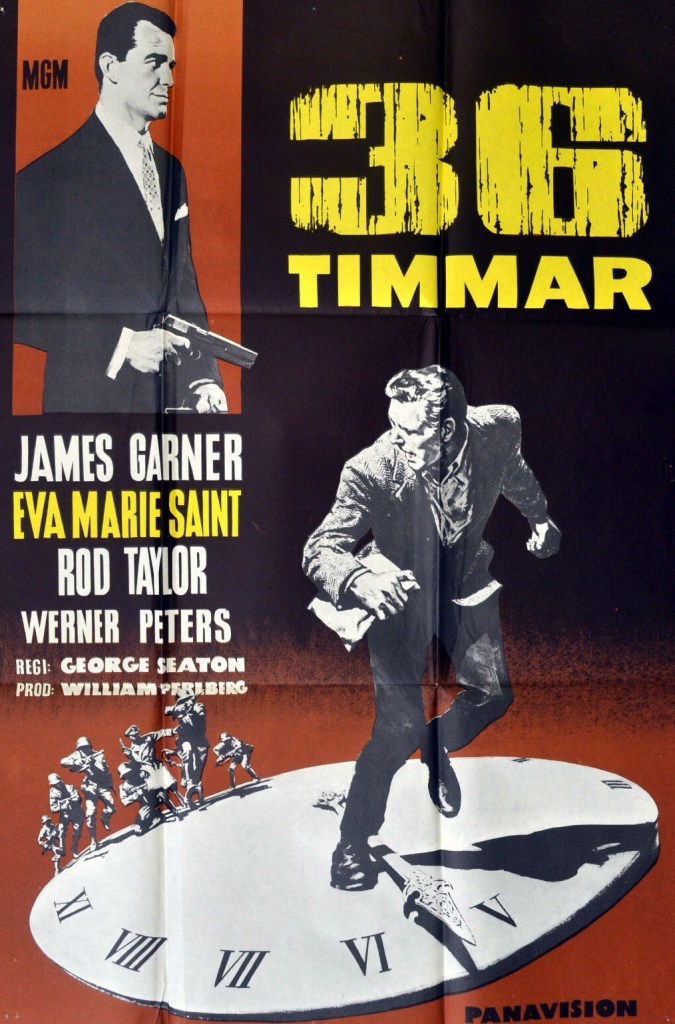
36 Hours (1964) ***

High concept thrillers that derails two-thirds of the way through. While it’s a battle of wits between German psychiatrist Major Gerber (Rod Taylor) and kidnapped spy Major Pike (James Garner), and between the German and his cynical superior, S.S. chief Schack (Werner Peters), it’s a fascinating insight into the power of mind games, almost slipping into the sci fi genre. Pike has intimate knowledge of the Allied D-Day plans but instead of submitting him to routine torture, he is handed over to Gerber who convinces him he has been suffering from amnesia for six years.

Pike finds himself in what he perceives to be an Allied hospital where everyone wears Yank uniforms, speaks English and listens to baseball scores on the radio. Pike has aged, thanks to greying hair and vision blurred so badly he requires spectacles. There’s even a wife, Anna (Eva Marie Saint), he doesn’t remember marrying. On the eve of D-Day the Germans expect the main invasion thrust to target Calais, the shortest crossing from England, not the Normandy beaches further to the south.  Someone who knows the truth might well be willing to suffer extreme torture to keep the secret out or enemy hands, therefore justifying this approach.

While the idea of a prefabricated existence would not be foreign to today’s audience, it was  an unusual idea at the time, although films as diverse as The Wizard of Oz (1939) and 1984 (1956) revolved around alternative reality. That the whole scheme is entirely plausible is down to Gerber. Rather than the one-dimensional villain, he’s an early version of the “good German,” whose scientific breakthroughs have alleviated suffering. Yes, he’s charming and suave and clever enough to hurry Pike along, but also very humane.

As you might expect, the best part is the constructed universe, Pike’s understandable disbelief at suffering from amnesia, and for so long, the shock to his vanity that his hair and eyes show signs of ageing. Just like Battle of the Bulge (out the next year) where American-born Germans were dropped behind enemy lines as saboteurs, Gerber’s ease with American idiom and culture is key to making the enterprise work. An easy-on-the-ear scientist, he employs a cupboard as a prop to explain the differences in the various types of amnesia. Pike is fooled and does inadvertently betray his country and the twist is that Schack, with so much invested in the notion of the invasion at Calais, refuses to believe it.

As ever in this kind of semi-sci-fi film it’s something incredibly simple (along the lines of the aliens susceptible to water in Signs or the common cold in War of the Worlds) that makes the clever construct unravel. In this case it’s Pike finding a paper cut on his finger and working out it should not be so sore after six years. So, thereafter, the film shifts into escape mode, which is considerably less thrilling compared to the sci-fi hi-jinks. A sub-plot involving Anna, a Jew willing to do anything to avoid the concentration camp, adds some depth to the proceedings.

Oddly enough, despite the title there’s no real sense of a deadline, nor does it come close to achieving the tension racked up in Day of the Jackal (1973) for an event the audience knew never took place, since 36 Hours fails to convince us the D-Day landings were ever in jeopardy.

It’s much more involving, not to mention highly successful, in the middle section where Pike is being duped, the lengths to which Gerber has gone to create the perfect fiction under audience scrutiny, while we watch Pike twist and turn as he comes to terms with what in those days would be perceived as serious mental illness, and from which there is no defined cure. That the escape is triggered by Gerber’s ego adds another element.

The picture did not hit the box office target on release in part I guess because by that time no enemy had to kidnap anyone to fill in the blanks in their scientific knowledge since there was such a plethora of defectors and in part because it seems insane that anyone would go to such excesses when less costly and proven torture implements were to hand.

That it works at all is down to the acting. James Garner (Hour of the Gun, 1967) straddles a number of his screen personas, from his instantly recognisable cocky character of The Great Escape (1963) to the befuddled double-takes of A Man Could Get Killed (1966) and tougher incarnation of Grand Prix (1966). Rod Taylor (Dark of the Sun, 1968) is his match with one of his best performances, infusing the mad scientist with surprising humanity at the same time as wriggling out from under the maw of the inhuman Schack, and, despite clearly being desperate to see his plan work, managing to keep his character on an even, chatty, keel. Eva Marie Saint (The Stalking Moon, 1968), the go-to choice for a vulnerable woman, brings an edge to her role.

Audiences glimpsing the name Roald Dahl in the credits in those days would not have been expecting an imaginative confection in the Willie Wonka and the Chocolate Factory  (1971) vein but something much more adult given the twist-ridden short stories which had made his name. This was based on his Beware of the Dog (1946) tale, the first of his pieces to be made into a film although some of the best of Alfred Hitchcock Presents (1958-1961) had lent heavily on his work.

Writer-director George Seaton put the project together, with occasionally some elan,  but as with The Counterfeit Traitor (1962) it’s a film of two distinct parts, but whereas with that film the latter stage was the more interesting here it is the first section. This is best approached as an offshoot of the kind of sci fi themes that inform the work of Philip K. Dick.

Catch-Up:  Rod Taylor’s acting development can be traced through films already reviewed in the Blog – Seven Seas to Calais (1962), Fate Is the Hunter (1964), The Liquidator (1965), The Glass Bottom Boat (1966), Hotel (1967), Dark of the Sun (1968) and The High Commissioner (1968). James Garner pictures previously reviewed are: Doris Day comedy Move Over, Darling (1963), spy spoof A Man Could Get Killed (1966) and the westerns Duel at Diablo (1966) and Hour of the Gun (1967).

Discover WordPress

A daily selection of the best content published on WordPress, collected for you by humans who love to read.

The Atavist Magazine

by Brian Hannan

WordPress.com News

The latest news on WordPress.com and the WordPress community.