The Strip Tease Murder (1961) ***

A treat in so many ways. A killer who could be the evil twin of Q, James Bond’s gadget supremo. A denouement worthy of Hercule Poirot. A femme fatale whose villainous boyfriend thinks he’s in charge until he learns, to his cost, she’s far smarter. A hero who’s just an ordinary bloke, derided for the most part, who enjoys none of the brio of the good guy who wins out because he can’t get over his loss.

And all this packed into an exceptionally slim running time once you deduct time for half a dozen striptease routines. Given the era the title is bait-and-switch, not much to see here that the censor of the times would permit.
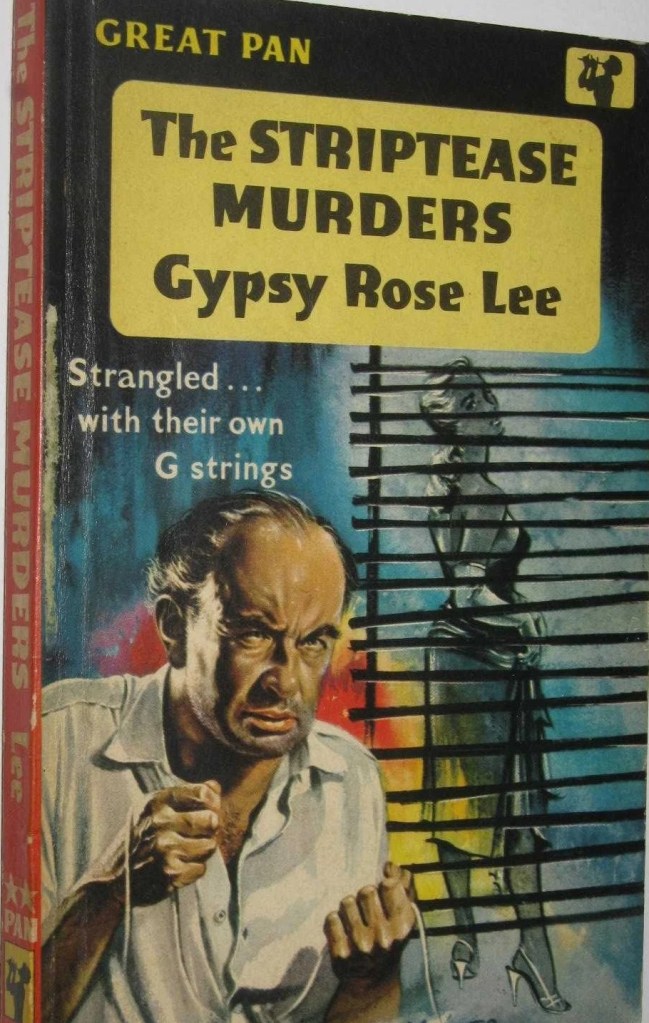
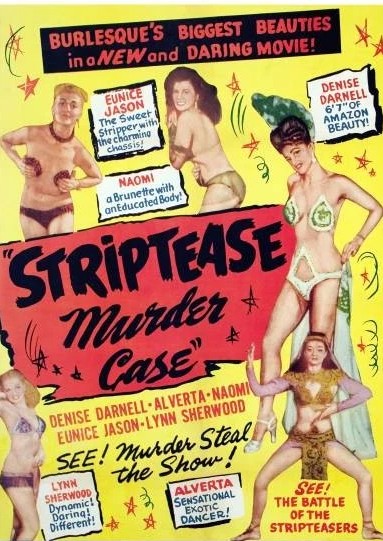
I confess to having employed a bit of bait-and-switch. Neither this illustration – by the world’s most famous stripper – nor the poster at the top are anything to do with this film. In my defence, I couldn’t find a poster or lobby card in color and feared the review would be ignored for that reason.

In The Flamingo Club in London’s Soho, businessman Branco (Kenneth J. Warren) is being blackmailed by former mistress Rita (Ann Lynn), a stripper. What he doesn’t know is that she’s set her sights on more than blackmail and she’s not become his mistress for the few scraps of nice clothing and fancy jewels he can bestow on her. She’s set out deliberately to seduce him so she can get the inside gen on his operation with a view to moving in.

Branco, sensing imminent threat, goes to sound engineer Perkel (Peter Elliott) for the answer. Perkel, in a manner that would delight Q, has rigged up a mic that, via a transistor and remote control, will electrocute the singer at the switch of a button. Only problem is, inadvertently, he kills the wrong girl, Diana (Jean Muir), wife of hapless M.C. Bert (John Hewer), an alcoholic former comedian down on his luck.

The cops aren’t interested in his theories of dirty dealing especially when the autopsy returns a verdict that suggests nothing untoward except bad luck for someone so young. But Bert’s found something unusual. Diana’s corpse is cold except for her ear, which is warm, which gets him to thinking. He tracks down Diana, only to be beaten up by her boyfriend Rocco (Carl Duerring), but when he calls on his inner Poirot he alights on Perkel.
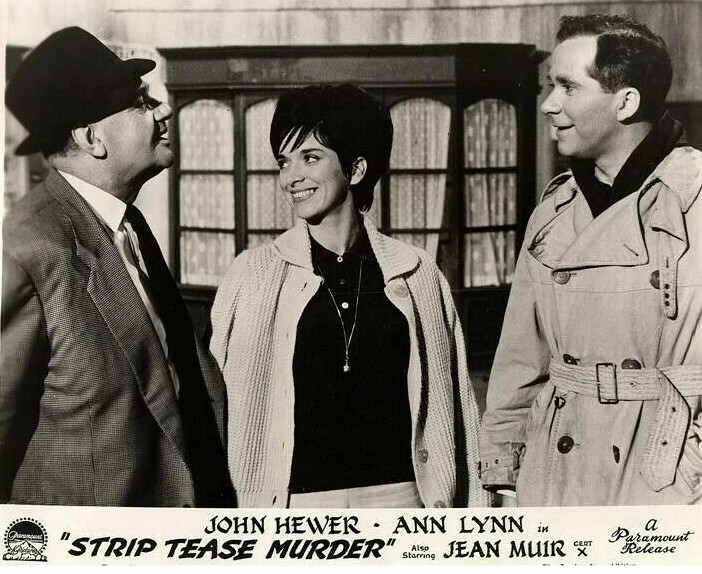
This is the real thing.

Diana reveals her true plan to the astonished Branco, who is shot by Rocco, with the entrepreneurial woman taking over his drug-running operation. Then with the help of the strippers and waiters at the club, Bert brings the villainous trio to the club where he enacts a potential second killing with the cops looking on.

So some very well-drawn characters make this worth more than the meager plot suggests. Perkel is a beaut. It’s worth remembering that Q was hardly a harmless inventor, and that most of his gadgets were meant to kill the enemy, such actions deemed justified because the bad guys are Russians or intent on global domination. Perkel is of the same boastful persuasion as Q, demanding that his ingenuity be recognized, willing to carry out murder for free just for the opportunity of proving that his weapon can kill more than snakes or horses. He is easily flattered and even when being arrested believes the cops are more interested in his invention – who knows, maybe it would end up in Q’s laboratory.

Diana, too, is something of a surprise, shifting from being apparently nothing more than a gangster’s moll to becoming the kind of ambitious gangster her boyfriend could not hope to emulate and more ruthless.

And Bert, while dogged for sure, and dumping the booze after his wife’s death, never finds a moment’s solace. Solving the murder won’t bring back the victim. Unusually, in this respect, reality intrudes in the world of crime fiction.

John Hewer (Three Spare Wives) went on to become a British television fixture, ironically as an M.C., host of variety show The Pig and Whistle (1965-1977). Ann Lynn (Piccadilly Third Stop, 1960) had a more varied career in television and film with a notable turn as the wife with lesbian tendencies in Baby Love (1969). Kenneth J. Warren was the bad guy with too much imagination in The Saint: The Fiction Makers (1968). Peter Elliott (Village of Daughters, 1962) steals the show as the meek killer who thinks genius excuses murder.

This was put together by the Danzigers, American producer brothers, who were prolific creators of B-pictures designed for the supporting feature slot in the days when audiences demanded double bills. Directed by Ernest Morris (Echo of Diana, 1963) from a script by Paul Tabori (Doomsday at Eleven, 1962).

Had this been made today, with hopefully the stripper element not played for exploitation, critics would have been pointing to the unusual depth of character.

It’s short enough to be well worth a look.
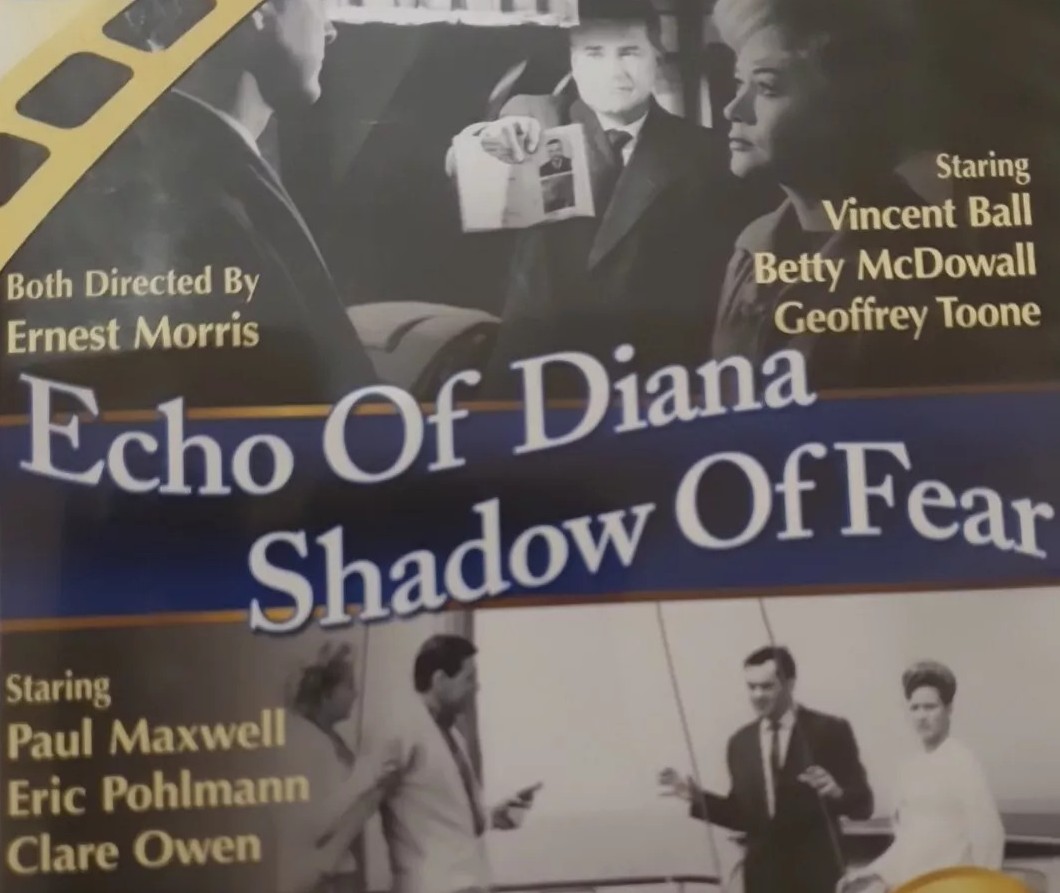
Shadow of Fear (1963) **

The Eady system at its worst. I’ve been singing the praises of quite a few of these British crime B-movies, made to take advantage of the Eady Levy cashback system and a Governmental dictat that cinemas had to show a certain proportion of British-made features. Generally, they were intended to fill the supporting feature slot, providing cinemas with a double feature. In the course of writing this Blog, I’ve uncovered a few minor gems, brisk, well-directed thrillers, good acting not necessarily essential.

The best this has to show for it is the ruthlessness of British spy chiefs in using an innocent couple as bait for foreign spies. Otherwise, beyond the initial twist, it’s too desultory for words, with too much time – even in a 60-minute feature – spent on too little.

American oilman Bill Martin (Paul Maxwell), flying back to London from Baghdad, agrees to carry a coded message for Jack Carter (Antony Wager), a casual British acquaintance. On landing at Heathrow Bill discovers Jack has been murdered. He’s accosted by a couple of cops, taken to a seedy hotel to wait for a fellow called Oliver, accepting all this oddness because he assumes he’s delivering a message for British Intelligence. After handing over the message he makes the mistake of telling Oliver that not only did he read the message, although failing to decode its content, but, having a photographic memory, had committed it to his brain.

Cue imprisonment. He escapes only because someone attempts to kill him and in turning the tide finds a way out. He flees to girlfriend Barbara (Clare Owen) and she whizzes him in a nifty sports car to her Uncle John (Colin Tapley) who knows somebody who knows somebody and it soon emerges that the fellow called Oliver was actually a fellow called Sharp (John Arnatt), a spy of unknown affiliation.

Assuming the bad guys would still want to eliminate our hero, the real Oliver (Reginald Marsh) reckons this is too good an opportunity to miss – the end justifying the means and all that rather than the more traditional British notion of fair play – and gets Bill and Barbara to agree to act as bait to trap the spies.

This doesn’t go as neatly as the good guys might expect and the baddies make further attempts on the couple’s lives and finally manage to kidnap them and take them out to sea with the intention of dropping them overboard. Luckily, the Brits are able to call in the Coastguard – armed for the occasion – to intercept and it all ends happily.

There’s not enough of anything to keep this moving – scarcely a red herring – and there’s about a dozen characters who flit in and out, various thugs, a top thug called Warner (Alan Tilvern), a femme fatale Ruth (Anita West) who is given no chance to exert her femme fatale wiles, and sundry MI5 and FBI characters and various others along the way. From the amount of time spent focusing on the belly dancer (Mia Karam) in the Baghdad hotel, you might have expected that she would have a role to play because she had more screen time than Ruth.

Nobody went on to greater things. Canadian Paul Maxwell (Man in the Middle / The Winston Affair, 1964) specialized in playing Americans in British films and television, even had a running part in soap opera Coronation Street and if you look closely you’ll see him pop up in A Bridge Too Far (1977).

Director Ernest Morris (Echo of Diana, 1963) can’t do much with the script by Ronald Liles (Night of the Big Heat, 1967) and Jim O’Connolly (Smokescreen, 1964) based on a tale by T.F. Fetherby.

Dull whichever way you cut it.

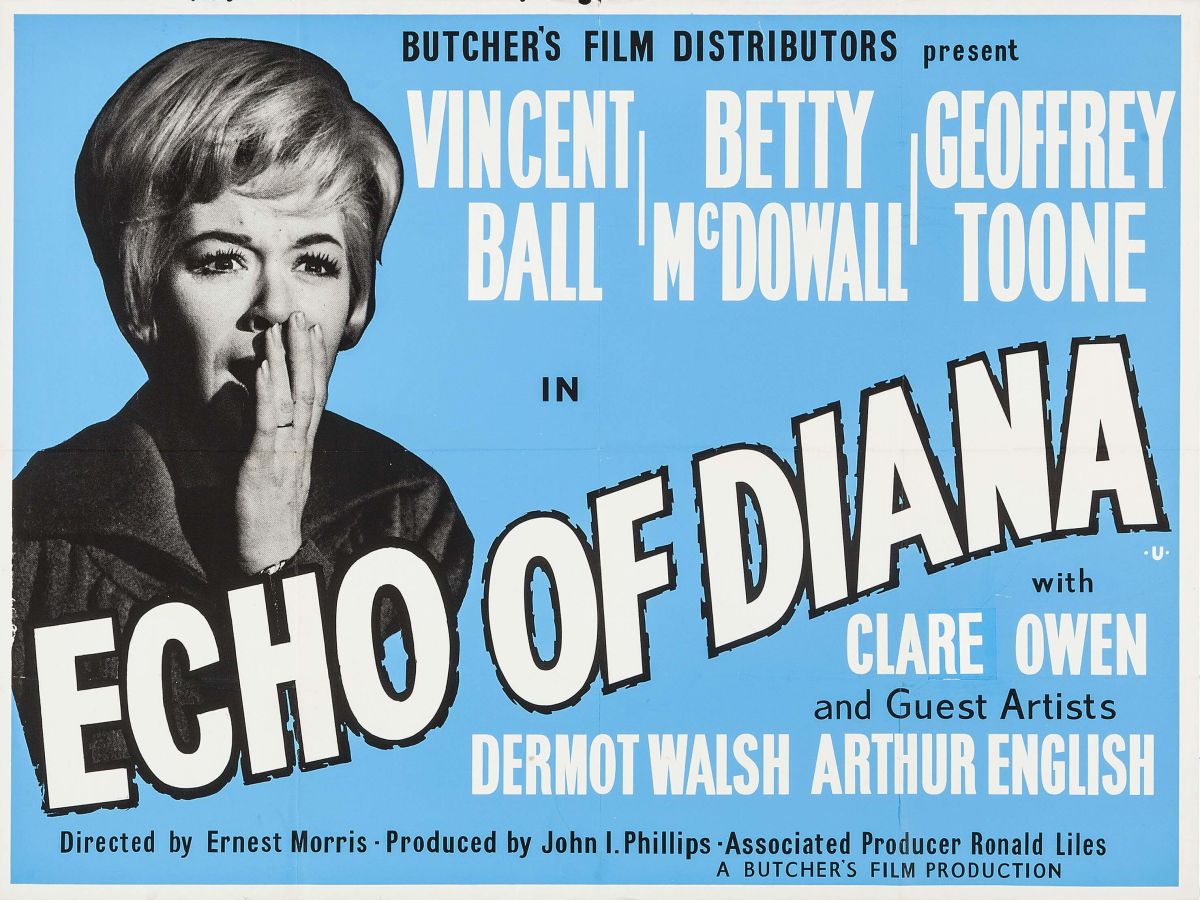
Echo of Diana (1962) ***

Minor British B-picture gem, though more for the exquisite narrative and tsunami of twists than the acting. And while not being one of those devious arthouse farragoes spins the starting point as the climax. Also, very prescient, heavily reliant of the espionage tradecraft that would later become de rigeur.

On the day she learns of her husband’s death in a plane crash in Turkey, Joan (Betty McDowall) finds an intriguing reference to the dead man in the “Personal Column” of The Times newspaper signed by “Diana.” Suspecting a mistress or skulduggery, her friend Pam (Clare Owen), a former fashion editor, investigates and triggers trouble. Joan’s flat is burgled, they are accosted by dubious police, the dead man’s effects are foreign to Joan, the receptionist at a newspaper makes a mysterious phone call.

Fairly quickly, Joan and Pam fall in the purlieu of British espionage chief Col Justin (Geoffrey Toone) who puts them in touch with suave journalist Bill (Vincent Ball), an old colleague of the husband, whose apartment has also been tossed, and who has taken a shine to Pam. The women are somewhat surprised when a murder is hushed up but that’s the least of the espionage malarkey. Mysterious contacts, equally odd points of contact, disguises (though mostly this runs to a blonde wig), code names, double agents, phone tapping and mail drops leave the women somewhat befuddled but they play along and with that British bluffness, not quite aware they are acting as decoys to draw out a crew of foreign spies headed by a rough fella called Harris (Basil Beale).

Halfway through it seems her husband might not be dead after all, but, according to the Turkish ambassador, Joan might need to head off to Turkey or thereabouts and certainly other interested parties want her out of the country.

And it being British, and nobody wanting to take the whole thing seriously, especially since the James Bond boom had not begun in earnest, the drama is offset by some pointed comedy: the proprietor of an accommodation address business has a side hustle in porn mags, one of the contacts is annoyingly punctilious, one promising lead turns out to be a very grumpy old man, another lead results in a race horse called Diana in a grubby betting shop where they are rooked by another old guy.

But it’s lavished with twists: double-crossers double-crossed, misleading clues, bad guys far cleverer than good guys, the wrong person in the right car, kidnap, unexpected occurrence. Pretty contemporary, too, with much of the action driven by telephone calls. But something of an ironic climax, the notice in the newspaper having legitimate espionage purpose.

The action is so pell-mell, Joan and Pam scarcely have time to draw breath, never mind give vent to heavy emotion, the best we are afforded is a moment when Joan doesn’t know “whether she’s wife or widow.” But that’s just as well. We are in B-movie land with a B-movie class of actors, probably recognizable to audiences then as the kind of actors who never managed a step up.

Vincent Ball did best, a long-running role in BBC TV series Compact (1962-1965), male lead in skin flick Not Tonight, Darling (1971) and decades of bit parts. You might have caught Betty McDowell in First Men in the Moon (1964) or The Omen (1976). Clare Owen was female lead in Shadow of Fear (1963) and had a part in ITV soap Crossroads (1965-1972).

Directed by Ernest Morris (Shadow of Fear) from a script by Reginald Hearne (Serena, 1962). You’d say a better script than a movie, and with better casting might have taken off, but, still, very satisfying supporting feature for the times.

Discover WordPress

A daily selection of the best content published on WordPress, collected for you by humans who love to read.

The Atavist Magazine

by Brian Hannan

WordPress.com News

The latest news on WordPress.com and the WordPress community.