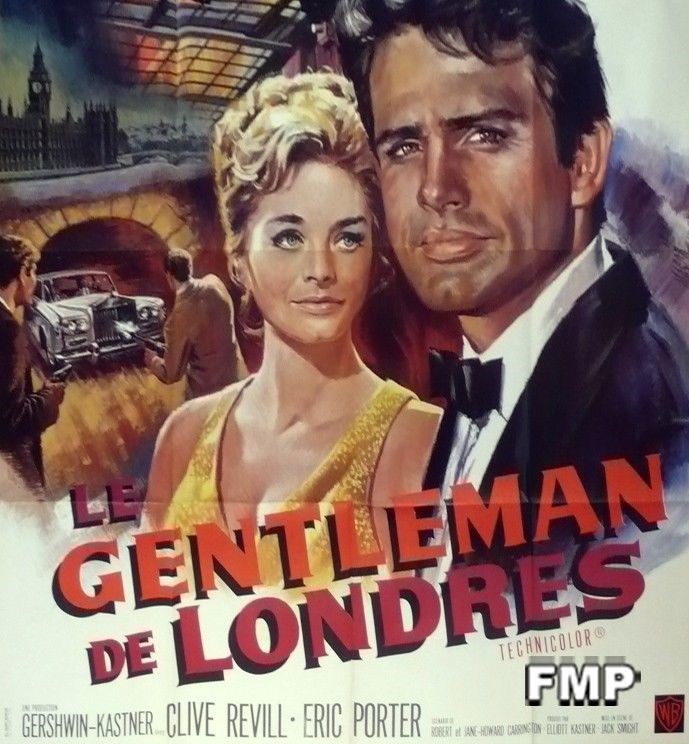
Kaleidoscope (1966) ***

Amazing the tension that emanates from the turn of a card. Or, more correctly, waiting for one. Only problem is we’re two-third through the movie before high-stakes poker begins – the pot nudging £250,00 (close on a cool £5 million now). Mostly, the earlier tension derives from not knowing what the hell is going on in this enjoyable thriller made at the height of the Swinging Sixties as playboy gambler Barney (Warren Beatty), a walking Carnaby St model driving an Aston Martin DB5, tilts the odds dramatically in his favor.

Barney is a gambler but the problem with gambling is the odds. They can be against you too much. So Barney decides to turn himself into a burglar, the kind that can clamber over rooftops, abseil between buildings, and break into – a printing business called Kaleidoscope. This just happens to print the playing cards supplied to all the major European casinos. So Barney does a little doctoring of the master printing plates. Bingo, the odds are a bit more even now that he knows what cards are coming out of the shoe – he plays chemin de fer (as it is known in posh casinos, pontoon or 21 to you and me).

While cleaning up he bumps again into fashion designer Angel (Susannah York) – their original meet-cute taking place in a traffic jam – who he dated once in London. Unbeknownst to him, she is on a scouting mission, looking to snare the kind of high-rolling gambler who can take on and completely fleece the drugs kingpin Harry (Eric Porter) being pursued by cop Manny (Clive Revill), her father who, rather than waste so much time collecting the required evidence to put the villain behind bars, decides it would easier done by making him broke. Unable to pay his debts, some other villain would put him out of business in the traditional cemented-boot fashion.

It takes a while for the movie to line up all its ducks in a row, mainly by holding on to the information the audience requires. But the audience is privy to details of the way Manny works that Barney is not. Even for ruthless villains, Manny has a peculiar calling card, one that would make any gambler think twice about entering his lair. Of course, it doesn’t take long for Manny to rumble Barney’s game so the stakes are much higher than the charming gambler imagines.

Throw in as much fashion as London was capable of generating at this time, the burgeoning romance, some exotic European locations, a castle with a moat, and the usual tourist guide stuff of red buses, Big Ben, Piccadilly Circus, pubs and Tower Bridge and you have all the ingredients of an easy on the eye thriller.

It’s a movie that relies on star power but Beatty and York deliver. That is, if you don’t need Beatty to do much more than be Beatty, all teeth and charm. At this point in his career Beatty looked as if his career was fast approaching its end. The box office success of Splendor in the Grass (1961) had been followed by a string of flops, romantic dramas and comedies that should have had audiences queuing up plus an occasional wild card like Arthur Penn’s Mickey One (1965), the biggest flop of all. He does make an engaging crook, and he never loses his screen charisma here, but there ain’t quite the right number of twists that moviegoers weaned on the likes of Topkapi (1964) had come to expect.

Hollywood had been doing its best to position Susannah York as a top box office attraction and she had snagged the female lead in The 7th Dawn (1964) opposite William Holden and Stanley Baker in Sands of the Kalahari (1965)  but she was recovering from the colossal flop of Scruggs (1965) by ‘poet of the cinema’ David Hart.  Kaleidoscope offered  the kind of role York could do with her eyes closed. So while the screen pair were not exactly sleep-walking it was not the kind of story that was going to create sparks.

Character actor Clive Revill (Fathom, 1967) and Eric Portman (The Pumpkin Eater, 1964) take more leeway with their roles, the latter almost chewing he scenery, the former content with just chewing his lips. Look out for Jane Birkin (Blow-Up, 1966) and British television stalwarts Yootha Joyce, George Sewell and John Junkin. 

The title would have been more enigmatic, original meaning of images twisted out of shape, had it not also applied, straightforwardly, to the card-making company. Giving Harry the surname of Dominion seems overkill.

Director Jack Smight (No Way to Treat a Lady, 1969) came to this after twisty private eye picture Harper/The Moving Target (1966), a big hit starring Paul Newman. This is too lightweight a feature to command such interest, but he does keep the story rolling along and it’s an effortless watch and it has a certain offbeat quality. The screenplay was fashioned by Robert Harrington and Jane-Howard Harrington, making their movie debut, who also co-wrote Wait until Dark (1967). It was also the debut for Winkast Productions, the Jerry Gershwin-Elliott Kastner production team who went on to make Where Eagles Dare (1968).

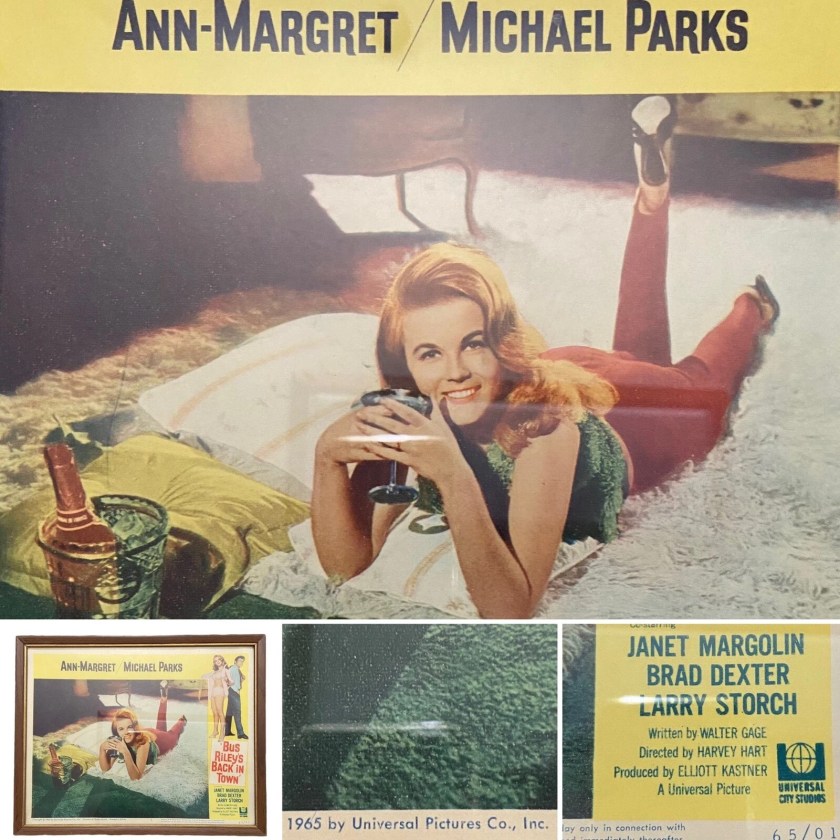
Behind the Scenes: “Bus Riley’s Back in Town” (1965)

Small wonder that Bus Riley’s Back in Town found scant appreciation on producer’s Elliott Kastner’s dance card. He preferred to have people believe that his career began with box office smash Harper / The Moving Target (1966) rather than the two flops – Kaleidoscope (1966) and Bus Riley’s Back in Town (1965) – that preceded it. As his son Dillon Kastner pointed out: “He always preferred to forget his first film. He liked to think his first film was Harper so he never put that title (Bus Riley) on his list of credits for investors.”

After jockeying in the Hollywood trenches for three years, Kastner should have been delighted to finally get his name on a picture after so many potential movies had slipped through his grasp. But he had good reason to want to forget the experience of working on Bus Riley. It sat on the shelf for a year and, minus the involvement of the producer, was “butchered” by the studio.

By the time the movie appeared it was the latest in a long line of failed attempts by former agent Elliott Kastner to get onto the Hollywood starting grid. He had previously been involved in a pair to star Warren Beatty – Honeybear, I Love You with a screenplay by Charles Eastman and Boys and Girls Together adapted from the William Goldman bestseller with Joseph Losey (Accident, 1966) lined up as director. Also on his scorecard were 1963 William Inge play Natural Affection, Tropic of Cancer from the controversial Henry Miller novel and The Crows of Edwina Hill. At the time of the Bus Riley opening, he had acquired a further seven properties.

Bus Riley was never intended as a major picture, the budget limited to $550,000 – at a time when a decent-sized budget was well over $1 million. Shot in Spring 1964, and in post-production in July, release was delayed until Universal re-edited it and added new scenes because Ann-Margret had  achieved surprising movie stardom between her recruitment and the film’s completion. Along with Raquel Welch, she became one of the most glamorous stars of the decade and in building up her own career Welch clearly followed the Ann-Margret template of taking on a bucket of roles and signing deals with competing studios.

After making just three movies – A Pocketful of Miracles (1962), State Fair (1962) and Bye, Bye Birdie (1963) – Ann-Margret shot into the fast lane, contracted for three movies with MGM at an average $200,000 per plus an average 12% of the profit, substantial sums for a neophyte. On top of that she had four far less remunerative pictures for Twentieth Century Fox, three for Columbia, Marriage on the Rocks with Frank Sinatra and a couple of others. By the time Bus Riley finally appeared, she had expanded her appeal through Viva Las Vegas (1964) opposite Elvis and top-billed roles in Kitten with a Whip (1964) and The Pleasure Seekers (1964).

Universal also had another property to protect. Michael Parks was one of small contingent of novice actors in whom the studio had invested considerable sums, using them in television roles before placing them in major movies. Others in this group – at a time when most studios had abandoned the idea of developing new talent – included Katharine Ross and Tom Simcox who both appeared in Shenandoah (1965), James Farentino (The War Lord, 1965), Don Galloway (The Rare Breed, 1965), Doug McClure (The Lively Set, 1964) and Robert Fuller and Jocelyn Lane in Incident at Phantom Hill (1965).

However, the introduction of Parks had not gone to plan. He was set to make his debut in The Wild Seed (1965) – originally titled Daffy and going through several other titles besides – but that was also delayed until after Bus Riley, riding on Ann-Margret’s coat-tails, offered greater potential. Kastner had been instrumental in the casting of Parks – whom he tabbed as “a wonderful up-and-coming actor” – in The Wild Seed.

Also making their movie debuts in Bus Riley were Kim Darby (True Grit, 1969) and Canadian director  Harvey Hart (Dark Intruder, 1965), an established television name. Hart joined David Lowell Rich and Jack Smight as the next generation of television directors making the transition. Universal was on a roll, in 1964 greenlighting 25 pictures, double the number of productions in any year since 1957.

Falling just behind Tennessee Williams league in terms of marquee clout, playwright William Inge had won an Oscar for Splendor in the Grass (1961) and been responsible for a string of hits including Come Back Little Sheba (1952) – Oscar for Shirley Booth – the Oscar-nominated Picnic (1955) starring William Holden and Kim Novak and Bus Stop (1956) with Marilyn Monroe.

Kastner had persuaded him to turn his little-known 1958 one-act play All Kinds of People into a movie-length screenplay. Inge was initially keen to work on a low-budget picture, anticipating “more freedom with an abbreviated budget.” He asserted, “You don’t have the front office calling you up all the time.” Since the movie was not initially envisaged as a star vehicle for Ann-Margret (and, in fact, she plays the supporting role) he saw it as a “way of breaking up that old Hollywood method of selling pictures before they were made” on the back of a big star and hefty promotional budget.

Unfortunately for him, once Universal realized they had, after all, a star vehicle, the studio concluded that her image was more important than the “dramatic impact” of the film. “When we signed Ann-Margret she wasn’t a big star but in six months she was and Universal became very frightened of her public image. They wanted a more refined image.”

Kastner and Inge were elbowed aside as Universal ordered a rewrite and reshoots. Inge took his name off the picture. The credited screenwriter Walter Gage did not exist, he was created to get round a Writer’s Guild dictat that no movie could be shown without a writer’s name on the credits.

Despite her supposed growing power, Ann-Margret had little say in preventing the changes either. She expressed her disappointment to Gordon Gow of Films and Filming: “You should have seen the film we shot originally. William Inge’s screenplay…had been so wonderful. So brutally honest, And the woman, Laurel, as he wrote her, was mean and he made that very sad. But the studio at the time didn’t want me to have that image for the young people of America. They thought it was too brutal a portrayal. They wanted me to re-do five key scenes. And those scenes completely changed the story. There were two of these scenes that I just refused to do. The other three I did, but I was upset and angry.”

Film historian James Robert Parish refuted Ann-Margret’s recollection of events. He claimed the changes were made at her insistence because she wanted to be the focal point of the narrative rather than Bus Riley (Michael Parks).

Harvey Hart reckoned Universal got cold feet after the audience attending a sneak preview made “idiotic” comments on the questionnaire. Recalled Kastner, “I had nothing but heavy fiddling and interference from Universal.” Even so, given it was his debut production, he wasn’t likely to disown then and didn’t follow Inge in removing his name.

Despite the changes, the movie received a cool reception at the box office. It turned in opening weeks of a “modest” $7,000 in Columbus, “slow” $9,000 in Boston, “modest” $9,000 in Washington, “lightweight” $10,000 at the 1642-seat Palace in New York, “mild” $4,000 in Provident, “so-so” $4,000 in Portland, “not so good” $7,000 in Pittsburgh, “okay” $7,000 in Philadelphia, and $98,000 from 22 houses in Los Angeles with the only upticks being a “good” $7,000 in Cincinnati and a “fast” $7,000 in Minneapolis. The movie didn’t register in Variety’s Annual Box Office Chart which meant it earned less than $1 million in U.S. rentals and was listed as a flop.

SOURCES: Elliott Kastner Memoir, courtesy of Dillon Kastner; “Elliott Kastner’s Partner on Honeybear Is Warren Beatty,” Variety, January 23, 1963, p4; “Elliott Kastner Will Helm Crows for U,” Variety, May 1, 1963, p21; “Escalating Actress,” Variety, May 22, 1963, page 4; “Raid Canadian Director,” Variety, March 4, 1964, p24; “Inge Thinks Writer Contentment May Lie in Creative Scope of Cheaper Pix,” Variety, May 6, 1964, p2; “Ann-Margret Into the Cash Splash,” Variety, July 22, 1964, p5; “Universal Puts 9 Novices Into Pix,” Variety, March 3, 1965, p25; “ A Collective Byline,” Variety, March 17, 1965, p2; “U Stable of Promising Thespians,” Variety, March 17, 9965, p2; “Fear Ann-Margret Going Wrongo in Her Screen Image,” Variety, March 24, 1965, p5; “Radical Kastner-Gershwin Policy: Get Scripts in Shape Way Ahead,” Variety, May 19, 1965, p19; “Warren Beatty Partner and Star of Goldman Tale Via Elliott Kastner,” March 31, 1965, p7; “Picture Grosses,” Variety – March-May 1965.

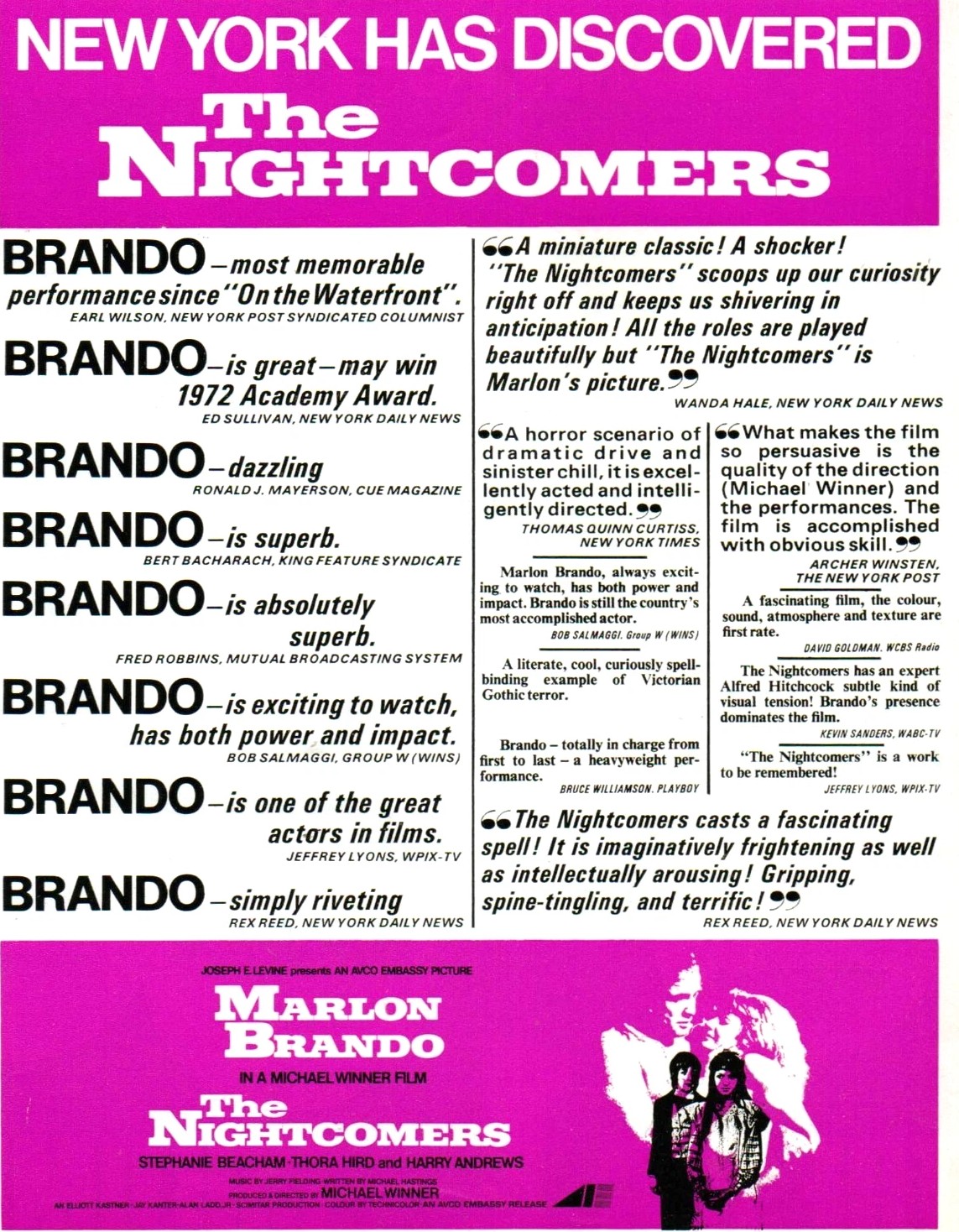
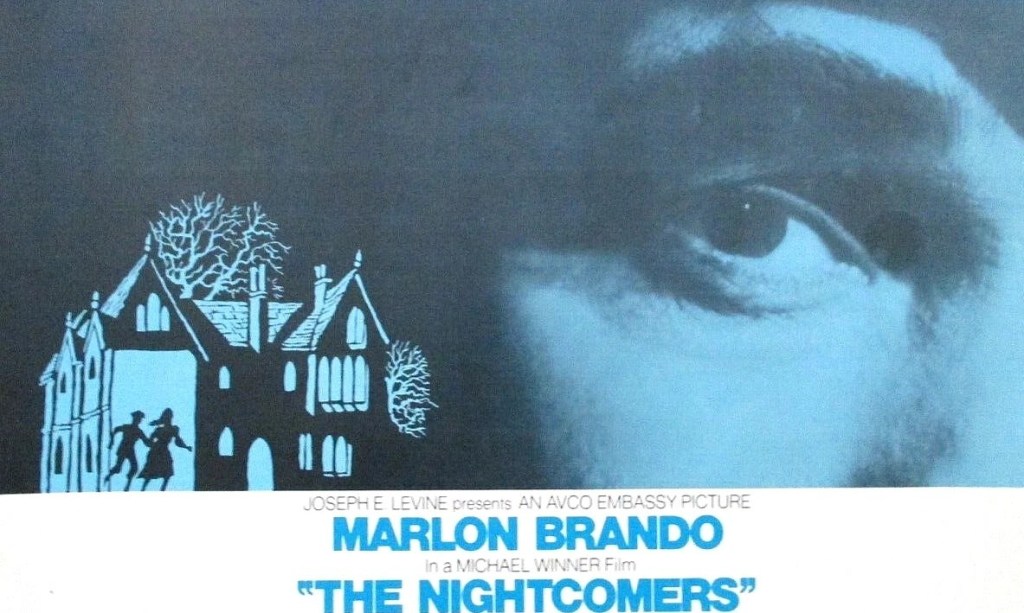
Behind the Scenes: “The Nightcomers” (1972)

Marlon Brando’s box office cachet had crashed. He hadn’t made a picture in two years following the flop of Queimada/Burn (1969) which had followed his debilitating box office trend of most of the decade. While his stock remained high enough to headline such big budget numbers as The Chase (1966) and Reflections in a Golden Eye (1967), thereafter confidence in his marquee value tumbled. Apart from Queimada, he had only been signed up for Night of the Following Day (1968), another loser.

But that last picture had brought him into the orbit of independent producer Elliott Kastner (Where Eagles Dare, 1968) who had been a friend of director Hubert Cornfield (Pressure Point, 1962) when they had both worked as agents at MCA. “Although he was crazy,” recalled Kastner, “I loved his writing and his drive.” Kastner was a fan of Cornfield’s earlier movies especially as they had been delivered on short time schedules. “I wanted to do something with Marlon Brando and he wrote Night of the Following Day.” 

Brando still had clout in Hollywood. His three-picture deal with Universal obliged the studio to pony up for any (financially viable) projects he put to them. Kastner was delighted to hop over from his base in London to the French location and although the movie continued the actor’s poor reception at the box office, the producer enjoyed the experience.

Brando wasn’t averse to the “resting” that most actors endure, stints of unemployment between gigs. So when the actor approached Kastner to work with him again, it took the producer by surprise. “Marlon wanted to do a film,” said Kastner, “which was unusual for Marlon because he hides from work. He wanted to do a film in Europe and he loved staying at my house in the country. I talked to (Brando’s agent) Jay Kanter (who later became Kastner’s business partner) about it and we gave him a screenplay called The Nightcomers…that Michael Winner wanted to direct.”

Kastner had liked Winner’s output and was equally attracted to the fact that he also worked fast. Winner was contemptuous of directors who shot too much footage, especially “coverage”, filming a scene from too many different angles. But he was also a very fast editor. He took an editing caravan with him on location, and after the day’s filming ended at 6pm he spent the next two hours watching rushes and another two hours after that editing. His editor Freddie Wilson said,” His speed of decision in the cutting room saves a great deal of time and money.”

Winner had been sitting on the screenplay by Michael Hastings for some time. “No one was rushing to finance it,” remembered Winner, until Brando showed an interest. Winner arranged to meet the actor at his “modest Japanese-style house” in Los Angeles. However, insurance proved a sticking point following payouts for Quiemada.

“On a personal level,” recollected Kastner, “I thought he (Winner) was a bully with waiters. He was really nasty to people beneath him. I didn’t have much (personal) respect for him but he was very amusing.”

Due to scheduling conflict Vanessa Redgrave (Blow-Up, 1966) turned down the role of Miss Jessel. Winner also offered the part to Britt Ekland (The Double Man, 1967) provided she could bring some financing to the project. In the end, remembered Kastner, “Michael wanted to cast this girl with this big bust who was a halfway decent actor.” Neither Redgrave nor Ekland could compare in the bust measurement department to Stephanie Beacham, so clearly chest size was not a priority.

Kastner reckoned Brando “would bring plenty of poetry” to the project. It was remarkably cheap even for a star of Brando’s fading attraction. The budget was $686,000, of which Kastner received $50,000 as a producer’s fee plus 30% of the profits. Winner deferred his fee, only paid if the movie made money. At that point, Kastner was leading the way in finding funding outside the studio system. Funding for When Eight Bells Toll (1970), for example, was entirely sourced from an American businessman. For The Nightcomers, Kastner located investment of $100,000 from a company called Film & General Investments. Universal was involved through its contract with Brando – paying him his $300,000 salary for this picture to count as the final one on his contract, but declined to distribute the picture. For another producer, this might have been enough to kill off the project, but not for Kastner, who, following his current practice, intending to sell the completed film to a distributor.

As far as Kastner was concerned the movie went into immediate profit. Joe Levine of mini major Avco Embassy, still riding high after the success of The Graduate (1967) and The Lion in Winter (1968), ponied up $1 million for the worldwide rights plus a share of the profits. But Avco also limited its exposure, selling a 40% share to businessman Sigmond Summer for $1 million. (Judging from later legal documents, Universal retained some financial interest in the picture).

Brando had decided Quint was Irish. To learn the dialect, Brando and Winner got together with a group of Irishmen in the back room of a pub, one whom became the actor’s dialog coach on location.

The six-week shoot, on locations in Cambridgeshire, Britain, with Sawston Hall doubling as the mansion, began in January 1971. There was another reason for the speed of the shoot. Winner had contracted with United Artists to make Chato’s Land (1972) and there was no time to spare between the movies. Over 100 actresses auditioned for the role of the female orphan. Winner, seeking “someone over 18 who looked 11,” selected Verna Harvey (she also won a role in Chato’s Land).

Although Winner had gone to some expense to set up a private dining room for the star at Sawston Hall, Brando preferred to eat with the crew. According to Winner, despite Brando’s fearsome reputation, he knew all his lines, immensely patient with his young inexperienced co-stars, concerned about the crew, and, as importantly, arrived on time and even watched rushes, a rarity among the profession. Brando used earplugs to prevent distraction from extraneous noise. During the shoot Francis Ford Coppola flew over to spend time discussing the script of The Godfather with Brando.

Brando initially refused to have stills taken of him during the sex scene and only gave in after considerable persuasion, though he kept his wellington boots on. He wanted to leave the drunk soliloquy to the end of shooting. Though he was actually drunk after consuming a lot of Scotch, “he remembered his lines immaculately…(and) also matched his hand movements and body movements, which is very important in movies,” explained Winner, “because if you have to cut different bits of film together if the body or hands or arms are in a different position you’re in trouble.” 

Jerry Fielding didn’t record his score until July during a three-day session with an orchestra of 80 at Cine Tele Sounds Studio. Despite his editing prowess, Winner realized his final version didn’t work. “The first cut was too fast. For a moody period film I’d just messed up. I put back seven minutes (of footage) and spent another three weeks getting it right.”

Thanks to its world premiere at the Venice Film Festival alongside the likes of Sunday, Bloody, Sunday (1971), it was touted, perhaps unwisely, as an arthouse picture, rather than majoring on the sex and violence. While Variety tabbed it a “grippingly atmospheric thriller,” only two out of the five most influential New York critics gave it the thumbs-up.

A distribution deal was not struck till the end of 1971. Rather than potentially riding along in the slipstream of The Godfather (1972), which was already attracting huge hype, Avco decided that it was better to come out before the Mafia picture than risk being swamped in its wake. But there was confidence in the project. “Joe Levine thought the film was so brilliant we didn’t have to wait for The Godfather,” related Winner.

It launched first in America, opening in February 1972 – beating The Godfather to the punch by a month – at the 430-seat Baronet arthouse in New York. The opening week of $20,700 was rated “nice” and held well for the second week before plummeting to $11,000 in the third week. It was yanked after six weeks.

By the time it spread out into the rest of the country, The Godfather rollercoaster was well into it stride, but the early release had not particularly gathered any pace and in the aftermath of the Coppola movie it was certainly buried. It opened to $6,500 in Boston compared to The Godfather’s second week of $140,000. There was a “scant” $39,000 from 13 houses in Los Angeles, a “modest” $4,000 in Louisville though $5,000 in San Francisco was rated “brisk” and the same amount in Washington “snappy.

Initially, at least, Britain appeared more propitious. It opened in key West End venue the 1,400-seat Leicester Square Theatre to a “loud” $24,700 and though it dropped $10,100 in the second week, the third and fourth weeks improved on the second. Eight weeks into its West End run, when it was still pulling down $13,300, The Godfather put it to the sword with a record-breaking $191,000 from five West End houses. After that pummelling, The Nightcomers managed only three further weeks.

In fact, the movie did surprisingly well, especially overseas. Total rentals came to $1.69 million, a clear million-dollar profit on the negative cost. While less than half a million came from the U.S., and only $160,000 from Britain, the overseas market kicked in the bulk of revenue – $986,000 – possibly because it was released after The Godfather (1972) rather than, as in the UK and the US, before. In the run-up to and in the wake of The Missouri Breaks (1976), it was included in Brando perspectives at the Museum of Fine Arts, where it was presented as a “novel film…lost in the shadow of The Godfather,”  and Carnegie Hall. But an attempt at commercial  reissue proved disastrous – a “weak” $1200 in Pittsburgh.

Except from a financial perspective, Kastner wasn’t especially impressed, calling it “grim, boring, contemptuous of story, oblique.” Viewers, including me, beg to disagree.

SOURCES: Elliott Kastner’s Unpublished Memoirs, courtesy of Dillon Kastner; Elliott Kastner Archive, courtesy of Dillon Kastner; Michael Winner, Winner Takes All, (Robson Books, 2004); “Production Review,” Kine Weekly, January 23, 1971, p10; “Not So Young,” Kine Weekly, May 22, 1971, p16;“Jerry Fielding,” Kine Weekly, July 17, 1971, p10; “Michael Winner,” Kine Weekly, August 13, 1971, p10; “Nightcomers to Avemb,” Variety, January, 19,1972, p5;  “New York Critics,” Variety, February 23, 1972, p35; “Picture Grosses”, Variety, 1972: February 23-April 26, June 7-14; July 19- Sep 27; “Broadway,” Box Office, February 9, 1976, pE2; “Museum of Fine Arts,” Box Office, October 18.

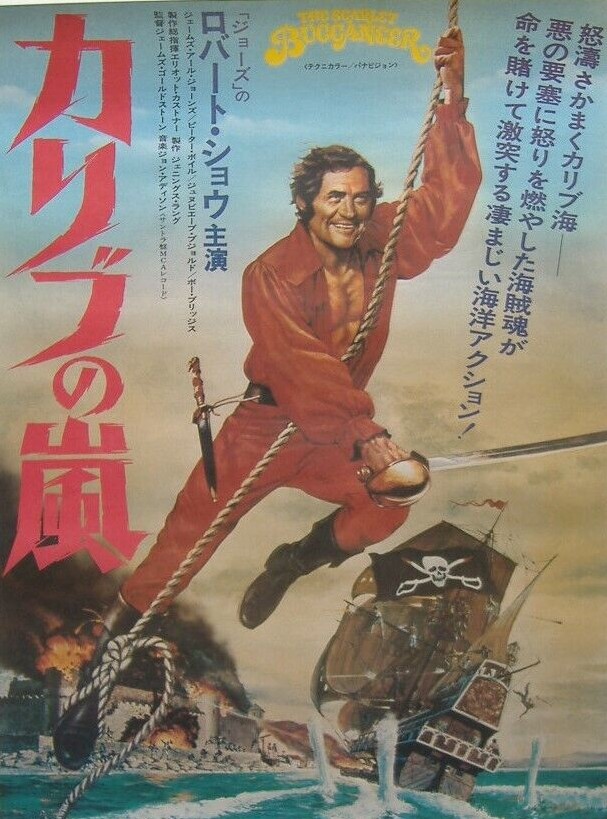
Swashbuckler (1976) **

Red faces all round. Uneasy pirate spoof that misses all its targets, coming close to resembling the kind of movie that gives turkeys a bad name and saved only by a spirited performance by Genevieve Bujold. Uber-producers Jennings Lang (Rollercoaster, 1977) and Elliott Kastner (Where Eagles Dare, 1968) should have known better but were seduced by the tantalizing returns for Richard Donner’s The Three Musketeers (1974) and its sequel which had revived the moribund swashbuckling genre.

Robert Shaw (Custer of the West, 1967) was nailed-on for the leading role since had made his name playing a pirate in British television series The Buccaneers (1956-1957) and was as hot as he was going to get after the double whammy of The Sting (1973) and Jaws (1975). However, the movie takes its cue from one of the chief supporting actors Major Folly (Beau Bridges).

It’s color-coded. In case we can’t tell a good guy from a bad guy, we’ve got the Man in Red, pirate Ned Lynch (Robert Shaw), shaping up against the Man in Black, unscrupulous Jamaican governor Lord Durant (Peter Boyle). Ned is presented as a seagoing Robin Hood, Durant as the wicked Sheriff of Nottingham, his ruthlessness somewhat undermined by his predilection for playing with toy boats in his bath and for getting his hairy back waxed.

Twin narratives quickly unspool. Ned rescues from being hanged shipmate Nick Debrett (James Earl Jones) while Durant jails island chief justice Sir James Barnet (Bernard Behrens) and steals his treasure.

Stolen treasure being fair game, Ned and Nick hijack a coach-load of it, while Sir James’s on-the-run daughter Jane (Genevieve Bujold) ends up in their hands. Not being as black-hearted as his nemesis, Ned puts Jane ashore, but still a bit black-hearted humiliates her in a swordfight, and is disinclined to help her save her imprisoned father.

However, Jane has a trump card. For reasons unknown, Durant is heading back to England with a cargo of 10,000 dubloons, too tempting a target for any pirate. Naturally, nothing goes as planned but, as you might expect, there is a happy ending.

This might have worked, since all the ingredients are there, the laughing cavalier, the spirited woman, the humorous sidekick, the unprincipled villain. You’ve got an historically-accurate pirate ship for once, unlikely romance between high-born woman and charming scallywag, simple rescue-imprisonment-rescue scenario, and ample scope for swordplay.

Except the dialog is awful, the ship too small to accommodate any fighting so the pirates are landlubbers for the most part, and except for the duels between Ned and Jane and Ned and Durant, the swordfights are all kind of bundled together, and every now and then the action stops so we can hear a verse or two of a sea shanty sung by nobody in particular.

Though Ned and Nick trade cringeworthy, and in one case downright offensive, limericks, the best (only) laugh comes when Ned chucks Jane off a roof onto a canopy and follows up with the line “It worked.”  It doesn’t help that Durant’s pederastic tendences are played as a joke. Everywhere you look people are turning cartwheels or are “blithering idiots” or “pawns” and as you might expect there’s a cat-fight and a monkey around to relieve a jailer of his keys. You are just praying for a shark to come along to put the cast out of their misery.

In the midst of this feast of over-acting along comes Genevieve Bujold (Anne of the Thousand Days, 1969) who must think she’s in a different picture. She is a feisty one all right, not above putting a knife to a man’s cojones, or kneeing them in that region, and, given the lawless state of the island, branded a criminal for wounding a rapist.   At least she takes the whole thing seriously rather than as if being in a Mel Brooks picture.

It’s hard to know who to blame: the stars for acting as if enjoying a holiday from more serious fare; director James Goldstone (Winning, 1969) for failing to get the recipe right and employing a jaunty score that undercut everything, or writers Jeffrey Bloom (11 Harrowhouse, 1974) and Paul Wheeler (Caravan to Vaccares, 1974) for making a mess of the ingredients in the first place.

Of course, I am hardly blameless in drawing your attention to this, a sudden enthusiasm for pirate pictures sending me dashing into the wrong decade.

Watch for: Robert Shaw making a bid for the all-time Golden Raspberry; an unrecognizable Peter Boyle (Taxi Driver, 1976); Beau Bridges (Gaily, Gaily, 1969) doing his best Frankie Howerd impression; James Earl Jones (The Comedians, 1967) sounding normal, minus the deep-throated vocal tic on which he made his name; and so many inanities it falls easily into the So Bad It’s Good category.  

The Greatest Movie Never Made

Forty Days at Musa Dagh was a strong contender by the end of the 1960s for The Greatest Movie Never Made. By then an eye-watering one million bucks had been spent without a foot of film being shot.

I came across it while writing my book about “The Making of The Guns of Navarone.” That  film’s producer Carl Foreman was slated in the early 1960s to write what I soon discovered was a legendary lost project. It was subsequently fated to become the most high-profile casualty of MGM’s financial problems at the end of that decade.

Forty Days of Musa Dagh was based on the debut novel written in German by Prague-born poet Franz Werfel (who later wrote The Song of Bernadette filmed in 1942). It concerned the infamous Armenian genocide carried out by the Turks in World War One.

The novel had such advance buzz that news of its imminent publication in Germany in 1933 quickly crossed the Atlantic. After studio representatives read the book in the original German, MGM wunderkind Irving Thalberg bought the rights in 1934, prior to its American publication, for $35,000 (equivalent to $650,000 now).

Thalberg promised “one of the most staggering  production undertakings of all motion picture history.” With Clark Gable and William Powell heading the cast (there would be 63 roles) and director William Wellman (Call of the Wild, 1935) assigned a million-dollar budget, an enormous amount for the time, and with screenwriter Talbot Jennings (Mutiny on the Bounty, 1935) on board, Thalberg was intent on delivering a prestige product. In publicity material, MGM boasted: “What a picture it will make.” 

The novel was a huge success with 170,000 copies sold in hardback even though, priced at $3, it was 50 cents or a dollar more expensive than other bestsellers. It was simultaneously snapped up by the Book of the Month Club and the Catholic Book club and only kept off the top of the bestseller lists by James Hilton’s Lost Horizon.

However, publication was shrouded in controversy. It was banned in Germany shortly after publication. In America, publisher Viking and the author faced a $200,000 libel lawsuit brought by Harutian Nokhudian and the case went to the U.S. Supreme Court in 1936 – where it was dismissed. But that was only the beginning of its troubles.

Thalberg had not counted on opposition from Turkey. Or if such a possibility had been considered, it had been dismissed since that country was not a profitable outlet for Hollywood product. However, Turkey had very strong trading relationships and threatened to instigate a ban on all MGM releases in these European countries as well as the entire Muslim world, an action which if successful would put a huge hole in the studio’s foreign receipts.

For the first time studios “had begun to pay attention to foreign repercussions” after Paramount had been forced to withdraw from Spain and many other markets the final Josef von Sternberg-Marlene Dietrich collaboration The Devil Is A Woman  (1935) when that movie ruffled the feathers of foreign powers. Unwilling to go ahead with a picture that might cost them heavily at the foreign box office, Thalberg shelved the movie (along with two others).

The idea remained dormant for 15 years until revived by independent producer Walter Wanger (Joan of Arc, 1948) who had originally competed with MGM for the rights and had Paramount waiting in the wings to provide backing should the Thalberg deal fall through. But even a seasoned a producer such as Wanger had no more success in placing it on the launch pad and it struggled along in development hell for another decade until, out of the blue, in 1961 MGM hooked writer-director Carl Foreman.

This was a considerable surprise because Foreman had an exclusive and lucrative deal with Columbia (they split profits on his films down the middle) but as he was coming off that studio’s most successful picture of all time The Guns of Navarone (1961) with a high-octane cast of Gregory Peck, David Niven and Anthony Quinn the studio cut him some slack.

Foreman did not come cheap. In addition to his $27,500 fee for writing the script, Foreman was entitled to 2.5 per cent of the gross after MGM had taken in twice the negative cost. After an arduous four-year slog delivering The Guns of Navarone, Foreman described his new venture as “a bit of a rest” which seemed an odd choice of phrase given that MGM was under pressure to greenlight the picture in 1962. 

It was firmly in MGM’s production sights for most of the 1960s. In 1963 it was seen as one of the studio’s biggest upcoming projects along with Doctor Zhivago, the adaptation of James Michener’s Caravans and musical Say It with Music. By the following year it had been allocated a $7.5 million budget – the same as Zhivago – and was on course to be made in Greece in the spring of that year.

By 1965 it landed in the lap of Oscar-nominated British director Guy Green who had nurtured the $1.2 million A Patch of Blue (1965) starring Sidney Poitier into a substantial hit. Although the budget had by now dropped to $5 million it had attracted Omar Sharif, one of four big stars set. There was a new script by Scottish Oscar-winner Neil Paterson (Room at the Top, 1959) and best of all there was a top-flight producer in Pandro S. Berman (Father of the Bride, 1950)  with over two decades experience at MGM. Filming, however, though still in Greece, had been pushed back to 1966.

Although Guy Green appeared to have the most solid lock on the project, other names associated with the movie included producer Carlo Ponti (Doctor Zhivago, 1965) and directors William Wyler (Ben Hur, 1959),  Henri Verneuil  (The 25th Hour, 1967) and Elia Kazan (On the Waterfront, 1954), the last two both born in the former Ottoman Empire now known as Turkey.

It was listed as being on the MGM production schedules for every year till the end of the decade with names like Yul Brynner and Charlton Heston bandied about until it joined a massive bonfire of other expensive projects. By the end of the decade it had racked up over a million dollars in producer and screenwriter fees. According to Variety it was “the most off-again on-again major literary property in the history of American motion picture.”

But it was not alone in being dumped by a studio. Towards the end of the 1960s Hollywood was awash with abandoned projects. The rights to Broadway musical Coco had cost $2.25 million. Fred Zinnemann’s adaptation of Andre Malraux’s Man’s Fate had a $12 million budget before the plug was pulled. A record $600,000 had been spent on acquiring the rights to William Styron bestseller The Confessions of Nat Turner.

Other high-priced acquisitions lumped in production limbo included The Spy Who Came in from the Cold (1965) author John Le Carre’s A Small Town in Germany, Armageddon by Leon Uris of Exodus (1960) fame, Bullet Park by John Cheever who had written The Swimmer (1968), Caravans despite the success of the author’s Hawaii (1966) and The Inheritors by Harold Robbins who had churned out The Carpetbaggers (1964).

Hit plays were no more successful in reaching the starting grid – Arthur Miller’s After the Fall had George Cukor lined up to direct and Faye Dunaway as star and a total of $350,000 had been spent on Tom Stoppard’s  Rosencrantz and Guildenstern Are Dead.  

And there, surely, Forty Days of Musa Dagh should have been laid to rest. Of all these expensive projects, only Caravans would eventually see the light of day. But against all odds, interest in Forty Days of Musa Dagh remained high. Fresh from success with Where Eagles Dare (1968) producing team Elliott Kastner and Jerry Gershwin took a stab at the project, setting their sights on a new script and a 1970 start date. But the duo could not turn the idea into reality. And once again it sank to the bottom of the pile.

Armenian businessman and sometime producer John Kurkjian (The Tears of Happiness, 1974) picked up the rights through his vehicle High Investment and wooed MGM. And in 1976 the project was revived by the studio as a co-production with James B. Harris (Paths of Glory, 1957) overseeing production based on a new script by South African playwright Ronald Harwood (One Day in the Life of Ivan Denisovich, 1970). This was viewed as “the last attempt to revive it” and for a time it appeared as if the project would at last see the light of day. But MGM’s optimism barely lasted the year and, concluding the movie was too rich for its blood, dropped out.

Kurkjian continued to try to interest other studios and was confident. With a new script by Clarke Reynolds (Shalako, 1968), he was convinced he could get the movie off the ground with the backing of the Yugoslavian government were the film to shoot there. United Artists announced the movie would be on its release slate for 1977-1978. But that, too, proved a false dawn.

Redemption came from the most unlikely of sources –  American B-picture production outfit Cannon which had been taken over in 1979 for just $500,000 by Israeli writer-director Menahem Golem and his cousin Yoram Globus. Although this pair specialized in low-budget action pictures such as Death Wish sequels and martial arts efforts like Enter the Ninja (1981), they had artistic pretensions, borne out by The Magician of Lublin (1979) directed by Golan and starring Alan Arkin. That same year, a new version of Forty Days of Musa Dagh took shape, part-funded by High Investment and the West Berlin Senate. Charles Bronson was lined up as star. The budget was set at $10 million.

In the end, there was no Bronson and no $10 million budget, but the movie did get made in 1982 for $4 million by Transcontinental Picture Industries with the less stellar cast of Indian star Kabir Bedi (Sandokan mini-series, 1976), American television actress Ronnie Carol and character actor Guy Stockwell  (Beau Geste, 1966). It was directed by Israeli Sarky Mouradian (Tears of Happiness). It did not reach the United States for another five years. And it was no epic, coming in at a trim 94 minutes. Nor was it a huge box office success. And it’s pretty impossible to find on DVD.

Footnote: The Promise (2016) covered the same ground. Directed by Terry George, it starred Chistian Bale, Oscar Isaac and Charlotte Le Bon. It was funded by Kirk Kerkorian.

SOURCES: “Double Pan for Reich,” Variety, Feb 27, 1934, 58; “Literati: Best Sellers,” Variety, Jan 1, 1935, 58; “Wellman’s Chore,” Variety, Apr 10, 1935, 2; Advertisement, MGM, Variety, Jun 12, 1935, 25-28; “Foreign Rights Bugaboo,” Variety, Nov 27, 1935, 2; “Thalberg’s Eight; Four at $1,000,000,” Variety, Dec 25, 1935, 4; “H’Wood Foreign Jams,” Variety, Mar 25, 1936, 3; “MGM Scraps Witch of Timbuctoo and Musa Dagh,” Variety Mar 25, 1936, 3; “Film Industry Watching Blockade as B.O. Cue on Provocative Themes,” Variety, Jun 22, 1938, 1; “Carl Foreman to Metro on Loan,” Variety, Feb 1, 1961, 3;  “Columbia Waives Rights to Foreman for 40 Days,” Variety, Feb 8, 1961, 59; “Foreman’s Commitment: Doing 40 Days for MGM, Strength for Columbia,” Variety, Jul 5, 1961, 11; “Positive Side of Negatives,” Variety, May 30, 1962, 5; “Berman, 22-Year Man, Stays on MGM Lot,” Variety, Aug 1, 1962, 3; “Upcoming MG Slate May Number 30 Pix,” Variety, Jan 1, 1964, 16; “1965-1967 Will Be Roadshow Years” Variety, Sep 16, 1964, 4; “Pictures: Omar Sharif,” Variety, Dec 9, 1964, 21; “Guy Green Next Helms Musa Dagh,” Variety, Apr 14, 1965, 20; “Musa Dagh Nearer,” Variety, Jul 7, 1965, 9; “MGM Keeps Pledge of 26 Prods,” Variety, Aug 10, 1965, 5; “MGM’s (Hopefully) Final Loan,” Variety, Sep 14, 1966, 3; “3 Ponti Films on Metro O’Seas Slate,” Variety, Apr 19, 1967, 65; “Forty Days (and 34 Years) of Musa Dagh,” Variety, Apr 16, 1969, 19; “Acceptable Script As Invisible Cost Before Production,” Variety, Jul 14, 1971, 3; “Big Investment in Story Values Which Have Not Yet Been Filmed,” Variety, May 9, 1973, 28; “Werfel, After 40 years,” Variety, Jul 28, 1976, 6; “United Artists Looks Ahead; 13 from Metro Inventory,” Variety, Sep 22, 1976, 3; “Shepherd, As MGM Producer, Details Plans, Dropped Films, ” Variety, Dec 15, 1976,3; “Golan-Globus to Film 40 Days of Musa Dagh,” Variety, Feb 14, 1979, 27; “TPI Carves Out Sales Niche,” Variety, Oct 26, 1983, 69; “Film Review,” Variety, Nov 25, 1987, 19; “Cannon Completed Versus Unmade Films,” Variety, Oct 5, 1988, 52.

Discover WordPress

A daily selection of the best content published on WordPress, collected for you by humans who love to read.

The Atavist Magazine

by Brian Hannan

WordPress.com News

The latest news on WordPress.com and the WordPress community.